Mgt 723 Dr. Martina Musteen Group study Airbus A380 Daisy Hsieh, Joe Wu Sandra Wu, Sean Yeh
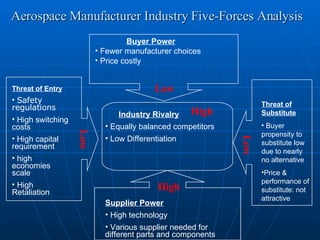
Aerospace Manufacturer Industry Five-Forces Analysis Supplier Power High technology Various supplier needed for different parts and components Buyer Power   Fewer manufacturer choices Price costly  Threat of Substitute Buyer propensity to substitute low due to nearly no alternative Price & performance of substitute: not attractive Industry Rivalry Equally balanced competitors Low Differentiation Low Low High Low High Threat of Entry Safety regulations High switching costs High capital requirement high economies scale High Retaliation
Neutralized Negative Forces Industry Rivalry Product differentiation >> A380 Increase capacity Power of Supplier Long-term strategic alliance with key suppliers Multiple-sources of key component suppliers
Strategic Group – FAA Standards Sources: The Airbus A380 Logistics and financing
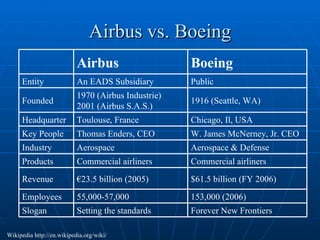
Airbus vs. Boeing Wikipedia http://en.wikipedia.org/wiki/ Forever New Frontiers Setting the standards Slogan 153,000 (2006) 55,000-57,000 Employees $61.5 billion (FY 2006) € 23.5 billion (2005) Revenue Commercial airliners Commercial airliners Products Aerospace & Defense Aerospace Industry W. James McNerney, Jr. CEO Thomas Enders, CEO Key People Chicago, Il, USA Toulouse, France Headquarter 1916 (Seattle, WA) 1970 (Airbus Industrie) 2001 (Airbus S.A.S.) Founded Public An EADS Subsidiary Entity Boeing Airbus
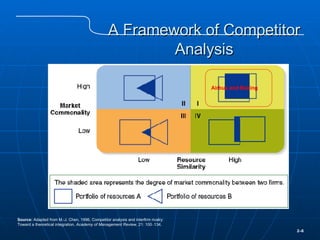
A Framework of Competitor Analysis Source:  Adapted from M.-J. Chen, 1996, Competitor analysis and interfirm rivalry: Toward a theoretical integration,  Academy of Management Review,  21: 100 – 134. 2– Airbus and Boeing
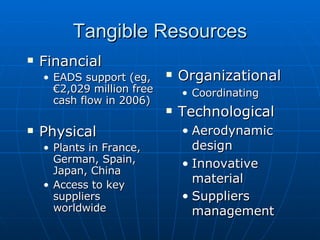
Tangible Resources Financial EADS support (eg,  €2,029 million free cash flow in 2006)  Physical Plants in France, German, Spain, Japan, China Access to key suppliers worldwide Organizational  Coordinating Technological Aerodynamic design Innovative material Suppliers management
Intangible Resources Human Capital 57,000 employees at 16 sites in 4 European countries Close link to the Concorde project  Innovation/Creativity/Learning Innovative material: glass-and carbon-fibre reinforced material Social Capital European base firm is a favor of Europe airliners.
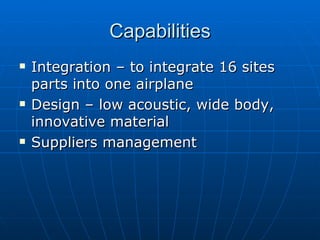
Capabilities Integration – to integrate 16 sites parts into one airplane Design – low acoustic, wide body, innovative material Suppliers management
Value Chain Margin Margin Support Activities Primary Activities Firm Infrastructure Human Resources Management Technology Development: developed at diff sites & integrated Procurement : 75% external procurement, (collaborative supply chain) Operations Manufacturing Assembling Integration Marketing & sales Service: Maintenance Training Inbound Logistics: Use RFID Trigger notification when parts arrived
Supply Chain Management External Collaborative Approach Buyer-Suppliers info sharing 75% external procurement Real time Exception based (late management) Proactive Visibility (notify when arrived) eSupplyChain
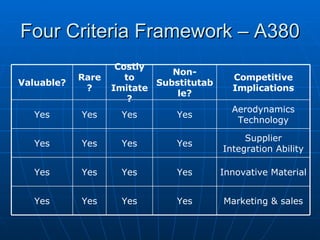
Four Criteria Framework – A380 Innovative Material Yes Yes Yes Yes Valuable? Rare? Costly to Imitate? Non-Substitutable? Competitive Implications Yes Yes Yes Yes Aerodynamics Technology Yes Yes Yes Yes Supplier Integration Ability Yes Yes Yes Yes Marketing & sales
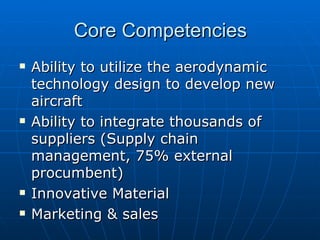
Core Competencies Ability to utilize the aerodynamic technology design to develop new aircraft Ability to integrate thousands of suppliers (Supply chain management, 75% external procumbent) Innovative Material Marketing & sales
Business Level Strategy cost leadership Cost-efficiency, scale efficiency, product improvement  to utilize the technology design  carry more passengers CO2 emission reduction fuel efficiency noise reduction
Corporate Level Strategy Related Diversification Subsidiary of EDAS transferring core competencies
International Strategy
Recommendation A380 is the right  long-term solution for Airbus.
Rationale to Build A380 Increase product range in Group VI arena Resolve Airport Congestion: high capacity aircraft Take Boeing 747 replaced market Utilize Airbus’s core competencies Extend leading technology  gap Global popularity of high  fuel-efficient aircrafts Larger cabin provided  differentiation layout to  operators
Production Capacity Financial Pressure Increase capacity Expedite delivery Issues Solutions
Conclusion Proceed  with  A380
A380 Highlights Wikipedia http://en.wikipedia.org/wiki/Airbus_380 A380 program cost:  US$17 billion A380 unit cost: US $319 million Market demand researched 1991 Boeing canceled similar project 1993 Began developing Very Large Airliner, A3xx 1994 "Large Aircraft Division" formed 1996 Dec. 12, Commercial launch of the A3xxx ( € 8.8 billion) 2000 Airbus consortium was merged 2001 Component-manufacturing starts 2002 First engine delivered 2004 Maiden flight 2005 Certification and delays 2006 Airbus delivers first A380-800 to SIA 2007
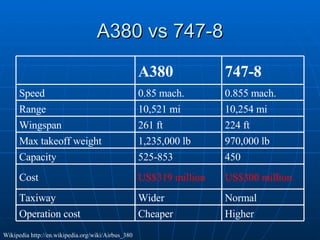
A380 vs 747-8 Wikipedia http://en.wikipedia.org/wiki/Airbus_380 Higher Cheaper Operation cost Normal Wider Taxiway US$300 million US$319 million Cost 450 525-853 Capacity 970,000 lb 1,235,000 lb Max takeoff weight 224 ft 261 ft Wingspan 10,254 mi 10,521 mi Range 0.855 mach. 0.85 mach. Speed 747-8 A380

Airbus

  • 1.
    Mgt 723 Dr.Martina Musteen Group study Airbus A380 Daisy Hsieh, Joe Wu Sandra Wu, Sean Yeh
  • 2.
    Aerospace Manufacturer IndustryFive-Forces Analysis Supplier Power High technology Various supplier needed for different parts and components Buyer Power Fewer manufacturer choices Price costly Threat of Substitute Buyer propensity to substitute low due to nearly no alternative Price & performance of substitute: not attractive Industry Rivalry Equally balanced competitors Low Differentiation Low Low High Low High Threat of Entry Safety regulations High switching costs High capital requirement high economies scale High Retaliation
  • 3.
    Neutralized Negative ForcesIndustry Rivalry Product differentiation >> A380 Increase capacity Power of Supplier Long-term strategic alliance with key suppliers Multiple-sources of key component suppliers
  • 4.
    Strategic Group –FAA Standards Sources: The Airbus A380 Logistics and financing
  • 5.
    Airbus vs. BoeingWikipedia http://en.wikipedia.org/wiki/ Forever New Frontiers Setting the standards Slogan 153,000 (2006) 55,000-57,000 Employees $61.5 billion (FY 2006) € 23.5 billion (2005) Revenue Commercial airliners Commercial airliners Products Aerospace & Defense Aerospace Industry W. James McNerney, Jr. CEO Thomas Enders, CEO Key People Chicago, Il, USA Toulouse, France Headquarter 1916 (Seattle, WA) 1970 (Airbus Industrie) 2001 (Airbus S.A.S.) Founded Public An EADS Subsidiary Entity Boeing Airbus
  • 6.
    A Framework ofCompetitor Analysis Source: Adapted from M.-J. Chen, 1996, Competitor analysis and interfirm rivalry: Toward a theoretical integration, Academy of Management Review, 21: 100 – 134. 2– Airbus and Boeing
  • 7.
    Tangible Resources FinancialEADS support (eg, €2,029 million free cash flow in 2006) Physical Plants in France, German, Spain, Japan, China Access to key suppliers worldwide Organizational Coordinating Technological Aerodynamic design Innovative material Suppliers management
  • 8.
    Intangible Resources HumanCapital 57,000 employees at 16 sites in 4 European countries Close link to the Concorde project Innovation/Creativity/Learning Innovative material: glass-and carbon-fibre reinforced material Social Capital European base firm is a favor of Europe airliners.
  • 9.
    Capabilities Integration –to integrate 16 sites parts into one airplane Design – low acoustic, wide body, innovative material Suppliers management
  • 10.
    Value Chain MarginMargin Support Activities Primary Activities Firm Infrastructure Human Resources Management Technology Development: developed at diff sites & integrated Procurement : 75% external procurement, (collaborative supply chain) Operations Manufacturing Assembling Integration Marketing & sales Service: Maintenance Training Inbound Logistics: Use RFID Trigger notification when parts arrived
  • 11.
    Supply Chain ManagementExternal Collaborative Approach Buyer-Suppliers info sharing 75% external procurement Real time Exception based (late management) Proactive Visibility (notify when arrived) eSupplyChain
  • 12.
    Four Criteria Framework– A380 Innovative Material Yes Yes Yes Yes Valuable? Rare? Costly to Imitate? Non-Substitutable? Competitive Implications Yes Yes Yes Yes Aerodynamics Technology Yes Yes Yes Yes Supplier Integration Ability Yes Yes Yes Yes Marketing & sales
  • 13.
    Core Competencies Abilityto utilize the aerodynamic technology design to develop new aircraft Ability to integrate thousands of suppliers (Supply chain management, 75% external procumbent) Innovative Material Marketing & sales
  • 14.
    Business Level Strategycost leadership Cost-efficiency, scale efficiency, product improvement to utilize the technology design carry more passengers CO2 emission reduction fuel efficiency noise reduction
  • 15.
    Corporate Level StrategyRelated Diversification Subsidiary of EDAS transferring core competencies
  • 16.
  • 17.
    Recommendation A380 isthe right long-term solution for Airbus.
  • 18.
    Rationale to BuildA380 Increase product range in Group VI arena Resolve Airport Congestion: high capacity aircraft Take Boeing 747 replaced market Utilize Airbus’s core competencies Extend leading technology gap Global popularity of high fuel-efficient aircrafts Larger cabin provided differentiation layout to operators
  • 19.
    Production Capacity FinancialPressure Increase capacity Expedite delivery Issues Solutions
  • 20.
  • 21.
    A380 Highlights Wikipediahttp://en.wikipedia.org/wiki/Airbus_380 A380 program cost: US$17 billion A380 unit cost: US $319 million Market demand researched 1991 Boeing canceled similar project 1993 Began developing Very Large Airliner, A3xx 1994 "Large Aircraft Division" formed 1996 Dec. 12, Commercial launch of the A3xxx ( € 8.8 billion) 2000 Airbus consortium was merged 2001 Component-manufacturing starts 2002 First engine delivered 2004 Maiden flight 2005 Certification and delays 2006 Airbus delivers first A380-800 to SIA 2007
  • 22.
    A380 vs 747-8Wikipedia http://en.wikipedia.org/wiki/Airbus_380 Higher Cheaper Operation cost Normal Wider Taxiway US$300 million US$319 million Cost 450 525-853 Capacity 970,000 lb 1,235,000 lb Max takeoff weight 224 ft 261 ft Wingspan 10,254 mi 10,521 mi Range 0.855 mach. 0.85 mach. Speed 747-8 A380