Porter’s Competitive
Strategies:
Q1: Refer to Michael Porter’s basic competitive positioning strategies (low
cost, differentiation, focus). Which of these strategies does each of the
companies use: FedEx, UPS and Airborne Express?
 Airborne’s Strategy:
 They targeted business customers who regularly shipped large quantities of item that
were urgent e.g. Xerox
 They never used public advertisements and focused only on large shipping companies
 The sales force was given more freedom to negotiate volume discounts
 The company positioned themselves as a low-price service since their prices were very
low
 They owned airports, which served as their major hubs, to reduce operational costs
 Didn’t spend much on websites
These statements show that Airborne Express is using the low-cost form of competitive
positioning strategy.
 FedEx’s Strategy:
 Widely known for its persistence
 Virtually invented express mail service
 Used distinctive mottoes while advertising to create hype
 They used this headline in the early days: “We have trains, planes and
automobiles” which meant they could ship anything whether large or small
 Awarded employees (with a “Bravo Zulu”) based on performance
 Constantly focused on improvement of quality
 Invested millions on training programs for employees
This shows that FedEx used the differentiation form of competitive positioning
strategy.
UPS’s Strategy:
 Delivery arm of major departmental stores
 Launched “common-carrier” service in 1922
 Maintained efficiency by instructing drivers
 Charged a single price from all customers
 Main focus was on customer service (picked up 3 times as many parcels as FedEx)
 Spent around 80% on media
 Allocated up to 15% of tax profits to buy stocks
 Invested in a globally distribution system
These statements show that UPS is using the focus form of competitive positioning
strategy.
Customer Segments:
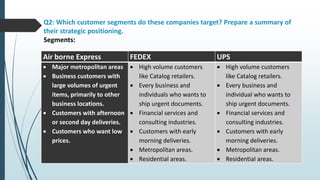
Q2: Which customer segments do these companies target? Prepare a summary of
their strategic positioning.
Segments:
Air borne Express FEDEX UPS
 Major metropolitan areas
 Business customers with
large volumes of urgent
items, primarily to other
business locations.
 Customers with afternoon
or second day deliveries.
 Customers who want low
prices.
 High volume customers
like Catalog retailers.
 Every business and
individuals who wants to
ship urgent documents.
 Financial services and
consulting industries.
 Customers with early
morning deliveries.
 Metropolitan areas.
 Residential areas.
 High volume customers
like Catalog retailers.
 Every business and
individual who wants to
ship urgent documents.
 Financial services and
consulting industries.
 Customers with early
morning deliveries.
 Metropolitan areas.
 Residential areas.
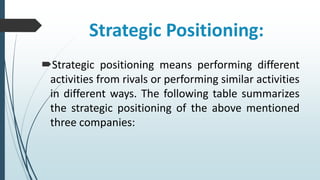
Strategic Positioning:
Strategic positioning means performing different
activities from rivals or performing similar activities
in different ways. The following table summarizes
the strategic positioning of the above mentioned
three companies:
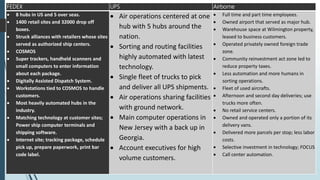
FEDEX UPS Airborne
 8 hubs in US and 5 over seas.
 1400 retail sites and 32000 drop off
boxes.
 Struck alliances with retailers whose sites
served as authorized ship centers.
 COSMOS
 Super trackers, handheld scanners and
small computers to enter information
about each package.
 Digitally Assisted Dispatch System.
 Workstations tied to COSMOS to handle
customers.
 Most heavily automated hubs in the
industry.
 Matching technology at customer sites;
Power ship computer terminals and
shipping software.
 Internet site; tracking package, schedule
pick up, prepare paperwork, print bar
code label.
 Air operations centered at one
hub with 5 hubs around the
nation.
 Sorting and routing facilities
highly automated with latest
technology.
 Single fleet of trucks to pick
and deliver all UPS shipments.
 Air operations sharing facilities
with ground network.
 Main computer operations in
New Jersey with a back up in
Georgia.
 Account executives for high
volume customers.
 Full time and part time employees.
 Owned airport that served as major hub.
 Warehouse space at Wilmington property,
leased to business customers.
 Operated privately owned foreign trade
zone.
 Community reinvestment act zone led to
reduce property taxes.
 Less automation and more humans in
sorting operations.
 Fleet of used aircrafts.
 Afternoon and second day deliveries; use
trucks more often.
 No retail service centers.
 Owned and operated only a portion of its
delivery vans.
 Delivered more parcels per stop; less labor
costs.
 Selective investment in technology; FOCUS
 Call center automation.
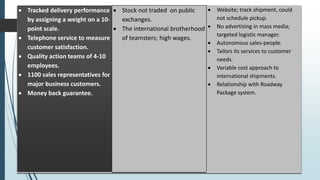
 Tracked delivery performance
by assigning a weight on a 10-
point scale.
 Telephone service to measure
customer satisfaction.
 Quality action teams of 4-10
employees.
 1100 sales representatives for
major business customers.
 Money back guarantee.
 Stock not traded on public
exchanges.
 The international brotherhood
of teamsters; high wages.
 Website; track shipment, could
not schedule pickup.
 No advertising in mass media;
targeted logistic manager.
 Autonomous sales-people.
 Tailors its services to customer
needs.
 Variable cost approach to
international shipments.
 Relationship with Roadway
Package system.
Structure of Mail Industry:
Q3: Is the U.S. express mail industry structurally attractive?
To look whether the US express mail industry is structurally attractive or not, we are basically evaluating
Porter’s five competitive forces:
 Threat of New Entrants is low because:
 There are a lot of barriers for the new comers.
 A vast initial investment is required including plane fleet, trucks fleet, funds for marketing the
company, and setting new hubs and spokes and a lot of airline regulations to meet.
 So the start-up costs will be very high.
 These factors provide advantage to the existing companies to sustain in the market and make it
difficult for the new entrants to enter the market. Hence, the threat of new entrants is low for US
express mail industry.
 However, big companies from other continents, with massive capital, can enter the market but still it
will be problematic because they won’t be much aware of the market conditions and needs of the
people of this area and the niche.
 Bargaining power of Buyers is high because:
 Lack of differentiating unique products
 There are customers such as Xerox, IBM etc. that require high volumes of
products/packages that needs to be transported and delivered
 Majority of express mail users are corporate users that demand substantial discounts
 As prices are almost identical so they can shift to other companies that are offering
low prices
 Thus, we can say that there is no brand loyalty
 Moreover, customers are well informed about the market
 Bargaining power of Suppliers is high because:
 In the given case the particular suppliers include airports/airfields, truck and vehicle
maintenance, aircraft maintenance, fuel suppliers and worker unions
 These factors have strong influence on the companies in most of the cases
 Moreover the products that we require are not ordinary rather they are specialized to
some extent
 Similarly substitutes are not easily available in the market
 Threats of Substitutes is moderate because:
 There is no direct substitute for parcel/ package delivery as new
technologies can only substitute the letter part of the express mail.
 Rivalry among existing Competitors is between moderate and high since:
 It is easy for the customers to switch to the competitors as there is a
homogeneous product
 Moreover, the exiting cost is very high so the companies will try to fight and
remain in the market even if the market is not profitable.
 Furthermore, as the fixed costs are very high, the companies will try to
cover up these high costs.
 As the products are not vastly differentiating, the companies can compete
on prices thereby increasing rivalry.
 Also, FedEx and UPS have also gone to a price war once.
Conclusion:
In the given case of express mail industry, bargaining power of
buyers as well suppliers is very high. Similarly, threats of new
entrants are very low. Threats of substitutes are moderate. Rivalry
among the existing competitors is moderate to high. So after
observing all these Porter’s five forces, we have come to the
conclusion that U.S express mail industry is structurally more
unattractive rather than attractive.
Distinctive Capabilities:
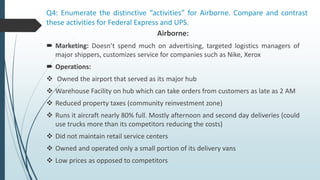
Q4: Enumerate the distinctive “activities” for Airborne. Compare and contrast
these activities for Federal Express and UPS.
Airborne:
 Marketing: Doesn’t spend much on advertising, targeted logistics managers of
major shippers, customizes service for companies such as Nike, Xerox
 Operations:
 Owned the airport that served as its major hub
 Warehouse Facility on hub which can take orders from customers as late as 2 AM
 Reduced property taxes (community reinvestment zone)
 Runs it aircraft nearly 80% full. Mostly afternoon and second day deliveries (could
use trucks more than its competitors reducing the costs)
 Did not maintain retail service centers
 Owned and operated only a small portion of its delivery vans
 Low prices as opposed to competitors
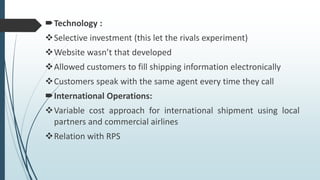
Technology :
Selective investment (this let the rivals experiment)
Website wasn’t that developed
Allowed customers to fill shipping information electronically
Customers speak with the same agent every time they call
International Operations:
Variable cost approach for international shipment using local
partners and commercial airlines
Relation with RPS
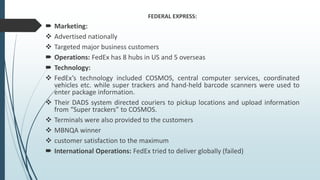
FEDERAL EXPRESS:
 Marketing:
 Advertised nationally
 Targeted major business customers
 Operations: FedEx has 8 hubs in US and 5 overseas
 Technology:
 FedEx’s technology included COSMOS, central computer services, coordinated
vehicles etc. while super trackers and hand-held barcode scanners were used to
enter package information.
 Their DADS system directed couriers to pickup locations and upload information
from “Super trackers” to COSMOS.
 Terminals were also provided to the customers
 MBNQA winner
 customer satisfaction to the maximum
 International Operations: FedEx tried to deliver globally (failed)
UPS:
Marketing:
USP has no or very little advertising till 1996.
The advertisements done later targeted high-volume
customers.
Operations: USP has air operations centered at one hub with 5
other regional hubs.
Technology: UPS developed website similar to FedEx
International Operations: USP also invested in globally
distribution (failed)
Strengths, Threats and
Opportunities:
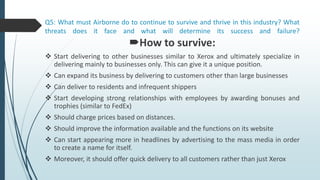
Q5: What must Airborne do to continue to survive and thrive in this industry? What
threats does it face and what will determine its success and failure?
How to survive:
 Start delivering to other businesses similar to Xerox and ultimately specialize in
delivering mainly to businesses only. This can give it a unique position.
 Can expand its business by delivering to customers other than large businesses
 Can deliver to residents and infrequent shippers
 Start developing strong relationships with employees by awarding bonuses and
trophies (similar to FedEx)
 Should charge prices based on distances.
 Should improve the information available and the functions on its website
 Can start appearing more in headlines by advertising to the mass media in order
to create a name for itself.
 Moreover, it should offer quick delivery to all customers rather than just Xerox
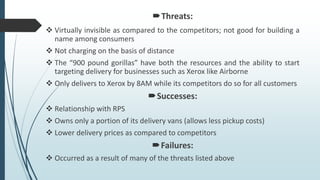
Threats:
 Virtually invisible as compared to the competitors; not good for building a
name among consumers
 Not charging on the basis of distance
 The “900 pound gorillas” have both the resources and the ability to start
targeting delivery for businesses such as Xerox like Airborne
 Only delivers to Xerox by 8AM while its competitors do so for all customers
Successes:
 Relationship with RPS
 Owns only a portion of its delivery vans (allows less pickup costs)
 Lower delivery prices as compared to competitors
Failures:
 Occurred as a result of many of the threats listed above

Airborne presentation

  • 1.
  • 2.
    Q1: Refer toMichael Porter’s basic competitive positioning strategies (low cost, differentiation, focus). Which of these strategies does each of the companies use: FedEx, UPS and Airborne Express?  Airborne’s Strategy:  They targeted business customers who regularly shipped large quantities of item that were urgent e.g. Xerox  They never used public advertisements and focused only on large shipping companies  The sales force was given more freedom to negotiate volume discounts  The company positioned themselves as a low-price service since their prices were very low  They owned airports, which served as their major hubs, to reduce operational costs  Didn’t spend much on websites These statements show that Airborne Express is using the low-cost form of competitive positioning strategy.
  • 3.
     FedEx’s Strategy: Widely known for its persistence  Virtually invented express mail service  Used distinctive mottoes while advertising to create hype  They used this headline in the early days: “We have trains, planes and automobiles” which meant they could ship anything whether large or small  Awarded employees (with a “Bravo Zulu”) based on performance  Constantly focused on improvement of quality  Invested millions on training programs for employees This shows that FedEx used the differentiation form of competitive positioning strategy.
  • 4.
    UPS’s Strategy:  Deliveryarm of major departmental stores  Launched “common-carrier” service in 1922  Maintained efficiency by instructing drivers  Charged a single price from all customers  Main focus was on customer service (picked up 3 times as many parcels as FedEx)  Spent around 80% on media  Allocated up to 15% of tax profits to buy stocks  Invested in a globally distribution system These statements show that UPS is using the focus form of competitive positioning strategy.
  • 5.
  • 6.
    Q2: Which customersegments do these companies target? Prepare a summary of their strategic positioning. Segments: Air borne Express FEDEX UPS  Major metropolitan areas  Business customers with large volumes of urgent items, primarily to other business locations.  Customers with afternoon or second day deliveries.  Customers who want low prices.  High volume customers like Catalog retailers.  Every business and individuals who wants to ship urgent documents.  Financial services and consulting industries.  Customers with early morning deliveries.  Metropolitan areas.  Residential areas.  High volume customers like Catalog retailers.  Every business and individual who wants to ship urgent documents.  Financial services and consulting industries.  Customers with early morning deliveries.  Metropolitan areas.  Residential areas.
  • 7.
    Strategic Positioning: Strategic positioningmeans performing different activities from rivals or performing similar activities in different ways. The following table summarizes the strategic positioning of the above mentioned three companies:
  • 8.
    FEDEX UPS Airborne 8 hubs in US and 5 over seas.  1400 retail sites and 32000 drop off boxes.  Struck alliances with retailers whose sites served as authorized ship centers.  COSMOS  Super trackers, handheld scanners and small computers to enter information about each package.  Digitally Assisted Dispatch System.  Workstations tied to COSMOS to handle customers.  Most heavily automated hubs in the industry.  Matching technology at customer sites; Power ship computer terminals and shipping software.  Internet site; tracking package, schedule pick up, prepare paperwork, print bar code label.  Air operations centered at one hub with 5 hubs around the nation.  Sorting and routing facilities highly automated with latest technology.  Single fleet of trucks to pick and deliver all UPS shipments.  Air operations sharing facilities with ground network.  Main computer operations in New Jersey with a back up in Georgia.  Account executives for high volume customers.  Full time and part time employees.  Owned airport that served as major hub.  Warehouse space at Wilmington property, leased to business customers.  Operated privately owned foreign trade zone.  Community reinvestment act zone led to reduce property taxes.  Less automation and more humans in sorting operations.  Fleet of used aircrafts.  Afternoon and second day deliveries; use trucks more often.  No retail service centers.  Owned and operated only a portion of its delivery vans.  Delivered more parcels per stop; less labor costs.  Selective investment in technology; FOCUS  Call center automation.
  • 9.
     Tracked deliveryperformance by assigning a weight on a 10- point scale.  Telephone service to measure customer satisfaction.  Quality action teams of 4-10 employees.  1100 sales representatives for major business customers.  Money back guarantee.  Stock not traded on public exchanges.  The international brotherhood of teamsters; high wages.  Website; track shipment, could not schedule pickup.  No advertising in mass media; targeted logistic manager.  Autonomous sales-people.  Tailors its services to customer needs.  Variable cost approach to international shipments.  Relationship with Roadway Package system.
  • 10.
  • 11.
    Q3: Is theU.S. express mail industry structurally attractive? To look whether the US express mail industry is structurally attractive or not, we are basically evaluating Porter’s five competitive forces:  Threat of New Entrants is low because:  There are a lot of barriers for the new comers.  A vast initial investment is required including plane fleet, trucks fleet, funds for marketing the company, and setting new hubs and spokes and a lot of airline regulations to meet.  So the start-up costs will be very high.  These factors provide advantage to the existing companies to sustain in the market and make it difficult for the new entrants to enter the market. Hence, the threat of new entrants is low for US express mail industry.  However, big companies from other continents, with massive capital, can enter the market but still it will be problematic because they won’t be much aware of the market conditions and needs of the people of this area and the niche.
  • 12.
     Bargaining powerof Buyers is high because:  Lack of differentiating unique products  There are customers such as Xerox, IBM etc. that require high volumes of products/packages that needs to be transported and delivered  Majority of express mail users are corporate users that demand substantial discounts  As prices are almost identical so they can shift to other companies that are offering low prices  Thus, we can say that there is no brand loyalty  Moreover, customers are well informed about the market  Bargaining power of Suppliers is high because:  In the given case the particular suppliers include airports/airfields, truck and vehicle maintenance, aircraft maintenance, fuel suppliers and worker unions  These factors have strong influence on the companies in most of the cases  Moreover the products that we require are not ordinary rather they are specialized to some extent  Similarly substitutes are not easily available in the market
  • 13.
     Threats ofSubstitutes is moderate because:  There is no direct substitute for parcel/ package delivery as new technologies can only substitute the letter part of the express mail.  Rivalry among existing Competitors is between moderate and high since:  It is easy for the customers to switch to the competitors as there is a homogeneous product  Moreover, the exiting cost is very high so the companies will try to fight and remain in the market even if the market is not profitable.  Furthermore, as the fixed costs are very high, the companies will try to cover up these high costs.  As the products are not vastly differentiating, the companies can compete on prices thereby increasing rivalry.  Also, FedEx and UPS have also gone to a price war once.
  • 14.
    Conclusion: In the givencase of express mail industry, bargaining power of buyers as well suppliers is very high. Similarly, threats of new entrants are very low. Threats of substitutes are moderate. Rivalry among the existing competitors is moderate to high. So after observing all these Porter’s five forces, we have come to the conclusion that U.S express mail industry is structurally more unattractive rather than attractive.
  • 15.
  • 16.
    Q4: Enumerate thedistinctive “activities” for Airborne. Compare and contrast these activities for Federal Express and UPS. Airborne:  Marketing: Doesn’t spend much on advertising, targeted logistics managers of major shippers, customizes service for companies such as Nike, Xerox  Operations:  Owned the airport that served as its major hub  Warehouse Facility on hub which can take orders from customers as late as 2 AM  Reduced property taxes (community reinvestment zone)  Runs it aircraft nearly 80% full. Mostly afternoon and second day deliveries (could use trucks more than its competitors reducing the costs)  Did not maintain retail service centers  Owned and operated only a small portion of its delivery vans  Low prices as opposed to competitors
  • 17.
    Technology : Selective investment(this let the rivals experiment) Website wasn’t that developed Allowed customers to fill shipping information electronically Customers speak with the same agent every time they call International Operations: Variable cost approach for international shipment using local partners and commercial airlines Relation with RPS
  • 18.
    FEDERAL EXPRESS:  Marketing: Advertised nationally  Targeted major business customers  Operations: FedEx has 8 hubs in US and 5 overseas  Technology:  FedEx’s technology included COSMOS, central computer services, coordinated vehicles etc. while super trackers and hand-held barcode scanners were used to enter package information.  Their DADS system directed couriers to pickup locations and upload information from “Super trackers” to COSMOS.  Terminals were also provided to the customers  MBNQA winner  customer satisfaction to the maximum  International Operations: FedEx tried to deliver globally (failed)
  • 19.
    UPS: Marketing: USP has noor very little advertising till 1996. The advertisements done later targeted high-volume customers. Operations: USP has air operations centered at one hub with 5 other regional hubs. Technology: UPS developed website similar to FedEx International Operations: USP also invested in globally distribution (failed)
  • 20.
  • 21.
    Q5: What mustAirborne do to continue to survive and thrive in this industry? What threats does it face and what will determine its success and failure? How to survive:  Start delivering to other businesses similar to Xerox and ultimately specialize in delivering mainly to businesses only. This can give it a unique position.  Can expand its business by delivering to customers other than large businesses  Can deliver to residents and infrequent shippers  Start developing strong relationships with employees by awarding bonuses and trophies (similar to FedEx)  Should charge prices based on distances.  Should improve the information available and the functions on its website  Can start appearing more in headlines by advertising to the mass media in order to create a name for itself.  Moreover, it should offer quick delivery to all customers rather than just Xerox
  • 22.
    Threats:  Virtually invisibleas compared to the competitors; not good for building a name among consumers  Not charging on the basis of distance  The “900 pound gorillas” have both the resources and the ability to start targeting delivery for businesses such as Xerox like Airborne  Only delivers to Xerox by 8AM while its competitors do so for all customers Successes:  Relationship with RPS  Owns only a portion of its delivery vans (allows less pickup costs)  Lower delivery prices as compared to competitors Failures:  Occurred as a result of many of the threats listed above