A cyclist’s perspective

                                         John Cherrie and Karen Galea
                                                      John.Cherrie@iom-world.org

                                          With help from Melanie Gorman Ng and
                                                        Araceli Sanchez Jimenez
                                              SEPA LAQM 26 March 2013


INSTITUTE OF OCCUPATIONAL MEDICINE . Edinburgh . UK                    www.iom-world.org
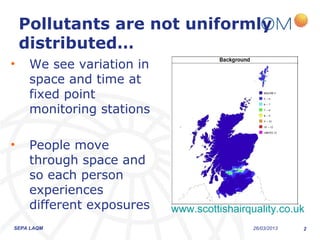
Pollutants are not uniformly
    distributed…
•    We see variation in
     space and time at
     fixed point
     monitoring stations

•    People move
     through space and
     so each person
     experiences
     different exposures   www.scottishairquality.co.uk
SEPA LAQM                                   26/03/2013   2
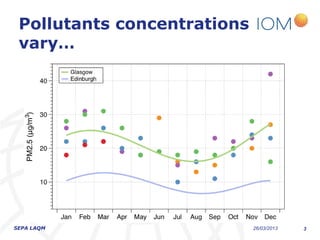
Pollutants concentrations
 vary…


SEPA LAQM                    26/03/2013   3
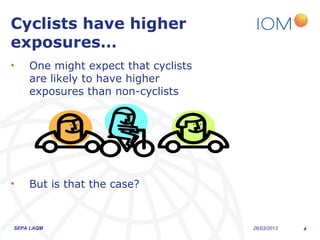
Cyclists have higher
exposures…
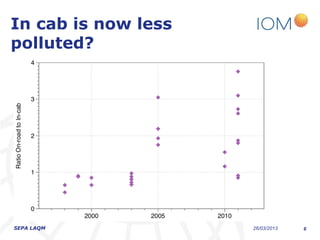
•   One might expect that cyclists
    are likely to have higher
    exposures than non-cyclists


•   But is that the case?


SEPA LAQM                            26/03/2013   4
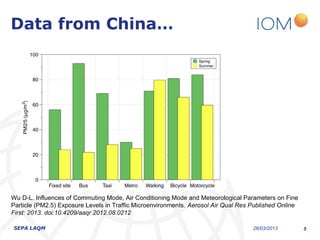
Data from China…


Wu D-L. Influences of Commuting Mode, Air Conditioning Mode and Meteorological Parameters on Fine
Particle (PM2.5) Exposure Levels in Traffic Microenvironments. Aerosol Air Qual Res Published Online
First: 2013. doi:10.4209/aaqr.2012.08.0212

SEPA LAQM                                                                           26/03/2013         5
In cab is now less
polluted?


SEPA LAQM            26/03/2013   6
Children may have higher
exposure…
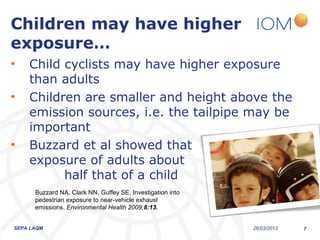
•   Child cyclists may have higher exposure
    than adults
•   Children are smaller and height above the
    emission sources, i.e. the tailpipe may be
    important
•   Buzzard et al showed that
    exposure of adults about
          half that of a child
      Buzzard NA, Clark NN, Guffey SE. Investigation into
      pedestrian exposure to near-vehicle exhaust
      emissions. Environmental Health 2009;8:13.


SEPA LAQM                                                   26/03/2013   7
Sensors…
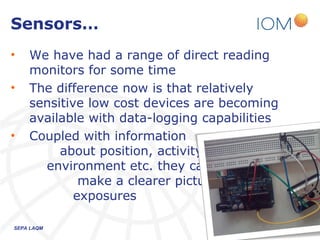
•   We have had a range of direct reading
    monitors for some time
•   The difference now is that relatively
    sensitive low cost devices are becoming
    available with data-logging capabilities
•   Coupled with information
         about position, activity,
      environment etc. they can
             make a clearer picture of
            exposures

SEPA LAQM                              26/03/2013   8
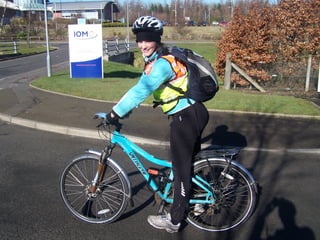
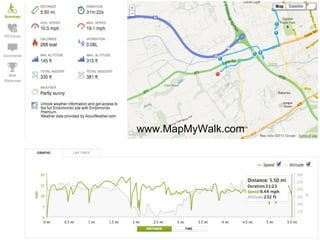
Demonstration from a
cycling journey


SEPA LAQM              26/03/2013   9
MapMyWalk.com


            www.MapMyWalk.com


SEPA LAQM                       26/03/2013   10
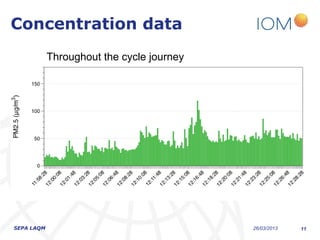
Concentration data
            Throughout the cycle journey


SEPA LAQM                                  26/03/2013   11
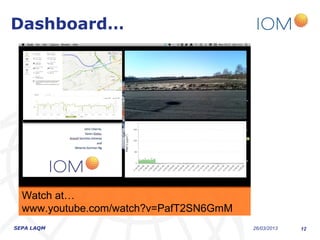
Dashboard…


  Watch at…
  www.youtube.com/watch?v=PafT2SN6GmM
SEPA LAQM                               26/03/2013   12
Some key observations

•   Concentration response lagged in relation to
    sources
•   Response also smoothed to some extent
•   The move from the quiet campus
           to the roads associated with
                   a rise in concentration
•   Peaks when traffic heavy
•   Level seems to rise during
          the test

SEPA LAQM                              26/03/2013   13
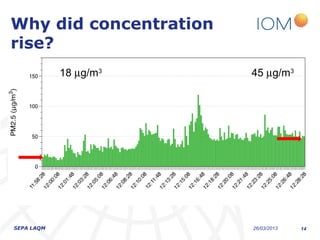
Why did concentration
rise?
            18 µg/m3    45 µg/m3


SEPA LAQM               26/03/2013   14
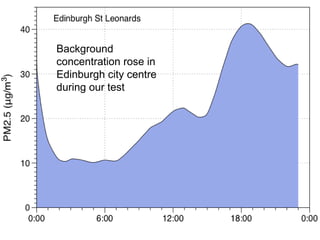
Why did concentration
seemBackground
     to rise?
            concentration rose in
            Edinburgh city centre
            during our test


SEPA LAQM                           26/03/2013   15
Conclusions and
discussion…
•   Low-cost sensors offer new possibilities to
    investigate exposure to air pollutants
•   Video can provide context but is difficult
    to interpret in a large-scale study
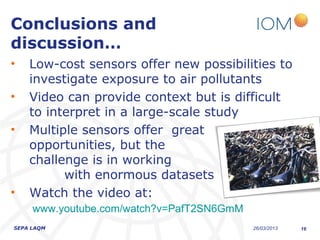
•   Multiple sensors offer great
    opportunities, but the
    challenge is in working
          with enormous datasets
•   Watch the video at:
     www.youtube.com/watch?v=PafT2SN6GmM
SEPA LAQM                                  26/03/2013   16

Air quality while cycling in Edinburgh

  • 1.
    A cyclist’s perspective John Cherrie and Karen Galea John.Cherrie@iom-world.org With help from Melanie Gorman Ng and Araceli Sanchez Jimenez SEPA LAQM 26 March 2013 INSTITUTE OF OCCUPATIONAL MEDICINE . Edinburgh . UK www.iom-world.org
  • 2.
    Pollutants are notuniformly distributed… • We see variation in space and time at fixed point monitoring stations • People move through space and so each person experiences different exposures www.scottishairquality.co.uk SEPA LAQM 26/03/2013 2
  • 3.
  • 4.
    Cyclists have higher exposures… • One might expect that cyclists are likely to have higher exposures than non-cyclists • But is that the case? SEPA LAQM 26/03/2013 4
  • 5.
    Data from China… WuD-L. Influences of Commuting Mode, Air Conditioning Mode and Meteorological Parameters on Fine Particle (PM2.5) Exposure Levels in Traffic Microenvironments. Aerosol Air Qual Res Published Online First: 2013. doi:10.4209/aaqr.2012.08.0212 SEPA LAQM 26/03/2013 5
  • 6.
    In cab isnow less polluted? SEPA LAQM 26/03/2013 6
  • 7.
    Children may havehigher exposure… • Child cyclists may have higher exposure than adults • Children are smaller and height above the emission sources, i.e. the tailpipe may be important • Buzzard et al showed that exposure of adults about half that of a child Buzzard NA, Clark NN, Guffey SE. Investigation into pedestrian exposure to near-vehicle exhaust emissions. Environmental Health 2009;8:13. SEPA LAQM 26/03/2013 7
  • 8.
    Sensors… • We have had a range of direct reading monitors for some time • The difference now is that relatively sensitive low cost devices are becoming available with data-logging capabilities • Coupled with information about position, activity, environment etc. they can make a clearer picture of exposures SEPA LAQM 26/03/2013 8
  • 9.
    Demonstration from a cyclingjourney SEPA LAQM 26/03/2013 9
  • 10.
    MapMyWalk.com www.MapMyWalk.com SEPA LAQM 26/03/2013 10
  • 11.
    Concentration data Throughout the cycle journey SEPA LAQM 26/03/2013 11
  • 12.
    Dashboard… Watchat… www.youtube.com/watch?v=PafT2SN6GmM SEPA LAQM 26/03/2013 12
  • 13.
    Some key observations • Concentration response lagged in relation to sources • Response also smoothed to some extent • The move from the quiet campus to the roads associated with a rise in concentration • Peaks when traffic heavy • Level seems to rise during the test SEPA LAQM 26/03/2013 13
  • 14.
    Why did concentration rise? 18 µg/m3 45 µg/m3 SEPA LAQM 26/03/2013 14
  • 15.
    Why did concentration seemBackground to rise? concentration rose in Edinburgh city centre during our test SEPA LAQM 26/03/2013 15
  • 16.
    Conclusions and discussion… • Low-cost sensors offer new possibilities to investigate exposure to air pollutants • Video can provide context but is difficult to interpret in a large-scale study • Multiple sensors offer great opportunities, but the challenge is in working with enormous datasets • Watch the video at: www.youtube.com/watch?v=PafT2SN6GmM SEPA LAQM 26/03/2013 16