The Advanced REACH ToolJohn Cherrie
Summary…BackgroundThe concept of ARTThe mechanistic model toolDispersion, an example of the work to underpin the modelBayesian updatingModel output
Background…ART is a generic higher tier toolIncluded in the REACH GuidanceApplicable for exposure to dust, vapour, mist, and fumesCo-development project funded by:Shell, GSK, Eurometaux, CeficHSE, Dutch government, AfssetBOHSDelivered by:TNO, IOM, HSL, BAuA, UU and NRCWE
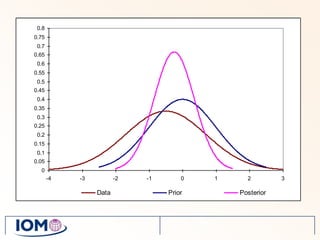
The conceptual basis…Based on the premise that both models and measurement data can be informative about exposureSet within a Bayesian framework
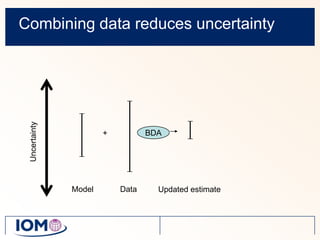
Combining data reduces uncertainty+BDAUncertaintyModel            Data  Updated estimate
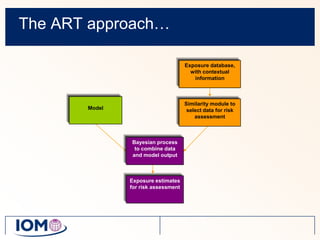
The ART approach…Exposure database, with contextual informationModel Similarity module to select data for risk assessmentBayesian process to combine data and model outputExposure estimates for risk assessment
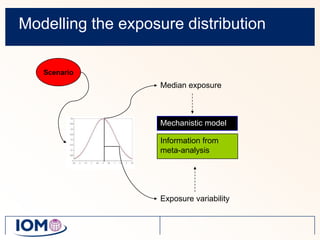
Modelling the exposure distributionScenarioMedian exposureMechanistic modelInformation from meta-analysisExposure variability
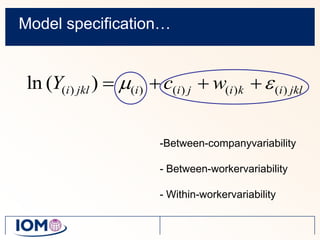
Model specification…Between-companyvariability- Between-workervariability- Within-workervariability
Underpinning the mechanistic model…The early work by Cherrie, Schneider et alDeveloped a model for use in epidemiological studiesMultiplicative deterministic modelNear-field/Far-fieldRelied on the assessor to choose the parametersValidated in a number of different situationsDispersion parameters derived from a 2-box modelCherrie and Schneider. (1999) Validation of a new method for structured subjective assessment of past concentrations. The Annals of Occupational Hygiene;43 (4):235-245.Cherrie. (1999) The effect of room size and general ventilation on the relationship between near and far-field concentrations. Applied occupational and environmental hygiene; 14 (8): 539-46.
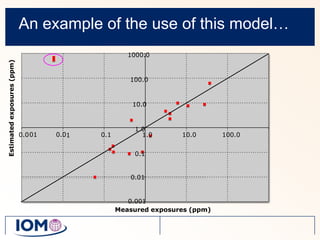
An example of the use of this model…1000.0100.010.0Estimated exposures (ppm)1.00.0010.00.11.010.0100.010.10.010.001Measured exposures (ppm)
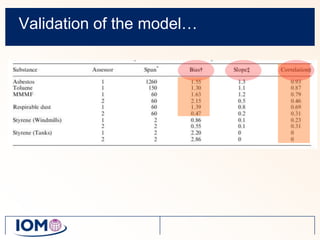
Validation of the model…
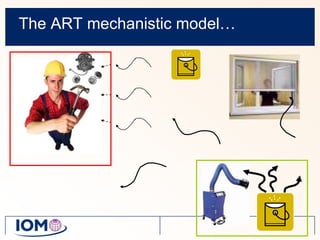
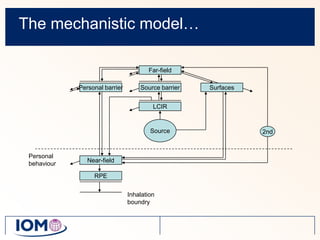
The ART mechanistic model…
The mechanistic model…Far-fieldSource barrierPersonal barrierSurfacesLCIRSource2ndPersonal behaviourNear-fieldRPEInhalation boundry
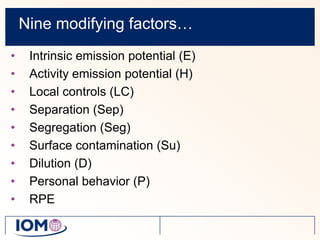
Nine modifying factors…Intrinsic emission potential (E)Activity emission potential (H)Local controls (LC)Separation (Sep) Segregation (Seg)Surface contamination (Su)Dilution (D)Personal behavior (P)RPE
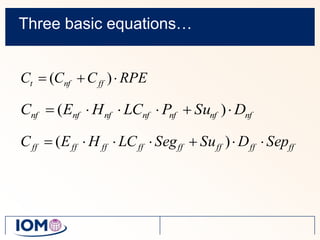
Three basic equations…
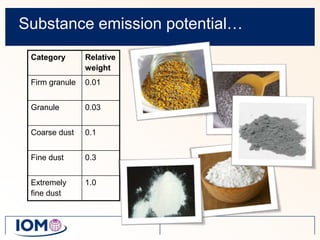
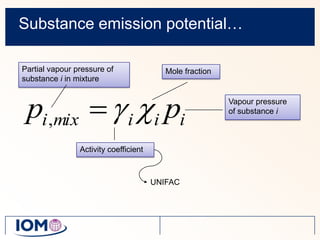
Substance emission potential…
Substance emission potential…Partial vapour pressure of substance i in mixtureMole fractionVapour pressure of substance iActivity coefficientUNIFAC
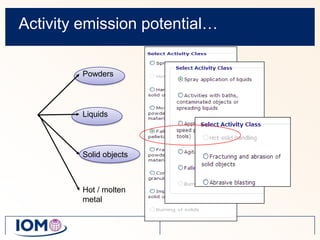
Activity emission potential…PowdersLiquidsSolid objectsHot / molten metal
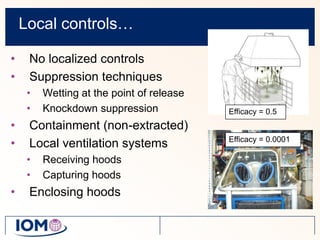
Local controls…No localized controlsSuppression techniquesWetting at the point of releaseKnockdown suppressionContainment (non-extracted)Local ventilation systemsReceiving hoodsCapturing hoodsEnclosing hoodsEfficacy = 0.5Efficacy = 0.0001
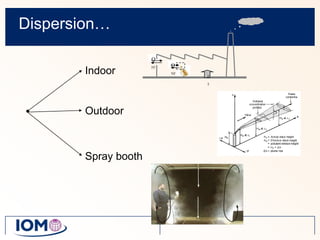
Dispersion…QFFQNFeTIndoorOutdoorSpray booth
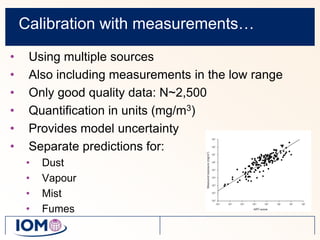
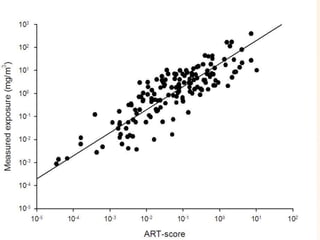
Calibration with measurements…Using multiple sourcesAlso including measurements in the low rangeOnly good quality data: N~2,500Quantification in units (mg/m3)Provides model uncertaintySeparate predictions for:DustVapourMistFumes
Bayesian updating…Bayesian techniques allow for different types of information to be integrated in a theoretically rigorous way via probability theoryBayes approach takes account of the relative strength of the different information sourcesBayesian module is integrated in ART to update model estimate with user’s own data
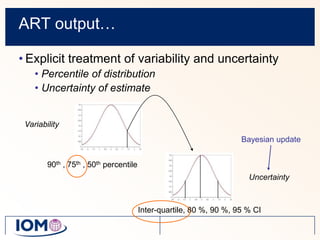
ART output…Explicit treatment of variability and uncertainty
Percentile of distribution
Uncertainty of estimateVariabilityBayesian update90th , 75th , 50th percentileUncertaintyInter-quartile, 80 %, 90 %, 95 % CI

3. The Advanced REACH Tool (ART)