Air
Pollution
CONTENTS
Introduction
Four Main Types Of Air Pollution Sources
Air Pollutants
Effects Of Air Pollutants
Controlling Measures Of Air Pollution
Summary Of Sources Of Air Pollution In India
Action Plan For Combating Air Pollution In India
References
INTRODUCTION
Air pollution is the introduction of particulates, biological
molecules, or other harmful materials into Earth's
atmosphere, causing diseases, death to humans, damage to
other living organisms such as animals and food crops, or
the natural or built environment.
According to The Air (Prevention and Control of
Pollution) Act, 1981, “Air pollution is the presence of
any solid, liquid, or gaseous substances in the
atmosphere in such concentration as may be or tend to
be injurious to human beings or other living creatures
or plants or property or environment”.
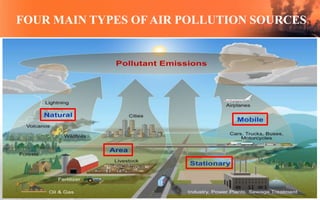
FOUR MAIN TYPES OF AIR POLLUTION SOURCES
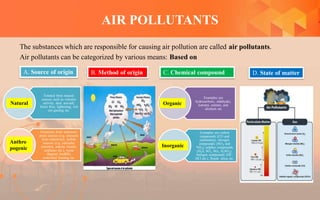
The substances which are responsible for causing air pollution are called air pollutants.
Air pollutants can be categorized by various means: Based on
AIR POLLUTANTS
A. Source of origin B. Method of origin C. Chemical compound D. State of matter
Emitted from natural
sources such as volcanic
activity, dust, sea-salt,
forest fires, lightening, soil
out gassing etc.
Emissions from stationary
point sources (e.g. emission
from industries), mobile
sources (e.g. vehicular
emission, marine vessels,
airplanes etc.), waste
disposal landfills,
controlled burning etc.
Examples are
hydrocarbons, aldehydes,
ketones, amines, and
alcohols etc
Examples are carbon
compounds (CO and
carbonates), nitrogen
compounds (NOX and
NH3), sulphur compounds
(H2S, SO2, SO3, H2SO4),
halogen compounds (HF,
HCl etc.), flyash, silica etc.
Natural
Anthro
pogenic
Organic
Inorganic
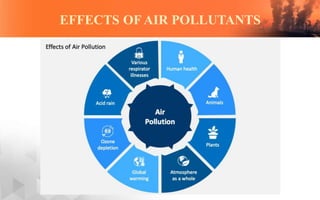
EFFECTS OF AIR POLLUTANTS
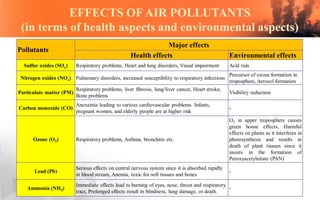
EFFECTS OFAIR POLLUTANTS
(in terms of health aspects and environmental aspects)
Pollutants
Major effects
Health effects Environmental effects
Sulfur oxides (SOx) Respiratory problems, Heart and lung disorders, Visual impairment Acid rain
Nitrogen oxides (NOx) Pulmonary disorders, increased susceptibility to respiratory infections
Precursor of ozone formation in
troposphere, Aerosol formation
Particulate matter (PM)
Respiratory problems, liver fibrosis, lung/liver cancer, Heart stroke,
Bone problems
Visibility reduction
Carbon monoxide (CO)
Anoxemia leading to various cardiovascular problems. Infants,
pregnant women, and elderly people are at higher risk
-
Ozone (O3) Respiratory problems, Asthma, bronchitis etc.
O3 in upper troposphere causes
green house effects, Harmful
effects on plants as it interferes in
photosynthesis and results in
death of plant tissues since it
assists in the formation of
Peroxyacetylnitate (PAN)
Lead (Pb)
Serious effects on central nervous system since it is absorbed rapidly
in blood stream, Anemia, toxic for soft tissues and bones
-
Ammonia (NH3)
Immediate effects lead to burning of eyes, nose, throat and respiratory
tract. Prolonged effects result in blindness, lung damage, or death.
-
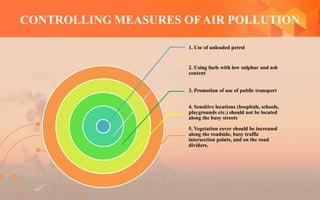
CONTROLLING MEASURES OFAIR POLLUTION
1. Use of unleaded petrol
2. Using fuels with low sulphur and ash
content
3. Promotion of use of public transport
4. Sensitive locations (hospitals, schools,
playgrounds etc.) should not be located
along the busy streets
5. Vegetation cover should be increased
along the roadside, busy traffic
intersection points, and on the road
dividers.
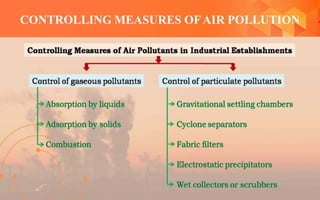
CONTROLLING MEASURES OFAIR POLLUTION
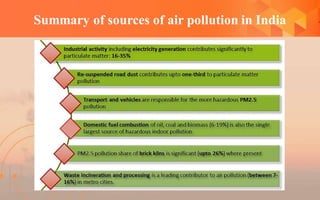
Summary of sources of air pollution in India
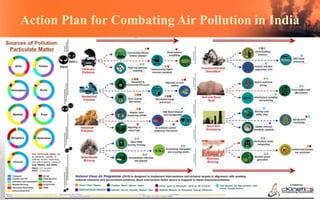
Action Plan for Combating Air Pollution in India
REFERENCES
 Singh, Surya & Sharma, Meena. (2017). Impact of Air Pollution on Global Environment. 10.37591/rrjoe.v7
i1.816..
 Xue, Y., Zhang, S., Nie, T., Cao, X., & Shi, A. (2020). Environmental Effective Assessment of Control Mea
sures Implemented by Clean Air Action Plan (2013–2017) in Beijing, China. Atmosphere, 11(2), 189.
 Gheorghe, I. F. , & Ion, B. (2011). The Effects of Air Pollutants on Vegetation and the Role of Vegetation in
Reducing Atmospheric Pollution. In (Ed.), The Impact of Air Pollution on Health, Economy, Environment an
d Agricultural Sources. IntechOpen. https://doi.org/10.5772/17660
 http://www.envis.nic.in
 https://www.clarity.io/blog/how-measuring-different-types-of-air-pollutants-creates-a-more-holistic-picture-
of-air-pollution
 https://www.sketchbubble.com/en/presentation-air-pollution.html
 http://www.sustainabilityoutlook.in/content/bated-breath-action-plan-combating-air-pollution-india-764637
THANK YOU

Air Pollution.pdf

  • 1.
  • 2.
    CONTENTS Introduction Four Main TypesOf Air Pollution Sources Air Pollutants Effects Of Air Pollutants Controlling Measures Of Air Pollution Summary Of Sources Of Air Pollution In India Action Plan For Combating Air Pollution In India References
  • 3.
    INTRODUCTION Air pollution isthe introduction of particulates, biological molecules, or other harmful materials into Earth's atmosphere, causing diseases, death to humans, damage to other living organisms such as animals and food crops, or the natural or built environment. According to The Air (Prevention and Control of Pollution) Act, 1981, “Air pollution is the presence of any solid, liquid, or gaseous substances in the atmosphere in such concentration as may be or tend to be injurious to human beings or other living creatures or plants or property or environment”.
  • 4.
    FOUR MAIN TYPESOF AIR POLLUTION SOURCES
  • 5.
    The substances whichare responsible for causing air pollution are called air pollutants. Air pollutants can be categorized by various means: Based on AIR POLLUTANTS A. Source of origin B. Method of origin C. Chemical compound D. State of matter Emitted from natural sources such as volcanic activity, dust, sea-salt, forest fires, lightening, soil out gassing etc. Emissions from stationary point sources (e.g. emission from industries), mobile sources (e.g. vehicular emission, marine vessels, airplanes etc.), waste disposal landfills, controlled burning etc. Examples are hydrocarbons, aldehydes, ketones, amines, and alcohols etc Examples are carbon compounds (CO and carbonates), nitrogen compounds (NOX and NH3), sulphur compounds (H2S, SO2, SO3, H2SO4), halogen compounds (HF, HCl etc.), flyash, silica etc. Natural Anthro pogenic Organic Inorganic
  • 6.
    EFFECTS OF AIRPOLLUTANTS
  • 7.
    EFFECTS OFAIR POLLUTANTS (interms of health aspects and environmental aspects) Pollutants Major effects Health effects Environmental effects Sulfur oxides (SOx) Respiratory problems, Heart and lung disorders, Visual impairment Acid rain Nitrogen oxides (NOx) Pulmonary disorders, increased susceptibility to respiratory infections Precursor of ozone formation in troposphere, Aerosol formation Particulate matter (PM) Respiratory problems, liver fibrosis, lung/liver cancer, Heart stroke, Bone problems Visibility reduction Carbon monoxide (CO) Anoxemia leading to various cardiovascular problems. Infants, pregnant women, and elderly people are at higher risk - Ozone (O3) Respiratory problems, Asthma, bronchitis etc. O3 in upper troposphere causes green house effects, Harmful effects on plants as it interferes in photosynthesis and results in death of plant tissues since it assists in the formation of Peroxyacetylnitate (PAN) Lead (Pb) Serious effects on central nervous system since it is absorbed rapidly in blood stream, Anemia, toxic for soft tissues and bones - Ammonia (NH3) Immediate effects lead to burning of eyes, nose, throat and respiratory tract. Prolonged effects result in blindness, lung damage, or death. -
  • 8.
    CONTROLLING MEASURES OFAIRPOLLUTION 1. Use of unleaded petrol 2. Using fuels with low sulphur and ash content 3. Promotion of use of public transport 4. Sensitive locations (hospitals, schools, playgrounds etc.) should not be located along the busy streets 5. Vegetation cover should be increased along the roadside, busy traffic intersection points, and on the road dividers.
  • 9.
  • 10.
    Summary of sourcesof air pollution in India
  • 11.
    Action Plan forCombating Air Pollution in India
  • 12.
    REFERENCES  Singh, Surya& Sharma, Meena. (2017). Impact of Air Pollution on Global Environment. 10.37591/rrjoe.v7 i1.816..  Xue, Y., Zhang, S., Nie, T., Cao, X., & Shi, A. (2020). Environmental Effective Assessment of Control Mea sures Implemented by Clean Air Action Plan (2013–2017) in Beijing, China. Atmosphere, 11(2), 189.  Gheorghe, I. F. , & Ion, B. (2011). The Effects of Air Pollutants on Vegetation and the Role of Vegetation in Reducing Atmospheric Pollution. In (Ed.), The Impact of Air Pollution on Health, Economy, Environment an d Agricultural Sources. IntechOpen. https://doi.org/10.5772/17660  http://www.envis.nic.in  https://www.clarity.io/blog/how-measuring-different-types-of-air-pollutants-creates-a-more-holistic-picture- of-air-pollution  https://www.sketchbubble.com/en/presentation-air-pollution.html  http://www.sustainabilityoutlook.in/content/bated-breath-action-plan-combating-air-pollution-india-764637
  • 13.