7) Hydrogen Sulphide : Human activities reease naturally occuring hydrogen sulphide into ambient air.Hydrogen sulphide is
formed during coke production, viscose rayon production, waste water treatment plant, oil refining. It is also involved in
lifestock rearing system. The first effect of hydrogen sulphide is its unpleasant odour. The next symptom is conjunctival
irritation. Workers exposed to hydrogen sulphide concentration of less than 30 microgram /m3 are reported to have diffuse
neurological symptoms.
8) Ozone : It is not formed by human activity. Existing ozone has been formed by chemical reaction in the air.
9) Polynuclear aromatic hudrocarbons :
They are formed during combustion of oil, coal or woods. in India PAH are formed in great amount in indoors during
cooking with biomass fuels. They cause skin cancer or lung cancer. Because of their carcinogenicity, no safe limit of PAH is
recommended.
10) Particulate matter : Airborne particulate matter represents a complex mixture of organic and inorganic substances. They
are formed in dust wind, industries, petrol vehicles, domestic coal burning, incinerators. 100 micro gram/m3 is considered
maximum safe limit of particulate matter in air.
Nitrogen di oxide is the most harmful of these compounds and iss generated from the combustion of fuel rngines and
industry. It can damage human heart and lung.
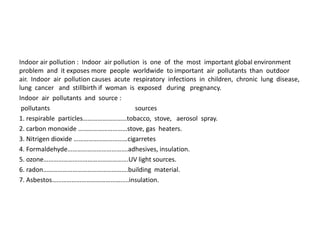
Indoor air pollution : Indoor air pollution is one of the most important global environment
problem and it exposes more people worldwide to important air pollutants than outdoor
air. Indoor air pollution causes acute respiratory infections in children, chronic lung disease,
lung cancer and stillbirth if woman is exposed during pregnancy.
Indoor air pollutants and source :
pollutants sources
1. respirable particles………………………tobacco, stove, aerosol spray.
2. carbon monoxide …………………………stove, gas heaters.
3. Nitrigen dioxide ……………………………cigarretes
4. Formaldehyde……………………………….adhesives, insulation.
5. ozone…………………………………………….UV light sources.
6. radon…………………………………………….building material.
7. Asbestos………………………………………..insulation.
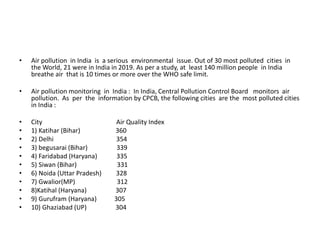
• Air pollution in India is a serious environmental issue. Out of 30 most polluted cities in
the World, 21 were in India in 2019. As per a study, at least 140 million people in India
breathe air that is 10 times or more over the WHO safe limit.
• Air pollution monitoring in India : In India, Central Pollution Control Board monitors air
pollution. As per the information by CPCB, the following cities are the most polluted cities
in India :
• City Air Quality Index
• 1) Katihar (Bihar) 360
• 2) Delhi 354
• 3) begusarai (Bihar) 339
• 4) Faridabad (Haryana) 335
• 5) Siwan (Bihar) 331
• 6) Noida (Uttar Pradesh) 328
• 7) Gwalior(MP) 312
• 8)Katihal (Haryana) 307
• 9) Gurufram (Haryana) 305
• 10) Ghaziabad (UP) 304
Air quality Index : AQI is a yardstick that runs from 0- 500. The higher the AQI value, the greater value of air pollution and the greater health concern.
AQI 50 or below representa good air quality and AQI value over 300 represents hazardous air quality. The purpose of AQi is to help people know
how the local air quality impacts their health. The EPA (Environmental Protection agency) calculates the AQI for 5 major air pollutants for which
national air quality standard have been astablishedto safeguard public health. 8 pollutants are monitored for the calculation of AQI : PM10, PM 2.5,
nitrogen dioxide, sulphur di oxide,carbon monoxide, ground level ozone, ammonia and lead.
The AQI is divided into six categories. Each category corresponds to a different level of health concern. Each category also has a specific colour. The
colour makes it easy for people to to quickly determine wheather air quality is reaching unhealthy levels in their communities.
colour concern AQI Air quality
Green good 0-50 satisfactory. poses no risk.
Yellow moderate 51-100 Acceptable but may be a risk for some people.
Orange unhealthy 101-150 sensitive people may experience health effects,
for sensitive people others less likely to be affected.
red unhealthy 151-200 may experience mild to severe health problems.
Purple very unhealthy 201-300 risk of health effects is increased for everyone
Maroon hazardous 301 and health warning og emergency conditions. Everyone is more likely to be affected.
higher
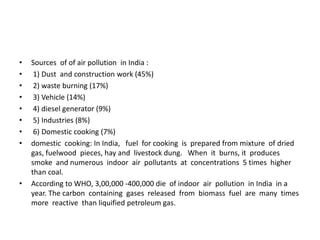
• Sources of of air pollution in India :
• 1) Dust and construction work (45%)
• 2) waste burning (17%)
• 3) Vehicle (14%)
• 4) diesel generator (9%)
• 5) Industries (8%)
• 6) Domestic cooking (7%)
• domestic cooking: In India, fuel for cooking is prepared from mixture of dried
gas, fuelwood pieces, hay and livestock dung. When it burns, it produces
smoke and numerous indoor air pollutants at concentrations 5 times higher
than coal.
• According to WHO, 3,00,000 -400,000 die of indoor air pollution in India in a
year. The carbon containing gases released from biomass fuel are many times
more reactive than liquified petroleum gas.
• Fuel Adulteration : In India adulteration of petrol and diesel with lower priced fuel is
common. These adultarants emit harmful pollutants from vehicles worsening air
pollution.These pollutants are hydrocarbon, carbon monooxide, nitrogen oxide, PAH and
particulate matter.
• Traffic congestion : It is severe in India’s cities and towns. traffic congestion reduces traffic
speed and scientific studies show that aow speed vehicles burn fuel inefficiently and
pollute air.
• Greenhouse gas emissions: India emits greenhouse gases which is 7% of total global
emissions, these green house gases are responsible for climate changes in India. the
green house gases are mainly carbon di oxide, methane, water vapour, nitrous oxide and
ozone. As a result of these large amount of green house gases , India will witness heat
waves,landslides, floods and droughts in near future.
• Least air polluted cities in India :
• 1) Imphal (Manipur)
• 2) Madikeri (Karnataka)
• 3) Mysuru (Karnataka)
• 4) Mangalore (Karnataka)
• 5) Amaravati (Andhra pradesh)
• 6) Haldia (West Bengal)
• 7) Gorakhpur (UP)
• 8) Bagalkot (Karnataka)
• 9)Chikkaballapur. (Karnataka)
• Effects of air pollution on health : About 1 billion urban residents worldwide are exposed
to air pollution level above recommended limits. Air quality in developed countries has
improved in the last 2 decades, but in many developing countries air quality has
deteriorated because of rising industrial activity, increasing power generation and the
congestion of streets with poorly maintained motor vehicles that use leaded fuel.
• Effects of sulphur di oxide : When we breath it in, it irritates nose, throat, airway and
causes tightness of chest, headache, anxiety. The affects are felt very quickly and many
people feel worst symptoms in 10-15 minutes after breathing it. People who have
ashma, lung problem suffer more than others.
• Effects of particulate matter : Particulate matter consists of dust, dirt, smoke and liquid
droplets. Particulate matters are classified into 3 types on the basis of its diameter:
• 1) Fine particles : <2.5 micro meter.
• 2) Coarse particle : 2.5- 10 micro meter.
• 3) Ultra fineparticle : < .1 micro meter.
• Exposure to particulate matter cause asthma, bronchitis, respiratory disease, cancer,
COAD, Brain stroke, cognitive disorder, MI, infertility, miscarriage etc.
• Carbon monoxide : It is a poisonous gas. It does not have taste and smell and
due to it, high level can not be determined. It is produced by combustion of
biomass fuel, motor vehicles and industries. It forms carboxyhemoglobin that
cause hypoxia, angina, confusion, giddiness, chest pain, blurred vision,
shortness of breath etc.
• Nitrogen di oxide: It is produced in food processing industries and in
combustion od oil, coal and gas. It causes cough, cold, bronchitis, respiratory
problems,, reduce immunity to lung infection. The effects are significant on
people with asthma.
• Lead : Found in Earth’s crust and released in air by soil erosion. Mining and
metal manufacturing industries are major sources of lead emissions. it is a
health hazard and it is deposited on teeth, bone, liver and kidney. children are
at more risk . It causes decreased vision, hair fall, unusual taste, slurred
speech, blue line along gum, kidney failure, CNS problem, infertility,
neuromuscular problem, loss of coordination, anaemia, digestion problem and
skin problem.
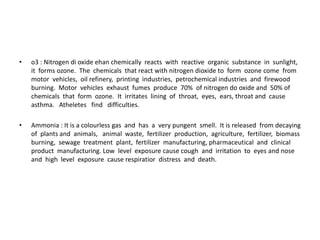
• o3 : Nitrogen di oxide ehan chemically reacts with reactive organic substance in sunlight,
it forms ozone. The chemicals that react with nitrogen dioxide to form ozone come from
motor vehicles, oil refinery, printing industries, petrochemical industries and firewood
burning. Motor vehicles exhaust fumes produce 70% of nitrogen do oxide and 50% of
chemicals that form ozone. It irritates lining of throat, eyes, ears, throat and cause
asthma. Atheletes find difficulties.
• Ammonia : It is a colourless gas and has a very pungent smell. It is released from decaying
of plants and animals, animal waste, fertilizer production, agriculture, fertilizer, biomass
burning, sewage treatment plant, fertilizer manufacturing, pharmaceutical and clinical
product manufacturing. Low level exposure cause cough and irritation to eyes and nose
and high level exposure cause respiratior distress and death.
• Air pollution in hospitals : In hospitals toxic air pollutants are produced due to different
activities. Mercury is emitted when it is used in thermometer and BP cuffs. Other
chemicals and microbial air pollutants are released from different processes like
laboratory tests, heating, ventillating, washing , radiological procedures, office
equipments, washing etc.
• The air of indoor environments contain carbon di oxide, carbon monoxide, formaldehyde,
nitrous oxide, radon and particulate matter.
• Air quality in hospitals increase the risk of infections in visitors and staff.
• Steps taken to control air pollution :
• !) The govt of Delhi Launched an odd-even rule for vehicle. th means vehicles with number platee ending in odd number could
only be driven in certain days in a week and with even digit will run in other days of the week.
• Other ways by which air pollution can be controlled :
• We should always keep in mind 4 air quality principles : minimize indoor emissions, keep it dry, Ventillate well, protect against
outdoor pollution.
• 2) By strict pollution control norm.
• 3) Replacing biomass fuels for cooking by liquid petroleum gas.
• 4) By Introducing electric public transport bus,
• 5) By introducing electric private vehicle,
• 6) By converting agricultiral residue to fertilizer,
• 7) Using renewable energy in all power plants. like solar energy, wind energy, hdroelectric,
• 8) Informing public about air pollution data.
• 9) by planting trees.
• 10) save energy.
• 11) plant trees.
• 12) use eco friendly products in your home.
• 13) keep air cleaning houseplant in indoors.
14) avoid use of crackers.
air  pollution.pptx
air  pollution.pptx

air pollution.pptx

  • 1.
    7) Hydrogen Sulphide: Human activities reease naturally occuring hydrogen sulphide into ambient air.Hydrogen sulphide is formed during coke production, viscose rayon production, waste water treatment plant, oil refining. It is also involved in lifestock rearing system. The first effect of hydrogen sulphide is its unpleasant odour. The next symptom is conjunctival irritation. Workers exposed to hydrogen sulphide concentration of less than 30 microgram /m3 are reported to have diffuse neurological symptoms. 8) Ozone : It is not formed by human activity. Existing ozone has been formed by chemical reaction in the air. 9) Polynuclear aromatic hudrocarbons : They are formed during combustion of oil, coal or woods. in India PAH are formed in great amount in indoors during cooking with biomass fuels. They cause skin cancer or lung cancer. Because of their carcinogenicity, no safe limit of PAH is recommended. 10) Particulate matter : Airborne particulate matter represents a complex mixture of organic and inorganic substances. They are formed in dust wind, industries, petrol vehicles, domestic coal burning, incinerators. 100 micro gram/m3 is considered maximum safe limit of particulate matter in air. Nitrogen di oxide is the most harmful of these compounds and iss generated from the combustion of fuel rngines and industry. It can damage human heart and lung.
  • 2.
    Indoor air pollution: Indoor air pollution is one of the most important global environment problem and it exposes more people worldwide to important air pollutants than outdoor air. Indoor air pollution causes acute respiratory infections in children, chronic lung disease, lung cancer and stillbirth if woman is exposed during pregnancy. Indoor air pollutants and source : pollutants sources 1. respirable particles………………………tobacco, stove, aerosol spray. 2. carbon monoxide …………………………stove, gas heaters. 3. Nitrigen dioxide ……………………………cigarretes 4. Formaldehyde……………………………….adhesives, insulation. 5. ozone…………………………………………….UV light sources. 6. radon…………………………………………….building material. 7. Asbestos………………………………………..insulation.
  • 3.
    • Air pollutionin India is a serious environmental issue. Out of 30 most polluted cities in the World, 21 were in India in 2019. As per a study, at least 140 million people in India breathe air that is 10 times or more over the WHO safe limit. • Air pollution monitoring in India : In India, Central Pollution Control Board monitors air pollution. As per the information by CPCB, the following cities are the most polluted cities in India : • City Air Quality Index • 1) Katihar (Bihar) 360 • 2) Delhi 354 • 3) begusarai (Bihar) 339 • 4) Faridabad (Haryana) 335 • 5) Siwan (Bihar) 331 • 6) Noida (Uttar Pradesh) 328 • 7) Gwalior(MP) 312 • 8)Katihal (Haryana) 307 • 9) Gurufram (Haryana) 305 • 10) Ghaziabad (UP) 304
  • 4.
    Air quality Index: AQI is a yardstick that runs from 0- 500. The higher the AQI value, the greater value of air pollution and the greater health concern. AQI 50 or below representa good air quality and AQI value over 300 represents hazardous air quality. The purpose of AQi is to help people know how the local air quality impacts their health. The EPA (Environmental Protection agency) calculates the AQI for 5 major air pollutants for which national air quality standard have been astablishedto safeguard public health. 8 pollutants are monitored for the calculation of AQI : PM10, PM 2.5, nitrogen dioxide, sulphur di oxide,carbon monoxide, ground level ozone, ammonia and lead. The AQI is divided into six categories. Each category corresponds to a different level of health concern. Each category also has a specific colour. The colour makes it easy for people to to quickly determine wheather air quality is reaching unhealthy levels in their communities. colour concern AQI Air quality Green good 0-50 satisfactory. poses no risk. Yellow moderate 51-100 Acceptable but may be a risk for some people. Orange unhealthy 101-150 sensitive people may experience health effects, for sensitive people others less likely to be affected. red unhealthy 151-200 may experience mild to severe health problems. Purple very unhealthy 201-300 risk of health effects is increased for everyone Maroon hazardous 301 and health warning og emergency conditions. Everyone is more likely to be affected. higher
  • 5.
    • Sources ofof air pollution in India : • 1) Dust and construction work (45%) • 2) waste burning (17%) • 3) Vehicle (14%) • 4) diesel generator (9%) • 5) Industries (8%) • 6) Domestic cooking (7%) • domestic cooking: In India, fuel for cooking is prepared from mixture of dried gas, fuelwood pieces, hay and livestock dung. When it burns, it produces smoke and numerous indoor air pollutants at concentrations 5 times higher than coal. • According to WHO, 3,00,000 -400,000 die of indoor air pollution in India in a year. The carbon containing gases released from biomass fuel are many times more reactive than liquified petroleum gas.
  • 6.
    • Fuel Adulteration: In India adulteration of petrol and diesel with lower priced fuel is common. These adultarants emit harmful pollutants from vehicles worsening air pollution.These pollutants are hydrocarbon, carbon monooxide, nitrogen oxide, PAH and particulate matter. • Traffic congestion : It is severe in India’s cities and towns. traffic congestion reduces traffic speed and scientific studies show that aow speed vehicles burn fuel inefficiently and pollute air. • Greenhouse gas emissions: India emits greenhouse gases which is 7% of total global emissions, these green house gases are responsible for climate changes in India. the green house gases are mainly carbon di oxide, methane, water vapour, nitrous oxide and ozone. As a result of these large amount of green house gases , India will witness heat waves,landslides, floods and droughts in near future.
  • 7.
    • Least airpolluted cities in India : • 1) Imphal (Manipur) • 2) Madikeri (Karnataka) • 3) Mysuru (Karnataka) • 4) Mangalore (Karnataka) • 5) Amaravati (Andhra pradesh) • 6) Haldia (West Bengal) • 7) Gorakhpur (UP) • 8) Bagalkot (Karnataka) • 9)Chikkaballapur. (Karnataka)
  • 8.
    • Effects ofair pollution on health : About 1 billion urban residents worldwide are exposed to air pollution level above recommended limits. Air quality in developed countries has improved in the last 2 decades, but in many developing countries air quality has deteriorated because of rising industrial activity, increasing power generation and the congestion of streets with poorly maintained motor vehicles that use leaded fuel. • Effects of sulphur di oxide : When we breath it in, it irritates nose, throat, airway and causes tightness of chest, headache, anxiety. The affects are felt very quickly and many people feel worst symptoms in 10-15 minutes after breathing it. People who have ashma, lung problem suffer more than others. • Effects of particulate matter : Particulate matter consists of dust, dirt, smoke and liquid droplets. Particulate matters are classified into 3 types on the basis of its diameter: • 1) Fine particles : <2.5 micro meter. • 2) Coarse particle : 2.5- 10 micro meter. • 3) Ultra fineparticle : < .1 micro meter. • Exposure to particulate matter cause asthma, bronchitis, respiratory disease, cancer, COAD, Brain stroke, cognitive disorder, MI, infertility, miscarriage etc.
  • 9.
    • Carbon monoxide: It is a poisonous gas. It does not have taste and smell and due to it, high level can not be determined. It is produced by combustion of biomass fuel, motor vehicles and industries. It forms carboxyhemoglobin that cause hypoxia, angina, confusion, giddiness, chest pain, blurred vision, shortness of breath etc. • Nitrogen di oxide: It is produced in food processing industries and in combustion od oil, coal and gas. It causes cough, cold, bronchitis, respiratory problems,, reduce immunity to lung infection. The effects are significant on people with asthma. • Lead : Found in Earth’s crust and released in air by soil erosion. Mining and metal manufacturing industries are major sources of lead emissions. it is a health hazard and it is deposited on teeth, bone, liver and kidney. children are at more risk . It causes decreased vision, hair fall, unusual taste, slurred speech, blue line along gum, kidney failure, CNS problem, infertility, neuromuscular problem, loss of coordination, anaemia, digestion problem and skin problem.
  • 10.
    • o3 :Nitrogen di oxide ehan chemically reacts with reactive organic substance in sunlight, it forms ozone. The chemicals that react with nitrogen dioxide to form ozone come from motor vehicles, oil refinery, printing industries, petrochemical industries and firewood burning. Motor vehicles exhaust fumes produce 70% of nitrogen do oxide and 50% of chemicals that form ozone. It irritates lining of throat, eyes, ears, throat and cause asthma. Atheletes find difficulties. • Ammonia : It is a colourless gas and has a very pungent smell. It is released from decaying of plants and animals, animal waste, fertilizer production, agriculture, fertilizer, biomass burning, sewage treatment plant, fertilizer manufacturing, pharmaceutical and clinical product manufacturing. Low level exposure cause cough and irritation to eyes and nose and high level exposure cause respiratior distress and death.
  • 11.
    • Air pollutionin hospitals : In hospitals toxic air pollutants are produced due to different activities. Mercury is emitted when it is used in thermometer and BP cuffs. Other chemicals and microbial air pollutants are released from different processes like laboratory tests, heating, ventillating, washing , radiological procedures, office equipments, washing etc. • The air of indoor environments contain carbon di oxide, carbon monoxide, formaldehyde, nitrous oxide, radon and particulate matter. • Air quality in hospitals increase the risk of infections in visitors and staff.
  • 12.
    • Steps takento control air pollution : • !) The govt of Delhi Launched an odd-even rule for vehicle. th means vehicles with number platee ending in odd number could only be driven in certain days in a week and with even digit will run in other days of the week. • Other ways by which air pollution can be controlled : • We should always keep in mind 4 air quality principles : minimize indoor emissions, keep it dry, Ventillate well, protect against outdoor pollution. • 2) By strict pollution control norm. • 3) Replacing biomass fuels for cooking by liquid petroleum gas. • 4) By Introducing electric public transport bus, • 5) By introducing electric private vehicle, • 6) By converting agricultiral residue to fertilizer, • 7) Using renewable energy in all power plants. like solar energy, wind energy, hdroelectric, • 8) Informing public about air pollution data. • 9) by planting trees. • 10) save energy. • 11) plant trees. • 12) use eco friendly products in your home. • 13) keep air cleaning houseplant in indoors. 14) avoid use of crackers.