Air conditioning
Prepared by
M.S.Steve
Assistant Professor
Dept. of Mechanical Engineering
Amal Jyothi College of Engineering
Kanjirapally.

msstevesimon@gmail.com
Definition
 Process of treating the air so as to control simultaneously its
temperature, humidity, purity and distribution to meet the
requirements of controlled space.
 Requirements of a conditioned space
1. Comfort and health of occupants
2. Needs of certain industrial processes

3. Efficient working of commercial premises/offices

msstevesimon@gmail.com

Page

2
Air conditioning
 For human comfort ,air should have the following
properties :
1. Temperature -22 °C to 27 °C

2. Humidity - 55% to 65% Relative Humidity
3. Velocity - 0.3 -0.5 m/s.

 Air conditioning systems cool/heat the air,
humidify/dehumidify the air to the above human
comfort conditions depending on the temperature
and humidity of the outside atmospheric air.
msstevesimon@gmail.com

Page

3
Applications
 Industrial applications- To control chemical & bio
chemical reactions .
 Commercial applications- Theatres, hotels, banks
etc.
 Transport applications – automobiles, aircrafts,ships
etc
 Special applications – T .V centres , hospitals,
computer centres etc.
msstevesimon@gmail.com

Page

4
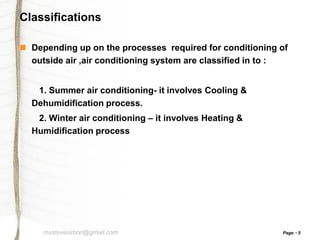
Classifications
 Depending up on the processes required for conditioning of
outside air ,air conditioning system are classified in to :
1. Summer air conditioning- it involves Cooling &
Dehumidification process.
2. Winter air conditioning – it involves Heating &
Humidification process

msstevesimon@gmail.com

Page

5
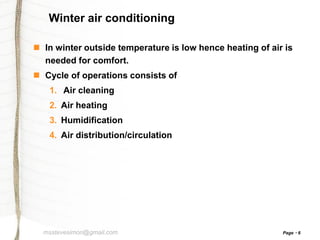
Winter air conditioning
 In winter outside temperature is low hence heating of air is
needed for comfort.
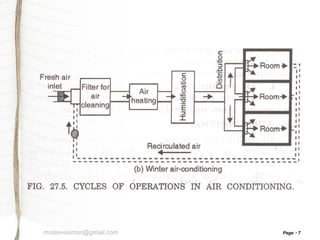
 Cycle of operations consists of
1. Air cleaning
2. Air heating
3. Humidification
4. Air distribution/circulation

msstevesimon@gmail.com

Page

6
msstevesimon@gmail.com

Page

7
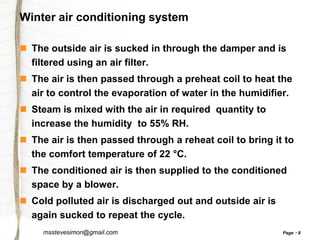
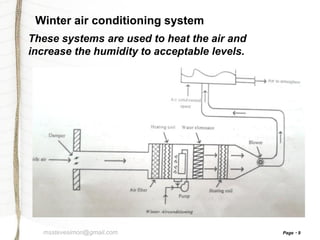
Winter air conditioning system
 The outside air is sucked in through the damper and is
filtered using an air filter.
 The air is then passed through a preheat coil to heat the
air to control the evaporation of water in the humidifier.
 Steam is mixed with the air in required quantity to
increase the humidity to 55% RH.
 The air is then passed through a reheat coil to bring it to
the comfort temperature of 22 °C.
 The conditioned air is then supplied to the conditioned
space by a blower.
 Cold polluted air is discharged out and outside air is
again sucked to repeat the cycle.
msstevesimon@gmail.com

Page

8
Winter air conditioning system
These systems are used to heat the air and
increase the humidity to acceptable levels.

msstevesimon@gmail.com

Page

9
Summer air conditioning
 In summer outside temp is more and hence cooling of air is
required
Consists of
1. Air cleaning
2. Air cooling
3. Dehumidification
4. Air distribution/circulation

msstevesimon@gmail.com

Page

10
msstevesimon@gmail.com

Page

11
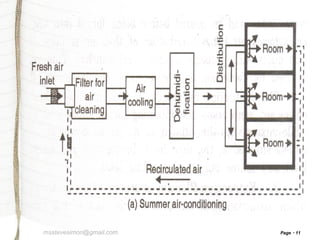
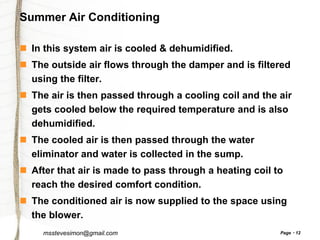
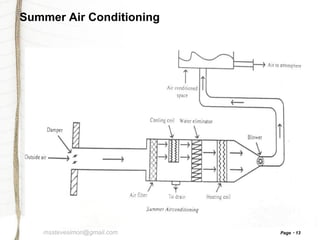
Summer Air Conditioning
 In this system air is cooled & dehumidified.
 The outside air flows through the damper and is filtered
using the filter.
 The air is then passed through a cooling coil and the air
gets cooled below the required temperature and is also
dehumidified.
 The cooled air is then passed through the water
eliminator and water is collected in the sump.
 After that air is made to pass through a heating coil to
reach the desired comfort condition.
 The conditioned air is now supplied to the space using
the blower.
msstevesimon@gmail.com

Page

12
Summer Air Conditioning

msstevesimon@gmail.com

Page

13
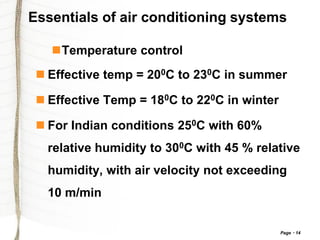
Essentials of air conditioning systems
Temperature control
 Effective temp = 200C to 230C in summer
 Effective Temp = 180C to 220C in winter
 For Indian conditions 250C with 60%
relative humidity to 300C with 45 % relative
humidity, with air velocity not exceeding
10 m/min

Page

14
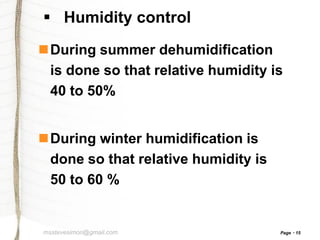
 Humidity control
During summer dehumidification
is done so that relative humidity is
40 to 50%
During winter humidification is
done so that relative humidity is
50 to 60 %

msstevesimon@gmail.com

Page

15
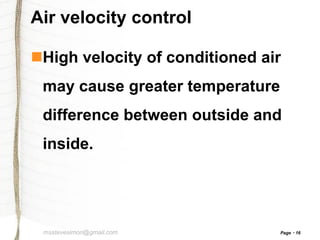
Air velocity control
High velocity of conditioned air
may cause greater temperature
difference between outside and
inside.

msstevesimon@gmail.com

Page

16
Air quality control
Air should be free from
odour, toxic gases, bacteria
and other micro-organisms

msstevesimon@gmail.com

Page

17
Essentials of air conditioning systems
1. Filtration
2. Heating (in winter)

3. Cooling (in summer)
4. Humidification
5. Dehumidification
6. Air circulation or distribution

msstevesimon@gmail.com

Page

18
1. Filtration
 Should be capable of removing dust, ash, smoke,
bacteria etc
 Should be capable of holding moderate amount of
dust without affecting the efficiency
 Should offer low resistance to flow of air
 Workable under sufficient range of velocities.

 Should afford easy cleaning manually or
mechanically

msstevesimon@gmail.com

Page

19
2. Heating (in winter)
 Heating is necessary in winter so as to
compensate heat loss from room.

 Pre heating of incoming air may be done by
passing over air furnaces or coils through
which hot water is circulated

msstevesimon@gmail.com

Page

20
3. Cooling (in summer)
Cooling
of incoming air is
necessary in summer.
Principle of mechanical refrigeration
is used.

msstevesimon@gmail.com

Page

21
4.

Humidification

Humidification or addition of water is
necessary in winter because of low

temp has less humidity.
Incoming air is passed through pans of

water or wet cloth strips

msstevesimon@gmail.com

Page

22
5. Dehumidification
In this process certain amount of
water is extracted from air.
This is done in summer where
incoming air is cooled.
Adsorbents can be used to adsorb
excess moisture from air .

msstevesimon@gmail.com

Page

23
Psychrometry
 The properties of moist air are called as
pshychrometric properties .

 Although the principles of pshychrometry
can be applied to any physical system
consisting of gas vapour mixtures,the most
common system of interest is the mixture of
water vapour & air.

msstevesimon@gmail.com

Page

24
Terms used in psychrometry
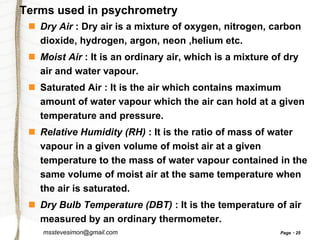
 Dry Air : Dry air is a mixture of oxygen, nitrogen, carbon
dioxide, hydrogen, argon, neon ,helium etc.
 Moist Air : It is an ordinary air, which is a mixture of dry
air and water vapour.
 Saturated Air : It is the air which contains maximum
amount of water vapour which the air can hold at a given
temperature and pressure.
 Relative Humidity (RH) : It is the ratio of mass of water
vapour in a given volume of moist air at a given
temperature to the mass of water vapour contained in the
same volume of moist air at the same temperature when
the air is saturated.
 Dry Bulb Temperature (DBT) : It is the temperature of air
measured by an ordinary thermometer.
msstevesimon@gmail.com

Page

25
Terms used in psychrometry
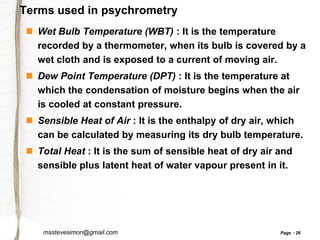
 Wet Bulb Temperature (WBT) : It is the temperature
recorded by a thermometer, when its bulb is covered by a
wet cloth and is exposed to a current of moving air.
 Dew Point Temperature (DPT) : It is the temperature at
which the condensation of moisture begins when the air
is cooled at constant pressure.

 Sensible Heat of Air : It is the enthalpy of dry air, which
can be calculated by measuring its dry bulb temperature.
 Total Heat : It is the sum of sensible heat of dry air and
sensible plus latent heat of water vapour present in it.

msstevesimon@gmail.com

Page

26
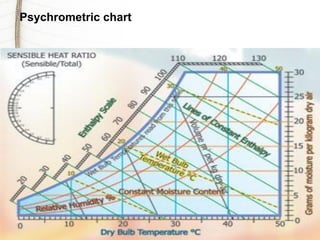
Psychrometric chart

Page

27
Thank You

M S Steve
msstevesimon@gmail.com

@msstevesimon
2m.s.steve
msstevesimon@gmail.com

Basic Mechanical Engineering - Air conditioning

  • 1.
    Air conditioning Prepared by M.S.Steve AssistantProfessor Dept. of Mechanical Engineering Amal Jyothi College of Engineering Kanjirapally. msstevesimon@gmail.com
  • 2.
    Definition  Process oftreating the air so as to control simultaneously its temperature, humidity, purity and distribution to meet the requirements of controlled space.  Requirements of a conditioned space 1. Comfort and health of occupants 2. Needs of certain industrial processes 3. Efficient working of commercial premises/offices msstevesimon@gmail.com Page 2
  • 3.
    Air conditioning  Forhuman comfort ,air should have the following properties : 1. Temperature -22 °C to 27 °C 2. Humidity - 55% to 65% Relative Humidity 3. Velocity - 0.3 -0.5 m/s.  Air conditioning systems cool/heat the air, humidify/dehumidify the air to the above human comfort conditions depending on the temperature and humidity of the outside atmospheric air. msstevesimon@gmail.com Page 3
  • 4.
    Applications  Industrial applications-To control chemical & bio chemical reactions .  Commercial applications- Theatres, hotels, banks etc.  Transport applications – automobiles, aircrafts,ships etc  Special applications – T .V centres , hospitals, computer centres etc. msstevesimon@gmail.com Page 4
  • 5.
    Classifications  Depending upon the processes required for conditioning of outside air ,air conditioning system are classified in to : 1. Summer air conditioning- it involves Cooling & Dehumidification process. 2. Winter air conditioning – it involves Heating & Humidification process msstevesimon@gmail.com Page 5
  • 6.
    Winter air conditioning In winter outside temperature is low hence heating of air is needed for comfort.  Cycle of operations consists of 1. Air cleaning 2. Air heating 3. Humidification 4. Air distribution/circulation msstevesimon@gmail.com Page 6
  • 7.
  • 8.
    Winter air conditioningsystem  The outside air is sucked in through the damper and is filtered using an air filter.  The air is then passed through a preheat coil to heat the air to control the evaporation of water in the humidifier.  Steam is mixed with the air in required quantity to increase the humidity to 55% RH.  The air is then passed through a reheat coil to bring it to the comfort temperature of 22 °C.  The conditioned air is then supplied to the conditioned space by a blower.  Cold polluted air is discharged out and outside air is again sucked to repeat the cycle. msstevesimon@gmail.com Page 8
  • 9.
    Winter air conditioningsystem These systems are used to heat the air and increase the humidity to acceptable levels. msstevesimon@gmail.com Page 9
  • 10.
    Summer air conditioning In summer outside temp is more and hence cooling of air is required Consists of 1. Air cleaning 2. Air cooling 3. Dehumidification 4. Air distribution/circulation msstevesimon@gmail.com Page 10
  • 11.
  • 12.
    Summer Air Conditioning In this system air is cooled & dehumidified.  The outside air flows through the damper and is filtered using the filter.  The air is then passed through a cooling coil and the air gets cooled below the required temperature and is also dehumidified.  The cooled air is then passed through the water eliminator and water is collected in the sump.  After that air is made to pass through a heating coil to reach the desired comfort condition.  The conditioned air is now supplied to the space using the blower. msstevesimon@gmail.com Page 12
  • 13.
  • 14.
    Essentials of airconditioning systems Temperature control  Effective temp = 200C to 230C in summer  Effective Temp = 180C to 220C in winter  For Indian conditions 250C with 60% relative humidity to 300C with 45 % relative humidity, with air velocity not exceeding 10 m/min Page 14
  • 15.
     Humidity control Duringsummer dehumidification is done so that relative humidity is 40 to 50% During winter humidification is done so that relative humidity is 50 to 60 % msstevesimon@gmail.com Page 15
  • 16.
    Air velocity control Highvelocity of conditioned air may cause greater temperature difference between outside and inside. msstevesimon@gmail.com Page 16
  • 17.
    Air quality control Airshould be free from odour, toxic gases, bacteria and other micro-organisms msstevesimon@gmail.com Page 17
  • 18.
    Essentials of airconditioning systems 1. Filtration 2. Heating (in winter) 3. Cooling (in summer) 4. Humidification 5. Dehumidification 6. Air circulation or distribution msstevesimon@gmail.com Page 18
  • 19.
    1. Filtration  Shouldbe capable of removing dust, ash, smoke, bacteria etc  Should be capable of holding moderate amount of dust without affecting the efficiency  Should offer low resistance to flow of air  Workable under sufficient range of velocities.  Should afford easy cleaning manually or mechanically msstevesimon@gmail.com Page 19
  • 20.
    2. Heating (inwinter)  Heating is necessary in winter so as to compensate heat loss from room.  Pre heating of incoming air may be done by passing over air furnaces or coils through which hot water is circulated msstevesimon@gmail.com Page 20
  • 21.
    3. Cooling (insummer) Cooling of incoming air is necessary in summer. Principle of mechanical refrigeration is used. msstevesimon@gmail.com Page 21
  • 22.
    4. Humidification Humidification or additionof water is necessary in winter because of low temp has less humidity. Incoming air is passed through pans of water or wet cloth strips msstevesimon@gmail.com Page 22
  • 23.
    5. Dehumidification In thisprocess certain amount of water is extracted from air. This is done in summer where incoming air is cooled. Adsorbents can be used to adsorb excess moisture from air . msstevesimon@gmail.com Page 23
  • 24.
    Psychrometry  The propertiesof moist air are called as pshychrometric properties .  Although the principles of pshychrometry can be applied to any physical system consisting of gas vapour mixtures,the most common system of interest is the mixture of water vapour & air. msstevesimon@gmail.com Page 24
  • 25.
    Terms used inpsychrometry  Dry Air : Dry air is a mixture of oxygen, nitrogen, carbon dioxide, hydrogen, argon, neon ,helium etc.  Moist Air : It is an ordinary air, which is a mixture of dry air and water vapour.  Saturated Air : It is the air which contains maximum amount of water vapour which the air can hold at a given temperature and pressure.  Relative Humidity (RH) : It is the ratio of mass of water vapour in a given volume of moist air at a given temperature to the mass of water vapour contained in the same volume of moist air at the same temperature when the air is saturated.  Dry Bulb Temperature (DBT) : It is the temperature of air measured by an ordinary thermometer. msstevesimon@gmail.com Page 25
  • 26.
    Terms used inpsychrometry  Wet Bulb Temperature (WBT) : It is the temperature recorded by a thermometer, when its bulb is covered by a wet cloth and is exposed to a current of moving air.  Dew Point Temperature (DPT) : It is the temperature at which the condensation of moisture begins when the air is cooled at constant pressure.  Sensible Heat of Air : It is the enthalpy of dry air, which can be calculated by measuring its dry bulb temperature.  Total Heat : It is the sum of sensible heat of dry air and sensible plus latent heat of water vapour present in it. msstevesimon@gmail.com Page 26
  • 27.
  • 28.
    Thank You M SSteve msstevesimon@gmail.com @msstevesimon 2m.s.steve msstevesimon@gmail.com