TEVAR for traumatic aortic tear:
  The Queensland experience.
Adeli B, Gale J, Boyne N, McGahan T, Jackson M,
  Golledge J, Wu R, Buckenham T, Walker PJ.

 Department of Vascular Surgery, Royal Brisbane & Women’s Hospital,
University of Queensland, Department of Surgery and Centre for Clinical
                    Research, Brisbane, Australia.
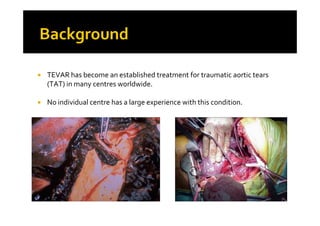
TEVAR has become an established treatment for traumatic aortic tears
(TAT) in many centres worldwide.

No individual centre has a large experience with this condition.
The aim of this project was
to establish a Queensland
registry to document the
clinical presentation,
procedural outcomes, and
follow-up results of TEVAR
for traumatic aortic injury.
Funding was obtained from the CONROD-RACS Trauma
Fellowship to establish a state-wide registry with the
agreement and participation of the Vascular Surgery Units
throughout Queensland.
 Agreement was obtained from the New Zealand Registry to
allow us to mirror their data set.

Inclusion criteria
  blunt trauma
Exclusions
  deaths before intervention
  penetrating trauma (eg GSW, fish bone)
Data was collected on a
retrospective basis on patients
already treated, and for new cases
the data is being collected on a
prospective basis.

Data sheets and a SPSS database
were developed
  Patient demographics & risk factors
  Trauma aetiology
  Procedural details including adjunctive
  procedures
  Outcomes
Between 1996 and 2010 38 patients underwent
TEVAR for blunt TAT

mean age 43 years (range 17-78)

80% (n=30) male

36 acute     < 2 weeks
 2 chronic   33 , 155 days
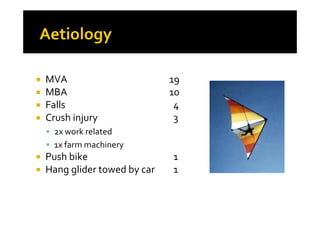
MVA                        19
MBA                        10
Falls                       4
Crush injury                3
  2x work related
  1x farm machinery
Push bike                  1
Hang glider towed by car   1
Descending TA   31
Isthmus          4
Arch             3
All had significant associated injuries, predominantly
musculoskeletal and lung injury.
40% haemodynamically unstable at some stage
preoperatively; five patients had a systolic BP <
100mmHg recorded pre-op in hospital.
GCS was normal in 63%.
ASA grade:
  ASA1   18%
  ASA2    9%
  ASA3   27%
  ASA4   46%
Patient ID

Mean time between admission and surgery was 180 hr, 12 min (range 34
mins - 155 days); Median 11 hours, 19 mins
For the acute (<2 week) patients 55 hours, 5 minutes
42% (n=15) had their TEVAR on the day of admission
34% (n=13) had their TEVAR on day two.
One half had surgery outside normal hours.
All procedures were performed under GA in a:
 Surgical Theatre 22
 Endovascular Suite 10
 Radiology Suite     6
Femoral in 36 cases (95%)
Iliac in two patients
 one direct CIA access
 one iliac conduit
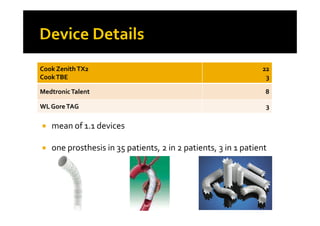
Cook Zenith TX2                                                22
Cook TBE                                                        3

Medtronic Talent                                                8

WL Gore TAG                                                     3

   mean of 1.1 devices

   one prosthesis in 35 patients, 2 in 2 patients, 3 in 1 patient
Intra-operative antihypertensive   – 3 (9 %)

Intra-operative heparin            – 27 (73%)
left SCA was
covered in 11
cases (29%)

no other arch
vessels were
covered
Two patients required ilio-femoral bypass grafts
for iliac vessel injury.
No patient required conversion to open repair.
Mean procedure time was 2 hrs and 15 mins
(median 2:01; range 59 mins – 4:45)


                                            Patient ID
no procedures were abandoned
no conversions to open repair

2 patients required further stent-grafting during their initial
admission for proximal and distal endoleaks

1 perioperative death due to multisystem failure (2.6%)

morbidity occurred in 23 patients (42%).
Graft related
  2 endoleaks required further stenting – 1 endoleak persists

Neurological
  There was no instance of paraparesis / paraplegia
  1 TIA ( blurred vision in right eye for few minutes)

Other
  4 patients had groin / access site complications
     1 infection and 3 fluid collection/haematoma
  4 post implantation fever with no defined sepsis
  4 prolonged ventilation and 2 others suffered pneumonia
  1 patient suffered a PE and received an IVC filter
  2 patients developed ARF (not requiring dialysis)
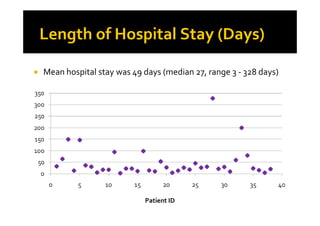
Mean hospital stay was 49 days (median 27, range 3 - 328 days)


                          Patient ID
FU range 10 days– 11 years
37 alive at last FU
17 lost to FU (refuse travel / treatment / reviews elsewhere)
Mean FU for 20 patients still under surveillance = 20.4
months
1 persisting endoleak – no further treatment so far
1 left CCA-SCA bypass for arm claudication and subclavian
steal symptoms @ 2years post TEVAR
1 left CCA-SCA bypass for arm claudication @ 5 weeks –
complicated by post-op Horner’s syndrome
1 persistent L thigh numbness from groin incision @ 28 weeks
The early results of TEVAR for TAT in Queensland patients are
comparable to those reported by other centers around the world

Low in hospital and 30 day mortality (2.6%)

No paraplegia

Low stent graft related complication rate

No Migration

Significant hospital LOS

Concerning loss to FU (45%)
Long-term surveillance will enable us to determine the late outcome
and durability of this technique particularly in younger individuals.


In the future, it is hoped to combine with the NZ Registry, and ultimately
to expand to a bi-national online registry including all states and
territories and encompassing all indications for TEVAR as already occurs
in NZ.
Thank you

Traumatic aortic tear

  • 1.
    TEVAR for traumaticaortic tear: The Queensland experience. Adeli B, Gale J, Boyne N, McGahan T, Jackson M, Golledge J, Wu R, Buckenham T, Walker PJ. Department of Vascular Surgery, Royal Brisbane & Women’s Hospital, University of Queensland, Department of Surgery and Centre for Clinical Research, Brisbane, Australia.
  • 2.
    TEVAR has becomean established treatment for traumatic aortic tears (TAT) in many centres worldwide. No individual centre has a large experience with this condition.
  • 3.
    The aim ofthis project was to establish a Queensland registry to document the clinical presentation, procedural outcomes, and follow-up results of TEVAR for traumatic aortic injury.
  • 4.
    Funding was obtainedfrom the CONROD-RACS Trauma Fellowship to establish a state-wide registry with the agreement and participation of the Vascular Surgery Units throughout Queensland. Agreement was obtained from the New Zealand Registry to allow us to mirror their data set. Inclusion criteria blunt trauma Exclusions deaths before intervention penetrating trauma (eg GSW, fish bone)
  • 5.
    Data was collectedon a retrospective basis on patients already treated, and for new cases the data is being collected on a prospective basis. Data sheets and a SPSS database were developed Patient demographics & risk factors Trauma aetiology Procedural details including adjunctive procedures Outcomes
  • 6.
    Between 1996 and2010 38 patients underwent TEVAR for blunt TAT mean age 43 years (range 17-78) 80% (n=30) male 36 acute < 2 weeks 2 chronic 33 , 155 days
  • 7.
    MVA 19 MBA 10 Falls 4 Crush injury 3 2x work related 1x farm machinery Push bike 1 Hang glider towed by car 1
  • 8.
    Descending TA 31 Isthmus 4 Arch 3
  • 9.
    All had significantassociated injuries, predominantly musculoskeletal and lung injury. 40% haemodynamically unstable at some stage preoperatively; five patients had a systolic BP < 100mmHg recorded pre-op in hospital. GCS was normal in 63%. ASA grade: ASA1 18% ASA2 9% ASA3 27% ASA4 46%
  • 10.
    Patient ID Mean timebetween admission and surgery was 180 hr, 12 min (range 34 mins - 155 days); Median 11 hours, 19 mins For the acute (<2 week) patients 55 hours, 5 minutes
  • 11.
    42% (n=15) hadtheir TEVAR on the day of admission 34% (n=13) had their TEVAR on day two. One half had surgery outside normal hours.
  • 12.
    All procedures wereperformed under GA in a: Surgical Theatre 22 Endovascular Suite 10 Radiology Suite 6
  • 13.
    Femoral in 36cases (95%) Iliac in two patients one direct CIA access one iliac conduit
  • 14.
    Cook Zenith TX2 22 Cook TBE 3 Medtronic Talent 8 WL Gore TAG 3 mean of 1.1 devices one prosthesis in 35 patients, 2 in 2 patients, 3 in 1 patient
  • 15.
    Intra-operative antihypertensive – 3 (9 %) Intra-operative heparin – 27 (73%)
  • 16.
    left SCA was coveredin 11 cases (29%) no other arch vessels were covered
  • 17.
    Two patients requiredilio-femoral bypass grafts for iliac vessel injury. No patient required conversion to open repair.
  • 18.
    Mean procedure timewas 2 hrs and 15 mins (median 2:01; range 59 mins – 4:45) Patient ID
  • 19.
    no procedures wereabandoned no conversions to open repair 2 patients required further stent-grafting during their initial admission for proximal and distal endoleaks 1 perioperative death due to multisystem failure (2.6%) morbidity occurred in 23 patients (42%).
  • 20.
    Graft related 2 endoleaks required further stenting – 1 endoleak persists Neurological There was no instance of paraparesis / paraplegia 1 TIA ( blurred vision in right eye for few minutes) Other 4 patients had groin / access site complications 1 infection and 3 fluid collection/haematoma 4 post implantation fever with no defined sepsis 4 prolonged ventilation and 2 others suffered pneumonia 1 patient suffered a PE and received an IVC filter 2 patients developed ARF (not requiring dialysis)
  • 21.
    Mean hospital staywas 49 days (median 27, range 3 - 328 days) Patient ID
  • 22.
    FU range 10days– 11 years 37 alive at last FU 17 lost to FU (refuse travel / treatment / reviews elsewhere) Mean FU for 20 patients still under surveillance = 20.4 months 1 persisting endoleak – no further treatment so far 1 left CCA-SCA bypass for arm claudication and subclavian steal symptoms @ 2years post TEVAR 1 left CCA-SCA bypass for arm claudication @ 5 weeks – complicated by post-op Horner’s syndrome 1 persistent L thigh numbness from groin incision @ 28 weeks
  • 23.
    The early resultsof TEVAR for TAT in Queensland patients are comparable to those reported by other centers around the world Low in hospital and 30 day mortality (2.6%) No paraplegia Low stent graft related complication rate No Migration Significant hospital LOS Concerning loss to FU (45%)
  • 24.
    Long-term surveillance willenable us to determine the late outcome and durability of this technique particularly in younger individuals. In the future, it is hoped to combine with the NZ Registry, and ultimately to expand to a bi-national online registry including all states and territories and encompassing all indications for TEVAR as already occurs in NZ.
  • 25.