A Novel Approach to Simultaneous Selection of
Surrogate Models, Constitutive Kernels, and
Hyper-parameter Values
Ali Mehmani*, Souma Chowdhury#, and Achille Messac#
* Syracuse University, Department of Mechanical and Aerospace Engineering
# Mississippi State University, Bagley College of Engineering
10th Multi-Disciplinary Design Optimization Conference
AIAA Science and Technology Forum and Exposition
January 13 – 17, 2014 National Harbor, Maryland
Surrogate model
• Surrogate models are commonly used for providing a tractable and
inexpensive approximation of the actual system behavior in many
routine engineering analysis and design activities:
2
Surrogate model
• Surrogate models are commonly used for providing a tractable and
inexpensive approximation of the actual system behavior in many
routine engineering analysis and design activities:
3
Kriging . . .Model Type RBF SVR
Kernel / basis function
Linear Exponential Gaussian Cubic Multiquadric . . .
Hyper-parameter
Correlation parameter Shape parameter . . .
𝒇 𝒙 =
𝒊=𝟏
𝒏
𝒘𝒊 𝝍( 𝒙 − 𝒙𝒊
)
𝝍 𝒓 = (𝒓 𝟐
+ 𝒄 𝟐
) 𝟏/𝟐
𝒓= 𝒙 − 𝒙𝒊
𝒄𝒍𝒐𝒘𝒆𝒓
< 𝒄 < 𝒄 𝒖𝒑𝒑𝒆𝒓
Research Objective
 Develop a new model selection approach, which
simultaneously select the best model type, kernel function, and
hyper-parameter.
4
Types of model Types of basis/kernel Hyper-parameter(s)
• RBF,
• Kriging,
• E-RBF,
• SVR,
• QRS,
• …
• Linear
• Gaussian
• Multiquadric
• Inverse multiquadric
• Kriging
• …
• Shape parameter in RBF,
• Smoothness and width
parameters in Kriging,
• Kernel parameter in SVM,
• …
Presentation Outline
5
• Surrogate model selection
• REES-based Model Selection
• 3-Level model selection
• Regional Error Estimation of Surrogate (REES)
• Numerical Examples
• Concluding Remarks
Surrogate model selection
6
• Dimension and nature of sample points,
• Level of a noise,
• Application domain,
• …
Suitable Surrogate
Error measures are used to
select the best surrogate
Experienced-based model selection
Automated model selection
• RMSE,
• Cross-validation,
• REES,
• …
 Hyper-parameter selection (Kriging-Guassian) using cross validation and
maximum likelihood estimation (Martin and Simpson)
 Model type and basis function selection using cross validation (Viana and Haftka)
 Model type selection using leave-one-out cross validation (Drik Gorisson et al.)
3-Level model selection
7
 In 3-level model selection, the selection criteria could depend
on the user preference.
Standard surrogate-based analysis
Structural optimization applications
lower median error
lower maximum error
3-Level model selection
8
Median error
Maximum error
Two model selection criteria
evaluated using advanced surrogate error
estimation method presented in REES
 Depending on the problem and the available data set, the
median and maximum errors might be
mutually conflicting
mutually promoting
Pareto models
A single optimum model
3-Level model selection
9
 To implement a 3-level model selection, two approaches are
proposed:
(i) Cascaded technique, and
(ii) One-Step technique.
3-Level model selection
10
Cascaded technique
 For each candidate kernel function, hyper-parameter optimization is
performed to minimize the median and maximum error.
 Post hyper-parameter optimizations,
Pareto filter is used to reach the final
Pareto models.
 Hyper-parameter optimization is
the process of quantitative search to
find optimum hyper-parameter
value(s).
3-Level model selection
11
Cascaded technique
Solutions of the hyper-parameter optimization in the cascaded
technique for multiquadric basis function of RBF surrogate for
Baranin-hoo function
3-Level model selection
12
One-Step technique
 To escape the potentially high computational cost of the cascaded
technique
Subjected to
The three-level model selection could also be performed by solving
a single uniquely formulated mixed integer nonlinear
programming (MINLP) problem.
model type
basis function
hyper-parameter(s)
Regional Error Estimation of Surrogate
(REES)
13
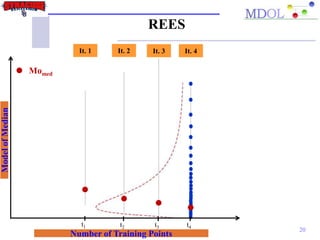
The REES method is derived from the hypothesis that the accuracy of
approximation models is related to the amount of data resources
leveraged to train the model.
• Mehmani, A., Chowdhury, S., Zhang, Jie, and Messac, A., “Quantifying Regional Error in
Surrogates by Modeling its Relationship with Sample Density,” 54th
AIAA/ASME/ASCE/AHS/ASC Structures, Structural Dynamics and Materials Conference,
Paper No. AIAA 2013-1751, Boston, Massachusetts, April 8-11, 2013.
• Mehmani, et. al., “Model Selection based on Generalized-Regional Error Estimation for
Surrogate,” 10th World Congress on Structural and Multidisciplinary Optimization, Paper No.
5447, Orlando, Florida, May 19-24, 2013.
• Mehmani, et. al.., “Regional Error Estimation of Surrogates (REES),” 14th AIAA/ISSMO
Multidisciplinary Analysis and Optimization Conference, Paper No. AIAA 2012-5707,
Indianapolis, Indiana, September 17-19, 2012.
REES
Sample Point
Surrogate Model
Training Point
Test Point
Training Point
1st Iter.
2nd Iter.
3rd Iter.
4th Iter.
Error
Surrogate
ε1
ε2
ε3
ε4
?
8 16
12 12
16 8
20 4
24 0
1st
2nd
3rd
4th
REES
Test Point
Training Point
1st
MedianofRAEs
1st
ε = 𝒎𝒆𝒅 |
𝒇𝒊 − 𝒇𝒊
𝒇𝒊
| ,
𝐢 = 𝟏, … , 𝟏𝟔
Actual modelIntermediate
surrogate model
...
REES
16
17
MedianofRAEs
Momed
Number of Training Points
t1 t2 t3 t4
It. 1
REES
18
MedianofRAEs
Number of Training Points
t1 t2 t3 t4
Momed
It. 2It. 1
REES
19
MedianofRAEs
Number of Training Points
t1 t2 t3 t4
Momed
It. 3It. 2It. 1
REES
20
It. 3It. 1
MedianofRAEs
Number of Training Points
t1 t2 t3 t4
It. 2
Momed
It. 4
ModelofMedian
REES
21
It. 3It. 1
MedianofRAEs
Number of Training Points
t1 t2 t3 t4
It. 2
Momed
It. 4
ModelofMedian
Predicted Median Error
REES
22
It. 3It. 1
MedianofRAEs
Number of Training Points
t1 t2 t3 t4
It. 2
Momed
It. 4
ModelofMedian
Momax Mode of maximum
error distribution at
each iteration
Predicted Median Error
Predicted Maximum Error
REES
23
The effectiveness of the new 3-level model selection method is
investigated by considering the following three candidate surrogates:
The methods are implemented on three benchmark problems and an
engineering design problem are tested.
Gaussian basis function
Multiquadric basis function
Gaussian correlation function
Exponential correlation function
Radial basis kernel function
Sigmoid kernel function
SVR
RBF
Kriging
Model type Kernel function Hyper-parameter
Numerical Examples
24
Numerical Setting
 The numerical settings for the implementation of REES-based model selection
for the benchmark problems
 The numerical settings for the hyper-parameter optimization
Numerical Examples
24
25
Hyper-parameter optimization of Cascaded technique in different surrogate type and
Kernel functions for Branin-Hoo function with 2 design variables
Numerical Examples
26
Numerical Setting
 The numerical settings for One-Step technique
Integer design variables
Numerical Examples
27
Results; Branin-hoo 2 design variables
Computational cost
One-Step Technique
Cascaded technique
RBF-Multiquadric
28
Cascaded technique
Actual error
RBF-Multiquadric
One-Step Technique
Results; Branin-hoo 2 design variables
RBF-Multiquadric
29
Computational cost
One-Step Technique
Cascaded technique
Results; Hartmann function with 6 design variables
SVR-Radial basis
30
Cascaded technique
Results; Hartmann function with 6 design variables
One-Step Technique
SVR-Radial basis
Actual error
SVR-Radial basis
31
Computational cost
Cascaded technique
Results; Dixon & Price function with 18 design variables
One-Step Technique
RBF-Multiquadric
32
Cascaded technique
One-Step Technique
RBF-Multiquadric
Actual error
RBF-Multiquadric
Results; Dixon & Price function with 18 design variables
33
Numerical Examples
Initial Value Final Solution
Emax EmaxEmax
Emed Emed Emed
RBF-Multiquadric (C=0.9)
34
Concluding Remarks
 A new 3-level model selection approach is developed to select the best
surrogate among available surrogate candidates based on the level of
accuracy.
 This approach is based on the model independent error measure given by the
Regional Error Estimation of Surrogates (REES) method.
 The preliminary results on problems indicate at least 60% reduction in
maximum and median error values.
(i) model type selection,
(ii) kernel function selection, and
(iii) hyper-parameter selection.
35
Future Work
 Implementation of One-Step technique with
 larger pool of surrogates with different number of kernels
 higher dimensional and more computationally intensive problems
 Develop an open online platform called Collaborative Surrogate
Model Selection (COSMOS) to allow users to submit
- training data for identifying an ideal model from existing pool
of surrogate models, and
- their own new surrogate into the pool of surrogate candidates.
If interested in COSMOS please contact me at amehmani@syr.edu
Acknowledgement
 I would like to acknowledge my research adviser
Prof. Achille Messac, and my co-adviser Dr.
Souma Chowdhury for their immense help and
support in this research.
 I would also like to thank my friend and colleague
Weiyang Tong for his valuable contributions to this
paper.
 Support from the NSF Awards is also
acknowledged.
36
Questions
and
Comments
37
Thank you
Quantifying the mode of median and maximum errors
38
39
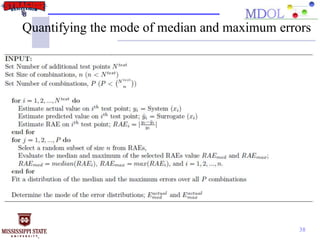
A chi-square (χ2) goodness-of-fit criterion is used to select the
type of distribution from a list of candidates such as lognormal,
Gamma, Weibull, logistic, log logistic, inverse Gaussian, and
generalized extreme value distribution.

AIAA-SciTech-ModelSelection-2014-Mehmani

  • 1.
    A Novel Approachto Simultaneous Selection of Surrogate Models, Constitutive Kernels, and Hyper-parameter Values Ali Mehmani*, Souma Chowdhury#, and Achille Messac# * Syracuse University, Department of Mechanical and Aerospace Engineering # Mississippi State University, Bagley College of Engineering 10th Multi-Disciplinary Design Optimization Conference AIAA Science and Technology Forum and Exposition January 13 – 17, 2014 National Harbor, Maryland
  • 2.
    Surrogate model • Surrogatemodels are commonly used for providing a tractable and inexpensive approximation of the actual system behavior in many routine engineering analysis and design activities: 2
  • 3.
    Surrogate model • Surrogatemodels are commonly used for providing a tractable and inexpensive approximation of the actual system behavior in many routine engineering analysis and design activities: 3 Kriging . . .Model Type RBF SVR Kernel / basis function Linear Exponential Gaussian Cubic Multiquadric . . . Hyper-parameter Correlation parameter Shape parameter . . . 𝒇 𝒙 = 𝒊=𝟏 𝒏 𝒘𝒊 𝝍( 𝒙 − 𝒙𝒊 ) 𝝍 𝒓 = (𝒓 𝟐 + 𝒄 𝟐 ) 𝟏/𝟐 𝒓= 𝒙 − 𝒙𝒊 𝒄𝒍𝒐𝒘𝒆𝒓 < 𝒄 < 𝒄 𝒖𝒑𝒑𝒆𝒓
  • 4.
    Research Objective  Developa new model selection approach, which simultaneously select the best model type, kernel function, and hyper-parameter. 4 Types of model Types of basis/kernel Hyper-parameter(s) • RBF, • Kriging, • E-RBF, • SVR, • QRS, • … • Linear • Gaussian • Multiquadric • Inverse multiquadric • Kriging • … • Shape parameter in RBF, • Smoothness and width parameters in Kriging, • Kernel parameter in SVM, • …
  • 5.
    Presentation Outline 5 • Surrogatemodel selection • REES-based Model Selection • 3-Level model selection • Regional Error Estimation of Surrogate (REES) • Numerical Examples • Concluding Remarks
  • 6.
    Surrogate model selection 6 •Dimension and nature of sample points, • Level of a noise, • Application domain, • … Suitable Surrogate Error measures are used to select the best surrogate Experienced-based model selection Automated model selection • RMSE, • Cross-validation, • REES, • …  Hyper-parameter selection (Kriging-Guassian) using cross validation and maximum likelihood estimation (Martin and Simpson)  Model type and basis function selection using cross validation (Viana and Haftka)  Model type selection using leave-one-out cross validation (Drik Gorisson et al.)
  • 7.
    3-Level model selection 7 In 3-level model selection, the selection criteria could depend on the user preference. Standard surrogate-based analysis Structural optimization applications lower median error lower maximum error
  • 8.
    3-Level model selection 8 Medianerror Maximum error Two model selection criteria evaluated using advanced surrogate error estimation method presented in REES  Depending on the problem and the available data set, the median and maximum errors might be mutually conflicting mutually promoting Pareto models A single optimum model
  • 9.
    3-Level model selection 9 To implement a 3-level model selection, two approaches are proposed: (i) Cascaded technique, and (ii) One-Step technique.
  • 10.
    3-Level model selection 10 Cascadedtechnique  For each candidate kernel function, hyper-parameter optimization is performed to minimize the median and maximum error.  Post hyper-parameter optimizations, Pareto filter is used to reach the final Pareto models.  Hyper-parameter optimization is the process of quantitative search to find optimum hyper-parameter value(s).
  • 11.
    3-Level model selection 11 Cascadedtechnique Solutions of the hyper-parameter optimization in the cascaded technique for multiquadric basis function of RBF surrogate for Baranin-hoo function
  • 12.
    3-Level model selection 12 One-Steptechnique  To escape the potentially high computational cost of the cascaded technique Subjected to The three-level model selection could also be performed by solving a single uniquely formulated mixed integer nonlinear programming (MINLP) problem. model type basis function hyper-parameter(s)
  • 13.
    Regional Error Estimationof Surrogate (REES) 13 The REES method is derived from the hypothesis that the accuracy of approximation models is related to the amount of data resources leveraged to train the model. • Mehmani, A., Chowdhury, S., Zhang, Jie, and Messac, A., “Quantifying Regional Error in Surrogates by Modeling its Relationship with Sample Density,” 54th AIAA/ASME/ASCE/AHS/ASC Structures, Structural Dynamics and Materials Conference, Paper No. AIAA 2013-1751, Boston, Massachusetts, April 8-11, 2013. • Mehmani, et. al., “Model Selection based on Generalized-Regional Error Estimation for Surrogate,” 10th World Congress on Structural and Multidisciplinary Optimization, Paper No. 5447, Orlando, Florida, May 19-24, 2013. • Mehmani, et. al.., “Regional Error Estimation of Surrogates (REES),” 14th AIAA/ISSMO Multidisciplinary Analysis and Optimization Conference, Paper No. AIAA 2012-5707, Indianapolis, Indiana, September 17-19, 2012.
  • 14.
  • 15.
    Test Point Training Point 1stIter. 2nd Iter. 3rd Iter. 4th Iter. Error Surrogate ε1 ε2 ε3 ε4 ? 8 16 12 12 16 8 20 4 24 0 1st 2nd 3rd 4th REES
  • 16.
    Test Point Training Point 1st MedianofRAEs 1st ε= 𝒎𝒆𝒅 | 𝒇𝒊 − 𝒇𝒊 𝒇𝒊 | , 𝐢 = 𝟏, … , 𝟏𝟔 Actual modelIntermediate surrogate model ... REES 16
  • 17.
    17 MedianofRAEs Momed Number of TrainingPoints t1 t2 t3 t4 It. 1 REES
  • 18.
    18 MedianofRAEs Number of TrainingPoints t1 t2 t3 t4 Momed It. 2It. 1 REES
  • 19.
    19 MedianofRAEs Number of TrainingPoints t1 t2 t3 t4 Momed It. 3It. 2It. 1 REES
  • 20.
    20 It. 3It. 1 MedianofRAEs Numberof Training Points t1 t2 t3 t4 It. 2 Momed It. 4 ModelofMedian REES
  • 21.
    21 It. 3It. 1 MedianofRAEs Numberof Training Points t1 t2 t3 t4 It. 2 Momed It. 4 ModelofMedian Predicted Median Error REES
  • 22.
    22 It. 3It. 1 MedianofRAEs Numberof Training Points t1 t2 t3 t4 It. 2 Momed It. 4 ModelofMedian Momax Mode of maximum error distribution at each iteration Predicted Median Error Predicted Maximum Error REES
  • 23.
    23 The effectiveness ofthe new 3-level model selection method is investigated by considering the following three candidate surrogates: The methods are implemented on three benchmark problems and an engineering design problem are tested. Gaussian basis function Multiquadric basis function Gaussian correlation function Exponential correlation function Radial basis kernel function Sigmoid kernel function SVR RBF Kriging Model type Kernel function Hyper-parameter Numerical Examples
  • 24.
    24 Numerical Setting  Thenumerical settings for the implementation of REES-based model selection for the benchmark problems  The numerical settings for the hyper-parameter optimization Numerical Examples 24
  • 25.
    25 Hyper-parameter optimization ofCascaded technique in different surrogate type and Kernel functions for Branin-Hoo function with 2 design variables Numerical Examples
  • 26.
    26 Numerical Setting  Thenumerical settings for One-Step technique Integer design variables Numerical Examples
  • 27.
    27 Results; Branin-hoo 2design variables Computational cost One-Step Technique Cascaded technique RBF-Multiquadric
  • 28.
    28 Cascaded technique Actual error RBF-Multiquadric One-StepTechnique Results; Branin-hoo 2 design variables RBF-Multiquadric
  • 29.
    29 Computational cost One-Step Technique Cascadedtechnique Results; Hartmann function with 6 design variables SVR-Radial basis
  • 30.
    30 Cascaded technique Results; Hartmannfunction with 6 design variables One-Step Technique SVR-Radial basis Actual error SVR-Radial basis
  • 31.
    31 Computational cost Cascaded technique Results;Dixon & Price function with 18 design variables One-Step Technique RBF-Multiquadric
  • 32.
    32 Cascaded technique One-Step Technique RBF-Multiquadric Actualerror RBF-Multiquadric Results; Dixon & Price function with 18 design variables
  • 33.
    33 Numerical Examples Initial ValueFinal Solution Emax EmaxEmax Emed Emed Emed RBF-Multiquadric (C=0.9)
  • 34.
    34 Concluding Remarks  Anew 3-level model selection approach is developed to select the best surrogate among available surrogate candidates based on the level of accuracy.  This approach is based on the model independent error measure given by the Regional Error Estimation of Surrogates (REES) method.  The preliminary results on problems indicate at least 60% reduction in maximum and median error values. (i) model type selection, (ii) kernel function selection, and (iii) hyper-parameter selection.
  • 35.
    35 Future Work  Implementationof One-Step technique with  larger pool of surrogates with different number of kernels  higher dimensional and more computationally intensive problems  Develop an open online platform called Collaborative Surrogate Model Selection (COSMOS) to allow users to submit - training data for identifying an ideal model from existing pool of surrogate models, and - their own new surrogate into the pool of surrogate candidates. If interested in COSMOS please contact me at amehmani@syr.edu
  • 36.
    Acknowledgement  I wouldlike to acknowledge my research adviser Prof. Achille Messac, and my co-adviser Dr. Souma Chowdhury for their immense help and support in this research.  I would also like to thank my friend and colleague Weiyang Tong for his valuable contributions to this paper.  Support from the NSF Awards is also acknowledged. 36
  • 37.
  • 38.
    Quantifying the modeof median and maximum errors 38
  • 39.
    39 A chi-square (χ2)goodness-of-fit criterion is used to select the type of distribution from a list of candidates such as lognormal, Gamma, Weibull, logistic, log logistic, inverse Gaussian, and generalized extreme value distribution.