Adaptive Sequential Sampling 
for 
Surrogate-based Design Optimization 
Ali Mehmani*, Jie Zhang#, Souma Chowdhury# and Achille Messac* 
* Syracuse University, Department of Mechanical and Aerospace Engineering 
# Rensselaer Polytechnic Institute, Department of Mechanical, Aerospace, and Nuclear Engineering 
53rd AIAA/ASME/ASCE/AHS/ASC Structures, Structural Dynamics and 
Materials Conference, 
23 - 26 April 2012 
Honolulu, Hawaii
Surrogate-based Optimization - Overview 
• Design optimization problems often involve computationally 
intensive simulation models or expensive experiment-based 
system evaluations. 
• Use of mathematical approximation models (Surrogate) in 
design optimization are effective tools for reducing the 
computational cost and filtering numerical noise of these 
simulation models. 
• In surrogate-based design optimization, expensive objective 
and/or constraint functions are substituted by accurate surrogate 
models. 
2
Research Motivation 
 In spite of the recent developments in surrogate modeling 
techniques, the low fidelity of these models often limits their use in 
practical engineering design optimization. 
 When such surrogates are used for optimization, it becomes 
challenging to find the optimum/optima with certainty. 
 Sequential sampling methods offer a powerful solution to this 
challenge by providing the surrogate with reasonable accuracy 
where and when needed. 
3
Research Objectives 
 Develop a new methodology to perform surrogate-based 
design optimization using a sequential sampling method to 
improve the accuracy of the surrogate in 
• the region of the current global optimum (local exploitation) and, 
• the regions of higher relative errors (global exploration). 
 The proposed method adds infill points in the region of global 
optimum as well as in the locations where the surrogate model 
has relatively high errors. 
4
Presentation Outline 
• Surrogate-based Design Optimization Review 
• Adaptive Sequential Sampling method for SBDO 
 Cross-Validation error 
 Cross-Over operator 
 Surrogate-based design optimization by using ASS method 
• Numerical examples: results and discussion 
• Concluding remarks 
5
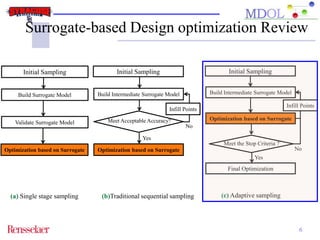
Surrogate-based Design optimization Review 
6 
Initial Sampling 
Build Surrogate Model 
Validate Surrogate Model 
Optimization based on Surrogate 
Initial Sampling 
Build Intermediate Surrogate Model 
Infill Points 
Meet Acceptable Accuracy? 
Yes 
Optimization based on Surrogate 
No 
Initial Sampling 
Build Intermediate Surrogate Model 
Optimization based on Surrogate 
Meet the Stop Criteria ? 
(a) Single stage sampling (b)Traditional sequential sampling (c) Adaptive sampling 
Infill Points 
Final Optimization 
No 
Yes
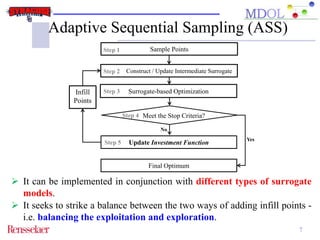
Adaptive Sequential Sampling (ASS) 
 It can be implemented in conjunction with different types of surrogate 
7 
Sample Points 
Construct / Update Intermediate Surrogate 
Surrogate-based Optimization 
Update Investment Function 
Final Optimum 
Step 1 
Step 2 
Step 3 
Step 4 Meet the Stop Criteria? 
No 
Infill 
Points 
Yes 
Step 5 
models. 
 It seeks to strike a balance between the two ways of adding infill points - 
i.e. balancing the exploitation and exploration.
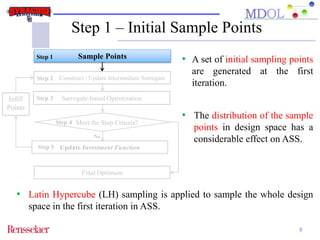
Step 1 – Initial Sample Points 
Sample Points 
Construct / Update Intermediate Surrogate 
Surrogate-based Optimization 
Update Investment Function 
• Latin Hypercube (LH) sampling is applied to sample the whole design 
8 
space in the first iteration in ASS. 
Infill 
Points 
Final Optimum 
Step 1 
Step 2 
Step 3 
Step 4 Meet the Stop Criteria? 
No 
Step 5 
• A set of initial sampling points 
are generated at the first 
iteration. 
• The distribution of the sample 
points in design space has a 
considerable effect on ASS.
Step 2 – Intermediate Surrogate Model 
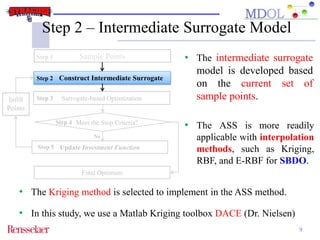
• The intermediate surrogate 
model is developed based 
on the current set of 
sample points. 
• The ASS is more readily 
applicable with interpolation 
methods, such as Kriging, 
RBF, and E-RBF for SBDO. 
9 
Sample Points 
Construct Intermediate Surrogate 
Surrogate-based Optimization 
Step 4 Meet the Stop Criteria? 
No 
Update Investment Function 
Final Optimum 
Step 1 
Step 2 
Step 3 
Infill 
Points 
Step 5 
• The Kriging method is selected to implement in the ASS method. 
• In this study, we use a Matlab Kriging toolbox DACE (Dr. Nielsen)
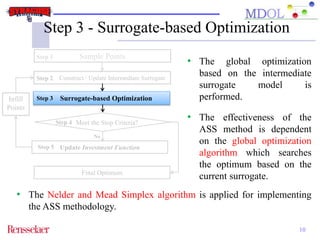
Step 3 - Surrogate-based Optimization 
• The effectiveness of the 
ASS method is dependent 
on the global optimization 
algorithm which searches 
the optimum based on the 
current surrogate. 
Sample Points 
Construct / Update Intermediate Surrogate 
Surrogate-based Optimization 
Step 4 Meet the Stop Criteria? 
No 
Update Investment Function 
Final Optimum 
Step 1 
Step 2 
Step 3 
• The Nelder and Mead Simplex algorithm is applied for implementing 
10 
the ASS methodology. 
Infill 
Points 
Step 5 
• The global optimization 
based on the intermediate 
surrogate model is 
performed.
Step 4 – Stopping Criteria 
11 
Sample Points 
Construct / Update Intermediate Surrogate 
Surrogate-based Optimization 
Update Investment Function 
Final Optimum 
Step 1 
Step 2 
Step 3 
Step 4 
Meet the Stop Criteria? 
No 
Infill 
Points 
Step 5 
Yes
Step 4 – Stopping Criteria 
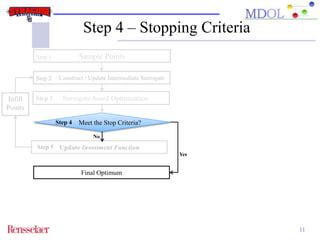
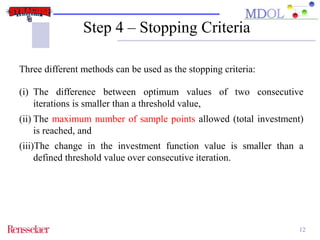
Three different methods can be used as the stopping criteria: 
(i) The difference between optimum values of two consecutive 
12 
iterations is smaller than a threshold value, 
(ii) The maximum number of sample points allowed (total investment) 
is reached, and 
(iii)The change in the investment function value is smaller than a 
defined threshold value over consecutive iteration.
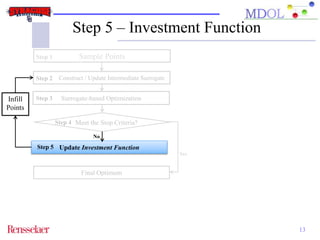
Step 5 – Investment Function 
13 
Sample Points 
Construct / Update Intermediate Surrogate 
Surrogate-based Optimization 
Update Investment Function 
Final Optimum 
Step 1 
Step 2 
Step 3 
Step 4 Meet the Stop Criteria? 
No 
Infill 
Points 
Step 5 
Yes
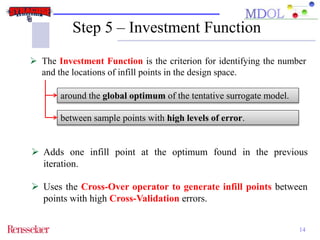
Step 5 – Investment Function 
 The Investment Function is the criterion for identifying the number 
14 
and the locations of infill points in the design space. 
around the global optimum of the tentative surrogate model. 
between sample points with high levels of error. 
 Adds one infill point at the optimum found in the previous 
iteration. 
 Uses the Cross-Over operator to generate infill points between 
points with high Cross-Validation errors.
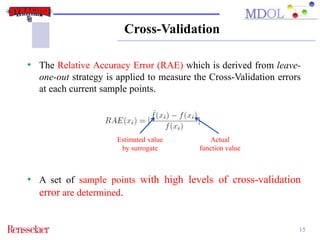
Cross-Validation 
• The Relative Accuracy Error (RAE) which is derived from leave-one- 
out strategy is applied to measure the Cross-Validation errors 
15 
at each current sample points. 
• A set of sample points with high levels of cross-validation 
error are determined. 
Actual 
function value 
Estimated value 
by surrogate
Cross-Over 
• This operator is used to combine information from two current 
16 
sample points with high levels of cross-validation error. 
• The Intermediate Recombination method is only applicable to real 
variables to combine the genetic material of two parents. 
α represents a scaling factor, and is chosen randomly between the 
interval [−d, 1 + d]. 
• In this study, the standard intermediate recombination is used and 
the value of d is assumed to be zero (d = 0)
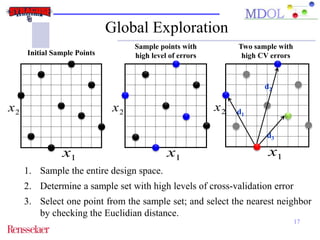
Global Exploration 
17 
1 x 
2 x 
1 x 
2 x 
1. Sample the entire design space. 
2. Determine a sample set with high levels of cross-validation error 
3. Select one point from the sample set; and select the nearest neighbor 
by checking the Euclidian distance. 
1 x 
2 x d1 
d2 
d3 
Initial Sample Points 
Sample points with 
high level of errors 
Two sample with 
high CV errors
Global Exploration 
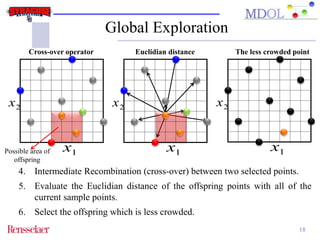
Cross-over operator Euclidian distance The less crowded point 
18 
Possible area of 
offspring 
1 x 
2 x 
1 x 
2 x 
1 x 
2 x 
4. Intermediate Recombination (cross-over) between two selected points. 
5. Evaluate the Euclidian distance of the offspring points with all of the 
current sample points. 
6. Select the offspring which is less crowded.
Numerical Examples 
• The ASS method is validated using the following numerical test 
19 
problems: 
1) 1-variable function; 
2) Booth function; 
3) Hartmann function with 3 variables; and 
4) Hartmann function with 6 variables.
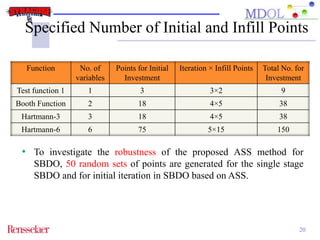
Specified Number of Initial and Infill Points 
20 
Function No. of 
variables 
Points for Initial 
Investment 
Iteration × Infill Points Total No. for 
Investment 
Test function 1 1 3 3×2 9 
Booth Function 2 18 4×5 38 
Hartmann-3 3 18 4×5 38 
Hartmann-6 6 75 5×15 150 
• To investigate the robustness of the proposed ASS method for 
SBDO, 50 random sets of points are generated for the single stage 
SBDO and for initial iteration in SBDO based on ASS.
21 
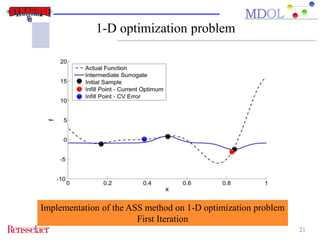
1-D optimization problem 
Implementation of the ASS method on 1-D optimization problem 
First Iteration
22 
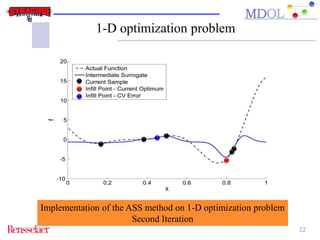
1-D optimization problem 
Implementation of the ASS method on 1-D optimization problem 
Second Iteration
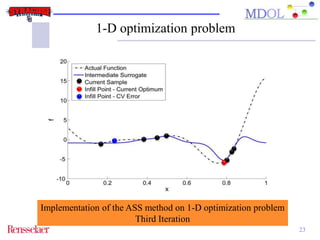
23 
1-D optimization problem 
Implementation of the ASS method on 1-D optimization problem 
Third Iteration
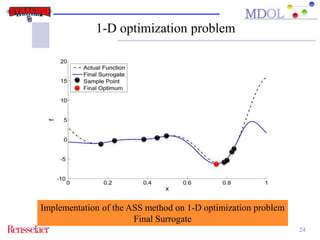
24 
1-D optimization problem 
Implementation of the ASS method on 1-D optimization problem 
Final Surrogate
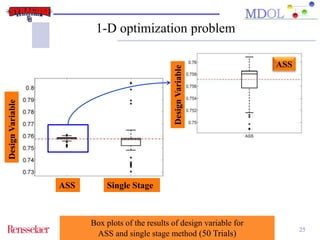
25 
1-D optimization problem 
ASS Single Stage 
Box plots of the results of design variable for 
ASS and single stage method (50 Trials) 
Design Variable 
ASS 
Design Variable
26 
1-D optimization problem 
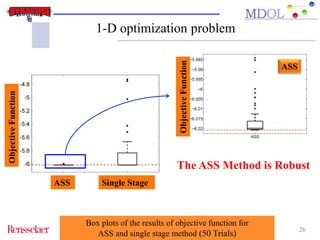
Box plots of the results of objective function for 
ASS and single stage method (50 Trials) 
ASS 
Objective Function 
ASS Single Stage 
Objective Function 
The ASS Method is Robust
1-D optimization problem 
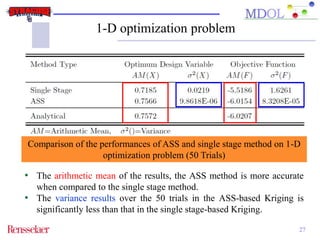
Comparison of the performances of ASS and single stage method on 1-D 
27 
optimization problem (50 Trials) 
• The arithmetic mean of the results, the ASS method is more accurate 
when compared to the single stage method. 
• The variance results over the 50 trials in the ASS-based Kriging is 
significantly less than that in the single stage-based Kriging.
28 
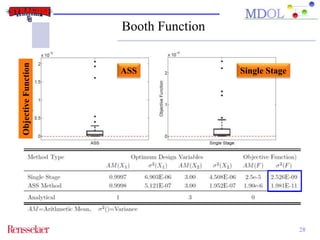
Booth Function 
ASS Single Stage 
Objective Function
29 
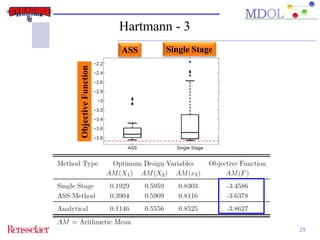
Hartmann - 3 
Objective Function 
ASS Single Stage
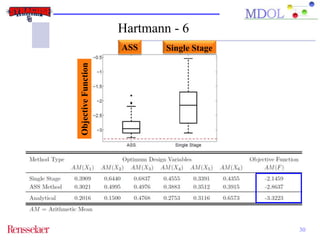
30 
Hartmann - 6 
Objective Function 
ASS Single Stage
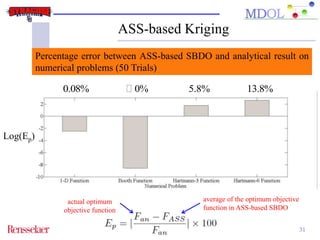
31 
ASS-based Kriging 
Percentage error between ASS-based SBDO and analytical result on 
numerical problems (50 Trials) 
0.08% 0% 5.8% 13.8% 
actual optimum 
objective function 
average of the optimum objective 
function in ASS-based SBDO 
Log(Ep)
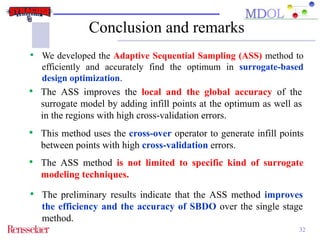
Conclusion and remarks 
• We developed the Adaptive Sequential Sampling (ASS) method to 
efficiently and accurately find the optimum in surrogate-based 
design optimization. 
• The ASS improves the local and the global accuracy of the 
surrogate model by adding infill points at the optimum as well as 
in the regions with high cross-validation errors. 
• This method uses the cross-over operator to generate infill points 
• The preliminary results indicate that the ASS method improves 
the efficiency and the accuracy of SBDO over the single stage 
method. 
32 
between points with high cross-validation errors. 
• The ASS method is not limited to specific kind of surrogate 
modeling techniques.
Future work 
• Apply other robust heuristic algorithms such as Particle 
33 
Swarm Optimization to perform SBDO 
• Apply special criteria for adaptively identifying the suitable 
number of infill points at each iteration during the SBDO 
process.
Acknowledgement 
• I would like to acknowledge my research adviser Prof. 
Achille Messac, for his immense help and support in this 
research. 
• I would also like to thank my friends and colleagues Jie 
Zhang and Souma Chowdhury for their valuable 
contributions to this paper. 
• Support from the NSF Awards is also acknowledged. 
34
Thank you 
Questions 
and 
Comments

ASS_SDM2012_Ali

  • 1.
    Adaptive Sequential Sampling for Surrogate-based Design Optimization Ali Mehmani*, Jie Zhang#, Souma Chowdhury# and Achille Messac* * Syracuse University, Department of Mechanical and Aerospace Engineering # Rensselaer Polytechnic Institute, Department of Mechanical, Aerospace, and Nuclear Engineering 53rd AIAA/ASME/ASCE/AHS/ASC Structures, Structural Dynamics and Materials Conference, 23 - 26 April 2012 Honolulu, Hawaii
  • 2.
    Surrogate-based Optimization -Overview • Design optimization problems often involve computationally intensive simulation models or expensive experiment-based system evaluations. • Use of mathematical approximation models (Surrogate) in design optimization are effective tools for reducing the computational cost and filtering numerical noise of these simulation models. • In surrogate-based design optimization, expensive objective and/or constraint functions are substituted by accurate surrogate models. 2
  • 3.
    Research Motivation In spite of the recent developments in surrogate modeling techniques, the low fidelity of these models often limits their use in practical engineering design optimization.  When such surrogates are used for optimization, it becomes challenging to find the optimum/optima with certainty.  Sequential sampling methods offer a powerful solution to this challenge by providing the surrogate with reasonable accuracy where and when needed. 3
  • 4.
    Research Objectives Develop a new methodology to perform surrogate-based design optimization using a sequential sampling method to improve the accuracy of the surrogate in • the region of the current global optimum (local exploitation) and, • the regions of higher relative errors (global exploration).  The proposed method adds infill points in the region of global optimum as well as in the locations where the surrogate model has relatively high errors. 4
  • 5.
    Presentation Outline •Surrogate-based Design Optimization Review • Adaptive Sequential Sampling method for SBDO  Cross-Validation error  Cross-Over operator  Surrogate-based design optimization by using ASS method • Numerical examples: results and discussion • Concluding remarks 5
  • 6.
    Surrogate-based Design optimizationReview 6 Initial Sampling Build Surrogate Model Validate Surrogate Model Optimization based on Surrogate Initial Sampling Build Intermediate Surrogate Model Infill Points Meet Acceptable Accuracy? Yes Optimization based on Surrogate No Initial Sampling Build Intermediate Surrogate Model Optimization based on Surrogate Meet the Stop Criteria ? (a) Single stage sampling (b)Traditional sequential sampling (c) Adaptive sampling Infill Points Final Optimization No Yes
  • 7.
    Adaptive Sequential Sampling(ASS)  It can be implemented in conjunction with different types of surrogate 7 Sample Points Construct / Update Intermediate Surrogate Surrogate-based Optimization Update Investment Function Final Optimum Step 1 Step 2 Step 3 Step 4 Meet the Stop Criteria? No Infill Points Yes Step 5 models.  It seeks to strike a balance between the two ways of adding infill points - i.e. balancing the exploitation and exploration.
  • 8.
    Step 1 –Initial Sample Points Sample Points Construct / Update Intermediate Surrogate Surrogate-based Optimization Update Investment Function • Latin Hypercube (LH) sampling is applied to sample the whole design 8 space in the first iteration in ASS. Infill Points Final Optimum Step 1 Step 2 Step 3 Step 4 Meet the Stop Criteria? No Step 5 • A set of initial sampling points are generated at the first iteration. • The distribution of the sample points in design space has a considerable effect on ASS.
  • 9.
    Step 2 –Intermediate Surrogate Model • The intermediate surrogate model is developed based on the current set of sample points. • The ASS is more readily applicable with interpolation methods, such as Kriging, RBF, and E-RBF for SBDO. 9 Sample Points Construct Intermediate Surrogate Surrogate-based Optimization Step 4 Meet the Stop Criteria? No Update Investment Function Final Optimum Step 1 Step 2 Step 3 Infill Points Step 5 • The Kriging method is selected to implement in the ASS method. • In this study, we use a Matlab Kriging toolbox DACE (Dr. Nielsen)
  • 10.
    Step 3 -Surrogate-based Optimization • The effectiveness of the ASS method is dependent on the global optimization algorithm which searches the optimum based on the current surrogate. Sample Points Construct / Update Intermediate Surrogate Surrogate-based Optimization Step 4 Meet the Stop Criteria? No Update Investment Function Final Optimum Step 1 Step 2 Step 3 • The Nelder and Mead Simplex algorithm is applied for implementing 10 the ASS methodology. Infill Points Step 5 • The global optimization based on the intermediate surrogate model is performed.
  • 11.
    Step 4 –Stopping Criteria 11 Sample Points Construct / Update Intermediate Surrogate Surrogate-based Optimization Update Investment Function Final Optimum Step 1 Step 2 Step 3 Step 4 Meet the Stop Criteria? No Infill Points Step 5 Yes
  • 12.
    Step 4 –Stopping Criteria Three different methods can be used as the stopping criteria: (i) The difference between optimum values of two consecutive 12 iterations is smaller than a threshold value, (ii) The maximum number of sample points allowed (total investment) is reached, and (iii)The change in the investment function value is smaller than a defined threshold value over consecutive iteration.
  • 13.
    Step 5 –Investment Function 13 Sample Points Construct / Update Intermediate Surrogate Surrogate-based Optimization Update Investment Function Final Optimum Step 1 Step 2 Step 3 Step 4 Meet the Stop Criteria? No Infill Points Step 5 Yes
  • 14.
    Step 5 –Investment Function  The Investment Function is the criterion for identifying the number 14 and the locations of infill points in the design space. around the global optimum of the tentative surrogate model. between sample points with high levels of error.  Adds one infill point at the optimum found in the previous iteration.  Uses the Cross-Over operator to generate infill points between points with high Cross-Validation errors.
  • 15.
    Cross-Validation • TheRelative Accuracy Error (RAE) which is derived from leave-one- out strategy is applied to measure the Cross-Validation errors 15 at each current sample points. • A set of sample points with high levels of cross-validation error are determined. Actual function value Estimated value by surrogate
  • 16.
    Cross-Over • Thisoperator is used to combine information from two current 16 sample points with high levels of cross-validation error. • The Intermediate Recombination method is only applicable to real variables to combine the genetic material of two parents. α represents a scaling factor, and is chosen randomly between the interval [−d, 1 + d]. • In this study, the standard intermediate recombination is used and the value of d is assumed to be zero (d = 0)
  • 17.
    Global Exploration 17 1 x 2 x 1 x 2 x 1. Sample the entire design space. 2. Determine a sample set with high levels of cross-validation error 3. Select one point from the sample set; and select the nearest neighbor by checking the Euclidian distance. 1 x 2 x d1 d2 d3 Initial Sample Points Sample points with high level of errors Two sample with high CV errors
  • 18.
    Global Exploration Cross-overoperator Euclidian distance The less crowded point 18 Possible area of offspring 1 x 2 x 1 x 2 x 1 x 2 x 4. Intermediate Recombination (cross-over) between two selected points. 5. Evaluate the Euclidian distance of the offspring points with all of the current sample points. 6. Select the offspring which is less crowded.
  • 19.
    Numerical Examples •The ASS method is validated using the following numerical test 19 problems: 1) 1-variable function; 2) Booth function; 3) Hartmann function with 3 variables; and 4) Hartmann function with 6 variables.
  • 20.
    Specified Number ofInitial and Infill Points 20 Function No. of variables Points for Initial Investment Iteration × Infill Points Total No. for Investment Test function 1 1 3 3×2 9 Booth Function 2 18 4×5 38 Hartmann-3 3 18 4×5 38 Hartmann-6 6 75 5×15 150 • To investigate the robustness of the proposed ASS method for SBDO, 50 random sets of points are generated for the single stage SBDO and for initial iteration in SBDO based on ASS.
  • 21.
    21 1-D optimizationproblem Implementation of the ASS method on 1-D optimization problem First Iteration
  • 22.
    22 1-D optimizationproblem Implementation of the ASS method on 1-D optimization problem Second Iteration
  • 23.
    23 1-D optimizationproblem Implementation of the ASS method on 1-D optimization problem Third Iteration
  • 24.
    24 1-D optimizationproblem Implementation of the ASS method on 1-D optimization problem Final Surrogate
  • 25.
    25 1-D optimizationproblem ASS Single Stage Box plots of the results of design variable for ASS and single stage method (50 Trials) Design Variable ASS Design Variable
  • 26.
    26 1-D optimizationproblem Box plots of the results of objective function for ASS and single stage method (50 Trials) ASS Objective Function ASS Single Stage Objective Function The ASS Method is Robust
  • 27.
    1-D optimization problem Comparison of the performances of ASS and single stage method on 1-D 27 optimization problem (50 Trials) • The arithmetic mean of the results, the ASS method is more accurate when compared to the single stage method. • The variance results over the 50 trials in the ASS-based Kriging is significantly less than that in the single stage-based Kriging.
  • 28.
    28 Booth Function ASS Single Stage Objective Function
  • 29.
    29 Hartmann -3 Objective Function ASS Single Stage
  • 30.
    30 Hartmann -6 Objective Function ASS Single Stage
  • 31.
    31 ASS-based Kriging Percentage error between ASS-based SBDO and analytical result on numerical problems (50 Trials) 0.08% 0% 5.8% 13.8% actual optimum objective function average of the optimum objective function in ASS-based SBDO Log(Ep)
  • 32.
    Conclusion and remarks • We developed the Adaptive Sequential Sampling (ASS) method to efficiently and accurately find the optimum in surrogate-based design optimization. • The ASS improves the local and the global accuracy of the surrogate model by adding infill points at the optimum as well as in the regions with high cross-validation errors. • This method uses the cross-over operator to generate infill points • The preliminary results indicate that the ASS method improves the efficiency and the accuracy of SBDO over the single stage method. 32 between points with high cross-validation errors. • The ASS method is not limited to specific kind of surrogate modeling techniques.
  • 33.
    Future work •Apply other robust heuristic algorithms such as Particle 33 Swarm Optimization to perform SBDO • Apply special criteria for adaptively identifying the suitable number of infill points at each iteration during the SBDO process.
  • 34.
    Acknowledgement • Iwould like to acknowledge my research adviser Prof. Achille Messac, for his immense help and support in this research. • I would also like to thank my friends and colleagues Jie Zhang and Souma Chowdhury for their valuable contributions to this paper. • Support from the NSF Awards is also acknowledged. 34
  • 35.
    Thank you Questions and Comments