THE CLUSTERING APPROACH TO
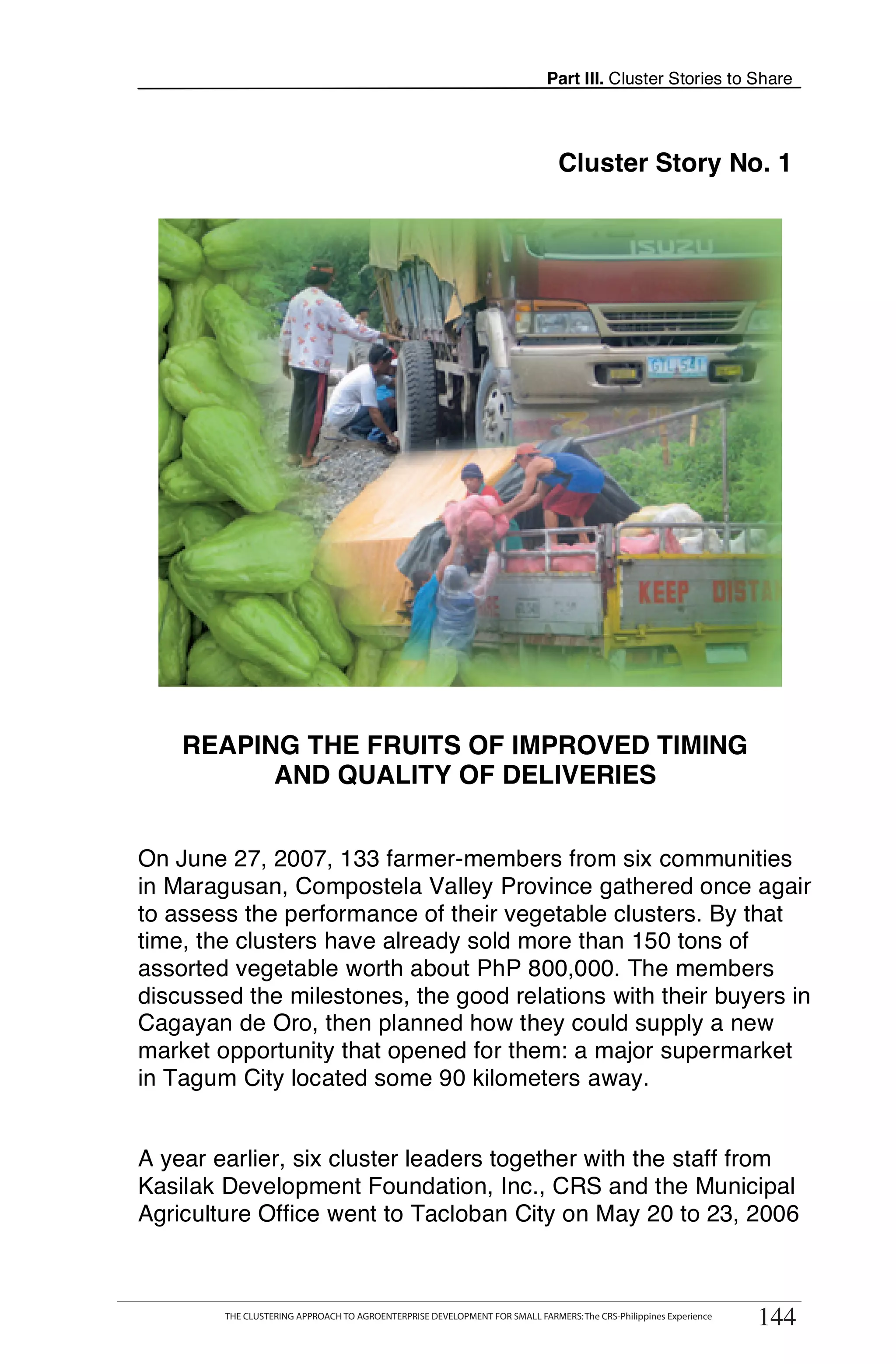
AGROENTERPRISE DEVELOPMENT
FOR SMALL FARMERS:
The CRS-Philippines Experience
A Guidebook for Facilitators
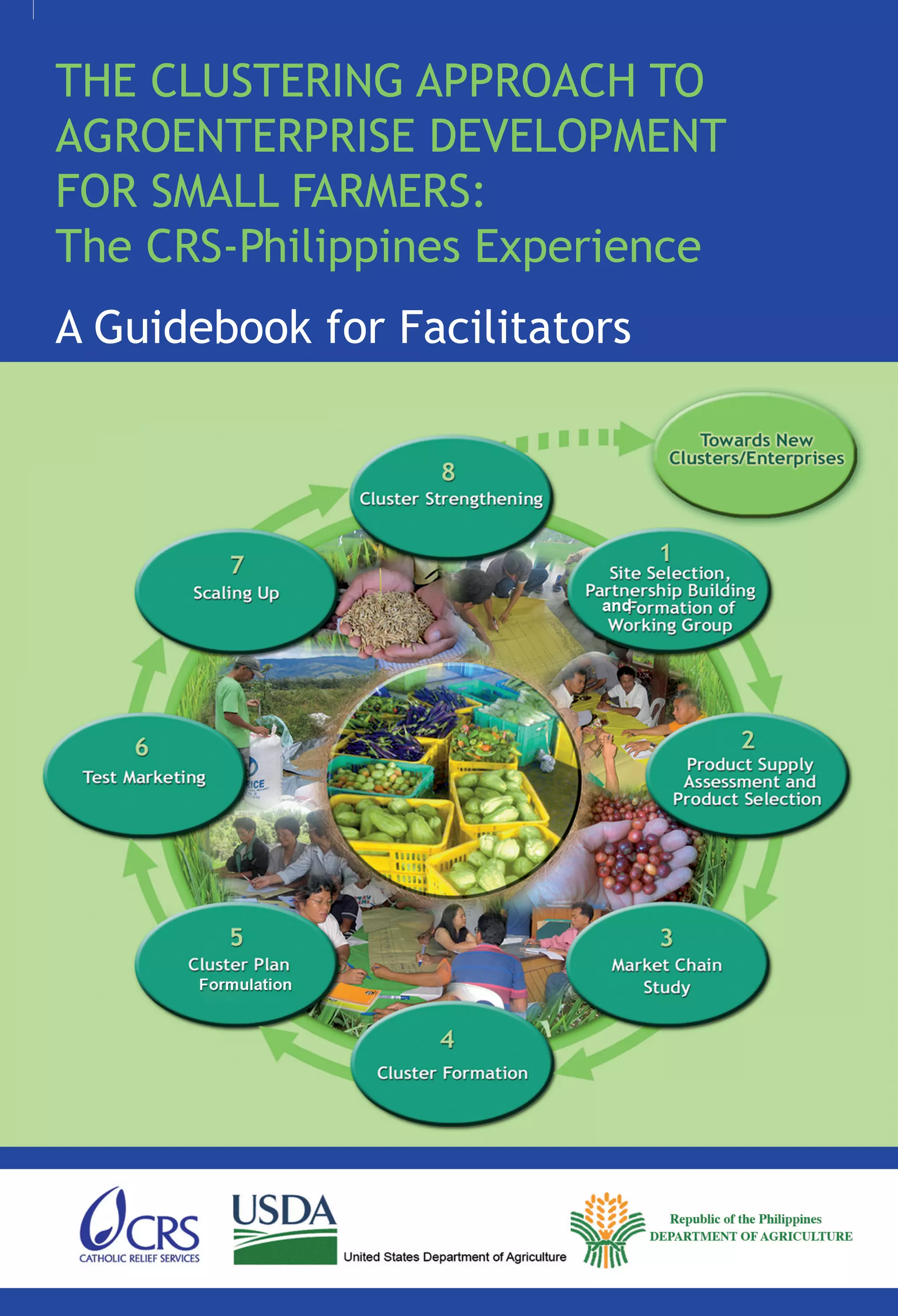
About the cover
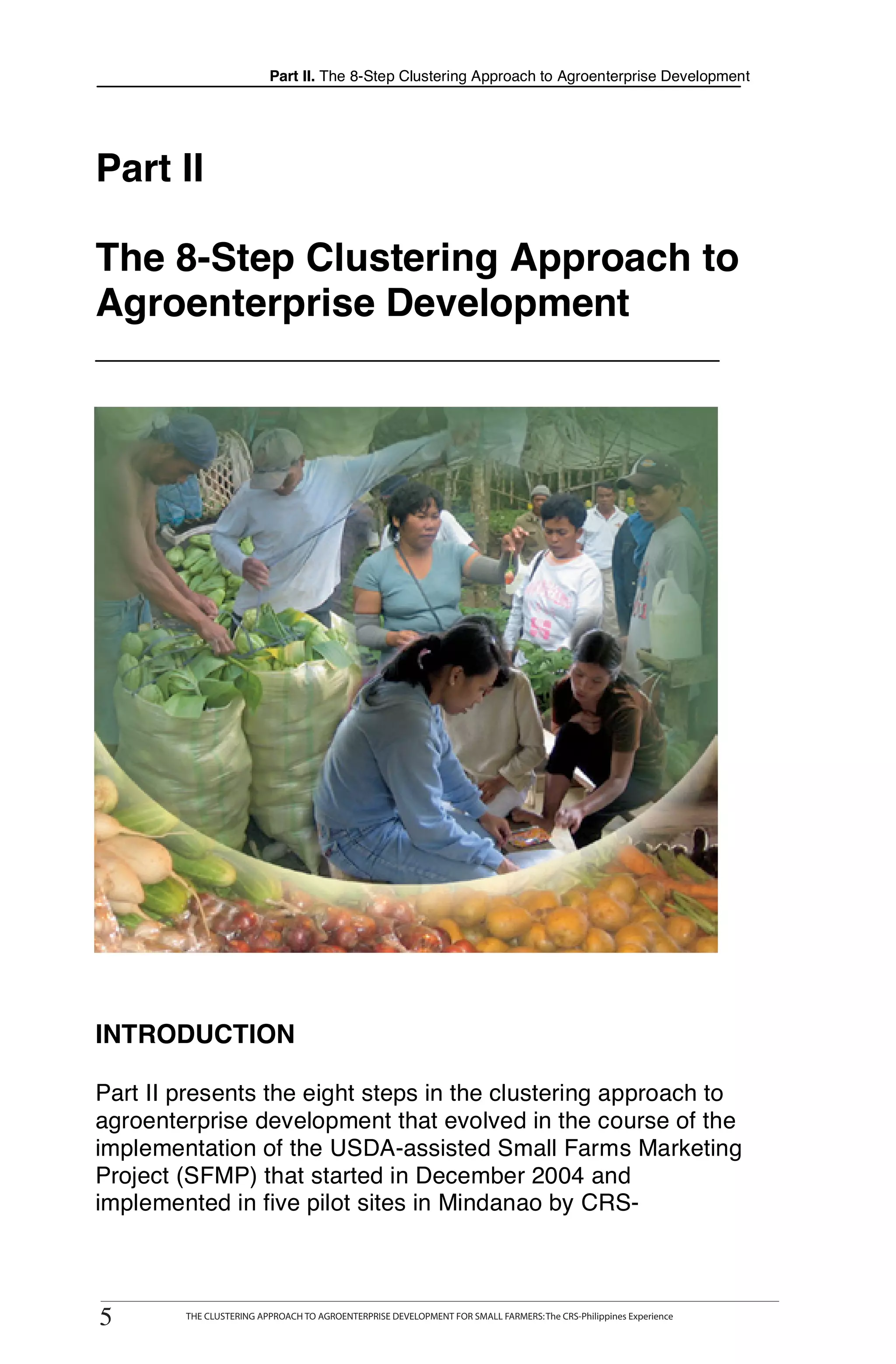
Organized clusters can be the key to successful agroenterprise
development. The illustration on the cover represents the eight-
step participatory process where clusters of small scale farmers
become active players gainfully engaging in the dynamic market.
Innovated by CRS-Philippines Agri/NRM Program from the CRS-
CIAT Learning Alliance on Agroenterprise Development, the
process continues and progresses towards the empowerment of
the clusters and the building of new ones.
THE CLUSTERING APPROACH TO
AGROENTERPRISE DEVELOPMENT
FOR SMALL FARMERS:
The CRS-Philippines Experience

A Guidebook for Facilitators
Correct Citation
CRS-Philippines. 2007. The Clustering Approach to Agroenterprise
Development for Small Farmers: The CRS-Philippines Experience.
A Guidebook for Facilitators. Davao City, Philippines.


Published by
Catholic Relief Services – USCCB
Philippine Program

ISBN 978-971-93973-0-4


For further information and feedback, please contact:
Catholic Relief Services – USCCB
Philippine Program
CBCP Building, 470 Gen. Luna Street
Intramuros, 1002 Manila
Philippines

Tel. (63 2) 527 8331 to 35
Fax (63 2) 527 4140
E-mail: crsphils@ph.seapro.crs.org
Website: www.crs.org


     This Guidebook is considered as an international public
     good. Any part of it may be quoted or reproduced provided
     the source is acknowledged and the purpose is non-profit.

     CRS-Philippines will appreciate receiving feedbacks on this
     Guidebook and copies of any publication which draws on it.


ii

     ii
Guidebook Review and
Oversight Committee

Pedro Terry R.Tuason - Chair
Program Manager, CRS Ph Agriculture and Natural Resource Management
Program

Donato Romulo C. del Castillo – Vice Chair
Program Advisor, CRS Ph Agriculture and Natural Resource Management
Program

Jessan S. Catre - Member
Marketing Project Coordinator, CRS Ph Agriculture and Natural Resource
Management Program

Floro T. Israel - Member
Marketing Project Coordinator, CRS Ph Agriculture and Natural Resource
Management Program

Lionel D. Mendoza - Member
Marketing Project Coordinator, CRS Ph Agriculture and Natural Resource
Management Program

Joan Cua Uy - Member
Marketing Consultant, CRS Ph Agriculture and Natural Resource
Management Program
Vice President for Marketing, Northern Mindanao Vegetable Producers
Association, Inc. (NorminVeggies)


                                                                         iii

                                                                     iii
Guidebook Writing Team

CRS-Philippines
Jessan S. Catre
Marketing Project Coordinator, Agriculture and Natural Resource
Management Program

Floro T. Israel
Marketing Project Coordinator, Agriculture and Natural Resource
Management Program

Lionel D. Mendoza
Marketing Project Coordinator, Agriculture and Natural Resource
Management Program

Joan Cua Uy
Marketing Consultant, Agriculture and Natural Resource Management
Program
Vice President for Marketing, Northern Mindanao Vegetable Producers
Association, Inc. (NorminVeggies)


External Writers
Dinah Q. Tabbada
Formerly Community and Institution Development and Extension Specialist
of the EU-GOP Upland Development Project in Southern Mindanao and
Development Communication Specialist of the World Agroforestry Centre
(ICRAF-Philippines).

Alexander U. Tabbada
Formerly Senior Programme Specialist and NRM Research Officer of the
World Agroforestry Centre (ICRAF-Philippines) and Agribusiness Specialist
of the USAID-Growth with Equity in Mindanao Program – Phase 1.


iv

 iv
Contents
Acronyms                                                ix
Glossary of Terms                                       xi
Preface                                                xiv
Forewords                                              xvi
Messages                                               xix
About this Guidebook                                  xxii
How to Use this Guidebook                             xxiv
Acknowledgements                                      xxv
Part I     Agroenterprise as a Strategy to              1
           Improve Well Being
           The Integral Human Development               2
           Framework
           The Agriculture/Natural Resource             3
           Management Framework
           The Agroenterprise Development               3
           Approach
Part II    The 8-step Clustering Approach to            5
           Agroenterprise Development
Step 1     Site selection, partnership building and    13
           formation of Working Group
Step 2     Product supply assessment and product       35
           selection
Step 3     Market chain study                          49
Step 4     Cluster formation                           73
Step 5     Cluster plan formulation                    89
Step 6     Test marketing                             109
Step 7     Scaling up                                 119


                                                             v

                                                         v
Step 8     Cluster strengthening                            127
Part III   Cluster Stories to Tell                          141
Story 1    Reaping the fruits of improved timing and        144
           quality of deliveries
Story 2    The cluster of hat makers in                     151
           Maguindanao
Story 3    Organizing and training for the strawberry       154
           market
Story 4    Testing the waters with dried fish               157
Story 5    The cluster moves forest coffee (and             160
           other farmers) to the market
Story 6    Missing the boat, missing the market             165
Story 7    Small, steady steps to build a marketing         169
           enterprise for Maguindanao’s organically
           grown, traditional rice
Story 8    Small Impasugong squash farmers                  173
           moving into the market with the vegetable
           industry group in Northern Mindanao
Part IV    Lessons Learned                                  177
References                                                  184

List of Figures
Figure 1     The CRS framework for Integral Human             2
             Development
Figure 2     The Agri-NRM Development Framework and           3
             Processes of CRS-Philippines

Figure 3     An illustration of the 8-step process of the     8
             clustering approach to agroenterprise
             development, CRS-Philippines experience
Figure 4     Example of a sociogram used to identify         22
             leaders among 10 pre-identified community
             members


vi

     vi
Figure 5    A sample of market chain showing the              28
            different stages and the corresponding
            business support services
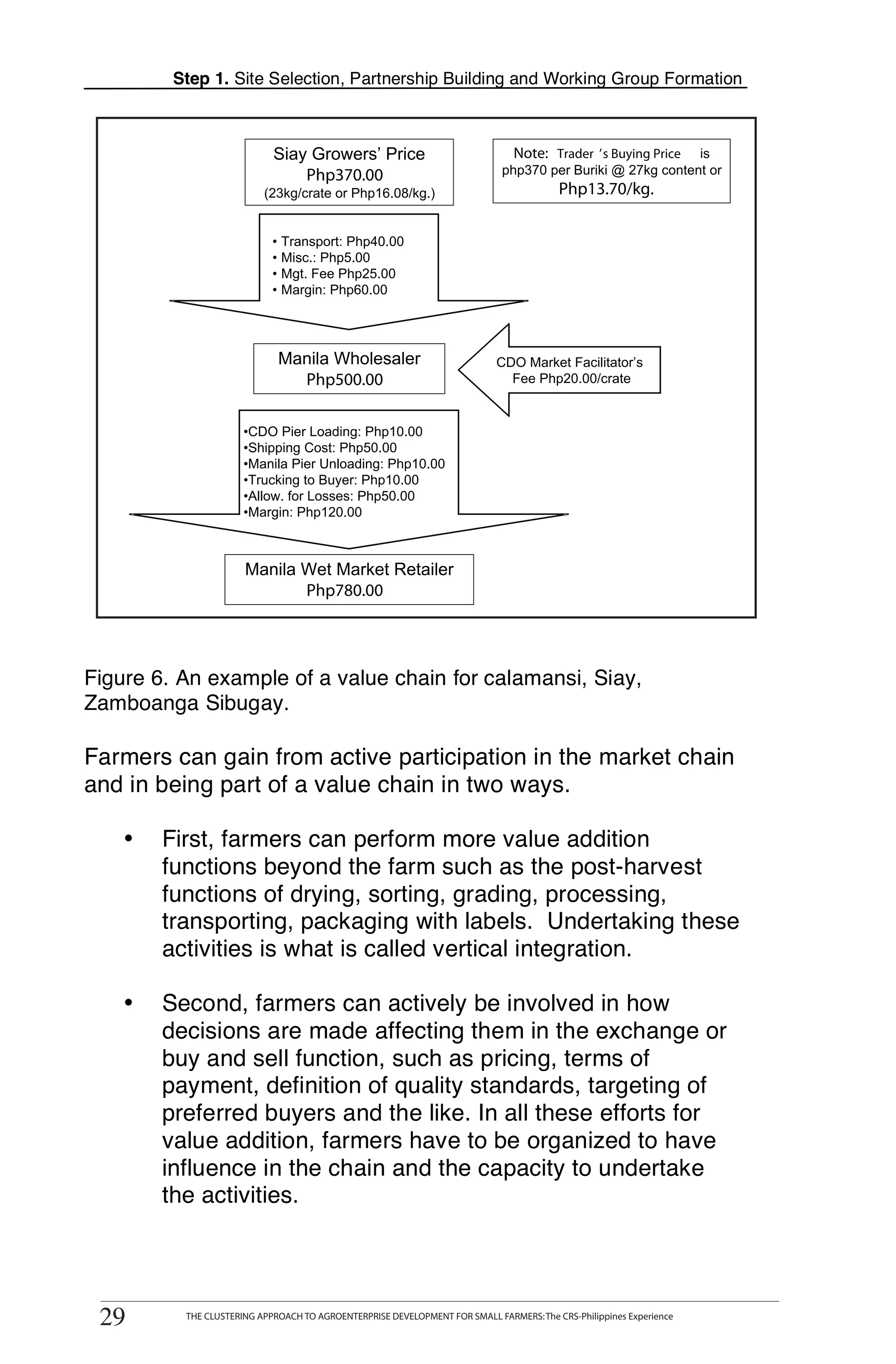
Figure 6    An example of a value chain for calamansi,        29
            Siay, Zamboanga Sibugay
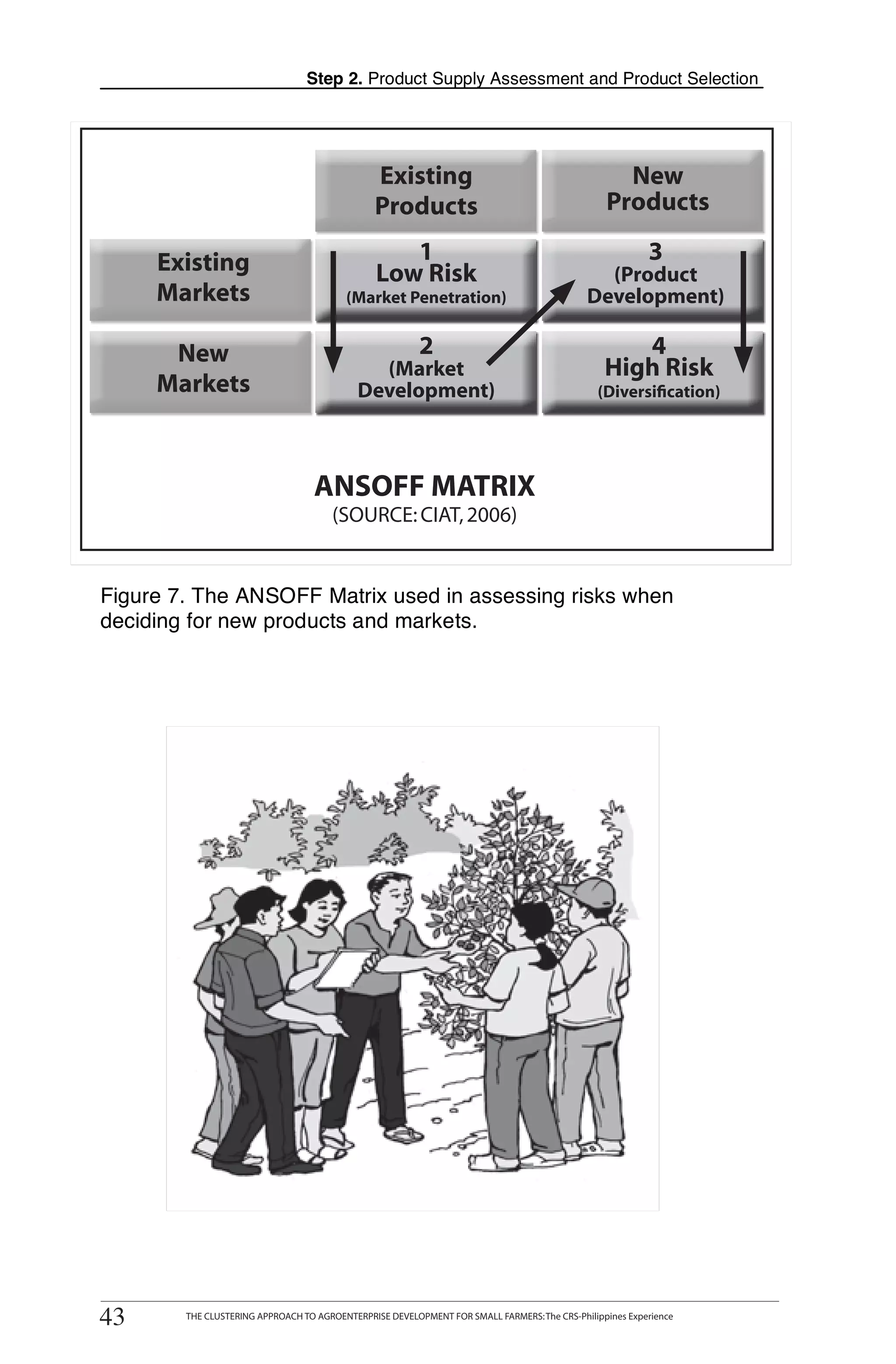
Figure 7    The ANSOFF Matrix used in assessing risks         43
            when deciding for new products & markets
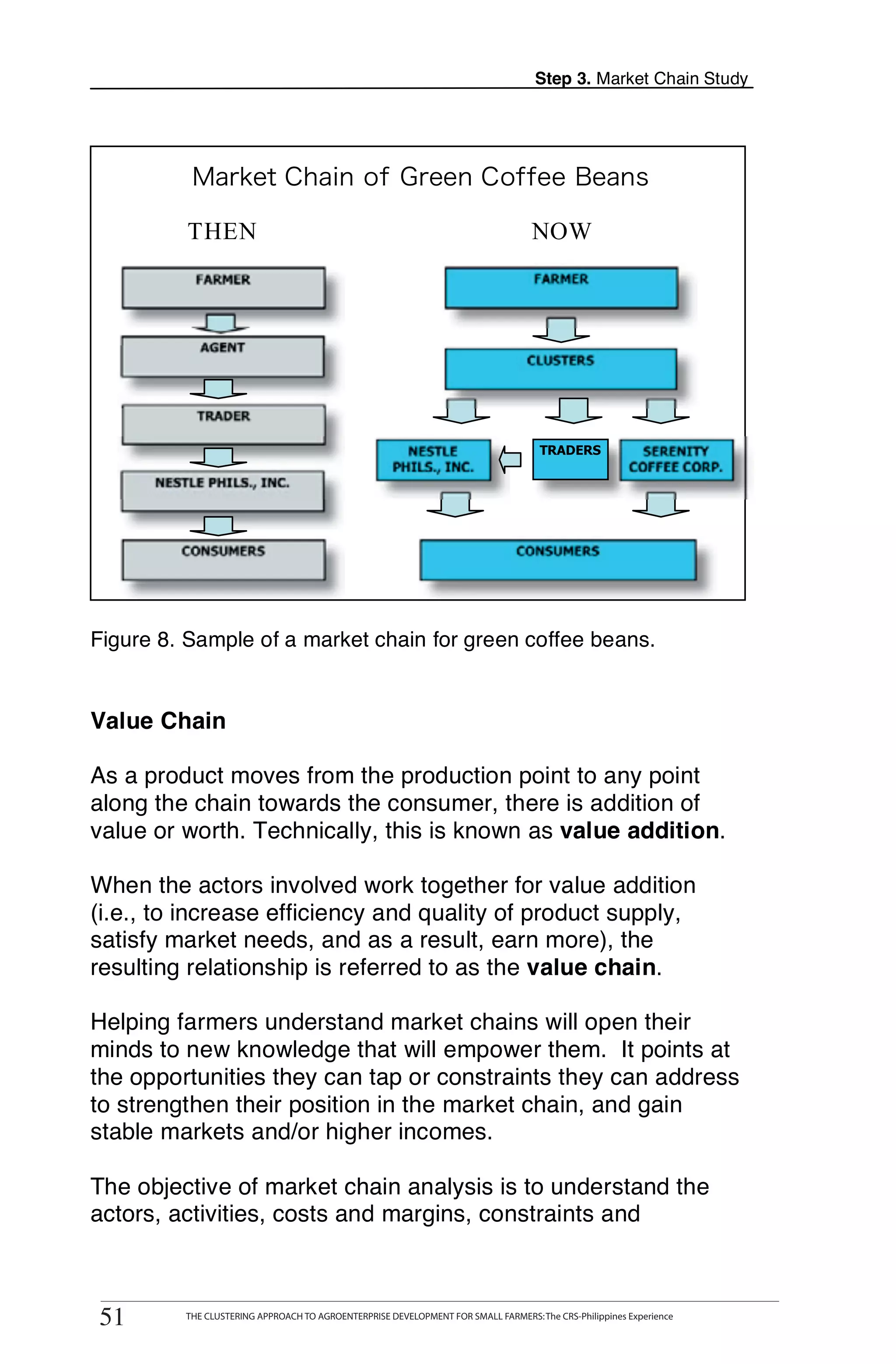
Figure 8    Sample of a market chain for green coffee         51
            beans
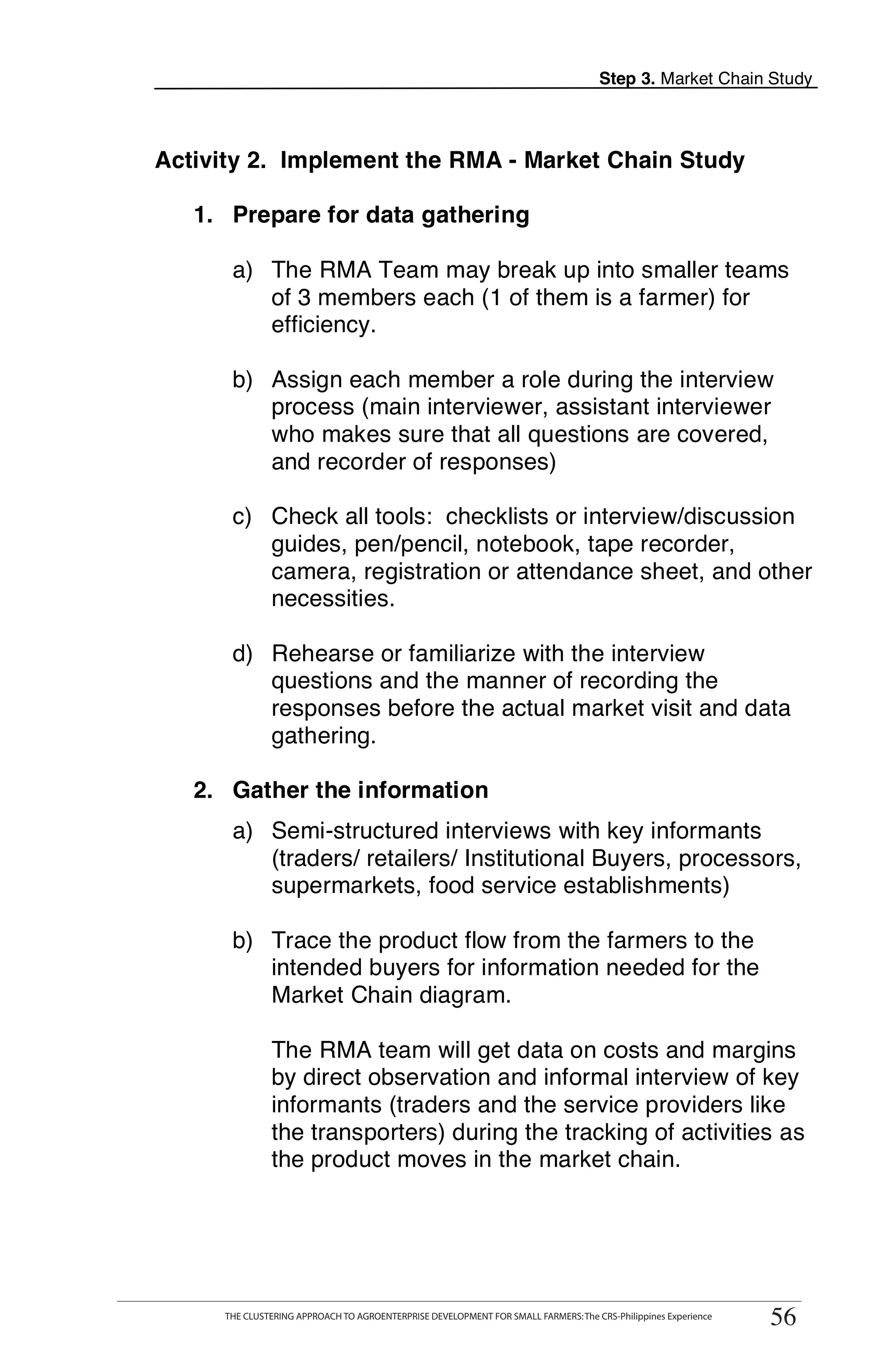
Figure 9    Market chain map drawn from a corn market         58
            chain study using the RMA
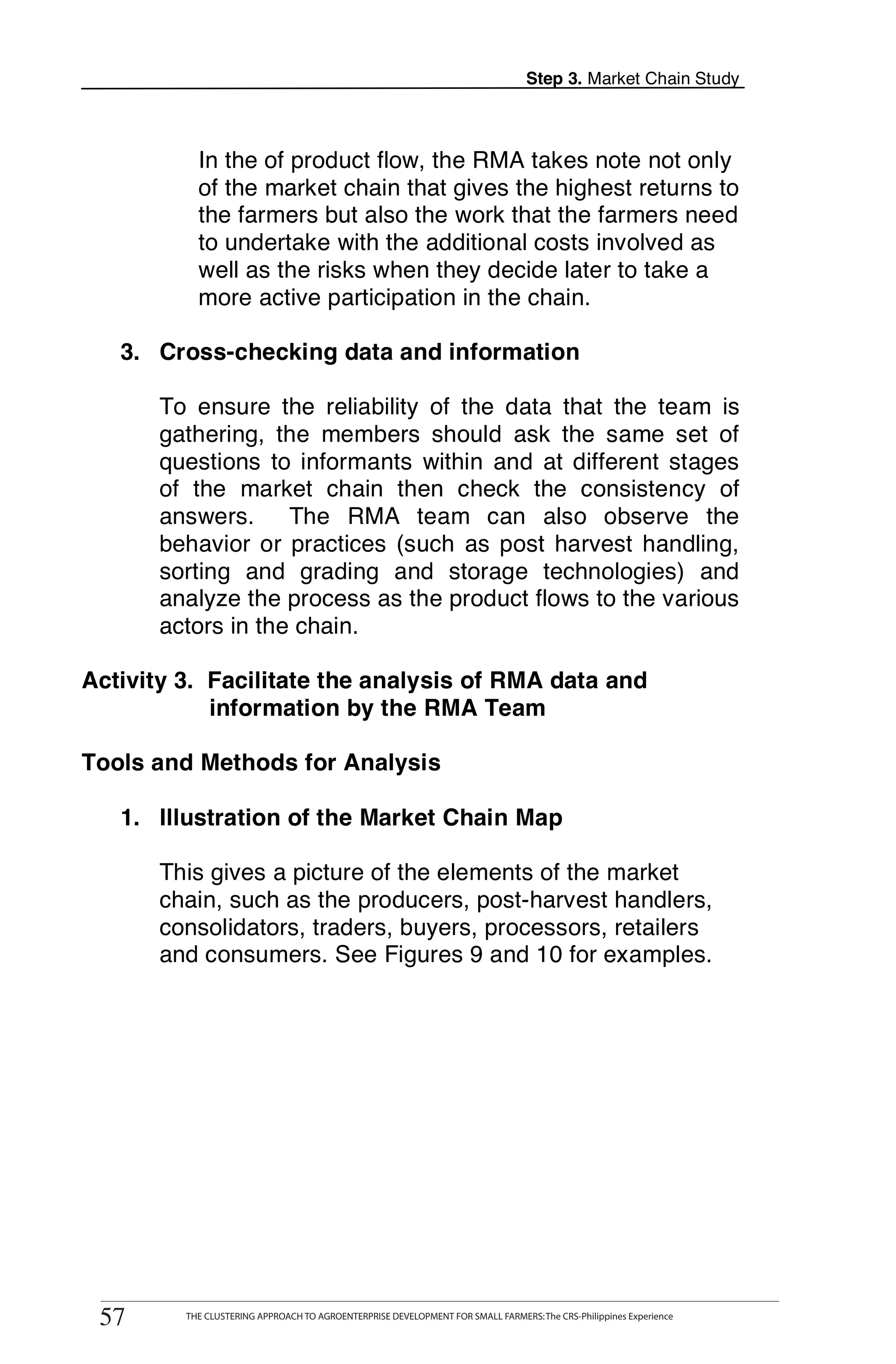
Figure 10   Market chain map drawn from a vegetable           58
            market chain study using the RMA
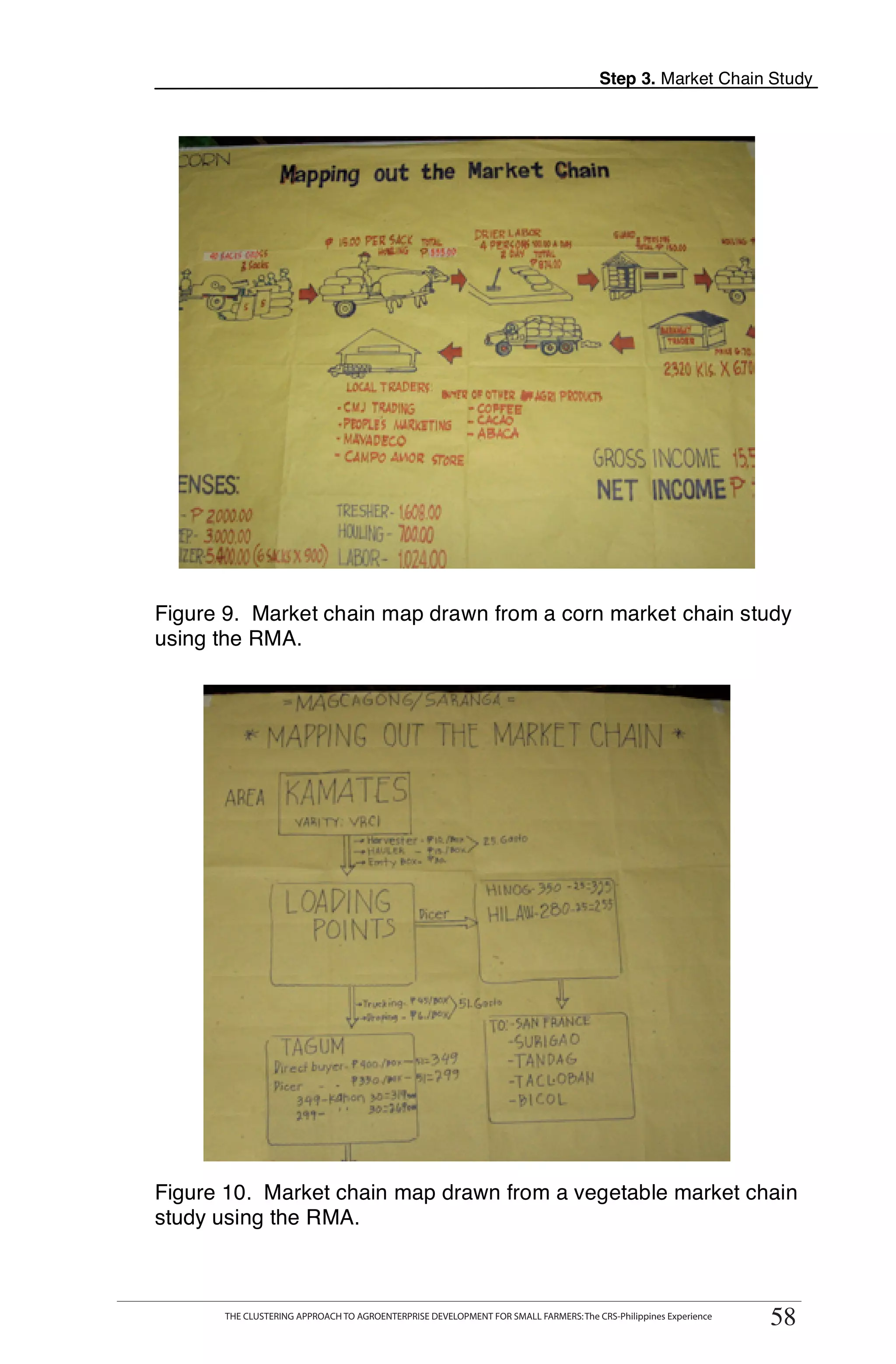
Figure 11   Example of a value chain for dried coffee         59
            beans
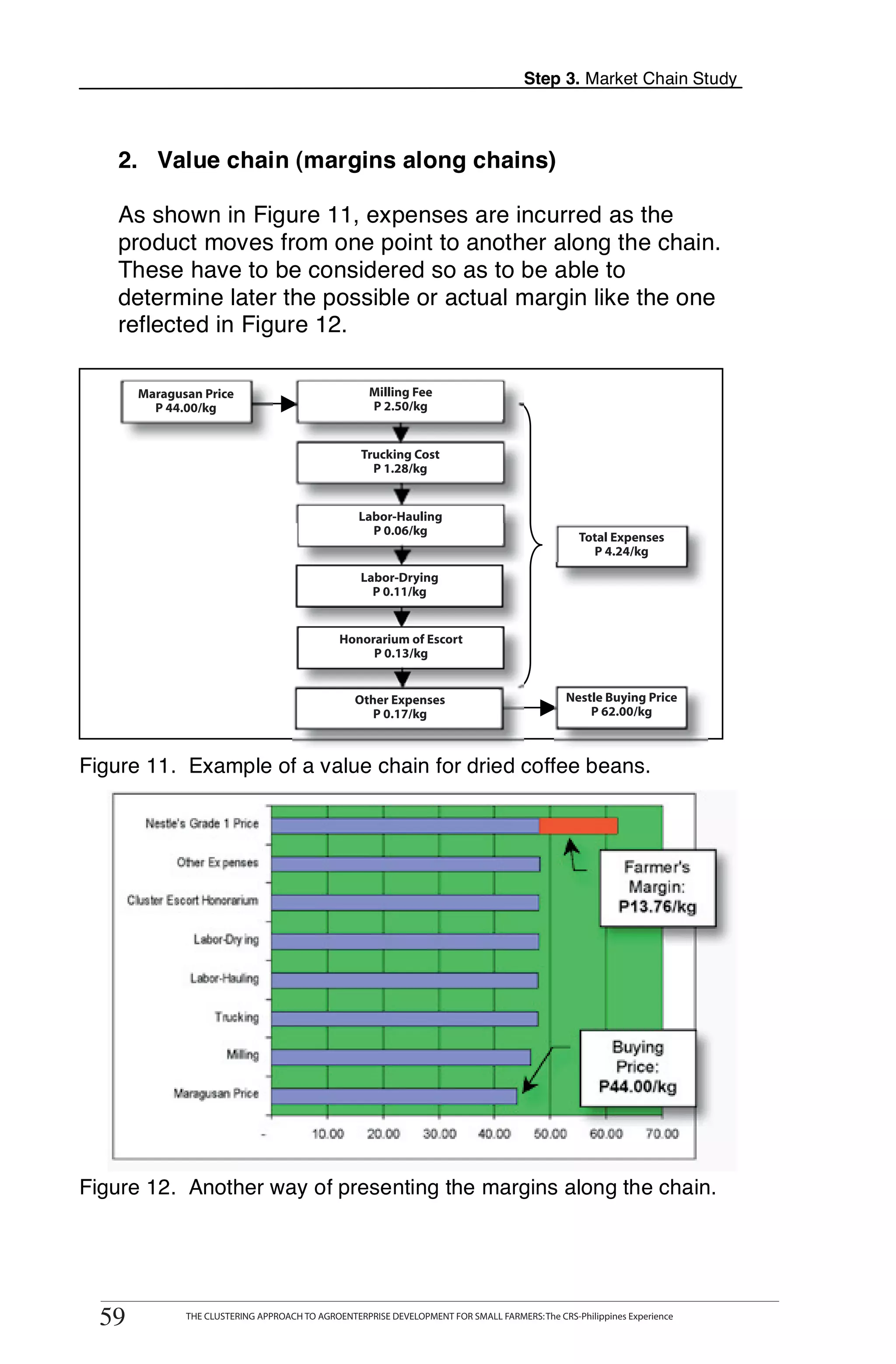
Figure 12   Another way of presenting the margins along       59
            the chain
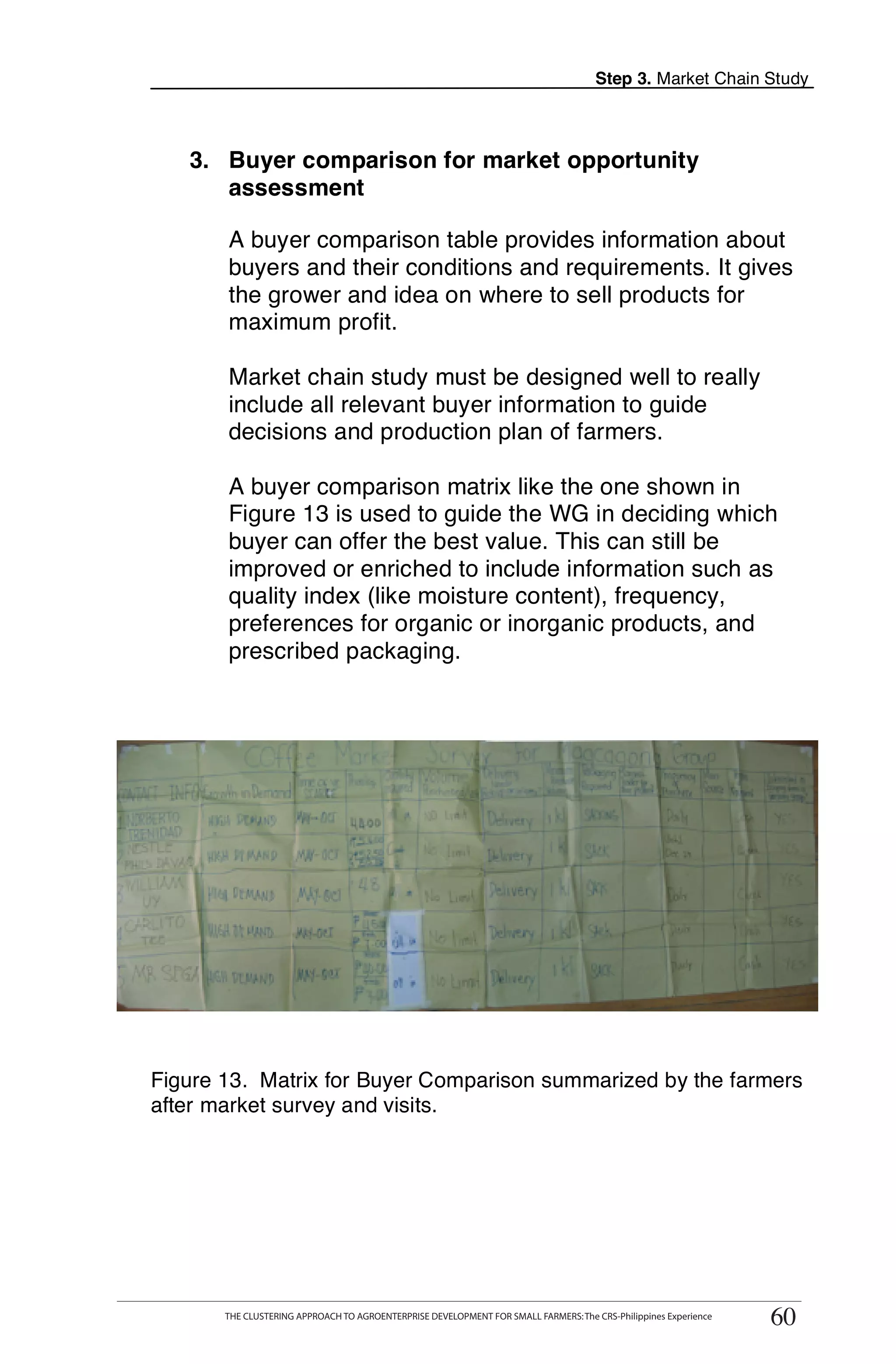
Figure 13   Matrix for Buyer Comparison summarized by         60
            the farmers after market survey and visits
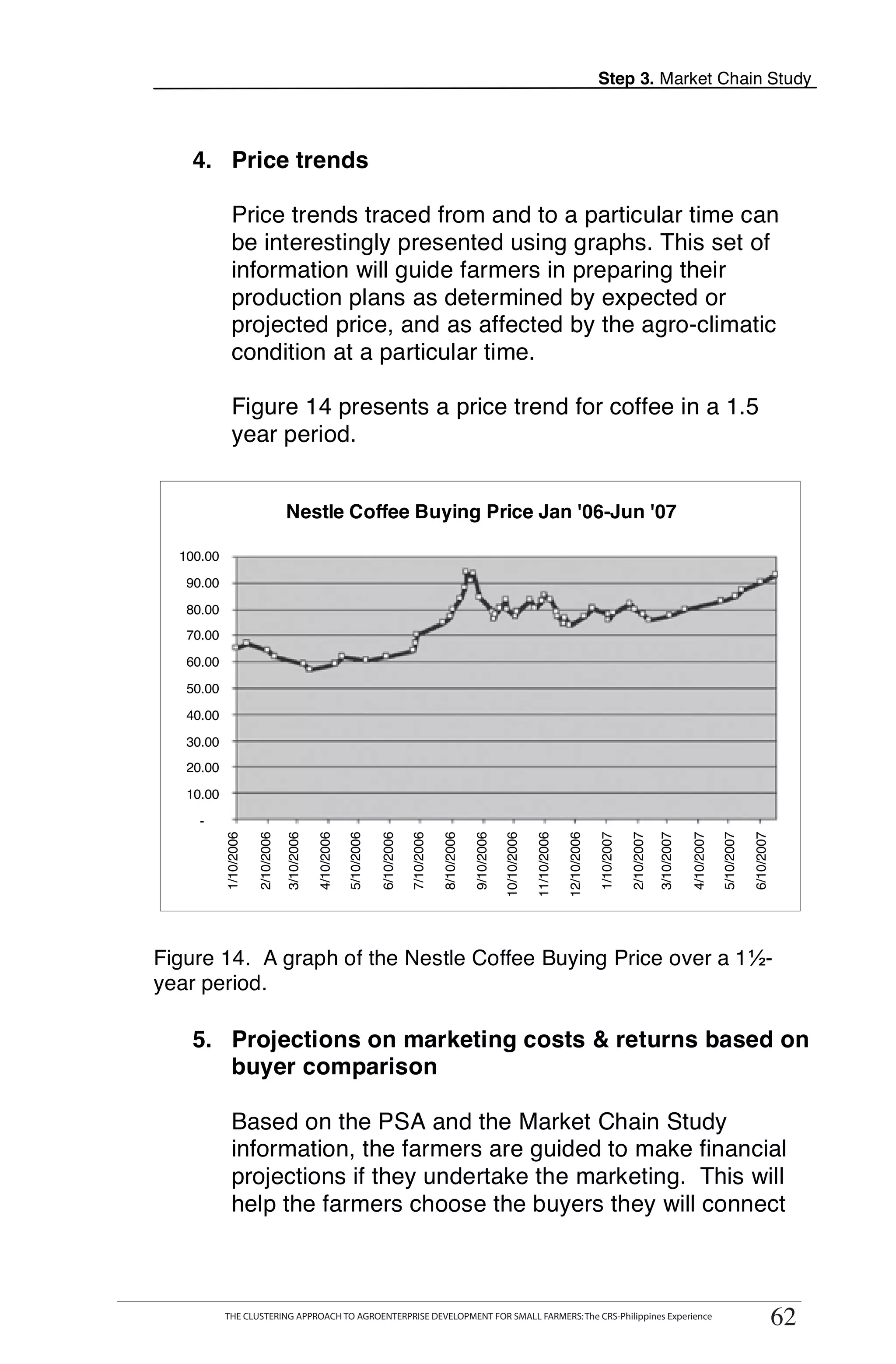
Figure 14   A graph of the Nestle Coffee Buying Price         62
            over a 1 -year period
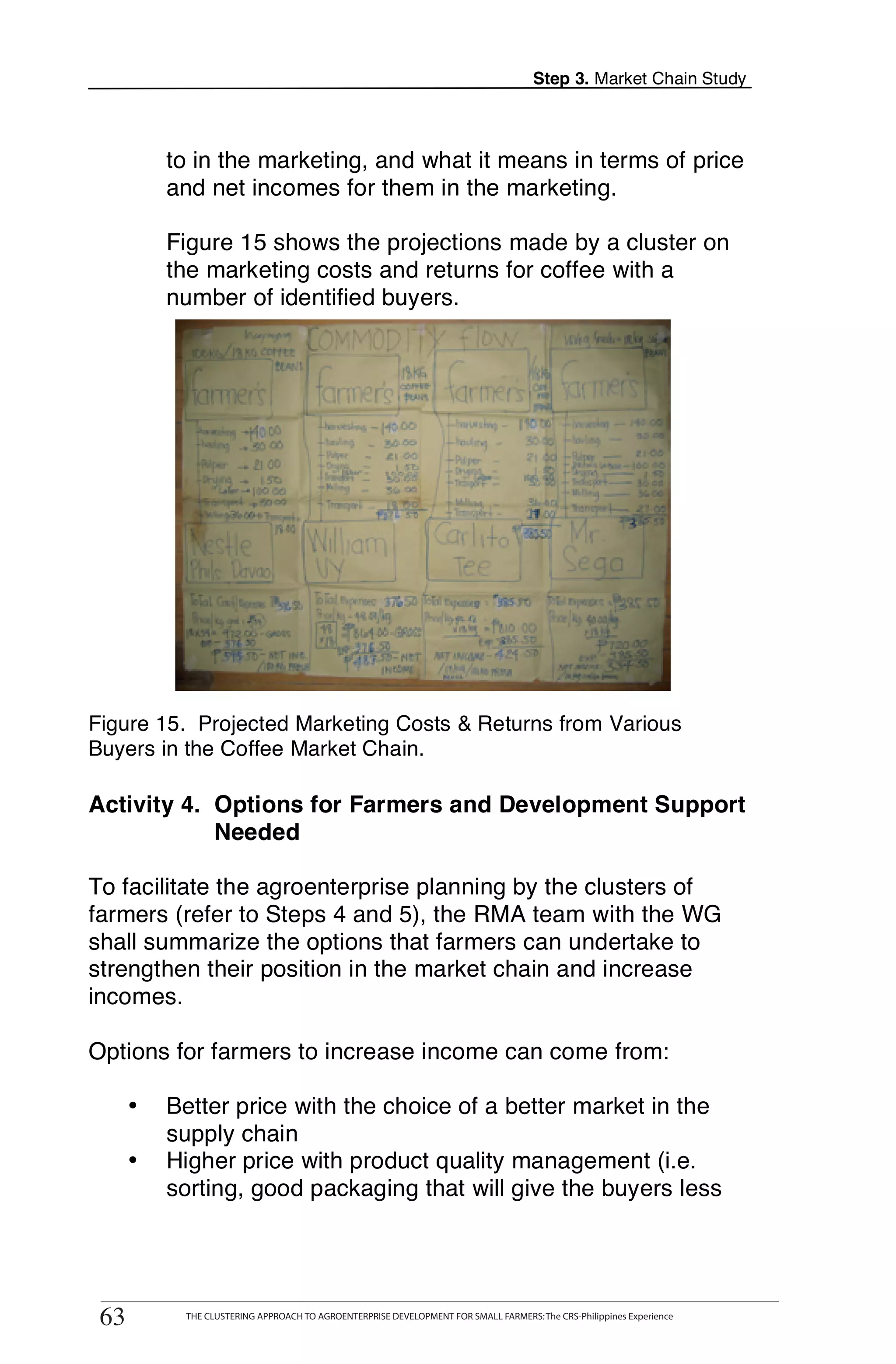
Figure 15   Projected Marketing Costs & Returns from          63
            Various Buyers in the Coffee Market Chain
Figure 16   Basic structure of a group of clusters            79
Figure 17   Structure of Clusters covering 3 municipalities   84
            in 3 provinces collaborating to supply one
            market
Figure 18   Cluster Map of Saranga Coffee Farmers             88
Figure 19   Coffee harvest and product delivery calendar      88
            of Saranga Cluster
Figure 20   The framework of Agroenterprise                   91
            Development
Figure 21   Illustration of a sample PQMP that each           95
            cluster member must follow to ensure quality
            of produce


                                                               vii

                                                              vii
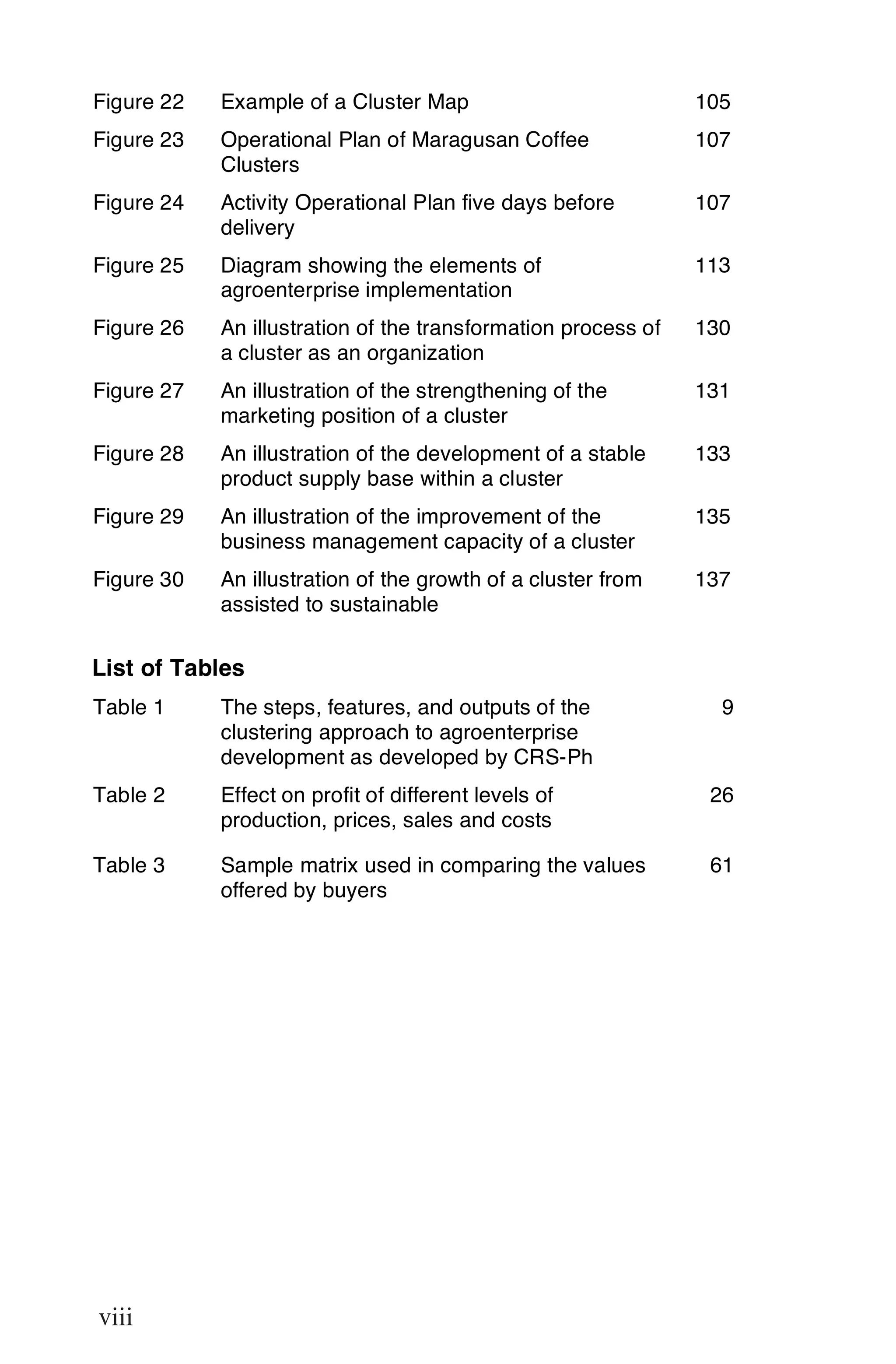
Figure 24    Activity Operational Plan five days before         107
             delivery
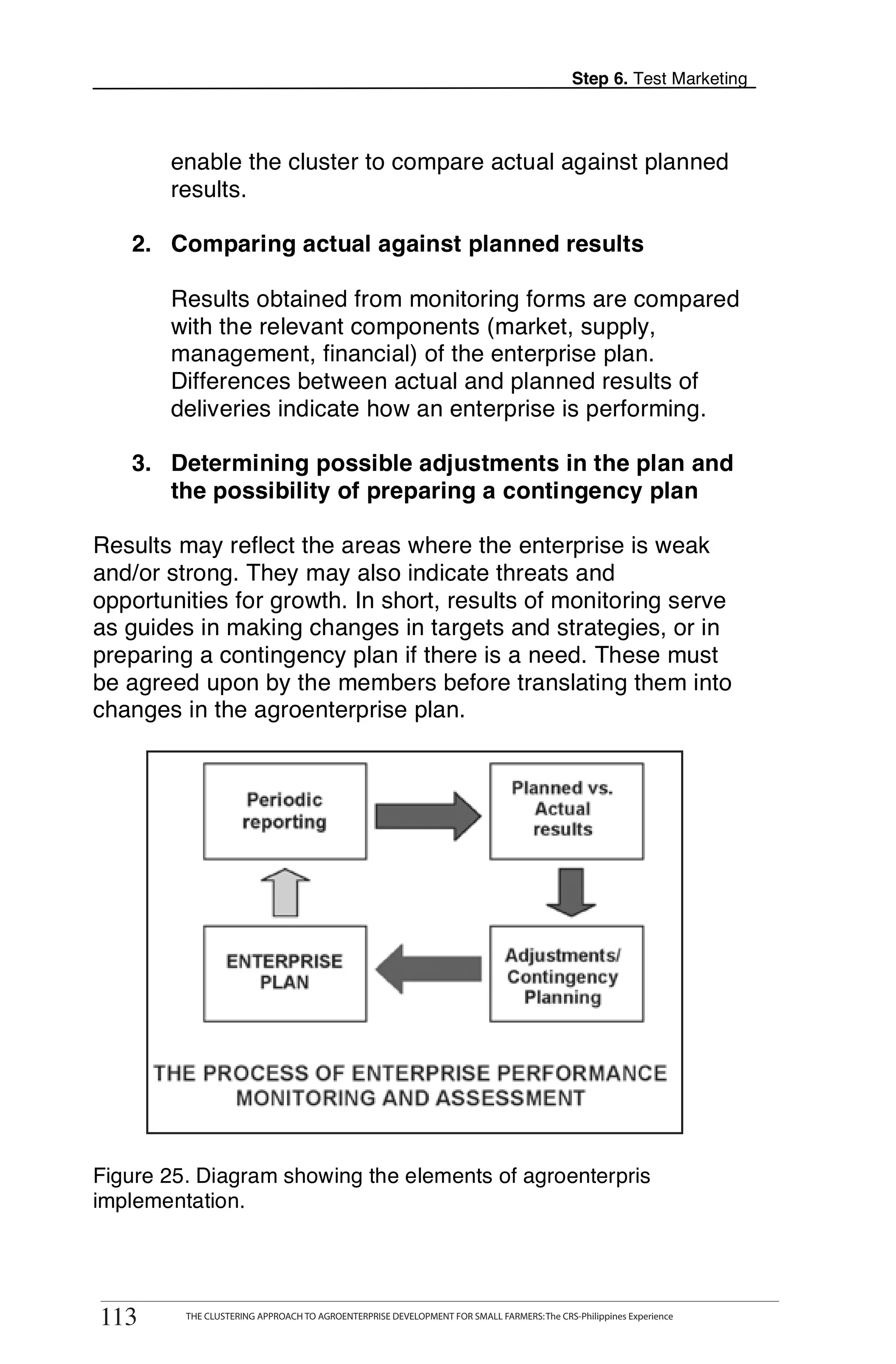
Figure 25    Diagram showing the elements of                    114
Figure 22    agroenterprise implementation
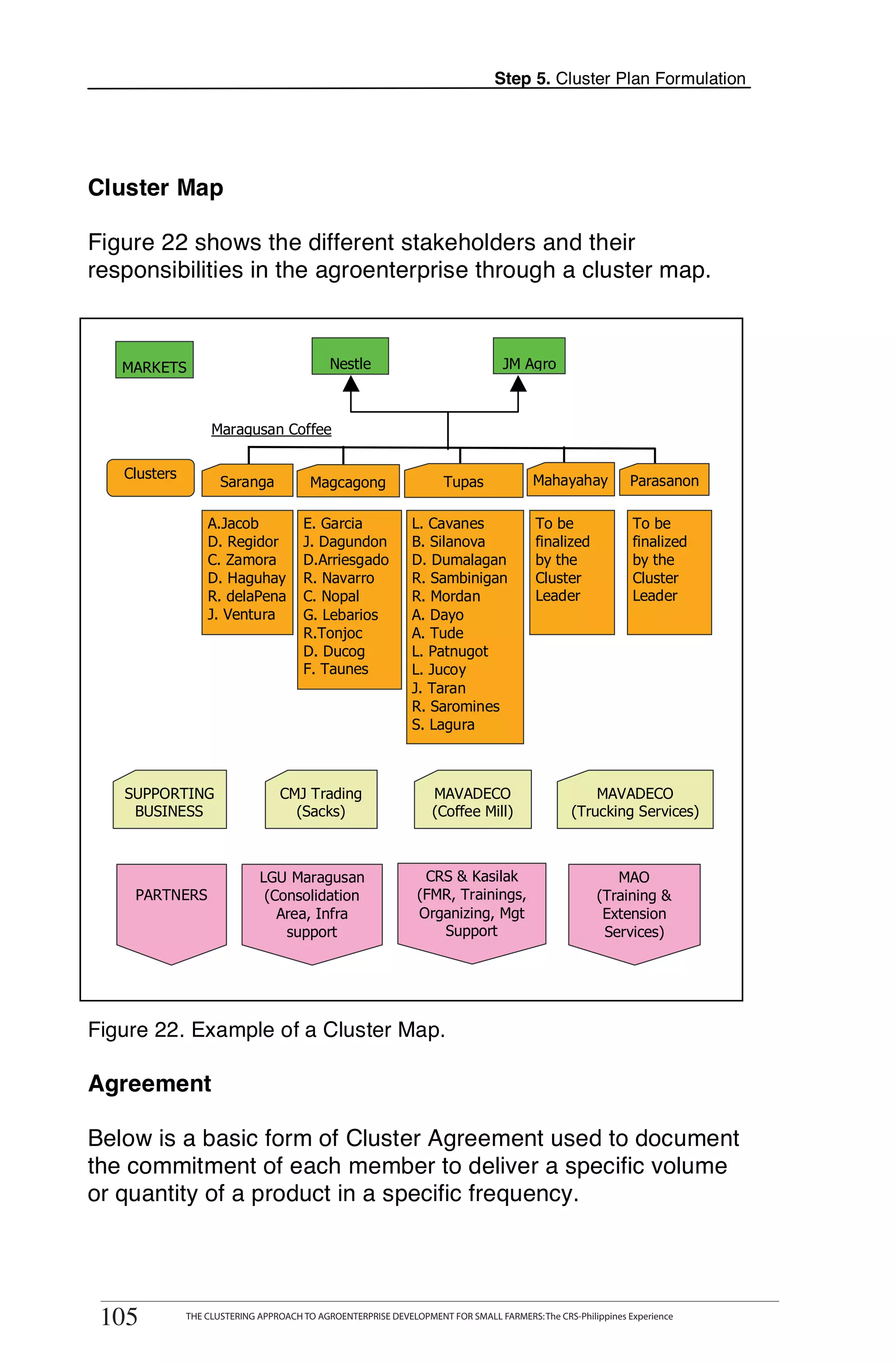
             Example of a Cluster Map                           105
Figure 26
       23    An illustration of the Maragusan Coffee
             Operational Plan of transformation process of      130
                                                                107
             a cluster as an organization
             Clusters
Figure 27
       24    An illustration of the Plan five days of the
             Activity Operational strengthening before          131
                                                                107
             marketing position of a cluster
             delivery
Figure 28
       25    An illustration of the development of a stable
             Diagram showing the elements of                    133
                                                                114
             product supply implementation
             agroenterprise base within a cluster
       26
Figure 29                           transformation process of
             An illustration of the improvement of the          130
                                                                135
             business as an organization
             a cluster management capacity of a cluster
       27
Figure 30    An illustration of the strengthening of the
                                    growth of a cluster from    131
                                                                137
             assisted toposition of a cluster
             marketing sustainable
Figure 28    An illustration of the development of a stable     133
List of Tables
            product supply base within a cluster
Figure1
Table 29     An illustration of the improvement of the
             The steps, features, and outputs of the            135
                                                                  9
             business management agroenterprise
             clustering approach to capacity of a cluster
Figure 30    An illustrationas developed by a cluster from
             development of the growth of CRS-Ph                137
Table 2      assisted to sustainable
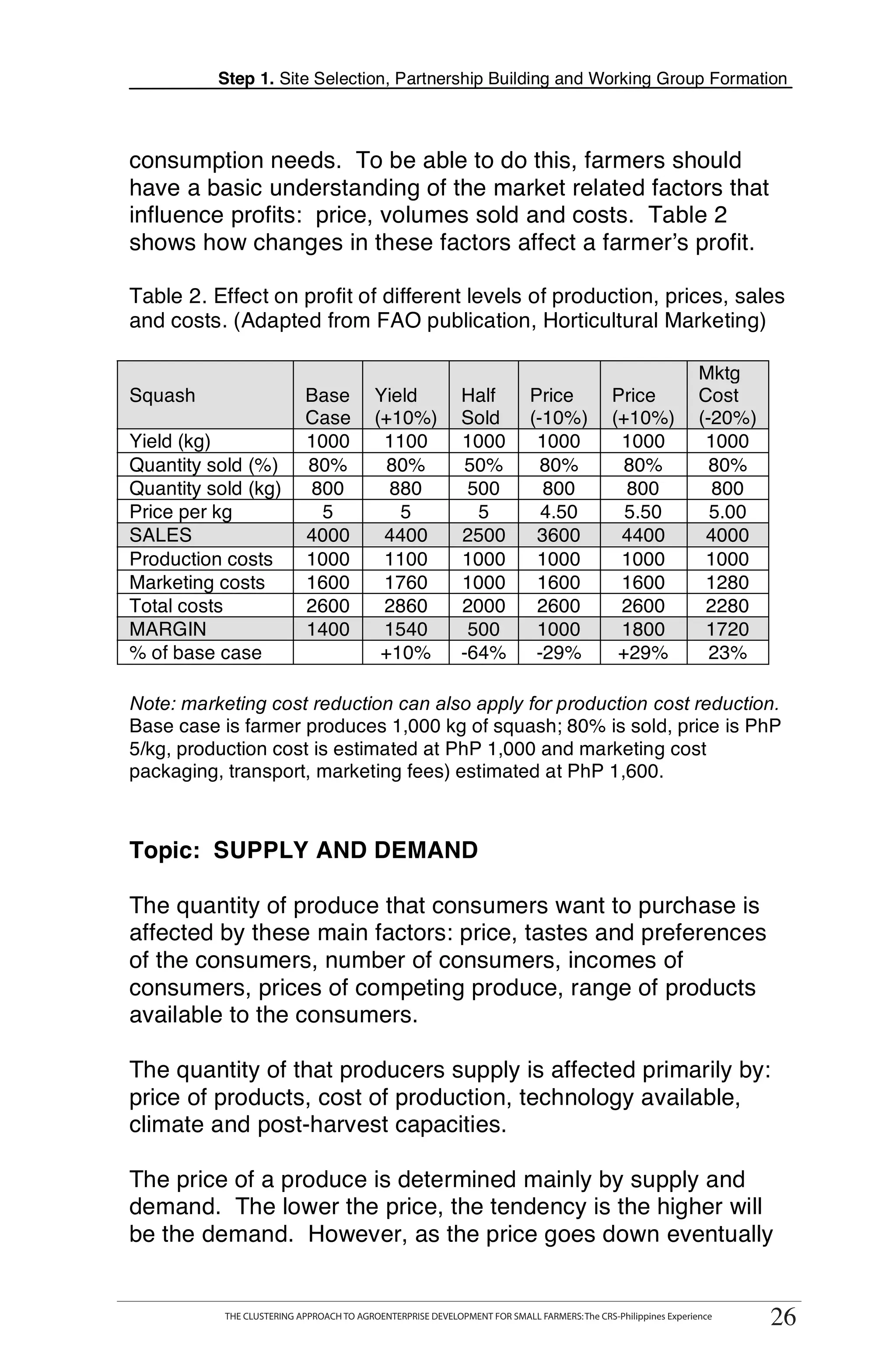
             Effect on profit of different levels of             26
             production, prices, sales and costs
List of Tables
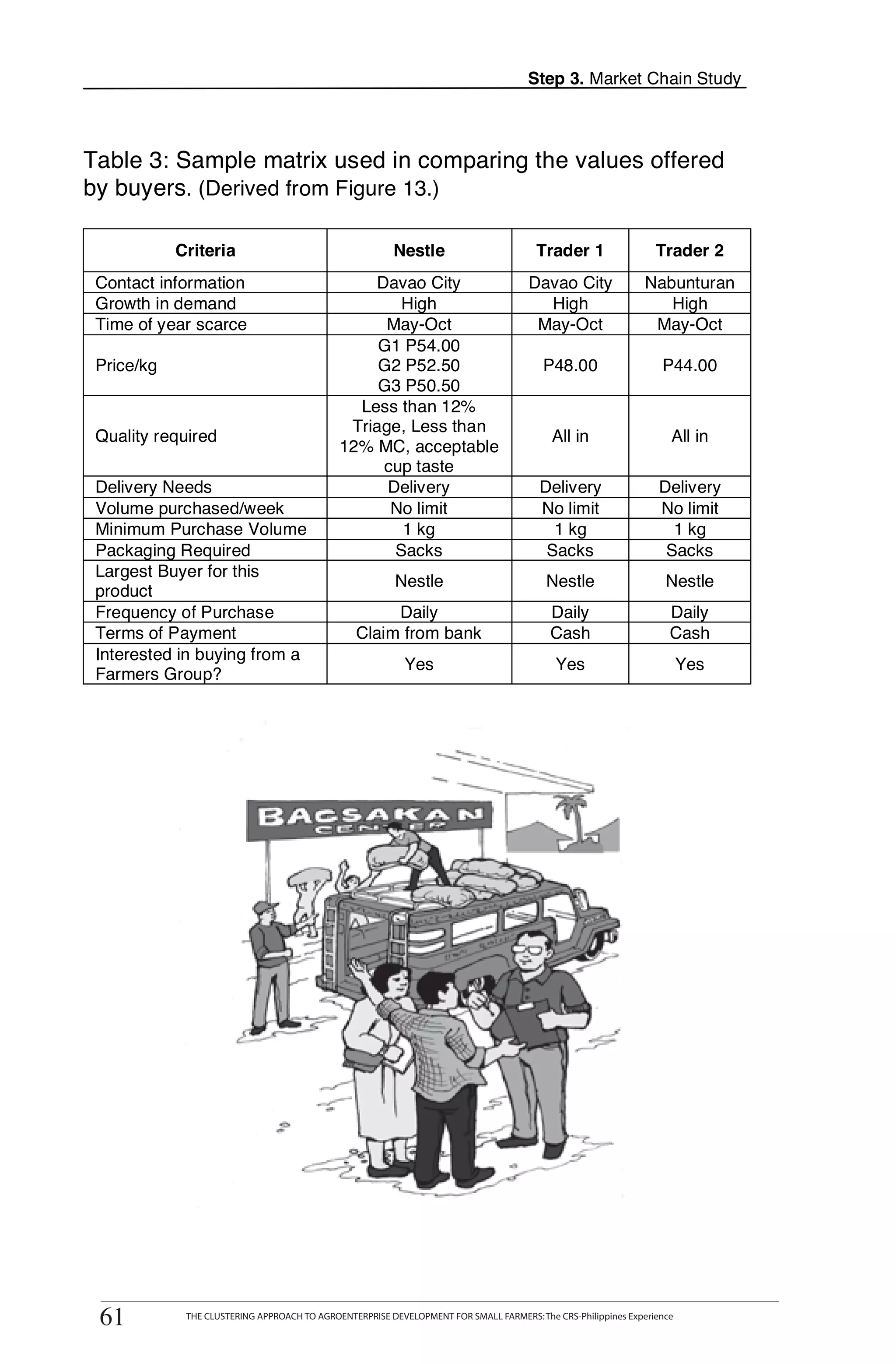
Table 3     Sample matrix used in comparing the values           61
Table 1      offered by buyers and outputs of the
             The steps, features,                                 9
             clustering approach to agroenterprise
             development as developed by CRS-Ph
Table 2      Effect on profit of different levels of             26
             production, prices, sales and costs

Table 3      Sample matrix used in comparing the values          61
             offered by buyers


viii


viii

viii
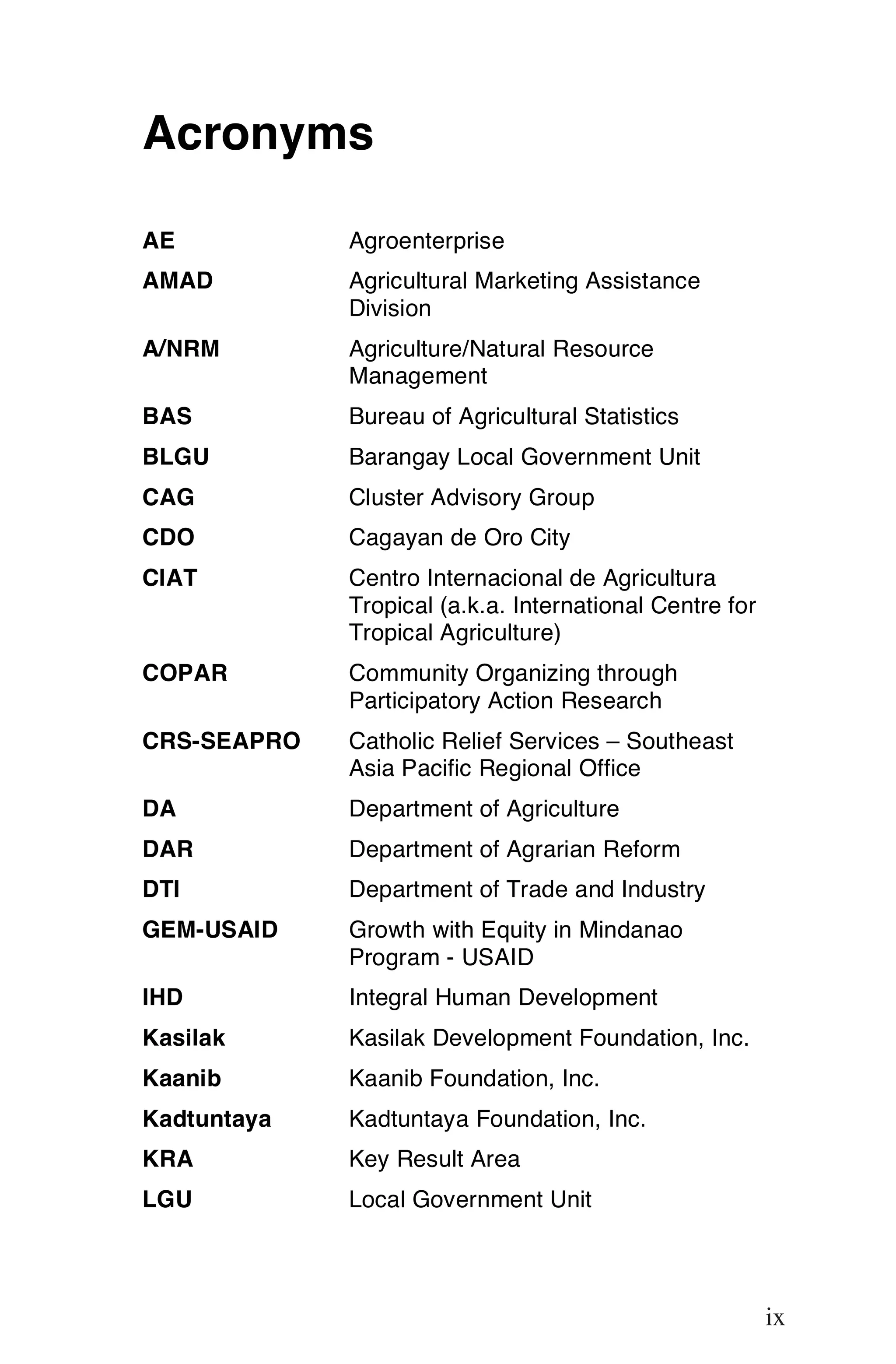
Acronyms

AE           Agroenterprise
AMAD         Agricultural Marketing Assistance
             Division
A/NRM        Agriculture/Natural Resource
             Management
BAS          Bureau of Agricultural Statistics
BLGU         Barangay Local Government Unit
CAG          Cluster Advisory Group
CDO          Cagayan de Oro City
CIAT         Centro Internacional de Agricultura
             Tropical (a.k.a. International Centre for
             Tropical Agriculture)
COPAR        Community Organizing through
             Participatory Action Research
CRS-SEAPRO   Catholic Relief Services – Southeast
             Asia Pacific Regional Office
DA           Department of Agriculture
DAR          Department of Agrarian Reform
DTI          Department of Trade and Industry
GEM-USAID    Growth with Equity in Mindanao
             Program - USAID
IHD          Integral Human Development
Kasilak      Kasilak Development Foundation, Inc.
Kaanib       Kaanib Foundation, Inc.
Kadtuntaya   Kadtuntaya Foundation, Inc.
KRA          Key Result Area
LGU          Local Government Unit

                                                          ix

                                                         ix
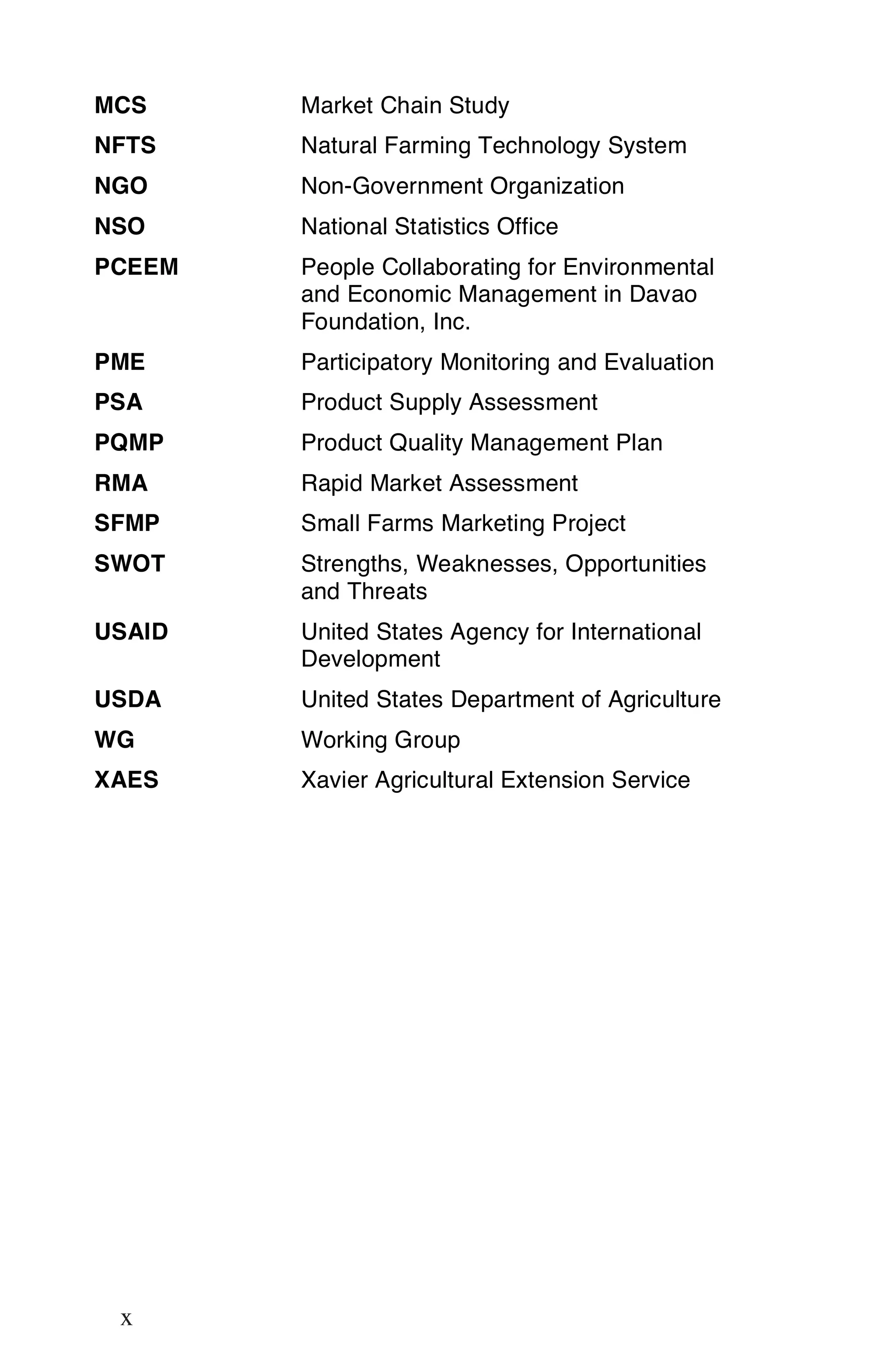
MCS     Market Chain Study
NFTS    Natural Farming Technology System
NGO     Non-Government Organization
NSO     National Statistics Office
PCEEM   People Collaborating for Environmental
        and Economic Management in Davao
        Foundation, Inc.
PME     Participatory Monitoring and Evaluation
PSA     Product Supply Assessment
PQMP    Product Quality Management Plan
RMA     Rapid Market Assessment
SFMP    Small Farms Marketing Project
SWOT    Strengths, Weaknesses, Opportunities
        and Threats
USAID   United States Agency for International
        Development
USDA    United States Department of Agriculture
WG      Working Group
XAES    Xavier Agricultural Extension Service


x


    x
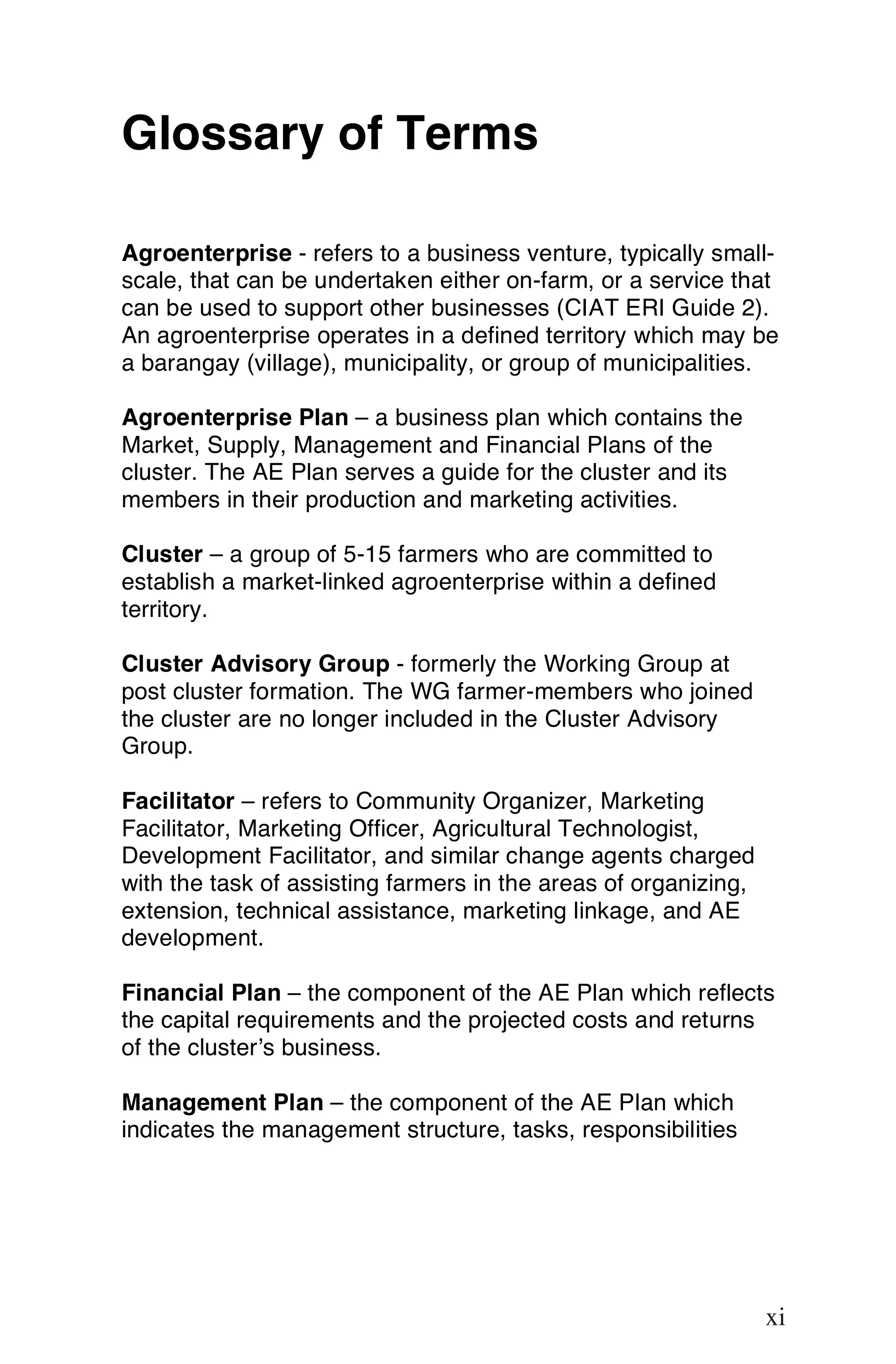
Glossary of Terms

Agroenterprise - refers to a business venture, typically small-
scale, that can be undertaken either on-farm, or a service that
can be used to support other businesses (CIAT ERI Guide 2).
An agroenterprise operates in a defined territory which may be
a barangay (village), municipality, or group of municipalities.

Agroenterprise Plan – a business plan which contains the
Market, Supply, Management and Financial Plans of the
cluster. The AE Plan serves a guide for the cluster and its
members in their production and marketing activities.

Cluster – a group of 5-15 farmers who are committed to
establish a market-linked agroenterprise within a defined
territory.

Cluster Advisory Group - formerly the Working Group at
post cluster formation. The WG farmer-members who joined
the cluster are no longer included in the Cluster Advisory
Group.

Facilitator – refers to Community Organizer, Marketing
Facilitator, Marketing Officer, Agricultural Technologist,
Development Facilitator, and similar change agents charged
with the task of assisting farmers in the areas of organizing,
extension, technical assistance, marketing linkage, and AE
development.

Financial Plan – the component of the AE Plan which reflects
the capital requirements and the projected costs and returns
of the cluster’s business.

Management Plan – the component of the AE Plan which
indicates the management structure, tasks, responsibilities


                                                                 xi

                                                                 xi
and compensations, and policies and procedures of the
cluster.

Market Plan – the component of the AE Plan which indicates
the product/s to produce and market, the sales targets, the
payment arrangements and procedures, and the promotion
strategies.

Marketing - the process of moving products from the point of
production to the point of consumption to satisfy the needs
and wants of customers or buyers at a profit.

Small-scale farmer – refers to a farmer who falls in any of the
following three types of poor as qualified by CRS-Philippines:

      1. Resourceful poor - consistently able to sustain at
         least a small margin above a minimum livelihood ,
         have sufficient resources to fall back on when there
         are extraordinary economic or environmental shocks
         and to “grow” their livelihood options.

      2. Poor - vulnerable to extraordinary economic or
         environmental shocks but otherwise able to sustain a
         livelihood that meets their basic needs and to
         minimally improve their livelihoods.

      3. Chronic or ultra poor - resources are at or below a
         bare minimum for daily survival, they are extremely
         vulnerable all or most of the time and have the
         greatest difficulty of all three groups in improving their
         situation.

For purposes of developing clusters that can initiate and
pump-prime more AEs, CRS-Philippines worked with
resourceful poor farmers.

Supply Plan – the component of the AE Plan which shows
the suppliers (of the products to be marketed), the estimated
volumes of supply, the quality management processes and


xii

 xii
requirements, the product operational flow, and the materials,
equipment and other needs.

Territorial Approach - a participatory and an area-defined
scheme in rural enterprise development developed by the
International Center for Tropical Agriculture. The territory may
be a barangay (village), municipality, or group of
municipalities.

Working Group – composed of farmers, NGOs, Local
Government Units, local business sector, and Peoples
Organizations. The Group is tasked to conduct Community-
Based Market Research and Product Selection and other
relevant activities. The WG may also be called the Local
Planning Team or the Local Research Team.


                                                             xiii

                                                             xiii
Preface
Over the past several years, a new trend in the marketing of
agricultural produce has emerged driven by the increasing
population of urban consumers with higher incomes and
dynamic lifestyles. The increase in the demand for high quality
and safe produce, coupled with the want for leisure and
convenience, gave rise to the rapid growth of supermarkets,
quick service restaurants and food manufacturers/processors.
Globalization, which made it easier to move a variety of high
quality products across geographical areas, has fueled this
demand and contributed to this dramatic change in the
markets.

With funding support from the United States Department of
Agriculture – Food for Progress Act of 2004, Catholic Relief
Services (CRS) Philippines started implementing in mid 2004
the Small Farms Marketing Project (SFMP) in the following
provinces of Mindanao: Bukidnon, Compostela Valley,
Maguindanao, Zamboanga Sibugay and the upper watershed
of Davao City. All CRS agriculture and natural resource
management programs are guided by the following six
principles: [1] Work with farmers as partners; [2] Treat farming
as a family business, acknowledging that rural communities
are linked to markets and that farm families need income for
off-farm products and services; [3] Focus on farming systems,
supporting diverse production - crops, livestock, trees and
fish; [4] Promote agricultural practices that do not deplete or
damage resources, linking production to conservation; [5] Use
watershed approaches, fostering cross-community
collaboration for resource protection, natural disaster
mitigation, and upstream/downstream cooperation to meet
competing water needs; and [6] Ensure immediate benefits;
invest in long-term production.

CRS Philippines, through the Small Farms Marketing
Project, has organized small farmers into marketing clusters


xiv

xiv
to enable them to equitably participate in the opportunities of
evolving dynamic markets. Through the clusters, farmers can
proactively plan their production in cooperation with the big
consolidators servicing these high value markets, manage
quality, and consolidate significant product supply. The
clustering strategy has enabled farmers to introduce reforms
in the marketplace, gradually replacing adversarial
relationship with some traders into collaborative arrangements
with product consolidators and institutional buyers. This has
resulted in innovative supply chains that cut layers towards
the dynamic markets and gave small farmers, acting
collectively, the benefits of more stable markets and/or higher
returns.

This guidebook, “The Clustering Approach to Agroenterprise
Development for Small Farmers, the CRS – Philippines
Experience,” has been designed for Field Facilitators who
have adequate field experience in community development
work. The production of this guidebook was also made in
response to the request of other development organizations to
assist them on how to adopt, adapt and implement
Agroenterprise Development in linking small farmers to
modern markets.


PEDRO TERRY R. TUASON
Program Manager
Agriculture and Natural Resource Management Program
Catholic Relief Services - Philippines


                                                            xv

                                                             xv
Foreword

In recent years, CRS programs in Africa, Latin America and
Asia have promoted market driven strategies for poor,
marginalized small farmers. This manual, The Clustering
Approach to Agroenterprise Development for Small Farmers,
the CRS-Philippines Experience, is an exciting new addition to
the best practice guides being developed by CRS.

The manual is a Guidebook for Field Facilitators. It provides a
stepwise practical approach to understanding markets,
identifying market opportunities and then preparing farmers to
supply selected market types. The guide uses novel methods
for clustering farmers and linking them into higher value
market chains that would not have been open to individual
farmers.

This guidebook is valuable for all practitioners. It builds on
existing knowledge, is grounded in a local situation, and adds
new concepts on setting up farmer groups for marketing and
clustering groups to achieve high volume for sales. The
process of developing this guide comes through a strong
partnership between CRS, research, farmer associations and
traders. These partners are essential to make markets work
for the poor farming communities.

A critical part of CRS’ work is finding sustainable solutions for
the poor that provide livelihood pathways out of poverty. This
process includes engaging with markets and playing an active
and innovative role in market chains. This guide provides us
with the stepwise approach to that goal of sustainability. All of
this takes much time and effort but through these types of


 xvi
xvi
guides CRS staff and partners are better able to facilitate the
process of positive change.

We congratulate the CRS and partner agribusiness team in
The Philippines for the excellent guide. It’s important to
document our work and share it with the broader CRS
community and others engaged in similar work.

Agroenterprise approaches are proving successful
mechanism to lift poor farmers out of subsistence living and
into sustainable livelihoods. This manual is a significant
contribution to CRS’ work with the poor and marginalized.


MARY HODEM
Regional Director
CRS-Southeast Asia and Pacific Region Office (SEAPRO)


SUSAN HAHN
Deputy Regional Director, Program Quality
CRS-SEAPRO


SHAUN FERRIS
Senior Technical Advisor, Agriculture and Livelihood


                                                            xvii

                                                            xvii
Republic of the Philippines
                 DEPARTMENT OF AGRICULTURE
                 Office of the Secretary
                 Elliptical Road, Diliman, Quezon City 1100


 Foreword
 The task of teaching small farmers and fishers modern and
 sustainable technologies and convincing them to organize
 themselves into associations or cooperatives so they could expand
 into processing and marketing enterprises are enormous challenges
 that the Department of Agriculture family cannot perform and
 bankroll alone. Thus, we continuously seek the support of concerned
 groups and institutions, here and abroad.

 In this case, we wholeheartedly appreciate the initiatives of the
 Catholic Relief Services and the United States Department of
 Agriculture in the packaging and publication of this valuable
 document.

 Indeed, this guidebook will serve as a valuable reference for
 community organizers and facilitators, agriculture technicians and
 extension workers in helping organize small farmers into groups or
 clusters, link them directly with the markets, and pave the way to
 establishing their respective agro enterprises.

 We therefore commend the men and women of CRS-Philippines, its
 partner NGOs and farmer-leaders who shared their respective
 experiences and spent painstaking hours to complete this book,
 which we expect will serve its purpose well in transforming farmers
 into market-oriented producers and entrepreneurs.

 Mabuhay ang CRS at USDA!
 Maraming salamat sa inyong patuloy na tulong!


 ARTHUR C. YAP
 Secretary


 xviii

xviii
Message
The production of “The Clustering Approach to Agroenterprise
Development for Small Farmers, the CRS –Philippines Experience”
is the result of years of experience and effort by CRS staff and
partners in Mindanao. It started over ten years ago with the idea of
assisting farmers in Mindanao to increase productivity through
improved environment-friendly farming techniques.

As the interaction grew between CRS, the farmers and the other
project stakeholders, the focus of the project evolved from “farmer-
to-farmer” training to “integrated pest management” to “landcare” to
“marketing” to the “clustering approach to marketing”. The current
program continues to incorporate all of these aspects but with an
emphasis on the “clustering approach”. The manual is an attempt to
share this learning process.

Many talented and dedicated people were involved in this effort
starting with the farmers groups and the local government units.
Archbishop Antonio Ledesma actively supported the first successful
“calamansi” projects in the Ipil Prelature. Paul Hicks and Terry
Tuason of CRS led the transformation of the idea into a concrete
proposal and initiative. Joan Uy provided the intellectual framework
for the “clustering” approach which was indispensable to the
program. Danny Ocampo provided steady management support
through rough periods. Our NGO partners - Kasilak, Kaanib,
Kadtuntaya, XAES, and PCEEM - were instrumental in leading the
process of inclusion of and consultation with government at the local
and provincial levels. Senator Ting Paterno and Bobby Ansaldo
helped promote the program among the business community.

Finally, the program could not have succeeded without the support
and encouragement of the Department of Agriculture of the Republic
of the Philippines and the United States Department of Agriculture.


Michael J. Frank
CRS Ph Country Representative


                                                                  xix

                                                                  xix
Message
Philippine agricultural development is key in moving the country
forward and it is widely known that sustained expansion of the
national economy will likewise require sustained growth in the
agricultural sector. Various economic and sophisticated
developmental models have been designed for this although many
times, they remain as such, all theory and speculation.

Translating theory into reality is easier said than done and this is
usually the case in developing countries whose agricultural sectors
are predominantly in the hands of small-scale farmers. As the world
rapidly changes and the dynamics of rural social systems continue
to shift, identifying the appropriate mix of developmental
interventions require patience and innovation.

The Clustering Approach to AgroEnterprise Development for Small
Farmers: The CRS-Philippine Experience goes beyond identifying
the tools for change by integrating, among others, certain essential
management disciplines in the development process.

Drawing from proven and tested countryside developmental
experience, the guidebook is not only deliberate, determined and
instructional; it is also practical, realistic and concise. It is the
perfect companion for the field-extension worker and rural
development planner.

I would like to congratulate all those involved in the preparation of
this excellent guidebook and I assure you of my continued support


Emiko Purdy
Agricultural Counselor


xx
 xx
Office of the Archbishop
                  Archbishop’s House
                  P.O. Box 113
                  Cagayan de Oro City
                  9000 Misamis Oriental, Philippines
                  Tel. Nos. (08822) 72-63-04; 72-23-75 (088) 857-1357 • Fax No. (08822) 72-63-05
                  E-mail address: acdo_chancery@yahoo.com


Message

Throughout Mindanao, on a seasonal or even daily basis, countless
rural households sell their produce at the farmgate to middlemen for
immediate cash, but at relatively low prices. These products range
from the traditional crops of rice, corn, and coconuts to the more
diversified and location-specific commodities like vegetables, rubber,
seaweed, calamansi, coffee, and rural handicraft. At the end of the
day, the products of small farmers and fishermen reach the tables of
consumers through a multi-linked marketing chain that channels
most of the profits to middlemen rather than to the primary
producers.

It is this anomalous situation that the eight-step clustering approach
explained in this CRS guidebook tries to remedy. From actual
experience in pilot areas, this clustering approach has reaped
dividends for many small farmer households—helping them to
gradually transform their production areas into entrepreneurial and
self-reliant communities.

Much study, discipline, and self-organization, however, are required.
The eight steps focus on these prerequisites which can be viewed
more as guideposts for the planned and conscious development of
rural households—clustered together.


+ ANTONIO J. LEDESMA, S.J.
  Archbishop of Cagayan de Oro


                                                                                                   xxi
                                                                                                   xxi
About this Guidebook
This Guidebook is published by the Catholic Relief Services –
Philippines primarily, but not exclusively, for Facilitators who
are tasked in assisting small farmers interested to organize
themselves into marketing clusters and to develop their own
agroenterprises linked with the market. It provides the 8-step
process clustering approach that guides Facilitators in
equipping farmers with innovative methods so they become
market oriented in their farming and can actually engage the
markets.

This book has four parts. Part I provides an overview with the
discussion of the CRS Integral Human Development
framework that helps the reader understand the holistic
dimensions of an enabling development process for the poor.
Part II describes the clustering approach comprising a set of
eight activities within a stepwise process that provides
facilitators with knowledge and skills in participatory methods
that enable them to effectively assist farmers build
agroenterprises and engage the market. Tool kits are included
in Steps 1 to 6 to guide facilitation. Part III shares stories from
different clusters, and Part IV presents the lessons distilled
from program experiences and recommendations for future
course of action that can build on the current work.

The contents of this Guidebook are based mainly on the
experiences of CRS-Philippines in assisting farmers develop
markets for their produce and build their agroenterprises,
under its Agriculture/Natural Resource Management Program
with its partner non-governmental organizations (NGOs) and
Local Government Units (LGUs).

This Guidebook took shape in a span of two years during
which time CRS-Philippines and its partners gathered several
times in knowledge-sharing sessions called the learning
alliance. Through these joint learning activities, the steps in


xxii

xxii
the clustering approach for agroenterprise development were
clarified and simplified under different situations.

The clustering approach to agroenterprise development for
small farmers is a work in progress. CRS-Philippines hopes
that this Guidebook can lead or contribute to the development
of approaches and strategies towards sustainable
agroenterprises, especially among the small farmers.


                                                         xxiii

                                                         xxiii
How to Use this Guidebook

This Guidebook is for use by Facilitators of development
service providers such as government agencies, NGOs or
other private sector actors including businesses, cooperatives
and farmers associations that assist small farmers organize
themselves, assess their market opportunities, establish links
with markets, and build their own agroenterprises.
The steps in clustering for agroenterprise development are
presented with accompanying informational materials and
tools to guide Facilitators in the conduct of training and market
visits for farmers, and through the actual “learning by doing”
process in enterprise operations.
The approach is designed to be followed from Steps 1 to 8 in
a systematic process as the farmers go through the market
preparation and engagement for the first time. The sequence
of activities is planned so that the results of the previous step
lead to the next.
When farmers gain marketing experience and move to the
expansion stage (i.e. working with more producers, new
products or higher value markets), they may skip certain steps
and proceed to those appropriate to their immediate needs.
For instance, when an organized cluster decides to market a
new product, it can immediately proceed to Step 3, Market
Chain Study.
The scenarios presented and options taken emphasize the
realities of uncertainty and risk inherent in a business, and
therefore the user of this Guidebook should be flexible in
following the steps according to the needs, capacities and
resources of the farmers and the development service
provider.
The user of this Guidebook is encouraged to innovate.
Feedback on its use is welcome.


xxiv

xxiv
Acknowledgements
The publication of this Guidebook has been made possible through the
generous sharing of resources, time and information by a number of
benefactors and partners, the encouragement from the business sector,
and the trust and confidence of the participants on the CRS process.
CRS-Philippines is especially grateful to the following:

International and National Partners
United States Department of Agriculture Food for Progress, benefactor
of the Small Farms Marketing Project; CRS-Southeast Asia Pacific
Regional Office; International Centre for Tropical Agriculture; The
Philippine Department of Agriculture and its Regional Field Units
Non-Government Organizations
Kaanib Foundation, Inc.; Kadtuntaya Foundation, Inc.; Kasilak
Development Foundation, Inc.; People Collaborating for Environmental
and Economic Management in Davao Foundation, Inc. and Xavier
Science Foundation – Xavier Agricultural Extension Service

Local Government Units
Davao City; Impasugong, Bukidnon; Maragusan, Compostela Valley
Province; Paglat and Gen. SK Pendatun, Maguindanao and Siay,
Zamboanga Sibugay

Business Sector
Northern Mindanao Vegetable Producers Association, Inc.; Vegetable
Industry Council of Southern Mindanao and the institutional buyers,
wholesalers/traders and supermarkets and business service providers
for believing in and supporting the capability of small farmers to do
business with them

The Working Groups and the Agroenterprise Clusters and their
Leaders who journeyed with the staff of the CRS-Agri/NRM and its
partners in evolving the 8-step process in the clustering approach for
agroenterprise development.


The Guidebook Committee and the Writing Team who put all the
significant experiences into this handy, practical and useful form.


                                                                   xxv

                                                                  xxv
Part I. Agroenterprise Development as a Strategy to Improve Well Being


Part I

Agroenterprise Development as a
Strategy to Improve Well Being

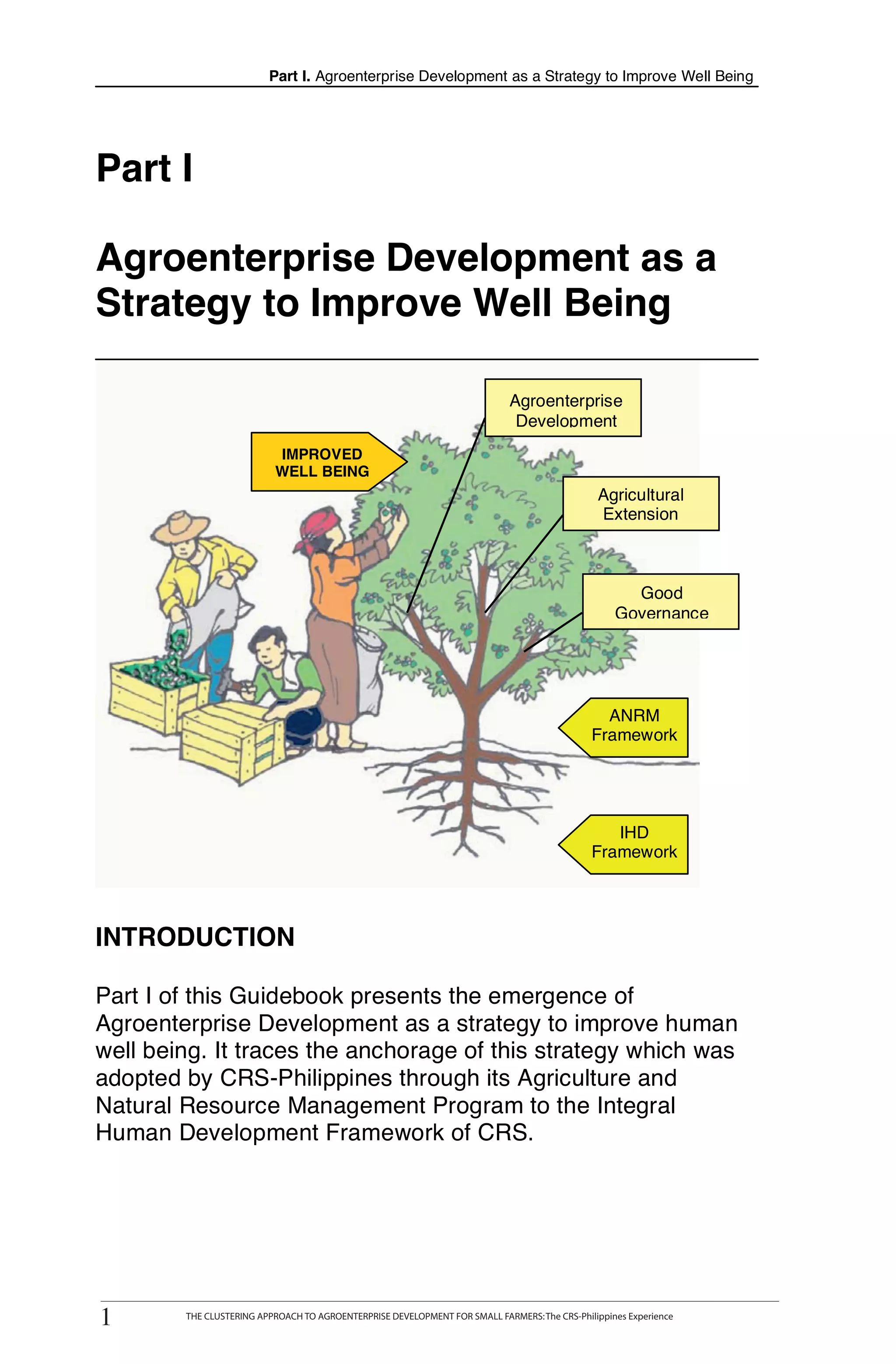
                                                                               Agroenterprise
                                                                                Development
                             IMPROVED
                             WELL BEING
                                                                                                  Agricultural
                                                                                                  Extension


                                                                                                       Good
                                                                                                     Governance


                                                                                                  ANRM
                                                                                                Framework


                                                                                                   IHD
                                                                                                Framework


INTRODUCTION

Part I of this Guidebook presents the emergence of
Agroenterprise Development as a strategy to improve human
well being. It traces the anchorage of this strategy which was
adopted by CRS-Philippines through its Agriculture and
Natural Resource Management Program to the Integral
Human Development Framework of CRS.


1
1
     THE CLUSTERING APPROACH TO AGROENTERPRISE DEVELOPMENT FOR SMALL FARMERS : The CRS-Philippines Experience
           THE CLUSTERING APPROACH TO AGROENTERPRISE DEVELOPMENT FOR SMALL FARMERS: The CRS-Philippines Experience
Part I. Agroenterprise Development as a Strategy to Improve Well Being


THE INTEGRAL HUMAN DEVELOPMENT
FRAMEWORK

The Catholic Relief Services or CRS is the official international
relief and development agency of the Catholic community of
the United States of America. As a general approach, it builds
capacities to improve integral human development and
people’s environment as it aims to: (1) alleviate human
suffering, (2) promote integral human development, (3)
change unjust structures, and (4) promote solidarity. (See
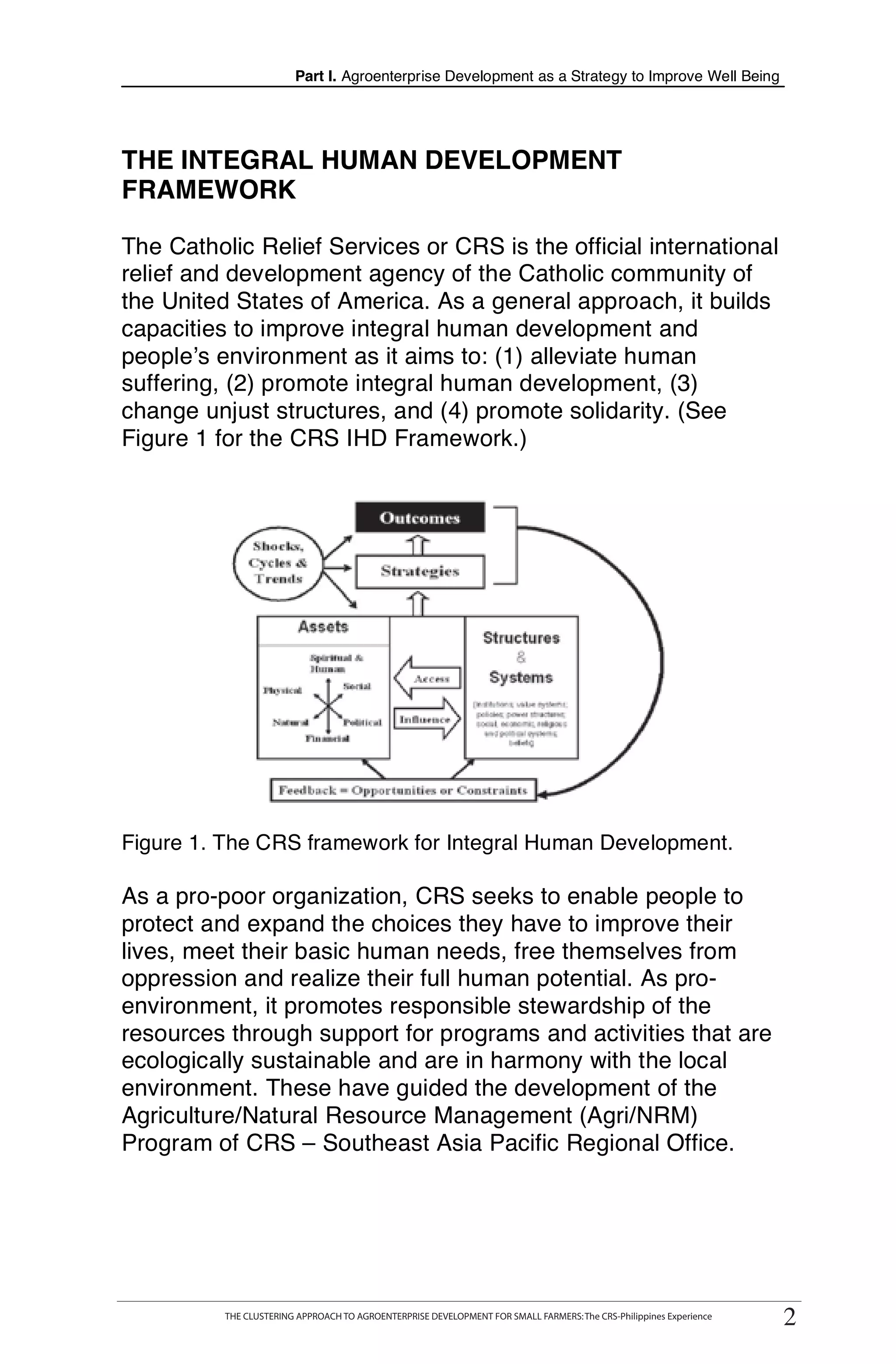
Figure 1 for the CRS IHD Framework.)


Figure 1. The CRS framework for Integral Human Development.

As a pro-poor organization, CRS seeks to enable people to
protect and expand the choices they have to improve their
lives, meet their basic human needs, free themselves from
oppression and realize their full human potential. As pro-
environment, it promotes responsible stewardship of the
resources through support for programs and activities that are
ecologically sustainable and are in harmony with the local
environment. These have guided the development of the
Agriculture/Natural Resource Management (Agri/NRM)
Program of CRS – Southeast Asia Pacific Regional Office.


                                                                                                                       22
     THE CLUSTERING APPROACH TO AGROENTERPRISE DEVELOPMENT FOR SMALL FARMERS : The CRS-Philippines Experience
             THE CLUSTERING APPROACH TO AGROENTERPRISE DEVELOPMENT FOR SMALL FARMERS: The CRS-Philippines Experience
Part I. Agroenterprise Development as a Strategy to Improve Well Being


THE AGRCULTURE/NATURAL RESOURCE
MANAGEMENT DEVELOPMENT FRAMEWORK

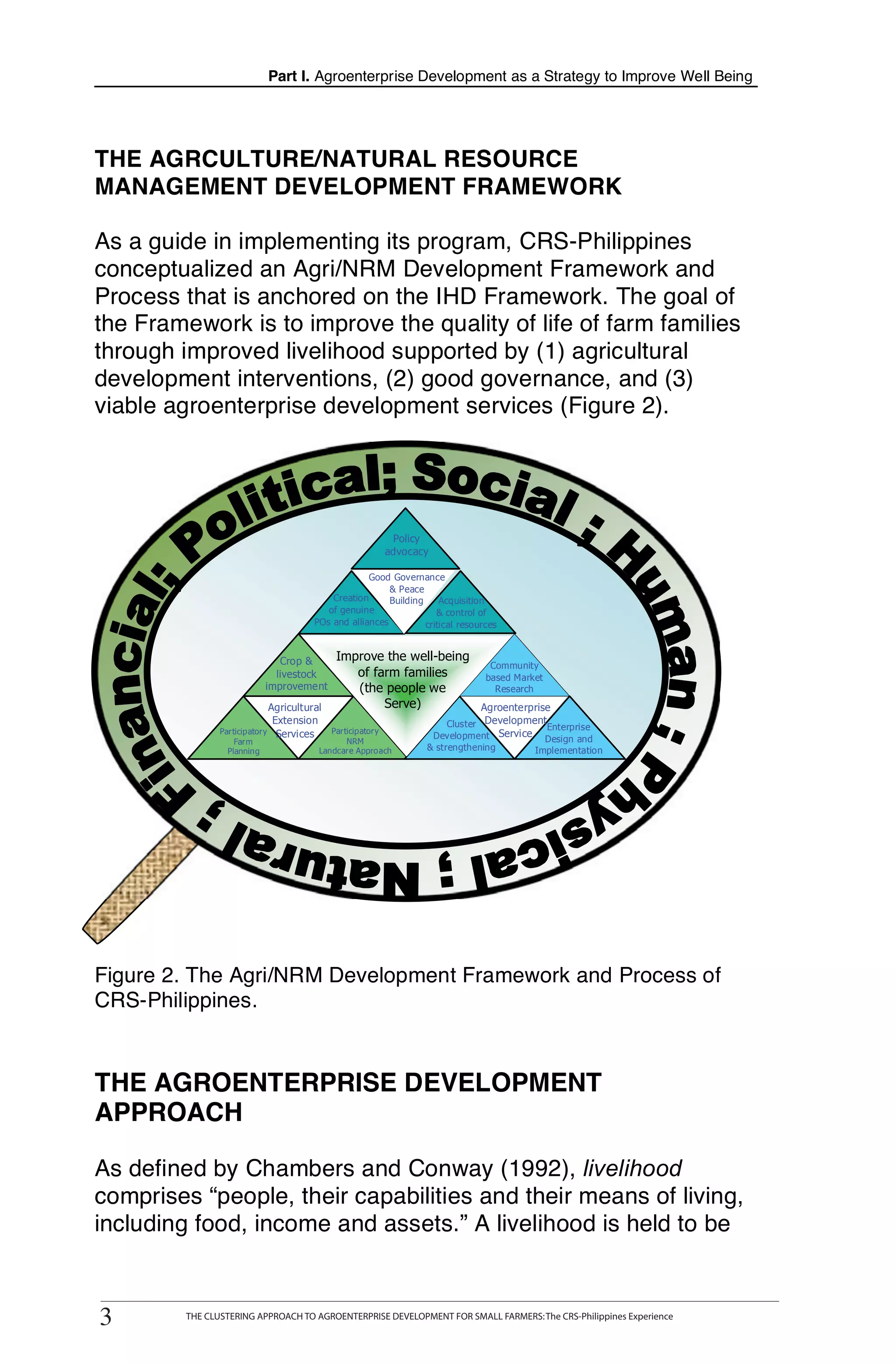
As a guide in implementing its program, CRS-Philippines
conceptualized an Agri/NRM Development Framework and
Process that is anchored on the IHD Framework. The goal of
the Framework is to improve the quality of life of farm families
through improved livelihood supported by (1) agricultural
development interventions, (2) good governance, and (3)
viable agroenterprise development services (Figure 2).


                                                                 Policy
                                                               advocacy

                                                         Good Governance
                                                              & Peace
                                                Creation      Building     Acquisition
                                               of genuine                 & control of
                                            POs and alliances          critical resources


                                 Crop &          Improve the well-being
                                                                                       Community
                                livestock           of farm families                  based Market
                              improvement           (the people we                      Research
                                  Agricultural           Serve)                      Agroenterprise
                                   Extension                                Cluster DevelopmentEnterprise
                  Participatory                Participatory
                                    Services                            Development Service Design and
                      Farm                         NRM
                    Planning                 Landcare Approach         & strengthening       Implementation


Figure 2. The Agri/NRM Development Framework and Process of
CRS-Philippines.


THE AGROENTERPRISE DEVELOPMENT
APPROACH

As defined by Chambers and Conway (1992), livelihood
comprises “people, their capabilities and their means of living,
including food, income and assets.” A livelihood is held to be


3
3
     THE CLUSTERING APPROACH TO AGROENTERPRISE DEVELOPMENT FOR SMALL FARMERS : The CRS-Philippines Experience
           THE CLUSTERING APPROACH TO AGROENTERPRISE DEVELOPMENT FOR SMALL FARMERS: The CRS-Philippines Experience
Part I. Agroenterprise Development as a Strategy to Improve Well Being


sustainable when “it can cope with and recover from stresses
and shocks and maintain or enhance its capabilities and
assets, both now and in the future, while not undermining the
natural resource base”. In line with this definition and
qualification, CRS adopted the Agroenterprise Development
(AED) Strategy to sustainable livelihood development.

Agroenterprise refers to a business venture, typically small-
scale, that can be undertaken either on-farm, or a service that
can be used to support other businesses (CIAT ERI Guide 2).
The AED Strategy brings small holder growers together and
guides their activities towards market-oriented and competitive
farm business operations without necessarily forming a formal
organization as a prerequisite. It combines good farming
practices and business skills for farmers to develop
sustainable production system that can respond to the need
for food security, increased income, and sustainable resource
base.

The CRS-Philippines experience in agroenterprise
development stemmed from the 10-year experience of the
International Centre for Tropical Agriculture (CIAT) in many
collaborative projects in Latin America, Africa and Asia. The
CIAT model which guided the first implementation stage of the
CRS-SFMP uses the “territorial approach” as it develops
community-based agroenterprises operating within defined
geographical areas.

In an analogy presented at the introduction of Part I,
agroenterprise development is one of the branches of the
Agri/NRM tree that is anchored on the IHD Framework. The
other branches of Agri/NRM are (1) agricultural extension,
with emphasis on sustainable farm practices, and (2) good
governance that promotes peoples’ participation in policies
and programs that directly affect their livelihood. These three
branches provide nourishment to the fruits, which represent
the improved well being of the poor.


                                                                                                                       44
     THE CLUSTERING APPROACH TO AGROENTERPRISE DEVELOPMENT FOR SMALL FARMERS : The CRS-Philippines Experience
             THE CLUSTERING APPROACH TO AGROENTERPRISE DEVELOPMENT FOR SMALL FARMERS: The CRS-Philippines Experience
Part II. The 8-Step Clustering Approach to Agroenterprise Development


Part II

The 8-Step Clustering Approach to
Agroenterprise Development


INTRODUCTION

Part II presents the eight steps in the clustering approach to
agroenterprise development that evolved in the course of the
implementation of the USDA-assisted Small Farms Marketing
Project (SFMP) that started in December 2004 and
implemented in five pilot sites in Mindanao by CRS-


5
5
      THE CLUSTERING APPROACH TO AGROENTERPRISE DEVELOPMENT FOR SMALL FARMERS: The CRS-Philippines Experience
          THE CLUSTERING APPROACH TO AGROENTERPRISE DEVELOPMENT FOR SMALL FARMERS: The CRS-Philippines Experience
Part II. The 8-Step Clustering Approach to Agroenterprise Development


Philippines in partnership with local NGOs and Local
Government Units (NGOs).

The sharing of experiences and the refinement of the
clustering approach were facilitated by the gatherings of CRS-
Philippines with its development partners and farmer leaders
for joint learning called the Mindanao Agroenterprise Learning
Alliance (MAELA). These interactions captured the rich
experiences of CRS-Philippines in developing agroenterprises
in the light of emerging and growing markets, and the
challenge to assist small farmers to become competitive and
significant market players.


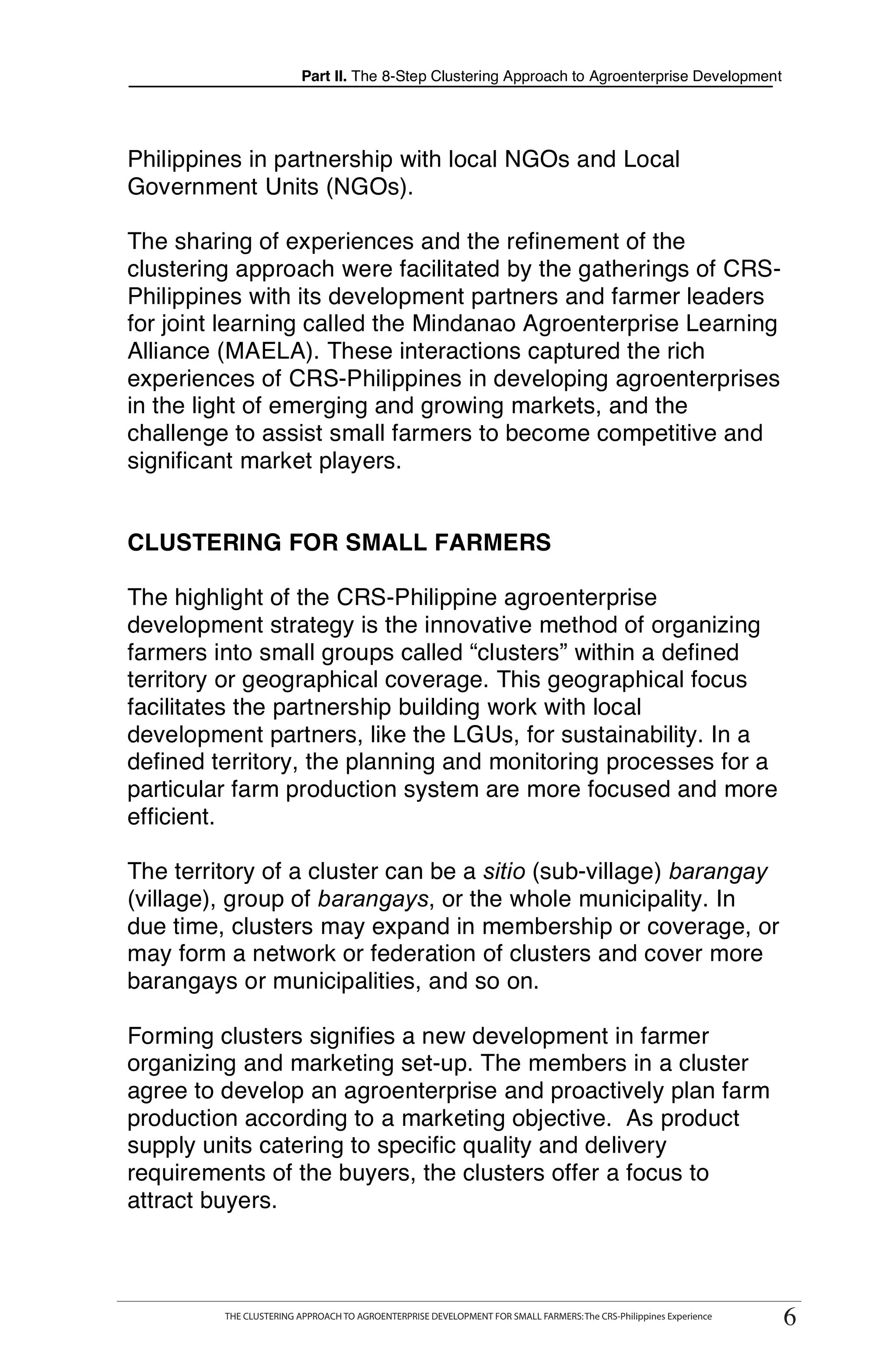
CLUSTERING FOR SMALL FARMERS

The highlight of the CRS-Philippine agroenterprise
development strategy is the innovative method of organizing
farmers into small groups called “clusters” within a defined
territory or geographical coverage. This geographical focus
facilitates the partnership building work with local
development partners, like the LGUs, for sustainability. In a
defined territory, the planning and monitoring processes for a
particular farm production system are more focused and more
efficient.

The territory of a cluster can be a sitio (sub-village) barangay
(village), group of barangays, or the whole municipality. In
due time, clusters may expand in membership or coverage, or
may form a network or federation of clusters and cover more
barangays or municipalities, and so on.

Forming clusters signifies a new development in farmer
organizing and marketing set-up. The members in a cluster
agree to develop an agroenterprise and proactively plan farm
production according to a marketing objective. As product
supply units catering to specific quality and delivery
requirements of the buyers, the clusters offer a focus to
attract buyers.


                                                                                                                     66
      THE CLUSTERING APPROACH TO AGROENTERPRISE DEVELOPMENT FOR SMALL FARMERS: The CRS-Philippines Experience
           THE CLUSTERING APPROACH TO AGROENTERPRISE DEVELOPMENT FOR SMALL FARMERS: The CRS-Philippines Experience
Part II. The 8-Step Clustering Approach to Agroenterprise Development


Being small groups, clusters are better able to keep pace with
continuously changing market opportunities that require
constant innovations from them in production and postharvest
practices. Moreover, the chance for each member to actively
participate and be heard in meetings is greater than in large
groups.

The clustering method provides a concrete mechanism where
farmers can exercise ownership and control of their
agroenterprise, benefit from it, and thus facilitate the farmers’
empowerment process. The clusters provide the learning
ground for self and group management, a maturation process
that is necessary for farmers to transition successfully into
formal business entities and effectively relate with other
market players and partners.

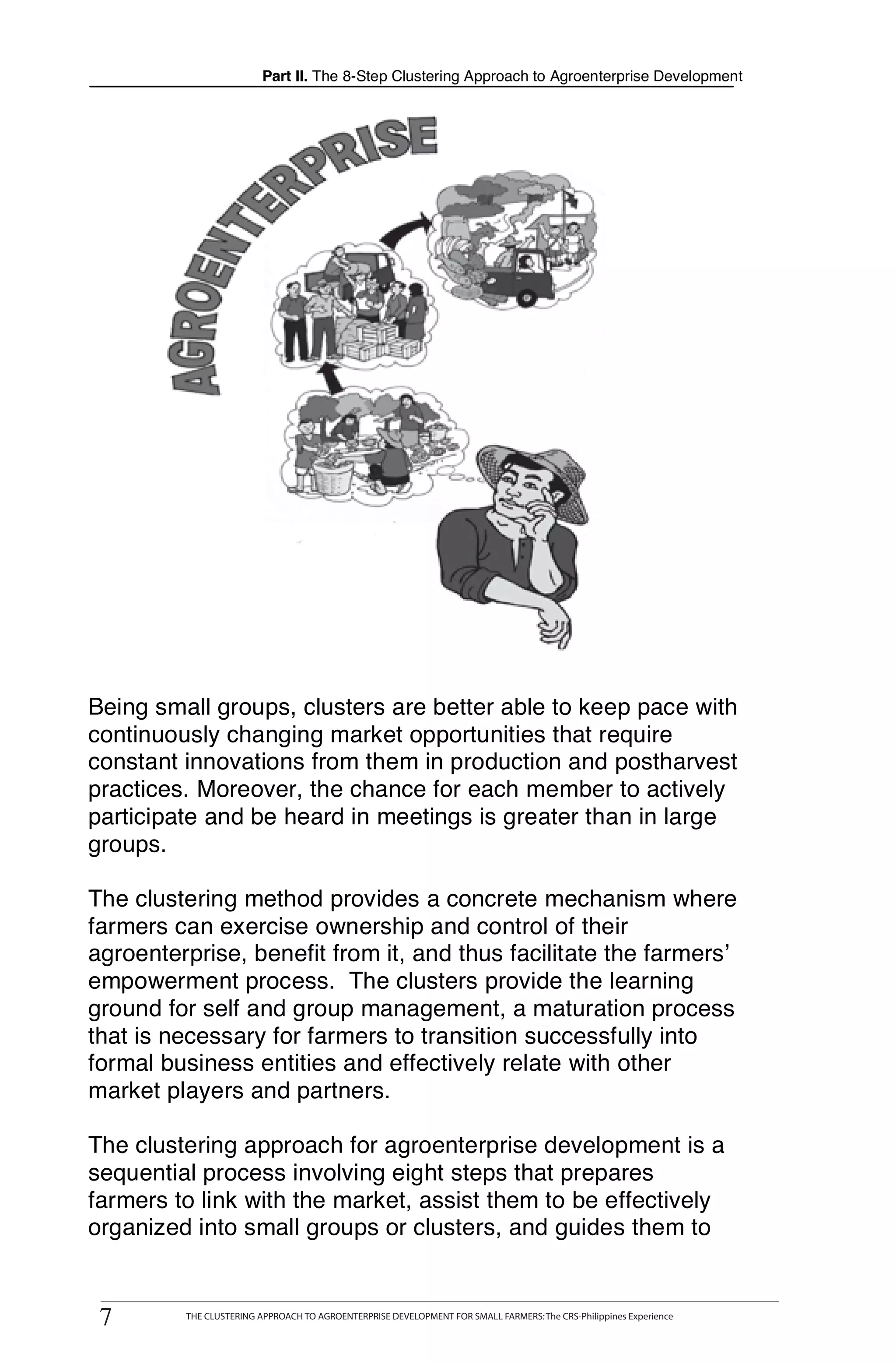
The clustering approach for agroenterprise development is a
sequential process involving eight steps that prepares
farmers to link with the market, assist them to be effectively
organized into small groups or clusters, and guides them to


77
      THE CLUSTERING APPROACH TO AGROENTERPRISE DEVELOPMENT FOR SMALL FARMERS: The CRS-Philippines Experience
            THE CLUSTERING APPROACH TO AGROENTERPRISE DEVELOPMENT FOR SMALL FARMERS: The CRS-Philippines Experience
Part II. The 8-Step Clustering Approach to Agroenterprise Development


engage the market with favorable arrangements that improve
their incomes and livelihood.

The first five steps comprise the preparatory activities. This
emphasizes the need for farmers to learn new skills, access
new information, and adopt innovative methods to be able to
identify and respond to market demands and opportunities
given their capacities. Adequate preparation during this
critical business preparation and organizing stage ensures
that a higher degree of success is attained when their actual
marketing starts to take place in Step 6 (Test Marketing).

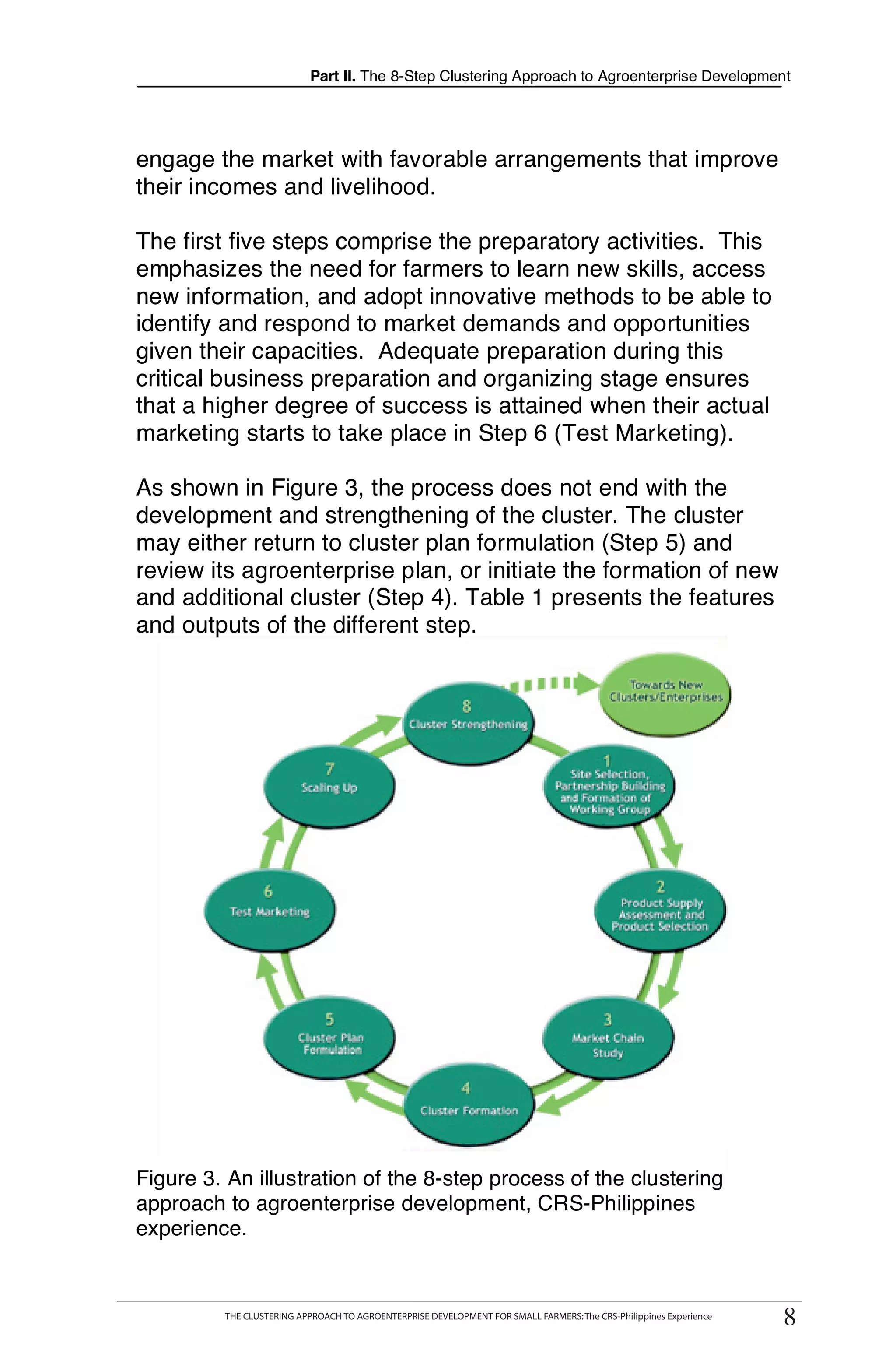
As shown in Figure 3, the process does not end with the
development and strengthening of the cluster. The cluster
may either return to cluster plan formulation (Step 5) and
review its agroenterprise plan, or initiate the formation of new
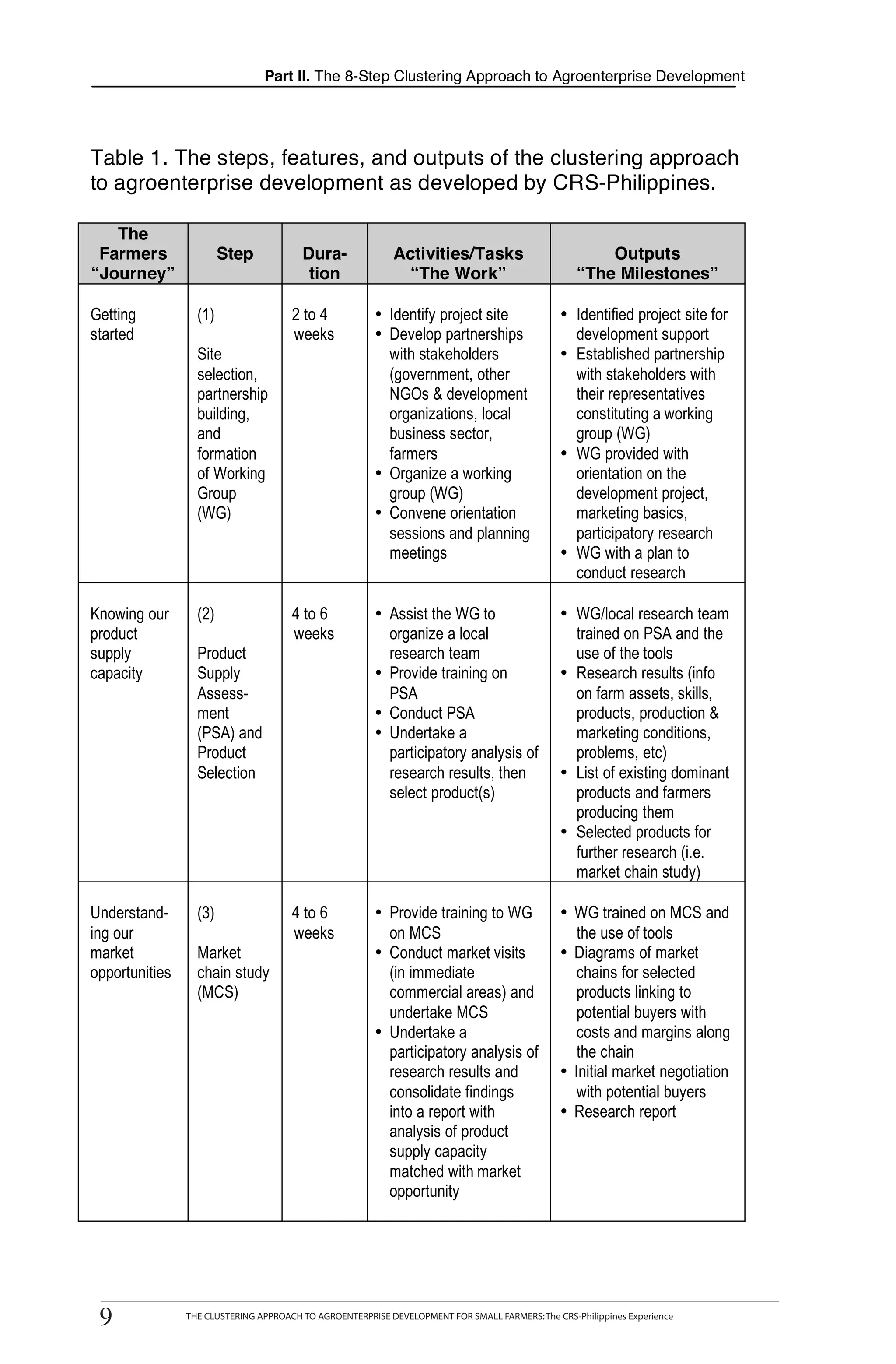
and additional cluster (Step 4). Table 1 presents the features
and outputs of the different step.


Figure 3. An illustration of the 8-step process of the clustering
approach to agroenterprise development, CRS-Philippines
experience.


       THE CLUSTERING APPROACH TO AGROENTERPRISE DEVELOPMENT FOR SMALL FARMERS: The CRS-Philippines Experience
           THE CLUSTERING APPROACH TO AGROENTERPRISE DEVELOPMENT FOR SMALL FARMERS: The CRS-Philippines Experience
                                                                                                                     8
                                                                                                                     8
Part II. The 8-Step Clustering Approach to Agroenterprise Development


Table 1. The steps, features, and outputs of the clustering approach
to agroenterprise development as developed by CRS-Philippines.

   The
 Farmers                Step            Dura-              Activities/Tasks                           Outputs
“Journey”                                tion                “The Work”                           “The Milestones”

Getting           (1)                 2 to 4           • Identify project site                 • Identified project site for
started                               weeks            • Develop partnerships                    development support
                  Site                                   with stakeholders                     • Established partnership
                  selection,                             (government, other                      with stakeholders with
                  partnership                            NGOs & development                      their representatives
                  building,                              organizations, local                    constituting a working
                  and                                    business sector,                        group (WG)
                  formation                              farmers                               • WG provided with
                  of Working                           • Organize a working                      orientation on the
                  Group                                  group (WG)                              development project,
                  (WG)                                 • Convene orientation                     marketing basics,
                                                         sessions and planning                   participatory research
                                                         meetings                              • WG with a plan to
                                                                                                 conduct research

Knowing our       (2)                 4 to 6           • Assist the WG to                      • WG/local research team
product                               weeks              organize a local                        trained on PSA and the
supply            Product                                research team                           use of the tools
capacity          Supply                               • Provide training on                   • Research results (info
                  Assess-                                PSA                                     on farm assets, skills,
                  ment                                 • Conduct PSA                             products, production &
                  (PSA) and                            • Undertake a                             marketing conditions,
                  Product                                participatory analysis of               problems, etc)
                  Selection                              research results, then                • List of existing dominant
                                                         select product(s)                       products and farmers
                                                                                                 producing them
                                                                                               • Selected products for
                                                                                                 further research (i.e.
                                                                                                 market chain study)

Understand-       (3)                 4 to 6           • Provide training to WG                • WG trained on MCS and
ing our                               weeks              on MCS                                   the use of tools
market            Market                               • Conduct market visits                 • Diagrams of market
opportunities     chain study                            (in immediate                            chains for selected
                  (MCS)                                  commercial areas) and                    products linking to
                                                         undertake MCS                            potential buyers with
                                                       • Undertake a                              costs and margins along
                                                         participatory analysis of                the chain
                                                         research results and                  • Initial market negotiation
                                                         consolidate findings                     with potential buyers
                                                         into a report with                    • Research report
                                                         analysis of product
                                                         supply capacity
                                                         matched with market
                                                         opportunity


99
          THE CLUSTERING APPROACH TO AGROENTERPRISE DEVELOPMENT FOR SMALL FARMERS: The CRS-Philippines Experience
                THE CLUSTERING APPROACH TO AGROENTERPRISE DEVELOPMENT FOR SMALL FARMERS: The CRS-Philippines Experience
Part II. The 8-Step Clustering Approach to Agroenterprise Development


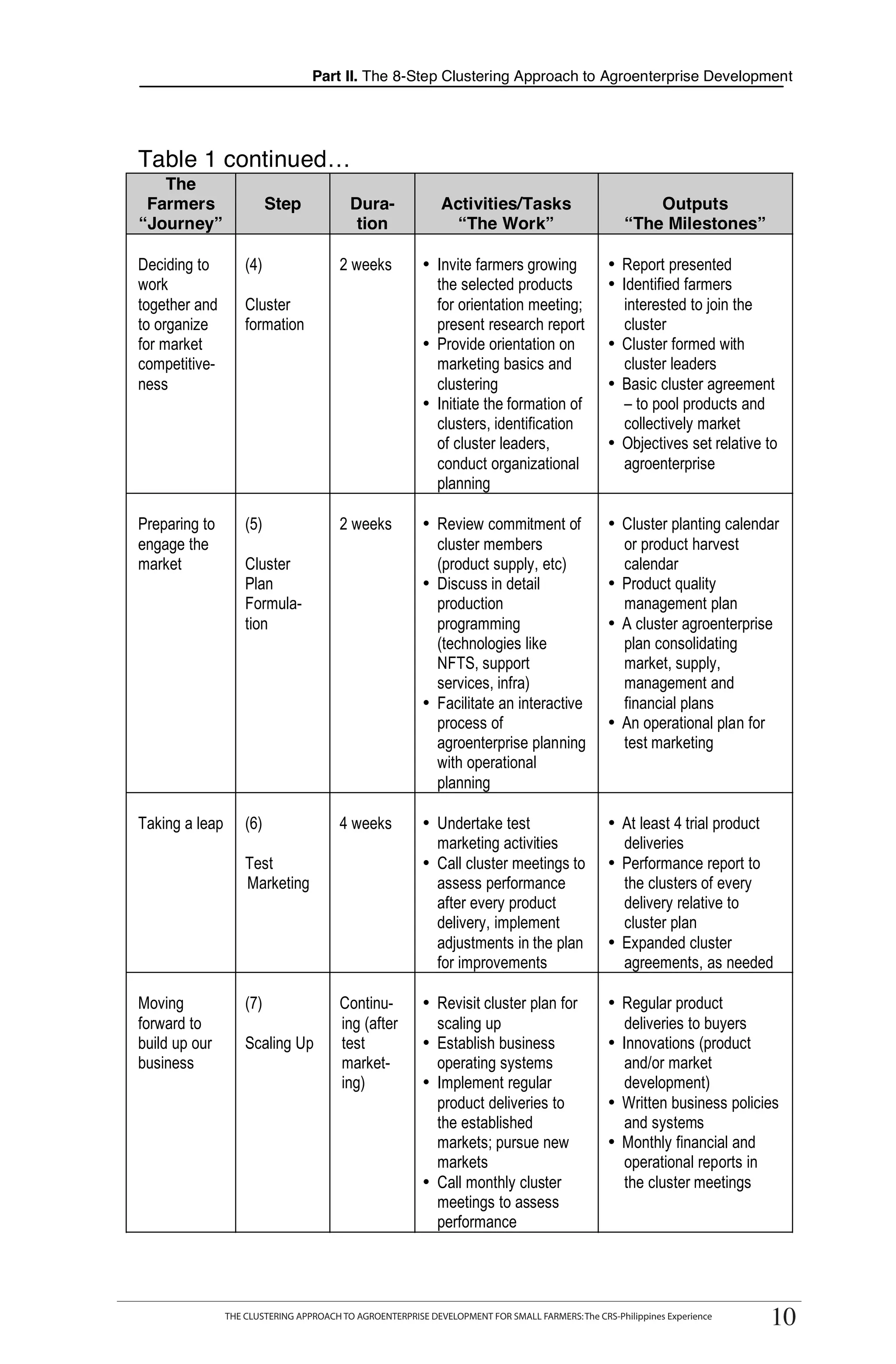
Table 1 continued…
   The
 Farmers                  Step            Dura-              Activities/Tasks                           Outputs
“Journey”                                  tion                “The Work”                           “The Milestones”

Deciding to         (4)                 2 weeks          • Invite farmers growing               • Report presented
work                                                       the selected products                • Identified farmers
together and        Cluster                                for orientation meeting;               interested to join the
to organize         formation                              present research report                cluster
for market                                               • Provide orientation on               • Cluster formed with
competitive-                                               marketing basics and                   cluster leaders
ness                                                       clustering                           • Basic cluster agreement
                                                         • Initiate the formation of              – to pool products and
                                                           clusters, identification               collectively market
                                                           of cluster leaders,                  • Objectives set relative to
                                                           conduct organizational                 agroenterprise
                                                           planning

Preparing to        (5)                 2 weeks          • Review commitment of                 • Cluster planting calendar
engage the                                                 cluster members                        or product harvest
market              Cluster                                (product supply, etc)                  calendar
                    Plan                                 • Discuss in detail                    • Product quality
                    Formula-                               production                             management plan
                    tion                                   programming                          • A cluster agroenterprise
                                                           (technologies like                     plan consolidating
                                                           NFTS, support                          market, supply,
                                                           services, infra)                       management and
                                                         • Facilitate an interactive              financial plans
                                                           process of                           • An operational plan for
                                                           agroenterprise planning                test marketing
                                                           with operational
                                                           planning

Taking a leap       (6)                 4 weeks          • Undertake test                       • At least 4 trial product
                                                           marketing activities                   deliveries
                    Test                                 • Call cluster meetings to             • Performance report to
                    Marketing                              assess performance                     the clusters of every
                                                           after every product                    delivery relative to
                                                           delivery, implement                    cluster plan
                                                           adjustments in the plan              • Expanded cluster
                                                           for improvements                       agreements, as needed

Moving              (7)                 Continu-         • Revisit cluster plan for             • Regular product
forward to                              ing (after         scaling up                              deliveries to buyers
build up our        Scaling Up          test             • Establish business                   • Innovations (product
business                                market-            operating systems                       and/or market
                                        ing)             • Implement regular                       development)
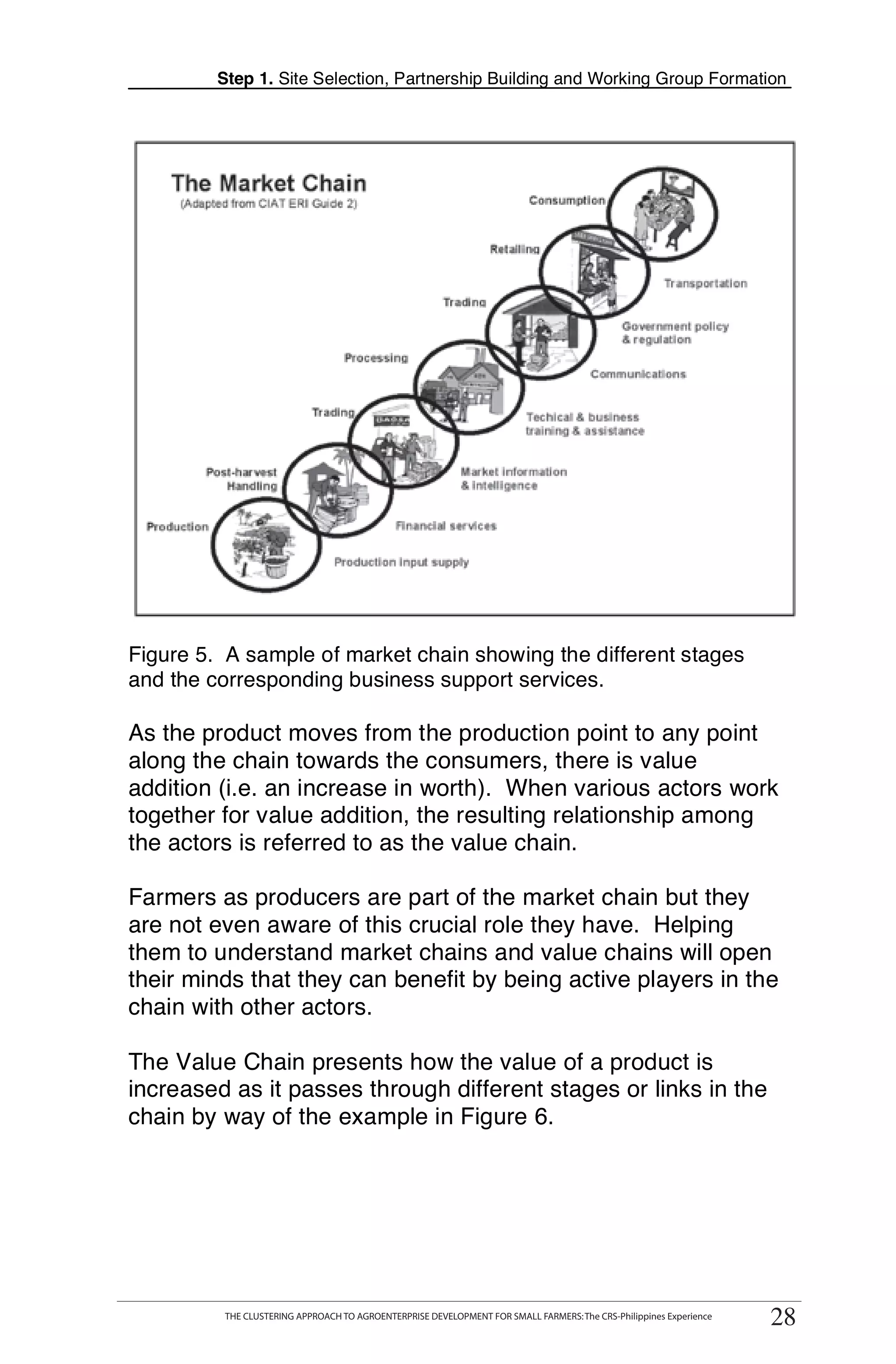
                                                           product deliveries to                • Written business policies
                                                           the established                        and systems
                                                           markets; pursue new                  • Monthly financial and
                                                           markets                                operational reports in
                                                         • Call monthly cluster                   the cluster meetings
                                                           meetings to assess
                                                           performance


          THE CLUSTERING APPROACH TO AGROENTERPRISE DEVELOPMENT FOR SMALL FARMERS: The CRS-Philippines Experience
                THE CLUSTERING APPROACH TO AGROENTERPRISE DEVELOPMENT FOR SMALL FARMERS: The CRS-Philippines Experience
                                                                                                                          10
                                                                                                                          10
Part II. The 8-Step Clustering Approach to Agroenterprise Development


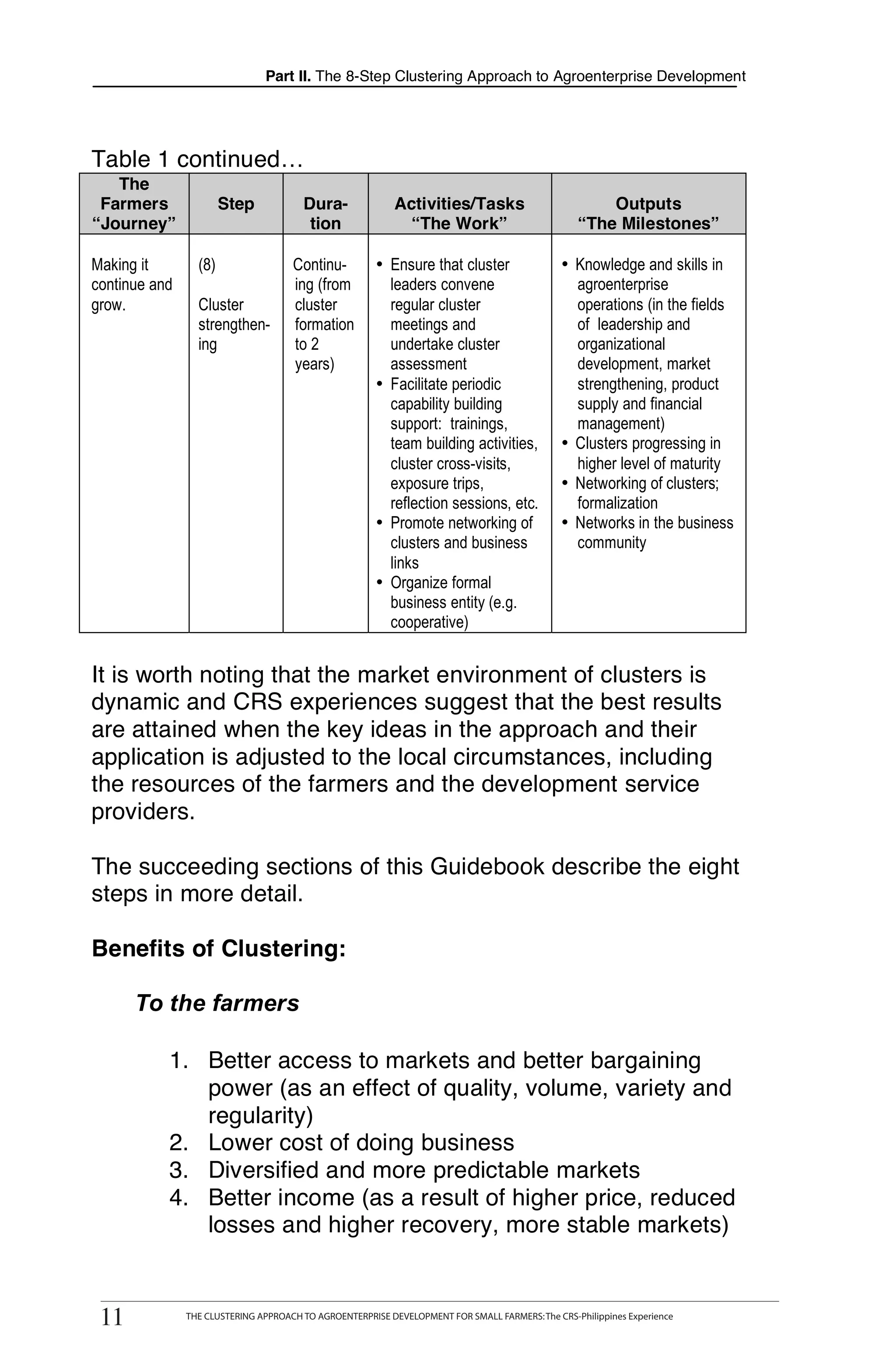
Table 1 continued…
   The
 Farmers               Step            Dura-               Activities/Tasks                          Outputs
“Journey”                               tion                 “The Work”                          “The Milestones”

Making it        (8)                 Continu-          • Ensure that cluster                  • Knowledge and skills in
continue and                         ing (from           leaders convene                        agroenterprise
grow.            Cluster             cluster             regular cluster                        operations (in the fields
                 strengthen-         formation           meetings and                           of leadership and
                 ing                 to 2                undertake cluster                      organizational
                                     years)              assessment                             development, market
                                                       • Facilitate periodic                    strengthening, product
                                                         capability building                    supply and financial
                                                         support: trainings,                    management)
                                                         team building activities,            • Clusters progressing in
                                                         cluster cross-visits,                  higher level of maturity
                                                         exposure trips,                      • Networking of clusters;
                                                         reflection sessions, etc.              formalization
                                                       • Promote networking of                • Networks in the business
                                                         clusters and business                  community
                                                         links
                                                       • Organize formal
                                                         business entity (e.g.
                                                         cooperative)


It is worth noting that the market environment of clusters is
dynamic and CRS experiences suggest that the best results
are attained when the key ideas in the approach and their
application is adjusted to the local circumstances, including
the resources of the farmers and the development service
providers.

The succeeding sections of this Guidebook describe the eight
steps in more detail.

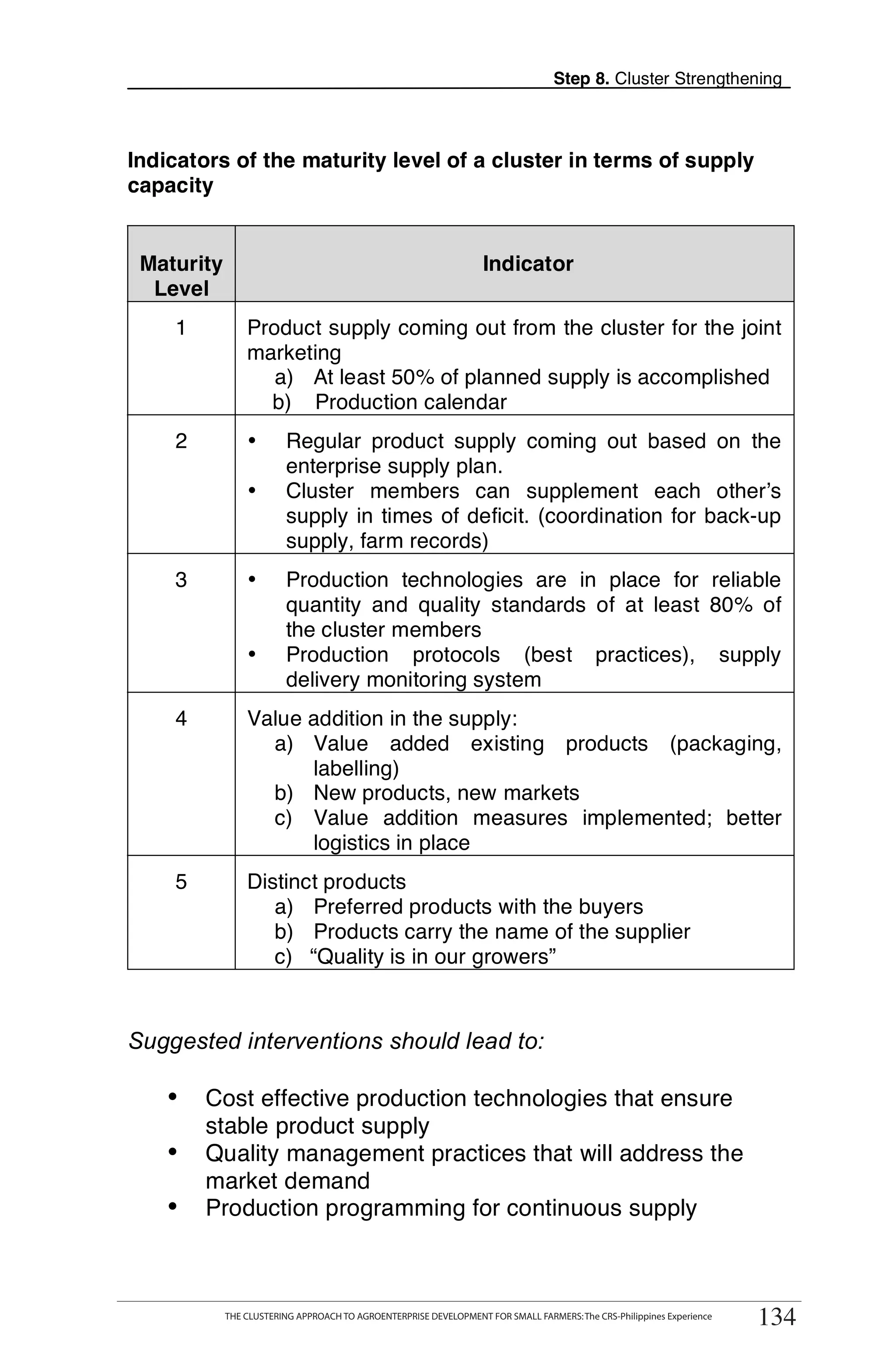
Benefits of Clustering:

      To the farmers

           1. Better access to markets and better bargaining
              power (as an effect of quality, volume, variety and
              regularity)
           2. Lower cost of doing business
           3. Diversified and more predictable markets
           4. Better income (as a result of higher price, reduced
              losses and higher recovery, more stable markets)


 11
11
         THE CLUSTERING APPROACH TO AGROENTERPRISE DEVELOPMENT FOR SMALL FARMERS: The CRS-Philippines Experience
               THE CLUSTERING APPROACH TO AGROENTERPRISE DEVELOPMENT FOR SMALL FARMERS: The CRS-Philippines Experience
Part II. The 8-Step Clustering Approach to Agroenterprise Development


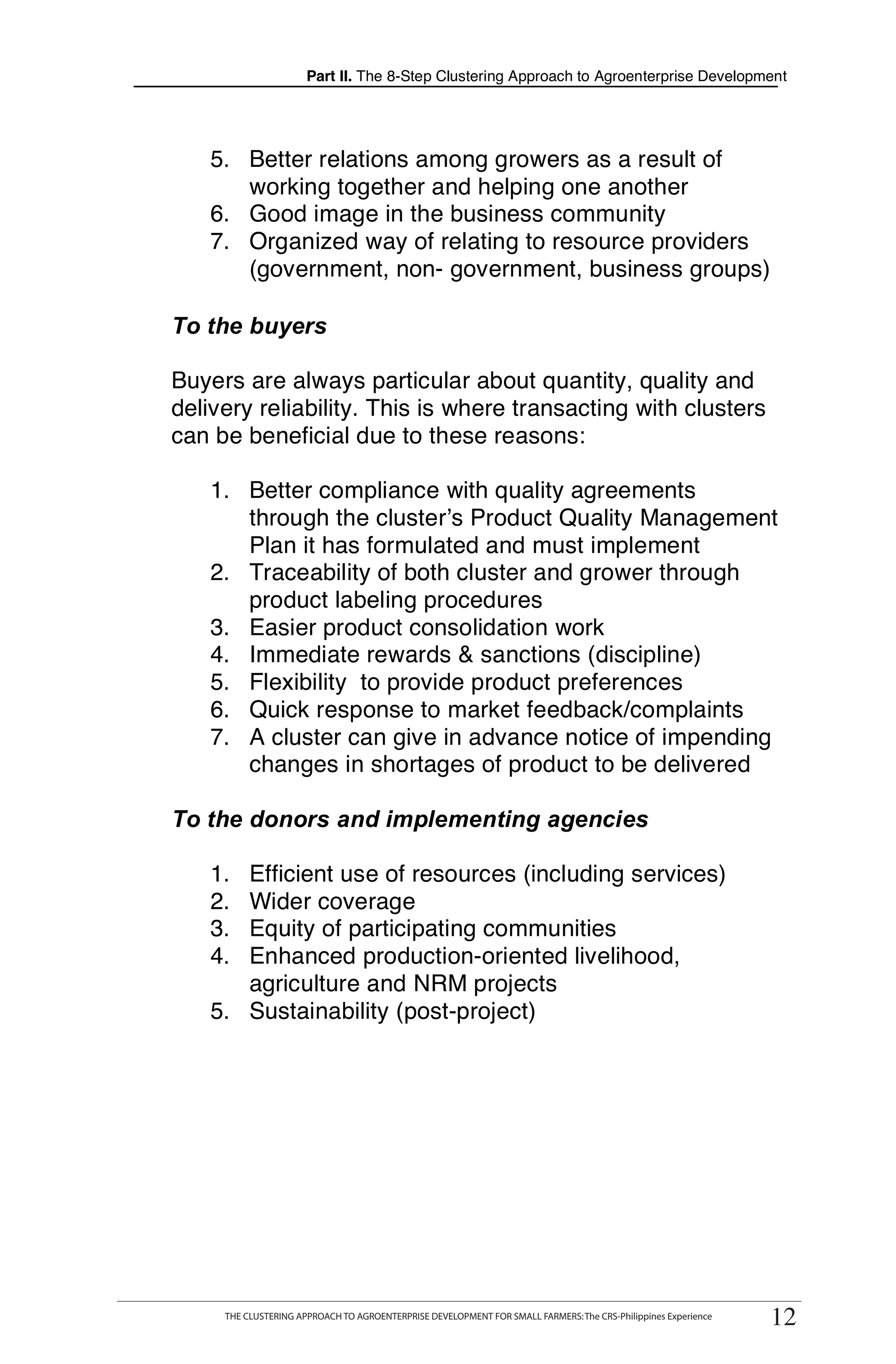
    5. Better relations among growers as a result of
       working together and helping one another
    6. Good image in the business community
    7. Organized way of relating to resource providers
       (government, non- government, business groups)

To the buyers

Buyers are always particular about quantity, quality and
delivery reliability. This is where transacting with clusters
can be beneficial due to these reasons:

    1. Better compliance with quality agreements
       through the cluster’s Product Quality Management
       Plan it has formulated and must implement
    2. Traceability of both cluster and grower through
       product labeling procedures
    3. Easier product consolidation work
    4. Immediate rewards & sanctions (discipline)
    5. Flexibility to provide product preferences
    6. Quick response to market feedback/complaints
    7. A cluster can give in advance notice of impending
       changes in shortages of product to be delivered

To the donors and implementing agencies

    1. Efficient use of resources (including services)
    2. Wider coverage
    3. Equity of participating communities
    4. Enhanced production-oriented livelihood,
       agriculture and NRM projects
    5. Sustainability (post-project)


  THE CLUSTERING APPROACH TO AGROENTERPRISE DEVELOPMENT FOR SMALL FARMERS: The CRS-Philippines Experience
      THE CLUSTERING APPROACH TO AGROENTERPRISE DEVELOPMENT FOR SMALL FARMERS: The CRS-Philippines Experience
                                                                                                                 12
                                                                                                                12
Step 1. Site Selection, Partnership Building and Working Group Formation


 Site Selection, Partnership Building
    and Working Group Formation


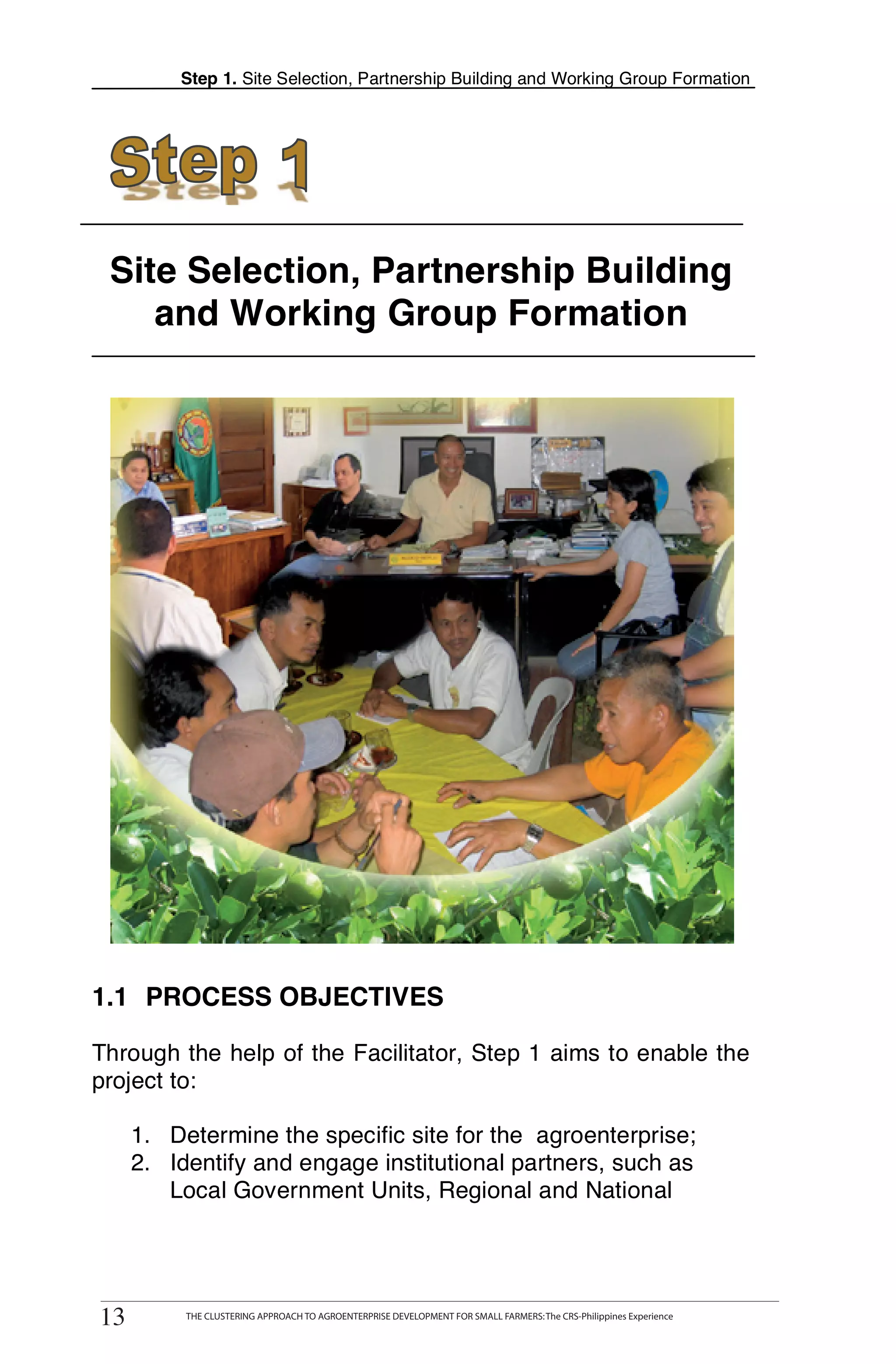
1.1 PROCESS OBJECTIVES

Through the help of the Facilitator, Step 1 aims to enable the
project to:

      1. Determine the specific site for the agroenterprise;
      2. Identify and engage institutional partners, such as
         Local Government Units, Regional and National


 13
13
        THE CLUSTERING APPROACH TO AGROENTERPRISE DEVELOPMENT FOR SMALL FARMERS: The CRS-Philippines Experience
             THE CLUSTERING APPROACH TO AGROENTERPRISE DEVELOPMENT FOR SMALL FARMERS: The CRS-Philippines Experience
Step 1. Site Selection, Partnership Building and Working Group Formation


      Government Agencies, Non-Government
      Organizations, and Peoples Organizations;
   3. Form and orient a Working Group (WG); and
   4. Assist the WG in formulating a plan for community-
      based research.


1.2 INTRODUCTION

Site Selection, Partnership Building and Working Group
Formation is a community process where appropriate site or
sites and partners for the agroenterprise project are identified,
and a Working Group (WG) composed of producers, local
government units (LGU), non-governmental organizations
(NGO), business sector and other relevant representation is
constituted.

This is also the phase where potential farmer leaders are
identified through rapid appraisal. These leaders are invited to
be part of the Working Group (WG) and to participate in the
upcoming initial activities.


1.3 SELECTING THE SITE

Basis for selection

In many cases, sites for the agroenterprise endeavor can be
pre-identified from among existing project areas, or on the
basis of donor preferences.

Ideally, a potential site for the agroenterprise project should
have the following facilitating or enabling factors:

   1.    Responsive LGU
   2.    Presence of good extension services
   3.    Willing producers
   4.    Surplus farm products


        THE CLUSTERING APPROACH TO AGROENTERPRISE DEVELOPMENT FOR SMALL FARMERS: The CRS-PhilippinesExperience
              THE CLUSTERING APPROACH TO AGROENTERPRISE DEVELOPMENT FOR SMALL FARMERS: The CRS-Philippines Experience
                                                                                                                         14
                                                                                                                        14
Step 1. Site Selection, Partnership Building and Working Group Formation


      5. Favorable social conditions (peace and order,
         community awareness)
      6. Presence of potential partners or related projects such
         as agriculture, natural resource management,
         landcare, or community development

The presence of more of these factors would facilitate the
development of an agroenterprise.

At the minimum, willing farmers who have products that can
be marketed can let an agroenterprise endeavor begin.
However, this will require so much facilitation for clustering,
capacity building, operationalizing and networking.

Geographical Focus

The site can be a sitio (sub-village), barangay (village),
municipality, or a group/combination of each.

In a small area, like the sitio or barangay, the focus can be on
understanding the local marketing system and identifying
problems and bottlenecks that can be addressed through
interventions in the local economy.

Rapid Area Assessment

In order to have a good grasp of the current situation of the
site, a quick survey of the resources, institutions and their
predominant business and production activities will be of help
to the Facilitator. Knowing what and who are in the community
will help him/her in carrying out the assigned tasks.

The following information can serve as a starting point for the
Facilitator in making a rapid assessment of the area prior to a
more extensive information gathering and analysis:

       1. Physical resources (land and its use, water
          resources, soil, climate, rainfall patterns, cropping
          seasons, vegetation)


 15
15
        THE CLUSTERING APPROACH TO AGROENTERPRISE DEVELOPMENT FOR SMALL FARMERS: The CRS-Philippines Experience
              THE CLUSTERING APPROACH TO AGROENTERPRISE DEVELOPMENT FOR SMALL FARMERS: The CRS-Philippines Experience
Step 1. Site Selection, Partnership Building and Working Group Formation


     2. Community profile (gender, age distribution, number
        of farmers, other sectors, household size, social
        groupings, educational level, history of collective
        action)
     3. Infrastructure (roads/accessibility of farm areas,
        communications, electricity, water systems)
     4. Business activities/services (business
        establishments, markets, business service providers,
        credit services both formal and informal)
     5. Development assistance (NGOs, political structure,
        government policies and programs for the agriculture
        sector).

The above information can be generated by direct observation
or by reviewing secondary sources such as the barangay or
municipal profiles and development plans, LGU reports such
as those in the Municipal Planning & Development Office
(MPDO), the Municipal Agriculture Office (MAO), the
Municipal Economic Enterprise Development Office
(MEEDO), the Municipal Engineering Office (MEO), and other
relevant offices.


1.4 BUILDING PARTNERSHIPS

This is the continuing process of linking with and engaging
relevant institutions or organizations to support the
agroenterprise development undertakings. For example, the
Barangay Development Plan (BDPs) of Barangay Local
Government Units (BLGUs) can be the entry point for
agroenterprise projects especially when these are consistent
with, or part of the agricultural development component of the
BDP. Moreover, barangay officials, such as the Barangay
Chair and the Committee Chair on Agriculture, can provide for
the relevant local policy and program support.

At the level of the Municipal LGU, partnership can yield more
support and counterparts, such as human resources,
infrastructure, logistics (i.e., hand-held radios and
transportation services), and policies. These can be provided


      THE CLUSTERING APPROACH TO AGROENTERPRISE DEVELOPMENT FOR SMALL FARMERS: The CRS-Philippines Experience
            THE CLUSTERING APPROACH TO AGROENTERPRISE DEVELOPMENT FOR SMALL FARMERS: The CRS-Philippines Experience
                                                                                                                       16
                                                                                                                      16
Step 1. Site Selection, Partnership Building and Working Group Formation


by the office of the Local Chief Executive, the MAO, the
MEEDO, the MEO, the MPDO, and the offices of relevant
Sangguniang Bayan (Municipal Council) Committees.
Links with other institutions and organizations operating in the
barangay, municipal and provincial territories (such as
producers, business sector and church) can also be
established.

The process of building partnerships can be initiated through
courtesy calls and meetings leading towards a consultation
among identified partners. The active partnership begins with
the establishment of a Working Group (WG).


1.5 FORMING A WORKING GROUP

During the community consultation, the Facilitator draws out
the current situation related to farmers’ production and
marketing, available resources, and existing programs of
NGOs and LGUs. From the discussions, he/she leads the
participants to a consensus on issues pertaining to farm
productivity and incomes.

Addressing the above issues realistically needs a multi-
pronged approach which can be led by the WG.

Role and lifespan of the WG

The WG is an adhoc body organized to provide leadership in
the gathering of information that can help in product selection
(Step 2), in conducting market chain studies (Step 3), and in
forming cluster (or clusters) of farmers for agroenterprise
development (Step 4). Immediately after cluster formation, the
WG transforms itself into a Cluster Advisory Group (CAG) that
will provide assistance in formulating and implementing an
agroenterprise plan (Steps 5-7).

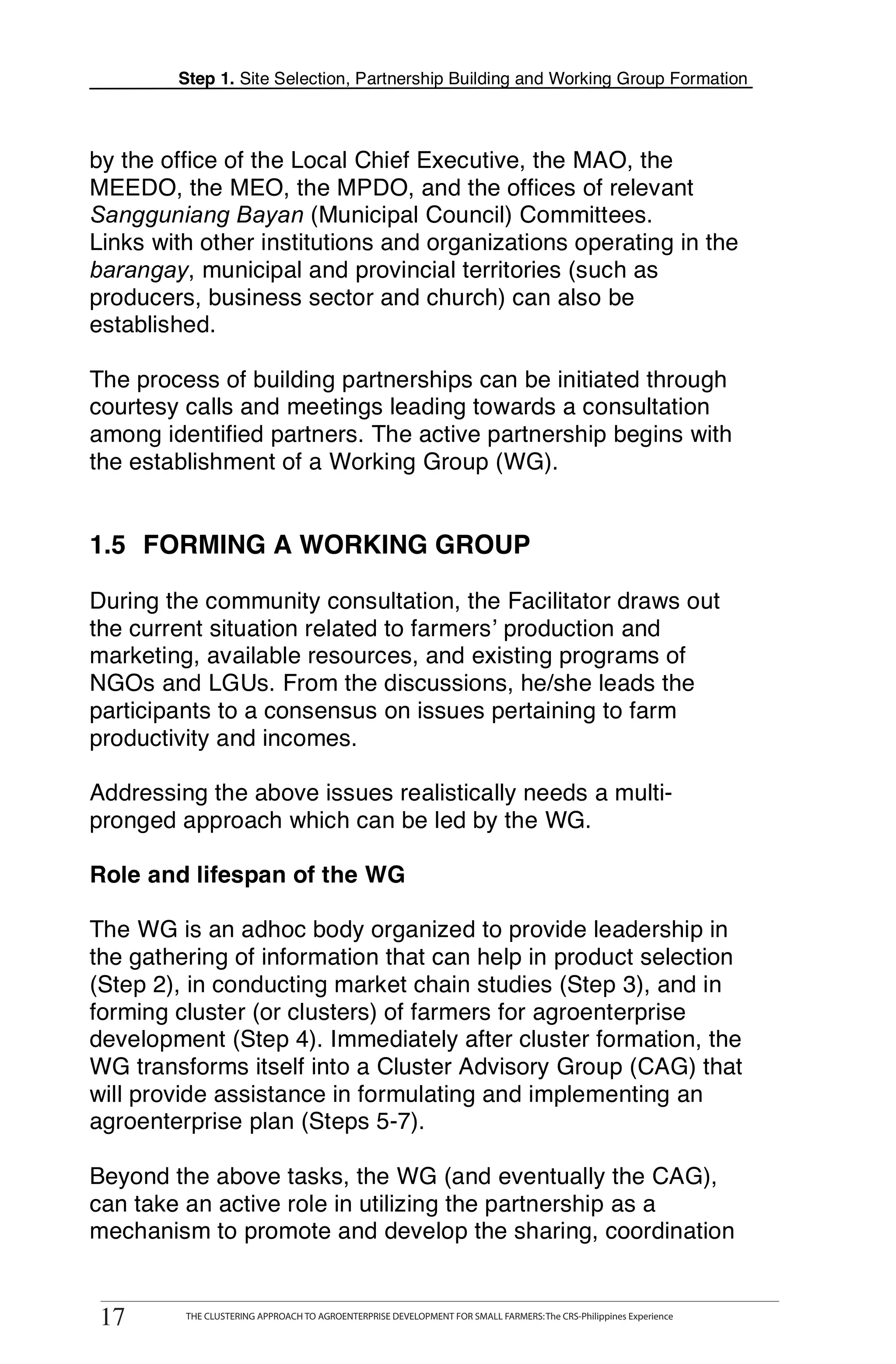
Beyond the above tasks, the WG (and eventually the CAG),
can take an active role in utilizing the partnership as a
mechanism to promote and develop the sharing, coordination


 17
17
      THE CLUSTERING APPROACH TO AGROENTERPRISE DEVELOPMENT FOR SMALL FARMERS: The CRS-Philippines Experience
           THE CLUSTERING APPROACH TO AGROENTERPRISE DEVELOPMENT FOR SMALL FARMERS: The CRS-Philippines Experience
Step 1. Site Selection, Partnership Building and Working Group Formation


and complementation of local programs and resources
towards a common goal.


Composition of the WG

A WG may be composed of representatives from the MAO,
MEEDO, NGOs, business sectors, farmers and people’s
organization (PO). WG membership ranges from 10 to 15
individuals, at least two-thirds of which are farmers.

Members of the WG should meet at least once a month to
discuss updates and coordinate activities.

To ensure the representation of farmers in the WG, the
Facilitator must take extra effort to identify potential farmer-
leaders.

(Refer to Facilitator’s Tool Kit No. 1 for the standards used in
identifying farmer-leaders to be involved as members of the
WG.)

Identifying local leaders for the WG

The Sociogram method can be used to identify indigenous
leaders (male and female key persons and/ or opinion


       THE CLUSTERING APPROACH TO AGROENTERPRISE DEVELOPMENT FOR SMALL FARMERS: The CRS-Philippines Experience
            THE CLUSTERING APPROACH TO AGROENTERPRISE DEVELOPMENT FOR SMALL FARMERS: The CRS-Philippines Experience
                                                                                                                       18
                                                                                                                      18
Step 1. Site Selection, Partnership Building and Working Group Formation


leaders) in the community who can facilitate the change
process.

(Refer to Facilitator’s Tool Kit No.1 for a guide in using the
sociogram.)


1.6 ORIENTING THE WORKING GROUP ON
    MARKETING

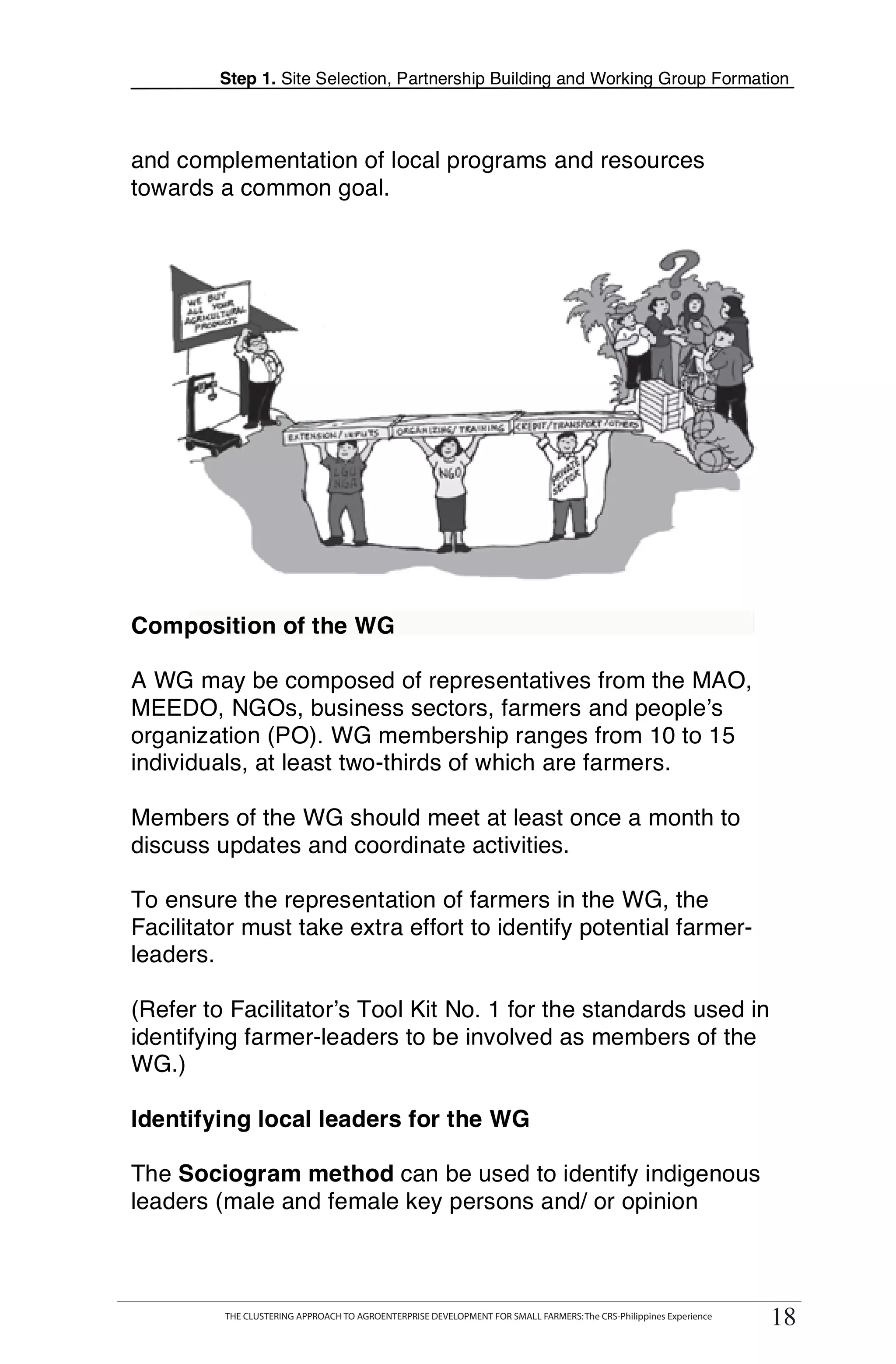
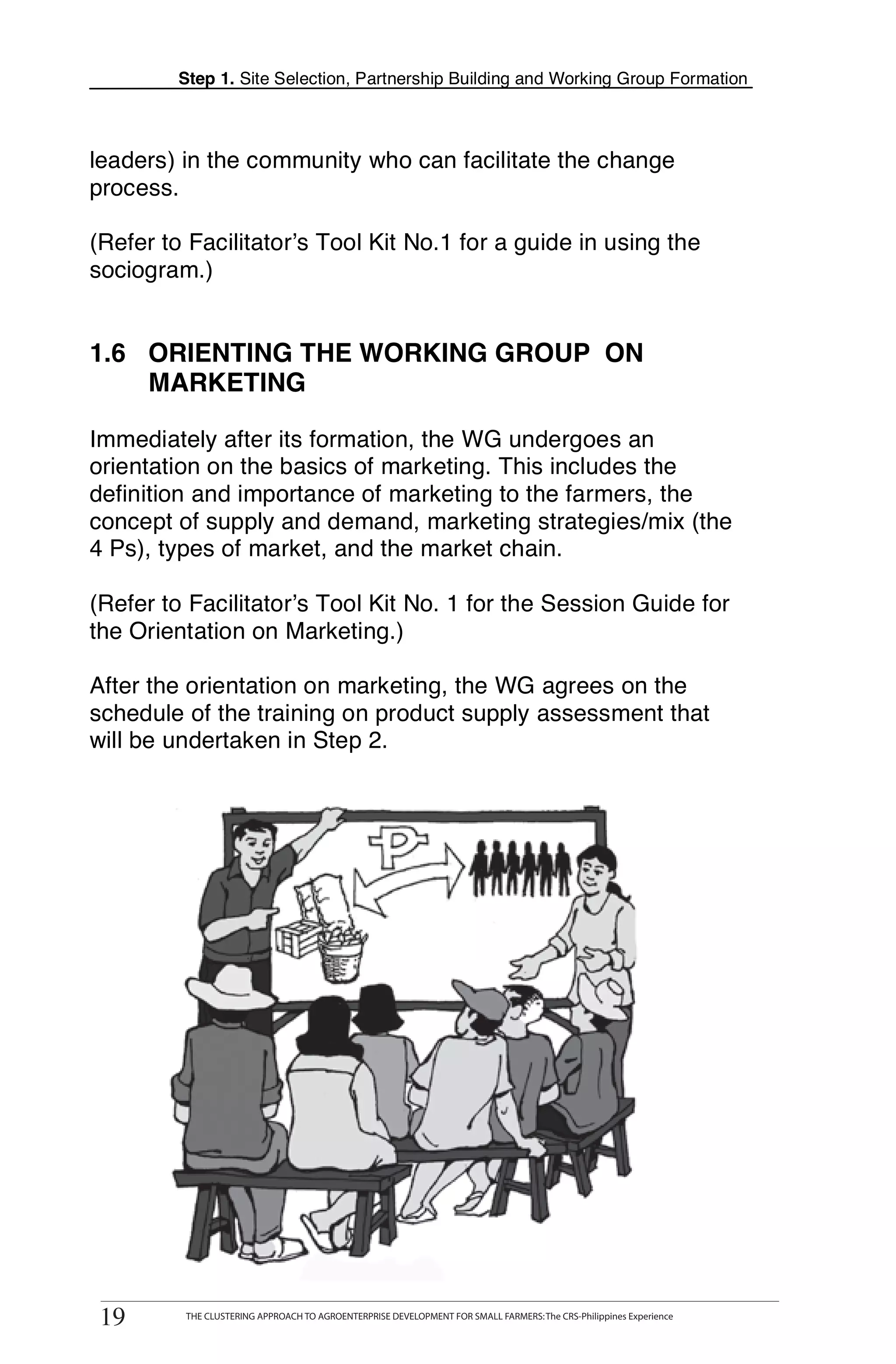
Immediately after its formation, the WG undergoes an
orientation on the basics of marketing. This includes the
definition and importance of marketing to the farmers, the
concept of supply and demand, marketing strategies/mix (the
4 Ps), types of market, and the market chain.

(Refer to Facilitator’s Tool Kit No. 1 for the Session Guide for
the Orientation on Marketing.)

After the orientation on marketing, the WG agrees on the
schedule of the training on product supply assessment that
will be undertaken in Step 2.


 19
19
       THE CLUSTERING APPROACH TO AGROENTERPRISE DEVELOPMENT FOR SMALL FARMERS: The CRS-Philippines Experience
            THE CLUSTERING APPROACH TO AGROENTERPRISE DEVELOPMENT FOR SMALL FARMERS: The CRS-Philippines Experience
Step 1. Site Selection, Partnership Building and Working Group Formation


                                                               Facilitator’s Tool Kit No. 1


A. IDENTIFYING LOCAL LEADERS

Standards used in selecting farmer-leaders

Selection standard for leaders, men and women, may include,
but not limited to the following:
   1. Farmer producer
   2. With experience in marketing farm products                                                                          T
   3. Respected
   4. Aware and concerned about the community issues and
      needs                                                                                                               O
   5. Believes in the stake and power of communities
      through participation                                                                                               O
   6. Good communicator: good listener, can express well
      and open to ideas
                                                                                                                          L
Using the Sociogram Method in identifying local leaders

How to Use the Sociogram
                                                                                                                          K
The sociogram is especially useful in analyzing social or peer
relationships. It gives the Facilitator an idea of how a member
of a community or cluster is viewed by her/his peers in terms
                                                                                                                          I
of leadership, trustworthiness, approachability and in other
similar qualities.                                                                                                        T
Spot potential leaders you can invite later to join the Working                                                           T
Group, following the basic steps below. You may revise these
steps depending on specific or bulk of information needed and
the number of respondents you can manage. Just make sure
you maintain gender inclusiveness.
   1. Gather at least 20 respondents, 10 men and 10
      women. Give each one two (2) small sheets of paper.
      Make sure each has a pencil or ballpen.
   2. Ask them to write their names on the topmost part of
      each paper provided to them.


        THE CLUSTERING APPROACH TO AGROENTERPRISE DEVELOPMENT FOR SMALL FARMERS: The CRS-Philippines Experience
           THE CLUSTERING APPROACH TO AGROENTERPRISE DEVELOPMENT FOR SMALL FARMERS: The CRS-Philippines Experience
                                                                                                                     20
                                                                                                                     20
Step 1. Site Selection, Partnership Building and Working Group Formation


          3.     Ask them to discreetly write on one piece of paper the
                names of one (1) man and one (1) woman from the
                community whom they mostly approached for advice
                or opinions. Please emphasize that their choices
                should come only from their community.
          4. Collect the answers and proceed to the next question.
          5. Ask them to discreetly write on one piece of paper the
             names of two people (one man and one woman) from
             their community whom they trusted most. Emphasize
             that their choices should come only from their
             community.
T
          6. Collect the answers and thank the respondents for
             cooperating.
O
          7. Classify the responses corresponding each of the two
             questions asked.
O         8. Make a sociogram of the responses to show who
             among the names were frequently most approached,
L            or most trusted (and other qualities).
          9. Make a sociogram of the results. (Refer to Figure 4 for
             the example.)
K         10. Spot the two most approached men and women and
              list down their names. Similarly, spot the two most
              trusted men and women and list down their names.
I             This gives you eight potential leaders.
                In case a person is chosen as most approached and
T               most trusted by a respondent, give him/her a point for
T               each quality.
          11. Develop a tool to further assess the above potential
              leaders in terms of leadership behavior (may be a
              matrix of leadership qualities or standard using a 3-
              or 5-point-scale from poor to excellent.


     21
    21
               THE CLUSTERING APPROACH TO AGROENTERPRISE DEVELOPMENT FOR SMALL FARMERS: The CRS-Philippines Experience
                    THE CLUSTERING APPROACH TO AGROENTERPRISE DEVELOPMENT FOR SMALL FARMERS: The CRS-Philippines Experience
Step 1. Site Selection, Partnership Building and Working Group Formation


                                  Man                                              Man
                                  Mario                                           Ramon


                                                         Woman
          Woman
                                                          Bilma
           Lisa                                                                                        Man
                                                                                                     Armando
                                                                                                                             T
                                         Man
                                        Rolando                                                                              O
                                                                                   Woman
     Woman                                                                         Teresa
      Mila                                                                                                                   O

                                                                                                                             L
                               Man                                 Woma
                                                                   Woman
                              Nicasio                              Minerva
                                                                      n
                                                                                                                             K

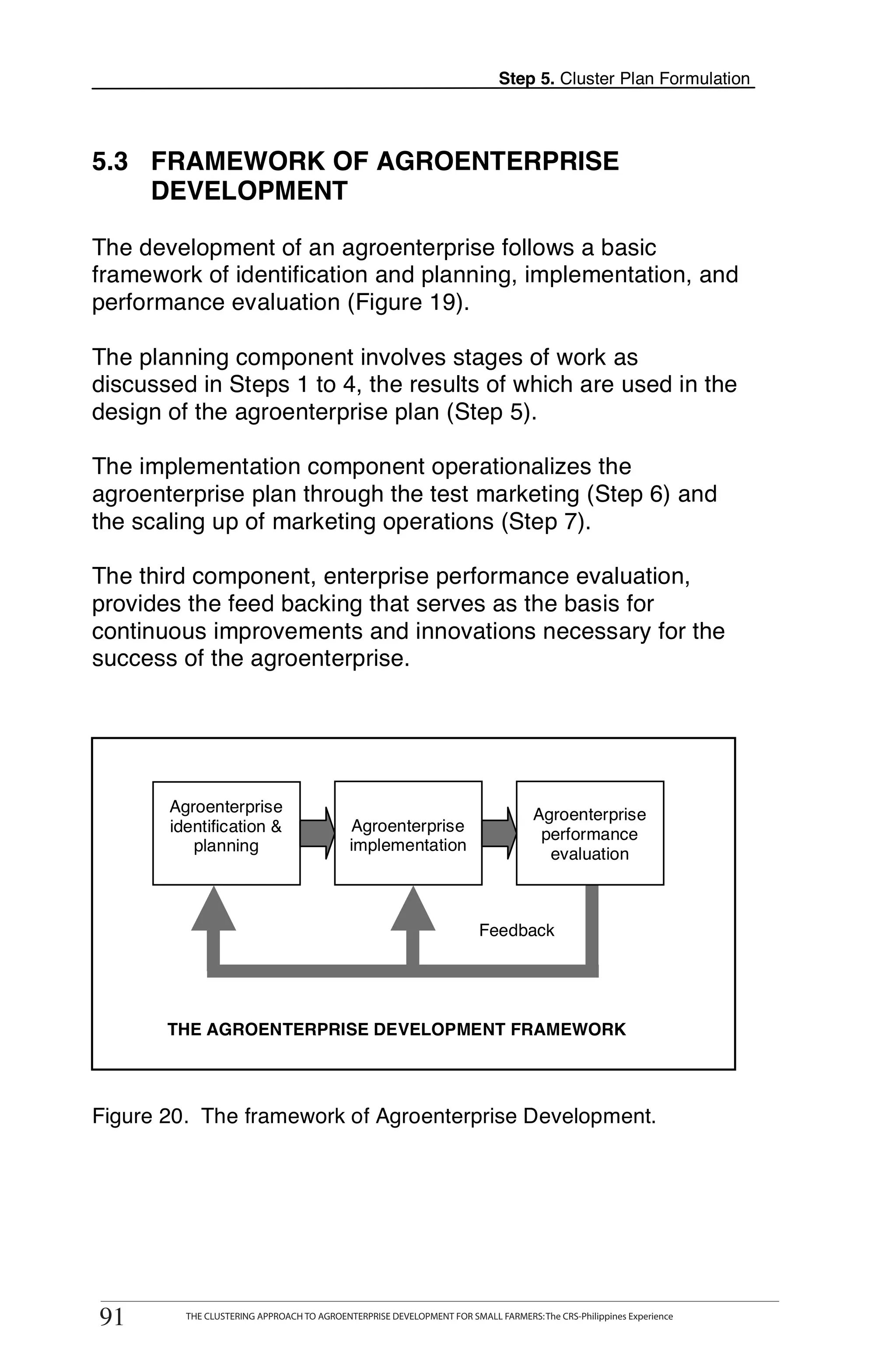
                                                                                                                             I
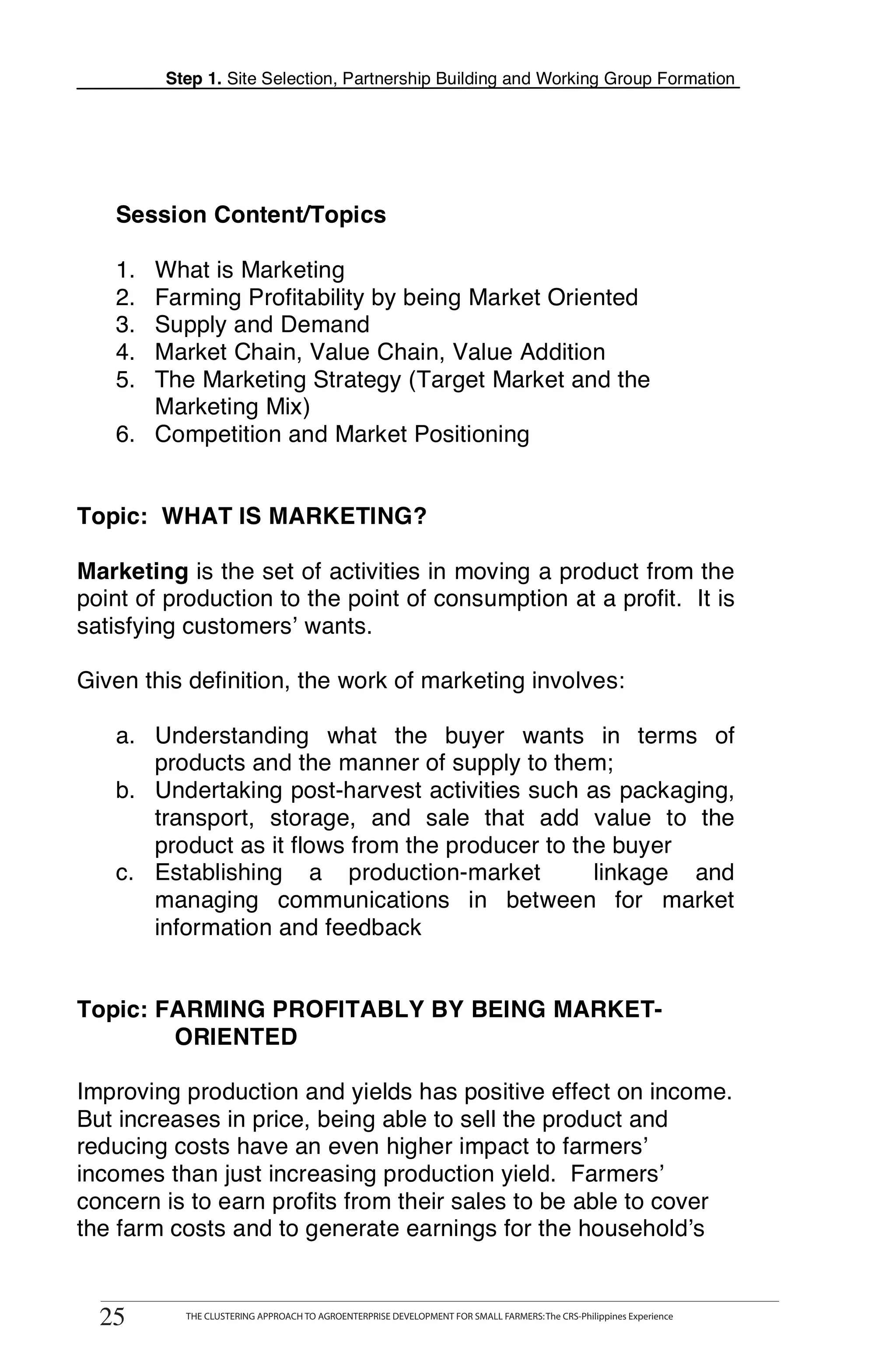
                     Most approached: Man – Armand; Woman – Bilma
                     Most trusted: Man – Ramon; Woman - Teresa                                                               T
                                                                                                                             T
Figure 4. Example of a sociogram used to identify leaders among 10
pre-identified community members.


       THE CLUSTERING APPROACH TO AGROENTERPRISE DEVELOPMENT FOR SMALL FARMERS: TheCRS-Philippines Experience
             THE CLUSTERING APPROACH TO AGROENTERPRISE DEVELOPMENT FOR SMALL FARMERS: The CRS-Philippines Experience
                                                                                                                        22
                                                                                                                       22
Step 1. Site Selection, Partnership Building and Working Group Formation


    B. SESSION GUIDE FOR THE ORIENTATION ON
       MARKETING

          Session Objectives

          At the end of the session, the members of WG will be able
          to:

          1. Define marketing;
T         2. Articulate the effects of market related factors on
             farmer’s profit;
          3. Explain the relationships of supply and demand and
O            the factors affecting them;
          4. Describe the market chain and the participants/actors
O            involved;
          5. Discuss value chain and how farmers earn from value
             addition through participation in the chain;
L         6. Articulate the 4 P’s of marketing, competition and
             market positioning; and
          7. Demonstrate positive attitude towards marketing

K         Time Duration

I         2.0 hours

          Resources Needed
T
T         Visual aids, marking pens, newsprint/manila paper,
          cartolina (for meta cards), adhesives, session and activity
          guide, and energizers

          Session Procedure

          1. Draw out participants’ understanding of Marketing.
             Open participation with this statement:

                     “One enjoyed a cup of brewed coffee this morning
                     during breakfast because marketing made it


     23
    23
            THE CLUSTERING APPROACH TO AGROENTERPRISE DEVELOPMENT FOR SMALL FARMERS: The CRS-Philippines Experience
                 THE CLUSTERING APPROACH TO AGROENTERPRISE DEVELOPMENT FOR SMALL FARMERS: The CRS-Philippines Experience
Step 1. Site Selection, Partnership Building and Working Group Formation


           possible to move coffee beans from the farmers
           and transform it into brewed coffee for your
           consumption.”

   Ask participants to individually write on the meta cards
   what comes into their mind on marketing based on the
   statement. Then synthesize the answers into a
   definition. (It will help to arrange the meta cards with
   suppliers and buyers on opposite ends, then product,
   actors and activities/functions in between).
                                                                                                                  T
2. Present a matrix for computation where farmers can
   appreciate increase in income that is substantial from
   market related factors such as price increase of                                                               O
   product, more volume sold/reduced damage, etc.
   (Refer to Table 1.) The red figures are the ones the
                                                                                                                  O
   participants are asked to compute. Deepen
   participants with discussion.
                                                                                                                  L
3. Give lecture and facilitate discussion on supply and
   demand with the factors that affect them or are
   affected by them.
                                                                                                                  K
4. Give lecture and facilitate discussion on Market Chain
   and Value Chain. Present an example of a value
   chain. (Refer to the example on page 29.) Draw out
   from participants the ways in which product value
   increases as it moves in the chain. Distribute meta                                                            T
   cards for their individual answers, and synthesize by                                                          T
   putting together the cards with similar ideas.

5. Give lecture and facilitate discussion on Marketing
   Strategy. Draw out from participants what kinds of
   questions will be helpful in strategizing using the
   marketing mix of product, price, placement and
   promotions. (Helpful questions as guide provided
   under the topic on Marketing Strategy, pages 31-33.)

6. End the session with an input on competition and
   product positioning.


  THE CLUSTERING APPROACH TO AGROENTERPRISE DEVELOPMENT FOR SMALL FARMERS: The CRS-Philippines Experience
  THE CLUSTERING APPROACH TO AGROENTERPRISE DEVELOPMENT FOR SMALL FARMERS: The CRS-Philippines Experience
                                                                                                            24
                                                                                                             24
Step 1. Site Selection, Partnership Building and Working Group Formation


       Session Content/Topics

       1. What is Marketing
       2. Farming Profitability by being Market Oriented
       3. Supply and Demand
       4. Market Chain, Value Chain, Value Addition
       5. The Marketing Strategy (Target Market and the
          Marketing Mix)
       6. Competition and Market Positioning


O   Topic: WHAT IS MARKETING?

    Marketing is the set of activities in moving a product from the
O   point of production to the point of consumption at a profit. It is
    satisfying customers’ wants.

    Given this definition, the work of marketing involves:

       a. Understanding what the buyer wants in terms of
K         products and the manner of supply to them;
       b. Undertaking post-harvest activities such as packaging,
          transport, storage, and sale that add value to the
          product as it flows from the producer to the buyer
       c. Establishing a production-market           linkage and
          managing communications in between for market
          information and feedback


    Topic: FARMING PROFITABLY BY BEING MARKET-
            ORIENTED

    Improving production and yields has positive effect on income.
    But increases in price, being able to sell the product and
    reducing costs have an even higher impact to farmers’
    incomes than just increasing production yield. Farmers’
    concern is to earn profits from their sales to be able to cover
    the farm costs and to generate earnings for the household’s


    2525
            THE CLUSTERING APPROACH TO AGROENTERPRISE DEVELOPMENT FOR SMALL FARMERS: The CRS-Philippines Experience
                    THE CLUSTERING APPROACH TO AGROENTERPRISE DEVELOPMENT FOR SMALL FARMERS: The CRS-Philippines Experience
Step 1. Site Selection, Partnership Building and Working Group Formation


consumption needs. To be able to do this, farmers should
have a basic understanding of the market related factors that
influence profits: price, volumes sold and costs. Table 2
shows how changes in these factors affect a farmer’s profit.

Table 2. Effect on profit of different levels of production, prices, sales
and costs. (Adapted from FAO publication, Horticultural Marketing)
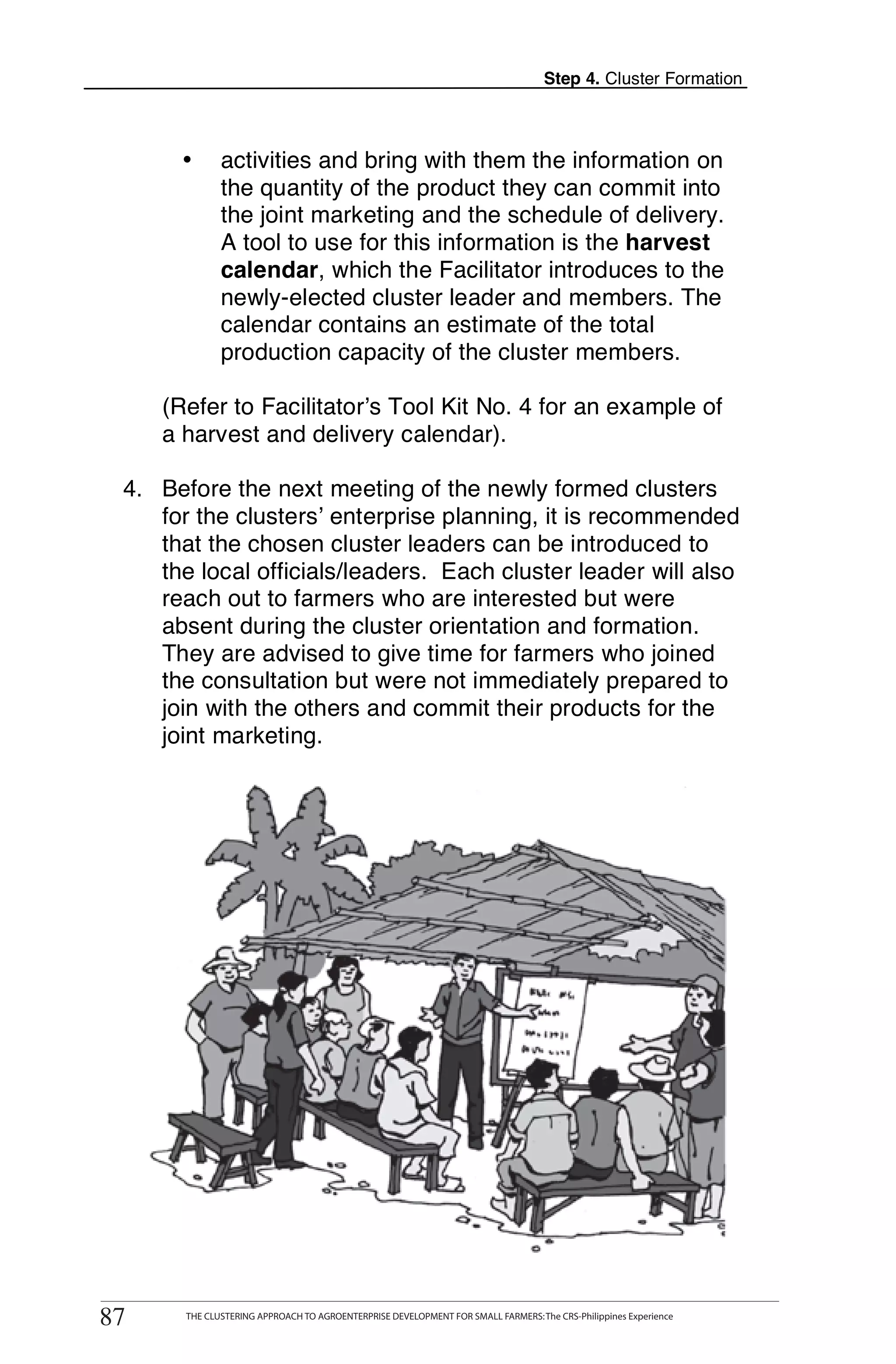
                                                                                                                 Mktg
Squash                         Base          Yield             Half          Price             Price             Cost
                               Case          (+10%)            Sold          (-10%)            (+10%)            (-20%)
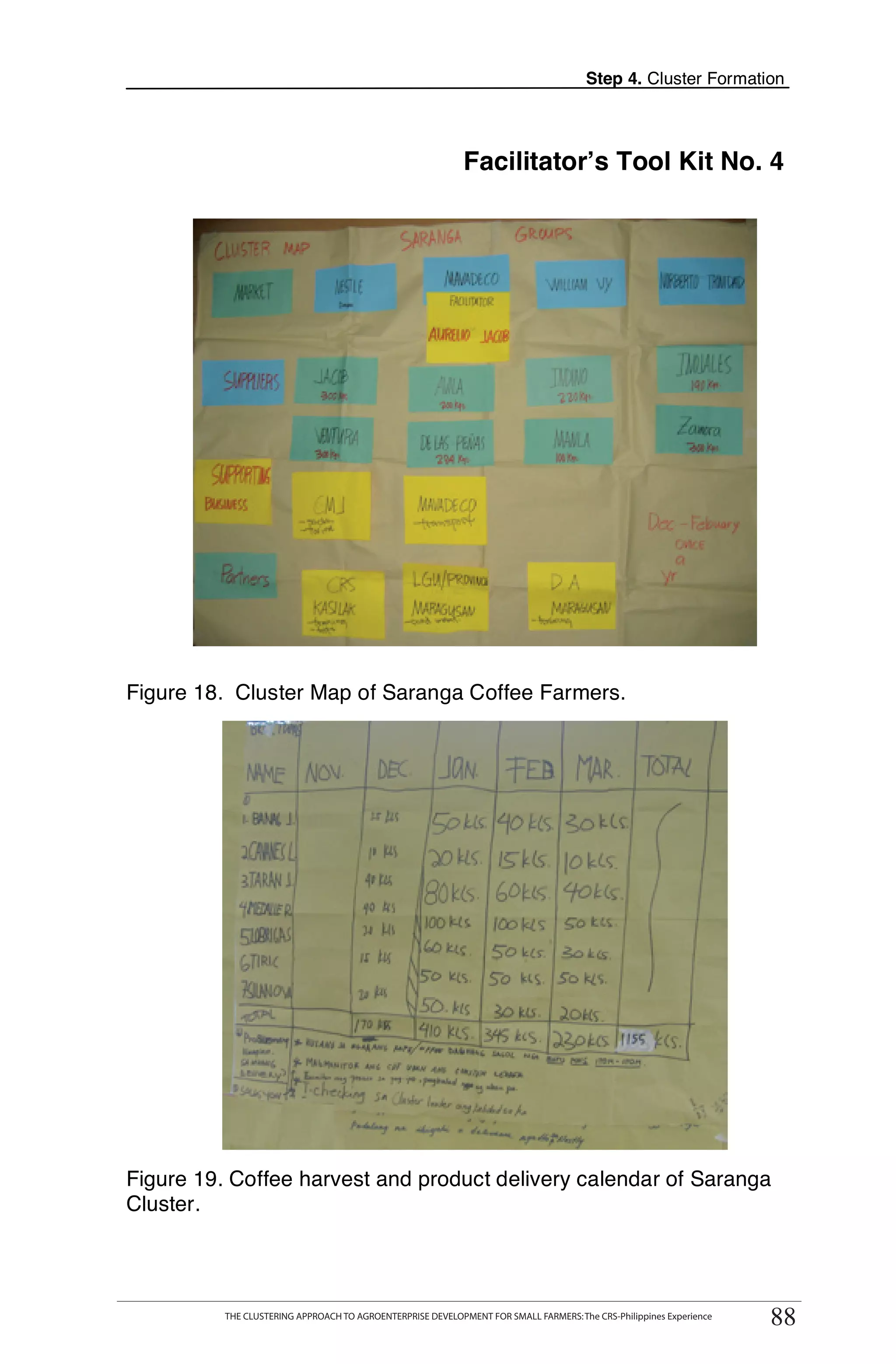
Yield (kg)                     1000           1100             1000           1000              1000              1000          T
Quantity sold (%)              80%             80%             50%             80%              80%                80%
Quantity sold (kg)             800             880              500            800               800               800
Price per kg                    5               5                5             4.50              5.50              5.00         O
SALES                          4000           4400             2500           3600              4400              4000
Production costs               1000           1100             1000           1000              1000              1000
Marketing costs                1600           1760             1000           1600              1600              1280          O
Total costs                    2600           2860             2000           2600              2600              2280
MARGIN                         1400           1540              500           1000              1800              1720
% of base case                                +10%             -64%           -29%              +29%               23%          L
Note: marketing cost reduction can also apply for production cost reduction.
Base case is farmer produces 1,000 kg of squash; 80% is sold, price is PhP
5/kg, production cost is estimated at PhP 1,000 and marketing cost
packaging, transport, marketing fees) estimated at PhP 1,600.
                                                                                                                                K

                                                                                                                                I
Topic: SUPPLY AND DEMAND

The quantity of produce that consumers want to purchase is                                                                      T
affected by these main factors: price, tastes and preferences                                                                   T
of the consumers, number of consumers, incomes of
consumers, prices of competing produce, range of products
available to the consumers.

The quantity of that producers supply is affected primarily by:
price of products, cost of production, technology available,
climate and post-harvest capacities.

The price of a produce is determined mainly by supply and
demand. The lower the price, the tendency is the higher will
be the demand. However, as the price goes down eventually


         THE CLUSTERING APPROACH TO AGROENTERPRISE DEVELOPMENT FOR SMALL FARMERS: The CRS-Philippines Experience
              THE CLUSTERING APPROACH TO AGROENTERPRISE DEVELOPMENT FOR SMALL FARMERS: The CRS-Philippines Experience
                                                                                                                           26
                                                                                                                          26
Step 1. Site Selection, Partnership Building and Working Group Formation


    less will be supplied. Conversely, the higher the price, the
    higher is the supply.

       1. Supply – is what producers are prepared to sell at a
          certain price

       2. Demand – is how much buyers are prepared to buy at
          the market price

    The relationship between what is demanded and what farmers
T   are prepared to produce leads to a balance between supply
    and demand (referred to as the equilibrium). In practice, this
O   point is difficult to attain because the workings of the market is
    very dynamic. Many factors influence supply and demand.
    Example, farmer’s supply is affected by climate, seasonality,
O   road condition, etc. and not just the price.

L   However challenging is the situation of farmers, it is important
    for them to understand how the market works. And their
    objective should be: to be market demand oriented. This
    means: producing what they can sell instead of trying to sell
K   what they have produced. This implies the importance of
    farmers understanding demand, supply and price
    movements/trends.
I

T   Topic: THE MARKET CHAIN AND VALUE CHAIN
T   A market chain refers to a set of linkages between actors
    involved from production to the consumers. Actors are those
    involved in various functions such as producing, processing,
    trading or consuming a particular product, and including those
    who provide various services. Figure 5 shows the functions
    as the product moves in the market chains with the various
    business support services.


     27
    27
           THE CLUSTERING APPROACH TO AGROENTERPRISE DEVELOPMENT FOR SMALL FARMERS: The CRS-Philippines Experience
                 THE CLUSTERING APPROACH TO AGROENTERPRISE DEVELOPMENT FOR SMALL FARMERS: The CRS-Philippines Experience
Step 1. Site Selection, Partnership Building and Working Group Formation


    The Market Chain
      (Adapted from CIAT ERI Guide 2)                                         Consumption

                                                                                                                         Research
                                                                      Retailing

                                                                                                          Transportation
                                                            Trading

                                                                                                 Government policy
                                                                                                 & regulation
                                       Processing
                                                                                           Communications


                                                                                                                                    T
                                Trading                                      Techical & business
                                                                             training & assistance


          Post-harvest                                         Market information                                                   T
             Handling                                          & intelligence


 Production                                       Financial services
                                                                                                                                    O
                                     Production input supply


                                                                                                                                    O
Figure 5. A sample of market chain showing the different stages
and the corresponding business support services.                                                                                    L
As the product moves from the production point to any point
along the chain towards the consumers, there is value
addition (i.e. an increase in worth). When various actors work                                                                      K
together for value addition, the resulting relationship among
the actors is referred to as the value chain.                                                                                       I
Farmers as producers are part of the market chain but they
are not even aware of this crucial role they have. Helping                                                                          T
them to understand market chains and value chains will open                                                                         O
their minds that they can benefit by being active players in the
chain with other actors.

The Value Chain presents how the value of a product is
increased as it passes through different stages or links in the
chain by way of the example in Figure 6.


          THE CLUSTERING APPROACH TO AGROENTERPRISE DEVELOPMENT FOR SMALL FARMERS: The CRS-Philippines Experience
               THE CLUSTERING APPROACH TO AGROENTERPRISE DEVELOPMENT FOR SMALL FARMERS: The CRS-Philippines Experience
                                                                                                                              28
                                                                                                                             28
Step 1. Site Selection, Partnership Building and Working Group Formation


                                     Siay Growers’ Price                               Note: Trader ’s Buying Price is
                                         Php370.00                                   php370 per Buriki @ 27kg content or
                                   (23kg/crate or Php16.08/kg.)                                  Php13.70/kg.

                                    •   Transport: Php40.00
                                    •   Misc.: Php5.00
                                    •   Mgt. Fee Php25.00
                                    •   Margin: Php60.00


                                        Manila Wholesaler                          CDO Market Facilitator’s
                                          Php500.00                                  Fee Php20.00/crate


T
                              •CDO Pier Loading: Php10.00
                              •Shipping Cost: Php50.00
                              •Manila Pier Unloading: Php10.00
                              •Trucking to Buyer: Php10.00

O
                              •Allow. for Losses: Php50.00
                              •Margin: Php120.00


O
                               Manila Wet Market Retailer
                                      Php780.00


L
    Figure 6. An example of a value chain for calamansi, Siay,
    Zamboanga Sibugay.

K   Farmers can gain from active participation in the market chain
    and in being part of a value chain in two ways.
I       •    First, farmers can perform more value addition
             functions beyond the farm such as the post-harvest
T            functions of drying, sorting, grading, processing,
T            transporting, packaging with labels. Undertaking these
             activities is what is called vertical integration.

        •    Second, farmers can actively be involved in how
             decisions are made affecting them in the exchange or
             buy and sell function, such as pricing, terms of
             payment, definition of quality standards, targeting of
             preferred buyers and the like. In all these efforts for
             value addition, farmers have to be organized to have
             influence in the chain and the capacity to undertake
             the activities.


     29
    29
            THE CLUSTERING APPROACH TO AGROENTERPRISE DEVELOPMENT FOR SMALL FARMERS: The CRS-Philippines Experience
                  THE CLUSTERING APPROACH TO AGROENTERPRISE DEVELOPMENT FOR SMALL FARMERS: The CRS-Philippines Experience
Step 1. Site Selection, Partnership Building and Working Group Formation


The farmers may choose a long or a short chain and how far
their participation in it. It depends on the type of product, the
capacity of the farmers as well as the risks involved.

Important Market Chain Actors

   1. Barangay Traders – the small traders who visit the
      barangays to buy either from agents or directly from
      farmers.

   2. Assembly Traders – the traders who buy from the
      barangay traders, agents or directly from the farmers.
      They are normally operating at the rural markets or                                                                    T
      towns.
                                                                                                                             O
   3. Wholesalers – the traders who deal with bigger
      volumes from the barangay and assembly traders.
      They serve the needs of larger markets (like the                                                                       O
      processors and institutional buyers) or other bigger
      wholesalers operating in the towns or cities. They also                                                                L
      cater to the retailers.

   4. Retailers – the ones who take care of the distribution
      to the products to the consumers. Retailers can be the                                                                 K
      sellers operating in small shops, roadside market
      outlet, and the high-end supermarkets.
                                                                                                                             I
   5. Processors – the individuals or firms who transform
      products into different forms. Examples are the                                                                        T
      processors for fruit juices or the rice millers. They can
      either be small household businesses or large firms.                                                                   T


Topic: MARKETING STRATEGY

A Marketing Strategy has two interrelated elements: the
Target Market and the Marketing Mix. The target market is
a person, group of people or a business organization that the
seller wishes to be the buyer of the product. This enables the


       THE CLUSTERING APPROACH TO AGROENTERPRISE DEVELOPMENT FOR SMALL FARMERS: The CRS-Philippines Experience
             THE CLUSTERING APPROACH TO AGROENTERPRISE DEVELOPMENT FOR SMALL FARMERS: The CRS-Philippines Experience
                                                                                                                        30
                                                                                                                       30
Step 1. Site Selection, Partnership Building and Working Group Formation


    seller to focus on a target for both the product and the
    communication work.

    The marketing mix which is commonly referred to as the 4 P’s
    in marketing, is a set of controllable and interrelated variables
    comprised of the product, place, price and promotions that the
    seller puts together to be able to satisfy the target market(s)
    better than its competitors. The marketing mix is the source of
    much of the content of the marketing plan.

T   The marketing mix variables are as follows:

       1. Product – refers to the product offered for sale. The
O         type and characteristics of the product will depend on
          what the target market wants. These questions may
          help:
O
            •       Who buys the product?
L           •       For what and how will it be used?
            •       What does the buyer look for in the product?
                    (quality, size, packaging, and other characteristics)
                    What is unique about the product offered?
K
            •

           The following trends in consumption may serve as
I          additional guide in determining what products to
           produce and market:

T           •       Preference for convenience products
T           •       Preference for natural, organically grown, healthful
                    and nutritious products – fruits, vegetables, low-
                    calorie products
            •       Interest in ethnic or regional products (niche /
                    nostalgia)
            •       Interest in exotic products
            •       Increase in meals outside of home (ready to cook
                    or ready to eat products)
            •       Concern for production conditions – social equity,
                    conservation, etc.


     31
    31
          THE CLUSTERING APPROACH TO AGROENTERPRISE DEVELOPMENT FOR SMALL FARMERS: The CRS-Philippines Experience
                 THE CLUSTERING APPROACH TO AGROENTERPRISE DEVELOPMENT FOR SMALL FARMERS: The CRS-Philippines Experience
Step 1. Site Selection, Partnership Building and Working Group Formation


2. Price – refers to the amount at which the product is
   sold, the decision of which is influenced by what the
   target market can afford and is willing to pay for the
   kind of product that is being sold. Helpful questions:

    •       What is the price? What is the payment term and
            arrangement?
    •       Is the price competitive?

   Main considerations in determining the price offer:

            Production cost
                                                                                                                         T
                                                                                                                         T
    •
    •       Marketing cost
    •       Other costs
    •       Profit margin                                                                                                O

                                                                                                                         O

                                                                                                                         L


                                                                                                                         K

                                                                                                                         I

                                                                                                                         T


  THE CLUSTERING APPROACH TO AGROENTERPRISE DEVELOPMENT FOR SMALL FARMERS: The CRS-Philippines Experience
         THE CLUSTERING APPROACH TO AGROENTERPRISE DEVELOPMENT FOR SMALL FARMERS: The CRS-Philippines Experience
                                                                                                                    32
                                                                                                                   32
Step 1. Site Selection, Partnership Building and Working Group Formation


      3. Placement or distribution – refers to the channels of
         distribution or the physical flow of the product from the
         time it is produced until it is bought. Normal channels
         include wholesalers, retailers, distributors, etc.

           The choice of the channel is influenced by the buying
           behaviour of the target market because the objective is
T          to make the product conveniently available to the
           target market consistent with their purchase
O          preference. Helpful questions:

                    Where do the buyers normally buy? Why?
O
            •
            •       Where do the competitors sell their products?
            •       Who can help in the transfer in the distribution of
L                   the product to the buyer?

           Considerations in placement:

K          •       Area covered and supplied
           •       Transport
                   Storage (inventory)
I          •
           •       Channel (players involved)

T     4. Promotions – refers to the ways and means to build
T        awareness of the product and to improve the demand
         of the target market. The use of promotion depends
         on the target markets’ attitudes and behavior. Helpful
         questions:

           •       What makes the customers buy the product?
           •       What makes the customers prefer the product to
                   the competitors?

           Some means of promotion:

           •       Advertisement (informing and persuading)
           •       PR (good image of product/supplier)
           •       Sales promotion (discount or sample)


     33
    33
          THE CLUSTERING APPROACH TO AGROENTERPRISE DEVELOPMENT FOR SMALL FARMERS: The CRS-Philippines Experience
                THE CLUSTERING APPROACH TO AGROENTERPRISE DEVELOPMENT FOR SMALL FARMERS: The CRS-Philippines Experience
Step 1. Site Selection, Partnership Building and Working Group Formation


        •       Direct marketing (bringing the product to the
                potential buyer)

Product and Placement are considered the strategic Ps of the
marketing mix because they need long-term planning.
Promotions and price which can be changed easily are
considered the tactical Ps of the marketing mix.


Topic: COMPETITION AND MARKET POSITIONING
                                                                                                                             T
Competition is a “given” in marketing, especially when there                                                                 T
are good and big markets. It usually happens when many
suppliers with the same product have a common market.
                                                                                                                             O
Market positioning is making the product offer unique or
different in the mind of the target market. This is attained                                                                 O
through a good marketing mix, i.e. the best grouping of
marketing activities that a seller undertakes to make the
market buy the product and at a level where profit is
                                                                                                                             L
maximized.

                                                                                                                             K

                                                                                                                             I

                                                                                                                             T


       THE CLUSTERING APPROACH TO AGROENTERPRISE DEVELOPMENT FOR SMALL FARMERS: The CRS-Philippines Experience
             THE CLUSTERING APPROACH TO AGROENTERPRISE DEVELOPMENT FOR SMALL FARMERS: The CRS-Philippines Experience
                                                                                                                        34
                                                                                                                       34
Step 2. Product Supply Assessment and Product Selection


  Product Supply Assessment and
        Product Selection


2.1 PROCESS OBJECTIVES

Through the help of the Facilitator, Step 2 aims to design and
implement Product Supply Assessment that will allow the
Working Group (WG) with the community to:

   1. Gather information on resources, products, production
      and marketing practices in the community; and


      THE CLUSTERING APPROACH TO AGROENTERPRISE DEVELOPMENT FOR SMALL FARMERS: The CRS-Philippines Experience
35
 35         THE CLUSTERING APPROACH TO AGROENTERPRISE DEVELOPMENT FOR SMALL FARMERS: The CRS-Philippines Experience
Step 2. Product Supply Assessment and Product Selection


   2. Identify the main products for agroenterprise
      development and analyze the farmers’ capacity to
      supply them for the market.


2.2 INTRODUCTION

Engaging in an agroenterprise, or any enterprise for that
matter, requires careful analysis, plan and decisions based on
realistic, timely, comprehensive and reliable information about
the producers, their supply and the market environment. This
is where research is most useful.

The research process involves several activities with the
participation of farmers and other partners. Working with the
participation of the community is critical because the aim is to
empower them with the capacity to identify their resources
and their market opportunity, and for them to have ownership
of the agroenterprise plan which is based on the research
findings.

The Facilitator acts as a catalyst, making available the
participatory tools as a means for the community’s “learning
by doing” process. He/she assists the Working Group (WG)
plan the research work which starts at the community level
and extends beyond it where marketing-related activities
continue.

This Step largely covers two activities, namely: Product
Supply Assessment (PSA) and Product Selection for
Agroenterprise Development


2.3 UNDERSTANDING PSA

PSA is a participatory study done at the barangay level on the
community’s resources, products, production and marketing
practices that have a bearing on agroenterprise planning.

      THE CLUSTERING APPROACH TO AGROENTERPRISE DEVELOPMENT FOR SMALL FARMERS: The CRS-Philippines Experience
                                                                                                                     36
           THE CLUSTERING APPROACH TO AGROENTERPRISE DEVELOPMENT FOR SMALL FARMERS: The CRS-Philippines Experience
                                                                                                                      36
Step 2. Product Supply Assessment and Product Selection


PSA leads to the selection of product or products for
agroenterprise development.

As mentioned in the previous step, a WG is organized to
handle the PSA. In Step 2, the WG members undergo
training on PSA which culminates with planning for its
conduct.

Key elements studied in the PSA include:

       1. Farm production (farm sizes, land tenure, farm
          tools/equipment, labor utilization, products, yields,
          production methods, problems)
       2. Marketing practices (farmers’ and buyers’ practices,
          problems)

The PSA starts with the collection of relevant secondary data,
and then proceeds with primary data gathering only as a
means to fill up important data gaps.


2.4 COLLECTING PRIMARY DATA

In collecting primary data mainly on production, Focus Group
Discussion (FGD) is the method that involves the shortest
time and the least cost. (Refer to Facilitator’s Tool Kit No. 2 for
tips in conducting FGD.)

FGD is complemented by interviews using a survey
questionnaire to collect farmer- or household-specific
information. (Refer to Facilitator’s Tool Kit No.2 for a sample
of a survey questionnaire.)

Date gathered has to be summarized so they can be easily
analyzed by the WG. Collating the information on production
and marketing practices can be facilitated by using simple
tables. If resources and time allow it, the WG may seek the
assistance of a research practitioner in data handling.


        THE CLUSTERING APPROACH TO AGROENTERPRISE DEVELOPMENT FOR SMALL FARMERS: The CRS-Philippines Experience
37
  37           THE CLUSTERING APPROACH TO AGROENTERPRISE DEVELOPMENT FOR SMALL FARMERS: The CRS-Philippines Experience
Step 2. Product Supply Assessment and Product Selection


FACILITATION GUIDE FOR PRIMARY DATA
GATHERING

Collecting Data on Farm Production

The main objective in the PSA is to come up with an analysis
on the farmers and their supply capacity. Therefore, it is
important to get in-depth knowledge on the farmers so that
information for agroenterprise planning will not be too general
or vague.

To gain a good understanding on the farmers’ current
production and marketing practices, including the problems or
constraints they perceive or have encountered, the WG
conducts a community consultation.


Basic Steps in Arranging and Conducting a Community
Consultation by the WG:

   1. With the assistance of barangay officials and LGU staff
      (e.g. the agricultural technicians assigned in the
      particular barangay), arrange for a community
      consultation.

   2. Prior to the consultation, advise the Agricultural
      Technologist of the LGU to prepare secondary
      information on the main products in the barangay and
      who are producing them. This will facilitate the pre-
      identification of farmers who will be invited to the
      consultation.

   3. In the community consultation, the WG explains the
      project’s objectives in terms of agroenterprise
      development and the purpose of conducting the PSA.

   4. Using the FGD method, the Facilitator and the other
      WG members lead the participants to a discussion on
      the following topics:

      THE CLUSTERING APPROACH TO AGROENTERPRISE DEVELOPMENT FOR SMALL FARMERS: The CRS-Philippines Experience
                                                                                                                 38
      THE CLUSTERING APPROACH TO AGROENTERPRISE DEVELOPMENT FOR SMALL FARMERS: The CRS-Philippines Experience
                                                                                                                38
Step 2. Product Supply Assessment and Product Selection


   •    Farm management practices and crop/livestock
        production performance
   •    Production costs and returns (KII with at least 5
        farmers before FGD)
   •    Sources of information/advice related to farming and
        marketing
   •    Sources of credit and credit arrangements
   •    The buyers and the marketing arrangements
   •    Problems in farm production and in marketing

(See Facilitator’s Tool Kit No. 2 for helpful questions during
the FGD.)


       THE CLUSTERING APPROACH TO AGROENTERPRISE DEVELOPMENT FOR SMALL FARMERS: The CRS-Philippines Experience
39
 39          THE CLUSTERING APPROACH TO AGROENTERPRISE DEVELOPMENT FOR SMALL FARMERS: The CRS-Philippines Experience
Step 2. Product Supply Assessment and Product Selection


For farmer- and household- specific information, a survey is
administered among the consultation participants. This is
done by the WG or local enumerators (people to conduct the
survey) who are enlisted for assistance.
Important specific information includes the following:

   •    crops grown and expected harvest schedules
   •    areas planted or plant population
   •    expected yields based on past performance
   •    previous buyers

These above information are very useful in determining the
relevance of the crop during product selection and serve as
valuable input to the agroenterprise planning, particularly the
formulation of the product supply plan.

(Refer to Facilitator’s Tool Kit No. 2 for survey questionnaire.)

In addition, a Key Informant Interview with five (5) farmers
who are knowledgeable about the community and their
farming practices can be conducted. The data gathered will
provide a benchmark for the cost and returns with information
on break-even points (volume and price) that will guide the
farmers when they negotiate with the market for their
products. On the other hand, the data on cultural management
can help the Facilitator in identifying the good practices, gaps
and the appropriate interventions.

(Refer to Facilitator’s Tool Kit No. 2 for the sample of
questions for the KII and the table on cost & returns
summary.)

Collecting Data on Marketing Practices

During the consultations, as farmers relate about their present
buyers and marketing practices, they will be asked to draw the
market chain map showing how their products flow out from
their farms to their buyers.


       THE CLUSTERING APPROACH TO AGROENTERPRISE DEVELOPMENT FOR SMALL FARMERS: The CRS-Philippines Experience
                                                                                                                  40
       THE CLUSTERING APPROACH TO AGROENTERPRISE DEVELOPMENT FOR SMALL FARMERS: The CRS-Philippines Experience
                                                                                                                 40
Step 2. Product Supply Assessment and Product Selection


It is mainly a “telling a story” process with this graphic tool that
provide details of the buyers involved and their market
locations, the distances from the farms to the markets, the
packaging and transport means, the prices and the costs, and
more importantly, the major problems as they move their
products in the market chain.

In this exercise, farmers will expectedly be familiar only with a
part of the entire market chain since their products are
commonly sold locally. But this exercise is continued to fill in
the gaps in the market chain map (i.e. trace the products
beyond the community) when the WG can do the market visits
in the nearby commercial areas as will be explained in the
next step (Market Chain Study).


2.5 SELECTING THE PRODUCT FOR THE MARKET

From the products identified in the PSA through FGD and the
survey, the WG proceeds to select one to three among them
which are produced mainly for income and those that are
produced by the majority of the farmers.

Working with existing products at the start for new or
inexperienced groups offer these advantages:

      1. The WG can delve on priority options in a relatively
         shorter timeframe

      2. Farmers are already familiar with the production
         technology, thus, can focus more on marketing
         aspects

When new products will be chosen, usually when they have
more capacity to venture into new enterprises, it is important
for the WG to set evaluation criteria. Important considerations
in choosing new products are as follows:


        THE CLUSTERING APPROACH TO AGROENTERPRISE DEVELOPMENT FOR SMALL FARMERS: The CRS-Philippines Experience
41
 41          THE CLUSTERING APPROACH TO AGROENTERPRISE DEVELOPMENT FOR SMALL FARMERS: The CRS-Philippines Experience
Step 2. Product Supply Assessment and Product Selection


   Area of                                                        Key Question
consideration
                             Is there a favorable market? (i.e., continuing
Market
                             and/or growing market demand)
                             Can we produce it? (i.e., agro-climatic conditions
Production
                             relative to the production requirements)
                             Do we have financial resources to produce it?
Financial
                             Will it be profitable relative to investment? Is the
                             level of risk appropriate to the farmers?

In selecting new products, it is important that the decision
making is participatory because the choice should be based
significantly on the participants’ own experiences, capacities
and risk assessment.

A tool to guide farmers to assess risk relative to their decision
on new products and markets is the Product-Market Growth
Matrix also known as the Ansoff Matrix (Figure 7).

In the Matrix, risk is shown to be lowest at Box 1 (Market
Penetration) and highest at Box 4 (Diversification). Evaluation
done above based on demand and profitability is often
associated also with high risk options. It is advisable for
farmers to start with existing products based on Market
Penetration strategies.

When they have more experiences and more resources, they
can proceed to higher risk options that bring the potentials of
higher returns.


         THE CLUSTERING APPROACH TO AGROENTERPRISE DEVELOPMENT FOR SMALL FARMERS: The CRS-Philippines Experience
                                                                                                                    42
         THE CLUSTERING APPROACH TO AGROENTERPRISE DEVELOPMENT FOR SMALL FARMERS: The CRS-Philippines Experience
                                                                                                                   42
Step 2. Product Supply Assessment and Product Selection


                                               Existing
                                                Existing                                        New
                                                                                                 New
                                               products
                                               Products                                       products
                                                                                               Products

     Existing
     Existing                                      1
                                                   1                                                     3
                                                                                                         3
                                             Low Risk
     markets
     Markets                                Low Risk
                                          (Market Penetration)
                                                                                               (Product
                                                                                                (Product
                                                                                              Development)
                                                                                             Development)
                                            (Market Penetration)

      New
      New                                                 2
                                                          2                                         44
     markets                                   (Market
                                                 (Market                                       High Risk
                                                                                             High Risk
     Markets                                  Development)
                                             Development)                                     (Diversification)
                                                                                              (Diversification)


                                  ANSOFFMATRIX
                                  ANSOFF MATRIX
                                      (Source: CIAT, 2006)
                                       (SOURCE: CIAT, 2006)


Figure 7. The ANSOFF Matrix used in assessing risks when
deciding for new products and markets.


      THE CLUSTERING APPROACH TO AGROENTERPRISE DEVELOPMENT FOR SMALL FARMERS: The CRS-Philippines Experience
43
43       THE CLUSTERING APPROACH TO AGROENTERPRISE DEVELOPMENT FOR SMALL FARMERS: The CRS-Philippines Experience
Step 2. Product Supply Assessment and Product Selection


                                                             Facilitator’s Tool Kit No. 2


INFORMATION TO BE GATHERED BY FGD

   1. What are the three (3) main products in the barangay?
      (Note: Ranked according to the most number of
      producers)
   2. Where do you avail credit and what are the
      arrangements in financing?
   3. Who are the main buyers of the products mentioned?                                                              T
      (Note: From within and outside the barangay)
   4. Do you have problems with production?
   5. Do you have problems with marketing?                                                                            O
TIPS IN CONDUCTING FGD
                                                                                                                      O
   1. For effective handling and documentation, the number
      of participants should not exceed 15, if possible.                                                              L
   2. Group the participants according to dominant products
      in the community (i.e., the products that give the
      highest economic values to the farmers). These focus
      groups are referred to as the crop assemblies. The                                                              K
      advantage of a crop assembly is that the discussions
      are more focused on a particular product and analysis
      is more easily facilitated.                                                                                     I

   3. Using a prepared set of guide questions, facilitate                                                             T
      discussions and keenly note and record responses.

   4. Synthesize the proceedings focusing on their strengths
      and their constraints (weaknesses) that will need to be
      addressed for effective product supply in the joint
      marketing in the future.


     THE CLUSTERING APPROACH TO AGROENTERPRISE DEVELOPMENT FOR SMALL FARMERS: The CRS-Philippines Experience
                                                                                                                 44
      THE CLUSTERING APPROACH TO AGROENTERPRISE DEVELOPMENT FOR SMALL FARMERS: The CRS-Philippines Experience
                                                                                                                44
Step 2. Product Supply Assessment and Product Selection


    INFORMATION TO BE GATHERED BY KII WITH SELECTED
    FARMERS

       Name of Farmer       _________________
                   Location         _________________
                   Product          _________________
                   Area             _________________
                   Crop Period      _________________

       1. Crop Management


T
              1.1. Nutrient Management
                                                                                      Application
                                                              Quantity              Frequency Per                Schedule of

O
                    Kind of Fertilizers                      (unit/tree)                Year                     Application
                 Chemical (Inorganic)
                 1.

O
                 2.
                 Organic/Natural Method
                 1.

L
                 2.

              1.2. Crop Protection Against Pests and Diseases
                                                            Application
                                              Quantity      Frequency/                                           Schedule of
                        Kind Used            (unit/tree)       Year                                              Application

K
                 Chemical
                 1.
                 2.

I
                 Organic/Natural Method
                 1.
                 2.

T              1.3 Soil and Water Conservation Practices
                       Technology/Practice                                                      Description
                 1.
                 2.
                 3.

               1.4 Other Farm Technologies and Practices:
                    Kind of Technology/Practice                                                 Description
                 1.
                 2.
                 3.

       2. Do you have problems with your product? ____1. Yes ___2.None


          THE CLUSTERING APPROACH TO AGROENTERPRISE DEVELOPMENT FOR SMALL FARMERS: The CRS-Philippines Experience
    45
     45         THE CLUSTERING APPROACH TO AGROENTERPRISE DEVELOPMENT FOR SMALL FARMERS: The CRS-Philippines Experience
Step 2. Product Supply Assessment and Product Selection


3.   If yes, what are your problems?_____________________________

4.   Summary of Cost and Returns per crop production cycle:


                                                    Item                                              Amount (PhP)
                 Labor                                                Hired
                                                                      Family
                 Inputs
                 Equipment Rental
                 Marketing Costs                                      Packaging
                                                                      Transport                                               T
                 Loan Interest
                 Other Expenses
                 TOTAL COSTS                                                                                                  O
                 Yield
                 Sales (Yield x Price)
                 NET INCOME (Sales – Total                                                                                    O
                 Costs)

                                                                                                                              L

SAMPLE OF A SURVEY QUESTIONNAIRE


                                                                                                                              K
SURVEY AMONG COFFEE FARMERS
IMPASUGONG, BUKIDNON

                                                                                                                              I
1.      Personal Information

     1.1. Name of respondent_______________________                                         1.2. Age_____
     1.3. Name of spouse____________________                                                1.4. Age_____                     T
     1.5. Residence (address)__________________________________
     1.6. No. of years in residence: _____
     1.7. Number of children______
     1.8. Total number of household members (including farmer) _____
2. Information on Land, Tools and Farming

2.0 How many farmlots are you cultivating (owned, rented, leased, others)?                                     ___ ___


         THE CLUSTERING APPROACH TO AGROENTERPRISE DEVELOPMENT FOR SMALL FARMERS: The CRS-Philippines Experience
                                                                                                                         46
           THE CLUSTERING APPROACH TO AGROENTERPRISE DEVELOPMENT FOR SMALL FARMERS: The CRS-Philippines Experience
                                                                                                                         46
Step 2. Product Supply Assessment and Product Selection


          2.1. Information on Land
                                                                                                           Land Status?
                                                                       Dominant                     1. Owned, 2. Rented (fixed
                     Lot      Location           Area (ha)              Slope?                      payment), 3. Rented (Share
                                                                       1. Flat, 2.                   of yield), 4. Borrowed; 5.
                                                                     Gentle, 3.Steep                     Others (describe)
                     1
                     2

          2.2. Farm Tools Owned:
T                       Kind                             Quantity                     Kind                               Quantity
                1. Draft Animal                                                 6. Weeder
                2. Plow                                                         7.
O               3. Harrow                                                       8.
                4. Cart                                                         9.
                5. Sprayer                                                      10.
O
          2.3. Number of years in farming? _____ years

L         2.4. Crops planted?                Ranking: 1. __________ 2.___________ 3.____________

    3. Coffee Information

          3.1. Area planted to coffee? ___________ (hectare)

K         3.2.        Total number of coffee trees? _______________

                  3.2.1. Number of coffee trees bearing?____________
I                 3.2.2. Number of non-bearing coffee trees?______________


T
                              4.1.1.1 For bearing trees, what is the average yield (kg) per tree ? ____

                              4.1.1.2 How many times do you harvest in one cropping season? _____

    4.       Marketing

             4.1 Over the past 12 months, what is the quantity of coffee sold?

             4.2 Quantity of Coffee Beans Sold the Past Year
                          Month               Quantity Sold                                                       Price
                                                  (In kg)
                  January
                  February
                  March
                  April
                  May
                  June

                 THE CLUSTERING APPROACH TO AGROENTERPRISE DEVELOPMENT FOR SMALL FARMERS: The CRS-Philippines Experience
    47
     47              THE CLUSTERING APPROACH TO AGROENTERPRISE DEVELOPMENT FOR SMALL FARMERS: The CRS-Philippines Experience
Step 2. Product Supply Assessment and Product Selection


                July
                August
                September
                October
                November
                December
                       TOTAL

       4.3     Source of Capital

                 What is your capital source?                      How
                                                                                    Purpose of
                                                                                      Loan?
                                                                                                               Terms of
                                                                                                               Payment?
                                                                                                                            T
                                                                  much?
                 1. Own
                                                                                                                            O
                 2. Financier (name:                )
                 3. Trader (name:                   )
                 4. Bank (name:                     )                                                                       O
                 5. Others (specify:                )

       4.4. Buyer                                                                                                           L
              Who were                    Address?             Place of           Type of          Reason for choosing
             your buyers?                                      delivery?          buyer?           the buyer? Indicate
                                                                                                         Code*
                1.
                2.

      * Code – reason for choosing the buyer:
                                                                                                                            K
         1. High price        3. Usual buyer (suki)            5. Others (specify
         2. No other buyer    4. Have loan with the buyer (pay to crop)
                                                                                                                            I
       4.5.     Method of Selling
                4.6.1 Packaging
                4.6.2. Mode of delivery (delivered or picked up)
                                                                                                                            T
                4.6.3. If delivered, method of transportation
                      4.6.3.1. Point of delivery?
                      4.6.3.2. How much is the transport cost?
                4.6.4 How much is the labor cost (loading/unloading)
                4.6.5. Mode of payment (cash, installment, others)

5.0 Problems in Marketing

       5.1. Do you have problems in marketing? ___ 1. Yes ____ 2. No

                 If yes, what are your problems? ________________________

____________________________                                        _____________________
        Interviewer                                                          Date


         THE CLUSTERING APPROACH TO AGROENTERPRISE DEVELOPMENT FOR SMALL FARMERS: The CRS-Philippines Experience
                                                                                                                       48
          THE CLUSTERING APPROACH TO AGROENTERPRISE DEVELOPMENT FOR SMALL FARMERS: The CRS-Philippines Experience
                                                                                                                      48
Step 3. Market Chain Study


                       Market Chain Study


3.1 PROCESS OBJECTIVES

Using the rapid market appraisal method, the Facilitator
together with the WG shall:

   1.        Conduct a market chain study for the products
             selected during the PSA;
   2.        Identify several market chains for each product and
             analyze the farmers’ position in them;
   3.        Select the best market chain(s) to work on and the
             buyer(s) that offer the most benefits;

        THE CLUSTERING APPROACH TO AGROENTERPRISE DEVELOPMENT FOR SMALL FARMERS: The CRS-Philippines Experience
49
 49           THE CLUSTERING APPROACH TO AGROENTERPRISE DEVELOPMENT FOR SMALL FARMERS: The CRS-Philippines Experience
Step 3. Market Chain Study


   4.        Come up with strategies to assist the farmers
             participate in specific market chain(s) with the
             attendant costs and margins in their participation, as
             well as the development support they will need; and
   5.        Report the findings back to the farmers for goal
             setting in agroenterprise development


3.2 INTRODUCTION

Having selected product(s) for agroenterprise development
(Step 2), the next activity is market chain analysis which is
done to get in-depth market-related information on the chosen
product(s). Some definitions will help simplify the
understanding on market chain analysis.

Market Chain

Market chain refers to a set of linkages between actors
involved from production through processing, distribution and
retailing to the consumers. Actors are those involved in
producing, processing, trading or consuming a particular
agricultural product, and including those who provide various
financial and non-financial support services such as the
truckers, suppliers (inputs, packaging materials, etc.), market
research groups, and others. See Figure 8 for an example of a
market chain.

Farmers produce and sell products but are not even aware
that in doing so they are a crucial part of the market chain.
This lack of understanding constrains them to recognize and
carry out their position in the chain (i.e., how they perform,
what their advantages and constraints are, and what their
opportunities are if they “engage” the market or work together
with other actors in the product movement).


        THE CLUSTERING APPROACH TO AGROENTERPRISE DEVELOPMENT FOR SMALL FARMERS: The CRS-Philippines Experience
                                                                                                                       50
             THE CLUSTERING APPROACH TO AGROENTERPRISE DEVELOPMENT FOR SMALL FARMERS: The CRS-Philippines Experience
                                                                                                                        50
Step 3. Market Chain Study


            THEN                                                                     NOW
              FARMER                                                                 FARMER


               AGENT
                                                                                    CLUSTERS


              TRADER

                                                         NESTLE                       TRADERS              SERENITY
                                                       PHILS., INC.                                      COFFEE CORP.
      NESTLE PHILS., INC.


           CONSUMERS                                                             CONSUMERS


Figure 8. Sample of a market chain for green coffee beans.


Value Chain

As a product moves from the production point to any point
along the chain towards the consumer, there is addition of
value or worth. Technically, this is known as value addition.

When the actors involved work together for value addition
(i.e., to increase efficiency and quality of product supply,
satisfy market needs, and as a result, earn more), the
resulting relationship is referred to as the value chain.

Helping farmers understand market chains will open their
minds to new knowledge that will empower them. It points at
the opportunities they can tap or constraints they can address
to strengthen their position in the market chain, and gain
stable markets and/or higher incomes.

The objective of market chain analysis is to understand the
actors, activities, costs and margins, constraints and

       THE CLUSTERING APPROACH TO AGROENTERPRISE DEVELOPMENT FOR SMALL FARMERS: The CRS-Philippines Experience
51
 51         THE CLUSTERING APPROACH TO AGROENTERPRISE DEVELOPMENT FOR SMALL FARMERS: The CRS-Philippines Experience
Step 3. Market Chain Study


opportunities related to the movement of the product starting
with the farmers and ending with the buyers and/or
consumers. These information help in the identification of the
best market chain to work on, and the key buyers for the
farmers. Thus, market chain analysis is an activity for
strategic thinking in designing agroenterprises.


3.3 RAPID MARKET APPRAISAL

Rapid Market Appraisal or RMA is the most practical, popular
and preferred approach to market chain studies. Based on its
user-friendly qualities, RMA is defined as a quick, flexible and
effective market research method.

Advantages of RMA:

   1. Quick (uses rapid appraisal methods: focus groups,
      key informant interview, semi-structured interview)

   2. Flexible (RMAs can be designed according to purpose
      and resources)

   3. Effective (can generate detailed understanding of
      marketing systems, including constraints and
      opportunities, leading to design of interventions)

Limitations of RMA:

As a quick process, the findings of RMA may apply only to its
defined purpose. Seasonality of relevant factors cannot be
captured owing to its very short time frame.

Relying on key informants, the results are largely dependent
on the openness and active participation of prospective
groups or participants. It will matter if there will be a good and
skillful facilitator and a good documenter for the activities.


       THE CLUSTERING APPROACH TO AGROENTERPRISE DEVELOPMENT FOR SMALL FARMERS: The CRS-Philippines Experience
                                                                                                                      52
            THE CLUSTERING APPROACH TO AGROENTERPRISE DEVELOPMENT FOR SMALL FARMERS: The CRS-Philippines Experience
                                                                                                                       52
Step 3. Market Chain Study


3.4 FACILITATION GUIDE FOR THE RAPID MARKET
    APPRAISAL

Facilitate the following activities in the conduct of RMA by the
WG:

   1.    Design of the study
   2.    Implementation of the study
   3.    Analysis of data and information
   4.    Options for farmers and development support needed
   5.    Report writing


Activity 1. Design of RMA-Market Chain Study

In the PSA, most of the marketing-related information
gathered by the WG from the farmers are confined to the
immediate vicinity of the community. The Market Chain Study
links the market data in PSA with relevant industry and buyer
information beyond the community.

   1. Create a RMA-Market Chain Study Team with
      members coming from WG earlier formed in Step 1. A
      good size is at least 10, two-thirds (6-7) of which are
      farmers. Subdivide the Team into smaller groups of 3-
      4 members each to share the market chain study
      activities.

         Depending on the complexity of the market chain
         being studied or the extent of geographical coverage
         of the study, the team may invite a marketing
         practitioner who possesses the following:

             • Exposure or experience in market research
             • Technical knowledge (including production, post-
               harvest and processing issues)
             • Contacts in the trading community


        THE CLUSTERING APPROACH TO AGROENTERPRISE DEVELOPMENT FOR SMALL FARMERS: The CRS-Philippines Experience
53
  53           THE CLUSTERING APPROACH TO AGROENTERPRISE DEVELOPMENT FOR SMALL FARMERS: The CRS-Philippines Experience
Step 3. Market Chain Study


Then the RMA Team will:

   2. List down possible key issues for investigation in
      RMA/Market Chain, such as but not limited to:

           • Product characteristics (variety, grade, moisture,
             and other quality specifications)
           • Demand patterns (growth and seasonality)
           • Supply situation (origin, production volume,
             seasonality of supply)
           • Price (trends)
           • Actors in the chain (market channels) and their
             activities
           • Marketing infrastructure (roads, market places,
             facilities, communication)

   3. Review available literatures or get secondary data
      to clearly identify gaps that need to be filled in by
      primary data.

       The following are the possible sources of secondary
       information for the study:

               Offices                                                            Materials
• LGUs (barangay, municipal &                                              • Newspapers
  provincial)                                                              • Reports
• DA (including BAS and AMAD)                                              • E-publications
• DTI                                                                        (internet)
• NSO                                                                      • Socio-economic
• NGOs                                                                       profiles
• Academe & research
  institutions
• Industry associations

   4. Select markets and key informants

       For primary data gathering, the RMA / Market Chain
       Study team must start with the five most mentioned
       community traders in the PSA and trace their


     THE CLUSTERING APPROACH TO AGROENTERPRISE DEVELOPMENT FOR SMALL FARMERS: The CRS-Philippines Experience
                                                                                                                 54
      THE CLUSTERING APPROACH TO AGROENTERPRISE DEVELOPMENT FOR SMALL FARMERS: The CRS-Philippines Experience
                                                                                                                54
Step 3. Market Chain Study


        immediate buyers to be included as informants in the
        individual interviews. Because of their influence in
        their marketplace, make sure to include the top five
        buyers in the nearest commercial center.

        Augment the activity with interviews with the various
        points in the chain of the products identified in the PSA
        to capture information at different points of the market
        chain. Get at least two informants at each point and
        cross check answers.

    5. Prepare a checklist of questions or process guides

        Prepare appropriate set of questions or process guides
        for key informants/interviewees to elicit respective
        information outlined below:

     Respondents/
      Informants/                                                          Data/Information
 Actors In Market Chain
                                                • Product requirements with the quality
  • Wholesalers
                                                  specifications
  • Retailers
                                                • Supply sources
  • Institutional buyers
                                                • Destination of products
    (processors,
                                                • Experiences in demand & supply
    supermarkets, food
                                                  movements
    service
                                                • Prices
    establishments)
                                                • Marketing practices
                                                • Marketing costs
                                                • Support services
                                                • Support infrastructures
                                                • Openness to buy directly from farmers

The information outlined above are presented in a more
detailed interview guide.

(Refer to Facilitator’s Tool Kit No. 3 for the interview guide in
English and in Filipino.)


       THE CLUSTERING APPROACH TO AGROENTERPRISE DEVELOPMENT FOR SMALL FARMERS: The CRS-Philippines Experience
55
  55          THE CLUSTERING APPROACH TO AGROENTERPRISE DEVELOPMENT FOR SMALL FARMERS: The CRS-Philippines Experience
Step 3. Market Chain Study


Activity 2. Implement the RMA - Market Chain Study

   1. Prepare for data gathering

      a) The RMA Team may break up into smaller teams
         of 3 members each (1 of them is a farmer) for
         efficiency.

      b) Assign each member a role during the interview
         process (main interviewer, assistant interviewer
         who makes sure that all questions are covered,
         and recorder of responses)

      c) Check all tools: checklists or interview/discussion
         guides, pen/pencil, notebook, tape recorder,
         camera, registration or attendance sheet, and other
         necessities.

      d) Rehearse or familiarize with the interview
         questions and the manner of recording the
         responses before the actual market visit and data
         gathering.

   2. Gather the information
      a) Semi-structured interviews with key informants
         (traders/ retailers/ Institutional Buyers, processors,
         supermarkets, food service establishments)

      b) Trace the product flow from the farmers to the
         intended buyers for information needed for the
         Market Chain diagram.

              The RMA team will get data on costs and margins
              by direct observation and informal interview of key
              informants (traders and the service providers like
              the transporters) during the tracking of activities as
              the product moves in the market chain.


     THE CLUSTERING APPROACH TO AGROENTERPRISE DEVELOPMENT FOR SMALL FARMERS: The CRS-Philippines Experience
                                                                                                                56
     THE CLUSTERING APPROACH TO AGROENTERPRISE DEVELOPMENT FOR SMALL FARMERS: The CRS-Philippines Experience
                                                                                                               56
Step 3. Market Chain Study


               In the of product flow, the RMA takes note not only
               of the market chain that gives the highest returns to
               the farmers but also the work that the farmers need
               to undertake with the additional costs involved as
               well as the risks when they decide later to take a
               more active participation in the chain.

   3. Cross-checking data and information

       To ensure the reliability of the data that the team is
       gathering, the members should ask the same set of
       questions to informants within and at different stages
       of the market chain then check the consistency of
       answers. The RMA team can also observe the
       behavior or practices (such as post harvest handling,
       sorting and grading and storage technologies) and
       analyze the process as the product flows to the various
       actors in the chain.

Activity 3. Facilitate the analysis of RMA data and
            information by the RMA Team

Tools and Methods for Analysis

   1. Illustration of the Market Chain Map

       This gives a picture of the elements of the market
       chain, such as the producers, post-harvest handlers,
       consolidators, traders, buyers, processors, retailers
       and consumers. See Figures 9 and 10 for examples.


      THE CLUSTERING APPROACH TO AGROENTERPRISE DEVELOPMENT FOR SMALL FARMERS: The CRS-Philippines Experience
57
 57         THE CLUSTERING APPROACH TO AGROENTERPRISE DEVELOPMENT FOR SMALL FARMERS: The CRS-Philippines Experience
Step 3. Market Chain Study


Figure 9. Market chain map drawn from a corn market chain study
using the RMA.


Figure 10. Market chain map drawn from a vegetable market chain
study using the RMA.

      THE CLUSTERING APPROACH TO AGROENTERPRISE DEVELOPMENT FOR SMALL FARMERS: The CRS-Philippines Experience
                                                                                                                 58
      THE CLUSTERING APPROACH TO AGROENTERPRISE DEVELOPMENT FOR SMALL FARMERS: The CRS-Philippines Experience
                                                                                                                58
Step 3. Market Chain Study


    2. Value chain (margins along chains)

    As shown in Figure 11, expenses are incurred as the
    product moves from one point to another along the chain.
    These have to be considered so as to be able to
    determine later the possible or actual margin like the one
    reflected in Figure 12.

       MaragusanPrice
        Maragusan Price                               MillingFee
                                                      Milling Fee
         PP44.00/kg
           44.00/kg                                    P2.50/kg
                                                      P 2.50/kg


                                                    Trucking Cost
                                                     Trucking Cost
                                                       P1.28/kg
                                                      P 1.28/kg


                                                    Labor-Hauling
                                                     Labor-Hauling
                                                       P0.06/kg
                                                      P 0.06/kg
                                                                                                   Total Expenses
                                                                                                    Total Expenses
                                                                                                       P4.24/kg
                                                                                                      P 4.24/kg
                                                     Labor-Drying
                                                    Labor-Drying
                                                       P0.11/kg
                                                      P 0.11/kg


                                                Honorariumof Escort
                                                 Honorarium of Escort
                                                      P0.13/kg
                                                     P 0.13/kg


                                                    Other Expenses
                                                   Other Expenses                               Nestle BuyingPrice
                                                                                                 Nestle Buying Price
                                                       P0.17/kg                                      P62.00/kg
                                                                                                    P 62.00/kg
                                                      P 0.17/kg


Figure 11. Example of a value chain for dried coffee beans.


          Nestle's Grade 1 Price

                Other Ex penses                                                                         Farmer's
                                                                                                          Farmer’s
                                                                                                         Margin:
                                                                                                          Margin:
                                                                                                        P13.76/kg
       Cluster Escort Honorarium                                                                         P 13.76/kg

                   Labor-Dry ing

                   Labor-Hauling

                       Trucking

                          Milling                                                                    Buying
                                                                                                      Price:
               Maragusan Price                                                                      P44.00/kg

                                    -     10.00      20.00       30.00      40.00      50.00      60.00      70.00


Figure 12. Another way of presenting the margins along the chain.


         THE CLUSTERING APPROACH TO AGROENTERPRISE DEVELOPMENT FOR SMALL FARMERS: The CRS-Philippines Experience
59
  59            THE CLUSTERING APPROACH TO AGROENTERPRISE DEVELOPMENT FOR SMALL FARMERS: The CRS-Philippines Experience
Step 3. Market Chain Study


   3. Buyer comparison for market opportunity
      assessment

       A buyer comparison table provides information about
       buyers and their conditions and requirements. It gives
       the grower and idea on where to sell products for
       maximum profit.

       Market chain study must be designed well to really
       include all relevant buyer information to guide
       decisions and production plan of farmers.

       A buyer comparison matrix like the one shown in
       Figure 13 is used to guide the WG in deciding which
       buyer can offer the best value. This can still be
       improved or enriched to include information such as
       quality index (like moisture content), frequency,
       preferences for organic or inorganic products, and
       prescribed packaging.


Figure 13. Matrix for Buyer Comparison summarized by the farmers
after market survey and visits.


      THE CLUSTERING APPROACH TO AGROENTERPRISE DEVELOPMENT FOR SMALL FARMERS: The CRS-Philippines Experience
                                                                                                                  60
       THE CLUSTERING APPROACH TO AGROENTERPRISE DEVELOPMENT FOR SMALL FARMERS: The CRS-Philippines Experience
                                                                                                                 60
Step 3. Market Chain Study


Table 3: Sample matrix used in comparing the values offered
by buyers. (Derived from Figure 13.)

            Criteria                                     Nestle                         Trader 1                 Trader 2
 Contact information                              Davao City                          Davao City               Nabunturan
 Growth in demand                                     High                              High                      High
 Time of year scarce                                May-Oct                            May-Oct                  May-Oct
                                                   G1 P54.00
 Price/kg                                          G2 P52.50                             P48.00                   P44.00
                                                   G3 P50.50
                                                Less than 12%
                                               Triage, Less than
 Quality required                                                                          All in                   All in
                                              12% MC, acceptable
                                                   cup taste
 Delivery Needs                                     Delivery                            Delivery                 Delivery
 Volume purchased/week                              No limit                            No limit                 No limit
 Minimum Purchase Volume                              1 kg                                1 kg                     1 kg
 Packaging Required                                  Sacks                               Sacks                    Sacks
 Largest Buyer for this
                                                          Nestle                          Nestle                   Nestle
 product
 Frequency of Purchase                                Daily                                Daily                    Daily
 Terms of Payment                                Claim from bank                           Cash                     Cash
 Interested in buying from a
                                                            Yes                             Yes                         Yes
 Farmers Group?


        THE CLUSTERING APPROACH TO AGROENTERPRISE DEVELOPMENT FOR SMALL FARMERS: The CRS-Philippines Experience
61
 61           THE CLUSTERING APPROACH TO AGROENTERPRISE DEVELOPMENT FOR SMALL FARMERS: The CRS-Philippines Experience
Step 3. Market Chain Study


    4. Price trends

               Price trends traced from and to a particular time can
               be interestingly presented using graphs. This set of
               information will guide farmers in preparing their
               production plans as determined by expected or
               projected price, and as affected by the agro-climatic
               condition at a particular time.

               Figure 14 presents a price trend for coffee in a 1.5
               year period.


                                    Nestle Coffee Buying Price Jan '06-Jun '07

  100.00

   90.00

   80.00
   70.00
   60.00

   50.00

   40.00

   30.00
   20.00

   10.00

     -
           1/10/2006

                       2/10/2006

                                   3/10/2006

                                               4/10/2006

                                                           5/10/2006

                                                                       6/10/2006

                                                                                   7/10/2006

                                                                                               8/10/2006

                                                                                                           9/10/2006

                                                                                                                       10/10/2006

                                                                                                                                    11/10/2006

                                                                                                                                                 12/10/2006

                                                                                                                                                              1/10/2007

                                                                                                                                                                          2/10/2007

                                                                                                                                                                                      3/10/2007

                                                                                                                                                                                                  4/10/2007

                                                                                                                                                                                                              5/10/2007

                                                                                                                                                                                                                          6/10/2007


Figure 14. A graph of the Nestle Coffee Buying Price over a 1 -
year period.

    5. Projections on marketing costs & returns based on
       buyer comparison

               Based on the PSA and the Market Chain Study
               information, the farmers are guided to make financial
               projections if they undertake the marketing. This will
               help the farmers choose the buyers they will connect


           THE CLUSTERING APPROACH TO AGROENTERPRISE DEVELOPMENT FOR SMALL FARMERS: The CRS-Philippines Experience
                                                                                                                                                                                                                                   62
            THE CLUSTERING APPROACH TO AGROENTERPRISE DEVELOPMENT FOR SMALL FARMERS: The CRS-Philippines Experience
                                                                                                                                                                                                                                  62
Step 3. Market Chain Study


           to in the marketing, and what it means in terms of price
           and net incomes for them in the marketing.

           Figure 15 shows the projections made by a cluster on
           the marketing costs and returns for coffee with a
           number of identified buyers.


Figure 15. Projected Marketing Costs & Returns from Various
Buyers in the Coffee Market Chain.

Activity 4. Options for Farmers and Development Support
            Needed

To facilitate the agroenterprise planning by the clusters of
farmers (refer to Steps 4 and 5), the RMA team with the WG
shall summarize the options that farmers can undertake to
strengthen their position in the market chain and increase
incomes.

Options for farmers to increase income can come from:

      •    Better price with the choice of a better market in the
           supply chain
      •    Higher price with product quality management (i.e.
           sorting, good packaging that will give the buyers less


          THE CLUSTERING APPROACH TO AGROENTERPRISE DEVELOPMENT FOR SMALL FARMERS: The CRS-Philippines Experience
63
 63            THE CLUSTERING APPROACH TO AGROENTERPRISE DEVELOPMENT FOR SMALL FARMERS: The CRS-Philippines Experience
Step 3. Market Chain Study


        damage and higher recovery, thus warrants their
        giving a higher price, etc
   •    Good organization of farmers and buyer’s trust in their
        delivery and quality reliability
   •    Good management of production related activities
        such as good product quality from the field, minimal
        deterioration during harvest, more efficient use of
        inputs and labor, thus lowering costs, etc.
   •    Good management of market related activities such as
        procurement and distribution of packaging of materials,
        better packaging, transport, receiving and invoicing,
        etc.
   •    Favorable program and policies (e.g. infrastructure
        development support from the local government)

These will be the basis for the development interventions to
be extended to them. These interventions can include:

   •    Technology innovations that strengthen improve
        production yields and quality, lower production costs,
        provide value added opportunities and specific points
        in the market chain
   •    Enterprise design, implementation and management
        assistance
   •    Organizational mobilization through cluster formation
   •    Various areas of business support such as market
        information, extension services, market linkage, etc.

Activity 5. RMA- Market Chain Study Report

A concise report on the results of the PSA and the Market
Chain Study must be prepared and presented to the farmers
as input to agroenterprise planning (Step 5). The whole write-
up should not take more than 10 pages and should revolve on
the two main analyses of market opportunity and how the
farmers will take advantage of them given their product supply
capacity, assets and constraints.


       THE CLUSTERING APPROACH TO AGROENTERPRISE DEVELOPMENT FOR SMALL FARMERS: The CRS-Philippines Experience
                                                                                                                  64
       THE CLUSTERING APPROACH TO AGROENTERPRISE DEVELOPMENT FOR SMALL FARMERS: The CRS-Philippines Experience
                                                                                                                 64
Step 3. Market Chain Study


The RMA team leader spearheads the report writing work,
putting clear emphasis on the following minimum parts and
topics:

 I.   Background
       A. The farmers’ project, objectives, the site and the
           development partners
       B. Rationale for the PSA and Market Chain Study

 II. How the Study Was Conducted
      A. PSA
      B. Market Chain Study
      C. Methods and Tools
          • Direct observation
          • Semi-structured interviews
          • Focus groups
          • Formal questionnaires (if applicable)

 III. Results

        A. Product
           • Product features
        B. Demand analysis
           • Market types/size,
           • Demand conditions and prospects
           • Market opportunities by market type
           • Volume Trends
        C. Supply analysis
           • Supply sources
           • Principal supply channels and constraints
           • Supply Trends
           • Production conditions (technology, costs, etc)
        D. Prices and margins
           • Price trends
           • Margin analysis (gross, net and break-even)
        E. Principal Market Chain and the most promising buyers
        F. Strengths, weaknesses, opportunities and threats
           (SWOT) related to production and marketing
           (See Facilitator’s Tool Kit No. 3 for a sample of SWOT
           analysis.)

 IV. Strategies for the farmers
 V. Conclusions


       THE CLUSTERING APPROACH TO AGROENTERPRISE DEVELOPMENT FOR SMALL FARMERS: The CRS-Philippines Experience
65
 65         THE CLUSTERING APPROACH TO AGROENTERPRISE DEVELOPMENT FOR SMALL FARMERS: The CRS-Philippines Experience
Step 3. Market Chain Study


                                                               Facilitator’s Tool Kit No.3


A. CONDUCTING A KEY INFORMANT INTERVIEW (KII)

Information to be gathered by KII:

   1. Demand-Supply conditions
      • Seasonality and price responses

   2. General Business Information
      • Type of business, kinds of activities handled
         (vertical integration done?)                                                                                 T

   3. Pricing Mechanisms                                                                                              O
      • Months of lowest price and highest price over the
          past 12 months
      • Months of lowest demand and highest demand                                                                    O
          over the past 12 months
      • Months of lowest supply and highest supply over                                                               L
          the past 12 months
      • Quality /Grading
      • Procurement Practices (terms, frequency, source)

   4. Trading Information
      • Products handled
                                                                                                                      K
      • Purchase Data over the past 12 months, (purchase
         frequency, volume/purchase, month of highest                                                                 I
         purchase, month of lowest purchase, highest
         purchase price, lowest purchase price)
      • Source of Products (suppliers, who is the preferred                                                           T
         source and why)
      • Procurement Practice (method of procurement –
         suppliers come or go to source, Mode of purchase
         – picked up or delivered? Manner of payment –
         cash or terms)
      • Basis of Buying Price (prevailing, quality specs,
         time and season, credit obligation from supplier)


      THE CLUSTERING APPROACH TO AGROENTERPRISE DEVELOPMENT FOR SMALL FARMERS: The CRS-Philippines Experience
                                                                                                                 66
      THE CLUSTERING APPROACH TO AGROENTERPRISE DEVELOPMENT FOR SMALL FARMERS: The CRS-Philippines Experience
                                                                                                                66
Step 3. Market Chain Study


           •       Market Outlets (who are the outlets for his/her
                   traded products, type of outlet, reason for choice of
                   outlet, location)
           •       Selling Practice (price, volumes,
                   grading/standardization done before selling)

       5. Marketing Investments (Facility/Equipment and
          Capacity)

       6. Market Share Protection (provides financing,
T         undertake own production, give price incentives,
          months of lowest demand and highest demand over
O         the past 12 months)

       7. Openness to future supply/volume in the next 12
O         months (what products and what estimated volume
          requirements, frequency of supply)
L
       8. Problems Perceived and/or encountered in his/her
          marketing business

    Tips on conducting KII:
K
       1. Introduce yourself and your organization.
       2. Be clear about the purpose and timing of the interview.
I      3. Stress confidentiality.
       4. Be friendly and relaxed, use humor.
T      5. Ask simple and clear questions.
       6. Follow a logical sequence.
       7. Avoid leading questions.
       8. Ask most sensitive questions last.
       9. Be prepared to listen and learn.
       10. Engage the respondent (don’t be afraid to challenge
           the accuracy of the information provided, use diagrams
           to assist discussions).
       11. Investigate new areas of interest as they arise.
       12. Avoid very lengthy interviews, follow up if necessary.
       13. Use the information to improve the next interview.


          THE CLUSTERING APPROACH TO AGROENTERPRISE DEVELOPMENT FOR SMALL FARMERS: The CRS-Philippines Experience
    67
     67         THE CLUSTERING APPROACH TO AGROENTERPRISE DEVELOPMENT FOR SMALL FARMERS: The CRS-Philippines Experience
Step 3. Market Chain Study


Sample of a Buyer Interview Guide

                    English                                                               Filipino
1.   What is your name?                                       1.       Ano ang inyong pangalan?

2.   What is your complete                                    2.       Ano ang inyong address?
     address?
3.   What is your cell phone and                              3.       Ano ang inyong cellphone at
     landline number?                                                  landline number?
4.   What quality do buyers look                              4.       Ano ang mga katangian o
     for?                                                              kalidad na hinahanap ninyo sa
                                                                       mga binibiling produkto?
5.   How frequent do you buy? How                             5.       Gaano kadalas ka namimili?
     much or what volume do you
     buy?
                                                                       Gaano karami ang inyong
                                                                       binibili?
                                                                                                                        T
6.   What container is appropriate?                           6.       Anong ang maayos na

7.   How much is your buying price                            7.
                                                                       paglagyan ng produkto?
                                                                       Magkano ang bili ninyo ngayon?                   O
     at present? How much was the                                      Magkano ang pinaka mataas na
     highest and the lowest price
                                                                                                                        O
                                                                       presyo na presyo ng nakaraang
     you offered or gave in the past                                   12 na buwan? Ano naman ang
     12 months?                                                        pinaka mababa?
8.   What is the payment
                                                                                                                        L
                                                              8.       Paano ang bayaran? Cash o
     arrangement, cash or terms? If                                    terms? Kung terms, gaano
     “in terms”, how long?                                             katagal (ilang araw, linggo,
                                                                       buwan)
9.  Do you pick up, or is the                                 9.       Pick-up po ba o delivery?
    product delivered to you?
10. What is the minimum and                                   10. Gaano karami and kaya ninyong
    maximum volume that you buy                                   bilhin? Gaano kakonti naman                           K
    at a time?                                                    ang pwedeng ibenta sa inyo?

11. Where do you sell the product?                            11. Saan ninyo ibinebenta and
                                                                  produkto?
12. In the past 12 months, what                               12. Anong buwan and pinaka
    were the 3 months of highest                                  maraming kailangan ang inyong                         T
    demand from your buyer?                                       buyer?
13. In the past 12 months, what are                           13. Anong buwan and pinaka kaunti
    the 3 months of lowest demand                                 na kailangan ang inyong buyer?
    from your buyer?
14. Where do you get the products                             14. Saan galing ang mga produkto
    you are selling? Who is/are                                   na ibinebenta nyo? Sino ang
    your preferred suppliers and                                  paboritong ninyong supplier?
    why?                                                          Bakit?
15. Would you be interested to buy                            15. Interesado ka bang bumili mula
    from us?                                                      sa amin?


        THE CLUSTERING APPROACH TO AGROENTERPRISE DEVELOPMENT FOR SMALL FARMERS: The CRS-Philippines Experience
                                                                                                                   68
        THE CLUSTERING APPROACH TO AGROENTERPRISE DEVELOPMENT FOR SMALL FARMERS: The CRS-Philippines Experience
                                                                                                                  68
Step 3. Market Chain Study


    TO THE TEAM: Through direct observation, note down the
    facilities, equipment other assets used by the buyer in
    marketing, as well as the marketing set up and operations,
    that can be indicative of the buyer’s capacity.


    B. CONDUCTING SWOT ANALYSIS
T
    Below is a portion of a report on a SWOT Analysis conducted
    for the Coffee Clusters in Maragusan, Compostela Valley. The
O   report shows the strengths, weaknesses, opportunities and
    threats inside and outside of the enterprise. These served as
O   bases in determining marketing strategies and the
    development interventions.

L   This sample report can serve as guide in conducting SWOT
    Analysis


    SWOT Analysis
K   Coffee Cluster
    Maragusan, Compostela Valley
I
    Objective: Grade 1 Green Coffee Beans sold directly to
    Nestle Philippines, Inc., Davao City Buying Station
T
    Strengths

          •    Maragusan used to be a major coffee-producing area
               in Southern Mindanao and farmers have been
               growing coffee for several decades
          •    Coffee trees grow well in the municipality due to its
               high elevation and cool climate
          •    Absence of typhoon
          •    Farmers are predominantly self-financed, they can
               decide on their product independently because they
               are not tied up with the traders


              THE CLUSTERING APPROACH TO AGROENTERPRISE DEVELOPMENT FOR SMALL FARMERS: The CRS-Philippines Experience
     69
    69         THE CLUSTERING APPROACH TO AGROENTERPRISE DEVELOPMENT FOR SMALL FARMERS: The CRS-Philippines Experience
Step 3. Market Chain Study


Weaknesses

   •    Coffee is a seasonal crop- farmers neglect their coffee
        trees and tend to it only when they are about to bear
        fruits
   •    Poor quality as farmers seldom practice selective
        harvesting of berries thus producing low-quality beans
   •    Coffee trees are old- most of them are more than 10
        years and fruiting has started to decline
   •    Difficulty in drying beans due to high rainfall especially
        during months of coffee harvesting
   •    Lack of drying facilities                                                                                       T
   •    Minimal agricultural extension services that can inform
        the farmers on the proper management, harvesting
        and processing of coffee
                                                                                                                        O

Opportunities                                                                                                           O
        Domestic consumption and local demand for coffee is
                                                                                                                        L
   •
        constantly increasing thus prompting the major instant
        coffee producers to import from Vietnam & Indonesia
   •    There is an increasing demand for brewed coffee
        which is spurred by the growing specialty coffee
        shops and processors
   •    Farmers can be taught to harvest their berries                                                                  K
        selectively to improve the quality of their product and
        thus fetching higher prices from their buyers, and to                                                           I
        rejuvenate their ageing coffee trees
        Opportunity for the farmers to plant the higher value
                                                                                                                        T
   •
        variety of coffee (Arabica) due to its high elevation
        requirement
   •    The biggest coffee buyer in the Philippines is
        providing free training on coffee production and
        processing and has a multitude of coffee buying
        stations nationwide
   •    There is a development project (CRS- assisted in
        partnership with Kasilak Development Foundation,
        Inc.) that currently assists the farmers in conservation
        farming by way of proper land use.


       THE CLUSTERING APPROACH TO AGROENTERPRISE DEVELOPMENT FOR SMALL FARMERS: The CRS-Philippines Experience
                                                                                                                   70
        THE CLUSTERING APPROACH TO AGROENTERPRISE DEVELOPMENT FOR SMALL FARMERS: The CRS-Philippines Experience
                                                                                                                  70
Step 3. Market Chain Study


    Threats

           •       Coffee farmers have begun to convert their coffee
                   areas into short-term crops such as corn,
                   rootcrops and vegetables to finance their daily
                   needs
           •       The recent price slump (early 2000s) of the global
                   coffee prices has discouraged traditional coffee
                   farmers and forced them to look for other
                   profitable crops.
                   Because it is the second most traded commodity
T          •
                   in the world, coffee prices are subject to sudden
                   and dramatic price fluctuations in a short period of
O                  time
           •       Coffee trading in the municipality has been
                   handled by a handful of traders which have been
O                  buying ‘all-in’ at one price regardless of quality
                   and moisture content- which de-emphasizes the
L                  need for better quality

    Marketing Strategies

    1. Introduce and emphasize the need for value-adding
K      activities such as selective harvesting, sorting and proper
       drying to the farmers
    2. Sell to Nestle through its Coffee Buying Station to earn
I      bigger margins for the farmers.
    3. Identify other buyers near the Nestle Coffee Buying
T      Station which can absorb the coffee beans which may be
       rejected
    4. Identify other higher-value markets which may be
       interested in procuring good quality beans directly from
       the farmers

    Suggested Development Interventions

    1. Introduce the clustering strategy in marketing so that the
       farmers can acquire capability to meet the requirements
       of the market for quality deliveries


          THE CLUSTERING APPROACH TO AGROENTERPRISE DEVELOPMENT FOR SMALL FARMERS: The CRS-Philippines Experience
    71
     71        THE CLUSTERING APPROACH TO AGROENTERPRISE DEVELOPMENT FOR SMALL FARMERS: The CRS-Philippines Experience
Step 3. Market Chain Study


2. Organize farmers into clusters so that they can be
   grouped effectively to consolidate product volume and to
   immediately address market feedback.

3. Extend trainings and exposure related to marketing.

4. Work on the quality management program starting at the
   field and up to post-harvest, with the Agri-extension
   component. Avail of the free training provided by Nestle
   to enhance the cultural management and post-harvest
   practices of the farmers;

5. Provide assistance in market opportunity identification,                                                               T
   business planning and in the actual run of the first
   marketing moves.                                                                                                       O
6. Install basic operating systems (i.e. recordings, financial
   management, delivery monitoring, etc).                                                                                 O

7. Provide assistance in market linkage to both the                                                                       L
   wholesalers and the processors market.

8. Extend business coaching especially in the first marketing
   activities so that critical gaps are immediately addressed
   and the marketing project can take off.                                                                                K

                                                                                                                          I

                                                                                                                          T


      THE CLUSTERING APPROACH TO AGROENTERPRISE DEVELOPMENT FOR SMALL FARMERS: The CRS-Philippines Experience
                                                                                                                    72
          THE CLUSTERING APPROACH TO AGROENTERPRISE DEVELOPMENT FOR SMALL FARMERS: The CRS-Philippines Experience
                                                                                                                     72
Step 4. Cluster Formation


                          Cluster Formation


4.1 PROCESS OBJECTIVES

Through competent facilitation, the Facilitator with the Working
Group can:

   1.        Present the findings of the PSA and Market Chain
             Study;
   2.        Provide marketing basics and orientation on the
             clustering method of business organizing to the
             farmers;


        THE CLUSTERING APPROACH TO AGROENTERPRISE DEVELOPMENT FOR SMALL FARMERS: The CRS-Philippines Experience
73
 73           THE CLUSTERING APPROACH TO AGROENTERPRISE DEVELOPMENT FOR SMALL FARMERS: The CRS-Philippines Experience
Step 4. Cluster Formation


   3.        Provide farmers with informed choices by discussing
             the benefits of clustering as a business group;
   4.        Facilitate the formation of agroenterprise clusters
             and leader identification, as well as the cluster basic
             agreements.


4.2 INTRODUCTION

Clustering is a general term that refers to the goal-oriented
cooperation of stakeholders in an industry. In 1999, the
government through the Department of Trade and Industry
(DTI) introduced industry clustering as a development
strategy to build industries at the sub-regional and regional
levels (e.g. food production industry in the province of
Bukidnon, fisheries and eco-tourism in the Panguil Bay area in
Region X). This strategy was conceived as a response to the
challenge of competition resulting from globalization that
allowed the open movement of products across geographical
boundaries.

Four years after, the vegetable industry association in Region
X called the Northern Mindanao Vegetable Producers
Association Inc. (NorminVeggies) adopted the clustering
strategy focusing on the cooperation among the small and
medium scale producers for a strategic move towards high
value markets like supermarkets and fastfoods. Thus,
NorminVeggies called its vegetable clusters as marketing
clusters. In this endeavor, NorminVeggies received
competence enhancing support from its partners: the DA, DTI
and the GEM-USAID.

In 2005, CRS-Philippines studied the NorminVeggies
experience on clustering. Its lessons on market and industry
moves were valuable but CRS project implementors saw the
importance to undertake the basic work first. This is the
adequate preparation of farmers so they will be ready to
engage the market in the first place. This has not been easy
given the farmers’ challenges: poor productivity, infrastructure

        THE CLUSTERING APPROACH TO AGROENTERPRISE DEVELOPMENT FOR SMALL FARMERS: The CRS-Philippines Experience
                                                                                                                       74
             THE CLUSTERING APPROACH TO AGROENTERPRISE DEVELOPMENT FOR SMALL FARMERS: The CRS-Philippines Experience
                                                                                                                        74
Step 4. Cluster Formation


gaps, poor logistical capabilities, a lack of understanding on
how markets work, fragmented locations and farming
activities. All these problems impede on the farmers’ ability to
effectively participate in the market and gain from the
clustering method of market organizing.

In undertaking the SFMP, CRS-Philippines tried out innovative
development interventions guided by the NorminVeggies
experience and by the informational materials drawn from the
CRS-SEAPRO and CIAT Learning Alliance. It achieved a
promising process in farmers organizing appropriate to their
circumstances for market preparedness and effective market
participation. And it called the farmer clusters formed as
agroenterprise clusters.


4.3 AGROENTERPRISE CLUSTERING

1. The Starting Point: Motivating Farmers for Collective
   Action

Organizing farmers for collective marketing is a decision that
should result from a need felt by farmers to work together for a
common market. It should not be imposed on them. The
Facilitator’s task is to organize farmers into clusters and
empower them to carry out collective marketing, not to be the
one to undertake the marketing for them. The first step
towards this process is for them to understand the benefits of
working together in a joint marketing enterprise.

Participatory involvement through a consultation attended by
farmers producing the selected products is conducted. In the
consultation, the PSA and the market chain study results are
presented to them by the WG, highlighting the analysis and
options for improvements that bring income increase.

Discussion follows wherein the Facilitator points out how it is
not possible to take advantage of and benefit from the market


      THE CLUSTERING APPROACH TO AGROENTERPRISE DEVELOPMENT FOR SMALL FARMERS: The CRS-Philippines Experience
75
 75         THE CLUSTERING APPROACH TO AGROENTERPRISE DEVELOPMENT FOR SMALL FARMERS: The CRS-Philippines Experience
Step 4. Cluster Formation


opportunities if the farmers are not organized, and to explain
how the group needs to organize itself to carry out whatever
plan it will come up with.

This discussion sets the stage to introduce the approach of
organizing agroenterprise clusters that will be the vehicle of
farmers to strengthen their position in the market chain and
gainfully participate in marketing.

2. What is Clustering?

Farmers often help one another be it in farm activities like
planting and harvesting, or in the exchange of information
about how best to grow their crops and who their buyers are,
and also in social activities like the celebration of a feast day.
These are good starting points of cooperation but they need to
be carried further to bring them the advantages in the
markets.

The type of cooperation where farmers are organized into
small groups or clusters and actually consolidate their
products, coordinated with a common plan, and directed at the
agreed market(s) is what is referred to as agroenterprise
clustering.

An agroenterprise cluster is a small group of individual
farmers who, under a shared agroenterprise plan, commit to
work together for collective marketing.

This definition presupposes that the farmers in a cluster bring
not just their person into the group but also their products
because in a cluster, they are formed as a product supply unit
for an identified market(s). And they come together to
actualize their business potentials through collective action.

A cluster may come from a sitio (sub-village), barangay
(village), or municipality. At these levels, the clusters can
seek interventions in the local economy for problems and
bottlenecks in their production and marketing activities. When


       THE CLUSTERING APPROACH TO AGROENTERPRISE DEVELOPMENT FOR SMALL FARMERS: The CRS-Philippines Experience
                                                                                                                      76
            THE CLUSTERING APPROACH TO AGROENTERPRISE DEVELOPMENT FOR SMALL FARMERS: The CRS-Philippines Experience
                                                                                                                       76
Step 4. Cluster Formation


clusters join for linkage at the municipal or even provincial
level, they can impact not only on temporary or village based
agroenterprise related issues but also on policies and
programs that will have long term and encompassing benefits
in the environment where clusters undertake their business.

4. Types of Agroenterprise Clusters

      One product cluster

      As the name implies, this type of cluster commits to the
      joint marketing of one product. An example is the Coffee
      Cluster of Impasugong in Bukidnon.

      Diversified product cluster

      This type of agroenterprise cluster handles the marketing
      of two or more commodities produced by the cluster
      members and combined for the needs of buyers. One
      good example is the Diversified Vegetable Cluster of
      Maragusan, Compostela Valley that is a preferred supplier
      of the assorted vegetable needs of a supermarket.

5. Cluster Size

      Based on experience, successful collective marketing is
      generally carried out by a cluster of five (5) to 15
      members. For the collective marketing to succeed, all the
      farmers should meet regularly to discuss their problems
      and plan for the future. The bigger a group is in a
      meeting, the more difficult it is to ensure that everyone’s
      voice is heard.

      The advantage of small groups is that the members can
      be gathered more easily, and they can get to know the
      group members well. It is recommended therefore that in
      most cases, the membership of a cluster is kept at below
      20.


        THE CLUSTERING APPROACH TO AGROENTERPRISE DEVELOPMENT FOR SMALL FARMERS: The CRS-Philippines Experience
77
 77          THE CLUSTERING APPROACH TO AGROENTERPRISE DEVELOPMENT FOR SMALL FARMERS: The CRS-Philippines Experience
Step 4. Cluster Formation


   Farmers need to be able to talk regularly with each other
   and to establish the essential trusting environment among
   cluster members that have a big bearing on whether they
   will also entrust their products into the joint marketing. In
   the case of 30 farmers in a barangay for example who
   want to form a cluster, it is recommended that the 30
   farmers will be organized into two (2) clusters.

6. Features of an Agroenterprise Cluster

   •    A cluster can be composed of 5-15 members from the
        same sitio or barangay.
   •    The cluster is product based and is a product supply
        unit.
   •    A cluster is headed by a cluster leader. The cluster
        can opt to choose also an assistant cluster leader, a
        secretary and a treasurer.
   •    The cluster is guided by an agroenterprise plan with
        each cluster member following common product
        quality management procedures.
   •    The cluster adheres to the practice of market
        facilitation in the marketing of the products so the
        cluster members continue to own their products up to
        the buyer’s end.
   •    There is strong emphasis for the core values of
        sharing, discipline and joint responsibility to
        consolidate the quality and quantity as negotiated with
        the market
   •    A cluster may start as an informal organization and
        later establish its formal structure as a business entity
        such as a cooperative; or it may exist within a
        cooperative or association as special structures for
        product consolidation and marketing.

Figure 16 shows the basic structure of a group of clusters
operating as a small network in a barangay.


       THE CLUSTERING APPROACH TO AGROENTERPRISE DEVELOPMENT FOR SMALL FARMERS: The CRS-Philippines Experience
                                                                                                                      78
            THE CLUSTERING APPROACH TO AGROENTERPRISE DEVELOPMENT FOR SMALL FARMERS: The CRS-Philippines Experience
                                                                                                                       78
Step 4. Cluster Formation


                                                         Buyers

                                                                                      Cluster Advisory
                                                      Council of                           Group
                                                   Cluster Leaders                      (NGO/CRS/
                                                                                       Government)


                      Cluster                 Cluster                 Cluster                Cluster
                      Leader                  Leader                  Leader                 Leader


                       Cluster                Cluster                 Cluster                Cluster
                      Members                Members                 Members                Members


Figure 16. Basic structure of a group of clusters.


6. Scope of Agroenterprise Cluster Agreements

On the minimum, cluster members agree to help one another
to:

    1. Consolidate a particular product volume;
    2. Attain agreed quality;
    3. Deliver as promised or scheduled;
    4. Follow the agreed product operational flow (from farm
       to consolidation point and labeling for traceability of
       supply source); and
    5. Plan and implement group agreements such as regular
       meetings, the payment of facilitation fees, particularly
       management fee and marketing fee, and the
       mobilization of savings

The above agreements are usually verbal when the clusters
are just new and they are still going through trial marketing
(refer to Step 6). But it is recommended that agreements be
written when the clusters undertake commercialization
operations (refer to Step 7).


         THE CLUSTERING APPROACH TO AGROENTERPRISE DEVELOPMENT FOR SMALL FARMERS: The CRS-Philippines Experience
79
 79            THE CLUSTERING APPROACH TO AGROENTERPRISE DEVELOPMENT FOR SMALL FARMERS: The CRS-Philippines Experience
Step 4. Cluster Formation


7. Clustering – Not for All Farmers

   The Facilitator has to be prepared that there will be
   farmers who will decide not to take part at all in the
   clusters for a number of reasons:

       •       They are satisfied with their own local markets
               such as a roadside market or the barangay market
               day (also called tabo) giving them satisfactory
               prices; or they have good relations with a trader.
       •       They are not comfortable working in a group.
       •       They are physically isolated that makes collective
               marketing activity difficult to establish.
       •       Their production is just for basic needs that they
               may not yet have surplus for marketing and other
               types of development assistance are needed.

8. The Concept of Market Facilitation by the Cluster

   In marketing through the clusters, a key concept is market
   facilitation. This means that the cluster only acts as the
   “bridge” to connect the farmers to the market as well as to
   link them to the business service providers like the
   truckers, package suppliers, etc. There is no “trader”
   between the farmers and the buyers to whom the
   ownership of the product changes hands.

   The farmers in a cluster own the product up to the buyer’s
   end and so they get the price offered by the buyer. With
   the ownership of the product is also the corresponding
   accountability for the product in terms of quantity, quality
   and delivery reliability.

   The mechanism to trace product supply to a farmer, and
   accordingly impose discipline in following the cluster
   agreement on product quality and delivery reliability, is
   product labeling by cluster and by cluster member.


      THE CLUSTERING APPROACH TO AGROENTERPRISE DEVELOPMENT FOR SMALL FARMERS: The CRS-Philippines Experience
                                                                                                                     80
           THE CLUSTERING APPROACH TO AGROENTERPRISE DEVELOPMENT FOR SMALL FARMERS: The CRS-Philippines Experience
                                                                                                                      80
Step 4. Cluster Formation


   As product owners, the farmers in a cluster, through
   representation by the cluster leaders, interact with the
   buyers face-to-face. The commitment to supply therefore
   is given to the buyer by the clusters themselves, not the
   Facilitator. From experience, this practice has made the
   clusters directly responsible for problems that they
   experience, which is expected in a fluid market
   environment; and not to blame the Facilitator when a
   problematic situation arises.

   To operate a collective marketing successfully, the cluster
   needs people devoting their time and efforts in the
   activities such as the cluster leaders, the product
   consolidators who may be assigned, and others. Their
   expenses have to be compensated, hence the farmers
   while they get the buyer’s price must also shoulder the
   market facilitation cost by paying service fees based on
   the products that they have marketed through the cluster.

9. Cluster Leadership and Management

   Successful clusters need the basic skills of group
   management and decision making to make them
   functional. At the minimum, the cluster must have a
   common goal for collective marketing. This is the reason
   why clusters are formed from farmers who are ready to
   bring in their products because this is the starting point of
   a goal that is simple and that can be broken down into
   responsibility or accountability each one in the cluster can
   take up.

   The cluster must use democratic methods to make
   decisions in order to give every member a feeling of full
   participation and ownership in the cluster’s marketing
   venture. No one should be allowed to dominate the
   cluster’s decision.

   The focal person in the group management is the cluster
   leader. The type of leadership required in an


       THE CLUSTERING APPROACH TO AGROENTERPRISE DEVELOPMENT FOR SMALL FARMERS: The CRS-Philippines Experience
81
  81          THE CLUSTERING APPROACH TO AGROENTERPRISE DEVELOPMENT FOR SMALL FARMERS: The CRS-Philippines Experience
Step 4. Cluster Formation


   agroenterprise cluster needs to be elaborated. The cluster
   leader need not be the biggest producer in the cluster.
   What is important is he/she has the personality and the
   skills to mobilize the members of the cluster. He/she is
   tasked to convene and facilitate cluster meetings, and to
   coordinate activities related to collective marketing.

   The cluster may recognize one or more sub-leaders to
   share the responsibilities. The cluster leader may take
   responsibility for market related activities while a sub-
   leader can handle the production related concerns. A
   secretary writes down meeting proceedings and
   agreements, while a treasurer ensures that a record and
   report of the marketing transactions are made.

10. Communication – The Importance of Regular Cluster
    Meetings

   This Guidebook stresses the importance of holding regular
   cluster meetings (i.e. once a week during trial marketing,
   and every month subsequently). The meeting is the
   venue to assess performance versus targets in the plan
   made. Only by regularly reviewing activities, identifying
   good practices and analyzing the bad ones can the cluster
   develop the systems that work best.

   With the opportunity that a meeting provides for each one
   to be informed and involved, trust is built. This is of
   utmost importance considering that marketing is a difficult
   process, and not all transactions will turn out to be a
   success. This high level of trust ensures that members
   will persevere and work out the problems together.

   At the start, the Facilitator convenes and facilitates the
   cluster meetings until the cluster leaders are chosen and
   they are phased in with guidance, and also when the
   meeting schedules and basic cluster agreements are
   tackled.


     THE CLUSTERING APPROACH TO AGROENTERPRISE DEVELOPMENT FOR SMALL FARMERS: The CRS-Philippines Experience
                                                                                                                    82
          THE CLUSTERING APPROACH TO AGROENTERPRISE DEVELOPMENT FOR SMALL FARMERS: The CRS-Philippines Experience
                                                                                                                     82
Step 4. Cluster Formation


   The cluster meetings actually serve to ensure that the
   development interventions are carried out in a
   participatory manner; and that the farmers are not just
   passive clients but are active participants of the whole
   process, actually learning the business by doing it.

11. Collaboration of Clusters and Linkages

      The farmers must be able to produce enough product
      quantity at the right quality and time to interest the buyers
      in the first place. This is the basis for the clustering
      approach that brings together individual farmers to jointly
      market their products.

      More advantages of collective marketing are realized
      when the clusters form a network among themselves and
      marketing a significant quantity of products. For example,
      barangay-based clusters working together as a municipal
      level network can fill up a truckload of product for a bigger
      market. The higher the level of networking, as in the case
      of municipal level clusters working together, the more is
      the bargaining influence towards higher value markets.

      The cluster leaders acting together will become the prime
      movers of the enterprise. Later when the clusters
      transform into a formal organization like a cooperative,
      representative leadership can be practiced with the cluster
      leaders taking up the position of the board. Refer to Step
      8 for cluster strengthening.

      Clusters are more likely to succeed if they not only
      cooperate among themselves but are also linked to other
      organizations. These include national government
      agencies, local government units, financing institutions,
      transport groups, farm input suppliers, school/academe,
      other farmer organizations and industry association. It
      may take sometime to build these linkages but they
      should be sought because the clusters will need many
      kinds of support.


        THE CLUSTERING APPROACH TO AGROENTERPRISE DEVELOPMENT FOR SMALL FARMERS: The CRS-Philippines Experience
83
 83           THE CLUSTERING APPROACH TO AGROENTERPRISE DEVELOPMENT FOR SMALL FARMERS: The CRS-Philippines Experience
Step 4. Cluster Formation


                                              Serenity Coffee Corp.


                                                   Coffee Task
                                                      Force


        Impasugong, Bukidnon                                       Maragusan,                            Davao City
              Clusters                                           ComVal Clusters                          Clusters


                   Council of                                          Council of                          Council of
                    Leaders                                             Leaders                             Leaders


  Cluster                                                               Cluster                              Cluster
                       Cluster              Cluster
  Leader                                    Leader                      Leaders                              Leaders
                       Leader


 Cluster               Cluster                Cluster                    Cluster                             Cluster
Members               Members                Members                    Members                             Members


Figure 17. Structure of Clusters covering 3 municipalities in 3
provinces collaborating to supply one market.


     Which groups to connect to? The Facilitator can assist in
     the linkage building process by analyzing the needs of the
     cluster. The most important connections needed by the
     clusters are with the business sector (i.e. other suppliers
     like them who have bigger production scale and have
     influence in the market, and the buyers).

12. Cluster Strengthening

     It is recognized that in working with farmers, there is a
     maturation period required wherein they are gradually
     trained and primed for agroenterprise operations. The
     role of the Facilitator is to assist this maturation process
     through training, coaching, facilitation of cluster activities
     and group development, leadership development,
     installation of business policies and system.


            THE CLUSTERING APPROACH TO AGROENTERPRISE DEVELOPMENT FOR SMALL FARMERS: The CRS-Philippines Experience
                                                                                                                          84
            THE CLUSTERING APPROACH TO AGROENTERPRISE DEVELOPMENT FOR SMALL FARMERS: The CRS-Philippines Experience
                                                                                                                        84
Step 4. Cluster Formation


      Cluster development takes time. It is an investment in
      group learning and doing. Cluster strengthening will be
      elaborated in Step 8.


4.4 FACILITATION GUIDE FOR AGROENTERPRISE
    CLUSTER FORMATION

      1. Conduct a consultation in the barangay, inviting the
         farmers growing the products selected for
         agroenterprise development. This is done right after
         the PSA and the market chain study, the WG has
         analyzed the results and is ready to present them to
         the farmers for validation in the consultation.

         Emphasize the following information during the
         consultation:

             •       Market opportunities as revealed in the market
                     chain study will remain beyond the reach of
                     farmers if they are not organized and cannot
                     consolidate a significant product quantity for the
                     market.
             •       Agroenterprise clustering is the tried strategy to
                     transform the farmers acting independently and
                     with fragmented farm areas into valued suppliers
                     with consolidated products.
             •       Important information for the farmers are:
                     definition of a cluster, types of cluster, structure,
                     key features, leadership and management,
                     advantages in forming clusters, networking of
                     clusters, and cluster strengthening, benefit of
                     clustering.
             •       Membership in the cluster will require farmers to
                     commit a certain quantity of their products into
                     the cluster for collective marketing. Also, the
                     cluster agreements bind the farmers in a cluster.


        THE CLUSTERING APPROACH TO AGROENTERPRISE DEVELOPMENT FOR SMALL FARMERS: The CRS-Philippines Experience
85
 85          THE CLUSTERING APPROACH TO AGROENTERPRISE DEVELOPMENT FOR SMALL FARMERS: The CRS-Philippines Experience
Step 4. Cluster Formation


2. At this stage, it is helpful if experiences and lessons
   from organized clusters can be shared. (It is best
   handled if the sharing comes directly from a local,
   promising/successful agroenterprise cluster). Allow
   the participants to freely interact with the resource
   persons and with each other. And give time for
   reflection. Then ask those who are interested in
   clustering to group together.

3. Proceed to the formation of the agroenterprise
   cluster/s.

        •       Gather expressions of interest to work together
                for common marketing
        •       Facilitate listing of members and election of
                cluster leader

        •       A participatory tool to facilitate cluster formation
                is the cluster map that communicates the
                components of the cluster (adaptation of the DTI
                Industry Cluster Map). It identifies the farmers
                and their planned product commitment, the
                agreed markets, the supporting businesses on
                which the farmers rely on, and the strategic
                partnerships from the public and private sector
                i.e. NGO, national government, and others.

    (Refer to Facilitator’s Tool Kit No. 4 for an example of
    a cluster map).

    Use of meta cards or strips is recommended so that
    during the process, if a farmer changes his/her mind in
    joining the cluster, he/she can easily remove the card.
    If a farmer wishes to add information, additional meta
    cards can be pasted.

        •       Cluster members will then set a schedule for
                enterprise planning. As an assignment, the
                cluster members are ask to review their farm


   THE CLUSTERING APPROACH TO AGROENTERPRISE DEVELOPMENT FOR SMALL FARMERS: The CRS-Philippines Experience
                                                                                                                    86
          THE CLUSTERING APPROACH TO AGROENTERPRISE DEVELOPMENT FOR SMALL FARMERS: The CRS-Philippines Experience
                                                                                                                     86
Step 4. Cluster Formation


           •       activities and bring with them the information on
                   the quantity of the product they can commit into
                   the joint marketing and the schedule of delivery.
                   A tool to use for this information is the harvest
                   calendar, which the Facilitator introduces to the
                   newly-elected cluster leader and members. The
                   calendar contains an estimate of the total
                   production capacity of the cluster members.

       (Refer to Facilitator’s Tool Kit No. 4 for an example of
       a harvest and delivery calendar).

  4. Before the next meeting of the newly formed clusters
     for the clusters’ enterprise planning, it is recommended
     that the chosen cluster leaders can be introduced to
     the local officials/leaders. Each cluster leader will also
     reach out to farmers who are interested but were
     absent during the cluster orientation and formation.
     They are advised to give time for farmers who joined
     the consultation but were not immediately prepared to
     join with the others and commit their products for the
     joint marketing.


      THE CLUSTERING APPROACH TO AGROENTERPRISE DEVELOPMENT FOR SMALL FARMERS: The CRS-Philippines Experience
87
 87         THE CLUSTERING APPROACH TO AGROENTERPRISE DEVELOPMENT FOR SMALL FARMERS: The CRS-Philippines Experience
Step 4. Cluster Formation


                                                              Facilitator’s Tool Kit No. 4


                                                                                                                            T
                                                                                                                            T

                                                                                                                            O

                                                                                                                            O

                                                                                                                            L
Figure 18. Cluster Map of Saranga Coffee Farmers.


                                                                                                                            K

                                                                                                                            I

                                                                                                                            T
                                                                                                                            O


Figure 19. Coffee harvest and product delivery calendar of Saranga
Cluster.


       THE CLUSTERING APPROACH TO AGROENTERPRISE DEVELOPMENT FOR SMALL FARMERS: The CRS-Philippines Experience
                                                                                                                      88
            THE CLUSTERING APPROACH TO AGROENTERPRISE DEVELOPMENT FOR SMALL FARMERS: The CRS-Philippines Experience
                                                                                                                       88
Step 5. Cluster Plan Formulation


       Cluster Plan Formulation


5.1 PROCESS OBJECTIVES

With the help of the Facilitator and the Cluster Advisory Group
(CAG), Step 5 aims to enable the newly formed clusters to:

      1. Appreciate the value of understanding markets in
         making an agroenterprise plan;
      2. Utilize the findings of the PSA (Step 2) and MCS
         (Step 3) and validate the SWOT analysis, objective


       THE CLUSTERING APPROACH TO AGROENTERPRISE DEVELOPMENT FOR SMALL FARMERS: The CRS-Philippines Experience
89
 89         THE CLUSTERING APPROACH TO AGROENTERPRISE DEVELOPMENT FOR SMALL FARMERS: The CRS-Philippines Experience
Step 5. Cluster Plan Formulation


          and strategy in agroenterprise development done by
          the WG;
       3. Translate the strategy into an agroenterprise plan
          that will guide the clusters when they set up the
          selected agroenterprise; and
       4. Formulate an operational plan for the product
          deliveries in the test marketing.


5.2 INTRODUCTION

An agroenterprise plan is a “road map” that guides the farmers
market their products, increase income and attain sustainable
livelihood. As a plan, it helps prepare the clusters before they
make that “leap,” their first product supply to the buyer.

A good agroenterprise plan depends on the following:

   •    The clusters’ understanding of how markets work and
        on an informed choice on how they can possibly
        participate in various market chains that offer them
        opportunities for income

   •    Good data gathering in Steps 2 and 3 (i.e. PSA and
        MCS) that provides the clusters with essential
        information to analyze their strengths, weakness,
        opportunities, threats, and which guides them towards
        a good strategy to be able to match the market
        opportunities with their product supply capacity.

Objective setting is an important activity in this Step. It is a
decision to undertake a specific agroenterprise in a selected
market chain. An example is the objective of the coffee
clusters in the municipality of Maragusan, Compostela to be
able to supply coffee beans to a chosen market chain which
will bring their product to the buyer, Nestle Philippines, Inc.


       THE CLUSTERING APPROACH TO AGROENTERPRISE DEVELOPMENT FOR SMALL FARMERS: The CRS-Philippines Experience
                                                                                                                      90
            THE CLUSTERING APPROACH TO AGROENTERPRISE DEVELOPMENT FOR SMALL FARMERS: The CRS-Philippines Experience
                                                                                                                       90
Step 5. Cluster Plan Formulation


5.3 FRAMEWORK OF AGROENTERPRISE
    DEVELOPMENT

The development of an agroenterprise follows a basic
framework of identification and planning, implementation, and
performance evaluation (Figure 19).

The planning component involves stages of work as
discussed in Steps 1 to 4, the results of which are used in the
design of the agroenterprise plan (Step 5).

The implementation component operationalizes the
agroenterprise plan through the test marketing (Step 6) and
the scaling up of marketing operations (Step 7).

The third component, enterprise performance evaluation,
provides the feed backing that serves as the basis for
continuous improvements and innovations necessary for the
success of the agroenterprise.


       Agroenterprise                                                              Agroenterprise
       identification &                     Agroenterprise                          performance
          planning                          implementation
                                                                                     evaluation


                                                                       Feedback


       THE AGROENTERPRISE DEVELOPMENT FRAMEWORK


Figure 20. The framework of Agroenterprise Development.


      THE CLUSTERING APPROACH TO AGROENTERPRISE DEVELOPMENT FOR SMALL FARMERS: The CRS-Philippines Experience
91
 91       THE CLUSTERING APPROACH TO AGROENTERPRISE DEVELOPMENT FOR SMALL FARMERS: The CRS-Philippines Experience
Step 5. Cluster Plan Formulation


5.4 THE AGROENTERPRISE PLAN

An agroenterprise plan has four basic components, namely:
the market plan, the supply plan, the management plan,
and the financial plan. The agroenterprise plan puts
substance into a desired objective through the integration of
the four component plans.

A framework containing basic information per component is
the guide to make an agroenterprise plan. These sets of
information are organized like a jigsaw puzzle. The absence of
any information will render the puzzle incomplete and may
make it hard for the player or players to appreciate and
articulate the picture in its completeness.

Below is a general guide for agroenterprise planning:


               GUIDE FOR AGROENTERPRISE PLAN
                                               •   Buyer
Market Plan                                    •   Product
                                               •   Quality specifications
                                               •   Price
                                               •   Sales target
                                               •   Payment terms
                                               •   Promotion
                                               •   Suppliers
Supply Plan                                    •   Estimated supply volume
                                               •   Product Quality management
                                               •   Operational flow
                                               •   Materials/facilities needed
                                               •   Management set up/arrangement
Management Plan                                •   Compensation
                                               •   Policies and procedures
                                               •   Financial requirements
Financial Plan                                 •   Estimated cost and returns


       THE CLUSTERING APPROACH TO AGROENTERPRISE DEVELOPMENT FOR SMALL FARMERS: The CRS-Philippines Experience
                                                                                                                      92
            THE CLUSTERING APPROACH TO AGROENTERPRISE DEVELOPMENT FOR SMALL FARMERS: The CRS-Philippines Experience
                                                                                                                       92
Step 5. Cluster Plan Formulation


A business begins and ends with a market, and so the first
plan to make is the market plan.

The MCS (Step 3) provides the basis for choosing a buyer(s)
for the market plan as well as the cost and returns projection
in the financial plan. The PSA (Step 2) with information on the
farmers, the harvest calendar that the clusters will make after
cluster formation (Step 4) supports the information needs to
draw up a product supply plan. The cluster formation with its
network and linkages (Step 4) can be a basis for the
management set-up.

Tools to Support the Agroenterprise Plan

These are the basic tools that guide each cluster member
effectively support the agroenterprise plan and its
implementation.

   1. Cluster Map – To show the farmers who joined the
      cluster with corresponding product volume
      commitment, the buyer(s) agreed by the cluster, the
      supporting businesses in their marketing activities and
      the alliances (LGUs, NGOs, resource agencies, and
      others.

       Usually, several clusters help one another to pool a
       considerable quantity of products for the market. A
       cluster map can also be drawn for a network of
       clusters.

       (Refer to Facilitator’s Tool Kit No. 5 for an example of
       a cluster map.)

   2. Cluster Agreement - To guide the members on the
      agreement that binds them in the supply of their
      product and the performance of their functions. Its
      form can be agreed upon by the cluster members.


      THE CLUSTERING APPROACH TO AGROENTERPRISE DEVELOPMENT FOR SMALL FARMERS: The CRS-Philippines Experience
93
 93         THE CLUSTERING APPROACH TO AGROENTERPRISE DEVELOPMENT FOR SMALL FARMERS: The CRS-Philippines Experience
Step 5. Cluster Plan Formulation


   Basic content of a Cluster Agreement:

               •       Committed product volume and delivery
                       schedule
               •       Product quality
               •       Contingency supply (in case of deficiency)
               •       Operational flow (from farm to consolidation
                       point and labeling)
               •       Management fee
               •       Marketing fee
               •       Meetings

   (Refer to Facilitator’s Tool Kit No. 5 for an example of
   a Cluster Agreement form.)

3. Planting Calendar or Harvest Calendar - To guide
   the cluster member in scheduling the planting activity
   in respect to the target time to harvest and the
   committed product quantity to be delivered to the
   buyer.

   (Refer to Facilitator’s Tool Kit No. 5 for an example of
   a cluster harvest calendar.)

   If several clusters work together to supply a particular
   market with a consolidated product volume, a
   summary of commitment per cluster is made to
   guide all the clusters to aggregate the supply for the
   buyer.

   (Refer to Facilitator’s Tool Kit No. 5 for an example of
   a cluster commitment form.)

4. Product Quality Management Plan (PQMP) – This is
   agreed upon by the cluster members and distributed to
   them as guide, together with the Operational Plan. In
   the PQMP, the “must do” work in harvest and
   postharvest to ensure the homogeneous quality from
   the cluster. (See Figure 20 for an example of a
   PQMP).

  THE CLUSTERING APPROACH TO AGROENTERPRISE DEVELOPMENT FOR SMALL FARMERS: The CRS-Philippines Experience
                                                                                                                  94
        THE CLUSTERING APPROACH TO AGROENTERPRISE DEVELOPMENT FOR SMALL FARMERS: The CRS-Philippines Experience
                                                                                                                   94
Step 5. Cluster Plan Formulation


  Post-harvest Quality Management Plan


                               MARKET                                             Consolidation area,
                                                                                      transport


                         TRANSPORT FOR
                         CONSOLIDATION
                                                                                Sort defects from good
                                                                                        beans

                              SORTING

                                                                                   De-pulp, solar dryer,
                                                                                      milling facility
                               DRYING/
                               MILLING


                            HARVESTING                                           Selective harvesting


                            CULTURAL
                           MANAGEMENT                                               Pruning, weeding,
                                                                                       rejuvenation


      Road                Communications                        Financing
                             system


Figure 21. Illustration of a sample PQMP that each cluster member
must follow to ensure quality of produce.


5.5 OPERATIONAL PLANNING AND TASKING

After preparing the agroenterprise plan, the cluster proceeds
to undertake two more activities: (a) make an operational
plan, and (b) list the critical tasks leading to the test marketing.

An operational plan contains the logical moves and the tight
coordination needed as the product flows out from the farms
to the intended buyers. This product flow process shown in a
diagram is what guides each cluster member of the sequence
of activities and the things to prepare (e.g. packaging
materials, product labels, etc) in the joint marketing. The


        THE CLUSTERING APPROACH TO AGROENTERPRISE DEVELOPMENT FOR SMALL FARMERS: The CRS-Philippines Experience
95
 95           THE CLUSTERING APPROACH TO AGROENTERPRISE DEVELOPMENT FOR SMALL FARMERS: The CRS-Philippines Experience
Step 5. Cluster Plan Formulation


following basic accompanying documentation will be needed
for tracking the product flows:

        •       Farm labels on packaging
        •       Cluster receiving form
        •       Buyer receiving form

(Refer to Facilitator’s Tool Kit No. 5 for a sample of an
operational plan.)

The list of the Critical Tasks Leading to the Test Marketing
spells out the tasks per components that are needed to be
done before the actual product delivery. An assignment of
tasks is done together with the timeframe. Examples of these
critical tasks are: (a) Confirmation of delivery to the buyers,
(b) Negotiation and confirmation with the transport service
provider, (c) Checking of shipping schedules and bookings,
and (d) Procurement of packaging materials.


An example of a Matrix for Critical Tasks Leading to Test
Marketing

                                                    Respon-                   Timeframe/
 Component                     Task                                                                           Remarks
                                                      sible                      Date
                           Quality &               Cluster                    March 10
Quality Control
                           moisture                Leader
                           check of
                           beans
                           Consoli-                Cluster                    March 12
Consolidation
                           dation of               Leaders
                           coffee
                           beans
                           Delivery                Facilitator                March 13
Marketing
                           to Nestle               & Cluster
                                                   Leaders


       THE CLUSTERING APPROACH TO AGROENTERPRISE DEVELOPMENT FOR SMALL FARMERS: The CRS-Philippines Experience
                                                                                                                      96
            THE CLUSTERING APPROACH TO AGROENTERPRISE DEVELOPMENT FOR SMALL FARMERS: The CRS-Philippines Experience
                                                                                                                       96
Step 5. Cluster Plan Formulation


5.6 CONTINGENCY DECISIONS

After the plans with the tools are made, it is important to
emphasize to the clusters that plans at best can only
anticipate results. Marketing is a dynamic activity and caution
must be given to the cluster that no matter how much planning
is done to foresee activities ahead; allowance must be
provided for variances that can happen.

In the implementation of the plan, certain unexpected
outcomes with the challenges can arise which call for quick
decisions from their cluster leaders. Clusters must then
choose leaders that they highly trust so that their leaders,
together with the Facilitator or whoever is tasked to oversee
the whole marketing operations, can confidently make these
urgent “contingency” decisions that in many cases can spell
the success or failure of the marketing moves.


5.7 MONITORING AND ASSESSMENT

The test deliveries are a way to try out if the plans made are
appropriate or if they need adjustments. During the test
marketing, the performance is monitored right after each
product delivery so that the problems are immediately
corrected before the next delivery. To assist the clusters in the
monitoring is a delivery monitoring form.


      THE CLUSTERING APPROACH TO AGROENTERPRISE DEVELOPMENT FOR SMALL FARMERS: The CRS-Philippines Experience
97
 97         THE CLUSTERING APPROACH TO AGROENTERPRISE DEVELOPMENT FOR SMALL FARMERS: The CRS-Philippines Experience
Step 5. Cluster Plan Formulation


5.8 FACILITATION GUIDE FOR AGROENTERPRISE
    PLANNING

     1. Undertake several preliminary activities.

             •       Provide inputs on Marketing Basics. (Refer to
                     Facilitator’s Tool Kit No. 1, in Step 1.)

             •       Present the results of PSA and MCS. (Refer to
                     Facilitator’s Tool Kit No. 3, in Step 3, for the
                     format of the report.)

             •       Validate the result of SWOT analysis in the
                     same report. Get consensus from among the
                     cluster members.

             •       Provide input on the options in the same report.

             •       Facilitate objective setting and strategy
                     formulation by the cluster

     2. Handle an interactive process of agroenterprise
        planning.

             •       Begin with the following guide statement that
                     helps simplify understanding of agroenterprise
                     planning.

             “An agroenterprise plan can be better understood
             and appreciated by way of the following statement,
             which when answered, actually constitute a simple
             and doable agroenterprise plan.”

             •       Related to the Market: “We plan to sell 10 tons
                     of coffee beans to Nestle".

             •       Related to Supply: “We, 4 clusters with 40
                     members, will produce 10 tons of coffee beans
                     in 5 months (October to March)”.

    THE CLUSTERING APPROACH TO AGROENTERPRISE DEVELOPMENT FOR SMALL FARMERS: The CRS-Philippines Experience
                                                                                                                   98
         THE CLUSTERING APPROACH TO AGROENTERPRISE DEVELOPMENT FOR SMALL FARMERS: The CRS-Philippines Experience
                                                                                                                    98
Step 5. Cluster Plan Formulation


               •       Related to Management: “We shall organize
                       this way: Cluster Leaders coordinated by the
                       Marketing Facilitator and assisted by local
                       consolidators”.

               •       Related to Finance: “We target to earn a gross
                       income of Php 200,000 for distribution to cost
                       payment including management and marketing
                       fees and marketing income rebates to cluster
                       members”.

               •       Then, deepen this by presenting the framework
                       containing the essential information for each
                       component in the agroenterprise plan. Draw
                       out answers from the clusters by posing
                       questions for discussion per component
                       (marketing, production/supply, management
                       and finance). Use the framework as guide in
                       asking the questions.

               •       After the general planning of the enterprise,
                       facilitate the compilation by the cluster of the
                       basic tools that guide each member in the
                       delivery of his/her product and bind them in the
                       cluster activities, particularly in the preparation
                       of (a) cluster map, (b) cluster agreements, (c)
                       farm plan and budget, (d) planting or harvest
                       calendar, and (e) product quality management
                       plan.

                       (Refer to Facilitator’s Took Kit No. 5 for a
                       sample of a cluster agroenterprise plan with the
                       supporting tools.)

       3. Discuss the importance of an operational plan for
          the product deliveries. Guide the clusters to
          formulate an operational plan detailing the
          sequence of activities from the time of harvest until
          the product reaches the intended buyer.


      THE CLUSTERING APPROACH TO AGROENTERPRISE DEVELOPMENT FOR SMALL FARMERS: The CRS-Philippines Experience
99
 99         THE CLUSTERING APPROACH TO AGROENTERPRISE DEVELOPMENT FOR SMALL FARMERS: The CRS-Philippines Experience
Step 5. Cluster Plan Formulation


         (Refer to Facilitator’s Took Kit No. 5 for a sample of
         an operational plan.)

 4. Guide the clusters to fill up a checklist of critical
    activities for the test market deliveries. It
    enumerates the work per component (i.e.
    marketing, production, management and finance)
    that has to be done, together with the person
    responsible and the timeframe.

         (Refer to Facilitator’s Took Kit No. 5 for the matrix
         to be filled up for the critical work to be done before
         test delivery.)


THE CLUSTERING APPROACH TO AGROENTERPRISE DEVELOPMENT FOR SMALL FARMERS: The CRS-Philippines Experience
                                                                                                                100
      THE CLUSTERING APPROACH TO AGROENTERPRISE DEVELOPMENT FOR SMALL FARMERS: The CRS-Philippines Experience
                                                                                                                 100
Step 5. Cluster Plan Formulation


                                                                  Facilitator’s Tool Kit No. 5


            AGROENTERPRISE PLANNING
    A. PLANNING WITH SWOT ANALYSIS

    SWOT Analysis should be conducted only when cluster and
    agroenterprise objectives are clearly stated. This is to enable
    the cluster to make an effective analysis and identify
    interventions or strategies in carrying out the plan.
T
T   The cluster members are assisted by the other members of
    the CAG in conducting a SWOT Analysis. (Refer to Tool Kit
    No. 3 for a sample of the results of a SWOT Analysis,
O   including the suggested interventions.)

O   After conducting a SWOT Analysis, the cluster then proceeds
    with the formulation of its agroenterprise plan with the
    assistance of the CAG. Below is a sample of an AE Plan.
L

    AGROENTERPRISE PLAN
K   Coffee Cluster
    Maragusan, Compostela Valley
    Plan for the Third Delivery (February 24, 2006)
I
    Basic                                                           PARTICULARS
T   Element/
    Information
O
    A.   Marketing Plan
                      •                 Nestle Philippines, Inc. and other coffee buyers
    1. Target         •                 Test deliveries for the first month then regular
       Market                           deliveries in the succeeding months until the end of
                                        the coffee season
                                •       Product form – Green Coffee Beans
    2. Product                  •       Quality specs – moisture content (MC) not more
                                        than 12%, sorted coffee beans with minimal defects

           THE CLUSTERING APPROACH TO AGROENTERPRISE DEVELOPMENT FOR SMALL FARMERS: The CRS-Philippines Experience
    101
    101       THE CLUSTERING APPROACH TO AGROENTERPRISE DEVELOPMENT FOR SMALL FARMERS: The CRS-Philippines Experience
Step 5. Cluster Plan Formulation


                                     and can be accepted either as Grade 1, Grade 2 or
                                     Grade 3 by the Buying Station
                            •        Packaging – clean synthetic sacks labeled with the
                                     name of the farmer and cluster
                            •        In case of rejects – deliver to other coffee buyers
                                     identified in the market survey
                            •        The staff of Nestle will gather samples from all the
                                     sacks and conduct Quality Control inspection using
                                     Cup Tasting, Triage and Moisture Content Analysis
                            •        Target of 3,000kgs to be consolidated
3. Target Sales             •        Price per unit –Based on the prevailing Nestle                                           T
                                     Coffee Buying Price at the time the delivery arrives
                                     at the Buying Station
                            •        Projected sales – Based on price for the week                                            O
                                     (Refer to attached financial format for computation)
                                                                                                                              O
B.   Production/Supply Plan
                                     5 clusters (comprised of 28 farmers from 5
                                                                                                                              L
                            •
1. Supply                            barangays: Mahayahay, Parasanon, Saranga,
   Source                            Magcagong & Tupas)
                            •        Total committed volume of the 5 clusters: 2,590kgs
                                     One week before the scheduled delivery, the
                                                                                                                              K
                            •
                                     Cluster Leaders finalize their plan based on actual
                                     capacity to supply. Those with less harvest than
                                     their commitment shall be supplemented by the
                                     other clusters                                                                           I
                           Two weeks before delivery (Last week of February)
2. Operational              • Start of harvesting of coffee berries                                                           T
   Flow                     • Start of pulping & drying                                                                       T
   (from the
   farm to the             Five days before delivery (March 8, 2006)
   buyer)                   • Start of milling of dried cherries
                            • Volume check by the Cluster Leaders
                            • Start of bean sorting/quality improvement
                            • Contact truck

                           Three days before delivery (March 10, 2006)
                            • Check if the coffee beans are dry
                            • Quality check by the Cluster Leaders

                           One day before delivery (March 12, 2006)
                           • Storage of coffee beans at the Kasilak Office

       THE CLUSTERING APPROACH TO AGROENTERPRISE DEVELOPMENT FOR SMALL FARMERS: The CRS-Philippines Experience
                                                                                                                       102
             THE CLUSTERING APPROACH TO AGROENTERPRISE DEVELOPMENT FOR SMALL FARMERS: The CRS-Philippines Experience
                                                                                                                        102
Step 5. Cluster Plan Formulation


                                 •  Loading in the afternoon (assisted by Cluster
                                    representatives and Marketing Officer)
                               Delivery Day (March 13, 2006)
                                • Departure of truck at 3 o`clock in the morning
    3. Materials,                •       Materials – synthetic sacks
       Facilities &              •       Facilities/Equipment – truck with 5 metric tons
       Equipment                         capacity
       Needed
T
    C. Management Plan
O                                •       Farmers are organized into clusters. The cluster is
    1. Organiza-                         a supply unit.
O      tional &                  •       Each cluster has a cluster head and an assistant
       Manage-                           cluster head.
       ment Set Up               •       Decisions are done with the 9 clusters heads
L                                        constituting the leadership of the group guided by
                                         the Marketing Officer of the implementing NGO.
                                 •       Cluster Leaders are responsible for checking their
                                         members if their coffee is ready and to check the
K                                        quality of their coffee
                                 •       Since the Tupas Cluster has no prior experience in
                                         test delivery, the Cluster Leader who has
                                         participated in the first two deliveries will
                                         accompany the truck

T                                •       Cluster leaders are responsible for supply
T   2. Operations                        consolidation, and product flow as well as the
                                         quality management on field.
                                 •       Cluster leaders shall be supported by the project
                                         staff
                                 •       The Cluster Leaders will be assisted by the
    3. Finance &                         Marketing Officer in dividing the expenses as well
       Admin                             as the net proceeds from the sales

                                 •       Policies and procedures – to be finalized after the
    4. Recording &                       one month trial
       Controls                  •       Forms to be used:
                                 •       Estimated harvest for the whole coffee season
                                 •       Delivery Monitoring Form


            THE CLUSTERING APPROACH TO AGROENTERPRISE DEVELOPMENT FOR SMALL FARMERS: The CRS-Philippines Experience
    103
     103         THE CLUSTERING APPROACH TO AGROENTERPRISE DEVELOPMENT FOR SMALL FARMERS: The CRS-Philippines Experience
Step 5. Cluster Plan Formulation


D. Financial Plan

     Target volume (in kg)                                                                              3,000
     Price offered by Nestle (PhP/kg)                                                                   46.00
     Expected Total Gross (in PhP)                                                                  40,500.00
             Operating costs (in PhP):
     Trucking                                                                                        6,000.00
     Milling                                                                                         7,500.00
     Labor- Hauling                                                                                    288.00
     Labor-Drying                                                                                      500.00
     Wages (2 representatives)                                                                         600.00             T
     Meals (4 persons including driver)                                                                600.00
     Miscellaneous                                                                                     200.00
     Total expenses                                                                                 15,688.00             O
     Gross Profit (in PhP)                                                                          24,812.00
                                                                                                                          O

B. TOOLS FOR ENSURING SUCCESSFUL PLAN                                                                                     L

In ensuring a successful implementation of an AE Plan, the
following tools can be used to guide the cluster members:
                                                                                                                          K
    1. Cluster Map
    2. Cluster Agreement                                                                                                  I
    3. Planting Calendar or Harvest Calendar (per cluster
       and for all the clusters)
    4. Product Quality Management Plan
                                                                                                                          T
                                                                                                                          T


       THE CLUSTERING APPROACH TO AGROENTERPRISE DEVELOPMENT FOR SMALL FARMERS: The CRS-Philippines Experience
                                                                                                                    104
          THE CLUSTERING APPROACH TO AGROENTERPRISE DEVELOPMENT FOR SMALL FARMERS: The CRS-Philippines Experience
                                                                                                                    104
Step 5. Cluster Plan Formulation


    Cluster Map

    Figure 22 shows the different stakeholders and their
    responsibilities in the agroenterprise through a cluster map.


       MARKETS                                  Nestle                              JM Agro


                       Maragusan Coffee

T      Clusters
                         Saranga            Magcagong                   Tupas              Mahayahay           Parasanon


O                     A.Jacob
                      D. Regidor
                                          E. Garcia
                                          J. Dagundon
                                                                 L. Cavanes
                                                                 B. Silanova
                                                                                           To be
                                                                                           finalized
                                                                                                                To be
                                                                                                                finalized
                      C. Zamora           D.Arriesgado           D. Dumalagan              by the               by the

O
                      D. Haguhay          R. Navarro             R. Sambinigan             Cluster              Cluster
                      R. delaPena         C. Nopal               R. Mordan                 Leader               Leader
                      J. Ventura          G. Lebarios            A. Dayo
                                          R.Tonjoc               A. Tude

L
                                          D. Ducog               L. Patnugot
                                          F. Taunes              L. Jucoy
                                                                 J. Taran
                                                                 R. Saromines
                                                                 S. Lagura


K
       SUPPORTING                    CMJ Trading                      MAVADECO                         MAVADECO
        BUSINESS                       (Sacks)                        (Coffee Mill)                (Trucking Services)

I
                                 LGU Maragusan                     CRS & Kasilak                           MAO

T
        PARTNERS                  (Consolidation                  (FMR, Trainings,                      (Training &
                                    Area, Infra                   Organizing, Mgt                        Extension

T
                                     support                         Support                             Services)


    Figure 22. Example of a Cluster Map.

    Agreement

    Below is a basic form of Cluster Agreement used to document
    the commitment of each member to deliver a specific volume
    or quantity of a product in a specific frequency.


            THE CLUSTERING APPROACH TO AGROENTERPRISE DEVELOPMENT FOR SMALL FARMERS: The CRS-Philippines Experience
    105
     105          THE CLUSTERING APPROACH TO AGROENTERPRISE DEVELOPMENT FOR SMALL FARMERS: The CRS-Philippines Experience
Step 5. Cluster Plan Formulation


                                   Cluster Agreement

 I, (farmer’s name), of legal age and a resident of (address), am
 willing to become part of the (cluster’s name) Cluster and commit
 to:

 1. Contribute (indicate volume) kilos/pieces of (product) to the
    cluster every (indicate frequency);
 2. Follow the production and marketing protocols of the cluster;
 3. Pay the Management Fee (indicate %) and the Marketing
    Fee (indicate %) based on Sale Value every delivery;                                                                    T
 4. Attend all the cluster meetings;
 5. Provide more products to cover the deficiency of the other
    members due to unforeseen reasons; and
                                                                                                                            O
 6. Abide by the decisions and policies set forth by the cluster.
                                                                                                                            O
 I have affixed my signature below as a sign of my commitment to
 the cluster.
                                           ___________________
                                                                                                                            L
                                                  Member

                                           ___________________
                                               Cluster Leader                                                               K

                                                                                                                            I
Operational Plan

A sample Operational Plan diagrammatically presented is                                                                     T
shown in Figure 23. This supports the narrative operational                                                                 T
plan in the agroenterprise plan.

   1. Preparing Activity Operational Plans

       Using the General Operational Plan as reference,
       Activity Operational Plans are prepared. An activity
       represents a time element before, during, or after
       harvest.


      THE CLUSTERING APPROACH TO AGROENTERPRISE DEVELOPMENT FOR SMALL FARMERS: The CRS-Philippines Experience
                                                                                                                     106
           THE CLUSTERING APPROACH TO AGROENTERPRISE DEVELOPMENT FOR SMALL FARMERS: The CRS-Philippines Experience
                                                                                                                      106
Step 5. Cluster Plan Formulation


                    2 weeks before delivery                                   5 days before delivery

                    Start of            Start of         Start of              Volume          Start of           Contact
                   harvestin           pulping &         milling of           check by          quality            truck
                      g of              drying            dried                  the          improvem
                    coffee                               cherries              Cluster           ent
                    berries                                                   Leaders


                                                                         Volume
     Maragusan Coffee Clusters                                        commitments per
                                                                         member
     Product Flow & Forms Used

                      Delivery Day                      1 day before delivery                 3 days before delivery

                                                                         Storage                                   Check if


T
             8:00 AM                 3:00 AM         Labelling                               Check
                                                     & Loading           of coffee          quality of            the coffee
                                                      of sacks           beans at            beans                beans are
             Arrival in           Departure
                                                         into               the                                       dry


T
              Nestle               of truck
                                                       trucks             Kasilak
              Buying                                                      Office
              Station


O
                   Delivery                               List of Farmers &                     Nestle Quality
                Monitoring Form                           Volume Delivered                     Control Standard


O   Figure 23. Operational Plan of Maragusan Coffee Clusters.


    General Operational Plan for the Test Delivery of Coffee Beans
L
       Day                                            Activity
                          •    Harvesting pulping, drying & milling of coffee berries
     Before
                               Volume check
K
                          •
     Delivery
                          •    Quality improvement (appearance & moisture content)
      Day
                          •    Contact truck
     Delivery                  Truck departs for Davao City at 3:00 am
I
                          •
      Day                 •    Arrives at Nestle Buying Station at 8:00am


T
T     Start of milling                  Verify available
                                                                               Start of bean
                                                                                                                        Contact
                                                                              sorting/quality
      of dried berries                      volume                             improvement                               truck


          Farmer                                                                  Farmer                          Cluster Leaders
         members                        Cluster Leaders                          members                            assisted by
                                                                                                                     Marketing
      • Milling                                                                                                       Officer
        facility


    Figure 24. Activity Operational Plan five days before delivery.


             THE CLUSTERING APPROACH TO AGROENTERPRISE DEVELOPMENT FOR SMALL FARMERS: The CRS-Philippines Experience
    107
     107           THE CLUSTERING APPROACH TO AGROENTERPRISE DEVELOPMENT FOR SMALL FARMERS: The CRS-Philippines Experience
Step 5. Cluster Plan Formulation


   2. Getting the volume capacity and commitment of
      each cluster and for all the clusters working
      together for a delivery

Cluster Commitment Form
3rd delivery of coffee beans
Maragusan, Compostela Valley

                                                                No. of                              Commitment
  Cluster/Cluster Leader
                                                               Members                                (in kg)
                                                          To be finalized by                     To be verified by the         T
 Mahayahay / R. Balucos                                  the Cluster Leader
                                                          To be finalized by
                                                                                                   Cluster Leader
                                                                                                 To be verified by the         T
 Parasanon / A. Rosel                                    the Cluster Leader                        Cluster Leader
 Saranga / A. Jacob                                                               7                                     800
 Tupas / J. Banag                                                                13                                     620    O
 Magcagong / D. Arriesgado                                                        9                                   1,170
             Total                                                               29                                   2,590    O

Magcagong Coffee Cluster                                                                                                       L
Volume Committed (in kilograms)

   Name of Member                        Nov             Dec              Jan             Feb              Mar         Total
E. Garcia                                    50             100              200             100               50        500   K
J. Dagundon                                  20              40               80              40               20        200
D. Arriesgado                                10              20               40              20               10        100   I
R. Navarro                                    5              10               20              10                5         50
C. Nopal                                      2               4                8               4                2         20   T
G. Lebarios                                   2               4                8               4                2         20
                                                                                                                               T
R. Tonjoc                                     3               6               12               6                3         30
J. D. Ducog                                  20              40               80              40               20        200
B. F. Taunes                                  5              10               20              10                5         50
        Total                               117             234              468             234              117      1,170


       THE CLUSTERING APPROACH TO AGROENTERPRISE DEVELOPMENT FOR SMALL FARMERS: The CRS-Philippines Experience
                                                                                                                      108
            THE CLUSTERING APPROACH TO AGROENTERPRISE DEVELOPMENT FOR SMALL FARMERS: The CRS-Philippines Experience
                                                                                                                       108
Step 6. Test Marketing


                               Test Marketing


6.1.    PROCESS OBJECTIVES

Through the help of the Facilitator and the Cluster Advisory
Group (CAG), Step 6 aims to enable the newly formed
clusters to:

   1. Undertake the trial marketing moves;
   2. Assess the performance of the trial product deliveries
      and come up with contingency plans to address the


       THE CLUSTERING APPROACH TO AGROENTERPRISE DEVELOPMENT FOR SMALL FARMERS: The CRS-Philippines Experience
109
109        THE CLUSTERING APPROACH TO AGROENTERPRISE DEVELOPMENT FOR SMALL FARMERS: The CRS-Philippines Experience
Step 6. Test Marketing


      immediate needs for adjustments using the tools
      prepared in Step 5; and
   3. Review the clusters’ agroenterprise plan and revise as
      needed for the scaling up of trial marketing into the
      next step, the commercial marketing operations.


6.2.     INTRODUCTION

In this Step, the cluster implements its agroenterprise plan
starting with test marketing undertaken in preparation for a
bigger scale. Included in this Step is Participatory Monitoring
and Evaluation (PME), a cross-cutting component of the 8-
Step process of clustering for AE development.


6.3.     PREPARING FOR THE TRIAL DELIVERIES

At least four trial deliveries are usually conducted to enable
the cluster to have a good assessment of its capacity and the
market. The number of trial deliveries to be undertaken
depends much on the cluster’s capacities, resources, and
response of the market.

As indicated in Step 5, a number of preparatory activities
have to be done at least a week before the delivery. The
Facilitator convenes a meeting with the cluster leader and the
CAG to review the status of preparations based on the
checklist prepared in Step 5.


6.4.     CONDUCTING AND DOCUMENTING THE
         TRIAL DELIVERY

Guided by the general AE and activity operational plans, the
cluster conducts the trial delivery. Documentation of the
activities, outputs and outcomes related to the delivery should
be done as an aid to monitoring and assessment. Photo-
documentation may also be done if the cluster has the

       THE CLUSTERING APPROACH TO AGROENTERPRISE DEVELOPMENT FOR SMALL FARMERS: The CRS-Philippines Experience
                                                                                                                      110
            THE CLUSTERING APPROACH TO AGROENTERPRISE DEVELOPMENT FOR SMALL FARMERS: The CRS-Philippines Experience
                                                                                                                       110
Step 6. Test Marketing


facilities. During test marketing stage, a member of the CAG
is designated as responsible for the documentation in
preparation for post-delivery assessments.

Good practices:

   •     The cluster leaders, assisted by the Facilitator, directly
         negotiate and enter into agreement with the buyer/s.
   •     Cluster leader and Facilitator are jointly responsible for
         the delivery starting from the consolidation to the
         acceptance of the product by the buyer
   •     Facilitator maintains close coordination/contact with
         cluster leaders
   •     Cluster leaders take turns in accompanying the
         deliveries (with the Facilitator) as part of the “learning
         by doing” process
   •     If resources allow, photo-documentation is done and
         shared with clusters members
   •     The minimum forms that support the transfer of
         responsibility from the farmer to the cluster leader,
         then to the buyer are implemented, in particular,
         product label per cluster per grower and the
         accompanying receiving forms.
   •     Right after each delivery and prior to the next one,
         financial transactions are reported to the cluster
         members and payments due to the members, as well
         as the service providers, are completely settled. This
         is part of the “learning by doing” process in setting the
         standards of accountability and discipline essential to
         the success of an agroenterpise.


6.5.     EVALUATING THE TRIAL DELIVERY

Immediately after each trial delivery, an assessment is done
to determine whether the cluster has to proceed with the
succeeding deliveries or stop for a while and make some
adjustments or changes. The assessment is done by


       THE CLUSTERING APPROACH TO AGROENTERPRISE DEVELOPMENT FOR SMALL FARMERS: The CRS-Philippines Experience
111
 111         THE CLUSTERING APPROACH TO AGROENTERPRISE DEVELOPMENT FOR SMALL FARMERS: The CRS-Philippines Experience
Step 6. Test Marketing


comparing the outcomes vis-à-vis the plan and using tools
such as the SWOT Analysis (see Step 5).

Monitoring of the trial deliveries is focused more, but not
exclusive, on the market and supply relationship which is
critical in terms of trust and confidence building.

A basic requirement in monitoring is information on product
delivered by the clusters and received by the buyers. To
gather this information, forms are prepared which can be
simple or very detailed depending on the type of product and
the requirements of the buyer. (See Facilitator’s Tool Kit No. 6
for samples of monitoring forms.)


6.6.     ASSESSING AGROENTERPRISE
         PERFORMANCE

Aside from assessing the performance of each delivery,
assessing or evaluating the overall performance of an
agroenterprise should also be done in order to know whether
business is doing well as planned or otherwise. The cluster
may design its own tools basing on the components of the
enterprise plan, namely: market, supply, management and
finances. See example of plan in Step 5.

As shown in Figure 20, monitoring the activities of an
enterprise for the purpose of assessing its performance
follows the following stages:

   1. Reporting

         Documentation of activities and the corresponding
         costs and gains involved is very critical. Reporting the
         results of documentation is equally critical particularly
         in respect of accuracy and timeliness.

         Reports have to be prepared and submitted
         immediately after completion of each delivery to

       THE CLUSTERING APPROACH TO AGROENTERPRISE DEVELOPMENT FOR SMALL FARMERS: The CRS-Philippines Experience
                                                                                                                      112
            THE CLUSTERING APPROACH TO AGROENTERPRISE DEVELOPMENT FOR SMALL FARMERS: The CRS-Philippines Experience
                                                                                                                       112
Step 6. Test Marketing


         enable the cluster to compare actual against planned
         results.

   2. Comparing actual against planned results

         Results obtained from monitoring forms are compared
         with the relevant components (market, supply,
         management, financial) of the enterprise plan.
         Differences between actual and planned results of
         deliveries indicate how an enterprise is performing.

   3. Determining possible adjustments in the plan and
      the possibility of preparing a contingency plan

Results may reflect the areas where the enterprise is weak
and/or strong. They may also indicate threats and
opportunities for growth. In short, results of monitoring serve
as guides in making changes in targets and strategies, or in
preparing a contingency plan if there is a need. These must
be agreed upon by the members before translating them into
changes in the agroenterprise plan.


                                                                              Planned vs.
                         Periodic                                                Actual
                        reporting                                               results


                     ENTERPRISE                                              Adjustments/
                        PLAN                                                 Contingency
                                                                               Planning


       THE PROCESS OF ENTERPRISE PERFORMANCE
             MONITORING AND ASSESSMENT


Figure 25. Diagram showing the elements of agroenterpris
implementation.


       THE CLUSTERING APPROACH TO AGROENTERPRISE DEVELOPMENT FOR SMALL FARMERS: The CRS-Philippines Experience
113
 113        THE CLUSTERING APPROACH TO AGROENTERPRISE DEVELOPMENT FOR SMALL FARMERS: The CRS-Philippines Experience
Step 6. Test Marketing


   4. Revising the enterprise plan/preparing a
      contingency plan

        The members of the cluster (or the Working Group
        during the initial steps) meet to make the necessary
        revisions in the plan as identified and agreed upon. If
        necessary, a contingency plan may be formulated to
        serve as an alternative.

Participatory Monitoring and Evaluation (PME) should be
done regularly in order for the cluster to be able to respond to
problems and opportunities in a prompt and systematic
manner. Until ready with minimum or no assistance at all, the
members should be aided by project staff or the Facilitator.


      THE CLUSTERING APPROACH TO AGROENTERPRISE DEVELOPMENT FOR SMALL FARMERS: The CRS-Philippines Experience
                                                                                                                      114
            THE CLUSTERING APPROACH TO AGROENTERPRISE DEVELOPMENT FOR SMALL FARMERS: The CRS-Philippines Experience
                                                                                                                       114
Step 6. Test Marketing


                                                       Facilitator’s Tool Kit No. ___


   CONDUCTING AND DOCUMENTING
        TRIAL DELIVERIES

A. DOCUMENTING THE TRIAL DELIVERY

Part of the pre-delivery activities is the preparation of the
                                                                                                                      T
forms that will be used to document the delivery.
                                                                                                                      O
Below is a sample of a simple Delivery and Receiving Forms
that is used to document the supplier, the quantity and the
acknowledgement of buyer with the remarks.                                                                            O

Cluster Delivery and Receiving Form                                                                                   L
Cluster:_____________


  Name of Member                     No. of              Remarks                              Other
                                     boxes                                                  Comments
 1.                                                                                                                   K
 2.
 3.
 4.                                                                                                                   I
 5.
 6.
 7.                                                                                                                   T
 8.
 9.
 10.


      Prepared by:                                                                 Received by:
 ____________________                                                           __________________
     Cluster Leader                                                                 Truck Driver


       Received by:                                                                Received by:
 ______________________                                                         __________________
 Partner NGO Finance Staff                                                      Market/Port Facilitator


       THE CLUSTERING APPROACH TO AGROENTERPRISE DEVELOPMENT FOR SMALL FARMERS: The CRS-Philippines Experience
115
 115        THE CLUSTERING APPROACH TO AGROENTERPRISE DEVELOPMENT FOR SMALL FARMERS: The CRS-Philippines Experience
Step 6. Test Marketing


    Below is an example of another delivery form that is used in
    documenting the vegetables from the cluster to the market. It
    includes quantities, values and sales, and costs and returns.

                          MARAGUSAN VEGETABLE CLUSTER
                            DELIVERY MONITORING FORM

    Delivery No.:_____                  Market: _________________                                     Date: __________

                                                                               Total Value                                    Total
                                                      Maragusan                   (PhP)                     CDO               Sales
        Vegetable                 Quantity             Price/kg                  Quantity x                Price              (PhP)
                                                        (PhP)                    Maragusan                 (PhP)             Quantity x
                                                                                   Price                                     CDO Price


O   String Beans (kg)
    Bitter Gourd (kg)

O   Sweet Pepper (kg)
    Chayote (sack)
    Eggplant (kg)
    Squash (kg)
    Tomato (crate)

    Sweet Potato (kg)
    TOTAL
K
                                Costs and Returns                                                            Amount (PhP)
    Sales (Total Quantity x CDO Price)

    Cost of Goods (Total Quantity x Maragusan Price)
    Gross Income (Sales – Cost of Goods)
    Expenses
       Trucking
       Fuel

       Management Fee (__% of Gross Income)
       Packaging Materials (sako, crates, twine, etc.)
       Other Expenses
    Net Income (Gross Income – Total Expenses)
    Cost per Kilogram (Total Expenses / Total Quantity)


              THE CLUSTERING APPROACH TO AGROENTERPRISE DEVELOPMENT FOR SMALL FARMERS: The CRS-Philippines Experience
                                                                                                                               116
                   THE CLUSTERING APPROACH TO AGROENTERPRISE DEVELOPMENT FOR SMALL FARMERS: The CRS-Philippines Experience
                                                                                                                                116
Step 6. Test Marketing


Below is an example of a more detailed receiving report form
based on the buyer’s requirement for product quality data and
traceability as to origin or source.
Delivery                            COFFEE GREEN BEANS
  No.                                RECEIVING REPORT                            Date

Supplier:                                                Address:
 No. of          Gross           Sack weight              Net Weight

                                                                                                                                 T
  bags           Weight          (No. of bags x             (Gross wt –          Variety:         Robusta         Arabica
                                      0.2)                    sack wt)

                                                                                 Type :          Dry             Wet

                                                                                                                                 O
       DEFECT                              BEAN COUNT                                  Coefficient                  Equivalent


                                                                                                                                 O
Black beans                                                       ÷                            5.0

Moldy beans                                                       ÷                            5.0

Dried cherry                                                      ÷                            5.0

Broken                                                            ÷                          15.0                                L
Immature                                                          ÷                          25.0

Insect-damaged                                                    ÷                          35.0

Admixture                                                         ÷                            5.0

Foreign matter                                                    ÷                            5.0                               K
GOOD BEANS                                                        ÷               TOTAL DEFECTS

      TOTAL BEANS                                                 ÷                            8.0
                                                                                                                                 I
Triage: Grade 1 (0-8), Grade 2 (9-12)                                             Moisture: More than 12% - Reject


                                                                                                                                 T
Triage (A / B)      Grade           Total Amt. (Price/kg x Net wt)               Balance (Total amt – Partial payment)

% Moisture          Price/kg        Farm gate price                              Expenses (transport, labor, fees)

                                    Partial payment (Farm gate                   Final Payment (Balance – Expenses)
                                    price x Net wt.)

Remarks                             Partial payment received by                  Full payment received by / Date
                                    / Date


The above forms may be modified to include more information
which the cluster thinks need to be documented also.


            THE CLUSTERING APPROACH TO AGROENTERPRISE DEVELOPMENT FOR SMALL FARMERS: The CRS-Philippines Experience
117
 117             THE CLUSTERING APPROACH TO AGROENTERPRISE DEVELOPMENT FOR SMALL FARMERS: The CRS-Philippines Experience
Step 6. Test Marketing


    B. MONITORING DELIVERIES

    Following is a form for monitoring trial deliveries as used by
    the calamansi clusters. It provides for a comparison of the
    actual vis-à-vis the planned, and for suggested corrective
    measures in case some things went wrong.


    Delivery Monitoring Form
    Calamansi Cluster
T   Siay, Zamboanga Sibugay

O    Enterprise
                              Planned                    Actual
                                                                               Corrective
                                                                                                           Tasking
     Component                                                                 Measures

O
      st
     1 delivery            Arrival at               Truck                     Clockwork in              Cluster
                           the port at 6            arrived late              consolidation             Leader to
     SUPPLY                AM                       (10 AM), the              to be                     do
     PLAN                                           boat already              followed;                 clockwork
L    • Operational                                  left                      new truck                 check; Hire
       Flow                                                                   has to be                 truck
                                                                              hired
      nd
     2 delivery            23 kg/crate              Buyer                     Weighing                  NGO
                                                    complained                scale to be               Marketing
     MARKET                                         of varied                 used during               Staff to
K    PLAN                                           weights of                packaging                 procure
     • Market                                       product (21-                                        weighing
       (quality)                                    25 kg/crate)                                        scale;
I    SUPPLY
                                                                                                        Cluster
                                                                                                        Leaders to
     PLAN                                                                                               explain to

T
     • Materials,                                                                                       members
       equipment                                                                                        the use of
       & facilities                                                                                     scales


            THE CLUSTERING APPROACH TO AGROENTERPRISE DEVELOPMENT FOR SMALL FARMERS: The CRS-Philippines Experience
                                                                                                                        118
              THE CLUSTERING APPROACH TO AGROENTERPRISE DEVELOPMENT FOR SMALL FARMERS: The CRS-Philippines Experience
                                                                                                                        118
Step 7. Scaling Up


                                       Scaling Up


7.1 PROCESS OBJECTIVES

With the help of the Facilitator and the Cluster Advisory
Group, Step 7 aims to enable the clusters to:

       1. Assess the performance of the test marketing
          activities in preparation for scaling up;
       2. Document scaling up marketing activities and
          periodically assess their operations;

       THE CLUSTERING APPROACH TO AGROENTERPRISE DEVELOPMENT FOR SMALL FARMERS: The CRS-Philippines Experience
119
 119         THE CLUSTERING APPROACH TO AGROENTERPRISE DEVELOPMENT FOR SMALL FARMERS: The CRS-Philippines Experience
Step 7. Scaling Up


     3. Review the Cluster Agroenterprise Plan, and make
        the needed adjustments; and
     4. Determine the support systems needed for the
        success of the scaled up marketing operations.


7.2 PREPARING FOR SCALING UP

After several test marketing when the clusters will have
learned lessons from experience, made appropriate
adjustments in their plan, and built confidence, they may be
ready for scaling up.

The Facilitator reviews the performance of the first four test
product deliveries before discussion with the clusters on their
next moves. It will help if a matrix is used to summarize the
main problems addressed in the first four product deliveries,
with the corrective measures.

(Refer to Facilitator’s Tool Kit No. 6 in Step 6 for Summary of
Problems with Corrective Measures in the Test Marketing)

At this point, the clusters are asked to reflect on their
experiences and then to decide if they want to go on with their
agroenterprise. They can either stop or continue it. And if
they decide to continue, they will be asked if they want to
continue with more test marketing or are confident to move to
the next stage of agroenterprise planning and implementation,
the scaling up.

Scaling up means bigger resources being invested in an
agroenterprise resulting from:

     •
     o     Higher product supply to match the increasing
           demand of existing buyers (example: more coffee
           supply to Nestle from additional clusters)

     •
     o     Higher product supply to respond to a more,
           diversified market (example: a supermarket buyer in

      THE CLUSTERING APPROACH TO AGROENTERPRISE DEVELOPMENT FOR SMALL FARMERS: The CRS-Philippines Experience
                                                                                                                     120
           THE CLUSTERING APPROACH TO AGROENTERPRISE DEVELOPMENT FOR SMALL FARMERS: The CRS-Philippines Experience
                                                                                                                      120
Step 7. Scaling Up


            addition to the wholesaler buying vegetables from
            the clusters)

       •
       o    Same products, same markets but more market
            chain activities being performed (example: rice
            farmers undertaking forward integration moves and
            selling milled rice instead of just wet palay)

       •
       o    New products handled in addition to the existing
            ones (example: an additional variety of coffee for
            the same market).

Success in marketing that builds confidence on both the
buyers and the clusters propels the farmers into scaling up.
The potentials for higher income however come with the
higher risks. And so, it is prudent to proceed carefully with
scaling up, assessing first the preparedness of the clusters.


7.3 ASSESSING THE PREPAREDNESS OF
    CLUSTERS FOR SCALING UP

More income potentials with bigger resources in a scaled up
agroenterprise also bring with it certain risks. Entering this
next stage of business operations require that plans are
reviewed for existing products; and a market chain study is
done for new products before agroenterprise planning.

How fast test marketing can progress to scaling up stage is
influenced by these factors: (a) past enterprise performance
in the test marketing, (b) the supply base of the clusters to
come up with more and/or new products, (c) resources for
investments needed, and (d) access to business support
services.

There is no point of scaling up unless the clusters are
confident to do it, and there are gains from the trial deliveries
that are worth scaling up. A framework to ascertain
preparedness that includes other considerations will guide the

       THE CLUSTERING APPROACH TO AGROENTERPRISE DEVELOPMENT FOR SMALL FARMERS: The CRS-Philippines Experience
121
 121         THE CLUSTERING APPROACH TO AGROENTERPRISE DEVELOPMENT FOR SMALL FARMERS: The CRS-Philippines Experience
Step 7. Scaling Up


reflection process that the Facilitator will handle with the
clusters prior to scaling up.


Reflection tool for self-assessment of the cluster’s
preparedness for scaling up


 Key Element                                                     Guide Question
Cluster                          Members wiling to proceed from test marketing
                                 to scaled-up operations?
Supply                           Is the product supply considerable? Is this
                                 coming from an increasing number of farmers?

                                 Can delivery reliability be assured?
Market                           Is the current market regular and growing?

                                 Are there new market opportunities?
Management                       Can cluster leaders and members perform tasks
                                 as expected?

                                 Are cluster meetings done regularly? Are
                                 policies and procedures written and followed?
Financial                        Did the test deliveries yield increasing levels of
                                 net incomes or decreasing levels of losses?

                                 Is there a reducing trend in subsidies extended
                                 by the service providers during the test
                                 marketing?


For clusters that are ready for scaling up, the process they
follow in planning is the same provided in Step 5. They
integrate their market, production or supply, management and
financial plans, formulate their operational plans and list the
critical activities to marketing of their product(s). What will
matter in scaling up success is how integrated are the plans
and how tightly coordinated are the needs and activities.


         THE CLUSTERING APPROACH TO AGROENTERPRISE DEVELOPMENT FOR SMALL FARMERS: The CRS-Philippines Experience
                                                                                                                        122
              THE CLUSTERING APPROACH TO AGROENTERPRISE DEVELOPMENT FOR SMALL FARMERS: The CRS-Philippines Experience
                                                                                                                         122
Step 7. Scaling Up


The critical factor is the supply capacity of the farmers. At
production stage, technologies to be followed should be in
place and verified. Very detailed operational planning is
necessary putting together specific tasks, with dates, names
and areas as well as back up documentation.

Roles and responsibilities should be clear. Particular
attention needs to be given that the management set up is in
place, backed up with written business policies and operating
systems refined from the previous test marketing, and
imposed by the clusters with a signed agreement.

In the financial projections, assumptions and calculations
regarding yield, sales, costs and margins should be very
conservative. They should also factor in when making
harvest calendars the fluctuations in product supply due to
climatic factors or some cluster members not performing as
expected.

With the higher financial investments needed in scaled up
marketing operations, it is important for the clusters to
determine their capital sources, particularly: what can be
done with existing sources of funding, what is possible with
cluster savings, what can be tapped from business partners,
and what else needs to be generated from external sources.

At this stage, the clusters should be able to mobilize
resources and should depend less from the financial support
given by development projects during the test marketing
stage. Project funds may still be provided at scaled up stage
to support experimentations, verify innovations, undertake
market related studies, and assist clusters in training and
capability building activities. Continuing financial assistance
depends on the available resources of the development
service provider.


       THE CLUSTERING APPROACH TO AGROENTERPRISE DEVELOPMENT FOR SMALL FARMERS: The CRS-Philippines Experience
123
 123        THE CLUSTERING APPROACH TO AGROENTERPRISE DEVELOPMENT FOR SMALL FARMERS: The CRS-Philippines Experience
Step 7. Scaling Up


7.4 ASSESSING AGROENTERPRISE
    PERFORMANCE

A key role of the Facilitator is to guide the clusters to set up a
monitoring system so that the cluster can periodically review
progress, and know whether the business is doing well as
planned or otherwise. During the test marketing (Step 6),
monitoring is done after every product delivery and is
reported immediately, and this is before the next product
delivery. In the scaled up agroenterprise stage, results of
continuing monitoring can be reported periodically during the
monthly cluster meetings.

Much of the business learnings by the clusters result from the
monitoring process which shows them the progress of their
agroenterprise as well as the problems that need their action.
Monitoring can be done best if there are records on the
following:

      •    Production performance per cluster member
      •    Product supply of the cluster members through the
           cluster relative to commitment
      •    Financial transactions (sales, costs, returns, service
           fees, savings, loans, capital, etc)
      •    Loan records (if the cluster borrows or lends)
      •    Marketing, production, financial and management
           outputs relative to targets (i.e. the agroenterprise
           plan revisited)
      •    Problems encountered and solutions done
      •    Minutes of meetings

These records will help enormously the clusters in assessing
their agroenterprise performance. Clusters that have no
records on their product supply, market deliveries, and
finances will not be able to objectively study their decisions
and actions. The information in their records is what is
organized in the reports given to the cluster members every
month.


      THE CLUSTERING APPROACH TO AGROENTERPRISE DEVELOPMENT FOR SMALL FARMERS: The CRS-Philippines Experience
                                                                                                                     124
           THE CLUSTERING APPROACH TO AGROENTERPRISE DEVELOPMENT FOR SMALL FARMERS: The CRS-Philippines Experience
                                                                                                                      124
Step 7. Scaling Up


7.5 RISK MANAGEMENT

Despite all the preparations with good planning and
monitoring systems, it should be recognized that every
business has a certain degree of risk because not all factors
affecting the business can be controlled, especially those that
are external to the cluster. However, clusters can devise
ways and strategies to reduce risk.

When the clusters are asked to produce new varieties of the
same crop, it is prudent to thoroughly test its production
management in several sites to determine the best way of
producing it for the market.

This practice of experimentation is good to develop especially
when the clusters plan to move into diversified production in
response to the expanding needs of the growing market.
Experimentation, not just in production but also in the
marketing, opens the clusters to the opportunities for
innovations which make them competitive in the marketplace.
It also opens options, thus reducing risks and uncertainties.

When new products are to be handled in the scaling up, the
Facilitator guides the clusters to undertake market chain study
(Step 3), and conduct a new round of cluster planning (Step
5) and test marketing (Step 6). This will test the business
decision made with reduced risks. The best lessons will
come from the actual producers, so the clusters should
explore ways to get first hand, reliable information on how a
particular product is being produced and/or processed by
visiting existing producers.


       THE CLUSTERING APPROACH TO AGROENTERPRISE DEVELOPMENT FOR SMALL FARMERS: The CRS-Philippines Experience
125
 125         THE CLUSTERING APPROACH TO AGROENTERPRISE DEVELOPMENT FOR SMALL FARMERS: The CRS-Philippines Experience
Step 7. Scaling Up


7.6 GOOD PRACTICES FOR SCALING UP

Below are some tips for clusters that intend to scale up their
operations:

   1. Form a network of clusters to build economies of scale
      (i.e., coffee)
   2. Link network of clusters with apex organizations (like
      industry associations)
   3. Work with partners to draw support from government
      and other sources (initially through and with the WG)
   4. Establish linkages for market information
   5. Link with institutions engages in research for
      technology development (i.e., fish product
      development)
   6. Develop business linkages (markets that can be part
      of the market chain)


      THE CLUSTERING APPROACH TO AGROENTERPRISE DEVELOPMENT FOR SMALL FARMERS: The CRS-Philippines Experience
                                                                                                                      126
            THE CLUSTERING APPROACH TO AGROENTERPRISE DEVELOPMENT FOR SMALL FARMERS: The CRS-Philippines Experience
                                                                                                                       126
Step 8. Cluster Strengthening


                  Cluster Strengthening


8.1 PROCESS OBJECTIVES

Through competent facilitation, Step 8 aims to enable the
cluster members to:

      1.      Appreciate the importance of self-assessment of the
              strength of their cluster and their agroenterprise;
              and
      2.      Determine the level of maturity of their cluster in a
              combination of key areas for improvement.


127        THE CLUSTERING APPROACH TO AGROENTERPRISE DEVELOPMENT FOR SMALL FARMERS


 127         THE CLUSTERING APPROACH TO AGROENTERPRISE DEVELOPMENT FOR SMALL FARMERS: The CRS-Philippines Experience
Step 8. Cluster Strengthening


8.2 INTRODUCTION

The Facilitator is a catalyst in building agroenterprise
capacities in the clusters. In this role, he/she is called to
guide them through participatory processes that provide the
“learning by doing” opportunities for farmers. This task is not
easy because there is a maturation period needed for farmers
to take in new knowledge, new skills, new values and new
organizing methods through the clusters.

In the context of an agroenterprise project, the level of
maturity of a cluster is determined by increasing levels of
experiences and a gain of capacities in key areas. From CRS
experiences, learnings built in a combination of five areas will
move the clusters forward to viability and sustainability.

It is in these five areas that the Facilitator guides the learning
process, and implements capacity building interventions.


8.3 KEY AREAS FOR CAPACITY BUILDING IN
    CLUSTER STRENGTHENING

The Facilitator guides the learning process and implements
capacity building interventions (i.e. trainings, reflection
sessions, hands-on learning activities, observation visits, etc)
in five key areas:

      1.    Organizational Development
      2.    Market Position
      3.    Supply Capacity
      4.    Financial Resources
      5.    Management Capacity

These key areas are interrelated. CRS experiences point to
the observation that effectiveness in the cluster’s engagement
to the market and the establishment of its agroenterprise


           THE CLUSTERING APPROACH TO AGROENTERPRISE DEVELOPMENT FOR SMALL FARMERS                                    128
            THE CLUSTERING APPROACH TO AGROENTERPRISE DEVELOPMENT FOR SMALL FARMERS: The CRS-Philippines Experience
                                                                                                                       128
Step 8. Cluster Strengthening


requires a combination of capacities, or a balanced
maturation process.


8.4 GUIDE FOR SELF-ASSESSMENT OF LEVEL OF
    CLUSTER MATURITY

As part of the cluster’s learning process, its level of maturity is
assessed in a participatory way in a continuing monitoring
program. The clusters periodically assess themselves and
their collective effects in the agroenterprise. To assist them, a
set of indicators describe the stages of maturity that they
aspire for. A scale of 1 to 5 enables the cluster to appreciate
their progression.

Organizational Development

In an agroenterprise, a cluster is envisioned to transform from
a dependent to an enabled, and finally, to an empowered
entity as illustrated in Figure 26.

129     THE CLUSTERING APPROACH TO AGROENTERPRISE DEVELOPMENT FOR SMALL FARMERS


 129       THE CLUSTERING APPROACH TO AGROENTERPRISE DEVELOPMENT FOR SMALL FARMERS: The CRS-Philippines Experience
Step 8. Cluster Strengthening


                                                    ENABLED                                EMPOWERED
         DEPENDENT


Figure 26. An illustration of the transformation process of a cluster
as an organization.


The level of maturity in this key area can be determined using
the following matrix as guide:


Indicators of the maturity level of a cluster in terms of
organizational development


 Maturity                                                         Indicator
  Level
     1          Core group of 5 producers with at least 1 lead
                producer. NGO staff primarily organizing group
                activities.
     2          Cluster formed with cluster leader (s). Cluster has:
                   a) Meetings
                   b) Common production and market plans
                  c) Verbal agreements
     3          Cluster has regular meetings called by its cluster
                leaders, with written agreements, and written policies
     4          The cluster is functioning independently; able to:
                  a) Implement enterprise plans (marketing and
                       supply)
                  b) Have regular assessments
                  c) Have written financial reports
     5          The cluster is in a network with other clusters; able to
                work with other clusters as part of a common business
                entity.


          THE CLUSTERING APPROACH TO AGROENTERPRISE DEVELOPMENT FOR SMALL FARMERS                                    130
           THE CLUSTERING APPROACH TO AGROENTERPRISE DEVELOPMENT FOR SMALL FARMERS: The CRS-Philippines Experience
                                                                                                                     130
Step 8. Cluster Strengthening


Suggested Interventions in the form of trainings, reflection
sessions, meetings, exposure visits, and observations should
lead to the following:

      •    Leaders can facilitate meetings where members can
           express their views and decisions are arrived at with
           consensus
      •    The cluster can formulate its objectives and strategies
      •    The cluster can review their performance relative to
           their plans; can tackle and resolve problems
      •    There is transparency (clusters have records and
           reports)
      •    There is mutual trust and respect among the members
      •    Clusters recognize their interdependence with other
           clusters and partners in their agroenterprise

Market Position

An agroenterprise is desired to have a market position
graduating from small sized market to big-sized, from low to
high bargaining influence, and from random/spot to
arranged/negotiated buyer as illustrated in Figure 27.


          SMALL MARKET SIZE                                                                 BIG


            LOW BARGAINING                                                              HIGH
              INFLUENCE


                                                                                  ARRANGED/
      RANDOM / SPOT BUYER                                                         NEGOTIATED


Figure 27. An illustration of the strengthening of the marketing
position of a cluster.


131         THE CLUSTERING APPROACH TO AGROENTERPRISE DEVELOPMENT FOR SMALL FARMERS


131          THE CLUSTERING APPROACH TO AGROENTERPRISE DEVELOPMENT FOR SMALL FARMERS: The CRS-Philippines Experience
Step 8. Cluster Strengthening


The level of maturity in this key area can be determined using
the following matrix as guide:


Indicators of the maturity level of a cluster in terms of market
position


 Maturity                                                       Indicator
  Level
    1         Market penetration with trial deliveries
                a) At least 50% of market plan accomplished in
                    target product volume.
                b) Getting to know stage with the buyer(s)
    2         Market is strengthened
                a) Markets are maintained and product volume is
                    scaled up.
                b) There is build up of buyer relations.
    3         Market is developed with more buyers who can offer
              stable arrangements.
                 a) More buyers tapped.
                 b) Markets entered into are for longer term
                     agreements.
                 c) Special pricing negotiations done.
    4         Markets are diversified
                a) New products (value added)
                b) Clusters pursue market research for higher value
                    markets
    5         Network of support is established (business services in
              the chain).


Suggested interventions should lead to:

   •    Awareness on the role of the cluster in the market
        chain and how it can increase participation
   •    Understanding of market opportunities that come with
        stable supply base, value addition with quality
        management or new products, improvements in

        THE CLUSTERING APPROACH TO AGROENTERPRISE DEVELOPMENT FOR SMALL FARMERS                                    132
         THE CLUSTERING APPROACH TO AGROENTERPRISE DEVELOPMENT FOR SMALL FARMERS: The CRS-Philippines Experience
                                                                                                                   132
Step 8. Cluster Strengthening


          postharvest activities, links to various market types
          and partners
    •     Skills in market negotiation and market development
          towards higher value buyers

Supply Capacity

The capacity of a cluster to supply its markets should move
from quantity to quality (form), and eventually to value
orientation; from sustainable production system to distinct
preferred products; and from quality supply to quality supplier.
This process of development is illustrated in Figure 28.


         QUANTITY                                   QUALITY                                VALUE SALES
                                                     (FORM)


           SUSTAINABLE                                                DISTINCT PREFERRED
        PRODUCTION SYSTEM                                                  PRODUCTS


         QUALITY SUPPLY                                                  QUALITY SUPPLIER


Figure 28. An illustration of the development of a stable product
supply base within a cluster.


The level of maturity in this KRA can be determined using the
following matrix as guide:


133       THE CLUSTERING APPROACH TO AGROENTERPRISE DEVELOPMENT FOR SMALL FARMERS


 133       THE CLUSTERING APPROACH TO AGROENTERPRISE DEVELOPMENT FOR SMALL FARMERS: The CRS-Philippines Experience
Step 8. Cluster Strengthening


Indicators of the maturity level of a cluster in terms of supply
capacity


 Maturity                                                         Indicator
  Level
    1           Product supply coming out from the cluster for the joint
                marketing
                   a) At least 50% of planned supply is accomplished
                  b) Production calendar
    2           •       Regular product supply coming out based on the
                        enterprise supply plan.
                •       Cluster members can supplement each other’s
                        supply in times of deficit. (coordination for back-up
                        supply, farm records)
    3           •       Production technologies are in place for reliable
                        quantity and quality standards of at least 80% of
                        the cluster members
                •       Production protocols (best practices), supply
                        delivery monitoring system
    4           Value addition in the supply:
                  a) Value added existing products (packaging,
                      labelling)
                  b) New products, new markets
                  c) Value addition measures implemented; better
                      logistics in place
    5           Distinct products
                   a) Preferred products with the buyers
                   b) Products carry the name of the supplier
                   c) “Quality is in our growers”


Suggested interventions should lead to:

   •    Cost effective production technologies that ensure
        stable product supply
   •    Quality management practices that will address the
        market demand
   •    Production programming for continuous supply

        THE CLUSTERING APPROACH TO AGROENTERPRISE DEVELOPMENT FOR SMALL FARMERS                                       134
            THE CLUSTERING APPROACH TO AGROENTERPRISE DEVELOPMENT FOR SMALL FARMERS: The CRS-Philippines Experience
                                                                                                                       134
Step 8. Cluster Strengthening


    •   Experimentation for continuous innovations in
        production method (reduction of costs, soil and water
        conservation, natural farming methods like NFTS, etc).


Business Management Capacity

The capacity of the cluster to manage its agroenterprise must
progress from being assisted to co-managed, and finally to
independent, as illustrated in Figure 29.


                                                 CO-MANAGED                                INDEPENDENT
        ASSISTED


Figure 29. An illustration of the improvement of the business
management capacity of a cluster.


135      THE CLUSTERING APPROACH TO AGROENTERPRISE DEVELOPMENT FOR SMALL FARMERS


135       THE CLUSTERING APPROACH TO AGROENTERPRISE DEVELOPMENT FOR SMALL FARMERS: The CRS-Philippines Experience
Step 8. Cluster Strengthening


The level of maturity in this key area can be determined using
the following matrix as guide:


Indicators of the maturity level of a cluster in terms of
management capacity


 Maturity                                                         Indicator
  Level
    1           Enterprise plan and operation plan are formulated.
                (80%)
                   a) NGO facilitated the process.
                   b) Product consolidation & market facilitation
                      procedures tried out.
    2           Cluster leaders and assigned management people are
                functioning. (60%)
                   a) Roles and responsibilities spelled out.
                   b) Task related trainings done.
                   c) Agreed scheme of remuneration tried out.
    3           Operational plan review is routinely done. (40%)
                  a) Agreed scheme of remuneration established.
                  b) Business operating systems in place.
    4           •       Enterprise plan enhanced to address new
                        opportunities. (20%)
                •       Performance based incentives
                •       Institutionalization
    5
                •       Structure, management set up, policies and
                        systems to ensure high performance of business
                        activities


Suggested Interventions should lead to:

    •   Understanding the functions of enterprise
        management comprised of: planning, organizing,
        implementation, monitoring and evaluation
    •   Installed policies and system in enterprise operation
        including incentives and sanctions


        THE CLUSTERING APPROACH TO AGROENTERPRISE DEVELOPMENT FOR SMALL FARMERS                                       136
            THE CLUSTERING APPROACH TO AGROENTERPRISE DEVELOPMENT FOR SMALL FARMERS: The CRS-Philippines Experience
                                                                                                                       136
Step 8. Cluster Strengthening


    •   Clear roles and responsibilities of the cluster members
        and officer


Financial Resources

The resources of a cluster in operating its agroenterprise,
particularly financial, should evolve from assisted to earning,
then to sustainable as illustrated in Figure 30.


        ASSISTED                                    EARNING                               SUSTAINABLE


Figure 30. An illustration of the growth of a cluster from assisted to
sustainable.


137      THE CLUSTERING APPROACH TO AGROENTERPRISE DEVELOPMENT FOR SMALL FARMERS


 137      THE CLUSTERING APPROACH TO AGROENTERPRISE DEVELOPMENT FOR SMALL FARMERS: The CRS-Philippines Experience
Step 8. Cluster Strengthening


The level of maturity in this key area can be determined using
the following matrix as guide:


Indicators of the maturity level of a cluster in terms of financial
resources


 Maturity                                                         Indicator
  Level
    1           With external financial support
                  a) Trainings, capability building
                  b) Market operating funds
    2           Cluster start to experience marketing earnings (not
                regular yet).
                   a) Enterprise transactions are recorded.
                   b) Service fees (management and/or marketing are
                       initially paid)
    3           Marketing earnings are more predictable (and regular).
                  a) Financial reports are done and discussed in the
                      cluster meetings.
                  b) Service fees pay part of the marketing &
                      management costs.
                  c) Financial systems are in place.
    4           Capital build-up scheme from joint marketing is
                established.
                   a) Individual
                   b) Organizational
                  c) Service fees are used to pay in full the marketing
                       and management costs.
    5           Clusters have generated funds for business investment.

Suggested interventions should lead to:

    •   Understanding the need for transparency and
        accountability
    •   Installation of policies and procedures related to cash
        management, internal controls, financial recording and
        reporting (i.e., accounting reports,

        THE CLUSTERING APPROACH TO AGROENTERPRISE DEVELOPMENT FOR SMALL FARMERS                                       138
            THE CLUSTERING APPROACH TO AGROENTERPRISE DEVELOPMENT FOR SMALL FARMERS: The CRS-Philippines Experience
                                                                                                                       138
Step 8. Cluster Strengthening


   •   Increase in responsibility to pay for services provide
       by the cluster (i.e., management and marketing fees)
   •   Generation of individual and organization savings


8.5 THE OBJECTIVE FOR BALANCED MATURITY

Assessing the level of cluster maturity may be done every six
(6) months to coincide with the assembly of cluster members
for agroenterprise evaluation and planning activity.

The levels of maturity may vary among the key areas
depending on internal and external assets of the enterprise,
and the performance of the cluster members. This means
that interventions should be directed more on the less mature
key area so that the growth and development of the cluster
and its agroenterprise is balanced.

Using the Summary Matrix of Key Areas, Levels and
Indicators of Maturity, the Facilitator provides a holistic view of
the maturation process to the clusters. The Facilitator
familiarizes the clusters on the tool, and then leads them to
self-assess their level of maturity. Assessment is a continuing
activity because clusters can progress or retrogress across
the levels. And it will help them to be always critical of their
performance and progress.


139     THE CLUSTERING APPROACH TO AGROENTERPRISE DEVELOPMENT FOR SMALL FARMERS


 139      THE CLUSTERING APPROACH TO AGROENTERPRISE DEVELOPMENT FOR SMALL FARMERS: The CRS-Philippines Experience
SUMMARY MATRIX OF KEY AREAS, LEVELS OF MATURITY, AND INDICATORS OF AGROENTERPRISE MATURITY

                                                                                                                                                                                    Maturity         Organizational                                                                                          Business Management
                                                                                                                                                                                                                                        Market Position                      Supply Capacity                                                        Financial Resources
                                                                                                                                                                                     Level           Development                                                                                                   Capacity

                                                                                                                                                                                               Core group of 5 producers with      Market penetration with trial        Product supply coming out            Enterprise plan and operation        With external financial support:
                                                                                                                                                                                               at least 1 lead producer. NGO       deliveries: a.) At least 50% of      from the cluster for the joint       plan are formulated. (80%): a.)      a.) Trainings, capability building
                                                                                                                                                                                       1       staff primarily organizing group    market plan accomplished in          marketing: a.) At least 50% of       NGO facilitated the process. b.)     b.) Market operating funds
                                                                                                                                                                                               activities.                         target product volume. b.) Getting   planned supply is accomplished       Product consolidation & market
                                                                                                                                                                                                                                   to know stage with the buyer(s)      b.) Production calendar              facilitation procedures tried out.
                                                                                                                                                                                               Cluster formed with cluster         Market is strengthened: a.) Mar-     Regular product supply coming        Cluster leaders and assigned         Cluster start to experience
                                                                                                                                                                                               leader/s. Cluster has: a.) Meet-    kets are maintained and product      out based on the enterprise          management people are func-          marketing earnings (not regular
                                                                                                                                                                                               ings b.) Common production and      volume is scaled up. b.) There is    supply plan. Cluster members         tioning. (60%): a.) Roles and        yet): a.) Enterprise transactions
                                                                                                                                                                                       2       market plans c.) Verbal agree-      build up of buyer relations.         can supplement each other’s          responsibilities spelled out. Task   are recorded. b.) Service fees
                                                                                                                                                                                               ments                                                                    supply in times of deficit. (coor-   related trainings done. b.) Agreed   (management and/or marketing
                                                                                                                                                                                                                                                                        dination for back-up supply, farm    scheme of remuneration tried out.    are initially paid)
                                                                                                                                                                                                                                                                        records)
                                                                                                                                                                                               Cluster has regular meetings        Market is developed with more        Production technologies are in       Operational plan review is rou-      Marketing earnings are more
                                                                                                                                                                                               called by its cluster leaders,      buyers who can offer stable          place for reliable quantity and      tinely done. (40%): a.) Agreed       predictable (and regular): a.)
                                                                                                                                                                                               with written agreements, and        arrangements.: a.) More buyers       quality standards of at least        scheme of remuneration estab-        Financial reports are done and
                                                                                                                                                                                       3       written policies                    tapped. b.) Markets entered into     80% of the cluster members.          lished. b.) Business operating       discussed in the cluster meetings.
                                                                                                                                                                                                                                   are for longer term agreements.      Production protocols (best prac-     systems in place.                    b.) Service fees pay part of the
                                                                                                                                                                                                                                   c.) Special pricing negotiations     tices), supply delivery monitoring                                        marketing & management costs.
                                                                                                                                                                                                                                   done.                                system.                                                                   c.) Financial systems are in place.
                                                                                                                                                                                               The cluster is functioning inde-    Markets are diversified: a.)         Value addition in the supply:        Enterprise plan enhanced to          Capital build-up scheme from
                                                                                                                                                                                               pendently; able to: a.) Implement   New products (value added) b.)       a.) Value added existing products    address new opportunities.           joint marketing is established:
                                                                                                                                                                                               enterprise plans (marketing and     Clusters pursue market research      (packaging, labelling) b.) New       (20%): a.) Performance based         a.) Individual b.) Organizational;
                                                                                                                                                                                       4
                                                                                                                                                                                               supply) b.) Have regular assess-    for higher value markets             products, new markets c.) Value      incentives                           c.) Service fees are used to pay
                                                                                                                                                                                               ments c.) Have written financial                                         addition measures implemented;                                            in full the marketing and manage-
                                                                                                                                                                                               reports                                                                  better logistics in place                                                 ment costs.


THE CLUSTERING APPROACH TO AGROENTERPRISE DEVELOPMENT FOR SMALL FARMERS: The CRS-Philippines Experience
                                                                                                          THE CLUSTERING APPROACH TO AGROENTERPRISE DEVELOPMENT FOR SMALL FARMERS
                                                                                                                                                                                               The cluster is in a network with    Network of support is estab-         Distinct products: a.) Preferred     Institutionalization: Structure,     Clusters have generated funds
                                                                                                                                                                                               other clusters; able to work with   lished (business services in         products with the buyers b.)         management set up, policies and      for business investment.
                                                                                                                                                                                       5       other clusters as part of a com-    the chain).                          Products carry the name of the       systems to ensure high perfor-
                                                                                                                                                                                               mon business entity.                                                     supplier c.) “Quality is in our      mance of business activities
                                                                                                                                                                                                                                                                        growers”


140
                                                                                                          140
                                                                                                                                                                                                                                                                                                                                                                                        Step 8. Cluster Strengthening
Part III. Cluster Stories to Share


Part III

Cluster Stories to Tell


Part III compiles and shares the experiences of the different
clusters through stories of the good and bad events that
occurred especially during their infancy. Their experiences
served as worthwhile lessons to the members as these made
them more responsible and more forward-looking
agroentrepreneurs.

It is hoped that these Cluster Stories can give some insights
to those who intend to adopt the clustering approach to
agroenterprise development. A story may find importance in
one or more of the eight steps in the process.


      THE CLUSTERING APPROACH TO AGROENTERPRISE DEVELOPMENT FOR SMALL FARMERS: The CRS-Philippines Experience
141
141       THE CLUSTERING APPROACH TO AGROENTERPRISE DEVELOPMENT FOR SMALL FARMERS: The CRS-Philippines Experience
Part III. Cluster Stories to Share


The reality of developing an agroenterprise is complex but
they can be grasped by way of the stories that highlight the
experiences of the different clusters as their members work
together to prepare for a market, access and develop it under
different situations. Part III presents some cluster stories that
tell not only of the opportunities but also the challenges to
eliminate the roadblocks to farmers’ access and hold on the
market.

The initiative of the Maguindanao local traders of sayap
(native hat) to link with the weavers show how two actors in a
market chain can work together. The efforts in tilapia fish
processing is to develop more attractive products so the
farmers can access a higher value market as they take
advantage of seasonal, abundant fish supply from the
Ligawasan Marsh.

The Farmers Field School for Maguindanao rice farmers
shows a first step in market development by improving
farming skills in natural farming methods and reducing
production costs. This will enable farmers to produce and
supply organically grown rice that will be an attractive product
to consumers. In a short market chain wherein the clusters
link directly to the consumers, they can bypass the
entrenched local traders and avoid a situation of conflict in an
already volatile peace and order environment.

The Strawberry Clusters’ story in Sitio Epol (in Davao City)
highlights the experience of farmers working on their existing
market at the roadside for travelers, but confronting the
challenge to come up with more strawberry products available
in regular supply, and without which, their marketing
enterprise will not take off.

The Maragusan Clusters’ story (in Compostela Valley) relate
the perseverance of the farmers to consolidate vegetables per
truckload to make it an economical move given the distance
and the difficult infrastructure constraints. But this learning
from the challenges experience has also given them the


      THE CLUSTERING APPROACH TO AGROENTERPRISE DEVELOPMENT FOR SMALL FARMERS: The CRS-Philippines Experience
                                                                                                                      142
            THE CLUSTERING APPROACH TO AGROENTERPRISE DEVELOPMENT FOR SMALL FARMERS: The CRS-Philippines Experience
                                                                                                                       142
Part III. Cluster Stories to Share


confidence to scale up by gradually moving into an additional
market under a partnership arrangement with a supermarket.

In the Siay Calamansi Cluster story (in Zamboanga Sibugay),
we see the example of clusters that have formalized into a
cooperative after a build up of organizational fund from
marketing. It also presents the reality that success in product
consolidation for markets brings with it its own challenges one
of which is the resistance of the traders who see their hold
threatened if farmers start to participate actively in marketing.

The Impasugong Coffee Cluster story (in Bukidnon) provides
a glimpse of how a cluster is managed for a high value market
like Nestle and Serenity Coffee Corporation, types of markets
that require high discipline because quality, traceability and
delivery reliability are demanded in exchange for high price.
An interesting story is that of the Impasugong Squash
Clusters that demonstrate that through the support of bigger
producers and the influence of an industry group like the
vegetable association, farmers can immediately secure a hold
on the markets that otherwise are reluctant to take in supply
from small farmers.

In all the above stories, we can picture how dynamic is a
market condition, what innovations are called for from the
farmers so that they can respond and cope with the market
situations, and what development interventions from
intermediary organizations can be provided to support
farmers’ needs in their agroenterprise development.


       THE CLUSTERING APPROACH TO AGROENTERPRISE DEVELOPMENT FOR SMALL FARMERS: The CRS-Philippines Experience
143
 143          THE CLUSTERING APPROACH TO AGROENTERPRISE DEVELOPMENT FOR SMALL FARMERS: The CRS-Philippines Experience
Part III. Cluster Stories to Share


                                                                               Cluster Story No. 1


    REAPING THE FRUITS OF IMPROVED TIMING
          AND QUALITY OF DELIVERIES


On June 27, 2007, 133 farmer-members from six communities
in Maragusan, Compostela Valley Province gathered once again
to assess the performance of their vegetable clusters. By that
time, the clusters have already sold more than 150 tons of
assorted vegetable worth about PhP 800,000. The members
discussed the milestones, the good relations with their buyers in
Cagayan de Oro, then planned how they could supply a new
market opportunity that opened for them: a major supermarket
in Tagum City located some 90 kilometers away.


A year earlier, six cluster leaders together with the staff from
Kasilak Development Foundation, Inc., CRS and the Municipal
Agriculture Office went to Tacloban City on May 20 to 23, 2006

      THE CLUSTERING APPROACH TO AGROENTERPRISE DEVELOPMENT FOR SMALL FARMERS: The CRS-Philippines Experience
                                                                                                                   144
         THE CLUSTERING APPROACH TO AGROENTERPRISE DEVELOPMENT FOR SMALL FARMERS: The CRS-Philippines Experience
                                                                                                                   144
Part III. Cluster Stories to Share


to verify the prospective vegetable markets. This market was
considered first because it was the place where most of the
local market agents sent their vegetables. Accompanying them
in the trip was a vegetable market facilitator based in Cagayan
de Oro City but who has market contacts in Sogod, Southern
Leyte. The facilitator was interested in establishing a market in
Sogod as a dropping point of vegetables on the way to Tacloban
City.

In the analysis done after the Tacloban trip, the group saw the
big potential of the Sogod-Tacloban markets in terms of price
margins and volume capacity given that the region is not a
vegetable producing area. However, they were concerned
about the high risk of this particular market given its distance.
The group, instead, decided to undertake trial runs to Cagayan
de Oro to enable them to go through the experience of actual
consolidation and delivery in a wet market. The choice of
Cagayan de Oro was made considering the presence of
NorminVeggies, a potential support system from the vegetable
industry group that could be tapped.

Over the next four weeks after the Tacloban trip, the cluster
leaders with the Kasilak marketing officer met weekly to discuss
the preparations for the test delivery. The plan was a delivery
scheduled to arrive in Cagayan de Oro in the morning of June
28. This date of arrival was targeted because it coincided with
the peak market day in the City when majority of the “viajeros”
from Visayas, Luzon, and the provinces of Butuan, Surigao and
Zamboanga would procure the highest volume for the weekend
market in their respective areas. Plans were made and reviewed
by the group including the logistics, pricing, operational flow and
financial analysis. The test delivery involved clusters from six
barangays, namely: Magcagong, Saranga, Mahayahay,
Parasanon, Tupas and New Albay.

During the consolidation

On the day of consolidation, the leaders confronted several
daunting challenges. The wooden tomato crates that were


       THE CLUSTERING APPROACH TO AGROENTERPRISE DEVELOPMENT FOR SMALL FARMERS: The CRS-Philippines Experience
145
 145        THE CLUSTERING APPROACH TO AGROENTERPRISE DEVELOPMENT FOR SMALL FARMERS: The CRS-Philippines Experience
Part III. Cluster Stories to Share


supposed to be delivered to the members were sold by the
manufacturer to another buyer. So the leaders had to look for
other sources of crates.

The road leading to the upper barangays of Mahayahay and
Parasanon were rendered impassable due to continuous rains
for the past several days. The truck driver recommended that all
vegetables be consolidated at the roadside in barangay
Saranga, several kilometers away from the source of the
vegetables. The implication was that instead of the truck
passing by the different barangays to pick up the vegetables,
the growers had to bring their products from their areas to the
suggested consolidation site by way of motorcycles or carabaos
and horses.

Then there was a heavy downpour starting at 1 o’clock in the
afternoon which continued throughout the evening. So instead
of the truck departing for the other three barangays at 11 o’clock
in the morning as originally scheduled, it left the roadside
consolidation area for these barangays at 6 o’clock in the
evening. Thirty minutes after, the truck got stuck in the muddy
road and it took volunteers five hours to get it out. In effect, the
truck arrived at Magcagong, the next barangay, around 11
o’clock in the evening to pick up the vegetables from the
clusters. By this time, based on the plan, the truck should have
traveled half the distance to Cagayan de Oro.

At dawn, the truck proceeded to the two remaining barangays,
New Albay and Tupas. Unfortunately, the squash at New Albay
were not yet packed in sacks and weighed. So the leaders had
to work together to facilitate so that it could be done fast.

By the time the group got to Barangay Tupas, the last barangay,
it was already 4 o’clock of June 28 and there was another delay
as the cluster leader had left after waiting for the truck the whole
night. He was located and arrived at the meeting place after
about an hour. It should be noted that by this time, the
vegetables should have already arrived in Cagayan de Oro.


      THE CLUSTERING APPROACH TO AGROENTERPRISE DEVELOPMENT FOR SMALL FARMERS: The CRS-Philippines Experience
                                                                                                                  146
        THE CLUSTERING APPROACH TO AGROENTERPRISE DEVELOPMENT FOR SMALL FARMERS: The CRS-Philippines Experience
                                                                                                                  146
Part III. Cluster Stories to Share


Finally, at 6 o’clock in the morning, the group finally departed for
Cagayan de Oro with the consolidated vegetables.

Along the road in Montevista, Compostela Valley, the inner rear
tire of the truck got flat. The driver and his crew took about an
hour to get the truck on its way. This was followed by another
breakdown in Rosario, Agusan de Sur, caused by the damage
of the rim of the outer rear tire. Altogether, this was a delay of
another four hours.

At the buyer’s stall in the wholesale market

The group finally arrived in Cagayan de Oro at midnight on June
28. The contracted buyers had waited from 6 in the morning to
12 noon. By the time the delivery arrived, the buyers had
procured from other sources because the vegetables were to be
“outshipped” to other provinces as there was a cut-off time. The
vegetables could be marketed only the next day, June 29, or a
24-hour delay from the negotiated delivery time. So the market
facilitator in Cagayan de Oro had to look for new buyers in the
local spot market.

Other buyers came but the price was subjected to the supply-
demand conditions in the spot market for the day. By this time,
tomatoes from the other supply sites in Bukidnon and Misamis
Oriental were arriving and the price was reduced from PhP
180.00 in the morning to only PhP 110.00 per crate later in the
day. A buyer negotiated for the price of PhP 140.00 but upon
close inspection, he did not pursue the transaction as he noticed
mixed sizes, ripened fruits, and presence of fruit damage.

This was the same case with the squash - several buyers had
already negotiated at PhP 7.00 per kilo but upon close
inspection when some sacks were opened, they did not
continue with the purchase. For squash, the problems were:
mixture of small with the big-medium sizes, mechanical damage
with some having molds, and over maturity. In all, reduction of
value was about half of the original intended price.


       THE CLUSTERING APPROACH TO AGROENTERPRISE DEVELOPMENT FOR SMALL FARMERS: The CRS-Philippines Experience
147
 147        THE CLUSTERING APPROACH TO AGROENTERPRISE DEVELOPMENT FOR SMALL FARMERS: The CRS-Philippines Experience
Part III. Cluster Stories to Share


On the other hand, the five other vegetables, Baguio beans,
ampalaya, sweet pepper, sayote and eggplant, were easily sold
in the spot market at good prices mainly because they were of
good quality.

Assessment

The necessary plans were made by the clusters and the
arrangements with the outshipment buyers were done by a
market facilitator two days before the vegetable delivery in the
Agora wet market of Cagayan de Oro. For this reason, the
market facilitator already gave a price to the Kasilak Marketing
Officer on the basis of her negotiated sale to the outshipment
buyers.

There are two kinds of buyers in the Agora wet market. One is
the group of outshipment buyers who are the “viajeros” from the
other provinces in Mindanao, Visayas and Manila. They
negotiate a price through an Agora-based market facilitator
based on an agreed time of delivery, quality and volume. The
other one represents the spot buyers - the local buyers who
distribute in the neighboring provinces and whose price is
dependent on the prevailing conditions of supply and demand
for the day.

It was unfortunate that the vegetables did not arrive on time.
The outshipment buyers stretched their waiting time from
morning to noontime just to accommodate the request of the
market facilitator. But during the cut-off time at noon in June 28,
there was no way the clusters could deliver the promised
vegetables as they were still in San Francisco, Agusan del Sur,
about halfway to Cagayan de Oro. The outshipment buyers
procured from other sources and when the clusters’ vegetables
were finally unloaded the next day, the market facilitator had to
look for new buyers and had no option but to undertake spot
selling where the prices would fluctuate depending on the actual
supply and demand situation.


      THE CLUSTERING APPROACH TO AGROENTERPRISE DEVELOPMENT FOR SMALL FARMERS: The CRS-Philippines Experience
                                                                                                                     148
           THE CLUSTERING APPROACH TO AGROENTERPRISE DEVELOPMENT FOR SMALL FARMERS: The CRS-Philippines Experience
                                                                                                                      148
Part III. Cluster Stories to Share


The Baguio beans, ampalaya, sweet pepper, sayote, and
eggplant were of good quality so they were immediately sold
within the day but at a slightly lower than negotiated
outshipment price because the prices had to be pegged on the
spot wet market price already. But it was a different case with
the squash and the tomato. Several buyers (both outshipment
and spot) were interested to purchase but because of quality
issues, they did not pursue the transaction. In one case, the
buyer had already paid but called off the deal when the she
found out about the extent of the quality problem in the squash.

Eventually, the clusters had to settle at a price that the buyers
would be willing to pay for all the remaining stocks or risk not
getting any sale at all because the marketing time may catch up
with the deteriorating vegetables. Also, fresh stocks were
coming in every five to ten minutes.

On analysis, the problems can be grouped into two: timing and
quality. Had the vegetables arrived on the agreed time, the
clusters could have gotten the price agreed with the
outshipment buyers. More importantly, had the quality been
good, there would have been bargaining power during
negotiations to sell in the wet market despite a spot market
condition. There were several buyers who had wanted to buy
the squash and tomato to add to their volume of procurement
but their common feedback was the poor quality of the squash
and tomato.

The participating cluster members were immediately convened
to discuss the results of the test marketing where the
circumstances and results were presented objectively. It was
pointed out that most of the challenges like quality control,
timing of harvesting, consolidation and coordination with
suppliers and service providers can be addressed. The rest of
the assessment was devoted to a planning session for the next
delivery where all the improvements and adjustments in the
operational plan were made. It was emphasized to the
members that while agri-marketing is particularly challenging,
they were able to bring a truckload of vegetable out of their


       THE CLUSTERING APPROACH TO AGROENTERPRISE DEVELOPMENT FOR SMALL FARMERS: The CRS-Philippines Experience
149
 149         THE CLUSTERING APPROACH TO AGROENTERPRISE DEVELOPMENT FOR SMALL FARMERS: The CRS-Philippines Experience
Part III. Cluster Stories to Share


farms to a major trading hub in Mindanao – not a small feat for
small farmers in the uplands.

If the clusters had stopped after the first market delivery given
the challenges they had to go through, they would not have
celebrated their first year of anniversary with 150 tons of
vegetables unloaded to the market. They would not be able to
even consider a new market avenue, the supermarket. A year
after their first market move, they started to enter J.S. Gaisano
Supermarket and are into their 16th weekly delivery to this higher
value market.


Contributed by: Lionel Mendoza, Vicente Gualberto, Ronnie
Fruto, Danylle Ann Pascual, Lily Naldoza and Albert Ventura


      THE CLUSTERING APPROACH TO AGROENTERPRISE DEVELOPMENT FOR SMALL FARMERS: The CRS-Philippines Experience
                                                                                                                     150
           THE CLUSTERING APPROACH TO AGROENTERPRISE DEVELOPMENT FOR SMALL FARMERS: The CRS-Philippines Experience
                                                                                                                      150
Part III. Cluster Stories to Share


                                                                                Cluster Story No. 2


THE CLUSTER OF HAT MAKERS IN MAGUINDANAO


Keting Acob is a Maguindanaon trader who lives in SK
Pendatun in Maguindanao Province. For almost two years, he
has been buying sayap, the native hat produced by his
Maguindanaon neighbors, and then selling them in the
neighboring city of Tacurong every Wednesday and Sunday,
the designated market days in this capital city.

For each market day, Keting buys 200 pieces of sayap at PhP
5.00 each and then sells them at PhP 6.00. He and his fellow
sayap buyers organized an informal group of their own, and
they connect to the various sayap makers to whom they
supply the raw material needs. Each trader has a group of
sayap makers. As an agreement, the indebted sayap makers
can sell their sayap only to the traders who financed their

       THE CLUSTERING APPROACH TO AGROENTERPRISE DEVELOPMENT FOR SMALL FARMERS: The CRS-Philippines Experience
151
 151        THE CLUSTERING APPROACH TO AGROENTERPRISE DEVELOPMENT FOR SMALL FARMERS: The CRS-Philippines Experience
Part III. Cluster Stories to Share


respective raw material requirements. The former sets the
buying price.

One day in December 2006 Keting learned that a respected
Community Organizer of the Kadtuntaya Foundation, Inc was
organizing the sayap makers into a cluster under a project
supported by CRS. Keting decided to attend the first meeting.
He saw this as an opportunity for him and his fellow buyers to
be better linked with the suppliers’ end.

The Magungaya sa Ligawasan Multi Purpose Farmers
Association (MALIMU) was formed with Keting and the other
traders joining the sayap makers. With more women
members, MALIMU is composed of clusters, each of which is
led by a trader-member.

Now, Keting and the other trader-members buy sayap at PhP
6.00 a piece, thus, increasing the income of the other
members by PhP 1.00. With this development, the makers of
sayap are increasing in number as children and other
community members are joining the trade. This may not be a
big income but the other benefits are as important: how the
small producers can start to get their acts together and relate
with other market actors such as Keting in the local trade.

CRS and KFI are trying to build on this local initiative. As part
of product support, they have explored the possibility of the
raw material of sayap, which is the leaf of the romblon plant,
to be semi-processed for the needs of the exporters in the
furniture industry capital of the country in the Visayas island of
Cebu. Also, they are studying how Keting’s and other sayap
buyers’ role can be transformed from a trader into a business
service provider, organizing the product supply consolidation
and the quality control for a service fee which could be
generated from the addition earnings from a higher value
market.

Short term objectives have to be secured with long term
concerns. Thus, the project assistance also includes as part


      THE CLUSTERING APPROACH TO AGROENTERPRISE DEVELOPMENT FOR SMALL FARMERS: The CRS-Philippines Experience
                                                                                                                     152
           THE CLUSTERING APPROACH TO AGROENTERPRISE DEVELOPMENT FOR SMALL FARMERS: The CRS-Philippines Experience
                                                                                                                      152
Part III. Cluster Stories to Share


of the Natural Resource Management, the continued planting
of the romblon plant for the sustainable supply of raw
materials for the budding handicraft business in the
community. This effort was foreseen by MALIMU to be a key
in the sustained business. Full of hopes, the sayap clusters
sent their first sample of dried romblon leaves to a Cebu
furniture exporter for product development and designing.
And the effort to plant more romblon is also ongoing.


Contributed by: Marynisa S. Paglala, MALIMU Marketing
Officer, Hai Arap and Floro Israel


       THE CLUSTERING APPROACH TO AGROENTERPRISE DEVELOPMENT FOR SMALL FARMERS: The CRS-Philippines Experience
153
 153        THE CLUSTERING APPROACH TO AGROENTERPRISE DEVELOPMENT FOR SMALL FARMERS: The CRS-Philippines Experience
Part III. Cluster Stories to Share


                                                                                Cluster Story No. 3


        ORGANIZING AND TRAINING FOR THE
             STRAWBERRY MARKET

Baganihan is an upland Barangay of Davao City near the
boundary with Bukidnon Province. Its cool climate supports
the growing of semi-temperate crops which puts this area and
its neighboring barangays in a competitive advantage. Some
of the crops grown are strawberry, potato, crucifers, tomato,
sweet pepper and cutflowers. The asphalting of the national
highway that passes by Baganihan some seven years ago
greatly enhanced the marketing of farm products.

One of the sitios or sub-villages of Baganihan is Epol which is
home to farmers belonging to the B’laan and Matigsalog
tribes. Bilma Fuertes, a Matigsalog, and an elected member
of the Barangay Council, is one of the farmers. Her
membership in the Council gave her the name as Kagawad
Bilma.


      THE CLUSTERING APPROACH TO AGROENTERPRISE DEVELOPMENT FOR SMALL FARMERS: The CRS-Philippines Experience
                                                                                                                      154
            THE CLUSTERING APPROACH TO AGROENTERPRISE DEVELOPMENT FOR SMALL FARMERS: The CRS-Philippines Experience
                                                                                                                       154
Part III. Cluster Stories to Share


With her strong leadership, Bilma paved the way for the
organization a group of women-farmers producing
strawberries in Epol. The group expanded its farming
activities and eventually became the Baganihan Agri-Eco
Venture Cooperative or BAVC. The members decided to
produce and market vegetables, strawberries and ornamental
plants. Through the leadership of Bilma, BAVC received
assistance from different projects.

One of the crops that benefited from external assistance was
strawberry. The trainings provided by the projects initiated a
small strawberry jam processing endeavor.

In 2005, the People Collaborating for Environmental and
Economic Management in Davao (PCEEM) Foundation and
the Catholic Relief Services (CRS) – Philippines through the
Timely Intervention and Natural Approaches to Watershed
(TIN-AW) Management Project provided production
assistance to BAVC and formed clusters among the
members. Upon the approval of the cooperative's Board of
Directors, three clusters were developed representing three
farm commodities to be produced and marketed, namely:
vegetables, cut flowers and strawberries. BAVC also
benefited from institutional development assistance and has
signed a Memorandum of Agreement with PCEEM for a grant
for strawberry production. Thirty one members were able to
avail of the production assistance.

PCEEM and CRS-Philippines also provided training to BAVC
on Biodynamic and Natural Farming Technology Systems or
NFTS. The members also underwent a series of lectures that
gave them helpful tips including study of different types and
climatic requirements of strawberries. They were also taught
the basics of land preparation, strawberry runner segregation,
establishment of nurseries, planting, fertilization, irrigation,
mulching, pruning and disease and pest control, proper
harvest and post-harvest practices, and farm record
management.


       THE CLUSTERING APPROACH TO AGROENTERPRISE DEVELOPMENT FOR SMALL FARMERS: The CRS-Philippines Experience
155
 155        THE CLUSTERING APPROACH TO AGROENTERPRISE DEVELOPMENT FOR SMALL FARMERS: The CRS-Philippines Experience
Part III. Cluster Stories to Share


Prior to the trainings provided by PCEEM and CRS, the
members were trained by SDC-Asia on the clean and
acceptable ways of processing jams, marmalades and syrups
through a special training on Good Manufacturing Practices or
GMP. They were also given processing equipment for group
use.

With the integration of NFTS in their production practices,
Bilma observed marked improvements in the fruiting patterns
of the strawberry plants even during days of heavy rains.

”Our trainings have made a great difference for our group
from planting to processing. Our products are fast gaining
popularity after they have been introduced in trade fairs.
Motorists plying Davao-Bukidnon route now make it a habit to
stop by and buy strawberry jam, marmalade, syrup, or fresh
strawberries." Bilma proudly said.

Currently, fresh and processed strawberries are in demand at
the roadside in Epol. These products are also becoming
popular during festivals and other celebrations such as
Kadayawan and Araw ng Davao. Other institutional markets
like hotels, restaurants and supermarkets are also lining up at
BAVC’s door asking for consistent supply.

Kagawad Bilma shares that finding a market for strawberry is
not a problem, but rather a challenge to produce it in a
continuous manner in order to respond to the needs of their
buyers not only along the highway but in the expanding and
more stable institutional markets.


Contributed by: Bilma Fuertes, Linus Miranda and Lionel
Mendoza


      THE CLUSTERING APPROACH TO AGROENTERPRISE DEVELOPMENT FOR SMALL FARMERS: The CRS-Philippines Experience
                                                                                                                     156
           THE CLUSTERING APPROACH TO AGROENTERPRISE DEVELOPMENT FOR SMALL FARMERS: The CRS-Philippines Experience
                                                                                                                      156
Part III. Cluster Stories to Share


                                                                                Cluster Story No. 4


            TESTING THE WATERS WITH DRIED FISH

At certain months of the year (May to August), tilapia fish
supply from the Ligwasan Marsh in the Province of
Maguindanao is abundant. Prices would drop, and the small
producers would have to take in whatever prices were given to
them by the local traders. If only tilapia fish could be
processed at the peak supply months. During the community
based research activities conducted as part of the
development support of Catholic Relief Service (CRS) with its
partner, Kadtuntaya Foundation, Inc. (KFI), tilapia fish in
processed form surfaced as a product with an untapped
opportunity.

Twenty (20) small producers decided to pursue this window of
opportunity for processed dried tilapia, tapping an available
product from its natural resource, the Ligwasan Marsh. They
formed a cluster after which the members agreed to


       THE CLUSTERING APPROACH TO AGROENTERPRISE DEVELOPMENT FOR SMALL FARMERS: The CRS-Philippines Experience
157
 157          THE CLUSTERING APPROACH TO AGROENTERPRISE DEVELOPMENT FOR SMALL FARMERS: The CRS-Philippines Experience
Part III. Cluster Stories to Share


consolidate a portion of their tilapia catch to be dried as their
new product for the market.

CRS and KFI facilitated that appropriate skills and knowledge
in fish drying through hands-on demonstration could be
extended to the cluster from the Department of Agriculture
through its Agricultural Training Institute (ATI) and the Bureau
of Fish and Aquatic Resources). Specific improvements
introduced were the manner of cleaning the fish and the
hygienic handling during processing. It was emphasized
during the training that for processed products, it is extremely
important to assure the customers with food safety.

The first test market was the Kadtuntaya Foundation, Inc.
(KFI) staff and their friends. In the test marketing done, KFI
helped assess the quality of the product in terms of palatability
and pricing. From the assessments done, it was determined
from customer feedback that the visual quality of the dried
product was well received. But the dried fish was found to be
too salty, which necessitated adjustments in the brine solution
(i.e. salt in water) used. Also, the price that the product was
offered at PhP 150/kg was rated by customers as too high
relative to competition.

A careful review led the cluster members to make adjustments
in their fish procurement practice and in the processing
activities to bring down the selling price to only PhP 125/kg.
Then an innovation was discussed to come up with a
diversified product that would be higher value for the high end
market: marinated-deboned-dried tilapia fish and for which
product development assistance was requested from the Food
Technology Center of the Xavier University College of
Agriculture in Cagayan de Oro City. The new product was
also well received during the food tasting activity done.

In anticipation of the abundant tilapia coming up in a few
months, these two directions for dried fish, one that would be
affordable and the other a special, niche product for the high
end market will be pursued. In the meantime, CRS and KFI


      THE CLUSTERING APPROACH TO AGROENTERPRISE DEVELOPMENT FOR SMALL FARMERS: The CRS-Philippines Experience
                                                                                                                      158
            THE CLUSTERING APPROACH TO AGROENTERPRISE DEVELOPMENT FOR SMALL FARMERS: The CRS-Philippines Experience
                                                                                                                       158
Part III. Cluster Stories to Share


have been assisting the community in building awareness of
the ways to protect the ecology of the Ligwasan Marsh for
sustainable supply of fish and other products.


Contributed by: Hai Arap, Jim Dalgan and Floro Israel


      THE CLUSTERING APPROACH TO AGROENTERPRISE DEVELOPMENT FOR SMALL FARMERS: The CRS-Philippines Experience
159
159       THE CLUSTERING APPROACH TO AGROENTERPRISE DEVELOPMENT FOR SMALL FARMERS: The CRS-Philippines Experience
Part III. Cluster Stories to Share


                                                                                Cluster Story No. 5


       THE CLUSTER MOVES FOREST COFFEE
          (AND OTHER FARMERS) TO THE
                MARKET STREAM

Dumalaguing is a highland barangay in Impasugong town,
Province of Bukidnon. It is where Romeo Saplian lives.
Popularly known as Mimi, Romeo is one of the Higaonon tribe
farmers who are growing coffee in the forest.

The hilly terrain and poor roads of Dumalaguing, as well as
the Tagoloan River that divides the barangay from Poblacion,
or the center of the town, make transport of goods into and
out of the community difficult and expensive.

Given this situation, Mimi and over 100 other coffee farmers
in his barangay opted to just sell unsorted coffee beans to the
barangay traders at whatever price is given to them. These


      THE CLUSTERING APPROACH TO AGROENTERPRISE DEVELOPMENT FOR SMALL FARMERS: The CRS-Philippines Experience
                                                                                                                      160
            THE CLUSTERING APPROACH TO AGROENTERPRISE DEVELOPMENT FOR SMALL FARMERS: The CRS-Philippines Experience
                                                                                                                       160
Part III. Cluster Stories to Share


traders in turn transport the coffee across the river on a raft
and bring them to the nearby Poblacion trader. The coffee is
then sorted and re-dried to meet the requirements of Nestle
Philippines located in the nearest commercial center of
Cagayan de Oro City, about 80 kilometers away from
Impasugong. This has been the market chain until the
Catholic Relief Services, or CRS, in partnership with Kaanib
Foundation, Inc., or KFI, and the Local Government Unit
extended development support for these producers and linked
them directly to high value markets.

Mimi is now a coffee cluster leader of Dumalaguing where 25
farmers formed two clusters. Their clusters, together with
those of the neighboring barangays of Guihean and Sayawan,
consolidated 6,600 kilograms of coffee beans during the
recent harvest season, December 2006 to March 2007. The
coffee delivered were all of Grade 1 quality, earning for the
cluster members an additional price per kilogram as incentive.

As cluster leader, Mimi makes sure that his members have a
cluster plan for an agreed market and volume each harvest
season, and that each member has filled up a product
commitment form which he summarizes into a matrix called
the harvest calendar. He convenes several meetings before
the first harvest for the cluster’s agreements on quality,
pricing and payment procedures. He makes them understand
that joining the cluster is a voluntary decision but once a
member; they must abide by their agreements. He makes
sure that they can have regular meetings to discuss their
activities.

The high price that Serenity Coffee Corporation offered in the
recent coffee season, December 2006 to March 2007, was 28
percent higher than the barangay trader. The offer came with
stringent quality standards and procedures for coffee
traceability per farmer. To ensure quality coffee delivery, a
Coffee Consolidator was assigned in each barangay. He/she
is tasked to accept only Grades 1 and 2 coffee, and manage
the physical consolidation and the payments. For marketing


       THE CLUSTERING APPROACH TO AGROENTERPRISE DEVELOPMENT FOR SMALL FARMERS: The CRS-Philippines Experience
161
 161         THE CLUSTERING APPROACH TO AGROENTERPRISE DEVELOPMENT FOR SMALL FARMERS: The CRS-Philippines Experience
Part III. Cluster Stories to Share


capital, KFI got a PhP 500, 000 short term loan from the
Federation of People’s Sustainable Development Cooperative
of which it is a member. The marketing is operated like a
business, with the Consolidator getting paid with a
management fee equivalent to five percent of the net sale
value.

Given his long experience in coffee and the high trust in him,
Mimi was chosen by the cluster as the barangay’s Coffee
Consolidator. His residence became the collection area and
housed the weighing scale, sacks, needles and twine,
marking pens for labeling and coding, and the receiving forms
that contain information on the quality and sale computation.

Having reached Grade 4 only of formal education, Mimi found
it difficult to compute using the calculator and coefficients for
quality determination. Fortunately, his family can help him.
His daughter who reached high school does the
computations, while his wife acts as the cashier. Mimi focuses
on segregating a sample from each farmer’s delivery and
subjecting it to quality evaluation as he, together with the
Consolidators of other barangays, was trained to do.

Mimi and all the other cluster leaders for coffee, abaca and
vegetables in the municipality are assisted by KFI’s project
staff, the CRS Agroenterprise Coordinator and the Agricultural
Technologists of the local government. Their role in the
project is clear to Mimi. They are just facilitators helping the
clusters do the actual marketing themselves. And this is why
the cluster leaders had to meet the buyers and directly
transact with them.

After assessing their coffee agroenterprise, Mimi reported to
the members their combined sales, costs covering transport,
labor, consolidator’s fee, management fee, and the resulting
net income. Of the net income, 80 percent was returned to
the clusters while the remaining 20 percent was retained as
the cluster fund. Reflects Mimi, “When we think of our total


      THE CLUSTERING APPROACH TO AGROENTERPRISE DEVELOPMENT FOR SMALL FARMERS: The CRS-Philippines Experience
                                                                                                                      162
            THE CLUSTERING APPROACH TO AGROENTERPRISE DEVELOPMENT FOR SMALL FARMERS: The CRS-Philippines Experience
                                                                                                                       162
Part III. Cluster Stories to Share


sales at over half million pesos, then we begin to feel that our
clusters can be as big as the trader.”

Compared to unorganized farmers, Mimi and all the other
farmers in the coffee cluster enjoy more benefits because
they actively participate in the market chain. They are
involved not only in producing coffee but also in value adding
activities like drying, grading, sorting, and labeling before
selling their product. In addition, they are taking more control
over the management of the chain itself by seeking new
markets, controlling product quality, negotiating for a better
price, and building trust through a good track record in
product supply.

The results are encouraging. During the first coffee season,
November 2005 to March 2006, 25 farmers organized in three
clusters in three barangays and agreed to test joint marketing.
Altogether they delivered two tons of Grade 1 quality coffee to
Nestle. In the next season, November 2006 to March 2007,
they increased their membership to75 with a corresponding
three-fold increase in product volume consolidated. These
were of Grade 1 quality and delivered to Serenity Coffee
Corporation. In the coming coffee season, more farmers are
expected to join the clusters with estimated volume of no less
than 15 tons.

It is a long journey of possibilities as the clusters feel
confident to engage in more economic activities. They are
now studying their market moves with new products, namely:
semi-processed non-timber forest products for the Cebu
furniture exporters, and vegetables for the supermarkets.
According to them, this will further diversify and strengthen
their income base. Moreover, they hope that their stories will
echo to other farmers who are still unorganized and realize
that they need not feel so helpless with their “smallness” and
their constraints because clustering can simply make them
big.


       THE CLUSTERING APPROACH TO AGROENTERPRISE DEVELOPMENT FOR SMALL FARMERS: The CRS-Philippines Experience
163
 163         THE CLUSTERING APPROACH TO AGROENTERPRISE DEVELOPMENT FOR SMALL FARMERS: The CRS-Philippines Experience
Part III. Cluster Stories to Share


Contributed by: Dennis Pace, KFI Project Coordinator; Lou
Ann Gomez, KFI Marketing Officer; and Juanito Barsomo,
CRS Agroenterprise Coordinator for Bukidnon


      THE CLUSTERING APPROACH TO AGROENTERPRISE DEVELOPMENT FOR SMALL FARMERS: The CRS-Philippines Experience
                                                                                                                     164
           THE CLUSTERING APPROACH TO AGROENTERPRISE DEVELOPMENT FOR SMALL FARMERS: The CRS-Philippines Experience
                                                                                                                      164
Part III. Cluster Stories to Share


                                                                                Cluster Story No. 6


    MISSING THE BOAT, MISSING THE MARKET

Calamansi (Citrofortunella microcarpa) is a popular economic
crop in the municipality of Siay in Zamboanga Sibugay
Province. Located in Western Philippines, Sibugay has the
climate favorable for year round production of calamansi.
Sometime in October 2005, a group of 94 calamansi growers
formed themselves into seven clusters distributed in three
barangays. Their objective was to find access to the buyers in
the demand center of Manila market that could absorb their
substantial production from the area. From the clusters,
calamansi volume was as much as 15 tons weekly which they
intended to consolidate for the Manila buyers through a
Cagayan de Oro-based Market Facilitator.

The formation of clusters for common calamansi marketing
was assisted by the Xavier Agricultural Extension Service of

       THE CLUSTERING APPROACH TO AGROENTERPRISE DEVELOPMENT FOR SMALL FARMERS: The CRS-Philippines Experience
165
 165          THE CLUSTERING APPROACH TO AGROENTERPRISE DEVELOPMENT FOR SMALL FARMERS: The CRS-Philippines Experience
Part III. Cluster Stories to Share


the College of Agriculture Complex of Xavier University and
the Catholic Relief Services - Philippines. Majority of the
cluster members are Visayan growers, predominantly women.
But about 20 percent of the cluster membership was
comprised of an indigenous group, the Subanens.

Despite the extensive planning done, the first four product
deliveries to Cagayan de Oro City, a 10 to 12-hour travel
from Siay, were challenged by problems. During the first
delivery, the truck that the cluster hired was not able to catch
the boat at the Cagayan de Oro port. So discouraged were
the clusters because their calamansi arrived at the port just as
the ship for Manila was departing. The clusters were
compelled to unload the calamansi at the local wholesale
market at only 60 percent of the agreed price with the market
facilitator.

The Facilitators made sure to immediately convene an
assessment because the clusters had doubts they could
make it. A few weeks before their first test marketing, the
local agents and assemblers of the long established trader in
the community had told them it would be too complicated for
the farmers to undertake it. The cluster leaders realized from
the assessment that the main problem was the operational
flow, i.e. the agreed time for the truck departure from Siay at
eight o’clock in the evening was not followed. And this was
traced that not all the clusters could comply with the agreed
consolidation time of six in the evening. The clusters made
improvements in their operational flow that is part of their
clusters’ supply plan.

While the operational flow was improved, the second delivery
a week after was confronted by another problem. The buyers
complained that not all the calamansi sent to them was not
standardized at 25 kg/wooden crate as agreed. This was
costly on their part because they were the ones who paid for
the ship freight from Cagayan de Oro to Manila. Again, the
clusters addressed the problem by ensuring that all cluster
members use a weighing scale to standardize wooden crate


      THE CLUSTERING APPROACH TO AGROENTERPRISE DEVELOPMENT FOR SMALL FARMERS: The CRS-Philippines Experience
                                                                                                                  166
       THE CLUSTERING APPROACH TO AGROENTERPRISE DEVELOPMENT FOR SMALL FARMERS: The CRS-Philippines Experience
                                                                                                                 166
Part III. Cluster Stories to Share


content, and that a label traceable to each grower and cluster
should be implemented to impose discipline because an
agreement with the buyer is a promise to deliver on a
commitment.

On the third delivery, another problem surfaced. The truck
hired broke down in transit. A rescue truck had to be
immediately hired. While the calamansi still arrived in time at
the Cagayan de Oro port, the trucking cost was 50 percent
higher which affected significantly the net returns of the
growers. So in the assessment before the next delivery, a
cluster leader was assigned to survey the different truckers
and ensure that the truck hired would be in good condition.

By the time the clusters made the fourth delivery, most of the
problems were resolved. But a different one came up. The
local trader had reacted with a price war. By this time, the
clusters had already become confident to confront the new
problem. The regular assessments had taught the clusters
that marketing is such a dynamic activity and they would
succeed if their management would be that of constant
improvements. Their early experiences made the cluster more
forward-looking and proactive in its agroenterprise activities.

About two years after the first delivery, the clusters had
delivered a total of 482 tons of calamansi and accumulated a
total of PhP 278,700 organizational funds from the
management fees and the savings. The growers organized a
formal cooperative called Zamboanga Sibugay High Value
Crop Marketing Cooperative (ZASHIVAC) to be able to enter
into business agreements with the institutional market, the
processors. In the course of their marketing experiences over
the past two years, the clusters realized that the wholesalers’
market is not stable because it was always determined by the
market forces of demand and supply. The institutional market
would be a predictable market and they are willing to come up
with two annual “lock in” prices (for the dry and the wet
seasons) as well as commit to a regular supply by adjusting
their farm activities to be able to address the need of this type


       THE CLUSTERING APPROACH TO AGROENTERPRISE DEVELOPMENT FOR SMALL FARMERS: The CRS-Philippines Experience
167
 167         THE CLUSTERING APPROACH TO AGROENTERPRISE DEVELOPMENT FOR SMALL FARMERS: The CRS-Philippines Experience
Part III. Cluster Stories to Share


of market. And they are hopeful that their organization, the
systems they have installed and their track record of supply
would convince the institutional buyers that they need not
worry in having to deal with small growers.


Contributed by: Earl Villota, Bert Sabar, Mirza Rivas, Analiza
Digdigan and Floro Israel


      THE CLUSTERING APPROACH TO AGROENTERPRISE DEVELOPMENT FOR SMALL FARMERS: The CRS-Philippines Experience
                                                                                                                     168
           THE CLUSTERING APPROACH TO AGROENTERPRISE DEVELOPMENT FOR SMALL FARMERS: The CRS-Philippines Experience
                                                                                                                      168
Part III. Cluster Stories to Share


                                                                                Cluster Story No. 7


 SMALL, STEADY STEPS TO BUILD A MARKETING
      ENTERPRISE FOR MAGUINDANAO’S
   ORGANICALLY GROWN, TRADITIONAL RICE

The rice farmers of Maguindanao have been growing their
traditional rice varieties, mostly the Kawilan and Tibi-tibi
varieties but have depended entirely on rains as their source
of water. In this condition, they have been so disadvantaged
in the market. Traditional rice varieties are not considered
“premium rice” compared to the new so-called “high yielding”
varieties. Although better tasting, they are assigned a lower
price by the traders compared to the new “high yielding”
varieties. Also, rice millers say that the palay (i.e. the rice in
raw form) from rainfed farms yield low milling recovery
compared to those from the irrigated fields when converted to
milled rice.

Exacerbated by other limitations such as lack of adequate
postharvest facilities like solar dryers, storage building and
transportation, and being unorganized, the farmers are forced

       THE CLUSTERING APPROACH TO AGROENTERPRISE DEVELOPMENT FOR SMALL FARMERS: The CRS-Philippines Experience
169
 169          THE CLUSTERING APPROACH TO AGROENTERPRISE DEVELOPMENT FOR SMALL FARMERS: The CRS-Philippines Experience
Part III. Cluster Stories to Share


to sell their wet palay during the peak harvest times when the
prices are at their lowest. Without good returns, farmers have
had little incentive to improve production.

In Year 2005, with the support of the Catholic Relief Services
(CRS), Kadtuntaya Foundation, Inc. through the Peace and
Agricultural Development for Sustainable Livelihood in Central
Mindanao (PADSLCM) extended production improvement
and marketing assistance to the rice farmers. The farmers
from 6 barangays (Bulod, Damalusay, Adsoy, Damakling,
Poblacion and U. Idtig), all in 2 municipalities (Paglat and SK
Pendatun) of predominant Muslim Maguindanao Province
were organized into clusters. In this small group, farmers
went through the learning process of understanding their
production and marketing conditions, and then proceeded to
establish improvements in their production practices. This
was a basic important step recognized before the actual joint
marketing is to be done.

The Farmers’ Field School (FFS) was set up using a 1
hectare demo farm. Twenty five farmers representing the
clusters in the 6 barangays involved in the project got
practical knowledge and skills on the Natural Farming
Technology System (NFTS) approach. They were guided by
the CRS Agri Extension Staff from land preparation to post
harvest activities, incorporating the formulation & applications
of organic concoctions as fertilizer, insecticides & pesticides
for crop care and protection.

The learnings in the FFS were applied by the participants in
their own family rice fields that in effect became also the
demonstration sites for other farmers in the community. So
far, of the 34 clusters formed involving 444 rice farmers
distributed in 6 barangays, close to 65 percent have already
adopted NFTS technologies. For the NFTS adoptors, their
production costs have reduced dramatically and they have
also reduced their dependence on outside financing for
inorganic inputs from the traders/financiers. This core of
independently producing rice farmers was envisioned to pave


      THE CLUSTERING APPROACH TO AGROENTERPRISE DEVELOPMENT FOR SMALL FARMERS: The CRS-Philippines Experience
                                                                                                                      170
            THE CLUSTERING APPROACH TO AGROENTERPRISE DEVELOPMENT FOR SMALL FARMERS: The CRS-Philippines Experience
                                                                                                                       170
Part III. Cluster Stories to Share


the way for a collective marketing effort to have more chances
of success.

While the NFTS technology adoption was fast, the marketing
activities were done with much caution. Maguindanao is an
area with well-entrenched traders and it was difficult for a
project to introduce a situation of tension in an area that was
already experiencing a volatile peace and order situation.
Thus, the marketing chain favored in the strategizing was to
work with existing “friendly” traders and market chain actors to
be able to sell the bulk of the wet palay produced by the
clusters, but to also gradually build the market chain of
processing the palay into milled organically grown rice
directed at consumers so that Maguindanao rice as premium
product could be communicated to the consumers.

In the first harvest season of joint marketing last September to
October 2006, only 11,500 kilos (230 sacks) of palay was
consolidated as majority of the farmers are still tied up with
the traders that provided them inorganic inputs. This quantity
of rice was facilitated by KFI to be processed into milled rice
marketed, and were then sold under test marketing to in
Cotabato City where KFI holds its office. The financial
performance of this first marketing venture was however a
loss. CRS staff then assisted that a value chain analysis
could be done to pinpoint the bottlenecks in the marketing
activities that needed to be addressed, as well as to
understand the cost and returns in every product move from
the farms to the consumers.

With the confidence gained from the lessons of the earlier
marketing experience, the cluster leaders for the current
harvest season (September to October 2007) set a higher
target of 2,000 sacks of consolidated palay (with a modest
contribution of about 5 sacks from each cluster member into
the joint marketing venture). This volume targeted would be
10% of the member’s potential harvest but it was a good
target in terms of working out a transition for marketing in a
community long dominated by traders.


       THE CLUSTERING APPROACH TO AGROENTERPRISE DEVELOPMENT FOR SMALL FARMERS: The CRS-Philippines Experience
171
 171         THE CLUSTERING APPROACH TO AGROENTERPRISE DEVELOPMENT FOR SMALL FARMERS: The CRS-Philippines Experience
Part III. Cluster Stories to Share


Operationally, the 30 clusters are organized into 6 Peoples
Organizations or POs who carried out the purchasing and
consolidation of fresh palay in their respective barangays.
The palay is picked-up by KFI for postharvest processing
utilizing the facility available in the nearby city of Tacurong.
For now, the well-milled rice marketing activity is principally
managed by KFI but along the process, as efficiency levels
are established, the PO Marketing Officer from the barangay
of Adsoy, Marynisa Paglala, is learning the business together
with the KFI staff in preparation for the eventual transfer of
functions to the POs.

In the future, federating the six POs is the logical step to take
to consolidate and market with efficiency, invest economically
in joint postharvest facilities, as well as cater to the demand of
buyers for quality and delivery reliability. On the part of KFI
facilitating market outlets, it has developed its own market
strategy for the fast turn-over of the milled rice. CRS has also
provided small infrastructure support such as solar dryers,
shallow tube wells for water supply, modest storage buildings,
and trailers.

In the midst of challenges, the assessment and reflection
activities on the various activities have been helpful in KFI
staff with the cluster leaders being able to come up with the
necessary improvements. Indeed, teamwork is at work and
this is one of the strengths recognized in the partnership. It
is half way the harvest season, and the clusters have so far
consolidated 30,077 kg (601 sacks), looking ahead that they
can reach their 2000 sack target level of marketable palay.
Small gains but moving towards a clear positive direction in
bringing the farmers actively involved in the market up to the
consumers’ end.

Contributed by: Hai Arap, Nonita Alim, Jim Dalgan and Floro
Israel


      THE CLUSTERING APPROACH TO AGROENTERPRISE DEVELOPMENT FOR SMALL FARMERS: The CRS-Philippines Experience
                                                                                                                     172
           THE CLUSTERING APPROACH TO AGROENTERPRISE DEVELOPMENT FOR SMALL FARMERS: The CRS-Philippines Experience
                                                                                                                      172
Part III. Cluster Stories to Share


                                                                                Cluster Story No. 8


     SMALL IMPASUGONG SQUASH FARMERS
      MOVING INTO THE MARKET WITH THE
   VEGETABLE INDUSTRY GROUP IN NORTHERN
                 MINDANAO

The Municipality of Impasugong in Bukidnon is a highland
blessed with cool temperature suitable for vegetable
production. Twenty five (25) small farmers in the municipality
have organized 4 squash clusters in 4 barangays. The
cluster members take turns planting squash beside their corn
plants. Each cluster member is assigned a particular week
when to plant based on a planting calendar so that there is a
weekly harvest. So that the farmer has his farm requirements
at the time of planting, he can borrow production capital for
farm inputs from the local cooperative, the Kauyagan Savers
Cooperative (KSC).


       THE CLUSTERING APPROACH TO AGROENTERPRISE DEVELOPMENT FOR SMALL FARMERS: The CRS-Philippines Experience
173
 173          THE CLUSTERING APPROACH TO AGROENTERPRISE DEVELOPMENT FOR SMALL FARMERS: The CRS-Philippines Experience
Part III. Cluster Stories to Share


The Catholic Relief Services (CRS) in partnership with Kaanib
Foundation, Inc.(KFI) and the local government through its
Municipal Economic Enterprise Development Office (MEEDO)
has collaborated to assist small farmers in production and
marketing support. CRS provided a fund deposit in KSC
which is used as leverage fund, and KSC directly lends
production capital to the farmers equivalent to two times the
leverage fund.

Every Wednesday morning, a cluster member harvests
squash. This is brought to the nearby City of Cagayan de Oro,
about 2 hours drive from Impasugong. The squash is
unloaded at the consolidation center of the Northern
Mindanao Vegetable Producers Association, Inc. (NVCC).
KFI is a member of the NorminVeggies that owns the facility
established with counterpart support from the vegetable
association’s development partners, particularly the
Department of Agriculture (DA) and the Growth with Equity in
Mindanao Program (GEM-USAID). As member, KFI gets an
allocation of NorminVeggies market for its assisted farmers
not only for squash but for 4 other vegetables, namely: sweet
pea, eggplant, ampalaya and spring onions and for which
clusters have been formed.

Every Thursday, the cluster member’s squash is marketed by
NorminCorp (the marketing group for NorminVeggies’
members) together with 10 other items to a supermarket in
the neighboring island of Cebu. It is loaded in the boat and
upon arrival in Cebu, the supermarket representative
withdraws the vegetables from the port and brings them to the
supermarket’s warehouse where Normincorp’s representative
will have them received, and then will issue a charge invoice
that is the basis for the admin staff to work on the payment
transfers by bank a week after the vegetables are received.
Normincorp forwards all payments to KFI that facilitates that
KSC’s loans are paid and net payments are given to the
cluster members.


      THE CLUSTERING APPROACH TO AGROENTERPRISE DEVELOPMENT FOR SMALL FARMERS: The CRS-Philippines Experience
                                                                                                                      174
            THE CLUSTERING APPROACH TO AGROENTERPRISE DEVELOPMENT FOR SMALL FARMERS: The CRS-Philippines Experience
                                                                                                                       174
Part III. Cluster Stories to Share


For its marketing service, Normincorp charges a service fee
at the rate of 5 percent of the sale value. With the marketing
fee, the cluster member is also charged another 5 percent of
the sale value for the management fee provided by the cluster
in consolidating the product. Based on experience, the
cluster members are willing to pay the fees as long as they
can be covered by the additional earnings generated from
organized marketing to targeted buyers. Normincorp uses its
bargaining influence in handling high volumes of assorted
vegetables to get the best price possible for the supermarket
and wholesale market where price is pegged weekly and
daily, respectively.

On October 11, 2007 when the price of squash negotiated
with the Cebu supermarket reached PhP 9.50 per kilo, the
price of the Cagayan de Oro spot market traders was only at
PhP 5.00 per kilo Deducting Cebu shipping and handling
costs at PhP1.50 per kilo plus the Normincorp marketing fee
(5 percent of sale value) at PhP 0.48 per kilo, as well as that
of the cluster’s management fee at PhP 0.48 per kilo, the
cluster member still has a net price of PhP 7.04 per kilo which
is way above the trader’s price of PhP 5.00 per kilo at the
Cagayan de Oro wholesale point.

Only 2 tons of squash with weight of a minimum of 2 kilos are
sent to the Cebu supermarket. The rest are sold by
Normincorp to its network of 30 wholesaler/buyers from the
neighboring provinces in Mindanao that are not vegetable
producing. At times when the clusters cannot deliver due to
weather problems, Normincorp taps from other
NorminVeggies’ members so that its market supply
agreements to the supermarket can be complied. This back-
up support has been very helpful that the Impasugong
clusters can sustain and hold the markets.

Only about a year ago, the cluster members were individual
producers with no bargaining influence relative to the
markets. Lacking information on market players, and an
understanding of how markets can work to their advantage,


       THE CLUSTERING APPROACH TO AGROENTERPRISE DEVELOPMENT FOR SMALL FARMERS: The CRS-Philippines Experience
175
 175         THE CLUSTERING APPROACH TO AGROENTERPRISE DEVELOPMENT FOR SMALL FARMERS: The CRS-Philippines Experience
Part III. Cluster Stories to Share


they just involved themselves up to production and sold their
vegetables to the local assemblers or agents of the
wholesaler/traders in the nearby Agora wholesale market in
Cagayan de Oro City.

With the CRS program support where farmers could be
organized into clusters and could undertake production
programs, they have become a part of a value chain. But
while there is benefit in being part of the value chain, there is
also the work, the problems and the risks. And it has not
been easy complying with the supply commitments when
some farmers got affected with the white fly problem that
reduced the yields and when there was too much rain in
September that affected production. These challenges
encountered made it necessary that the clusters work within a
vegetable association where back-up supply could be
provided as the farmers were still learning about their
production systems and when uncontrollable factors like the
climate adversely affected yields.

As part of the chain moving to the supermarket with other
suppliers in NorminVeggies, the Impasugong cluster farmers
could undertake various activities (planting, crop
management, harvesting, sorting, grading, packaging,
shipping, selling to choiced markets) that give them higher
earnings which individually would be difficult for them all to
do. And the more the value chain is studied and discussed
with them, the more incentive is for them to work together to
earn more through joint marketing.


Contributed by Denis Pace, KFI Project Coordinator; Lou Ann
Gomez, KFI Marketing Officer and Juanito Barsomo, CRS
Agroenterprise Coordinator for Bukidnon


      THE CLUSTERING APPROACH TO AGROENTERPRISE DEVELOPMENT FOR SMALL FARMERS: The CRS-Philippines Experience
                                                                                                                     176
           THE CLUSTERING APPROACH TO AGROENTERPRISE DEVELOPMENT FOR SMALL FARMERS: The CRS-Philippines Experience
                                                                                                                      176
Part III. Lessons Learned
                                                                                               IV.


Part IV

Lessons Learned


The clustering strategy for agroenterprise development is a
simple approach to assist small farmers to be organized and
produce based on market demands and opportunities. It can
be adopted by development service providers such as NGOs
and government agencies interested to undertake projects
that build the entrepreneurial capacities of farmers. It can also
be used to enhance projects focused on farmers.

Here are some valuable lessons of CRS-Philippines in its
SFMP pilot project experiences. It is hoped that they can help
development service providers reflect on roles and


177
        THE CLUSTERING APPROACH TO AGROENTERPRISE DEVELOPMENT FOR SMALL FARMERS
177      THE CLUSTERING APPROACH TO AGROENTERPRISE DEVELOPMENT FOR SMALL FARMERS: The CRS-Philippines Experience
Part III. Lessons Learned
                                                                                            IV.


competencies in the complex and dynamic work of enabling
farmers to undertake marketing as a group enterprise.

1.   Initial benefits are attained without too much risk if
     projects start with what the farmers have and build on
     available opportunities.

     For farmers engaging in marketing for the first time, it is
     less risky to improve existing products and enter new
     markets, rather than to work with new products with new
     markets. New products can bring higher earnings but
     they also carry high risks. In the design of projects, new
     products can be part of the expansion phase.

2.   Securing the product supply base of a core of farmers is
     the prerequisite for engaging the market.

     Farmers’ capability to produce and to supply the
     products the buyers want, even in small quantities at the
     start but in a reliable and sustainable manner, is what
     determines if the marketing venture is ready to scale up
     commercially, remain at pilot/testing stage, or fold up.
     Effective and timely extension services facilitate the
     development of a core of farmers who serve as models
     to other farmers on improved farm management
     practices and sustainable production technologies.

3.   Understanding marketing and market opportunities is
     the key to a market-oriented, profitable farming.

     The challenge for development organizations is to assist
     farmers not only to increase farm yields but also to farm
     profitably. This calls for a shift in development
     interventions from just production-focused to a market-
     oriented approach that emphasizes production
     according to market opportunities and for income.


                                                                                                                   178
       THE CLUSTERING APPROACH TO AGROENTERPRISE DEVELOPMENT FOR SMALL FARMERS
        THE CLUSTERING APPROACH TO AGROENTERPRISE DEVELOPMENT FOR SMALL FARMERS: The CRS-Philippines Experience
                                                                                                                  178
Part III. Lessons Learned
                                                                                          Part IV. Lessons Learned


4.     Helping farmers analyze market opportunities and their
       product supply capacity relative to opportunities opens
       their minds to new knowledge that empower them.

       Tools in participatory research that lead farmers to
       arrive at this type of analysis enable them to realize that
       they are a crucial part of the market chain. They also let
       them think of what they can do to gainfully participate in
       it. This analysis relates directly to a practical challenge
       and objective for them: “How to supply their product to
       the buyer that interests them?”

5.     Clustering is the new mode of organizing where farmers
       can be competitive in the market, become attractive to
       the buyers, and exercise ownership of their
       agroenterprise.

       The clusters are product supply units, proactively
       planning production for the intended market. Being small
       groups, they can keep pace with continuously changing
       market conditions that require innovations from them.
       The cluster is also the mechanism where each farmer’s
       voice is heard and he/she can actively participate in
       decision making as owner of the agroenterprise.

6.     Guiding the clusters to go through an interactive
       enterprise planning is a powerful process that starts
       farmers to think in an entrepreneurial way.

       This process “demystifies” business and guides farmers
       to break up plans into pragmatic “doables” in marketing,
       supply, management and finance. When farmers make
       their financial plan, they will go through profitability
       analysis and will recognize that they must pay costs and
       service fees. Involving farmers will make them feel
       ownership of the plan and widen their opportunity to
       readjust them based on need.


 179
         THE CLUSTERING APPROACH TO AGROENTERPRISE DEVELOPMENT FOR SMALL FARMERS
179       THE CLUSTERING APPROACH TO AGROENTERPRISE DEVELOPMENT FOR SMALL FARMERS: The CRS-Philippines Experience
Part III. Lessons Learned
                                                                                             IV.


7.    Cost payments, savings and organizational fund build-
      up should already be integrated even at an early stage.

      This will enable the farmers to have a realistic view of
      business operations to make it succeed. This will also
      emphasize to the farmers the importance to maintain
      financial records and methods of financial management
      which are basic skills needed in operating a business.

8.    Development facilitators should only initiate the market
      linkage. A market commitment which is a promise to
      supply to a buyer must be made by the clusters
      themselves.

      Commitments are made by farmers because they are
      the ones to weigh the opportunities with the risks on the
      basis of their experiences, circumstances and
      resources. In so deciding, they will own whatever is the
      result and not blame the development providers for any
      problem.

9.    The clusters’ relationship is direct to the buyer. There
      should be no layer in between them and the buyer.

      This implies that the farmers in the cluster will get the
      buyer’s price for the product that is promised to the
      buyer. Marketing is through facilitation services and for
      which they pay marketing service fees. This practice of
      market facilitation ensures that farmers own the product
      and will take responsibility for product quality and
      delivery reliability up to the buyer’s end.

10.   Test marketing will put a severe test on the clusters. It
      is a period of steepest learning curve. At the heart of
      viability is an assessment after every market transaction
      and fast corrective measures.

      Problems are expected. It does not matter what
      problem will arise; what is important is that the clusters


                                                                                                                    180
        THE CLUSTERING APPROACH TO AGROENTERPRISE DEVELOPMENT FOR SMALL FARMERS
         THE CLUSTERING APPROACH TO AGROENTERPRISE DEVELOPMENT FOR SMALL FARMERS: The CRS-Philippines Experience
                                                                                                                   180
Part III. Lessons Learned
                                                                                          Part IV. Lessons Learned


       understand the problem and they can make the decision
       to correct it fast. Documentation of activities and
       assessment of every product delivery is essential;
       otherwise the farmers can get discouraged and lose
       confidence.

11.    It is alright for small failures and setbacks to happen,
       and development organizations must not readily
       subsidize the losses or costs.

       In business, every product delivery is not necessarily
       profitable. Computations are done across a period of
       time and what matters is that the resulting income is
       positive. Interventions become necessary though when
       the survival of the enterprise is at stake. But clusters
       can more likely cope with the rigors of business if they
       have gone through adequate preparation before
       marketing.

12.    “Enabling” subsidies or grants may be required for the
       clusters to undertake innovative practices or address
       certain bottlenecks especially during the test marketing
       stage.

       But farmers have to be informed that these are only
       short term support during the incubation stage of their
       enterprise. It is important for the clusters to generate
       organizational capital for investments in continuous
       innovations.

13.    When credit is needed, it is better to provide them
       through organizations that have the expertise for credit
       management.

       The development organization’s role is just to reduce
       risks through ensuring that technologies for productivity
       are in place, the loan is used for its intended purpose,
       field monitoring with technical advice is provided, and


 181
         THE CLUSTERING APPROACH TO AGROENTERPRISE DEVELOPMENT FOR SMALL FARMERS
181       THE CLUSTERING APPROACH TO AGROENTERPRISE DEVELOPMENT FOR SMALL FARMERS: The CRS-Philippines Experience
Part III. Lessons Learned
                                                                                             IV.


      built-in schemes of loan payment from product sales can
      be installed.

14.   Good monitoring, assessment and documentation guide
      the clusters towards the needed innovations and provide
      progress of clusters from test marketing towards scaling
      up.

      Business is unforgiving of inefficiencies. At scaled up
      operations, enterprise operating policies and systems
      have to be written. Records and reports have to be
      regularly done. The advantage of scaled up operations
      is that the clusters can move with lower costs which
      allow farmers to feel the real benefit of their marketing
      enterprise.

15.   Linkages and partnerships will matter. The wider the
      network, the more the support.

      Involving the private sector, especially the business
      sector, and the government translates into faster results
      and practical solutions to challenges. Government
      partnerships ensure that development support is
      mainstreamed. In market linkage, considerable benefits
      are attained if clusters can work alongside with bigger
      producers or in partnerships with buyers.

16.   Development service providers play an important role in
      the initial stage of establishing the sound foundation for
      agroenterprise.

      Development investments are required in trainings,
      capacity building (in the areas of production
      improvement, business planning and management,
      cluster organizing and strengthening), value addition
      technologies, market research, partnership and linkage
      building, and management support from business
      practitioners or specialists.


                                                                                                                    182
        THE CLUSTERING APPROACH TO AGROENTERPRISE DEVELOPMENT FOR SMALL FARMERS
         THE CLUSTERING APPROACH TO AGROENTERPRISE DEVELOPMENT FOR SMALL FARMERS: The CRS-Philippines Experience
                                                                                                                   182
Part III. Lessons Learned
                                                                                         Part IV. Lessons Learned


Agroenterprise development should not be rushed. At least a
2-year timeframe is needed for farmers to go through a
maturation process. It takes time for farmers to learn new
knowledge, new skills, new values, and to build their
organization and enterprise. It is largely a learning-by-doing
process for both the farmers and the development facilitators.

CRS-Philippine experiences demonstrate that the clustering
approach is a promising participatory, integrated capacity
building assistance to prepare small farmers for market
engagement. The development facilitator starts with a certain
number of farmers formed into a cluster. Then the market
“drives” its expansion as the farmers try to come up with more
supply of a given product for the market demand. At this
stage, the clusters take up their own dynamics for growth as
they pass on their experiences and skills to a bigger group
and then network for more advantages in the market.

What lies ahead for the clusters? Cluster development should
lead to formal business organizing. The cooperative may still
be the best business type. It is owned by members who
control and benefit from it. Unfortunately, their advantages
have been outweighed by financial losses due to
mismanagement that have made farmers wary of them.

Clusters linked with one another in a network, able to work
with markets and finances, generate savings and organization
funds, keep records and practice transparency, accountability,
and participatory decision making, can serve as good building
blocks for a strong farmers’ cooperatives or other types of
business entities, or even movements that can advocate for
development changes that bring lasting improvements: good
governance with policies and programs that favor sustainable
development of the farming sector.


 183
        THE CLUSTERING APPROACH TO AGROENTERPRISE DEVELOPMENT FOR SMALL FARMERS
183      THE CLUSTERING APPROACH TO AGROENTERPRISE DEVELOPMENT FOR SMALL FARMERS: The CRS-Philippines Experience
References
                                                                                                               References


References
Research Report

Digal, L.; Concepcion, S.; Cua Uy, J. Keys to the Inclusion of Small
   Farmers in the Dynamic Vegetable Market: The Case of
   NorminVeggies in the Philippines. Regoverning Markets Program.
   Philippines. 2006.

Books

Catholic Relief Services. Preparing Farmer Groups to Engage
   Successfully With Markets. A field guide for five key skill sets. A
   product of the CRS and RII-CIAT Agroenterprise Study Tour Group:
   Catholic Relief Services, Baltimore, USA and The Rural Innovation
   Institute, CIAT, Cali, Colombia. July 2007.

Department of Trade and Industry. Industry Clustering: Inspiring Ways
  to Competitiveness. A documentation project done by C.L. Follosco,
  J.P. Tabbada, M.C. Garcia, A.M. Maghirang, G.T, Mirasol and G.S.
  Recio. Export Development Council. Philippines. June 2007.

Food and Agriculture Organization of the United Nations. Horticultural
   Marketing. Rome. 2005.

Ferris, S.; Best, R.; Ostertag, C.; Lundy, M.; Gottret, M. A Participatory
   and Area-Based Approach to Rural Agroenterprise Development.
   Centro Internacional de Agricultura Tropical. Colombia. 2006.

Ferris, S.; Kaganzi, E.; Best, R.; Ostertag, C.; Lundy, M.;
   Wandschneider, T. A Market Facilitator’s Guide to Participatory
   Agroenterprise Development. Centro Internacional de Agricultura
   Tropical. Colombia. 2006.

Robins, P.; Bikande, F.; Ferris, S.; Kleih, U.; Okoboi, G.;
  Wandschneider, T. Guide to Collective Marketing for Small-Scale
  Farmers. Undated.

Wandschneider, T.; Ferris, S.; Lundy, M.; Ostertag, C. A Guide to Rapid
  Participatory Methods for Analysing Markets. CIAT Rural Agro-
  enterprise Project. 2006.

CRS Presentations and Workshop Proceedings

Catre, J. Community Processes. Paper presented during the
   Agroenterprise Development Training and Workshop. Malaybalay,
   Bukidnon, Philippines. May 21-26, 2007.


        THE CLUSTERING APPROACH TO AGROENTERPRISE DEVELOPMENT FOR SMALL FARMERS: The CRS-Philippines Experience
                                                                                                                      184
            THE CLUSTERING APPROACH TO AGROENTERPRISE DEVELOPMENT FOR SMALL FARMERS: The CRS-Philippines Experience
                                                                                                                       184
References


CRS Philppines. Proceedings of the Agroenterprise and Marketing
  Manualization Workshop. Talomo, Davao City, Philippines. June 19-
  23, 2006.

CRS Philppines. Proceedings of the 1st Agroenterprise Mindanao
  Agroenterprise Learning Alliance (MAeLA) . Malaybalay, Bukidnon,
  Philippines. 2005.

CRS Philppines. Proceedings of the 2nd Agroenterprise Mindanao
  Agroenterprise Learning Alliance (MAeLA) . Maragusan,
  Compostela Valley, Philippines. 2006.

Israel, F. Cluster Formation and Enterprise Planning. Paper presented
    during the Agroenterprise Development Training and Workshop.
    Malaybalay, Bukidnon, Philippines. May 21-26, 2007.

Mendoza, L. Coffee Quality Control Procedures. Paper presented
  during the Coffee Buying Training and Workshop. Malaybalay,
  Bukidnon, Philippines. January 15-19, 2007.

__________. The Territorial Approach & CRS Innovations. Paper
   presented during the Agroenterprise Development Training and
   Workshop. Malaybalay, Bukidnon, Philippines. May 21-26, 2007.

__________. Rapid Market Appraisal. Paper presented during the
   Agroenterprise Development Training and Workshop. Malaybalay,
   Bukidnon, Philippines. May 21-26, 2007.

__________. The Experience of CRS in Clustering Small Farmers.
   Paper presented during the 3rd Mindanao Vegetable Congress.
   Cagayan de Oro City, Philippines. October 25-27, 2006.

Uy, J. Marketing Concepts. Paper presented during the Agroenterprise
   Development Training and Workshop. Malaybalay, Bukidnon,
   Philippines. May 21-26, 2007.

__________. Cluster Formation and Enterprise Planning. Paper
   presented during the Agroenterprise Development Training and
   Workshop. Malaybalay, Bukidnon, Philippines. May 21-26, 2007.

__________. Cluster Enterprise Performance Monitoring &
   Development. Paper presented during the Agroenterprise
   Development Training and Workshop. Malaybalay, Bukidnon,
   Philippines. May 21-26, 2007.

__________. Cluster Formation and Enterprise Planning. Paper
   presented during the Agroenterprise Development Training and
   Workshop. Malaybalay, Bukidnon, Philippines. May 21-26, 2007.


       THE CLUSTERING APPROACH TO AGROENTERPRISE DEVELOPMENT FOR SMALL FARMERS: The CRS-Philippines Experience
185
 185         THE CLUSTERING APPROACH TO AGROENTERPRISE DEVELOPMENT FOR SMALL FARMERS: The CRS-Philippines Experience
Credits
Design and layout:
Dinah Q. Tabbada, Alexander U. Tabbada and Lionel D. Mendoza

Front cover and computer graphics:
Xavier Aurelio Q. Tabbada and Linus T. Miranda

Artworks:
Joselito T. Jimenez

Photos:
CRS-Philippines Agriculture/NRM Program


       THE CLUSTERING APPROACH TO AGROENTERPRISE DEVELOPMENT FOR SMALL FARMERS: The CRS-Philippines Experience
                                                                                                                 186
SFMP

 The Small Farms Marketing Project (SFMP) is a three-year program
 (2004-2007) funded through the USDA Food for Progress Program
 monetization. The SFMP aims to improve the livelihoods of 3,500 resource-
 poor upland farmers in Mindanao by increasing the productivity of
 marketable horticultural crops in small farms and by improving the efficiency
 of domestic market chains for these products. CRS will support farmers
 through (a) agriculture extension, (b) marketing assistance, (c)
 infrastructure projects, and (d) by funding natural resource conservation
 projects to promote the sustainability of agricultural development efforts.

 The overall objectives of the program are:
 [1] Increased on farm incomes for rural households; and
 [2] Community-based environmental and conservation initiatives that lead
       to improved natural resource management.

 Program Components and Strategy

 1. Agricultural Extension: Enhancement of farm productivity through
     extension services assisting farmers to reduce their production costs
     and risks and to maximize the production of quality marketable
     produce.
 2. Marketing Assistance: Identification of crops meeting consumer
     demand and preferences through a farmer generated Productivity
     Agenda; Marketing assistance in research and farmer-to-market
     training designed to link farmers more efficiently to the domestic fruit
     and vegetable supply chain.
 3. Rural Infrastructure: Access to rural infrastructure inputs including post-
     harvest handling and other equipment for activities promoting the
     economic potential of farmer communities.
 4. NRM/Landcare for Watershed Management: Improvement of on-farm
     conservation in critical watershed areas allowing for sustainable
     production and support to livelihoods.

 CRS, its partners, and rural people are engaged in advocacy initiatives for
 favorable agriculture and NRM policies at the local, national and
 international level; and collaboration among diverse groups to clarify and
 uphold shared rights and responsibilities over public and private resources
 thru good local governance.

 Approaches
 The Agri/NRM program and its partners continue using well-tested
 participatory rural and agro-enterprise development methodologies such as
 COPAR (Community Organizing through Participatory Action Research),
 the Territorial Approach to agroenterprise development and Integrated
 Watershed Management.


187      THE CLUSTERING APPROACH TO AGROENTERPRISE DEVELOPMENT FOR SMALL FARMERS: The CRS-Philippines Experience
Catholic Relief Services was founded in 1943 by the Catholic
Bishops of the United States to assist the poor and
disadvantaged outside the country.

It is administered by a Board of Bishops selected by the
National Council of Catholic Bishops and is staffed by men and
women committed to the Catholic Church's apostolate of
helping those in need. It maintains strict standards of efficiency
and accountability.

The fundamental motivating force in all activities of CRS is the
Gospel of Jesus Christ as it pertains to the alleviation of
human suffering, the development of people and the fostering
of charity and justice in the world. The policies and programs
of the agency reflect and express the teaching of the Catholic
Church. At the same time, Catholic Relief Services assists
persons on the basis of need, not creed, race or nationality.

Catholic Relief Services gives active witness to the mandate of
Jesus Christ to respond to human needs by:

• Responding to victims of natural and man-made disasters;
• Providing assistance to the poor to alleviate their immediate
  needs;
• Supporting self-help programs which involve people and
  communities in their own development;
• Helping those it serves to restore and preserve their dignity
  and to realize their potential;
• Collaborating with religious and nonsectarian persons and
  groups of goodwill in programs and projects which contribute
  to a more equitable society; and
• Helping to educate the people of the United States to fulfill
  their moral responsibilities in alleviating human suffering,
  removing its causes and promoting social justice.

Agroenterprise Guidebook

  • 1.
    THE CLUSTERING APPROACHTO AGROENTERPRISE DEVELOPMENT FOR SMALL FARMERS: The CRS-Philippines Experience A Guidebook for Facilitators
  • 2.
    About the cover Organizedclusters can be the key to successful agroenterprise development. The illustration on the cover represents the eight- step participatory process where clusters of small scale farmers become active players gainfully engaging in the dynamic market. Innovated by CRS-Philippines Agri/NRM Program from the CRS- CIAT Learning Alliance on Agroenterprise Development, the process continues and progresses towards the empowerment of the clusters and the building of new ones.
  • 3.
    THE CLUSTERING APPROACHTO AGROENTERPRISE DEVELOPMENT FOR SMALL FARMERS: The CRS-Philippines Experience A Guidebook for Facilitators
  • 4.
    Correct Citation CRS-Philippines. 2007.The Clustering Approach to Agroenterprise Development for Small Farmers: The CRS-Philippines Experience. A Guidebook for Facilitators. Davao City, Philippines. Published by Catholic Relief Services – USCCB Philippine Program ISBN 978-971-93973-0-4 For further information and feedback, please contact: Catholic Relief Services – USCCB Philippine Program CBCP Building, 470 Gen. Luna Street Intramuros, 1002 Manila Philippines Tel. (63 2) 527 8331 to 35 Fax (63 2) 527 4140 E-mail: crsphils@ph.seapro.crs.org Website: www.crs.org This Guidebook is considered as an international public good. Any part of it may be quoted or reproduced provided the source is acknowledged and the purpose is non-profit. CRS-Philippines will appreciate receiving feedbacks on this Guidebook and copies of any publication which draws on it. ii ii
  • 5.
    Guidebook Review and OversightCommittee Pedro Terry R.Tuason - Chair Program Manager, CRS Ph Agriculture and Natural Resource Management Program Donato Romulo C. del Castillo – Vice Chair Program Advisor, CRS Ph Agriculture and Natural Resource Management Program Jessan S. Catre - Member Marketing Project Coordinator, CRS Ph Agriculture and Natural Resource Management Program Floro T. Israel - Member Marketing Project Coordinator, CRS Ph Agriculture and Natural Resource Management Program Lionel D. Mendoza - Member Marketing Project Coordinator, CRS Ph Agriculture and Natural Resource Management Program Joan Cua Uy - Member Marketing Consultant, CRS Ph Agriculture and Natural Resource Management Program Vice President for Marketing, Northern Mindanao Vegetable Producers Association, Inc. (NorminVeggies) iii iii
  • 6.
    Guidebook Writing Team CRS-Philippines JessanS. Catre Marketing Project Coordinator, Agriculture and Natural Resource Management Program Floro T. Israel Marketing Project Coordinator, Agriculture and Natural Resource Management Program Lionel D. Mendoza Marketing Project Coordinator, Agriculture and Natural Resource Management Program Joan Cua Uy Marketing Consultant, Agriculture and Natural Resource Management Program Vice President for Marketing, Northern Mindanao Vegetable Producers Association, Inc. (NorminVeggies) External Writers Dinah Q. Tabbada Formerly Community and Institution Development and Extension Specialist of the EU-GOP Upland Development Project in Southern Mindanao and Development Communication Specialist of the World Agroforestry Centre (ICRAF-Philippines). Alexander U. Tabbada Formerly Senior Programme Specialist and NRM Research Officer of the World Agroforestry Centre (ICRAF-Philippines) and Agribusiness Specialist of the USAID-Growth with Equity in Mindanao Program – Phase 1. iv iv
  • 7.
    Contents Acronyms ix Glossary of Terms xi Preface xiv Forewords xvi Messages xix About this Guidebook xxii How to Use this Guidebook xxiv Acknowledgements xxv Part I Agroenterprise as a Strategy to 1 Improve Well Being The Integral Human Development 2 Framework The Agriculture/Natural Resource 3 Management Framework The Agroenterprise Development 3 Approach Part II The 8-step Clustering Approach to 5 Agroenterprise Development Step 1 Site selection, partnership building and 13 formation of Working Group Step 2 Product supply assessment and product 35 selection Step 3 Market chain study 49 Step 4 Cluster formation 73 Step 5 Cluster plan formulation 89 Step 6 Test marketing 109 Step 7 Scaling up 119 v v
  • 8.
    Step 8 Cluster strengthening 127 Part III Cluster Stories to Tell 141 Story 1 Reaping the fruits of improved timing and 144 quality of deliveries Story 2 The cluster of hat makers in 151 Maguindanao Story 3 Organizing and training for the strawberry 154 market Story 4 Testing the waters with dried fish 157 Story 5 The cluster moves forest coffee (and 160 other farmers) to the market Story 6 Missing the boat, missing the market 165 Story 7 Small, steady steps to build a marketing 169 enterprise for Maguindanao’s organically grown, traditional rice Story 8 Small Impasugong squash farmers 173 moving into the market with the vegetable industry group in Northern Mindanao Part IV Lessons Learned 177 References 184 List of Figures Figure 1 The CRS framework for Integral Human 2 Development Figure 2 The Agri-NRM Development Framework and 3 Processes of CRS-Philippines Figure 3 An illustration of the 8-step process of the 8 clustering approach to agroenterprise development, CRS-Philippines experience Figure 4 Example of a sociogram used to identify 22 leaders among 10 pre-identified community members vi vi
  • 9.
    Figure 5 A sample of market chain showing the 28 different stages and the corresponding business support services Figure 6 An example of a value chain for calamansi, 29 Siay, Zamboanga Sibugay Figure 7 The ANSOFF Matrix used in assessing risks 43 when deciding for new products & markets Figure 8 Sample of a market chain for green coffee 51 beans Figure 9 Market chain map drawn from a corn market 58 chain study using the RMA Figure 10 Market chain map drawn from a vegetable 58 market chain study using the RMA Figure 11 Example of a value chain for dried coffee 59 beans Figure 12 Another way of presenting the margins along 59 the chain Figure 13 Matrix for Buyer Comparison summarized by 60 the farmers after market survey and visits Figure 14 A graph of the Nestle Coffee Buying Price 62 over a 1 -year period Figure 15 Projected Marketing Costs & Returns from 63 Various Buyers in the Coffee Market Chain Figure 16 Basic structure of a group of clusters 79 Figure 17 Structure of Clusters covering 3 municipalities 84 in 3 provinces collaborating to supply one market Figure 18 Cluster Map of Saranga Coffee Farmers 88 Figure 19 Coffee harvest and product delivery calendar 88 of Saranga Cluster Figure 20 The framework of Agroenterprise 91 Development Figure 21 Illustration of a sample PQMP that each 95 cluster member must follow to ensure quality of produce vii vii
  • 10.
    Figure 24 Activity Operational Plan five days before 107 delivery Figure 25 Diagram showing the elements of 114 Figure 22 agroenterprise implementation Example of a Cluster Map 105 Figure 26 23 An illustration of the Maragusan Coffee Operational Plan of transformation process of 130 107 a cluster as an organization Clusters Figure 27 24 An illustration of the Plan five days of the Activity Operational strengthening before 131 107 marketing position of a cluster delivery Figure 28 25 An illustration of the development of a stable Diagram showing the elements of 133 114 product supply implementation agroenterprise base within a cluster 26 Figure 29 transformation process of An illustration of the improvement of the 130 135 business as an organization a cluster management capacity of a cluster 27 Figure 30 An illustration of the strengthening of the growth of a cluster from 131 137 assisted toposition of a cluster marketing sustainable Figure 28 An illustration of the development of a stable 133 List of Tables product supply base within a cluster Figure1 Table 29 An illustration of the improvement of the The steps, features, and outputs of the 135 9 business management agroenterprise clustering approach to capacity of a cluster Figure 30 An illustrationas developed by a cluster from development of the growth of CRS-Ph 137 Table 2 assisted to sustainable Effect on profit of different levels of 26 production, prices, sales and costs List of Tables Table 3 Sample matrix used in comparing the values 61 Table 1 offered by buyers and outputs of the The steps, features, 9 clustering approach to agroenterprise development as developed by CRS-Ph Table 2 Effect on profit of different levels of 26 production, prices, sales and costs Table 3 Sample matrix used in comparing the values 61 offered by buyers viii viii viii
  • 11.
    Acronyms AE Agroenterprise AMAD Agricultural Marketing Assistance Division A/NRM Agriculture/Natural Resource Management BAS Bureau of Agricultural Statistics BLGU Barangay Local Government Unit CAG Cluster Advisory Group CDO Cagayan de Oro City CIAT Centro Internacional de Agricultura Tropical (a.k.a. International Centre for Tropical Agriculture) COPAR Community Organizing through Participatory Action Research CRS-SEAPRO Catholic Relief Services – Southeast Asia Pacific Regional Office DA Department of Agriculture DAR Department of Agrarian Reform DTI Department of Trade and Industry GEM-USAID Growth with Equity in Mindanao Program - USAID IHD Integral Human Development Kasilak Kasilak Development Foundation, Inc. Kaanib Kaanib Foundation, Inc. Kadtuntaya Kadtuntaya Foundation, Inc. KRA Key Result Area LGU Local Government Unit ix ix
  • 12.
    MCS Market Chain Study NFTS Natural Farming Technology System NGO Non-Government Organization NSO National Statistics Office PCEEM People Collaborating for Environmental and Economic Management in Davao Foundation, Inc. PME Participatory Monitoring and Evaluation PSA Product Supply Assessment PQMP Product Quality Management Plan RMA Rapid Market Assessment SFMP Small Farms Marketing Project SWOT Strengths, Weaknesses, Opportunities and Threats USAID United States Agency for International Development USDA United States Department of Agriculture WG Working Group XAES Xavier Agricultural Extension Service x x
  • 13.
    Glossary of Terms Agroenterprise- refers to a business venture, typically small- scale, that can be undertaken either on-farm, or a service that can be used to support other businesses (CIAT ERI Guide 2). An agroenterprise operates in a defined territory which may be a barangay (village), municipality, or group of municipalities. Agroenterprise Plan – a business plan which contains the Market, Supply, Management and Financial Plans of the cluster. The AE Plan serves a guide for the cluster and its members in their production and marketing activities. Cluster – a group of 5-15 farmers who are committed to establish a market-linked agroenterprise within a defined territory. Cluster Advisory Group - formerly the Working Group at post cluster formation. The WG farmer-members who joined the cluster are no longer included in the Cluster Advisory Group. Facilitator – refers to Community Organizer, Marketing Facilitator, Marketing Officer, Agricultural Technologist, Development Facilitator, and similar change agents charged with the task of assisting farmers in the areas of organizing, extension, technical assistance, marketing linkage, and AE development. Financial Plan – the component of the AE Plan which reflects the capital requirements and the projected costs and returns of the cluster’s business. Management Plan – the component of the AE Plan which indicates the management structure, tasks, responsibilities xi xi
  • 14.
    and compensations, andpolicies and procedures of the cluster. Market Plan – the component of the AE Plan which indicates the product/s to produce and market, the sales targets, the payment arrangements and procedures, and the promotion strategies. Marketing - the process of moving products from the point of production to the point of consumption to satisfy the needs and wants of customers or buyers at a profit. Small-scale farmer – refers to a farmer who falls in any of the following three types of poor as qualified by CRS-Philippines: 1. Resourceful poor - consistently able to sustain at least a small margin above a minimum livelihood , have sufficient resources to fall back on when there are extraordinary economic or environmental shocks and to “grow” their livelihood options. 2. Poor - vulnerable to extraordinary economic or environmental shocks but otherwise able to sustain a livelihood that meets their basic needs and to minimally improve their livelihoods. 3. Chronic or ultra poor - resources are at or below a bare minimum for daily survival, they are extremely vulnerable all or most of the time and have the greatest difficulty of all three groups in improving their situation. For purposes of developing clusters that can initiate and pump-prime more AEs, CRS-Philippines worked with resourceful poor farmers. Supply Plan – the component of the AE Plan which shows the suppliers (of the products to be marketed), the estimated volumes of supply, the quality management processes and xii xii
  • 15.
    requirements, the productoperational flow, and the materials, equipment and other needs. Territorial Approach - a participatory and an area-defined scheme in rural enterprise development developed by the International Center for Tropical Agriculture. The territory may be a barangay (village), municipality, or group of municipalities. Working Group – composed of farmers, NGOs, Local Government Units, local business sector, and Peoples Organizations. The Group is tasked to conduct Community- Based Market Research and Product Selection and other relevant activities. The WG may also be called the Local Planning Team or the Local Research Team. xiii xiii
  • 16.
    Preface Over the pastseveral years, a new trend in the marketing of agricultural produce has emerged driven by the increasing population of urban consumers with higher incomes and dynamic lifestyles. The increase in the demand for high quality and safe produce, coupled with the want for leisure and convenience, gave rise to the rapid growth of supermarkets, quick service restaurants and food manufacturers/processors. Globalization, which made it easier to move a variety of high quality products across geographical areas, has fueled this demand and contributed to this dramatic change in the markets. With funding support from the United States Department of Agriculture – Food for Progress Act of 2004, Catholic Relief Services (CRS) Philippines started implementing in mid 2004 the Small Farms Marketing Project (SFMP) in the following provinces of Mindanao: Bukidnon, Compostela Valley, Maguindanao, Zamboanga Sibugay and the upper watershed of Davao City. All CRS agriculture and natural resource management programs are guided by the following six principles: [1] Work with farmers as partners; [2] Treat farming as a family business, acknowledging that rural communities are linked to markets and that farm families need income for off-farm products and services; [3] Focus on farming systems, supporting diverse production - crops, livestock, trees and fish; [4] Promote agricultural practices that do not deplete or damage resources, linking production to conservation; [5] Use watershed approaches, fostering cross-community collaboration for resource protection, natural disaster mitigation, and upstream/downstream cooperation to meet competing water needs; and [6] Ensure immediate benefits; invest in long-term production. CRS Philippines, through the Small Farms Marketing Project, has organized small farmers into marketing clusters xiv xiv
  • 17.
    to enable themto equitably participate in the opportunities of evolving dynamic markets. Through the clusters, farmers can proactively plan their production in cooperation with the big consolidators servicing these high value markets, manage quality, and consolidate significant product supply. The clustering strategy has enabled farmers to introduce reforms in the marketplace, gradually replacing adversarial relationship with some traders into collaborative arrangements with product consolidators and institutional buyers. This has resulted in innovative supply chains that cut layers towards the dynamic markets and gave small farmers, acting collectively, the benefits of more stable markets and/or higher returns. This guidebook, “The Clustering Approach to Agroenterprise Development for Small Farmers, the CRS – Philippines Experience,” has been designed for Field Facilitators who have adequate field experience in community development work. The production of this guidebook was also made in response to the request of other development organizations to assist them on how to adopt, adapt and implement Agroenterprise Development in linking small farmers to modern markets. PEDRO TERRY R. TUASON Program Manager Agriculture and Natural Resource Management Program Catholic Relief Services - Philippines xv xv
  • 18.
    Foreword In recent years,CRS programs in Africa, Latin America and Asia have promoted market driven strategies for poor, marginalized small farmers. This manual, The Clustering Approach to Agroenterprise Development for Small Farmers, the CRS-Philippines Experience, is an exciting new addition to the best practice guides being developed by CRS. The manual is a Guidebook for Field Facilitators. It provides a stepwise practical approach to understanding markets, identifying market opportunities and then preparing farmers to supply selected market types. The guide uses novel methods for clustering farmers and linking them into higher value market chains that would not have been open to individual farmers. This guidebook is valuable for all practitioners. It builds on existing knowledge, is grounded in a local situation, and adds new concepts on setting up farmer groups for marketing and clustering groups to achieve high volume for sales. The process of developing this guide comes through a strong partnership between CRS, research, farmer associations and traders. These partners are essential to make markets work for the poor farming communities. A critical part of CRS’ work is finding sustainable solutions for the poor that provide livelihood pathways out of poverty. This process includes engaging with markets and playing an active and innovative role in market chains. This guide provides us with the stepwise approach to that goal of sustainability. All of this takes much time and effort but through these types of xvi xvi
  • 19.
    guides CRS staffand partners are better able to facilitate the process of positive change. We congratulate the CRS and partner agribusiness team in The Philippines for the excellent guide. It’s important to document our work and share it with the broader CRS community and others engaged in similar work. Agroenterprise approaches are proving successful mechanism to lift poor farmers out of subsistence living and into sustainable livelihoods. This manual is a significant contribution to CRS’ work with the poor and marginalized. MARY HODEM Regional Director CRS-Southeast Asia and Pacific Region Office (SEAPRO) SUSAN HAHN Deputy Regional Director, Program Quality CRS-SEAPRO SHAUN FERRIS Senior Technical Advisor, Agriculture and Livelihood xvii xvii
  • 20.
    Republic of thePhilippines DEPARTMENT OF AGRICULTURE Office of the Secretary Elliptical Road, Diliman, Quezon City 1100 Foreword The task of teaching small farmers and fishers modern and sustainable technologies and convincing them to organize themselves into associations or cooperatives so they could expand into processing and marketing enterprises are enormous challenges that the Department of Agriculture family cannot perform and bankroll alone. Thus, we continuously seek the support of concerned groups and institutions, here and abroad. In this case, we wholeheartedly appreciate the initiatives of the Catholic Relief Services and the United States Department of Agriculture in the packaging and publication of this valuable document. Indeed, this guidebook will serve as a valuable reference for community organizers and facilitators, agriculture technicians and extension workers in helping organize small farmers into groups or clusters, link them directly with the markets, and pave the way to establishing their respective agro enterprises. We therefore commend the men and women of CRS-Philippines, its partner NGOs and farmer-leaders who shared their respective experiences and spent painstaking hours to complete this book, which we expect will serve its purpose well in transforming farmers into market-oriented producers and entrepreneurs. Mabuhay ang CRS at USDA! Maraming salamat sa inyong patuloy na tulong! ARTHUR C. YAP Secretary xviii xviii
  • 21.
    Message The production of“The Clustering Approach to Agroenterprise Development for Small Farmers, the CRS –Philippines Experience” is the result of years of experience and effort by CRS staff and partners in Mindanao. It started over ten years ago with the idea of assisting farmers in Mindanao to increase productivity through improved environment-friendly farming techniques. As the interaction grew between CRS, the farmers and the other project stakeholders, the focus of the project evolved from “farmer- to-farmer” training to “integrated pest management” to “landcare” to “marketing” to the “clustering approach to marketing”. The current program continues to incorporate all of these aspects but with an emphasis on the “clustering approach”. The manual is an attempt to share this learning process. Many talented and dedicated people were involved in this effort starting with the farmers groups and the local government units. Archbishop Antonio Ledesma actively supported the first successful “calamansi” projects in the Ipil Prelature. Paul Hicks and Terry Tuason of CRS led the transformation of the idea into a concrete proposal and initiative. Joan Uy provided the intellectual framework for the “clustering” approach which was indispensable to the program. Danny Ocampo provided steady management support through rough periods. Our NGO partners - Kasilak, Kaanib, Kadtuntaya, XAES, and PCEEM - were instrumental in leading the process of inclusion of and consultation with government at the local and provincial levels. Senator Ting Paterno and Bobby Ansaldo helped promote the program among the business community. Finally, the program could not have succeeded without the support and encouragement of the Department of Agriculture of the Republic of the Philippines and the United States Department of Agriculture. Michael J. Frank CRS Ph Country Representative xix xix
  • 22.
    Message Philippine agricultural developmentis key in moving the country forward and it is widely known that sustained expansion of the national economy will likewise require sustained growth in the agricultural sector. Various economic and sophisticated developmental models have been designed for this although many times, they remain as such, all theory and speculation. Translating theory into reality is easier said than done and this is usually the case in developing countries whose agricultural sectors are predominantly in the hands of small-scale farmers. As the world rapidly changes and the dynamics of rural social systems continue to shift, identifying the appropriate mix of developmental interventions require patience and innovation. The Clustering Approach to AgroEnterprise Development for Small Farmers: The CRS-Philippine Experience goes beyond identifying the tools for change by integrating, among others, certain essential management disciplines in the development process. Drawing from proven and tested countryside developmental experience, the guidebook is not only deliberate, determined and instructional; it is also practical, realistic and concise. It is the perfect companion for the field-extension worker and rural development planner. I would like to congratulate all those involved in the preparation of this excellent guidebook and I assure you of my continued support Emiko Purdy Agricultural Counselor xx xx
  • 23.
    Office of theArchbishop Archbishop’s House P.O. Box 113 Cagayan de Oro City 9000 Misamis Oriental, Philippines Tel. Nos. (08822) 72-63-04; 72-23-75 (088) 857-1357 • Fax No. (08822) 72-63-05 E-mail address: acdo_chancery@yahoo.com Message Throughout Mindanao, on a seasonal or even daily basis, countless rural households sell their produce at the farmgate to middlemen for immediate cash, but at relatively low prices. These products range from the traditional crops of rice, corn, and coconuts to the more diversified and location-specific commodities like vegetables, rubber, seaweed, calamansi, coffee, and rural handicraft. At the end of the day, the products of small farmers and fishermen reach the tables of consumers through a multi-linked marketing chain that channels most of the profits to middlemen rather than to the primary producers. It is this anomalous situation that the eight-step clustering approach explained in this CRS guidebook tries to remedy. From actual experience in pilot areas, this clustering approach has reaped dividends for many small farmer households—helping them to gradually transform their production areas into entrepreneurial and self-reliant communities. Much study, discipline, and self-organization, however, are required. The eight steps focus on these prerequisites which can be viewed more as guideposts for the planned and conscious development of rural households—clustered together. + ANTONIO J. LEDESMA, S.J. Archbishop of Cagayan de Oro xxi xxi
  • 24.
    About this Guidebook ThisGuidebook is published by the Catholic Relief Services – Philippines primarily, but not exclusively, for Facilitators who are tasked in assisting small farmers interested to organize themselves into marketing clusters and to develop their own agroenterprises linked with the market. It provides the 8-step process clustering approach that guides Facilitators in equipping farmers with innovative methods so they become market oriented in their farming and can actually engage the markets. This book has four parts. Part I provides an overview with the discussion of the CRS Integral Human Development framework that helps the reader understand the holistic dimensions of an enabling development process for the poor. Part II describes the clustering approach comprising a set of eight activities within a stepwise process that provides facilitators with knowledge and skills in participatory methods that enable them to effectively assist farmers build agroenterprises and engage the market. Tool kits are included in Steps 1 to 6 to guide facilitation. Part III shares stories from different clusters, and Part IV presents the lessons distilled from program experiences and recommendations for future course of action that can build on the current work. The contents of this Guidebook are based mainly on the experiences of CRS-Philippines in assisting farmers develop markets for their produce and build their agroenterprises, under its Agriculture/Natural Resource Management Program with its partner non-governmental organizations (NGOs) and Local Government Units (LGUs). This Guidebook took shape in a span of two years during which time CRS-Philippines and its partners gathered several times in knowledge-sharing sessions called the learning alliance. Through these joint learning activities, the steps in xxii xxii
  • 25.
    the clustering approachfor agroenterprise development were clarified and simplified under different situations. The clustering approach to agroenterprise development for small farmers is a work in progress. CRS-Philippines hopes that this Guidebook can lead or contribute to the development of approaches and strategies towards sustainable agroenterprises, especially among the small farmers. xxiii xxiii
  • 26.
    How to Usethis Guidebook This Guidebook is for use by Facilitators of development service providers such as government agencies, NGOs or other private sector actors including businesses, cooperatives and farmers associations that assist small farmers organize themselves, assess their market opportunities, establish links with markets, and build their own agroenterprises. The steps in clustering for agroenterprise development are presented with accompanying informational materials and tools to guide Facilitators in the conduct of training and market visits for farmers, and through the actual “learning by doing” process in enterprise operations. The approach is designed to be followed from Steps 1 to 8 in a systematic process as the farmers go through the market preparation and engagement for the first time. The sequence of activities is planned so that the results of the previous step lead to the next. When farmers gain marketing experience and move to the expansion stage (i.e. working with more producers, new products or higher value markets), they may skip certain steps and proceed to those appropriate to their immediate needs. For instance, when an organized cluster decides to market a new product, it can immediately proceed to Step 3, Market Chain Study. The scenarios presented and options taken emphasize the realities of uncertainty and risk inherent in a business, and therefore the user of this Guidebook should be flexible in following the steps according to the needs, capacities and resources of the farmers and the development service provider. The user of this Guidebook is encouraged to innovate. Feedback on its use is welcome. xxiv xxiv
  • 27.
    Acknowledgements The publication ofthis Guidebook has been made possible through the generous sharing of resources, time and information by a number of benefactors and partners, the encouragement from the business sector, and the trust and confidence of the participants on the CRS process. CRS-Philippines is especially grateful to the following: International and National Partners United States Department of Agriculture Food for Progress, benefactor of the Small Farms Marketing Project; CRS-Southeast Asia Pacific Regional Office; International Centre for Tropical Agriculture; The Philippine Department of Agriculture and its Regional Field Units Non-Government Organizations Kaanib Foundation, Inc.; Kadtuntaya Foundation, Inc.; Kasilak Development Foundation, Inc.; People Collaborating for Environmental and Economic Management in Davao Foundation, Inc. and Xavier Science Foundation – Xavier Agricultural Extension Service Local Government Units Davao City; Impasugong, Bukidnon; Maragusan, Compostela Valley Province; Paglat and Gen. SK Pendatun, Maguindanao and Siay, Zamboanga Sibugay Business Sector Northern Mindanao Vegetable Producers Association, Inc.; Vegetable Industry Council of Southern Mindanao and the institutional buyers, wholesalers/traders and supermarkets and business service providers for believing in and supporting the capability of small farmers to do business with them The Working Groups and the Agroenterprise Clusters and their Leaders who journeyed with the staff of the CRS-Agri/NRM and its partners in evolving the 8-step process in the clustering approach for agroenterprise development. The Guidebook Committee and the Writing Team who put all the significant experiences into this handy, practical and useful form. xxv xxv
  • 28.
    Part I. AgroenterpriseDevelopment as a Strategy to Improve Well Being Part I Agroenterprise Development as a Strategy to Improve Well Being Agroenterprise Development IMPROVED WELL BEING Agricultural Extension Good Governance ANRM Framework IHD Framework INTRODUCTION Part I of this Guidebook presents the emergence of Agroenterprise Development as a strategy to improve human well being. It traces the anchorage of this strategy which was adopted by CRS-Philippines through its Agriculture and Natural Resource Management Program to the Integral Human Development Framework of CRS. 1 1 THE CLUSTERING APPROACH TO AGROENTERPRISE DEVELOPMENT FOR SMALL FARMERS : The CRS-Philippines Experience THE CLUSTERING APPROACH TO AGROENTERPRISE DEVELOPMENT FOR SMALL FARMERS: The CRS-Philippines Experience
  • 29.
    Part I. AgroenterpriseDevelopment as a Strategy to Improve Well Being THE INTEGRAL HUMAN DEVELOPMENT FRAMEWORK The Catholic Relief Services or CRS is the official international relief and development agency of the Catholic community of the United States of America. As a general approach, it builds capacities to improve integral human development and people’s environment as it aims to: (1) alleviate human suffering, (2) promote integral human development, (3) change unjust structures, and (4) promote solidarity. (See Figure 1 for the CRS IHD Framework.) Figure 1. The CRS framework for Integral Human Development. As a pro-poor organization, CRS seeks to enable people to protect and expand the choices they have to improve their lives, meet their basic human needs, free themselves from oppression and realize their full human potential. As pro- environment, it promotes responsible stewardship of the resources through support for programs and activities that are ecologically sustainable and are in harmony with the local environment. These have guided the development of the Agriculture/Natural Resource Management (Agri/NRM) Program of CRS – Southeast Asia Pacific Regional Office. 22 THE CLUSTERING APPROACH TO AGROENTERPRISE DEVELOPMENT FOR SMALL FARMERS : The CRS-Philippines Experience THE CLUSTERING APPROACH TO AGROENTERPRISE DEVELOPMENT FOR SMALL FARMERS: The CRS-Philippines Experience
  • 30.
    Part I. AgroenterpriseDevelopment as a Strategy to Improve Well Being THE AGRCULTURE/NATURAL RESOURCE MANAGEMENT DEVELOPMENT FRAMEWORK As a guide in implementing its program, CRS-Philippines conceptualized an Agri/NRM Development Framework and Process that is anchored on the IHD Framework. The goal of the Framework is to improve the quality of life of farm families through improved livelihood supported by (1) agricultural development interventions, (2) good governance, and (3) viable agroenterprise development services (Figure 2). Policy advocacy Good Governance & Peace Creation Building Acquisition of genuine & control of POs and alliances critical resources Crop & Improve the well-being Community livestock of farm families based Market improvement (the people we Research Agricultural Serve) Agroenterprise Extension Cluster DevelopmentEnterprise Participatory Participatory Services Development Service Design and Farm NRM Planning Landcare Approach & strengthening Implementation Figure 2. The Agri/NRM Development Framework and Process of CRS-Philippines. THE AGROENTERPRISE DEVELOPMENT APPROACH As defined by Chambers and Conway (1992), livelihood comprises “people, their capabilities and their means of living, including food, income and assets.” A livelihood is held to be 3 3 THE CLUSTERING APPROACH TO AGROENTERPRISE DEVELOPMENT FOR SMALL FARMERS : The CRS-Philippines Experience THE CLUSTERING APPROACH TO AGROENTERPRISE DEVELOPMENT FOR SMALL FARMERS: The CRS-Philippines Experience
  • 31.
    Part I. AgroenterpriseDevelopment as a Strategy to Improve Well Being sustainable when “it can cope with and recover from stresses and shocks and maintain or enhance its capabilities and assets, both now and in the future, while not undermining the natural resource base”. In line with this definition and qualification, CRS adopted the Agroenterprise Development (AED) Strategy to sustainable livelihood development. Agroenterprise refers to a business venture, typically small- scale, that can be undertaken either on-farm, or a service that can be used to support other businesses (CIAT ERI Guide 2). The AED Strategy brings small holder growers together and guides their activities towards market-oriented and competitive farm business operations without necessarily forming a formal organization as a prerequisite. It combines good farming practices and business skills for farmers to develop sustainable production system that can respond to the need for food security, increased income, and sustainable resource base. The CRS-Philippines experience in agroenterprise development stemmed from the 10-year experience of the International Centre for Tropical Agriculture (CIAT) in many collaborative projects in Latin America, Africa and Asia. The CIAT model which guided the first implementation stage of the CRS-SFMP uses the “territorial approach” as it develops community-based agroenterprises operating within defined geographical areas. In an analogy presented at the introduction of Part I, agroenterprise development is one of the branches of the Agri/NRM tree that is anchored on the IHD Framework. The other branches of Agri/NRM are (1) agricultural extension, with emphasis on sustainable farm practices, and (2) good governance that promotes peoples’ participation in policies and programs that directly affect their livelihood. These three branches provide nourishment to the fruits, which represent the improved well being of the poor. 44 THE CLUSTERING APPROACH TO AGROENTERPRISE DEVELOPMENT FOR SMALL FARMERS : The CRS-Philippines Experience THE CLUSTERING APPROACH TO AGROENTERPRISE DEVELOPMENT FOR SMALL FARMERS: The CRS-Philippines Experience
  • 32.
    Part II. The8-Step Clustering Approach to Agroenterprise Development Part II The 8-Step Clustering Approach to Agroenterprise Development INTRODUCTION Part II presents the eight steps in the clustering approach to agroenterprise development that evolved in the course of the implementation of the USDA-assisted Small Farms Marketing Project (SFMP) that started in December 2004 and implemented in five pilot sites in Mindanao by CRS- 5 5 THE CLUSTERING APPROACH TO AGROENTERPRISE DEVELOPMENT FOR SMALL FARMERS: The CRS-Philippines Experience THE CLUSTERING APPROACH TO AGROENTERPRISE DEVELOPMENT FOR SMALL FARMERS: The CRS-Philippines Experience
  • 33.
    Part II. The8-Step Clustering Approach to Agroenterprise Development Philippines in partnership with local NGOs and Local Government Units (NGOs). The sharing of experiences and the refinement of the clustering approach were facilitated by the gatherings of CRS- Philippines with its development partners and farmer leaders for joint learning called the Mindanao Agroenterprise Learning Alliance (MAELA). These interactions captured the rich experiences of CRS-Philippines in developing agroenterprises in the light of emerging and growing markets, and the challenge to assist small farmers to become competitive and significant market players. CLUSTERING FOR SMALL FARMERS The highlight of the CRS-Philippine agroenterprise development strategy is the innovative method of organizing farmers into small groups called “clusters” within a defined territory or geographical coverage. This geographical focus facilitates the partnership building work with local development partners, like the LGUs, for sustainability. In a defined territory, the planning and monitoring processes for a particular farm production system are more focused and more efficient. The territory of a cluster can be a sitio (sub-village) barangay (village), group of barangays, or the whole municipality. In due time, clusters may expand in membership or coverage, or may form a network or federation of clusters and cover more barangays or municipalities, and so on. Forming clusters signifies a new development in farmer organizing and marketing set-up. The members in a cluster agree to develop an agroenterprise and proactively plan farm production according to a marketing objective. As product supply units catering to specific quality and delivery requirements of the buyers, the clusters offer a focus to attract buyers. 66 THE CLUSTERING APPROACH TO AGROENTERPRISE DEVELOPMENT FOR SMALL FARMERS: The CRS-Philippines Experience THE CLUSTERING APPROACH TO AGROENTERPRISE DEVELOPMENT FOR SMALL FARMERS: The CRS-Philippines Experience
  • 34.
    Part II. The8-Step Clustering Approach to Agroenterprise Development Being small groups, clusters are better able to keep pace with continuously changing market opportunities that require constant innovations from them in production and postharvest practices. Moreover, the chance for each member to actively participate and be heard in meetings is greater than in large groups. The clustering method provides a concrete mechanism where farmers can exercise ownership and control of their agroenterprise, benefit from it, and thus facilitate the farmers’ empowerment process. The clusters provide the learning ground for self and group management, a maturation process that is necessary for farmers to transition successfully into formal business entities and effectively relate with other market players and partners. The clustering approach for agroenterprise development is a sequential process involving eight steps that prepares farmers to link with the market, assist them to be effectively organized into small groups or clusters, and guides them to 77 THE CLUSTERING APPROACH TO AGROENTERPRISE DEVELOPMENT FOR SMALL FARMERS: The CRS-Philippines Experience THE CLUSTERING APPROACH TO AGROENTERPRISE DEVELOPMENT FOR SMALL FARMERS: The CRS-Philippines Experience
  • 35.
    Part II. The8-Step Clustering Approach to Agroenterprise Development engage the market with favorable arrangements that improve their incomes and livelihood. The first five steps comprise the preparatory activities. This emphasizes the need for farmers to learn new skills, access new information, and adopt innovative methods to be able to identify and respond to market demands and opportunities given their capacities. Adequate preparation during this critical business preparation and organizing stage ensures that a higher degree of success is attained when their actual marketing starts to take place in Step 6 (Test Marketing). As shown in Figure 3, the process does not end with the development and strengthening of the cluster. The cluster may either return to cluster plan formulation (Step 5) and review its agroenterprise plan, or initiate the formation of new and additional cluster (Step 4). Table 1 presents the features and outputs of the different step. Figure 3. An illustration of the 8-step process of the clustering approach to agroenterprise development, CRS-Philippines experience. THE CLUSTERING APPROACH TO AGROENTERPRISE DEVELOPMENT FOR SMALL FARMERS: The CRS-Philippines Experience THE CLUSTERING APPROACH TO AGROENTERPRISE DEVELOPMENT FOR SMALL FARMERS: The CRS-Philippines Experience 8 8
  • 36.
    Part II. The8-Step Clustering Approach to Agroenterprise Development Table 1. The steps, features, and outputs of the clustering approach to agroenterprise development as developed by CRS-Philippines. The Farmers Step Dura- Activities/Tasks Outputs “Journey” tion “The Work” “The Milestones” Getting (1) 2 to 4 • Identify project site • Identified project site for started weeks • Develop partnerships development support Site with stakeholders • Established partnership selection, (government, other with stakeholders with partnership NGOs & development their representatives building, organizations, local constituting a working and business sector, group (WG) formation farmers • WG provided with of Working • Organize a working orientation on the Group group (WG) development project, (WG) • Convene orientation marketing basics, sessions and planning participatory research meetings • WG with a plan to conduct research Knowing our (2) 4 to 6 • Assist the WG to • WG/local research team product weeks organize a local trained on PSA and the supply Product research team use of the tools capacity Supply • Provide training on • Research results (info Assess- PSA on farm assets, skills, ment • Conduct PSA products, production & (PSA) and • Undertake a marketing conditions, Product participatory analysis of problems, etc) Selection research results, then • List of existing dominant select product(s) products and farmers producing them • Selected products for further research (i.e. market chain study) Understand- (3) 4 to 6 • Provide training to WG • WG trained on MCS and ing our weeks on MCS the use of tools market Market • Conduct market visits • Diagrams of market opportunities chain study (in immediate chains for selected (MCS) commercial areas) and products linking to undertake MCS potential buyers with • Undertake a costs and margins along participatory analysis of the chain research results and • Initial market negotiation consolidate findings with potential buyers into a report with • Research report analysis of product supply capacity matched with market opportunity 99 THE CLUSTERING APPROACH TO AGROENTERPRISE DEVELOPMENT FOR SMALL FARMERS: The CRS-Philippines Experience THE CLUSTERING APPROACH TO AGROENTERPRISE DEVELOPMENT FOR SMALL FARMERS: The CRS-Philippines Experience
  • 37.
    Part II. The8-Step Clustering Approach to Agroenterprise Development Table 1 continued… The Farmers Step Dura- Activities/Tasks Outputs “Journey” tion “The Work” “The Milestones” Deciding to (4) 2 weeks • Invite farmers growing • Report presented work the selected products • Identified farmers together and Cluster for orientation meeting; interested to join the to organize formation present research report cluster for market • Provide orientation on • Cluster formed with competitive- marketing basics and cluster leaders ness clustering • Basic cluster agreement • Initiate the formation of – to pool products and clusters, identification collectively market of cluster leaders, • Objectives set relative to conduct organizational agroenterprise planning Preparing to (5) 2 weeks • Review commitment of • Cluster planting calendar engage the cluster members or product harvest market Cluster (product supply, etc) calendar Plan • Discuss in detail • Product quality Formula- production management plan tion programming • A cluster agroenterprise (technologies like plan consolidating NFTS, support market, supply, services, infra) management and • Facilitate an interactive financial plans process of • An operational plan for agroenterprise planning test marketing with operational planning Taking a leap (6) 4 weeks • Undertake test • At least 4 trial product marketing activities deliveries Test • Call cluster meetings to • Performance report to Marketing assess performance the clusters of every after every product delivery relative to delivery, implement cluster plan adjustments in the plan • Expanded cluster for improvements agreements, as needed Moving (7) Continu- • Revisit cluster plan for • Regular product forward to ing (after scaling up deliveries to buyers build up our Scaling Up test • Establish business • Innovations (product business market- operating systems and/or market ing) • Implement regular development) product deliveries to • Written business policies the established and systems markets; pursue new • Monthly financial and markets operational reports in • Call monthly cluster the cluster meetings meetings to assess performance THE CLUSTERING APPROACH TO AGROENTERPRISE DEVELOPMENT FOR SMALL FARMERS: The CRS-Philippines Experience THE CLUSTERING APPROACH TO AGROENTERPRISE DEVELOPMENT FOR SMALL FARMERS: The CRS-Philippines Experience 10 10
  • 38.
    Part II. The8-Step Clustering Approach to Agroenterprise Development Table 1 continued… The Farmers Step Dura- Activities/Tasks Outputs “Journey” tion “The Work” “The Milestones” Making it (8) Continu- • Ensure that cluster • Knowledge and skills in continue and ing (from leaders convene agroenterprise grow. Cluster cluster regular cluster operations (in the fields strengthen- formation meetings and of leadership and ing to 2 undertake cluster organizational years) assessment development, market • Facilitate periodic strengthening, product capability building supply and financial support: trainings, management) team building activities, • Clusters progressing in cluster cross-visits, higher level of maturity exposure trips, • Networking of clusters; reflection sessions, etc. formalization • Promote networking of • Networks in the business clusters and business community links • Organize formal business entity (e.g. cooperative) It is worth noting that the market environment of clusters is dynamic and CRS experiences suggest that the best results are attained when the key ideas in the approach and their application is adjusted to the local circumstances, including the resources of the farmers and the development service providers. The succeeding sections of this Guidebook describe the eight steps in more detail. Benefits of Clustering: To the farmers 1. Better access to markets and better bargaining power (as an effect of quality, volume, variety and regularity) 2. Lower cost of doing business 3. Diversified and more predictable markets 4. Better income (as a result of higher price, reduced losses and higher recovery, more stable markets) 11 11 THE CLUSTERING APPROACH TO AGROENTERPRISE DEVELOPMENT FOR SMALL FARMERS: The CRS-Philippines Experience THE CLUSTERING APPROACH TO AGROENTERPRISE DEVELOPMENT FOR SMALL FARMERS: The CRS-Philippines Experience
  • 39.
    Part II. The8-Step Clustering Approach to Agroenterprise Development 5. Better relations among growers as a result of working together and helping one another 6. Good image in the business community 7. Organized way of relating to resource providers (government, non- government, business groups) To the buyers Buyers are always particular about quantity, quality and delivery reliability. This is where transacting with clusters can be beneficial due to these reasons: 1. Better compliance with quality agreements through the cluster’s Product Quality Management Plan it has formulated and must implement 2. Traceability of both cluster and grower through product labeling procedures 3. Easier product consolidation work 4. Immediate rewards & sanctions (discipline) 5. Flexibility to provide product preferences 6. Quick response to market feedback/complaints 7. A cluster can give in advance notice of impending changes in shortages of product to be delivered To the donors and implementing agencies 1. Efficient use of resources (including services) 2. Wider coverage 3. Equity of participating communities 4. Enhanced production-oriented livelihood, agriculture and NRM projects 5. Sustainability (post-project) THE CLUSTERING APPROACH TO AGROENTERPRISE DEVELOPMENT FOR SMALL FARMERS: The CRS-Philippines Experience THE CLUSTERING APPROACH TO AGROENTERPRISE DEVELOPMENT FOR SMALL FARMERS: The CRS-Philippines Experience 12 12
  • 40.
    Step 1. SiteSelection, Partnership Building and Working Group Formation Site Selection, Partnership Building and Working Group Formation 1.1 PROCESS OBJECTIVES Through the help of the Facilitator, Step 1 aims to enable the project to: 1. Determine the specific site for the agroenterprise; 2. Identify and engage institutional partners, such as Local Government Units, Regional and National 13 13 THE CLUSTERING APPROACH TO AGROENTERPRISE DEVELOPMENT FOR SMALL FARMERS: The CRS-Philippines Experience THE CLUSTERING APPROACH TO AGROENTERPRISE DEVELOPMENT FOR SMALL FARMERS: The CRS-Philippines Experience
  • 41.
    Step 1. SiteSelection, Partnership Building and Working Group Formation Government Agencies, Non-Government Organizations, and Peoples Organizations; 3. Form and orient a Working Group (WG); and 4. Assist the WG in formulating a plan for community- based research. 1.2 INTRODUCTION Site Selection, Partnership Building and Working Group Formation is a community process where appropriate site or sites and partners for the agroenterprise project are identified, and a Working Group (WG) composed of producers, local government units (LGU), non-governmental organizations (NGO), business sector and other relevant representation is constituted. This is also the phase where potential farmer leaders are identified through rapid appraisal. These leaders are invited to be part of the Working Group (WG) and to participate in the upcoming initial activities. 1.3 SELECTING THE SITE Basis for selection In many cases, sites for the agroenterprise endeavor can be pre-identified from among existing project areas, or on the basis of donor preferences. Ideally, a potential site for the agroenterprise project should have the following facilitating or enabling factors: 1. Responsive LGU 2. Presence of good extension services 3. Willing producers 4. Surplus farm products THE CLUSTERING APPROACH TO AGROENTERPRISE DEVELOPMENT FOR SMALL FARMERS: The CRS-PhilippinesExperience THE CLUSTERING APPROACH TO AGROENTERPRISE DEVELOPMENT FOR SMALL FARMERS: The CRS-Philippines Experience 14 14
  • 42.
    Step 1. SiteSelection, Partnership Building and Working Group Formation 5. Favorable social conditions (peace and order, community awareness) 6. Presence of potential partners or related projects such as agriculture, natural resource management, landcare, or community development The presence of more of these factors would facilitate the development of an agroenterprise. At the minimum, willing farmers who have products that can be marketed can let an agroenterprise endeavor begin. However, this will require so much facilitation for clustering, capacity building, operationalizing and networking. Geographical Focus The site can be a sitio (sub-village), barangay (village), municipality, or a group/combination of each. In a small area, like the sitio or barangay, the focus can be on understanding the local marketing system and identifying problems and bottlenecks that can be addressed through interventions in the local economy. Rapid Area Assessment In order to have a good grasp of the current situation of the site, a quick survey of the resources, institutions and their predominant business and production activities will be of help to the Facilitator. Knowing what and who are in the community will help him/her in carrying out the assigned tasks. The following information can serve as a starting point for the Facilitator in making a rapid assessment of the area prior to a more extensive information gathering and analysis: 1. Physical resources (land and its use, water resources, soil, climate, rainfall patterns, cropping seasons, vegetation) 15 15 THE CLUSTERING APPROACH TO AGROENTERPRISE DEVELOPMENT FOR SMALL FARMERS: The CRS-Philippines Experience THE CLUSTERING APPROACH TO AGROENTERPRISE DEVELOPMENT FOR SMALL FARMERS: The CRS-Philippines Experience
  • 43.
    Step 1. SiteSelection, Partnership Building and Working Group Formation 2. Community profile (gender, age distribution, number of farmers, other sectors, household size, social groupings, educational level, history of collective action) 3. Infrastructure (roads/accessibility of farm areas, communications, electricity, water systems) 4. Business activities/services (business establishments, markets, business service providers, credit services both formal and informal) 5. Development assistance (NGOs, political structure, government policies and programs for the agriculture sector). The above information can be generated by direct observation or by reviewing secondary sources such as the barangay or municipal profiles and development plans, LGU reports such as those in the Municipal Planning & Development Office (MPDO), the Municipal Agriculture Office (MAO), the Municipal Economic Enterprise Development Office (MEEDO), the Municipal Engineering Office (MEO), and other relevant offices. 1.4 BUILDING PARTNERSHIPS This is the continuing process of linking with and engaging relevant institutions or organizations to support the agroenterprise development undertakings. For example, the Barangay Development Plan (BDPs) of Barangay Local Government Units (BLGUs) can be the entry point for agroenterprise projects especially when these are consistent with, or part of the agricultural development component of the BDP. Moreover, barangay officials, such as the Barangay Chair and the Committee Chair on Agriculture, can provide for the relevant local policy and program support. At the level of the Municipal LGU, partnership can yield more support and counterparts, such as human resources, infrastructure, logistics (i.e., hand-held radios and transportation services), and policies. These can be provided THE CLUSTERING APPROACH TO AGROENTERPRISE DEVELOPMENT FOR SMALL FARMERS: The CRS-Philippines Experience THE CLUSTERING APPROACH TO AGROENTERPRISE DEVELOPMENT FOR SMALL FARMERS: The CRS-Philippines Experience 16 16
  • 44.
    Step 1. SiteSelection, Partnership Building and Working Group Formation by the office of the Local Chief Executive, the MAO, the MEEDO, the MEO, the MPDO, and the offices of relevant Sangguniang Bayan (Municipal Council) Committees. Links with other institutions and organizations operating in the barangay, municipal and provincial territories (such as producers, business sector and church) can also be established. The process of building partnerships can be initiated through courtesy calls and meetings leading towards a consultation among identified partners. The active partnership begins with the establishment of a Working Group (WG). 1.5 FORMING A WORKING GROUP During the community consultation, the Facilitator draws out the current situation related to farmers’ production and marketing, available resources, and existing programs of NGOs and LGUs. From the discussions, he/she leads the participants to a consensus on issues pertaining to farm productivity and incomes. Addressing the above issues realistically needs a multi- pronged approach which can be led by the WG. Role and lifespan of the WG The WG is an adhoc body organized to provide leadership in the gathering of information that can help in product selection (Step 2), in conducting market chain studies (Step 3), and in forming cluster (or clusters) of farmers for agroenterprise development (Step 4). Immediately after cluster formation, the WG transforms itself into a Cluster Advisory Group (CAG) that will provide assistance in formulating and implementing an agroenterprise plan (Steps 5-7). Beyond the above tasks, the WG (and eventually the CAG), can take an active role in utilizing the partnership as a mechanism to promote and develop the sharing, coordination 17 17 THE CLUSTERING APPROACH TO AGROENTERPRISE DEVELOPMENT FOR SMALL FARMERS: The CRS-Philippines Experience THE CLUSTERING APPROACH TO AGROENTERPRISE DEVELOPMENT FOR SMALL FARMERS: The CRS-Philippines Experience
  • 45.
    Step 1. SiteSelection, Partnership Building and Working Group Formation and complementation of local programs and resources towards a common goal. Composition of the WG A WG may be composed of representatives from the MAO, MEEDO, NGOs, business sectors, farmers and people’s organization (PO). WG membership ranges from 10 to 15 individuals, at least two-thirds of which are farmers. Members of the WG should meet at least once a month to discuss updates and coordinate activities. To ensure the representation of farmers in the WG, the Facilitator must take extra effort to identify potential farmer- leaders. (Refer to Facilitator’s Tool Kit No. 1 for the standards used in identifying farmer-leaders to be involved as members of the WG.) Identifying local leaders for the WG The Sociogram method can be used to identify indigenous leaders (male and female key persons and/ or opinion THE CLUSTERING APPROACH TO AGROENTERPRISE DEVELOPMENT FOR SMALL FARMERS: The CRS-Philippines Experience THE CLUSTERING APPROACH TO AGROENTERPRISE DEVELOPMENT FOR SMALL FARMERS: The CRS-Philippines Experience 18 18
  • 46.
    Step 1. SiteSelection, Partnership Building and Working Group Formation leaders) in the community who can facilitate the change process. (Refer to Facilitator’s Tool Kit No.1 for a guide in using the sociogram.) 1.6 ORIENTING THE WORKING GROUP ON MARKETING Immediately after its formation, the WG undergoes an orientation on the basics of marketing. This includes the definition and importance of marketing to the farmers, the concept of supply and demand, marketing strategies/mix (the 4 Ps), types of market, and the market chain. (Refer to Facilitator’s Tool Kit No. 1 for the Session Guide for the Orientation on Marketing.) After the orientation on marketing, the WG agrees on the schedule of the training on product supply assessment that will be undertaken in Step 2. 19 19 THE CLUSTERING APPROACH TO AGROENTERPRISE DEVELOPMENT FOR SMALL FARMERS: The CRS-Philippines Experience THE CLUSTERING APPROACH TO AGROENTERPRISE DEVELOPMENT FOR SMALL FARMERS: The CRS-Philippines Experience
  • 47.
    Step 1. SiteSelection, Partnership Building and Working Group Formation Facilitator’s Tool Kit No. 1 A. IDENTIFYING LOCAL LEADERS Standards used in selecting farmer-leaders Selection standard for leaders, men and women, may include, but not limited to the following: 1. Farmer producer 2. With experience in marketing farm products T 3. Respected 4. Aware and concerned about the community issues and needs O 5. Believes in the stake and power of communities through participation O 6. Good communicator: good listener, can express well and open to ideas L Using the Sociogram Method in identifying local leaders How to Use the Sociogram K The sociogram is especially useful in analyzing social or peer relationships. It gives the Facilitator an idea of how a member of a community or cluster is viewed by her/his peers in terms I of leadership, trustworthiness, approachability and in other similar qualities. T Spot potential leaders you can invite later to join the Working T Group, following the basic steps below. You may revise these steps depending on specific or bulk of information needed and the number of respondents you can manage. Just make sure you maintain gender inclusiveness. 1. Gather at least 20 respondents, 10 men and 10 women. Give each one two (2) small sheets of paper. Make sure each has a pencil or ballpen. 2. Ask them to write their names on the topmost part of each paper provided to them. THE CLUSTERING APPROACH TO AGROENTERPRISE DEVELOPMENT FOR SMALL FARMERS: The CRS-Philippines Experience THE CLUSTERING APPROACH TO AGROENTERPRISE DEVELOPMENT FOR SMALL FARMERS: The CRS-Philippines Experience 20 20
  • 48.
    Step 1. SiteSelection, Partnership Building and Working Group Formation 3. Ask them to discreetly write on one piece of paper the names of one (1) man and one (1) woman from the community whom they mostly approached for advice or opinions. Please emphasize that their choices should come only from their community. 4. Collect the answers and proceed to the next question. 5. Ask them to discreetly write on one piece of paper the names of two people (one man and one woman) from their community whom they trusted most. Emphasize that their choices should come only from their community. T 6. Collect the answers and thank the respondents for cooperating. O 7. Classify the responses corresponding each of the two questions asked. O 8. Make a sociogram of the responses to show who among the names were frequently most approached, L or most trusted (and other qualities). 9. Make a sociogram of the results. (Refer to Figure 4 for the example.) K 10. Spot the two most approached men and women and list down their names. Similarly, spot the two most trusted men and women and list down their names. I This gives you eight potential leaders. In case a person is chosen as most approached and T most trusted by a respondent, give him/her a point for T each quality. 11. Develop a tool to further assess the above potential leaders in terms of leadership behavior (may be a matrix of leadership qualities or standard using a 3- or 5-point-scale from poor to excellent. 21 21 THE CLUSTERING APPROACH TO AGROENTERPRISE DEVELOPMENT FOR SMALL FARMERS: The CRS-Philippines Experience THE CLUSTERING APPROACH TO AGROENTERPRISE DEVELOPMENT FOR SMALL FARMERS: The CRS-Philippines Experience
  • 49.
    Step 1. SiteSelection, Partnership Building and Working Group Formation Man Man Mario Ramon Woman Woman Bilma Lisa Man Armando T Man Rolando O Woman Woman Teresa Mila O L Man Woma Woman Nicasio Minerva n K I Most approached: Man – Armand; Woman – Bilma Most trusted: Man – Ramon; Woman - Teresa T T Figure 4. Example of a sociogram used to identify leaders among 10 pre-identified community members. THE CLUSTERING APPROACH TO AGROENTERPRISE DEVELOPMENT FOR SMALL FARMERS: TheCRS-Philippines Experience THE CLUSTERING APPROACH TO AGROENTERPRISE DEVELOPMENT FOR SMALL FARMERS: The CRS-Philippines Experience 22 22
  • 50.
    Step 1. SiteSelection, Partnership Building and Working Group Formation B. SESSION GUIDE FOR THE ORIENTATION ON MARKETING Session Objectives At the end of the session, the members of WG will be able to: 1. Define marketing; T 2. Articulate the effects of market related factors on farmer’s profit; 3. Explain the relationships of supply and demand and O the factors affecting them; 4. Describe the market chain and the participants/actors O involved; 5. Discuss value chain and how farmers earn from value addition through participation in the chain; L 6. Articulate the 4 P’s of marketing, competition and market positioning; and 7. Demonstrate positive attitude towards marketing K Time Duration I 2.0 hours Resources Needed T T Visual aids, marking pens, newsprint/manila paper, cartolina (for meta cards), adhesives, session and activity guide, and energizers Session Procedure 1. Draw out participants’ understanding of Marketing. Open participation with this statement: “One enjoyed a cup of brewed coffee this morning during breakfast because marketing made it 23 23 THE CLUSTERING APPROACH TO AGROENTERPRISE DEVELOPMENT FOR SMALL FARMERS: The CRS-Philippines Experience THE CLUSTERING APPROACH TO AGROENTERPRISE DEVELOPMENT FOR SMALL FARMERS: The CRS-Philippines Experience
  • 51.
    Step 1. SiteSelection, Partnership Building and Working Group Formation possible to move coffee beans from the farmers and transform it into brewed coffee for your consumption.” Ask participants to individually write on the meta cards what comes into their mind on marketing based on the statement. Then synthesize the answers into a definition. (It will help to arrange the meta cards with suppliers and buyers on opposite ends, then product, actors and activities/functions in between). T 2. Present a matrix for computation where farmers can appreciate increase in income that is substantial from market related factors such as price increase of O product, more volume sold/reduced damage, etc. (Refer to Table 1.) The red figures are the ones the O participants are asked to compute. Deepen participants with discussion. L 3. Give lecture and facilitate discussion on supply and demand with the factors that affect them or are affected by them. K 4. Give lecture and facilitate discussion on Market Chain and Value Chain. Present an example of a value chain. (Refer to the example on page 29.) Draw out from participants the ways in which product value increases as it moves in the chain. Distribute meta T cards for their individual answers, and synthesize by T putting together the cards with similar ideas. 5. Give lecture and facilitate discussion on Marketing Strategy. Draw out from participants what kinds of questions will be helpful in strategizing using the marketing mix of product, price, placement and promotions. (Helpful questions as guide provided under the topic on Marketing Strategy, pages 31-33.) 6. End the session with an input on competition and product positioning. THE CLUSTERING APPROACH TO AGROENTERPRISE DEVELOPMENT FOR SMALL FARMERS: The CRS-Philippines Experience THE CLUSTERING APPROACH TO AGROENTERPRISE DEVELOPMENT FOR SMALL FARMERS: The CRS-Philippines Experience 24 24
  • 52.
    Step 1. SiteSelection, Partnership Building and Working Group Formation Session Content/Topics 1. What is Marketing 2. Farming Profitability by being Market Oriented 3. Supply and Demand 4. Market Chain, Value Chain, Value Addition 5. The Marketing Strategy (Target Market and the Marketing Mix) 6. Competition and Market Positioning O Topic: WHAT IS MARKETING? Marketing is the set of activities in moving a product from the O point of production to the point of consumption at a profit. It is satisfying customers’ wants. Given this definition, the work of marketing involves: a. Understanding what the buyer wants in terms of K products and the manner of supply to them; b. Undertaking post-harvest activities such as packaging, transport, storage, and sale that add value to the product as it flows from the producer to the buyer c. Establishing a production-market linkage and managing communications in between for market information and feedback Topic: FARMING PROFITABLY BY BEING MARKET- ORIENTED Improving production and yields has positive effect on income. But increases in price, being able to sell the product and reducing costs have an even higher impact to farmers’ incomes than just increasing production yield. Farmers’ concern is to earn profits from their sales to be able to cover the farm costs and to generate earnings for the household’s 2525 THE CLUSTERING APPROACH TO AGROENTERPRISE DEVELOPMENT FOR SMALL FARMERS: The CRS-Philippines Experience THE CLUSTERING APPROACH TO AGROENTERPRISE DEVELOPMENT FOR SMALL FARMERS: The CRS-Philippines Experience
  • 53.
    Step 1. SiteSelection, Partnership Building and Working Group Formation consumption needs. To be able to do this, farmers should have a basic understanding of the market related factors that influence profits: price, volumes sold and costs. Table 2 shows how changes in these factors affect a farmer’s profit. Table 2. Effect on profit of different levels of production, prices, sales and costs. (Adapted from FAO publication, Horticultural Marketing) Mktg Squash Base Yield Half Price Price Cost Case (+10%) Sold (-10%) (+10%) (-20%) Yield (kg) 1000 1100 1000 1000 1000 1000 T Quantity sold (%) 80% 80% 50% 80% 80% 80% Quantity sold (kg) 800 880 500 800 800 800 Price per kg 5 5 5 4.50 5.50 5.00 O SALES 4000 4400 2500 3600 4400 4000 Production costs 1000 1100 1000 1000 1000 1000 Marketing costs 1600 1760 1000 1600 1600 1280 O Total costs 2600 2860 2000 2600 2600 2280 MARGIN 1400 1540 500 1000 1800 1720 % of base case +10% -64% -29% +29% 23% L Note: marketing cost reduction can also apply for production cost reduction. Base case is farmer produces 1,000 kg of squash; 80% is sold, price is PhP 5/kg, production cost is estimated at PhP 1,000 and marketing cost packaging, transport, marketing fees) estimated at PhP 1,600. K I Topic: SUPPLY AND DEMAND The quantity of produce that consumers want to purchase is T affected by these main factors: price, tastes and preferences T of the consumers, number of consumers, incomes of consumers, prices of competing produce, range of products available to the consumers. The quantity of that producers supply is affected primarily by: price of products, cost of production, technology available, climate and post-harvest capacities. The price of a produce is determined mainly by supply and demand. The lower the price, the tendency is the higher will be the demand. However, as the price goes down eventually THE CLUSTERING APPROACH TO AGROENTERPRISE DEVELOPMENT FOR SMALL FARMERS: The CRS-Philippines Experience THE CLUSTERING APPROACH TO AGROENTERPRISE DEVELOPMENT FOR SMALL FARMERS: The CRS-Philippines Experience 26 26
  • 54.
    Step 1. SiteSelection, Partnership Building and Working Group Formation less will be supplied. Conversely, the higher the price, the higher is the supply. 1. Supply – is what producers are prepared to sell at a certain price 2. Demand – is how much buyers are prepared to buy at the market price The relationship between what is demanded and what farmers T are prepared to produce leads to a balance between supply and demand (referred to as the equilibrium). In practice, this O point is difficult to attain because the workings of the market is very dynamic. Many factors influence supply and demand. Example, farmer’s supply is affected by climate, seasonality, O road condition, etc. and not just the price. L However challenging is the situation of farmers, it is important for them to understand how the market works. And their objective should be: to be market demand oriented. This means: producing what they can sell instead of trying to sell K what they have produced. This implies the importance of farmers understanding demand, supply and price movements/trends. I T Topic: THE MARKET CHAIN AND VALUE CHAIN T A market chain refers to a set of linkages between actors involved from production to the consumers. Actors are those involved in various functions such as producing, processing, trading or consuming a particular product, and including those who provide various services. Figure 5 shows the functions as the product moves in the market chains with the various business support services. 27 27 THE CLUSTERING APPROACH TO AGROENTERPRISE DEVELOPMENT FOR SMALL FARMERS: The CRS-Philippines Experience THE CLUSTERING APPROACH TO AGROENTERPRISE DEVELOPMENT FOR SMALL FARMERS: The CRS-Philippines Experience
  • 55.
    Step 1. SiteSelection, Partnership Building and Working Group Formation The Market Chain (Adapted from CIAT ERI Guide 2) Consumption Research Retailing Transportation Trading Government policy & regulation Processing Communications T Trading Techical & business training & assistance Post-harvest Market information T Handling & intelligence Production Financial services O Production input supply O Figure 5. A sample of market chain showing the different stages and the corresponding business support services. L As the product moves from the production point to any point along the chain towards the consumers, there is value addition (i.e. an increase in worth). When various actors work K together for value addition, the resulting relationship among the actors is referred to as the value chain. I Farmers as producers are part of the market chain but they are not even aware of this crucial role they have. Helping T them to understand market chains and value chains will open O their minds that they can benefit by being active players in the chain with other actors. The Value Chain presents how the value of a product is increased as it passes through different stages or links in the chain by way of the example in Figure 6. THE CLUSTERING APPROACH TO AGROENTERPRISE DEVELOPMENT FOR SMALL FARMERS: The CRS-Philippines Experience THE CLUSTERING APPROACH TO AGROENTERPRISE DEVELOPMENT FOR SMALL FARMERS: The CRS-Philippines Experience 28 28
  • 56.
    Step 1. SiteSelection, Partnership Building and Working Group Formation Siay Growers’ Price Note: Trader ’s Buying Price is Php370.00 php370 per Buriki @ 27kg content or (23kg/crate or Php16.08/kg.) Php13.70/kg. • Transport: Php40.00 • Misc.: Php5.00 • Mgt. Fee Php25.00 • Margin: Php60.00 Manila Wholesaler CDO Market Facilitator’s Php500.00 Fee Php20.00/crate T •CDO Pier Loading: Php10.00 •Shipping Cost: Php50.00 •Manila Pier Unloading: Php10.00 •Trucking to Buyer: Php10.00 O •Allow. for Losses: Php50.00 •Margin: Php120.00 O Manila Wet Market Retailer Php780.00 L Figure 6. An example of a value chain for calamansi, Siay, Zamboanga Sibugay. K Farmers can gain from active participation in the market chain and in being part of a value chain in two ways. I • First, farmers can perform more value addition functions beyond the farm such as the post-harvest T functions of drying, sorting, grading, processing, T transporting, packaging with labels. Undertaking these activities is what is called vertical integration. • Second, farmers can actively be involved in how decisions are made affecting them in the exchange or buy and sell function, such as pricing, terms of payment, definition of quality standards, targeting of preferred buyers and the like. In all these efforts for value addition, farmers have to be organized to have influence in the chain and the capacity to undertake the activities. 29 29 THE CLUSTERING APPROACH TO AGROENTERPRISE DEVELOPMENT FOR SMALL FARMERS: The CRS-Philippines Experience THE CLUSTERING APPROACH TO AGROENTERPRISE DEVELOPMENT FOR SMALL FARMERS: The CRS-Philippines Experience
  • 57.
    Step 1. SiteSelection, Partnership Building and Working Group Formation The farmers may choose a long or a short chain and how far their participation in it. It depends on the type of product, the capacity of the farmers as well as the risks involved. Important Market Chain Actors 1. Barangay Traders – the small traders who visit the barangays to buy either from agents or directly from farmers. 2. Assembly Traders – the traders who buy from the barangay traders, agents or directly from the farmers. They are normally operating at the rural markets or T towns. O 3. Wholesalers – the traders who deal with bigger volumes from the barangay and assembly traders. They serve the needs of larger markets (like the O processors and institutional buyers) or other bigger wholesalers operating in the towns or cities. They also L cater to the retailers. 4. Retailers – the ones who take care of the distribution to the products to the consumers. Retailers can be the K sellers operating in small shops, roadside market outlet, and the high-end supermarkets. I 5. Processors – the individuals or firms who transform products into different forms. Examples are the T processors for fruit juices or the rice millers. They can either be small household businesses or large firms. T Topic: MARKETING STRATEGY A Marketing Strategy has two interrelated elements: the Target Market and the Marketing Mix. The target market is a person, group of people or a business organization that the seller wishes to be the buyer of the product. This enables the THE CLUSTERING APPROACH TO AGROENTERPRISE DEVELOPMENT FOR SMALL FARMERS: The CRS-Philippines Experience THE CLUSTERING APPROACH TO AGROENTERPRISE DEVELOPMENT FOR SMALL FARMERS: The CRS-Philippines Experience 30 30
  • 58.
    Step 1. SiteSelection, Partnership Building and Working Group Formation seller to focus on a target for both the product and the communication work. The marketing mix which is commonly referred to as the 4 P’s in marketing, is a set of controllable and interrelated variables comprised of the product, place, price and promotions that the seller puts together to be able to satisfy the target market(s) better than its competitors. The marketing mix is the source of much of the content of the marketing plan. T The marketing mix variables are as follows: 1. Product – refers to the product offered for sale. The O type and characteristics of the product will depend on what the target market wants. These questions may help: O • Who buys the product? L • For what and how will it be used? • What does the buyer look for in the product? (quality, size, packaging, and other characteristics) What is unique about the product offered? K • The following trends in consumption may serve as I additional guide in determining what products to produce and market: T • Preference for convenience products T • Preference for natural, organically grown, healthful and nutritious products – fruits, vegetables, low- calorie products • Interest in ethnic or regional products (niche / nostalgia) • Interest in exotic products • Increase in meals outside of home (ready to cook or ready to eat products) • Concern for production conditions – social equity, conservation, etc. 31 31 THE CLUSTERING APPROACH TO AGROENTERPRISE DEVELOPMENT FOR SMALL FARMERS: The CRS-Philippines Experience THE CLUSTERING APPROACH TO AGROENTERPRISE DEVELOPMENT FOR SMALL FARMERS: The CRS-Philippines Experience
  • 59.
    Step 1. SiteSelection, Partnership Building and Working Group Formation 2. Price – refers to the amount at which the product is sold, the decision of which is influenced by what the target market can afford and is willing to pay for the kind of product that is being sold. Helpful questions: • What is the price? What is the payment term and arrangement? • Is the price competitive? Main considerations in determining the price offer: Production cost T T • • Marketing cost • Other costs • Profit margin O O L K I T THE CLUSTERING APPROACH TO AGROENTERPRISE DEVELOPMENT FOR SMALL FARMERS: The CRS-Philippines Experience THE CLUSTERING APPROACH TO AGROENTERPRISE DEVELOPMENT FOR SMALL FARMERS: The CRS-Philippines Experience 32 32
  • 60.
    Step 1. SiteSelection, Partnership Building and Working Group Formation 3. Placement or distribution – refers to the channels of distribution or the physical flow of the product from the time it is produced until it is bought. Normal channels include wholesalers, retailers, distributors, etc. The choice of the channel is influenced by the buying behaviour of the target market because the objective is T to make the product conveniently available to the target market consistent with their purchase O preference. Helpful questions: Where do the buyers normally buy? Why? O • • Where do the competitors sell their products? • Who can help in the transfer in the distribution of L the product to the buyer? Considerations in placement: K • Area covered and supplied • Transport Storage (inventory) I • • Channel (players involved) T 4. Promotions – refers to the ways and means to build T awareness of the product and to improve the demand of the target market. The use of promotion depends on the target markets’ attitudes and behavior. Helpful questions: • What makes the customers buy the product? • What makes the customers prefer the product to the competitors? Some means of promotion: • Advertisement (informing and persuading) • PR (good image of product/supplier) • Sales promotion (discount or sample) 33 33 THE CLUSTERING APPROACH TO AGROENTERPRISE DEVELOPMENT FOR SMALL FARMERS: The CRS-Philippines Experience THE CLUSTERING APPROACH TO AGROENTERPRISE DEVELOPMENT FOR SMALL FARMERS: The CRS-Philippines Experience
  • 61.
    Step 1. SiteSelection, Partnership Building and Working Group Formation • Direct marketing (bringing the product to the potential buyer) Product and Placement are considered the strategic Ps of the marketing mix because they need long-term planning. Promotions and price which can be changed easily are considered the tactical Ps of the marketing mix. Topic: COMPETITION AND MARKET POSITIONING T Competition is a “given” in marketing, especially when there T are good and big markets. It usually happens when many suppliers with the same product have a common market. O Market positioning is making the product offer unique or different in the mind of the target market. This is attained O through a good marketing mix, i.e. the best grouping of marketing activities that a seller undertakes to make the market buy the product and at a level where profit is L maximized. K I T THE CLUSTERING APPROACH TO AGROENTERPRISE DEVELOPMENT FOR SMALL FARMERS: The CRS-Philippines Experience THE CLUSTERING APPROACH TO AGROENTERPRISE DEVELOPMENT FOR SMALL FARMERS: The CRS-Philippines Experience 34 34
  • 62.
    Step 2. ProductSupply Assessment and Product Selection Product Supply Assessment and Product Selection 2.1 PROCESS OBJECTIVES Through the help of the Facilitator, Step 2 aims to design and implement Product Supply Assessment that will allow the Working Group (WG) with the community to: 1. Gather information on resources, products, production and marketing practices in the community; and THE CLUSTERING APPROACH TO AGROENTERPRISE DEVELOPMENT FOR SMALL FARMERS: The CRS-Philippines Experience 35 35 THE CLUSTERING APPROACH TO AGROENTERPRISE DEVELOPMENT FOR SMALL FARMERS: The CRS-Philippines Experience
  • 63.
    Step 2. ProductSupply Assessment and Product Selection 2. Identify the main products for agroenterprise development and analyze the farmers’ capacity to supply them for the market. 2.2 INTRODUCTION Engaging in an agroenterprise, or any enterprise for that matter, requires careful analysis, plan and decisions based on realistic, timely, comprehensive and reliable information about the producers, their supply and the market environment. This is where research is most useful. The research process involves several activities with the participation of farmers and other partners. Working with the participation of the community is critical because the aim is to empower them with the capacity to identify their resources and their market opportunity, and for them to have ownership of the agroenterprise plan which is based on the research findings. The Facilitator acts as a catalyst, making available the participatory tools as a means for the community’s “learning by doing” process. He/she assists the Working Group (WG) plan the research work which starts at the community level and extends beyond it where marketing-related activities continue. This Step largely covers two activities, namely: Product Supply Assessment (PSA) and Product Selection for Agroenterprise Development 2.3 UNDERSTANDING PSA PSA is a participatory study done at the barangay level on the community’s resources, products, production and marketing practices that have a bearing on agroenterprise planning. THE CLUSTERING APPROACH TO AGROENTERPRISE DEVELOPMENT FOR SMALL FARMERS: The CRS-Philippines Experience 36 THE CLUSTERING APPROACH TO AGROENTERPRISE DEVELOPMENT FOR SMALL FARMERS: The CRS-Philippines Experience 36
  • 64.
    Step 2. ProductSupply Assessment and Product Selection PSA leads to the selection of product or products for agroenterprise development. As mentioned in the previous step, a WG is organized to handle the PSA. In Step 2, the WG members undergo training on PSA which culminates with planning for its conduct. Key elements studied in the PSA include: 1. Farm production (farm sizes, land tenure, farm tools/equipment, labor utilization, products, yields, production methods, problems) 2. Marketing practices (farmers’ and buyers’ practices, problems) The PSA starts with the collection of relevant secondary data, and then proceeds with primary data gathering only as a means to fill up important data gaps. 2.4 COLLECTING PRIMARY DATA In collecting primary data mainly on production, Focus Group Discussion (FGD) is the method that involves the shortest time and the least cost. (Refer to Facilitator’s Tool Kit No. 2 for tips in conducting FGD.) FGD is complemented by interviews using a survey questionnaire to collect farmer- or household-specific information. (Refer to Facilitator’s Tool Kit No.2 for a sample of a survey questionnaire.) Date gathered has to be summarized so they can be easily analyzed by the WG. Collating the information on production and marketing practices can be facilitated by using simple tables. If resources and time allow it, the WG may seek the assistance of a research practitioner in data handling. THE CLUSTERING APPROACH TO AGROENTERPRISE DEVELOPMENT FOR SMALL FARMERS: The CRS-Philippines Experience 37 37 THE CLUSTERING APPROACH TO AGROENTERPRISE DEVELOPMENT FOR SMALL FARMERS: The CRS-Philippines Experience
  • 65.
    Step 2. ProductSupply Assessment and Product Selection FACILITATION GUIDE FOR PRIMARY DATA GATHERING Collecting Data on Farm Production The main objective in the PSA is to come up with an analysis on the farmers and their supply capacity. Therefore, it is important to get in-depth knowledge on the farmers so that information for agroenterprise planning will not be too general or vague. To gain a good understanding on the farmers’ current production and marketing practices, including the problems or constraints they perceive or have encountered, the WG conducts a community consultation. Basic Steps in Arranging and Conducting a Community Consultation by the WG: 1. With the assistance of barangay officials and LGU staff (e.g. the agricultural technicians assigned in the particular barangay), arrange for a community consultation. 2. Prior to the consultation, advise the Agricultural Technologist of the LGU to prepare secondary information on the main products in the barangay and who are producing them. This will facilitate the pre- identification of farmers who will be invited to the consultation. 3. In the community consultation, the WG explains the project’s objectives in terms of agroenterprise development and the purpose of conducting the PSA. 4. Using the FGD method, the Facilitator and the other WG members lead the participants to a discussion on the following topics: THE CLUSTERING APPROACH TO AGROENTERPRISE DEVELOPMENT FOR SMALL FARMERS: The CRS-Philippines Experience 38 THE CLUSTERING APPROACH TO AGROENTERPRISE DEVELOPMENT FOR SMALL FARMERS: The CRS-Philippines Experience 38
  • 66.
    Step 2. ProductSupply Assessment and Product Selection • Farm management practices and crop/livestock production performance • Production costs and returns (KII with at least 5 farmers before FGD) • Sources of information/advice related to farming and marketing • Sources of credit and credit arrangements • The buyers and the marketing arrangements • Problems in farm production and in marketing (See Facilitator’s Tool Kit No. 2 for helpful questions during the FGD.) THE CLUSTERING APPROACH TO AGROENTERPRISE DEVELOPMENT FOR SMALL FARMERS: The CRS-Philippines Experience 39 39 THE CLUSTERING APPROACH TO AGROENTERPRISE DEVELOPMENT FOR SMALL FARMERS: The CRS-Philippines Experience
  • 67.
    Step 2. ProductSupply Assessment and Product Selection For farmer- and household- specific information, a survey is administered among the consultation participants. This is done by the WG or local enumerators (people to conduct the survey) who are enlisted for assistance. Important specific information includes the following: • crops grown and expected harvest schedules • areas planted or plant population • expected yields based on past performance • previous buyers These above information are very useful in determining the relevance of the crop during product selection and serve as valuable input to the agroenterprise planning, particularly the formulation of the product supply plan. (Refer to Facilitator’s Tool Kit No. 2 for survey questionnaire.) In addition, a Key Informant Interview with five (5) farmers who are knowledgeable about the community and their farming practices can be conducted. The data gathered will provide a benchmark for the cost and returns with information on break-even points (volume and price) that will guide the farmers when they negotiate with the market for their products. On the other hand, the data on cultural management can help the Facilitator in identifying the good practices, gaps and the appropriate interventions. (Refer to Facilitator’s Tool Kit No. 2 for the sample of questions for the KII and the table on cost & returns summary.) Collecting Data on Marketing Practices During the consultations, as farmers relate about their present buyers and marketing practices, they will be asked to draw the market chain map showing how their products flow out from their farms to their buyers. THE CLUSTERING APPROACH TO AGROENTERPRISE DEVELOPMENT FOR SMALL FARMERS: The CRS-Philippines Experience 40 THE CLUSTERING APPROACH TO AGROENTERPRISE DEVELOPMENT FOR SMALL FARMERS: The CRS-Philippines Experience 40
  • 68.
    Step 2. ProductSupply Assessment and Product Selection It is mainly a “telling a story” process with this graphic tool that provide details of the buyers involved and their market locations, the distances from the farms to the markets, the packaging and transport means, the prices and the costs, and more importantly, the major problems as they move their products in the market chain. In this exercise, farmers will expectedly be familiar only with a part of the entire market chain since their products are commonly sold locally. But this exercise is continued to fill in the gaps in the market chain map (i.e. trace the products beyond the community) when the WG can do the market visits in the nearby commercial areas as will be explained in the next step (Market Chain Study). 2.5 SELECTING THE PRODUCT FOR THE MARKET From the products identified in the PSA through FGD and the survey, the WG proceeds to select one to three among them which are produced mainly for income and those that are produced by the majority of the farmers. Working with existing products at the start for new or inexperienced groups offer these advantages: 1. The WG can delve on priority options in a relatively shorter timeframe 2. Farmers are already familiar with the production technology, thus, can focus more on marketing aspects When new products will be chosen, usually when they have more capacity to venture into new enterprises, it is important for the WG to set evaluation criteria. Important considerations in choosing new products are as follows: THE CLUSTERING APPROACH TO AGROENTERPRISE DEVELOPMENT FOR SMALL FARMERS: The CRS-Philippines Experience 41 41 THE CLUSTERING APPROACH TO AGROENTERPRISE DEVELOPMENT FOR SMALL FARMERS: The CRS-Philippines Experience
  • 69.
    Step 2. ProductSupply Assessment and Product Selection Area of Key Question consideration Is there a favorable market? (i.e., continuing Market and/or growing market demand) Can we produce it? (i.e., agro-climatic conditions Production relative to the production requirements) Do we have financial resources to produce it? Financial Will it be profitable relative to investment? Is the level of risk appropriate to the farmers? In selecting new products, it is important that the decision making is participatory because the choice should be based significantly on the participants’ own experiences, capacities and risk assessment. A tool to guide farmers to assess risk relative to their decision on new products and markets is the Product-Market Growth Matrix also known as the Ansoff Matrix (Figure 7). In the Matrix, risk is shown to be lowest at Box 1 (Market Penetration) and highest at Box 4 (Diversification). Evaluation done above based on demand and profitability is often associated also with high risk options. It is advisable for farmers to start with existing products based on Market Penetration strategies. When they have more experiences and more resources, they can proceed to higher risk options that bring the potentials of higher returns. THE CLUSTERING APPROACH TO AGROENTERPRISE DEVELOPMENT FOR SMALL FARMERS: The CRS-Philippines Experience 42 THE CLUSTERING APPROACH TO AGROENTERPRISE DEVELOPMENT FOR SMALL FARMERS: The CRS-Philippines Experience 42
  • 70.
    Step 2. ProductSupply Assessment and Product Selection Existing Existing New New products Products products Products Existing Existing 1 1 3 3 Low Risk markets Markets Low Risk (Market Penetration) (Product (Product Development) Development) (Market Penetration) New New 2 2 44 markets (Market (Market High Risk High Risk Markets Development) Development) (Diversification) (Diversification) ANSOFFMATRIX ANSOFF MATRIX (Source: CIAT, 2006) (SOURCE: CIAT, 2006) Figure 7. The ANSOFF Matrix used in assessing risks when deciding for new products and markets. THE CLUSTERING APPROACH TO AGROENTERPRISE DEVELOPMENT FOR SMALL FARMERS: The CRS-Philippines Experience 43 43 THE CLUSTERING APPROACH TO AGROENTERPRISE DEVELOPMENT FOR SMALL FARMERS: The CRS-Philippines Experience
  • 71.
    Step 2. ProductSupply Assessment and Product Selection Facilitator’s Tool Kit No. 2 INFORMATION TO BE GATHERED BY FGD 1. What are the three (3) main products in the barangay? (Note: Ranked according to the most number of producers) 2. Where do you avail credit and what are the arrangements in financing? 3. Who are the main buyers of the products mentioned? T (Note: From within and outside the barangay) 4. Do you have problems with production? 5. Do you have problems with marketing? O TIPS IN CONDUCTING FGD O 1. For effective handling and documentation, the number of participants should not exceed 15, if possible. L 2. Group the participants according to dominant products in the community (i.e., the products that give the highest economic values to the farmers). These focus groups are referred to as the crop assemblies. The K advantage of a crop assembly is that the discussions are more focused on a particular product and analysis is more easily facilitated. I 3. Using a prepared set of guide questions, facilitate T discussions and keenly note and record responses. 4. Synthesize the proceedings focusing on their strengths and their constraints (weaknesses) that will need to be addressed for effective product supply in the joint marketing in the future. THE CLUSTERING APPROACH TO AGROENTERPRISE DEVELOPMENT FOR SMALL FARMERS: The CRS-Philippines Experience 44 THE CLUSTERING APPROACH TO AGROENTERPRISE DEVELOPMENT FOR SMALL FARMERS: The CRS-Philippines Experience 44
  • 72.
    Step 2. ProductSupply Assessment and Product Selection INFORMATION TO BE GATHERED BY KII WITH SELECTED FARMERS Name of Farmer _________________ Location _________________ Product _________________ Area _________________ Crop Period _________________ 1. Crop Management T 1.1. Nutrient Management Application Quantity Frequency Per Schedule of O Kind of Fertilizers (unit/tree) Year Application Chemical (Inorganic) 1. O 2. Organic/Natural Method 1. L 2. 1.2. Crop Protection Against Pests and Diseases Application Quantity Frequency/ Schedule of Kind Used (unit/tree) Year Application K Chemical 1. 2. I Organic/Natural Method 1. 2. T 1.3 Soil and Water Conservation Practices Technology/Practice Description 1. 2. 3. 1.4 Other Farm Technologies and Practices: Kind of Technology/Practice Description 1. 2. 3. 2. Do you have problems with your product? ____1. Yes ___2.None THE CLUSTERING APPROACH TO AGROENTERPRISE DEVELOPMENT FOR SMALL FARMERS: The CRS-Philippines Experience 45 45 THE CLUSTERING APPROACH TO AGROENTERPRISE DEVELOPMENT FOR SMALL FARMERS: The CRS-Philippines Experience
  • 73.
    Step 2. ProductSupply Assessment and Product Selection 3. If yes, what are your problems?_____________________________ 4. Summary of Cost and Returns per crop production cycle: Item Amount (PhP) Labor Hired Family Inputs Equipment Rental Marketing Costs Packaging Transport T Loan Interest Other Expenses TOTAL COSTS O Yield Sales (Yield x Price) NET INCOME (Sales – Total O Costs) L SAMPLE OF A SURVEY QUESTIONNAIRE K SURVEY AMONG COFFEE FARMERS IMPASUGONG, BUKIDNON I 1. Personal Information 1.1. Name of respondent_______________________ 1.2. Age_____ 1.3. Name of spouse____________________ 1.4. Age_____ T 1.5. Residence (address)__________________________________ 1.6. No. of years in residence: _____ 1.7. Number of children______ 1.8. Total number of household members (including farmer) _____ 2. Information on Land, Tools and Farming 2.0 How many farmlots are you cultivating (owned, rented, leased, others)? ___ ___ THE CLUSTERING APPROACH TO AGROENTERPRISE DEVELOPMENT FOR SMALL FARMERS: The CRS-Philippines Experience 46 THE CLUSTERING APPROACH TO AGROENTERPRISE DEVELOPMENT FOR SMALL FARMERS: The CRS-Philippines Experience 46
  • 74.
    Step 2. ProductSupply Assessment and Product Selection 2.1. Information on Land Land Status? Dominant 1. Owned, 2. Rented (fixed Lot Location Area (ha) Slope? payment), 3. Rented (Share 1. Flat, 2. of yield), 4. Borrowed; 5. Gentle, 3.Steep Others (describe) 1 2 2.2. Farm Tools Owned: T Kind Quantity Kind Quantity 1. Draft Animal 6. Weeder 2. Plow 7. O 3. Harrow 8. 4. Cart 9. 5. Sprayer 10. O 2.3. Number of years in farming? _____ years L 2.4. Crops planted? Ranking: 1. __________ 2.___________ 3.____________ 3. Coffee Information 3.1. Area planted to coffee? ___________ (hectare) K 3.2. Total number of coffee trees? _______________ 3.2.1. Number of coffee trees bearing?____________ I 3.2.2. Number of non-bearing coffee trees?______________ T 4.1.1.1 For bearing trees, what is the average yield (kg) per tree ? ____ 4.1.1.2 How many times do you harvest in one cropping season? _____ 4. Marketing 4.1 Over the past 12 months, what is the quantity of coffee sold? 4.2 Quantity of Coffee Beans Sold the Past Year Month Quantity Sold Price (In kg) January February March April May June THE CLUSTERING APPROACH TO AGROENTERPRISE DEVELOPMENT FOR SMALL FARMERS: The CRS-Philippines Experience 47 47 THE CLUSTERING APPROACH TO AGROENTERPRISE DEVELOPMENT FOR SMALL FARMERS: The CRS-Philippines Experience
  • 75.
    Step 2. ProductSupply Assessment and Product Selection July August September October November December TOTAL 4.3 Source of Capital What is your capital source? How Purpose of Loan? Terms of Payment? T much? 1. Own O 2. Financier (name: ) 3. Trader (name: ) 4. Bank (name: ) O 5. Others (specify: ) 4.4. Buyer L Who were Address? Place of Type of Reason for choosing your buyers? delivery? buyer? the buyer? Indicate Code* 1. 2. * Code – reason for choosing the buyer: K 1. High price 3. Usual buyer (suki) 5. Others (specify 2. No other buyer 4. Have loan with the buyer (pay to crop) I 4.5. Method of Selling 4.6.1 Packaging 4.6.2. Mode of delivery (delivered or picked up) T 4.6.3. If delivered, method of transportation 4.6.3.1. Point of delivery? 4.6.3.2. How much is the transport cost? 4.6.4 How much is the labor cost (loading/unloading) 4.6.5. Mode of payment (cash, installment, others) 5.0 Problems in Marketing 5.1. Do you have problems in marketing? ___ 1. Yes ____ 2. No If yes, what are your problems? ________________________ ____________________________ _____________________ Interviewer Date THE CLUSTERING APPROACH TO AGROENTERPRISE DEVELOPMENT FOR SMALL FARMERS: The CRS-Philippines Experience 48 THE CLUSTERING APPROACH TO AGROENTERPRISE DEVELOPMENT FOR SMALL FARMERS: The CRS-Philippines Experience 48
  • 76.
    Step 3. MarketChain Study Market Chain Study 3.1 PROCESS OBJECTIVES Using the rapid market appraisal method, the Facilitator together with the WG shall: 1. Conduct a market chain study for the products selected during the PSA; 2. Identify several market chains for each product and analyze the farmers’ position in them; 3. Select the best market chain(s) to work on and the buyer(s) that offer the most benefits; THE CLUSTERING APPROACH TO AGROENTERPRISE DEVELOPMENT FOR SMALL FARMERS: The CRS-Philippines Experience 49 49 THE CLUSTERING APPROACH TO AGROENTERPRISE DEVELOPMENT FOR SMALL FARMERS: The CRS-Philippines Experience
  • 77.
    Step 3. MarketChain Study 4. Come up with strategies to assist the farmers participate in specific market chain(s) with the attendant costs and margins in their participation, as well as the development support they will need; and 5. Report the findings back to the farmers for goal setting in agroenterprise development 3.2 INTRODUCTION Having selected product(s) for agroenterprise development (Step 2), the next activity is market chain analysis which is done to get in-depth market-related information on the chosen product(s). Some definitions will help simplify the understanding on market chain analysis. Market Chain Market chain refers to a set of linkages between actors involved from production through processing, distribution and retailing to the consumers. Actors are those involved in producing, processing, trading or consuming a particular agricultural product, and including those who provide various financial and non-financial support services such as the truckers, suppliers (inputs, packaging materials, etc.), market research groups, and others. See Figure 8 for an example of a market chain. Farmers produce and sell products but are not even aware that in doing so they are a crucial part of the market chain. This lack of understanding constrains them to recognize and carry out their position in the chain (i.e., how they perform, what their advantages and constraints are, and what their opportunities are if they “engage” the market or work together with other actors in the product movement). THE CLUSTERING APPROACH TO AGROENTERPRISE DEVELOPMENT FOR SMALL FARMERS: The CRS-Philippines Experience 50 THE CLUSTERING APPROACH TO AGROENTERPRISE DEVELOPMENT FOR SMALL FARMERS: The CRS-Philippines Experience 50
  • 78.
    Step 3. MarketChain Study THEN NOW FARMER FARMER AGENT CLUSTERS TRADER NESTLE TRADERS SERENITY PHILS., INC. COFFEE CORP. NESTLE PHILS., INC. CONSUMERS CONSUMERS Figure 8. Sample of a market chain for green coffee beans. Value Chain As a product moves from the production point to any point along the chain towards the consumer, there is addition of value or worth. Technically, this is known as value addition. When the actors involved work together for value addition (i.e., to increase efficiency and quality of product supply, satisfy market needs, and as a result, earn more), the resulting relationship is referred to as the value chain. Helping farmers understand market chains will open their minds to new knowledge that will empower them. It points at the opportunities they can tap or constraints they can address to strengthen their position in the market chain, and gain stable markets and/or higher incomes. The objective of market chain analysis is to understand the actors, activities, costs and margins, constraints and THE CLUSTERING APPROACH TO AGROENTERPRISE DEVELOPMENT FOR SMALL FARMERS: The CRS-Philippines Experience 51 51 THE CLUSTERING APPROACH TO AGROENTERPRISE DEVELOPMENT FOR SMALL FARMERS: The CRS-Philippines Experience
  • 79.
    Step 3. MarketChain Study opportunities related to the movement of the product starting with the farmers and ending with the buyers and/or consumers. These information help in the identification of the best market chain to work on, and the key buyers for the farmers. Thus, market chain analysis is an activity for strategic thinking in designing agroenterprises. 3.3 RAPID MARKET APPRAISAL Rapid Market Appraisal or RMA is the most practical, popular and preferred approach to market chain studies. Based on its user-friendly qualities, RMA is defined as a quick, flexible and effective market research method. Advantages of RMA: 1. Quick (uses rapid appraisal methods: focus groups, key informant interview, semi-structured interview) 2. Flexible (RMAs can be designed according to purpose and resources) 3. Effective (can generate detailed understanding of marketing systems, including constraints and opportunities, leading to design of interventions) Limitations of RMA: As a quick process, the findings of RMA may apply only to its defined purpose. Seasonality of relevant factors cannot be captured owing to its very short time frame. Relying on key informants, the results are largely dependent on the openness and active participation of prospective groups or participants. It will matter if there will be a good and skillful facilitator and a good documenter for the activities. THE CLUSTERING APPROACH TO AGROENTERPRISE DEVELOPMENT FOR SMALL FARMERS: The CRS-Philippines Experience 52 THE CLUSTERING APPROACH TO AGROENTERPRISE DEVELOPMENT FOR SMALL FARMERS: The CRS-Philippines Experience 52
  • 80.
    Step 3. MarketChain Study 3.4 FACILITATION GUIDE FOR THE RAPID MARKET APPRAISAL Facilitate the following activities in the conduct of RMA by the WG: 1. Design of the study 2. Implementation of the study 3. Analysis of data and information 4. Options for farmers and development support needed 5. Report writing Activity 1. Design of RMA-Market Chain Study In the PSA, most of the marketing-related information gathered by the WG from the farmers are confined to the immediate vicinity of the community. The Market Chain Study links the market data in PSA with relevant industry and buyer information beyond the community. 1. Create a RMA-Market Chain Study Team with members coming from WG earlier formed in Step 1. A good size is at least 10, two-thirds (6-7) of which are farmers. Subdivide the Team into smaller groups of 3- 4 members each to share the market chain study activities. Depending on the complexity of the market chain being studied or the extent of geographical coverage of the study, the team may invite a marketing practitioner who possesses the following: • Exposure or experience in market research • Technical knowledge (including production, post- harvest and processing issues) • Contacts in the trading community THE CLUSTERING APPROACH TO AGROENTERPRISE DEVELOPMENT FOR SMALL FARMERS: The CRS-Philippines Experience 53 53 THE CLUSTERING APPROACH TO AGROENTERPRISE DEVELOPMENT FOR SMALL FARMERS: The CRS-Philippines Experience
  • 81.
    Step 3. MarketChain Study Then the RMA Team will: 2. List down possible key issues for investigation in RMA/Market Chain, such as but not limited to: • Product characteristics (variety, grade, moisture, and other quality specifications) • Demand patterns (growth and seasonality) • Supply situation (origin, production volume, seasonality of supply) • Price (trends) • Actors in the chain (market channels) and their activities • Marketing infrastructure (roads, market places, facilities, communication) 3. Review available literatures or get secondary data to clearly identify gaps that need to be filled in by primary data. The following are the possible sources of secondary information for the study: Offices Materials • LGUs (barangay, municipal & • Newspapers provincial) • Reports • DA (including BAS and AMAD) • E-publications • DTI (internet) • NSO • Socio-economic • NGOs profiles • Academe & research institutions • Industry associations 4. Select markets and key informants For primary data gathering, the RMA / Market Chain Study team must start with the five most mentioned community traders in the PSA and trace their THE CLUSTERING APPROACH TO AGROENTERPRISE DEVELOPMENT FOR SMALL FARMERS: The CRS-Philippines Experience 54 THE CLUSTERING APPROACH TO AGROENTERPRISE DEVELOPMENT FOR SMALL FARMERS: The CRS-Philippines Experience 54
  • 82.
    Step 3. MarketChain Study immediate buyers to be included as informants in the individual interviews. Because of their influence in their marketplace, make sure to include the top five buyers in the nearest commercial center. Augment the activity with interviews with the various points in the chain of the products identified in the PSA to capture information at different points of the market chain. Get at least two informants at each point and cross check answers. 5. Prepare a checklist of questions or process guides Prepare appropriate set of questions or process guides for key informants/interviewees to elicit respective information outlined below: Respondents/ Informants/ Data/Information Actors In Market Chain • Product requirements with the quality • Wholesalers specifications • Retailers • Supply sources • Institutional buyers • Destination of products (processors, • Experiences in demand & supply supermarkets, food movements service • Prices establishments) • Marketing practices • Marketing costs • Support services • Support infrastructures • Openness to buy directly from farmers The information outlined above are presented in a more detailed interview guide. (Refer to Facilitator’s Tool Kit No. 3 for the interview guide in English and in Filipino.) THE CLUSTERING APPROACH TO AGROENTERPRISE DEVELOPMENT FOR SMALL FARMERS: The CRS-Philippines Experience 55 55 THE CLUSTERING APPROACH TO AGROENTERPRISE DEVELOPMENT FOR SMALL FARMERS: The CRS-Philippines Experience
  • 83.
    Step 3. MarketChain Study Activity 2. Implement the RMA - Market Chain Study 1. Prepare for data gathering a) The RMA Team may break up into smaller teams of 3 members each (1 of them is a farmer) for efficiency. b) Assign each member a role during the interview process (main interviewer, assistant interviewer who makes sure that all questions are covered, and recorder of responses) c) Check all tools: checklists or interview/discussion guides, pen/pencil, notebook, tape recorder, camera, registration or attendance sheet, and other necessities. d) Rehearse or familiarize with the interview questions and the manner of recording the responses before the actual market visit and data gathering. 2. Gather the information a) Semi-structured interviews with key informants (traders/ retailers/ Institutional Buyers, processors, supermarkets, food service establishments) b) Trace the product flow from the farmers to the intended buyers for information needed for the Market Chain diagram. The RMA team will get data on costs and margins by direct observation and informal interview of key informants (traders and the service providers like the transporters) during the tracking of activities as the product moves in the market chain. THE CLUSTERING APPROACH TO AGROENTERPRISE DEVELOPMENT FOR SMALL FARMERS: The CRS-Philippines Experience 56 THE CLUSTERING APPROACH TO AGROENTERPRISE DEVELOPMENT FOR SMALL FARMERS: The CRS-Philippines Experience 56
  • 84.
    Step 3. MarketChain Study In the of product flow, the RMA takes note not only of the market chain that gives the highest returns to the farmers but also the work that the farmers need to undertake with the additional costs involved as well as the risks when they decide later to take a more active participation in the chain. 3. Cross-checking data and information To ensure the reliability of the data that the team is gathering, the members should ask the same set of questions to informants within and at different stages of the market chain then check the consistency of answers. The RMA team can also observe the behavior or practices (such as post harvest handling, sorting and grading and storage technologies) and analyze the process as the product flows to the various actors in the chain. Activity 3. Facilitate the analysis of RMA data and information by the RMA Team Tools and Methods for Analysis 1. Illustration of the Market Chain Map This gives a picture of the elements of the market chain, such as the producers, post-harvest handlers, consolidators, traders, buyers, processors, retailers and consumers. See Figures 9 and 10 for examples. THE CLUSTERING APPROACH TO AGROENTERPRISE DEVELOPMENT FOR SMALL FARMERS: The CRS-Philippines Experience 57 57 THE CLUSTERING APPROACH TO AGROENTERPRISE DEVELOPMENT FOR SMALL FARMERS: The CRS-Philippines Experience
  • 85.
    Step 3. MarketChain Study Figure 9. Market chain map drawn from a corn market chain study using the RMA. Figure 10. Market chain map drawn from a vegetable market chain study using the RMA. THE CLUSTERING APPROACH TO AGROENTERPRISE DEVELOPMENT FOR SMALL FARMERS: The CRS-Philippines Experience 58 THE CLUSTERING APPROACH TO AGROENTERPRISE DEVELOPMENT FOR SMALL FARMERS: The CRS-Philippines Experience 58
  • 86.
    Step 3. MarketChain Study 2. Value chain (margins along chains) As shown in Figure 11, expenses are incurred as the product moves from one point to another along the chain. These have to be considered so as to be able to determine later the possible or actual margin like the one reflected in Figure 12. MaragusanPrice Maragusan Price MillingFee Milling Fee PP44.00/kg 44.00/kg P2.50/kg P 2.50/kg Trucking Cost Trucking Cost P1.28/kg P 1.28/kg Labor-Hauling Labor-Hauling P0.06/kg P 0.06/kg Total Expenses Total Expenses P4.24/kg P 4.24/kg Labor-Drying Labor-Drying P0.11/kg P 0.11/kg Honorariumof Escort Honorarium of Escort P0.13/kg P 0.13/kg Other Expenses Other Expenses Nestle BuyingPrice Nestle Buying Price P0.17/kg P62.00/kg P 62.00/kg P 0.17/kg Figure 11. Example of a value chain for dried coffee beans. Nestle's Grade 1 Price Other Ex penses Farmer's Farmer’s Margin: Margin: P13.76/kg Cluster Escort Honorarium P 13.76/kg Labor-Dry ing Labor-Hauling Trucking Milling Buying Price: Maragusan Price P44.00/kg - 10.00 20.00 30.00 40.00 50.00 60.00 70.00 Figure 12. Another way of presenting the margins along the chain. THE CLUSTERING APPROACH TO AGROENTERPRISE DEVELOPMENT FOR SMALL FARMERS: The CRS-Philippines Experience 59 59 THE CLUSTERING APPROACH TO AGROENTERPRISE DEVELOPMENT FOR SMALL FARMERS: The CRS-Philippines Experience
  • 87.
    Step 3. MarketChain Study 3. Buyer comparison for market opportunity assessment A buyer comparison table provides information about buyers and their conditions and requirements. It gives the grower and idea on where to sell products for maximum profit. Market chain study must be designed well to really include all relevant buyer information to guide decisions and production plan of farmers. A buyer comparison matrix like the one shown in Figure 13 is used to guide the WG in deciding which buyer can offer the best value. This can still be improved or enriched to include information such as quality index (like moisture content), frequency, preferences for organic or inorganic products, and prescribed packaging. Figure 13. Matrix for Buyer Comparison summarized by the farmers after market survey and visits. THE CLUSTERING APPROACH TO AGROENTERPRISE DEVELOPMENT FOR SMALL FARMERS: The CRS-Philippines Experience 60 THE CLUSTERING APPROACH TO AGROENTERPRISE DEVELOPMENT FOR SMALL FARMERS: The CRS-Philippines Experience 60
  • 88.
    Step 3. MarketChain Study Table 3: Sample matrix used in comparing the values offered by buyers. (Derived from Figure 13.) Criteria Nestle Trader 1 Trader 2 Contact information Davao City Davao City Nabunturan Growth in demand High High High Time of year scarce May-Oct May-Oct May-Oct G1 P54.00 Price/kg G2 P52.50 P48.00 P44.00 G3 P50.50 Less than 12% Triage, Less than Quality required All in All in 12% MC, acceptable cup taste Delivery Needs Delivery Delivery Delivery Volume purchased/week No limit No limit No limit Minimum Purchase Volume 1 kg 1 kg 1 kg Packaging Required Sacks Sacks Sacks Largest Buyer for this Nestle Nestle Nestle product Frequency of Purchase Daily Daily Daily Terms of Payment Claim from bank Cash Cash Interested in buying from a Yes Yes Yes Farmers Group? THE CLUSTERING APPROACH TO AGROENTERPRISE DEVELOPMENT FOR SMALL FARMERS: The CRS-Philippines Experience 61 61 THE CLUSTERING APPROACH TO AGROENTERPRISE DEVELOPMENT FOR SMALL FARMERS: The CRS-Philippines Experience
  • 89.
    Step 3. MarketChain Study 4. Price trends Price trends traced from and to a particular time can be interestingly presented using graphs. This set of information will guide farmers in preparing their production plans as determined by expected or projected price, and as affected by the agro-climatic condition at a particular time. Figure 14 presents a price trend for coffee in a 1.5 year period. Nestle Coffee Buying Price Jan '06-Jun '07 100.00 90.00 80.00 70.00 60.00 50.00 40.00 30.00 20.00 10.00 - 1/10/2006 2/10/2006 3/10/2006 4/10/2006 5/10/2006 6/10/2006 7/10/2006 8/10/2006 9/10/2006 10/10/2006 11/10/2006 12/10/2006 1/10/2007 2/10/2007 3/10/2007 4/10/2007 5/10/2007 6/10/2007 Figure 14. A graph of the Nestle Coffee Buying Price over a 1 - year period. 5. Projections on marketing costs & returns based on buyer comparison Based on the PSA and the Market Chain Study information, the farmers are guided to make financial projections if they undertake the marketing. This will help the farmers choose the buyers they will connect THE CLUSTERING APPROACH TO AGROENTERPRISE DEVELOPMENT FOR SMALL FARMERS: The CRS-Philippines Experience 62 THE CLUSTERING APPROACH TO AGROENTERPRISE DEVELOPMENT FOR SMALL FARMERS: The CRS-Philippines Experience 62
  • 90.
    Step 3. MarketChain Study to in the marketing, and what it means in terms of price and net incomes for them in the marketing. Figure 15 shows the projections made by a cluster on the marketing costs and returns for coffee with a number of identified buyers. Figure 15. Projected Marketing Costs & Returns from Various Buyers in the Coffee Market Chain. Activity 4. Options for Farmers and Development Support Needed To facilitate the agroenterprise planning by the clusters of farmers (refer to Steps 4 and 5), the RMA team with the WG shall summarize the options that farmers can undertake to strengthen their position in the market chain and increase incomes. Options for farmers to increase income can come from: • Better price with the choice of a better market in the supply chain • Higher price with product quality management (i.e. sorting, good packaging that will give the buyers less THE CLUSTERING APPROACH TO AGROENTERPRISE DEVELOPMENT FOR SMALL FARMERS: The CRS-Philippines Experience 63 63 THE CLUSTERING APPROACH TO AGROENTERPRISE DEVELOPMENT FOR SMALL FARMERS: The CRS-Philippines Experience
  • 91.
    Step 3. MarketChain Study damage and higher recovery, thus warrants their giving a higher price, etc • Good organization of farmers and buyer’s trust in their delivery and quality reliability • Good management of production related activities such as good product quality from the field, minimal deterioration during harvest, more efficient use of inputs and labor, thus lowering costs, etc. • Good management of market related activities such as procurement and distribution of packaging of materials, better packaging, transport, receiving and invoicing, etc. • Favorable program and policies (e.g. infrastructure development support from the local government) These will be the basis for the development interventions to be extended to them. These interventions can include: • Technology innovations that strengthen improve production yields and quality, lower production costs, provide value added opportunities and specific points in the market chain • Enterprise design, implementation and management assistance • Organizational mobilization through cluster formation • Various areas of business support such as market information, extension services, market linkage, etc. Activity 5. RMA- Market Chain Study Report A concise report on the results of the PSA and the Market Chain Study must be prepared and presented to the farmers as input to agroenterprise planning (Step 5). The whole write- up should not take more than 10 pages and should revolve on the two main analyses of market opportunity and how the farmers will take advantage of them given their product supply capacity, assets and constraints. THE CLUSTERING APPROACH TO AGROENTERPRISE DEVELOPMENT FOR SMALL FARMERS: The CRS-Philippines Experience 64 THE CLUSTERING APPROACH TO AGROENTERPRISE DEVELOPMENT FOR SMALL FARMERS: The CRS-Philippines Experience 64
  • 92.
    Step 3. MarketChain Study The RMA team leader spearheads the report writing work, putting clear emphasis on the following minimum parts and topics: I. Background A. The farmers’ project, objectives, the site and the development partners B. Rationale for the PSA and Market Chain Study II. How the Study Was Conducted A. PSA B. Market Chain Study C. Methods and Tools • Direct observation • Semi-structured interviews • Focus groups • Formal questionnaires (if applicable) III. Results A. Product • Product features B. Demand analysis • Market types/size, • Demand conditions and prospects • Market opportunities by market type • Volume Trends C. Supply analysis • Supply sources • Principal supply channels and constraints • Supply Trends • Production conditions (technology, costs, etc) D. Prices and margins • Price trends • Margin analysis (gross, net and break-even) E. Principal Market Chain and the most promising buyers F. Strengths, weaknesses, opportunities and threats (SWOT) related to production and marketing (See Facilitator’s Tool Kit No. 3 for a sample of SWOT analysis.) IV. Strategies for the farmers V. Conclusions THE CLUSTERING APPROACH TO AGROENTERPRISE DEVELOPMENT FOR SMALL FARMERS: The CRS-Philippines Experience 65 65 THE CLUSTERING APPROACH TO AGROENTERPRISE DEVELOPMENT FOR SMALL FARMERS: The CRS-Philippines Experience
  • 93.
    Step 3. MarketChain Study Facilitator’s Tool Kit No.3 A. CONDUCTING A KEY INFORMANT INTERVIEW (KII) Information to be gathered by KII: 1. Demand-Supply conditions • Seasonality and price responses 2. General Business Information • Type of business, kinds of activities handled (vertical integration done?) T 3. Pricing Mechanisms O • Months of lowest price and highest price over the past 12 months • Months of lowest demand and highest demand O over the past 12 months • Months of lowest supply and highest supply over L the past 12 months • Quality /Grading • Procurement Practices (terms, frequency, source) 4. Trading Information • Products handled K • Purchase Data over the past 12 months, (purchase frequency, volume/purchase, month of highest I purchase, month of lowest purchase, highest purchase price, lowest purchase price) • Source of Products (suppliers, who is the preferred T source and why) • Procurement Practice (method of procurement – suppliers come or go to source, Mode of purchase – picked up or delivered? Manner of payment – cash or terms) • Basis of Buying Price (prevailing, quality specs, time and season, credit obligation from supplier) THE CLUSTERING APPROACH TO AGROENTERPRISE DEVELOPMENT FOR SMALL FARMERS: The CRS-Philippines Experience 66 THE CLUSTERING APPROACH TO AGROENTERPRISE DEVELOPMENT FOR SMALL FARMERS: The CRS-Philippines Experience 66
  • 94.
    Step 3. MarketChain Study • Market Outlets (who are the outlets for his/her traded products, type of outlet, reason for choice of outlet, location) • Selling Practice (price, volumes, grading/standardization done before selling) 5. Marketing Investments (Facility/Equipment and Capacity) 6. Market Share Protection (provides financing, T undertake own production, give price incentives, months of lowest demand and highest demand over O the past 12 months) 7. Openness to future supply/volume in the next 12 O months (what products and what estimated volume requirements, frequency of supply) L 8. Problems Perceived and/or encountered in his/her marketing business Tips on conducting KII: K 1. Introduce yourself and your organization. 2. Be clear about the purpose and timing of the interview. I 3. Stress confidentiality. 4. Be friendly and relaxed, use humor. T 5. Ask simple and clear questions. 6. Follow a logical sequence. 7. Avoid leading questions. 8. Ask most sensitive questions last. 9. Be prepared to listen and learn. 10. Engage the respondent (don’t be afraid to challenge the accuracy of the information provided, use diagrams to assist discussions). 11. Investigate new areas of interest as they arise. 12. Avoid very lengthy interviews, follow up if necessary. 13. Use the information to improve the next interview. THE CLUSTERING APPROACH TO AGROENTERPRISE DEVELOPMENT FOR SMALL FARMERS: The CRS-Philippines Experience 67 67 THE CLUSTERING APPROACH TO AGROENTERPRISE DEVELOPMENT FOR SMALL FARMERS: The CRS-Philippines Experience
  • 95.
    Step 3. MarketChain Study Sample of a Buyer Interview Guide English Filipino 1. What is your name? 1. Ano ang inyong pangalan? 2. What is your complete 2. Ano ang inyong address? address? 3. What is your cell phone and 3. Ano ang inyong cellphone at landline number? landline number? 4. What quality do buyers look 4. Ano ang mga katangian o for? kalidad na hinahanap ninyo sa mga binibiling produkto? 5. How frequent do you buy? How 5. Gaano kadalas ka namimili? much or what volume do you buy? Gaano karami ang inyong binibili? T 6. What container is appropriate? 6. Anong ang maayos na 7. How much is your buying price 7. paglagyan ng produkto? Magkano ang bili ninyo ngayon? O at present? How much was the Magkano ang pinaka mataas na highest and the lowest price O presyo na presyo ng nakaraang you offered or gave in the past 12 na buwan? Ano naman ang 12 months? pinaka mababa? 8. What is the payment L 8. Paano ang bayaran? Cash o arrangement, cash or terms? If terms? Kung terms, gaano “in terms”, how long? katagal (ilang araw, linggo, buwan) 9. Do you pick up, or is the 9. Pick-up po ba o delivery? product delivered to you? 10. What is the minimum and 10. Gaano karami and kaya ninyong maximum volume that you buy bilhin? Gaano kakonti naman K at a time? ang pwedeng ibenta sa inyo? 11. Where do you sell the product? 11. Saan ninyo ibinebenta and produkto? 12. In the past 12 months, what 12. Anong buwan and pinaka were the 3 months of highest maraming kailangan ang inyong T demand from your buyer? buyer? 13. In the past 12 months, what are 13. Anong buwan and pinaka kaunti the 3 months of lowest demand na kailangan ang inyong buyer? from your buyer? 14. Where do you get the products 14. Saan galing ang mga produkto you are selling? Who is/are na ibinebenta nyo? Sino ang your preferred suppliers and paboritong ninyong supplier? why? Bakit? 15. Would you be interested to buy 15. Interesado ka bang bumili mula from us? sa amin? THE CLUSTERING APPROACH TO AGROENTERPRISE DEVELOPMENT FOR SMALL FARMERS: The CRS-Philippines Experience 68 THE CLUSTERING APPROACH TO AGROENTERPRISE DEVELOPMENT FOR SMALL FARMERS: The CRS-Philippines Experience 68
  • 96.
    Step 3. MarketChain Study TO THE TEAM: Through direct observation, note down the facilities, equipment other assets used by the buyer in marketing, as well as the marketing set up and operations, that can be indicative of the buyer’s capacity. B. CONDUCTING SWOT ANALYSIS T Below is a portion of a report on a SWOT Analysis conducted for the Coffee Clusters in Maragusan, Compostela Valley. The O report shows the strengths, weaknesses, opportunities and threats inside and outside of the enterprise. These served as O bases in determining marketing strategies and the development interventions. L This sample report can serve as guide in conducting SWOT Analysis SWOT Analysis K Coffee Cluster Maragusan, Compostela Valley I Objective: Grade 1 Green Coffee Beans sold directly to Nestle Philippines, Inc., Davao City Buying Station T Strengths • Maragusan used to be a major coffee-producing area in Southern Mindanao and farmers have been growing coffee for several decades • Coffee trees grow well in the municipality due to its high elevation and cool climate • Absence of typhoon • Farmers are predominantly self-financed, they can decide on their product independently because they are not tied up with the traders THE CLUSTERING APPROACH TO AGROENTERPRISE DEVELOPMENT FOR SMALL FARMERS: The CRS-Philippines Experience 69 69 THE CLUSTERING APPROACH TO AGROENTERPRISE DEVELOPMENT FOR SMALL FARMERS: The CRS-Philippines Experience
  • 97.
    Step 3. MarketChain Study Weaknesses • Coffee is a seasonal crop- farmers neglect their coffee trees and tend to it only when they are about to bear fruits • Poor quality as farmers seldom practice selective harvesting of berries thus producing low-quality beans • Coffee trees are old- most of them are more than 10 years and fruiting has started to decline • Difficulty in drying beans due to high rainfall especially during months of coffee harvesting • Lack of drying facilities T • Minimal agricultural extension services that can inform the farmers on the proper management, harvesting and processing of coffee O Opportunities O Domestic consumption and local demand for coffee is L • constantly increasing thus prompting the major instant coffee producers to import from Vietnam & Indonesia • There is an increasing demand for brewed coffee which is spurred by the growing specialty coffee shops and processors • Farmers can be taught to harvest their berries K selectively to improve the quality of their product and thus fetching higher prices from their buyers, and to I rejuvenate their ageing coffee trees Opportunity for the farmers to plant the higher value T • variety of coffee (Arabica) due to its high elevation requirement • The biggest coffee buyer in the Philippines is providing free training on coffee production and processing and has a multitude of coffee buying stations nationwide • There is a development project (CRS- assisted in partnership with Kasilak Development Foundation, Inc.) that currently assists the farmers in conservation farming by way of proper land use. THE CLUSTERING APPROACH TO AGROENTERPRISE DEVELOPMENT FOR SMALL FARMERS: The CRS-Philippines Experience 70 THE CLUSTERING APPROACH TO AGROENTERPRISE DEVELOPMENT FOR SMALL FARMERS: The CRS-Philippines Experience 70
  • 98.
    Step 3. MarketChain Study Threats • Coffee farmers have begun to convert their coffee areas into short-term crops such as corn, rootcrops and vegetables to finance their daily needs • The recent price slump (early 2000s) of the global coffee prices has discouraged traditional coffee farmers and forced them to look for other profitable crops. Because it is the second most traded commodity T • in the world, coffee prices are subject to sudden and dramatic price fluctuations in a short period of O time • Coffee trading in the municipality has been handled by a handful of traders which have been O buying ‘all-in’ at one price regardless of quality and moisture content- which de-emphasizes the L need for better quality Marketing Strategies 1. Introduce and emphasize the need for value-adding K activities such as selective harvesting, sorting and proper drying to the farmers 2. Sell to Nestle through its Coffee Buying Station to earn I bigger margins for the farmers. 3. Identify other buyers near the Nestle Coffee Buying T Station which can absorb the coffee beans which may be rejected 4. Identify other higher-value markets which may be interested in procuring good quality beans directly from the farmers Suggested Development Interventions 1. Introduce the clustering strategy in marketing so that the farmers can acquire capability to meet the requirements of the market for quality deliveries THE CLUSTERING APPROACH TO AGROENTERPRISE DEVELOPMENT FOR SMALL FARMERS: The CRS-Philippines Experience 71 71 THE CLUSTERING APPROACH TO AGROENTERPRISE DEVELOPMENT FOR SMALL FARMERS: The CRS-Philippines Experience
  • 99.
    Step 3. MarketChain Study 2. Organize farmers into clusters so that they can be grouped effectively to consolidate product volume and to immediately address market feedback. 3. Extend trainings and exposure related to marketing. 4. Work on the quality management program starting at the field and up to post-harvest, with the Agri-extension component. Avail of the free training provided by Nestle to enhance the cultural management and post-harvest practices of the farmers; 5. Provide assistance in market opportunity identification, T business planning and in the actual run of the first marketing moves. O 6. Install basic operating systems (i.e. recordings, financial management, delivery monitoring, etc). O 7. Provide assistance in market linkage to both the L wholesalers and the processors market. 8. Extend business coaching especially in the first marketing activities so that critical gaps are immediately addressed and the marketing project can take off. K I T THE CLUSTERING APPROACH TO AGROENTERPRISE DEVELOPMENT FOR SMALL FARMERS: The CRS-Philippines Experience 72 THE CLUSTERING APPROACH TO AGROENTERPRISE DEVELOPMENT FOR SMALL FARMERS: The CRS-Philippines Experience 72
  • 100.
    Step 4. ClusterFormation Cluster Formation 4.1 PROCESS OBJECTIVES Through competent facilitation, the Facilitator with the Working Group can: 1. Present the findings of the PSA and Market Chain Study; 2. Provide marketing basics and orientation on the clustering method of business organizing to the farmers; THE CLUSTERING APPROACH TO AGROENTERPRISE DEVELOPMENT FOR SMALL FARMERS: The CRS-Philippines Experience 73 73 THE CLUSTERING APPROACH TO AGROENTERPRISE DEVELOPMENT FOR SMALL FARMERS: The CRS-Philippines Experience
  • 101.
    Step 4. ClusterFormation 3. Provide farmers with informed choices by discussing the benefits of clustering as a business group; 4. Facilitate the formation of agroenterprise clusters and leader identification, as well as the cluster basic agreements. 4.2 INTRODUCTION Clustering is a general term that refers to the goal-oriented cooperation of stakeholders in an industry. In 1999, the government through the Department of Trade and Industry (DTI) introduced industry clustering as a development strategy to build industries at the sub-regional and regional levels (e.g. food production industry in the province of Bukidnon, fisheries and eco-tourism in the Panguil Bay area in Region X). This strategy was conceived as a response to the challenge of competition resulting from globalization that allowed the open movement of products across geographical boundaries. Four years after, the vegetable industry association in Region X called the Northern Mindanao Vegetable Producers Association Inc. (NorminVeggies) adopted the clustering strategy focusing on the cooperation among the small and medium scale producers for a strategic move towards high value markets like supermarkets and fastfoods. Thus, NorminVeggies called its vegetable clusters as marketing clusters. In this endeavor, NorminVeggies received competence enhancing support from its partners: the DA, DTI and the GEM-USAID. In 2005, CRS-Philippines studied the NorminVeggies experience on clustering. Its lessons on market and industry moves were valuable but CRS project implementors saw the importance to undertake the basic work first. This is the adequate preparation of farmers so they will be ready to engage the market in the first place. This has not been easy given the farmers’ challenges: poor productivity, infrastructure THE CLUSTERING APPROACH TO AGROENTERPRISE DEVELOPMENT FOR SMALL FARMERS: The CRS-Philippines Experience 74 THE CLUSTERING APPROACH TO AGROENTERPRISE DEVELOPMENT FOR SMALL FARMERS: The CRS-Philippines Experience 74
  • 102.
    Step 4. ClusterFormation gaps, poor logistical capabilities, a lack of understanding on how markets work, fragmented locations and farming activities. All these problems impede on the farmers’ ability to effectively participate in the market and gain from the clustering method of market organizing. In undertaking the SFMP, CRS-Philippines tried out innovative development interventions guided by the NorminVeggies experience and by the informational materials drawn from the CRS-SEAPRO and CIAT Learning Alliance. It achieved a promising process in farmers organizing appropriate to their circumstances for market preparedness and effective market participation. And it called the farmer clusters formed as agroenterprise clusters. 4.3 AGROENTERPRISE CLUSTERING 1. The Starting Point: Motivating Farmers for Collective Action Organizing farmers for collective marketing is a decision that should result from a need felt by farmers to work together for a common market. It should not be imposed on them. The Facilitator’s task is to organize farmers into clusters and empower them to carry out collective marketing, not to be the one to undertake the marketing for them. The first step towards this process is for them to understand the benefits of working together in a joint marketing enterprise. Participatory involvement through a consultation attended by farmers producing the selected products is conducted. In the consultation, the PSA and the market chain study results are presented to them by the WG, highlighting the analysis and options for improvements that bring income increase. Discussion follows wherein the Facilitator points out how it is not possible to take advantage of and benefit from the market THE CLUSTERING APPROACH TO AGROENTERPRISE DEVELOPMENT FOR SMALL FARMERS: The CRS-Philippines Experience 75 75 THE CLUSTERING APPROACH TO AGROENTERPRISE DEVELOPMENT FOR SMALL FARMERS: The CRS-Philippines Experience
  • 103.
    Step 4. ClusterFormation opportunities if the farmers are not organized, and to explain how the group needs to organize itself to carry out whatever plan it will come up with. This discussion sets the stage to introduce the approach of organizing agroenterprise clusters that will be the vehicle of farmers to strengthen their position in the market chain and gainfully participate in marketing. 2. What is Clustering? Farmers often help one another be it in farm activities like planting and harvesting, or in the exchange of information about how best to grow their crops and who their buyers are, and also in social activities like the celebration of a feast day. These are good starting points of cooperation but they need to be carried further to bring them the advantages in the markets. The type of cooperation where farmers are organized into small groups or clusters and actually consolidate their products, coordinated with a common plan, and directed at the agreed market(s) is what is referred to as agroenterprise clustering. An agroenterprise cluster is a small group of individual farmers who, under a shared agroenterprise plan, commit to work together for collective marketing. This definition presupposes that the farmers in a cluster bring not just their person into the group but also their products because in a cluster, they are formed as a product supply unit for an identified market(s). And they come together to actualize their business potentials through collective action. A cluster may come from a sitio (sub-village), barangay (village), or municipality. At these levels, the clusters can seek interventions in the local economy for problems and bottlenecks in their production and marketing activities. When THE CLUSTERING APPROACH TO AGROENTERPRISE DEVELOPMENT FOR SMALL FARMERS: The CRS-Philippines Experience 76 THE CLUSTERING APPROACH TO AGROENTERPRISE DEVELOPMENT FOR SMALL FARMERS: The CRS-Philippines Experience 76
  • 104.
    Step 4. ClusterFormation clusters join for linkage at the municipal or even provincial level, they can impact not only on temporary or village based agroenterprise related issues but also on policies and programs that will have long term and encompassing benefits in the environment where clusters undertake their business. 4. Types of Agroenterprise Clusters One product cluster As the name implies, this type of cluster commits to the joint marketing of one product. An example is the Coffee Cluster of Impasugong in Bukidnon. Diversified product cluster This type of agroenterprise cluster handles the marketing of two or more commodities produced by the cluster members and combined for the needs of buyers. One good example is the Diversified Vegetable Cluster of Maragusan, Compostela Valley that is a preferred supplier of the assorted vegetable needs of a supermarket. 5. Cluster Size Based on experience, successful collective marketing is generally carried out by a cluster of five (5) to 15 members. For the collective marketing to succeed, all the farmers should meet regularly to discuss their problems and plan for the future. The bigger a group is in a meeting, the more difficult it is to ensure that everyone’s voice is heard. The advantage of small groups is that the members can be gathered more easily, and they can get to know the group members well. It is recommended therefore that in most cases, the membership of a cluster is kept at below 20. THE CLUSTERING APPROACH TO AGROENTERPRISE DEVELOPMENT FOR SMALL FARMERS: The CRS-Philippines Experience 77 77 THE CLUSTERING APPROACH TO AGROENTERPRISE DEVELOPMENT FOR SMALL FARMERS: The CRS-Philippines Experience
  • 105.
    Step 4. ClusterFormation Farmers need to be able to talk regularly with each other and to establish the essential trusting environment among cluster members that have a big bearing on whether they will also entrust their products into the joint marketing. In the case of 30 farmers in a barangay for example who want to form a cluster, it is recommended that the 30 farmers will be organized into two (2) clusters. 6. Features of an Agroenterprise Cluster • A cluster can be composed of 5-15 members from the same sitio or barangay. • The cluster is product based and is a product supply unit. • A cluster is headed by a cluster leader. The cluster can opt to choose also an assistant cluster leader, a secretary and a treasurer. • The cluster is guided by an agroenterprise plan with each cluster member following common product quality management procedures. • The cluster adheres to the practice of market facilitation in the marketing of the products so the cluster members continue to own their products up to the buyer’s end. • There is strong emphasis for the core values of sharing, discipline and joint responsibility to consolidate the quality and quantity as negotiated with the market • A cluster may start as an informal organization and later establish its formal structure as a business entity such as a cooperative; or it may exist within a cooperative or association as special structures for product consolidation and marketing. Figure 16 shows the basic structure of a group of clusters operating as a small network in a barangay. THE CLUSTERING APPROACH TO AGROENTERPRISE DEVELOPMENT FOR SMALL FARMERS: The CRS-Philippines Experience 78 THE CLUSTERING APPROACH TO AGROENTERPRISE DEVELOPMENT FOR SMALL FARMERS: The CRS-Philippines Experience 78
  • 106.
    Step 4. ClusterFormation Buyers Cluster Advisory Council of Group Cluster Leaders (NGO/CRS/ Government) Cluster Cluster Cluster Cluster Leader Leader Leader Leader Cluster Cluster Cluster Cluster Members Members Members Members Figure 16. Basic structure of a group of clusters. 6. Scope of Agroenterprise Cluster Agreements On the minimum, cluster members agree to help one another to: 1. Consolidate a particular product volume; 2. Attain agreed quality; 3. Deliver as promised or scheduled; 4. Follow the agreed product operational flow (from farm to consolidation point and labeling for traceability of supply source); and 5. Plan and implement group agreements such as regular meetings, the payment of facilitation fees, particularly management fee and marketing fee, and the mobilization of savings The above agreements are usually verbal when the clusters are just new and they are still going through trial marketing (refer to Step 6). But it is recommended that agreements be written when the clusters undertake commercialization operations (refer to Step 7). THE CLUSTERING APPROACH TO AGROENTERPRISE DEVELOPMENT FOR SMALL FARMERS: The CRS-Philippines Experience 79 79 THE CLUSTERING APPROACH TO AGROENTERPRISE DEVELOPMENT FOR SMALL FARMERS: The CRS-Philippines Experience
  • 107.
    Step 4. ClusterFormation 7. Clustering – Not for All Farmers The Facilitator has to be prepared that there will be farmers who will decide not to take part at all in the clusters for a number of reasons: • They are satisfied with their own local markets such as a roadside market or the barangay market day (also called tabo) giving them satisfactory prices; or they have good relations with a trader. • They are not comfortable working in a group. • They are physically isolated that makes collective marketing activity difficult to establish. • Their production is just for basic needs that they may not yet have surplus for marketing and other types of development assistance are needed. 8. The Concept of Market Facilitation by the Cluster In marketing through the clusters, a key concept is market facilitation. This means that the cluster only acts as the “bridge” to connect the farmers to the market as well as to link them to the business service providers like the truckers, package suppliers, etc. There is no “trader” between the farmers and the buyers to whom the ownership of the product changes hands. The farmers in a cluster own the product up to the buyer’s end and so they get the price offered by the buyer. With the ownership of the product is also the corresponding accountability for the product in terms of quantity, quality and delivery reliability. The mechanism to trace product supply to a farmer, and accordingly impose discipline in following the cluster agreement on product quality and delivery reliability, is product labeling by cluster and by cluster member. THE CLUSTERING APPROACH TO AGROENTERPRISE DEVELOPMENT FOR SMALL FARMERS: The CRS-Philippines Experience 80 THE CLUSTERING APPROACH TO AGROENTERPRISE DEVELOPMENT FOR SMALL FARMERS: The CRS-Philippines Experience 80
  • 108.
    Step 4. ClusterFormation As product owners, the farmers in a cluster, through representation by the cluster leaders, interact with the buyers face-to-face. The commitment to supply therefore is given to the buyer by the clusters themselves, not the Facilitator. From experience, this practice has made the clusters directly responsible for problems that they experience, which is expected in a fluid market environment; and not to blame the Facilitator when a problematic situation arises. To operate a collective marketing successfully, the cluster needs people devoting their time and efforts in the activities such as the cluster leaders, the product consolidators who may be assigned, and others. Their expenses have to be compensated, hence the farmers while they get the buyer’s price must also shoulder the market facilitation cost by paying service fees based on the products that they have marketed through the cluster. 9. Cluster Leadership and Management Successful clusters need the basic skills of group management and decision making to make them functional. At the minimum, the cluster must have a common goal for collective marketing. This is the reason why clusters are formed from farmers who are ready to bring in their products because this is the starting point of a goal that is simple and that can be broken down into responsibility or accountability each one in the cluster can take up. The cluster must use democratic methods to make decisions in order to give every member a feeling of full participation and ownership in the cluster’s marketing venture. No one should be allowed to dominate the cluster’s decision. The focal person in the group management is the cluster leader. The type of leadership required in an THE CLUSTERING APPROACH TO AGROENTERPRISE DEVELOPMENT FOR SMALL FARMERS: The CRS-Philippines Experience 81 81 THE CLUSTERING APPROACH TO AGROENTERPRISE DEVELOPMENT FOR SMALL FARMERS: The CRS-Philippines Experience
  • 109.
    Step 4. ClusterFormation agroenterprise cluster needs to be elaborated. The cluster leader need not be the biggest producer in the cluster. What is important is he/she has the personality and the skills to mobilize the members of the cluster. He/she is tasked to convene and facilitate cluster meetings, and to coordinate activities related to collective marketing. The cluster may recognize one or more sub-leaders to share the responsibilities. The cluster leader may take responsibility for market related activities while a sub- leader can handle the production related concerns. A secretary writes down meeting proceedings and agreements, while a treasurer ensures that a record and report of the marketing transactions are made. 10. Communication – The Importance of Regular Cluster Meetings This Guidebook stresses the importance of holding regular cluster meetings (i.e. once a week during trial marketing, and every month subsequently). The meeting is the venue to assess performance versus targets in the plan made. Only by regularly reviewing activities, identifying good practices and analyzing the bad ones can the cluster develop the systems that work best. With the opportunity that a meeting provides for each one to be informed and involved, trust is built. This is of utmost importance considering that marketing is a difficult process, and not all transactions will turn out to be a success. This high level of trust ensures that members will persevere and work out the problems together. At the start, the Facilitator convenes and facilitates the cluster meetings until the cluster leaders are chosen and they are phased in with guidance, and also when the meeting schedules and basic cluster agreements are tackled. THE CLUSTERING APPROACH TO AGROENTERPRISE DEVELOPMENT FOR SMALL FARMERS: The CRS-Philippines Experience 82 THE CLUSTERING APPROACH TO AGROENTERPRISE DEVELOPMENT FOR SMALL FARMERS: The CRS-Philippines Experience 82
  • 110.
    Step 4. ClusterFormation The cluster meetings actually serve to ensure that the development interventions are carried out in a participatory manner; and that the farmers are not just passive clients but are active participants of the whole process, actually learning the business by doing it. 11. Collaboration of Clusters and Linkages The farmers must be able to produce enough product quantity at the right quality and time to interest the buyers in the first place. This is the basis for the clustering approach that brings together individual farmers to jointly market their products. More advantages of collective marketing are realized when the clusters form a network among themselves and marketing a significant quantity of products. For example, barangay-based clusters working together as a municipal level network can fill up a truckload of product for a bigger market. The higher the level of networking, as in the case of municipal level clusters working together, the more is the bargaining influence towards higher value markets. The cluster leaders acting together will become the prime movers of the enterprise. Later when the clusters transform into a formal organization like a cooperative, representative leadership can be practiced with the cluster leaders taking up the position of the board. Refer to Step 8 for cluster strengthening. Clusters are more likely to succeed if they not only cooperate among themselves but are also linked to other organizations. These include national government agencies, local government units, financing institutions, transport groups, farm input suppliers, school/academe, other farmer organizations and industry association. It may take sometime to build these linkages but they should be sought because the clusters will need many kinds of support. THE CLUSTERING APPROACH TO AGROENTERPRISE DEVELOPMENT FOR SMALL FARMERS: The CRS-Philippines Experience 83 83 THE CLUSTERING APPROACH TO AGROENTERPRISE DEVELOPMENT FOR SMALL FARMERS: The CRS-Philippines Experience
  • 111.
    Step 4. ClusterFormation Serenity Coffee Corp. Coffee Task Force Impasugong, Bukidnon Maragusan, Davao City Clusters ComVal Clusters Clusters Council of Council of Council of Leaders Leaders Leaders Cluster Cluster Cluster Cluster Cluster Leader Leader Leaders Leaders Leader Cluster Cluster Cluster Cluster Cluster Members Members Members Members Members Figure 17. Structure of Clusters covering 3 municipalities in 3 provinces collaborating to supply one market. Which groups to connect to? The Facilitator can assist in the linkage building process by analyzing the needs of the cluster. The most important connections needed by the clusters are with the business sector (i.e. other suppliers like them who have bigger production scale and have influence in the market, and the buyers). 12. Cluster Strengthening It is recognized that in working with farmers, there is a maturation period required wherein they are gradually trained and primed for agroenterprise operations. The role of the Facilitator is to assist this maturation process through training, coaching, facilitation of cluster activities and group development, leadership development, installation of business policies and system. THE CLUSTERING APPROACH TO AGROENTERPRISE DEVELOPMENT FOR SMALL FARMERS: The CRS-Philippines Experience 84 THE CLUSTERING APPROACH TO AGROENTERPRISE DEVELOPMENT FOR SMALL FARMERS: The CRS-Philippines Experience 84
  • 112.
    Step 4. ClusterFormation Cluster development takes time. It is an investment in group learning and doing. Cluster strengthening will be elaborated in Step 8. 4.4 FACILITATION GUIDE FOR AGROENTERPRISE CLUSTER FORMATION 1. Conduct a consultation in the barangay, inviting the farmers growing the products selected for agroenterprise development. This is done right after the PSA and the market chain study, the WG has analyzed the results and is ready to present them to the farmers for validation in the consultation. Emphasize the following information during the consultation: • Market opportunities as revealed in the market chain study will remain beyond the reach of farmers if they are not organized and cannot consolidate a significant product quantity for the market. • Agroenterprise clustering is the tried strategy to transform the farmers acting independently and with fragmented farm areas into valued suppliers with consolidated products. • Important information for the farmers are: definition of a cluster, types of cluster, structure, key features, leadership and management, advantages in forming clusters, networking of clusters, and cluster strengthening, benefit of clustering. • Membership in the cluster will require farmers to commit a certain quantity of their products into the cluster for collective marketing. Also, the cluster agreements bind the farmers in a cluster. THE CLUSTERING APPROACH TO AGROENTERPRISE DEVELOPMENT FOR SMALL FARMERS: The CRS-Philippines Experience 85 85 THE CLUSTERING APPROACH TO AGROENTERPRISE DEVELOPMENT FOR SMALL FARMERS: The CRS-Philippines Experience
  • 113.
    Step 4. ClusterFormation 2. At this stage, it is helpful if experiences and lessons from organized clusters can be shared. (It is best handled if the sharing comes directly from a local, promising/successful agroenterprise cluster). Allow the participants to freely interact with the resource persons and with each other. And give time for reflection. Then ask those who are interested in clustering to group together. 3. Proceed to the formation of the agroenterprise cluster/s. • Gather expressions of interest to work together for common marketing • Facilitate listing of members and election of cluster leader • A participatory tool to facilitate cluster formation is the cluster map that communicates the components of the cluster (adaptation of the DTI Industry Cluster Map). It identifies the farmers and their planned product commitment, the agreed markets, the supporting businesses on which the farmers rely on, and the strategic partnerships from the public and private sector i.e. NGO, national government, and others. (Refer to Facilitator’s Tool Kit No. 4 for an example of a cluster map). Use of meta cards or strips is recommended so that during the process, if a farmer changes his/her mind in joining the cluster, he/she can easily remove the card. If a farmer wishes to add information, additional meta cards can be pasted. • Cluster members will then set a schedule for enterprise planning. As an assignment, the cluster members are ask to review their farm THE CLUSTERING APPROACH TO AGROENTERPRISE DEVELOPMENT FOR SMALL FARMERS: The CRS-Philippines Experience 86 THE CLUSTERING APPROACH TO AGROENTERPRISE DEVELOPMENT FOR SMALL FARMERS: The CRS-Philippines Experience 86
  • 114.
    Step 4. ClusterFormation • activities and bring with them the information on the quantity of the product they can commit into the joint marketing and the schedule of delivery. A tool to use for this information is the harvest calendar, which the Facilitator introduces to the newly-elected cluster leader and members. The calendar contains an estimate of the total production capacity of the cluster members. (Refer to Facilitator’s Tool Kit No. 4 for an example of a harvest and delivery calendar). 4. Before the next meeting of the newly formed clusters for the clusters’ enterprise planning, it is recommended that the chosen cluster leaders can be introduced to the local officials/leaders. Each cluster leader will also reach out to farmers who are interested but were absent during the cluster orientation and formation. They are advised to give time for farmers who joined the consultation but were not immediately prepared to join with the others and commit their products for the joint marketing. THE CLUSTERING APPROACH TO AGROENTERPRISE DEVELOPMENT FOR SMALL FARMERS: The CRS-Philippines Experience 87 87 THE CLUSTERING APPROACH TO AGROENTERPRISE DEVELOPMENT FOR SMALL FARMERS: The CRS-Philippines Experience
  • 115.
    Step 4. ClusterFormation Facilitator’s Tool Kit No. 4 T T O O L Figure 18. Cluster Map of Saranga Coffee Farmers. K I T O Figure 19. Coffee harvest and product delivery calendar of Saranga Cluster. THE CLUSTERING APPROACH TO AGROENTERPRISE DEVELOPMENT FOR SMALL FARMERS: The CRS-Philippines Experience 88 THE CLUSTERING APPROACH TO AGROENTERPRISE DEVELOPMENT FOR SMALL FARMERS: The CRS-Philippines Experience 88
  • 116.
    Step 5. ClusterPlan Formulation Cluster Plan Formulation 5.1 PROCESS OBJECTIVES With the help of the Facilitator and the Cluster Advisory Group (CAG), Step 5 aims to enable the newly formed clusters to: 1. Appreciate the value of understanding markets in making an agroenterprise plan; 2. Utilize the findings of the PSA (Step 2) and MCS (Step 3) and validate the SWOT analysis, objective THE CLUSTERING APPROACH TO AGROENTERPRISE DEVELOPMENT FOR SMALL FARMERS: The CRS-Philippines Experience 89 89 THE CLUSTERING APPROACH TO AGROENTERPRISE DEVELOPMENT FOR SMALL FARMERS: The CRS-Philippines Experience
  • 117.
    Step 5. ClusterPlan Formulation and strategy in agroenterprise development done by the WG; 3. Translate the strategy into an agroenterprise plan that will guide the clusters when they set up the selected agroenterprise; and 4. Formulate an operational plan for the product deliveries in the test marketing. 5.2 INTRODUCTION An agroenterprise plan is a “road map” that guides the farmers market their products, increase income and attain sustainable livelihood. As a plan, it helps prepare the clusters before they make that “leap,” their first product supply to the buyer. A good agroenterprise plan depends on the following: • The clusters’ understanding of how markets work and on an informed choice on how they can possibly participate in various market chains that offer them opportunities for income • Good data gathering in Steps 2 and 3 (i.e. PSA and MCS) that provides the clusters with essential information to analyze their strengths, weakness, opportunities, threats, and which guides them towards a good strategy to be able to match the market opportunities with their product supply capacity. Objective setting is an important activity in this Step. It is a decision to undertake a specific agroenterprise in a selected market chain. An example is the objective of the coffee clusters in the municipality of Maragusan, Compostela to be able to supply coffee beans to a chosen market chain which will bring their product to the buyer, Nestle Philippines, Inc. THE CLUSTERING APPROACH TO AGROENTERPRISE DEVELOPMENT FOR SMALL FARMERS: The CRS-Philippines Experience 90 THE CLUSTERING APPROACH TO AGROENTERPRISE DEVELOPMENT FOR SMALL FARMERS: The CRS-Philippines Experience 90
  • 118.
    Step 5. ClusterPlan Formulation 5.3 FRAMEWORK OF AGROENTERPRISE DEVELOPMENT The development of an agroenterprise follows a basic framework of identification and planning, implementation, and performance evaluation (Figure 19). The planning component involves stages of work as discussed in Steps 1 to 4, the results of which are used in the design of the agroenterprise plan (Step 5). The implementation component operationalizes the agroenterprise plan through the test marketing (Step 6) and the scaling up of marketing operations (Step 7). The third component, enterprise performance evaluation, provides the feed backing that serves as the basis for continuous improvements and innovations necessary for the success of the agroenterprise. Agroenterprise Agroenterprise identification & Agroenterprise performance planning implementation evaluation Feedback THE AGROENTERPRISE DEVELOPMENT FRAMEWORK Figure 20. The framework of Agroenterprise Development. THE CLUSTERING APPROACH TO AGROENTERPRISE DEVELOPMENT FOR SMALL FARMERS: The CRS-Philippines Experience 91 91 THE CLUSTERING APPROACH TO AGROENTERPRISE DEVELOPMENT FOR SMALL FARMERS: The CRS-Philippines Experience
  • 119.
    Step 5. ClusterPlan Formulation 5.4 THE AGROENTERPRISE PLAN An agroenterprise plan has four basic components, namely: the market plan, the supply plan, the management plan, and the financial plan. The agroenterprise plan puts substance into a desired objective through the integration of the four component plans. A framework containing basic information per component is the guide to make an agroenterprise plan. These sets of information are organized like a jigsaw puzzle. The absence of any information will render the puzzle incomplete and may make it hard for the player or players to appreciate and articulate the picture in its completeness. Below is a general guide for agroenterprise planning: GUIDE FOR AGROENTERPRISE PLAN • Buyer Market Plan • Product • Quality specifications • Price • Sales target • Payment terms • Promotion • Suppliers Supply Plan • Estimated supply volume • Product Quality management • Operational flow • Materials/facilities needed • Management set up/arrangement Management Plan • Compensation • Policies and procedures • Financial requirements Financial Plan • Estimated cost and returns THE CLUSTERING APPROACH TO AGROENTERPRISE DEVELOPMENT FOR SMALL FARMERS: The CRS-Philippines Experience 92 THE CLUSTERING APPROACH TO AGROENTERPRISE DEVELOPMENT FOR SMALL FARMERS: The CRS-Philippines Experience 92
  • 120.
    Step 5. ClusterPlan Formulation A business begins and ends with a market, and so the first plan to make is the market plan. The MCS (Step 3) provides the basis for choosing a buyer(s) for the market plan as well as the cost and returns projection in the financial plan. The PSA (Step 2) with information on the farmers, the harvest calendar that the clusters will make after cluster formation (Step 4) supports the information needs to draw up a product supply plan. The cluster formation with its network and linkages (Step 4) can be a basis for the management set-up. Tools to Support the Agroenterprise Plan These are the basic tools that guide each cluster member effectively support the agroenterprise plan and its implementation. 1. Cluster Map – To show the farmers who joined the cluster with corresponding product volume commitment, the buyer(s) agreed by the cluster, the supporting businesses in their marketing activities and the alliances (LGUs, NGOs, resource agencies, and others. Usually, several clusters help one another to pool a considerable quantity of products for the market. A cluster map can also be drawn for a network of clusters. (Refer to Facilitator’s Tool Kit No. 5 for an example of a cluster map.) 2. Cluster Agreement - To guide the members on the agreement that binds them in the supply of their product and the performance of their functions. Its form can be agreed upon by the cluster members. THE CLUSTERING APPROACH TO AGROENTERPRISE DEVELOPMENT FOR SMALL FARMERS: The CRS-Philippines Experience 93 93 THE CLUSTERING APPROACH TO AGROENTERPRISE DEVELOPMENT FOR SMALL FARMERS: The CRS-Philippines Experience
  • 121.
    Step 5. ClusterPlan Formulation Basic content of a Cluster Agreement: • Committed product volume and delivery schedule • Product quality • Contingency supply (in case of deficiency) • Operational flow (from farm to consolidation point and labeling) • Management fee • Marketing fee • Meetings (Refer to Facilitator’s Tool Kit No. 5 for an example of a Cluster Agreement form.) 3. Planting Calendar or Harvest Calendar - To guide the cluster member in scheduling the planting activity in respect to the target time to harvest and the committed product quantity to be delivered to the buyer. (Refer to Facilitator’s Tool Kit No. 5 for an example of a cluster harvest calendar.) If several clusters work together to supply a particular market with a consolidated product volume, a summary of commitment per cluster is made to guide all the clusters to aggregate the supply for the buyer. (Refer to Facilitator’s Tool Kit No. 5 for an example of a cluster commitment form.) 4. Product Quality Management Plan (PQMP) – This is agreed upon by the cluster members and distributed to them as guide, together with the Operational Plan. In the PQMP, the “must do” work in harvest and postharvest to ensure the homogeneous quality from the cluster. (See Figure 20 for an example of a PQMP). THE CLUSTERING APPROACH TO AGROENTERPRISE DEVELOPMENT FOR SMALL FARMERS: The CRS-Philippines Experience 94 THE CLUSTERING APPROACH TO AGROENTERPRISE DEVELOPMENT FOR SMALL FARMERS: The CRS-Philippines Experience 94
  • 122.
    Step 5. ClusterPlan Formulation Post-harvest Quality Management Plan MARKET Consolidation area, transport TRANSPORT FOR CONSOLIDATION Sort defects from good beans SORTING De-pulp, solar dryer, milling facility DRYING/ MILLING HARVESTING Selective harvesting CULTURAL MANAGEMENT Pruning, weeding, rejuvenation Road Communications Financing system Figure 21. Illustration of a sample PQMP that each cluster member must follow to ensure quality of produce. 5.5 OPERATIONAL PLANNING AND TASKING After preparing the agroenterprise plan, the cluster proceeds to undertake two more activities: (a) make an operational plan, and (b) list the critical tasks leading to the test marketing. An operational plan contains the logical moves and the tight coordination needed as the product flows out from the farms to the intended buyers. This product flow process shown in a diagram is what guides each cluster member of the sequence of activities and the things to prepare (e.g. packaging materials, product labels, etc) in the joint marketing. The THE CLUSTERING APPROACH TO AGROENTERPRISE DEVELOPMENT FOR SMALL FARMERS: The CRS-Philippines Experience 95 95 THE CLUSTERING APPROACH TO AGROENTERPRISE DEVELOPMENT FOR SMALL FARMERS: The CRS-Philippines Experience
  • 123.
    Step 5. ClusterPlan Formulation following basic accompanying documentation will be needed for tracking the product flows: • Farm labels on packaging • Cluster receiving form • Buyer receiving form (Refer to Facilitator’s Tool Kit No. 5 for a sample of an operational plan.) The list of the Critical Tasks Leading to the Test Marketing spells out the tasks per components that are needed to be done before the actual product delivery. An assignment of tasks is done together with the timeframe. Examples of these critical tasks are: (a) Confirmation of delivery to the buyers, (b) Negotiation and confirmation with the transport service provider, (c) Checking of shipping schedules and bookings, and (d) Procurement of packaging materials. An example of a Matrix for Critical Tasks Leading to Test Marketing Respon- Timeframe/ Component Task Remarks sible Date Quality & Cluster March 10 Quality Control moisture Leader check of beans Consoli- Cluster March 12 Consolidation dation of Leaders coffee beans Delivery Facilitator March 13 Marketing to Nestle & Cluster Leaders THE CLUSTERING APPROACH TO AGROENTERPRISE DEVELOPMENT FOR SMALL FARMERS: The CRS-Philippines Experience 96 THE CLUSTERING APPROACH TO AGROENTERPRISE DEVELOPMENT FOR SMALL FARMERS: The CRS-Philippines Experience 96
  • 124.
    Step 5. ClusterPlan Formulation 5.6 CONTINGENCY DECISIONS After the plans with the tools are made, it is important to emphasize to the clusters that plans at best can only anticipate results. Marketing is a dynamic activity and caution must be given to the cluster that no matter how much planning is done to foresee activities ahead; allowance must be provided for variances that can happen. In the implementation of the plan, certain unexpected outcomes with the challenges can arise which call for quick decisions from their cluster leaders. Clusters must then choose leaders that they highly trust so that their leaders, together with the Facilitator or whoever is tasked to oversee the whole marketing operations, can confidently make these urgent “contingency” decisions that in many cases can spell the success or failure of the marketing moves. 5.7 MONITORING AND ASSESSMENT The test deliveries are a way to try out if the plans made are appropriate or if they need adjustments. During the test marketing, the performance is monitored right after each product delivery so that the problems are immediately corrected before the next delivery. To assist the clusters in the monitoring is a delivery monitoring form. THE CLUSTERING APPROACH TO AGROENTERPRISE DEVELOPMENT FOR SMALL FARMERS: The CRS-Philippines Experience 97 97 THE CLUSTERING APPROACH TO AGROENTERPRISE DEVELOPMENT FOR SMALL FARMERS: The CRS-Philippines Experience
  • 125.
    Step 5. ClusterPlan Formulation 5.8 FACILITATION GUIDE FOR AGROENTERPRISE PLANNING 1. Undertake several preliminary activities. • Provide inputs on Marketing Basics. (Refer to Facilitator’s Tool Kit No. 1, in Step 1.) • Present the results of PSA and MCS. (Refer to Facilitator’s Tool Kit No. 3, in Step 3, for the format of the report.) • Validate the result of SWOT analysis in the same report. Get consensus from among the cluster members. • Provide input on the options in the same report. • Facilitate objective setting and strategy formulation by the cluster 2. Handle an interactive process of agroenterprise planning. • Begin with the following guide statement that helps simplify understanding of agroenterprise planning. “An agroenterprise plan can be better understood and appreciated by way of the following statement, which when answered, actually constitute a simple and doable agroenterprise plan.” • Related to the Market: “We plan to sell 10 tons of coffee beans to Nestle". • Related to Supply: “We, 4 clusters with 40 members, will produce 10 tons of coffee beans in 5 months (October to March)”. THE CLUSTERING APPROACH TO AGROENTERPRISE DEVELOPMENT FOR SMALL FARMERS: The CRS-Philippines Experience 98 THE CLUSTERING APPROACH TO AGROENTERPRISE DEVELOPMENT FOR SMALL FARMERS: The CRS-Philippines Experience 98
  • 126.
    Step 5. ClusterPlan Formulation • Related to Management: “We shall organize this way: Cluster Leaders coordinated by the Marketing Facilitator and assisted by local consolidators”. • Related to Finance: “We target to earn a gross income of Php 200,000 for distribution to cost payment including management and marketing fees and marketing income rebates to cluster members”. • Then, deepen this by presenting the framework containing the essential information for each component in the agroenterprise plan. Draw out answers from the clusters by posing questions for discussion per component (marketing, production/supply, management and finance). Use the framework as guide in asking the questions. • After the general planning of the enterprise, facilitate the compilation by the cluster of the basic tools that guide each member in the delivery of his/her product and bind them in the cluster activities, particularly in the preparation of (a) cluster map, (b) cluster agreements, (c) farm plan and budget, (d) planting or harvest calendar, and (e) product quality management plan. (Refer to Facilitator’s Took Kit No. 5 for a sample of a cluster agroenterprise plan with the supporting tools.) 3. Discuss the importance of an operational plan for the product deliveries. Guide the clusters to formulate an operational plan detailing the sequence of activities from the time of harvest until the product reaches the intended buyer. THE CLUSTERING APPROACH TO AGROENTERPRISE DEVELOPMENT FOR SMALL FARMERS: The CRS-Philippines Experience 99 99 THE CLUSTERING APPROACH TO AGROENTERPRISE DEVELOPMENT FOR SMALL FARMERS: The CRS-Philippines Experience
  • 127.
    Step 5. ClusterPlan Formulation (Refer to Facilitator’s Took Kit No. 5 for a sample of an operational plan.) 4. Guide the clusters to fill up a checklist of critical activities for the test market deliveries. It enumerates the work per component (i.e. marketing, production, management and finance) that has to be done, together with the person responsible and the timeframe. (Refer to Facilitator’s Took Kit No. 5 for the matrix to be filled up for the critical work to be done before test delivery.) THE CLUSTERING APPROACH TO AGROENTERPRISE DEVELOPMENT FOR SMALL FARMERS: The CRS-Philippines Experience 100 THE CLUSTERING APPROACH TO AGROENTERPRISE DEVELOPMENT FOR SMALL FARMERS: The CRS-Philippines Experience 100
  • 128.
    Step 5. ClusterPlan Formulation Facilitator’s Tool Kit No. 5 AGROENTERPRISE PLANNING A. PLANNING WITH SWOT ANALYSIS SWOT Analysis should be conducted only when cluster and agroenterprise objectives are clearly stated. This is to enable the cluster to make an effective analysis and identify interventions or strategies in carrying out the plan. T T The cluster members are assisted by the other members of the CAG in conducting a SWOT Analysis. (Refer to Tool Kit No. 3 for a sample of the results of a SWOT Analysis, O including the suggested interventions.) O After conducting a SWOT Analysis, the cluster then proceeds with the formulation of its agroenterprise plan with the assistance of the CAG. Below is a sample of an AE Plan. L AGROENTERPRISE PLAN K Coffee Cluster Maragusan, Compostela Valley Plan for the Third Delivery (February 24, 2006) I Basic PARTICULARS T Element/ Information O A. Marketing Plan • Nestle Philippines, Inc. and other coffee buyers 1. Target • Test deliveries for the first month then regular Market deliveries in the succeeding months until the end of the coffee season • Product form – Green Coffee Beans 2. Product • Quality specs – moisture content (MC) not more than 12%, sorted coffee beans with minimal defects THE CLUSTERING APPROACH TO AGROENTERPRISE DEVELOPMENT FOR SMALL FARMERS: The CRS-Philippines Experience 101 101 THE CLUSTERING APPROACH TO AGROENTERPRISE DEVELOPMENT FOR SMALL FARMERS: The CRS-Philippines Experience
  • 129.
    Step 5. ClusterPlan Formulation and can be accepted either as Grade 1, Grade 2 or Grade 3 by the Buying Station • Packaging – clean synthetic sacks labeled with the name of the farmer and cluster • In case of rejects – deliver to other coffee buyers identified in the market survey • The staff of Nestle will gather samples from all the sacks and conduct Quality Control inspection using Cup Tasting, Triage and Moisture Content Analysis • Target of 3,000kgs to be consolidated 3. Target Sales • Price per unit –Based on the prevailing Nestle T Coffee Buying Price at the time the delivery arrives at the Buying Station • Projected sales – Based on price for the week O (Refer to attached financial format for computation) O B. Production/Supply Plan 5 clusters (comprised of 28 farmers from 5 L • 1. Supply barangays: Mahayahay, Parasanon, Saranga, Source Magcagong & Tupas) • Total committed volume of the 5 clusters: 2,590kgs One week before the scheduled delivery, the K • Cluster Leaders finalize their plan based on actual capacity to supply. Those with less harvest than their commitment shall be supplemented by the other clusters I Two weeks before delivery (Last week of February) 2. Operational • Start of harvesting of coffee berries T Flow • Start of pulping & drying T (from the farm to the Five days before delivery (March 8, 2006) buyer) • Start of milling of dried cherries • Volume check by the Cluster Leaders • Start of bean sorting/quality improvement • Contact truck Three days before delivery (March 10, 2006) • Check if the coffee beans are dry • Quality check by the Cluster Leaders One day before delivery (March 12, 2006) • Storage of coffee beans at the Kasilak Office THE CLUSTERING APPROACH TO AGROENTERPRISE DEVELOPMENT FOR SMALL FARMERS: The CRS-Philippines Experience 102 THE CLUSTERING APPROACH TO AGROENTERPRISE DEVELOPMENT FOR SMALL FARMERS: The CRS-Philippines Experience 102
  • 130.
    Step 5. ClusterPlan Formulation • Loading in the afternoon (assisted by Cluster representatives and Marketing Officer) Delivery Day (March 13, 2006) • Departure of truck at 3 o`clock in the morning 3. Materials, • Materials – synthetic sacks Facilities & • Facilities/Equipment – truck with 5 metric tons Equipment capacity Needed T C. Management Plan O • Farmers are organized into clusters. The cluster is 1. Organiza- a supply unit. O tional & • Each cluster has a cluster head and an assistant Manage- cluster head. ment Set Up • Decisions are done with the 9 clusters heads L constituting the leadership of the group guided by the Marketing Officer of the implementing NGO. • Cluster Leaders are responsible for checking their members if their coffee is ready and to check the K quality of their coffee • Since the Tupas Cluster has no prior experience in test delivery, the Cluster Leader who has participated in the first two deliveries will accompany the truck T • Cluster leaders are responsible for supply T 2. Operations consolidation, and product flow as well as the quality management on field. • Cluster leaders shall be supported by the project staff • The Cluster Leaders will be assisted by the 3. Finance & Marketing Officer in dividing the expenses as well Admin as the net proceeds from the sales • Policies and procedures – to be finalized after the 4. Recording & one month trial Controls • Forms to be used: • Estimated harvest for the whole coffee season • Delivery Monitoring Form THE CLUSTERING APPROACH TO AGROENTERPRISE DEVELOPMENT FOR SMALL FARMERS: The CRS-Philippines Experience 103 103 THE CLUSTERING APPROACH TO AGROENTERPRISE DEVELOPMENT FOR SMALL FARMERS: The CRS-Philippines Experience
  • 131.
    Step 5. ClusterPlan Formulation D. Financial Plan Target volume (in kg) 3,000 Price offered by Nestle (PhP/kg) 46.00 Expected Total Gross (in PhP) 40,500.00 Operating costs (in PhP): Trucking 6,000.00 Milling 7,500.00 Labor- Hauling 288.00 Labor-Drying 500.00 Wages (2 representatives) 600.00 T Meals (4 persons including driver) 600.00 Miscellaneous 200.00 Total expenses 15,688.00 O Gross Profit (in PhP) 24,812.00 O B. TOOLS FOR ENSURING SUCCESSFUL PLAN L In ensuring a successful implementation of an AE Plan, the following tools can be used to guide the cluster members: K 1. Cluster Map 2. Cluster Agreement I 3. Planting Calendar or Harvest Calendar (per cluster and for all the clusters) 4. Product Quality Management Plan T T THE CLUSTERING APPROACH TO AGROENTERPRISE DEVELOPMENT FOR SMALL FARMERS: The CRS-Philippines Experience 104 THE CLUSTERING APPROACH TO AGROENTERPRISE DEVELOPMENT FOR SMALL FARMERS: The CRS-Philippines Experience 104
  • 132.
    Step 5. ClusterPlan Formulation Cluster Map Figure 22 shows the different stakeholders and their responsibilities in the agroenterprise through a cluster map. MARKETS Nestle JM Agro Maragusan Coffee T Clusters Saranga Magcagong Tupas Mahayahay Parasanon O A.Jacob D. Regidor E. Garcia J. Dagundon L. Cavanes B. Silanova To be finalized To be finalized C. Zamora D.Arriesgado D. Dumalagan by the by the O D. Haguhay R. Navarro R. Sambinigan Cluster Cluster R. delaPena C. Nopal R. Mordan Leader Leader J. Ventura G. Lebarios A. Dayo R.Tonjoc A. Tude L D. Ducog L. Patnugot F. Taunes L. Jucoy J. Taran R. Saromines S. Lagura K SUPPORTING CMJ Trading MAVADECO MAVADECO BUSINESS (Sacks) (Coffee Mill) (Trucking Services) I LGU Maragusan CRS & Kasilak MAO T PARTNERS (Consolidation (FMR, Trainings, (Training & Area, Infra Organizing, Mgt Extension T support Support Services) Figure 22. Example of a Cluster Map. Agreement Below is a basic form of Cluster Agreement used to document the commitment of each member to deliver a specific volume or quantity of a product in a specific frequency. THE CLUSTERING APPROACH TO AGROENTERPRISE DEVELOPMENT FOR SMALL FARMERS: The CRS-Philippines Experience 105 105 THE CLUSTERING APPROACH TO AGROENTERPRISE DEVELOPMENT FOR SMALL FARMERS: The CRS-Philippines Experience
  • 133.
    Step 5. ClusterPlan Formulation Cluster Agreement I, (farmer’s name), of legal age and a resident of (address), am willing to become part of the (cluster’s name) Cluster and commit to: 1. Contribute (indicate volume) kilos/pieces of (product) to the cluster every (indicate frequency); 2. Follow the production and marketing protocols of the cluster; 3. Pay the Management Fee (indicate %) and the Marketing Fee (indicate %) based on Sale Value every delivery; T 4. Attend all the cluster meetings; 5. Provide more products to cover the deficiency of the other members due to unforeseen reasons; and O 6. Abide by the decisions and policies set forth by the cluster. O I have affixed my signature below as a sign of my commitment to the cluster. ___________________ L Member ___________________ Cluster Leader K I Operational Plan A sample Operational Plan diagrammatically presented is T shown in Figure 23. This supports the narrative operational T plan in the agroenterprise plan. 1. Preparing Activity Operational Plans Using the General Operational Plan as reference, Activity Operational Plans are prepared. An activity represents a time element before, during, or after harvest. THE CLUSTERING APPROACH TO AGROENTERPRISE DEVELOPMENT FOR SMALL FARMERS: The CRS-Philippines Experience 106 THE CLUSTERING APPROACH TO AGROENTERPRISE DEVELOPMENT FOR SMALL FARMERS: The CRS-Philippines Experience 106
  • 134.
    Step 5. ClusterPlan Formulation 2 weeks before delivery 5 days before delivery Start of Start of Start of Volume Start of Contact harvestin pulping & milling of check by quality truck g of drying dried the improvem coffee cherries Cluster ent berries Leaders Volume Maragusan Coffee Clusters commitments per member Product Flow & Forms Used Delivery Day 1 day before delivery 3 days before delivery Storage Check if T 8:00 AM 3:00 AM Labelling Check & Loading of coffee quality of the coffee of sacks beans at beans beans are Arrival in Departure into the dry T Nestle of truck trucks Kasilak Buying Office Station O Delivery List of Farmers & Nestle Quality Monitoring Form Volume Delivered Control Standard O Figure 23. Operational Plan of Maragusan Coffee Clusters. General Operational Plan for the Test Delivery of Coffee Beans L Day Activity • Harvesting pulping, drying & milling of coffee berries Before Volume check K • Delivery • Quality improvement (appearance & moisture content) Day • Contact truck Delivery Truck departs for Davao City at 3:00 am I • Day • Arrives at Nestle Buying Station at 8:00am T T Start of milling Verify available Start of bean Contact sorting/quality of dried berries volume improvement truck Farmer Farmer Cluster Leaders members Cluster Leaders members assisted by Marketing • Milling Officer facility Figure 24. Activity Operational Plan five days before delivery. THE CLUSTERING APPROACH TO AGROENTERPRISE DEVELOPMENT FOR SMALL FARMERS: The CRS-Philippines Experience 107 107 THE CLUSTERING APPROACH TO AGROENTERPRISE DEVELOPMENT FOR SMALL FARMERS: The CRS-Philippines Experience
  • 135.
    Step 5. ClusterPlan Formulation 2. Getting the volume capacity and commitment of each cluster and for all the clusters working together for a delivery Cluster Commitment Form 3rd delivery of coffee beans Maragusan, Compostela Valley No. of Commitment Cluster/Cluster Leader Members (in kg) To be finalized by To be verified by the T Mahayahay / R. Balucos the Cluster Leader To be finalized by Cluster Leader To be verified by the T Parasanon / A. Rosel the Cluster Leader Cluster Leader Saranga / A. Jacob 7 800 Tupas / J. Banag 13 620 O Magcagong / D. Arriesgado 9 1,170 Total 29 2,590 O Magcagong Coffee Cluster L Volume Committed (in kilograms) Name of Member Nov Dec Jan Feb Mar Total E. Garcia 50 100 200 100 50 500 K J. Dagundon 20 40 80 40 20 200 D. Arriesgado 10 20 40 20 10 100 I R. Navarro 5 10 20 10 5 50 C. Nopal 2 4 8 4 2 20 T G. Lebarios 2 4 8 4 2 20 T R. Tonjoc 3 6 12 6 3 30 J. D. Ducog 20 40 80 40 20 200 B. F. Taunes 5 10 20 10 5 50 Total 117 234 468 234 117 1,170 THE CLUSTERING APPROACH TO AGROENTERPRISE DEVELOPMENT FOR SMALL FARMERS: The CRS-Philippines Experience 108 THE CLUSTERING APPROACH TO AGROENTERPRISE DEVELOPMENT FOR SMALL FARMERS: The CRS-Philippines Experience 108
  • 136.
    Step 6. TestMarketing Test Marketing 6.1. PROCESS OBJECTIVES Through the help of the Facilitator and the Cluster Advisory Group (CAG), Step 6 aims to enable the newly formed clusters to: 1. Undertake the trial marketing moves; 2. Assess the performance of the trial product deliveries and come up with contingency plans to address the THE CLUSTERING APPROACH TO AGROENTERPRISE DEVELOPMENT FOR SMALL FARMERS: The CRS-Philippines Experience 109 109 THE CLUSTERING APPROACH TO AGROENTERPRISE DEVELOPMENT FOR SMALL FARMERS: The CRS-Philippines Experience
  • 137.
    Step 6. TestMarketing immediate needs for adjustments using the tools prepared in Step 5; and 3. Review the clusters’ agroenterprise plan and revise as needed for the scaling up of trial marketing into the next step, the commercial marketing operations. 6.2. INTRODUCTION In this Step, the cluster implements its agroenterprise plan starting with test marketing undertaken in preparation for a bigger scale. Included in this Step is Participatory Monitoring and Evaluation (PME), a cross-cutting component of the 8- Step process of clustering for AE development. 6.3. PREPARING FOR THE TRIAL DELIVERIES At least four trial deliveries are usually conducted to enable the cluster to have a good assessment of its capacity and the market. The number of trial deliveries to be undertaken depends much on the cluster’s capacities, resources, and response of the market. As indicated in Step 5, a number of preparatory activities have to be done at least a week before the delivery. The Facilitator convenes a meeting with the cluster leader and the CAG to review the status of preparations based on the checklist prepared in Step 5. 6.4. CONDUCTING AND DOCUMENTING THE TRIAL DELIVERY Guided by the general AE and activity operational plans, the cluster conducts the trial delivery. Documentation of the activities, outputs and outcomes related to the delivery should be done as an aid to monitoring and assessment. Photo- documentation may also be done if the cluster has the THE CLUSTERING APPROACH TO AGROENTERPRISE DEVELOPMENT FOR SMALL FARMERS: The CRS-Philippines Experience 110 THE CLUSTERING APPROACH TO AGROENTERPRISE DEVELOPMENT FOR SMALL FARMERS: The CRS-Philippines Experience 110
  • 138.
    Step 6. TestMarketing facilities. During test marketing stage, a member of the CAG is designated as responsible for the documentation in preparation for post-delivery assessments. Good practices: • The cluster leaders, assisted by the Facilitator, directly negotiate and enter into agreement with the buyer/s. • Cluster leader and Facilitator are jointly responsible for the delivery starting from the consolidation to the acceptance of the product by the buyer • Facilitator maintains close coordination/contact with cluster leaders • Cluster leaders take turns in accompanying the deliveries (with the Facilitator) as part of the “learning by doing” process • If resources allow, photo-documentation is done and shared with clusters members • The minimum forms that support the transfer of responsibility from the farmer to the cluster leader, then to the buyer are implemented, in particular, product label per cluster per grower and the accompanying receiving forms. • Right after each delivery and prior to the next one, financial transactions are reported to the cluster members and payments due to the members, as well as the service providers, are completely settled. This is part of the “learning by doing” process in setting the standards of accountability and discipline essential to the success of an agroenterpise. 6.5. EVALUATING THE TRIAL DELIVERY Immediately after each trial delivery, an assessment is done to determine whether the cluster has to proceed with the succeeding deliveries or stop for a while and make some adjustments or changes. The assessment is done by THE CLUSTERING APPROACH TO AGROENTERPRISE DEVELOPMENT FOR SMALL FARMERS: The CRS-Philippines Experience 111 111 THE CLUSTERING APPROACH TO AGROENTERPRISE DEVELOPMENT FOR SMALL FARMERS: The CRS-Philippines Experience
  • 139.
    Step 6. TestMarketing comparing the outcomes vis-à-vis the plan and using tools such as the SWOT Analysis (see Step 5). Monitoring of the trial deliveries is focused more, but not exclusive, on the market and supply relationship which is critical in terms of trust and confidence building. A basic requirement in monitoring is information on product delivered by the clusters and received by the buyers. To gather this information, forms are prepared which can be simple or very detailed depending on the type of product and the requirements of the buyer. (See Facilitator’s Tool Kit No. 6 for samples of monitoring forms.) 6.6. ASSESSING AGROENTERPRISE PERFORMANCE Aside from assessing the performance of each delivery, assessing or evaluating the overall performance of an agroenterprise should also be done in order to know whether business is doing well as planned or otherwise. The cluster may design its own tools basing on the components of the enterprise plan, namely: market, supply, management and finances. See example of plan in Step 5. As shown in Figure 20, monitoring the activities of an enterprise for the purpose of assessing its performance follows the following stages: 1. Reporting Documentation of activities and the corresponding costs and gains involved is very critical. Reporting the results of documentation is equally critical particularly in respect of accuracy and timeliness. Reports have to be prepared and submitted immediately after completion of each delivery to THE CLUSTERING APPROACH TO AGROENTERPRISE DEVELOPMENT FOR SMALL FARMERS: The CRS-Philippines Experience 112 THE CLUSTERING APPROACH TO AGROENTERPRISE DEVELOPMENT FOR SMALL FARMERS: The CRS-Philippines Experience 112
  • 140.
    Step 6. TestMarketing enable the cluster to compare actual against planned results. 2. Comparing actual against planned results Results obtained from monitoring forms are compared with the relevant components (market, supply, management, financial) of the enterprise plan. Differences between actual and planned results of deliveries indicate how an enterprise is performing. 3. Determining possible adjustments in the plan and the possibility of preparing a contingency plan Results may reflect the areas where the enterprise is weak and/or strong. They may also indicate threats and opportunities for growth. In short, results of monitoring serve as guides in making changes in targets and strategies, or in preparing a contingency plan if there is a need. These must be agreed upon by the members before translating them into changes in the agroenterprise plan. Planned vs. Periodic Actual reporting results ENTERPRISE Adjustments/ PLAN Contingency Planning THE PROCESS OF ENTERPRISE PERFORMANCE MONITORING AND ASSESSMENT Figure 25. Diagram showing the elements of agroenterpris implementation. THE CLUSTERING APPROACH TO AGROENTERPRISE DEVELOPMENT FOR SMALL FARMERS: The CRS-Philippines Experience 113 113 THE CLUSTERING APPROACH TO AGROENTERPRISE DEVELOPMENT FOR SMALL FARMERS: The CRS-Philippines Experience
  • 141.
    Step 6. TestMarketing 4. Revising the enterprise plan/preparing a contingency plan The members of the cluster (or the Working Group during the initial steps) meet to make the necessary revisions in the plan as identified and agreed upon. If necessary, a contingency plan may be formulated to serve as an alternative. Participatory Monitoring and Evaluation (PME) should be done regularly in order for the cluster to be able to respond to problems and opportunities in a prompt and systematic manner. Until ready with minimum or no assistance at all, the members should be aided by project staff or the Facilitator. THE CLUSTERING APPROACH TO AGROENTERPRISE DEVELOPMENT FOR SMALL FARMERS: The CRS-Philippines Experience 114 THE CLUSTERING APPROACH TO AGROENTERPRISE DEVELOPMENT FOR SMALL FARMERS: The CRS-Philippines Experience 114
  • 142.
    Step 6. TestMarketing Facilitator’s Tool Kit No. ___ CONDUCTING AND DOCUMENTING TRIAL DELIVERIES A. DOCUMENTING THE TRIAL DELIVERY Part of the pre-delivery activities is the preparation of the T forms that will be used to document the delivery. O Below is a sample of a simple Delivery and Receiving Forms that is used to document the supplier, the quantity and the acknowledgement of buyer with the remarks. O Cluster Delivery and Receiving Form L Cluster:_____________ Name of Member No. of Remarks Other boxes Comments 1. K 2. 3. 4. I 5. 6. 7. T 8. 9. 10. Prepared by: Received by: ____________________ __________________ Cluster Leader Truck Driver Received by: Received by: ______________________ __________________ Partner NGO Finance Staff Market/Port Facilitator THE CLUSTERING APPROACH TO AGROENTERPRISE DEVELOPMENT FOR SMALL FARMERS: The CRS-Philippines Experience 115 115 THE CLUSTERING APPROACH TO AGROENTERPRISE DEVELOPMENT FOR SMALL FARMERS: The CRS-Philippines Experience
  • 143.
    Step 6. TestMarketing Below is an example of another delivery form that is used in documenting the vegetables from the cluster to the market. It includes quantities, values and sales, and costs and returns. MARAGUSAN VEGETABLE CLUSTER DELIVERY MONITORING FORM Delivery No.:_____ Market: _________________ Date: __________ Total Value Total Maragusan (PhP) CDO Sales Vegetable Quantity Price/kg Quantity x Price (PhP) (PhP) Maragusan (PhP) Quantity x Price CDO Price O String Beans (kg) Bitter Gourd (kg) O Sweet Pepper (kg) Chayote (sack) Eggplant (kg) Squash (kg) Tomato (crate) Sweet Potato (kg) TOTAL K Costs and Returns Amount (PhP) Sales (Total Quantity x CDO Price) Cost of Goods (Total Quantity x Maragusan Price) Gross Income (Sales – Cost of Goods) Expenses Trucking Fuel Management Fee (__% of Gross Income) Packaging Materials (sako, crates, twine, etc.) Other Expenses Net Income (Gross Income – Total Expenses) Cost per Kilogram (Total Expenses / Total Quantity) THE CLUSTERING APPROACH TO AGROENTERPRISE DEVELOPMENT FOR SMALL FARMERS: The CRS-Philippines Experience 116 THE CLUSTERING APPROACH TO AGROENTERPRISE DEVELOPMENT FOR SMALL FARMERS: The CRS-Philippines Experience 116
  • 144.
    Step 6. TestMarketing Below is an example of a more detailed receiving report form based on the buyer’s requirement for product quality data and traceability as to origin or source. Delivery COFFEE GREEN BEANS No. RECEIVING REPORT Date Supplier: Address: No. of Gross Sack weight Net Weight T bags Weight (No. of bags x (Gross wt – Variety: Robusta Arabica 0.2) sack wt) Type : Dry Wet O DEFECT BEAN COUNT Coefficient Equivalent O Black beans ÷ 5.0 Moldy beans ÷ 5.0 Dried cherry ÷ 5.0 Broken ÷ 15.0 L Immature ÷ 25.0 Insect-damaged ÷ 35.0 Admixture ÷ 5.0 Foreign matter ÷ 5.0 K GOOD BEANS ÷ TOTAL DEFECTS TOTAL BEANS ÷ 8.0 I Triage: Grade 1 (0-8), Grade 2 (9-12) Moisture: More than 12% - Reject T Triage (A / B) Grade Total Amt. (Price/kg x Net wt) Balance (Total amt – Partial payment) % Moisture Price/kg Farm gate price Expenses (transport, labor, fees) Partial payment (Farm gate Final Payment (Balance – Expenses) price x Net wt.) Remarks Partial payment received by Full payment received by / Date / Date The above forms may be modified to include more information which the cluster thinks need to be documented also. THE CLUSTERING APPROACH TO AGROENTERPRISE DEVELOPMENT FOR SMALL FARMERS: The CRS-Philippines Experience 117 117 THE CLUSTERING APPROACH TO AGROENTERPRISE DEVELOPMENT FOR SMALL FARMERS: The CRS-Philippines Experience
  • 145.
    Step 6. TestMarketing B. MONITORING DELIVERIES Following is a form for monitoring trial deliveries as used by the calamansi clusters. It provides for a comparison of the actual vis-à-vis the planned, and for suggested corrective measures in case some things went wrong. Delivery Monitoring Form Calamansi Cluster T Siay, Zamboanga Sibugay O Enterprise Planned Actual Corrective Tasking Component Measures O st 1 delivery Arrival at Truck Clockwork in Cluster the port at 6 arrived late consolidation Leader to SUPPLY AM (10 AM), the to be do PLAN boat already followed; clockwork L • Operational left new truck check; Hire Flow has to be truck hired nd 2 delivery 23 kg/crate Buyer Weighing NGO complained scale to be Marketing MARKET of varied used during Staff to K PLAN weights of packaging procure • Market product (21- weighing (quality) 25 kg/crate) scale; I SUPPLY Cluster Leaders to PLAN explain to T • Materials, members equipment the use of & facilities scales THE CLUSTERING APPROACH TO AGROENTERPRISE DEVELOPMENT FOR SMALL FARMERS: The CRS-Philippines Experience 118 THE CLUSTERING APPROACH TO AGROENTERPRISE DEVELOPMENT FOR SMALL FARMERS: The CRS-Philippines Experience 118
  • 146.
    Step 7. ScalingUp Scaling Up 7.1 PROCESS OBJECTIVES With the help of the Facilitator and the Cluster Advisory Group, Step 7 aims to enable the clusters to: 1. Assess the performance of the test marketing activities in preparation for scaling up; 2. Document scaling up marketing activities and periodically assess their operations; THE CLUSTERING APPROACH TO AGROENTERPRISE DEVELOPMENT FOR SMALL FARMERS: The CRS-Philippines Experience 119 119 THE CLUSTERING APPROACH TO AGROENTERPRISE DEVELOPMENT FOR SMALL FARMERS: The CRS-Philippines Experience
  • 147.
    Step 7. ScalingUp 3. Review the Cluster Agroenterprise Plan, and make the needed adjustments; and 4. Determine the support systems needed for the success of the scaled up marketing operations. 7.2 PREPARING FOR SCALING UP After several test marketing when the clusters will have learned lessons from experience, made appropriate adjustments in their plan, and built confidence, they may be ready for scaling up. The Facilitator reviews the performance of the first four test product deliveries before discussion with the clusters on their next moves. It will help if a matrix is used to summarize the main problems addressed in the first four product deliveries, with the corrective measures. (Refer to Facilitator’s Tool Kit No. 6 in Step 6 for Summary of Problems with Corrective Measures in the Test Marketing) At this point, the clusters are asked to reflect on their experiences and then to decide if they want to go on with their agroenterprise. They can either stop or continue it. And if they decide to continue, they will be asked if they want to continue with more test marketing or are confident to move to the next stage of agroenterprise planning and implementation, the scaling up. Scaling up means bigger resources being invested in an agroenterprise resulting from: • o Higher product supply to match the increasing demand of existing buyers (example: more coffee supply to Nestle from additional clusters) • o Higher product supply to respond to a more, diversified market (example: a supermarket buyer in THE CLUSTERING APPROACH TO AGROENTERPRISE DEVELOPMENT FOR SMALL FARMERS: The CRS-Philippines Experience 120 THE CLUSTERING APPROACH TO AGROENTERPRISE DEVELOPMENT FOR SMALL FARMERS: The CRS-Philippines Experience 120
  • 148.
    Step 7. ScalingUp addition to the wholesaler buying vegetables from the clusters) • o Same products, same markets but more market chain activities being performed (example: rice farmers undertaking forward integration moves and selling milled rice instead of just wet palay) • o New products handled in addition to the existing ones (example: an additional variety of coffee for the same market). Success in marketing that builds confidence on both the buyers and the clusters propels the farmers into scaling up. The potentials for higher income however come with the higher risks. And so, it is prudent to proceed carefully with scaling up, assessing first the preparedness of the clusters. 7.3 ASSESSING THE PREPAREDNESS OF CLUSTERS FOR SCALING UP More income potentials with bigger resources in a scaled up agroenterprise also bring with it certain risks. Entering this next stage of business operations require that plans are reviewed for existing products; and a market chain study is done for new products before agroenterprise planning. How fast test marketing can progress to scaling up stage is influenced by these factors: (a) past enterprise performance in the test marketing, (b) the supply base of the clusters to come up with more and/or new products, (c) resources for investments needed, and (d) access to business support services. There is no point of scaling up unless the clusters are confident to do it, and there are gains from the trial deliveries that are worth scaling up. A framework to ascertain preparedness that includes other considerations will guide the THE CLUSTERING APPROACH TO AGROENTERPRISE DEVELOPMENT FOR SMALL FARMERS: The CRS-Philippines Experience 121 121 THE CLUSTERING APPROACH TO AGROENTERPRISE DEVELOPMENT FOR SMALL FARMERS: The CRS-Philippines Experience
  • 149.
    Step 7. ScalingUp reflection process that the Facilitator will handle with the clusters prior to scaling up. Reflection tool for self-assessment of the cluster’s preparedness for scaling up Key Element Guide Question Cluster Members wiling to proceed from test marketing to scaled-up operations? Supply Is the product supply considerable? Is this coming from an increasing number of farmers? Can delivery reliability be assured? Market Is the current market regular and growing? Are there new market opportunities? Management Can cluster leaders and members perform tasks as expected? Are cluster meetings done regularly? Are policies and procedures written and followed? Financial Did the test deliveries yield increasing levels of net incomes or decreasing levels of losses? Is there a reducing trend in subsidies extended by the service providers during the test marketing? For clusters that are ready for scaling up, the process they follow in planning is the same provided in Step 5. They integrate their market, production or supply, management and financial plans, formulate their operational plans and list the critical activities to marketing of their product(s). What will matter in scaling up success is how integrated are the plans and how tightly coordinated are the needs and activities. THE CLUSTERING APPROACH TO AGROENTERPRISE DEVELOPMENT FOR SMALL FARMERS: The CRS-Philippines Experience 122 THE CLUSTERING APPROACH TO AGROENTERPRISE DEVELOPMENT FOR SMALL FARMERS: The CRS-Philippines Experience 122
  • 150.
    Step 7. ScalingUp The critical factor is the supply capacity of the farmers. At production stage, technologies to be followed should be in place and verified. Very detailed operational planning is necessary putting together specific tasks, with dates, names and areas as well as back up documentation. Roles and responsibilities should be clear. Particular attention needs to be given that the management set up is in place, backed up with written business policies and operating systems refined from the previous test marketing, and imposed by the clusters with a signed agreement. In the financial projections, assumptions and calculations regarding yield, sales, costs and margins should be very conservative. They should also factor in when making harvest calendars the fluctuations in product supply due to climatic factors or some cluster members not performing as expected. With the higher financial investments needed in scaled up marketing operations, it is important for the clusters to determine their capital sources, particularly: what can be done with existing sources of funding, what is possible with cluster savings, what can be tapped from business partners, and what else needs to be generated from external sources. At this stage, the clusters should be able to mobilize resources and should depend less from the financial support given by development projects during the test marketing stage. Project funds may still be provided at scaled up stage to support experimentations, verify innovations, undertake market related studies, and assist clusters in training and capability building activities. Continuing financial assistance depends on the available resources of the development service provider. THE CLUSTERING APPROACH TO AGROENTERPRISE DEVELOPMENT FOR SMALL FARMERS: The CRS-Philippines Experience 123 123 THE CLUSTERING APPROACH TO AGROENTERPRISE DEVELOPMENT FOR SMALL FARMERS: The CRS-Philippines Experience
  • 151.
    Step 7. ScalingUp 7.4 ASSESSING AGROENTERPRISE PERFORMANCE A key role of the Facilitator is to guide the clusters to set up a monitoring system so that the cluster can periodically review progress, and know whether the business is doing well as planned or otherwise. During the test marketing (Step 6), monitoring is done after every product delivery and is reported immediately, and this is before the next product delivery. In the scaled up agroenterprise stage, results of continuing monitoring can be reported periodically during the monthly cluster meetings. Much of the business learnings by the clusters result from the monitoring process which shows them the progress of their agroenterprise as well as the problems that need their action. Monitoring can be done best if there are records on the following: • Production performance per cluster member • Product supply of the cluster members through the cluster relative to commitment • Financial transactions (sales, costs, returns, service fees, savings, loans, capital, etc) • Loan records (if the cluster borrows or lends) • Marketing, production, financial and management outputs relative to targets (i.e. the agroenterprise plan revisited) • Problems encountered and solutions done • Minutes of meetings These records will help enormously the clusters in assessing their agroenterprise performance. Clusters that have no records on their product supply, market deliveries, and finances will not be able to objectively study their decisions and actions. The information in their records is what is organized in the reports given to the cluster members every month. THE CLUSTERING APPROACH TO AGROENTERPRISE DEVELOPMENT FOR SMALL FARMERS: The CRS-Philippines Experience 124 THE CLUSTERING APPROACH TO AGROENTERPRISE DEVELOPMENT FOR SMALL FARMERS: The CRS-Philippines Experience 124
  • 152.
    Step 7. ScalingUp 7.5 RISK MANAGEMENT Despite all the preparations with good planning and monitoring systems, it should be recognized that every business has a certain degree of risk because not all factors affecting the business can be controlled, especially those that are external to the cluster. However, clusters can devise ways and strategies to reduce risk. When the clusters are asked to produce new varieties of the same crop, it is prudent to thoroughly test its production management in several sites to determine the best way of producing it for the market. This practice of experimentation is good to develop especially when the clusters plan to move into diversified production in response to the expanding needs of the growing market. Experimentation, not just in production but also in the marketing, opens the clusters to the opportunities for innovations which make them competitive in the marketplace. It also opens options, thus reducing risks and uncertainties. When new products are to be handled in the scaling up, the Facilitator guides the clusters to undertake market chain study (Step 3), and conduct a new round of cluster planning (Step 5) and test marketing (Step 6). This will test the business decision made with reduced risks. The best lessons will come from the actual producers, so the clusters should explore ways to get first hand, reliable information on how a particular product is being produced and/or processed by visiting existing producers. THE CLUSTERING APPROACH TO AGROENTERPRISE DEVELOPMENT FOR SMALL FARMERS: The CRS-Philippines Experience 125 125 THE CLUSTERING APPROACH TO AGROENTERPRISE DEVELOPMENT FOR SMALL FARMERS: The CRS-Philippines Experience
  • 153.
    Step 7. ScalingUp 7.6 GOOD PRACTICES FOR SCALING UP Below are some tips for clusters that intend to scale up their operations: 1. Form a network of clusters to build economies of scale (i.e., coffee) 2. Link network of clusters with apex organizations (like industry associations) 3. Work with partners to draw support from government and other sources (initially through and with the WG) 4. Establish linkages for market information 5. Link with institutions engages in research for technology development (i.e., fish product development) 6. Develop business linkages (markets that can be part of the market chain) THE CLUSTERING APPROACH TO AGROENTERPRISE DEVELOPMENT FOR SMALL FARMERS: The CRS-Philippines Experience 126 THE CLUSTERING APPROACH TO AGROENTERPRISE DEVELOPMENT FOR SMALL FARMERS: The CRS-Philippines Experience 126
  • 154.
    Step 8. ClusterStrengthening Cluster Strengthening 8.1 PROCESS OBJECTIVES Through competent facilitation, Step 8 aims to enable the cluster members to: 1. Appreciate the importance of self-assessment of the strength of their cluster and their agroenterprise; and 2. Determine the level of maturity of their cluster in a combination of key areas for improvement. 127 THE CLUSTERING APPROACH TO AGROENTERPRISE DEVELOPMENT FOR SMALL FARMERS 127 THE CLUSTERING APPROACH TO AGROENTERPRISE DEVELOPMENT FOR SMALL FARMERS: The CRS-Philippines Experience
  • 155.
    Step 8. ClusterStrengthening 8.2 INTRODUCTION The Facilitator is a catalyst in building agroenterprise capacities in the clusters. In this role, he/she is called to guide them through participatory processes that provide the “learning by doing” opportunities for farmers. This task is not easy because there is a maturation period needed for farmers to take in new knowledge, new skills, new values and new organizing methods through the clusters. In the context of an agroenterprise project, the level of maturity of a cluster is determined by increasing levels of experiences and a gain of capacities in key areas. From CRS experiences, learnings built in a combination of five areas will move the clusters forward to viability and sustainability. It is in these five areas that the Facilitator guides the learning process, and implements capacity building interventions. 8.3 KEY AREAS FOR CAPACITY BUILDING IN CLUSTER STRENGTHENING The Facilitator guides the learning process and implements capacity building interventions (i.e. trainings, reflection sessions, hands-on learning activities, observation visits, etc) in five key areas: 1. Organizational Development 2. Market Position 3. Supply Capacity 4. Financial Resources 5. Management Capacity These key areas are interrelated. CRS experiences point to the observation that effectiveness in the cluster’s engagement to the market and the establishment of its agroenterprise THE CLUSTERING APPROACH TO AGROENTERPRISE DEVELOPMENT FOR SMALL FARMERS 128 THE CLUSTERING APPROACH TO AGROENTERPRISE DEVELOPMENT FOR SMALL FARMERS: The CRS-Philippines Experience 128
  • 156.
    Step 8. ClusterStrengthening requires a combination of capacities, or a balanced maturation process. 8.4 GUIDE FOR SELF-ASSESSMENT OF LEVEL OF CLUSTER MATURITY As part of the cluster’s learning process, its level of maturity is assessed in a participatory way in a continuing monitoring program. The clusters periodically assess themselves and their collective effects in the agroenterprise. To assist them, a set of indicators describe the stages of maturity that they aspire for. A scale of 1 to 5 enables the cluster to appreciate their progression. Organizational Development In an agroenterprise, a cluster is envisioned to transform from a dependent to an enabled, and finally, to an empowered entity as illustrated in Figure 26. 129 THE CLUSTERING APPROACH TO AGROENTERPRISE DEVELOPMENT FOR SMALL FARMERS 129 THE CLUSTERING APPROACH TO AGROENTERPRISE DEVELOPMENT FOR SMALL FARMERS: The CRS-Philippines Experience
  • 157.
    Step 8. ClusterStrengthening ENABLED EMPOWERED DEPENDENT Figure 26. An illustration of the transformation process of a cluster as an organization. The level of maturity in this key area can be determined using the following matrix as guide: Indicators of the maturity level of a cluster in terms of organizational development Maturity Indicator Level 1 Core group of 5 producers with at least 1 lead producer. NGO staff primarily organizing group activities. 2 Cluster formed with cluster leader (s). Cluster has: a) Meetings b) Common production and market plans c) Verbal agreements 3 Cluster has regular meetings called by its cluster leaders, with written agreements, and written policies 4 The cluster is functioning independently; able to: a) Implement enterprise plans (marketing and supply) b) Have regular assessments c) Have written financial reports 5 The cluster is in a network with other clusters; able to work with other clusters as part of a common business entity. THE CLUSTERING APPROACH TO AGROENTERPRISE DEVELOPMENT FOR SMALL FARMERS 130 THE CLUSTERING APPROACH TO AGROENTERPRISE DEVELOPMENT FOR SMALL FARMERS: The CRS-Philippines Experience 130
  • 158.
    Step 8. ClusterStrengthening Suggested Interventions in the form of trainings, reflection sessions, meetings, exposure visits, and observations should lead to the following: • Leaders can facilitate meetings where members can express their views and decisions are arrived at with consensus • The cluster can formulate its objectives and strategies • The cluster can review their performance relative to their plans; can tackle and resolve problems • There is transparency (clusters have records and reports) • There is mutual trust and respect among the members • Clusters recognize their interdependence with other clusters and partners in their agroenterprise Market Position An agroenterprise is desired to have a market position graduating from small sized market to big-sized, from low to high bargaining influence, and from random/spot to arranged/negotiated buyer as illustrated in Figure 27. SMALL MARKET SIZE BIG LOW BARGAINING HIGH INFLUENCE ARRANGED/ RANDOM / SPOT BUYER NEGOTIATED Figure 27. An illustration of the strengthening of the marketing position of a cluster. 131 THE CLUSTERING APPROACH TO AGROENTERPRISE DEVELOPMENT FOR SMALL FARMERS 131 THE CLUSTERING APPROACH TO AGROENTERPRISE DEVELOPMENT FOR SMALL FARMERS: The CRS-Philippines Experience
  • 159.
    Step 8. ClusterStrengthening The level of maturity in this key area can be determined using the following matrix as guide: Indicators of the maturity level of a cluster in terms of market position Maturity Indicator Level 1 Market penetration with trial deliveries a) At least 50% of market plan accomplished in target product volume. b) Getting to know stage with the buyer(s) 2 Market is strengthened a) Markets are maintained and product volume is scaled up. b) There is build up of buyer relations. 3 Market is developed with more buyers who can offer stable arrangements. a) More buyers tapped. b) Markets entered into are for longer term agreements. c) Special pricing negotiations done. 4 Markets are diversified a) New products (value added) b) Clusters pursue market research for higher value markets 5 Network of support is established (business services in the chain). Suggested interventions should lead to: • Awareness on the role of the cluster in the market chain and how it can increase participation • Understanding of market opportunities that come with stable supply base, value addition with quality management or new products, improvements in THE CLUSTERING APPROACH TO AGROENTERPRISE DEVELOPMENT FOR SMALL FARMERS 132 THE CLUSTERING APPROACH TO AGROENTERPRISE DEVELOPMENT FOR SMALL FARMERS: The CRS-Philippines Experience 132
  • 160.
    Step 8. ClusterStrengthening postharvest activities, links to various market types and partners • Skills in market negotiation and market development towards higher value buyers Supply Capacity The capacity of a cluster to supply its markets should move from quantity to quality (form), and eventually to value orientation; from sustainable production system to distinct preferred products; and from quality supply to quality supplier. This process of development is illustrated in Figure 28. QUANTITY QUALITY VALUE SALES (FORM) SUSTAINABLE DISTINCT PREFERRED PRODUCTION SYSTEM PRODUCTS QUALITY SUPPLY QUALITY SUPPLIER Figure 28. An illustration of the development of a stable product supply base within a cluster. The level of maturity in this KRA can be determined using the following matrix as guide: 133 THE CLUSTERING APPROACH TO AGROENTERPRISE DEVELOPMENT FOR SMALL FARMERS 133 THE CLUSTERING APPROACH TO AGROENTERPRISE DEVELOPMENT FOR SMALL FARMERS: The CRS-Philippines Experience
  • 161.
    Step 8. ClusterStrengthening Indicators of the maturity level of a cluster in terms of supply capacity Maturity Indicator Level 1 Product supply coming out from the cluster for the joint marketing a) At least 50% of planned supply is accomplished b) Production calendar 2 • Regular product supply coming out based on the enterprise supply plan. • Cluster members can supplement each other’s supply in times of deficit. (coordination for back-up supply, farm records) 3 • Production technologies are in place for reliable quantity and quality standards of at least 80% of the cluster members • Production protocols (best practices), supply delivery monitoring system 4 Value addition in the supply: a) Value added existing products (packaging, labelling) b) New products, new markets c) Value addition measures implemented; better logistics in place 5 Distinct products a) Preferred products with the buyers b) Products carry the name of the supplier c) “Quality is in our growers” Suggested interventions should lead to: • Cost effective production technologies that ensure stable product supply • Quality management practices that will address the market demand • Production programming for continuous supply THE CLUSTERING APPROACH TO AGROENTERPRISE DEVELOPMENT FOR SMALL FARMERS 134 THE CLUSTERING APPROACH TO AGROENTERPRISE DEVELOPMENT FOR SMALL FARMERS: The CRS-Philippines Experience 134
  • 162.
    Step 8. ClusterStrengthening • Experimentation for continuous innovations in production method (reduction of costs, soil and water conservation, natural farming methods like NFTS, etc). Business Management Capacity The capacity of the cluster to manage its agroenterprise must progress from being assisted to co-managed, and finally to independent, as illustrated in Figure 29. CO-MANAGED INDEPENDENT ASSISTED Figure 29. An illustration of the improvement of the business management capacity of a cluster. 135 THE CLUSTERING APPROACH TO AGROENTERPRISE DEVELOPMENT FOR SMALL FARMERS 135 THE CLUSTERING APPROACH TO AGROENTERPRISE DEVELOPMENT FOR SMALL FARMERS: The CRS-Philippines Experience
  • 163.
    Step 8. ClusterStrengthening The level of maturity in this key area can be determined using the following matrix as guide: Indicators of the maturity level of a cluster in terms of management capacity Maturity Indicator Level 1 Enterprise plan and operation plan are formulated. (80%) a) NGO facilitated the process. b) Product consolidation & market facilitation procedures tried out. 2 Cluster leaders and assigned management people are functioning. (60%) a) Roles and responsibilities spelled out. b) Task related trainings done. c) Agreed scheme of remuneration tried out. 3 Operational plan review is routinely done. (40%) a) Agreed scheme of remuneration established. b) Business operating systems in place. 4 • Enterprise plan enhanced to address new opportunities. (20%) • Performance based incentives • Institutionalization 5 • Structure, management set up, policies and systems to ensure high performance of business activities Suggested Interventions should lead to: • Understanding the functions of enterprise management comprised of: planning, organizing, implementation, monitoring and evaluation • Installed policies and system in enterprise operation including incentives and sanctions THE CLUSTERING APPROACH TO AGROENTERPRISE DEVELOPMENT FOR SMALL FARMERS 136 THE CLUSTERING APPROACH TO AGROENTERPRISE DEVELOPMENT FOR SMALL FARMERS: The CRS-Philippines Experience 136
  • 164.
    Step 8. ClusterStrengthening • Clear roles and responsibilities of the cluster members and officer Financial Resources The resources of a cluster in operating its agroenterprise, particularly financial, should evolve from assisted to earning, then to sustainable as illustrated in Figure 30. ASSISTED EARNING SUSTAINABLE Figure 30. An illustration of the growth of a cluster from assisted to sustainable. 137 THE CLUSTERING APPROACH TO AGROENTERPRISE DEVELOPMENT FOR SMALL FARMERS 137 THE CLUSTERING APPROACH TO AGROENTERPRISE DEVELOPMENT FOR SMALL FARMERS: The CRS-Philippines Experience
  • 165.
    Step 8. ClusterStrengthening The level of maturity in this key area can be determined using the following matrix as guide: Indicators of the maturity level of a cluster in terms of financial resources Maturity Indicator Level 1 With external financial support a) Trainings, capability building b) Market operating funds 2 Cluster start to experience marketing earnings (not regular yet). a) Enterprise transactions are recorded. b) Service fees (management and/or marketing are initially paid) 3 Marketing earnings are more predictable (and regular). a) Financial reports are done and discussed in the cluster meetings. b) Service fees pay part of the marketing & management costs. c) Financial systems are in place. 4 Capital build-up scheme from joint marketing is established. a) Individual b) Organizational c) Service fees are used to pay in full the marketing and management costs. 5 Clusters have generated funds for business investment. Suggested interventions should lead to: • Understanding the need for transparency and accountability • Installation of policies and procedures related to cash management, internal controls, financial recording and reporting (i.e., accounting reports, THE CLUSTERING APPROACH TO AGROENTERPRISE DEVELOPMENT FOR SMALL FARMERS 138 THE CLUSTERING APPROACH TO AGROENTERPRISE DEVELOPMENT FOR SMALL FARMERS: The CRS-Philippines Experience 138
  • 166.
    Step 8. ClusterStrengthening • Increase in responsibility to pay for services provide by the cluster (i.e., management and marketing fees) • Generation of individual and organization savings 8.5 THE OBJECTIVE FOR BALANCED MATURITY Assessing the level of cluster maturity may be done every six (6) months to coincide with the assembly of cluster members for agroenterprise evaluation and planning activity. The levels of maturity may vary among the key areas depending on internal and external assets of the enterprise, and the performance of the cluster members. This means that interventions should be directed more on the less mature key area so that the growth and development of the cluster and its agroenterprise is balanced. Using the Summary Matrix of Key Areas, Levels and Indicators of Maturity, the Facilitator provides a holistic view of the maturation process to the clusters. The Facilitator familiarizes the clusters on the tool, and then leads them to self-assess their level of maturity. Assessment is a continuing activity because clusters can progress or retrogress across the levels. And it will help them to be always critical of their performance and progress. 139 THE CLUSTERING APPROACH TO AGROENTERPRISE DEVELOPMENT FOR SMALL FARMERS 139 THE CLUSTERING APPROACH TO AGROENTERPRISE DEVELOPMENT FOR SMALL FARMERS: The CRS-Philippines Experience
  • 167.
    SUMMARY MATRIX OFKEY AREAS, LEVELS OF MATURITY, AND INDICATORS OF AGROENTERPRISE MATURITY Maturity Organizational Business Management Market Position Supply Capacity Financial Resources Level Development Capacity Core group of 5 producers with Market penetration with trial Product supply coming out Enterprise plan and operation With external financial support: at least 1 lead producer. NGO deliveries: a.) At least 50% of from the cluster for the joint plan are formulated. (80%): a.) a.) Trainings, capability building 1 staff primarily organizing group market plan accomplished in marketing: a.) At least 50% of NGO facilitated the process. b.) b.) Market operating funds activities. target product volume. b.) Getting planned supply is accomplished Product consolidation & market to know stage with the buyer(s) b.) Production calendar facilitation procedures tried out. Cluster formed with cluster Market is strengthened: a.) Mar- Regular product supply coming Cluster leaders and assigned Cluster start to experience leader/s. Cluster has: a.) Meet- kets are maintained and product out based on the enterprise management people are func- marketing earnings (not regular ings b.) Common production and volume is scaled up. b.) There is supply plan. Cluster members tioning. (60%): a.) Roles and yet): a.) Enterprise transactions 2 market plans c.) Verbal agree- build up of buyer relations. can supplement each other’s responsibilities spelled out. Task are recorded. b.) Service fees ments supply in times of deficit. (coor- related trainings done. b.) Agreed (management and/or marketing dination for back-up supply, farm scheme of remuneration tried out. are initially paid) records) Cluster has regular meetings Market is developed with more Production technologies are in Operational plan review is rou- Marketing earnings are more called by its cluster leaders, buyers who can offer stable place for reliable quantity and tinely done. (40%): a.) Agreed predictable (and regular): a.) with written agreements, and arrangements.: a.) More buyers quality standards of at least scheme of remuneration estab- Financial reports are done and 3 written policies tapped. b.) Markets entered into 80% of the cluster members. lished. b.) Business operating discussed in the cluster meetings. are for longer term agreements. Production protocols (best prac- systems in place. b.) Service fees pay part of the c.) Special pricing negotiations tices), supply delivery monitoring marketing & management costs. done. system. c.) Financial systems are in place. The cluster is functioning inde- Markets are diversified: a.) Value addition in the supply: Enterprise plan enhanced to Capital build-up scheme from pendently; able to: a.) Implement New products (value added) b.) a.) Value added existing products address new opportunities. joint marketing is established: enterprise plans (marketing and Clusters pursue market research (packaging, labelling) b.) New (20%): a.) Performance based a.) Individual b.) Organizational; 4 supply) b.) Have regular assess- for higher value markets products, new markets c.) Value incentives c.) Service fees are used to pay ments c.) Have written financial addition measures implemented; in full the marketing and manage- reports better logistics in place ment costs. THE CLUSTERING APPROACH TO AGROENTERPRISE DEVELOPMENT FOR SMALL FARMERS: The CRS-Philippines Experience THE CLUSTERING APPROACH TO AGROENTERPRISE DEVELOPMENT FOR SMALL FARMERS The cluster is in a network with Network of support is estab- Distinct products: a.) Preferred Institutionalization: Structure, Clusters have generated funds other clusters; able to work with lished (business services in products with the buyers b.) management set up, policies and for business investment. 5 other clusters as part of a com- the chain). Products carry the name of the systems to ensure high perfor- mon business entity. supplier c.) “Quality is in our mance of business activities growers” 140 140 Step 8. Cluster Strengthening
  • 168.
    Part III. ClusterStories to Share Part III Cluster Stories to Tell Part III compiles and shares the experiences of the different clusters through stories of the good and bad events that occurred especially during their infancy. Their experiences served as worthwhile lessons to the members as these made them more responsible and more forward-looking agroentrepreneurs. It is hoped that these Cluster Stories can give some insights to those who intend to adopt the clustering approach to agroenterprise development. A story may find importance in one or more of the eight steps in the process. THE CLUSTERING APPROACH TO AGROENTERPRISE DEVELOPMENT FOR SMALL FARMERS: The CRS-Philippines Experience 141 141 THE CLUSTERING APPROACH TO AGROENTERPRISE DEVELOPMENT FOR SMALL FARMERS: The CRS-Philippines Experience
  • 169.
    Part III. ClusterStories to Share The reality of developing an agroenterprise is complex but they can be grasped by way of the stories that highlight the experiences of the different clusters as their members work together to prepare for a market, access and develop it under different situations. Part III presents some cluster stories that tell not only of the opportunities but also the challenges to eliminate the roadblocks to farmers’ access and hold on the market. The initiative of the Maguindanao local traders of sayap (native hat) to link with the weavers show how two actors in a market chain can work together. The efforts in tilapia fish processing is to develop more attractive products so the farmers can access a higher value market as they take advantage of seasonal, abundant fish supply from the Ligawasan Marsh. The Farmers Field School for Maguindanao rice farmers shows a first step in market development by improving farming skills in natural farming methods and reducing production costs. This will enable farmers to produce and supply organically grown rice that will be an attractive product to consumers. In a short market chain wherein the clusters link directly to the consumers, they can bypass the entrenched local traders and avoid a situation of conflict in an already volatile peace and order environment. The Strawberry Clusters’ story in Sitio Epol (in Davao City) highlights the experience of farmers working on their existing market at the roadside for travelers, but confronting the challenge to come up with more strawberry products available in regular supply, and without which, their marketing enterprise will not take off. The Maragusan Clusters’ story (in Compostela Valley) relate the perseverance of the farmers to consolidate vegetables per truckload to make it an economical move given the distance and the difficult infrastructure constraints. But this learning from the challenges experience has also given them the THE CLUSTERING APPROACH TO AGROENTERPRISE DEVELOPMENT FOR SMALL FARMERS: The CRS-Philippines Experience 142 THE CLUSTERING APPROACH TO AGROENTERPRISE DEVELOPMENT FOR SMALL FARMERS: The CRS-Philippines Experience 142
  • 170.
    Part III. ClusterStories to Share confidence to scale up by gradually moving into an additional market under a partnership arrangement with a supermarket. In the Siay Calamansi Cluster story (in Zamboanga Sibugay), we see the example of clusters that have formalized into a cooperative after a build up of organizational fund from marketing. It also presents the reality that success in product consolidation for markets brings with it its own challenges one of which is the resistance of the traders who see their hold threatened if farmers start to participate actively in marketing. The Impasugong Coffee Cluster story (in Bukidnon) provides a glimpse of how a cluster is managed for a high value market like Nestle and Serenity Coffee Corporation, types of markets that require high discipline because quality, traceability and delivery reliability are demanded in exchange for high price. An interesting story is that of the Impasugong Squash Clusters that demonstrate that through the support of bigger producers and the influence of an industry group like the vegetable association, farmers can immediately secure a hold on the markets that otherwise are reluctant to take in supply from small farmers. In all the above stories, we can picture how dynamic is a market condition, what innovations are called for from the farmers so that they can respond and cope with the market situations, and what development interventions from intermediary organizations can be provided to support farmers’ needs in their agroenterprise development. THE CLUSTERING APPROACH TO AGROENTERPRISE DEVELOPMENT FOR SMALL FARMERS: The CRS-Philippines Experience 143 143 THE CLUSTERING APPROACH TO AGROENTERPRISE DEVELOPMENT FOR SMALL FARMERS: The CRS-Philippines Experience
  • 171.
    Part III. ClusterStories to Share Cluster Story No. 1 REAPING THE FRUITS OF IMPROVED TIMING AND QUALITY OF DELIVERIES On June 27, 2007, 133 farmer-members from six communities in Maragusan, Compostela Valley Province gathered once again to assess the performance of their vegetable clusters. By that time, the clusters have already sold more than 150 tons of assorted vegetable worth about PhP 800,000. The members discussed the milestones, the good relations with their buyers in Cagayan de Oro, then planned how they could supply a new market opportunity that opened for them: a major supermarket in Tagum City located some 90 kilometers away. A year earlier, six cluster leaders together with the staff from Kasilak Development Foundation, Inc., CRS and the Municipal Agriculture Office went to Tacloban City on May 20 to 23, 2006 THE CLUSTERING APPROACH TO AGROENTERPRISE DEVELOPMENT FOR SMALL FARMERS: The CRS-Philippines Experience 144 THE CLUSTERING APPROACH TO AGROENTERPRISE DEVELOPMENT FOR SMALL FARMERS: The CRS-Philippines Experience 144
  • 172.
    Part III. ClusterStories to Share to verify the prospective vegetable markets. This market was considered first because it was the place where most of the local market agents sent their vegetables. Accompanying them in the trip was a vegetable market facilitator based in Cagayan de Oro City but who has market contacts in Sogod, Southern Leyte. The facilitator was interested in establishing a market in Sogod as a dropping point of vegetables on the way to Tacloban City. In the analysis done after the Tacloban trip, the group saw the big potential of the Sogod-Tacloban markets in terms of price margins and volume capacity given that the region is not a vegetable producing area. However, they were concerned about the high risk of this particular market given its distance. The group, instead, decided to undertake trial runs to Cagayan de Oro to enable them to go through the experience of actual consolidation and delivery in a wet market. The choice of Cagayan de Oro was made considering the presence of NorminVeggies, a potential support system from the vegetable industry group that could be tapped. Over the next four weeks after the Tacloban trip, the cluster leaders with the Kasilak marketing officer met weekly to discuss the preparations for the test delivery. The plan was a delivery scheduled to arrive in Cagayan de Oro in the morning of June 28. This date of arrival was targeted because it coincided with the peak market day in the City when majority of the “viajeros” from Visayas, Luzon, and the provinces of Butuan, Surigao and Zamboanga would procure the highest volume for the weekend market in their respective areas. Plans were made and reviewed by the group including the logistics, pricing, operational flow and financial analysis. The test delivery involved clusters from six barangays, namely: Magcagong, Saranga, Mahayahay, Parasanon, Tupas and New Albay. During the consolidation On the day of consolidation, the leaders confronted several daunting challenges. The wooden tomato crates that were THE CLUSTERING APPROACH TO AGROENTERPRISE DEVELOPMENT FOR SMALL FARMERS: The CRS-Philippines Experience 145 145 THE CLUSTERING APPROACH TO AGROENTERPRISE DEVELOPMENT FOR SMALL FARMERS: The CRS-Philippines Experience
  • 173.
    Part III. ClusterStories to Share supposed to be delivered to the members were sold by the manufacturer to another buyer. So the leaders had to look for other sources of crates. The road leading to the upper barangays of Mahayahay and Parasanon were rendered impassable due to continuous rains for the past several days. The truck driver recommended that all vegetables be consolidated at the roadside in barangay Saranga, several kilometers away from the source of the vegetables. The implication was that instead of the truck passing by the different barangays to pick up the vegetables, the growers had to bring their products from their areas to the suggested consolidation site by way of motorcycles or carabaos and horses. Then there was a heavy downpour starting at 1 o’clock in the afternoon which continued throughout the evening. So instead of the truck departing for the other three barangays at 11 o’clock in the morning as originally scheduled, it left the roadside consolidation area for these barangays at 6 o’clock in the evening. Thirty minutes after, the truck got stuck in the muddy road and it took volunteers five hours to get it out. In effect, the truck arrived at Magcagong, the next barangay, around 11 o’clock in the evening to pick up the vegetables from the clusters. By this time, based on the plan, the truck should have traveled half the distance to Cagayan de Oro. At dawn, the truck proceeded to the two remaining barangays, New Albay and Tupas. Unfortunately, the squash at New Albay were not yet packed in sacks and weighed. So the leaders had to work together to facilitate so that it could be done fast. By the time the group got to Barangay Tupas, the last barangay, it was already 4 o’clock of June 28 and there was another delay as the cluster leader had left after waiting for the truck the whole night. He was located and arrived at the meeting place after about an hour. It should be noted that by this time, the vegetables should have already arrived in Cagayan de Oro. THE CLUSTERING APPROACH TO AGROENTERPRISE DEVELOPMENT FOR SMALL FARMERS: The CRS-Philippines Experience 146 THE CLUSTERING APPROACH TO AGROENTERPRISE DEVELOPMENT FOR SMALL FARMERS: The CRS-Philippines Experience 146
  • 174.
    Part III. ClusterStories to Share Finally, at 6 o’clock in the morning, the group finally departed for Cagayan de Oro with the consolidated vegetables. Along the road in Montevista, Compostela Valley, the inner rear tire of the truck got flat. The driver and his crew took about an hour to get the truck on its way. This was followed by another breakdown in Rosario, Agusan de Sur, caused by the damage of the rim of the outer rear tire. Altogether, this was a delay of another four hours. At the buyer’s stall in the wholesale market The group finally arrived in Cagayan de Oro at midnight on June 28. The contracted buyers had waited from 6 in the morning to 12 noon. By the time the delivery arrived, the buyers had procured from other sources because the vegetables were to be “outshipped” to other provinces as there was a cut-off time. The vegetables could be marketed only the next day, June 29, or a 24-hour delay from the negotiated delivery time. So the market facilitator in Cagayan de Oro had to look for new buyers in the local spot market. Other buyers came but the price was subjected to the supply- demand conditions in the spot market for the day. By this time, tomatoes from the other supply sites in Bukidnon and Misamis Oriental were arriving and the price was reduced from PhP 180.00 in the morning to only PhP 110.00 per crate later in the day. A buyer negotiated for the price of PhP 140.00 but upon close inspection, he did not pursue the transaction as he noticed mixed sizes, ripened fruits, and presence of fruit damage. This was the same case with the squash - several buyers had already negotiated at PhP 7.00 per kilo but upon close inspection when some sacks were opened, they did not continue with the purchase. For squash, the problems were: mixture of small with the big-medium sizes, mechanical damage with some having molds, and over maturity. In all, reduction of value was about half of the original intended price. THE CLUSTERING APPROACH TO AGROENTERPRISE DEVELOPMENT FOR SMALL FARMERS: The CRS-Philippines Experience 147 147 THE CLUSTERING APPROACH TO AGROENTERPRISE DEVELOPMENT FOR SMALL FARMERS: The CRS-Philippines Experience
  • 175.
    Part III. ClusterStories to Share On the other hand, the five other vegetables, Baguio beans, ampalaya, sweet pepper, sayote and eggplant, were easily sold in the spot market at good prices mainly because they were of good quality. Assessment The necessary plans were made by the clusters and the arrangements with the outshipment buyers were done by a market facilitator two days before the vegetable delivery in the Agora wet market of Cagayan de Oro. For this reason, the market facilitator already gave a price to the Kasilak Marketing Officer on the basis of her negotiated sale to the outshipment buyers. There are two kinds of buyers in the Agora wet market. One is the group of outshipment buyers who are the “viajeros” from the other provinces in Mindanao, Visayas and Manila. They negotiate a price through an Agora-based market facilitator based on an agreed time of delivery, quality and volume. The other one represents the spot buyers - the local buyers who distribute in the neighboring provinces and whose price is dependent on the prevailing conditions of supply and demand for the day. It was unfortunate that the vegetables did not arrive on time. The outshipment buyers stretched their waiting time from morning to noontime just to accommodate the request of the market facilitator. But during the cut-off time at noon in June 28, there was no way the clusters could deliver the promised vegetables as they were still in San Francisco, Agusan del Sur, about halfway to Cagayan de Oro. The outshipment buyers procured from other sources and when the clusters’ vegetables were finally unloaded the next day, the market facilitator had to look for new buyers and had no option but to undertake spot selling where the prices would fluctuate depending on the actual supply and demand situation. THE CLUSTERING APPROACH TO AGROENTERPRISE DEVELOPMENT FOR SMALL FARMERS: The CRS-Philippines Experience 148 THE CLUSTERING APPROACH TO AGROENTERPRISE DEVELOPMENT FOR SMALL FARMERS: The CRS-Philippines Experience 148
  • 176.
    Part III. ClusterStories to Share The Baguio beans, ampalaya, sweet pepper, sayote, and eggplant were of good quality so they were immediately sold within the day but at a slightly lower than negotiated outshipment price because the prices had to be pegged on the spot wet market price already. But it was a different case with the squash and the tomato. Several buyers (both outshipment and spot) were interested to purchase but because of quality issues, they did not pursue the transaction. In one case, the buyer had already paid but called off the deal when the she found out about the extent of the quality problem in the squash. Eventually, the clusters had to settle at a price that the buyers would be willing to pay for all the remaining stocks or risk not getting any sale at all because the marketing time may catch up with the deteriorating vegetables. Also, fresh stocks were coming in every five to ten minutes. On analysis, the problems can be grouped into two: timing and quality. Had the vegetables arrived on the agreed time, the clusters could have gotten the price agreed with the outshipment buyers. More importantly, had the quality been good, there would have been bargaining power during negotiations to sell in the wet market despite a spot market condition. There were several buyers who had wanted to buy the squash and tomato to add to their volume of procurement but their common feedback was the poor quality of the squash and tomato. The participating cluster members were immediately convened to discuss the results of the test marketing where the circumstances and results were presented objectively. It was pointed out that most of the challenges like quality control, timing of harvesting, consolidation and coordination with suppliers and service providers can be addressed. The rest of the assessment was devoted to a planning session for the next delivery where all the improvements and adjustments in the operational plan were made. It was emphasized to the members that while agri-marketing is particularly challenging, they were able to bring a truckload of vegetable out of their THE CLUSTERING APPROACH TO AGROENTERPRISE DEVELOPMENT FOR SMALL FARMERS: The CRS-Philippines Experience 149 149 THE CLUSTERING APPROACH TO AGROENTERPRISE DEVELOPMENT FOR SMALL FARMERS: The CRS-Philippines Experience
  • 177.
    Part III. ClusterStories to Share farms to a major trading hub in Mindanao – not a small feat for small farmers in the uplands. If the clusters had stopped after the first market delivery given the challenges they had to go through, they would not have celebrated their first year of anniversary with 150 tons of vegetables unloaded to the market. They would not be able to even consider a new market avenue, the supermarket. A year after their first market move, they started to enter J.S. Gaisano Supermarket and are into their 16th weekly delivery to this higher value market. Contributed by: Lionel Mendoza, Vicente Gualberto, Ronnie Fruto, Danylle Ann Pascual, Lily Naldoza and Albert Ventura THE CLUSTERING APPROACH TO AGROENTERPRISE DEVELOPMENT FOR SMALL FARMERS: The CRS-Philippines Experience 150 THE CLUSTERING APPROACH TO AGROENTERPRISE DEVELOPMENT FOR SMALL FARMERS: The CRS-Philippines Experience 150
  • 178.
    Part III. ClusterStories to Share Cluster Story No. 2 THE CLUSTER OF HAT MAKERS IN MAGUINDANAO Keting Acob is a Maguindanaon trader who lives in SK Pendatun in Maguindanao Province. For almost two years, he has been buying sayap, the native hat produced by his Maguindanaon neighbors, and then selling them in the neighboring city of Tacurong every Wednesday and Sunday, the designated market days in this capital city. For each market day, Keting buys 200 pieces of sayap at PhP 5.00 each and then sells them at PhP 6.00. He and his fellow sayap buyers organized an informal group of their own, and they connect to the various sayap makers to whom they supply the raw material needs. Each trader has a group of sayap makers. As an agreement, the indebted sayap makers can sell their sayap only to the traders who financed their THE CLUSTERING APPROACH TO AGROENTERPRISE DEVELOPMENT FOR SMALL FARMERS: The CRS-Philippines Experience 151 151 THE CLUSTERING APPROACH TO AGROENTERPRISE DEVELOPMENT FOR SMALL FARMERS: The CRS-Philippines Experience
  • 179.
    Part III. ClusterStories to Share respective raw material requirements. The former sets the buying price. One day in December 2006 Keting learned that a respected Community Organizer of the Kadtuntaya Foundation, Inc was organizing the sayap makers into a cluster under a project supported by CRS. Keting decided to attend the first meeting. He saw this as an opportunity for him and his fellow buyers to be better linked with the suppliers’ end. The Magungaya sa Ligawasan Multi Purpose Farmers Association (MALIMU) was formed with Keting and the other traders joining the sayap makers. With more women members, MALIMU is composed of clusters, each of which is led by a trader-member. Now, Keting and the other trader-members buy sayap at PhP 6.00 a piece, thus, increasing the income of the other members by PhP 1.00. With this development, the makers of sayap are increasing in number as children and other community members are joining the trade. This may not be a big income but the other benefits are as important: how the small producers can start to get their acts together and relate with other market actors such as Keting in the local trade. CRS and KFI are trying to build on this local initiative. As part of product support, they have explored the possibility of the raw material of sayap, which is the leaf of the romblon plant, to be semi-processed for the needs of the exporters in the furniture industry capital of the country in the Visayas island of Cebu. Also, they are studying how Keting’s and other sayap buyers’ role can be transformed from a trader into a business service provider, organizing the product supply consolidation and the quality control for a service fee which could be generated from the addition earnings from a higher value market. Short term objectives have to be secured with long term concerns. Thus, the project assistance also includes as part THE CLUSTERING APPROACH TO AGROENTERPRISE DEVELOPMENT FOR SMALL FARMERS: The CRS-Philippines Experience 152 THE CLUSTERING APPROACH TO AGROENTERPRISE DEVELOPMENT FOR SMALL FARMERS: The CRS-Philippines Experience 152
  • 180.
    Part III. ClusterStories to Share of the Natural Resource Management, the continued planting of the romblon plant for the sustainable supply of raw materials for the budding handicraft business in the community. This effort was foreseen by MALIMU to be a key in the sustained business. Full of hopes, the sayap clusters sent their first sample of dried romblon leaves to a Cebu furniture exporter for product development and designing. And the effort to plant more romblon is also ongoing. Contributed by: Marynisa S. Paglala, MALIMU Marketing Officer, Hai Arap and Floro Israel THE CLUSTERING APPROACH TO AGROENTERPRISE DEVELOPMENT FOR SMALL FARMERS: The CRS-Philippines Experience 153 153 THE CLUSTERING APPROACH TO AGROENTERPRISE DEVELOPMENT FOR SMALL FARMERS: The CRS-Philippines Experience
  • 181.
    Part III. ClusterStories to Share Cluster Story No. 3 ORGANIZING AND TRAINING FOR THE STRAWBERRY MARKET Baganihan is an upland Barangay of Davao City near the boundary with Bukidnon Province. Its cool climate supports the growing of semi-temperate crops which puts this area and its neighboring barangays in a competitive advantage. Some of the crops grown are strawberry, potato, crucifers, tomato, sweet pepper and cutflowers. The asphalting of the national highway that passes by Baganihan some seven years ago greatly enhanced the marketing of farm products. One of the sitios or sub-villages of Baganihan is Epol which is home to farmers belonging to the B’laan and Matigsalog tribes. Bilma Fuertes, a Matigsalog, and an elected member of the Barangay Council, is one of the farmers. Her membership in the Council gave her the name as Kagawad Bilma. THE CLUSTERING APPROACH TO AGROENTERPRISE DEVELOPMENT FOR SMALL FARMERS: The CRS-Philippines Experience 154 THE CLUSTERING APPROACH TO AGROENTERPRISE DEVELOPMENT FOR SMALL FARMERS: The CRS-Philippines Experience 154
  • 182.
    Part III. ClusterStories to Share With her strong leadership, Bilma paved the way for the organization a group of women-farmers producing strawberries in Epol. The group expanded its farming activities and eventually became the Baganihan Agri-Eco Venture Cooperative or BAVC. The members decided to produce and market vegetables, strawberries and ornamental plants. Through the leadership of Bilma, BAVC received assistance from different projects. One of the crops that benefited from external assistance was strawberry. The trainings provided by the projects initiated a small strawberry jam processing endeavor. In 2005, the People Collaborating for Environmental and Economic Management in Davao (PCEEM) Foundation and the Catholic Relief Services (CRS) – Philippines through the Timely Intervention and Natural Approaches to Watershed (TIN-AW) Management Project provided production assistance to BAVC and formed clusters among the members. Upon the approval of the cooperative's Board of Directors, three clusters were developed representing three farm commodities to be produced and marketed, namely: vegetables, cut flowers and strawberries. BAVC also benefited from institutional development assistance and has signed a Memorandum of Agreement with PCEEM for a grant for strawberry production. Thirty one members were able to avail of the production assistance. PCEEM and CRS-Philippines also provided training to BAVC on Biodynamic and Natural Farming Technology Systems or NFTS. The members also underwent a series of lectures that gave them helpful tips including study of different types and climatic requirements of strawberries. They were also taught the basics of land preparation, strawberry runner segregation, establishment of nurseries, planting, fertilization, irrigation, mulching, pruning and disease and pest control, proper harvest and post-harvest practices, and farm record management. THE CLUSTERING APPROACH TO AGROENTERPRISE DEVELOPMENT FOR SMALL FARMERS: The CRS-Philippines Experience 155 155 THE CLUSTERING APPROACH TO AGROENTERPRISE DEVELOPMENT FOR SMALL FARMERS: The CRS-Philippines Experience
  • 183.
    Part III. ClusterStories to Share Prior to the trainings provided by PCEEM and CRS, the members were trained by SDC-Asia on the clean and acceptable ways of processing jams, marmalades and syrups through a special training on Good Manufacturing Practices or GMP. They were also given processing equipment for group use. With the integration of NFTS in their production practices, Bilma observed marked improvements in the fruiting patterns of the strawberry plants even during days of heavy rains. ”Our trainings have made a great difference for our group from planting to processing. Our products are fast gaining popularity after they have been introduced in trade fairs. Motorists plying Davao-Bukidnon route now make it a habit to stop by and buy strawberry jam, marmalade, syrup, or fresh strawberries." Bilma proudly said. Currently, fresh and processed strawberries are in demand at the roadside in Epol. These products are also becoming popular during festivals and other celebrations such as Kadayawan and Araw ng Davao. Other institutional markets like hotels, restaurants and supermarkets are also lining up at BAVC’s door asking for consistent supply. Kagawad Bilma shares that finding a market for strawberry is not a problem, but rather a challenge to produce it in a continuous manner in order to respond to the needs of their buyers not only along the highway but in the expanding and more stable institutional markets. Contributed by: Bilma Fuertes, Linus Miranda and Lionel Mendoza THE CLUSTERING APPROACH TO AGROENTERPRISE DEVELOPMENT FOR SMALL FARMERS: The CRS-Philippines Experience 156 THE CLUSTERING APPROACH TO AGROENTERPRISE DEVELOPMENT FOR SMALL FARMERS: The CRS-Philippines Experience 156
  • 184.
    Part III. ClusterStories to Share Cluster Story No. 4 TESTING THE WATERS WITH DRIED FISH At certain months of the year (May to August), tilapia fish supply from the Ligwasan Marsh in the Province of Maguindanao is abundant. Prices would drop, and the small producers would have to take in whatever prices were given to them by the local traders. If only tilapia fish could be processed at the peak supply months. During the community based research activities conducted as part of the development support of Catholic Relief Service (CRS) with its partner, Kadtuntaya Foundation, Inc. (KFI), tilapia fish in processed form surfaced as a product with an untapped opportunity. Twenty (20) small producers decided to pursue this window of opportunity for processed dried tilapia, tapping an available product from its natural resource, the Ligwasan Marsh. They formed a cluster after which the members agreed to THE CLUSTERING APPROACH TO AGROENTERPRISE DEVELOPMENT FOR SMALL FARMERS: The CRS-Philippines Experience 157 157 THE CLUSTERING APPROACH TO AGROENTERPRISE DEVELOPMENT FOR SMALL FARMERS: The CRS-Philippines Experience
  • 185.
    Part III. ClusterStories to Share consolidate a portion of their tilapia catch to be dried as their new product for the market. CRS and KFI facilitated that appropriate skills and knowledge in fish drying through hands-on demonstration could be extended to the cluster from the Department of Agriculture through its Agricultural Training Institute (ATI) and the Bureau of Fish and Aquatic Resources). Specific improvements introduced were the manner of cleaning the fish and the hygienic handling during processing. It was emphasized during the training that for processed products, it is extremely important to assure the customers with food safety. The first test market was the Kadtuntaya Foundation, Inc. (KFI) staff and their friends. In the test marketing done, KFI helped assess the quality of the product in terms of palatability and pricing. From the assessments done, it was determined from customer feedback that the visual quality of the dried product was well received. But the dried fish was found to be too salty, which necessitated adjustments in the brine solution (i.e. salt in water) used. Also, the price that the product was offered at PhP 150/kg was rated by customers as too high relative to competition. A careful review led the cluster members to make adjustments in their fish procurement practice and in the processing activities to bring down the selling price to only PhP 125/kg. Then an innovation was discussed to come up with a diversified product that would be higher value for the high end market: marinated-deboned-dried tilapia fish and for which product development assistance was requested from the Food Technology Center of the Xavier University College of Agriculture in Cagayan de Oro City. The new product was also well received during the food tasting activity done. In anticipation of the abundant tilapia coming up in a few months, these two directions for dried fish, one that would be affordable and the other a special, niche product for the high end market will be pursued. In the meantime, CRS and KFI THE CLUSTERING APPROACH TO AGROENTERPRISE DEVELOPMENT FOR SMALL FARMERS: The CRS-Philippines Experience 158 THE CLUSTERING APPROACH TO AGROENTERPRISE DEVELOPMENT FOR SMALL FARMERS: The CRS-Philippines Experience 158
  • 186.
    Part III. ClusterStories to Share have been assisting the community in building awareness of the ways to protect the ecology of the Ligwasan Marsh for sustainable supply of fish and other products. Contributed by: Hai Arap, Jim Dalgan and Floro Israel THE CLUSTERING APPROACH TO AGROENTERPRISE DEVELOPMENT FOR SMALL FARMERS: The CRS-Philippines Experience 159 159 THE CLUSTERING APPROACH TO AGROENTERPRISE DEVELOPMENT FOR SMALL FARMERS: The CRS-Philippines Experience
  • 187.
    Part III. ClusterStories to Share Cluster Story No. 5 THE CLUSTER MOVES FOREST COFFEE (AND OTHER FARMERS) TO THE MARKET STREAM Dumalaguing is a highland barangay in Impasugong town, Province of Bukidnon. It is where Romeo Saplian lives. Popularly known as Mimi, Romeo is one of the Higaonon tribe farmers who are growing coffee in the forest. The hilly terrain and poor roads of Dumalaguing, as well as the Tagoloan River that divides the barangay from Poblacion, or the center of the town, make transport of goods into and out of the community difficult and expensive. Given this situation, Mimi and over 100 other coffee farmers in his barangay opted to just sell unsorted coffee beans to the barangay traders at whatever price is given to them. These THE CLUSTERING APPROACH TO AGROENTERPRISE DEVELOPMENT FOR SMALL FARMERS: The CRS-Philippines Experience 160 THE CLUSTERING APPROACH TO AGROENTERPRISE DEVELOPMENT FOR SMALL FARMERS: The CRS-Philippines Experience 160
  • 188.
    Part III. ClusterStories to Share traders in turn transport the coffee across the river on a raft and bring them to the nearby Poblacion trader. The coffee is then sorted and re-dried to meet the requirements of Nestle Philippines located in the nearest commercial center of Cagayan de Oro City, about 80 kilometers away from Impasugong. This has been the market chain until the Catholic Relief Services, or CRS, in partnership with Kaanib Foundation, Inc., or KFI, and the Local Government Unit extended development support for these producers and linked them directly to high value markets. Mimi is now a coffee cluster leader of Dumalaguing where 25 farmers formed two clusters. Their clusters, together with those of the neighboring barangays of Guihean and Sayawan, consolidated 6,600 kilograms of coffee beans during the recent harvest season, December 2006 to March 2007. The coffee delivered were all of Grade 1 quality, earning for the cluster members an additional price per kilogram as incentive. As cluster leader, Mimi makes sure that his members have a cluster plan for an agreed market and volume each harvest season, and that each member has filled up a product commitment form which he summarizes into a matrix called the harvest calendar. He convenes several meetings before the first harvest for the cluster’s agreements on quality, pricing and payment procedures. He makes them understand that joining the cluster is a voluntary decision but once a member; they must abide by their agreements. He makes sure that they can have regular meetings to discuss their activities. The high price that Serenity Coffee Corporation offered in the recent coffee season, December 2006 to March 2007, was 28 percent higher than the barangay trader. The offer came with stringent quality standards and procedures for coffee traceability per farmer. To ensure quality coffee delivery, a Coffee Consolidator was assigned in each barangay. He/she is tasked to accept only Grades 1 and 2 coffee, and manage the physical consolidation and the payments. For marketing THE CLUSTERING APPROACH TO AGROENTERPRISE DEVELOPMENT FOR SMALL FARMERS: The CRS-Philippines Experience 161 161 THE CLUSTERING APPROACH TO AGROENTERPRISE DEVELOPMENT FOR SMALL FARMERS: The CRS-Philippines Experience
  • 189.
    Part III. ClusterStories to Share capital, KFI got a PhP 500, 000 short term loan from the Federation of People’s Sustainable Development Cooperative of which it is a member. The marketing is operated like a business, with the Consolidator getting paid with a management fee equivalent to five percent of the net sale value. Given his long experience in coffee and the high trust in him, Mimi was chosen by the cluster as the barangay’s Coffee Consolidator. His residence became the collection area and housed the weighing scale, sacks, needles and twine, marking pens for labeling and coding, and the receiving forms that contain information on the quality and sale computation. Having reached Grade 4 only of formal education, Mimi found it difficult to compute using the calculator and coefficients for quality determination. Fortunately, his family can help him. His daughter who reached high school does the computations, while his wife acts as the cashier. Mimi focuses on segregating a sample from each farmer’s delivery and subjecting it to quality evaluation as he, together with the Consolidators of other barangays, was trained to do. Mimi and all the other cluster leaders for coffee, abaca and vegetables in the municipality are assisted by KFI’s project staff, the CRS Agroenterprise Coordinator and the Agricultural Technologists of the local government. Their role in the project is clear to Mimi. They are just facilitators helping the clusters do the actual marketing themselves. And this is why the cluster leaders had to meet the buyers and directly transact with them. After assessing their coffee agroenterprise, Mimi reported to the members their combined sales, costs covering transport, labor, consolidator’s fee, management fee, and the resulting net income. Of the net income, 80 percent was returned to the clusters while the remaining 20 percent was retained as the cluster fund. Reflects Mimi, “When we think of our total THE CLUSTERING APPROACH TO AGROENTERPRISE DEVELOPMENT FOR SMALL FARMERS: The CRS-Philippines Experience 162 THE CLUSTERING APPROACH TO AGROENTERPRISE DEVELOPMENT FOR SMALL FARMERS: The CRS-Philippines Experience 162
  • 190.
    Part III. ClusterStories to Share sales at over half million pesos, then we begin to feel that our clusters can be as big as the trader.” Compared to unorganized farmers, Mimi and all the other farmers in the coffee cluster enjoy more benefits because they actively participate in the market chain. They are involved not only in producing coffee but also in value adding activities like drying, grading, sorting, and labeling before selling their product. In addition, they are taking more control over the management of the chain itself by seeking new markets, controlling product quality, negotiating for a better price, and building trust through a good track record in product supply. The results are encouraging. During the first coffee season, November 2005 to March 2006, 25 farmers organized in three clusters in three barangays and agreed to test joint marketing. Altogether they delivered two tons of Grade 1 quality coffee to Nestle. In the next season, November 2006 to March 2007, they increased their membership to75 with a corresponding three-fold increase in product volume consolidated. These were of Grade 1 quality and delivered to Serenity Coffee Corporation. In the coming coffee season, more farmers are expected to join the clusters with estimated volume of no less than 15 tons. It is a long journey of possibilities as the clusters feel confident to engage in more economic activities. They are now studying their market moves with new products, namely: semi-processed non-timber forest products for the Cebu furniture exporters, and vegetables for the supermarkets. According to them, this will further diversify and strengthen their income base. Moreover, they hope that their stories will echo to other farmers who are still unorganized and realize that they need not feel so helpless with their “smallness” and their constraints because clustering can simply make them big. THE CLUSTERING APPROACH TO AGROENTERPRISE DEVELOPMENT FOR SMALL FARMERS: The CRS-Philippines Experience 163 163 THE CLUSTERING APPROACH TO AGROENTERPRISE DEVELOPMENT FOR SMALL FARMERS: The CRS-Philippines Experience
  • 191.
    Part III. ClusterStories to Share Contributed by: Dennis Pace, KFI Project Coordinator; Lou Ann Gomez, KFI Marketing Officer; and Juanito Barsomo, CRS Agroenterprise Coordinator for Bukidnon THE CLUSTERING APPROACH TO AGROENTERPRISE DEVELOPMENT FOR SMALL FARMERS: The CRS-Philippines Experience 164 THE CLUSTERING APPROACH TO AGROENTERPRISE DEVELOPMENT FOR SMALL FARMERS: The CRS-Philippines Experience 164
  • 192.
    Part III. ClusterStories to Share Cluster Story No. 6 MISSING THE BOAT, MISSING THE MARKET Calamansi (Citrofortunella microcarpa) is a popular economic crop in the municipality of Siay in Zamboanga Sibugay Province. Located in Western Philippines, Sibugay has the climate favorable for year round production of calamansi. Sometime in October 2005, a group of 94 calamansi growers formed themselves into seven clusters distributed in three barangays. Their objective was to find access to the buyers in the demand center of Manila market that could absorb their substantial production from the area. From the clusters, calamansi volume was as much as 15 tons weekly which they intended to consolidate for the Manila buyers through a Cagayan de Oro-based Market Facilitator. The formation of clusters for common calamansi marketing was assisted by the Xavier Agricultural Extension Service of THE CLUSTERING APPROACH TO AGROENTERPRISE DEVELOPMENT FOR SMALL FARMERS: The CRS-Philippines Experience 165 165 THE CLUSTERING APPROACH TO AGROENTERPRISE DEVELOPMENT FOR SMALL FARMERS: The CRS-Philippines Experience
  • 193.
    Part III. ClusterStories to Share the College of Agriculture Complex of Xavier University and the Catholic Relief Services - Philippines. Majority of the cluster members are Visayan growers, predominantly women. But about 20 percent of the cluster membership was comprised of an indigenous group, the Subanens. Despite the extensive planning done, the first four product deliveries to Cagayan de Oro City, a 10 to 12-hour travel from Siay, were challenged by problems. During the first delivery, the truck that the cluster hired was not able to catch the boat at the Cagayan de Oro port. So discouraged were the clusters because their calamansi arrived at the port just as the ship for Manila was departing. The clusters were compelled to unload the calamansi at the local wholesale market at only 60 percent of the agreed price with the market facilitator. The Facilitators made sure to immediately convene an assessment because the clusters had doubts they could make it. A few weeks before their first test marketing, the local agents and assemblers of the long established trader in the community had told them it would be too complicated for the farmers to undertake it. The cluster leaders realized from the assessment that the main problem was the operational flow, i.e. the agreed time for the truck departure from Siay at eight o’clock in the evening was not followed. And this was traced that not all the clusters could comply with the agreed consolidation time of six in the evening. The clusters made improvements in their operational flow that is part of their clusters’ supply plan. While the operational flow was improved, the second delivery a week after was confronted by another problem. The buyers complained that not all the calamansi sent to them was not standardized at 25 kg/wooden crate as agreed. This was costly on their part because they were the ones who paid for the ship freight from Cagayan de Oro to Manila. Again, the clusters addressed the problem by ensuring that all cluster members use a weighing scale to standardize wooden crate THE CLUSTERING APPROACH TO AGROENTERPRISE DEVELOPMENT FOR SMALL FARMERS: The CRS-Philippines Experience 166 THE CLUSTERING APPROACH TO AGROENTERPRISE DEVELOPMENT FOR SMALL FARMERS: The CRS-Philippines Experience 166
  • 194.
    Part III. ClusterStories to Share content, and that a label traceable to each grower and cluster should be implemented to impose discipline because an agreement with the buyer is a promise to deliver on a commitment. On the third delivery, another problem surfaced. The truck hired broke down in transit. A rescue truck had to be immediately hired. While the calamansi still arrived in time at the Cagayan de Oro port, the trucking cost was 50 percent higher which affected significantly the net returns of the growers. So in the assessment before the next delivery, a cluster leader was assigned to survey the different truckers and ensure that the truck hired would be in good condition. By the time the clusters made the fourth delivery, most of the problems were resolved. But a different one came up. The local trader had reacted with a price war. By this time, the clusters had already become confident to confront the new problem. The regular assessments had taught the clusters that marketing is such a dynamic activity and they would succeed if their management would be that of constant improvements. Their early experiences made the cluster more forward-looking and proactive in its agroenterprise activities. About two years after the first delivery, the clusters had delivered a total of 482 tons of calamansi and accumulated a total of PhP 278,700 organizational funds from the management fees and the savings. The growers organized a formal cooperative called Zamboanga Sibugay High Value Crop Marketing Cooperative (ZASHIVAC) to be able to enter into business agreements with the institutional market, the processors. In the course of their marketing experiences over the past two years, the clusters realized that the wholesalers’ market is not stable because it was always determined by the market forces of demand and supply. The institutional market would be a predictable market and they are willing to come up with two annual “lock in” prices (for the dry and the wet seasons) as well as commit to a regular supply by adjusting their farm activities to be able to address the need of this type THE CLUSTERING APPROACH TO AGROENTERPRISE DEVELOPMENT FOR SMALL FARMERS: The CRS-Philippines Experience 167 167 THE CLUSTERING APPROACH TO AGROENTERPRISE DEVELOPMENT FOR SMALL FARMERS: The CRS-Philippines Experience
  • 195.
    Part III. ClusterStories to Share of market. And they are hopeful that their organization, the systems they have installed and their track record of supply would convince the institutional buyers that they need not worry in having to deal with small growers. Contributed by: Earl Villota, Bert Sabar, Mirza Rivas, Analiza Digdigan and Floro Israel THE CLUSTERING APPROACH TO AGROENTERPRISE DEVELOPMENT FOR SMALL FARMERS: The CRS-Philippines Experience 168 THE CLUSTERING APPROACH TO AGROENTERPRISE DEVELOPMENT FOR SMALL FARMERS: The CRS-Philippines Experience 168
  • 196.
    Part III. ClusterStories to Share Cluster Story No. 7 SMALL, STEADY STEPS TO BUILD A MARKETING ENTERPRISE FOR MAGUINDANAO’S ORGANICALLY GROWN, TRADITIONAL RICE The rice farmers of Maguindanao have been growing their traditional rice varieties, mostly the Kawilan and Tibi-tibi varieties but have depended entirely on rains as their source of water. In this condition, they have been so disadvantaged in the market. Traditional rice varieties are not considered “premium rice” compared to the new so-called “high yielding” varieties. Although better tasting, they are assigned a lower price by the traders compared to the new “high yielding” varieties. Also, rice millers say that the palay (i.e. the rice in raw form) from rainfed farms yield low milling recovery compared to those from the irrigated fields when converted to milled rice. Exacerbated by other limitations such as lack of adequate postharvest facilities like solar dryers, storage building and transportation, and being unorganized, the farmers are forced THE CLUSTERING APPROACH TO AGROENTERPRISE DEVELOPMENT FOR SMALL FARMERS: The CRS-Philippines Experience 169 169 THE CLUSTERING APPROACH TO AGROENTERPRISE DEVELOPMENT FOR SMALL FARMERS: The CRS-Philippines Experience
  • 197.
    Part III. ClusterStories to Share to sell their wet palay during the peak harvest times when the prices are at their lowest. Without good returns, farmers have had little incentive to improve production. In Year 2005, with the support of the Catholic Relief Services (CRS), Kadtuntaya Foundation, Inc. through the Peace and Agricultural Development for Sustainable Livelihood in Central Mindanao (PADSLCM) extended production improvement and marketing assistance to the rice farmers. The farmers from 6 barangays (Bulod, Damalusay, Adsoy, Damakling, Poblacion and U. Idtig), all in 2 municipalities (Paglat and SK Pendatun) of predominant Muslim Maguindanao Province were organized into clusters. In this small group, farmers went through the learning process of understanding their production and marketing conditions, and then proceeded to establish improvements in their production practices. This was a basic important step recognized before the actual joint marketing is to be done. The Farmers’ Field School (FFS) was set up using a 1 hectare demo farm. Twenty five farmers representing the clusters in the 6 barangays involved in the project got practical knowledge and skills on the Natural Farming Technology System (NFTS) approach. They were guided by the CRS Agri Extension Staff from land preparation to post harvest activities, incorporating the formulation & applications of organic concoctions as fertilizer, insecticides & pesticides for crop care and protection. The learnings in the FFS were applied by the participants in their own family rice fields that in effect became also the demonstration sites for other farmers in the community. So far, of the 34 clusters formed involving 444 rice farmers distributed in 6 barangays, close to 65 percent have already adopted NFTS technologies. For the NFTS adoptors, their production costs have reduced dramatically and they have also reduced their dependence on outside financing for inorganic inputs from the traders/financiers. This core of independently producing rice farmers was envisioned to pave THE CLUSTERING APPROACH TO AGROENTERPRISE DEVELOPMENT FOR SMALL FARMERS: The CRS-Philippines Experience 170 THE CLUSTERING APPROACH TO AGROENTERPRISE DEVELOPMENT FOR SMALL FARMERS: The CRS-Philippines Experience 170
  • 198.
    Part III. ClusterStories to Share the way for a collective marketing effort to have more chances of success. While the NFTS technology adoption was fast, the marketing activities were done with much caution. Maguindanao is an area with well-entrenched traders and it was difficult for a project to introduce a situation of tension in an area that was already experiencing a volatile peace and order situation. Thus, the marketing chain favored in the strategizing was to work with existing “friendly” traders and market chain actors to be able to sell the bulk of the wet palay produced by the clusters, but to also gradually build the market chain of processing the palay into milled organically grown rice directed at consumers so that Maguindanao rice as premium product could be communicated to the consumers. In the first harvest season of joint marketing last September to October 2006, only 11,500 kilos (230 sacks) of palay was consolidated as majority of the farmers are still tied up with the traders that provided them inorganic inputs. This quantity of rice was facilitated by KFI to be processed into milled rice marketed, and were then sold under test marketing to in Cotabato City where KFI holds its office. The financial performance of this first marketing venture was however a loss. CRS staff then assisted that a value chain analysis could be done to pinpoint the bottlenecks in the marketing activities that needed to be addressed, as well as to understand the cost and returns in every product move from the farms to the consumers. With the confidence gained from the lessons of the earlier marketing experience, the cluster leaders for the current harvest season (September to October 2007) set a higher target of 2,000 sacks of consolidated palay (with a modest contribution of about 5 sacks from each cluster member into the joint marketing venture). This volume targeted would be 10% of the member’s potential harvest but it was a good target in terms of working out a transition for marketing in a community long dominated by traders. THE CLUSTERING APPROACH TO AGROENTERPRISE DEVELOPMENT FOR SMALL FARMERS: The CRS-Philippines Experience 171 171 THE CLUSTERING APPROACH TO AGROENTERPRISE DEVELOPMENT FOR SMALL FARMERS: The CRS-Philippines Experience
  • 199.
    Part III. ClusterStories to Share Operationally, the 30 clusters are organized into 6 Peoples Organizations or POs who carried out the purchasing and consolidation of fresh palay in their respective barangays. The palay is picked-up by KFI for postharvest processing utilizing the facility available in the nearby city of Tacurong. For now, the well-milled rice marketing activity is principally managed by KFI but along the process, as efficiency levels are established, the PO Marketing Officer from the barangay of Adsoy, Marynisa Paglala, is learning the business together with the KFI staff in preparation for the eventual transfer of functions to the POs. In the future, federating the six POs is the logical step to take to consolidate and market with efficiency, invest economically in joint postharvest facilities, as well as cater to the demand of buyers for quality and delivery reliability. On the part of KFI facilitating market outlets, it has developed its own market strategy for the fast turn-over of the milled rice. CRS has also provided small infrastructure support such as solar dryers, shallow tube wells for water supply, modest storage buildings, and trailers. In the midst of challenges, the assessment and reflection activities on the various activities have been helpful in KFI staff with the cluster leaders being able to come up with the necessary improvements. Indeed, teamwork is at work and this is one of the strengths recognized in the partnership. It is half way the harvest season, and the clusters have so far consolidated 30,077 kg (601 sacks), looking ahead that they can reach their 2000 sack target level of marketable palay. Small gains but moving towards a clear positive direction in bringing the farmers actively involved in the market up to the consumers’ end. Contributed by: Hai Arap, Nonita Alim, Jim Dalgan and Floro Israel THE CLUSTERING APPROACH TO AGROENTERPRISE DEVELOPMENT FOR SMALL FARMERS: The CRS-Philippines Experience 172 THE CLUSTERING APPROACH TO AGROENTERPRISE DEVELOPMENT FOR SMALL FARMERS: The CRS-Philippines Experience 172
  • 200.
    Part III. ClusterStories to Share Cluster Story No. 8 SMALL IMPASUGONG SQUASH FARMERS MOVING INTO THE MARKET WITH THE VEGETABLE INDUSTRY GROUP IN NORTHERN MINDANAO The Municipality of Impasugong in Bukidnon is a highland blessed with cool temperature suitable for vegetable production. Twenty five (25) small farmers in the municipality have organized 4 squash clusters in 4 barangays. The cluster members take turns planting squash beside their corn plants. Each cluster member is assigned a particular week when to plant based on a planting calendar so that there is a weekly harvest. So that the farmer has his farm requirements at the time of planting, he can borrow production capital for farm inputs from the local cooperative, the Kauyagan Savers Cooperative (KSC). THE CLUSTERING APPROACH TO AGROENTERPRISE DEVELOPMENT FOR SMALL FARMERS: The CRS-Philippines Experience 173 173 THE CLUSTERING APPROACH TO AGROENTERPRISE DEVELOPMENT FOR SMALL FARMERS: The CRS-Philippines Experience
  • 201.
    Part III. ClusterStories to Share The Catholic Relief Services (CRS) in partnership with Kaanib Foundation, Inc.(KFI) and the local government through its Municipal Economic Enterprise Development Office (MEEDO) has collaborated to assist small farmers in production and marketing support. CRS provided a fund deposit in KSC which is used as leverage fund, and KSC directly lends production capital to the farmers equivalent to two times the leverage fund. Every Wednesday morning, a cluster member harvests squash. This is brought to the nearby City of Cagayan de Oro, about 2 hours drive from Impasugong. The squash is unloaded at the consolidation center of the Northern Mindanao Vegetable Producers Association, Inc. (NVCC). KFI is a member of the NorminVeggies that owns the facility established with counterpart support from the vegetable association’s development partners, particularly the Department of Agriculture (DA) and the Growth with Equity in Mindanao Program (GEM-USAID). As member, KFI gets an allocation of NorminVeggies market for its assisted farmers not only for squash but for 4 other vegetables, namely: sweet pea, eggplant, ampalaya and spring onions and for which clusters have been formed. Every Thursday, the cluster member’s squash is marketed by NorminCorp (the marketing group for NorminVeggies’ members) together with 10 other items to a supermarket in the neighboring island of Cebu. It is loaded in the boat and upon arrival in Cebu, the supermarket representative withdraws the vegetables from the port and brings them to the supermarket’s warehouse where Normincorp’s representative will have them received, and then will issue a charge invoice that is the basis for the admin staff to work on the payment transfers by bank a week after the vegetables are received. Normincorp forwards all payments to KFI that facilitates that KSC’s loans are paid and net payments are given to the cluster members. THE CLUSTERING APPROACH TO AGROENTERPRISE DEVELOPMENT FOR SMALL FARMERS: The CRS-Philippines Experience 174 THE CLUSTERING APPROACH TO AGROENTERPRISE DEVELOPMENT FOR SMALL FARMERS: The CRS-Philippines Experience 174
  • 202.
    Part III. ClusterStories to Share For its marketing service, Normincorp charges a service fee at the rate of 5 percent of the sale value. With the marketing fee, the cluster member is also charged another 5 percent of the sale value for the management fee provided by the cluster in consolidating the product. Based on experience, the cluster members are willing to pay the fees as long as they can be covered by the additional earnings generated from organized marketing to targeted buyers. Normincorp uses its bargaining influence in handling high volumes of assorted vegetables to get the best price possible for the supermarket and wholesale market where price is pegged weekly and daily, respectively. On October 11, 2007 when the price of squash negotiated with the Cebu supermarket reached PhP 9.50 per kilo, the price of the Cagayan de Oro spot market traders was only at PhP 5.00 per kilo Deducting Cebu shipping and handling costs at PhP1.50 per kilo plus the Normincorp marketing fee (5 percent of sale value) at PhP 0.48 per kilo, as well as that of the cluster’s management fee at PhP 0.48 per kilo, the cluster member still has a net price of PhP 7.04 per kilo which is way above the trader’s price of PhP 5.00 per kilo at the Cagayan de Oro wholesale point. Only 2 tons of squash with weight of a minimum of 2 kilos are sent to the Cebu supermarket. The rest are sold by Normincorp to its network of 30 wholesaler/buyers from the neighboring provinces in Mindanao that are not vegetable producing. At times when the clusters cannot deliver due to weather problems, Normincorp taps from other NorminVeggies’ members so that its market supply agreements to the supermarket can be complied. This back- up support has been very helpful that the Impasugong clusters can sustain and hold the markets. Only about a year ago, the cluster members were individual producers with no bargaining influence relative to the markets. Lacking information on market players, and an understanding of how markets can work to their advantage, THE CLUSTERING APPROACH TO AGROENTERPRISE DEVELOPMENT FOR SMALL FARMERS: The CRS-Philippines Experience 175 175 THE CLUSTERING APPROACH TO AGROENTERPRISE DEVELOPMENT FOR SMALL FARMERS: The CRS-Philippines Experience
  • 203.
    Part III. ClusterStories to Share they just involved themselves up to production and sold their vegetables to the local assemblers or agents of the wholesaler/traders in the nearby Agora wholesale market in Cagayan de Oro City. With the CRS program support where farmers could be organized into clusters and could undertake production programs, they have become a part of a value chain. But while there is benefit in being part of the value chain, there is also the work, the problems and the risks. And it has not been easy complying with the supply commitments when some farmers got affected with the white fly problem that reduced the yields and when there was too much rain in September that affected production. These challenges encountered made it necessary that the clusters work within a vegetable association where back-up supply could be provided as the farmers were still learning about their production systems and when uncontrollable factors like the climate adversely affected yields. As part of the chain moving to the supermarket with other suppliers in NorminVeggies, the Impasugong cluster farmers could undertake various activities (planting, crop management, harvesting, sorting, grading, packaging, shipping, selling to choiced markets) that give them higher earnings which individually would be difficult for them all to do. And the more the value chain is studied and discussed with them, the more incentive is for them to work together to earn more through joint marketing. Contributed by Denis Pace, KFI Project Coordinator; Lou Ann Gomez, KFI Marketing Officer and Juanito Barsomo, CRS Agroenterprise Coordinator for Bukidnon THE CLUSTERING APPROACH TO AGROENTERPRISE DEVELOPMENT FOR SMALL FARMERS: The CRS-Philippines Experience 176 THE CLUSTERING APPROACH TO AGROENTERPRISE DEVELOPMENT FOR SMALL FARMERS: The CRS-Philippines Experience 176
  • 204.
    Part III. LessonsLearned IV. Part IV Lessons Learned The clustering strategy for agroenterprise development is a simple approach to assist small farmers to be organized and produce based on market demands and opportunities. It can be adopted by development service providers such as NGOs and government agencies interested to undertake projects that build the entrepreneurial capacities of farmers. It can also be used to enhance projects focused on farmers. Here are some valuable lessons of CRS-Philippines in its SFMP pilot project experiences. It is hoped that they can help development service providers reflect on roles and 177 THE CLUSTERING APPROACH TO AGROENTERPRISE DEVELOPMENT FOR SMALL FARMERS 177 THE CLUSTERING APPROACH TO AGROENTERPRISE DEVELOPMENT FOR SMALL FARMERS: The CRS-Philippines Experience
  • 205.
    Part III. LessonsLearned IV. competencies in the complex and dynamic work of enabling farmers to undertake marketing as a group enterprise. 1. Initial benefits are attained without too much risk if projects start with what the farmers have and build on available opportunities. For farmers engaging in marketing for the first time, it is less risky to improve existing products and enter new markets, rather than to work with new products with new markets. New products can bring higher earnings but they also carry high risks. In the design of projects, new products can be part of the expansion phase. 2. Securing the product supply base of a core of farmers is the prerequisite for engaging the market. Farmers’ capability to produce and to supply the products the buyers want, even in small quantities at the start but in a reliable and sustainable manner, is what determines if the marketing venture is ready to scale up commercially, remain at pilot/testing stage, or fold up. Effective and timely extension services facilitate the development of a core of farmers who serve as models to other farmers on improved farm management practices and sustainable production technologies. 3. Understanding marketing and market opportunities is the key to a market-oriented, profitable farming. The challenge for development organizations is to assist farmers not only to increase farm yields but also to farm profitably. This calls for a shift in development interventions from just production-focused to a market- oriented approach that emphasizes production according to market opportunities and for income. 178 THE CLUSTERING APPROACH TO AGROENTERPRISE DEVELOPMENT FOR SMALL FARMERS THE CLUSTERING APPROACH TO AGROENTERPRISE DEVELOPMENT FOR SMALL FARMERS: The CRS-Philippines Experience 178
  • 206.
    Part III. LessonsLearned Part IV. Lessons Learned 4. Helping farmers analyze market opportunities and their product supply capacity relative to opportunities opens their minds to new knowledge that empower them. Tools in participatory research that lead farmers to arrive at this type of analysis enable them to realize that they are a crucial part of the market chain. They also let them think of what they can do to gainfully participate in it. This analysis relates directly to a practical challenge and objective for them: “How to supply their product to the buyer that interests them?” 5. Clustering is the new mode of organizing where farmers can be competitive in the market, become attractive to the buyers, and exercise ownership of their agroenterprise. The clusters are product supply units, proactively planning production for the intended market. Being small groups, they can keep pace with continuously changing market conditions that require innovations from them. The cluster is also the mechanism where each farmer’s voice is heard and he/she can actively participate in decision making as owner of the agroenterprise. 6. Guiding the clusters to go through an interactive enterprise planning is a powerful process that starts farmers to think in an entrepreneurial way. This process “demystifies” business and guides farmers to break up plans into pragmatic “doables” in marketing, supply, management and finance. When farmers make their financial plan, they will go through profitability analysis and will recognize that they must pay costs and service fees. Involving farmers will make them feel ownership of the plan and widen their opportunity to readjust them based on need. 179 THE CLUSTERING APPROACH TO AGROENTERPRISE DEVELOPMENT FOR SMALL FARMERS 179 THE CLUSTERING APPROACH TO AGROENTERPRISE DEVELOPMENT FOR SMALL FARMERS: The CRS-Philippines Experience
  • 207.
    Part III. LessonsLearned IV. 7. Cost payments, savings and organizational fund build- up should already be integrated even at an early stage. This will enable the farmers to have a realistic view of business operations to make it succeed. This will also emphasize to the farmers the importance to maintain financial records and methods of financial management which are basic skills needed in operating a business. 8. Development facilitators should only initiate the market linkage. A market commitment which is a promise to supply to a buyer must be made by the clusters themselves. Commitments are made by farmers because they are the ones to weigh the opportunities with the risks on the basis of their experiences, circumstances and resources. In so deciding, they will own whatever is the result and not blame the development providers for any problem. 9. The clusters’ relationship is direct to the buyer. There should be no layer in between them and the buyer. This implies that the farmers in the cluster will get the buyer’s price for the product that is promised to the buyer. Marketing is through facilitation services and for which they pay marketing service fees. This practice of market facilitation ensures that farmers own the product and will take responsibility for product quality and delivery reliability up to the buyer’s end. 10. Test marketing will put a severe test on the clusters. It is a period of steepest learning curve. At the heart of viability is an assessment after every market transaction and fast corrective measures. Problems are expected. It does not matter what problem will arise; what is important is that the clusters 180 THE CLUSTERING APPROACH TO AGROENTERPRISE DEVELOPMENT FOR SMALL FARMERS THE CLUSTERING APPROACH TO AGROENTERPRISE DEVELOPMENT FOR SMALL FARMERS: The CRS-Philippines Experience 180
  • 208.
    Part III. LessonsLearned Part IV. Lessons Learned understand the problem and they can make the decision to correct it fast. Documentation of activities and assessment of every product delivery is essential; otherwise the farmers can get discouraged and lose confidence. 11. It is alright for small failures and setbacks to happen, and development organizations must not readily subsidize the losses or costs. In business, every product delivery is not necessarily profitable. Computations are done across a period of time and what matters is that the resulting income is positive. Interventions become necessary though when the survival of the enterprise is at stake. But clusters can more likely cope with the rigors of business if they have gone through adequate preparation before marketing. 12. “Enabling” subsidies or grants may be required for the clusters to undertake innovative practices or address certain bottlenecks especially during the test marketing stage. But farmers have to be informed that these are only short term support during the incubation stage of their enterprise. It is important for the clusters to generate organizational capital for investments in continuous innovations. 13. When credit is needed, it is better to provide them through organizations that have the expertise for credit management. The development organization’s role is just to reduce risks through ensuring that technologies for productivity are in place, the loan is used for its intended purpose, field monitoring with technical advice is provided, and 181 THE CLUSTERING APPROACH TO AGROENTERPRISE DEVELOPMENT FOR SMALL FARMERS 181 THE CLUSTERING APPROACH TO AGROENTERPRISE DEVELOPMENT FOR SMALL FARMERS: The CRS-Philippines Experience
  • 209.
    Part III. LessonsLearned IV. built-in schemes of loan payment from product sales can be installed. 14. Good monitoring, assessment and documentation guide the clusters towards the needed innovations and provide progress of clusters from test marketing towards scaling up. Business is unforgiving of inefficiencies. At scaled up operations, enterprise operating policies and systems have to be written. Records and reports have to be regularly done. The advantage of scaled up operations is that the clusters can move with lower costs which allow farmers to feel the real benefit of their marketing enterprise. 15. Linkages and partnerships will matter. The wider the network, the more the support. Involving the private sector, especially the business sector, and the government translates into faster results and practical solutions to challenges. Government partnerships ensure that development support is mainstreamed. In market linkage, considerable benefits are attained if clusters can work alongside with bigger producers or in partnerships with buyers. 16. Development service providers play an important role in the initial stage of establishing the sound foundation for agroenterprise. Development investments are required in trainings, capacity building (in the areas of production improvement, business planning and management, cluster organizing and strengthening), value addition technologies, market research, partnership and linkage building, and management support from business practitioners or specialists. 182 THE CLUSTERING APPROACH TO AGROENTERPRISE DEVELOPMENT FOR SMALL FARMERS THE CLUSTERING APPROACH TO AGROENTERPRISE DEVELOPMENT FOR SMALL FARMERS: The CRS-Philippines Experience 182
  • 210.
    Part III. LessonsLearned Part IV. Lessons Learned Agroenterprise development should not be rushed. At least a 2-year timeframe is needed for farmers to go through a maturation process. It takes time for farmers to learn new knowledge, new skills, new values, and to build their organization and enterprise. It is largely a learning-by-doing process for both the farmers and the development facilitators. CRS-Philippine experiences demonstrate that the clustering approach is a promising participatory, integrated capacity building assistance to prepare small farmers for market engagement. The development facilitator starts with a certain number of farmers formed into a cluster. Then the market “drives” its expansion as the farmers try to come up with more supply of a given product for the market demand. At this stage, the clusters take up their own dynamics for growth as they pass on their experiences and skills to a bigger group and then network for more advantages in the market. What lies ahead for the clusters? Cluster development should lead to formal business organizing. The cooperative may still be the best business type. It is owned by members who control and benefit from it. Unfortunately, their advantages have been outweighed by financial losses due to mismanagement that have made farmers wary of them. Clusters linked with one another in a network, able to work with markets and finances, generate savings and organization funds, keep records and practice transparency, accountability, and participatory decision making, can serve as good building blocks for a strong farmers’ cooperatives or other types of business entities, or even movements that can advocate for development changes that bring lasting improvements: good governance with policies and programs that favor sustainable development of the farming sector. 183 THE CLUSTERING APPROACH TO AGROENTERPRISE DEVELOPMENT FOR SMALL FARMERS 183 THE CLUSTERING APPROACH TO AGROENTERPRISE DEVELOPMENT FOR SMALL FARMERS: The CRS-Philippines Experience
  • 211.
    References References References Research Report Digal, L.; Concepcion, S.; Cua Uy, J. Keys to the Inclusion of Small Farmers in the Dynamic Vegetable Market: The Case of NorminVeggies in the Philippines. Regoverning Markets Program. Philippines. 2006. Books Catholic Relief Services. Preparing Farmer Groups to Engage Successfully With Markets. A field guide for five key skill sets. A product of the CRS and RII-CIAT Agroenterprise Study Tour Group: Catholic Relief Services, Baltimore, USA and The Rural Innovation Institute, CIAT, Cali, Colombia. July 2007. Department of Trade and Industry. Industry Clustering: Inspiring Ways to Competitiveness. A documentation project done by C.L. Follosco, J.P. Tabbada, M.C. Garcia, A.M. Maghirang, G.T, Mirasol and G.S. Recio. Export Development Council. Philippines. June 2007. Food and Agriculture Organization of the United Nations. Horticultural Marketing. Rome. 2005. Ferris, S.; Best, R.; Ostertag, C.; Lundy, M.; Gottret, M. A Participatory and Area-Based Approach to Rural Agroenterprise Development. Centro Internacional de Agricultura Tropical. Colombia. 2006. Ferris, S.; Kaganzi, E.; Best, R.; Ostertag, C.; Lundy, M.; Wandschneider, T. A Market Facilitator’s Guide to Participatory Agroenterprise Development. Centro Internacional de Agricultura Tropical. Colombia. 2006. Robins, P.; Bikande, F.; Ferris, S.; Kleih, U.; Okoboi, G.; Wandschneider, T. Guide to Collective Marketing for Small-Scale Farmers. Undated. Wandschneider, T.; Ferris, S.; Lundy, M.; Ostertag, C. A Guide to Rapid Participatory Methods for Analysing Markets. CIAT Rural Agro- enterprise Project. 2006. CRS Presentations and Workshop Proceedings Catre, J. Community Processes. Paper presented during the Agroenterprise Development Training and Workshop. Malaybalay, Bukidnon, Philippines. May 21-26, 2007. THE CLUSTERING APPROACH TO AGROENTERPRISE DEVELOPMENT FOR SMALL FARMERS: The CRS-Philippines Experience 184 THE CLUSTERING APPROACH TO AGROENTERPRISE DEVELOPMENT FOR SMALL FARMERS: The CRS-Philippines Experience 184
  • 212.
    References CRS Philppines. Proceedingsof the Agroenterprise and Marketing Manualization Workshop. Talomo, Davao City, Philippines. June 19- 23, 2006. CRS Philppines. Proceedings of the 1st Agroenterprise Mindanao Agroenterprise Learning Alliance (MAeLA) . Malaybalay, Bukidnon, Philippines. 2005. CRS Philppines. Proceedings of the 2nd Agroenterprise Mindanao Agroenterprise Learning Alliance (MAeLA) . Maragusan, Compostela Valley, Philippines. 2006. Israel, F. Cluster Formation and Enterprise Planning. Paper presented during the Agroenterprise Development Training and Workshop. Malaybalay, Bukidnon, Philippines. May 21-26, 2007. Mendoza, L. Coffee Quality Control Procedures. Paper presented during the Coffee Buying Training and Workshop. Malaybalay, Bukidnon, Philippines. January 15-19, 2007. __________. The Territorial Approach & CRS Innovations. Paper presented during the Agroenterprise Development Training and Workshop. Malaybalay, Bukidnon, Philippines. May 21-26, 2007. __________. Rapid Market Appraisal. Paper presented during the Agroenterprise Development Training and Workshop. Malaybalay, Bukidnon, Philippines. May 21-26, 2007. __________. The Experience of CRS in Clustering Small Farmers. Paper presented during the 3rd Mindanao Vegetable Congress. Cagayan de Oro City, Philippines. October 25-27, 2006. Uy, J. Marketing Concepts. Paper presented during the Agroenterprise Development Training and Workshop. Malaybalay, Bukidnon, Philippines. May 21-26, 2007. __________. Cluster Formation and Enterprise Planning. Paper presented during the Agroenterprise Development Training and Workshop. Malaybalay, Bukidnon, Philippines. May 21-26, 2007. __________. Cluster Enterprise Performance Monitoring & Development. Paper presented during the Agroenterprise Development Training and Workshop. Malaybalay, Bukidnon, Philippines. May 21-26, 2007. __________. Cluster Formation and Enterprise Planning. Paper presented during the Agroenterprise Development Training and Workshop. Malaybalay, Bukidnon, Philippines. May 21-26, 2007. THE CLUSTERING APPROACH TO AGROENTERPRISE DEVELOPMENT FOR SMALL FARMERS: The CRS-Philippines Experience 185 185 THE CLUSTERING APPROACH TO AGROENTERPRISE DEVELOPMENT FOR SMALL FARMERS: The CRS-Philippines Experience
  • 213.
    Credits Design and layout: DinahQ. Tabbada, Alexander U. Tabbada and Lionel D. Mendoza Front cover and computer graphics: Xavier Aurelio Q. Tabbada and Linus T. Miranda Artworks: Joselito T. Jimenez Photos: CRS-Philippines Agriculture/NRM Program THE CLUSTERING APPROACH TO AGROENTERPRISE DEVELOPMENT FOR SMALL FARMERS: The CRS-Philippines Experience 186
  • 214.
    SFMP The SmallFarms Marketing Project (SFMP) is a three-year program (2004-2007) funded through the USDA Food for Progress Program monetization. The SFMP aims to improve the livelihoods of 3,500 resource- poor upland farmers in Mindanao by increasing the productivity of marketable horticultural crops in small farms and by improving the efficiency of domestic market chains for these products. CRS will support farmers through (a) agriculture extension, (b) marketing assistance, (c) infrastructure projects, and (d) by funding natural resource conservation projects to promote the sustainability of agricultural development efforts. The overall objectives of the program are: [1] Increased on farm incomes for rural households; and [2] Community-based environmental and conservation initiatives that lead to improved natural resource management. Program Components and Strategy 1. Agricultural Extension: Enhancement of farm productivity through extension services assisting farmers to reduce their production costs and risks and to maximize the production of quality marketable produce. 2. Marketing Assistance: Identification of crops meeting consumer demand and preferences through a farmer generated Productivity Agenda; Marketing assistance in research and farmer-to-market training designed to link farmers more efficiently to the domestic fruit and vegetable supply chain. 3. Rural Infrastructure: Access to rural infrastructure inputs including post- harvest handling and other equipment for activities promoting the economic potential of farmer communities. 4. NRM/Landcare for Watershed Management: Improvement of on-farm conservation in critical watershed areas allowing for sustainable production and support to livelihoods. CRS, its partners, and rural people are engaged in advocacy initiatives for favorable agriculture and NRM policies at the local, national and international level; and collaboration among diverse groups to clarify and uphold shared rights and responsibilities over public and private resources thru good local governance. Approaches The Agri/NRM program and its partners continue using well-tested participatory rural and agro-enterprise development methodologies such as COPAR (Community Organizing through Participatory Action Research), the Territorial Approach to agroenterprise development and Integrated Watershed Management. 187 THE CLUSTERING APPROACH TO AGROENTERPRISE DEVELOPMENT FOR SMALL FARMERS: The CRS-Philippines Experience
  • 215.
    Catholic Relief Serviceswas founded in 1943 by the Catholic Bishops of the United States to assist the poor and disadvantaged outside the country. It is administered by a Board of Bishops selected by the National Council of Catholic Bishops and is staffed by men and women committed to the Catholic Church's apostolate of helping those in need. It maintains strict standards of efficiency and accountability. The fundamental motivating force in all activities of CRS is the Gospel of Jesus Christ as it pertains to the alleviation of human suffering, the development of people and the fostering of charity and justice in the world. The policies and programs of the agency reflect and express the teaching of the Catholic Church. At the same time, Catholic Relief Services assists persons on the basis of need, not creed, race or nationality. Catholic Relief Services gives active witness to the mandate of Jesus Christ to respond to human needs by: • Responding to victims of natural and man-made disasters; • Providing assistance to the poor to alleviate their immediate needs; • Supporting self-help programs which involve people and communities in their own development; • Helping those it serves to restore and preserve their dignity and to realize their potential; • Collaborating with religious and nonsectarian persons and groups of goodwill in programs and projects which contribute to a more equitable society; and • Helping to educate the people of the United States to fulfill their moral responsibilities in alleviating human suffering, removing its causes and promoting social justice.