Beneficiary Satisfaction and Impact
Assessment of ISFP TCP Projects:
a Global Synthesis
The designations employed and the presentation of material in this information product do not imply
the expression of any opinion whatsoever on the part of the Food and Agriculture Organization of
the United Nations (FAO) concerning the legal or development status of any country, territory, city
or area or of its authorities, or concerning the delimitation of its frontiers or boundaries. The mention
of specific companies or products of manufacturers, whether or not these have been patented, does
not imply that these have been endorsed or recommended by FAO in preference to others of a
similar nature that are not mentioned.


The views expressed in this information product are those of the author(s) and do not necessarily
reflect the views of FAO.


All rights reserved. FAO encourages the reproduction and dissemination of material in this
information product. Non-commercial uses will be authorized free of charge, upon request.
Reproduction for resale or other commercial purposes, including educational purposes, may incur
fees. Applications for permission to reproduce or disseminate FAO copyright materials, and all
queries concerning rights and licences, should be addressed by e-mail to copyright©FAO.org or to
the Chief, Publishing Policy and Support Branch, Office of Knowledge Exchange, Research and
Extension, FAO, Viale delle Terme di Caracalla, 00153 Rome, Italy.


© FAO 2010


Cover photo: ©FAO/Danfung Dennis
Table of contents

    Acknowledgements                                                                     3

    Acronyms                                                                             4

    Executive Summary                                                                    5


1   Introduction                                                                         7

2   FAO Agriculture Input Distribution TCP Projects                                      9
    2.1   Overview of ISFP TCP projects                                                  9
    2.2   Project description and features                                               9
    2.3   Target beneficiaries and regions                                               11
    2.4   Methods of distributing inputs                                                 12

3   Gauging perceptions of beneficiaries and project impacts                             15
    3.1   Beneficiaries’ knowledge of inputs distributed and willingness to adopt them   15
    3.2   Beneficiaries’ satisfaction level with the inputs received                     18
    3.3   Beneficiaries’ perceptions of the impacts of ISFP TCP projects                 20
    3.4   Gender perspectives in ISFP TCP projects                                       21

4   Lessons learned from implementation of ISFP TCP projects                             23
    4.1   Project planning issues                                                        23
    4.2   Project implementation issues                                                  25
          4.2.1    Targeting issues                                                      25
          4.2.2    Logistical issues                                                     26
          4.2.3    Procurement issues                                                    26
    4.3   Structural problems of agricultural sector affecting project                   27
          implementation and impact
    4.4   Assessment issues                                                              27

5   Conclusions and recommendations                                                      29


    References                                                                           33


Appendices

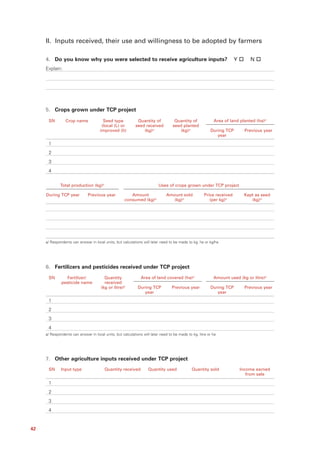
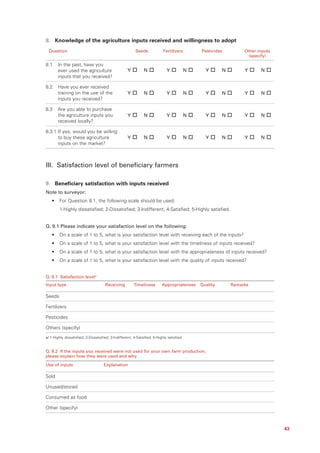
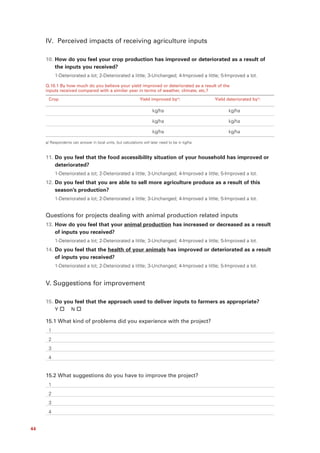
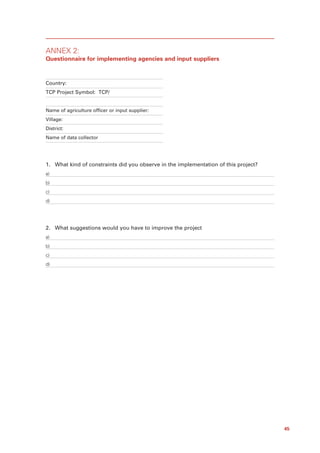
Appendix 1 General guidelines for the implementation of ISFP TCP
              beneficiary satisfaction and impact assessment survey                      34

Appendix 2 List of countries where ISFP TCP projects were implemented                    48
List of tables and boxes


Table 1   ISFP TCP project budgets and number of beneficiaries in 63 assessed countries       10

Table 2   Volumes of inputs distributed by ISFP TCP projects in 63 assessed countries         11

Table 3   Beneficiaries’ knowledge of seeds distributed and willingness to adopt them         17

Table 4   Beneficiaries’ knowledge of fertilizers distributed and willingness to adopt them   17

Table 5   Satisfaction of beneficiaries with receiving inputs                                 18

Table 6   Satisfaction of beneficiaries with the timeliness of input delivery                 19

Table 7   Satisfaction of beneficiaries with the appropriateness of inputs                    19

Table 8   Satisfaction of beneficiaries with the quality of inputs                            19

Table 9   Perceived impacts of ISFP TCP projects on crop production and food accessibility    20

Table 10 Perceived impacts of ISFP TCP projects on ability to sell                            21

Table 11 Perceived impacts of ISFP TCP projects on animal production and health               21

Table 12 Perceived impacts of ISFP TCP projects in Asia                                       22

Table 13 Use of income from sale of crops by gender in the SFS region                         22


Box 1     Distribution methods in Belize                                                      13

Box 2     Innovative scheme to fund community-based microprojects in Afghanistan              14

Box 3     Impact of ISFP TCP project in Chad: A testimonial from a female beneficiary         22
          in the Mandoul region

Box 4     ISFP TCP project in Sierra Leone: A catalyst for mobilizing USD 20 million          23
          to the National Agriculture Response Programme (NARP)

Box 5     Revival of rice growing in western Kenya                                            24

Box 6     The importance of building on country programmes                                    25
Acknowledgements

The Initiative on Soaring Food Prices (ISFP) Technical Cooperation Programme
(TCP) beneficiary satisfaction and impact assessment activity has been a large
undertaking involving the implementation, technical review and analysis of
assessments in 72 countries.
The ISFP Secretariat, with the support of Regional and Subregional Offices of
the Food and Agriculture Organization of the United Nations (FAO), has been
responsible for coordinating the implementation of the assessments at the
country level and developing subregional syntheses on which much of this
global synthesis is based.
Special thanks go to all the FAO staff in the Regional, Subregional and Country
Offices who were involved in the coordination and implementation of this activity,
the national consultants recruited to carry out the national assessments and
enumerators who collected the primary data. A special debt of gratitude is
expressed to the beneficiary households, input suppliers and implementing
agencies from around the world who spared their valuable time to answer
questions and share their views on the ISFP TCP projects.


                                                                                     3
Acronyms

    AFC        Agriculture Finance Cooperation
    CAADP      Comprehensive Africa Agriculture Development Programme
    CERF       United Nations Central Emergency Response Fund
    CFA        Comprehensive Framework for Action
    EUFF       European Union Food Facility
    FAO        Food and Agriculture Organization of the United Nations
    FSP        Fertilizer Support Programme
    GAFSP      Global Agriculture and Food Security Program
    GCP        Government Cooperative Programme
    HIV/AIDS   Human immunodeficiency virus/acquired immunodeficiency syndrome
    IDPs       Internally displaced persons
    IFAD       International Fund for Agricultural Development
    ISFP       Initiative on Soaring Food Prices
    ITF        Input trade fair
    NARP       National Agriculture Response Programme
    NGO        Nongovernmental organization
    NIB        National Irrigation Board
    OPEC       Organization of the Petroleum Exporting Countries
    OSRO       Office for Sahelian Relief Operations – Office for Special Relief Operations
    RAP        Regional Office for Asia and the Pacific
    RBM        Results-based Management
    RECA       Rural Environmental Care for Africa
    REU        Regional Office for Europe and Central Asia
    RNE        Regional Office for the Near East and North Africa
    SAP        Subregional Office for the Pacific Islands
    SFC        Subregional Office for Central Africa
    SFE        Subregional Office for Eastern Africa
    SFS        Subregional Office for Southern Africa
    SFW        Subregional Office for West Africa
    SLC        Subregional Office for the Caribbean
    SLM        Subregional Office for Central America
    TCP        Technical Cooperation Programme
    USD        United States Dollar
    WFP        World Food Programme


4
Executive Summary

In response to the emerging food price crisis in 2007, the Food and Agriculture
Organization of the United Nations (FAO) launched its Initiative on Soaring Food
Prices (ISFP), which followed a twin-track approach combining the promotion of
quick-response interventions with medium- and longer-term programmes for
agricultural growth. As a part of the immediate response, FAO launched 74
Technical Cooperation Programme (TCP) projects in 80 countries1, distributing
agricultural inputs such as seeds and fertilizers, for the most part free of cost, to
vulnerable smallholder farmers to boost their production. FAO made available
approximately USD 30 million for these emergency agriculture input distribution
TCP projects. The funds provided for these TCP projects and knowledge gained
from their implementation played an important catalytic role in mobilizing further
funding for short- and medium-term food security programmes and projects.
Examples of this include projects funded under the European Union Food Facility
(EUFF) and the United Nations Central Emergency Response Fund (CERF).


The projects provided direct and concrete support to over 500 000 households,
approximately 2.5 million people, with an average expenditure of approximately
USD 59 per household. These funds were used to purchase critical agricultural
inputs, provide training and support the logistics required for programme
implementation. In total, the programme provided over 80 000 metric tonnes of
crop and vegetable seeds, fertilizer and agrochemicals, as well as over 2.6 million
seedlings and cuttings, and over 57 000 live animals.


Key inputs provided through the FAO ISFP TCP programme

Crop seeds (tonnes)                                              48 735
Vegetable seeds (tonnes)                                          4 522
Seedlings and cuttings (pieces)                               2 684 675
Fertilizer (tonnes)                                              27 286
Agrochemicals (tonnes)                                              166
Live animals                                                     57 683
Tools and equipment (pieces)                                    277 984


With the view of learning lessons from such a large-scale emergency
intervention, FAO carried out impact assessments for ISFP agriculture input
distribution TCP projects. As the ISFP TCP projects had not been designed to
include assessment components, a standardized baseline data for all projects
was unavailable. The assessments were, therefore, launched to collect
information, both quantitative and qualitative, regarding beneficiaries’ satisfaction
with the project and perceived impacts.


1 One project in the Pacific Islands (TCP/RAS/3205) was a regional project of USD 500 000 encompassing
seven countries including the Cook Islands, Federated States of Micronesia, Marshall Islands, Niue, Palau,
Republic of Nauru and Tuvalu.


                                                                                                             5
Survey results show that about half of the overall beneficiaries had some prior
    exposure to the inputs distributed and that less than half had previously received
    training on their use. For the most part, beneficiaries were satisfied with receiving
    inputs and with their quality and appropriateness, but expressed some
    dissatisfaction with the timeliness of their delivery. Over 65 percent of
    beneficiaries saw improvements in their crop production and food accessibility
    situation due to the provision of ISFP TCP agriculture inputs. Drought and late
    delivery of inputs were cited as the major reasons for those who experienced a
    decline in crop production and food accessibility.

    Structural problems within the agricultural sector as a whole also affected ISFP
    TCP implementation and the projects’ impacts on beneficiaries. In some regions,
    for example, the low availability of quality seeds in local markets affected timely
    procurement and distribution. The lack of irrigation affected production levels and
    difficult access to markets in some areas impacted on beneficiaries’ ability to sell
    their produce. This hampered the ability of farmers to gain maximum impact from
    the inputs provided by the ISFP TCP project.


    The following recommendations, described in greater detail in Chapter 5, are
    based on the findings from the ISFP TCP assessments:
      •   link the TCP project with other ongoing programmes or projects
          whenever possible;
      •   consider the use of revolving schemes or equity contribution systems;
      •   ensure that training is incorporated into the project design;
      •   devote greater resources to project monitoring;
      •   consider the geographic context of the country;
      •   consider flexibility in procurement rules;
      •   avoid distribution of live animals unless proper transportation to the
          beneficiary’s farm can be assured;
      •   consider different possible distribution systems, according to the
          countries’ reality;
      •   improve Results-based Management (RBM) by defining measurable
          project results;
      •   encourage stronger donor commitment with government engagement in
          following up short-term emergency projects with medium-term
          investments to address structural problems (e.g. poorly developed seed
          industry; poor irrigation systems; poor access to markets, post-harvest and
          processing technologies; need for training and strengthening of
          institutions, etc.) within the agriculture sector;
      •   use TCP funding as a catalyst for technology innovation or
          leveraging investment.


6
1        Introduction


As early as July 2007, FAO warned of a rising         role in mobilizing further funding for short- and
food price crisis. In December 2007, FAO              medium-term food security programmes and
launched its Initiative on Soaring Food Prices        projects. FAO’s early action in approving these
(ISFP) to help smallholder farmers grow more          projects provided both immediate assistance to
food and earn more money. By mid-2008,                severely affected farming households, and sent a
international prices for basic food commodities       strong political message to donor agencies
had reached their highest level in nearly 30 years.   regarding the need for rapid action. Experience
The food price crisis, together with the global       gained in the early implementation of the projects
financial crisis, pushed an additional 115 million    also provided important baseline information to
people into poverty and hunger, bringing the total    direct programming choices for the deployment
number of malnourished people to over one             of much larger projects, especially the European
billion. In many developing countries, where          Union Food Facility (EUFF).1
people often spend between 60 and 80 percent of           Forty-one of the 50 projects approved to date
their income on food, prices continue to be high.     by the European Union under the Food Facility,
    The ISFP followed a twin-track approach,          (through a range of implementing partners), have
combining the promotion of quick-response             gone to countries that already were recipients of
agricultural growth with medium- and longer-term      FAO TCP funding, including 23 of the 29 country
programmes. FAO began implementing projects           projects awarded to FAO. In all 41 of these
through its own Technical Cooperation                 countries, there were interagency and rapid
Programme (TCP), financed from assessed               assessments deployed for the development of
contributions of its Members. The Programme           country fiches used as a basis for approving the
aims to provide FAO’s technical expertise to its      EUFF. These country fiches benefitted from
member countries through targeted, short-term,        knowledge obtained through the ongoing
catalytic projects. TCP projects, categorized as      implementation of TCP projects.
being either for Development Support (D) or               With the view of learning lessons from ISFP
Emergency Assistance and Support to                   TCP interventions, FAO carried out impact
Rehabilitation (E), should produce tangible and       assessments for ISFP agriculture input
immediate results in a cost-effective manner.         distribution TCP projects. As the emergency
They support improved food security and poverty       national ISFP TCP projects had not been
alleviation, and should catalyse long-term            designed with assessment components, a
development changes (FAO, 2009).                      standardized baseline data for all projects was
    FAO launched 74 emergency agriculture input       unavailable. It was thus felt that the best way to
distribution TCP projects and 45 technical            establish projects’ impacts was to survey
assistance TCP projects. The emergency input          beneficiaries’ views as to how the projects
distribution TCP projects primarily focussed on       affected their lives. The ISFP Secretariat
reviving agricultural production through the          developed a generic questionnaire and
provision of seeds, fertilizers, pesticides and       methodology to guide assessments and facilitate
animal production inputs to vulnerable                the comparison of data across countries (see
households, mostly at no cost to the producers.       Appendix 1). FAO decentralized offices
Other TCP projects worked on rehabilitating
irrigation schemes, rainwater structures and
small-scale agricultural infrastructure as well as
supporting seed systems, reducing post-harvest        1 The EUFF is the European Union’s EUR 1 billion response to
                                                      the global food crisis. It is a two-year initiative that aims to help
losses and training farmers in new technologies.      developing countries move towards longer-term food security.
                                                      Over EUR 228 million (USD 318 million) is being channelled
    The TCP projects and knowledge gained from
                                                      through FAO for operations in 28 countries in Africa, Asia and
their implementation played an important catalytic    Latin America and the Caribbean.


                                                                                                                              7
coordinated and implemented the assessments
    for their respective regions and countries. Given
    the heterogeneity in distributed inputs,
    questionnaires and methodology were then
    adjusted to country-specific contexts. The FAO
    subregional offices2 also compiled synthesis
    reports for the TCP projects implemented in their
    region, on which a large part of this global
    synthesis is based.
       This report highlights some of the major
    findings from the aforementioned beneficiary
    satisfaction and impact assessments. It is hoped
    that the lessons learned can help in the planning
    and implementation of future emergency input
    distribution projects.


    2 Synthesis reports have been compiled in the following regions:
    Regional Office for Asia and the Pacific (RAP), Subregional Office
    for the Pacific Islands (SAP), Subregional Office for Central Africa
    (SFC), Subregional Office for Eastern Africa (SFE), Subregional
    Office for Southern Africa (SFS), Subregional Office for West
    Africa (SFW) and Subregional Office for the Caribbean (SLC).


8
2         FAO Agriculture Input Distribution TCP Projects


2.1     Overview of ISFP TCP projects                  agriculture, often vital in providing the poor with
The goal of the ISFP TCP projects was to rapidly       fresh food of high nutritional value.
boost agricultural production among smallholder           The procurement and distribution of inputs
farmers, both for their own consumption and for        were monitored to ensure that farmers obtained
the sale of surplus produce on the market. By          inputs that met established quality standards.
providing quality agriculture inputs, such as          The use of existing practices and mechanisms for
quality seeds and fertilizers, the projects also       the effective supply of productive inputs to
aimed to enhance the awareness, knowledge              farmers and the marketing of surplus production
and capacity of targeted beneficiaries concerning      are integral elements of any productive safety
the sustainable use of improved inputs over the        net to support sustainability. Care was taken to
long run. Some projects included animal                avoid disrupting commercial markets and, where
production components such as the distribution         warranted, attention was given to alternative
of animal feed, vaccines, live animals, etc. Such      supply systems that are more private-sector
inputs could expand production of meat, eggs or        oriented (FAO, 2008).
other animal-related products and enable poor
households to improve their purchasing power           2.2      Project description and features
and nutritional status. The ISFP TCP projects,         At the global level, the ISFP launched 74 agriculture
through their visible implementation on the            input distribution TCP projects in 80 countries.
ground, also aimed to mobilize additional funding      Overall, USD 30 million were used in the ISFP TCP
and donor support for larger-scale short- and          projects, supporting over 500 000 beneficiaries
medium-term interventions.                             worldwide (see Table 1).
    The ISFP TCP projects targeted small farmers          The size of the ISFP TCP projects in each of
unable to produce enough for their own                 the beneficiary countries ranged between
consumption and who were net buyers of food.           USD 250 000 and USD 500 000. The overall
Rising food prices hit such vulnerable                 ISFP TCP project cost per beneficiary was USD
households hard, often reducing their capacity         58.86. The region with the lowest cost per
for agriculture production and forcing them to         beneficiary was Asia, with a minimum
sell productive assets.                                expenditure in Nepal (USD 13.35), while in Africa
    One of the first activities of ISFP TCP projects   the maximum expenditure was in Kenya (USD
was to identify the vulnerable farmers and             925.93). These countries reflect contrasting
determine the right crops and appropriate              ways that ISFP TCP project interventions were
varieties of seed or animal feed requirements.         designed. The project in Nepal looked to target
Different methods were used for distributing           as many beneficiaries as possible with seeds,
inputs, including direct distribution to farmers,      animal feed and medicines1, while the Kenya
input trade fairs and voucher schemes. The ISFP        project focused on a smaller number of
Programme document outlined that safety                beneficiaries and provided a more holistic
net/food rations could also be provided to help        package of rice seed, fertilizer, pesticide and
ensure that inputs received were used for              technical training.
production purposes; however, the use of such             The ISFP TCP projects distributed many
an arrangement was not highlighted in any of the       different types of inputs. The distribution of
national assessment reports.
    The ISFP TCP projects aimed to provide high
quality seed of appropriate crops and varieties        1 While the Nepal TCP project distributed animal feed and
                                                       medicines, the national assessment report only examined the
from local sources to ensure adaptation to local       seed distribution component. This was justified by the fact that
                                                       the livestock component was not part of the original project plan
conditions and acceptance by farmers. This
                                                       and the travel time and costs to survey the regions with livestock
included support to home gardens and peri-urban        interventions were prohibitive.


                                                                                                                            9
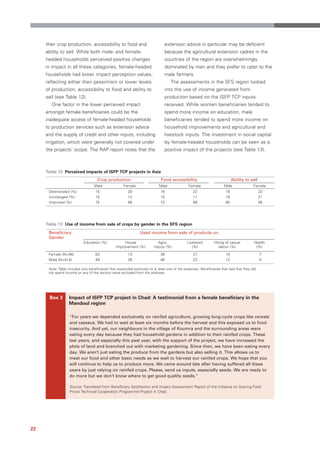
©FAO/Alessandra Benedetti


     Table 1     ISFP TCP project budgets and number of beneficiaries in 80 countries
      Region               Sub-regionb        Budget (USD)             No. of                     Budget/beneficiary household
                                                                     Beneficiary                       (USD/household)
                                                                     households
                                                                                              Overall               Min                   Max
     Asia and the               RAP               4 700 000             140 512                33.45                13.35                 167.79
     Pacific                    SAP               2 500 000              43 191                57.88                27.78                 227.27
     Sub-Saharan                SFC               2   250   000          57   958              38.82                25.00                  50.20
     Africa                     SFE               2   250   000          36   953              60.89                31.25                 925.93
                                SFS               4   750   000          64   577              73.56                29.09                 185.19
                                SFW               6   490   000          86   941              74.65                37.31                 179.02
     Caribbean                  SLC               3 250 000              20 250               169.49                46.01                 865.05
     Othersa                                      3 808 000              59 269                64.25                38.31                 116.28
     Total                                      29 998 000              509 651                58.86                13.35                 925.93
     Note:
     a - Other countries include Armenia, Haiti, Honduras, Kyrgyzstan, Mauritania, Nicaragua, Republic of Moldova and Yemen
     b - See Appendix 2 for full list of ISFP TCP beneficiary countries by subregional office


     cereal seeds was more common in Asia and                                   supplied an animal production package including
     other regions than in sub-Saharan Africa where                             live animals (e.g. chicks, piglets and rabbits),
     the focus was more on other crops, cuttings                                animal feed and medicines, and/or animal pen
     and seedlings. Many of the projects in Africa                              construction materials.
     focussed on the distribution of vegetable seeds
                                                                                2 The results are based on information received as of
     and other market garden crops due, in part, to
                                                                                3 September 2010 from 66 countries. Although assessments
     the growing season during which the TCP                                    were originally planned for all 80 countries, assessments in five
                                                                                countries (Comoros, Eritrea, Haiti, Pakistan and Yemen) were
     projects were being implemented. The                                       not implemented due to circumstances beyond the control of
     Caribbean focussed its interventions on                                    the project. Due primarily to delays in the implementation of
                                                                                some projects and their consequent late closure, at the time of
     non-cereal crops2, tools and animal production                             writing this synthesis report assessments had not been
     (see Table 2).                                                             completed in three countries (Antigua and Barbuda, Guyana and
                                                                                Suriname) and only partially completed in six others (Guinea
        The ISFP TCP projects in some countries also                            Bissau, Madagascar, Mauritius, Sao Tome and Principe,
     had animal production components. Such projects                            Seychelles and Sierra Leone). The survey results from these
                                                                                countries were thus not considered in the data tables, but
     either provided animal feed and medicines or                               described in certain parts of the report narrative.


10
Table 2       Volumes of inputs distributed by ISFP TCP projects in assessed countries
  Input type         Units                 Sub-Saharan          Asia and the            Caribbeanf        Other regions           Total
                                              Africa               Pacific            (10 countries)      (6 countries)
                                          (26 countries)       (23 countries)

Cerealsa             Tonnes                             774               46 019                   8.3                1 934         48 735

Other cropsb         Tonnes                           3 385                  830                  11.5                     295       4 522
                     Kits/packs                       1 400               62 500                  126                        -      64 026
                                                                                                                             -
Cuttings and         Number                      1 991 150               180 200              513 325                        -    2 684 675
seedlingsc

Fertilizers          Tonnes                          25 302                 1 390                  184                     187      27 063
                     Bagsd                            1 167                     -                7 750                        -      8 917

Pesticides,          Kg                               1 338                 3 000                   37              124 360        128 735
insecticides,        Litres                          36 862                   100                  283                    -         37 245
fungicides

Animals              Number                          25 000                 6 350              26 333                         -     57 683

Animal feed /        Tonnes                           1 224                     -                  145                        -      1 369
fodder seeds         Bagsd                                                  4 100                  250                        -      4 350

Other animal         Doses or pieces               170 000                       -               1 590                        -    171 590
relatede

Agriculture tools    Number                        191 505                68 364               18 115                         -    277 984
and materials

Note:
a - Cereals include maize, rice, wheat, millet and sorghum.
b - Other crops include vegetables, legumes, fruits, roots and tubers.
c - In addition the SFC region reported that 625 250 linear metres and 44 227 bottes of cassava were distributed.
d - Units expressed in bags as the size of bags was not specified in all the national reports.
e - Other animal related includes vaccines, mineral stones and medicines.
f - Data from the Caribbean is incomplete with no data for Antigua and Barbuda, Jamaica and Saint Vincent and the
    Grenadines. In addition to the above figures, the following inputs were distributed: seeds - 71 206 vegetable seeds,
    55 bags of unspecified size (peanuts), USD 1 750 of herb and vegetable seeds; pesticides - 18 packs of unspecified
    size and USD 15 000 of pesticides; animal related - 165 gallons of formic acid, 11 litres and USD 150 000 of
    medicines; agriculture tools and materials - 40.6 kg of nails and USD 5 400 of tools and materials.


2.3        Target beneficiaries and regions                                and technical authorities (e.g. Ministry of
The methods for determining target areas and                               Agriculture) in collaboration with the producers
beneficiary households differed among countries and                        themselves. Among such households some
regions, but some general criteria can be identified                       further selection criteria were identified, namely:
that helped in the decision-making process.                                    • ownership of farmland;
    In many countries, the projects targeted                                   • experience in producing crops grown in the
remote and underdeveloped locations                                                  context of TCP projects, including vegetable
(e.g. Bhutan, Nepal), areas affected by conflict                                     crops and other off-season crops;
(e.g. Pakistan, Sri Lanka, the Sudan) as well as                               • possession of livestock for recipients of
areas affected by recurrent natural disasters like                                   animal feed;
droughts, floods and hurricanes. Efforts were also                             • existence of potential markets for the
made, wherever possible, to target vulnerable                                        marketing of agricultural produce.
households that have agricultural potential.
    Projects in western Africa, for example,                               Many countries in the southern Africa subregion
broadly focussed their efforts on poor, vulnerable                         also tried to identify vulnerable households,
families, including those affected by natural                              which, at the same time, had good agricultural
disasters, those displaced by conflict, households                         potential. It was often difficult, however, to
with persons affected by chronic illness,                                  combine vulnerability and agricultural potential
households with limited arable land, etc.                                  characteristics, i.e. the most vulnerable groups
Beneficiary lists were established by local public                         are usually those with the least productive
administrators (e.g. mayor, high commissioners)                            assets. Various TCP projects that applied this type


                                                                                                                                              11
of selection method had difficulties in providing       2.4      Methods of distributing inputs
     coherent lists of beneficiary households.               In looking at the ways that inputs were delivered to
        Some countries relied on the knowledge of            beneficiaries in ISFP TCP projects, they can be
     local leaders to identify vulnerable households         grouped into two categories.
     who could benefit from the ISFP TCP intervention,
     such as the mayors in Armenia who described             Direct distribution
     their selection criteria below:                         One of the most commonly used delivery
                                                             methods by ISFP TCP projects was direct
           “The inputs were given to those who were          distribution. This involved the procurement of
        involved in farming and were poor, either living     inputs from local or international sources, after
        in temporary shelters/cabins, or with many           which they were distributed to farmers. The
        children…, mainly to those who have land and         distribution was conducted either through the
        are specialized in that…”, “we know who the          existing government decentralized network of
        poorest in the village are and who has arable        offices or through Nongovernmental
        land. We tried to give it to those in need, who      Organizations (NGOs) and/or farmers’ groups
        have no working hands, who need that                 who were then responsible for distributing inputs
        wheat…”, “we didn’t give it to the poorest, as       to individual farmers. In some cases, suppliers
        they intended to use it as animal feed…in            were responsible for delivery of inputs directly to
        order for the project to be efficient we gave it     local collection points where farmers went to
        to those who cultivate land.”                        pick them up.
                                                                The choice in whether to use existing
     A number of countries based the selection of            government networks or to channel inputs to
     beneficiaries primarily on their membership to a        NGOs or farmers’ groups was influenced by the
     farmer’s group (e.g. cooperatives, associations,        context of the country and project. For example,
     farmer field schools) and/or participation in ongoing   the TCP project in Zambia provided vegetable and
     government projects and programmes. The SFS             legume seeds to farmers participating in the
     region found this selection method to be one of the     Government's Fertilizer Support Programme (FSP).
     most efficient, as targeting was facilitated by the     The selection of beneficiaries and methods of
     participation of members in groups. Nevertheless,       delivering the seeds were thus based on the
     based on the review of the beneficiary targeting        processes already established by the FSP. Box 1
     experiences, in some countries (e.g. Angola and         provides an outline of the distribution methods
     Zambia) it seems that selection of beneficiaries from   used in Belize and illustrates variations on the
     groups could create internal conflict and disrupt the   direct distribution methods.
     well-being of the group. One suggestion was that it        There were projects that integrated innovative
     could be more effective to target all members of        features. For example, a number of countries
     selected groups even if at the expense of               used revolving schemes in the design of their
     decreasing the number of groups selected.               projects. In Saint Lucia and Saint Vincent and the
        On the other hand, in Burundi, while 30 percent      Grenadines, feed stocks were sold to farmers at
     of the beneficiaries consisted of internally            reduced prices. The money collected was used to
     displaced persons (IDPs), returnees and vulnerable      purchase more feed which was then distributed to
     farmers, the remaining 70 percent were selected         a wider cross section of beneficiaries. This is a
     from among the productive farmers. In this case,        more sustainable option than the free distribution
     more weight was given to productive farmers             of feed seen in some countries. In Burundi, bean
     because of the Government's intention to                seeds and potato cuttings were given to
     replicate the programme on a wider scale. The           beneficiaries as a loan. Farmers were asked to
     project looked to incorporate farmers with              give back the same quantity of seeds and cuttings
     capacities to pay back the seeds to enable the          after harvests to be distributed to other
     Government to scale up the programme by                 neighbouring farmers. In the event of crop failure,
     redistributing the seeds to new farmers the             however, farmers were not required to ‘refund’
     following seasons.                                      the seeds and cuttings.


12
Box 1     Distribution methods in Belize

           In Belize, poor farming households, reeling from the devastation of Hurricane Dean in 2007 and
           struggling with high food and fuel prices, received assistance either in the form of seeds,
           fertilizers and pesticides, or chickens and pigs.
           Belize used three methods of direct distribution depending on the types of inputs and availability
           of beneficiaries to collect them: direct delivery, collection at a central location, and personal
           office/supplier delivery.
           Farmers were most satisfied with the direct delivery system. There were a number of drawbacks,
           such as limits on the amount of inputs able to be delivered at any one time and occasional
           transportation issues causing delays and shortages. However, beneficiaries felt that if the system
           could be improved, it would be ideal as it enabled them to meet implementers on a more
           personal basis, enhance their oversight and ensure that they received the right amount of inputs
           at the right time.
           Beneficiaries acknowledged that with good organization the method of collecting inputs at a
           central location could be effective and efficient. However, the system allowed for politicians to be
           present at the delivery, risking government appropriation of FAO support and its use for political
           purposes. Furthermore, the lack of a well organized and transparent distribution can lead to
           confusion and little control over the flow of inputs. As a result, some beneficiaries ended up not
           receiving their full entitlements.
           Although personal office/supplier delivery method can also enable the provision of technical
           advice, beneficiaries showed some dissatisfaction with this system as it required transportation
           and a specific delivery time, which were often difficult to arrange.

           Source: Beneficiary Satisfaction and Impact Assessment Report of the Initiative on
           Soaring Food Prices Technical Cooperation Programme Project in Belize.


Vouchers and Input Trade Fairs                                     purchases could also be done with cash. The
The voucher and input trade fairs system involves                  interactions among agricultural extension officers,
the distribution of vouchers to beneficiary                        traders and purchasers stimulated an exchange of
households, which could be used as money to                        knowledge and ideas, serving as informal training
purchase inputs at input trade fairs (ITF) organized               to beneficiaries and traders.
by the government and FAO. Agricultural traders                       Even though ITFs have shown to be a positive
were invited to sell their wares and the farmers                   approach to input distribution, they also raised
were free to choose the types of inputs they                       some concerns, including the limited competition
wished to purchase within the limitations of the                   between traders and price fixing. It is necessary to
value of the vouchers distributed. The use of                      avoid price manipulation by ensuring that an
vouchers and ITFs to deliver inputs was done in                    adequate critical mass of traders is present and
very few countries.                                                price fixing does not occur.
  This system has various strengths, helping to                       The second difficulty was related to the cost-
ensure greater diversity and the free choice of                    effectiveness of the sale of inputs from traders,
inputs while decreasing logistical and                             especially when the suggested location of the
administrative costs. A few positive indirect                      ITFs was remote. In various cases in Lesotho,
impacts of ITFs are important to note. First,                      fairs had limited traders present with limited
indirect benefits could be seen at the                             inputs. In Lesotho, although households seemed
procurement level, where local small-, medium- or                  to be willing to purchase basal and topdressing
large-scale traders could participate in ITFs. The                 fertilizer with their vouchers, those commodities
suppliers benefited from a greater demand of                       were not available for purchase. In such cases, it
goods as farmers had access to funds to purchase                   might be necessary to support traders with
inputs. This provided a boost to the local                         transport so as to minimize their costs and
economy. ITFs, furthermore, also increased the                     ensure that ITFs are effectively carried out in
availability of inputs at the community level as                   remote areas.


                                                                                                                          13
Box 2    Innovative scheme to fund community-based microprojects in Afghanistan

                Decades of conflict in Afghanistan have left much of the country’s agriculture sector and rural
                infrastructure in tatters. Farmers have also had to contend with recurring drought, which has
                affected cereal production. In 2008, FAO launched a Technical Cooperation Programme (TCP)
                project to help assure the off-season wheat crop for some of the most vulnerable producers,
                providing certified wheat seed and fertilizers to families hit hard by the rise in food and fuel prices.

                To discourage farmers from becoming dependent, the Ministry of Agriculture, Irrigation and
                Livestock and FAO agreed to distribute the inputs against 20 percent of the actual cost of each
                package, excluding transportation and loading expenses. In previous years, FAO Afghanistan’s
                input distribution scheme included a subsidy of 50 percent of the value of the input. However,
                with the spike in food and input prices in 2008, the figure was reduced to 20 percent. The
                recovered amount was then used to fund three community-based microprojects: a livestock
                artificial insemination centre, a veterinary clinic, and an office building for an extension
                department. For all three projects, the recipient organization worked closely with local
                community leaders to determine the needs of their communities.

                Source: Beneficiary Satisfaction and Impact Assessment Report of the Initiative on Soaring Food Prices Technical
                Cooperation Programme Project in Afghanistan.


       The third difficulty was related to quality
     control. Because various unregistered traders
     were part of the ITFs, issues with quality and
     confidence of inputs were raised by beneficiaries,
     implementing agencies and FAO. Lastly,
     problems related to the forging of vouchers were
     also documented. It is important to ensure that a
     careful fraud prevention system is included in the
     ITF system design.
       The ISFP TCP impact assessment analysis of
     the benefits and limitations of voucher
     programmes are broadly confirmed by the findings
     of other more substantial reviews of input supply
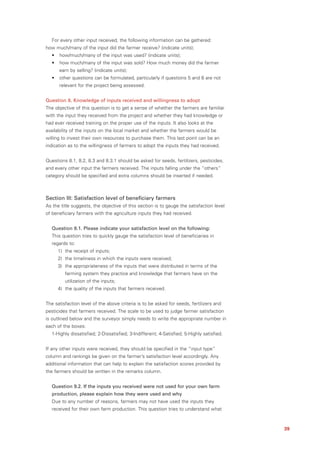
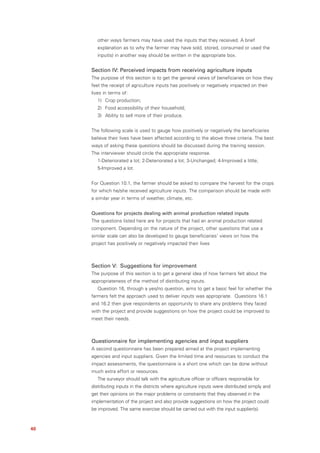
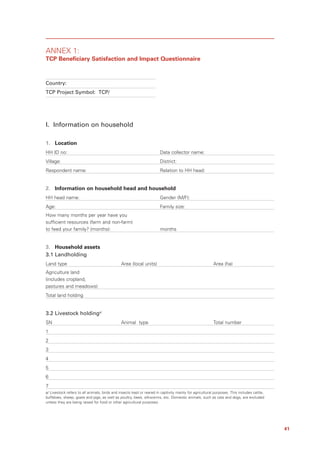
     voucher programmes in sub-Saharan Africa.


14
3         Gauging perceptions of beneficiaries and project impacts1


FAO TCP projects under the ISFP were                    willingness to adopt them: i) whether
developed and implemented over a very short             beneficiaries had used the project inputs
time frame in order to bring immediate assistance       previously; (ii) whether they were previously
to affected populations and serve as a catalyst for     trained on the use of project inputs; (iii) whether
additional funding. Because of this, it was not         they could buy project inputs locally; and
possible to conduct conventional baseline               (iv) whether they would be willing to buy inputs,
surveys that would have enabled more in-depth           if they were available in the market.
impact analysis. In the absence of such baseline            Table 3 presents the results regarding
data to evaluate project impact, the ISFP               beneficiaries’ knowledge of seeds distributed and
Secretariat developed general guidelines and            willingness to adopt them. The main deviations to
generic survey questionnaires to collect some           the global mean are usually caused by single
socio-economic data on beneficiaries, their             countries and can be considered as exceptions. In
satisfaction with the project and perceptions of        the case of RAP, Nepal, with 36 864 beneficiaries,
how the project impacted them.                          is mainly responsible for the low weighted average
    FAO decentralized offices and consultants           with regard to beneficiaries who have benefited
recruited to carry out the assessments were             from training.
given flexibility to adapt the questionnaires to            In the SFS region, Zambia, with a high number
better fit the context of the project and country in    of beneficiaries, had a strong influence on
which the surveys were to be conducted. As the          weighted averages. The limited access to TCP
assessments were funded from residual funds of          financed seeds in local markets in Zambia
national or regional ISFP TCP projects, budgetary       (25 percent) brings the weighted average down.
restrictions also played a role in determining          On the other hand, Zambian beneficiaries show a
sample sizes and methodologies. Efforts were            high willingness to adopt (91 percent), increasing
made to collect the views of female-headed              the weighted average of this indicator.
beneficiary households to see if differences                The figures show that on average only around
existed in the perceptions of male and female           half of the beneficiaries had previous contact with
beneficiaries. The views of implementing                the type of seeds received2 and less than a half
agencies and input suppliers involved in the            had had training on their use. Despite the lack of
projects were also collected.                           access to the distributed crops, an average of
    This chapter highlights some of the major           70 percent of the beneficiaries would be willing to
findings of the surveys including: (i) beneficiaries’   buy the seeds if they were affordable and available.
knowledge of inputs distributed and willingness             For the SFW region, farmers of Benin, Burkina
to adopt; (ii) satisfaction levels of beneficiaries     Faso and Senegal showed low levels of familiarity
with regards to reception, timeliness,                  with the distributed improved varieties: respectively
appropriateness and quality of inputs received;         18, 32 and 20 percent of the interviewed
(iii) perceived impacts that the project had on         households had previous contact with the
crop production, accessibility to food, ability to      distributed seed varieties. Respectively,
sell, animal production and animal health; and
(iv) gender differences in the responses provided       1 The regional and global averages of the different indicators
                                                        presented in this chapter are weighted according to the number
by sample households.                                   of beneficiaries of each project; the exception being Section 3.1 in
                                                        which both straight and weighted averages are presented, due to
                                                        significant differences in some of the figures.
3.1 Beneficiaries’ knowledge of inputs                  2 Depending on the countries, type of seed might refer to
distributed and willingness to adopt them               either crop or variety. In many countries where improved seed
                                                        varieties of traditional crops were distributed, the question
The questionnaire that was used contained four          focused on the knowledge of the varieties. In countries where
                                                        crops that were not the main local staple crop were distributed
yes or no questions on the beneficiaries’               (e.g. vegetable seeds) the question concerned the knowledge of
knowledge on the inputs distributed and the             those crops.


                                                                                                                               15
©FAO/Alessandra Benedetti


     77 and 61 percent of the interviewees in Benin and      23 percent of the Kenyan producers interviewed
     Burkina Faso said they would not buy the seeds as       had used the distributed fertilizers before, while in
     they are not available in the market.                   Burundi 71 percent of the interviewed beneficiaries
        The Dominican Republic, which targeted               had experience with the input. In RAP, the
     significantly more beneficiaries than any other         difference for the same indicator is between
     country in the SLC region (5 435 in total), is mainly   Afghanistan (0 percent), Bangladesh (37 percent)
     responsible for the increase of the weighted            and Cambodia (59 percent). Curiously when asked
     average of beneficiaries who received training on       if they had received training on the use of inputs,
     the distributed seeds, and for the decrease on the      answers showed an opposite trend: Afghanistan
     weighted average of beneficiaries who had access        (100 percent), Bangladesh (58 percent), and
     to the seeds locally.                                   Cambodia (10 percent). The TCP project in
        The SAP region is a particular case. In this         Afghanistan included a training component.
     subregion the variance in the results of the               On the whole, as the results suggest, there was
     different countries is large, making the means not      a lack of adequate knowledge concerning the
     very significant.                                       application of the distributed inputs. This is mostly
        With regard to the results for training in the       due to the preference given in the TCP projects to
     countries for which no (sub)regional synthesis was      improved technologies. This is illustrated by the
     produced, the Republic of Moldova, whose project        difference in results between Afghanistan and Chad.
     provided training and targeted 30 000 beneficiaries,    The seeds distributed in Chad were acquired in local
     greatly increased the weighted average.                 markets, thus 100 percent of the producers had
        Weighted and simple averages for fertilizers         used them before. Conversely, in the region where
     differ from each other slightly more than they do       the TCP project was implemented in Afghanistan,
     for seeds (see Table 4). This is primarily because      markets for agriculture inputs were almost non-
     fewer countries distributed fertilizer. In regions      existent. None of the beneficiaries interviewed in
     where only two countries with very different            this country had ever previously used the seeds that
     numbers of beneficiaries received fertilizers, the      were distributed.
     simple and the weighted averages show a wide               Even though the introduction of new and
     gap. This is the case of the SFE region where only      improved varieties and types of seeds is positive,


16
Table 3     Beneficiaries’ knowledge of seeds distributed and willingness to adopt them
 Region            Had used the TCP                     Had received                  Have access to TCP             Willing to buy seeds if
                     seeds before                   training on the TCP                  seeds locally                      available
                                                       seeds beforea
                  Weighted       Average (%)       Weighted       Average (%)        Weighted       Average (%)       Weighted       Average (%)
                 average (%)                      average (%)                       average (%)                      average (%)
 RAP                  48               53              36               42               62              56               63               58
 SAP                  67               72              37               57               72              60               72               54
 SFCb                 53               58              80               80               69              74               87               90
 SFE                  57               64              46               45               55              55               80               80
 SFS                  46               52              38               48               46              61               79               74
 SFW                  38               52              49               65               42              51               44               55
 SLC                  65               76              37               29               48              70               68               78
 Others               53               50              45               34               41              41               55               57
 Global               49               60              40               50               58              58               70               68
Note:
a - The interpretation of this table was not the same in all countries. Some beneficiaries responded about training received only during the TCP
    project, while others spoke of training received before and during the TCP.
b - For the SFC region, the questions were made for all the inputs distributed and not for seeds and fertilizers separately. Only the Democratic
    Republic of the Congo answered the question on whether beneficiaries had received training before.


Table 4     Beneficiaries’ knowledge of fertilizers distributed and willingness to adopt them
 Region            Had used the TCP                     Had received                  Have access to TCP                   Willing to buy
                    fertilizers before              training on the TCP                fertilizers locally                   fertilizers
                                                          fertilizers                                                       if available
                  Weighted       Average (%)       Weighted       Average (%)        Weighted       Average (%)       Weighted       Average (%)
                 average (%)                      average (%)                       average (%)                      average (%)
 RAP                  36               49              54               67               57              48               56               48
 SAP                  86               88              40               54               46              50               48               38
 SFE                  67               47              47               26               72              72               71               71
 SFS                  53               58              48               53               57              63               70               65
 SFW                  30               39              44               61               59              57               57               52
 SLC                  54               68              34               28               46              66               65               73
 Others               13               13              22               22               12              12               14               14
 Global               38               52              44               44               56              53               58               52


the lack of previous utilization of seeds calls for the                      beneficiaries had used the fertilizers before. Also in
need for training or technical support. As the ISFP                          some countries in SLC (Barbados, Saint Lucia and
TCP projects were responding to an emergency and                             Saint Vincent and the Grenadines), some
the instructions regarding the ISFP TCP projects                             beneficiaries said that they would normally
required that 95 percent of the funds be used for                            purchase the distributed seeds (rising prices
the purchase of inputs, training components were                             prohibited the purchase during the year of the TCP
not included in many of the projects. There were                             project). This, however, did not happen with
cases though, in which training was considered. In                           fertilizers and other agrochemicals. The
Angola, for example, the distribution of inputs was                          beneficiaries of some countries had neither
made through farmer field schools, which ensured                             knowledge nor training (91 percent in the Bahamas)
the training of beneficiaries. In countries in which                         in the use of these types of inputs.
inputs were distributed through input trade fairs                               Despite the lack of training, many beneficiaries
(e.g. Lesotho and Swaziland), beneficiaries could                            showed willingness to acquire the inputs
receive technical support while at the fair. In                              distributed by the ISFP TCP projects. Additionally,
Nicaragua, a portion of funds from a TCP Facility                            as pointed out in the report for Southern Africa,
(TCP/NIC/3201) provided technical assistance and                             the projects also showed a good degree of latent
capacity building support to 70 percent of ISFP TCP                          demand for new seeds as about 30 to 40 percent
project beneficiaries.                                                       of voucher-receiving beneficiaries in Lesotho and
   ISFP TCP project beneficiaries were less familiar                         Swaziland, for instance, chose seed varieties they
with fertilizers than they were with seeds, as                               had never planted before. Unfortunately, as the
fertilizers are expensive and sometimes not                                  report for SFC states, the willingness to acquire is
available in local markets. In the Democratic                                often greater than the purchasing capacities in
Republic of the Congo, only 9 percent of the                                 the subregion.


                                                                                                                                                   17
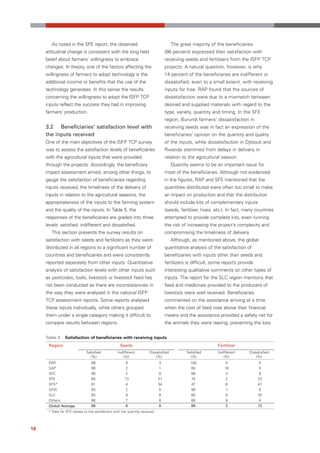
As noted in the SFE report, the observed                                       The great majority of the beneficiaries
     attitudinal change is consistent with the long held                           (86 percent) expressed their satisfaction with
     belief about farmers’ willingness to embrace                                  receiving seeds and fertilizers from the ISFP TCP
     changes. In theory, one of the factors affecting the                          projects. A natural question, however, is why
     willingness of farmers to adopt technology is the                             14 percent of the beneficiaries are indifferent or
     additional income or benefits that the use of the                             dissatisfied, even to a small extent, with receiving
     technology generates. In this sense the results                               inputs for free. RAP found that the sources of
     concerning the willingness to adopt the ISFP TCP                              dissatisfaction were due to a mismatch between
     inputs reflect the success they had in improving                              desired and supplied materials with regard to the
     farmers’ production.                                                          type, variety, quantity and timing. In the SFE
                                                                                   region, Burundi farmers’ dissatisfaction in
     3.2 Beneficiaries’ satisfaction level with                                    receiving seeds was in fact an expression of the
     the inputs received                                                           beneficiaries’ opinion on the quantity and quality
     One of the main objectives of the ISFP TCP survey                             of the inputs, while dissatisfaction in Djibouti and
     was to assess the satisfaction levels of beneficiaries                        Rwanda stemmed from delays in delivery in
     with the agricultural inputs that were provided                               relation to the agricultural season.
     through the projects. Accordingly, the beneficiary                                Quantity seems to be an important issue for
     impact assessment aimed, among other things, to                               most of the beneficiaries. Although not evidenced
     gauge the satisfaction of beneficiaries regarding                             in the figures, RAP and SFS mentioned that the
     inputs received, the timeliness of the delivery of                            quantities distributed were often too small to make
     inputs in relation to the agricultural seasons, the                           an impact on production and that the distribution
     appropriateness of the inputs to the farming system                           should include kits of complementary inputs
     and the quality of the inputs. In Table 5, the                                (seeds, fertilizer, hoes, etc.). In fact, many countries
     responses of the beneficiaries are graded into three                          attempted to provide complete kits, even running
     levels: satisfied, indifferent and dissatisfied.                              the risk of increasing the project’s complexity and
        This section presents the survey results on                                compromising the timeliness of delivery.
     satisfaction with seeds and fertilizers as they were                              Although, as mentioned above, the global
     distributed in all regions to a significant number of                         quantitative analysis of the satisfaction of
     countries and beneficiaries and were consistently                             beneficiaries with inputs other than seeds and
     reported separately from other inputs. Quantitative                           fertilizers is difficult, some reports provide
     analysis of satisfaction levels with other inputs such                        interesting qualitative comments on other types of
     as pesticides, tools, livestock or livestock feed has                         inputs. The report for the SLC region mentions that
     not been conducted as there are inconsistencies in                            feed and medicines provided to the producers of
     the way they were analysed in the national ISFP                               livestock were well received. Beneficiaries
     TCP assessment reports. Some reports analysed                                 commented on the assistance arriving at a time
     these inputs individually, while others grouped                               when the cost of feed rose above their financial
     them under a single category making it difficult to                           means and the assistance provided a safety net for
     compare results between regions.                                              the animals they were rearing, preventing the loss


     Table 5    Satisfaction of beneficiaries with receiving inputs
      Region                                        Seeds                                                     Fertilizer
                              Satisfied            Indifferent          Dissatisfied          Satisfied       Indifferent      Dissatisfied
                                (%)                    (%)                  (%)                 (%)               (%)              (%)
      RAP                        88                    9                      3                 100               0                 0
      SAP                        98                    2                      1                 84                16                0
      SFC                        90                    2                      8                 88                3                 9
      SFE                        65                    13                     21                75                2                 23
      SFS*                       61                    4                      34                47                6                 47
      SFW                        93                    2                      5                 90                1                 9
      SLC                        83                    9                      8                 80                0                 20
      Others                     86                    7                      8                 88                8                 4
      Global Average             86                    6                      9                 86                2                 12
      * Data for SFS relates to the satisfaction with the quantity received


18
of their stock (Barbados). In other instances, the                  The inputs distributed were considered
livestock (chickens) supplemented the diet of the              appropriate by most users (Table 7). The exception
beneficiaries’ families (Jamaica).                             here is the SFE region where Rwanda (47 percent
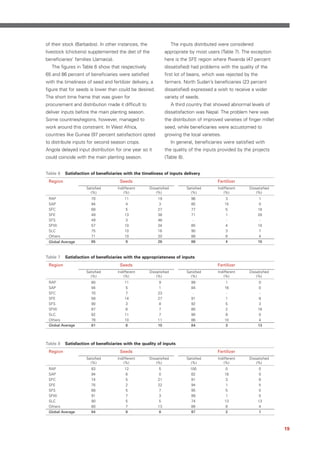
   The figures in Table 6 show that respectively               dissatisfied) had problems with the quality of the
65 and 86 percent of beneficiaries were satisfied              first lot of beans, which was rejected by the
with the timeliness of seed and fertilizer delivery, a         farmers. North Sudan’s beneficiaries (23 percent
figure that for seeds is lower than could be desired.          dissatisfied) expressed a wish to receive a wider
The short time frame that was given for                        variety of seeds.
procurement and distribution made it difficult to                   A third country that showed abnormal levels of
deliver inputs before the main planting season.                dissatisfaction was Nepal. The problem here was
Some countries/regions, however, managed to                    the distribution of improved varieties of finger millet
work around this constraint. In West Africa,                   seed, while beneficiaries were accustomed to
countries like Guinea (97 percent satisfaction) opted          growing the local varieties.
to distribute inputs for second season crops.                       In general, beneficiaries were satisfied with
Angola delayed input distribution for one year so it           the quality of the inputs provided by the projects
could coincide with the main planting season.                  (Table 8).


Table 6   Satisfaction of beneficiaries with the timeliness of inputs delivery
 Region                               Seeds                                               Fertilizer
                    Satisfied        Indifferent     Dissatisfied           Satisfied     Indifferent    Dissatisfied
                      (%)                (%)             (%)                  (%)             (%)            (%)
 RAP                   70                11               19                  96              3                1
 SAP                   94                4                3                   85              15               0
 SFC                   68                5                27                  77              5                18
 SFE                   49                13               38                  71              1                28
 SFS                   49                3                48                   -               -                -
 SFW                   57                10               34                  85              4                10
 SLC                   75                10               16                  90              3                7
 Others                71                10               20                  88              8                4
 Global Average        65                9                26                  86              4                10


Table 7   Satisfaction of beneficiaries with the appropriateness of inputs
 Region                               Seeds                                               Fertilizer
                    Satisfied        Indifferent     Dissatisfied           Satisfied     Indifferent    Dissatisfied
                      (%)                (%)             (%)                  (%)             (%)            (%)
 RAP                   80                11               9                   99              1                0
 SAP                   94                5                1                   84              16               0
 SFC                   70                7                23                   -               -                -
 SFE                   58                14               27                  91              1                8
 SFS                   90                3                8                   92              5                3
 SFW                   87                6                7                   80              2                18
 SLC                   82                11               7                   90              9                0
 Others                78                10               11                  86              10               4
 Global Average        81                8                10                  84              3                13


Table 8   Satisfaction of beneficiaries with the quality of inputs
 Region                               Seeds                                               Fertilizer
                    Satisfied        Indifferent     Dissatisfied           Satisfied     Indifferent    Dissatisfied
                      (%)                (%)             (%)                  (%)             (%)            (%)
 RAP                   83                12               5                   100             0                0
 SAP                   94                6                0                   82              18               0
 SFC                   74                5                21                  91              3                6
 SFE                   75                2                22                  94              1                5
 SFS                   88                5                7                   95              5                0
 SFW                   91                7                3                   99              1                0
 SLC                   90                5                5                   74              13               13
 Others                80                7                13                  88              8                4
 Global Average        84                8                8                   97              2                1


                                                                                                                         19
Concerns were raised in SLC that some of the                food accessibility experienced by beneficiaries.
     planting materials provided (cassava and sweet                 Adverse climatic conditions, i.e. drought, had been
     potatoes) did not have a regulated length and had              experienced in some countries. Delays in the
     been subject to a high percentage of water loss.               delivery of inputs and late planting also affected
     The handling of delicate seeds also resulted in a              production. In some cases seeds had to be stored
     number of seeds being damaged in different                     until the following season, which farmers felt had
     countries throughout the subregions, resulting in              affected the germination rates. In a few exceptional
     poor plant stand and low germination of seeds.                 cases, the poor quality of seeds was reported as
        Several reports (Dominica, Grenada and                      being problematic and pushed some farmers to
     Saint Lucia) referred to the need for certified                consume the seeds as food (e.g. Burundi). The
     providers of planting materials, more familiarity of           low local availability of quality seeds was a
     personnel involved in the project in dealing with              contributing factor and the report for Rwanda,
     large quantities of inputs as well as proper drying,           another country which faced problems of seed
     storage and transport.                                         quality, recommended the need to develop a
        Given the conditions in which the agents had to             reliable community-based seed industry to
     operate, however, it seems that the projects did               enhance the availability of quality seeds.
     the utmost to provide good quality inputs.                     Constraints in the structure and functionality of
                                                                    local input supply markets were an overarching
     3.3 Beneficiaries’ perceptions of the                          factor contributing to reduced ISFP TCP results.
     impacts of ISFP TCP projects                                      With regard to the ability to sell, improvements
     In looking at the perceived impacts that the ISFP              felt by beneficiaries were slightly less than their
     TCP projects had on crop production and food                   perceived impact on crop production or food
     accessibility, 65 percent of beneficiaries felt that           accessibility (see Table 10). Not all households had
     their production had improved (see Table 9). SAP               good access to markets to sell their surplus
     beneficiaries had the highest perception of                    production, which can help to account for this
     improvement, but the results may be influenced by              difference. The inclusion of a marketing or post-
     the small sample sizes used for the assessments in             harvest component in future interventions was
     the region. About 15-20 percent of the beneficiaries           recommended in the SLC report.
     felt their crop production and food accessibility had
     remained unchanged or had deteriorated.                        Animal production
        A number of factors can account for the                     In looking at the perceived impacts with regard to
     perceived deterioration of crop production and                 animal production components, about 50 percent of


     Table 9   Perceived impacts of ISFP TCP projects on crop production and food accessibility

      Perceived impact        Region                        Improved              Unchanged              Deteriorated
                                                              (%)                    (%)                     (%)
      Crop production         RAP                              62                       14                    24
                              SAP                              88                       12                    1
                              SFC                              57                       12                    31
                              SFE                              63                       14                    23
                              SFS                              50                       17                    33
                              SFW                              83                       15                    2
                              SLC                              60                       34                    6
                              Other                            42                       38                    20
                              Global Average                   65                       18                    17
      Food accessibility      RAP                              61                       14                    25
                              SAP                              87                       12                    1
                              SFC                              39                       24                    38
                              SFE                              62                       20                    18
                              SFS                              66                       20                    15
                              SFW                              83                       14                    2
                              SLC                              64                       32                    4
                              Other                            46                       42                    13
                              Global Average                   66                       20                    15


20
beneficiaries saw an improvement in animal                   3.4 Gender perspectives in ISFP TCP
production or health while the other 50 percent felt         projects
there was no change (see Table 11).                          While the majority of the ISFP TCP projects did
  The figures in Table 11, however, need to be               not specifically target female-headed
treated with some caution. In the SAP region,                households, there were countries, such as
for example, some of the projects were still in              Djibouti and Senegal, which made efforts to
the process of being implemented and it was                  target women’s cooperatives. The ISFP TCP
not easy for beneficiaries to judge whether their            assessments tried to consider gender
animal production or health had improved or not.             perspectives by analysing differences in
This accounts, in part, for the high proportion              responses to survey questions by male- and
of people stating that their situation had                   female-headed beneficiary households. There
remained unchanged.                                          was an inconsistency, however, in the analysis
  In the SLC region, the beneficiaries in Jamaica            of gender differences in responses, either due
felt that they had seen great improvements in                to the low level of female-headed households
animal production and health, while those in                 sampled or to the fact that many assessments
Grenada and Saint Lucia felt their situation                 did not find significant differences in the
remained unchanged. In the latter two countries,             answers provided. Nevertheless, there are some
problems with transport of live animals had led to           findings which are of interest to highlight.
high mortality rates and problems in the                        In Asia, it was found that previous knowledge
distribution system resulted in insufficient                 of the agriculture inputs received and satisfaction
quantities of inputs being distributed. These can            levels did not differ significantly between male-
be seen as reasons for the high percentage of                and female-headed households. Males, however,
beneficiaries stating that their situation had not           were more willing to buy TCP provided inputs if
changed. The SFW region had animal production                they were available on the market. Female
components in two countries, Cape Verde and the              beneficiaries were perhaps less likely to have the
Niger. Table 11 only shows the values for Cape               means to purchase such inputs.
Verde as the questions regarding animal                         The Asia report also highlights differences in
production and health were not asked in the Niger.           the perceived impacts that the ISFP TCP had on


Table 10 Perceived impacts of ISFP TCP projects on ability to sell
 Region                              Improved                      Unchanged                  Deteriorated
                                       (%)                            (%)                         (%)
 RAP                                     56                            22                          22
 SAP                                     86                            14                          0
 SFC                                     51                            23                          26
 SFE                                     43                            44                          12
 SFS                                     45                            35                          20
 SFW                                     83                            14                          2
 SLC                                     52                            43                          5
 Other                                   38                            43                          19
 Global Average                          60                            25                          14


Table 11 Perceived impacts of ISFP TCP projects on animal production and health
 Perceived impact       Region                       Improved               Unchanged          Deteriorated (%)
                                                       (%)                     (%)
 Animal production      SFW                             72                      29                      0
                        SAP                             28                      72                      0
                        SLC                             59                      41                      0
                        Global Average                  48                      52                      0
 Animal health          SFW                             73                      27                      0
                        SAP                             38                      60                      2
                        SLC                             54                      47                      0
                        Global Average                  53                      47                      1


                                                                                                                   21
their crop production, accessibility to food and                             extension advice in particular may be deficient
     ability to sell. While both male- and female-                                because the agricultural extension cadres in the
     headed households perceived positive changes                                 countries of the region are overwhelmingly
     in impact in all these categories, female-headed                             dominated by men and they prefer to cater to the
     households had lower impact perception values,                               male farmers.
     reflecting either their pessimism or lower levels                                The assessments in the SFS region looked
     of production, accessibility to food and ability to                          into the use of income generated from
     sell (see Table 12).                                                         production based on the ISFP TCP inputs
        One factor in the lower perceived impact                                  received. While women beneficiaries tended to
     amongst female beneficiaries could be the                                    spend more income on education, male
     inadequate access of female-headed households                                beneficiaries tended to spend more income on
     to production services such as extension advice                              household improvements and agricultural and
     and the supply of credit and other inputs, including                         livestock inputs. The investment in social capital
     irrigation, which were generally not covered under                           by female-headed households can be seen as a
     the projects’ scope. The RAP report notes that the                           positive impact of the projects (see Table 13).


     Table 12 Perceived impacts of ISFP TCP projects in Asia
                                     Crop production                           Food accessibility                              Ability to sell
                                   Male                Female                 Male               Female                  Male               Female
      Deteriorated (%)              15                    20                   16                   22                    18                     23
      Unchanged (%)                 10                    12                   10                   11                    18                     21
      Improved (%)                  75                    68                   73                   68                    65                     56


     Table 13 Use of income from sale of crops by gender in the SFS region
      Beneficiary                                                Used income from sale of products on
      Gender
                            Education (%)              House                 Agric.             Livestock         Hiring of casual          Health
                                                  Improvement (%)          Inputs (%)              (%)               labour (%)              (%)

      Female (N=48)                 63                    13                   38                   27                    10                     7
      Male (N=414)                  49                    26                   46                   22                    12                     0

      Note: Table includes only beneficiaries that responded positively to at least one of the expenses. Beneficiaries that said that they did
      not spend income on any of the sectors were excluded from the analyses.


      Box 3        Impact of ISFP TCP project in Chad: A testimonial from a female beneficiary in the
                   Mandoul region

                   “For years we depended exclusively on rainfed agriculture, growing long-cycle crops like cereals
                   and cassava. We had to wait at least six months before the harvest and this exposed us to food
                   insecurity. And yet, our neighbours in the village of Koumra and the surrounding areas were
                   eating every day because they had household gardens in addition to their rainfed crops. These
                   last years, and especially this past year, with the support of the project, we have increased the
                   plots of land and branched out with marketing gardening. Since then, we have been eating every
                   day. We aren’t just eating the produce from the gardens but also selling it. This allows us to
                   meet our food and other basic needs as we wait to harvest our rainfed crops. We hope that you
                   will continue to help us to produce more. We came around late after having suffered all these
                   years by just relying on rainfed crops. Please, send us inputs, especially seeds. We are ready to
                   do more but we don’t know where to get good quality seeds.”

                   Source: Translated from Beneficiary Satisfaction and Impact Assessment Report of the Initiative on Soaring Food
                   Prices Technical Cooperation Programme Project in Chad.


22
4         Lessons learned from implementation of ISFP TCP projects


4.1     Project planning issues                                   the projects tried to cover a high number of
One of the issues raised in the (sub)regional                     beneficiaries, with a small allocation to each
syntheses of ISFP TCP project assessments was                     household, to countries with a limited target
that the amounts allocated to each country project                population but a higher allocation per household.
did not vary much depending on their geographic                   In Asia, for example, Afghanistan made available
size, the size and poverty level of their population,             USD 168 for each of the 2 980 beneficiary
the magnitude of losses from natural disasters,                   households. The project in Nepal, on the other hand,
etc. More importantly, most of the funds allocated                distributed seeds, animal feed and vaccines to
through the TCP were too small to produce an                      37 464 households for an allocation of USD 13 per
impact on production that would be capable of                     beneficiary household. Another example of very
changing food prices in the intervened countries.                 specific limited targeting in a relatively large
    TCP interventions must be seen instead as a                   country is Kenya, with 540 beneficiary households
catalyst for change, including technical innovation               for a TCP of USD 500 000.
and increased donor engagement. There are                             These differences in the level of funds per
examples in which the ISFP TCP, though small in                   household obviously influence the type of input
size, played an important catalytic role in the                   package and size of the land parcel that is cultivated.
mobilization of larger funding by other partners.                 The high level of aid per household in Kenya allowed
Box 4 gives the example of Sierra Leone.                          for the distribution of seeds, fertilizers and pesticides
    Within the limitation of the ISFP TCP projects’               and technical assistance through the local NGO Rural
budgets, different countries adopted different                    Environmental Care for Africa (RECA), one of the
approaches in trying to make the best use of the                  implementing partners of the project (see Box 5). In
project funds. These varied from cases in which                   Afghanistan beneficiaries received a complete kit of


 Box 4      ISFP TCP project in Sierra Leone: A catalyst for mobilizing
            USD 20 million to the National Agriculture Response Programme (NARP)

            When the effects of the food price crisis began to be felt, Sierra Leone’s Minister of Agriculture,
            Forestry and Food Security worked closely with development partners, including FAO, World
            Food Programme (WFP), International Fund for Agricultural Development (IFAD) and the African
            Development Bank, as well as a coalition of NGOs, to design its National Agriculture Response
            Programme (NARP). The NARP mapped out short-term safety net activities, largely through WFP
            mechanisms, and medium-term food responses, building on “Operation Feed the Nation”, the
            country’s national programme for food security.

            In 2008, FAO’s ISFP provided USD 500 000 through its Technical Cooperation Programme (TCP)
            as the first contribution to the NARP. Other development partners, including Irish Aid, the
            Organization of the Petroleum Exporting Countries (OPEC) Fund for International Development
            and the Italian Cooperation, followed suit, providing financial support to the NARP, and in mid-
            2009, a two-year project was launched through the European Union Food Facility (EUFF), with
            more than EUR 10 million in funds. Additional activities were financed under existing African
            Development Bank and IFAD projects and new funding through the European Commission’s
            NGO and WFP support. Contributions to actions under the NARP now top USD 20 million.

            The NARP and the EUFF project, furthermore, underpinned Sierra Leone’s Comprehensive Africa
            Agriculture Development Programme (CAADP) Country Compact and resulting Country Investment
            Programme, which, in turn, formed the basis of a successful USD 50 million grant bid under the
            Global Agriculture and Food Security Program (GAFSP).

            Source: Adapted from Beneficiary Satisfaction and Impact Assessment Report of the Initiative on Soaring Food Prices
            Technical Cooperation Programme Project in Sierra Leone.


                                                                                                                                  23
inputs and also training on their correct use. The                  farming systems within their borders. The fact
     reports from Central and Eastern Africa and Asia                    that some countries had one crop as their staple
     were supportive of the distribution of complete kits                food led to only one seed variety of that crop
     of inputs, noting that the absence of fertilizers and               being distributed regardless of the differences in
     pesticides from the packages delivered to                           soil and climate conditions throughout each
     households undermined the gains in yields and                       country. On the other hand, the type of
     benefits expected from the use of improved seeds.                   agriculture, the farming systems and the
        Although most regions reported that complete                     identified needs of producers in the Pacific
     inputs kits should be distributed to farmers, the                   Islands and the Caribbean usually led to the
     report from SFS is clear in demonstrating that                      decision of adopting a complex approach
     when expensive inputs, such as fertilizers, are                     involving many types of inputs (vegetable seeds,
     included in the kits, the number of beneficiaries                   fertilizers, livestock and livestock feed, tools,
     declines drastically. The reports for Asia, Central                 machinery, building materials, etc.). These
     and Southern Africa note, however, that as inputs                   countries, however, are already constrained by
     are distributed for free to a limited number of                     their need to ship these products from long
     people within a community, there is always a                        distances and, although the concept was
     chance of informal sharing of inputs, resulting in an               adequate, this led to severe delays and problems
     incorrect application of the technical input package.               in procurement and delivery.
        Another issue that arose, which is partially                        There needs to be a good balance between
     linked to the available budget per household,                       blanket approaches and projects that tend to be
     concerned the type of inputs to distribute and                      so specific to a population’s needs that they
     how this selection was made.                                        become very complex and hard to manage.
        Asia saw the case of blanket approaches                             Overall, one size cannot fit all and countries
     being used in countries with very different                         need to have the technical capacity to weigh the


      Box 5     Revival of rice growing in western Kenya

                                                                      For much of the last decade, rice farmers in the Ahero
                                                                      Irrigation Scheme in Nyanza Province in western
                                                                      Kenya struggled with low yields. Despite an earlier
                                                                      FAO investment of two new water pumps, which
                                                                      helped to revive the collapsed scheme in the mid-
                                                                      2000s, crops continued to under-perform as farmers
                                                                      became increasingly hamstrung by the high cost of
                                                                      seeds, fertilizers and fuel. Large swathes of the
                                                                      scheme’s 2 168 acres were even left dormant. Fall-out
                                                                      from post-election violence coupled with the global
                                                                      surge in food prices in 2007-2008 left the Ahero
                                                                      community – already hit hard by poverty,
                                                                      unemployment and HIV/AIDS – even more vulnerable.
                                                 ©FAO/Sarah Elliott

                 In September 2008, FAO worked closely with Kenya’s National Irrigation Board (NIB), the
                 Agriculture Finance Cooperation (AFC) and the Rural Environmental Care for Africa (RECA), a local
                 NGO, to provide the scheme’s 540 farming families with high-yielding rice seeds, fertilizers,
                 pesticides and technical training. The number of beneficiaries to be assisted was decided on the
                 basis of the amount of resources available and the effective amounts of inputs required to enable
                 the vulnerable people to restart their livelihoods. In one season alone, farmers managed to double
                 – even triple – their yields. Thanks to a robust market for rice, many farmers earned seven to eight
                 times what they had made in the previous year. The rice boom generated many positive spin-offs
                 in the community of 20 000, including more jobs, especially for young people, more rice in the
                 markets, and more money flowing through the local economy. Farmers have begun to see farming
                 as a viable business, taking steps to become self-sufficient, including forming farmers’ groups and
                 setting up a revolving credit fund and marketing committee.

                 Source: Adapted from Beneficiary Satisfaction and Impact Assessment Report of the Initiative on Soaring Food Prices
                 Technical Cooperation Programme Project in Kenya.


24
many factors that have an effect on the results and      4.2.1 Targeting issues
impacts of the projects in order to make decisions       As mentioned in Chapter 2, the ISFP TCP projects
on complex issues such as objectives, targeting or       aimed to target vulnerable households that have
inputs choice. The choice in the level of aid per        some agriculture potential, particularly in areas
household should thus consider factors such as           affected by natural disasters or conflict. While it is
the country’s population size, farming systems,          important to have clear and specific selection
level of poverty and type of input distribution as       criteria, various factors can affect delivery of
well as the objectives of the project, i.e. to reach     inputs to targeted groups.
as many of the most vulnerable people as possible
(provide safety nets) or to identify those small         Political involvement
farmers with the greatest productive potential in        A number of the subregional synthesis reports
order to significantly increase production (supply       noted that, in some instances, political interference
the markets).                                            affected the end recipients of ISFP TCP inputs. In
  Some reports expressed concern about the lack          the SFS region, the process of beneficiary
of detail on these issues in the ISFP TCP project        selection, usually involving community chiefs,
documents. Flexibility, however, was seen as a           leadership councils or local government, tended to
major strength of the ISFP TCP projects in               raise issues of selection bias as the selection
Southern Africa. Country project managers had to         process was politicized. The Belize report
make major changes to original project designs, as       mentioned that although local extension officers
many project proposals were done under extreme           had done their best to identify and list vulnerable
time pressure and without proper stakeholder             households that were capable of producing, these
consultation. Hence, consultations between FAO           lists were later modified by centralized authorities
and stakeholders after the acceptance of proposals       according to political preferences.
meant major changes but also ensured that
programmes were better suited to local contexts.         Demand-side pressures
                                                         In some cases, even when the selection criteria
4.2    Project implementation issues                     were detailed, it was found that these criteria were
Based on the experiences in implementing the             not always strictly applied. In Bhutan, for example,
ISFP TCP projects, this section identifies some          extension workers at the time of input distribution
key issues to be aware of during the                     faced pressures from farmers who were not on the
implementation of such projects.                         beneficiary lists to divide seeds equally among all


 Box 6     The importance of building on country programmes


           In Southern Africa, in all instances, the deliveries of TCP inputs were done through ongoing
           governmental activities. This consolidation ensured that inputs were distributed in a timely
           manner once the project implementation started, administrative expenses were decreased and
           bumps and unforeseen issues were avoided. The intensive collaboration ensured that the vast
           majority of financial resources used in the TCPs were applied to the purchase of inputs,
           increasing the cost-effectiveness of projects. A significant part of the TCPs was implemented
           through projects on which FAO has already worked during the past and therefore FAO had good
           knowledge of practices, strengths and limitations of implementing agencies’ activities.

           Although collaboration with national governments was a major strength of the TCP projects,
           relying on the national government posed a few challenges. The first complexity was seen in
           some countries where programmes merged with ongoing governmental programmes and were
           directed to political goals. The successful implementation of the TCP projects was highly
           dependent upon the existing relationship between FAO and the Ministries of Agriculture
           through their focal point. Even though in most cases relationships were positive and actually
           facilitated the process, the lack of a constructive relationship may have posed difficulties for
           some activities.

           Source: Adapted from FAO SFS (2010).


                                                                                                                  25
farmers, partly because they were provided without     Transport of live animals
     charge. Some workers bowed to this pressure, but       In the delivery of animals (particularly baby chicks)
     such sharing reduces the amount of inputs              a high mortality rate was incurred in some cases.
     received by households and leads to the                In the SLC region, for example, such deaths were
     misapplication of input packages thus reducing the     attributed to accumulated heat in the farmers’
     impact on production levels. While the sharing of      transportation vehicles in cases where the input
     inputs with other families can never be completely     suppliers did not transport the live animals to the
     avoided, as this can happen informally after target    farms. Although livestock components result in
     beneficiaries receive them, country reports for        high degrees of satisfaction and improved income
     Bhutan and Cambodia suggested that an equity           and diets, the supply of live animals can only
     contribution by beneficiaries for the inputs they      occur if proper transportation can be guaranteed
     receive could improve beneficiary ownership.           down to the farm level.


     Practical issues                                       Repackaging of inputs
     The beneficiary selection criteria were not exactly    When agricultural inputs have been procured in
     followed in Nepal and hence the purpose of             bulk, some may need to be repackaged into
     distributing the seeds to only vulnerable              quantities that can be distributed to beneficiaries.
     households was not met. In the absence of funds        Some of the pesticides supplied to the Ministries of
     for transportation, representative farmers assigned    Agriculture in the SLC region were supplied in bulk.
     to distribute seeds in the local areas confined        This posed great challenges to the personnel and
     themselves to their close neighbours and relatives     resources of the Ministries of Agriculture as the
     rather than reaching out to the distant farmers        distribution to the beneficiaries required
     who were amongst the major target groups.              redistribution and decantering into smaller
        In one of the Pacific Islands, a village leader     quantities. Such issues should be taken into
     who did not fit the beneficiary selection criteria     consideration in the logistical planning of the project.
     received agriculture inputs, but this was justified
     as he played a leadership role in organizing and       Monitoring
     training villagers. Thus, while it is important to     Many of the reports indicated the need for greater
     have clear and specific selection criteria to ensure   resources to be devoted to the monitoring of
     transparency in the distribution process, some         project activities. This is particularly important at
     deviation from the established criteria may be         input distribution and crop planting stages of the
     required to better fit the country’s reality.          project as it can ensure proper targeting, and
                                                            extension advice can be provided on appropriate
     4.2.2 Logistical issues                                methods to grow crops and manage livestock to
     Timing of deliveries                                   ensure maximum production from inputs received.
     As planting seasons cannot wait, the timing of
     delivery is of utmost importance for emergency         4.2.3 Procurement issues
     input supply projects. Extra care needs to be taken    Lengthy administrative protocols and bureaucratic
     when the project requires the delivery of a wide       procedures (such as obtaining invoices, the
     variety of complementary inputs. In projects that      bidding process, approval processes from FAO
     were more complex with regard to the range of          headquarters, actual procurement and shipping,
     inputs to be delivered, however, there were a few      storage, etc.) with regard to procurement was
     cases where the timing of the delivery of              cited as a constraint in various regions. This was
     complementary inputs was staggered, causing            particularly true for countries that are relatively
     inconveniences. In Grenada, for example, materials     isolated by their geography, such as island and
     such as wire mesh and galvanized sheets were           mountainous countries, which often have to
     made available to some beneficiaries for building      obtain inputs from overseas or international
     poultry pens; however, a number of households          sources. In the SLC region it was noted that
     surveyed indicated that they had received the          these procedures resulted in inputs arriving six
     poultry before receiving those materials.              months later than originally expected, causing


26
considerable delays in project implementation.              Asia and Central Africa reported serious
Implementing agencies and input suppliers felt           constraints to production due to the lack of well
that the streamlining of procedures could                functioning irrigation systems or inappropriate
drastically improve the distribution system. The         terracing and land preparation. The ISFP TCP
report for Bhutan noted that the local                   projects often saw machinery or materials for
procurement system and procedures could have             irrigation arrive after the growing season. In some
been more cost effective and timely than the             cases, the lack of appropriate storage
direct FAO procurement.                                  infrastructure jeopardized the provision of good
   In the reports from RAP, SAP and SLC regions,         quality seed or the possibility of keeping improved
it was mentioned that local suppliers faced              seeds for the following years.
difficulties in procuring the quantities of inputs          All regions put a strong emphasis on the need to
required for the TCP project as FAO regulations          create better and more efficient markets, not only to
do not allow for advance payments to be made.            help ensure the supply of better quality and cheaper
The RAP report recommended the need for credit           inputs, but also to facilitate the sale of increased
arrangements for private input suppliers to              production. The poorly developed seed industry in
facilitate the purchase of the required quantities       some countries made it difficult to procure high
of inputs. The SAP region reported that input            quality and certified seeds in the amounts needed
suppliers in seven of the fourteen countries had         from local sources. Poor road infrastructure, lack of
faced this problem, which was regarded as the            access to post-harvest and processing technologies
main cause of delays in the procurement of               to add value and poor access to market information
inputs for the project. The SLC region noted that        hampered the ability of farmers to gain maximum
the lack of advance payments forced suppliers to         impact from the inputs provided.
stagger their purchases to amounts that fitted              Structural problems need to be addressed if
their cash flow. Such staggering not only leads to       input distribution initiatives are to make a real
delays in the procurement of inputs, but can also        difference in the livelihoods of their beneficiaries.
cause logistical problems for projects that require      Addressing these problems, however, should be
a number of different types of complementary             part of the country strategies for agricultural
inputs to be purchased and delivered at the              development and not the scope of short-term
same time.                                               emergency projects designed for rapid
   It should be noted that the ISFP TCP                  implementation. Additionally, the overall
represented a new experience of procurement              sustainability of these more long-term measures
delegation to many FAO offices (based on the             cannot be assured in emergency projects.
new FAO Procurement Manual). A Procurement
Support unit was established and operated                4.4    Assessment issues
within TCE for a period of six months at                 The ISFP TCP project assessments represents the
programme inception, and helped facilitate               first time that TCP projects have been evaluated on
procurement processes. However, it has been              a large scale. They involved considerable effort in
noted that there is a significant need for               coordination and quality control as they were
capacity building in procurement procedures at           conducted simultaneously in 72 countries and an
the FAO Representation level, an activity that is        evaluation component had not been integrated in
now underway.                                            the original project design. The process was
                                                         obviously not free of flaws and raised a few issues:
4.3 Structural problems of agricultural
sector affecting project implementation                     At the coordination level:
and impact                                                  •   the exercise should have been planned with
Despite the overall satisfaction expressed by                   the projects themselves. Then a baseline
beneficiaries with the ISFP TCP projects, many                  could have been set to facilitate the
countries reported that structural problems within the          assessment process. A practical and
agriculture sector hindered project implementation              modest approach to collect information on
and the achievement of better impacts.                          key indicators might have been followed;


                                                                                                                 27
©FAO/Sailendra Kharel


     •   the guidelines and generic questionnaires           be regarded as best practice with respect
         provided by the ISFP Secretariat were found         to TCP project impact assessments, but
         to have been interpreted differently in             also carries a cost that must be included in
         different countries, perhaps because they           the TCP design. The Subregional Office for
         lacked specificity;                                 Southern Africa benefitted from relatively
     •   the organization of orientation workshops           more available funding for the ISFP TCP
         at the regional level for the country teams         impact assessment following the
         carrying out impact assessment could have           cancellation of some other planned
         improved the consistency in data collection         regional activities.
         and reporting across countries. The             At the country level:
         Southern Africa office implemented both         •   in order to obtain pertinent and fresh
         inception and validation workshops with             information from the projects’ stakeholders,
         the participation of all national consultants       the assessments should be divided into at
         recruited to implement the assessments,             least a first field mission not more than
         which yielded positive results in the quality       three months after the distribution of the
         and timeliness of the reports, both at              inputs, and a second mission six months
         national and subregional levels. This should        after the beginning of the first harvests.


28
5         Conclusions and recommendations


The ISFP TCP projects were launched as a                and late delivery of inputs were cited as the major
productive safety net to help mitigate the impact       reasons for deterioration in crop production and
of soaring food prices on small farmers who are         food accessibility. In a few exceptional cases, the
unable to produce enough for their own                  poor quality of seeds was reported as being
consumption and risk having to sell productive          problematic. About 60 percent of beneficiaries
assets to survive. The projects provided                saw an improvement in their ability to sell
vulnerable households with quality agricultural         products, while 25 percent felt their situation had
inputs such as improved seeds, fertilizers,             remained unchanged. This can be attributed in
agricultural tools, animal feed and vaccines,           part to poor access to markets for their produce
mostly free of cost, and also aimed to enhance          by some beneficiaries or to production not being
awareness and knowledge of improved                     large enough to sell.
agricultural inputs.                                      Three out of seven subregions had animal
    The assessments revealed that about half of         production components in the ISFP TCP projects.
the beneficiaries had previous contact with the         Only about 50 percent of beneficiaries saw
types of seeds received and less than a half            improvements in their animal production and
had previously received training on their use.          health, while the other 50 percent felt their
Despite the lack of access to the distributed           situation was unchanged. These figures need to
inputs, an average of 70 percent of the                 be treated with caution, however, as some of the
beneficiaries would be willing to buy the seeds         projects were still being implemented at the time
if they were affordable and available. ISFP TCP         of the assessment and beneficiaries could not
project beneficiaries were less familiar with the       gauge if animal production and health had
fertilizers than with the seeds, as fertilizers         improved or not. Other projects faced high
are expensive and sometimes not available in            mortality rates due to problems in the transport
local markets.                                          of live animals and thus beneficiaries felt there
    Overall, beneficiaries were largely satisfied       was no change in their situation.
with receiving inputs, their quality and                  Only a few differences could be found
appropriateness, but less satisfied with the            between the perceptions of male and female
timeliness of their delivery. Many countries faced      beneficiaries. Male beneficiaries were more
problems in delivering inputs in a timely manner        willing to purchase inputs if they were available
due to the short time frame available for the           on the market. Female beneficiaries were often
procurement and distribution of inputs. In some         less likely to have the means to do so. Women
countries, this led to the late planting of seeds,      also had lower scores with regards to perceived
which adversely affected production levels; in          impacts on crop production, food accessibility
other countries, beneficiaries stored the seeds         and ability to sell. Less access to production
for the next planting season, which in some             services, such as extension advice, credit and
cases led to losses and poor germination rates          irrigation, were cited as reasons for this
due to insufficient storage facilities. In some         difference. Women in southern Africa, however,
cases, implementation of projects was delayed           were more likely to invest income generated on
until the following growing season.                     social capital such as education.
    Over 65 percent of beneficiaries saw                  The experience gained in the early
improvements in their crop production and food          implementation of the projects provided
accessibility situation due to the provision of ISFP    important baseline information to direct
TCP agriculture inputs. Between 15-20 percent of        programming choices for the deployment of
beneficiaries felt that their agricultural production   much larger projects, especially under
had remained unchanged or deteriorated. Drought         the EUFF.


                                                                                                              29
Based on the lessons learned in the                      b) Link up with existing project or programme
     implementation of ISFP TCP projects, the                       that provides training;
     following recommendations are made.                        c) Ensure government commitment to provide
                                                                    necessary extension services as a part of
     • Link the TCP project with other ongoing                      the project plan; or
       programmes or projects whenever possible                 d) Review and revise the 95 percent input
       The small size of the TCP budgets means that                 expenditure rule.
       there is a limit in the amount of inputs that can
       be provided. The project thus needs to find a          • Devote greater resources to project monitoring
       balance between reaching a large number of               The monitoring of projects, particularly during
       beneficiaries with small amounts of inputs               the input distribution and crop planting stages,
       versus the provision of more holistic packages           is important. This can help to avoid some of the
       focussing on a fewer number of farmers.                  problems with targeting that were experienced
       Holistic input packages can increase production,         and also allow for appropriate training to be
       but inputs such as fertilizers are expensive and,        provided before planting.
       given the limitations in TCP funds, are difficult to
       distribute to a large number of beneficiaries.         • Consider the geographic context of the country
           The integration of ISFP TCP projects into            Countries that face accessibility problems, such
       government programmes can help strengthen                as island nations and mountainous countries,
       the level of aid given to farmers. The TCP               require more time and money for
       project can supply farmers that are receiving            implementation. Often, the needed inputs
       inputs from the government with                          cannot be procured locally and require
       complementary inputs, improving the expected             purchasing from international sources which
       results. The existing government structure also          takes time to deliver. Once the inputs arrive in
       enables the distribution of inputs in a more             the country, the transportation costs and time
       cost-effective manner.                                   to deliver to isolated areas must be properly
                                                                considered in the project planning stages. The
     • Consider the use of revolving schemes or                 one-year time frame given to the projects was
       equity contribution systems                              deemed to be too short for proper
       Such systems can help to ensure continuity in            implementation in such countries.
       the project investments after it has been
       completed. The use of revolving schemes,               • Consider flexibility in procurement rules
       where beneficiaries pay back seeds they have             As advance payments are not permitted, some
       received after the harvest or pay a subsidized           local suppliers faced problems in procuring the
       amount for inputs in cash that can                       quantities of inputs required by the ISFP TCP
       subsequently be used to buy more inputs or be            projects. This forced some suppliers to stagger
       invested in microprojects, can also help to              their purchases in smaller quantities, which led
       improve ownership in the project, targeting and          to delays in project implementation. This could
       use of inputs received by the beneficiaries.             also cause problems if a wide variety of
                                                                complementary inputs needs to be purchased
     • Ensure that training is incorporated into the            and delivered at the same time. The provision
       project design                                           of credit facilities could perhaps help to
       As the rules regarding ISFP TCP projects                 alleviate this constraint. Some reports made
       required 95 percent of funds to be spent on              mention of the long time needed to receive
       purchase of inputs, several options can be               approval from FAO headquarters and efforts to
       considered for integrating training components:          streamline and expedite procedures were felt
       a) Target farmer groups, e.g. farmer field               to be useful to better ensure timely delivery.
           schools, which have already received
           training on inputs to be distributed;


30
• Avoid distribution of live animals unless                c) Distribution through NGOs or farmers
  proper transportation to the beneficiary’s                  groups has proven itself to be an effective
  farm can be assured                                         way of targeting and distributing inputs to
  The provision and transport of live animals                 beneficiaries. If they have technical
  needs careful consideration and planning in                 knowledge on the crops being produced
  order to avoid high mortality rates experienced             this can help to ensure that farmers are
  in some countries. Proper transport                         properly trained on the use of inputs.
  arrangements need to be assured all the way              d) Distribution by input suppliers might
  to the farm of the beneficiary.                             assure that beneficiaries are better
                                                              informed on the use of the inputs.
• Consider different possible distribution
  systems, according to the countries’ reality:          • Improve Results-based Management (RBM)
  a) Distribution through government                       by defining measurable project results
     institutions can be effective due to their            The project formulation process in an
     extended coverage, reach and possibilities            emergency context is typically characterized by
     of integration with existing government               time constraints and pressure for rapidly
     programmes. Attention should be paid,                 achieving project approval and a quick response
     however to: i) political influence in the             in delivering outputs. However, efforts to
     choice of beneficiaries; ii) government               improve the measurability of initiatives to be
     appropriation of support given by FAO and             implemented can be made at project planning
     its use for political purposes; iii) the capacity     phase. In particular, it is recommended to
     to effectively distribute inputs and provide          establish RBM frameworks by setting specific,
     training on its use; and iv) the capacity of          measurable, achievable, relevant and time-
     institutions to ensure that good quality              bound project results. This can be easily done
     inputs are delivered and that suppliers are           by linking the results to time-bound targets and
     held accountable for the quality of the               relevant indicators. Monitoring schemes can be
     products they supply. There is a need for             defined ex post during the project
     beneficiaries to be fully informed and                implementation phase. Implementation of RBM
     sensitized as to why assistance is given and          directly impacts the achievement of
     who or which organization is responsible for          development results through accountability,
     providing the assistance. This will make              results tracking and the systematization and
     political appropriation and favouritism less          use of lessons learned.
     likely to happen and beneficiaries more
     aware of the objectives of the project.             • Encourage stronger donor commitment with
  b) Distribution of inputs through input                  government engagement in following up
     trade fairs has many benefits. Farmers                short-term emergency projects with medium-
     are able to choose the types of inputs they           term investments to address structural
     want, project implementers are able to                problems within the agriculture sector
     reduce time and costs, and the ITFs                   The ISFP TCP projects were launched as an
     provide a boost to the local economy and              emergency response to the food price crisis in
     local agricultural input markets. However,            2008. Many countries reported that structural
     such input trade fairs can only work in               problems within the agriculture sector
     countries where markets are functioning.              (e.g. poorly developed seed industry; poor
     There are of course risks with regards to             irrigation systems; poor access to markets,
     corruption, forgery of vouchers, price fixing         post-harvest and processing technologies; need
     and lack of quality or quantity of inputs.            for training and strengthening of institutions,
     Measures need to be considered to                     etc.) hindered project implementation and the
     mitigate such problems.                               achievement of better impacts. In a number of
                                                           countries, the ISFP TCP projects succeeded in
                                                           acting as a catalyst to mobilize further funding,


                                                                                                               31
enabling the creation of linkages between           on people’s livelihoods. When planning TCP
       short-term safety net activities and medium-        projects, it is critical that they be designed to
       term measures. Such linkages should be              leverage additional investment or substantive
       actively sought to catalyse development             technology innovation. In the case of the ISFP
       changes in the longer term.                         TCP projects, this has been achieved in several
                                                           instances through their leveraging of donor
     • Use TCP funding as a catalyst for technology        funding, notably through the EUFF. Similar
       innovation or leveraging investment                 impacts could be sought through the use of
       As a stand-alone product, the TCP with its          TCPs to support the GAFSP or similar L'Aquila
       restricted funding can only have a limited impact   Food Security Initiative investment opportunities.


32
References

FAO. 2008. Initiative on Soaring Food Prices Programme Document: Aiming to
  reduce food insecurity caused by soaring food prices. Rome.

FAO. 2009. TCP Manual: Managing the decentralized Technical Cooperation
  Programme. Rome.
  (available at www.fao.org/tc/tcp/index_en.asp)

FAO RAP. 2010. Regional Synthesis of Beneficiary Satisfaction and Impact
  Assessment Reports for ISFP TCP in Asian Countries. Bangkok.

FAO SAP. 2010. Subregional synthesis of beneficiary satisfaction and impact
  assessment reports for ISFP TCP Projects in the Pacific Countries. Apia.

FAO SFC. 2010. Synthèse sous régionale des évaluations du degré de satisfaction
  des bénéficiaires et les impacts des TCP nationaux dans le cadre l’ISFP.
  Libreville.

FAO SFE. 2010. Beneficiary Satisfaction and Impact Assessment Survey of the
  Implementation of ISFP TCP Projects in the Eastern African Region. Addis
  Ababa.

FAO SFS. 2010. Southern Africa Regional Synthesis Report: Beneficiary
  Satisfaction and Impact Assessment of National Input Supply TCPs. Harare.

FAO SFW. 2010. Rapport de la synthèse régionale de la satisfaction des
  bénéficiaires et d’évaluation d’impact pour les projets ISFP TCP. Accra.

FAO SLC. 2010. Synthesis of the Beneficiary Satisfaction and Impact Assessment
  Reports for ISFP TCP Projects in the Caribbean Region. Bridgetown.


National ISFP TCP beneficiary satisfaction and impact assessment reports


                                                                                  33
APPENDIX 1
     General guidelines for the implementation of ISFP TCP
     beneficiary satisfaction and impact assessment survey


     1. Introduction

     As an emergency response to the rising price of food in late 2007 and 2008, a large
     number of FAO-supported Technical Cooperation Programme (TCP) projects were
     initiated. In total, there were 74 agriculture input distribution TCP projects as well as
     45 technical assistance TCPs that were launched. As the input supply TCPs are
     coming to a close, it was felt important to implement a standard beneficiary
     satisfaction and impact assessment for the input supply projects in order to gauge
     the usefulness and impacts that such TCPs have had on the farmers most affected
     by the food crisis.
        The national TCP projects that were developed did not have a beneficiary impact
     assessment component integrated into the original project design. This has meant
     that the collection of standardized baseline data has not been conducted for all the
     input supply projects. While some countries have incorporated an impact
     assessment activity for the input supply TCPs, the methodologies used and level of
     information collected have differed.
        In light of this situation, it was felt that the best way to gauge the impact of the
     TCPs is to focus on the collection of beneficiaries’ views of how they feel the
     projects have positively or negatively impacted on their lives. The ISFP Secretariat
     has thus developed a generic questionnaire and methodology to help guide the
     assessment of input distribution TCP projects and also facilitate comparisons
     between countries and regions. Given the heterogeneity in the inputs that were
     distributed and the large number of countries, the questionnaire and methodology
     should be adjusted to best suit the nature and context of the project being examined.


     2. Objectives of the assessment
     The objectives of the ISFP TCP assessment are to:
        1) Assess the level of satisfaction of beneficiaries with the FAO ISFP TCP
           projects and the impact that it has had on their lives;
        2) Collect the views of project beneficiaries, implementing agencies and input
           suppliers on the major constraints or problems they faced with the projects
           and suggestions that they have for improving them;
        3) Contribute to a lessons learning process that will be useful for optimizing
           future emergency responses.


     3. Methodology
     Information for the assessment will be collected through a generic questionnaire
     survey developed by the ISFP Secretariat in collaboration with TCP project budget
     holders and FAO technical departments. As the types of inputs distributed varied
     from project to project, the national consultants responsible for carrying out the
     assessments should adjust the questions to better suit the context and nature
     of the TCP project they are evaluating.


34
The first questionnaire (see Annex 1) aims to collect information from beneficiary
households by:
  1) examining how beneficiary farmers used the inputs they received;
  2) gauging their satisfaction with received inputs;
  3) getting their opinions on how they feel the TCPs have impacted on their food
      production and food security; and
  4) collecting their views on problems they faced and suggestions they have for
      improving the TCP project.


It is expected that, on average, the first questionnaire should take about one hour to
complete per household.
  A second questionnaire (see Annex 2) has also been developed to gather the
opinions of implementing agencies and input suppliers on what they feel are the major
constraints of the TCP projects and suggestions that they have for improving them.
  Once the questionnaire surveys have been completed, the data must be inserted
into the computer. The ISFP Secretariat has prepared a draft data entry template to
facilitate data entry and analysis of information. If the questionnaire has been
adjusted to better suit the context and nature of the project and country, the data
entry template should also be modified.
  The results of the two questionnaires are to be analysed and compiled into a
national report. The disaggregation of responses between male and female-headed
households is also important in order to see what differences exist in the
satisfaction and/or impacts that male and female farmers have felt.
  In order to guide the compilation of the report and facilitate comparisons
between countries where assessments are conducted, a report outline has been
developed (see Annex 3).


4. Planning and implementing the survey
This section outlines some major issues that should be considered for the planning
and implementation of the surveys.


4.1 Sampling size and method
As a great deal of money has been made available for the implementation of the
TCPs and significant funds are also being mobilized to conduct the TCP impact
assessments, every effort must be made to ensure that a meaningful sample size is
selected for the survey in each country.
  Based on the funding availability figures received thus far, it is estimated that
approximately USD 15 000 to USD 20 000 can be spent per TCP project for the
implementation of the survey and compilation of a national report. In light of these
budgetary restrictions, a minimum of 100 households should be surveyed in each of
the countries. However, in countries where there are a large number of beneficiary
households, efforts should be made to survey a greater number. For example, the
results of surveying 100 households in a country where there are 3 000 beneficiary
households will have greater significance than the surveying of 100 households in a
country where there are 20 000 beneficiaries.
  The selection of the type and number of sample households for the survey will
have to be determined by the national consultant and survey team, taking into
consideration the nature and context of the project, location of the project area,
gender, cost, etc.


                                                                                         35
4.2 Training and supervision of surveyors
     Once the survey instruments (questionnaires and data sheets) are drafted according
     to the specific needs of the project and country, the next steps are (i) the training of
     the enumerators and their supervisors; and (ii) the field testing of the survey
     instruments. The questionnaires and data sheets will have to be adjusted according
     to the results of the field tests.
        Experience has shown that training is a crucial component and a significant
     amount of time has to be allocated for it. Surveyors should know, for example, that
     they should not hand the questionnaire to the farmer to fill it in, but record answers
     based on a discussion with the farmer. Ideally, the discussion should take place on
     the farm, which will allow some visual verification of the information, although this
     may not always be possible. Proper training will also help surveyors to better
     understand the information that they need to collect and better enable the
     formulation of appropriate and effective questions. It is also good practice to
     prepare a detailed implementation manual for the survey personnel. Parts of this
     present document can also be useful for the development of a detailed
     implementation manual.
        In addition to the survey questionnaire, the use of group discussions can also be
     a useful tool to gather additional information. If such an approach is to be used,
     however, it is important to ensure that a good facilitator is available to properly
     facilitate the discussion.
        Supervision of enumerators is critical during implementation of the survey. Cost
     may limit the study team’s ability to monitor the data collection process
     continuously. In this case the team should do spot checks during the early stages of
     data collection to discover possible problems and make the necessary adjustments
     in time. The team will also need to scrutinize the completed questionnaires and the
     data files, and return visits might be necessary if major problems are seen with the
     information collected.
        The output from the surveys is the complete data set. It is also important to
     prepare comprehensive documentation of the survey soon after its completion. The
     analysis is typically done either by the study team or by the survey consultant in
     collaboration with the team. The reports and analysis should be widely disseminated
     to encourage debate and discussion to facilitate the alleviation of the problems
     highlighted in the survey.


     5. Description of survey questions
     This section provides brief descriptions of the purposes of each of the questions in
     the survey questionnaires. By outlining the main pieces of information that each
     question is trying to collect, this section aims to assist those implementing the
     survey to better understand the type of information they should be searching for
     during their interview with beneficiary farmers. The surveyors should be well
     trained on the purpose of each of the questions so that they thoroughly reflect
     beforehand on the best ways to phrase or ask questions.


36
Section I: Information on household
The purpose of this section is to collect minimal information on the basic socio-
economic characteristics of sample households.


Question 1. Location
The information in this section is needed to identify the household being studied
and identify the enumerator responsible for data collection. If questions arise
regarding the information written in the questionnaire, the name of the data
collector is important to be able to obtain clarifications.


Question 2. Information on household head and household
The purpose of this section is to collect minimal socio-economic information
regarding the household and household head. The primary purpose of collecting this
information is to assist in the assessment as to whether target beneficiaries of the
project have been reached. The information can also be used for any additional
analyses that national consultants deem necessary or wish to conduct in order to
better explain a situation that has arisen in the project.


Question 3. Household assets
The information contained in this section will also be useful to ascertain whether
target beneficiaries of the project have been reached.


   Question 3.1 Landholding
   For the purposes of agricultural censuses, FAO recommends the collection of
   landholding data according to seven basic land-use classifications.1 However,
   given the limited time and resources available for conducting the survey and the
   fact that detailed analysis of impacts will not be conducted with this landholding
   information, we would only like to obtain information on the area of agriculture
   land and the total landholding. Land tenure issues have also been omitted as
   detailed analysis in this regard is not foreseen in the country assessment report.
       Agriculture land includes cropland, pastures and meadows. Total landholding
   includes agriculture land, forest land, land used for acquaculture, homestead area, etc.


   Question 3.2 Livestock holding
   Livestock refers to all animals, birds and insects kept or reared in captivity mainly
   for agricultural purposes. This includes cattle, buffaloes, sheep, goats and pigs, as
   well as poultry, bees, silkworms, etc. Domestic animals, such as cats and dogs, are
   excluded unless they are being raised for food or other agricultural purposes.


Section II: Inputs received, their use and willingness of farmers to adopt
The objective of this section is two-fold:
   1) To collect information on the types of inputs farmers received and how they
        used these inputs.
   2) To see how farmers used the crops that were produced with the support of
        the TCP project.


1 The land-use classifications are: 1) land under temporary crops; 2) land under temporary meadows; 3) land
temporarily fallow; 4) land under permanent crops; 5) permanent meadows and pastures; 6) forest or other
wooded land; 7) other land. For more information on these land-use classifications see:
http://www.fao.org/docrep/009/a0135e/A0135E07.htm#ch11.3.


                                                                                                              37
As respondents will usually respond in local units, it is important for the surveyors
     to indicate the units of measurement wherever relevant. Conversions will need to
     be made into metric units during the entry of data into the spreadsheet.


     Question 4. Do you know why you were given agriculture inputs?
     The aim of this question is to judge the awareness of beneficiaries as to why they
     received agriculture inputs. It is also a way to lead into the more detailed questions
     to be asked in questions 5 to 7.


     Question 5. Crops grown under TCP project
     This question aims to gather basic quantitative data on how farmers used the seeds
     they received, the production they achieved from project support, and how they
     used the crops produced.
       For each crop farmers planted as a result of seeds they received, the surveyor
     should gather the following information:
       •   the name of the crop grown;
       •   were the seeds received local or improved varieties?;
       •   how much seed did farmers receive? (indicate units);
       •   how much of the seed received was planted? (indicate units);
       •   what was the area of land planted with the seed that was received? What
           was the area of land planted the previous year for each crop? (indicate units);
       •   what was the total production of the crop grown during the TCP year? How
           much of the crop did the farmer produce the previous year? (indicate units);
       •   how much of the total production during the TCP year was consumed by the
           household (indicate units);
       •   how much of the total production was sold on the market and the price
           received per kg (indicate units);
       •   how much of the total production was kept as seed (indicate units).


     Question 6. Fertilizers and pesticides received under TCP project
     This question tries to gather quantitative data on the quantities of fertilizers and
     pesticides that farmers received, how farmers used them during the project period
     and to see how much of each fertilizer/pesticide they used the previous year.
       For each fertilizer and pesticide the farmer received, the following information
     can be gathered:
       •   How much fertilizer/pesticide did the farmer receive? (indicate units);
       •   What was the area of land the farmer applied the fertilizer/pesticide during
           the project year? What area of land did the farmer apply the fertilizer/pesticide
           the previous year? (indicate units);
       •   How much of the fertilizer/pesticide received was used? How much of the
           fertilizer/pesticide did the farmer use the previous year? (indicate units).


     Question 7. Other agriculture inputs received under TCP project
     While the distribution of seeds and fertilizers was a major thrust of many TCP
     projects, there were also a wide variety of other inputs (e.g. agriculture tools and
     equipment, animal feed, veterinary medicines, etc.) that were distributed. This
     question aims to gather information on how much/many other inputs farmers
     received, whether they sold inputs and how much income they earned from selling.
     This question can be adapted to suit the specificities of the project being assessed,
     particularly if questions 5 and 6 are not very relevant.


38
For every other input received, the following information can be gathered:
how much/many of the input did the farmer receive? (indicate units);
  •   how/much/many of the input was used? (indicate units);
  •   how much/many of the input was sold? How much money did the farmer
      earn by selling? (indicate units);
  •   other questions can be formulated, particularly if questions 5 and 6 are not
      relevant for the project being assessed.


Question 8. Knowledge of inputs received and willingness to adopt
The objective of this question is to get a sense of whether the farmers are familiar
with the input they received from the project and whether they had knowledge or
had ever received training on the proper use of the inputs. It also looks at the
availability of the inputs on the local market and whether the farmers would be
willing to invest their own resources to purchase them. This last point can be an
indication as to the willingness of farmers to adopt the inputs they had received.


Questions 8.1, 8.2, 8.3 and 8.3.1 should be asked for seeds, fertilizers, pesticides,
and every other input the farmers received. The inputs falling under the “others”
category should be specified and extra columns should be inserted if needed.


Section III: Satisfaction level of beneficiary farmers
As the title suggests, the objective of this section is to gauge the satisfaction level
of beneficiary farmers with the agriculture inputs they had received.


  Question 9.1. Please indicate your satisfaction level on the following:
  This question tries to quickly gauge the satisfaction level of beneficiaries in
  regards to:
      1) the receipt of inputs;
      2) the timeliness in which the inputs were received;
      3) the appropriateness of the inputs that were distributed in terms of the
         farming system they practice and knowledge that farmers have on the
         utilization of the inputs;
      4) the quality of the inputs that farmers received.


The satisfaction level of the above criteria is to be asked for seeds, fertilizers and
pesticides that farmers received. The scale to be used to judge farmer satisfaction
is outlined below and the surveyor simply needs to write the appropriate number in
each of the boxes:
  1-Highly dissatisfied; 2-Dissatisfied; 3-Indifferent; 4-Satisfied; 5-Highly satisfied.


If any other inputs were received, they should be specified in the “input type”
column and rankings be given on the farmer’s satisfaction level accordingly. Any
additional information that can help to explain the satisfaction scores provided by
the farmers should be written in the remarks column.


  Question 9.2. If the inputs you received were not used for your own farm
  production, please explain how they were used and why
  Due to any number of reasons, farmers may not have used the inputs they
  received for their own farm production. This question tries to understand what


                                                                                           39
other ways farmers may have used the inputs that they received. A brief
        explanation as to why the farmer may have sold, stored, consumed or used the
        input(s) in another way should be written in the appropriate box.


     Section IV: Perceived impacts from receiving agriculture inputs
     The purpose of this section is to get the general views of beneficiaries on how they
     feel the receipt of agriculture inputs has positively or negatively impacted on their
     lives in terms of:
        1) Crop production;
        2) Food accessibility of their household;
        3) Ability to sell more of their produce.


     The following scale is used to gauge how positively or negatively the beneficiaries
     believe their lives have been affected according to the above three criteria. The best
     ways of asking these questions should be discussed during the training session.
     The interviewer should circle the appropriate response.
        1-Deteriorated a lot; 2-Deteriorated a lot; 3-Unchanged; 4-Improved a little;
        5-Improved a lot.


     For Question 10.1, the farmer should be asked to compare the harvest for the crops
     for which he/she received agriculture inputs. The comparison should be made with
     a similar year in terms of weather, climate, etc.


     Questions for projects dealing with animal production related inputs
     The questions listed here are for projects that had an animal production related
     component. Depending on the nature of the project, other questions that use a
     similar scale can also be developed to gauge beneficiaries’ views on how the
     project has positively or negatively impacted their lives


     Section V: Suggestions for improvement
     The purpose of this section is to get a general idea of how farmers felt about the
     appropriateness of the method of distributing inputs.
        Question 16, through a yes/no question, aims to get a basic feel for whether the
     farmers felt the approach used to deliver inputs was appropriate. Questions 16.1
     and 16.2 then give respondents an opportunity to share any problems they faced
     with the project and provide suggestions on how the project could be improved to
     meet their needs.


     Questionnaire for implementing agencies and input suppliers
     A second questionnaire has been prepared aimed at the project implementing
     agencies and input suppliers. Given the limited time and resources to conduct the
     impact assessments, the questionnaire is a short one which can be done without
     much extra effort or resources.
        The surveyor should talk with the agriculture officer or officers responsible for
     distributing inputs in the districts where agriculture inputs were distributed simply and
     get their opinions on the major problems or constraints that they observed in the
     implementation of the project and also provide suggestions on how the project could
     be improved. The same exercise should be carried out with the input supplier(s).


40
ANNEX 1:
TCP Beneficiary Satisfaction and Impact Questionnaire


Country:
TCP Project Symbol: TCP/


I. Information on household

1. Location
HH ID no:                                                              Data collector name:
Village:                                                               District:
Respondent name:                                                       Relation to HH head:


2. Information on household head and household
HH head name:                                                          Gender (M/F):
Age:                                                                   Family size:
How many months per year have you
sufficient resources (farm and non-farm)
to feed your family? (months):                                         months


3. Household assets
3.1 Landholding
Land type                                      Area (local units)                                        Area (ha)
Agriculture land
(includes cropland,
pastures and meadows)
Total land holding


3.2 Livestock holdinga/
SN                                             Animal type                                               Total number
1
2
3
4
5
6
7
a/ Livestock refers to all animals, birds and insects kept or reared in captivity mainly for agricultural purposes. This includes cattle,
buffaloes, sheep, goats and pigs, as well as poultry, bees, silkworms, etc. Domestic animals, such as cats and dogs, are excluded
unless they are being raised for food or other agricultural purposes.


                                                                                                                                            41
II. Inputs received, their use and willingness to be adopted by farmers

     4. Do you know why you were selected to receive agriculture inputs?                                              Y       N
     Explain:


     5. Crops grown under TCP project

      SN         Crop name              Seed type           Quantity of            Quantity of             Area of land planted (ha)a/
                                       (local (L) or       seed received          seed planted
                                      improved (I))            (kg)a/                 (kg)a/             During TCP         Previous year
                                                                                                            year
      1
      2
      3
      4

             Total production (kg)a/                                      Uses of crops grown under TCP project

     During TCP year          Previous year             Amount                Amount sold            Price received        Kept as seed
                                                     consumed (kg)a/            (kg)a/                  (per kg)a/            (kg)a/


     a/ Respondents can answer in local units, but calculations will later need to be made to kg, ha or kg/ha


     6. Fertilizers and pesticides received under TCP project
      SN         Fertilizer/            Quantity               Area of land covered (ha)a/                 Amount used (kg or litre)a/
              pesticide name            received
                                      (kg or litre)a/        During TCP           Previous year          During TCP         Previous year
                                                                year                                        year
      1
      2
      3
      4
     a/ Respondents can answer in local units, but calculations will later need to be made to kg, litre or ha


     7. Other agriculture inputs received under TCP project
      SN      Input type                 Quantity received         Quantity used              Quantity sold               Income earned
                                                                                                                             from sale

      1
      2
      3
      4


42
8. Knowledge of the agriculture inputs received and willingness to adopt
 Question                                                 Seeds             Fertilizers         Pesticides         Other inputs
                                                                                                                     (specify)

8.1    In the past, have you
       ever used the agriculture                     Y         N              Y             N     Y       N        Y      N
       inputs that you received?

8.2    Have you ever received
       training on the use of the                    Y         N              Y             N     Y       N        Y      N
       inputs you received?

8.3    Are you able to purchase
       the agriculture inputs you                    Y         N              Y             N     Y       N        Y      N
       received locally?

8.3.1 If yes, would you be willing
      to buy these agriculture                       Y         N              Y             N     Y       N        Y      N
      inputs on the market?


III. Satisfaction level of beneficiary farmers

9. Beneficiary satisfaction with inputs received
Note to surveyor:
   •    For Question 9.1, the following scale should be used:
        1-Highly dissatisfied; 2-Dissatisfied; 3-Indifferent; 4-Satisfied; 5-Highly satisfied.


Q. 9.1 Please indicate your satisfaction level on the following:
   •    On a scale of 1 to 5, what is your satisfaction level with receiving each of the inputs?
   •    On a scale of 1 to 5, what is your satisfaction level with the timeliness of inputs received?
   •    On a scale of 1 to 5, what is your satisfaction level with the appropriateness of inputs received?
   •    On a scale of 1 to 5, what is your satisfaction level with the quality of inputs received?


Q. 9.1 Satisfaction levela/
Input type                            Receiving          Timeliness        Appropriateness      Quality       Remarks

Seeds

Fertilizers

Pesticides

Others (specify)
a/ 1-Highly dissatisfied; 2-Dissatisfied; 3-Indifferent; 4-Satisfied; 5-Highly satisfied.


Q. 9.2 If the inputs you received were not used for your own farm production,
please explain how they were used and why.

Use of inputs                        Explanation

Sold

Unused/stored

Consumed as food

Other (specify)


                                                                                                                                  43
IV. Perceived impacts of receiving agriculture inputs

     10. How do you feel your crop production has improved or deteriorated as a result of
         the inputs you received?
          1-Deteriorated a lot; 2-Deteriorated a little; 3-Unchanged; 4-Improved a little; 5-Improved a lot.

     Q.10.1 By how much do you believe your yield improved or deteriorated as a result of the
     inputs received compared with a similar year in terms of weather, climate, etc.?

      Crop                                                    Yield improved bya/:               Yield deteriorated bya/:

                                                                      kg/ha                             kg/ha

                                                                      kg/ha                             kg/ha

                                                                      kg/ha                             kg/ha

     a/ Respondents can answer in local units, but calculations will later need to be in kg/ha


     11. Do you feel that the food accessibility situation of your household has improved or
         deteriorated?
          1-Deteriorated a lot; 2-Deteriorated a little; 3-Unchanged; 4-Improved a little; 5-Improved a lot.
     12. Do you feel that you are able to sell more agriculture produce as a result of this
         season’s production?
          1-Deteriorated a lot; 2-Deteriorated a little; 3-Unchanged; 4-Improved a little; 5-Improved a lot.


     Questions for projects dealing with animal production related inputs
     13. How do you feel that your animal production has increased or decreased as a result
         of inputs you received?
          1-Deteriorated a lot; 2-Deteriorated a little; 3-Unchanged; 4-Improved a little; 5-Improved a lot.
     14. Do you feel that the health of your animals has improved or deteriorated as a result
         of inputs you received?
          1-Deteriorated a lot; 2-Deteriorated a little; 3-Unchanged; 4-Improved a little; 5-Improved a lot.


     V. Suggestions for improvement

     15. Do you feel that the approach used to deliver inputs to farmers as appropriate?
          Y         N

     15.1 What kind of problems did you experience with the project?
      1
      2
      3
      4


     15.2 What suggestions do you have to improve the project?
      1
      2
      3
      4


44
ANNEX 2:
Questionnaire for implementing agencies and input suppliers


Country:
TCP Project Symbol: TCP/


Name of agriculture officer or input supplier:
Village:
District:
Name of data collector


1. What kind of constraints did you observe in the implementation of this project?
a)
b)
c)
d)


2. What suggestions would you have to improve the project
a)
b)
c)
d)


                                                                                     45
ANNEX 3:
     Outline of Beneficiary Satisfaction and Impact Report for ISFP TCP Project


     Executive summary

     1.   Introduction
          • Brief background on soaring food prices at national level
          • Objective of the survey
          • Methodology:
            - period of survey work and areas where work was conducted;
            - selection method of sample households;
            - organization of survey (survey coordinator, survey enumerators, training of
               survey staff, etc.);
            - data entry, quality checking, etc.
          • Content of the report


     2.   TCP project summary
          • Brief description of project
          • Main activities conducted
          • Description of target area(s) and households


     3.   Characteristics of sample beneficiary households
          • General characteristics of sample households: number of households,
            percentage of female-headed HH, percentage of literate households, average
            landholding, average family size, average months of food self-sufficiency
          • Asset holding of sample households: Landholding and livestock holding


     4.   Analysis of inputs distributed
          • Crops grown under TCP project:
            - Types of crops grown, amounts of seeds distributed and used per
               household;
            - Comparison of land area used for various crops and yields before and after
               the TCP project.
          • Fertilizers received under TCP project:
            - Types and amounts of fertilizers distributed and used per household;
            - Comparison of land area under fertilizer use and amount of fertilizer used
               before and after the TCP project.
          • Pesticides received under TCP project:
            - Types and amounts of pesticides distributed and used per household;
            - Comparison of land area under pesticide use and amount of pesticides
               used before and after the TCP project.
          • Other inputs received under TCP project and their usage
          • Crop production and usages of harvested crops after the TCP intervention


46
5.   Farmers’ impressions of receiving agriculture inputs
     • Awareness of farmers as to why they received agriculture inputs
     • Knowledge of the agriculture inputs received and willingness to adopt
     • Average satisfaction level with inputs received
     • Analysis of inputs not used for own farm production
     • Perceived impacts of receiving agriculture inputs on beneficiary households
     • Appropriateness of input delivery system
     • Views of implementing agencies and input suppliers


6.   Conclusions and recommendations
     • Have target beneficiaries been reached
     • Effectiveness of input distribution approach
     • Consideration of gender dimension in TCP intervention
     • Problems faced and possible solutions


Annexes - Questionnaires


                                                                                     47
APPENDIX 2
     List of countries where ISFP TCP projects were implemented


     Africa                                                                   Pakistan*
                                                                              Sri Lanka
     Subregional Office for Central Africa (SFC)                              Timor-Leste
       Cameroon
       Chad                                                                Subregional Office for the Pacific Islands (SAP)
       Central African Republic                                              Cook Islands
       Democratic Republic of the Congo                                      Federated States of Micronesia
       Sao Tome and Principe*                                                Fiji
                                                                             Kiribati
     Subregional Office for Eastern Africa (SFE)                             Marshall Islands
       Burundi                                                               Nauru
       Djibouti                                                              Niue
       Kenya                                                                 Palau
       Rwanda                                                                Papua New Guinea
       Sudan                                                                 Samoa
                                                                             Solomon Islands
     Subregional Office for Southern Africa (SFS)                            Tonga
       Angola                                                                Tuvalu
       Comoros*                                                              Vanuatu
       Eritrea*
       Lesotho                                                              Europe and Central Asia
       Madagascar*
       Malawi                                                              Regional Office for Europe and Central Asia (REU)
       Mauritius*                                                            Armenia
       Seychelles*                                                           Kyrgyzstan
       Swaziland                                                             Republic of Moldova
       United Republic of Tanzania
       Zambia                                                              Latin America and the Caribbean

     Subregional Office for West Africa (SFW)                              Subregional Office for the Caribbean (SLC)
       Benin                                                                 Antigua and Barbuda*
       Burkina Faso                                                          Bahamas
       Cape Verde                                                            Barbados
       Côte d’Ivoire                                                         Belize
       Gambia                                                                Dominica
       Ghana                                                                 Dominican Republic
       Guinea                                                                Grenada
       Guinea-Bissau*                                                        Guyana*
       Mali                                                                  Haiti*
       Niger                                                                 Jamaica
       Nigeria                                                               Saint Kitts and Nevis
       Senegal                                                               Saint Lucia
       Sierra Leone*                                                         Saint Vincent and the Grenadines
       Togo                                                                  Suriname*

     Asia and the Pacific                                                  Subregional Office for Central America (SLM)
                                                                             Honduras
     Regional Office for Asia and the Pacific (RAP)                          Nicaragua
       Afghanistan
       Bangladesh                                                          Near East and North Africa
       Bhutan
       Cambodia                                                            Regional Office for the Near East and North Africa
       Democratic People’s Republic of Korea                               (RNE)
       Mongolia                                                               Mauritania
       Nepal                                                                  Yemen*


     * Countries in which assessments were not completed or only partially completed at the time of writing


48
For more information, contact:
Office of the Assistant
Director-General
Technical Cooperation Department
Food and Agriculture Organization
of the United Nations
Viale delle Terme di Caracalla
00153 Rome, Italy
Tel.: +39 06 57051
Fax: + 39 06 57053152
E-mail: FAO-HQ@FAO.org
www.fao.org

Isfp report 2010_web

  • 1.
    Beneficiary Satisfaction andImpact Assessment of ISFP TCP Projects: a Global Synthesis
  • 2.
    The designations employedand the presentation of material in this information product do not imply the expression of any opinion whatsoever on the part of the Food and Agriculture Organization of the United Nations (FAO) concerning the legal or development status of any country, territory, city or area or of its authorities, or concerning the delimitation of its frontiers or boundaries. The mention of specific companies or products of manufacturers, whether or not these have been patented, does not imply that these have been endorsed or recommended by FAO in preference to others of a similar nature that are not mentioned. The views expressed in this information product are those of the author(s) and do not necessarily reflect the views of FAO. All rights reserved. FAO encourages the reproduction and dissemination of material in this information product. Non-commercial uses will be authorized free of charge, upon request. Reproduction for resale or other commercial purposes, including educational purposes, may incur fees. Applications for permission to reproduce or disseminate FAO copyright materials, and all queries concerning rights and licences, should be addressed by e-mail to copyright©FAO.org or to the Chief, Publishing Policy and Support Branch, Office of Knowledge Exchange, Research and Extension, FAO, Viale delle Terme di Caracalla, 00153 Rome, Italy. © FAO 2010 Cover photo: ©FAO/Danfung Dennis
  • 3.
    Table of contents Acknowledgements 3 Acronyms 4 Executive Summary 5 1 Introduction 7 2 FAO Agriculture Input Distribution TCP Projects 9 2.1 Overview of ISFP TCP projects 9 2.2 Project description and features 9 2.3 Target beneficiaries and regions 11 2.4 Methods of distributing inputs 12 3 Gauging perceptions of beneficiaries and project impacts 15 3.1 Beneficiaries’ knowledge of inputs distributed and willingness to adopt them 15 3.2 Beneficiaries’ satisfaction level with the inputs received 18 3.3 Beneficiaries’ perceptions of the impacts of ISFP TCP projects 20 3.4 Gender perspectives in ISFP TCP projects 21 4 Lessons learned from implementation of ISFP TCP projects 23 4.1 Project planning issues 23 4.2 Project implementation issues 25 4.2.1 Targeting issues 25 4.2.2 Logistical issues 26 4.2.3 Procurement issues 26 4.3 Structural problems of agricultural sector affecting project 27 implementation and impact 4.4 Assessment issues 27 5 Conclusions and recommendations 29 References 33 Appendices Appendix 1 General guidelines for the implementation of ISFP TCP beneficiary satisfaction and impact assessment survey 34 Appendix 2 List of countries where ISFP TCP projects were implemented 48
  • 4.
    List of tablesand boxes Table 1 ISFP TCP project budgets and number of beneficiaries in 63 assessed countries 10 Table 2 Volumes of inputs distributed by ISFP TCP projects in 63 assessed countries 11 Table 3 Beneficiaries’ knowledge of seeds distributed and willingness to adopt them 17 Table 4 Beneficiaries’ knowledge of fertilizers distributed and willingness to adopt them 17 Table 5 Satisfaction of beneficiaries with receiving inputs 18 Table 6 Satisfaction of beneficiaries with the timeliness of input delivery 19 Table 7 Satisfaction of beneficiaries with the appropriateness of inputs 19 Table 8 Satisfaction of beneficiaries with the quality of inputs 19 Table 9 Perceived impacts of ISFP TCP projects on crop production and food accessibility 20 Table 10 Perceived impacts of ISFP TCP projects on ability to sell 21 Table 11 Perceived impacts of ISFP TCP projects on animal production and health 21 Table 12 Perceived impacts of ISFP TCP projects in Asia 22 Table 13 Use of income from sale of crops by gender in the SFS region 22 Box 1 Distribution methods in Belize 13 Box 2 Innovative scheme to fund community-based microprojects in Afghanistan 14 Box 3 Impact of ISFP TCP project in Chad: A testimonial from a female beneficiary 22 in the Mandoul region Box 4 ISFP TCP project in Sierra Leone: A catalyst for mobilizing USD 20 million 23 to the National Agriculture Response Programme (NARP) Box 5 Revival of rice growing in western Kenya 24 Box 6 The importance of building on country programmes 25
  • 5.
    Acknowledgements The Initiative onSoaring Food Prices (ISFP) Technical Cooperation Programme (TCP) beneficiary satisfaction and impact assessment activity has been a large undertaking involving the implementation, technical review and analysis of assessments in 72 countries. The ISFP Secretariat, with the support of Regional and Subregional Offices of the Food and Agriculture Organization of the United Nations (FAO), has been responsible for coordinating the implementation of the assessments at the country level and developing subregional syntheses on which much of this global synthesis is based. Special thanks go to all the FAO staff in the Regional, Subregional and Country Offices who were involved in the coordination and implementation of this activity, the national consultants recruited to carry out the national assessments and enumerators who collected the primary data. A special debt of gratitude is expressed to the beneficiary households, input suppliers and implementing agencies from around the world who spared their valuable time to answer questions and share their views on the ISFP TCP projects. 3
  • 6.
    Acronyms AFC Agriculture Finance Cooperation CAADP Comprehensive Africa Agriculture Development Programme CERF United Nations Central Emergency Response Fund CFA Comprehensive Framework for Action EUFF European Union Food Facility FAO Food and Agriculture Organization of the United Nations FSP Fertilizer Support Programme GAFSP Global Agriculture and Food Security Program GCP Government Cooperative Programme HIV/AIDS Human immunodeficiency virus/acquired immunodeficiency syndrome IDPs Internally displaced persons IFAD International Fund for Agricultural Development ISFP Initiative on Soaring Food Prices ITF Input trade fair NARP National Agriculture Response Programme NGO Nongovernmental organization NIB National Irrigation Board OPEC Organization of the Petroleum Exporting Countries OSRO Office for Sahelian Relief Operations – Office for Special Relief Operations RAP Regional Office for Asia and the Pacific RBM Results-based Management RECA Rural Environmental Care for Africa REU Regional Office for Europe and Central Asia RNE Regional Office for the Near East and North Africa SAP Subregional Office for the Pacific Islands SFC Subregional Office for Central Africa SFE Subregional Office for Eastern Africa SFS Subregional Office for Southern Africa SFW Subregional Office for West Africa SLC Subregional Office for the Caribbean SLM Subregional Office for Central America TCP Technical Cooperation Programme USD United States Dollar WFP World Food Programme 4
  • 7.
    Executive Summary In responseto the emerging food price crisis in 2007, the Food and Agriculture Organization of the United Nations (FAO) launched its Initiative on Soaring Food Prices (ISFP), which followed a twin-track approach combining the promotion of quick-response interventions with medium- and longer-term programmes for agricultural growth. As a part of the immediate response, FAO launched 74 Technical Cooperation Programme (TCP) projects in 80 countries1, distributing agricultural inputs such as seeds and fertilizers, for the most part free of cost, to vulnerable smallholder farmers to boost their production. FAO made available approximately USD 30 million for these emergency agriculture input distribution TCP projects. The funds provided for these TCP projects and knowledge gained from their implementation played an important catalytic role in mobilizing further funding for short- and medium-term food security programmes and projects. Examples of this include projects funded under the European Union Food Facility (EUFF) and the United Nations Central Emergency Response Fund (CERF). The projects provided direct and concrete support to over 500 000 households, approximately 2.5 million people, with an average expenditure of approximately USD 59 per household. These funds were used to purchase critical agricultural inputs, provide training and support the logistics required for programme implementation. In total, the programme provided over 80 000 metric tonnes of crop and vegetable seeds, fertilizer and agrochemicals, as well as over 2.6 million seedlings and cuttings, and over 57 000 live animals. Key inputs provided through the FAO ISFP TCP programme Crop seeds (tonnes) 48 735 Vegetable seeds (tonnes) 4 522 Seedlings and cuttings (pieces) 2 684 675 Fertilizer (tonnes) 27 286 Agrochemicals (tonnes) 166 Live animals 57 683 Tools and equipment (pieces) 277 984 With the view of learning lessons from such a large-scale emergency intervention, FAO carried out impact assessments for ISFP agriculture input distribution TCP projects. As the ISFP TCP projects had not been designed to include assessment components, a standardized baseline data for all projects was unavailable. The assessments were, therefore, launched to collect information, both quantitative and qualitative, regarding beneficiaries’ satisfaction with the project and perceived impacts. 1 One project in the Pacific Islands (TCP/RAS/3205) was a regional project of USD 500 000 encompassing seven countries including the Cook Islands, Federated States of Micronesia, Marshall Islands, Niue, Palau, Republic of Nauru and Tuvalu. 5
  • 8.
    Survey results showthat about half of the overall beneficiaries had some prior exposure to the inputs distributed and that less than half had previously received training on their use. For the most part, beneficiaries were satisfied with receiving inputs and with their quality and appropriateness, but expressed some dissatisfaction with the timeliness of their delivery. Over 65 percent of beneficiaries saw improvements in their crop production and food accessibility situation due to the provision of ISFP TCP agriculture inputs. Drought and late delivery of inputs were cited as the major reasons for those who experienced a decline in crop production and food accessibility. Structural problems within the agricultural sector as a whole also affected ISFP TCP implementation and the projects’ impacts on beneficiaries. In some regions, for example, the low availability of quality seeds in local markets affected timely procurement and distribution. The lack of irrigation affected production levels and difficult access to markets in some areas impacted on beneficiaries’ ability to sell their produce. This hampered the ability of farmers to gain maximum impact from the inputs provided by the ISFP TCP project. The following recommendations, described in greater detail in Chapter 5, are based on the findings from the ISFP TCP assessments: • link the TCP project with other ongoing programmes or projects whenever possible; • consider the use of revolving schemes or equity contribution systems; • ensure that training is incorporated into the project design; • devote greater resources to project monitoring; • consider the geographic context of the country; • consider flexibility in procurement rules; • avoid distribution of live animals unless proper transportation to the beneficiary’s farm can be assured; • consider different possible distribution systems, according to the countries’ reality; • improve Results-based Management (RBM) by defining measurable project results; • encourage stronger donor commitment with government engagement in following up short-term emergency projects with medium-term investments to address structural problems (e.g. poorly developed seed industry; poor irrigation systems; poor access to markets, post-harvest and processing technologies; need for training and strengthening of institutions, etc.) within the agriculture sector; • use TCP funding as a catalyst for technology innovation or leveraging investment. 6
  • 9.
    1 Introduction As early as July 2007, FAO warned of a rising role in mobilizing further funding for short- and food price crisis. In December 2007, FAO medium-term food security programmes and launched its Initiative on Soaring Food Prices projects. FAO’s early action in approving these (ISFP) to help smallholder farmers grow more projects provided both immediate assistance to food and earn more money. By mid-2008, severely affected farming households, and sent a international prices for basic food commodities strong political message to donor agencies had reached their highest level in nearly 30 years. regarding the need for rapid action. Experience The food price crisis, together with the global gained in the early implementation of the projects financial crisis, pushed an additional 115 million also provided important baseline information to people into poverty and hunger, bringing the total direct programming choices for the deployment number of malnourished people to over one of much larger projects, especially the European billion. In many developing countries, where Union Food Facility (EUFF).1 people often spend between 60 and 80 percent of Forty-one of the 50 projects approved to date their income on food, prices continue to be high. by the European Union under the Food Facility, The ISFP followed a twin-track approach, (through a range of implementing partners), have combining the promotion of quick-response gone to countries that already were recipients of agricultural growth with medium- and longer-term FAO TCP funding, including 23 of the 29 country programmes. FAO began implementing projects projects awarded to FAO. In all 41 of these through its own Technical Cooperation countries, there were interagency and rapid Programme (TCP), financed from assessed assessments deployed for the development of contributions of its Members. The Programme country fiches used as a basis for approving the aims to provide FAO’s technical expertise to its EUFF. These country fiches benefitted from member countries through targeted, short-term, knowledge obtained through the ongoing catalytic projects. TCP projects, categorized as implementation of TCP projects. being either for Development Support (D) or With the view of learning lessons from ISFP Emergency Assistance and Support to TCP interventions, FAO carried out impact Rehabilitation (E), should produce tangible and assessments for ISFP agriculture input immediate results in a cost-effective manner. distribution TCP projects. As the emergency They support improved food security and poverty national ISFP TCP projects had not been alleviation, and should catalyse long-term designed with assessment components, a development changes (FAO, 2009). standardized baseline data for all projects was FAO launched 74 emergency agriculture input unavailable. It was thus felt that the best way to distribution TCP projects and 45 technical establish projects’ impacts was to survey assistance TCP projects. The emergency input beneficiaries’ views as to how the projects distribution TCP projects primarily focussed on affected their lives. The ISFP Secretariat reviving agricultural production through the developed a generic questionnaire and provision of seeds, fertilizers, pesticides and methodology to guide assessments and facilitate animal production inputs to vulnerable the comparison of data across countries (see households, mostly at no cost to the producers. Appendix 1). FAO decentralized offices Other TCP projects worked on rehabilitating irrigation schemes, rainwater structures and small-scale agricultural infrastructure as well as supporting seed systems, reducing post-harvest 1 The EUFF is the European Union’s EUR 1 billion response to the global food crisis. It is a two-year initiative that aims to help losses and training farmers in new technologies. developing countries move towards longer-term food security. Over EUR 228 million (USD 318 million) is being channelled The TCP projects and knowledge gained from through FAO for operations in 28 countries in Africa, Asia and their implementation played an important catalytic Latin America and the Caribbean. 7
  • 10.
    coordinated and implementedthe assessments for their respective regions and countries. Given the heterogeneity in distributed inputs, questionnaires and methodology were then adjusted to country-specific contexts. The FAO subregional offices2 also compiled synthesis reports for the TCP projects implemented in their region, on which a large part of this global synthesis is based. This report highlights some of the major findings from the aforementioned beneficiary satisfaction and impact assessments. It is hoped that the lessons learned can help in the planning and implementation of future emergency input distribution projects. 2 Synthesis reports have been compiled in the following regions: Regional Office for Asia and the Pacific (RAP), Subregional Office for the Pacific Islands (SAP), Subregional Office for Central Africa (SFC), Subregional Office for Eastern Africa (SFE), Subregional Office for Southern Africa (SFS), Subregional Office for West Africa (SFW) and Subregional Office for the Caribbean (SLC). 8
  • 11.
    2 FAO Agriculture Input Distribution TCP Projects 2.1 Overview of ISFP TCP projects agriculture, often vital in providing the poor with The goal of the ISFP TCP projects was to rapidly fresh food of high nutritional value. boost agricultural production among smallholder The procurement and distribution of inputs farmers, both for their own consumption and for were monitored to ensure that farmers obtained the sale of surplus produce on the market. By inputs that met established quality standards. providing quality agriculture inputs, such as The use of existing practices and mechanisms for quality seeds and fertilizers, the projects also the effective supply of productive inputs to aimed to enhance the awareness, knowledge farmers and the marketing of surplus production and capacity of targeted beneficiaries concerning are integral elements of any productive safety the sustainable use of improved inputs over the net to support sustainability. Care was taken to long run. Some projects included animal avoid disrupting commercial markets and, where production components such as the distribution warranted, attention was given to alternative of animal feed, vaccines, live animals, etc. Such supply systems that are more private-sector inputs could expand production of meat, eggs or oriented (FAO, 2008). other animal-related products and enable poor households to improve their purchasing power 2.2 Project description and features and nutritional status. The ISFP TCP projects, At the global level, the ISFP launched 74 agriculture through their visible implementation on the input distribution TCP projects in 80 countries. ground, also aimed to mobilize additional funding Overall, USD 30 million were used in the ISFP TCP and donor support for larger-scale short- and projects, supporting over 500 000 beneficiaries medium-term interventions. worldwide (see Table 1). The ISFP TCP projects targeted small farmers The size of the ISFP TCP projects in each of unable to produce enough for their own the beneficiary countries ranged between consumption and who were net buyers of food. USD 250 000 and USD 500 000. The overall Rising food prices hit such vulnerable ISFP TCP project cost per beneficiary was USD households hard, often reducing their capacity 58.86. The region with the lowest cost per for agriculture production and forcing them to beneficiary was Asia, with a minimum sell productive assets. expenditure in Nepal (USD 13.35), while in Africa One of the first activities of ISFP TCP projects the maximum expenditure was in Kenya (USD was to identify the vulnerable farmers and 925.93). These countries reflect contrasting determine the right crops and appropriate ways that ISFP TCP project interventions were varieties of seed or animal feed requirements. designed. The project in Nepal looked to target Different methods were used for distributing as many beneficiaries as possible with seeds, inputs, including direct distribution to farmers, animal feed and medicines1, while the Kenya input trade fairs and voucher schemes. The ISFP project focused on a smaller number of Programme document outlined that safety beneficiaries and provided a more holistic net/food rations could also be provided to help package of rice seed, fertilizer, pesticide and ensure that inputs received were used for technical training. production purposes; however, the use of such The ISFP TCP projects distributed many an arrangement was not highlighted in any of the different types of inputs. The distribution of national assessment reports. The ISFP TCP projects aimed to provide high quality seed of appropriate crops and varieties 1 While the Nepal TCP project distributed animal feed and medicines, the national assessment report only examined the from local sources to ensure adaptation to local seed distribution component. This was justified by the fact that the livestock component was not part of the original project plan conditions and acceptance by farmers. This and the travel time and costs to survey the regions with livestock included support to home gardens and peri-urban interventions were prohibitive. 9
  • 12.
    ©FAO/Alessandra Benedetti Table 1 ISFP TCP project budgets and number of beneficiaries in 80 countries Region Sub-regionb Budget (USD) No. of Budget/beneficiary household Beneficiary (USD/household) households Overall Min Max Asia and the RAP 4 700 000 140 512 33.45 13.35 167.79 Pacific SAP 2 500 000 43 191 57.88 27.78 227.27 Sub-Saharan SFC 2 250 000 57 958 38.82 25.00 50.20 Africa SFE 2 250 000 36 953 60.89 31.25 925.93 SFS 4 750 000 64 577 73.56 29.09 185.19 SFW 6 490 000 86 941 74.65 37.31 179.02 Caribbean SLC 3 250 000 20 250 169.49 46.01 865.05 Othersa 3 808 000 59 269 64.25 38.31 116.28 Total 29 998 000 509 651 58.86 13.35 925.93 Note: a - Other countries include Armenia, Haiti, Honduras, Kyrgyzstan, Mauritania, Nicaragua, Republic of Moldova and Yemen b - See Appendix 2 for full list of ISFP TCP beneficiary countries by subregional office cereal seeds was more common in Asia and supplied an animal production package including other regions than in sub-Saharan Africa where live animals (e.g. chicks, piglets and rabbits), the focus was more on other crops, cuttings animal feed and medicines, and/or animal pen and seedlings. Many of the projects in Africa construction materials. focussed on the distribution of vegetable seeds 2 The results are based on information received as of and other market garden crops due, in part, to 3 September 2010 from 66 countries. Although assessments the growing season during which the TCP were originally planned for all 80 countries, assessments in five countries (Comoros, Eritrea, Haiti, Pakistan and Yemen) were projects were being implemented. The not implemented due to circumstances beyond the control of Caribbean focussed its interventions on the project. Due primarily to delays in the implementation of some projects and their consequent late closure, at the time of non-cereal crops2, tools and animal production writing this synthesis report assessments had not been (see Table 2). completed in three countries (Antigua and Barbuda, Guyana and Suriname) and only partially completed in six others (Guinea The ISFP TCP projects in some countries also Bissau, Madagascar, Mauritius, Sao Tome and Principe, had animal production components. Such projects Seychelles and Sierra Leone). The survey results from these countries were thus not considered in the data tables, but either provided animal feed and medicines or described in certain parts of the report narrative. 10
  • 13.
    Table 2 Volumes of inputs distributed by ISFP TCP projects in assessed countries Input type Units Sub-Saharan Asia and the Caribbeanf Other regions Total Africa Pacific (10 countries) (6 countries) (26 countries) (23 countries) Cerealsa Tonnes 774 46 019 8.3 1 934 48 735 Other cropsb Tonnes 3 385 830 11.5 295 4 522 Kits/packs 1 400 62 500 126 - 64 026 - Cuttings and Number 1 991 150 180 200 513 325 - 2 684 675 seedlingsc Fertilizers Tonnes 25 302 1 390 184 187 27 063 Bagsd 1 167 - 7 750 - 8 917 Pesticides, Kg 1 338 3 000 37 124 360 128 735 insecticides, Litres 36 862 100 283 - 37 245 fungicides Animals Number 25 000 6 350 26 333 - 57 683 Animal feed / Tonnes 1 224 - 145 - 1 369 fodder seeds Bagsd 4 100 250 - 4 350 Other animal Doses or pieces 170 000 - 1 590 - 171 590 relatede Agriculture tools Number 191 505 68 364 18 115 - 277 984 and materials Note: a - Cereals include maize, rice, wheat, millet and sorghum. b - Other crops include vegetables, legumes, fruits, roots and tubers. c - In addition the SFC region reported that 625 250 linear metres and 44 227 bottes of cassava were distributed. d - Units expressed in bags as the size of bags was not specified in all the national reports. e - Other animal related includes vaccines, mineral stones and medicines. f - Data from the Caribbean is incomplete with no data for Antigua and Barbuda, Jamaica and Saint Vincent and the Grenadines. In addition to the above figures, the following inputs were distributed: seeds - 71 206 vegetable seeds, 55 bags of unspecified size (peanuts), USD 1 750 of herb and vegetable seeds; pesticides - 18 packs of unspecified size and USD 15 000 of pesticides; animal related - 165 gallons of formic acid, 11 litres and USD 150 000 of medicines; agriculture tools and materials - 40.6 kg of nails and USD 5 400 of tools and materials. 2.3 Target beneficiaries and regions and technical authorities (e.g. Ministry of The methods for determining target areas and Agriculture) in collaboration with the producers beneficiary households differed among countries and themselves. Among such households some regions, but some general criteria can be identified further selection criteria were identified, namely: that helped in the decision-making process. • ownership of farmland; In many countries, the projects targeted • experience in producing crops grown in the remote and underdeveloped locations context of TCP projects, including vegetable (e.g. Bhutan, Nepal), areas affected by conflict crops and other off-season crops; (e.g. Pakistan, Sri Lanka, the Sudan) as well as • possession of livestock for recipients of areas affected by recurrent natural disasters like animal feed; droughts, floods and hurricanes. Efforts were also • existence of potential markets for the made, wherever possible, to target vulnerable marketing of agricultural produce. households that have agricultural potential. Projects in western Africa, for example, Many countries in the southern Africa subregion broadly focussed their efforts on poor, vulnerable also tried to identify vulnerable households, families, including those affected by natural which, at the same time, had good agricultural disasters, those displaced by conflict, households potential. It was often difficult, however, to with persons affected by chronic illness, combine vulnerability and agricultural potential households with limited arable land, etc. characteristics, i.e. the most vulnerable groups Beneficiary lists were established by local public are usually those with the least productive administrators (e.g. mayor, high commissioners) assets. Various TCP projects that applied this type 11
  • 14.
    of selection methodhad difficulties in providing 2.4 Methods of distributing inputs coherent lists of beneficiary households. In looking at the ways that inputs were delivered to Some countries relied on the knowledge of beneficiaries in ISFP TCP projects, they can be local leaders to identify vulnerable households grouped into two categories. who could benefit from the ISFP TCP intervention, such as the mayors in Armenia who described Direct distribution their selection criteria below: One of the most commonly used delivery methods by ISFP TCP projects was direct “The inputs were given to those who were distribution. This involved the procurement of involved in farming and were poor, either living inputs from local or international sources, after in temporary shelters/cabins, or with many which they were distributed to farmers. The children…, mainly to those who have land and distribution was conducted either through the are specialized in that…”, “we know who the existing government decentralized network of poorest in the village are and who has arable offices or through Nongovernmental land. We tried to give it to those in need, who Organizations (NGOs) and/or farmers’ groups have no working hands, who need that who were then responsible for distributing inputs wheat…”, “we didn’t give it to the poorest, as to individual farmers. In some cases, suppliers they intended to use it as animal feed…in were responsible for delivery of inputs directly to order for the project to be efficient we gave it local collection points where farmers went to to those who cultivate land.” pick them up. The choice in whether to use existing A number of countries based the selection of government networks or to channel inputs to beneficiaries primarily on their membership to a NGOs or farmers’ groups was influenced by the farmer’s group (e.g. cooperatives, associations, context of the country and project. For example, farmer field schools) and/or participation in ongoing the TCP project in Zambia provided vegetable and government projects and programmes. The SFS legume seeds to farmers participating in the region found this selection method to be one of the Government's Fertilizer Support Programme (FSP). most efficient, as targeting was facilitated by the The selection of beneficiaries and methods of participation of members in groups. Nevertheless, delivering the seeds were thus based on the based on the review of the beneficiary targeting processes already established by the FSP. Box 1 experiences, in some countries (e.g. Angola and provides an outline of the distribution methods Zambia) it seems that selection of beneficiaries from used in Belize and illustrates variations on the groups could create internal conflict and disrupt the direct distribution methods. well-being of the group. One suggestion was that it There were projects that integrated innovative could be more effective to target all members of features. For example, a number of countries selected groups even if at the expense of used revolving schemes in the design of their decreasing the number of groups selected. projects. In Saint Lucia and Saint Vincent and the On the other hand, in Burundi, while 30 percent Grenadines, feed stocks were sold to farmers at of the beneficiaries consisted of internally reduced prices. The money collected was used to displaced persons (IDPs), returnees and vulnerable purchase more feed which was then distributed to farmers, the remaining 70 percent were selected a wider cross section of beneficiaries. This is a from among the productive farmers. In this case, more sustainable option than the free distribution more weight was given to productive farmers of feed seen in some countries. In Burundi, bean because of the Government's intention to seeds and potato cuttings were given to replicate the programme on a wider scale. The beneficiaries as a loan. Farmers were asked to project looked to incorporate farmers with give back the same quantity of seeds and cuttings capacities to pay back the seeds to enable the after harvests to be distributed to other Government to scale up the programme by neighbouring farmers. In the event of crop failure, redistributing the seeds to new farmers the however, farmers were not required to ‘refund’ following seasons. the seeds and cuttings. 12
  • 15.
    Box 1 Distribution methods in Belize In Belize, poor farming households, reeling from the devastation of Hurricane Dean in 2007 and struggling with high food and fuel prices, received assistance either in the form of seeds, fertilizers and pesticides, or chickens and pigs. Belize used three methods of direct distribution depending on the types of inputs and availability of beneficiaries to collect them: direct delivery, collection at a central location, and personal office/supplier delivery. Farmers were most satisfied with the direct delivery system. There were a number of drawbacks, such as limits on the amount of inputs able to be delivered at any one time and occasional transportation issues causing delays and shortages. However, beneficiaries felt that if the system could be improved, it would be ideal as it enabled them to meet implementers on a more personal basis, enhance their oversight and ensure that they received the right amount of inputs at the right time. Beneficiaries acknowledged that with good organization the method of collecting inputs at a central location could be effective and efficient. However, the system allowed for politicians to be present at the delivery, risking government appropriation of FAO support and its use for political purposes. Furthermore, the lack of a well organized and transparent distribution can lead to confusion and little control over the flow of inputs. As a result, some beneficiaries ended up not receiving their full entitlements. Although personal office/supplier delivery method can also enable the provision of technical advice, beneficiaries showed some dissatisfaction with this system as it required transportation and a specific delivery time, which were often difficult to arrange. Source: Beneficiary Satisfaction and Impact Assessment Report of the Initiative on Soaring Food Prices Technical Cooperation Programme Project in Belize. Vouchers and Input Trade Fairs purchases could also be done with cash. The The voucher and input trade fairs system involves interactions among agricultural extension officers, the distribution of vouchers to beneficiary traders and purchasers stimulated an exchange of households, which could be used as money to knowledge and ideas, serving as informal training purchase inputs at input trade fairs (ITF) organized to beneficiaries and traders. by the government and FAO. Agricultural traders Even though ITFs have shown to be a positive were invited to sell their wares and the farmers approach to input distribution, they also raised were free to choose the types of inputs they some concerns, including the limited competition wished to purchase within the limitations of the between traders and price fixing. It is necessary to value of the vouchers distributed. The use of avoid price manipulation by ensuring that an vouchers and ITFs to deliver inputs was done in adequate critical mass of traders is present and very few countries. price fixing does not occur. This system has various strengths, helping to The second difficulty was related to the cost- ensure greater diversity and the free choice of effectiveness of the sale of inputs from traders, inputs while decreasing logistical and especially when the suggested location of the administrative costs. A few positive indirect ITFs was remote. In various cases in Lesotho, impacts of ITFs are important to note. First, fairs had limited traders present with limited indirect benefits could be seen at the inputs. In Lesotho, although households seemed procurement level, where local small-, medium- or to be willing to purchase basal and topdressing large-scale traders could participate in ITFs. The fertilizer with their vouchers, those commodities suppliers benefited from a greater demand of were not available for purchase. In such cases, it goods as farmers had access to funds to purchase might be necessary to support traders with inputs. This provided a boost to the local transport so as to minimize their costs and economy. ITFs, furthermore, also increased the ensure that ITFs are effectively carried out in availability of inputs at the community level as remote areas. 13
  • 16.
    Box 2 Innovative scheme to fund community-based microprojects in Afghanistan Decades of conflict in Afghanistan have left much of the country’s agriculture sector and rural infrastructure in tatters. Farmers have also had to contend with recurring drought, which has affected cereal production. In 2008, FAO launched a Technical Cooperation Programme (TCP) project to help assure the off-season wheat crop for some of the most vulnerable producers, providing certified wheat seed and fertilizers to families hit hard by the rise in food and fuel prices. To discourage farmers from becoming dependent, the Ministry of Agriculture, Irrigation and Livestock and FAO agreed to distribute the inputs against 20 percent of the actual cost of each package, excluding transportation and loading expenses. In previous years, FAO Afghanistan’s input distribution scheme included a subsidy of 50 percent of the value of the input. However, with the spike in food and input prices in 2008, the figure was reduced to 20 percent. The recovered amount was then used to fund three community-based microprojects: a livestock artificial insemination centre, a veterinary clinic, and an office building for an extension department. For all three projects, the recipient organization worked closely with local community leaders to determine the needs of their communities. Source: Beneficiary Satisfaction and Impact Assessment Report of the Initiative on Soaring Food Prices Technical Cooperation Programme Project in Afghanistan. The third difficulty was related to quality control. Because various unregistered traders were part of the ITFs, issues with quality and confidence of inputs were raised by beneficiaries, implementing agencies and FAO. Lastly, problems related to the forging of vouchers were also documented. It is important to ensure that a careful fraud prevention system is included in the ITF system design. The ISFP TCP impact assessment analysis of the benefits and limitations of voucher programmes are broadly confirmed by the findings of other more substantial reviews of input supply voucher programmes in sub-Saharan Africa. 14
  • 17.
    3 Gauging perceptions of beneficiaries and project impacts1 FAO TCP projects under the ISFP were willingness to adopt them: i) whether developed and implemented over a very short beneficiaries had used the project inputs time frame in order to bring immediate assistance previously; (ii) whether they were previously to affected populations and serve as a catalyst for trained on the use of project inputs; (iii) whether additional funding. Because of this, it was not they could buy project inputs locally; and possible to conduct conventional baseline (iv) whether they would be willing to buy inputs, surveys that would have enabled more in-depth if they were available in the market. impact analysis. In the absence of such baseline Table 3 presents the results regarding data to evaluate project impact, the ISFP beneficiaries’ knowledge of seeds distributed and Secretariat developed general guidelines and willingness to adopt them. The main deviations to generic survey questionnaires to collect some the global mean are usually caused by single socio-economic data on beneficiaries, their countries and can be considered as exceptions. In satisfaction with the project and perceptions of the case of RAP, Nepal, with 36 864 beneficiaries, how the project impacted them. is mainly responsible for the low weighted average FAO decentralized offices and consultants with regard to beneficiaries who have benefited recruited to carry out the assessments were from training. given flexibility to adapt the questionnaires to In the SFS region, Zambia, with a high number better fit the context of the project and country in of beneficiaries, had a strong influence on which the surveys were to be conducted. As the weighted averages. The limited access to TCP assessments were funded from residual funds of financed seeds in local markets in Zambia national or regional ISFP TCP projects, budgetary (25 percent) brings the weighted average down. restrictions also played a role in determining On the other hand, Zambian beneficiaries show a sample sizes and methodologies. Efforts were high willingness to adopt (91 percent), increasing made to collect the views of female-headed the weighted average of this indicator. beneficiary households to see if differences The figures show that on average only around existed in the perceptions of male and female half of the beneficiaries had previous contact with beneficiaries. The views of implementing the type of seeds received2 and less than a half agencies and input suppliers involved in the had had training on their use. Despite the lack of projects were also collected. access to the distributed crops, an average of This chapter highlights some of the major 70 percent of the beneficiaries would be willing to findings of the surveys including: (i) beneficiaries’ buy the seeds if they were affordable and available. knowledge of inputs distributed and willingness For the SFW region, farmers of Benin, Burkina to adopt; (ii) satisfaction levels of beneficiaries Faso and Senegal showed low levels of familiarity with regards to reception, timeliness, with the distributed improved varieties: respectively appropriateness and quality of inputs received; 18, 32 and 20 percent of the interviewed (iii) perceived impacts that the project had on households had previous contact with the crop production, accessibility to food, ability to distributed seed varieties. Respectively, sell, animal production and animal health; and (iv) gender differences in the responses provided 1 The regional and global averages of the different indicators presented in this chapter are weighted according to the number by sample households. of beneficiaries of each project; the exception being Section 3.1 in which both straight and weighted averages are presented, due to significant differences in some of the figures. 3.1 Beneficiaries’ knowledge of inputs 2 Depending on the countries, type of seed might refer to distributed and willingness to adopt them either crop or variety. In many countries where improved seed varieties of traditional crops were distributed, the question The questionnaire that was used contained four focused on the knowledge of the varieties. In countries where crops that were not the main local staple crop were distributed yes or no questions on the beneficiaries’ (e.g. vegetable seeds) the question concerned the knowledge of knowledge on the inputs distributed and the those crops. 15
  • 18.
    ©FAO/Alessandra Benedetti 77 and 61 percent of the interviewees in Benin and 23 percent of the Kenyan producers interviewed Burkina Faso said they would not buy the seeds as had used the distributed fertilizers before, while in they are not available in the market. Burundi 71 percent of the interviewed beneficiaries The Dominican Republic, which targeted had experience with the input. In RAP, the significantly more beneficiaries than any other difference for the same indicator is between country in the SLC region (5 435 in total), is mainly Afghanistan (0 percent), Bangladesh (37 percent) responsible for the increase of the weighted and Cambodia (59 percent). Curiously when asked average of beneficiaries who received training on if they had received training on the use of inputs, the distributed seeds, and for the decrease on the answers showed an opposite trend: Afghanistan weighted average of beneficiaries who had access (100 percent), Bangladesh (58 percent), and to the seeds locally. Cambodia (10 percent). The TCP project in The SAP region is a particular case. In this Afghanistan included a training component. subregion the variance in the results of the On the whole, as the results suggest, there was different countries is large, making the means not a lack of adequate knowledge concerning the very significant. application of the distributed inputs. This is mostly With regard to the results for training in the due to the preference given in the TCP projects to countries for which no (sub)regional synthesis was improved technologies. This is illustrated by the produced, the Republic of Moldova, whose project difference in results between Afghanistan and Chad. provided training and targeted 30 000 beneficiaries, The seeds distributed in Chad were acquired in local greatly increased the weighted average. markets, thus 100 percent of the producers had Weighted and simple averages for fertilizers used them before. Conversely, in the region where differ from each other slightly more than they do the TCP project was implemented in Afghanistan, for seeds (see Table 4). This is primarily because markets for agriculture inputs were almost non- fewer countries distributed fertilizer. In regions existent. None of the beneficiaries interviewed in where only two countries with very different this country had ever previously used the seeds that numbers of beneficiaries received fertilizers, the were distributed. simple and the weighted averages show a wide Even though the introduction of new and gap. This is the case of the SFE region where only improved varieties and types of seeds is positive, 16
  • 19.
    Table 3 Beneficiaries’ knowledge of seeds distributed and willingness to adopt them Region Had used the TCP Had received Have access to TCP Willing to buy seeds if seeds before training on the TCP seeds locally available seeds beforea Weighted Average (%) Weighted Average (%) Weighted Average (%) Weighted Average (%) average (%) average (%) average (%) average (%) RAP 48 53 36 42 62 56 63 58 SAP 67 72 37 57 72 60 72 54 SFCb 53 58 80 80 69 74 87 90 SFE 57 64 46 45 55 55 80 80 SFS 46 52 38 48 46 61 79 74 SFW 38 52 49 65 42 51 44 55 SLC 65 76 37 29 48 70 68 78 Others 53 50 45 34 41 41 55 57 Global 49 60 40 50 58 58 70 68 Note: a - The interpretation of this table was not the same in all countries. Some beneficiaries responded about training received only during the TCP project, while others spoke of training received before and during the TCP. b - For the SFC region, the questions were made for all the inputs distributed and not for seeds and fertilizers separately. Only the Democratic Republic of the Congo answered the question on whether beneficiaries had received training before. Table 4 Beneficiaries’ knowledge of fertilizers distributed and willingness to adopt them Region Had used the TCP Had received Have access to TCP Willing to buy fertilizers before training on the TCP fertilizers locally fertilizers fertilizers if available Weighted Average (%) Weighted Average (%) Weighted Average (%) Weighted Average (%) average (%) average (%) average (%) average (%) RAP 36 49 54 67 57 48 56 48 SAP 86 88 40 54 46 50 48 38 SFE 67 47 47 26 72 72 71 71 SFS 53 58 48 53 57 63 70 65 SFW 30 39 44 61 59 57 57 52 SLC 54 68 34 28 46 66 65 73 Others 13 13 22 22 12 12 14 14 Global 38 52 44 44 56 53 58 52 the lack of previous utilization of seeds calls for the beneficiaries had used the fertilizers before. Also in need for training or technical support. As the ISFP some countries in SLC (Barbados, Saint Lucia and TCP projects were responding to an emergency and Saint Vincent and the Grenadines), some the instructions regarding the ISFP TCP projects beneficiaries said that they would normally required that 95 percent of the funds be used for purchase the distributed seeds (rising prices the purchase of inputs, training components were prohibited the purchase during the year of the TCP not included in many of the projects. There were project). This, however, did not happen with cases though, in which training was considered. In fertilizers and other agrochemicals. The Angola, for example, the distribution of inputs was beneficiaries of some countries had neither made through farmer field schools, which ensured knowledge nor training (91 percent in the Bahamas) the training of beneficiaries. In countries in which in the use of these types of inputs. inputs were distributed through input trade fairs Despite the lack of training, many beneficiaries (e.g. Lesotho and Swaziland), beneficiaries could showed willingness to acquire the inputs receive technical support while at the fair. In distributed by the ISFP TCP projects. Additionally, Nicaragua, a portion of funds from a TCP Facility as pointed out in the report for Southern Africa, (TCP/NIC/3201) provided technical assistance and the projects also showed a good degree of latent capacity building support to 70 percent of ISFP TCP demand for new seeds as about 30 to 40 percent project beneficiaries. of voucher-receiving beneficiaries in Lesotho and ISFP TCP project beneficiaries were less familiar Swaziland, for instance, chose seed varieties they with fertilizers than they were with seeds, as had never planted before. Unfortunately, as the fertilizers are expensive and sometimes not report for SFC states, the willingness to acquire is available in local markets. In the Democratic often greater than the purchasing capacities in Republic of the Congo, only 9 percent of the the subregion. 17
  • 20.
    As noted inthe SFE report, the observed The great majority of the beneficiaries attitudinal change is consistent with the long held (86 percent) expressed their satisfaction with belief about farmers’ willingness to embrace receiving seeds and fertilizers from the ISFP TCP changes. In theory, one of the factors affecting the projects. A natural question, however, is why willingness of farmers to adopt technology is the 14 percent of the beneficiaries are indifferent or additional income or benefits that the use of the dissatisfied, even to a small extent, with receiving technology generates. In this sense the results inputs for free. RAP found that the sources of concerning the willingness to adopt the ISFP TCP dissatisfaction were due to a mismatch between inputs reflect the success they had in improving desired and supplied materials with regard to the farmers’ production. type, variety, quantity and timing. In the SFE region, Burundi farmers’ dissatisfaction in 3.2 Beneficiaries’ satisfaction level with receiving seeds was in fact an expression of the the inputs received beneficiaries’ opinion on the quantity and quality One of the main objectives of the ISFP TCP survey of the inputs, while dissatisfaction in Djibouti and was to assess the satisfaction levels of beneficiaries Rwanda stemmed from delays in delivery in with the agricultural inputs that were provided relation to the agricultural season. through the projects. Accordingly, the beneficiary Quantity seems to be an important issue for impact assessment aimed, among other things, to most of the beneficiaries. Although not evidenced gauge the satisfaction of beneficiaries regarding in the figures, RAP and SFS mentioned that the inputs received, the timeliness of the delivery of quantities distributed were often too small to make inputs in relation to the agricultural seasons, the an impact on production and that the distribution appropriateness of the inputs to the farming system should include kits of complementary inputs and the quality of the inputs. In Table 5, the (seeds, fertilizer, hoes, etc.). In fact, many countries responses of the beneficiaries are graded into three attempted to provide complete kits, even running levels: satisfied, indifferent and dissatisfied. the risk of increasing the project’s complexity and This section presents the survey results on compromising the timeliness of delivery. satisfaction with seeds and fertilizers as they were Although, as mentioned above, the global distributed in all regions to a significant number of quantitative analysis of the satisfaction of countries and beneficiaries and were consistently beneficiaries with inputs other than seeds and reported separately from other inputs. Quantitative fertilizers is difficult, some reports provide analysis of satisfaction levels with other inputs such interesting qualitative comments on other types of as pesticides, tools, livestock or livestock feed has inputs. The report for the SLC region mentions that not been conducted as there are inconsistencies in feed and medicines provided to the producers of the way they were analysed in the national ISFP livestock were well received. Beneficiaries TCP assessment reports. Some reports analysed commented on the assistance arriving at a time these inputs individually, while others grouped when the cost of feed rose above their financial them under a single category making it difficult to means and the assistance provided a safety net for compare results between regions. the animals they were rearing, preventing the loss Table 5 Satisfaction of beneficiaries with receiving inputs Region Seeds Fertilizer Satisfied Indifferent Dissatisfied Satisfied Indifferent Dissatisfied (%) (%) (%) (%) (%) (%) RAP 88 9 3 100 0 0 SAP 98 2 1 84 16 0 SFC 90 2 8 88 3 9 SFE 65 13 21 75 2 23 SFS* 61 4 34 47 6 47 SFW 93 2 5 90 1 9 SLC 83 9 8 80 0 20 Others 86 7 8 88 8 4 Global Average 86 6 9 86 2 12 * Data for SFS relates to the satisfaction with the quantity received 18
  • 21.
    of their stock(Barbados). In other instances, the The inputs distributed were considered livestock (chickens) supplemented the diet of the appropriate by most users (Table 7). The exception beneficiaries’ families (Jamaica). here is the SFE region where Rwanda (47 percent The figures in Table 6 show that respectively dissatisfied) had problems with the quality of the 65 and 86 percent of beneficiaries were satisfied first lot of beans, which was rejected by the with the timeliness of seed and fertilizer delivery, a farmers. North Sudan’s beneficiaries (23 percent figure that for seeds is lower than could be desired. dissatisfied) expressed a wish to receive a wider The short time frame that was given for variety of seeds. procurement and distribution made it difficult to A third country that showed abnormal levels of deliver inputs before the main planting season. dissatisfaction was Nepal. The problem here was Some countries/regions, however, managed to the distribution of improved varieties of finger millet work around this constraint. In West Africa, seed, while beneficiaries were accustomed to countries like Guinea (97 percent satisfaction) opted growing the local varieties. to distribute inputs for second season crops. In general, beneficiaries were satisfied with Angola delayed input distribution for one year so it the quality of the inputs provided by the projects could coincide with the main planting season. (Table 8). Table 6 Satisfaction of beneficiaries with the timeliness of inputs delivery Region Seeds Fertilizer Satisfied Indifferent Dissatisfied Satisfied Indifferent Dissatisfied (%) (%) (%) (%) (%) (%) RAP 70 11 19 96 3 1 SAP 94 4 3 85 15 0 SFC 68 5 27 77 5 18 SFE 49 13 38 71 1 28 SFS 49 3 48 - - - SFW 57 10 34 85 4 10 SLC 75 10 16 90 3 7 Others 71 10 20 88 8 4 Global Average 65 9 26 86 4 10 Table 7 Satisfaction of beneficiaries with the appropriateness of inputs Region Seeds Fertilizer Satisfied Indifferent Dissatisfied Satisfied Indifferent Dissatisfied (%) (%) (%) (%) (%) (%) RAP 80 11 9 99 1 0 SAP 94 5 1 84 16 0 SFC 70 7 23 - - - SFE 58 14 27 91 1 8 SFS 90 3 8 92 5 3 SFW 87 6 7 80 2 18 SLC 82 11 7 90 9 0 Others 78 10 11 86 10 4 Global Average 81 8 10 84 3 13 Table 8 Satisfaction of beneficiaries with the quality of inputs Region Seeds Fertilizer Satisfied Indifferent Dissatisfied Satisfied Indifferent Dissatisfied (%) (%) (%) (%) (%) (%) RAP 83 12 5 100 0 0 SAP 94 6 0 82 18 0 SFC 74 5 21 91 3 6 SFE 75 2 22 94 1 5 SFS 88 5 7 95 5 0 SFW 91 7 3 99 1 0 SLC 90 5 5 74 13 13 Others 80 7 13 88 8 4 Global Average 84 8 8 97 2 1 19
  • 22.
    Concerns were raisedin SLC that some of the food accessibility experienced by beneficiaries. planting materials provided (cassava and sweet Adverse climatic conditions, i.e. drought, had been potatoes) did not have a regulated length and had experienced in some countries. Delays in the been subject to a high percentage of water loss. delivery of inputs and late planting also affected The handling of delicate seeds also resulted in a production. In some cases seeds had to be stored number of seeds being damaged in different until the following season, which farmers felt had countries throughout the subregions, resulting in affected the germination rates. In a few exceptional poor plant stand and low germination of seeds. cases, the poor quality of seeds was reported as Several reports (Dominica, Grenada and being problematic and pushed some farmers to Saint Lucia) referred to the need for certified consume the seeds as food (e.g. Burundi). The providers of planting materials, more familiarity of low local availability of quality seeds was a personnel involved in the project in dealing with contributing factor and the report for Rwanda, large quantities of inputs as well as proper drying, another country which faced problems of seed storage and transport. quality, recommended the need to develop a Given the conditions in which the agents had to reliable community-based seed industry to operate, however, it seems that the projects did enhance the availability of quality seeds. the utmost to provide good quality inputs. Constraints in the structure and functionality of local input supply markets were an overarching 3.3 Beneficiaries’ perceptions of the factor contributing to reduced ISFP TCP results. impacts of ISFP TCP projects With regard to the ability to sell, improvements In looking at the perceived impacts that the ISFP felt by beneficiaries were slightly less than their TCP projects had on crop production and food perceived impact on crop production or food accessibility, 65 percent of beneficiaries felt that accessibility (see Table 10). Not all households had their production had improved (see Table 9). SAP good access to markets to sell their surplus beneficiaries had the highest perception of production, which can help to account for this improvement, but the results may be influenced by difference. The inclusion of a marketing or post- the small sample sizes used for the assessments in harvest component in future interventions was the region. About 15-20 percent of the beneficiaries recommended in the SLC report. felt their crop production and food accessibility had remained unchanged or had deteriorated. Animal production A number of factors can account for the In looking at the perceived impacts with regard to perceived deterioration of crop production and animal production components, about 50 percent of Table 9 Perceived impacts of ISFP TCP projects on crop production and food accessibility Perceived impact Region Improved Unchanged Deteriorated (%) (%) (%) Crop production RAP 62 14 24 SAP 88 12 1 SFC 57 12 31 SFE 63 14 23 SFS 50 17 33 SFW 83 15 2 SLC 60 34 6 Other 42 38 20 Global Average 65 18 17 Food accessibility RAP 61 14 25 SAP 87 12 1 SFC 39 24 38 SFE 62 20 18 SFS 66 20 15 SFW 83 14 2 SLC 64 32 4 Other 46 42 13 Global Average 66 20 15 20
  • 23.
    beneficiaries saw animprovement in animal 3.4 Gender perspectives in ISFP TCP production or health while the other 50 percent felt projects there was no change (see Table 11). While the majority of the ISFP TCP projects did The figures in Table 11, however, need to be not specifically target female-headed treated with some caution. In the SAP region, households, there were countries, such as for example, some of the projects were still in Djibouti and Senegal, which made efforts to the process of being implemented and it was target women’s cooperatives. The ISFP TCP not easy for beneficiaries to judge whether their assessments tried to consider gender animal production or health had improved or not. perspectives by analysing differences in This accounts, in part, for the high proportion responses to survey questions by male- and of people stating that their situation had female-headed beneficiary households. There remained unchanged. was an inconsistency, however, in the analysis In the SLC region, the beneficiaries in Jamaica of gender differences in responses, either due felt that they had seen great improvements in to the low level of female-headed households animal production and health, while those in sampled or to the fact that many assessments Grenada and Saint Lucia felt their situation did not find significant differences in the remained unchanged. In the latter two countries, answers provided. Nevertheless, there are some problems with transport of live animals had led to findings which are of interest to highlight. high mortality rates and problems in the In Asia, it was found that previous knowledge distribution system resulted in insufficient of the agriculture inputs received and satisfaction quantities of inputs being distributed. These can levels did not differ significantly between male- be seen as reasons for the high percentage of and female-headed households. Males, however, beneficiaries stating that their situation had not were more willing to buy TCP provided inputs if changed. The SFW region had animal production they were available on the market. Female components in two countries, Cape Verde and the beneficiaries were perhaps less likely to have the Niger. Table 11 only shows the values for Cape means to purchase such inputs. Verde as the questions regarding animal The Asia report also highlights differences in production and health were not asked in the Niger. the perceived impacts that the ISFP TCP had on Table 10 Perceived impacts of ISFP TCP projects on ability to sell Region Improved Unchanged Deteriorated (%) (%) (%) RAP 56 22 22 SAP 86 14 0 SFC 51 23 26 SFE 43 44 12 SFS 45 35 20 SFW 83 14 2 SLC 52 43 5 Other 38 43 19 Global Average 60 25 14 Table 11 Perceived impacts of ISFP TCP projects on animal production and health Perceived impact Region Improved Unchanged Deteriorated (%) (%) (%) Animal production SFW 72 29 0 SAP 28 72 0 SLC 59 41 0 Global Average 48 52 0 Animal health SFW 73 27 0 SAP 38 60 2 SLC 54 47 0 Global Average 53 47 1 21
  • 24.
    their crop production,accessibility to food and extension advice in particular may be deficient ability to sell. While both male- and female- because the agricultural extension cadres in the headed households perceived positive changes countries of the region are overwhelmingly in impact in all these categories, female-headed dominated by men and they prefer to cater to the households had lower impact perception values, male farmers. reflecting either their pessimism or lower levels The assessments in the SFS region looked of production, accessibility to food and ability to into the use of income generated from sell (see Table 12). production based on the ISFP TCP inputs One factor in the lower perceived impact received. While women beneficiaries tended to amongst female beneficiaries could be the spend more income on education, male inadequate access of female-headed households beneficiaries tended to spend more income on to production services such as extension advice household improvements and agricultural and and the supply of credit and other inputs, including livestock inputs. The investment in social capital irrigation, which were generally not covered under by female-headed households can be seen as a the projects’ scope. The RAP report notes that the positive impact of the projects (see Table 13). Table 12 Perceived impacts of ISFP TCP projects in Asia Crop production Food accessibility Ability to sell Male Female Male Female Male Female Deteriorated (%) 15 20 16 22 18 23 Unchanged (%) 10 12 10 11 18 21 Improved (%) 75 68 73 68 65 56 Table 13 Use of income from sale of crops by gender in the SFS region Beneficiary Used income from sale of products on Gender Education (%) House Agric. Livestock Hiring of casual Health Improvement (%) Inputs (%) (%) labour (%) (%) Female (N=48) 63 13 38 27 10 7 Male (N=414) 49 26 46 22 12 0 Note: Table includes only beneficiaries that responded positively to at least one of the expenses. Beneficiaries that said that they did not spend income on any of the sectors were excluded from the analyses. Box 3 Impact of ISFP TCP project in Chad: A testimonial from a female beneficiary in the Mandoul region “For years we depended exclusively on rainfed agriculture, growing long-cycle crops like cereals and cassava. We had to wait at least six months before the harvest and this exposed us to food insecurity. And yet, our neighbours in the village of Koumra and the surrounding areas were eating every day because they had household gardens in addition to their rainfed crops. These last years, and especially this past year, with the support of the project, we have increased the plots of land and branched out with marketing gardening. Since then, we have been eating every day. We aren’t just eating the produce from the gardens but also selling it. This allows us to meet our food and other basic needs as we wait to harvest our rainfed crops. We hope that you will continue to help us to produce more. We came around late after having suffered all these years by just relying on rainfed crops. Please, send us inputs, especially seeds. We are ready to do more but we don’t know where to get good quality seeds.” Source: Translated from Beneficiary Satisfaction and Impact Assessment Report of the Initiative on Soaring Food Prices Technical Cooperation Programme Project in Chad. 22
  • 25.
    4 Lessons learned from implementation of ISFP TCP projects 4.1 Project planning issues the projects tried to cover a high number of One of the issues raised in the (sub)regional beneficiaries, with a small allocation to each syntheses of ISFP TCP project assessments was household, to countries with a limited target that the amounts allocated to each country project population but a higher allocation per household. did not vary much depending on their geographic In Asia, for example, Afghanistan made available size, the size and poverty level of their population, USD 168 for each of the 2 980 beneficiary the magnitude of losses from natural disasters, households. The project in Nepal, on the other hand, etc. More importantly, most of the funds allocated distributed seeds, animal feed and vaccines to through the TCP were too small to produce an 37 464 households for an allocation of USD 13 per impact on production that would be capable of beneficiary household. Another example of very changing food prices in the intervened countries. specific limited targeting in a relatively large TCP interventions must be seen instead as a country is Kenya, with 540 beneficiary households catalyst for change, including technical innovation for a TCP of USD 500 000. and increased donor engagement. There are These differences in the level of funds per examples in which the ISFP TCP, though small in household obviously influence the type of input size, played an important catalytic role in the package and size of the land parcel that is cultivated. mobilization of larger funding by other partners. The high level of aid per household in Kenya allowed Box 4 gives the example of Sierra Leone. for the distribution of seeds, fertilizers and pesticides Within the limitation of the ISFP TCP projects’ and technical assistance through the local NGO Rural budgets, different countries adopted different Environmental Care for Africa (RECA), one of the approaches in trying to make the best use of the implementing partners of the project (see Box 5). In project funds. These varied from cases in which Afghanistan beneficiaries received a complete kit of Box 4 ISFP TCP project in Sierra Leone: A catalyst for mobilizing USD 20 million to the National Agriculture Response Programme (NARP) When the effects of the food price crisis began to be felt, Sierra Leone’s Minister of Agriculture, Forestry and Food Security worked closely with development partners, including FAO, World Food Programme (WFP), International Fund for Agricultural Development (IFAD) and the African Development Bank, as well as a coalition of NGOs, to design its National Agriculture Response Programme (NARP). The NARP mapped out short-term safety net activities, largely through WFP mechanisms, and medium-term food responses, building on “Operation Feed the Nation”, the country’s national programme for food security. In 2008, FAO’s ISFP provided USD 500 000 through its Technical Cooperation Programme (TCP) as the first contribution to the NARP. Other development partners, including Irish Aid, the Organization of the Petroleum Exporting Countries (OPEC) Fund for International Development and the Italian Cooperation, followed suit, providing financial support to the NARP, and in mid- 2009, a two-year project was launched through the European Union Food Facility (EUFF), with more than EUR 10 million in funds. Additional activities were financed under existing African Development Bank and IFAD projects and new funding through the European Commission’s NGO and WFP support. Contributions to actions under the NARP now top USD 20 million. The NARP and the EUFF project, furthermore, underpinned Sierra Leone’s Comprehensive Africa Agriculture Development Programme (CAADP) Country Compact and resulting Country Investment Programme, which, in turn, formed the basis of a successful USD 50 million grant bid under the Global Agriculture and Food Security Program (GAFSP). Source: Adapted from Beneficiary Satisfaction and Impact Assessment Report of the Initiative on Soaring Food Prices Technical Cooperation Programme Project in Sierra Leone. 23
  • 26.
    inputs and alsotraining on their correct use. The farming systems within their borders. The fact reports from Central and Eastern Africa and Asia that some countries had one crop as their staple were supportive of the distribution of complete kits food led to only one seed variety of that crop of inputs, noting that the absence of fertilizers and being distributed regardless of the differences in pesticides from the packages delivered to soil and climate conditions throughout each households undermined the gains in yields and country. On the other hand, the type of benefits expected from the use of improved seeds. agriculture, the farming systems and the Although most regions reported that complete identified needs of producers in the Pacific inputs kits should be distributed to farmers, the Islands and the Caribbean usually led to the report from SFS is clear in demonstrating that decision of adopting a complex approach when expensive inputs, such as fertilizers, are involving many types of inputs (vegetable seeds, included in the kits, the number of beneficiaries fertilizers, livestock and livestock feed, tools, declines drastically. The reports for Asia, Central machinery, building materials, etc.). These and Southern Africa note, however, that as inputs countries, however, are already constrained by are distributed for free to a limited number of their need to ship these products from long people within a community, there is always a distances and, although the concept was chance of informal sharing of inputs, resulting in an adequate, this led to severe delays and problems incorrect application of the technical input package. in procurement and delivery. Another issue that arose, which is partially There needs to be a good balance between linked to the available budget per household, blanket approaches and projects that tend to be concerned the type of inputs to distribute and so specific to a population’s needs that they how this selection was made. become very complex and hard to manage. Asia saw the case of blanket approaches Overall, one size cannot fit all and countries being used in countries with very different need to have the technical capacity to weigh the Box 5 Revival of rice growing in western Kenya For much of the last decade, rice farmers in the Ahero Irrigation Scheme in Nyanza Province in western Kenya struggled with low yields. Despite an earlier FAO investment of two new water pumps, which helped to revive the collapsed scheme in the mid- 2000s, crops continued to under-perform as farmers became increasingly hamstrung by the high cost of seeds, fertilizers and fuel. Large swathes of the scheme’s 2 168 acres were even left dormant. Fall-out from post-election violence coupled with the global surge in food prices in 2007-2008 left the Ahero community – already hit hard by poverty, unemployment and HIV/AIDS – even more vulnerable. ©FAO/Sarah Elliott In September 2008, FAO worked closely with Kenya’s National Irrigation Board (NIB), the Agriculture Finance Cooperation (AFC) and the Rural Environmental Care for Africa (RECA), a local NGO, to provide the scheme’s 540 farming families with high-yielding rice seeds, fertilizers, pesticides and technical training. The number of beneficiaries to be assisted was decided on the basis of the amount of resources available and the effective amounts of inputs required to enable the vulnerable people to restart their livelihoods. In one season alone, farmers managed to double – even triple – their yields. Thanks to a robust market for rice, many farmers earned seven to eight times what they had made in the previous year. The rice boom generated many positive spin-offs in the community of 20 000, including more jobs, especially for young people, more rice in the markets, and more money flowing through the local economy. Farmers have begun to see farming as a viable business, taking steps to become self-sufficient, including forming farmers’ groups and setting up a revolving credit fund and marketing committee. Source: Adapted from Beneficiary Satisfaction and Impact Assessment Report of the Initiative on Soaring Food Prices Technical Cooperation Programme Project in Kenya. 24
  • 27.
    many factors thathave an effect on the results and 4.2.1 Targeting issues impacts of the projects in order to make decisions As mentioned in Chapter 2, the ISFP TCP projects on complex issues such as objectives, targeting or aimed to target vulnerable households that have inputs choice. The choice in the level of aid per some agriculture potential, particularly in areas household should thus consider factors such as affected by natural disasters or conflict. While it is the country’s population size, farming systems, important to have clear and specific selection level of poverty and type of input distribution as criteria, various factors can affect delivery of well as the objectives of the project, i.e. to reach inputs to targeted groups. as many of the most vulnerable people as possible (provide safety nets) or to identify those small Political involvement farmers with the greatest productive potential in A number of the subregional synthesis reports order to significantly increase production (supply noted that, in some instances, political interference the markets). affected the end recipients of ISFP TCP inputs. In Some reports expressed concern about the lack the SFS region, the process of beneficiary of detail on these issues in the ISFP TCP project selection, usually involving community chiefs, documents. Flexibility, however, was seen as a leadership councils or local government, tended to major strength of the ISFP TCP projects in raise issues of selection bias as the selection Southern Africa. Country project managers had to process was politicized. The Belize report make major changes to original project designs, as mentioned that although local extension officers many project proposals were done under extreme had done their best to identify and list vulnerable time pressure and without proper stakeholder households that were capable of producing, these consultation. Hence, consultations between FAO lists were later modified by centralized authorities and stakeholders after the acceptance of proposals according to political preferences. meant major changes but also ensured that programmes were better suited to local contexts. Demand-side pressures In some cases, even when the selection criteria 4.2 Project implementation issues were detailed, it was found that these criteria were Based on the experiences in implementing the not always strictly applied. In Bhutan, for example, ISFP TCP projects, this section identifies some extension workers at the time of input distribution key issues to be aware of during the faced pressures from farmers who were not on the implementation of such projects. beneficiary lists to divide seeds equally among all Box 6 The importance of building on country programmes In Southern Africa, in all instances, the deliveries of TCP inputs were done through ongoing governmental activities. This consolidation ensured that inputs were distributed in a timely manner once the project implementation started, administrative expenses were decreased and bumps and unforeseen issues were avoided. The intensive collaboration ensured that the vast majority of financial resources used in the TCPs were applied to the purchase of inputs, increasing the cost-effectiveness of projects. A significant part of the TCPs was implemented through projects on which FAO has already worked during the past and therefore FAO had good knowledge of practices, strengths and limitations of implementing agencies’ activities. Although collaboration with national governments was a major strength of the TCP projects, relying on the national government posed a few challenges. The first complexity was seen in some countries where programmes merged with ongoing governmental programmes and were directed to political goals. The successful implementation of the TCP projects was highly dependent upon the existing relationship between FAO and the Ministries of Agriculture through their focal point. Even though in most cases relationships were positive and actually facilitated the process, the lack of a constructive relationship may have posed difficulties for some activities. Source: Adapted from FAO SFS (2010). 25
  • 28.
    farmers, partly becausethey were provided without Transport of live animals charge. Some workers bowed to this pressure, but In the delivery of animals (particularly baby chicks) such sharing reduces the amount of inputs a high mortality rate was incurred in some cases. received by households and leads to the In the SLC region, for example, such deaths were misapplication of input packages thus reducing the attributed to accumulated heat in the farmers’ impact on production levels. While the sharing of transportation vehicles in cases where the input inputs with other families can never be completely suppliers did not transport the live animals to the avoided, as this can happen informally after target farms. Although livestock components result in beneficiaries receive them, country reports for high degrees of satisfaction and improved income Bhutan and Cambodia suggested that an equity and diets, the supply of live animals can only contribution by beneficiaries for the inputs they occur if proper transportation can be guaranteed receive could improve beneficiary ownership. down to the farm level. Practical issues Repackaging of inputs The beneficiary selection criteria were not exactly When agricultural inputs have been procured in followed in Nepal and hence the purpose of bulk, some may need to be repackaged into distributing the seeds to only vulnerable quantities that can be distributed to beneficiaries. households was not met. In the absence of funds Some of the pesticides supplied to the Ministries of for transportation, representative farmers assigned Agriculture in the SLC region were supplied in bulk. to distribute seeds in the local areas confined This posed great challenges to the personnel and themselves to their close neighbours and relatives resources of the Ministries of Agriculture as the rather than reaching out to the distant farmers distribution to the beneficiaries required who were amongst the major target groups. redistribution and decantering into smaller In one of the Pacific Islands, a village leader quantities. Such issues should be taken into who did not fit the beneficiary selection criteria consideration in the logistical planning of the project. received agriculture inputs, but this was justified as he played a leadership role in organizing and Monitoring training villagers. Thus, while it is important to Many of the reports indicated the need for greater have clear and specific selection criteria to ensure resources to be devoted to the monitoring of transparency in the distribution process, some project activities. This is particularly important at deviation from the established criteria may be input distribution and crop planting stages of the required to better fit the country’s reality. project as it can ensure proper targeting, and extension advice can be provided on appropriate 4.2.2 Logistical issues methods to grow crops and manage livestock to Timing of deliveries ensure maximum production from inputs received. As planting seasons cannot wait, the timing of delivery is of utmost importance for emergency 4.2.3 Procurement issues input supply projects. Extra care needs to be taken Lengthy administrative protocols and bureaucratic when the project requires the delivery of a wide procedures (such as obtaining invoices, the variety of complementary inputs. In projects that bidding process, approval processes from FAO were more complex with regard to the range of headquarters, actual procurement and shipping, inputs to be delivered, however, there were a few storage, etc.) with regard to procurement was cases where the timing of the delivery of cited as a constraint in various regions. This was complementary inputs was staggered, causing particularly true for countries that are relatively inconveniences. In Grenada, for example, materials isolated by their geography, such as island and such as wire mesh and galvanized sheets were mountainous countries, which often have to made available to some beneficiaries for building obtain inputs from overseas or international poultry pens; however, a number of households sources. In the SLC region it was noted that surveyed indicated that they had received the these procedures resulted in inputs arriving six poultry before receiving those materials. months later than originally expected, causing 26
  • 29.
    considerable delays inproject implementation. Asia and Central Africa reported serious Implementing agencies and input suppliers felt constraints to production due to the lack of well that the streamlining of procedures could functioning irrigation systems or inappropriate drastically improve the distribution system. The terracing and land preparation. The ISFP TCP report for Bhutan noted that the local projects often saw machinery or materials for procurement system and procedures could have irrigation arrive after the growing season. In some been more cost effective and timely than the cases, the lack of appropriate storage direct FAO procurement. infrastructure jeopardized the provision of good In the reports from RAP, SAP and SLC regions, quality seed or the possibility of keeping improved it was mentioned that local suppliers faced seeds for the following years. difficulties in procuring the quantities of inputs All regions put a strong emphasis on the need to required for the TCP project as FAO regulations create better and more efficient markets, not only to do not allow for advance payments to be made. help ensure the supply of better quality and cheaper The RAP report recommended the need for credit inputs, but also to facilitate the sale of increased arrangements for private input suppliers to production. The poorly developed seed industry in facilitate the purchase of the required quantities some countries made it difficult to procure high of inputs. The SAP region reported that input quality and certified seeds in the amounts needed suppliers in seven of the fourteen countries had from local sources. Poor road infrastructure, lack of faced this problem, which was regarded as the access to post-harvest and processing technologies main cause of delays in the procurement of to add value and poor access to market information inputs for the project. The SLC region noted that hampered the ability of farmers to gain maximum the lack of advance payments forced suppliers to impact from the inputs provided. stagger their purchases to amounts that fitted Structural problems need to be addressed if their cash flow. Such staggering not only leads to input distribution initiatives are to make a real delays in the procurement of inputs, but can also difference in the livelihoods of their beneficiaries. cause logistical problems for projects that require Addressing these problems, however, should be a number of different types of complementary part of the country strategies for agricultural inputs to be purchased and delivered at the development and not the scope of short-term same time. emergency projects designed for rapid It should be noted that the ISFP TCP implementation. Additionally, the overall represented a new experience of procurement sustainability of these more long-term measures delegation to many FAO offices (based on the cannot be assured in emergency projects. new FAO Procurement Manual). A Procurement Support unit was established and operated 4.4 Assessment issues within TCE for a period of six months at The ISFP TCP project assessments represents the programme inception, and helped facilitate first time that TCP projects have been evaluated on procurement processes. However, it has been a large scale. They involved considerable effort in noted that there is a significant need for coordination and quality control as they were capacity building in procurement procedures at conducted simultaneously in 72 countries and an the FAO Representation level, an activity that is evaluation component had not been integrated in now underway. the original project design. The process was obviously not free of flaws and raised a few issues: 4.3 Structural problems of agricultural sector affecting project implementation At the coordination level: and impact • the exercise should have been planned with Despite the overall satisfaction expressed by the projects themselves. Then a baseline beneficiaries with the ISFP TCP projects, many could have been set to facilitate the countries reported that structural problems within the assessment process. A practical and agriculture sector hindered project implementation modest approach to collect information on and the achievement of better impacts. key indicators might have been followed; 27
  • 30.
    ©FAO/Sailendra Kharel • the guidelines and generic questionnaires be regarded as best practice with respect provided by the ISFP Secretariat were found to TCP project impact assessments, but to have been interpreted differently in also carries a cost that must be included in different countries, perhaps because they the TCP design. The Subregional Office for lacked specificity; Southern Africa benefitted from relatively • the organization of orientation workshops more available funding for the ISFP TCP at the regional level for the country teams impact assessment following the carrying out impact assessment could have cancellation of some other planned improved the consistency in data collection regional activities. and reporting across countries. The At the country level: Southern Africa office implemented both • in order to obtain pertinent and fresh inception and validation workshops with information from the projects’ stakeholders, the participation of all national consultants the assessments should be divided into at recruited to implement the assessments, least a first field mission not more than which yielded positive results in the quality three months after the distribution of the and timeliness of the reports, both at inputs, and a second mission six months national and subregional levels. This should after the beginning of the first harvests. 28
  • 31.
    5 Conclusions and recommendations The ISFP TCP projects were launched as a and late delivery of inputs were cited as the major productive safety net to help mitigate the impact reasons for deterioration in crop production and of soaring food prices on small farmers who are food accessibility. In a few exceptional cases, the unable to produce enough for their own poor quality of seeds was reported as being consumption and risk having to sell productive problematic. About 60 percent of beneficiaries assets to survive. The projects provided saw an improvement in their ability to sell vulnerable households with quality agricultural products, while 25 percent felt their situation had inputs such as improved seeds, fertilizers, remained unchanged. This can be attributed in agricultural tools, animal feed and vaccines, part to poor access to markets for their produce mostly free of cost, and also aimed to enhance by some beneficiaries or to production not being awareness and knowledge of improved large enough to sell. agricultural inputs. Three out of seven subregions had animal The assessments revealed that about half of production components in the ISFP TCP projects. the beneficiaries had previous contact with the Only about 50 percent of beneficiaries saw types of seeds received and less than a half improvements in their animal production and had previously received training on their use. health, while the other 50 percent felt their Despite the lack of access to the distributed situation was unchanged. These figures need to inputs, an average of 70 percent of the be treated with caution, however, as some of the beneficiaries would be willing to buy the seeds projects were still being implemented at the time if they were affordable and available. ISFP TCP of the assessment and beneficiaries could not project beneficiaries were less familiar with the gauge if animal production and health had fertilizers than with the seeds, as fertilizers improved or not. Other projects faced high are expensive and sometimes not available in mortality rates due to problems in the transport local markets. of live animals and thus beneficiaries felt there Overall, beneficiaries were largely satisfied was no change in their situation. with receiving inputs, their quality and Only a few differences could be found appropriateness, but less satisfied with the between the perceptions of male and female timeliness of their delivery. Many countries faced beneficiaries. Male beneficiaries were more problems in delivering inputs in a timely manner willing to purchase inputs if they were available due to the short time frame available for the on the market. Female beneficiaries were often procurement and distribution of inputs. In some less likely to have the means to do so. Women countries, this led to the late planting of seeds, also had lower scores with regards to perceived which adversely affected production levels; in impacts on crop production, food accessibility other countries, beneficiaries stored the seeds and ability to sell. Less access to production for the next planting season, which in some services, such as extension advice, credit and cases led to losses and poor germination rates irrigation, were cited as reasons for this due to insufficient storage facilities. In some difference. Women in southern Africa, however, cases, implementation of projects was delayed were more likely to invest income generated on until the following growing season. social capital such as education. Over 65 percent of beneficiaries saw The experience gained in the early improvements in their crop production and food implementation of the projects provided accessibility situation due to the provision of ISFP important baseline information to direct TCP agriculture inputs. Between 15-20 percent of programming choices for the deployment of beneficiaries felt that their agricultural production much larger projects, especially under had remained unchanged or deteriorated. Drought the EUFF. 29
  • 32.
    Based on thelessons learned in the b) Link up with existing project or programme implementation of ISFP TCP projects, the that provides training; following recommendations are made. c) Ensure government commitment to provide necessary extension services as a part of • Link the TCP project with other ongoing the project plan; or programmes or projects whenever possible d) Review and revise the 95 percent input The small size of the TCP budgets means that expenditure rule. there is a limit in the amount of inputs that can be provided. The project thus needs to find a • Devote greater resources to project monitoring balance between reaching a large number of The monitoring of projects, particularly during beneficiaries with small amounts of inputs the input distribution and crop planting stages, versus the provision of more holistic packages is important. This can help to avoid some of the focussing on a fewer number of farmers. problems with targeting that were experienced Holistic input packages can increase production, and also allow for appropriate training to be but inputs such as fertilizers are expensive and, provided before planting. given the limitations in TCP funds, are difficult to distribute to a large number of beneficiaries. • Consider the geographic context of the country The integration of ISFP TCP projects into Countries that face accessibility problems, such government programmes can help strengthen as island nations and mountainous countries, the level of aid given to farmers. The TCP require more time and money for project can supply farmers that are receiving implementation. Often, the needed inputs inputs from the government with cannot be procured locally and require complementary inputs, improving the expected purchasing from international sources which results. The existing government structure also takes time to deliver. Once the inputs arrive in enables the distribution of inputs in a more the country, the transportation costs and time cost-effective manner. to deliver to isolated areas must be properly considered in the project planning stages. The • Consider the use of revolving schemes or one-year time frame given to the projects was equity contribution systems deemed to be too short for proper Such systems can help to ensure continuity in implementation in such countries. the project investments after it has been completed. The use of revolving schemes, • Consider flexibility in procurement rules where beneficiaries pay back seeds they have As advance payments are not permitted, some received after the harvest or pay a subsidized local suppliers faced problems in procuring the amount for inputs in cash that can quantities of inputs required by the ISFP TCP subsequently be used to buy more inputs or be projects. This forced some suppliers to stagger invested in microprojects, can also help to their purchases in smaller quantities, which led improve ownership in the project, targeting and to delays in project implementation. This could use of inputs received by the beneficiaries. also cause problems if a wide variety of complementary inputs needs to be purchased • Ensure that training is incorporated into the and delivered at the same time. The provision project design of credit facilities could perhaps help to As the rules regarding ISFP TCP projects alleviate this constraint. Some reports made required 95 percent of funds to be spent on mention of the long time needed to receive purchase of inputs, several options can be approval from FAO headquarters and efforts to considered for integrating training components: streamline and expedite procedures were felt a) Target farmer groups, e.g. farmer field to be useful to better ensure timely delivery. schools, which have already received training on inputs to be distributed; 30
  • 33.
    • Avoid distributionof live animals unless c) Distribution through NGOs or farmers proper transportation to the beneficiary’s groups has proven itself to be an effective farm can be assured way of targeting and distributing inputs to The provision and transport of live animals beneficiaries. If they have technical needs careful consideration and planning in knowledge on the crops being produced order to avoid high mortality rates experienced this can help to ensure that farmers are in some countries. Proper transport properly trained on the use of inputs. arrangements need to be assured all the way d) Distribution by input suppliers might to the farm of the beneficiary. assure that beneficiaries are better informed on the use of the inputs. • Consider different possible distribution systems, according to the countries’ reality: • Improve Results-based Management (RBM) a) Distribution through government by defining measurable project results institutions can be effective due to their The project formulation process in an extended coverage, reach and possibilities emergency context is typically characterized by of integration with existing government time constraints and pressure for rapidly programmes. Attention should be paid, achieving project approval and a quick response however to: i) political influence in the in delivering outputs. However, efforts to choice of beneficiaries; ii) government improve the measurability of initiatives to be appropriation of support given by FAO and implemented can be made at project planning its use for political purposes; iii) the capacity phase. In particular, it is recommended to to effectively distribute inputs and provide establish RBM frameworks by setting specific, training on its use; and iv) the capacity of measurable, achievable, relevant and time- institutions to ensure that good quality bound project results. This can be easily done inputs are delivered and that suppliers are by linking the results to time-bound targets and held accountable for the quality of the relevant indicators. Monitoring schemes can be products they supply. There is a need for defined ex post during the project beneficiaries to be fully informed and implementation phase. Implementation of RBM sensitized as to why assistance is given and directly impacts the achievement of who or which organization is responsible for development results through accountability, providing the assistance. This will make results tracking and the systematization and political appropriation and favouritism less use of lessons learned. likely to happen and beneficiaries more aware of the objectives of the project. • Encourage stronger donor commitment with b) Distribution of inputs through input government engagement in following up trade fairs has many benefits. Farmers short-term emergency projects with medium- are able to choose the types of inputs they term investments to address structural want, project implementers are able to problems within the agriculture sector reduce time and costs, and the ITFs The ISFP TCP projects were launched as an provide a boost to the local economy and emergency response to the food price crisis in local agricultural input markets. However, 2008. Many countries reported that structural such input trade fairs can only work in problems within the agriculture sector countries where markets are functioning. (e.g. poorly developed seed industry; poor There are of course risks with regards to irrigation systems; poor access to markets, corruption, forgery of vouchers, price fixing post-harvest and processing technologies; need and lack of quality or quantity of inputs. for training and strengthening of institutions, Measures need to be considered to etc.) hindered project implementation and the mitigate such problems. achievement of better impacts. In a number of countries, the ISFP TCP projects succeeded in acting as a catalyst to mobilize further funding, 31
  • 34.
    enabling the creationof linkages between on people’s livelihoods. When planning TCP short-term safety net activities and medium- projects, it is critical that they be designed to term measures. Such linkages should be leverage additional investment or substantive actively sought to catalyse development technology innovation. In the case of the ISFP changes in the longer term. TCP projects, this has been achieved in several instances through their leveraging of donor • Use TCP funding as a catalyst for technology funding, notably through the EUFF. Similar innovation or leveraging investment impacts could be sought through the use of As a stand-alone product, the TCP with its TCPs to support the GAFSP or similar L'Aquila restricted funding can only have a limited impact Food Security Initiative investment opportunities. 32
  • 35.
    References FAO. 2008. Initiativeon Soaring Food Prices Programme Document: Aiming to reduce food insecurity caused by soaring food prices. Rome. FAO. 2009. TCP Manual: Managing the decentralized Technical Cooperation Programme. Rome. (available at www.fao.org/tc/tcp/index_en.asp) FAO RAP. 2010. Regional Synthesis of Beneficiary Satisfaction and Impact Assessment Reports for ISFP TCP in Asian Countries. Bangkok. FAO SAP. 2010. Subregional synthesis of beneficiary satisfaction and impact assessment reports for ISFP TCP Projects in the Pacific Countries. Apia. FAO SFC. 2010. Synthèse sous régionale des évaluations du degré de satisfaction des bénéficiaires et les impacts des TCP nationaux dans le cadre l’ISFP. Libreville. FAO SFE. 2010. Beneficiary Satisfaction and Impact Assessment Survey of the Implementation of ISFP TCP Projects in the Eastern African Region. Addis Ababa. FAO SFS. 2010. Southern Africa Regional Synthesis Report: Beneficiary Satisfaction and Impact Assessment of National Input Supply TCPs. Harare. FAO SFW. 2010. Rapport de la synthèse régionale de la satisfaction des bénéficiaires et d’évaluation d’impact pour les projets ISFP TCP. Accra. FAO SLC. 2010. Synthesis of the Beneficiary Satisfaction and Impact Assessment Reports for ISFP TCP Projects in the Caribbean Region. Bridgetown. National ISFP TCP beneficiary satisfaction and impact assessment reports 33
  • 36.
    APPENDIX 1 General guidelines for the implementation of ISFP TCP beneficiary satisfaction and impact assessment survey 1. Introduction As an emergency response to the rising price of food in late 2007 and 2008, a large number of FAO-supported Technical Cooperation Programme (TCP) projects were initiated. In total, there were 74 agriculture input distribution TCP projects as well as 45 technical assistance TCPs that were launched. As the input supply TCPs are coming to a close, it was felt important to implement a standard beneficiary satisfaction and impact assessment for the input supply projects in order to gauge the usefulness and impacts that such TCPs have had on the farmers most affected by the food crisis. The national TCP projects that were developed did not have a beneficiary impact assessment component integrated into the original project design. This has meant that the collection of standardized baseline data has not been conducted for all the input supply projects. While some countries have incorporated an impact assessment activity for the input supply TCPs, the methodologies used and level of information collected have differed. In light of this situation, it was felt that the best way to gauge the impact of the TCPs is to focus on the collection of beneficiaries’ views of how they feel the projects have positively or negatively impacted on their lives. The ISFP Secretariat has thus developed a generic questionnaire and methodology to help guide the assessment of input distribution TCP projects and also facilitate comparisons between countries and regions. Given the heterogeneity in the inputs that were distributed and the large number of countries, the questionnaire and methodology should be adjusted to best suit the nature and context of the project being examined. 2. Objectives of the assessment The objectives of the ISFP TCP assessment are to: 1) Assess the level of satisfaction of beneficiaries with the FAO ISFP TCP projects and the impact that it has had on their lives; 2) Collect the views of project beneficiaries, implementing agencies and input suppliers on the major constraints or problems they faced with the projects and suggestions that they have for improving them; 3) Contribute to a lessons learning process that will be useful for optimizing future emergency responses. 3. Methodology Information for the assessment will be collected through a generic questionnaire survey developed by the ISFP Secretariat in collaboration with TCP project budget holders and FAO technical departments. As the types of inputs distributed varied from project to project, the national consultants responsible for carrying out the assessments should adjust the questions to better suit the context and nature of the TCP project they are evaluating. 34
  • 37.
    The first questionnaire(see Annex 1) aims to collect information from beneficiary households by: 1) examining how beneficiary farmers used the inputs they received; 2) gauging their satisfaction with received inputs; 3) getting their opinions on how they feel the TCPs have impacted on their food production and food security; and 4) collecting their views on problems they faced and suggestions they have for improving the TCP project. It is expected that, on average, the first questionnaire should take about one hour to complete per household. A second questionnaire (see Annex 2) has also been developed to gather the opinions of implementing agencies and input suppliers on what they feel are the major constraints of the TCP projects and suggestions that they have for improving them. Once the questionnaire surveys have been completed, the data must be inserted into the computer. The ISFP Secretariat has prepared a draft data entry template to facilitate data entry and analysis of information. If the questionnaire has been adjusted to better suit the context and nature of the project and country, the data entry template should also be modified. The results of the two questionnaires are to be analysed and compiled into a national report. The disaggregation of responses between male and female-headed households is also important in order to see what differences exist in the satisfaction and/or impacts that male and female farmers have felt. In order to guide the compilation of the report and facilitate comparisons between countries where assessments are conducted, a report outline has been developed (see Annex 3). 4. Planning and implementing the survey This section outlines some major issues that should be considered for the planning and implementation of the surveys. 4.1 Sampling size and method As a great deal of money has been made available for the implementation of the TCPs and significant funds are also being mobilized to conduct the TCP impact assessments, every effort must be made to ensure that a meaningful sample size is selected for the survey in each country. Based on the funding availability figures received thus far, it is estimated that approximately USD 15 000 to USD 20 000 can be spent per TCP project for the implementation of the survey and compilation of a national report. In light of these budgetary restrictions, a minimum of 100 households should be surveyed in each of the countries. However, in countries where there are a large number of beneficiary households, efforts should be made to survey a greater number. For example, the results of surveying 100 households in a country where there are 3 000 beneficiary households will have greater significance than the surveying of 100 households in a country where there are 20 000 beneficiaries. The selection of the type and number of sample households for the survey will have to be determined by the national consultant and survey team, taking into consideration the nature and context of the project, location of the project area, gender, cost, etc. 35
  • 38.
    4.2 Training andsupervision of surveyors Once the survey instruments (questionnaires and data sheets) are drafted according to the specific needs of the project and country, the next steps are (i) the training of the enumerators and their supervisors; and (ii) the field testing of the survey instruments. The questionnaires and data sheets will have to be adjusted according to the results of the field tests. Experience has shown that training is a crucial component and a significant amount of time has to be allocated for it. Surveyors should know, for example, that they should not hand the questionnaire to the farmer to fill it in, but record answers based on a discussion with the farmer. Ideally, the discussion should take place on the farm, which will allow some visual verification of the information, although this may not always be possible. Proper training will also help surveyors to better understand the information that they need to collect and better enable the formulation of appropriate and effective questions. It is also good practice to prepare a detailed implementation manual for the survey personnel. Parts of this present document can also be useful for the development of a detailed implementation manual. In addition to the survey questionnaire, the use of group discussions can also be a useful tool to gather additional information. If such an approach is to be used, however, it is important to ensure that a good facilitator is available to properly facilitate the discussion. Supervision of enumerators is critical during implementation of the survey. Cost may limit the study team’s ability to monitor the data collection process continuously. In this case the team should do spot checks during the early stages of data collection to discover possible problems and make the necessary adjustments in time. The team will also need to scrutinize the completed questionnaires and the data files, and return visits might be necessary if major problems are seen with the information collected. The output from the surveys is the complete data set. It is also important to prepare comprehensive documentation of the survey soon after its completion. The analysis is typically done either by the study team or by the survey consultant in collaboration with the team. The reports and analysis should be widely disseminated to encourage debate and discussion to facilitate the alleviation of the problems highlighted in the survey. 5. Description of survey questions This section provides brief descriptions of the purposes of each of the questions in the survey questionnaires. By outlining the main pieces of information that each question is trying to collect, this section aims to assist those implementing the survey to better understand the type of information they should be searching for during their interview with beneficiary farmers. The surveyors should be well trained on the purpose of each of the questions so that they thoroughly reflect beforehand on the best ways to phrase or ask questions. 36
  • 39.
    Section I: Informationon household The purpose of this section is to collect minimal information on the basic socio- economic characteristics of sample households. Question 1. Location The information in this section is needed to identify the household being studied and identify the enumerator responsible for data collection. If questions arise regarding the information written in the questionnaire, the name of the data collector is important to be able to obtain clarifications. Question 2. Information on household head and household The purpose of this section is to collect minimal socio-economic information regarding the household and household head. The primary purpose of collecting this information is to assist in the assessment as to whether target beneficiaries of the project have been reached. The information can also be used for any additional analyses that national consultants deem necessary or wish to conduct in order to better explain a situation that has arisen in the project. Question 3. Household assets The information contained in this section will also be useful to ascertain whether target beneficiaries of the project have been reached. Question 3.1 Landholding For the purposes of agricultural censuses, FAO recommends the collection of landholding data according to seven basic land-use classifications.1 However, given the limited time and resources available for conducting the survey and the fact that detailed analysis of impacts will not be conducted with this landholding information, we would only like to obtain information on the area of agriculture land and the total landholding. Land tenure issues have also been omitted as detailed analysis in this regard is not foreseen in the country assessment report. Agriculture land includes cropland, pastures and meadows. Total landholding includes agriculture land, forest land, land used for acquaculture, homestead area, etc. Question 3.2 Livestock holding Livestock refers to all animals, birds and insects kept or reared in captivity mainly for agricultural purposes. This includes cattle, buffaloes, sheep, goats and pigs, as well as poultry, bees, silkworms, etc. Domestic animals, such as cats and dogs, are excluded unless they are being raised for food or other agricultural purposes. Section II: Inputs received, their use and willingness of farmers to adopt The objective of this section is two-fold: 1) To collect information on the types of inputs farmers received and how they used these inputs. 2) To see how farmers used the crops that were produced with the support of the TCP project. 1 The land-use classifications are: 1) land under temporary crops; 2) land under temporary meadows; 3) land temporarily fallow; 4) land under permanent crops; 5) permanent meadows and pastures; 6) forest or other wooded land; 7) other land. For more information on these land-use classifications see: http://www.fao.org/docrep/009/a0135e/A0135E07.htm#ch11.3. 37
  • 40.
    As respondents willusually respond in local units, it is important for the surveyors to indicate the units of measurement wherever relevant. Conversions will need to be made into metric units during the entry of data into the spreadsheet. Question 4. Do you know why you were given agriculture inputs? The aim of this question is to judge the awareness of beneficiaries as to why they received agriculture inputs. It is also a way to lead into the more detailed questions to be asked in questions 5 to 7. Question 5. Crops grown under TCP project This question aims to gather basic quantitative data on how farmers used the seeds they received, the production they achieved from project support, and how they used the crops produced. For each crop farmers planted as a result of seeds they received, the surveyor should gather the following information: • the name of the crop grown; • were the seeds received local or improved varieties?; • how much seed did farmers receive? (indicate units); • how much of the seed received was planted? (indicate units); • what was the area of land planted with the seed that was received? What was the area of land planted the previous year for each crop? (indicate units); • what was the total production of the crop grown during the TCP year? How much of the crop did the farmer produce the previous year? (indicate units); • how much of the total production during the TCP year was consumed by the household (indicate units); • how much of the total production was sold on the market and the price received per kg (indicate units); • how much of the total production was kept as seed (indicate units). Question 6. Fertilizers and pesticides received under TCP project This question tries to gather quantitative data on the quantities of fertilizers and pesticides that farmers received, how farmers used them during the project period and to see how much of each fertilizer/pesticide they used the previous year. For each fertilizer and pesticide the farmer received, the following information can be gathered: • How much fertilizer/pesticide did the farmer receive? (indicate units); • What was the area of land the farmer applied the fertilizer/pesticide during the project year? What area of land did the farmer apply the fertilizer/pesticide the previous year? (indicate units); • How much of the fertilizer/pesticide received was used? How much of the fertilizer/pesticide did the farmer use the previous year? (indicate units). Question 7. Other agriculture inputs received under TCP project While the distribution of seeds and fertilizers was a major thrust of many TCP projects, there were also a wide variety of other inputs (e.g. agriculture tools and equipment, animal feed, veterinary medicines, etc.) that were distributed. This question aims to gather information on how much/many other inputs farmers received, whether they sold inputs and how much income they earned from selling. This question can be adapted to suit the specificities of the project being assessed, particularly if questions 5 and 6 are not very relevant. 38
  • 41.
    For every otherinput received, the following information can be gathered: how much/many of the input did the farmer receive? (indicate units); • how/much/many of the input was used? (indicate units); • how much/many of the input was sold? How much money did the farmer earn by selling? (indicate units); • other questions can be formulated, particularly if questions 5 and 6 are not relevant for the project being assessed. Question 8. Knowledge of inputs received and willingness to adopt The objective of this question is to get a sense of whether the farmers are familiar with the input they received from the project and whether they had knowledge or had ever received training on the proper use of the inputs. It also looks at the availability of the inputs on the local market and whether the farmers would be willing to invest their own resources to purchase them. This last point can be an indication as to the willingness of farmers to adopt the inputs they had received. Questions 8.1, 8.2, 8.3 and 8.3.1 should be asked for seeds, fertilizers, pesticides, and every other input the farmers received. The inputs falling under the “others” category should be specified and extra columns should be inserted if needed. Section III: Satisfaction level of beneficiary farmers As the title suggests, the objective of this section is to gauge the satisfaction level of beneficiary farmers with the agriculture inputs they had received. Question 9.1. Please indicate your satisfaction level on the following: This question tries to quickly gauge the satisfaction level of beneficiaries in regards to: 1) the receipt of inputs; 2) the timeliness in which the inputs were received; 3) the appropriateness of the inputs that were distributed in terms of the farming system they practice and knowledge that farmers have on the utilization of the inputs; 4) the quality of the inputs that farmers received. The satisfaction level of the above criteria is to be asked for seeds, fertilizers and pesticides that farmers received. The scale to be used to judge farmer satisfaction is outlined below and the surveyor simply needs to write the appropriate number in each of the boxes: 1-Highly dissatisfied; 2-Dissatisfied; 3-Indifferent; 4-Satisfied; 5-Highly satisfied. If any other inputs were received, they should be specified in the “input type” column and rankings be given on the farmer’s satisfaction level accordingly. Any additional information that can help to explain the satisfaction scores provided by the farmers should be written in the remarks column. Question 9.2. If the inputs you received were not used for your own farm production, please explain how they were used and why Due to any number of reasons, farmers may not have used the inputs they received for their own farm production. This question tries to understand what 39
  • 42.
    other ways farmersmay have used the inputs that they received. A brief explanation as to why the farmer may have sold, stored, consumed or used the input(s) in another way should be written in the appropriate box. Section IV: Perceived impacts from receiving agriculture inputs The purpose of this section is to get the general views of beneficiaries on how they feel the receipt of agriculture inputs has positively or negatively impacted on their lives in terms of: 1) Crop production; 2) Food accessibility of their household; 3) Ability to sell more of their produce. The following scale is used to gauge how positively or negatively the beneficiaries believe their lives have been affected according to the above three criteria. The best ways of asking these questions should be discussed during the training session. The interviewer should circle the appropriate response. 1-Deteriorated a lot; 2-Deteriorated a lot; 3-Unchanged; 4-Improved a little; 5-Improved a lot. For Question 10.1, the farmer should be asked to compare the harvest for the crops for which he/she received agriculture inputs. The comparison should be made with a similar year in terms of weather, climate, etc. Questions for projects dealing with animal production related inputs The questions listed here are for projects that had an animal production related component. Depending on the nature of the project, other questions that use a similar scale can also be developed to gauge beneficiaries’ views on how the project has positively or negatively impacted their lives Section V: Suggestions for improvement The purpose of this section is to get a general idea of how farmers felt about the appropriateness of the method of distributing inputs. Question 16, through a yes/no question, aims to get a basic feel for whether the farmers felt the approach used to deliver inputs was appropriate. Questions 16.1 and 16.2 then give respondents an opportunity to share any problems they faced with the project and provide suggestions on how the project could be improved to meet their needs. Questionnaire for implementing agencies and input suppliers A second questionnaire has been prepared aimed at the project implementing agencies and input suppliers. Given the limited time and resources to conduct the impact assessments, the questionnaire is a short one which can be done without much extra effort or resources. The surveyor should talk with the agriculture officer or officers responsible for distributing inputs in the districts where agriculture inputs were distributed simply and get their opinions on the major problems or constraints that they observed in the implementation of the project and also provide suggestions on how the project could be improved. The same exercise should be carried out with the input supplier(s). 40
  • 43.
    ANNEX 1: TCP BeneficiarySatisfaction and Impact Questionnaire Country: TCP Project Symbol: TCP/ I. Information on household 1. Location HH ID no: Data collector name: Village: District: Respondent name: Relation to HH head: 2. Information on household head and household HH head name: Gender (M/F): Age: Family size: How many months per year have you sufficient resources (farm and non-farm) to feed your family? (months): months 3. Household assets 3.1 Landholding Land type Area (local units) Area (ha) Agriculture land (includes cropland, pastures and meadows) Total land holding 3.2 Livestock holdinga/ SN Animal type Total number 1 2 3 4 5 6 7 a/ Livestock refers to all animals, birds and insects kept or reared in captivity mainly for agricultural purposes. This includes cattle, buffaloes, sheep, goats and pigs, as well as poultry, bees, silkworms, etc. Domestic animals, such as cats and dogs, are excluded unless they are being raised for food or other agricultural purposes. 41
  • 44.
    II. Inputs received,their use and willingness to be adopted by farmers 4. Do you know why you were selected to receive agriculture inputs? Y N Explain: 5. Crops grown under TCP project SN Crop name Seed type Quantity of Quantity of Area of land planted (ha)a/ (local (L) or seed received seed planted improved (I)) (kg)a/ (kg)a/ During TCP Previous year year 1 2 3 4 Total production (kg)a/ Uses of crops grown under TCP project During TCP year Previous year Amount Amount sold Price received Kept as seed consumed (kg)a/ (kg)a/ (per kg)a/ (kg)a/ a/ Respondents can answer in local units, but calculations will later need to be made to kg, ha or kg/ha 6. Fertilizers and pesticides received under TCP project SN Fertilizer/ Quantity Area of land covered (ha)a/ Amount used (kg or litre)a/ pesticide name received (kg or litre)a/ During TCP Previous year During TCP Previous year year year 1 2 3 4 a/ Respondents can answer in local units, but calculations will later need to be made to kg, litre or ha 7. Other agriculture inputs received under TCP project SN Input type Quantity received Quantity used Quantity sold Income earned from sale 1 2 3 4 42
  • 45.
    8. Knowledge ofthe agriculture inputs received and willingness to adopt Question Seeds Fertilizers Pesticides Other inputs (specify) 8.1 In the past, have you ever used the agriculture Y N Y N Y N Y N inputs that you received? 8.2 Have you ever received training on the use of the Y N Y N Y N Y N inputs you received? 8.3 Are you able to purchase the agriculture inputs you Y N Y N Y N Y N received locally? 8.3.1 If yes, would you be willing to buy these agriculture Y N Y N Y N Y N inputs on the market? III. Satisfaction level of beneficiary farmers 9. Beneficiary satisfaction with inputs received Note to surveyor: • For Question 9.1, the following scale should be used: 1-Highly dissatisfied; 2-Dissatisfied; 3-Indifferent; 4-Satisfied; 5-Highly satisfied. Q. 9.1 Please indicate your satisfaction level on the following: • On a scale of 1 to 5, what is your satisfaction level with receiving each of the inputs? • On a scale of 1 to 5, what is your satisfaction level with the timeliness of inputs received? • On a scale of 1 to 5, what is your satisfaction level with the appropriateness of inputs received? • On a scale of 1 to 5, what is your satisfaction level with the quality of inputs received? Q. 9.1 Satisfaction levela/ Input type Receiving Timeliness Appropriateness Quality Remarks Seeds Fertilizers Pesticides Others (specify) a/ 1-Highly dissatisfied; 2-Dissatisfied; 3-Indifferent; 4-Satisfied; 5-Highly satisfied. Q. 9.2 If the inputs you received were not used for your own farm production, please explain how they were used and why. Use of inputs Explanation Sold Unused/stored Consumed as food Other (specify) 43
  • 46.
    IV. Perceived impactsof receiving agriculture inputs 10. How do you feel your crop production has improved or deteriorated as a result of the inputs you received? 1-Deteriorated a lot; 2-Deteriorated a little; 3-Unchanged; 4-Improved a little; 5-Improved a lot. Q.10.1 By how much do you believe your yield improved or deteriorated as a result of the inputs received compared with a similar year in terms of weather, climate, etc.? Crop Yield improved bya/: Yield deteriorated bya/: kg/ha kg/ha kg/ha kg/ha kg/ha kg/ha a/ Respondents can answer in local units, but calculations will later need to be in kg/ha 11. Do you feel that the food accessibility situation of your household has improved or deteriorated? 1-Deteriorated a lot; 2-Deteriorated a little; 3-Unchanged; 4-Improved a little; 5-Improved a lot. 12. Do you feel that you are able to sell more agriculture produce as a result of this season’s production? 1-Deteriorated a lot; 2-Deteriorated a little; 3-Unchanged; 4-Improved a little; 5-Improved a lot. Questions for projects dealing with animal production related inputs 13. How do you feel that your animal production has increased or decreased as a result of inputs you received? 1-Deteriorated a lot; 2-Deteriorated a little; 3-Unchanged; 4-Improved a little; 5-Improved a lot. 14. Do you feel that the health of your animals has improved or deteriorated as a result of inputs you received? 1-Deteriorated a lot; 2-Deteriorated a little; 3-Unchanged; 4-Improved a little; 5-Improved a lot. V. Suggestions for improvement 15. Do you feel that the approach used to deliver inputs to farmers as appropriate? Y N 15.1 What kind of problems did you experience with the project? 1 2 3 4 15.2 What suggestions do you have to improve the project? 1 2 3 4 44
  • 47.
    ANNEX 2: Questionnaire forimplementing agencies and input suppliers Country: TCP Project Symbol: TCP/ Name of agriculture officer or input supplier: Village: District: Name of data collector 1. What kind of constraints did you observe in the implementation of this project? a) b) c) d) 2. What suggestions would you have to improve the project a) b) c) d) 45
  • 48.
    ANNEX 3: Outline of Beneficiary Satisfaction and Impact Report for ISFP TCP Project Executive summary 1. Introduction • Brief background on soaring food prices at national level • Objective of the survey • Methodology: - period of survey work and areas where work was conducted; - selection method of sample households; - organization of survey (survey coordinator, survey enumerators, training of survey staff, etc.); - data entry, quality checking, etc. • Content of the report 2. TCP project summary • Brief description of project • Main activities conducted • Description of target area(s) and households 3. Characteristics of sample beneficiary households • General characteristics of sample households: number of households, percentage of female-headed HH, percentage of literate households, average landholding, average family size, average months of food self-sufficiency • Asset holding of sample households: Landholding and livestock holding 4. Analysis of inputs distributed • Crops grown under TCP project: - Types of crops grown, amounts of seeds distributed and used per household; - Comparison of land area used for various crops and yields before and after the TCP project. • Fertilizers received under TCP project: - Types and amounts of fertilizers distributed and used per household; - Comparison of land area under fertilizer use and amount of fertilizer used before and after the TCP project. • Pesticides received under TCP project: - Types and amounts of pesticides distributed and used per household; - Comparison of land area under pesticide use and amount of pesticides used before and after the TCP project. • Other inputs received under TCP project and their usage • Crop production and usages of harvested crops after the TCP intervention 46
  • 49.
    5. Farmers’ impressions of receiving agriculture inputs • Awareness of farmers as to why they received agriculture inputs • Knowledge of the agriculture inputs received and willingness to adopt • Average satisfaction level with inputs received • Analysis of inputs not used for own farm production • Perceived impacts of receiving agriculture inputs on beneficiary households • Appropriateness of input delivery system • Views of implementing agencies and input suppliers 6. Conclusions and recommendations • Have target beneficiaries been reached • Effectiveness of input distribution approach • Consideration of gender dimension in TCP intervention • Problems faced and possible solutions Annexes - Questionnaires 47
  • 50.
    APPENDIX 2 List of countries where ISFP TCP projects were implemented Africa Pakistan* Sri Lanka Subregional Office for Central Africa (SFC) Timor-Leste Cameroon Chad Subregional Office for the Pacific Islands (SAP) Central African Republic Cook Islands Democratic Republic of the Congo Federated States of Micronesia Sao Tome and Principe* Fiji Kiribati Subregional Office for Eastern Africa (SFE) Marshall Islands Burundi Nauru Djibouti Niue Kenya Palau Rwanda Papua New Guinea Sudan Samoa Solomon Islands Subregional Office for Southern Africa (SFS) Tonga Angola Tuvalu Comoros* Vanuatu Eritrea* Lesotho Europe and Central Asia Madagascar* Malawi Regional Office for Europe and Central Asia (REU) Mauritius* Armenia Seychelles* Kyrgyzstan Swaziland Republic of Moldova United Republic of Tanzania Zambia Latin America and the Caribbean Subregional Office for West Africa (SFW) Subregional Office for the Caribbean (SLC) Benin Antigua and Barbuda* Burkina Faso Bahamas Cape Verde Barbados Côte d’Ivoire Belize Gambia Dominica Ghana Dominican Republic Guinea Grenada Guinea-Bissau* Guyana* Mali Haiti* Niger Jamaica Nigeria Saint Kitts and Nevis Senegal Saint Lucia Sierra Leone* Saint Vincent and the Grenadines Togo Suriname* Asia and the Pacific Subregional Office for Central America (SLM) Honduras Regional Office for Asia and the Pacific (RAP) Nicaragua Afghanistan Bangladesh Near East and North Africa Bhutan Cambodia Regional Office for the Near East and North Africa Democratic People’s Republic of Korea (RNE) Mongolia Mauritania Nepal Yemen* * Countries in which assessments were not completed or only partially completed at the time of writing 48
  • 52.
    For more information,contact: Office of the Assistant Director-General Technical Cooperation Department Food and Agriculture Organization of the United Nations Viale delle Terme di Caracalla 00153 Rome, Italy Tel.: +39 06 57051 Fax: + 39 06 57053152 E-mail: FAO-HQ@FAO.org www.fao.org