Attribution from a
Research Library
Perspective
Micah Altman
Director of Research
MIT Libraries
Prepared for
How Librarians Use, Implement and Can
Support Research Identifiers.
NISO Webinar
August 2016
Disclaimer
These opinions are my own, they are not the opinions of MIT, any of
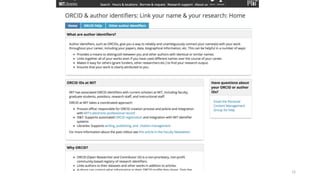
the project funders, nor (with the exception of co-authored previously
published work) my collaborators
Secondary disclaimer:
“It’s tough to make predictions, especially about the future!”
-- Attributed to Woody Allen, Yogi Berra, Niels Bohr, Vint Cerf, Winston Churchill, Confucius, Disreali [sic], Freeman Dyson,
Cecil B. Demille, Albert Einstein, Enrico Fermi, Edgar R. Fiedler, Bob Fourer, Sam Goldwyn, Allan Lamport, Groucho Marx,
Dan Quayle, George Bernard Shaw, Casey Stengel, Will Rogers, M. Taub, Mark Twain, Kerr L. White, etc.
2
Credits
• Collaborators (in part):
– Amy Brand, Liz Allen, Karen Smith-Yoshimura, OCLC
Identifeers group
• Acknowlegements
– CASRAI CRediT Board
– ORCID Team, ORCID Board
• Research Support
– Supported in part by Wellcome Trust 3
Related Publications
• Brand A, Allen L, Altman M, Hlava M, Scott J. Beyond authorship: attribution,
contribution, collaboration, and credit. Learned Publishing [Internet]. 2015;28(2):151-155.
• Allen L, Scott J, Brand A, Hlava M, Altman M. Publishing: Credit where credit is due.
Nature [Internet]. 2014;508(7496):312-313
• Smith-Yoshimura K, Altman M, Cristán AL, Dawson L, Dunham J, Hickey T, Hook D,
Horstmann W, MacEwan A, Schreur P, et al. Registering Researchers in Authority Files.
Dublin, OH: OCLC; 2014
• Altman, Micah, and Gary King. "A proposed standard for the scholarly citation of
quantitative data." D-lib 13, no. 3 (2007):
4
Reprints available from:
informatics.mit.edu
Today’s Perspectives
* Lifecycle View *
* Emerging Practice *
* On the Horizon *
5
Lifecycle View
6
Identifiers are Not Just for Published Articles
7
● Identifiers may apply to
many types of works
● Identifiers may reference
different types of entities
● Identifiers may be assigned
at any lifecycle stage
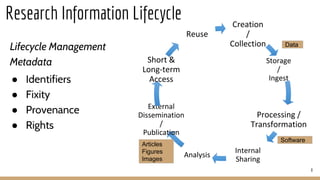
Research Information Lifecycle
8
Creation
/
Collection
Storage
/
Ingest
Processing /
Transformation
Internal
Sharing
Analysis
External
Dissemination
/
Publication
Short &
Long-term
Access
Reuse
Data
Software
Articles
Figures
Images
Lifecycle Management
Metadata
● Identifiers
● Fixity
● Provenance
● Rights
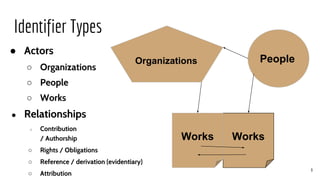
Identifier Types
9
● Actors
○ Organizations
○ People
○ Works
● Relationships
○ Contribution
/ Authorship
○ Rights / Obligations
○ Reference / derivation (evidentiary)
○ Attribution
Works
Organizations People
Works
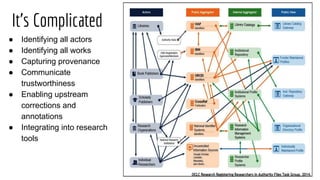
It’s Complicated
● Identifying all actors
● Identifying all works
● Capturing provenance
● Communicate
trustworthiness
● Enabling upstream
corrections and
annotations
● Integrating into research
tools
10
Emerging Practice
11
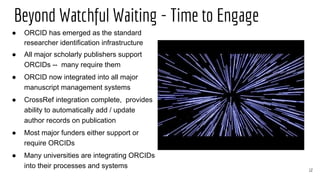
Beyond Watchful Waiting - Time to Engage
12
● ORCID has emerged as the standard
researcher identification infrastructure
● All major scholarly publishers support
ORCIDs -- many require them
● ORCID now integrated into all major
manuscript management systems
● CrossRef integration complete, provides
ability to automatically add / update
author records on publication
● Most major funders either support or
require ORCIDs
● Many universities are integrating ORCIDs
into their processes and systems
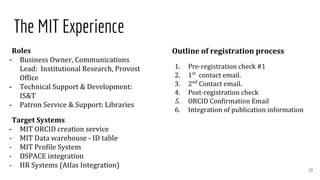
The MIT Experience
Roles
- Business Owner, Communications
Lead: Institutional Research, Provost
Office
- Technical Support & Development:
IS&T
- Patron Service & Support: Libraries
Target Systems
- MIT ORCID creation service
- MIT Data warehouse - ID table
- MIT Profile System
- DSPACE integration
- HR Systems (Atlas Integration)
Outline of registration process
1. Pre-registration check #1
2. 1st
contact email.
3. 2nd
Contact email.
4. Post-registration check
5. ORCID Confirmation Email
6. Integration of publication information
13
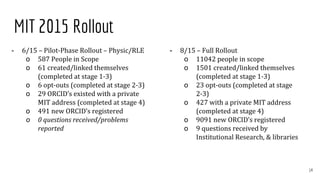
MIT 2015 Rollout
- 6/15 – Pilot-Phase Rollout – Physic/RLE
o 587 People in Scope
o 61 created/linked themselves
(completed at stage 1-3)
o 6 opt-outs (completed at stage 2-3)
o 29 ORCID’s existed with a private
MIT address (completed at stage 4)
o 491 new ORCID’s registered
o 0 questions received/problems
reported
- 8/15 – Full Rollout
o 11042 people in scope
o 1501 created/linked themselves
(completed at stage 1-3)
o 23 opt-outs (completed at stage
2-3)
o 427 with a private MIT address
(completed at stage 4)
o 9091 new ORCID’s registered
o 9 questions received by
Institutional Research, & libraries
14
15
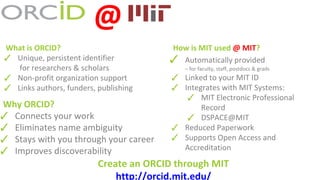
Why ORCID?
✓ Connects your work
✓ Eliminates name ambiguity
✓ Stays with you through your career
✓ Improves discoverability
What is ORCID?
✓ Unique, persistent identifier
for researchers & scholars
✓ Non-profit organization support
✓ Links authors, funders, publishing
Create an ORCID through MIT
http://orcid.mit.edu/
@
How is MIT used @ MIT?
✓ Automatically provided
– for faculty, staff, postdocs & grads
✓ Linked to your MIT ID
✓ Integrates with MIT Systems:
✓ MIT Electronic Professional
Record
✓ DSPACE@MIT
✓ Reduced Paperwork
✓ Supports Open Access and
Accreditation
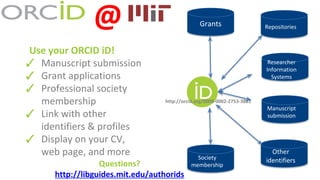
Grants
http://orcid.org/0000-0002-2753-3881
Repositories
Researcher
Information
Systems
Manuscript
submission
Other
identifiersSociety
membership
Use your ORCID iD!
✓ Manuscript submission
✓ Grant applications
✓ Professional society
membership
✓ Link with other
identifiers & profiles
✓ Display on your CV,
web page, and more
Questions?
http://libguides.mit.edu/authorids
@
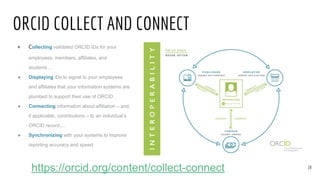
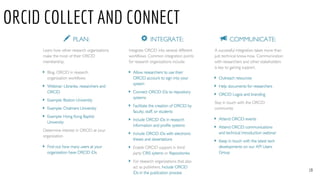
ORCID COLLECT AND CONNECT
● Collecting validated ORCID iDs for your
employees, members, affiliates, and
students…
● Displaying iDs to signal to your employees
and affiliates that your information systems are
plumbed to support their use of ORCID
● Connecting information about affiliation – and,
if applicable, contributions – to an individual’s
ORCID record,...
● Synchronizing with your systems to improve
reporting accuracy and speed
18
https://orcid.org/content/collect-connect
ORCID COLLECT AND CONNECT
19
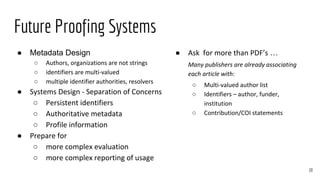
Future Proofing Systems
● Metadata Design
○ Authors, organizations are not strings
○ identifiers are multi-valued
○ multiple identifier authorities, resolvers
● Systems Design - Separation of Concerns
○ Persistent identifiers
○ Authoritative metadata
○ Profile information
● Prepare for
○ more complex evaluation
○ more complex reporting of usage
● Ask for more than PDF’s …
Many publishers are already associating
each article with:
○ Multi-valued author list
○ Identifiers – author, funder,
institution
○ Contribution/COI statements
20
On the Horizon
21
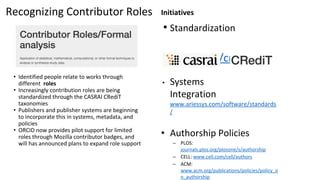
Recognizing Contributor Roles
• Identified people relate to works through
different roles
• Increasingly contribution roles are being
standardized through the CASRAI CRediT
taxonomies
• Publishers and publisher systems are beginning
to incorporate this in systems, metadata, and
policies
• ORCID now provides pilot support for limited
roles through Mozilla contributor badges, and
will has announced plans to expand role support
Initiatives
• Standardization
casrai.org/credit
• Systems
Integration
www.ariessys.com/software/standards
/
• Authorship Policies
– PLOS:
journals.plos.org/plosone/s/authorship
– CELL: www.cell.com/cell/authors
– ACM:
www.acm.org/publications/policies/policy_o
n_authorship
Bridging Person Identifiers, Data and Software
• Increasing integration of ORCID
identifiers into data repositories
over the last 3 years
• ORCID identifiers now
integrated with Datacite, and TR
Data Citation Index
• ORCID auto-update functionality
integrated with DataCite
• Broader practices are beginning
to emerge for software
repositories, and citation
Initiatives to Watch
• Project THOR
project-thor.eu
• FORCE 11 Software Citation
Principles
www.force11.org/software-citation-principles
• ACM New Publication Policies on Software
Reproducibility and
Contributorship
www.acm.org/publications/policies
• Software Preservation initiatives:
- www.softwarepreservationnetwork.org
- www.softwareheritage.org
- guides.github.com/activities/citable-code/
Questions?
Web:
Informatics.mit.edu
Email:
escience@mit.edu
24

Attribution From Res Lib Perspective - Micah Altman, MIT

  • 1.
    Attribution from a ResearchLibrary Perspective Micah Altman Director of Research MIT Libraries Prepared for How Librarians Use, Implement and Can Support Research Identifiers. NISO Webinar August 2016
  • 2.
    Disclaimer These opinions aremy own, they are not the opinions of MIT, any of the project funders, nor (with the exception of co-authored previously published work) my collaborators Secondary disclaimer: “It’s tough to make predictions, especially about the future!” -- Attributed to Woody Allen, Yogi Berra, Niels Bohr, Vint Cerf, Winston Churchill, Confucius, Disreali [sic], Freeman Dyson, Cecil B. Demille, Albert Einstein, Enrico Fermi, Edgar R. Fiedler, Bob Fourer, Sam Goldwyn, Allan Lamport, Groucho Marx, Dan Quayle, George Bernard Shaw, Casey Stengel, Will Rogers, M. Taub, Mark Twain, Kerr L. White, etc. 2
  • 3.
    Credits • Collaborators (inpart): – Amy Brand, Liz Allen, Karen Smith-Yoshimura, OCLC Identifeers group • Acknowlegements – CASRAI CRediT Board – ORCID Team, ORCID Board • Research Support – Supported in part by Wellcome Trust 3
  • 4.
    Related Publications • BrandA, Allen L, Altman M, Hlava M, Scott J. Beyond authorship: attribution, contribution, collaboration, and credit. Learned Publishing [Internet]. 2015;28(2):151-155. • Allen L, Scott J, Brand A, Hlava M, Altman M. Publishing: Credit where credit is due. Nature [Internet]. 2014;508(7496):312-313 • Smith-Yoshimura K, Altman M, Cristán AL, Dawson L, Dunham J, Hickey T, Hook D, Horstmann W, MacEwan A, Schreur P, et al. Registering Researchers in Authority Files. Dublin, OH: OCLC; 2014 • Altman, Micah, and Gary King. "A proposed standard for the scholarly citation of quantitative data." D-lib 13, no. 3 (2007): 4 Reprints available from: informatics.mit.edu
  • 5.
    Today’s Perspectives * LifecycleView * * Emerging Practice * * On the Horizon * 5
  • 6.
  • 7.
    Identifiers are NotJust for Published Articles 7 ● Identifiers may apply to many types of works ● Identifiers may reference different types of entities ● Identifiers may be assigned at any lifecycle stage
  • 8.
    Research Information Lifecycle 8 Creation / Collection Storage / Ingest Processing/ Transformation Internal Sharing Analysis External Dissemination / Publication Short & Long-term Access Reuse Data Software Articles Figures Images Lifecycle Management Metadata ● Identifiers ● Fixity ● Provenance ● Rights
  • 9.
    Identifier Types 9 ● Actors ○Organizations ○ People ○ Works ● Relationships ○ Contribution / Authorship ○ Rights / Obligations ○ Reference / derivation (evidentiary) ○ Attribution Works Organizations People Works
  • 10.
    It’s Complicated ● Identifyingall actors ● Identifying all works ● Capturing provenance ● Communicate trustworthiness ● Enabling upstream corrections and annotations ● Integrating into research tools 10
  • 11.
  • 12.
    Beyond Watchful Waiting- Time to Engage 12 ● ORCID has emerged as the standard researcher identification infrastructure ● All major scholarly publishers support ORCIDs -- many require them ● ORCID now integrated into all major manuscript management systems ● CrossRef integration complete, provides ability to automatically add / update author records on publication ● Most major funders either support or require ORCIDs ● Many universities are integrating ORCIDs into their processes and systems
  • 13.
    The MIT Experience Roles -Business Owner, Communications Lead: Institutional Research, Provost Office - Technical Support & Development: IS&T - Patron Service & Support: Libraries Target Systems - MIT ORCID creation service - MIT Data warehouse - ID table - MIT Profile System - DSPACE integration - HR Systems (Atlas Integration) Outline of registration process 1. Pre-registration check #1 2. 1st contact email. 3. 2nd Contact email. 4. Post-registration check 5. ORCID Confirmation Email 6. Integration of publication information 13
  • 14.
    MIT 2015 Rollout -6/15 – Pilot-Phase Rollout – Physic/RLE o 587 People in Scope o 61 created/linked themselves (completed at stage 1-3) o 6 opt-outs (completed at stage 2-3) o 29 ORCID’s existed with a private MIT address (completed at stage 4) o 491 new ORCID’s registered o 0 questions received/problems reported - 8/15 – Full Rollout o 11042 people in scope o 1501 created/linked themselves (completed at stage 1-3) o 23 opt-outs (completed at stage 2-3) o 427 with a private MIT address (completed at stage 4) o 9091 new ORCID’s registered o 9 questions received by Institutional Research, & libraries 14
  • 15.
  • 16.
    Why ORCID? ✓ Connectsyour work ✓ Eliminates name ambiguity ✓ Stays with you through your career ✓ Improves discoverability What is ORCID? ✓ Unique, persistent identifier for researchers & scholars ✓ Non-profit organization support ✓ Links authors, funders, publishing Create an ORCID through MIT http://orcid.mit.edu/ @ How is MIT used @ MIT? ✓ Automatically provided – for faculty, staff, postdocs & grads ✓ Linked to your MIT ID ✓ Integrates with MIT Systems: ✓ MIT Electronic Professional Record ✓ DSPACE@MIT ✓ Reduced Paperwork ✓ Supports Open Access and Accreditation
  • 17.
    Grants http://orcid.org/0000-0002-2753-3881 Repositories Researcher Information Systems Manuscript submission Other identifiersSociety membership Use your ORCIDiD! ✓ Manuscript submission ✓ Grant applications ✓ Professional society membership ✓ Link with other identifiers & profiles ✓ Display on your CV, web page, and more Questions? http://libguides.mit.edu/authorids @
  • 18.
    ORCID COLLECT ANDCONNECT ● Collecting validated ORCID iDs for your employees, members, affiliates, and students… ● Displaying iDs to signal to your employees and affiliates that your information systems are plumbed to support their use of ORCID ● Connecting information about affiliation – and, if applicable, contributions – to an individual’s ORCID record,... ● Synchronizing with your systems to improve reporting accuracy and speed 18 https://orcid.org/content/collect-connect
  • 19.
  • 20.
    Future Proofing Systems ●Metadata Design ○ Authors, organizations are not strings ○ identifiers are multi-valued ○ multiple identifier authorities, resolvers ● Systems Design - Separation of Concerns ○ Persistent identifiers ○ Authoritative metadata ○ Profile information ● Prepare for ○ more complex evaluation ○ more complex reporting of usage ● Ask for more than PDF’s … Many publishers are already associating each article with: ○ Multi-valued author list ○ Identifiers – author, funder, institution ○ Contribution/COI statements 20
  • 21.
  • 22.
    Recognizing Contributor Roles •Identified people relate to works through different roles • Increasingly contribution roles are being standardized through the CASRAI CRediT taxonomies • Publishers and publisher systems are beginning to incorporate this in systems, metadata, and policies • ORCID now provides pilot support for limited roles through Mozilla contributor badges, and will has announced plans to expand role support Initiatives • Standardization casrai.org/credit • Systems Integration www.ariessys.com/software/standards / • Authorship Policies – PLOS: journals.plos.org/plosone/s/authorship – CELL: www.cell.com/cell/authors – ACM: www.acm.org/publications/policies/policy_o n_authorship
  • 23.
    Bridging Person Identifiers,Data and Software • Increasing integration of ORCID identifiers into data repositories over the last 3 years • ORCID identifiers now integrated with Datacite, and TR Data Citation Index • ORCID auto-update functionality integrated with DataCite • Broader practices are beginning to emerge for software repositories, and citation Initiatives to Watch • Project THOR project-thor.eu • FORCE 11 Software Citation Principles www.force11.org/software-citation-principles • ACM New Publication Policies on Software Reproducibility and Contributorship www.acm.org/publications/policies • Software Preservation initiatives: - www.softwarepreservationnetwork.org - www.softwareheritage.org - guides.github.com/activities/citable-code/
  • 24.