Fostering better networking and collaboration among researchers,
    research managers, practitioners, extensionists, information managers
    in agriculture


           Valeria Pesce, Jon Corson-Rikert, John Fereira, Johannes Keizer


Cornell University
Global Forum on Agricultural Research (GFAR)
Food and Agriculture Organization of the United Nations
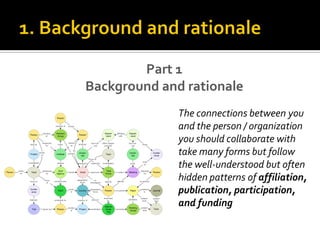
Part 1
Background and rationale
              The connections between you
              and your potential
              collaborators can take many
              forms. They usually follow the
              well-understood patterns of
              affiliation, publication,
              participation, and funding,
              which may be often hidden.
“Regional capacity development partnership is needed to [...] promote
   more effective regional and sub-regional collaborative
   research and networking to make better use of available resources
   and enhance capacity development in the smaller and weaker national
   systems”*

“The convening role of Regional and Global Fora and their functions in the
                                                                                          The GCARD
   sharing of knowledge and innovation between regions is crucial in
                                                                                          Road Map
   facilitating capacity strengthening and networking of skills
   where required to support national development processes and hasten
   development through inter-regional learning”*


                          * GFAR and CGIAR, 2011. The GCARD Road Map. Transforming Agricultural Research
                          for Development (AR4D) Systems for Global Impact. Available on line at
                          (http://www.fao.org/docs/eims/upload/294891/GCARD%20Road%20Map.pdf
   Fostering collaboration and synergy through
    greater awareness
   Reducing duplication of research
   Determining strategic trends based on
    strengths and weaknesses of the network
   Identifying missing expertise
   Improving responsiveness to calls for
    proposals
   Facilitating team formation
   Providing a marketing tool for research
                              Jon Corson-Rikert
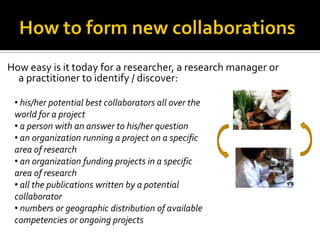
How easy is it today for a researcher, a research manager or
  a practitioner to identify / discover:

 • his/her potential best collaborators all over the
 world for a project
 • a person with an answer to his/her question
 • an organization running a project on a specific
 area of research
 • an organization funding projects in a specific
 area of research
 • all the publications written by a potential
 collaborator
 • numbers or geographic distribution of available
 competencies or ongoing projects
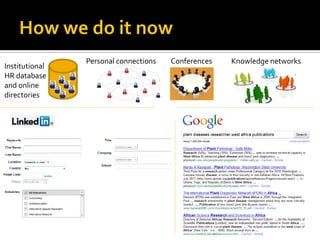
Personal connections   Conferences   Knowledge networks
Institutional
HR database
and online
directories
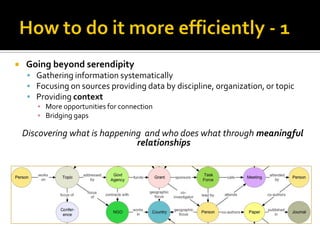
   Going beyond serendipity
      Gathering information systematically
      Focusing on sources providing data by discipline, organization, or topic
      Providing context
        ▪ More opportunities for connection
        ▪ Bridging gaps

    Discovering what is happening and who does what through meaningful
                                relationships
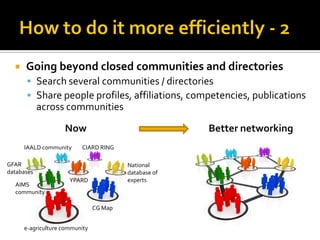
   Going beyond closed communities and directories
       Search several communities / directories
       Share people profiles, affiliations, competencies, publications
            across communities

                    Now                                Better networking
      IAALD community     CIARD RING

GFAR                                     National
databases                                database of
                      YPARD              experts
  AIMS
  community

                                CG Map


      e-agriculture community
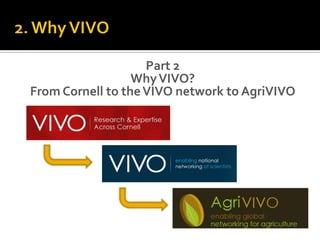
Part 2
                  Why VIVO?
From Cornell to the VIVO network to AgriVIVO
Research & Expertise
Across Cornell

 VIVO is a research-focused discovery tool that
   enables collaboration among scientists across all
   disciplines at Cornell University.
 VIVO supports browsing or searching information
   on people, departments, courses, grants, and
   publications.

 http://vivo.cornell.edu/
Enabling national
networking of scientists

 A $12.2 million, two-year grant from the National
   Institutes of Health's National Center for Research
   Resources to support the creation of VIVOweb, a
   multi-institutional consortium of VIVO installations
   that connects biomedical researchers, initially at
   seven sites. *

    http://vivoweb.org/
* http://www.news.cornell.edu/stories/Oct09/VIVOweb.ws.html
   The U.S. Department of Agriculture is the first federal
     organization to commit to using VIVO, a web
     application designed to enable better national
     networking between scientists from different
     disciplines and locations.*

     USDA's Agricultural Research Service (ARS), Economic Research
     Service, National Institute of Food and Agriculture, National Agricultural
     Statistics Service and Forest Service will be the first five USDA agencies to
     participate in VIVO. The National Agricultural Library, which is part of
     ARS, will host the web application.*

* http://www.usda.gov/wps/portal/usda/usdahome?contentidonly=true&contentid=2010/10/0507.xml
   "Addressing the critically important agricultural
       issues facing the world today requires an
       interdisciplinary approach between scientists
       across the United States and around the world"
       said Agriculture Secretary Tom Vilsack.*
       "VIVO will be an excellent way to make research
       more effective and help researchers forge
       important new collaborations that can lead to the
       kind of ground breaking results that we need to
       help solve the problems we face today.“*
* http://www.usda.gov/wps/portal/usda/usdahome?contentidonly=true&contentid=2010/10/0507.xml
   VIVO: greater interaction, with the goal of catalyzing
      networks of campus-wide scholarship, research and
      educational activities*
     VIVO U.S. network: greater interaction, with the goal of
      catalyzing networks of national scholarship, research and
      educational activities in health science
     VIVO at USDA: better national networking among scientists
      in agriculture, both in the government and academia

   AgriVIVO: greater interaction, with the goal of
   catalyzing networks of worldwide agricultural
   research, educational and policy activities
* http://www.dlib.org/dlib/july07/devare/07devare.html
Enabling global networking
for agriculture


    A global cross-institutional version of VIVO to
     help researchers, research
     managers, practitioners, extensionists, informati
     on managers, students in agriculture discover
     common interests and make connections.
    The goal is to foster alliances, making
     agricultural research and innovation move
     faster.
   AgriVIVO will not replace any existing community or database, it will
      work as a common registry to interlink the data managed in the
      existing communities and databases
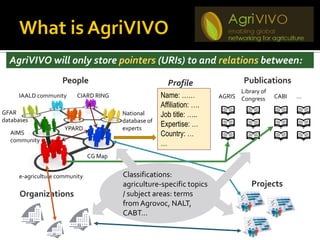
     AgriVIVO will only store pointers to and relations between the
      Agricultural Research Management data managed anywhere
     Communities and databases will indirectly share data through AgriVIVO


      IAALD community     CIARD RING

                                         National
GFAR                                                   Person1 > Affiliation > Institution3
                                         database of
databases                                              Institution3 > Participates in > Project2
                                         experts
                      YPARD                            Project2 > Is about > Topic1
  AIMS
                                                       Person2 > Participates in > Project2
  community
                                                       Person2 > Expertise > Topic1
                                                       Person1 > Knows > Person2
                                CG Map                 Person1 > Author of > Publication1
                                                       Person1 > Author of > Publication2
      e-agriculture community                          [...]
AgriVIVO will only store pointers (URIs) to and relations between:
                    People                              Profile                 Publications
                                                                              Library of
     IAALD community     CIARD RING                   Name: ……          AGRIS Congress     CABI   …
                                                      Affiliation: ….
GFAR                                    National      Job title: …..
databases                               database of
                     YPARD              experts
                                                      Expertise: …
  AIMS                                                Country: …
  community
                                                      …
                               CG Map


     e-agriculture community            Classifications:
                                        agriculture-specific topics                Projects
      Organizations                     / subject areas: terms
                                        from
                                        Agrovoc, NALT, CABT…
VIVO vs. Google

   VIVO only searches relevant communities / directories
   Information in VIVO is automatically gathered but can be curated
    by the community members:
    ▪ Editing one’s profile
    ▪ Claiming publications, associating / dis-associating oneself with/from
      projects


                                                  * Jon Corson-Rickert
VIVO vs. Linkedin
(or other similar social channels)

    VIVO searches across communities / directories, Linkedin only uses its internal
     database
    People profiles in VIVO are shared across communities
    In VIVO, subject areas, research topics and categorization criteria in general are
     customized for the community that is using it
    Data in VIVO can be easily re-used by other applications to build customized search
     engines


                                                      * Jon Corson-Rickert
VIVO vs. EuroCRIS
(or similar research information systems
    and career databases)

    EuroCRIS only manages European research data
    EuroCRIS is based on a GRID architecture, more complex and less “open”: data
     cannot be automatically imported from other communities / databases; VIVO can
     import data from other systems and can expose data for other applications easily
     because it uses standard semantic technologies
    EuroCRIS CVs are only available in the EuroCRIS database; people profiles in VIVO
     are shared across communities
    In VIVO, subject areas, research topics and categorization criteria in general are
     customized for the community that is using it
    Data in VIVO can be easily re-used by other applications to build customized search
     engines

VIVO and EuroCRIS have agreed in November 2011 to map
their data models to allow data exchange and common
searches
VIVO vs. WISARD / CARIS / InfosysPlus
(or similar agricultural research management information systems)


   Many databases of institutions / projects / experts in
    agriculture already exist, but they are managed in silos
      ▪ Each uses its own format / structure / classifications
      ▪ Each stores data in its own database with limited or no import /
        export functionalities  no data exchange and no common
        search possible
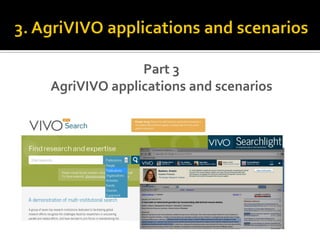
Part 3
AgriVIVO applications and scenarios
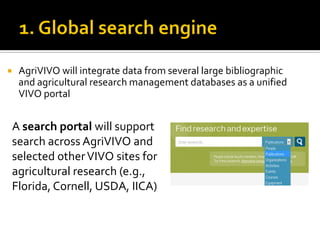
   AgriVIVO will integrate data from several large bibliographic
    and agricultural research management databases as a unified
    VIVO portal


A search portal will support
search across AgriVIVO and
selected other VIVO sites for
agricultural research
(e.g., Florida, Cornell, USDA,
IICA)
   VIVO’s search functionalities can be integrated in other websites
    through remote calls. In this way, specialized and targeted search engines
    can give access to and offer highly customized “views” of the data
    coming from AgriVIVO


                              Publication1 > Is about > Topic1
                              Publication2 > Is about > Topic1
                              Publication3 > Is about > Topic1
                              Person1 > Expertise > Topic1
                              Person2> Expertise > Topic1
                              Person3> Author of > Publication1
                              Person4 > Author of > Publication2
                              [...]
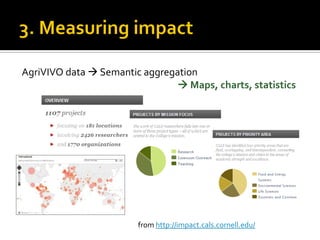
AgriVIVO data  Semantic aggregation
                                 Maps, charts, statistics


                        from http://impact.cals.cornell.edu/
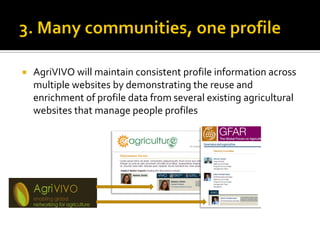
   AgriVIVO will maintain consistent profile information across
    multiple websites by demonstrating the reuse and
    enrichment of profile data from several existing agricultural
    websites that manage people profiles
   Users can validate (add / remove) relations:
     Claiming / disclaiming publications
       authors authority data
     Associating / removing oneself with / from a project


   Disambiguating authors and researchers is an
    active area of research
     VIVO is collaborating with ORCID (http://orcid.org)
      and the Publish Trust Project
      (http://www.publishtrust.org/)
    AgriVIVO project: http://www.egfar.org/agrivivo

    VIVO portal at Cornell: http://vivo.cornell.edu/
    VIVOweb: http://vivoweb.org/

    On VIVO: http://www.dlib.org/dlib/july07/devare/07devare.html
    VIVO going national: http://www.news.cornell.edu/stories/Oct09/VIVOweb.ws.html
    VIVO at USDA:
     http://www.usda.gov/wps/portal/usda/usdahome?contentidonly=true&contentid=2010/10/0507.xml


    Contact: agrivivo@gmail.com

AgriVIVO. Fostering better networking and collaboration among researchers, research managers, practitioners, extensionists, information managers in agriculture

  • 1.
    Fostering better networkingand collaboration among researchers, research managers, practitioners, extensionists, information managers in agriculture Valeria Pesce, Jon Corson-Rikert, John Fereira, Johannes Keizer Cornell University Global Forum on Agricultural Research (GFAR) Food and Agriculture Organization of the United Nations
  • 2.
    Part 1 Background andrationale The connections between you and your potential collaborators can take many forms. They usually follow the well-understood patterns of affiliation, publication, participation, and funding, which may be often hidden.
  • 3.
    “Regional capacity developmentpartnership is needed to [...] promote more effective regional and sub-regional collaborative research and networking to make better use of available resources and enhance capacity development in the smaller and weaker national systems”* “The convening role of Regional and Global Fora and their functions in the The GCARD sharing of knowledge and innovation between regions is crucial in Road Map facilitating capacity strengthening and networking of skills where required to support national development processes and hasten development through inter-regional learning”* * GFAR and CGIAR, 2011. The GCARD Road Map. Transforming Agricultural Research for Development (AR4D) Systems for Global Impact. Available on line at (http://www.fao.org/docs/eims/upload/294891/GCARD%20Road%20Map.pdf
  • 4.
    Fostering collaboration and synergy through greater awareness  Reducing duplication of research  Determining strategic trends based on strengths and weaknesses of the network  Identifying missing expertise  Improving responsiveness to calls for proposals  Facilitating team formation  Providing a marketing tool for research Jon Corson-Rikert
  • 5.
    How easy isit today for a researcher, a research manager or a practitioner to identify / discover: • his/her potential best collaborators all over the world for a project • a person with an answer to his/her question • an organization running a project on a specific area of research • an organization funding projects in a specific area of research • all the publications written by a potential collaborator • numbers or geographic distribution of available competencies or ongoing projects
  • 6.
    Personal connections Conferences Knowledge networks Institutional HR database and online directories
  • 7.
    Going beyond serendipity  Gathering information systematically  Focusing on sources providing data by discipline, organization, or topic  Providing context ▪ More opportunities for connection ▪ Bridging gaps Discovering what is happening and who does what through meaningful relationships
  • 8.
    Going beyond closed communities and directories  Search several communities / directories  Share people profiles, affiliations, competencies, publications across communities Now Better networking IAALD community CIARD RING GFAR National databases database of YPARD experts AIMS community CG Map e-agriculture community
  • 9.
    Part 2 Why VIVO? From Cornell to the VIVO network to AgriVIVO
  • 10.
    Research & Expertise AcrossCornell VIVO is a research-focused discovery tool that enables collaboration among scientists across all disciplines at Cornell University. VIVO supports browsing or searching information on people, departments, courses, grants, and publications. http://vivo.cornell.edu/
  • 11.
    Enabling national networking ofscientists A $12.2 million, two-year grant from the National Institutes of Health's National Center for Research Resources to support the creation of VIVOweb, a multi-institutional consortium of VIVO installations that connects biomedical researchers, initially at seven sites. * http://vivoweb.org/ * http://www.news.cornell.edu/stories/Oct09/VIVOweb.ws.html
  • 12.
    The U.S. Department of Agriculture is the first federal organization to commit to using VIVO, a web application designed to enable better national networking between scientists from different disciplines and locations.* USDA's Agricultural Research Service (ARS), Economic Research Service, National Institute of Food and Agriculture, National Agricultural Statistics Service and Forest Service will be the first five USDA agencies to participate in VIVO. The National Agricultural Library, which is part of ARS, will host the web application.* * http://www.usda.gov/wps/portal/usda/usdahome?contentidonly=true&contentid=2010/10/0507.xml
  • 13.
    "Addressing the critically important agricultural issues facing the world today requires an interdisciplinary approach between scientists across the United States and around the world" said Agriculture Secretary Tom Vilsack.* "VIVO will be an excellent way to make research more effective and help researchers forge important new collaborations that can lead to the kind of ground breaking results that we need to help solve the problems we face today.“* * http://www.usda.gov/wps/portal/usda/usdahome?contentidonly=true&contentid=2010/10/0507.xml
  • 14.
    VIVO: greater interaction, with the goal of catalyzing networks of campus-wide scholarship, research and educational activities*  VIVO U.S. network: greater interaction, with the goal of catalyzing networks of national scholarship, research and educational activities in health science  VIVO at USDA: better national networking among scientists in agriculture, both in the government and academia  AgriVIVO: greater interaction, with the goal of catalyzing networks of worldwide agricultural research, educational and policy activities * http://www.dlib.org/dlib/july07/devare/07devare.html
  • 15.
    Enabling global networking foragriculture  A global cross-institutional version of VIVO to help researchers, research managers, practitioners, extensionists, informati on managers, students in agriculture discover common interests and make connections.  The goal is to foster alliances, making agricultural research and innovation move faster.
  • 16.
    AgriVIVO will not replace any existing community or database, it will work as a common registry to interlink the data managed in the existing communities and databases  AgriVIVO will only store pointers to and relations between the Agricultural Research Management data managed anywhere  Communities and databases will indirectly share data through AgriVIVO IAALD community CIARD RING National GFAR Person1 > Affiliation > Institution3 database of databases Institution3 > Participates in > Project2 experts YPARD Project2 > Is about > Topic1 AIMS Person2 > Participates in > Project2 community Person2 > Expertise > Topic1 Person1 > Knows > Person2 CG Map Person1 > Author of > Publication1 Person1 > Author of > Publication2 e-agriculture community [...]
  • 17.
    AgriVIVO will onlystore pointers (URIs) to and relations between: People Profile Publications Library of IAALD community CIARD RING Name: …… AGRIS Congress CABI … Affiliation: …. GFAR National Job title: ….. databases database of YPARD experts Expertise: … AIMS Country: … community … CG Map e-agriculture community Classifications: agriculture-specific topics Projects Organizations / subject areas: terms from Agrovoc, NALT, CABT…
  • 18.
    VIVO vs. Google  VIVO only searches relevant communities / directories  Information in VIVO is automatically gathered but can be curated by the community members: ▪ Editing one’s profile ▪ Claiming publications, associating / dis-associating oneself with/from projects * Jon Corson-Rickert
  • 19.
    VIVO vs. Linkedin (orother similar social channels)  VIVO searches across communities / directories, Linkedin only uses its internal database  People profiles in VIVO are shared across communities  In VIVO, subject areas, research topics and categorization criteria in general are customized for the community that is using it  Data in VIVO can be easily re-used by other applications to build customized search engines * Jon Corson-Rickert
  • 20.
    VIVO vs. EuroCRIS (orsimilar research information systems and career databases)  EuroCRIS only manages European research data  EuroCRIS is based on a GRID architecture, more complex and less “open”: data cannot be automatically imported from other communities / databases; VIVO can import data from other systems and can expose data for other applications easily because it uses standard semantic technologies  EuroCRIS CVs are only available in the EuroCRIS database; people profiles in VIVO are shared across communities  In VIVO, subject areas, research topics and categorization criteria in general are customized for the community that is using it  Data in VIVO can be easily re-used by other applications to build customized search engines VIVO and EuroCRIS have agreed in November 2011 to map their data models to allow data exchange and common searches
  • 21.
    VIVO vs. WISARD/ CARIS / InfosysPlus (or similar agricultural research management information systems)  Many databases of institutions / projects / experts in agriculture already exist, but they are managed in silos ▪ Each uses its own format / structure / classifications ▪ Each stores data in its own database with limited or no import / export functionalities  no data exchange and no common search possible
  • 22.
  • 23.
    AgriVIVO will integrate data from several large bibliographic and agricultural research management databases as a unified VIVO portal A search portal will support search across AgriVIVO and selected other VIVO sites for agricultural research (e.g., Florida, Cornell, USDA, IICA)
  • 24.
    VIVO’s search functionalities can be integrated in other websites through remote calls. In this way, specialized and targeted search engines can give access to and offer highly customized “views” of the data coming from AgriVIVO Publication1 > Is about > Topic1 Publication2 > Is about > Topic1 Publication3 > Is about > Topic1 Person1 > Expertise > Topic1 Person2> Expertise > Topic1 Person3> Author of > Publication1 Person4 > Author of > Publication2 [...]
  • 25.
    AgriVIVO data Semantic aggregation  Maps, charts, statistics from http://impact.cals.cornell.edu/
  • 26.
    AgriVIVO will maintain consistent profile information across multiple websites by demonstrating the reuse and enrichment of profile data from several existing agricultural websites that manage people profiles
  • 27.
    Users can validate (add / remove) relations:  Claiming / disclaiming publications  authors authority data  Associating / removing oneself with / from a project  Disambiguating authors and researchers is an active area of research  VIVO is collaborating with ORCID (http://orcid.org) and the Publish Trust Project (http://www.publishtrust.org/)
  • 28.
    AgriVIVO project: http://www.egfar.org/agrivivo  VIVO portal at Cornell: http://vivo.cornell.edu/  VIVOweb: http://vivoweb.org/  On VIVO: http://www.dlib.org/dlib/july07/devare/07devare.html  VIVO going national: http://www.news.cornell.edu/stories/Oct09/VIVOweb.ws.html  VIVO at USDA: http://www.usda.gov/wps/portal/usda/usdahome?contentidonly=true&contentid=2010/10/0507.xml Contact: agrivivo@gmail.com

Editor's Notes

  • #12 http://www.news.cornell.edu/stories/Oct09/VIVOweb.ws.html