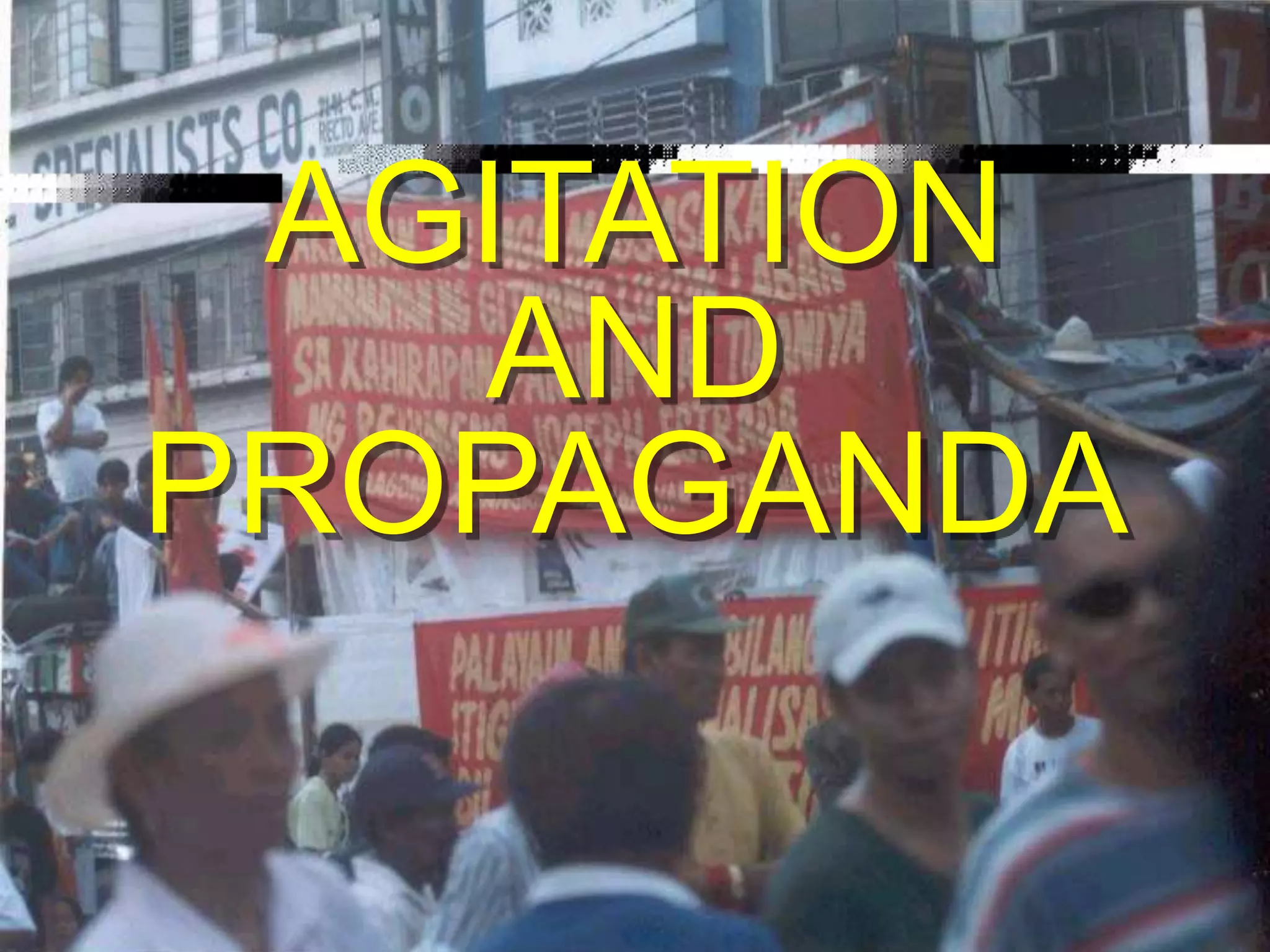
AGITATION
AND
PROPAGANDA
SCOPE OF PRESENTATION
A. Historical Background
B. The Central Activity - Agit-Prop
C. Propaganda and Organization
D. Propaganda Aspects
E. Methods of Agitation Propaganda
F. Mass actions and Mass Campaigns
SCOPE OF PRESENTATION
G. Political Education and Propaganda
H. CPP Guideline for Sweeping Work
I. Style of Work
HISTORICAL BACKGROUND
• “Propaganda” comes from the Latin
word “propagandus”, gerundive of
“propagare” which means “to
propagate”.
HISTORICAL BACKGROUND
• Pope Gregory XV was the first to
officially use the word “propaganda”
when he formed the “Congregatio de
Propaganda Fide” or Congregation of
Propaganda of Faith in 1662 to
defend and propagate the Catholic
Faith.
HISTORICAL BACKGROUND
• Propaganda during that time also
stressed the importance of political
acts like assassination and the
creation of front organizations.
HISTORICAL BACKGROUND
• The “propaganda by deeds” was a
concept propagated by the communist
movement which, under the leadership
of Lenin effectively used what was
called as “Agitation–Propaganda
Trains” to influence the masses.
AGITATION & PROPAGANDA
The objective of the Agit-Prop; To
develop the fundamental change in the
balance of forces entails not merely a
contest of arms but mostly a contest of
minimizing one’s sympathizers.
AGITATION & PROPAGANDA
• To the CPP, agitation-propaganda is
the central activity while fighting (at
least during the early stage), is
secondary.
AGITATION & PROPAGANDA
The twin effort of Agitation-Propaganda:
• Ideological indoctrination - convincing
the people.
• Unifying - poisoning the people’s
minds, agitating them and ends up by
organizing them for confrontation.
AGITATION & PROPAGANDA
• Compensates for the CPP’s
inferiority of weapons.
• A saturation campaign using word of
mouth, leaflets and bulletins,
newspapers, books and pamphlets,
play and films.
AGITATION & PROPAGANDA
• It is an “objective factor” which is to
be manipulated to maximize the
balance of forces in favor of the CPP.
RELATIONSHIP OF PROPAGANDA
& ORGANIZATION
“The scale of our effective propaganda depends upon
the level of our organizational strength.
The growth of our organizational strength depends
upon the scale of our effective propaganda.”
MLMTT
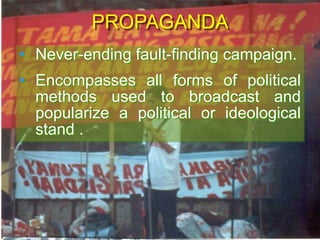
PROPAGANDA
• Never-ending fault-finding campaign.
• Encompasses all forms of political
methods used to broadcast and
popularize a political or ideological
stand .
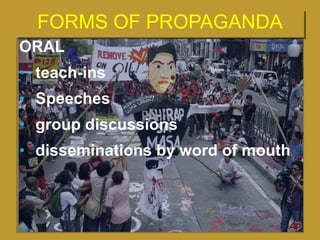
FORMS OF PROPAGANDA
ORAL
• teach-ins
• Speeches
• group discussions
• disseminations by word of mouth
FORMS OF PROPAGANDA
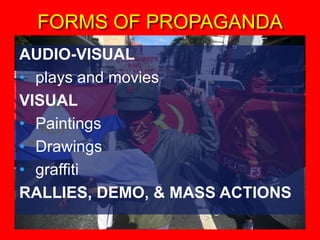
AUDIO-VISUAL
• plays and movies
VISUAL
• Paintings
• Drawings
• graffiti
RALLIES, DEMO, & MASS ACTIONS
ASPECTS OF CPP PROPAGANDA
• Quantitative Aspect - refers to the
number of people who receives the
propaganda.
• Qualitative Aspect - refers to the
political and ideological stand.
QUANTITATIVE ASPECT
• Effort to identify minority
– sympathetic and responsive
– against or hostile
• Effort to identify majority
– Neutral
• Effort to identify “progressives or
advanced elements”.
QUALITATIVE ASPECT
• Effort to bring down to earth Marxist-
Leninist ideology and CPP political
line.
• To link the insurgent political aims
with the peasantry, the proletariat
and the middle sector.
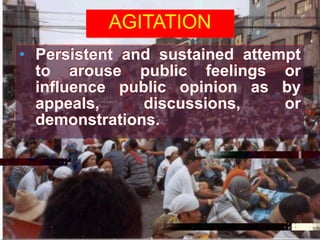
AGITATION
• Persistent and sustained attempt
to arouse public feelings or
influence public opinion as by
appeals, discussions, or
demonstrations.
METHODS OF AGITATION AND
PROPAGANDA
• Combining the legal & illegal means.
• Combining solid organizing and
sweeping work.
• Mass actions and Mass Campaigns.
• Combining General Propaganda and
Specific Propaganda.
COMBINING THE LEGAL AND
ILLEGAL MEANS
• The party’s legal arm organizes
seminars, dramas, symposia, farmers
consultations leadership trainings,
labor workshops, etc., with the aim of
identifying and evaluating probable
recruits.
COMBINING THE LEGAL AND
ILLEGAL MEANS
• Names and addresses of the probable
recruits are submitted to the illegal or
underground arm through a cut-out.
COMBINING THE LEGAL AND
ILLEGAL MEANS
• The illegal arm or the underground
contacts the candidate and recruits
them to form cells under the
appropriate mass organizations.
COMBINING THE LEGAL AND
ILLEGAL MEANS
• Covert or illegal arm is able to focus
his attention immediately upon the
most eligible recruits, saving him time,
giving him flexibility and allowing his
identity to remain a secret.
COMBINING SOLID ORGANIZING
AND SWEEPING WORK
• Solid Organizing
• Sweeping Work
• Sweeping Organizing
• Sweeping Propaganda
• Sweeping Mobilization
SOLID ORGANIZING
• Clandestine cellular expansion of
the party and the underground
mass organization.
• Establishing party cells or study
circles to tighten the party’s hold
over the entire organization.
SWEEPING WORK
OR MASS WORK
• Effort of the party and the underground
mass organization to reach the grass-
roots and establish contact with the
numerous masses through sweeping
organization.
SWEEPING WORK
OR MASS WORK
• An effort which consists of involving as
many people as possible in a widespread
and open propaganda through:
– Symposia
– Seminars
– Rallies
– Mass leafleting
– Cultural presentations, etc.
SWEEPING ORGANIZING
• Effort to organize open and broad
legal mass organization.
• Loose or alliances are formed based
on particular sectoral and class
issues.
SWEEPING ORGANIZING
• Provides cover for the party workers
as well as protection.
• Main effort is the capture of leader-
ship to control and manipulate an
organization which will serve the
interest of the party.
SWEEPING PROPAGANDA
• Enables the party to reach-out to the
greatest number of the unorganized
masses in order to entice them
progressively into the front
organization.
• An essential tie-up between sweeping
organizing and sweeping mobilization.
FORMS OF
SWEEPING PROPAGANDA
• Seminars, symposia, cultural
presentations, slide show and others
where a captive audience composed
of organized and unorganized
elements are gathered to propagate
the communist political line on
certain issues.
FORMS OF
SWEEPING PROPAGANDA
• Pamphlets, manifestoes, newsletters,
journals, comics and other written
forms where the communist political
lines are presented to reach the
greatest number of people as
possible.
FORMS OF
SWEEPING PROPAGANDA
• Press statements, press conference,
feature articles, news items and
others that appear in the so-called
bourgeois media.
• It bears the stamp of legitimacy.
TWO TYPES OF
SWEEPING PROPAGANDA
1. Explicative propaganda
– Propaganda that explains issues.
– Intended to deepen the under-
standing of the target audience.
TWO TYPES OF
SWEEPING PROPAGANDA
2. Agitation Propaganda
– Propaganda that seeks to move
the target audience to a definite
and immediate actions.
– Contains only the data necessary
to move the public to that action.
SWEEPING MOBILIZATION
• Entices the greater number of
organized and unorganized masses
to participate in open confrontation
with the government.
• Intends to provoke the government to
take harsh measures and put itself
into an embarrassing situation.
Relationship Between Sweeping
Work and Solid Organizing
• Casting a net and drawing the net in.
• Each time the net is cast and drawn,
the CPP underground organization is
ensured of a good harvest of more
and more activists & party members.
MASS ACTIONS AND
MASS CAMPAIGNS
Mass actions
• CPP planned and organized actions
for specific objectives.
• Includes rallies and demonstrations,
worker’s strikes, peasants
confrontations, protest marches, etc.
MASS ACTIONS AND
MASS CAMPAIGNS
Mass Campaigns
• CPP planned, organized & sustained
mass actions on a wider scope to
attain a set of objectives.
• Launched according to objectives:
Political Educational
Military Economic
Organizational Health
COMBINING GENERAL AND
SPECIFIC PROPAGANDA
• General Propaganda
– a broad range of issues which are
often national in scope.
– target audience is relatively
inactive.
COMBINING GENERAL AND
SPECIFIC PROPAGANDA
Specific or Topical Propaganda
– issues are narrowed down to
those which directly affect the
target audience.
– Target audience now politicized.
POLITICAL EDUCATION AND
PROPAGANDA
Political education
– implants in the minds of CPP mass
members a firm and strong
ideological stand.
– ensures that the CPP mass
members will be unified around the
party’s political line.
MAIN TYPES OF EDUCATION
• General Mass Course (GMC) -
presents a slanted history of the
Philippines and seeks to stir up the
emotions of the people and the
necessity of a violent revolution.
MAIN TYPES OF EDUCATION
• Special Mass Course (SMC) - slants
history and stirs up a certain group or
sector along a particular propaganda
line.
CPP GUIDELINES FOR
SWEEPING WORK
General steps in sweeping work:
• Identification of principal and
secondary targets
• Methods
• Appropriate form
• Organizational Considerations
• Post Mobilizations
IDENTIFICATION OF PRINCIPAL
AND SECONDARY TARGETS
• Total population is determined by
quantitative ratio of principal and
secondary target.
• General activities of the principal and
secondary targets are determined.
• Level of political consciousness of
the target population is determined.
METHODS
• General survey is conducted.
• Party elements, activists and
sympathizers are directed to gather
data and information.
• Leading group and subordinate
teams are organized.
FORMS
– Symposia/Seminars
– Rallies/Demonstrations
– Mass Leafleteering
– Cultural Presentations
– Slide shows/movies
The main point here is to play up the interest
and grievances of the target sector.
ORGANIZATIONAL
CONSIDERATIONS
• Degree of penetration within the sector.
• Spread and strength of CPP legal
(front) and underground organizations,
legal programs and legal institutions.
• Experience of legal and underground
organization in sweeping works.
• Other sweeping work being organized.
POST MOBILIZATIONS
Sweeping work in post mobilization:
• Expansion of party mass organization
• Formation of study circle
• Formation of support groups or
branches
• Assessment - reflection sessions
STYLE OF WORK
• Mass mobilization and mass
campaigns requires patience and
perseverance.
• Finish the task once started.
• Mobilize the people for varying
degrees of confrontation.
STYLE OF WORK
• Employ the principle of struggling
on a just ground/taking
advantage of the constitution.
• Provoke those in authority.
• Stretch the limits of legality.
SOFT-SELL vs AGIT-PROP
• SOFT-SELL
– advertising complex
– does not offend the public nor
attack established values
– debatable issues are avoided
– appeal to attitudes
SOFT-SELL vs AGIT-PROP
• AGIT-PROP
– evangelical propaganda
– always sides with the people and
violently attacks the leadership,
the present government, the
military and the social system
– face-to-face communication and
intense group pressure
SUMMARY OF PRESENTATION
A. Historical Background
B. The Central Activity - Agit-Prop
C. Propaganda and Organization
D. Propaganda Aspects
E. Methods of Agitation Propaganda
F. Mass actions and Mass Campaigns
SUMMARY OF PRESENTATION
G. Political Education and Propaganda
H. CPP Guideline for Sweeping Work
I. Style of Work
Agitation and Propaganda.pptx

Agitation and Propaganda.pptx

  • 1.
  • 2.
    SCOPE OF PRESENTATION A.Historical Background B. The Central Activity - Agit-Prop C. Propaganda and Organization D. Propaganda Aspects E. Methods of Agitation Propaganda F. Mass actions and Mass Campaigns
  • 3.
    SCOPE OF PRESENTATION G.Political Education and Propaganda H. CPP Guideline for Sweeping Work I. Style of Work
  • 4.
    HISTORICAL BACKGROUND • “Propaganda”comes from the Latin word “propagandus”, gerundive of “propagare” which means “to propagate”.
  • 5.
    HISTORICAL BACKGROUND • PopeGregory XV was the first to officially use the word “propaganda” when he formed the “Congregatio de Propaganda Fide” or Congregation of Propaganda of Faith in 1662 to defend and propagate the Catholic Faith.
  • 6.
    HISTORICAL BACKGROUND • Propagandaduring that time also stressed the importance of political acts like assassination and the creation of front organizations.
  • 7.
    HISTORICAL BACKGROUND • The“propaganda by deeds” was a concept propagated by the communist movement which, under the leadership of Lenin effectively used what was called as “Agitation–Propaganda Trains” to influence the masses.
  • 8.
    AGITATION & PROPAGANDA Theobjective of the Agit-Prop; To develop the fundamental change in the balance of forces entails not merely a contest of arms but mostly a contest of minimizing one’s sympathizers.
  • 9.
    AGITATION & PROPAGANDA •To the CPP, agitation-propaganda is the central activity while fighting (at least during the early stage), is secondary.
  • 10.
    AGITATION & PROPAGANDA Thetwin effort of Agitation-Propaganda: • Ideological indoctrination - convincing the people. • Unifying - poisoning the people’s minds, agitating them and ends up by organizing them for confrontation.
  • 11.
    AGITATION & PROPAGANDA •Compensates for the CPP’s inferiority of weapons. • A saturation campaign using word of mouth, leaflets and bulletins, newspapers, books and pamphlets, play and films.
  • 12.
    AGITATION & PROPAGANDA •It is an “objective factor” which is to be manipulated to maximize the balance of forces in favor of the CPP.
  • 13.
    RELATIONSHIP OF PROPAGANDA &ORGANIZATION “The scale of our effective propaganda depends upon the level of our organizational strength. The growth of our organizational strength depends upon the scale of our effective propaganda.” MLMTT
  • 14.
    PROPAGANDA • Never-ending fault-findingcampaign. • Encompasses all forms of political methods used to broadcast and popularize a political or ideological stand .
  • 15.
    FORMS OF PROPAGANDA ORAL •teach-ins • Speeches • group discussions • disseminations by word of mouth
  • 16.
    FORMS OF PROPAGANDA AUDIO-VISUAL •plays and movies VISUAL • Paintings • Drawings • graffiti RALLIES, DEMO, & MASS ACTIONS
  • 17.
    ASPECTS OF CPPPROPAGANDA • Quantitative Aspect - refers to the number of people who receives the propaganda. • Qualitative Aspect - refers to the political and ideological stand.
  • 18.
    QUANTITATIVE ASPECT • Effortto identify minority – sympathetic and responsive – against or hostile • Effort to identify majority – Neutral • Effort to identify “progressives or advanced elements”.
  • 19.
    QUALITATIVE ASPECT • Effortto bring down to earth Marxist- Leninist ideology and CPP political line. • To link the insurgent political aims with the peasantry, the proletariat and the middle sector.
  • 20.
    AGITATION • Persistent andsustained attempt to arouse public feelings or influence public opinion as by appeals, discussions, or demonstrations.
  • 21.
    METHODS OF AGITATIONAND PROPAGANDA • Combining the legal & illegal means. • Combining solid organizing and sweeping work. • Mass actions and Mass Campaigns. • Combining General Propaganda and Specific Propaganda.
  • 22.
    COMBINING THE LEGALAND ILLEGAL MEANS • The party’s legal arm organizes seminars, dramas, symposia, farmers consultations leadership trainings, labor workshops, etc., with the aim of identifying and evaluating probable recruits.
  • 23.
    COMBINING THE LEGALAND ILLEGAL MEANS • Names and addresses of the probable recruits are submitted to the illegal or underground arm through a cut-out.
  • 24.
    COMBINING THE LEGALAND ILLEGAL MEANS • The illegal arm or the underground contacts the candidate and recruits them to form cells under the appropriate mass organizations.
  • 25.
    COMBINING THE LEGALAND ILLEGAL MEANS • Covert or illegal arm is able to focus his attention immediately upon the most eligible recruits, saving him time, giving him flexibility and allowing his identity to remain a secret.
  • 26.
    COMBINING SOLID ORGANIZING ANDSWEEPING WORK • Solid Organizing • Sweeping Work • Sweeping Organizing • Sweeping Propaganda • Sweeping Mobilization
  • 27.
    SOLID ORGANIZING • Clandestinecellular expansion of the party and the underground mass organization. • Establishing party cells or study circles to tighten the party’s hold over the entire organization.
  • 28.
    SWEEPING WORK OR MASSWORK • Effort of the party and the underground mass organization to reach the grass- roots and establish contact with the numerous masses through sweeping organization.
  • 29.
    SWEEPING WORK OR MASSWORK • An effort which consists of involving as many people as possible in a widespread and open propaganda through: – Symposia – Seminars – Rallies – Mass leafleting – Cultural presentations, etc.
  • 30.
    SWEEPING ORGANIZING • Effortto organize open and broad legal mass organization. • Loose or alliances are formed based on particular sectoral and class issues.
  • 31.
    SWEEPING ORGANIZING • Providescover for the party workers as well as protection. • Main effort is the capture of leader- ship to control and manipulate an organization which will serve the interest of the party.
  • 32.
    SWEEPING PROPAGANDA • Enablesthe party to reach-out to the greatest number of the unorganized masses in order to entice them progressively into the front organization. • An essential tie-up between sweeping organizing and sweeping mobilization.
  • 33.
    FORMS OF SWEEPING PROPAGANDA •Seminars, symposia, cultural presentations, slide show and others where a captive audience composed of organized and unorganized elements are gathered to propagate the communist political line on certain issues.
  • 34.
    FORMS OF SWEEPING PROPAGANDA •Pamphlets, manifestoes, newsletters, journals, comics and other written forms where the communist political lines are presented to reach the greatest number of people as possible.
  • 35.
    FORMS OF SWEEPING PROPAGANDA •Press statements, press conference, feature articles, news items and others that appear in the so-called bourgeois media. • It bears the stamp of legitimacy.
  • 36.
    TWO TYPES OF SWEEPINGPROPAGANDA 1. Explicative propaganda – Propaganda that explains issues. – Intended to deepen the under- standing of the target audience.
  • 37.
    TWO TYPES OF SWEEPINGPROPAGANDA 2. Agitation Propaganda – Propaganda that seeks to move the target audience to a definite and immediate actions. – Contains only the data necessary to move the public to that action.
  • 38.
    SWEEPING MOBILIZATION • Enticesthe greater number of organized and unorganized masses to participate in open confrontation with the government. • Intends to provoke the government to take harsh measures and put itself into an embarrassing situation.
  • 39.
    Relationship Between Sweeping Workand Solid Organizing • Casting a net and drawing the net in. • Each time the net is cast and drawn, the CPP underground organization is ensured of a good harvest of more and more activists & party members.
  • 40.
    MASS ACTIONS AND MASSCAMPAIGNS Mass actions • CPP planned and organized actions for specific objectives. • Includes rallies and demonstrations, worker’s strikes, peasants confrontations, protest marches, etc.
  • 41.
    MASS ACTIONS AND MASSCAMPAIGNS Mass Campaigns • CPP planned, organized & sustained mass actions on a wider scope to attain a set of objectives. • Launched according to objectives: Political Educational Military Economic Organizational Health
  • 42.
    COMBINING GENERAL AND SPECIFICPROPAGANDA • General Propaganda – a broad range of issues which are often national in scope. – target audience is relatively inactive.
  • 43.
    COMBINING GENERAL AND SPECIFICPROPAGANDA Specific or Topical Propaganda – issues are narrowed down to those which directly affect the target audience. – Target audience now politicized.
  • 44.
    POLITICAL EDUCATION AND PROPAGANDA Politicaleducation – implants in the minds of CPP mass members a firm and strong ideological stand. – ensures that the CPP mass members will be unified around the party’s political line.
  • 45.
    MAIN TYPES OFEDUCATION • General Mass Course (GMC) - presents a slanted history of the Philippines and seeks to stir up the emotions of the people and the necessity of a violent revolution.
  • 46.
    MAIN TYPES OFEDUCATION • Special Mass Course (SMC) - slants history and stirs up a certain group or sector along a particular propaganda line.
  • 47.
    CPP GUIDELINES FOR SWEEPINGWORK General steps in sweeping work: • Identification of principal and secondary targets • Methods • Appropriate form • Organizational Considerations • Post Mobilizations
  • 48.
    IDENTIFICATION OF PRINCIPAL ANDSECONDARY TARGETS • Total population is determined by quantitative ratio of principal and secondary target. • General activities of the principal and secondary targets are determined. • Level of political consciousness of the target population is determined.
  • 49.
    METHODS • General surveyis conducted. • Party elements, activists and sympathizers are directed to gather data and information. • Leading group and subordinate teams are organized.
  • 50.
    FORMS – Symposia/Seminars – Rallies/Demonstrations –Mass Leafleteering – Cultural Presentations – Slide shows/movies The main point here is to play up the interest and grievances of the target sector.
  • 51.
    ORGANIZATIONAL CONSIDERATIONS • Degree ofpenetration within the sector. • Spread and strength of CPP legal (front) and underground organizations, legal programs and legal institutions. • Experience of legal and underground organization in sweeping works. • Other sweeping work being organized.
  • 52.
    POST MOBILIZATIONS Sweeping workin post mobilization: • Expansion of party mass organization • Formation of study circle • Formation of support groups or branches • Assessment - reflection sessions
  • 53.
    STYLE OF WORK •Mass mobilization and mass campaigns requires patience and perseverance. • Finish the task once started. • Mobilize the people for varying degrees of confrontation.
  • 54.
    STYLE OF WORK •Employ the principle of struggling on a just ground/taking advantage of the constitution. • Provoke those in authority. • Stretch the limits of legality.
  • 55.
    SOFT-SELL vs AGIT-PROP •SOFT-SELL – advertising complex – does not offend the public nor attack established values – debatable issues are avoided – appeal to attitudes
  • 56.
    SOFT-SELL vs AGIT-PROP •AGIT-PROP – evangelical propaganda – always sides with the people and violently attacks the leadership, the present government, the military and the social system – face-to-face communication and intense group pressure
  • 58.
    SUMMARY OF PRESENTATION A.Historical Background B. The Central Activity - Agit-Prop C. Propaganda and Organization D. Propaganda Aspects E. Methods of Agitation Propaganda F. Mass actions and Mass Campaigns
  • 59.
    SUMMARY OF PRESENTATION G.Political Education and Propaganda H. CPP Guideline for Sweeping Work I. Style of Work