SOCCER FITNESS
A SCIENCE BASED APPROACH
MikeYoung, PhD
Athletic Lab - Cary, NC
Vancouver Whitecaps -Vancouver, BC
Opening Thoughts
Assume nothing
Question everything
“Common” sense?
Science is fundamental
GAME REQUIREMENTS
FITNESSTRAINING
YEARLYPLANNING
REDUCING
INJURY
ATHLETEMO
NITO
RING
FATIGUE MANAGEMENT
GAME REQUIREMENTS
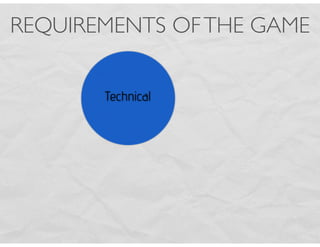
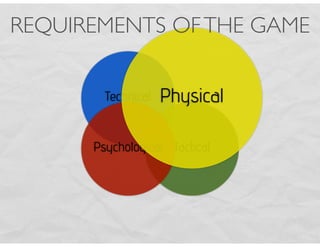
Technical
REQUIREMENTS OFTHE GAME
Technical
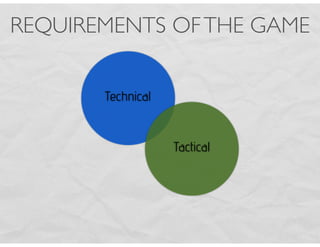
Tactical
REQUIREMENTS OFTHE GAME
Technical
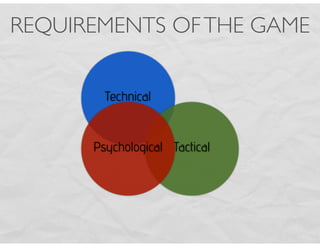
TacticalPsychological
REQUIREMENTS OFTHE GAME
Technical
TacticalPsychological
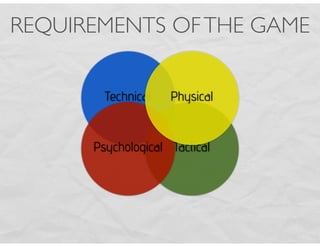
Physical
REQUIREMENTS OFTHE GAME
Technical
TacticalPsychological
Physical
REQUIREMENTS OFTHE GAME
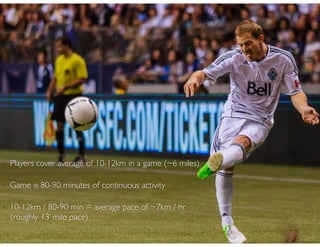
• Players cover average of 10-12km in a game (~6 miles)
• Game is 80-90 minutes of continuous activity
• 10-12km / 80-90 min = average pace of ~7km / hr
(roughly 13’ mile pace)
• Players cover average of 10-12km in a game (~6 miles)
• Game is 80-90 minutes of continuous activity
• 10-12km / 80-90 min = average pace of ~7km / hr
(roughly 13’ mile pace)
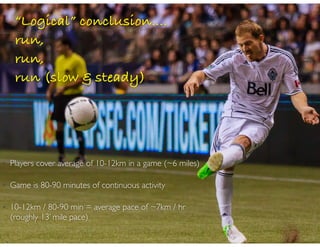
“Logical” conclusion....
run,
run,
run (slow & steady)
BUT....
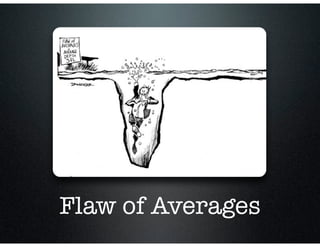
Flaw of Averages
JUST THE FACTS, MA’AM
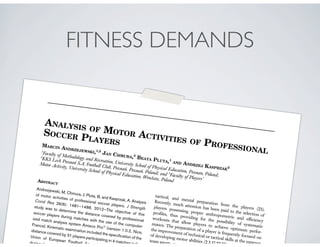
FITNESS DEMANDS
ANALYSIS OF MOTOR ACTIVITIES OF PROFESSIONAL
SOCCER PLAYERSMARCIN ANDRZEJEWSKI,1,2
JAN CHMURA,3
BEATA PLUTA,1
AND ANDRZEJ KASPRZAK2
1
Faculty of Methodology and Recreation, University School of Physical Education, Poznan, Poland;
2
KKS Lech Poznan´ S.A, Football Club, Poznan´, Poznan´, Poland; and 3
Faculty of Players’
Motor Activity, University School of Physical Education, Wrocław, PolandABSTRACT
Andrzejewski, M, Chmura, J, Pluta, B, and Kasprzak, A. Analysis
of motor activities of professional soccer players. J Strength
Cond Res 26(6): 1481–1488, 2012—The objective of this
study was to determine the distance covered by professional
soccer players during matches with the use of the computer-
ized match analysis system Amisco ProÒ
(version 1.0.2, Nice,
France). Kinematic examination included the specification of the
distance covered by 31 players participating in 4 matches in the
Union of European Football Association
during the 200
tactical, and mental preparation from the players (23).
Recently, much attention has been paid to the selection of
players possessing proper anthropometric and efficiency
profiles, thus providing for the possibility of systematic
workouts that allow players to achieve optimum perfor-
mance. The preparation of a player is frequently focused on
the improvement of technical or tactical skills at the expense
of developing motor abilities (2,3,17,22,27). Lik
team sports, soccer als
ANALYSIS OF MOTOR ACTIVITIES OF PROFESSIONAL
SOCCER PLAYERSMARCIN ANDRZEJEWSKI,1,2
JAN CHMURA,3
BEATA PLUTA,1
AND ANDRZEJ KASPRZAK2
1
Faculty of Methodology and Recreation, University School of Physical Education, Poznan, Poland;
2
KKS Lech Poznan´ S.A, Football Club, Poznan´, Poznan´, Poland; and 3
Faculty of Players’
Motor Activity, University School of Physical Education, Wrocław, PolandABSTRACT
Andrzejewski, M, Chmura, J, Pluta, B, and Kasprzak, A. Analysis
of motor activities of professional soccer players. J Strength

Cond Res 26(6): 1481–1488, 2012—The objective of this
study was to determine the distance covered by professional
soccer players during matches with the use of the computer-
ized match analysis system Amisco ProÒ
(version 1.0.2, Nice,
France). Kinematic examination included the specification of the

distance covered by 31 players participating in 4 matches in the
Union of European Football Association
during the 200
tactical, and mental preparation from the players (23).
Recently, much attention has been paid to the selection of
players possessing proper anthropometric and efficiency
profiles, thus providing for the possibility of systematic
workouts that allow players to achieve optimum perfor-
mance. The preparation of a player is frequently focused on
the improvement of technical or tactical skills at the expense
of developing motor abilities (2,3,17,22,27). Lik
team sports, soccer als
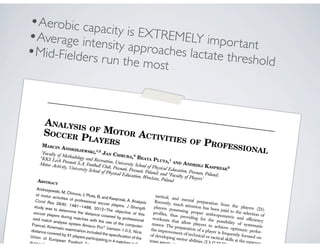
•Aerobic capacity is EXTREMELY important
•Average intensity approaches lactate threshold
•Mid-Fielders run the most
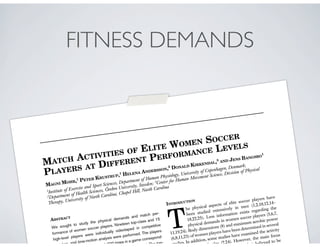
FITNESS DEMANDS
MATCH ACTIVITIES OF ELITE WOMEN SOCCER
PLAYERS AT DIFFERENT PERFORMANCE LEVELS
MAGNI MOHR,1
PETER KRUSTRUP,1
HELENA ANDERSSON,2
DONALD KIRKENDAL,3
AND JENS BANGSBO
1
1
Institute of Exercise and Sport Sciences, Department of Human Physiology, University of Copenhagen, Denmark;
2
Department of Health Sciences, O¨rebro University, Sweden; 3
Center for Human Movement Science, Division of Physical
Therapy, University of North Carolina, Chapel Hill, North Carolina
ABSTRACT
We sought to study the physical demands and match per-
formance of women soccer players. Nineteen top-class and 15
high-level players were individually videotaped in competitive
matches, and time-motion analysis were performed. The players
ity .1,300 times in a game correspond-
total. The top-
INTRODUCTION
T
he physical aspects of elite soccer players have
been studied extensively in men (1,2,10,12,14–
18,22,25). Less information exists regarding the
physical demands in women soccer players (5,6,7,
11,19,24). Body dimensions (8) and maximum aerobic power
(6,8,11,23) of women players have been determined in several
studies. In addition, some studies have examined the activity
atch play (2,24). However, the main focus
hich is believed to be
MATCH ACTIVITIES OF ELITE WOMEN SOCCER
PLAYERS AT DIFFERENT PERFORMANCE LEVELS
MAGNI MOHR,1
PETER KRUSTRUP,1
HELENA ANDERSSON,2
DONALD KIRKENDAL,3
AND JENS BANGSBO
1
1
Institute of Exercise and Sport Sciences, Department of Human Physiology, University of Copenhagen, Denmark;
2
Department of Health Sciences, O¨rebro University, Sweden; 3
Center for Human Movement Science, Division of Physical
Therapy, University of North Carolina, Chapel Hill, North Carolina
ABSTRACT
We sought to study the physical demands and match per-
formance of women soccer players. Nineteen top-class and 15
high-level players were individually videotaped in competitive
matches, and time-motion analysis were performed. The players
ity .1,300 times in a game correspond-
total. The top-
INTRODUCTION
T
he physical aspects of elite soccer players have
been studied extensively in men (1,2,10,12,14–
18,22,25). Less information exists regarding the
physical demands in women soccer players (5,6,7,
11,19,24). Body dimensions (8) and maximum aerobic power
(6,8,11,23) of women players have been determined in several
studies. In addition, some studies have examined the activity
atch play (2,24). However, the main focus
hich is believed to be
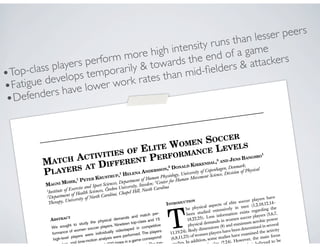
•Top-class players perform more high intensity runs than lesser peers
•Fatigue develops temporarily & towards the end of a game
•Defenders have lower work rates than mid-fielders & attackers
FITNESS DEMANDS
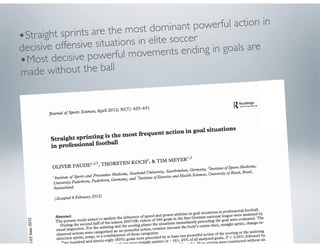
•Straight sprints are the most dominant powerful action in
decisive offensive situations in elite soccer
•Most decisive powerful movements ending in goals are
made without the ball
POSITIONAL DEMANDS
©Journal of Sports Science and Medicine (2007) 6, 63-70
http://www.jssm.org
Physical demands of different positions in FA Premier League soccer
Jonathan Bloomfield 1
, Remco Polman 2
and Peter O'Donoghue 3
1
Sports Institute of Northern Ireland, University of Ulster, Northern Ireland, UK, 2
Department of Sport, Health &
Exercise Science, The University of Hull, East Riding of Yorkshire, UK, 3
School of Sport, University of Wales Insti-
tute Cardiff, Cardiff, UK
Abstract
The purpose of this study was to evaluate the physical demands
of English Football Association (FA) Premier League soccer of
three different positional classifications (defender, midfielder
and striker). Computerised time-motion video-analysis using the
Bloomfield Movement Classification was undertaken on the
purposeful movement (PM) performed by 55 players. Recogni-
tion of PM had a good inter-tester reliability strength of agree-
ment ( = 0.7277). Players spent 40.6 ± 10.0% of the match
performing PM. Position had a significant influence o
time spent sprinting, running, shu
still (p < 0.0
age, stature, body mass and body mass index have been
recently identified between elite players of different posi-
tions suggesting that players of particular size and shape
may be suitable for the demands of the various playing
positions (Bloomfield et al., 2005). In this respect, posi-
tional role appears to have an influence on total energy
expenditure in a match, suggesting different physical,
physiological and bioenergetic requ
enced by play
Research article
©Journal of Sports Science and Medicine (2007) 6, 63-70
http://www.jssm.org
Physical demands of different positions in FA Premier League soccer
Jonathan Bloomfield 1
, Remco Polman 2
and Peter O'Donoghue 3
1
Sports Institute of Northern Ireland, University of Ulster, Northern Ireland, UK, 2
Department of Sport, Health &
Exercise Science, The University of Hull, East Riding of Yorkshire, UK, 3
School of Sport, University of Wales Insti-
tute Cardiff, Cardiff, UK
Abstract
The purpose of this study was to evaluate the physical demands
of English Football Association (FA) Premier League soccer of
three different positional classifications (defender, midfielder
and striker). Computerised time-motion video-analysis using the
Bloomfield Movement Classification was undertaken on the
purposeful movement (PM) performed by 55 players. Recogni-
tion of PM had a good inter-tester reliability strength of agree-
ment ( = 0.7277). Players spent 40.6 ± 10.0% of the match
performing PM. Position had a significant influence o
time spent sprinting, running, shu
still (p < 0.0
age, stature, body mass and body mass index have been
recently identified between elite players of different posi-
tions suggesting that players of particular size and shape
may be suitable for the demands of the various playing
positions (Bloomfield et al., 2005). In this respect, posi-
tional role appears to have an influence on total energy
expenditure in a match, suggesting different physical,
physiological and bioenergetic requ
enced by play
Research article
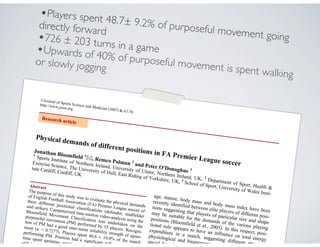
•Players spent 48.7± 9.2% of purposeful movement going
directly forward
•726 ± 203 turns in a game•Upwards of 40% of purposeful movement is spent walking
or slowly jogging
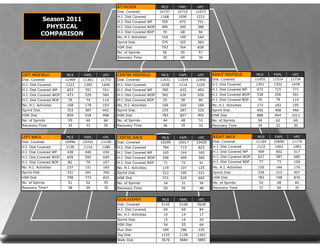
Season 2011
PHYSICAL
COMPARISON
ATTACKER MLS FAPL nPC
Dist. Covered 10737 10715 11073
H.I. Dist Covered 1168 1090 1221
H.I. Dist Covered WP 705 672 751
H.I. Dist Covered WOP 385 349 388
H.I. Dist Covered BOP 70 68 94
No. H.I. Activities 154 149 164
Sprint Dist. 375 325 383
HSR Dist 793 764 838
No. of Sprints 56 50 57
Recovery Time 39 40 36
LEFT MIDFIELD MLS FAPL nPC
Dist. Covered 11469 11361 11753
H.I. Dist Covered 1212 1305 1440
H.I. Dist Covered WP 653 701 741
H.I. Dist Covered WOP 473 529 584
H.I. Dist Covered BOP 76 74 114
No. H.I. Activities 168 178 193
Sprint Dist. 353 387 442
HSR Dist 859 918 998
No. of Sprints 55 60 66
Recovery Time 35 33 30
CENTRE MIDFIELD MLS FAPL nPC
Dist. Covered 11631 11544 11850
H.I. Dist Covered 1038 1114 1225
H.I. Dist Covered WP 395 432 492
H.I. Dist Covered WOP 581 626 650
H.I. Dist Covered BOP 55 56 80
No. H.I. Activities 166 169 184
Sprint Dist. 255 287 320
HSR Dist 783 827 905
No. of Sprints 44 48 53
Recovery Time 36 35 32
RIGHT MIDFIELD MLS FAPL nPC
Dist. Covered 11455 11514 11734
H.I. Dist Covered 1291 1352 1478
H.I. Dist Covered WP 673 715 771
H.I. Dist Covered WOP 538 556 591
H.I. Dist Covered BOP 76 79 114
No. H.I. Activities 173 183 195
Sprint Dist. 402 408 466
HSR Dist 888 944 1011
No. of Sprints 58 62 69
Recovery Time 34 32 30
LEFT BACK MLS FAPL nPC
Dist. Covered 10996 10741 11100
H.I. Dist Covered 1130 1114 1180
H.I. Dist Covered WP 438 440 430
H.I. Dist Covered WOP 609 595 640
H.I. Dist Covered BOP 82 79 107
No. H.I. Activities 157 151 165
Sprint Dist. 331 341 356
HSR Dist 798 773 825
No. of Sprints 51 52 55
Recovery Time* 38 39 35
CENTRE BACK MLS FAPL nPC
Dist. Covered 10299 10017 10420
H.I. Dist Covered 784 715 823
H.I. Dist Covered WP 165 144 165
H.I. Dist Covered WOP 546 499 566
H.I. Dist Covered BOP 71 72 91
No. H.I. Activities 119 107 125
Sprint Dist. 212 195 221
HSR Dist 571 520 602
No. of Sprints 34 31 36
Recovery Time 50 56 48
RIGHT BACK MLS FAPL nPC
Dist. Covered 11104 10690 11170
H.I. Dist Covered 1122 1063 1283
H.I. Dist Covered WP 409 402 517
H.I. Dist Covered WOP 627 587 660
H.I. Dist Covered BOP 77 73 104
No. H.I. Activities 155 146 170
Sprint Dist. 339 315 407
HSR Dist 783 748 876
No. of Sprints 52 48 60
Recovery Time 37 40 35
GOALKEEPER MLS FAPL nPC
Dist. Covered 5145 5168 5628
H.I. Dist Covered 69 69 84
No. H.I. Activities 14 14 17
Sprint Dist. 15 14 20
HSR Dist 54 55 64
Run Dist. 189 196 235
Jog Dist. 1125 1128 1343
Walk Dist. 3676 3684 3885
No. of Sprints 3 3 4
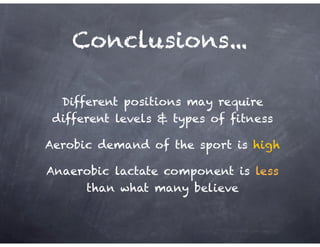
Conclusions...
Different positions may require
different levels & types of fitness
Aerobic demand of the sport is high
Anaerobic lactate component is less
than what many believe
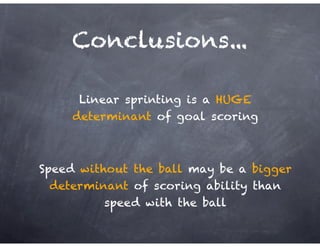
Conclusions...
Linear sprinting is a HUGE
determinant of goal scoring
Speed without the ball may be a bigger
determinant of scoring ability than
speed with the ball
Conclusions...
The game is primarily
characterized as short bursts of
high intensity straight ahead
acceleration punctuated by
intermittent rest periods of very
low & moderate activity
Conclusions...
Due to the intermittent high
intensity efforts with insufficient
recovery, the sport can best be
classified as an alactic-aerobic
sport
Application?
POINTS OF TRAINING
EMPHASIS
Considerable emphasis should be given to developing:
Aerobic capacity
Alactic Anaerobic abilities (especially linear speed)
Limited (but beneficial) training should be done to
enhance anaerobic lactate capacity
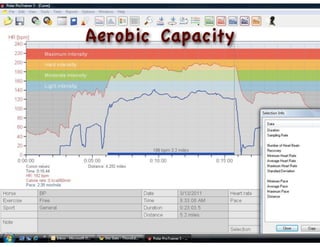
Aerobic Capacity
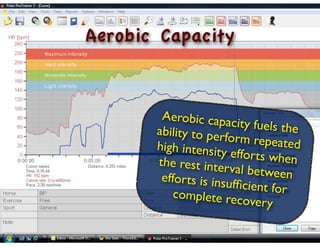
Aerobic Capacity
Aerobic capacity fuels theability to perform repeatedhigh intensity efforts whenthe rest interval betweenefforts is insufficient forcomplete recovery
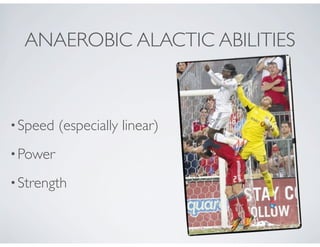
ANAEROBIC ALACTIC ABILITIES
•Speed (especially linear)
•Power
•Strength
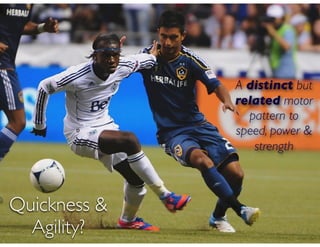
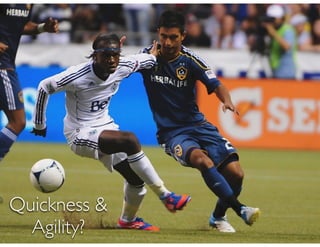
Quickness &
Agility?
Quickness &
Agility?
A distinct but
related motor
pattern to
speed, power &
strength
International Journal of Sports Physiology and Performance, 2009, 4, 291-306
© 2009 Human Kinetics, Inc.
High-Intensity Training in Football
F. Marcello Iaia, Ermanno Rampinini, and Jens Bangsbo
This article reviews the major physiological and performance effects of aerobic high-
ed-endurance training in football, and provides insight on implemen-
cal training. Analysis and physiological mea-
tically demanding, and
.
BRIEF REVIEW
ANAEROBIC LACTIC
CAPACITY
International Journal of Sports Physiology and Performance, 2009, 4, 291-306
© 2009 Human Kinetics, Inc.
High-Intensity Training in Football
F. Marcello Iaia, Ermanno Rampinini, and Jens Bangsbo
This article reviews the major physiological and performance effects of aerobic high-
ed-endurance training in football, and provides insight on implemen-
cal training. Analysis and physiological mea-
tically demanding, and
.
BRIEF REVIEW
•Players operate on the fringe of lactate threshold
•Although not critical anaerobic lactic capacity may play an
important support role
•Great for training efficiency
FITNESSTRAINING
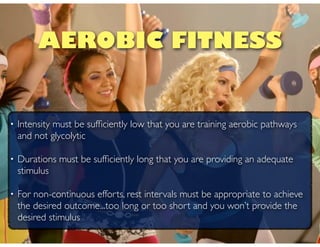
• Intensity must be sufficiently low that you are training aerobic pathways
and not glycolytic
• Durations must be sufficiently long that you are providing an adequate
stimulus
• For non-continuous efforts, rest intervals must be appropriate to achieve
the desired outcome...too long or too short and you won’t provide the
desired stimulus
AEROBIC FITNESS
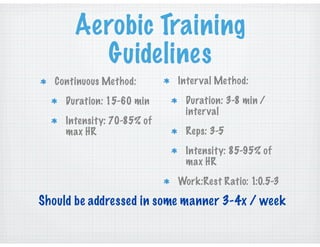
Aerobic Training
Guidelines
Continuous Method:
Duration: 15-60 min
Intensity: 70-85% of
max HR
Interval Method:
Duration: 3-8 min /
interval
Reps: 3-5
Intensity: 85-95% of
max HR
Work:Rest Ratio: 1:0.5-3
Should be addressed in some manner 3-4x / week
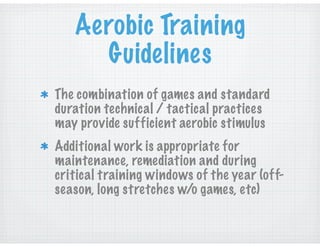
Aerobic Training
Guidelines
The combination of games and standard
duration technical / tactical practices
may provide sufficient aerobic stimulus
Additional work is appropriate for
maintenance, remediation and during
critical training windows of the year (off-
season, long stretches w/o games, etc)
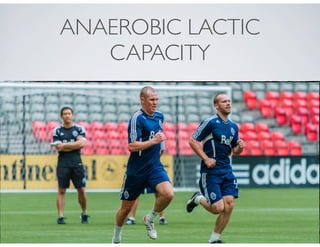
ANAEROBIC LACTIC
CAPACITY
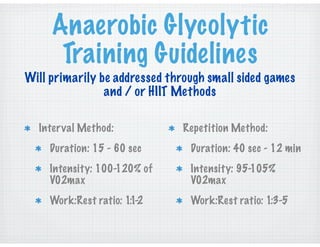
Anaerobic Glycolytic
Training Guidelines
Interval Method:
Duration: 15 - 60 sec
Intensity: 100-120% of
V02max
Work:Rest ratio: 1:1-2
Will primarily be addressed through small sided games
and / or HIIT Methods
Repetition Method:
Duration: 40 sec - 12 min
Intensity: 95-105%
V02max
Work:Rest ratio: 1:3-5
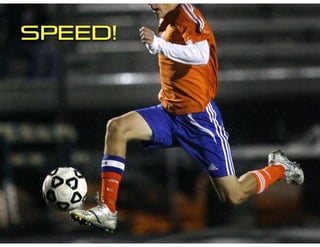
SPEED!
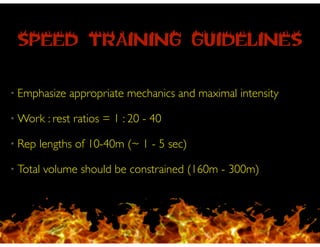
SPEED TRAINING GUIDELINES
• Emphasize appropriate mechanics and maximal intensity
• Work : rest ratios = 1 : 20 - 40
• Rep lengths of 10-40m (~ 1 - 5 sec)
• Total volume should be constrained (160m - 300m)
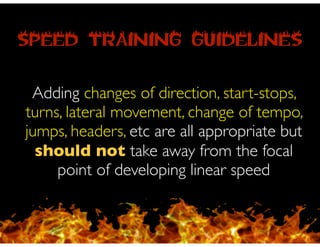
SPEED TRAINING GUIDELINES
Adding changes of direction, start-stops,
turns, lateral movement, change of tempo,
jumps, headers, etc are all appropriate but
should not take away from the focal
point of developing linear speed
To be fit for soccer
you must be able to
sprint fast.
Repeatedly.
With minimal rest.
Repeat Sprint
Ability
LIMITERS OF RSA
•Fatigue from repeat efforts is inversely correlated to initial sprint
performance
•Limitations in energy supply, which include energy available from
phosphocreatine hydrolysis, anaerobic glycolysis and oxidative
metabolism, and the intramuscular accumulation of metabolic by-
products, such as hydrogen ions are key factors in performance
decrement
•Neural factors (magnitude and strategy of recruitment) are
related to fatigue
•Stiffness regulation, hypoglycemia, muscle damage and
environmental conditions may also compromise repeat sprint ability
(Bishop et al, 2011)
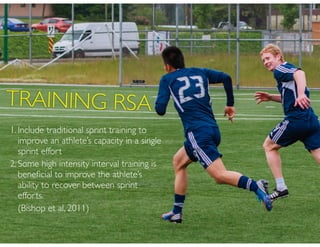
1. Include traditional sprint training to
improve an athlete’s capacity in a single
sprint effort
2. Some high intensity interval training is
beneficial to improve the athlete’s
ability to recover between sprint
efforts.
(Bishop et al, 2011)
TRAINING RSA
RSA Training Guidelines
Intensity: 95-100%
Reps: 10-30m
Volume: <300m total
Work:Rest Ratio: 1:5-10
Frequency: 1-2x / week
RSA is addressed indirectly through other training
methods but specific training is also recommended
AGILITY & QUICKNESS?
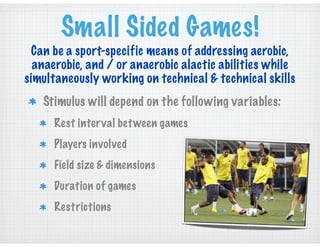
Small Sided Games!
Stimulus will depend on the following variables:
Rest interval between games
Players involved
Field size & dimensions
Duration of games
Restrictions
Can be a sport-specific means of addressing aerobic,
anaerobic, and / or anaerobic alactic abilities while
simultaneously working on technical & technical skills
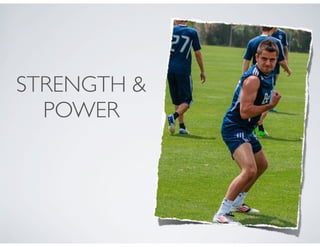
STRENGTH &
POWER
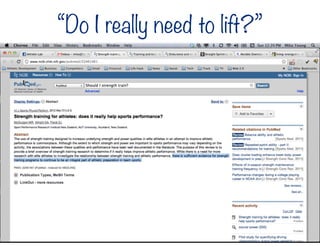
“Do I really need to lift?”
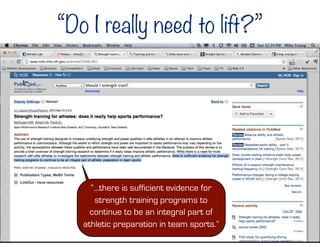
“...there is sufficient evidence for
strength training programs to
continue to be an integral part of
athletic preparation in team sports.”
“Do I really need to lift?”
Benefits of Strength Training
Enhances acceleration
Reduces likelihood for injury
Enhances power (jumping, change of direction, etc)
Improves running economy
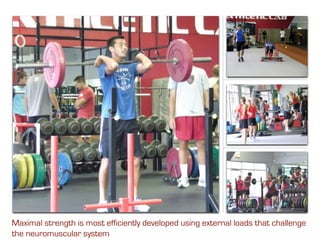
Maximal strength is most efficiently developed using external loads that challenge
the neuromuscular system
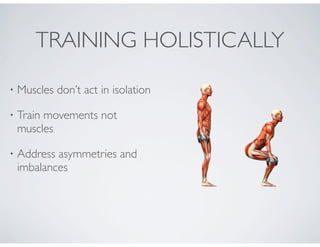
• Muscles don’t act in isolation
• Train movements not
muscles
• Address asymmetries and
imbalances
TRAINING HOLISTICALLY
• Multi-joint exercises through complete ranges of
motion
• For strength & power, lower rep ranges, higher
loads, and moderate volumes are suggested
• For hypertrophy, moderate reps and load with
higher volume is suggested
BASIC GUIDELINES
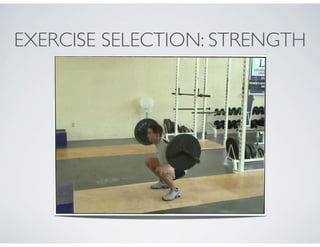
EXERCISE SELECTION: STRENGTH
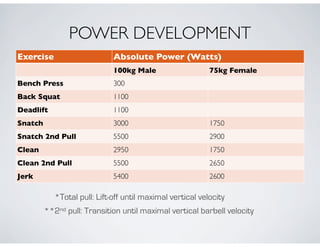
Exercise Absolute Power (Watts)Absolute Power (Watts)
100kg Male 75kg Female
Bench Press 300
Back Squat 1100
Deadlift 1100
Snatch 3000 1750
Snatch 2nd Pull 5500 2900
Clean 2950 1750
Clean 2nd Pull 5500 2650
Jerk 5400 2600
POWER DEVELOPMENT
*Total pull: Lift-off until maximal vertical velocity
**2nd pull: Transition until maximal vertical barbell velocity
Exercise Absolute Power (Watts)Absolute Power (Watts)
100kg Male 75kg Female
Bench Press 300
Back Squat 1100
Deadlift 1100
Snatch 3000 1750
Snatch 2nd Pull 5500 2900
Clean 2950 1750
Clean 2nd Pull 5500 2650
Jerk 5400 2600
POWER DEVELOPMENT
*Total pull: Lift-off until maximal vertical velocity
**2nd pull: Transition until maximal vertical barbell velocity
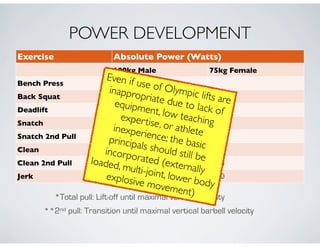
Even if use of Olympic lifts are
inappropriate due to lack of
equipment, low teachingexpertise, or athleteinexperience; the basicprincipals should still be
incorporated (externally
loaded, multi-joint, lower body
explosive movement)
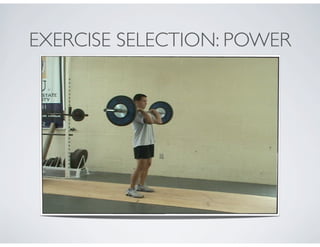
EXERCISE SELECTION: POWER
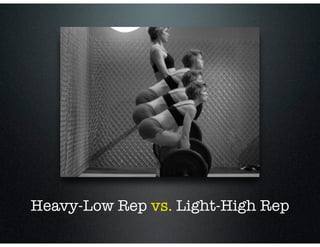
Heavy-Low Rep vs. Light-High Rep
• 1-3x/ week
• Short but intense workouts
• 20-40 minutes per session is sufficient
• High load / low rep and / or explosive
emphasis
• Train the entire body
• Use appropriate rest intervals
Weight Training
Guidelines
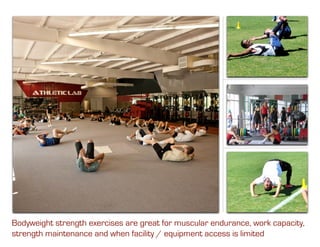
Bodyweight strength exercises are great for muscular endurance, work capacity,
strength maintenance and when facility / equipment access is limited
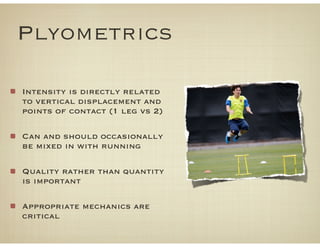
Plyometrics
Intensity is directly related
to vertical displacement and
points of contact (1 leg vs 2)
Can and should occasionally
be mixed in with running
Quality rather than quantity
is important
Appropriate mechanics are
critical
RUNNING ECONOMY:
HOW STRENGTH & POWERTRAINING CAN
AFFECT ENDURANCE
• Running economy is a result of enhanced neuromuscular
characteristics like improved muscle power development and
more efficient use of stored elastic energy
• Resistance training using heavier loads or explosive
movements improves muscle power and enhances the ability
to store and use elastic energy
MECHANISMS OF BENEFIT
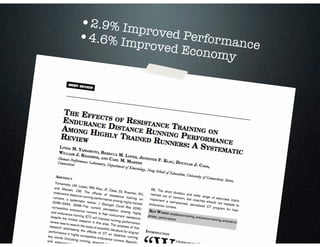
•2.9% Improved Performance
•4.6% Improved Economy
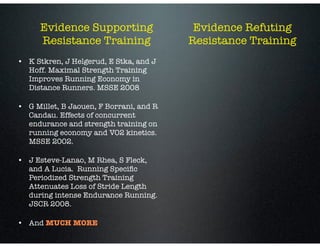
Evidence Supporting
Resistance Training
• K Stkren, J Helgerud, E Stka, and J
Hoff. Maximal Strength Training
Improves Running Economy in
Distance Runners. MSSE 2008
• G Millet, B Jaouen, F Borrani, and R
Candau. Effects of concurrent
endurance and strength training on
running economy and VO2 kinetics.
MSSE 2002.
• J Esteve-Lanao, M Rhea, S Fleck,  
and A Lucia.  Running Specific
Periodized Strength Training
Attenuates Loss of Stride Length
during intense Endurance Running.  
JSCR 2008.
• And MUCH MORE
Evidence Refuting
Resistance Training
CORE?
Myth: Mind-numbing
reps of “abs” are the
best way to strengthen
the core
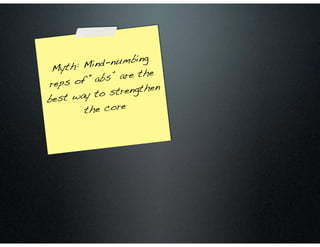
Myth: Mind-numbing
reps of “abs” are the
best way to strengthen
the core
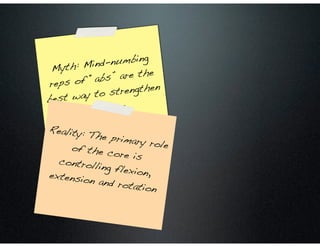
Reality: The primary roleof the core iscontrolling flexion,extension and rotation
Myth: Mind-numbing
reps of “abs” are the
best way to strengthen
the core
Reality: Running &loaded exercises are atleast as beneficial
Reality: The primary roleof the core iscontrolling flexion,extension and rotation
Myth: Mind-numbing
reps of “abs” are the
best way to strengthen
the core
Reality: Running &loaded exercises are atleast as beneficial
Reality: Rotational &
anterior (back) exercises
must be incorporated
Reality: The primary roleof the core iscontrolling flexion,extension and rotation
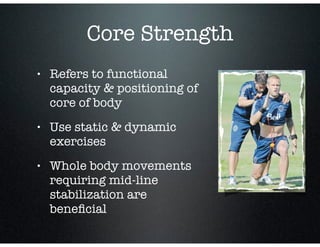
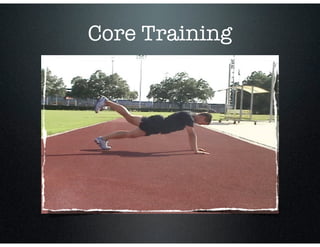
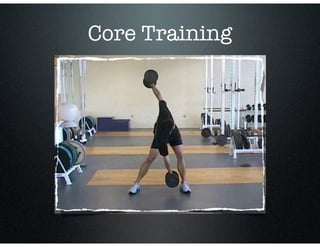
• Refers to functional
capacity & positioning of
core of body
• Use static & dynamic
exercises
• Whole body movements
requiring mid-line
stabilization are
beneficial
Core Strength
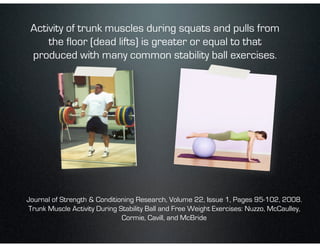
Activity of trunk muscles during squats and pulls from
the floor (dead lifts) is greater or equal to that
produced with many common stability ball exercises.
Journal of Strength & Conditioning Research, Volume 22, Issue 1, Pages 95-102, 2008.
Trunk Muscle Activity During Stability Ball and Free Weight Exercises: Nuzzo, McCaulley,
Cormie, Cavill, and McBride
Core Training
Core Training
Rotten Core
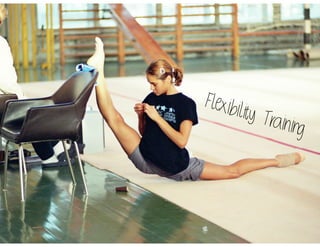
Flexibility Training
ROLE OF FLEXIBILITY FOR SOCCER
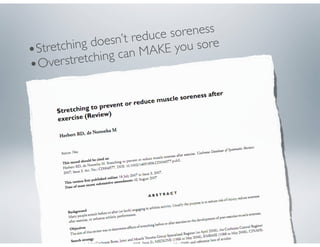
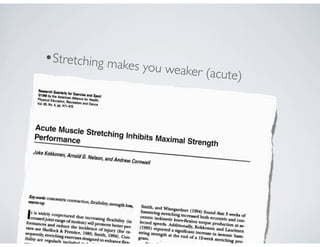
•Stretching doesn’t reduce soreness
•Overstretching can MAKE you sore
•Stretching makes you weaker (acute)
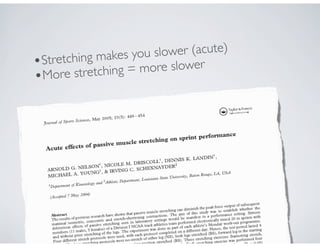
•Stretching makes you slower (acute)
•More stretching = more slower
Too
Flexible?
Stretching May Not Decrease Injury
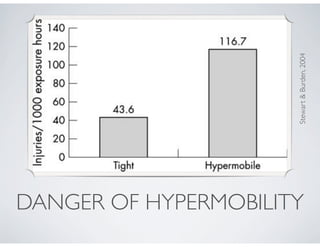
DANGER OF HYPERMOBILITY
Stewart&Burden,2004
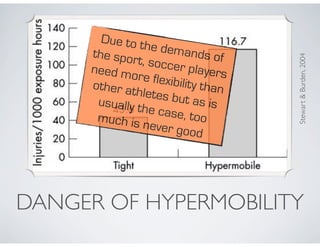
DANGER OF HYPERMOBILITY
Stewart&Burden,2004
Due to the demands ofthe sport, soccer playersneed more flexibility thanother athletes but as isusually the case, toomuch is never good
YEARLY PLANNING
PLAN
AHEA
OFF-SEASONTRAINING:
PUT HAY INTHE BARN
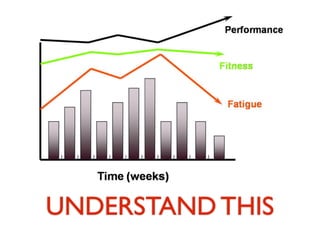
UNDERSTAND THIS
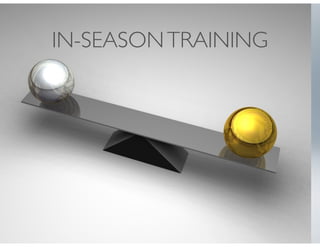
IN-SEASONTRAINING
Use
common
sense!
IN-SEASONTRAINING
CONSIDERATIONS
• Pre-game training for those not selected
• Post-game training for bench players who see minimal or no
time
• Maintaining fitness while minimizing likelihood for soreness and
fatigue
INJURY REDUCTION
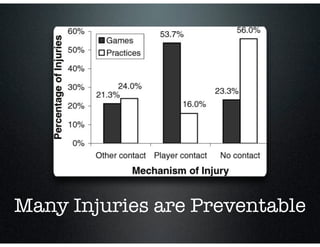
Many Injuries are Preventable
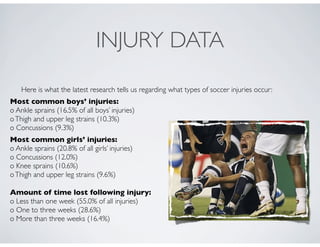
INJURY DATA
Here is what the latest research tells us regarding what types of soccer injuries occur:
Most common boys’ injuries:
o Ankle sprains (16.5% of all boys’ injuries)
oThigh and upper leg strains (10.3%)
o Concussions (9.3%)
Most common girls’ injuries:
o Ankle sprains (20.8% of all girls’ injuries)
o Concussions (12.0%)
o Knee sprains (10.6%)
oThigh and upper leg strains (9.6%)
Amount of time lost following injury:
o Less than one week (55.0% of all injuries)
o One to three weeks (28.6%)
o More than three weeks (16.4%)
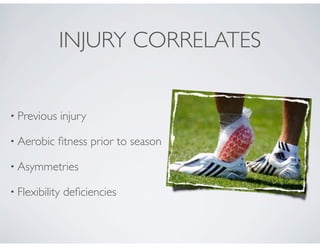
INJURY CORRELATES
• Previous injury
• Aerobic fitness prior to season
• Asymmetries
• Flexibility deficiencies
Performance
PERFORMANCE & INJURY
PerformanceInjury Prevention
PERFORMANCE & INJURY
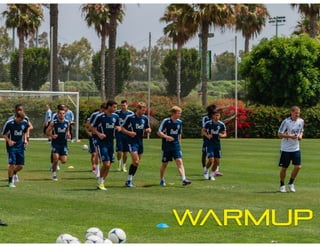
WARMUP
ROLE OFTHE WARMUP
• Ready the body and mind for practice / games:
• Increase core body temperature
• Improve performance
• Reduction of injury
• Psychologically, neurologically, physiologically prime
• Training stimulus?
WARMUP CONSIDERATIONS
• Timing
• Physical &Technical
• Practice vs. Games
• In-game sideline warmups
• General guidelines
• Duration
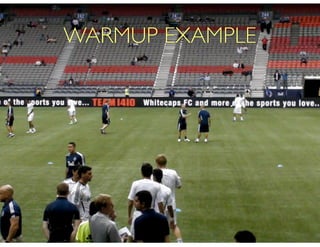
WARMUP EXAMPLE
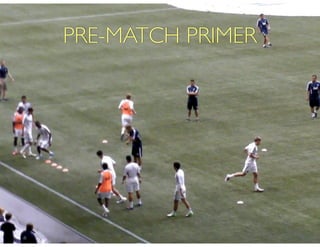
PRE-MATCH PRIMER
ATHLETE MONITORING
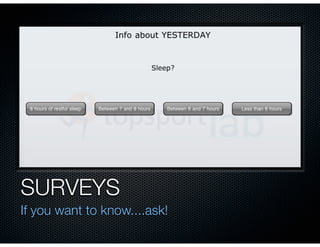
SURVEYS
If you want to know....ask!
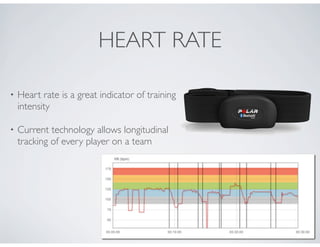
HEART RATE
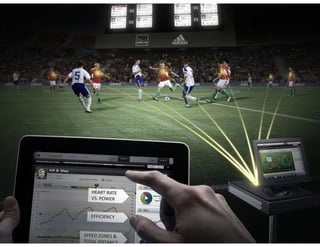
• Heart rate is a great indicator of training
intensity
• Current technology allows longitudinal
tracking of every player on a team
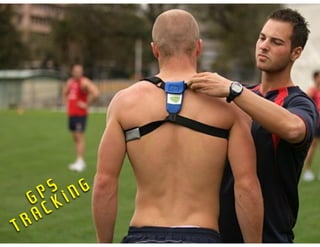
GPS
Tracking
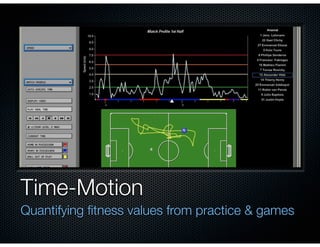
Time-Motion
Quantifying fitness values from practice & games
The Future is Here
HRV & OMEGA WAVE
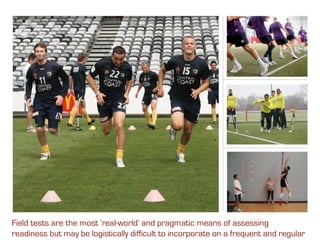
Field tests are the most ‘real-world’ and pragmatic means of assessing
readiness but may be logistically difficult to incorporate on a frequent and regular
FIELDTESTING
• Aerobic: Bleep,Yo-Yo1 & 2, XC Runs, Cooper test, etc
• Agility:Arrow head, Illinois, Pro-Agility, etc
• Speed: 10m, 20m, 30m, 40m
• Repeat Sprint Ability: 6 x 30m w/ 30 sec rest, etc
• Strength: weight room and body weight
• Power: power output, vertical jump, etc
PUTTING IT ALL
TOGETHER
MANAGING FATIGUE &
ENHANCING RECOVERY
Travel Stress
SLEEP &
REST
NUTRITION
• Daily
• Training
• Pre-training
• Post-training
• Games
• Pre-games
• Half-time
Man City “Nutrition Locker”
Teach lifestyle habits
Active recovery sessions?
Manual therapy
Cryo therapy
Facilitating
Recovery?
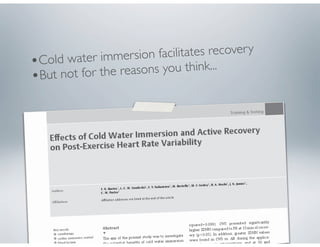
•Cold water immersion facilitates recovery
•But not for the reasons you think...
Fitness is more
than just running
and lifting
Fitness is more
than just running
and lifting
Manage fatigue &
player readiness
Fitness is more
than just running
and lifting
Manage fatigue &
player readiness
Plan, track,
monitor, repeat
Fitness is more
than just running
and lifting
Manage fatigue &
player readiness
Plan, track,
monitor, repeat
Smarter beats
harder any day
THANKS
@MIKEYOUNG
FITFORFUTBOL.COM
ELITETRACK.COM
ATHLETICLAB.COM
HPCSPORT.COM
MIKE@ATHLETICLAB.COM

Soccer Fitness

  • 1.
    SOCCER FITNESS A SCIENCEBASED APPROACH MikeYoung, PhD Athletic Lab - Cary, NC Vancouver Whitecaps -Vancouver, BC
  • 2.
    Opening Thoughts Assume nothing Questioneverything “Common” sense? Science is fundamental
  • 3.
  • 4.
  • 5.
  • 6.
  • 7.
  • 8.
  • 9.
  • 10.
  • 11.
  • 12.
  • 13.
  • 14.
  • 15.
    • Players coveraverage of 10-12km in a game (~6 miles) • Game is 80-90 minutes of continuous activity • 10-12km / 80-90 min = average pace of ~7km / hr (roughly 13’ mile pace)
  • 16.
    • Players coveraverage of 10-12km in a game (~6 miles) • Game is 80-90 minutes of continuous activity • 10-12km / 80-90 min = average pace of ~7km / hr (roughly 13’ mile pace) “Logical” conclusion.... run, run, run (slow & steady)
  • 17.
  • 18.
  • 19.
  • 20.
    FITNESS DEMANDS ANALYSIS OFMOTOR ACTIVITIES OF PROFESSIONAL SOCCER PLAYERSMARCIN ANDRZEJEWSKI,1,2 JAN CHMURA,3 BEATA PLUTA,1 AND ANDRZEJ KASPRZAK2 1 Faculty of Methodology and Recreation, University School of Physical Education, Poznan, Poland; 2 KKS Lech Poznan´ S.A, Football Club, Poznan´, Poznan´, Poland; and 3 Faculty of Players’ Motor Activity, University School of Physical Education, Wrocław, PolandABSTRACT Andrzejewski, M, Chmura, J, Pluta, B, and Kasprzak, A. Analysis of motor activities of professional soccer players. J Strength Cond Res 26(6): 1481–1488, 2012—The objective of this study was to determine the distance covered by professional soccer players during matches with the use of the computer- ized match analysis system Amisco ProÒ (version 1.0.2, Nice, France). Kinematic examination included the specification of the distance covered by 31 players participating in 4 matches in the Union of European Football Association during the 200 tactical, and mental preparation from the players (23). Recently, much attention has been paid to the selection of players possessing proper anthropometric and efficiency profiles, thus providing for the possibility of systematic workouts that allow players to achieve optimum perfor- mance. The preparation of a player is frequently focused on the improvement of technical or tactical skills at the expense of developing motor abilities (2,3,17,22,27). Lik team sports, soccer als
  • 21.
    ANALYSIS OF MOTORACTIVITIES OF PROFESSIONAL SOCCER PLAYERSMARCIN ANDRZEJEWSKI,1,2 JAN CHMURA,3 BEATA PLUTA,1 AND ANDRZEJ KASPRZAK2 1 Faculty of Methodology and Recreation, University School of Physical Education, Poznan, Poland; 2 KKS Lech Poznan´ S.A, Football Club, Poznan´, Poznan´, Poland; and 3 Faculty of Players’ Motor Activity, University School of Physical Education, Wrocław, PolandABSTRACT Andrzejewski, M, Chmura, J, Pluta, B, and Kasprzak, A. Analysis of motor activities of professional soccer players. J Strength Cond Res 26(6): 1481–1488, 2012—The objective of this study was to determine the distance covered by professional soccer players during matches with the use of the computer- ized match analysis system Amisco ProÒ (version 1.0.2, Nice, France). Kinematic examination included the specification of the distance covered by 31 players participating in 4 matches in the Union of European Football Association during the 200 tactical, and mental preparation from the players (23). Recently, much attention has been paid to the selection of players possessing proper anthropometric and efficiency profiles, thus providing for the possibility of systematic workouts that allow players to achieve optimum perfor- mance. The preparation of a player is frequently focused on the improvement of technical or tactical skills at the expense of developing motor abilities (2,3,17,22,27). Lik team sports, soccer als •Aerobic capacity is EXTREMELY important •Average intensity approaches lactate threshold •Mid-Fielders run the most
  • 22.
    FITNESS DEMANDS MATCH ACTIVITIESOF ELITE WOMEN SOCCER PLAYERS AT DIFFERENT PERFORMANCE LEVELS MAGNI MOHR,1 PETER KRUSTRUP,1 HELENA ANDERSSON,2 DONALD KIRKENDAL,3 AND JENS BANGSBO 1 1 Institute of Exercise and Sport Sciences, Department of Human Physiology, University of Copenhagen, Denmark; 2 Department of Health Sciences, O¨rebro University, Sweden; 3 Center for Human Movement Science, Division of Physical Therapy, University of North Carolina, Chapel Hill, North Carolina ABSTRACT We sought to study the physical demands and match per- formance of women soccer players. Nineteen top-class and 15 high-level players were individually videotaped in competitive matches, and time-motion analysis were performed. The players ity .1,300 times in a game correspond- total. The top- INTRODUCTION T he physical aspects of elite soccer players have been studied extensively in men (1,2,10,12,14– 18,22,25). Less information exists regarding the physical demands in women soccer players (5,6,7, 11,19,24). Body dimensions (8) and maximum aerobic power (6,8,11,23) of women players have been determined in several studies. In addition, some studies have examined the activity atch play (2,24). However, the main focus hich is believed to be
  • 23.
    MATCH ACTIVITIES OFELITE WOMEN SOCCER PLAYERS AT DIFFERENT PERFORMANCE LEVELS MAGNI MOHR,1 PETER KRUSTRUP,1 HELENA ANDERSSON,2 DONALD KIRKENDAL,3 AND JENS BANGSBO 1 1 Institute of Exercise and Sport Sciences, Department of Human Physiology, University of Copenhagen, Denmark; 2 Department of Health Sciences, O¨rebro University, Sweden; 3 Center for Human Movement Science, Division of Physical Therapy, University of North Carolina, Chapel Hill, North Carolina ABSTRACT We sought to study the physical demands and match per- formance of women soccer players. Nineteen top-class and 15 high-level players were individually videotaped in competitive matches, and time-motion analysis were performed. The players ity .1,300 times in a game correspond- total. The top- INTRODUCTION T he physical aspects of elite soccer players have been studied extensively in men (1,2,10,12,14– 18,22,25). Less information exists regarding the physical demands in women soccer players (5,6,7, 11,19,24). Body dimensions (8) and maximum aerobic power (6,8,11,23) of women players have been determined in several studies. In addition, some studies have examined the activity atch play (2,24). However, the main focus hich is believed to be •Top-class players perform more high intensity runs than lesser peers •Fatigue develops temporarily & towards the end of a game •Defenders have lower work rates than mid-fielders & attackers
  • 24.
  • 25.
    •Straight sprints arethe most dominant powerful action in decisive offensive situations in elite soccer •Most decisive powerful movements ending in goals are made without the ball
  • 26.
    POSITIONAL DEMANDS ©Journal ofSports Science and Medicine (2007) 6, 63-70 http://www.jssm.org Physical demands of different positions in FA Premier League soccer Jonathan Bloomfield 1 , Remco Polman 2 and Peter O'Donoghue 3 1 Sports Institute of Northern Ireland, University of Ulster, Northern Ireland, UK, 2 Department of Sport, Health & Exercise Science, The University of Hull, East Riding of Yorkshire, UK, 3 School of Sport, University of Wales Insti- tute Cardiff, Cardiff, UK Abstract The purpose of this study was to evaluate the physical demands of English Football Association (FA) Premier League soccer of three different positional classifications (defender, midfielder and striker). Computerised time-motion video-analysis using the Bloomfield Movement Classification was undertaken on the purposeful movement (PM) performed by 55 players. Recogni- tion of PM had a good inter-tester reliability strength of agree- ment ( = 0.7277). Players spent 40.6 ± 10.0% of the match performing PM. Position had a significant influence o time spent sprinting, running, shu still (p < 0.0 age, stature, body mass and body mass index have been recently identified between elite players of different posi- tions suggesting that players of particular size and shape may be suitable for the demands of the various playing positions (Bloomfield et al., 2005). In this respect, posi- tional role appears to have an influence on total energy expenditure in a match, suggesting different physical, physiological and bioenergetic requ enced by play Research article
  • 27.
    ©Journal of SportsScience and Medicine (2007) 6, 63-70 http://www.jssm.org Physical demands of different positions in FA Premier League soccer Jonathan Bloomfield 1 , Remco Polman 2 and Peter O'Donoghue 3 1 Sports Institute of Northern Ireland, University of Ulster, Northern Ireland, UK, 2 Department of Sport, Health & Exercise Science, The University of Hull, East Riding of Yorkshire, UK, 3 School of Sport, University of Wales Insti- tute Cardiff, Cardiff, UK Abstract The purpose of this study was to evaluate the physical demands of English Football Association (FA) Premier League soccer of three different positional classifications (defender, midfielder and striker). Computerised time-motion video-analysis using the Bloomfield Movement Classification was undertaken on the purposeful movement (PM) performed by 55 players. Recogni- tion of PM had a good inter-tester reliability strength of agree- ment ( = 0.7277). Players spent 40.6 ± 10.0% of the match performing PM. Position had a significant influence o time spent sprinting, running, shu still (p < 0.0 age, stature, body mass and body mass index have been recently identified between elite players of different posi- tions suggesting that players of particular size and shape may be suitable for the demands of the various playing positions (Bloomfield et al., 2005). In this respect, posi- tional role appears to have an influence on total energy expenditure in a match, suggesting different physical, physiological and bioenergetic requ enced by play Research article •Players spent 48.7± 9.2% of purposeful movement going directly forward •726 ± 203 turns in a game•Upwards of 40% of purposeful movement is spent walking or slowly jogging
  • 28.
    Season 2011 PHYSICAL COMPARISON ATTACKER MLSFAPL nPC Dist. Covered 10737 10715 11073 H.I. Dist Covered 1168 1090 1221 H.I. Dist Covered WP 705 672 751 H.I. Dist Covered WOP 385 349 388 H.I. Dist Covered BOP 70 68 94 No. H.I. Activities 154 149 164 Sprint Dist. 375 325 383 HSR Dist 793 764 838 No. of Sprints 56 50 57 Recovery Time 39 40 36 LEFT MIDFIELD MLS FAPL nPC Dist. Covered 11469 11361 11753 H.I. Dist Covered 1212 1305 1440 H.I. Dist Covered WP 653 701 741 H.I. Dist Covered WOP 473 529 584 H.I. Dist Covered BOP 76 74 114 No. H.I. Activities 168 178 193 Sprint Dist. 353 387 442 HSR Dist 859 918 998 No. of Sprints 55 60 66 Recovery Time 35 33 30 CENTRE MIDFIELD MLS FAPL nPC Dist. Covered 11631 11544 11850 H.I. Dist Covered 1038 1114 1225 H.I. Dist Covered WP 395 432 492 H.I. Dist Covered WOP 581 626 650 H.I. Dist Covered BOP 55 56 80 No. H.I. Activities 166 169 184 Sprint Dist. 255 287 320 HSR Dist 783 827 905 No. of Sprints 44 48 53 Recovery Time 36 35 32 RIGHT MIDFIELD MLS FAPL nPC Dist. Covered 11455 11514 11734 H.I. Dist Covered 1291 1352 1478 H.I. Dist Covered WP 673 715 771 H.I. Dist Covered WOP 538 556 591 H.I. Dist Covered BOP 76 79 114 No. H.I. Activities 173 183 195 Sprint Dist. 402 408 466 HSR Dist 888 944 1011 No. of Sprints 58 62 69 Recovery Time 34 32 30 LEFT BACK MLS FAPL nPC Dist. Covered 10996 10741 11100 H.I. Dist Covered 1130 1114 1180 H.I. Dist Covered WP 438 440 430 H.I. Dist Covered WOP 609 595 640 H.I. Dist Covered BOP 82 79 107 No. H.I. Activities 157 151 165 Sprint Dist. 331 341 356 HSR Dist 798 773 825 No. of Sprints 51 52 55 Recovery Time* 38 39 35 CENTRE BACK MLS FAPL nPC Dist. Covered 10299 10017 10420 H.I. Dist Covered 784 715 823 H.I. Dist Covered WP 165 144 165 H.I. Dist Covered WOP 546 499 566 H.I. Dist Covered BOP 71 72 91 No. H.I. Activities 119 107 125 Sprint Dist. 212 195 221 HSR Dist 571 520 602 No. of Sprints 34 31 36 Recovery Time 50 56 48 RIGHT BACK MLS FAPL nPC Dist. Covered 11104 10690 11170 H.I. Dist Covered 1122 1063 1283 H.I. Dist Covered WP 409 402 517 H.I. Dist Covered WOP 627 587 660 H.I. Dist Covered BOP 77 73 104 No. H.I. Activities 155 146 170 Sprint Dist. 339 315 407 HSR Dist 783 748 876 No. of Sprints 52 48 60 Recovery Time 37 40 35 GOALKEEPER MLS FAPL nPC Dist. Covered 5145 5168 5628 H.I. Dist Covered 69 69 84 No. H.I. Activities 14 14 17 Sprint Dist. 15 14 20 HSR Dist 54 55 64 Run Dist. 189 196 235 Jog Dist. 1125 1128 1343 Walk Dist. 3676 3684 3885 No. of Sprints 3 3 4
  • 29.
    Conclusions... Different positions mayrequire different levels & types of fitness Aerobic demand of the sport is high Anaerobic lactate component is less than what many believe
  • 30.
    Conclusions... Linear sprinting isa HUGE determinant of goal scoring Speed without the ball may be a bigger determinant of scoring ability than speed with the ball
  • 31.
    Conclusions... The game isprimarily characterized as short bursts of high intensity straight ahead acceleration punctuated by intermittent rest periods of very low & moderate activity
  • 32.
    Conclusions... Due to theintermittent high intensity efforts with insufficient recovery, the sport can best be classified as an alactic-aerobic sport
  • 33.
  • 34.
    POINTS OF TRAINING EMPHASIS Considerableemphasis should be given to developing: Aerobic capacity Alactic Anaerobic abilities (especially linear speed) Limited (but beneficial) training should be done to enhance anaerobic lactate capacity
  • 35.
  • 36.
    Aerobic Capacity Aerobic capacityfuels theability to perform repeatedhigh intensity efforts whenthe rest interval betweenefforts is insufficient forcomplete recovery
  • 37.
    ANAEROBIC ALACTIC ABILITIES •Speed(especially linear) •Power •Strength
  • 38.
  • 39.
    Quickness & Agility? A distinctbut related motor pattern to speed, power & strength
  • 40.
    International Journal ofSports Physiology and Performance, 2009, 4, 291-306 © 2009 Human Kinetics, Inc. High-Intensity Training in Football F. Marcello Iaia, Ermanno Rampinini, and Jens Bangsbo This article reviews the major physiological and performance effects of aerobic high- ed-endurance training in football, and provides insight on implemen- cal training. Analysis and physiological mea- tically demanding, and . BRIEF REVIEW ANAEROBIC LACTIC CAPACITY
  • 41.
    International Journal ofSports Physiology and Performance, 2009, 4, 291-306 © 2009 Human Kinetics, Inc. High-Intensity Training in Football F. Marcello Iaia, Ermanno Rampinini, and Jens Bangsbo This article reviews the major physiological and performance effects of aerobic high- ed-endurance training in football, and provides insight on implemen- cal training. Analysis and physiological mea- tically demanding, and . BRIEF REVIEW •Players operate on the fringe of lactate threshold •Although not critical anaerobic lactic capacity may play an important support role •Great for training efficiency
  • 42.
  • 43.
    • Intensity mustbe sufficiently low that you are training aerobic pathways and not glycolytic • Durations must be sufficiently long that you are providing an adequate stimulus • For non-continuous efforts, rest intervals must be appropriate to achieve the desired outcome...too long or too short and you won’t provide the desired stimulus AEROBIC FITNESS
  • 44.
    Aerobic Training Guidelines Continuous Method: Duration:15-60 min Intensity: 70-85% of max HR Interval Method: Duration: 3-8 min / interval Reps: 3-5 Intensity: 85-95% of max HR Work:Rest Ratio: 1:0.5-3 Should be addressed in some manner 3-4x / week
  • 45.
    Aerobic Training Guidelines The combinationof games and standard duration technical / tactical practices may provide sufficient aerobic stimulus Additional work is appropriate for maintenance, remediation and during critical training windows of the year (off- season, long stretches w/o games, etc)
  • 46.
  • 47.
    Anaerobic Glycolytic Training Guidelines IntervalMethod: Duration: 15 - 60 sec Intensity: 100-120% of V02max Work:Rest ratio: 1:1-2 Will primarily be addressed through small sided games and / or HIIT Methods Repetition Method: Duration: 40 sec - 12 min Intensity: 95-105% V02max Work:Rest ratio: 1:3-5
  • 48.
  • 49.
    SPEED TRAINING GUIDELINES •Emphasize appropriate mechanics and maximal intensity • Work : rest ratios = 1 : 20 - 40 • Rep lengths of 10-40m (~ 1 - 5 sec) • Total volume should be constrained (160m - 300m)
  • 50.
    SPEED TRAINING GUIDELINES Addingchanges of direction, start-stops, turns, lateral movement, change of tempo, jumps, headers, etc are all appropriate but should not take away from the focal point of developing linear speed
  • 51.
    To be fitfor soccer you must be able to sprint fast. Repeatedly. With minimal rest. Repeat Sprint Ability
  • 52.
    LIMITERS OF RSA •Fatiguefrom repeat efforts is inversely correlated to initial sprint performance •Limitations in energy supply, which include energy available from phosphocreatine hydrolysis, anaerobic glycolysis and oxidative metabolism, and the intramuscular accumulation of metabolic by- products, such as hydrogen ions are key factors in performance decrement •Neural factors (magnitude and strategy of recruitment) are related to fatigue •Stiffness regulation, hypoglycemia, muscle damage and environmental conditions may also compromise repeat sprint ability (Bishop et al, 2011)
  • 53.
    1. Include traditionalsprint training to improve an athlete’s capacity in a single sprint effort 2. Some high intensity interval training is beneficial to improve the athlete’s ability to recover between sprint efforts. (Bishop et al, 2011) TRAINING RSA
  • 54.
    RSA Training Guidelines Intensity:95-100% Reps: 10-30m Volume: <300m total Work:Rest Ratio: 1:5-10 Frequency: 1-2x / week RSA is addressed indirectly through other training methods but specific training is also recommended
  • 55.
  • 56.
    Small Sided Games! Stimuluswill depend on the following variables: Rest interval between games Players involved Field size & dimensions Duration of games Restrictions Can be a sport-specific means of addressing aerobic, anaerobic, and / or anaerobic alactic abilities while simultaneously working on technical & technical skills
  • 57.
  • 58.
    “Do I reallyneed to lift?”
  • 59.
    “...there is sufficientevidence for strength training programs to continue to be an integral part of athletic preparation in team sports.” “Do I really need to lift?”
  • 60.
    Benefits of StrengthTraining Enhances acceleration Reduces likelihood for injury Enhances power (jumping, change of direction, etc) Improves running economy
  • 61.
    Maximal strength ismost efficiently developed using external loads that challenge the neuromuscular system
  • 62.
    • Muscles don’tact in isolation • Train movements not muscles • Address asymmetries and imbalances TRAINING HOLISTICALLY
  • 63.
    • Multi-joint exercisesthrough complete ranges of motion • For strength & power, lower rep ranges, higher loads, and moderate volumes are suggested • For hypertrophy, moderate reps and load with higher volume is suggested BASIC GUIDELINES
  • 64.
  • 65.
    Exercise Absolute Power(Watts)Absolute Power (Watts) 100kg Male 75kg Female Bench Press 300 Back Squat 1100 Deadlift 1100 Snatch 3000 1750 Snatch 2nd Pull 5500 2900 Clean 2950 1750 Clean 2nd Pull 5500 2650 Jerk 5400 2600 POWER DEVELOPMENT *Total pull: Lift-off until maximal vertical velocity **2nd pull: Transition until maximal vertical barbell velocity
  • 66.
    Exercise Absolute Power(Watts)Absolute Power (Watts) 100kg Male 75kg Female Bench Press 300 Back Squat 1100 Deadlift 1100 Snatch 3000 1750 Snatch 2nd Pull 5500 2900 Clean 2950 1750 Clean 2nd Pull 5500 2650 Jerk 5400 2600 POWER DEVELOPMENT *Total pull: Lift-off until maximal vertical velocity **2nd pull: Transition until maximal vertical barbell velocity Even if use of Olympic lifts are inappropriate due to lack of equipment, low teachingexpertise, or athleteinexperience; the basicprincipals should still be incorporated (externally loaded, multi-joint, lower body explosive movement)
  • 67.
  • 68.
    Heavy-Low Rep vs.Light-High Rep
  • 69.
    • 1-3x/ week •Short but intense workouts • 20-40 minutes per session is sufficient • High load / low rep and / or explosive emphasis • Train the entire body • Use appropriate rest intervals Weight Training Guidelines
  • 70.
    Bodyweight strength exercisesare great for muscular endurance, work capacity, strength maintenance and when facility / equipment access is limited
  • 71.
    Plyometrics Intensity is directlyrelated to vertical displacement and points of contact (1 leg vs 2) Can and should occasionally be mixed in with running Quality rather than quantity is important Appropriate mechanics are critical
  • 72.
    RUNNING ECONOMY: HOW STRENGTH& POWERTRAINING CAN AFFECT ENDURANCE
  • 73.
    • Running economyis a result of enhanced neuromuscular characteristics like improved muscle power development and more efficient use of stored elastic energy • Resistance training using heavier loads or explosive movements improves muscle power and enhances the ability to store and use elastic energy MECHANISMS OF BENEFIT
  • 74.
  • 75.
    Evidence Supporting Resistance Training •K Stkren, J Helgerud, E Stka, and J Hoff. Maximal Strength Training Improves Running Economy in Distance Runners. MSSE 2008 • G Millet, B Jaouen, F Borrani, and R Candau. Effects of concurrent endurance and strength training on running economy and VO2 kinetics. MSSE 2002. • J Esteve-Lanao, M Rhea, S Fleck,   and A Lucia.  Running Specific Periodized Strength Training Attenuates Loss of Stride Length during intense Endurance Running.   JSCR 2008. • And MUCH MORE Evidence Refuting Resistance Training
  • 77.
  • 78.
    Myth: Mind-numbing reps of“abs” are the best way to strengthen the core
  • 79.
    Myth: Mind-numbing reps of“abs” are the best way to strengthen the core Reality: The primary roleof the core iscontrolling flexion,extension and rotation
  • 80.
    Myth: Mind-numbing reps of“abs” are the best way to strengthen the core Reality: Running &loaded exercises are atleast as beneficial Reality: The primary roleof the core iscontrolling flexion,extension and rotation
  • 81.
    Myth: Mind-numbing reps of“abs” are the best way to strengthen the core Reality: Running &loaded exercises are atleast as beneficial Reality: Rotational & anterior (back) exercises must be incorporated Reality: The primary roleof the core iscontrolling flexion,extension and rotation
  • 82.
    • Refers tofunctional capacity & positioning of core of body • Use static & dynamic exercises • Whole body movements requiring mid-line stabilization are beneficial Core Strength
  • 83.
    Activity of trunkmuscles during squats and pulls from the floor (dead lifts) is greater or equal to that produced with many common stability ball exercises. Journal of Strength & Conditioning Research, Volume 22, Issue 1, Pages 95-102, 2008. Trunk Muscle Activity During Stability Ball and Free Weight Exercises: Nuzzo, McCaulley, Cormie, Cavill, and McBride
  • 84.
  • 85.
  • 86.
  • 87.
  • 89.
    •Stretching doesn’t reducesoreness •Overstretching can MAKE you sore
  • 90.
  • 91.
    •Stretching makes youslower (acute) •More stretching = more slower
  • 92.
  • 93.
    Stretching May NotDecrease Injury
  • 94.
  • 95.
    DANGER OF HYPERMOBILITY Stewart&Burden,2004 Dueto the demands ofthe sport, soccer playersneed more flexibility thanother athletes but as isusually the case, toomuch is never good
  • 96.
  • 97.
  • 98.
  • 99.
  • 100.
  • 101.
  • 102.
    IN-SEASONTRAINING CONSIDERATIONS • Pre-game trainingfor those not selected • Post-game training for bench players who see minimal or no time • Maintaining fitness while minimizing likelihood for soreness and fatigue
  • 103.
  • 104.
    Many Injuries arePreventable
  • 105.
    INJURY DATA Here iswhat the latest research tells us regarding what types of soccer injuries occur: Most common boys’ injuries: o Ankle sprains (16.5% of all boys’ injuries) oThigh and upper leg strains (10.3%) o Concussions (9.3%) Most common girls’ injuries: o Ankle sprains (20.8% of all girls’ injuries) o Concussions (12.0%) o Knee sprains (10.6%) oThigh and upper leg strains (9.6%) Amount of time lost following injury: o Less than one week (55.0% of all injuries) o One to three weeks (28.6%) o More than three weeks (16.4%)
  • 106.
    INJURY CORRELATES • Previousinjury • Aerobic fitness prior to season • Asymmetries • Flexibility deficiencies
  • 107.
  • 108.
  • 109.
  • 110.
    ROLE OFTHE WARMUP •Ready the body and mind for practice / games: • Increase core body temperature • Improve performance • Reduction of injury • Psychologically, neurologically, physiologically prime • Training stimulus?
  • 111.
    WARMUP CONSIDERATIONS • Timing •Physical &Technical • Practice vs. Games • In-game sideline warmups • General guidelines • Duration
  • 112.
  • 113.
  • 114.
  • 115.
    SURVEYS If you wantto know....ask!
  • 116.
    HEART RATE • Heartrate is a great indicator of training intensity • Current technology allows longitudinal tracking of every player on a team
  • 117.
  • 118.
  • 119.
  • 121.
  • 122.
    Field tests arethe most ‘real-world’ and pragmatic means of assessing readiness but may be logistically difficult to incorporate on a frequent and regular
  • 123.
    FIELDTESTING • Aerobic: Bleep,Yo-Yo1& 2, XC Runs, Cooper test, etc • Agility:Arrow head, Illinois, Pro-Agility, etc • Speed: 10m, 20m, 30m, 40m • Repeat Sprint Ability: 6 x 30m w/ 30 sec rest, etc • Strength: weight room and body weight • Power: power output, vertical jump, etc
  • 124.
  • 125.
  • 127.
  • 128.
  • 129.
    NUTRITION • Daily • Training •Pre-training • Post-training • Games • Pre-games • Half-time Man City “Nutrition Locker”
  • 130.
    Teach lifestyle habits Activerecovery sessions? Manual therapy Cryo therapy Facilitating Recovery?
  • 131.
    •Cold water immersionfacilitates recovery •But not for the reasons you think...
  • 133.
    Fitness is more thanjust running and lifting
  • 134.
    Fitness is more thanjust running and lifting Manage fatigue & player readiness
  • 135.
    Fitness is more thanjust running and lifting Manage fatigue & player readiness Plan, track, monitor, repeat
  • 136.
    Fitness is more thanjust running and lifting Manage fatigue & player readiness Plan, track, monitor, repeat Smarter beats harder any day
  • 137.