


Durham University RFC
Strength & Conditioning
Plan
Created April 2019
Physical
Proficiency
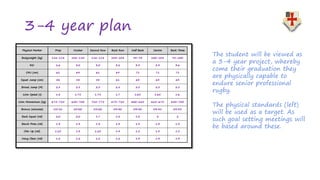
3-4 year plan
The student will be viewed as
a 3-4 year project, whereby
come their graduation they
are physically capable to
endure senior professional
rugby.
The physical standards (left)
will be used as a target. As
such goal setting meetings will
be based around these.
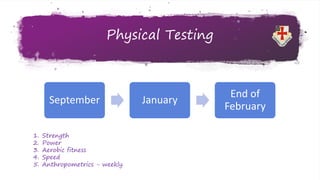
Physical Testing
September January
End of
February
1. Strength
2. Power
3. Aerobic fitness
4. Speed
5. Anthropometrics - weekly
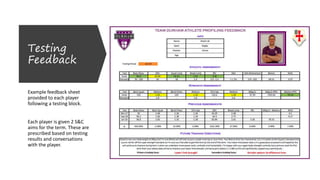
Testing
Feedback
Example feedback sheet
provided to each player
following a testing block.
Each player is given 2 S&C
aims for the term. These are
prescribed based on testing
results and conversations
with the player.
Goal
Setting
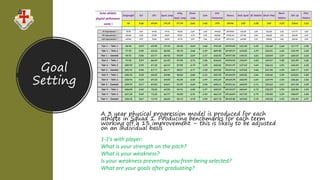
A 3 year physical progression model is produced for each
athlete in Squad 1. Producing benchmarks for each term
working off a 1% improvement – this is likely to be adjusted
on an individual basis
1-1’s with player:
What is your strength on the pitch?
What is your weakness?
Is your weakness preventing you from being selected?
What are your goals after graduating?
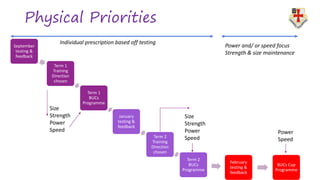
Physical Priorities
September
testing &
feedback
Term 1
Training
Direction
chosen
Term 1
BUCs
Programme
January
testing &
feedback
Term 2
Training
Direction
chosen
Term 2
BUCs
Programme
February
testing &
feedback
BUCs Cup
Programme
Size
Strength
Power
Speed
Size
Strength
Power
Speed
Power
Speed
Power and/ or speed focus
Strength & size maintenance
Individual prescription based off testing
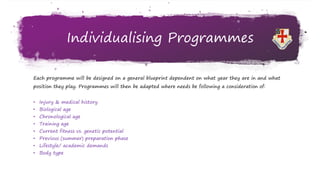
Individualising Programmes
Each programme will be designed on a general blueprint dependent on what year they are in and what
position they play. Programmes will then be adapted where needs be following a consideration of:
• Injury & medical history
• Biological age
• Chronological age
• Training age
• Current fitness vs. genetic potential
• Previous (summer) preparation phase
• Lifestyle/ academic demands
• Body type
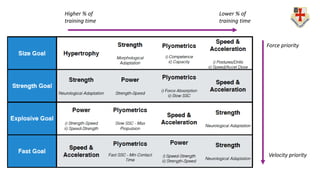
Higher % of
training time
Lower % of
training time
Force priority
Velocity priority
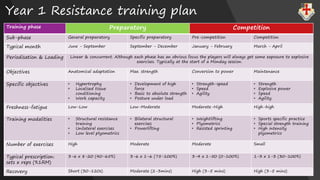
Year 1 Resistance training plan
Training phase Preparatory Competition
Sub-phase General preparatory Specific preparatory Pre-competition Competition
Typical month June - September September - December January - February March - April
Periodisation & Loading Linear & concurrent. Although each phase has an obvious focus the players will always get some exposure to explosive
exercises. Typically at the start of a Monday session.
Objectives Anatomical adaptation Max. strength Conversion to power Maintenance
Specific objectives • Hypertrophy
• Localised tissue
conditioning
• Work capacity
• Development of high
force
• Basic to absolute strength
• Posture under load
• Strength-speed
• Speed
• Agility
• Strength
• Explosive power
• Speed
• Agility
Freshness-fatigue Low-Low Low-Moderate Moderate-High High-high
Training modalities • Structural resistance
training
• Unilateral exercises
• Low level plyometrics
• Bilateral structural
exercises
• Powerlifting
• Weightlifting
• Plyometrics
• Resisted sprinting
• Sports specific practice
• Special strength training
• High intensity
plyometrics
Number of exercises High Moderate Moderate Small
Typical prescription:
sets x reps (%1RM)
3-6 x 8-20 (40-65%) 3-6 x 1-6 (75-100%) 3-4 x 1-50 (0-100%) 1-3 x 1-3 (30-100%)
Recovery Short (30-120s) Moderate (2-3mins) High (3-5 mins) High (3-5 mins)
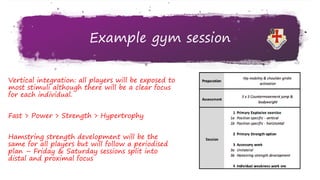
Example gym session
Vertical integration: all players will be exposed to
most stimuli although there will be a clear focus
for each individual.
Fast > Power > Strength > Hypertrophy
Hamstring strength development will be the
same for all players but will follow a periodised
plan – Friday & Saturday sessions split into
distal and proximal focus
Game Fitness
Blocks of 2-5 minutes in training at game speed/ intensity. Progressed throughout season.
These blocks will be designed to meet the worst case scenario metres per minute, high speed
running and ball in play demands of BUCS Super Rugby level.
Wrestling drills in every Friday session to support the development of mental toughness and
improve contact conditioning.
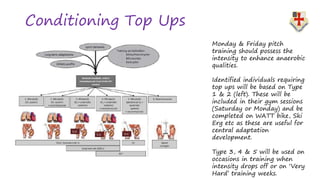
Conditioning Top Ups
Monday & Friday pitch
training should possess the
intensity to enhance anaerobic
qualities.
Identified individuals requiring
top ups will be based on Type
1 & 2 (left). These will be
included in their gym sessions
(Saturday or Monday) and be
completed on WATT bike, Ski
Erg etc as these are useful for
central adaptation
development.
Type 3, 4 & 5 will be used on
occasions in training when
intensity drops off or on ‘Very
Hard’ training weeks.
Worst case
scenario’s from
GPS data
Speed & Agility
Players to get sprinting exposure within both Monday and Friday sessions, following a wave
like progression in volume. Exposures on Saturday’s within season when fixtures allow or if
there is a skills session on a Saturday.
Mental Health
& Wellbeing
Wellbeing monitoring
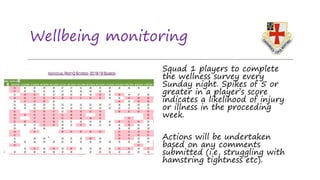
Squad 1 players to complete
the wellness survey every
Sunday night. Spikes of 5 or
greater in a player’s score
indicates a likelihood of injury
or illness in the proceeding
week.
Actions will be undertaken
based on any comments
submitted (i.e, struggling with
hamstring tightness etc).

DURFC S&C Programme

  • 1.
    Durham University RFC Strength& Conditioning Plan Created April 2019
  • 2.
  • 3.
    3-4 year plan Thestudent will be viewed as a 3-4 year project, whereby come their graduation they are physically capable to endure senior professional rugby. The physical standards (left) will be used as a target. As such goal setting meetings will be based around these.
  • 4.
    Physical Testing September January Endof February 1. Strength 2. Power 3. Aerobic fitness 4. Speed 5. Anthropometrics - weekly
  • 5.
    Testing Feedback Example feedback sheet providedto each player following a testing block. Each player is given 2 S&C aims for the term. These are prescribed based on testing results and conversations with the player.
  • 6.
    Goal Setting A 3 yearphysical progression model is produced for each athlete in Squad 1. Producing benchmarks for each term working off a 1% improvement – this is likely to be adjusted on an individual basis 1-1’s with player: What is your strength on the pitch? What is your weakness? Is your weakness preventing you from being selected? What are your goals after graduating?
  • 7.
    Physical Priorities September testing & feedback Term1 Training Direction chosen Term 1 BUCs Programme January testing & feedback Term 2 Training Direction chosen Term 2 BUCs Programme February testing & feedback BUCs Cup Programme Size Strength Power Speed Size Strength Power Speed Power Speed Power and/ or speed focus Strength & size maintenance Individual prescription based off testing
  • 8.
    Individualising Programmes Each programmewill be designed on a general blueprint dependent on what year they are in and what position they play. Programmes will then be adapted where needs be following a consideration of: • Injury & medical history • Biological age • Chronological age • Training age • Current fitness vs. genetic potential • Previous (summer) preparation phase • Lifestyle/ academic demands • Body type
  • 9.
    Higher % of trainingtime Lower % of training time Force priority Velocity priority
  • 10.
    Year 1 Resistancetraining plan Training phase Preparatory Competition Sub-phase General preparatory Specific preparatory Pre-competition Competition Typical month June - September September - December January - February March - April Periodisation & Loading Linear & concurrent. Although each phase has an obvious focus the players will always get some exposure to explosive exercises. Typically at the start of a Monday session. Objectives Anatomical adaptation Max. strength Conversion to power Maintenance Specific objectives • Hypertrophy • Localised tissue conditioning • Work capacity • Development of high force • Basic to absolute strength • Posture under load • Strength-speed • Speed • Agility • Strength • Explosive power • Speed • Agility Freshness-fatigue Low-Low Low-Moderate Moderate-High High-high Training modalities • Structural resistance training • Unilateral exercises • Low level plyometrics • Bilateral structural exercises • Powerlifting • Weightlifting • Plyometrics • Resisted sprinting • Sports specific practice • Special strength training • High intensity plyometrics Number of exercises High Moderate Moderate Small Typical prescription: sets x reps (%1RM) 3-6 x 8-20 (40-65%) 3-6 x 1-6 (75-100%) 3-4 x 1-50 (0-100%) 1-3 x 1-3 (30-100%) Recovery Short (30-120s) Moderate (2-3mins) High (3-5 mins) High (3-5 mins)
  • 11.
    Example gym session Verticalintegration: all players will be exposed to most stimuli although there will be a clear focus for each individual. Fast > Power > Strength > Hypertrophy Hamstring strength development will be the same for all players but will follow a periodised plan – Friday & Saturday sessions split into distal and proximal focus
  • 12.
    Game Fitness Blocks of2-5 minutes in training at game speed/ intensity. Progressed throughout season. These blocks will be designed to meet the worst case scenario metres per minute, high speed running and ball in play demands of BUCS Super Rugby level. Wrestling drills in every Friday session to support the development of mental toughness and improve contact conditioning.
  • 13.
    Conditioning Top Ups Monday& Friday pitch training should possess the intensity to enhance anaerobic qualities. Identified individuals requiring top ups will be based on Type 1 & 2 (left). These will be included in their gym sessions (Saturday or Monday) and be completed on WATT bike, Ski Erg etc as these are useful for central adaptation development. Type 3, 4 & 5 will be used on occasions in training when intensity drops off or on ‘Very Hard’ training weeks.
  • 14.
  • 15.
    Speed & Agility Playersto get sprinting exposure within both Monday and Friday sessions, following a wave like progression in volume. Exposures on Saturday’s within season when fixtures allow or if there is a skills session on a Saturday.
  • 16.
  • 17.
    Wellbeing monitoring Squad 1players to complete the wellness survey every Sunday night. Spikes of 5 or greater in a player’s score indicates a likelihood of injury or illness in the proceeding week. Actions will be undertaken based on any comments submitted (i.e, struggling with hamstring tightness etc).