Rockcliffe University
www.urockcliffe.com


                  Software Engineering


                        Bill Krebs – AgileBill@AgileDimensions.com

                        SL: AgileBill Firehawk
                        AgileDimensions, LLC.
                        © 2009 Rockcliffe University Consortium
What is Lean?


                           Lean

      Optimize how we work.


AgileDimensions, LLC.     © 2009, Rockcliffe University Consortium   2
Father and Son

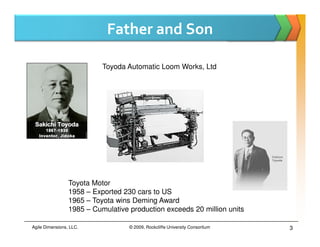
                           Toyoda Automatic Loom Works, Ltd


                 Toyota Motor
                 1958 – Exported 230 cars to US
                 1965 – Toyota wins Deming Award
                 1985 – Cumulative production exceeds 20 million units

Agile Dimensions, LLC.             © 2009, Rockcliffe University Consortium   3
At Toyota
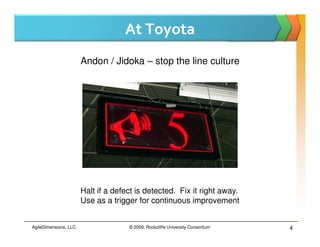
                        Andon / Jidoka – stop the line culture


                        Halt if a defect is detected. Fix it right away.
                        Use as a trigger for continuous improvement


AgileDimensions, LLC.                 © 2009, Rockcliffe University Consortium   4
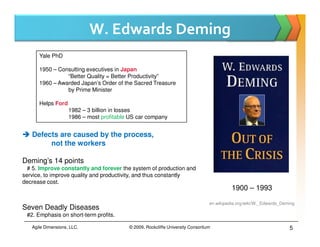
W. Edwards Deming
      Yale PhD

      1950 – Consulting executives in Japan
                “Better Quality = Better Productivity”
      1960 – Awarded Japan’s Order of the Sacred Treasure
                by Prime Minister

      Helps Ford
                    1982 – 3 billion in losses
                    1986 – most profitable US car company


   Defects are caused by the process,
        not the workers

Deming’s 14 points
  # 5. Improve constantly and forever the system of production and
service, to improve quality and productivity, and thus constantly
decrease cost.
                                                                                           1900 – 1993

                                                                                 en.wikipedia.org/wiki/W._Edwards_Deming
Seven Deadly Diseases
 #2. Emphasis on short-term profits.

   Agile Dimensions, LLC.                 © 2009, Rockcliffe University Consortium                                   5
Deming’s 14 points
From “Out of the Crisis” 1986. Does any of this still
  apply today?

1. Improve the product and service, compete, stay
   in business, and provide jobs
2. Western management must take on leadership
   for change
3. Build quality into the product instead of
   inspecting for defects
4. Minimize Total cost. Establish a trusted
   relationship with a supplier.
AgileDimensions, LLC.        © 2009, Rockcliffe University Consortium   6
More Deming points
5. Constantly improve the system. This will
   improve quality and productivity, and decrease
   cost.
6. Institute training on the job.
7. The aim of management should be to help
   people and machines and gadgets do a better
   job.
8. Drive out fear, so that everyone may work
   effectively for the company.
9. Break down barriers between departments.


AgileDimensions, LLC.        © 2009, Rockcliffe University Consortium   7
More Deming points
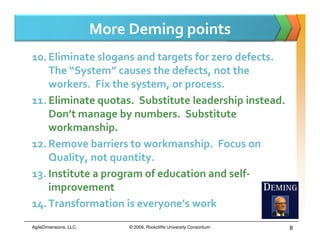
10. Eliminate slogans and targets for zero defects.
    The “System” causes the defects, not the
    workers. Fix the system, or process.
11. Eliminate quotas. Substitute leadership instead.
    Don’t manage by numbers. Substitute
    workmanship.
12. Remove barriers to workmanship. Focus on
    Quality, not quantity.
13. Institute a program of education and self-
    improvement
14. Transformation is everyone’s work
AgileDimensions, LLC.        © 2009, Rockcliffe University Consortium   8
Lean
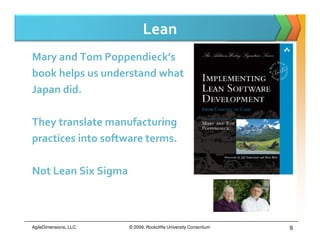
Mary and Tom Poppendieck’s
book helps us understand what
Japan did.

They translate manufacturing
practices into software terms.

Not Lean Six Sigma


AgileDimensions, LLC.   © 2009, Rockcliffe University Consortium   9
7 Principles
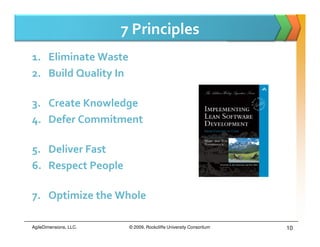
1. Eliminate Waste
2. Build Quality In

3. Create Knowledge
4. Defer Commitment

5. Deliver Fast
6. Respect People

7. Optimize the Whole

AgileDimensions, LLC.    © 2009, Rockcliffe University Consortium   10
Eliminate Waste
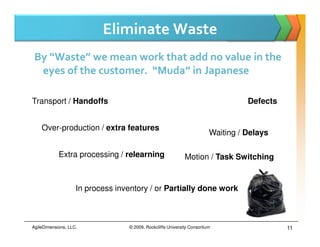
 By “Waste” we mean work that add no value in the
  eyes of the customer. “Muda” in Japanese

Transport / Handoffs                                                               Defects


    Over-production / extra features
                                                                         Waiting / Delays

            Extra processing / relearning                    Motion / Task Switching


                    In process inventory / or Partially done work


AgileDimensions, LLC.             © 2009, Rockcliffe University Consortium                   11
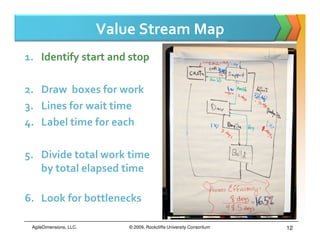
Value Stream Map
1. Identify start and stop

2. Draw boxes for work
3. Lines for wait time
4. Label time for each

5. Divide total work time
   by total elapsed time

6. Look for bottlenecks

 AgileDimensions, LLC.       © 2009, Rockcliffe University Consortium   12
Quiz


            Name some types of Waste


AgileDimensions, LLC.   © 2009, Rockcliffe University Consortium   13
Build Quality In
     Mistake-Proof the process
           Example: Test Driven Development

           Avoid Technical Debt
            a) Creation of work without associated test
            b) Work that passes test, but smells bad

              Avoid big band surprises
                Integrate smaller batches more often
                 (continuous integration)


AgileDimensions, LLC.        © 2009, Rockcliffe University Consortium   14
Create Knowledge
     Learn as you work

     Use the scientific Method
           Form a hypotheses, test, observe the results


     Standards
           What is their purpose? Conformity against change? Or
           baseline For change?
     Evolve knowledge Empirically
           Learn and adapt, not just predict and plan
           “Don’t just guess about the future and call it a plan”

AgileDimensions, LLC.         © 2009, Rockcliffe University Consortium   15
Defer Commitment
     Break dependencies

     Maintain Options
           When is the best time to decide?
           As early as possible? Or just in time?

           Can we make some decisions reversible?


AgileDimensions, LLC.        © 2009, Rockcliffe University Consortium   16
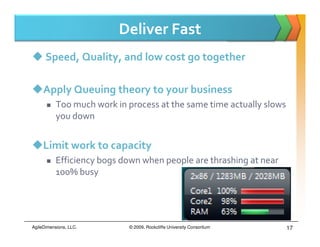
Deliver Fast
      Speed, Quality, and low cost go together

     Apply Queuing theory to your business
           Too much work in process at the same time actually slows
           you down


     Limit work to capacity
           Efficiency bogs down when people are thrashing at near
           100% busy


AgileDimensions, LLC.       © 2009, Rockcliffe University Consortium   17
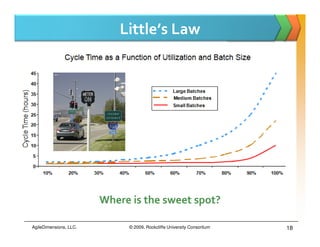
Little’s Law


                        Where is the sweet spot?

AgileDimensions, LLC.        © 2009, Rockcliffe University Consortium   18
Little’s Law in Action
      An Example of Little’s Law in action.


                            Twitter


AgileDimensions, LLC.         © 2009, Rockcliffe University Consortium   19
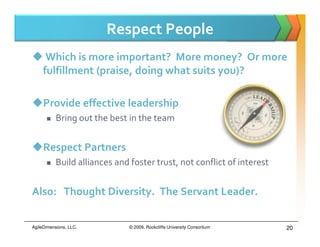
Respect People
      Which is more important? More money? Or more
     fulfillment (praise, doing what suits you)?

     Provide effective leadership
           Bring out the best in the team


     Respect Partners
           Build alliances and foster trust, not conflict of interest


Also: Thought Diversity. The Servant Leader.

AgileDimensions, LLC.          © 2009, Rockcliffe University Consortium   20
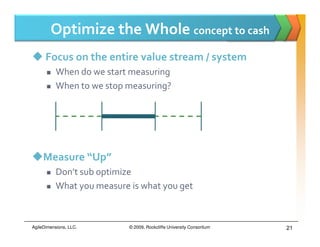
Optimize the Whole concept to cash
      Focus on the entire value stream / system
           When do we start measuring
           When to we stop measuring?


     Measure “Up”
           Don’t sub optimize
           What you measure is what you get


AgileDimensions, LLC.       © 2009, Rockcliffe University Consortium   21
Quiz
      Should we work people at 100% or more?

     Is there a trade off between quality, speed, and
     cost?

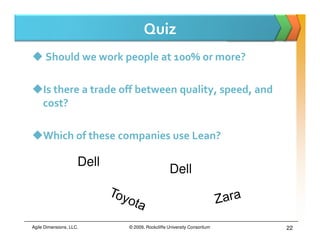
     Which of these companies use Lean?

                     Dell
                                               Dell


Agile Dimensions, LLC.      © 2009, Rockcliffe University Consortium   22
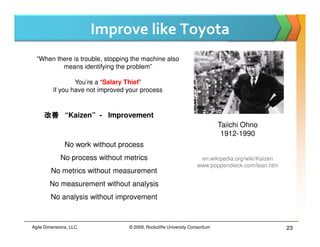
Improve like Toyota
  “When there is trouble, stopping the machine also
          means identifying the problem”

                  You’re a “Salary Thief”
          if you have not improved your process


     改善 “Kaizen” - Improvement
                                                                              Taiichi Ohno
                                                                               1912-1990
               No work without process
             No process without metrics                              en.wikipedia.org/wiki/Kaizen
                                                                    www.poppendieck.com/lean.htm
         No metrics without measurement
        No measurement without analysis
        No analysis without improvement


Agile Dimensions, LLC.             © 2009, Rockcliffe University Consortium                         23
What techniques do you like?

   DISCUSSION


Agile Dimensions        © 2009, Rockcliffe University Consortium   24
Rockcliffe University
www.urockcliffe.com


                        Bill Krebs – linkedin.com/in/BillKrebs

                        SL: AgileBill Firehawk
                        Agile Dimensions, LLC.
                        AgileBill@AgileDimensions.com

Agile Bill.Lean Primer.0906a

  • 1.
    Rockcliffe University www.urockcliffe.com Software Engineering Bill Krebs – AgileBill@AgileDimensions.com SL: AgileBill Firehawk AgileDimensions, LLC. © 2009 Rockcliffe University Consortium
  • 2.
    What is Lean? Lean Optimize how we work. AgileDimensions, LLC. © 2009, Rockcliffe University Consortium 2
  • 3.
    Father and Son Toyoda Automatic Loom Works, Ltd Toyota Motor 1958 – Exported 230 cars to US 1965 – Toyota wins Deming Award 1985 – Cumulative production exceeds 20 million units Agile Dimensions, LLC. © 2009, Rockcliffe University Consortium 3
  • 4.
    At Toyota Andon / Jidoka – stop the line culture Halt if a defect is detected. Fix it right away. Use as a trigger for continuous improvement AgileDimensions, LLC. © 2009, Rockcliffe University Consortium 4
  • 5.
    W. Edwards Deming Yale PhD 1950 – Consulting executives in Japan “Better Quality = Better Productivity” 1960 – Awarded Japan’s Order of the Sacred Treasure by Prime Minister Helps Ford 1982 – 3 billion in losses 1986 – most profitable US car company Defects are caused by the process, not the workers Deming’s 14 points # 5. Improve constantly and forever the system of production and service, to improve quality and productivity, and thus constantly decrease cost. 1900 – 1993 en.wikipedia.org/wiki/W._Edwards_Deming Seven Deadly Diseases #2. Emphasis on short-term profits. Agile Dimensions, LLC. © 2009, Rockcliffe University Consortium 5
  • 6.
    Deming’s 14 points From“Out of the Crisis” 1986. Does any of this still apply today? 1. Improve the product and service, compete, stay in business, and provide jobs 2. Western management must take on leadership for change 3. Build quality into the product instead of inspecting for defects 4. Minimize Total cost. Establish a trusted relationship with a supplier. AgileDimensions, LLC. © 2009, Rockcliffe University Consortium 6
  • 7.
    More Deming points 5.Constantly improve the system. This will improve quality and productivity, and decrease cost. 6. Institute training on the job. 7. The aim of management should be to help people and machines and gadgets do a better job. 8. Drive out fear, so that everyone may work effectively for the company. 9. Break down barriers between departments. AgileDimensions, LLC. © 2009, Rockcliffe University Consortium 7
  • 8.
    More Deming points 10.Eliminate slogans and targets for zero defects. The “System” causes the defects, not the workers. Fix the system, or process. 11. Eliminate quotas. Substitute leadership instead. Don’t manage by numbers. Substitute workmanship. 12. Remove barriers to workmanship. Focus on Quality, not quantity. 13. Institute a program of education and self- improvement 14. Transformation is everyone’s work AgileDimensions, LLC. © 2009, Rockcliffe University Consortium 8
  • 9.
    Lean Mary and TomPoppendieck’s book helps us understand what Japan did. They translate manufacturing practices into software terms. Not Lean Six Sigma AgileDimensions, LLC. © 2009, Rockcliffe University Consortium 9
  • 10.
    7 Principles 1. EliminateWaste 2. Build Quality In 3. Create Knowledge 4. Defer Commitment 5. Deliver Fast 6. Respect People 7. Optimize the Whole AgileDimensions, LLC. © 2009, Rockcliffe University Consortium 10
  • 11.
    Eliminate Waste By“Waste” we mean work that add no value in the eyes of the customer. “Muda” in Japanese Transport / Handoffs Defects Over-production / extra features Waiting / Delays Extra processing / relearning Motion / Task Switching In process inventory / or Partially done work AgileDimensions, LLC. © 2009, Rockcliffe University Consortium 11
  • 12.
    Value Stream Map 1.Identify start and stop 2. Draw boxes for work 3. Lines for wait time 4. Label time for each 5. Divide total work time by total elapsed time 6. Look for bottlenecks AgileDimensions, LLC. © 2009, Rockcliffe University Consortium 12
  • 13.
    Quiz Name some types of Waste AgileDimensions, LLC. © 2009, Rockcliffe University Consortium 13
  • 14.
    Build Quality In Mistake-Proof the process Example: Test Driven Development Avoid Technical Debt a) Creation of work without associated test b) Work that passes test, but smells bad Avoid big band surprises Integrate smaller batches more often (continuous integration) AgileDimensions, LLC. © 2009, Rockcliffe University Consortium 14
  • 15.
    Create Knowledge Learn as you work Use the scientific Method Form a hypotheses, test, observe the results Standards What is their purpose? Conformity against change? Or baseline For change? Evolve knowledge Empirically Learn and adapt, not just predict and plan “Don’t just guess about the future and call it a plan” AgileDimensions, LLC. © 2009, Rockcliffe University Consortium 15
  • 16.
    Defer Commitment Break dependencies Maintain Options When is the best time to decide? As early as possible? Or just in time? Can we make some decisions reversible? AgileDimensions, LLC. © 2009, Rockcliffe University Consortium 16
  • 17.
    Deliver Fast Speed, Quality, and low cost go together Apply Queuing theory to your business Too much work in process at the same time actually slows you down Limit work to capacity Efficiency bogs down when people are thrashing at near 100% busy AgileDimensions, LLC. © 2009, Rockcliffe University Consortium 17
  • 18.
    Little’s Law Where is the sweet spot? AgileDimensions, LLC. © 2009, Rockcliffe University Consortium 18
  • 19.
    Little’s Law inAction An Example of Little’s Law in action. Twitter AgileDimensions, LLC. © 2009, Rockcliffe University Consortium 19
  • 20.
    Respect People Which is more important? More money? Or more fulfillment (praise, doing what suits you)? Provide effective leadership Bring out the best in the team Respect Partners Build alliances and foster trust, not conflict of interest Also: Thought Diversity. The Servant Leader. AgileDimensions, LLC. © 2009, Rockcliffe University Consortium 20
  • 21.
    Optimize the Wholeconcept to cash Focus on the entire value stream / system When do we start measuring When to we stop measuring? Measure “Up” Don’t sub optimize What you measure is what you get AgileDimensions, LLC. © 2009, Rockcliffe University Consortium 21
  • 22.
    Quiz Should we work people at 100% or more? Is there a trade off between quality, speed, and cost? Which of these companies use Lean? Dell Dell Agile Dimensions, LLC. © 2009, Rockcliffe University Consortium 22
  • 23.
    Improve like Toyota “When there is trouble, stopping the machine also means identifying the problem” You’re a “Salary Thief” if you have not improved your process 改善 “Kaizen” - Improvement Taiichi Ohno 1912-1990 No work without process No process without metrics en.wikipedia.org/wiki/Kaizen www.poppendieck.com/lean.htm No metrics without measurement No measurement without analysis No analysis without improvement Agile Dimensions, LLC. © 2009, Rockcliffe University Consortium 23
  • 24.
    What techniques doyou like? DISCUSSION Agile Dimensions © 2009, Rockcliffe University Consortium 24
  • 25.
    Rockcliffe University www.urockcliffe.com Bill Krebs – linkedin.com/in/BillKrebs SL: AgileBill Firehawk Agile Dimensions, LLC. AgileBill@AgileDimensions.com