SAVE 76%

                                             AGILE DIMENSIONS
                                                   CASE STUDY
                                               A VIRTUAL MICRO CONFERENCE:
                                               AGILE WORLDS - JANUARY 2010”

                                                     AgileBill Firehawk, Jokay Wollongong,
                                                               Pamala Clift, Phelan Corrimal
                               AgileBill Firehawk / Krebs, CEO Agile Dimensions LLC
© 2010, Agile Dimensions LLC
                               In partnership with Rockcliffe University Consortium
Context
   May 2009
     Second   Life™ was selected as business critical
      tool by AgileBill‟s consulting company
     To reach new clients

     To save travel cost and, more importantly, time

     To teach *better* using immersive techniques

     Other virtual world tools have targed uses

   January 2010
     Hosted   a business conference
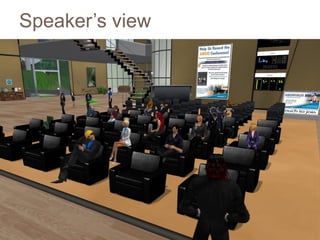
Speaker‟s view
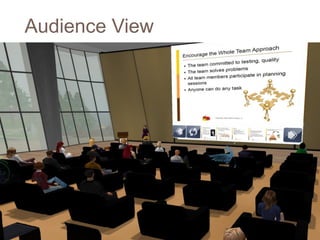
Audience View
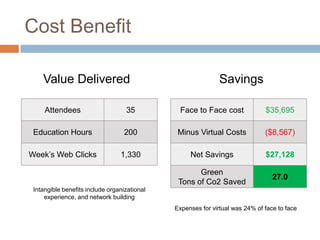
Cost Benefit

    Value Delivered                                           Savings

     Attendees                     35           Face to Face cost             $35,695

 Education Hours                   200         Minus Virtual Costs            ($8,567)

Week‟s Web Clicks                1,330             Net Savings                $27,128

                                                     Green
                                                                                 27.0
                                               Tons of Co2 Saved
 Intangible benefits include organizational
     experience, and network building
                                              Expenses for virtual was 24% of face to face
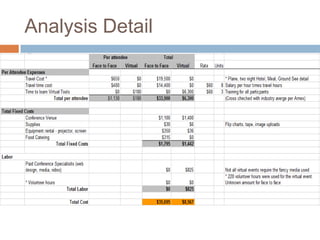
Analysis Detail
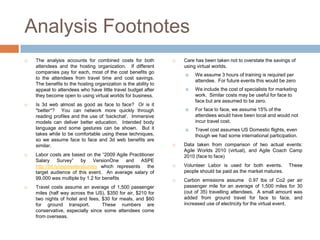
Analysis Footnotes
   The analysis accounts for combined costs for both               Care has been taken not to overstate the savings of
    attendees and the hosting organization. If different             using virtual worlds.
    companies pay for each, most of the cost benefits go
                                                                         We assume 3 hours of training is required per
    to the attendees from travel time and cost savings.
                                                                          attendee. For future events this would be zero
    The benefits to the hosting organization is the ability to
    appeal to attendees who have little travel budget after              We include the cost of specialists for marketing
    they become open to using virtual worlds for business.                work. Similar costs may be useful for face to
                                                                          face but are assumed to be zero.
   Is 3d web almost as good as face to face? Or is it
    *better*? You can network more quickly through                       For face to face, we assume 15% of the
    reading profiles and the use of „backchat‟. Immersive                 attendees would have been local and would not
    models can deliver better education. Intended body                    incur travel cost.
    language and some gestures can be shown. But it                      Travel cost assumes US Domestic flights, even
    takes while to be comfortable using these techniques,                 though we had some international participation.
    so we assume face to face and 3d web benefits are
    similar.                                                        Data taken from comparison of two actual events:
                                                                     Agile Worlds 2010 (virtual), and Agile Coach Camp
   Labor costs are based on the “2009 Agile Practitioner            2010 (face to face)
    Salary Survey” by VersionOne and ASPE
    http://bit.ly/aspesalarysurvey which represents the             Volunteer Labor is used for both events.         These
    target audience of this event. An average salary of              people should be paid as the market matures.
    99,000 was multiple by 1.2 for benefits                         Carbon emissions assume 0.97 lbs of Co2 per air
   Travel costs assume an average of 1,500 passenger                passenger mile for an average of 1,500 miles for 30
    miles (half way across the US), $350 for air, $210 for           (out of 35) travelling attendees. A small amount was
    two nights of hotel and fees, $30 for meals, and $60             added from ground travel for face to face, and
    for ground transport.         These numbers are                  increased use of electricity for the virtual event.
    conservative, especially since some attendees come
    from overseas.
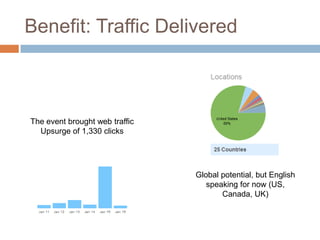
Benefit: Traffic Delivered


The event brought web traffic
  Upsurge of 1,330 clicks


                                Global potential, but English
                                   speaking for now (US,
                                       Canada, UK)
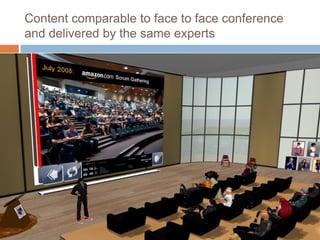
Content comparable to face to face conference
and delivered by the same experts
Pros and Cons
   Benefits                                 Challenges
                                                 Price Gap
       Less time wasted travelling                  Expectation in virtual worlds is
                                                      free education
       Less money wasted travelling
                                                     Expectation in physical world can
       Greener                                       be hundreds of dollars per day
                                                 Culture Gap
                                                     Takes an investment to orient
       Turbo networking environment                  people to virtual world tools, and to
       Able to create custom venues                  change perception of virtual worlds
                                                      from questionable toy to mission
       Possible to increase learning                 critical business tool
        through interactive techiniques
                                                 Labor Gap
                                                     Volunteers should eventually be
                                                      paid for their hard work
Lessons Learned
   Apply the same project management
    principles you would for any mid sized project
   Prepare risk mitigation plans for
     Lossof voice
     Cancelled speakers

     Security
       Screen   and monitor attendees
     Performance
       Balance   load on virtual venue tools
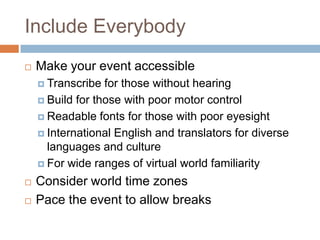
Include Everybody
   Make your event accessible
     Transcribe  for those without hearing
     Build for those with poor motor control

     Readable fonts for those with poor eyesight

     International English and translators for diverse
      languages and culture
     For wide ranges of virtual world familiarity

   Consider world time zones
   Pace the event to allow breaks
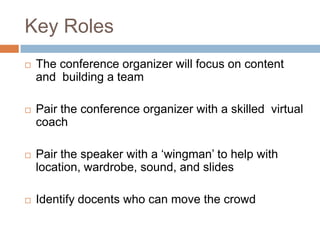
Key Roles
   The conference organizer will focus on content
    and building a team

   Pair the conference organizer with a skilled virtual
    coach

   Pair the speaker with a „wingman‟ to help with
    location, wardrobe, sound, and slides

   Identify docents who can move the crowd
Going Forward

   Share
   Learn
   Be Green
   Be Accessible
       Virtual worlds do not enhance life. They *are* life.
           Gentle Heron – VirtualAbility.org
Read More

 AgileBill Krebs   http://www.agiledimensions.com
 Dawn Cannan       http://www.passionatetester.com
Meadhbh Hamrick    http://lindenlab.com
 Janet Gregory     http://www.janetgregory.ca
 Alice Krueger     http://www.virtualability.org
   Alan Atlas      http://www.rallydev.com/agileblog/about/#alan-atlas
 Kevin Feenan      http://www.urockcliffe.com
    Jo Kay         http://jokaydia.com
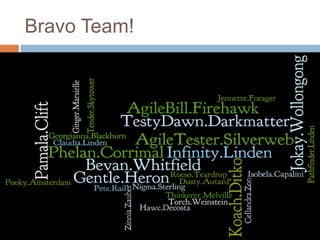
Bravo Team!
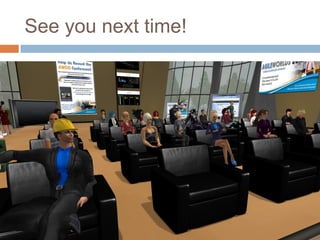
See you next time!

Save 76 percent - a Case Study of a Virtual Conference

  • 1.
    SAVE 76% AGILE DIMENSIONS CASE STUDY A VIRTUAL MICRO CONFERENCE: AGILE WORLDS - JANUARY 2010” AgileBill Firehawk, Jokay Wollongong, Pamala Clift, Phelan Corrimal AgileBill Firehawk / Krebs, CEO Agile Dimensions LLC © 2010, Agile Dimensions LLC In partnership with Rockcliffe University Consortium
  • 2.
    Context  May 2009  Second Life™ was selected as business critical tool by AgileBill‟s consulting company  To reach new clients  To save travel cost and, more importantly, time  To teach *better* using immersive techniques  Other virtual world tools have targed uses  January 2010  Hosted a business conference
  • 3.
  • 4.
  • 5.
    Cost Benefit Value Delivered Savings Attendees 35 Face to Face cost $35,695 Education Hours 200 Minus Virtual Costs ($8,567) Week‟s Web Clicks 1,330 Net Savings $27,128 Green 27.0 Tons of Co2 Saved Intangible benefits include organizational experience, and network building Expenses for virtual was 24% of face to face
  • 6.
  • 7.
    Analysis Footnotes  The analysis accounts for combined costs for both  Care has been taken not to overstate the savings of attendees and the hosting organization. If different using virtual worlds. companies pay for each, most of the cost benefits go  We assume 3 hours of training is required per to the attendees from travel time and cost savings. attendee. For future events this would be zero The benefits to the hosting organization is the ability to appeal to attendees who have little travel budget after  We include the cost of specialists for marketing they become open to using virtual worlds for business. work. Similar costs may be useful for face to face but are assumed to be zero.  Is 3d web almost as good as face to face? Or is it *better*? You can network more quickly through  For face to face, we assume 15% of the reading profiles and the use of „backchat‟. Immersive attendees would have been local and would not models can deliver better education. Intended body incur travel cost. language and some gestures can be shown. But it  Travel cost assumes US Domestic flights, even takes while to be comfortable using these techniques, though we had some international participation. so we assume face to face and 3d web benefits are similar.  Data taken from comparison of two actual events: Agile Worlds 2010 (virtual), and Agile Coach Camp  Labor costs are based on the “2009 Agile Practitioner 2010 (face to face) Salary Survey” by VersionOne and ASPE http://bit.ly/aspesalarysurvey which represents the  Volunteer Labor is used for both events. These target audience of this event. An average salary of people should be paid as the market matures. 99,000 was multiple by 1.2 for benefits  Carbon emissions assume 0.97 lbs of Co2 per air  Travel costs assume an average of 1,500 passenger passenger mile for an average of 1,500 miles for 30 miles (half way across the US), $350 for air, $210 for (out of 35) travelling attendees. A small amount was two nights of hotel and fees, $30 for meals, and $60 added from ground travel for face to face, and for ground transport. These numbers are increased use of electricity for the virtual event. conservative, especially since some attendees come from overseas.
  • 8.
    Benefit: Traffic Delivered Theevent brought web traffic Upsurge of 1,330 clicks Global potential, but English speaking for now (US, Canada, UK)
  • 9.
    Content comparable toface to face conference and delivered by the same experts
  • 10.
    Pros and Cons  Benefits  Challenges  Price Gap  Less time wasted travelling  Expectation in virtual worlds is free education  Less money wasted travelling  Expectation in physical world can  Greener be hundreds of dollars per day  Culture Gap  Takes an investment to orient  Turbo networking environment people to virtual world tools, and to  Able to create custom venues change perception of virtual worlds from questionable toy to mission  Possible to increase learning critical business tool through interactive techiniques  Labor Gap  Volunteers should eventually be paid for their hard work
  • 11.
    Lessons Learned  Apply the same project management principles you would for any mid sized project  Prepare risk mitigation plans for  Lossof voice  Cancelled speakers  Security  Screen and monitor attendees  Performance  Balance load on virtual venue tools
  • 12.
    Include Everybody  Make your event accessible  Transcribe for those without hearing  Build for those with poor motor control  Readable fonts for those with poor eyesight  International English and translators for diverse languages and culture  For wide ranges of virtual world familiarity  Consider world time zones  Pace the event to allow breaks
  • 13.
    Key Roles  The conference organizer will focus on content and building a team  Pair the conference organizer with a skilled virtual coach  Pair the speaker with a „wingman‟ to help with location, wardrobe, sound, and slides  Identify docents who can move the crowd
  • 14.
    Going Forward  Share  Learn  Be Green  Be Accessible Virtual worlds do not enhance life. They *are* life. Gentle Heron – VirtualAbility.org
  • 15.
    Read More AgileBillKrebs http://www.agiledimensions.com Dawn Cannan http://www.passionatetester.com Meadhbh Hamrick http://lindenlab.com Janet Gregory http://www.janetgregory.ca Alice Krueger http://www.virtualability.org Alan Atlas http://www.rallydev.com/agileblog/about/#alan-atlas Kevin Feenan http://www.urockcliffe.com Jo Kay http://jokaydia.com
  • 16.
  • 17.