AGILE SCRUM SUMMARY
KEY POINT
KienDN, 2018-Oct-29
Daongockien.vn@gmail.com
CONFIDENTIAL
Agenda
• Chapter 1: Scrum Theory and Concept
• Chapter 2: Scrum Roles
• Chapter 3: Scrum Artifacts & other glossaries
• Chapter 4: Scrum Events
• Chapter 5: Key Techniques
2
CONFIDENTIAL
SCRUM THEORY AND CONCEPT
Chapter 1
3
CONFIDENTIAL
Challenges in Software Development
• Requirements change
• Customers never knows exactly what they need
• Requirements are incomplete
• People rarely understand requirements from the beginning
• People make mistakes but it’s hard to fix them on the latter stages of development
• For most middle-to-large systems, it is hard (impossible) to design everything in
advance
4
CONFIDENTIAL
What customer really needs?
5
Plan?
UML
diagrams?
New
technology?
Design
documents?
Customer needs working software
that improves their business!
CONFIDENTIAL
AGILE MANIFESTO
6
CONFIDENTIAL
Scrum – At a Glance
7
Sprint length
Events 4 weeks 3 weeks 2 weeks 1 week
Sprint Planning 8 hr 6 hr 4 hr 2 hr
Daily Scrums 15 min 15 min 15 min 15 min
Sprint Review 4 hr 3 hr 2 hr 1 hr
Sprint Retrospective 3 hr 2.25 hr 1.5 hr 0.75 hr
• Iterative
• 3 roles
• 4 events
• Timebox
CONFIDENTIAL
SCRUM ROLES
Chapter 2
8
CONFIDENTIAL
The Scrum Team
9
There are three roles in a Scrum project; no less, and no more.
• 1 person
• Full-time or Part-time
• Business oriented
• 1 person
• Full-time or Part-time
• Scrum coach and
facilitator
• 3 to 9 people
• Full-time (recommended)
• Specialist
Other persons can also be involved in and potentially affect the project but they are not considered internal to the
project:
• Company manager
• Customer
• End user representative…
They are called Stakeholders
CONFIDENTIAL
So, Who is the Project Manager?
10
• There is no such role in Scrum
• None of the 3 roles of Scrum act as a traditional project manager.
• Some people consider the Scrum Master to be the equivalent to
traditional project manager; but it is not true
• The project management responsibilities are distributed among the
three roles of Scrum and there is no centralized project management
in Scrum
CONFIDENTIAL
SCRUM ARTIFACTS
Chapter 3
11
CONFIDENTIAL
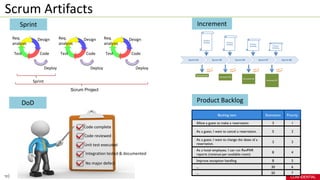
Scrum Artifacts
12
Req.
analysis
Design
CodeTest
Deploy
Sprint
Req.
analysis
Design
CodeTest
Deploy
Req.
analysis
Design
CodeTest
Deploy
Scrum Project
Sprint Increment
Code complete
Code reviewed
Unit test executed
Integration tested & documented
No major defect
DoD
Backlog item Estimation Priority
Allow a guest to make a reservation 3 1
As a guest, I want to cancel a reservation. 5 2
As a guest, I want to change the dates of a
reservation.
3 3
As a hotel employee, I can run RevPAR
reports (revenue-per-available-room)
8 4
Improve exception handling 8 5
... 30 6
... 50 7
Product Backlog
CONFIDENTIAL
Scrum Artifacts
13
Sprint Backlog Sprint Goal
Information Indicator Burndown chart
A short description (one or two
sentences) of what the team plans
to achieve during the sprint
CONFIDENTIAL
SCRUM EVENTS
Chapter 4
14
CONFIDENTIAL
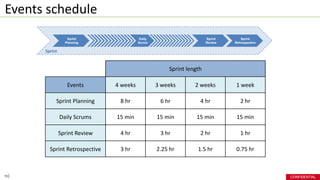
Events schedule
15
Sprint length
Events 4 weeks 3 weeks 2 weeks 1 week
Sprint Planning 8 hr 6 hr 4 hr 2 hr
Daily Scrums 15 min 15 min 15 min 15 min
Sprint Review 4 hr 3 hr 2 hr 1 hr
Sprint Retrospective 3 hr 2.25 hr 1.5 hr 0.75 hr
CONFIDENTIAL
Sprint planning
16
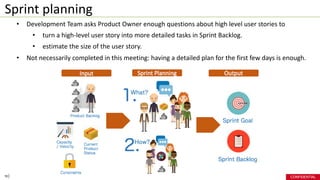
• Development Team asks Product Owner enough questions about high level user stories to
• turn a high-level user story into more detailed tasks in Sprint Backlog.
• estimate the size of the user story.
• Not necessarily completed in this meeting: having a detailed plan for the first few days is enough.
CONFIDENTIAL
Daily scrum
17
• What I did yesterday?
• What I plan to do today?
• What impediments are preventing progress?
CONFIDENTIAL
Sprint review
18
• Should be informal, no need to spend much time prepare nice documentations.
• Output of Sprint Review is updated Product Backlog
CONFIDENTIAL
Sprint retrospective
19
• Two main questions are asked in the sprint retrospective:
• What went well during the sprint?
• What could be improved in the next sprint?
CONFIDENTIAL
KEY TECHNIQUE
Chapter 5
20
CONFIDENTIAL
Key technique
21
• Estimation:
• Function point 1,2,3,5, 8, 13 (know how to handle) -> 13, 20, 40,
100 (undermined, story need to broken down)
• First, find an item that’s small in size, but not the smallest item—that’s
your first 2-point story.
• find another story that’s between 2x and 4x the size of your 2-point
story—that’s your first 5-point story.
• Sprint length
• Business, risk appetite, delivery frequency
• Overall length of release
• Uncertainty (change, technology stack, ..)
• Backlog transparency
• As A, I wanna to do smt at, … (5W).
• Make sure all member + stakeholder could clear abt backlog
CONFIDENTIAL
Key technique
22
• Epic vs Story vs Requirement Document = Requirement group vs
Requirement entry point vs Requirement
• Scope of work
• Make clear DoD, make clear task gradationally
• Change requirement during Sprint
• As taught, NO, but in fact in both theory and practice it is YES if
following condition is satisfied:
• Source of change: The change has been confirmed with the customer.
• Timing: The change has been identified at least X (2-3) days before the
end of sprint.
• Purpose: The change aligns well with the value proposition of a story in
the sprint
• Size: The change is small – up to X hours.
• Release
• Delivery frequently, since earlier stage, is a key point to get feedback
and success.
CONFIDENTIAL
Thank you!
Q&A
23

Agile scrum summary

  • 1.
    AGILE SCRUM SUMMARY KEYPOINT KienDN, 2018-Oct-29 Daongockien.vn@gmail.com
  • 2.
    CONFIDENTIAL Agenda • Chapter 1:Scrum Theory and Concept • Chapter 2: Scrum Roles • Chapter 3: Scrum Artifacts & other glossaries • Chapter 4: Scrum Events • Chapter 5: Key Techniques 2
  • 3.
    CONFIDENTIAL SCRUM THEORY ANDCONCEPT Chapter 1 3
  • 4.
    CONFIDENTIAL Challenges in SoftwareDevelopment • Requirements change • Customers never knows exactly what they need • Requirements are incomplete • People rarely understand requirements from the beginning • People make mistakes but it’s hard to fix them on the latter stages of development • For most middle-to-large systems, it is hard (impossible) to design everything in advance 4
  • 5.
    CONFIDENTIAL What customer reallyneeds? 5 Plan? UML diagrams? New technology? Design documents? Customer needs working software that improves their business!
  • 6.
  • 7.
    CONFIDENTIAL Scrum – Ata Glance 7 Sprint length Events 4 weeks 3 weeks 2 weeks 1 week Sprint Planning 8 hr 6 hr 4 hr 2 hr Daily Scrums 15 min 15 min 15 min 15 min Sprint Review 4 hr 3 hr 2 hr 1 hr Sprint Retrospective 3 hr 2.25 hr 1.5 hr 0.75 hr • Iterative • 3 roles • 4 events • Timebox
  • 8.
  • 9.
    CONFIDENTIAL The Scrum Team 9 Thereare three roles in a Scrum project; no less, and no more. • 1 person • Full-time or Part-time • Business oriented • 1 person • Full-time or Part-time • Scrum coach and facilitator • 3 to 9 people • Full-time (recommended) • Specialist Other persons can also be involved in and potentially affect the project but they are not considered internal to the project: • Company manager • Customer • End user representative… They are called Stakeholders
  • 10.
    CONFIDENTIAL So, Who isthe Project Manager? 10 • There is no such role in Scrum • None of the 3 roles of Scrum act as a traditional project manager. • Some people consider the Scrum Master to be the equivalent to traditional project manager; but it is not true • The project management responsibilities are distributed among the three roles of Scrum and there is no centralized project management in Scrum
  • 11.
  • 12.
    CONFIDENTIAL Scrum Artifacts 12 Req. analysis Design CodeTest Deploy Sprint Req. analysis Design CodeTest Deploy Req. analysis Design CodeTest Deploy Scrum Project SprintIncrement Code complete Code reviewed Unit test executed Integration tested & documented No major defect DoD Backlog item Estimation Priority Allow a guest to make a reservation 3 1 As a guest, I want to cancel a reservation. 5 2 As a guest, I want to change the dates of a reservation. 3 3 As a hotel employee, I can run RevPAR reports (revenue-per-available-room) 8 4 Improve exception handling 8 5 ... 30 6 ... 50 7 Product Backlog
  • 13.
    CONFIDENTIAL Scrum Artifacts 13 Sprint BacklogSprint Goal Information Indicator Burndown chart A short description (one or two sentences) of what the team plans to achieve during the sprint
  • 14.
  • 15.
    CONFIDENTIAL Events schedule 15 Sprint length Events4 weeks 3 weeks 2 weeks 1 week Sprint Planning 8 hr 6 hr 4 hr 2 hr Daily Scrums 15 min 15 min 15 min 15 min Sprint Review 4 hr 3 hr 2 hr 1 hr Sprint Retrospective 3 hr 2.25 hr 1.5 hr 0.75 hr
  • 16.
    CONFIDENTIAL Sprint planning 16 • DevelopmentTeam asks Product Owner enough questions about high level user stories to • turn a high-level user story into more detailed tasks in Sprint Backlog. • estimate the size of the user story. • Not necessarily completed in this meeting: having a detailed plan for the first few days is enough.
  • 17.
    CONFIDENTIAL Daily scrum 17 • WhatI did yesterday? • What I plan to do today? • What impediments are preventing progress?
  • 18.
    CONFIDENTIAL Sprint review 18 • Shouldbe informal, no need to spend much time prepare nice documentations. • Output of Sprint Review is updated Product Backlog
  • 19.
    CONFIDENTIAL Sprint retrospective 19 • Twomain questions are asked in the sprint retrospective: • What went well during the sprint? • What could be improved in the next sprint?
  • 20.
  • 21.
    CONFIDENTIAL Key technique 21 • Estimation: •Function point 1,2,3,5, 8, 13 (know how to handle) -> 13, 20, 40, 100 (undermined, story need to broken down) • First, find an item that’s small in size, but not the smallest item—that’s your first 2-point story. • find another story that’s between 2x and 4x the size of your 2-point story—that’s your first 5-point story. • Sprint length • Business, risk appetite, delivery frequency • Overall length of release • Uncertainty (change, technology stack, ..) • Backlog transparency • As A, I wanna to do smt at, … (5W). • Make sure all member + stakeholder could clear abt backlog
  • 22.
    CONFIDENTIAL Key technique 22 • Epicvs Story vs Requirement Document = Requirement group vs Requirement entry point vs Requirement • Scope of work • Make clear DoD, make clear task gradationally • Change requirement during Sprint • As taught, NO, but in fact in both theory and practice it is YES if following condition is satisfied: • Source of change: The change has been confirmed with the customer. • Timing: The change has been identified at least X (2-3) days before the end of sprint. • Purpose: The change aligns well with the value proposition of a story in the sprint • Size: The change is small – up to X hours. • Release • Delivery frequently, since earlier stage, is a key point to get feedback and success.
  • 23.