Introduction to Agile
Who am I? Software Practitioner & Evangelist 13 years of building software and learning Certified Scrum Master Lead Impetus Labs, Consulting and Research I am available for  Speaking on Technology & Agile Help & Support your Agile journey (e)  [email_address] (m) 931 310 2111
Agenda Introduction to Agile Lets begin by having fun.. History of evolution What is Agile? What Agile is NOT Common myths and misconceptions
Lets Have Some Fun … Need a few volunteers Clearing the Obstacle Course – Strategy 1 Our volunteers will be working in a team 1 Manager and other workers Worker cannot do anything on his own, he has to verbatim follow the instructions of the Manager Goal of the team is to clear the obstacle course Please observe them as they go through different the obstacle course Productivity (Individual & Overall) Happiness Ability to react to impediments
Lets Have Some Fun … Clearing the Obstacle Course – Strategy 2 Our volunteers will be own their own Goal of the volunteers is to clear the obstacle course Please observe them as they go through the obstacle course Productivity (Individual & Overall) Happiness Ability to react to impediments
Evolution Agile is evolutionary not revolutionary The context of developing software is changing Technology driven business innovation Dynamic Market conditions Time to Market Requirement Stability What does it mean for software development? You cant win a 20-20 game with a test match strategy
Some facts … 1995 : The CHAOS Report ** Type 1 : Project Success  On time on budget, all features are delivered ( 16.2% ) Type 2 : Project Challenged  Completed and operational but over budget, fewer features than specified (52.7%) Type 3 : Project Impaired  Cancelled at some stage (31.1%) **Tom Clancy 1995 | The Standish Group International
Some facts … Traditional Processes were not helping  Customers unhappy Requirement Changes are dealt through risk avoidance strategy i.e resist requirement change Eliminating change means business failure So ? These led to evolutions in the way we approach software development
Introducing Agile The BRAVE new way of developing software Don’t avoid risk, take it as unavoidable and accept it Requirement Changes are dealt through risk acceptance strategy
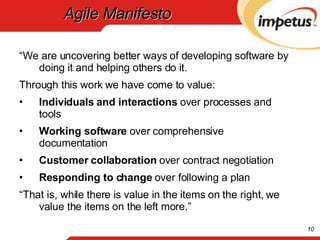
Agile Manifesto “ We are uncovering better ways of developing software by doing it and helping others do it. Through this work we have come to value: Individuals and interactions  over processes and tools Working software  over comprehensive documentation Customer collaboration  over contract negotiation Responding to change  over following a plan “ That is, while there is value in the items on the right, we value the items on the left more.”
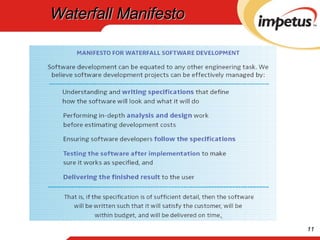
Waterfall Manifesto
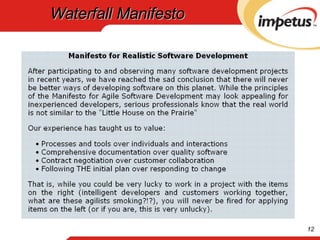
Waterfall Manifesto
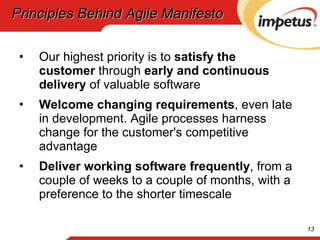
Principles Behind Agile Manifesto Our highest priority is to  satisfy the customer  through  early and continuous delivery  of valuable software Welcome changing requirements , even late in development. Agile processes harness change for the customer's competitive advantage Deliver working software frequently , from a couple of weeks to a couple of months, with a preference to the shorter timescale
Principles Behind Agile Manifesto Business people and developers must work together daily  throughout the project Build projects around  motivated individuals . Give them the  environment and support  they need, and  trust  them to get the job done The most  efficient and effective method of conveying information  to and within a development team is  face-to-face conversation Working software  is the primary measure of  progress
Principles Behind Agile Manifesto Agile processes  promote sustainable development . The sponsors, developers, and users should be able to  maintain a constant pace  indefinitely Continuous attention to  technical excellence  and good design enhances agility Simplicity- -the art of maximizing the amount of work not done--is essential. The best architectures, requirements, and designs emerge from  self-organizing  teams. At  regular intervals, the team reflects  on how to become more effective, then tunes and adjusts its behavior accordingly.
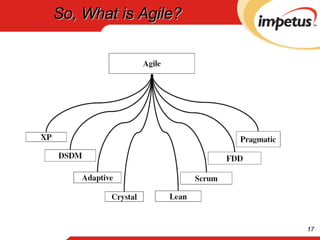
So, What is Agile? Simply Stating … It a way of developing software that follows the Agile Principles There are a number of agile software development methods; most attempt to  minimize risk by developing software in short timeboxes, called iterations, which typically last one to four weeks Each iteration is like a miniature software project of its own, and includes all of the tasks necessary to release the mini-increment of new functionality: planning, requirements analysis, design, coding, testing, and documentation
So, What is Agile?
Myths & Misconceptions Agile methods are sometimes characterized as being at the opposite end of the spectrum from "plan-driven" or "disciplined" methodologies This distinction is misleading, as it implies that agile methods are "unplanned" or "undisciplined“ A more accurate distinction is to say that methods exist on a continuum from "adaptive" to "predictive” Adaptive methods focus on adapting quickly to changing realities When the needs of a project change, an adaptive team changes as well An adaptive team will have difficulty describing exactly what will happen in the future. The further away a date is, the more vague an adaptive method will be about what will happen on that date An adaptive team can report exactly what tasks are being done next week, but only which features are planned for next month. When asked about a release six months from now, an adaptive team may only be able to report the mission statement for the release, or a statement of expected value vs. cost.
Myths & Misconceptions Predictive methods, in contrast, focus on planning the future in detail A predictive team can report exactly what features and tasks are planned for the entire length of the development process Predictive teams have difficulty changing direction The plan is typically optimized for the original destination and changing direction can cause completed work to be thrown away and done over differently Predictive teams will often institute a change control board to ensure that only the most valuable changes are considered
Myths & Misconceptions Agile methods v/s CMM/CMMi CMM/CMMi is NOT a method or a process model It is a reference process benchmark CMM/CMMi don’t prescribe what process (for developing software that is) to use Agile Software Development process can be benchmarked on CMM/CMMi models Initial, Managed, Defined, Quantitively Managed & Optimizing
Myths & Misconceptions Agile __________ Is a silver bullet Will solve my resource issues Has no planning/ documentation/architecture/ <insert pet peeve> Is a license to hack Creates quality issues Is undisciplined Doesn’t build on my previous experience / expertise Is not proven Is not being used by industry leaders
Thank You Questions?

Introduction To Agile

  • 1.
  • 2.
    Who am I?Software Practitioner & Evangelist 13 years of building software and learning Certified Scrum Master Lead Impetus Labs, Consulting and Research I am available for Speaking on Technology & Agile Help & Support your Agile journey (e) [email_address] (m) 931 310 2111
  • 3.
    Agenda Introduction toAgile Lets begin by having fun.. History of evolution What is Agile? What Agile is NOT Common myths and misconceptions
  • 4.
    Lets Have SomeFun … Need a few volunteers Clearing the Obstacle Course – Strategy 1 Our volunteers will be working in a team 1 Manager and other workers Worker cannot do anything on his own, he has to verbatim follow the instructions of the Manager Goal of the team is to clear the obstacle course Please observe them as they go through different the obstacle course Productivity (Individual & Overall) Happiness Ability to react to impediments
  • 5.
    Lets Have SomeFun … Clearing the Obstacle Course – Strategy 2 Our volunteers will be own their own Goal of the volunteers is to clear the obstacle course Please observe them as they go through the obstacle course Productivity (Individual & Overall) Happiness Ability to react to impediments
  • 6.
    Evolution Agile isevolutionary not revolutionary The context of developing software is changing Technology driven business innovation Dynamic Market conditions Time to Market Requirement Stability What does it mean for software development? You cant win a 20-20 game with a test match strategy
  • 7.
    Some facts …1995 : The CHAOS Report ** Type 1 : Project Success On time on budget, all features are delivered ( 16.2% ) Type 2 : Project Challenged Completed and operational but over budget, fewer features than specified (52.7%) Type 3 : Project Impaired Cancelled at some stage (31.1%) **Tom Clancy 1995 | The Standish Group International
  • 8.
    Some facts …Traditional Processes were not helping Customers unhappy Requirement Changes are dealt through risk avoidance strategy i.e resist requirement change Eliminating change means business failure So ? These led to evolutions in the way we approach software development
  • 9.
    Introducing Agile TheBRAVE new way of developing software Don’t avoid risk, take it as unavoidable and accept it Requirement Changes are dealt through risk acceptance strategy
  • 10.
    Agile Manifesto “We are uncovering better ways of developing software by doing it and helping others do it. Through this work we have come to value: Individuals and interactions over processes and tools Working software over comprehensive documentation Customer collaboration over contract negotiation Responding to change over following a plan “ That is, while there is value in the items on the right, we value the items on the left more.”
  • 11.
  • 12.
  • 13.
    Principles Behind AgileManifesto Our highest priority is to satisfy the customer through early and continuous delivery of valuable software Welcome changing requirements , even late in development. Agile processes harness change for the customer's competitive advantage Deliver working software frequently , from a couple of weeks to a couple of months, with a preference to the shorter timescale
  • 14.
    Principles Behind AgileManifesto Business people and developers must work together daily throughout the project Build projects around motivated individuals . Give them the environment and support they need, and trust them to get the job done The most efficient and effective method of conveying information to and within a development team is face-to-face conversation Working software is the primary measure of progress
  • 15.
    Principles Behind AgileManifesto Agile processes promote sustainable development . The sponsors, developers, and users should be able to maintain a constant pace indefinitely Continuous attention to technical excellence and good design enhances agility Simplicity- -the art of maximizing the amount of work not done--is essential. The best architectures, requirements, and designs emerge from self-organizing teams. At regular intervals, the team reflects on how to become more effective, then tunes and adjusts its behavior accordingly.
  • 16.
    So, What isAgile? Simply Stating … It a way of developing software that follows the Agile Principles There are a number of agile software development methods; most attempt to minimize risk by developing software in short timeboxes, called iterations, which typically last one to four weeks Each iteration is like a miniature software project of its own, and includes all of the tasks necessary to release the mini-increment of new functionality: planning, requirements analysis, design, coding, testing, and documentation
  • 17.
  • 18.
    Myths & MisconceptionsAgile methods are sometimes characterized as being at the opposite end of the spectrum from &quot;plan-driven&quot; or &quot;disciplined&quot; methodologies This distinction is misleading, as it implies that agile methods are &quot;unplanned&quot; or &quot;undisciplined“ A more accurate distinction is to say that methods exist on a continuum from &quot;adaptive&quot; to &quot;predictive” Adaptive methods focus on adapting quickly to changing realities When the needs of a project change, an adaptive team changes as well An adaptive team will have difficulty describing exactly what will happen in the future. The further away a date is, the more vague an adaptive method will be about what will happen on that date An adaptive team can report exactly what tasks are being done next week, but only which features are planned for next month. When asked about a release six months from now, an adaptive team may only be able to report the mission statement for the release, or a statement of expected value vs. cost.
  • 19.
    Myths & MisconceptionsPredictive methods, in contrast, focus on planning the future in detail A predictive team can report exactly what features and tasks are planned for the entire length of the development process Predictive teams have difficulty changing direction The plan is typically optimized for the original destination and changing direction can cause completed work to be thrown away and done over differently Predictive teams will often institute a change control board to ensure that only the most valuable changes are considered
  • 20.
    Myths & MisconceptionsAgile methods v/s CMM/CMMi CMM/CMMi is NOT a method or a process model It is a reference process benchmark CMM/CMMi don’t prescribe what process (for developing software that is) to use Agile Software Development process can be benchmarked on CMM/CMMi models Initial, Managed, Defined, Quantitively Managed & Optimizing
  • 21.
    Myths & MisconceptionsAgile __________ Is a silver bullet Will solve my resource issues Has no planning/ documentation/architecture/ <insert pet peeve> Is a license to hack Creates quality issues Is undisciplined Doesn’t build on my previous experience / expertise Is not proven Is not being used by industry leaders
  • 22.