SCRUMTRAINING
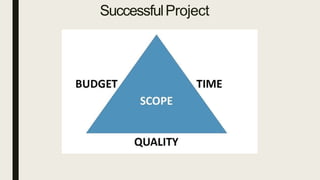
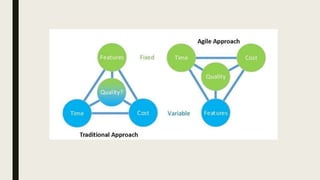
SuccessfulProject
Traditional
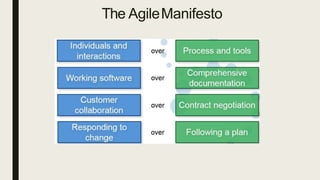
The AgileManifesto
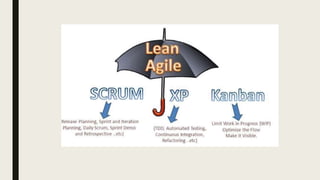
Agile Principles
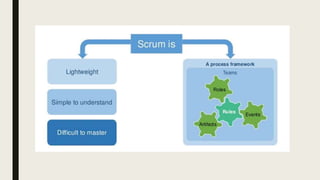
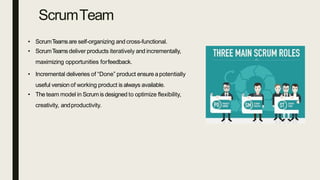
• ScrumTeamsare self-organizing and cross-functional.
• ScrumTeamsdeliver products iteratively and incrementally,
maximizing opportunities forfeedback.
• Incremental deliveries of “Done” product ensure apotentially
useful version of working product is always available.
• The team model in Scrum is designed to optimize flexibility,
creativity, andproductivity.
ScrumTeam
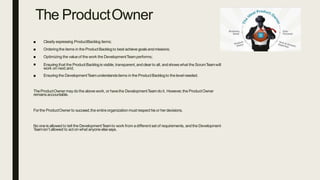
The ProductOwner
Orderingthe items in the ProductBacklogto best achieve goalsandmissions;
■ Clearly expressing ProductBacklog items;
■
■
■
Optimizing the valueof the work the DevelopmentTeamperforms;
Ensuring that the ProductBacklogis visible, transparent,andclearto all, andshowswhat the ScrumTeamwill
work on next;and,
■ Ensuring the DevelopmentTeamunderstandsitems in the ProductBacklogto the level needed.
TheProductOwner maydo the above work, or havethe DevelopmentTeamdoit. However,the ProductOwner
remainsaccountable.
Forthe ProductOwnerto succeed,the entireorganizationmust respect hisor herdecisions.
No oneis allowed to tell the DevelopmentTeamto work from adifferent set of requirements, andthe Development
Teamisn’t allowed to act on what anyone elsesays.
The ScrumMaster
• TheScrum Master is responsible for ensuring Scrum is understood and enacted.
• Scrum Masters do this by ensuring that the ScrumTeam adheres to Scrum theory, practices, and rules.
Responsible for enactingScrum values and practices
• TheScrum Master is aservant-leader for the ScrumTeam.
• TheScrum Master helps those outside the ScrumTeam understand which of their interactions with the
ScrumTeam are helpful and which aren’t.
• Removes impediments
• Ensure that the team is fully functional and productive
• Power of Scrum
• ScrumGuide
The DevelopmentTeam
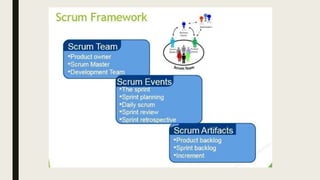
• TheDevelopmentTeamconsists of professionals who do the work of deliveringapotentially releasableIncrement of “Done” product at the
end ofeachSprint.
• TeamSize:
• Fewerthan 3DevelopmentTeammembers decreaseinteraction andresultsinsmallerproductivitygains.SmallerDevelopmentTeams
may encounterskill constraints during the Sprint, causing the Development Team to beunable to deliver a potentiallyreleasable
Increment.
• Havingmorethan 9 members requirestoo muchcoordination.Large DevelopmentTeamsgeneratetoomuchcomplexityforan empirical
process tomanage.
• Cross-functional:
• Programmers, testers,userexperiencedesigners,etc.butaccountabilitybelongs totheDevelopmentTeamas a whole.
• No sub-teams
• Teamsareself-organizing
• Ideally,no titlesbutrarelya possibility(developer)
ScrumEvents
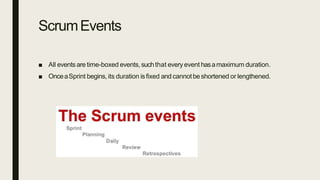
■ All eventsare time-boxed events,suchthat every event hasamaximum duration.
■ OnceaSprint begins,its duration isfixed and cannotbe shortened or lengthened.
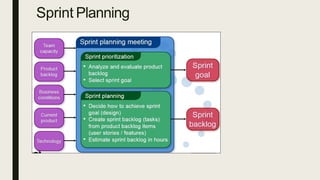
Sprint Planning
• Teamselectsitems from the product backlog they cancommit to completing
• Sprint backlog iscreated
• Tasksareidentifiedand each isestimated
• Collaboratively,not done alone bytheScrum Master
• High-level design isconsidered
Sprint Planning
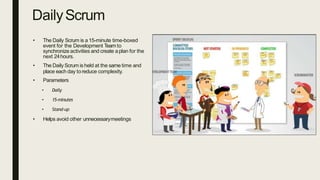
DailyScrum
• The Daily Scrum is a15-minute time-boxed
event for the Development Team to
synchronize activities and create aplan for the
next 24hours.
• The Daily Scrum is held at the same time and
place each day toreduce complexity.
• Parameters
• Daily
• 15-minutes
• Stand-up
• Helps avoid other unnecessarymeetings
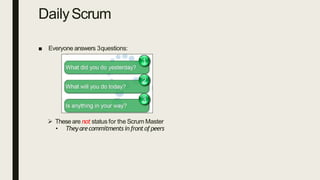
DailyScrum
■ Everyone answers 3questions:
 Theseare notstatus for the Scrum Master
• Theyarecommitments infrontofpeers
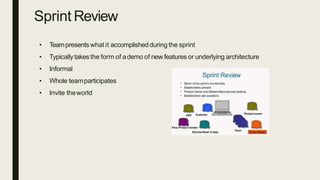
Sprint Review
• Teampresents what it accomplishedduring the sprint
• Typicallytakes the form of ademo of new features or underlying architecture
• Informal
• Whole teamparticipates
• Invite theworld
Sprint Retrospective
■ Periodically take alook at what is and isnot working
■ Max. 3hours for 1monthsprints
■ Done after everysprint
■ Whole teamparticipates
– Scrum Master
– Productowner
– Team
– Possibly customers andothers
■ Start /Stop/Continue
This is just one of
many ways to do a
sprint
retrospective.
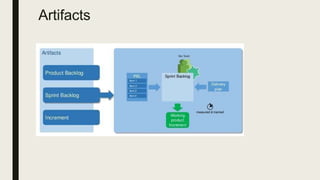
Artifacts
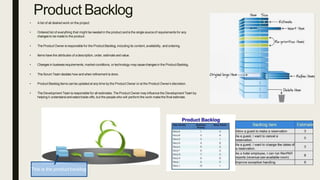
Product Backlog
• A list of all desired work on the project
• Ordered list of everything that might beneeded in the product andis the single sourceof requirements for any
changesto bemadeto the product.
• TheProduct Owner is responsible for the Product Backlog, including its content, availability, andordering.
• Items have the attributes of adescription, order, estimate andvalue.
• Changesin businessrequirements, market conditions, or technology maycausechangesin the Product Backlog.
• TheScrumTeam decides how andwhen refinement is done.
• Product Backlog items canbeupdatedat any time by the Product Owner or at the Product Owner’s discretion.
• TheDevelopment Team is responsible for all estimates.TheProduct Owner may influence the Development Team by
helping it understand andselect trade-offs, but the people who will perform the work makethe final estimate.
This is the product backlog
Sprint Backlog
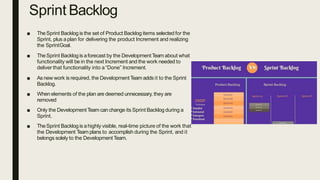
■ TheSprint Backlog is the set of Product Backlog items selected for the
Sprint, plus a plan for delivering the product Increment and realizing
the SprintGoal.
■ TheSprint Backlog is aforecast by the DevelopmentTeam about what
functionality will be in the next Increment and the work needed to
deliver that functionality into a“Done” Increment.
■ Asnew work is required, the DevelopmentTeam adds it to the Sprint
Backlog.
■ When elements of the plan are deemed unnecessary, they are
removed
■ Only the DevelopmentTeam can change its Sprint Backlog during a
Sprint.
■ TheSprint Backlog is ahighly visible, real-time picture of the work that
the Development Team plans to accomplish during the Sprint, and it
belongs solely to the DevelopmentTeam.
Increment
■ TheIncrement is the sumof all the Product Backlogitems completed during aSprint
and the value of the increments of all previousSprints.
■ At the end of aSprint, the new Increment must be “Done,” which meansit must be in
useablecondition and meet the ScrumTeam’sdefinition of “Done.”

Agile_PPT1.pptx

  • 1.
  • 3.
  • 6.
  • 9.
  • 11.
  • 18.
    • ScrumTeamsare self-organizingand cross-functional. • ScrumTeamsdeliver products iteratively and incrementally, maximizing opportunities forfeedback. • Incremental deliveries of “Done” product ensure apotentially useful version of working product is always available. • The team model in Scrum is designed to optimize flexibility, creativity, andproductivity. ScrumTeam
  • 19.
    The ProductOwner Orderingthe itemsin the ProductBacklogto best achieve goalsandmissions; ■ Clearly expressing ProductBacklog items; ■ ■ ■ Optimizing the valueof the work the DevelopmentTeamperforms; Ensuring that the ProductBacklogis visible, transparent,andclearto all, andshowswhat the ScrumTeamwill work on next;and, ■ Ensuring the DevelopmentTeamunderstandsitems in the ProductBacklogto the level needed. TheProductOwner maydo the above work, or havethe DevelopmentTeamdoit. However,the ProductOwner remainsaccountable. Forthe ProductOwnerto succeed,the entireorganizationmust respect hisor herdecisions. No oneis allowed to tell the DevelopmentTeamto work from adifferent set of requirements, andthe Development Teamisn’t allowed to act on what anyone elsesays.
  • 20.
    The ScrumMaster • TheScrumMaster is responsible for ensuring Scrum is understood and enacted. • Scrum Masters do this by ensuring that the ScrumTeam adheres to Scrum theory, practices, and rules. Responsible for enactingScrum values and practices • TheScrum Master is aservant-leader for the ScrumTeam. • TheScrum Master helps those outside the ScrumTeam understand which of their interactions with the ScrumTeam are helpful and which aren’t. • Removes impediments • Ensure that the team is fully functional and productive • Power of Scrum • ScrumGuide
  • 21.
    The DevelopmentTeam • TheDevelopmentTeamconsistsof professionals who do the work of deliveringapotentially releasableIncrement of “Done” product at the end ofeachSprint. • TeamSize: • Fewerthan 3DevelopmentTeammembers decreaseinteraction andresultsinsmallerproductivitygains.SmallerDevelopmentTeams may encounterskill constraints during the Sprint, causing the Development Team to beunable to deliver a potentiallyreleasable Increment. • Havingmorethan 9 members requirestoo muchcoordination.Large DevelopmentTeamsgeneratetoomuchcomplexityforan empirical process tomanage. • Cross-functional: • Programmers, testers,userexperiencedesigners,etc.butaccountabilitybelongs totheDevelopmentTeamas a whole. • No sub-teams • Teamsareself-organizing • Ideally,no titlesbutrarelya possibility(developer)
  • 22.
    ScrumEvents ■ All eventsaretime-boxed events,suchthat every event hasamaximum duration. ■ OnceaSprint begins,its duration isfixed and cannotbe shortened or lengthened.
  • 23.
    Sprint Planning • Teamselectsitemsfrom the product backlog they cancommit to completing • Sprint backlog iscreated • Tasksareidentifiedand each isestimated • Collaboratively,not done alone bytheScrum Master • High-level design isconsidered
  • 24.
  • 25.
    DailyScrum • The DailyScrum is a15-minute time-boxed event for the Development Team to synchronize activities and create aplan for the next 24hours. • The Daily Scrum is held at the same time and place each day toreduce complexity. • Parameters • Daily • 15-minutes • Stand-up • Helps avoid other unnecessarymeetings
  • 26.
    DailyScrum ■ Everyone answers3questions:  Theseare notstatus for the Scrum Master • Theyarecommitments infrontofpeers
  • 27.
    Sprint Review • Teampresentswhat it accomplishedduring the sprint • Typicallytakes the form of ademo of new features or underlying architecture • Informal • Whole teamparticipates • Invite theworld
  • 28.
    Sprint Retrospective ■ Periodicallytake alook at what is and isnot working ■ Max. 3hours for 1monthsprints ■ Done after everysprint ■ Whole teamparticipates – Scrum Master – Productowner – Team – Possibly customers andothers ■ Start /Stop/Continue This is just one of many ways to do a sprint retrospective.
  • 29.
  • 30.
    Product Backlog • Alist of all desired work on the project • Ordered list of everything that might beneeded in the product andis the single sourceof requirements for any changesto bemadeto the product. • TheProduct Owner is responsible for the Product Backlog, including its content, availability, andordering. • Items have the attributes of adescription, order, estimate andvalue. • Changesin businessrequirements, market conditions, or technology maycausechangesin the Product Backlog. • TheScrumTeam decides how andwhen refinement is done. • Product Backlog items canbeupdatedat any time by the Product Owner or at the Product Owner’s discretion. • TheDevelopment Team is responsible for all estimates.TheProduct Owner may influence the Development Team by helping it understand andselect trade-offs, but the people who will perform the work makethe final estimate. This is the product backlog
  • 31.
    Sprint Backlog ■ TheSprintBacklog is the set of Product Backlog items selected for the Sprint, plus a plan for delivering the product Increment and realizing the SprintGoal. ■ TheSprint Backlog is aforecast by the DevelopmentTeam about what functionality will be in the next Increment and the work needed to deliver that functionality into a“Done” Increment. ■ Asnew work is required, the DevelopmentTeam adds it to the Sprint Backlog. ■ When elements of the plan are deemed unnecessary, they are removed ■ Only the DevelopmentTeam can change its Sprint Backlog during a Sprint. ■ TheSprint Backlog is ahighly visible, real-time picture of the work that the Development Team plans to accomplish during the Sprint, and it belongs solely to the DevelopmentTeam.
  • 32.
    Increment ■ TheIncrement isthe sumof all the Product Backlogitems completed during aSprint and the value of the increments of all previousSprints. ■ At the end of aSprint, the new Increment must be “Done,” which meansit must be in useablecondition and meet the ScrumTeam’sdefinition of “Done.”