STRICTLY PRIVATE AND CONFIDENTIAL – DO NOT FURTHER DISTRIBUTE
Scrum
STRICTLY PRIVATE AND CONFIDENTIAL – DO NOT FURTHER DISTRIBUTE
2
Why Scrum?
What is Scrum?
Scrum Artifacts?
Is it ready? Is it done?
Estimation!!!
The Scrum Team
The Scrum Events
Reports
Notes
Table of contents
STRICTLY PRIVATE AND CONFIDENTIAL – DO NOT FURTHER DISTRIBUTE
3
Why?
Why Scrum?
 Fast reaction to changing requirement “changes are welcome”
 1-4 weeks for sprint provide sense of urgency & reduce risk
 Shippable increment early and often
 Continues feedback cycle
 Productive meetings
 Transparency
 Clear goal, high focus
1
STRICTLY PRIVATE AND CONFIDENTIAL – DO NOT FURTHER DISTRIBUTE
4
What?
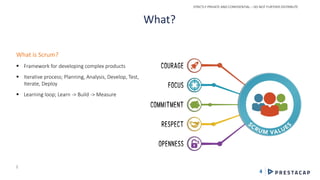
What is Scrum?
 Framework for developing complex products
 Iterative process; Planning, Analysis, Develop, Test,
Iterate, Deploy
 Learning loop; Learn -> Build -> Measure
1
STRICTLY PRIVATE AND CONFIDENTIAL – DO NOT FURTHER DISTRIBUTE
5
Scrum Artifacts
Product Backlog
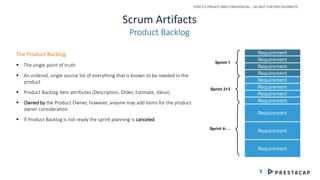
The Product Backlog
 The single point of truth
 An ordered, single source list of everything that is known to be needed in the
product
 Product Backlog item attributes (Description, Order, Estimate, Value)
 Owned by the Product Owner, however, anyone may add items for the product
owner consideration
 If Product Backlog is not ready the sprint planning is canceled
STRICTLY PRIVATE AND CONFIDENTIAL – DO NOT FURTHER DISTRIBUTE
6
Product Backlog
Definition of Ready & Done
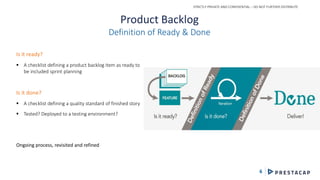
Is it ready?
 A checklist defining a product backlog item as ready to
be included sprint planning
Is it done?
 A checklist defining a quality standard of finished story
 Tested? Deployed to a testing environment?
Ongoing process, revisited and refined
STRICTLY PRIVATE AND CONFIDENTIAL – DO NOT FURTHER DISTRIBUTE
7
Scrum Artifacts
Sprint Backlog
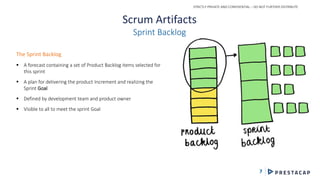
The Sprint Backlog
 A forecast containing a set of Product Backlog items selected for
this sprint
 A plan for delivering the product Increment and realizing the
Sprint Goal
 Defined by development team and product owner
 Visible to all to meet the sprint Goal
STRICTLY PRIVATE AND CONFIDENTIAL – DO NOT FURTHER DISTRIBUTE
8
Estimation
In Scrum, an estimate is one of four attributes of a Product Backlog item,
just like value, description and order
Why Estimate? It’s hard
 Estimation serve to achieve Transparency, Inspection, Reduce uncertainty
 It’s Time consuming! It could be that we are doing it on too much of a micro level
 I need more information! The more teams fear wrong estimations, the more time
consuming and frustrating it is to achieve estimates. To this I can only say that
estimates are always uncertain
 By using estimated (complexity and/or value) we can measure how much can be
completed each Sprint
 Just get it done in time mindset generally results in just bad product done too late
https://medium.com/serious-scrum/estimation-103de626551e, https://www.scrum.org/resources/blog/what-scrum-says-about-estimates,
STRICTLY PRIVATE AND CONFIDENTIAL – DO NOT FURTHER DISTRIBUTE
9
Estimation
Story point VS. Hours?
 Traditional teams give estimates in a time format: days, weeks, months
 Agile teams use story points. rate the effort in a Fibonacci-like format: 0, 0.5, 1, 2,
3, 5, 8, 13, 20, 40, 100
Why used use story points?
 Dates don’t account for the non-project related work emails, meetings … etc
 Story points reward team members for solving problems based on difficulty, not
time spent. This keeps team members focused on shipping value, not spending
time
 Team velocity will be measured which makes it impossible to play politics using
velocity as a weapon
https://www.atlassian.com/agile/project-management/estimation, https://medium.com/@mdalmijn/12-common-mistakes-made-when-using-
story-points-f0bb9212d2f7,
STRICTLY PRIVATE AND CONFIDENTIAL – DO NOT FURTHER DISTRIBUTE
10
Estimation
Story point, but How?
How do we estimate using story points?
 Using an exercise called planning poker
 The team will take an item from the backlog, discuss it briefly, each
member will mentally formulate an estimate.
 Then everyone holds up a card with the number that reflects their
estimate
 If there is a big difference take some time to understand why
https://www.atlassian.com/agile/project-management/estimation,
STRICTLY PRIVATE AND CONFIDENTIAL – DO NOT FURTHER DISTRIBUTE
11
Estimation
From Story point to days, possible but not recommended
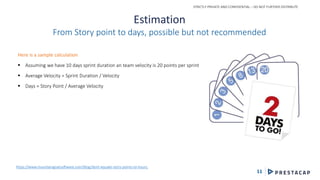
Here is a sample calculation
 Assuming we have 10 days sprint duration an team velocity is 20 points per sprint
 Average Velocity = Sprint Duration / Velocity
 Days = Story Point / Average Velocity
https://www.mountaingoatsoftware.com/blog/dont-equate-story-points-to-hours,
STRICTLY PRIVATE AND CONFIDENTIAL – DO NOT FURTHER DISTRIBUTE
12
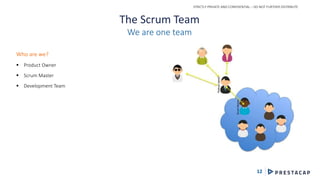
The Scrum Team
We are one team
Who are we?
 Product Owner
 Scrum Master
 Development Team
STRICTLY PRIVATE AND CONFIDENTIAL – DO NOT FURTHER DISTRIBUTE
13
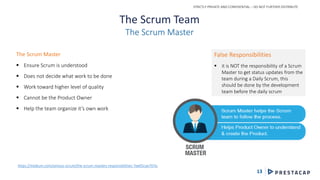
The Scrum Team
The Scrum Master
The Scrum Master
 Ensure Scrum is understood
 Does not decide what work to be done
 Work toward higher level of quality
 Cannot be the Product Owner
 Help the team organize it’s own work
False Responsibilities
 it is NOT the responsibility of a Scrum
Master to get status updates from the
team during a Daily Scrum, this
should be done by the development
team before the daily scrum
https://medium.com/serious-scrum/the-scrum-masters-responsibilities-7ee05cae707e,
STRICTLY PRIVATE AND CONFIDENTIAL – DO NOT FURTHER DISTRIBUTE
14
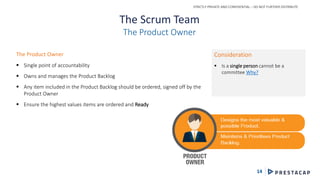
The Scrum Team
The Product Owner
The Product Owner
 Single point of accountability
 Owns and manages the Product Backlog
 Any item included in the Product Backlog should be ordered, signed off by the
Product Owner
 Ensure the highest values items are ordered and Ready
Consideration
 Is a single person cannot be a
committee Why?
STRICTLY PRIVATE AND CONFIDENTIAL – DO NOT FURTHER DISTRIBUTE
15
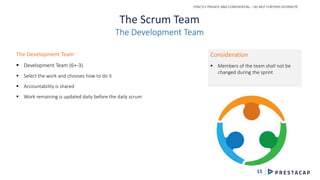
The Scrum Team
The Development Team
 Development Team (6+-3)
 Select the work and chooses how to do it
 Accountability is shared
 Work remaining is updated daily before the daily scrum
Consideration
 Members of the team shall not be
changed during the sprint
STRICTLY PRIVATE AND CONFIDENTIAL – DO NOT FURTHER DISTRIBUTE
16
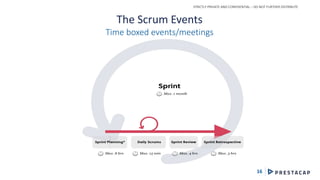
The Scrum Events
Time boxed events/meetings
STRICTLY PRIVATE AND CONFIDENTIAL – DO NOT FURTHER DISTRIBUTE
17
The Scrum Events
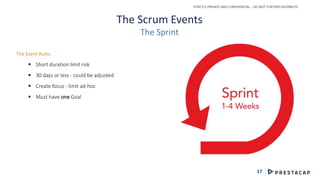
The Sprint
The Event Rules
 Short duration limit risk
 30 days or less - could be adjusted
 Create focus - limit ad-hoc
 Must have one Goal
STRICTLY PRIVATE AND CONFIDENTIAL – DO NOT FURTHER DISTRIBUTE
18
The Scrum Events
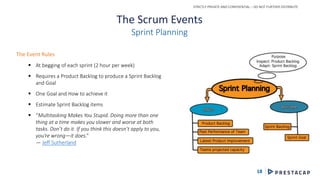
Sprint Planning
The Event Rules
 At begging of each sprint (2 hour per week)
 Requires a Product Backlog to produce a Sprint Backlog
and Goal
 One Goal and How to achieve it
 Estimate Sprint Backlog items
 “Multitasking Makes You Stupid. Doing more than one
thing at a time makes you slower and worse at both
tasks. Don’t do it. If you think this doesn’t apply to you,
you’re wrong—it does.”
― Jeff Sutherland
STRICTLY PRIVATE AND CONFIDENTIAL – DO NOT FURTHER DISTRIBUTE
19
The Scrum Events
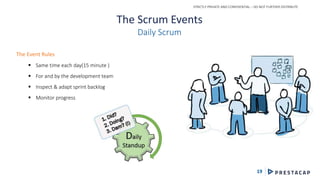
Daily Scrum
The Event Rules
 Same time each day(15 minute )
 For and by the development team
 Inspect & adapt sprint backlog
 Monitor progress
STRICTLY PRIVATE AND CONFIDENTIAL – DO NOT FURTHER DISTRIBUTE
20
The Scrum Events
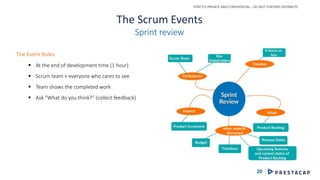
Sprint review
The Event Rules
 At the end of development time (1 hour)
 Scrum team + everyone who cares to see
 Team shows the completed work
 Ask “What do you think?” (collect feedback)
STRICTLY PRIVATE AND CONFIDENTIAL – DO NOT FURTHER DISTRIBUTE
21
The Scrum Events
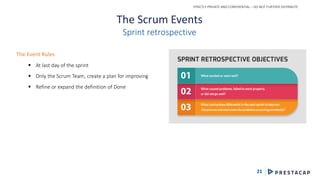
Sprint retrospective
The Event Rules
 At last day of the sprint
 Only the Scrum Team, create a plan for improving
 Refine or expand the definition of Done
STRICTLY PRIVATE AND CONFIDENTIAL – DO NOT FURTHER DISTRIBUTE
22
The Scrum Events
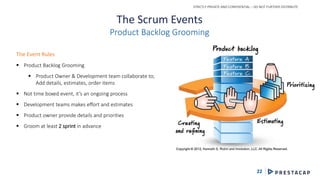
Product Backlog Grooming
The Event Rules
 Product Backlog Grooming
 Product Owner & Development team collaborate to;
Add details, estimates, order items
 Not time boxed event, it’s an ongoing process
 Development teams makes effort and estimates
 Product owner provide details and priorities
 Groom at least 2 sprint in advance
STRICTLY PRIVATE AND CONFIDENTIAL – DO NOT FURTHER DISTRIBUTE
23
The Scrum Events
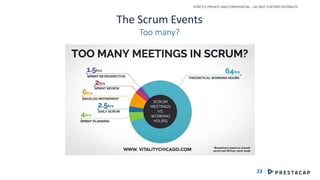
Too many?
STRICTLY PRIVATE AND CONFIDENTIAL – DO NOT FURTHER DISTRIBUTE
24
Reports
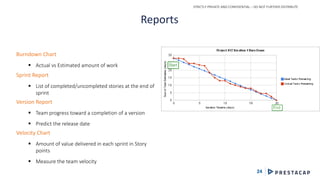
Burndown Chart
 Actual vs Estimated amount of work
Sprint Report
 List of completed/uncompleted stories at the end of
sprint
Version Report
 Team progress toward a completion of a version
 Predict the release date
Velocity Chart
 Amount of value delivered in each sprint in Story
points
 Measure the team velocity
STRICTLY PRIVATE AND CONFIDENTIAL – DO NOT FURTHER DISTRIBUTE
25
Final notes
What else?
 The tool, Trello is not good enough, JIRA?
 Cost? https://www.atlassian.com/software/jira/pricing
STRICTLY PRIVATE AND CONFIDENTIAL – DO NOT FURTHER DISTRIBUTE
www.prestacap.com
Questions?

Agile Scrum

  • 1.
    STRICTLY PRIVATE ANDCONFIDENTIAL – DO NOT FURTHER DISTRIBUTE Scrum
  • 2.
    STRICTLY PRIVATE ANDCONFIDENTIAL – DO NOT FURTHER DISTRIBUTE 2 Why Scrum? What is Scrum? Scrum Artifacts? Is it ready? Is it done? Estimation!!! The Scrum Team The Scrum Events Reports Notes Table of contents
  • 3.
    STRICTLY PRIVATE ANDCONFIDENTIAL – DO NOT FURTHER DISTRIBUTE 3 Why? Why Scrum?  Fast reaction to changing requirement “changes are welcome”  1-4 weeks for sprint provide sense of urgency & reduce risk  Shippable increment early and often  Continues feedback cycle  Productive meetings  Transparency  Clear goal, high focus 1
  • 4.
    STRICTLY PRIVATE ANDCONFIDENTIAL – DO NOT FURTHER DISTRIBUTE 4 What? What is Scrum?  Framework for developing complex products  Iterative process; Planning, Analysis, Develop, Test, Iterate, Deploy  Learning loop; Learn -> Build -> Measure 1
  • 5.
    STRICTLY PRIVATE ANDCONFIDENTIAL – DO NOT FURTHER DISTRIBUTE 5 Scrum Artifacts Product Backlog The Product Backlog  The single point of truth  An ordered, single source list of everything that is known to be needed in the product  Product Backlog item attributes (Description, Order, Estimate, Value)  Owned by the Product Owner, however, anyone may add items for the product owner consideration  If Product Backlog is not ready the sprint planning is canceled
  • 6.
    STRICTLY PRIVATE ANDCONFIDENTIAL – DO NOT FURTHER DISTRIBUTE 6 Product Backlog Definition of Ready & Done Is it ready?  A checklist defining a product backlog item as ready to be included sprint planning Is it done?  A checklist defining a quality standard of finished story  Tested? Deployed to a testing environment? Ongoing process, revisited and refined
  • 7.
    STRICTLY PRIVATE ANDCONFIDENTIAL – DO NOT FURTHER DISTRIBUTE 7 Scrum Artifacts Sprint Backlog The Sprint Backlog  A forecast containing a set of Product Backlog items selected for this sprint  A plan for delivering the product Increment and realizing the Sprint Goal  Defined by development team and product owner  Visible to all to meet the sprint Goal
  • 8.
    STRICTLY PRIVATE ANDCONFIDENTIAL – DO NOT FURTHER DISTRIBUTE 8 Estimation In Scrum, an estimate is one of four attributes of a Product Backlog item, just like value, description and order Why Estimate? It’s hard  Estimation serve to achieve Transparency, Inspection, Reduce uncertainty  It’s Time consuming! It could be that we are doing it on too much of a micro level  I need more information! The more teams fear wrong estimations, the more time consuming and frustrating it is to achieve estimates. To this I can only say that estimates are always uncertain  By using estimated (complexity and/or value) we can measure how much can be completed each Sprint  Just get it done in time mindset generally results in just bad product done too late https://medium.com/serious-scrum/estimation-103de626551e, https://www.scrum.org/resources/blog/what-scrum-says-about-estimates,
  • 9.
    STRICTLY PRIVATE ANDCONFIDENTIAL – DO NOT FURTHER DISTRIBUTE 9 Estimation Story point VS. Hours?  Traditional teams give estimates in a time format: days, weeks, months  Agile teams use story points. rate the effort in a Fibonacci-like format: 0, 0.5, 1, 2, 3, 5, 8, 13, 20, 40, 100 Why used use story points?  Dates don’t account for the non-project related work emails, meetings … etc  Story points reward team members for solving problems based on difficulty, not time spent. This keeps team members focused on shipping value, not spending time  Team velocity will be measured which makes it impossible to play politics using velocity as a weapon https://www.atlassian.com/agile/project-management/estimation, https://medium.com/@mdalmijn/12-common-mistakes-made-when-using- story-points-f0bb9212d2f7,
  • 10.
    STRICTLY PRIVATE ANDCONFIDENTIAL – DO NOT FURTHER DISTRIBUTE 10 Estimation Story point, but How? How do we estimate using story points?  Using an exercise called planning poker  The team will take an item from the backlog, discuss it briefly, each member will mentally formulate an estimate.  Then everyone holds up a card with the number that reflects their estimate  If there is a big difference take some time to understand why https://www.atlassian.com/agile/project-management/estimation,
  • 11.
    STRICTLY PRIVATE ANDCONFIDENTIAL – DO NOT FURTHER DISTRIBUTE 11 Estimation From Story point to days, possible but not recommended Here is a sample calculation  Assuming we have 10 days sprint duration an team velocity is 20 points per sprint  Average Velocity = Sprint Duration / Velocity  Days = Story Point / Average Velocity https://www.mountaingoatsoftware.com/blog/dont-equate-story-points-to-hours,
  • 12.
    STRICTLY PRIVATE ANDCONFIDENTIAL – DO NOT FURTHER DISTRIBUTE 12 The Scrum Team We are one team Who are we?  Product Owner  Scrum Master  Development Team
  • 13.
    STRICTLY PRIVATE ANDCONFIDENTIAL – DO NOT FURTHER DISTRIBUTE 13 The Scrum Team The Scrum Master The Scrum Master  Ensure Scrum is understood  Does not decide what work to be done  Work toward higher level of quality  Cannot be the Product Owner  Help the team organize it’s own work False Responsibilities  it is NOT the responsibility of a Scrum Master to get status updates from the team during a Daily Scrum, this should be done by the development team before the daily scrum https://medium.com/serious-scrum/the-scrum-masters-responsibilities-7ee05cae707e,
  • 14.
    STRICTLY PRIVATE ANDCONFIDENTIAL – DO NOT FURTHER DISTRIBUTE 14 The Scrum Team The Product Owner The Product Owner  Single point of accountability  Owns and manages the Product Backlog  Any item included in the Product Backlog should be ordered, signed off by the Product Owner  Ensure the highest values items are ordered and Ready Consideration  Is a single person cannot be a committee Why?
  • 15.
    STRICTLY PRIVATE ANDCONFIDENTIAL – DO NOT FURTHER DISTRIBUTE 15 The Scrum Team The Development Team The Development Team  Development Team (6+-3)  Select the work and chooses how to do it  Accountability is shared  Work remaining is updated daily before the daily scrum Consideration  Members of the team shall not be changed during the sprint
  • 16.
    STRICTLY PRIVATE ANDCONFIDENTIAL – DO NOT FURTHER DISTRIBUTE 16 The Scrum Events Time boxed events/meetings
  • 17.
    STRICTLY PRIVATE ANDCONFIDENTIAL – DO NOT FURTHER DISTRIBUTE 17 The Scrum Events The Sprint The Event Rules  Short duration limit risk  30 days or less - could be adjusted  Create focus - limit ad-hoc  Must have one Goal
  • 18.
    STRICTLY PRIVATE ANDCONFIDENTIAL – DO NOT FURTHER DISTRIBUTE 18 The Scrum Events Sprint Planning The Event Rules  At begging of each sprint (2 hour per week)  Requires a Product Backlog to produce a Sprint Backlog and Goal  One Goal and How to achieve it  Estimate Sprint Backlog items  “Multitasking Makes You Stupid. Doing more than one thing at a time makes you slower and worse at both tasks. Don’t do it. If you think this doesn’t apply to you, you’re wrong—it does.” ― Jeff Sutherland
  • 19.
    STRICTLY PRIVATE ANDCONFIDENTIAL – DO NOT FURTHER DISTRIBUTE 19 The Scrum Events Daily Scrum The Event Rules  Same time each day(15 minute )  For and by the development team  Inspect & adapt sprint backlog  Monitor progress
  • 20.
    STRICTLY PRIVATE ANDCONFIDENTIAL – DO NOT FURTHER DISTRIBUTE 20 The Scrum Events Sprint review The Event Rules  At the end of development time (1 hour)  Scrum team + everyone who cares to see  Team shows the completed work  Ask “What do you think?” (collect feedback)
  • 21.
    STRICTLY PRIVATE ANDCONFIDENTIAL – DO NOT FURTHER DISTRIBUTE 21 The Scrum Events Sprint retrospective The Event Rules  At last day of the sprint  Only the Scrum Team, create a plan for improving  Refine or expand the definition of Done
  • 22.
    STRICTLY PRIVATE ANDCONFIDENTIAL – DO NOT FURTHER DISTRIBUTE 22 The Scrum Events Product Backlog Grooming The Event Rules  Product Backlog Grooming  Product Owner & Development team collaborate to; Add details, estimates, order items  Not time boxed event, it’s an ongoing process  Development teams makes effort and estimates  Product owner provide details and priorities  Groom at least 2 sprint in advance
  • 23.
    STRICTLY PRIVATE ANDCONFIDENTIAL – DO NOT FURTHER DISTRIBUTE 23 The Scrum Events Too many?
  • 24.
    STRICTLY PRIVATE ANDCONFIDENTIAL – DO NOT FURTHER DISTRIBUTE 24 Reports Burndown Chart  Actual vs Estimated amount of work Sprint Report  List of completed/uncompleted stories at the end of sprint Version Report  Team progress toward a completion of a version  Predict the release date Velocity Chart  Amount of value delivered in each sprint in Story points  Measure the team velocity
  • 25.
    STRICTLY PRIVATE ANDCONFIDENTIAL – DO NOT FURTHER DISTRIBUTE 25 Final notes What else?  The tool, Trello is not good enough, JIRA?  Cost? https://www.atlassian.com/software/jira/pricing
  • 26.
    STRICTLY PRIVATE ANDCONFIDENTIAL – DO NOT FURTHER DISTRIBUTE www.prestacap.com Questions?