© 2014 Intelliware Development Inc.
What You’ll Learn in this Presentation:
•  The basics of release and iteration planning.
•  The differences between a release and an iteration.
•  The basics of task planning.
© 2014 Intelliware Development Inc. 2	
  
Some Things to Remember About Planning…
•  Agile planning is a continual process
o  Development is iterative, and so planning has to
respond accordingly.
•  Our planning motto: Work the plan, not work to the
plan
o  In other words, “Plans are worthless, but planning is
everything.”1 - Dwight D. Eisenhower
o  Planning enables Agile teams to stay focused on
business value.
© 2014 Intelliware Development Inc.
1 From a speech to the National Defense Executive Reserve Conference in Washington, D.C. (November 14, 1957) ; in Public Papers of the
Presidents of the United States, Dwight D. Eisenhower, 1957, National Archives and Records Service, Government Printing Office, p.
818 : ISBN 0160588510, 9780160588518.
3	
  
4
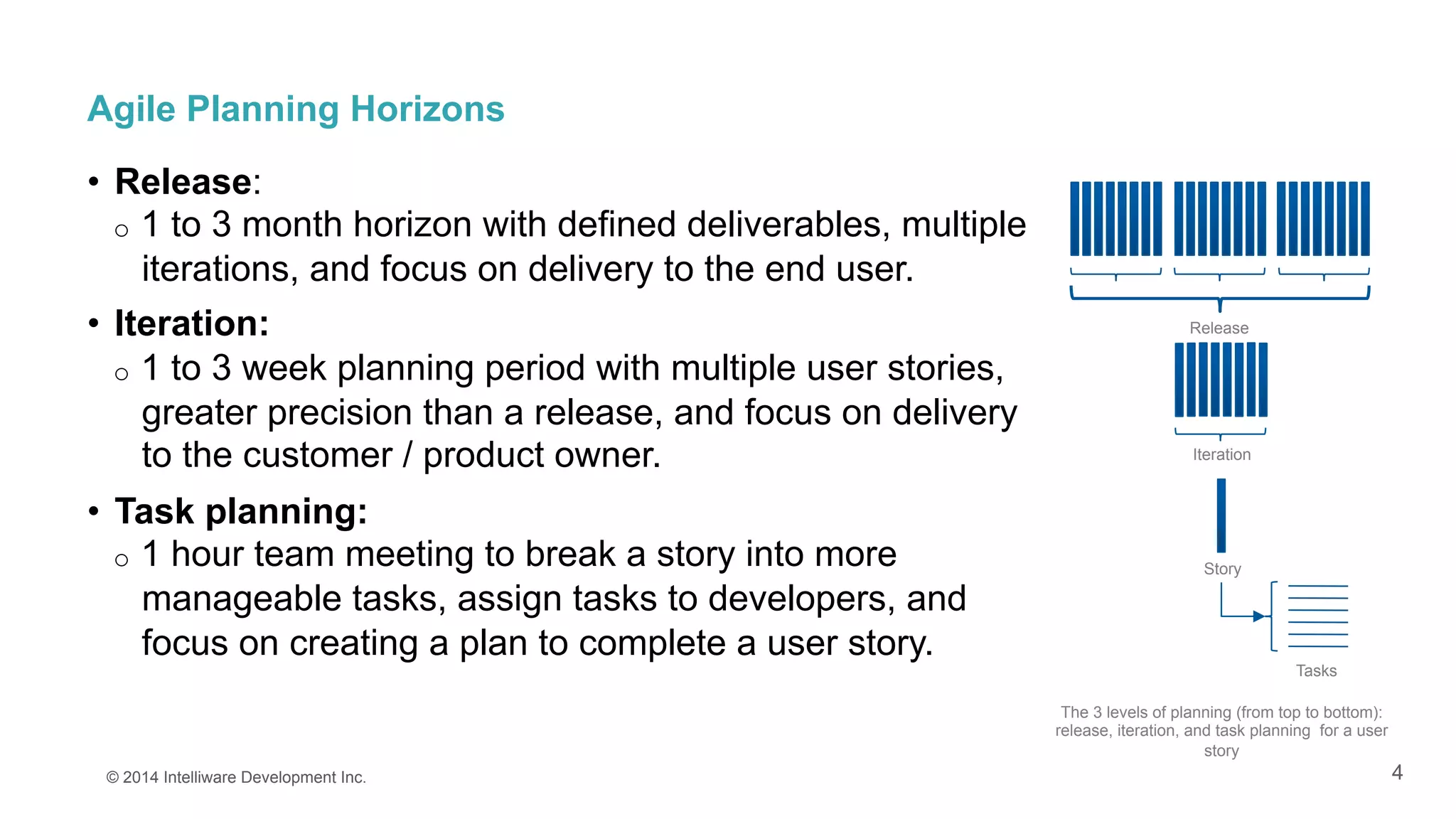
Agile Planning Horizons
•  Release:
o  1 to 3 month horizon with defined deliverables, multiple
iterations, and focus on delivery to the end user.
•  Iteration:
o  1 to 3 week planning period with multiple user stories,
greater precision than a release, and focus on delivery
to the customer / product owner.
•  Task planning:
o  1 hour team meeting to break a story into more
manageable tasks, assign tasks to developers, and
focus on creating a plan to complete a user story.
© 2014 Intelliware Development Inc.
The 3 levels of planning (from top to bottom):
release, iteration, and task planning for a user
story
Release
Iteration
Story
Tasks
5
Who’s Involved In Release Planning?
•  Customers / Product Owners:
o  define stories;
o  set priorities; and
o  put stories into iterations.
•  Developers:
o  estimate stories;
o  point out significant technical risks; and
o  establish velocity, a measure of team
development capacity.
© 2014 Intelliware Development Inc.
6
Defining a Release Plan
1.  Establish iteration lengths
o  Iterations are generally 1 to 3 weeks long.
o  Developers decide what will be in the iteration in
collaboration with the customer / product owner.
o  Smaller projects tend to have shorter iterations.
o  Size is important as release dates are usually based on
external constraints.
2.  Determine the velocity
o  Estimate of how many estimating units can be
completed per iteration.
o  Developer responsibility.
o  Unit of measurement used does not matter – be it
points, ideal days, or something else.
3.  Organize stories into iterations
o  Based on business and technical priorities.
© 2014 Intelliware Development Inc.
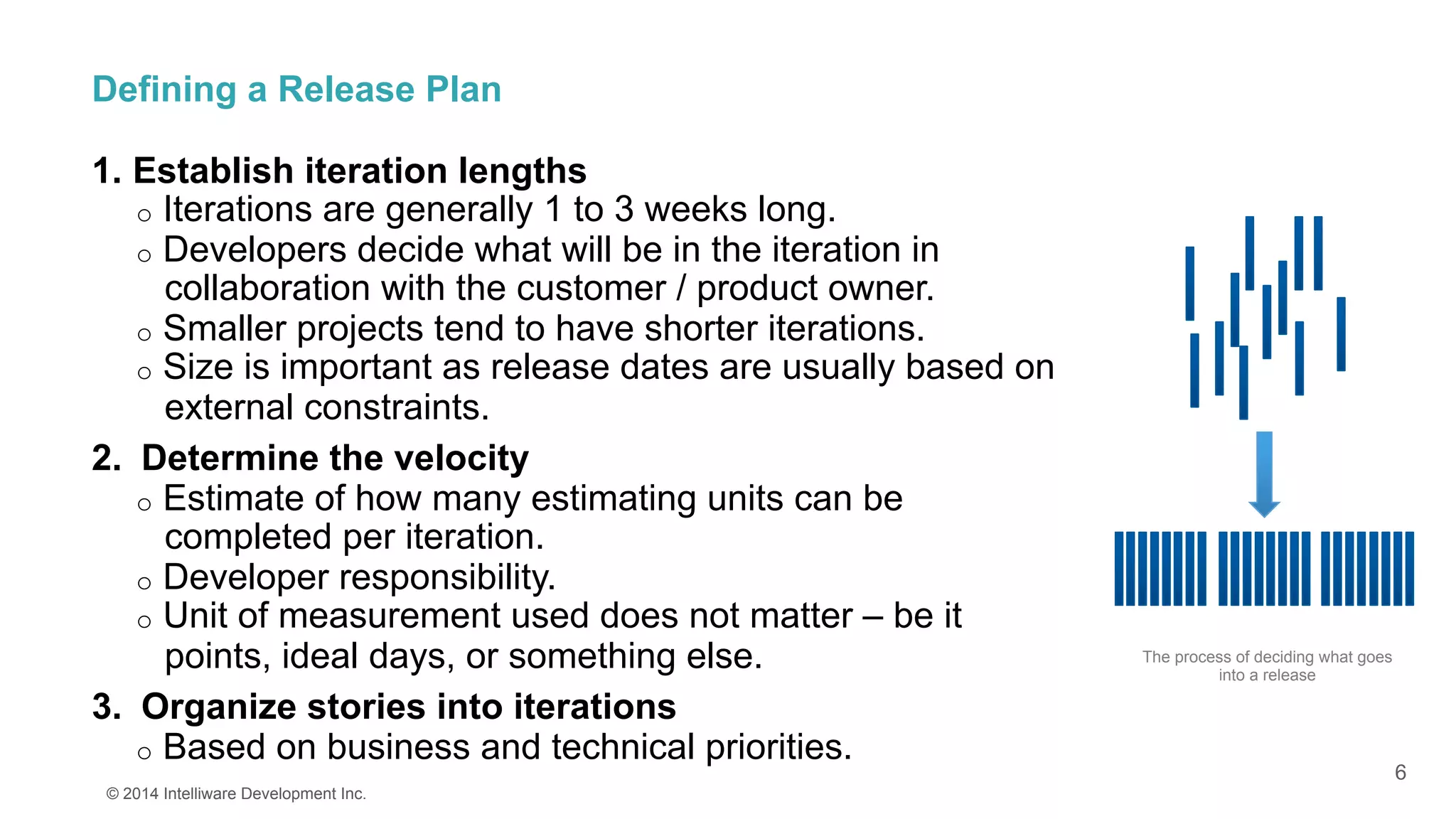
The process of deciding what goes
into a release
7
Release Plan Variations
A release plan can (and will) be modified in numerous ways:
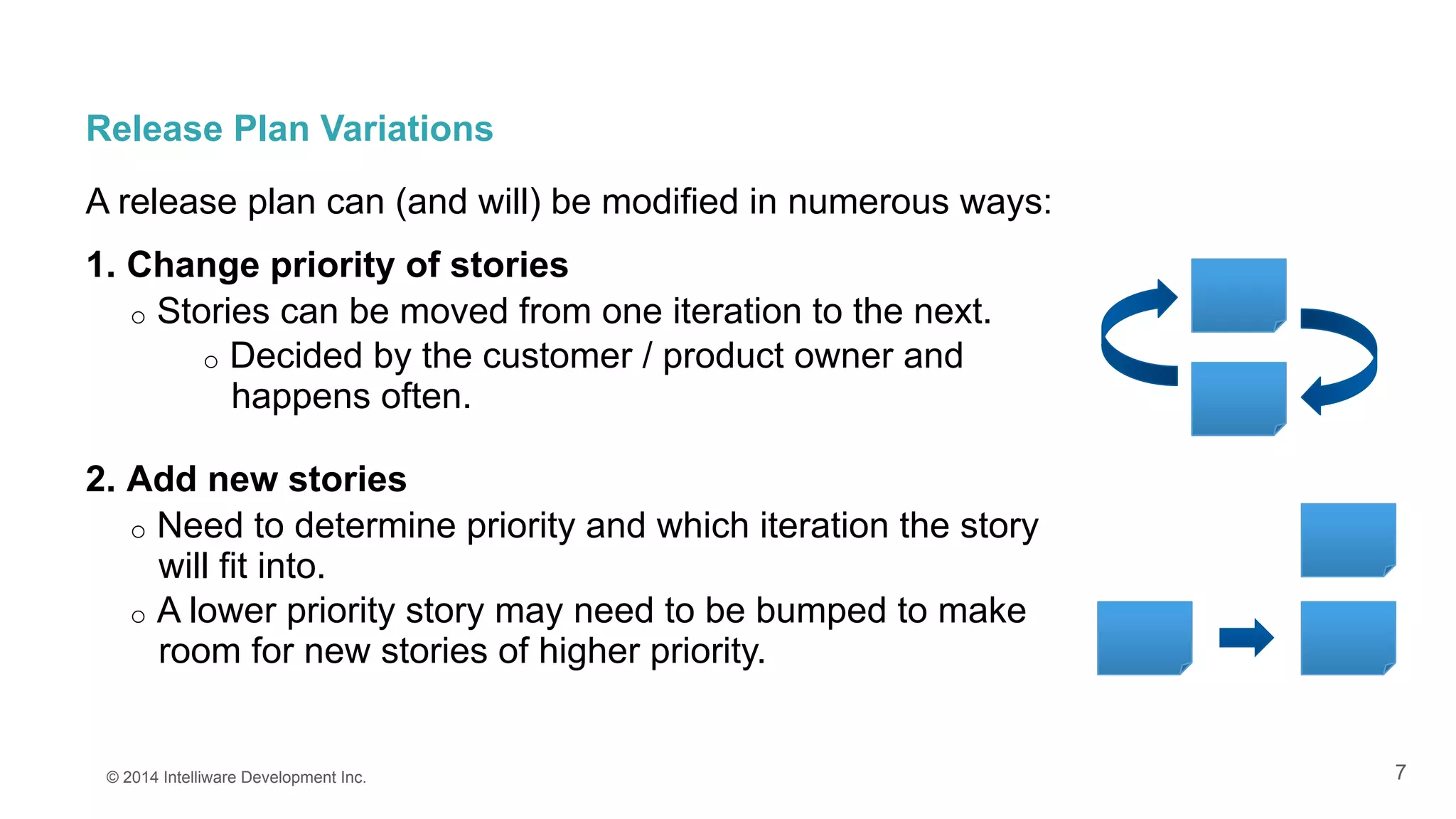
1.  Change priority of stories
o  Stories can be moved from one iteration to the next.
o  Decided by the customer / product owner and
happens often.
2.  Add new stories
o  Need to determine priority and which iteration the story
will fit into.
o  A lower priority story may need to be bumped to make
room for new stories of higher priority.
© 2014 Intelliware Development Inc.
8
Release Plan Variations (continued)
A release plan can (and will) be modified in numerous ways:
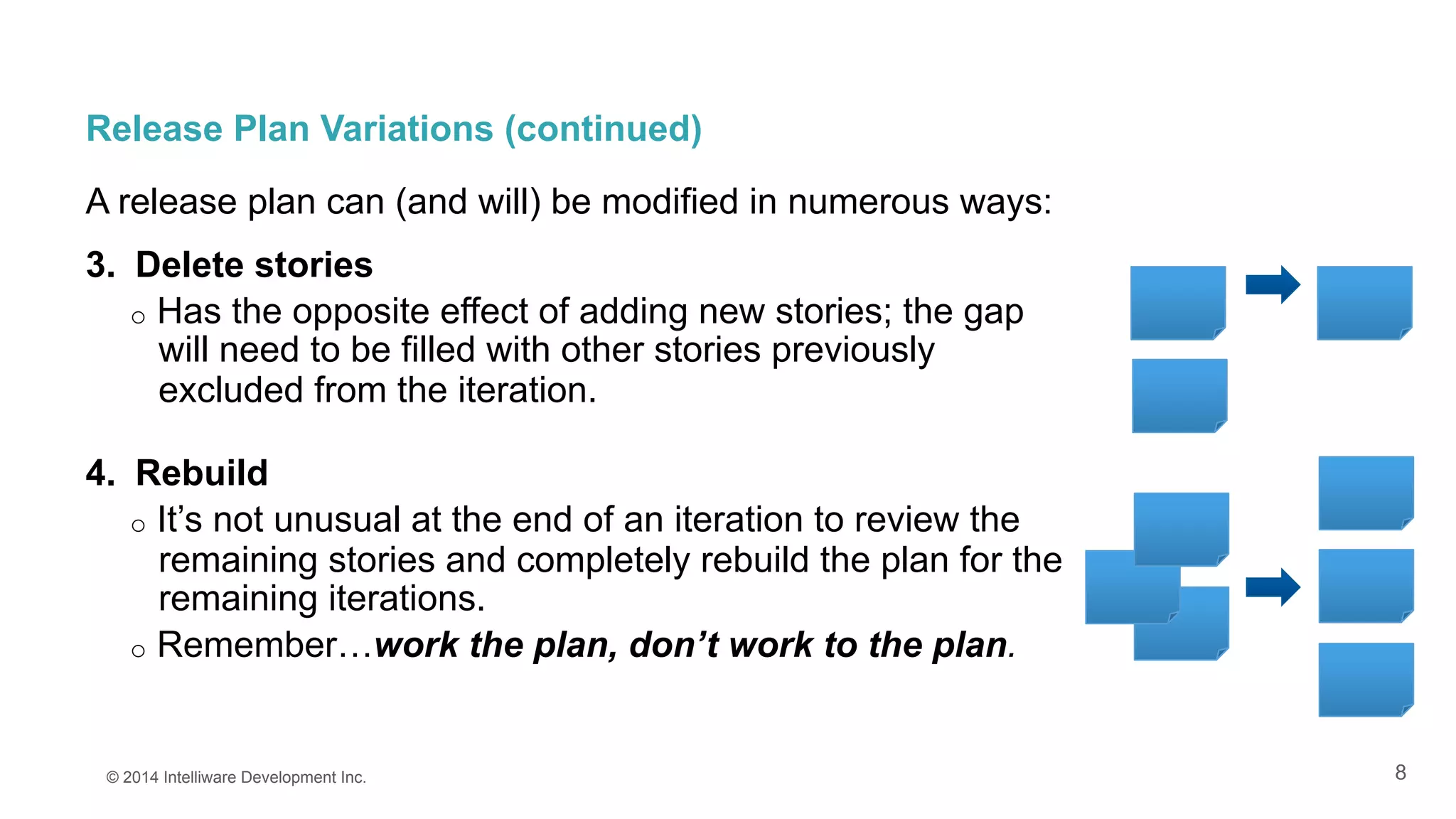
3.  Delete stories
o  Has the opposite effect of adding new stories; the gap
will need to be filled with other stories previously
excluded from the iteration.
4.  Rebuild
o  It’s not unusual at the end of an iteration to review the
remaining stories and completely rebuild the plan for the
remaining iterations.
o  Remember…work the plan, don’t work to the plan.
© 2014 Intelliware Development Inc.
9
Common Release Plan Problems & Solutions
•  Story too large to estimate
o  The story should be split into smaller parts.
•  Story spans iterations due to external dependencies
o  Best to have the developers split the story into two parts:
1.  Finish what can be completed now.
2.  Create second story representing what is not yet done.
•  Story ‘blows up’ due to scope or technical issues
o  The story needs to be halted and re-scoped or re-planned.
•  Release date slides
o  Development team is responsible for reporting this ASAP.
o  Developers and customer / product owner need to work
together to de-scope and re-plan.
© 2014 Intelliware Development Inc.
10
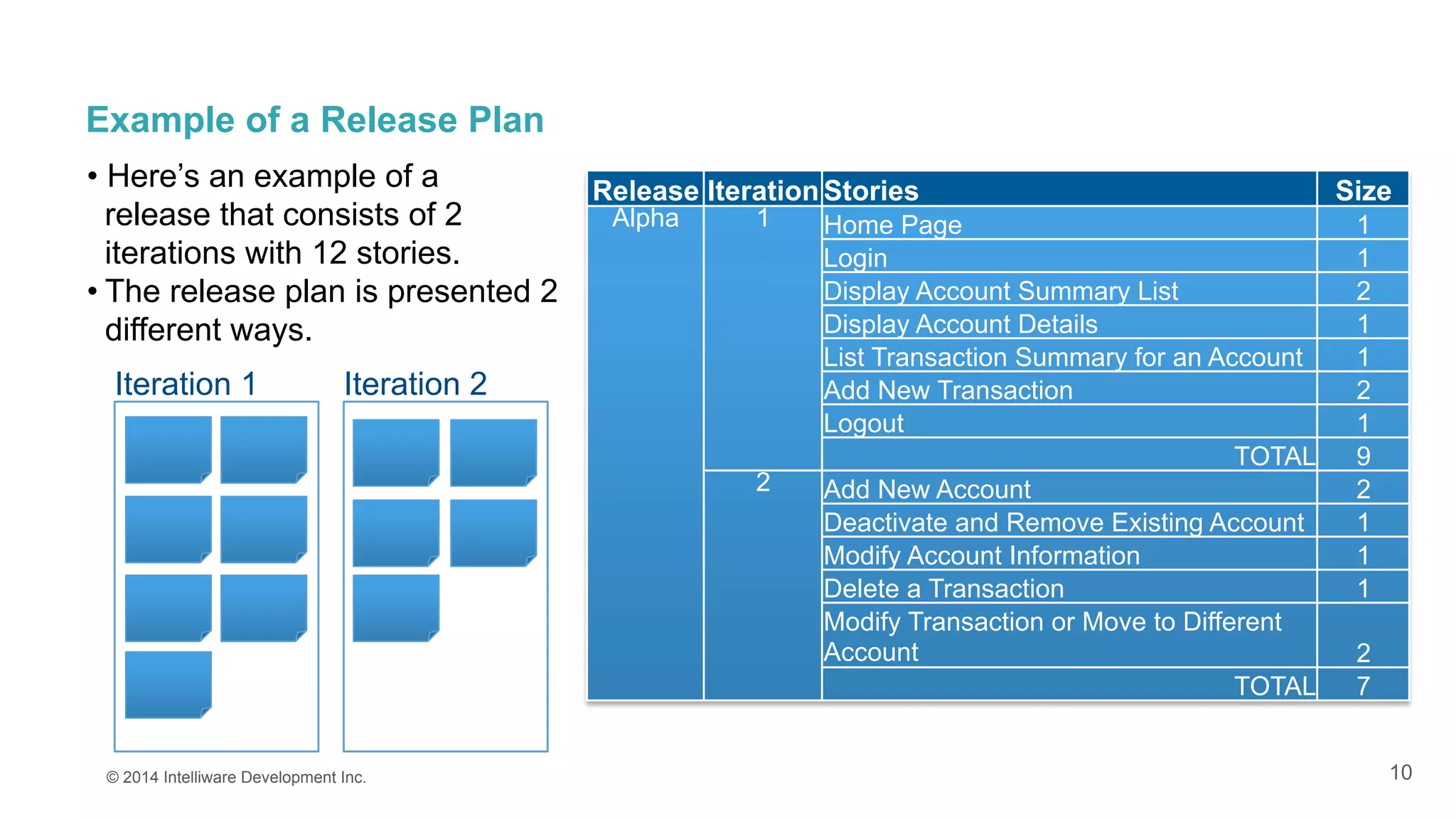
Example of a Release Plan
© 2014 Intelliware Development Inc.
Iteration 1 Iteration 2
Release	
  Iteration	
  Stories	
   Size	
  
Alpha	
   1	
   Home Page	
   1	
  
Login	
   1	
  
Display Account Summary List	
   2	
  
Display Account Details	
   1	
  
List Transaction Summary for an Account	
   1	
  
Add New Transaction	
   2	
  
Logout	
   1	
  
TOTAL	
   9	
  
2	
   Add New Account	
   2	
  
Deactivate and Remove Existing Account	
   1	
  
Modify Account Information	
   1	
  
Delete a Transaction	
   1	
  
Modify Transaction or Move to Different
Account	
   2	
  
TOTAL	
   7
• Here’s an example of a
release that consists of 2
iterations with 12 stories.
• The release plan is presented 2
different ways.
11
Iteration Planning
Characteristics of iterations to consider when planning:
•  Generally 1 to 3 weeks long.
•  More developer-focused than they are customer /
product-owner focused.
•  More precise than releases in terms of their planning
focus.
•  Have a specified length of time based on fixed dates.
•  Start by holding an iteration planning meeting.
© 2014 Intelliware Development Inc.
12
Iteration Planning Meeting
Objectives:
•  Acknowledge accomplishments of last iteration.
•  Determine the level of overall progress.
•  Review problems and issues.
•  Establish objectives for next iteration.
•  Task planning for target stories (optional).
© 2014 Intelliware Development Inc.
13
Estimating Velocity
•  Optimizing velocity is fraught with peril – regardless of the
team size, the difficulty level of the work, or the skill level of the
team.
o  Predicting the future is unreliable – don’t do it.
o  Velocity is about the team, not individuals.
o  Velocity is a measure of capacity, not performance.
•  Using velocity to compare teams is problematic at best
o  No two projects, domains or teams are the same.
•  Base velocity on “yesterday’s weather”
o  Yesterday’s weather: the velocity for the upcoming iteration is
assumed to be the same as that of the previous iteration.
© 2014 Intelliware Development Inc.
14
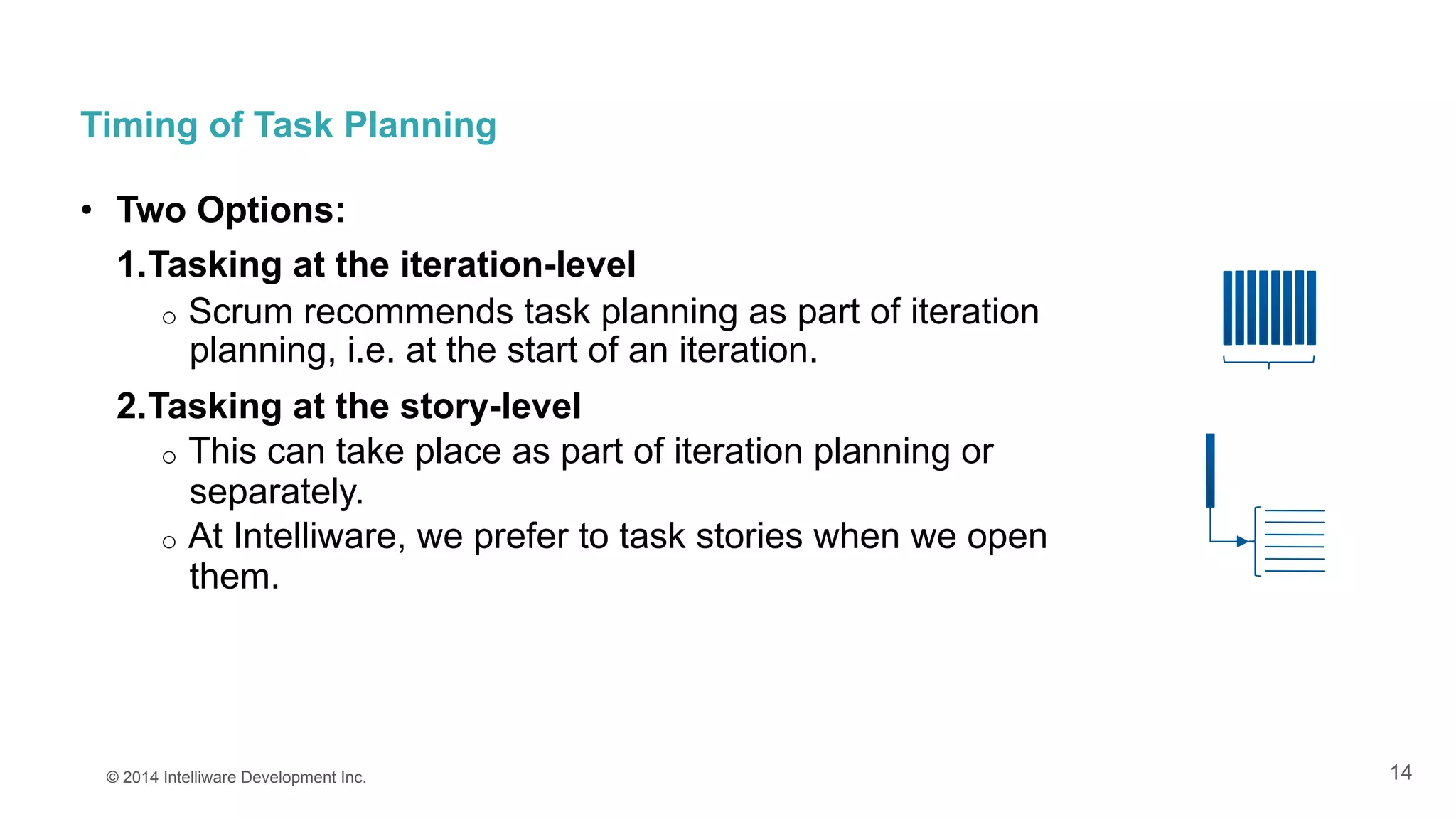
Timing of Task Planning
•  Two Options:
1. Tasking at the iteration-level
o  Scrum recommends task planning as part of iteration
planning, i.e. at the start of an iteration.
2. Tasking at the story-level
o  This can take place as part of iteration planning or
separately.
o  At Intelliware, we prefer to task stories when we open
them.
© 2014 Intelliware Development Inc.
15
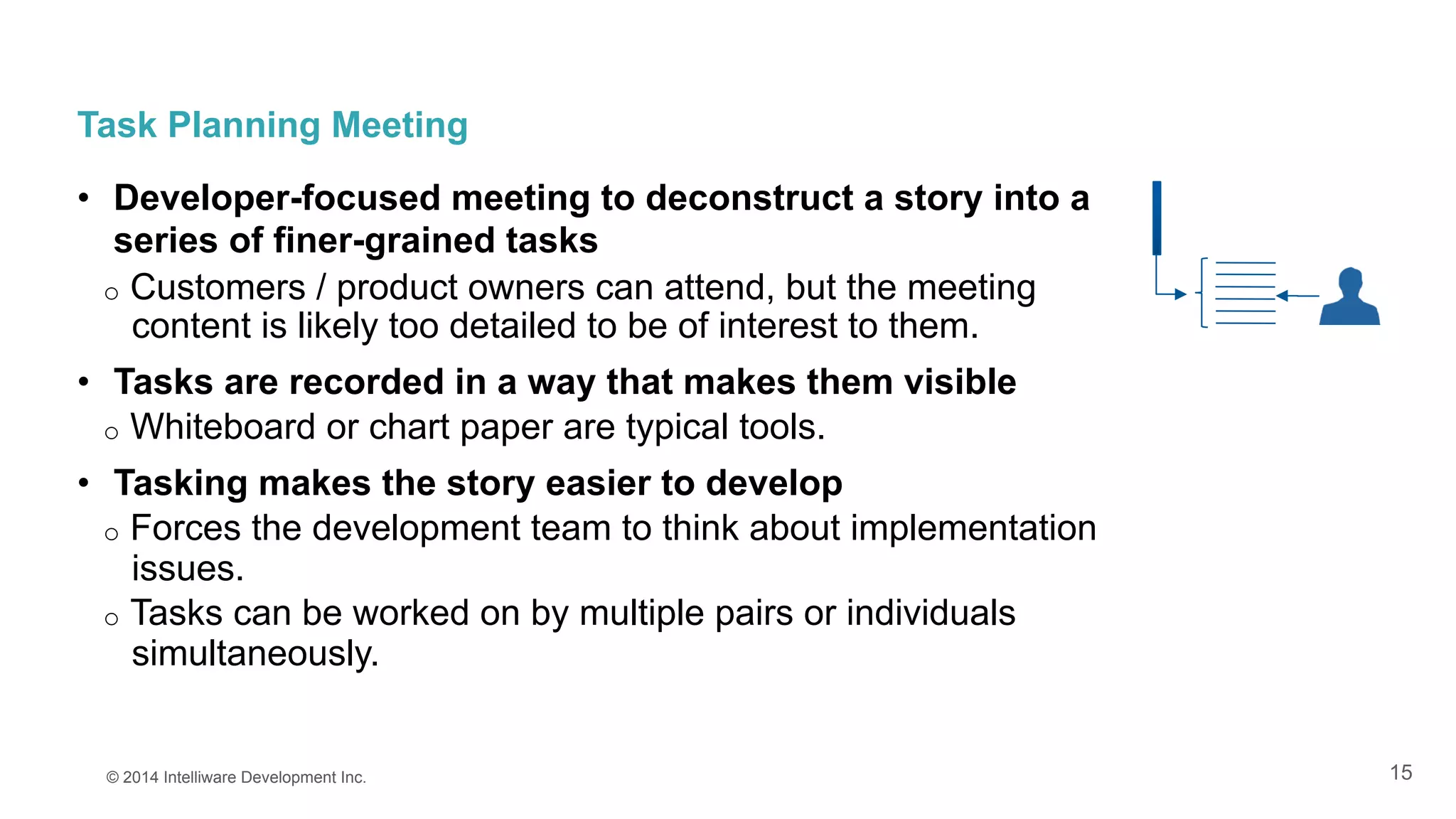
Task Planning Meeting
•  Developer-focused meeting to deconstruct a story into a
series of finer-grained tasks
o  Customers / product owners can attend, but the meeting
content is likely too detailed to be of interest to them.
•  Tasks are recorded in a way that makes them visible
o  Whiteboard or chart paper are typical tools.
•  Tasking makes the story easier to develop
o  Forces the development team to think about implementation
issues.
o  Tasks can be worked on by multiple pairs or individuals
simultaneously.
© 2014 Intelliware Development Inc.
16
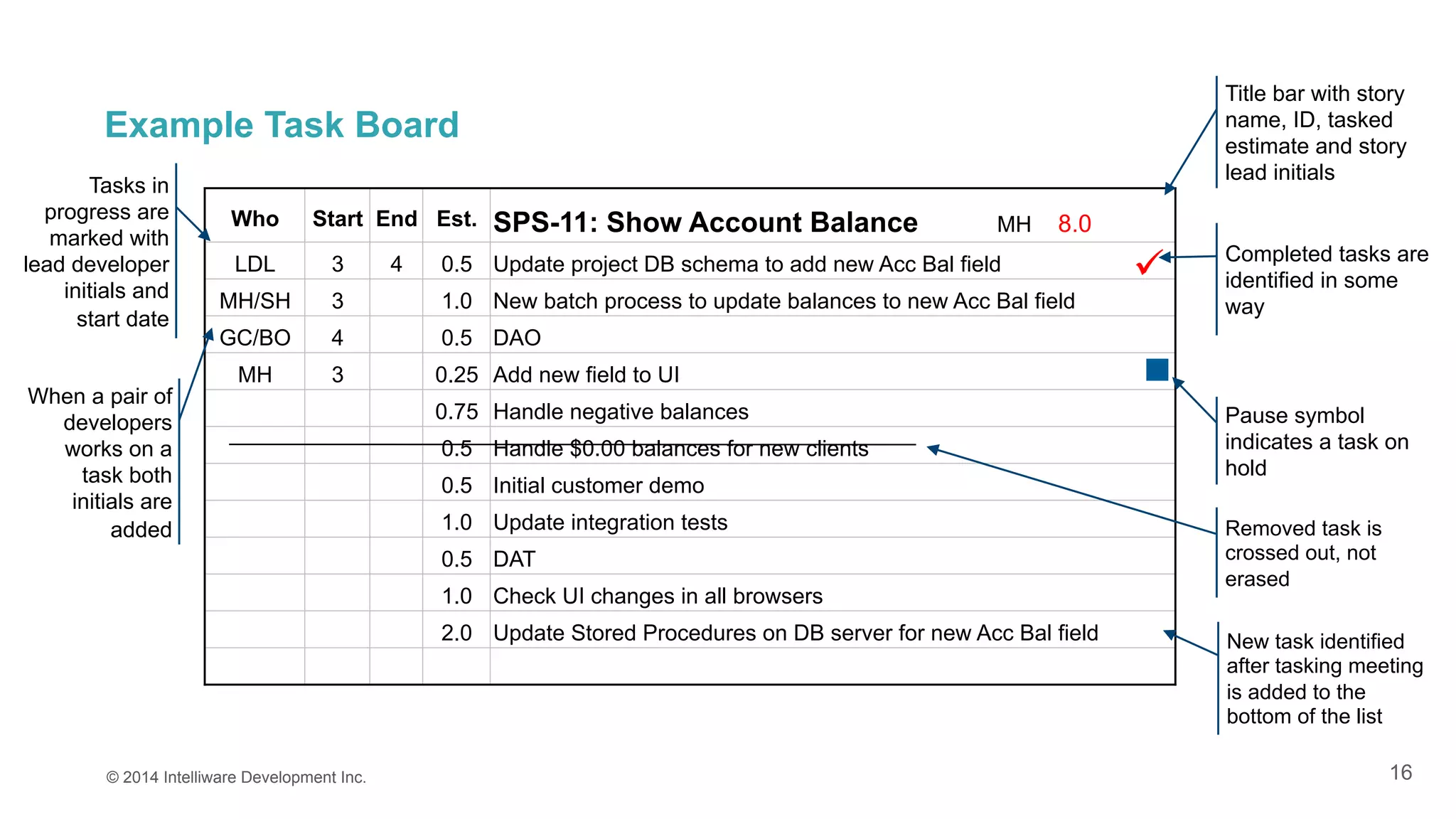
Example Task Board
© 2014 Intelliware Development Inc.
Who Start End Est. SPS-11: Show Account Balance MH 8.0
LDL 3 4 0.5 Update project DB schema to add new Acc Bal field
MH/SH 3 1.0 New batch process to update balances to new Acc Bal field
GC/BO 4 0.5 DAO
MH 3 0.25 Add new field to UI
0.75 Handle negative balances
0.5 Handle $0.00 balances for new clients
0.5 Initial customer demo
1.0 Update integration tests
0.5 DAT
1.0 Check UI changes in all browsers
2.0 Update Stored Procedures on DB server for new Acc Bal field
Title bar with story
name, ID, tasked
estimate and story
lead initials
Removed task is
crossed out, not
erased
New task identified
after tasking meeting
is added to the
bottom of the list
When a pair of
developers
works on a
task both
initials are
added
Tasks in
progress are
marked with
lead developer
initials and
start date
Pause symbol
indicates a task on
hold
Completed tasks are
identified in some
way
ü
17
A Task List
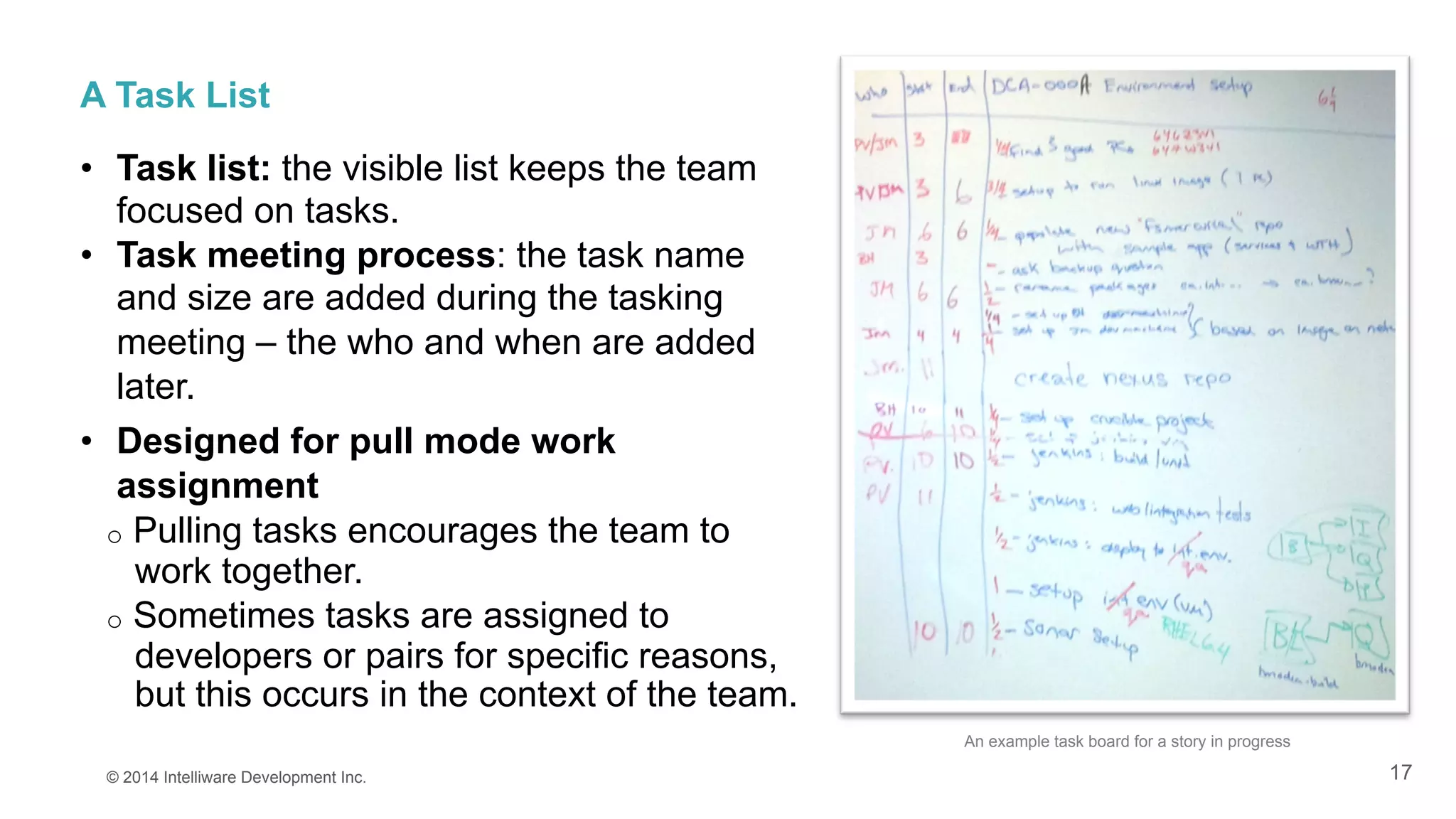
•  Task list: the visible list keeps the team
focused on tasks.
•  Task meeting process: the task name
and size are added during the tasking
meeting – the who and when are added
later.
•  Designed for pull mode work
assignment
o  Pulling tasks encourages the team to
work together.
o  Sometimes tasks are assigned to
developers or pairs for specific reasons,
but this occurs in the context of the team.
© 2014 Intelliware Development Inc.
An example task board for a story in progress
18
Task Attributes
•  Tasks should be quantifiable (in terms of time needed to complete)
o  Tasks are very specific and should have estimates in days, part-days or
even hours.
o  Task estimating occurs in the task planning meeting.
•  Tasks should be small
o  No more than a day or two per task.
•  Tasks can be technical
o  Refactorings, system upgrades, etc. are unavoidable.
© 2014 Intelliware Development Inc.
19
Task Tracking at Task Planning
•  Task size estimates provide an early indication of potential issues with
the story.
•  Example:
o  Story size estimate: 5 ideal days.
o  Sum of task estimates: 8 ideal days.
o  Over-estimate: 3 ideal days or 160%.
•  Outcome:
o  Team should discuss why task estimate > story estimate.
o  Team should consider ways to develop the story within the original
estimate, or split it (and report back to customer / product owner).
•  Tracking during development also provides an early indication of
possible issues – don’t leave things festering!
© 2014 Intelliware Development Inc.
20
For More Information
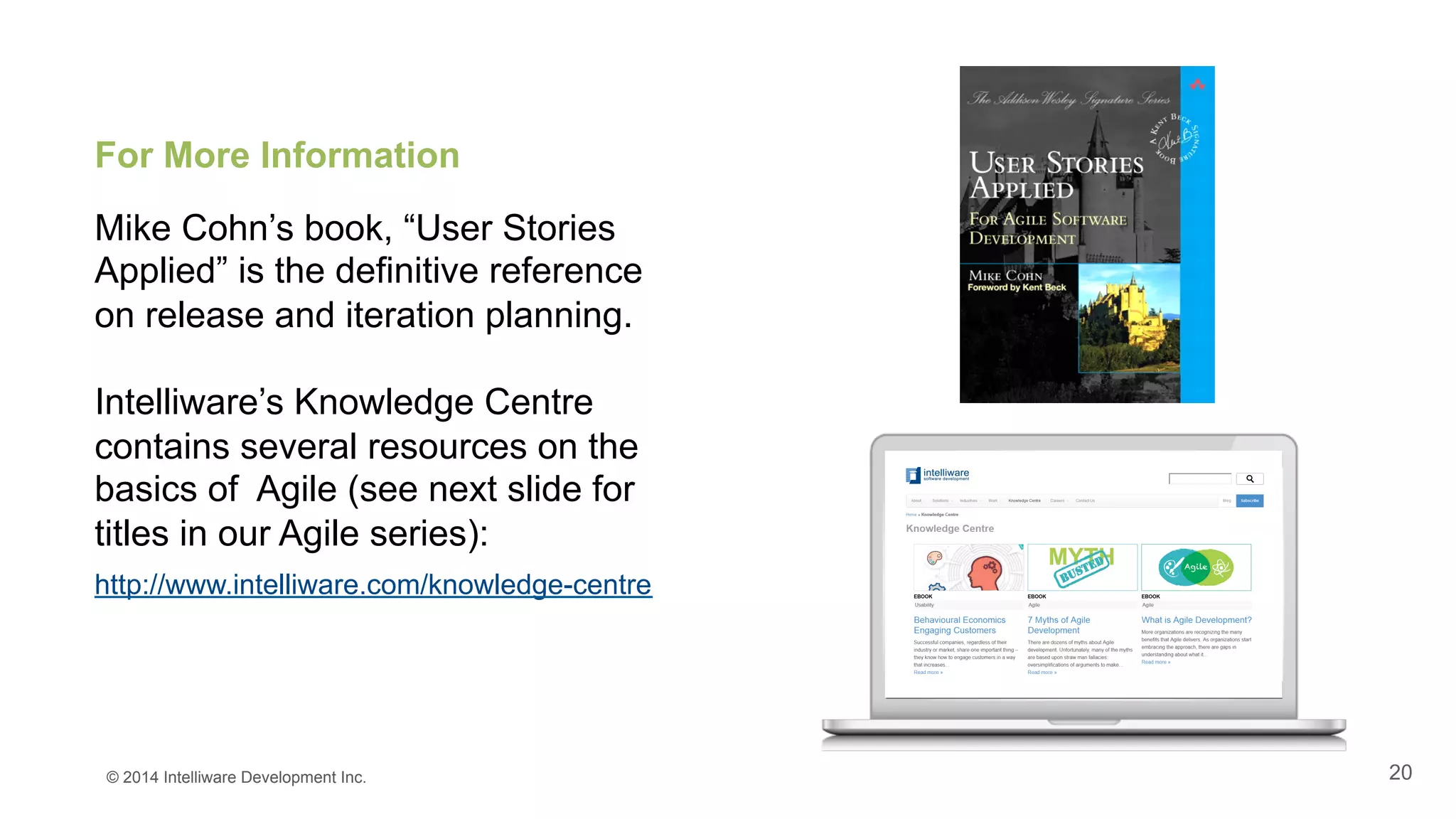
Mike Cohn’s book, “User Stories
Applied” is the definitive reference
on release and iteration planning.
Intelliware’s Knowledge Centre
contains several resources on the
basics of Agile (see next slide for
titles in our Agile series):
http://www.intelliware.com/knowledge-centre
© 2014 Intelliware Development Inc.
Check Out Other Titles From Our Agile Development Series
21© 2014 Intelliware Development Inc.
22© 2014 Intelliware Development Inc.
About Intelliware Development Inc.
Intelliware is a custom software, mobile solutions and product development
company headquartered in Toronto, Canada. Intelliware is a leader in Agile
software development practices which ensure the delivery of timely high quality
solutions for clients. Intelliware is engaged as a technical partner by a wide
range of national and global organizations in sectors that span Financial
Services, Healthcare, ICT, Retail, Manufacturing and Government.
/company/intelliware-development-inc-
/intelliware.inc
/intelliware_inc
/GooglePlusIntelliware
www.intelliware.com

Agile Release & Iteration Planning

  • 1.
    © 2014 IntelliwareDevelopment Inc.
  • 2.
    What You’ll Learnin this Presentation: •  The basics of release and iteration planning. •  The differences between a release and an iteration. •  The basics of task planning. © 2014 Intelliware Development Inc. 2  
  • 3.
    Some Things toRemember About Planning… •  Agile planning is a continual process o  Development is iterative, and so planning has to respond accordingly. •  Our planning motto: Work the plan, not work to the plan o  In other words, “Plans are worthless, but planning is everything.”1 - Dwight D. Eisenhower o  Planning enables Agile teams to stay focused on business value. © 2014 Intelliware Development Inc. 1 From a speech to the National Defense Executive Reserve Conference in Washington, D.C. (November 14, 1957) ; in Public Papers of the Presidents of the United States, Dwight D. Eisenhower, 1957, National Archives and Records Service, Government Printing Office, p. 818 : ISBN 0160588510, 9780160588518. 3  
  • 4.
    4 Agile Planning Horizons • Release: o  1 to 3 month horizon with defined deliverables, multiple iterations, and focus on delivery to the end user. •  Iteration: o  1 to 3 week planning period with multiple user stories, greater precision than a release, and focus on delivery to the customer / product owner. •  Task planning: o  1 hour team meeting to break a story into more manageable tasks, assign tasks to developers, and focus on creating a plan to complete a user story. © 2014 Intelliware Development Inc. The 3 levels of planning (from top to bottom): release, iteration, and task planning for a user story Release Iteration Story Tasks
  • 5.
    5 Who’s Involved InRelease Planning? •  Customers / Product Owners: o  define stories; o  set priorities; and o  put stories into iterations. •  Developers: o  estimate stories; o  point out significant technical risks; and o  establish velocity, a measure of team development capacity. © 2014 Intelliware Development Inc.
  • 6.
    6 Defining a ReleasePlan 1.  Establish iteration lengths o  Iterations are generally 1 to 3 weeks long. o  Developers decide what will be in the iteration in collaboration with the customer / product owner. o  Smaller projects tend to have shorter iterations. o  Size is important as release dates are usually based on external constraints. 2.  Determine the velocity o  Estimate of how many estimating units can be completed per iteration. o  Developer responsibility. o  Unit of measurement used does not matter – be it points, ideal days, or something else. 3.  Organize stories into iterations o  Based on business and technical priorities. © 2014 Intelliware Development Inc. The process of deciding what goes into a release
  • 7.
    7 Release Plan Variations Arelease plan can (and will) be modified in numerous ways: 1.  Change priority of stories o  Stories can be moved from one iteration to the next. o  Decided by the customer / product owner and happens often. 2.  Add new stories o  Need to determine priority and which iteration the story will fit into. o  A lower priority story may need to be bumped to make room for new stories of higher priority. © 2014 Intelliware Development Inc.
  • 8.
    8 Release Plan Variations(continued) A release plan can (and will) be modified in numerous ways: 3.  Delete stories o  Has the opposite effect of adding new stories; the gap will need to be filled with other stories previously excluded from the iteration. 4.  Rebuild o  It’s not unusual at the end of an iteration to review the remaining stories and completely rebuild the plan for the remaining iterations. o  Remember…work the plan, don’t work to the plan. © 2014 Intelliware Development Inc.
  • 9.
    9 Common Release PlanProblems & Solutions •  Story too large to estimate o  The story should be split into smaller parts. •  Story spans iterations due to external dependencies o  Best to have the developers split the story into two parts: 1.  Finish what can be completed now. 2.  Create second story representing what is not yet done. •  Story ‘blows up’ due to scope or technical issues o  The story needs to be halted and re-scoped or re-planned. •  Release date slides o  Development team is responsible for reporting this ASAP. o  Developers and customer / product owner need to work together to de-scope and re-plan. © 2014 Intelliware Development Inc.
  • 10.
    10 Example of aRelease Plan © 2014 Intelliware Development Inc. Iteration 1 Iteration 2 Release  Iteration  Stories   Size   Alpha   1   Home Page   1   Login   1   Display Account Summary List   2   Display Account Details   1   List Transaction Summary for an Account   1   Add New Transaction   2   Logout   1   TOTAL   9   2   Add New Account   2   Deactivate and Remove Existing Account   1   Modify Account Information   1   Delete a Transaction   1   Modify Transaction or Move to Different Account   2   TOTAL   7 • Here’s an example of a release that consists of 2 iterations with 12 stories. • The release plan is presented 2 different ways.
  • 11.
    11 Iteration Planning Characteristics ofiterations to consider when planning: •  Generally 1 to 3 weeks long. •  More developer-focused than they are customer / product-owner focused. •  More precise than releases in terms of their planning focus. •  Have a specified length of time based on fixed dates. •  Start by holding an iteration planning meeting. © 2014 Intelliware Development Inc.
  • 12.
    12 Iteration Planning Meeting Objectives: • Acknowledge accomplishments of last iteration. •  Determine the level of overall progress. •  Review problems and issues. •  Establish objectives for next iteration. •  Task planning for target stories (optional). © 2014 Intelliware Development Inc.
  • 13.
    13 Estimating Velocity •  Optimizingvelocity is fraught with peril – regardless of the team size, the difficulty level of the work, or the skill level of the team. o  Predicting the future is unreliable – don’t do it. o  Velocity is about the team, not individuals. o  Velocity is a measure of capacity, not performance. •  Using velocity to compare teams is problematic at best o  No two projects, domains or teams are the same. •  Base velocity on “yesterday’s weather” o  Yesterday’s weather: the velocity for the upcoming iteration is assumed to be the same as that of the previous iteration. © 2014 Intelliware Development Inc.
  • 14.
    14 Timing of TaskPlanning •  Two Options: 1. Tasking at the iteration-level o  Scrum recommends task planning as part of iteration planning, i.e. at the start of an iteration. 2. Tasking at the story-level o  This can take place as part of iteration planning or separately. o  At Intelliware, we prefer to task stories when we open them. © 2014 Intelliware Development Inc.
  • 15.
    15 Task Planning Meeting • Developer-focused meeting to deconstruct a story into a series of finer-grained tasks o  Customers / product owners can attend, but the meeting content is likely too detailed to be of interest to them. •  Tasks are recorded in a way that makes them visible o  Whiteboard or chart paper are typical tools. •  Tasking makes the story easier to develop o  Forces the development team to think about implementation issues. o  Tasks can be worked on by multiple pairs or individuals simultaneously. © 2014 Intelliware Development Inc.
  • 16.
    16 Example Task Board ©2014 Intelliware Development Inc. Who Start End Est. SPS-11: Show Account Balance MH 8.0 LDL 3 4 0.5 Update project DB schema to add new Acc Bal field MH/SH 3 1.0 New batch process to update balances to new Acc Bal field GC/BO 4 0.5 DAO MH 3 0.25 Add new field to UI 0.75 Handle negative balances 0.5 Handle $0.00 balances for new clients 0.5 Initial customer demo 1.0 Update integration tests 0.5 DAT 1.0 Check UI changes in all browsers 2.0 Update Stored Procedures on DB server for new Acc Bal field Title bar with story name, ID, tasked estimate and story lead initials Removed task is crossed out, not erased New task identified after tasking meeting is added to the bottom of the list When a pair of developers works on a task both initials are added Tasks in progress are marked with lead developer initials and start date Pause symbol indicates a task on hold Completed tasks are identified in some way ü
  • 17.
    17 A Task List • Task list: the visible list keeps the team focused on tasks. •  Task meeting process: the task name and size are added during the tasking meeting – the who and when are added later. •  Designed for pull mode work assignment o  Pulling tasks encourages the team to work together. o  Sometimes tasks are assigned to developers or pairs for specific reasons, but this occurs in the context of the team. © 2014 Intelliware Development Inc. An example task board for a story in progress
  • 18.
    18 Task Attributes •  Tasksshould be quantifiable (in terms of time needed to complete) o  Tasks are very specific and should have estimates in days, part-days or even hours. o  Task estimating occurs in the task planning meeting. •  Tasks should be small o  No more than a day or two per task. •  Tasks can be technical o  Refactorings, system upgrades, etc. are unavoidable. © 2014 Intelliware Development Inc.
  • 19.
    19 Task Tracking atTask Planning •  Task size estimates provide an early indication of potential issues with the story. •  Example: o  Story size estimate: 5 ideal days. o  Sum of task estimates: 8 ideal days. o  Over-estimate: 3 ideal days or 160%. •  Outcome: o  Team should discuss why task estimate > story estimate. o  Team should consider ways to develop the story within the original estimate, or split it (and report back to customer / product owner). •  Tracking during development also provides an early indication of possible issues – don’t leave things festering! © 2014 Intelliware Development Inc.
  • 20.
    20 For More Information MikeCohn’s book, “User Stories Applied” is the definitive reference on release and iteration planning. Intelliware’s Knowledge Centre contains several resources on the basics of Agile (see next slide for titles in our Agile series): http://www.intelliware.com/knowledge-centre © 2014 Intelliware Development Inc.
  • 21.
    Check Out OtherTitles From Our Agile Development Series 21© 2014 Intelliware Development Inc.
  • 22.
    22© 2014 IntelliwareDevelopment Inc. About Intelliware Development Inc. Intelliware is a custom software, mobile solutions and product development company headquartered in Toronto, Canada. Intelliware is a leader in Agile software development practices which ensure the delivery of timely high quality solutions for clients. Intelliware is engaged as a technical partner by a wide range of national and global organizations in sectors that span Financial Services, Healthcare, ICT, Retail, Manufacturing and Government. /company/intelliware-development-inc- /intelliware.inc /intelliware_inc /GooglePlusIntelliware www.intelliware.com