© 2014 Intelliware Development Inc.
What You’ll Learn in this Presentation:
• How estimates are used on Agile projects.
• How to define estimates.
• The basics of planning poker to help estimate.
© 2014 Intelliware Development Inc. 2
3
Introduction – Agile Planning
• Planning occurs throughout the development cycle and
is spread across the entire team.
• “Work the plan, not work to the plan.”
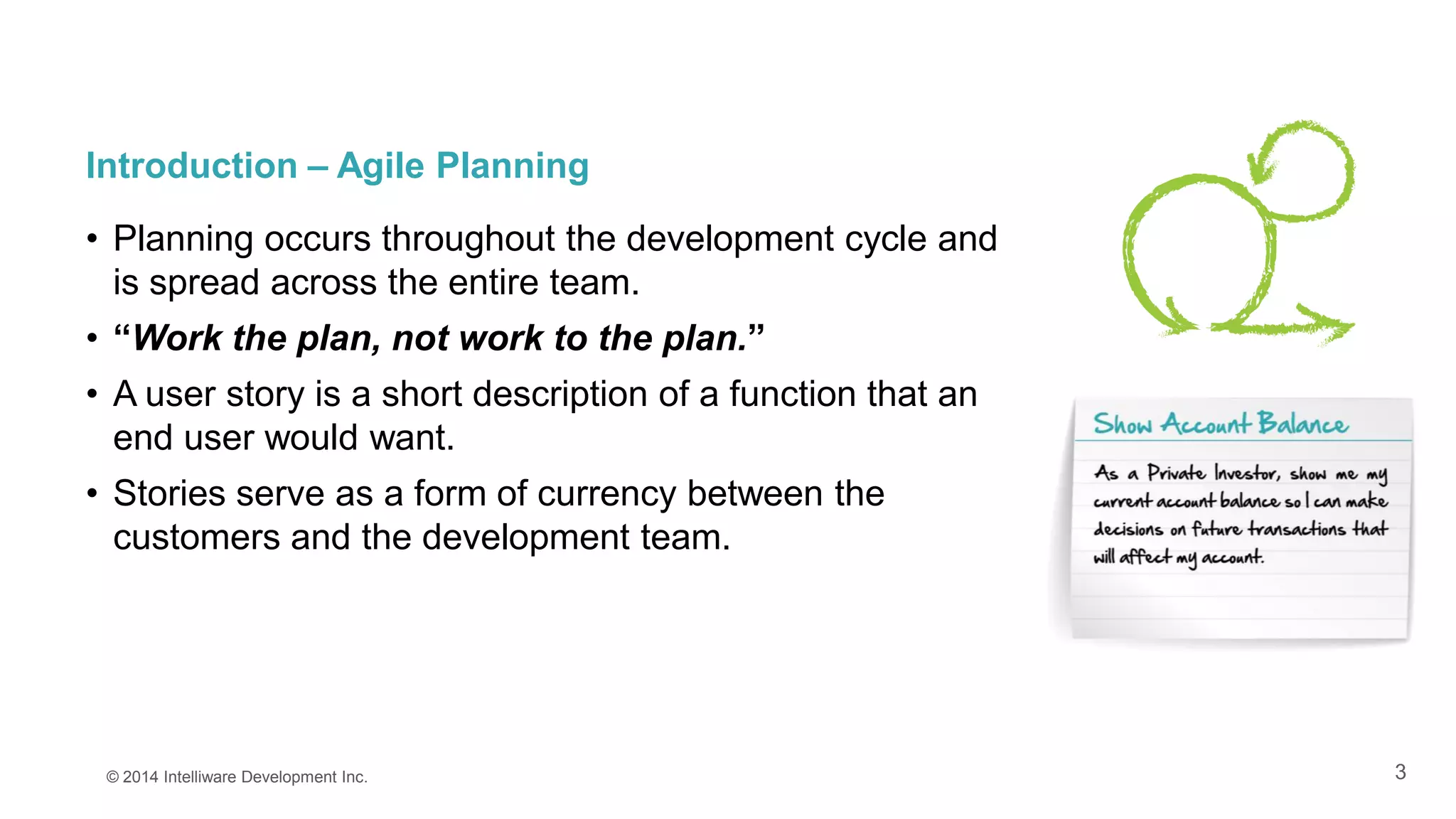
• A user story is a short description of a function that an
end user would want.
• Stories serve as a form of currency between the
customers and the development team.
© 2014 Intelliware Development Inc.
4
The Agile Planning Process
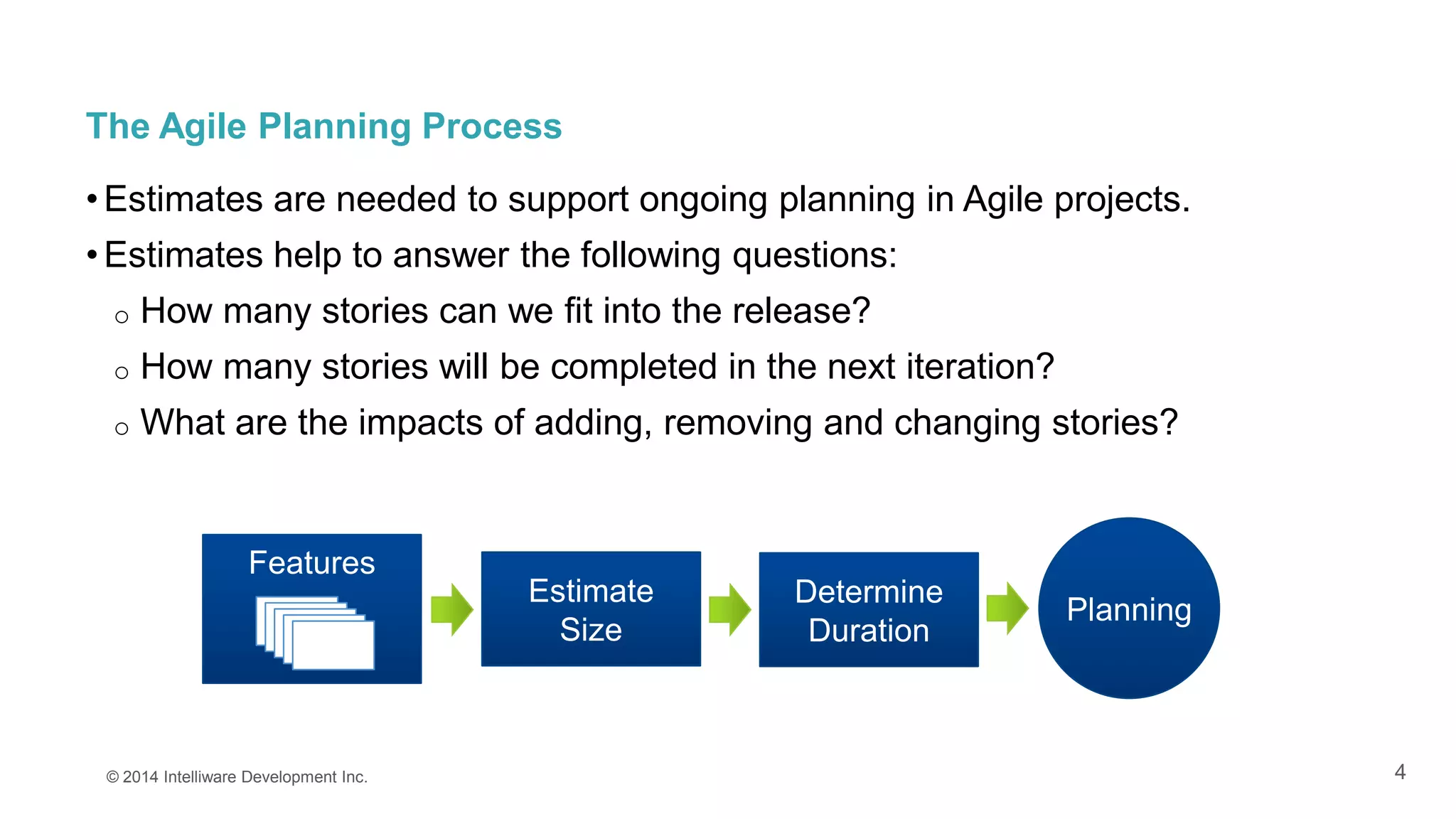
•Estimates are needed to support ongoing planning in Agile projects.
•Estimates help to answer the following questions:
o How many stories can we fit into the release?
o How many stories will be completed in the next iteration?
o What are the impacts of adding, removing and changing stories?
© 2014 Intelliware Development Inc.
Features
Estimate
Size
Determine
Duration
Planning
5
What is an Estimate?
• An estimate is a measure of the relative size, in
terms of effort, of a story.
• Why focus on size?
o Estimate size to derive duration.
o Size can be estimated.
o Duration is hard to determine due to meetings,
non-work appointments and other distractions that
cannot be estimated.
© 2014 Intelliware Development Inc.
6
1. non-development project time
(e.g. standup meetings), and
2. non-project work time (e.g. internal non-
project meetings, medical appointments).
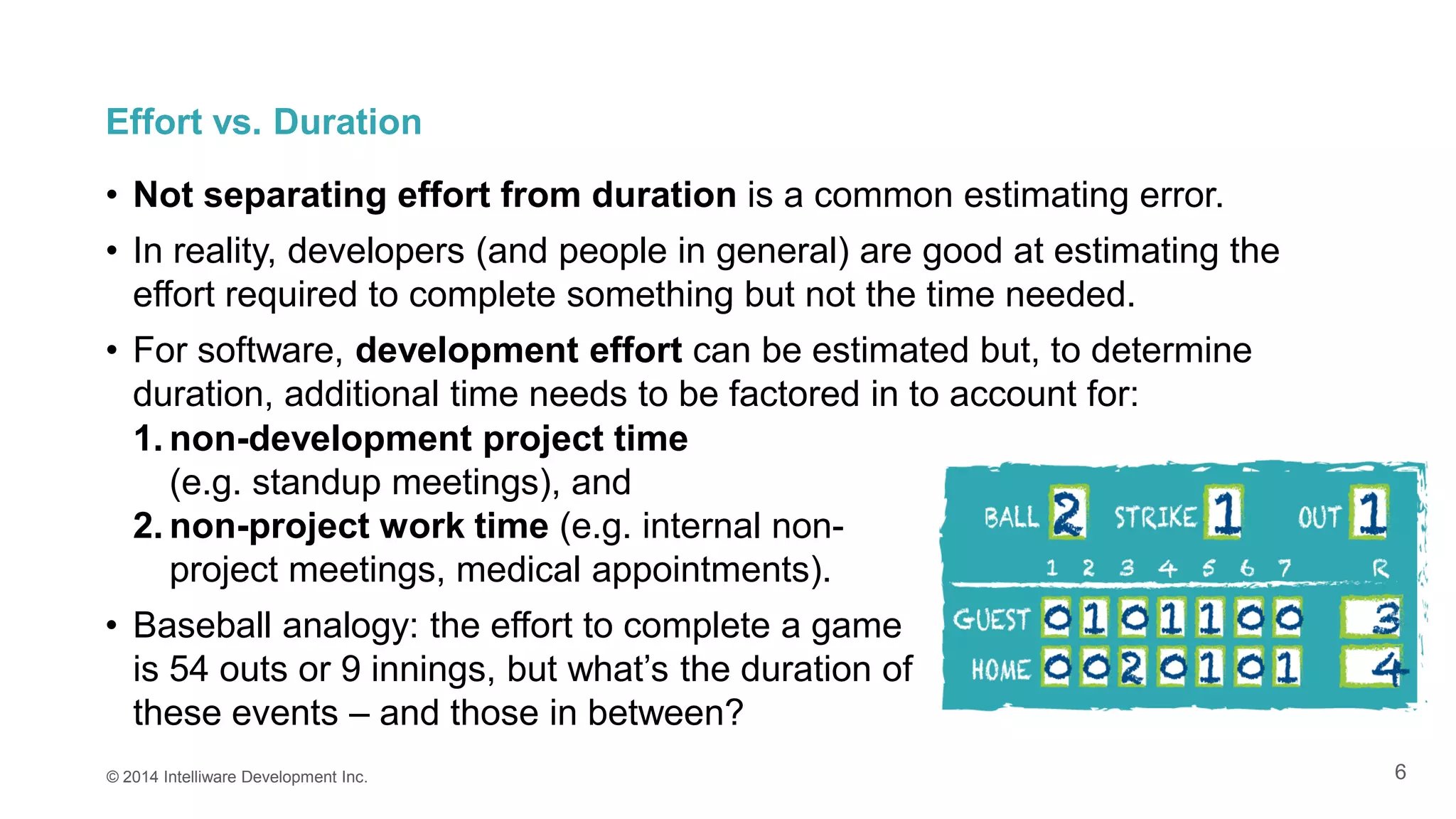
• Baseball analogy: the effort to complete a game
is 54 outs or 9 innings, but what’s the duration of
these events – and those in between?
© 2014 Intelliware Development Inc.
Effort vs. Duration
• Not separating effort from duration is a common estimating error.
• In reality, developers (and people in general) are good at estimating the
effort required to complete something but not the time needed.
• For software, development effort can be estimated but, to determine
duration, additional time needs to be factored in to account for:
7
Ideal Time vs. Real Time
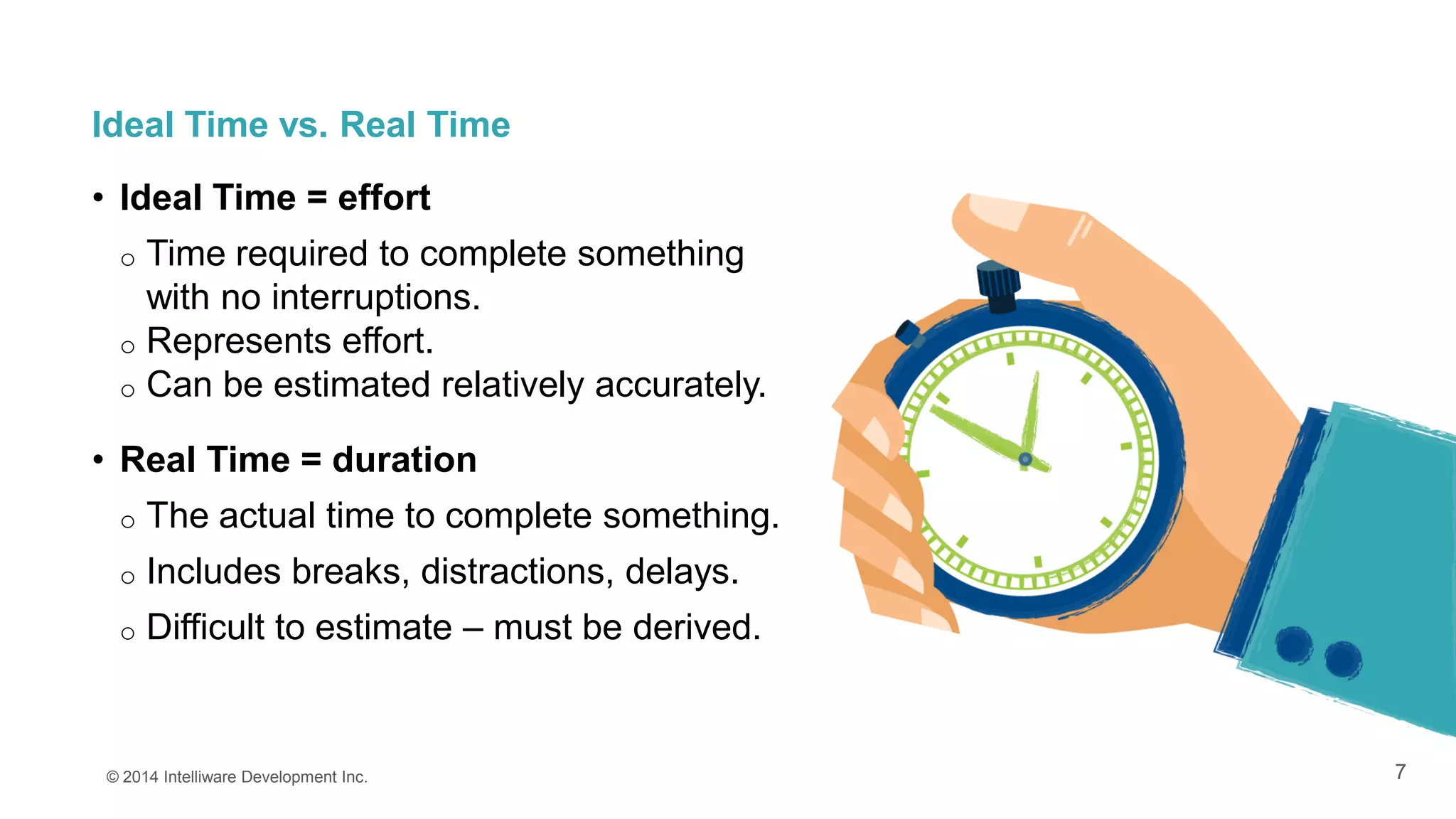
• Ideal Time = effort
o Time required to complete something
with no interruptions.
o Represents effort.
o Can be estimated relatively accurately.
• Real Time = duration
o The actual time to complete something.
o Includes breaks, distractions, delays.
o Difficult to estimate – must be derived.
© 2014 Intelliware Development Inc.
8
The Value of Estimates
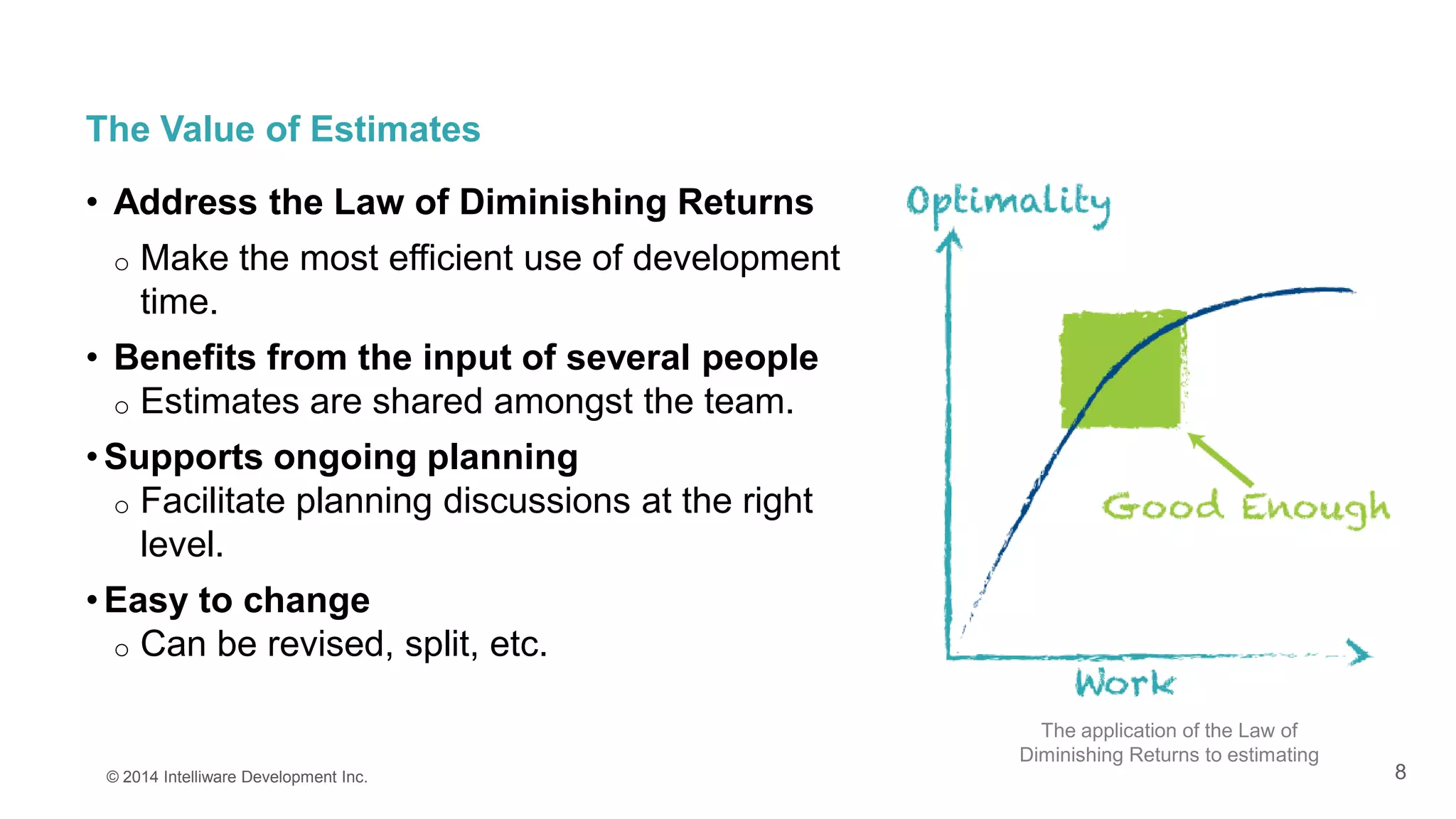
• Address the Law of Diminishing Returns
o Make the most efficient use of development
time.
• Benefits from the input of several people
o Estimates are shared amongst the team.
•Supports ongoing planning
o Facilitate planning discussions at the right
level.
•Easy to change
o Can be revised, split, etc.
© 2014 Intelliware Development Inc.
The application of the Law of
Diminishing Returns to estimating
9
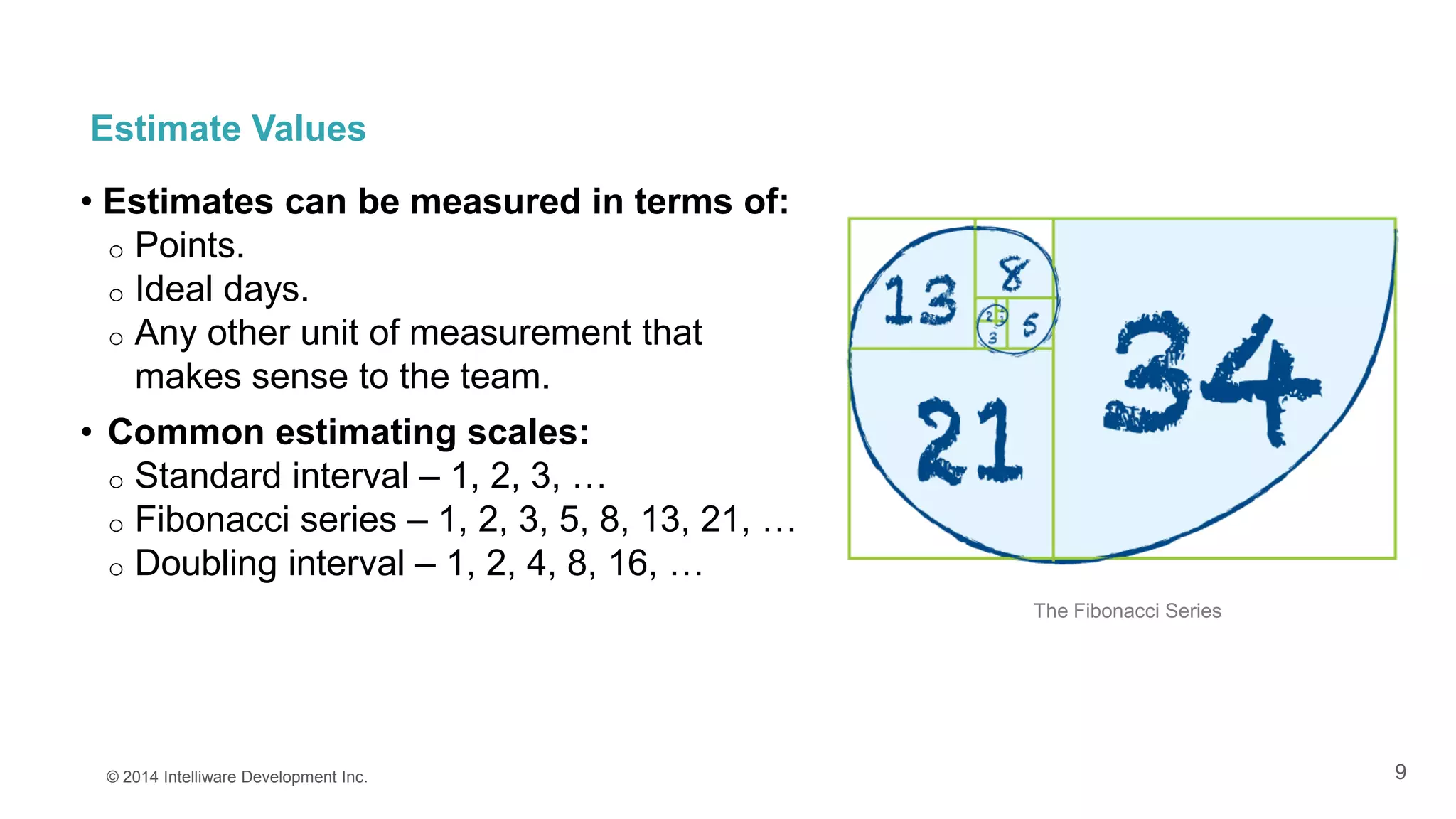
Estimate Values
• Estimates can be measured in terms of:
o Points.
o Ideal days.
o Any other unit of measurement that
makes sense to the team.
• Common estimating scales:
o Standard interval – 1, 2, 3, …
o Fibonacci series – 1, 2, 3, 5, 8, 13, 21, …
o Doubling interval – 1, 2, 4, 8, 16, …
© 2014 Intelliware Development Inc.
The Fibonacci Series
10
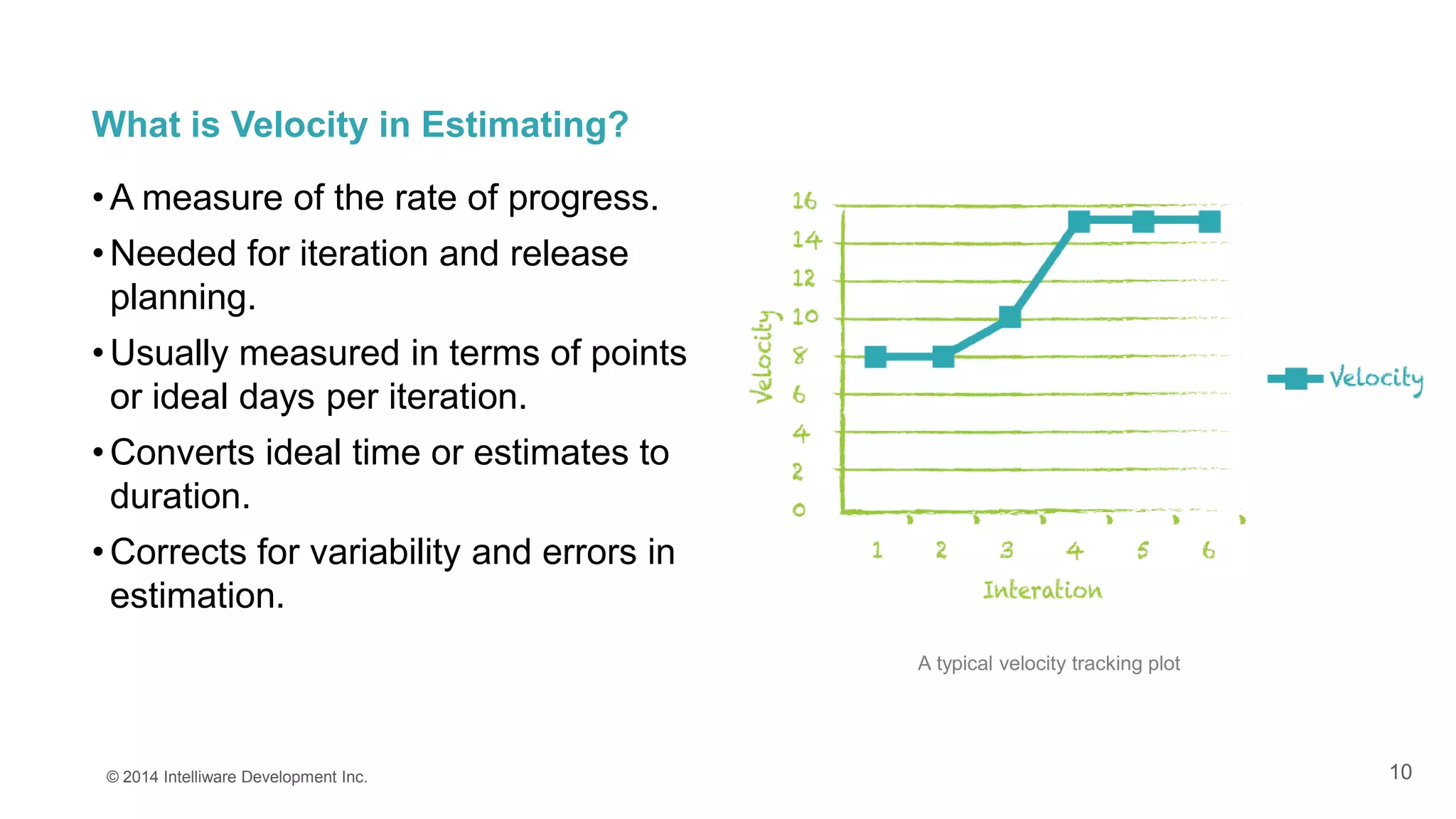
What is Velocity in Estimating?
•A measure of the rate of progress.
•Needed for iteration and release
planning.
•Usually measured in terms of points
or ideal days per iteration.
•Converts ideal time or estimates to
duration.
•Corrects for variability and errors in
estimation.
© 2014 Intelliware Development Inc.
A typical velocity tracking plot
11
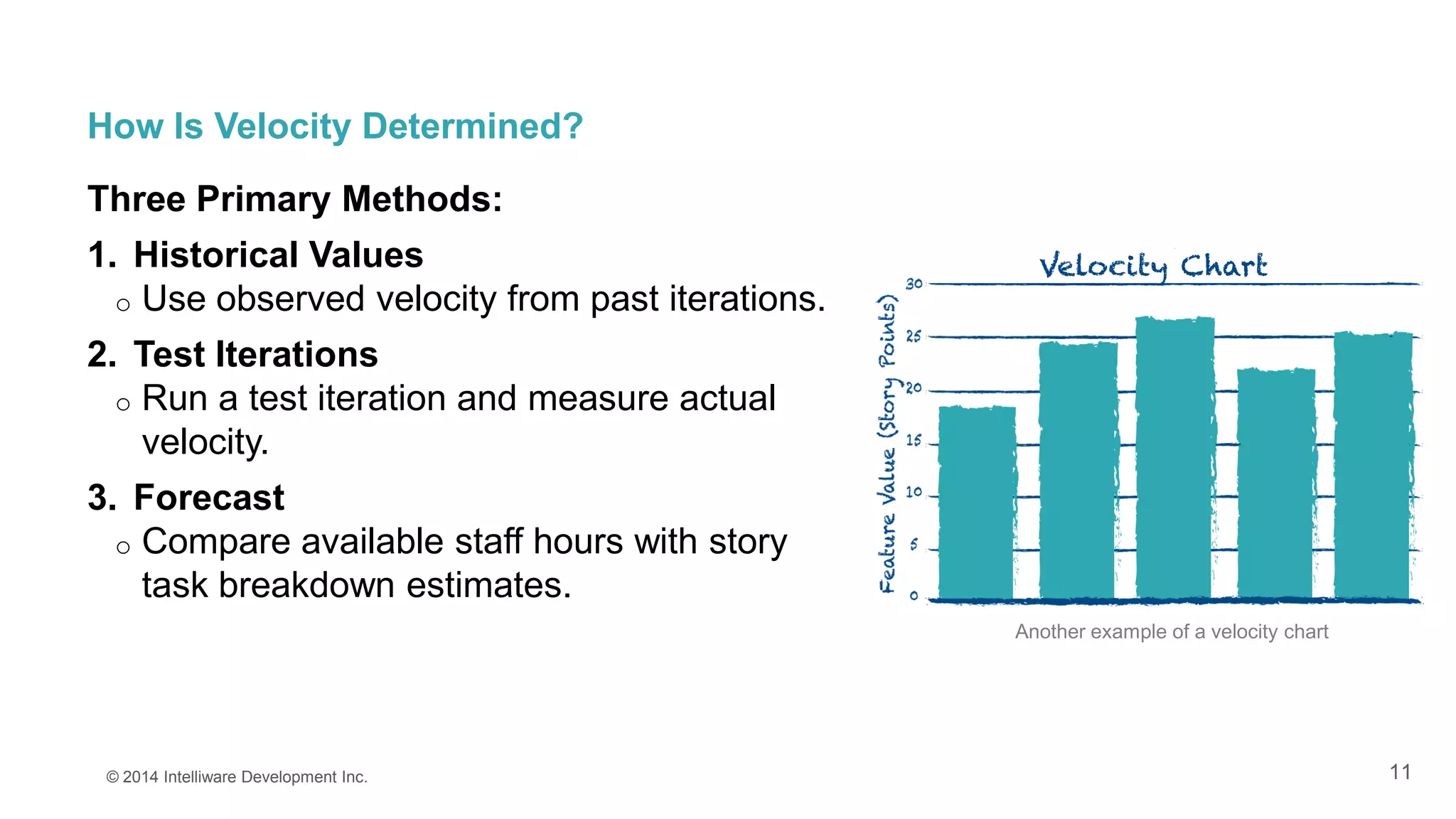
How Is Velocity Determined?
Three Primary Methods:
1. Historical Values
o Use observed velocity from past iterations.
2. Test Iterations
o Run a test iteration and measure actual
velocity.
3. Forecast
o Compare available staff hours with story
task breakdown estimates.
© 2014 Intelliware Development Inc.
Velocity Chart
Another example of a velocity chart
12
Planning Poker
• Recognized as one of the best
ways for Agile teams to estimate
because it:
o encourages the entire development
team to participate;
o is easy, interactive, and fun; and
o facilitates quick consensus on
estimates.
© 2014 Intelliware Development Inc.
13
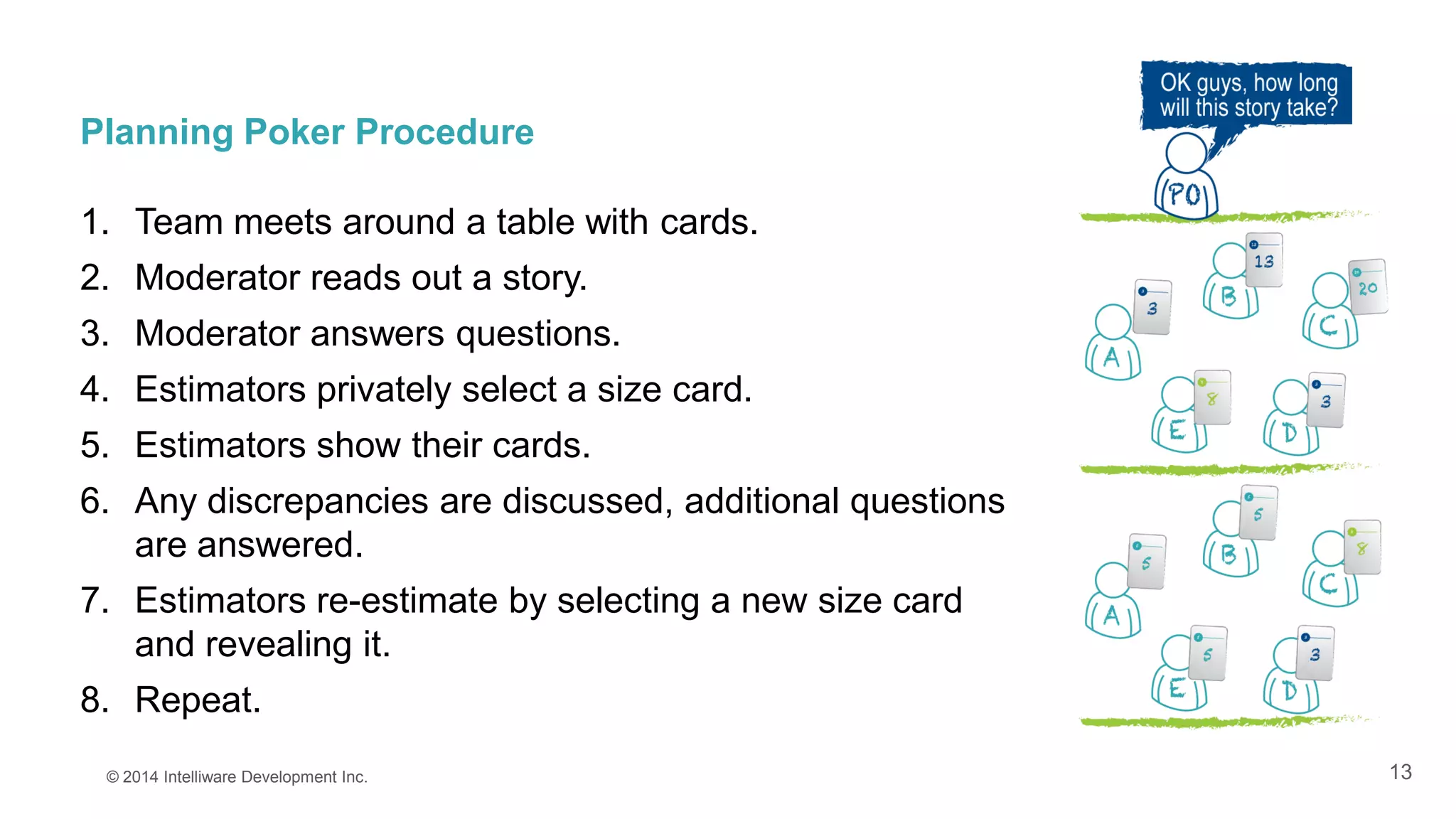
Planning Poker Procedure
1. Team meets around a table with cards.
2. Moderator reads out a story.
3. Moderator answers questions.
4. Estimators privately select a size card.
5. Estimators show their cards.
6. Any discrepancies are discussed, additional questions
are answered.
7. Estimators re-estimate by selecting a new size card
and revealing it.
8. Repeat.
© 2014 Intelliware Development Inc.
14
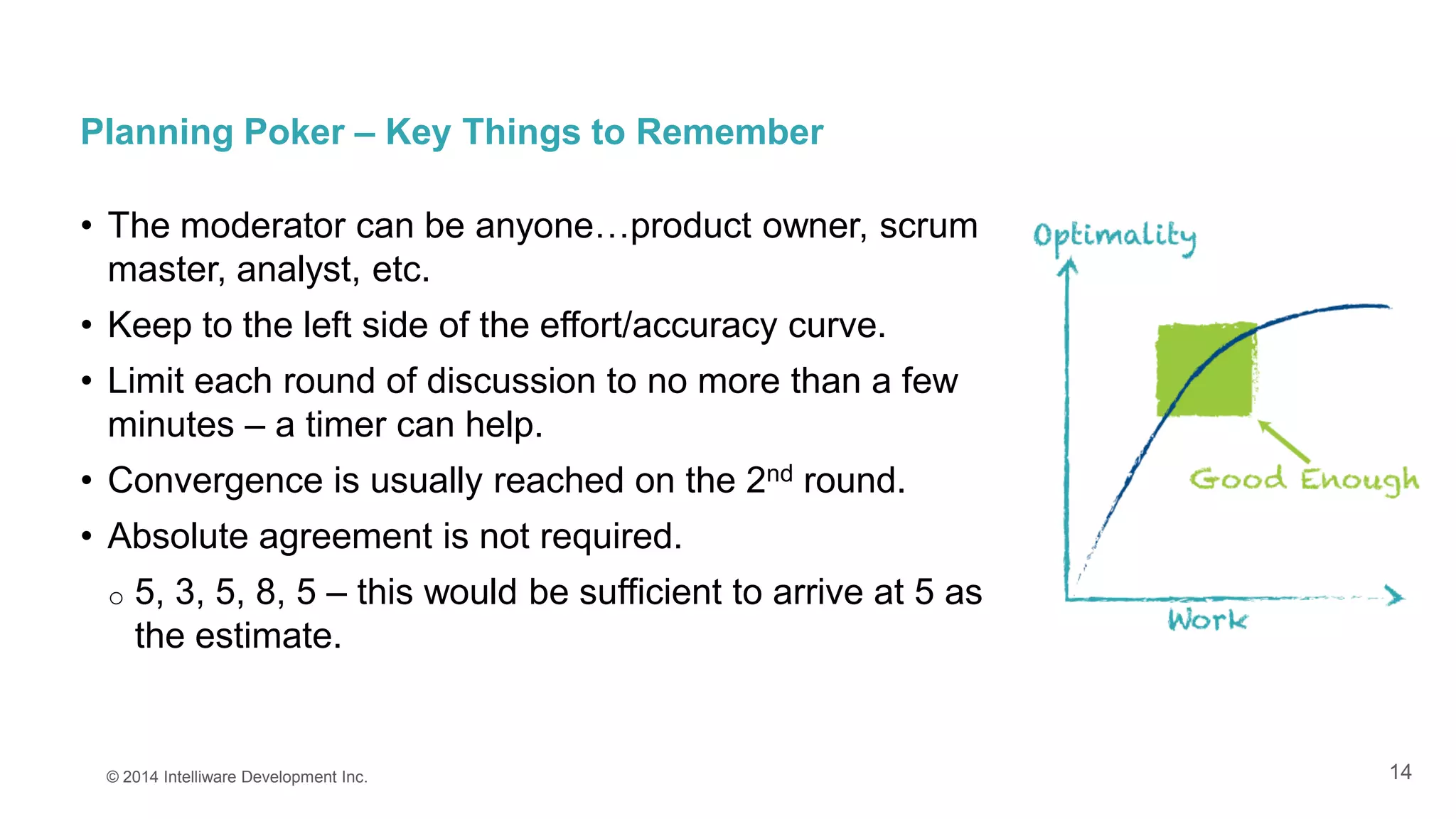
Planning Poker – Key Things to Remember
• The moderator can be anyone…product owner, scrum
master, analyst, etc.
• Keep to the left side of the effort/accuracy curve.
• Limit each round of discussion to no more than a few
minutes – a timer can help.
• Convergence is usually reached on the 2nd round.
• Absolute agreement is not required.
o 5, 3, 5, 8, 5 – this would be sufficient to arrive at 5 as
the estimate.
© 2014 Intelliware Development Inc.
15
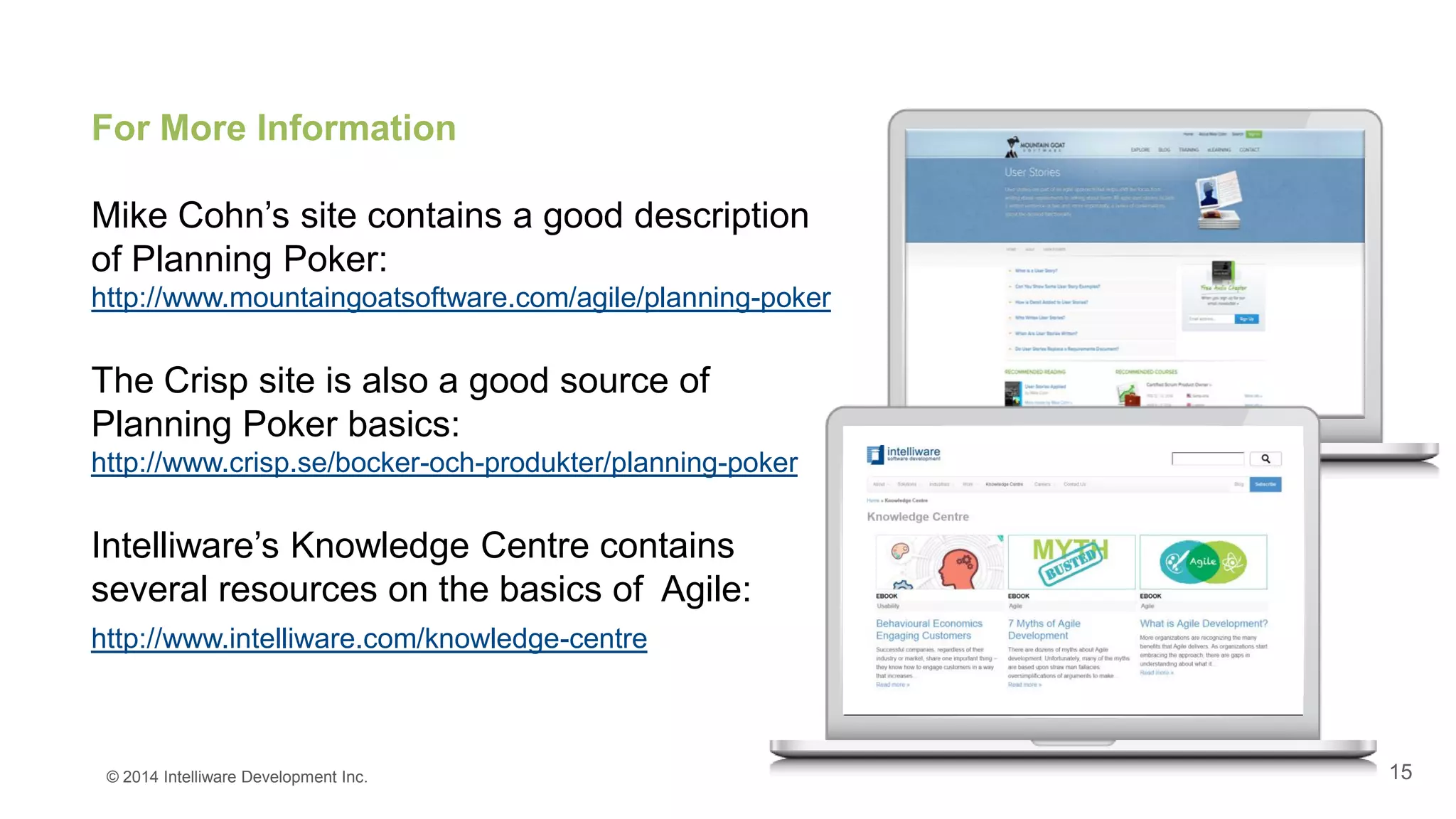
For More Information
Mike Cohn’s site contains a good description
of Planning Poker:
http://www.mountaingoatsoftware.com/agile/planning-poker
The Crisp site is also a good source of
Planning Poker basics:
http://www.crisp.se/bocker-och-produkter/planning-poker
Intelliware’s Knowledge Centre contains
several resources on the basics of Agile:
http://www.intelliware.com/knowledge-centre
© 2014 Intelliware Development Inc.
Check Out Other Titles From Our Agile Development Series
16© 2014 Intelliware Development Inc.
17© 2014 Intelliware Development Inc.
About Intelliware Development Inc.
Intelliware is a custom software, mobile solutions and product development
company headquartered in Toronto, Canada. Intelliware is a leader in Agile
software development practices which ensure the delivery of timely high quality
solutions for clients. Intelliware is engaged as a technical partner by a wide
range of national and global organizations in sectors that span Financial
Services, Healthcare, ICT, Retail, Manufacturing and Government.
/company/intelliware-development-inc-
/intelliware.inc
/intelliware_inc
/GooglePlusIntelliware
www.intelliware.com

Agile Estimating

  • 1.
    © 2014 IntelliwareDevelopment Inc.
  • 2.
    What You’ll Learnin this Presentation: • How estimates are used on Agile projects. • How to define estimates. • The basics of planning poker to help estimate. © 2014 Intelliware Development Inc. 2
  • 3.
    3 Introduction – AgilePlanning • Planning occurs throughout the development cycle and is spread across the entire team. • “Work the plan, not work to the plan.” • A user story is a short description of a function that an end user would want. • Stories serve as a form of currency between the customers and the development team. © 2014 Intelliware Development Inc.
  • 4.
    4 The Agile PlanningProcess •Estimates are needed to support ongoing planning in Agile projects. •Estimates help to answer the following questions: o How many stories can we fit into the release? o How many stories will be completed in the next iteration? o What are the impacts of adding, removing and changing stories? © 2014 Intelliware Development Inc. Features Estimate Size Determine Duration Planning
  • 5.
    5 What is anEstimate? • An estimate is a measure of the relative size, in terms of effort, of a story. • Why focus on size? o Estimate size to derive duration. o Size can be estimated. o Duration is hard to determine due to meetings, non-work appointments and other distractions that cannot be estimated. © 2014 Intelliware Development Inc.
  • 6.
    6 1. non-development projecttime (e.g. standup meetings), and 2. non-project work time (e.g. internal non- project meetings, medical appointments). • Baseball analogy: the effort to complete a game is 54 outs or 9 innings, but what’s the duration of these events – and those in between? © 2014 Intelliware Development Inc. Effort vs. Duration • Not separating effort from duration is a common estimating error. • In reality, developers (and people in general) are good at estimating the effort required to complete something but not the time needed. • For software, development effort can be estimated but, to determine duration, additional time needs to be factored in to account for:
  • 7.
    7 Ideal Time vs.Real Time • Ideal Time = effort o Time required to complete something with no interruptions. o Represents effort. o Can be estimated relatively accurately. • Real Time = duration o The actual time to complete something. o Includes breaks, distractions, delays. o Difficult to estimate – must be derived. © 2014 Intelliware Development Inc.
  • 8.
    8 The Value ofEstimates • Address the Law of Diminishing Returns o Make the most efficient use of development time. • Benefits from the input of several people o Estimates are shared amongst the team. •Supports ongoing planning o Facilitate planning discussions at the right level. •Easy to change o Can be revised, split, etc. © 2014 Intelliware Development Inc. The application of the Law of Diminishing Returns to estimating
  • 9.
    9 Estimate Values • Estimatescan be measured in terms of: o Points. o Ideal days. o Any other unit of measurement that makes sense to the team. • Common estimating scales: o Standard interval – 1, 2, 3, … o Fibonacci series – 1, 2, 3, 5, 8, 13, 21, … o Doubling interval – 1, 2, 4, 8, 16, … © 2014 Intelliware Development Inc. The Fibonacci Series
  • 10.
    10 What is Velocityin Estimating? •A measure of the rate of progress. •Needed for iteration and release planning. •Usually measured in terms of points or ideal days per iteration. •Converts ideal time or estimates to duration. •Corrects for variability and errors in estimation. © 2014 Intelliware Development Inc. A typical velocity tracking plot
  • 11.
    11 How Is VelocityDetermined? Three Primary Methods: 1. Historical Values o Use observed velocity from past iterations. 2. Test Iterations o Run a test iteration and measure actual velocity. 3. Forecast o Compare available staff hours with story task breakdown estimates. © 2014 Intelliware Development Inc. Velocity Chart Another example of a velocity chart
  • 12.
    12 Planning Poker • Recognizedas one of the best ways for Agile teams to estimate because it: o encourages the entire development team to participate; o is easy, interactive, and fun; and o facilitates quick consensus on estimates. © 2014 Intelliware Development Inc.
  • 13.
    13 Planning Poker Procedure 1.Team meets around a table with cards. 2. Moderator reads out a story. 3. Moderator answers questions. 4. Estimators privately select a size card. 5. Estimators show their cards. 6. Any discrepancies are discussed, additional questions are answered. 7. Estimators re-estimate by selecting a new size card and revealing it. 8. Repeat. © 2014 Intelliware Development Inc.
  • 14.
    14 Planning Poker –Key Things to Remember • The moderator can be anyone…product owner, scrum master, analyst, etc. • Keep to the left side of the effort/accuracy curve. • Limit each round of discussion to no more than a few minutes – a timer can help. • Convergence is usually reached on the 2nd round. • Absolute agreement is not required. o 5, 3, 5, 8, 5 – this would be sufficient to arrive at 5 as the estimate. © 2014 Intelliware Development Inc.
  • 15.
    15 For More Information MikeCohn’s site contains a good description of Planning Poker: http://www.mountaingoatsoftware.com/agile/planning-poker The Crisp site is also a good source of Planning Poker basics: http://www.crisp.se/bocker-och-produkter/planning-poker Intelliware’s Knowledge Centre contains several resources on the basics of Agile: http://www.intelliware.com/knowledge-centre © 2014 Intelliware Development Inc.
  • 16.
    Check Out OtherTitles From Our Agile Development Series 16© 2014 Intelliware Development Inc.
  • 17.
    17© 2014 IntelliwareDevelopment Inc. About Intelliware Development Inc. Intelliware is a custom software, mobile solutions and product development company headquartered in Toronto, Canada. Intelliware is a leader in Agile software development practices which ensure the delivery of timely high quality solutions for clients. Intelliware is engaged as a technical partner by a wide range of national and global organizations in sectors that span Financial Services, Healthcare, ICT, Retail, Manufacturing and Government. /company/intelliware-development-inc- /intelliware.inc /intelliware_inc /GooglePlusIntelliware www.intelliware.com