© 2014 Intelliware Development Inc.
What You’ll Learn in this Presentation:
•  How estimates are used on Agile projects.
•  How to define estimates.
•  The basics of planning poker to help estimate.
© 2014 Intelliware Development Inc. 2	
  
3
Introduction – Agile Planning
•  Planning occurs throughout the development cycle and
is spread across the entire team.
•  “Work the plan, not work to the plan.”
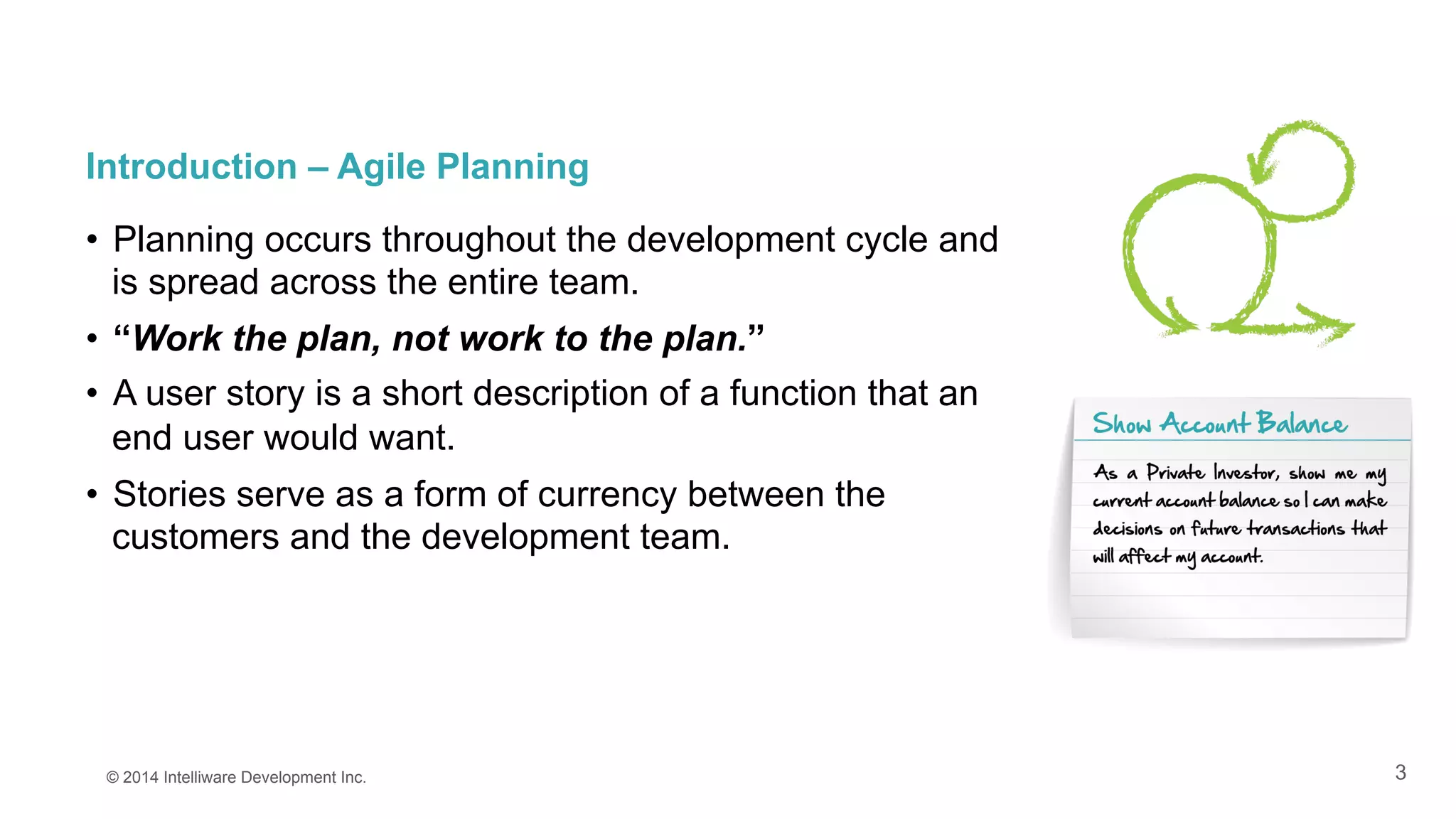
•  A user story is a short description of a function that an
end user would want.
•  Stories serve as a form of currency between the
customers and the development team.
© 2014 Intelliware Development Inc.
4
The Agile Planning Process
• Estimates are needed to support ongoing planning in Agile projects.
• Estimates help to answer the following questions:
o  How many stories can we fit into the release?
o  How many stories will be completed in the next iteration?
o  What are the impacts of adding, removing and changing stories?
© 2014 Intelliware Development Inc.
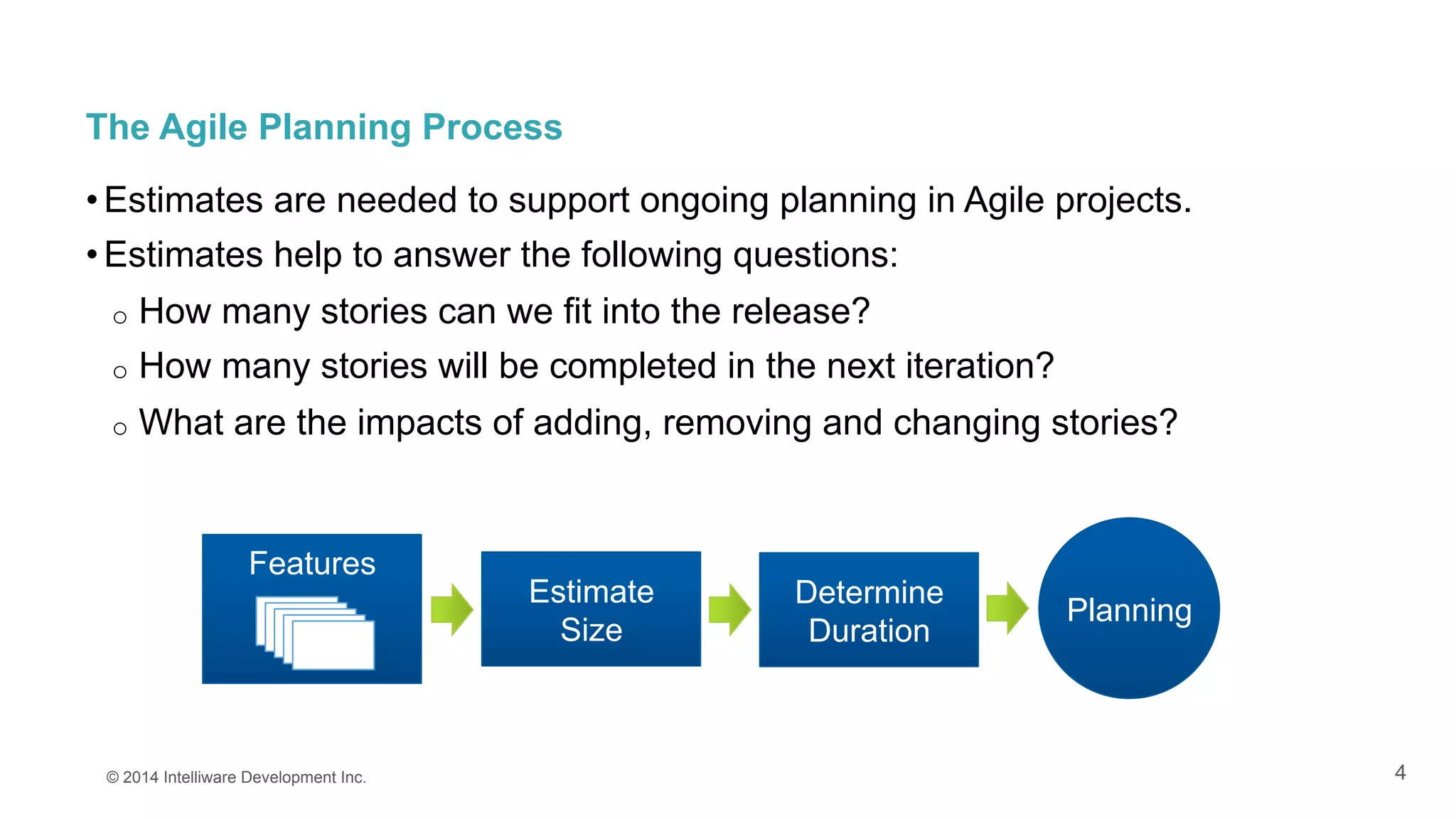
Features
Estimate
Size
Determine
Duration
Planning
5
What is an Estimate?
•  An estimate is a measure of the relative size, in
terms of effort, of a story.
•  Why focus on size?
o  Estimate size to derive duration.
o  Size can be estimated.
o  Duration is hard to determine due to meetings,
non-work appointments and other distractions that
cannot be estimated.
© 2014 Intelliware Development Inc.
6
1. non-development project time
(e.g. standup meetings), and
2. non-project work time (e.g. internal non-
project meetings, medical appointments).
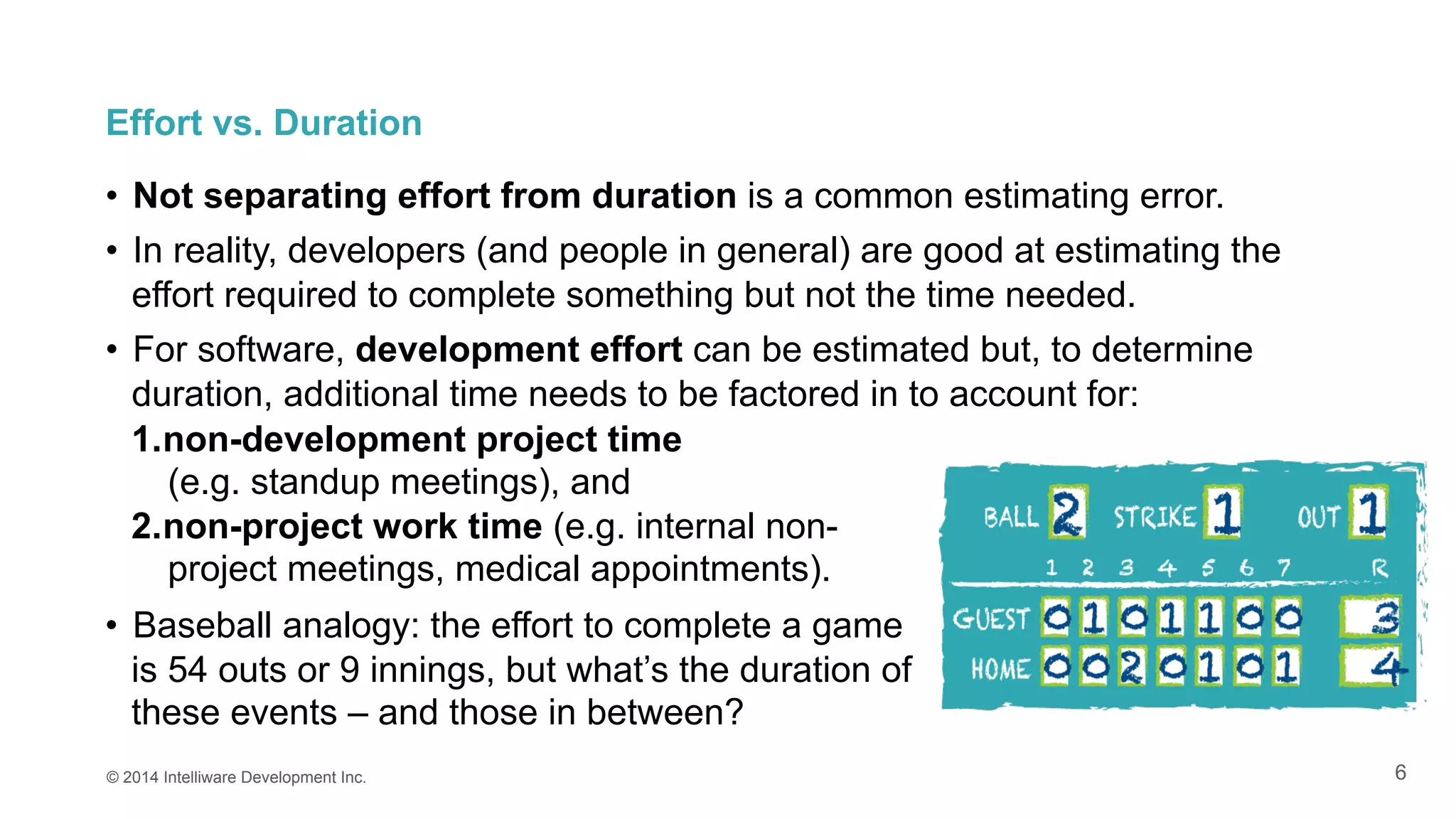
•  Baseball analogy: the effort to complete a game
is 54 outs or 9 innings, but what’s the duration of
these events – and those in between?
© 2014 Intelliware Development Inc.
Effort vs. Duration
•  Not separating effort from duration is a common estimating error.
•  In reality, developers (and people in general) are good at estimating the
effort required to complete something but not the time needed.
•  For software, development effort can be estimated but, to determine
duration, additional time needs to be factored in to account for:
7
Ideal Time vs. Real Time
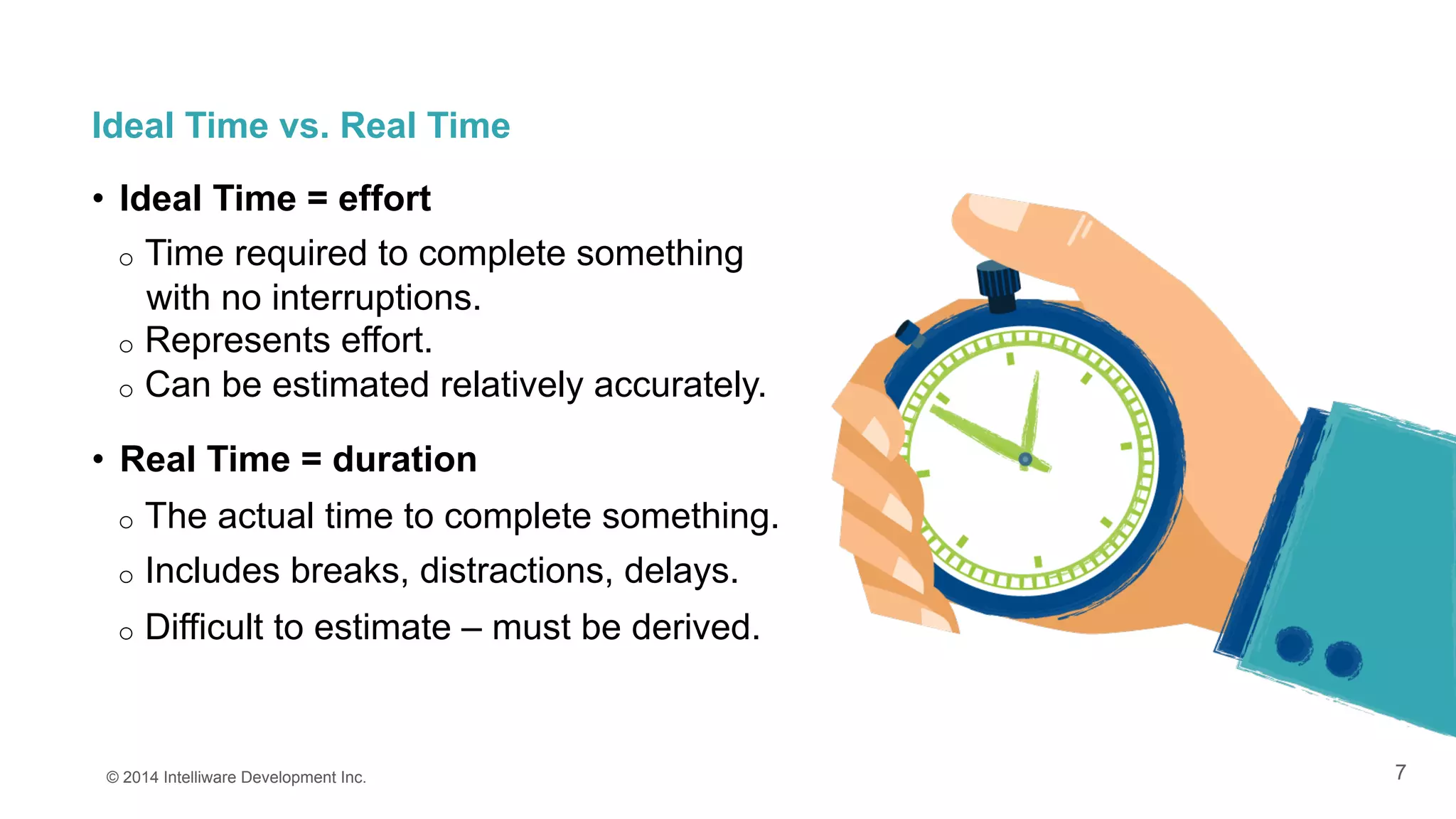
•  Ideal Time = effort
o  Time required to complete something
with no interruptions.
o  Represents effort.
o  Can be estimated relatively accurately.
•  Real Time = duration
o  The actual time to complete something.
o  Includes breaks, distractions, delays.
o  Difficult to estimate – must be derived.
© 2014 Intelliware Development Inc.
8
The Value of Estimates
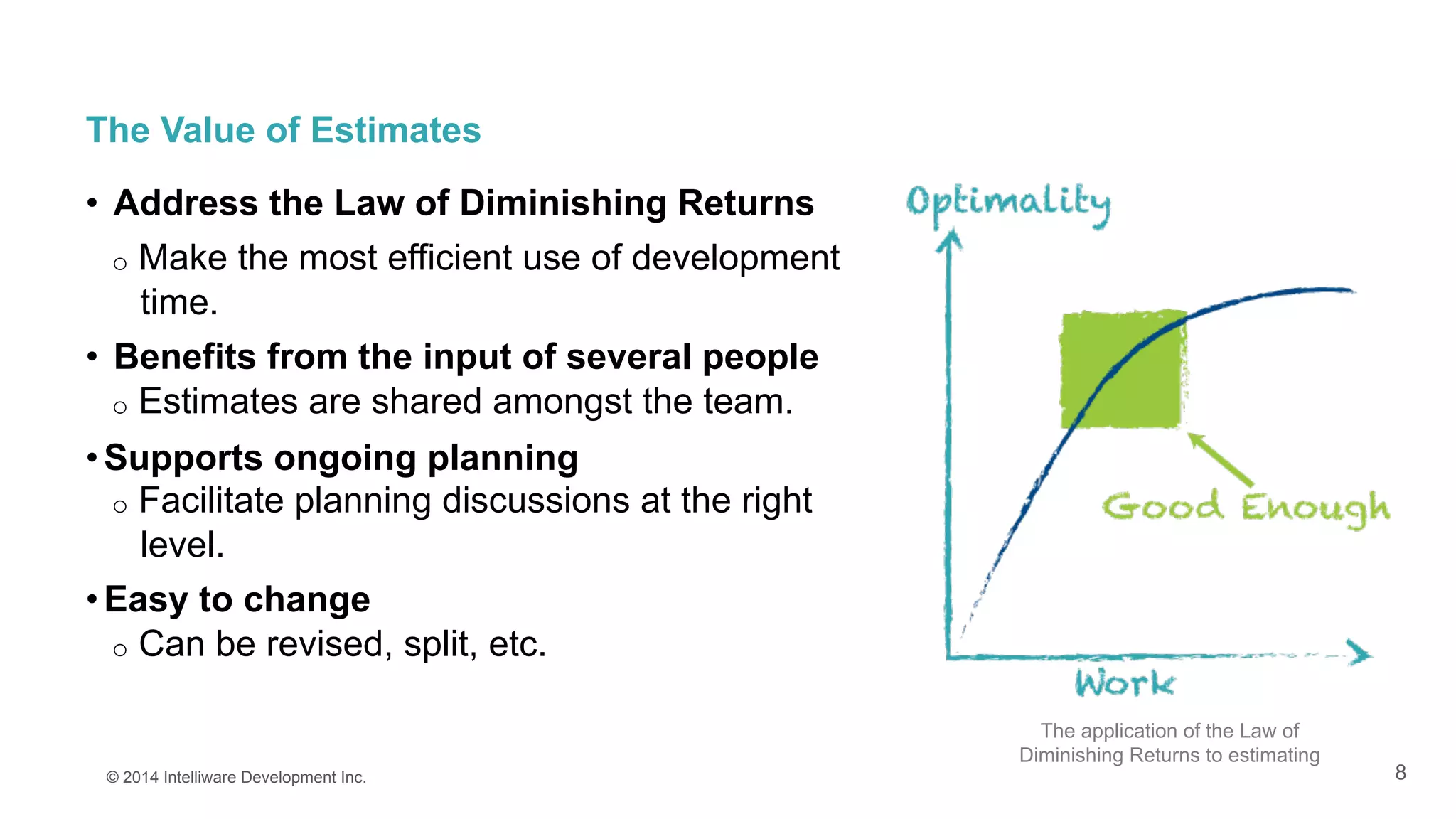
•  Address the Law of Diminishing Returns
o  Make the most efficient use of development
time.
•  Benefits from the input of several people
o  Estimates are shared amongst the team.
• Supports ongoing planning
o  Facilitate planning discussions at the right
level.
• Easy to change
o  Can be revised, split, etc.
© 2014 Intelliware Development Inc.
The application of the Law of
Diminishing Returns to estimating
9
Estimate Values
• Estimates can be measured in terms of:
o  Points.
o  Ideal days.
o  Any other unit of measurement that
makes sense to the team.
•  Common estimating scales:
o  Standard interval – 1, 2, 3, …
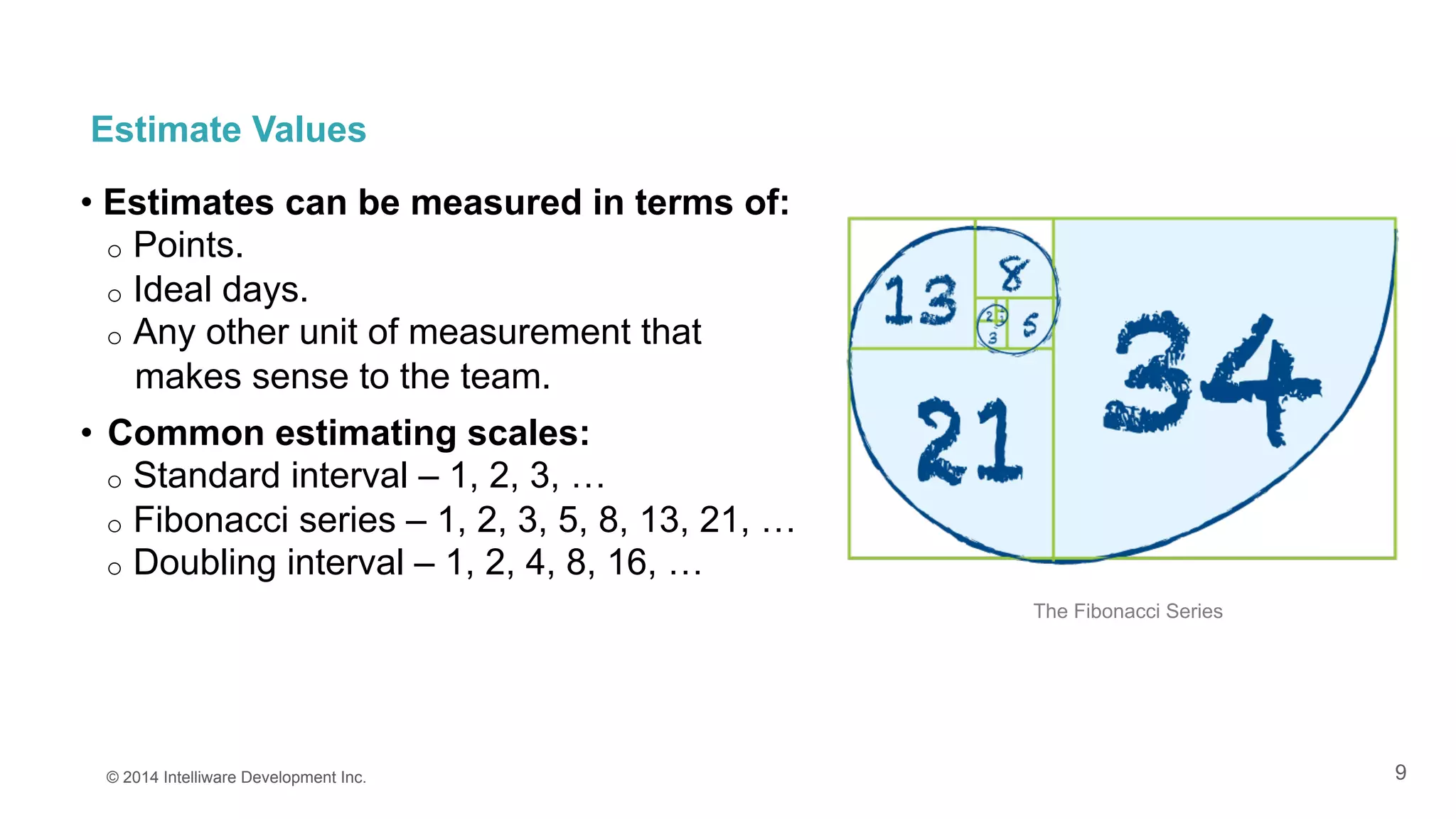
o  Fibonacci series – 1, 2, 3, 5, 8, 13, 21, …
o  Doubling interval – 1, 2, 4, 8, 16, …
© 2014 Intelliware Development Inc.
The Fibonacci Series
10
What is Velocity in Estimating?
• A measure of the rate of progress.
• Needed for iteration and release
planning.
• Usually measured in terms of points
or ideal days per iteration.
• Converts ideal time or estimates to
duration.
• Corrects for variability and errors in
estimation.
© 2014 Intelliware Development Inc.
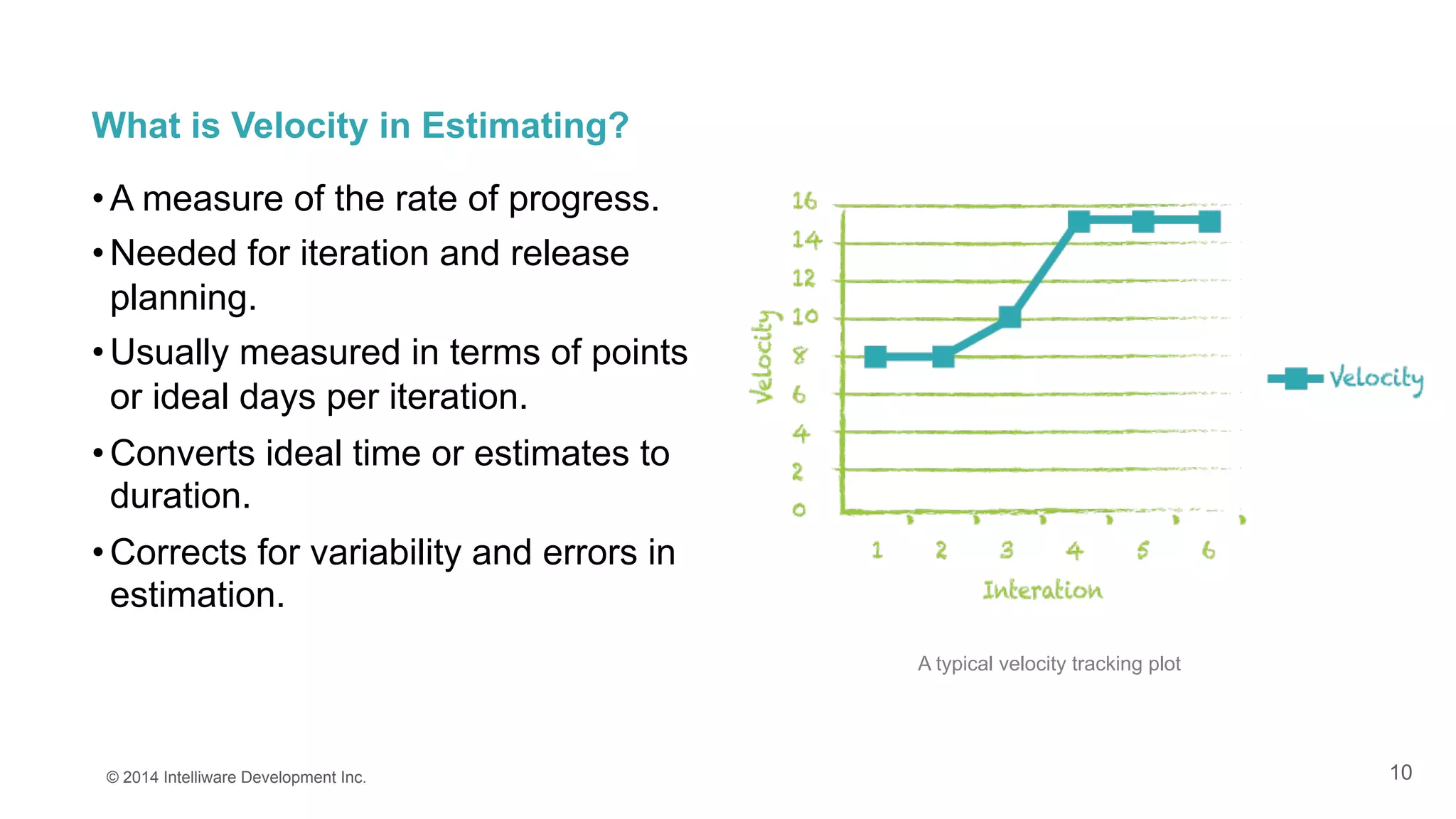
A typical velocity tracking plot
11
How Is Velocity Determined?
Three Primary Methods:
1.  Historical Values
o  Use observed velocity from past iterations.
2.  Test Iterations
o  Run a test iteration and measure actual
velocity.
3.  Forecast
o  Compare available staff hours with story
task breakdown estimates.
© 2014 Intelliware Development Inc.
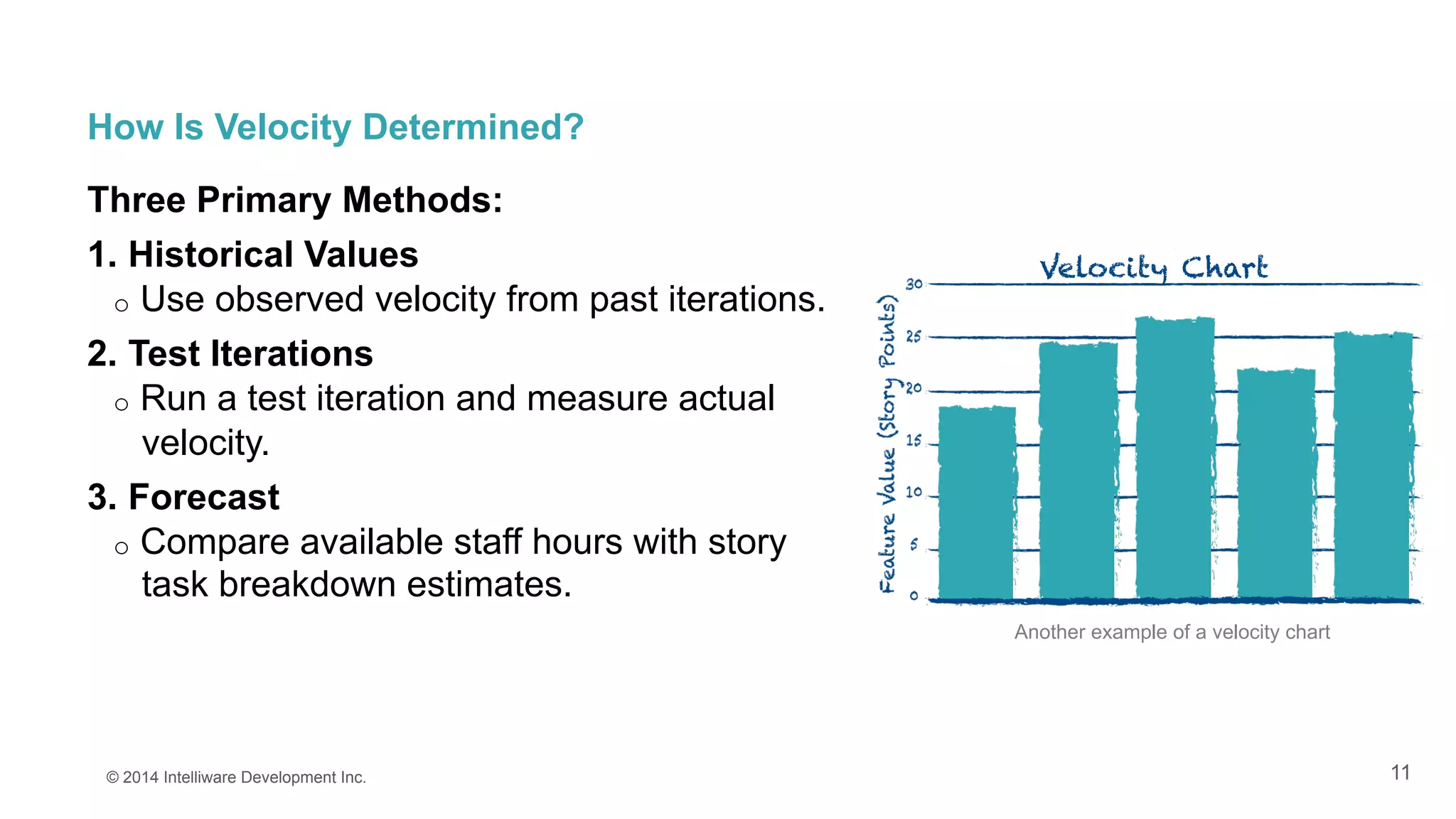
Velocity Chart
Another example of a velocity chart
12
Planning Poker
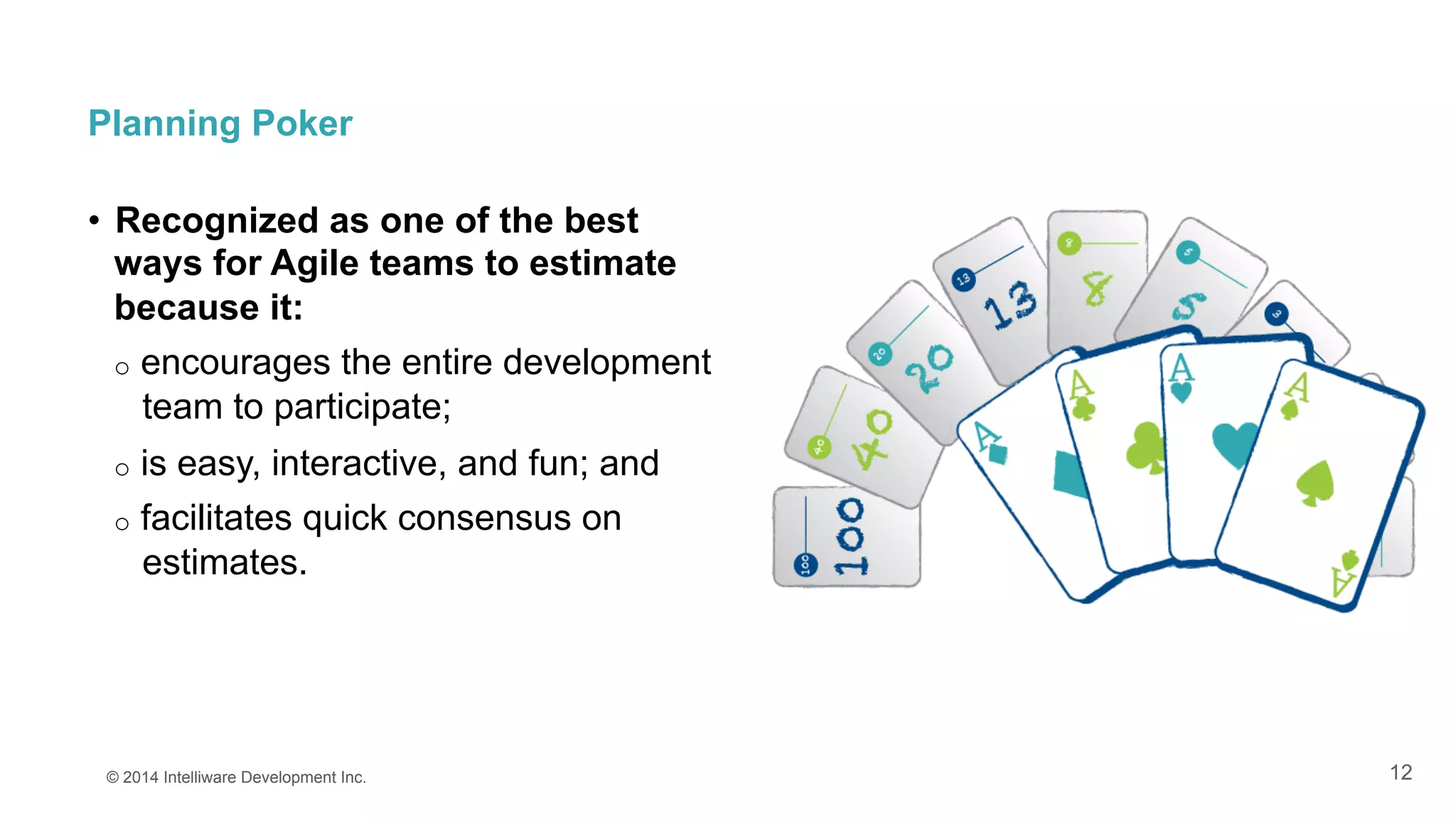
•  Recognized as one of the best
ways for Agile teams to estimate
because it:
o  encourages the entire development
team to participate;
o  is easy, interactive, and fun; and
o  facilitates quick consensus on
estimates.
© 2014 Intelliware Development Inc.
13
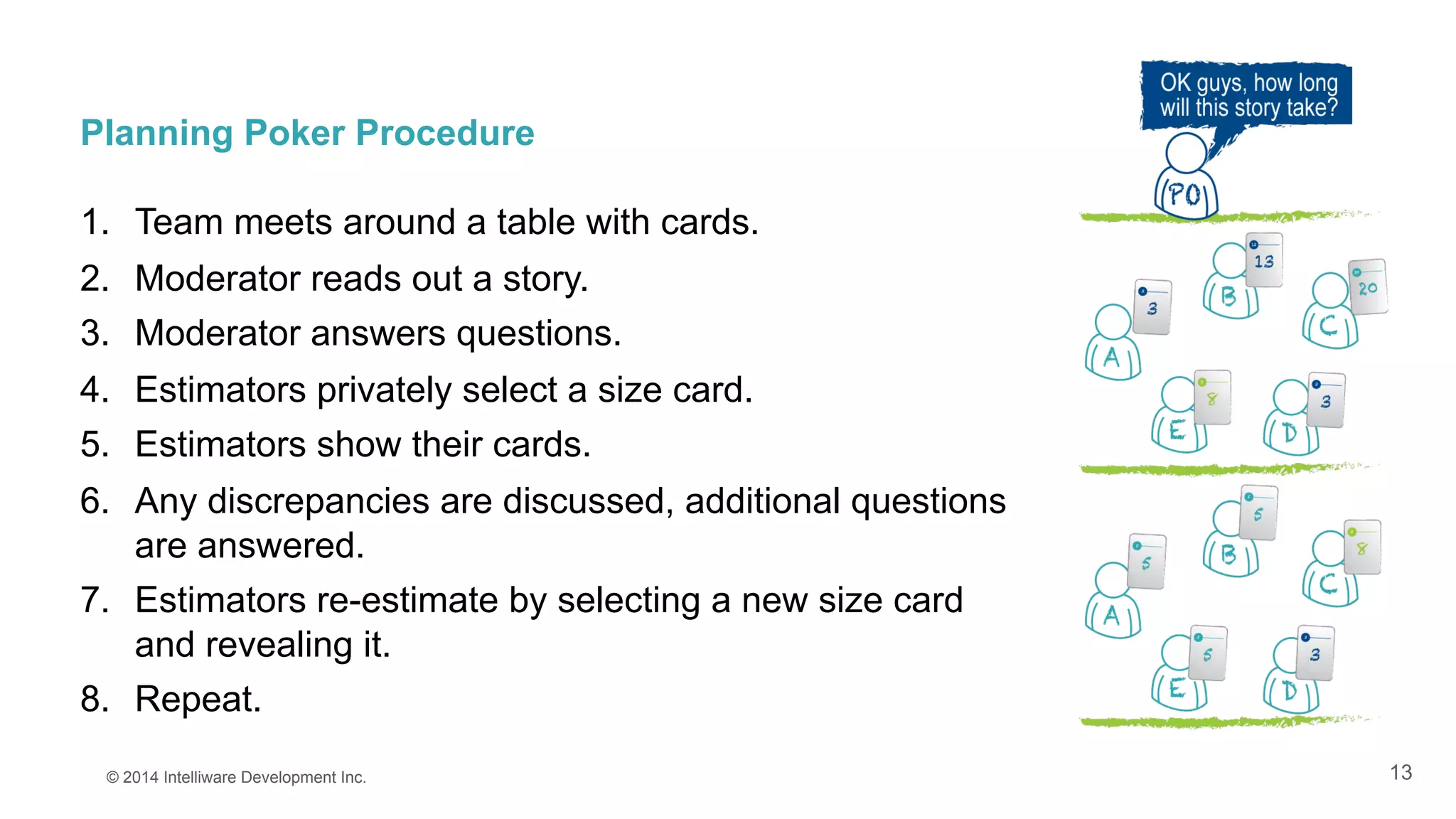
Planning Poker Procedure
1.  Team meets around a table with cards.
2.  Moderator reads out a story.
3.  Moderator answers questions.
4.  Estimators privately select a size card.
5.  Estimators show their cards.
6.  Any discrepancies are discussed, additional questions
are answered.
7.  Estimators re-estimate by selecting a new size card
and revealing it.
8.  Repeat.
© 2014 Intelliware Development Inc.
14
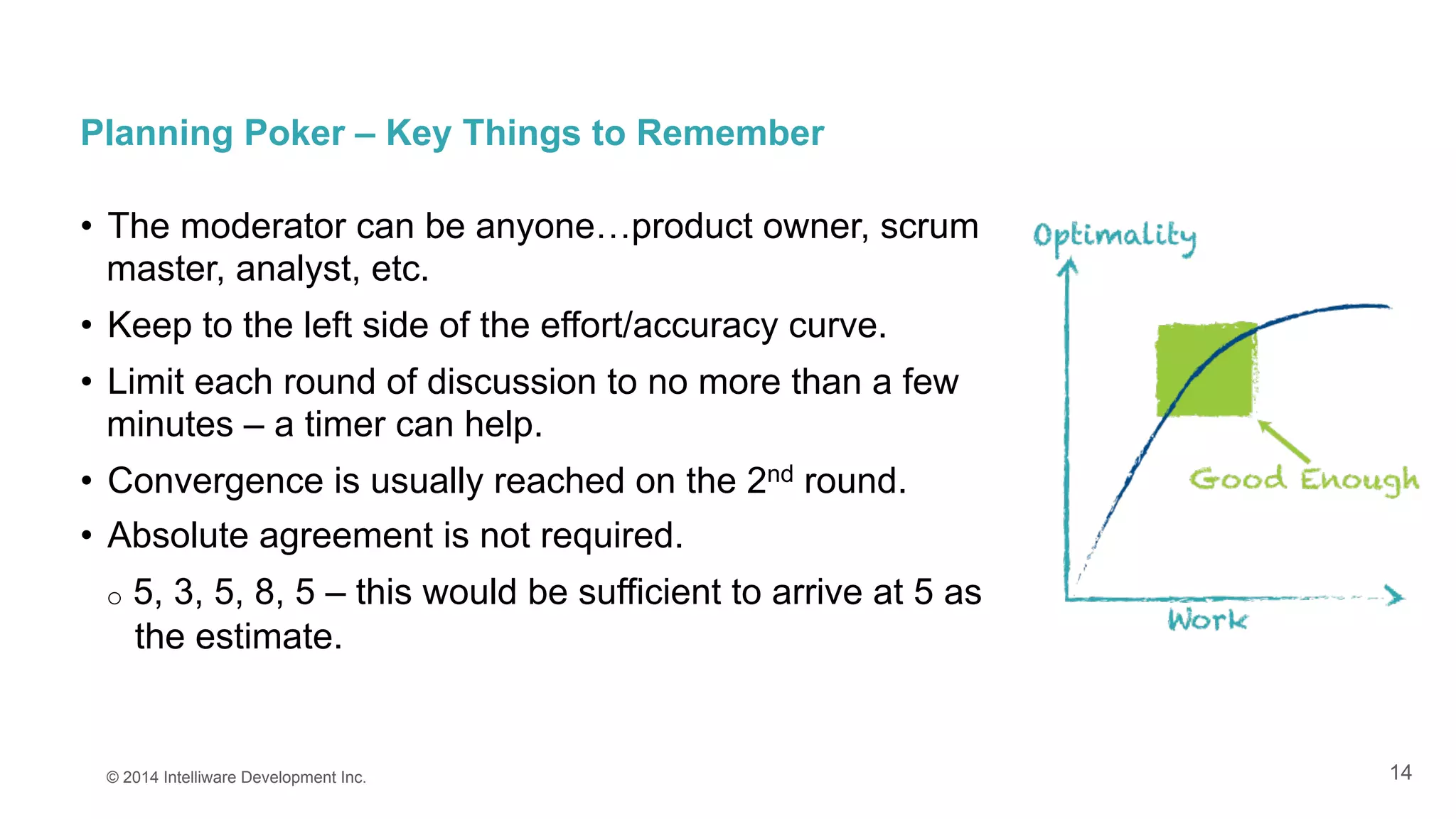
Planning Poker – Key Things to Remember
•  The moderator can be anyone…product owner, scrum
master, analyst, etc.
•  Keep to the left side of the effort/accuracy curve.
•  Limit each round of discussion to no more than a few
minutes – a timer can help.
•  Convergence is usually reached on the 2nd round.
•  Absolute agreement is not required.
o  5, 3, 5, 8, 5 – this would be sufficient to arrive at 5 as
the estimate.
© 2014 Intelliware Development Inc.
15
For More Information
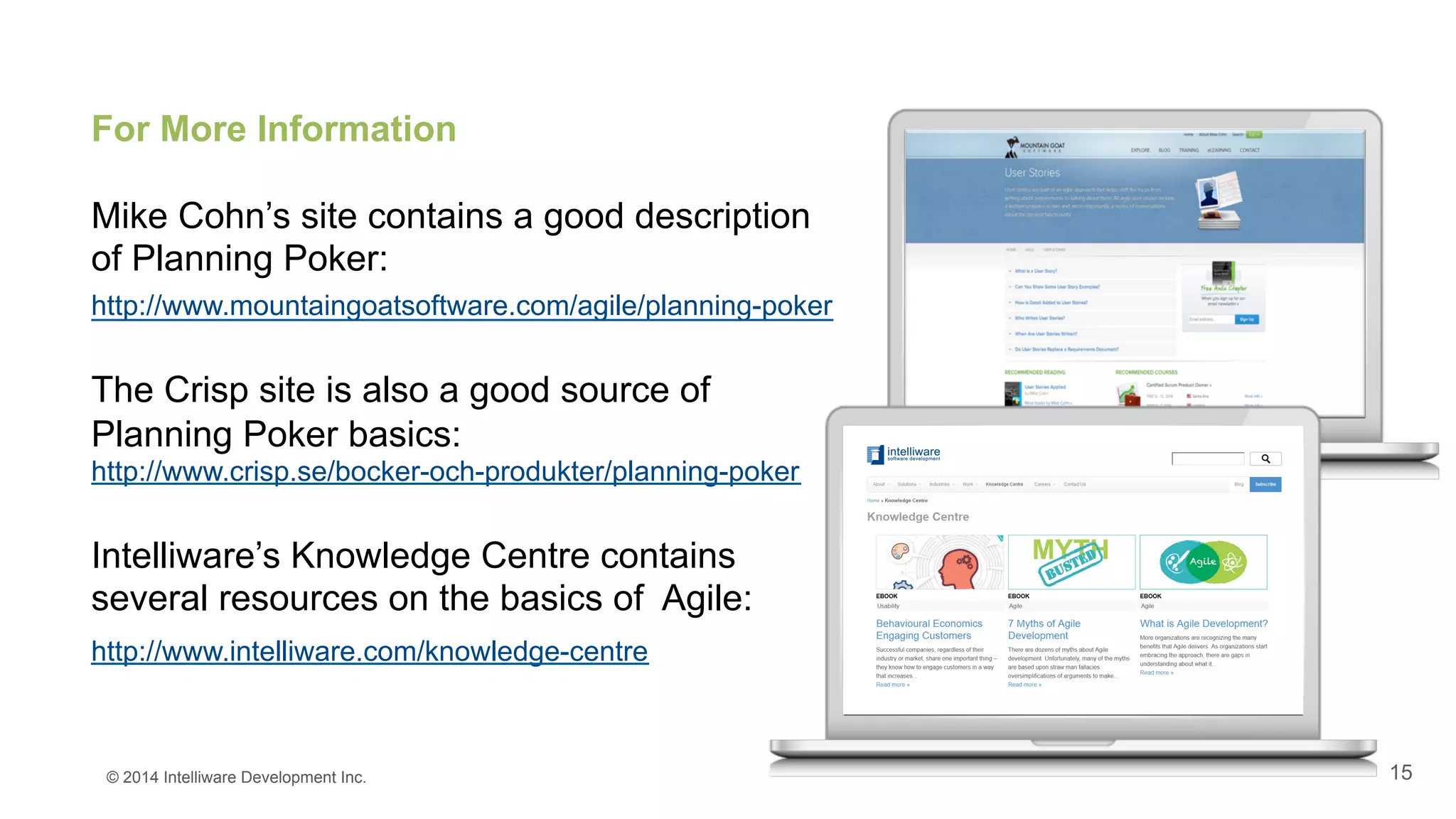
Mike Cohn’s site contains a good description
of Planning Poker:
http://www.mountaingoatsoftware.com/agile/planning-poker
The Crisp site is also a good source of
Planning Poker basics:
http://www.crisp.se/bocker-och-produkter/planning-poker
Intelliware’s Knowledge Centre contains
several resources on the basics of Agile:
http://www.intelliware.com/knowledge-centre
© 2014 Intelliware Development Inc.
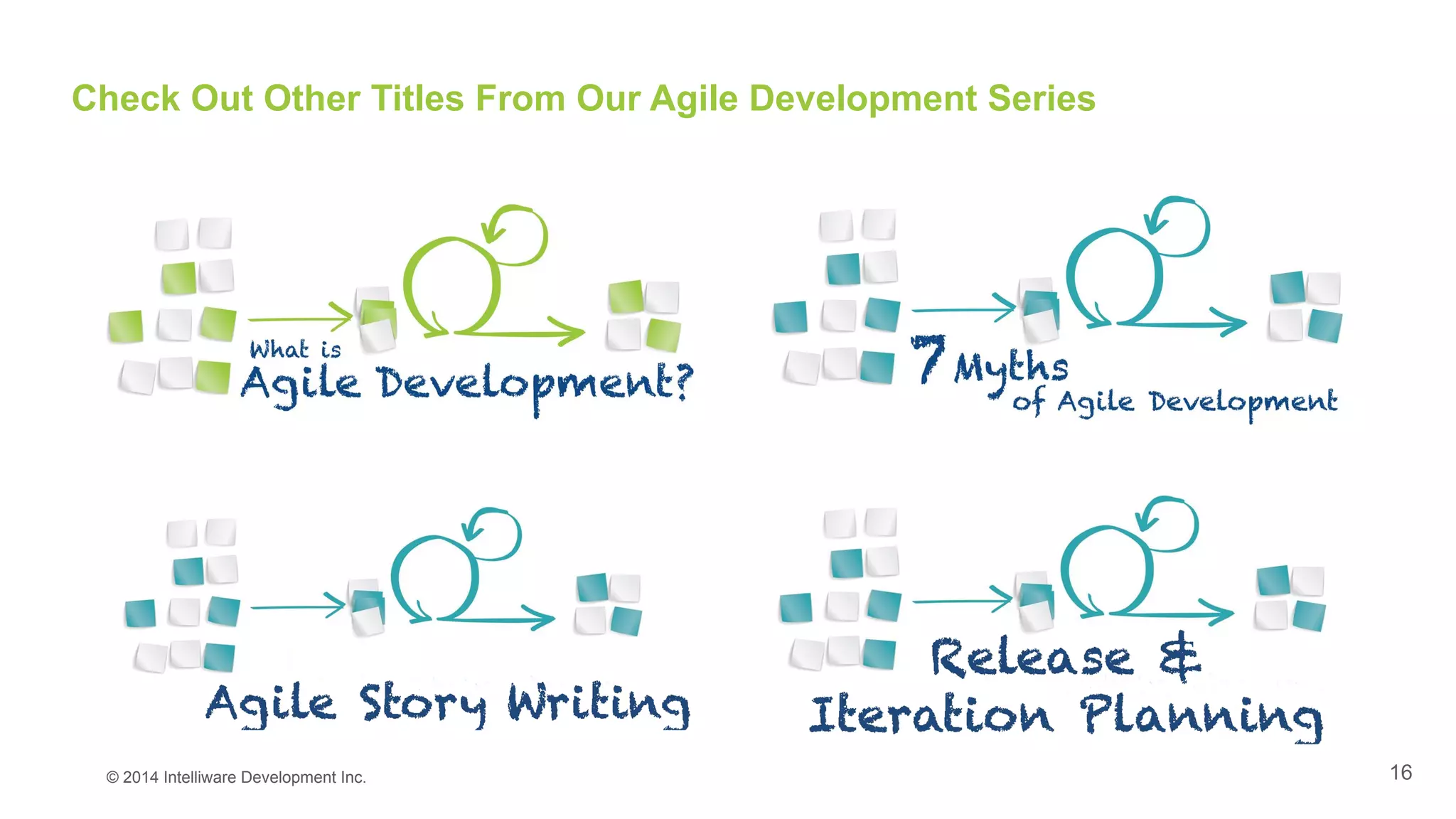
Check Out Other Titles From Our Agile Development Series
16© 2014 Intelliware Development Inc.
17
About Intelliware Development Inc.
Intelliware is a custom software, mobile solutions and product development
company headquartered in Toronto, Canada. Intelliware is a leader in Agile
software development practices which ensure the delivery of timely high quality
solutions for clients. Intelliware is engaged as a technical partner by a wide
range of national and global organizations in sectors that span Financial
Services, Healthcare, ICT, Retail, Manufacturing and Government.
/company/intelliware-development-inc-
/intelliware.inc
/intelliware_inc
/GooglePlusIntelliware
www.intelliware.com
© 2014 Intelliware Development Inc.

Agile Project Estimating

  • 1.
    © 2014 IntelliwareDevelopment Inc.
  • 2.
    What You’ll Learnin this Presentation: •  How estimates are used on Agile projects. •  How to define estimates. •  The basics of planning poker to help estimate. © 2014 Intelliware Development Inc. 2  
  • 3.
    3 Introduction – AgilePlanning •  Planning occurs throughout the development cycle and is spread across the entire team. •  “Work the plan, not work to the plan.” •  A user story is a short description of a function that an end user would want. •  Stories serve as a form of currency between the customers and the development team. © 2014 Intelliware Development Inc.
  • 4.
    4 The Agile PlanningProcess • Estimates are needed to support ongoing planning in Agile projects. • Estimates help to answer the following questions: o  How many stories can we fit into the release? o  How many stories will be completed in the next iteration? o  What are the impacts of adding, removing and changing stories? © 2014 Intelliware Development Inc. Features Estimate Size Determine Duration Planning
  • 5.
    5 What is anEstimate? •  An estimate is a measure of the relative size, in terms of effort, of a story. •  Why focus on size? o  Estimate size to derive duration. o  Size can be estimated. o  Duration is hard to determine due to meetings, non-work appointments and other distractions that cannot be estimated. © 2014 Intelliware Development Inc.
  • 6.
    6 1. non-development project time (e.g.standup meetings), and 2. non-project work time (e.g. internal non- project meetings, medical appointments). •  Baseball analogy: the effort to complete a game is 54 outs or 9 innings, but what’s the duration of these events – and those in between? © 2014 Intelliware Development Inc. Effort vs. Duration •  Not separating effort from duration is a common estimating error. •  In reality, developers (and people in general) are good at estimating the effort required to complete something but not the time needed. •  For software, development effort can be estimated but, to determine duration, additional time needs to be factored in to account for:
  • 7.
    7 Ideal Time vs.Real Time •  Ideal Time = effort o  Time required to complete something with no interruptions. o  Represents effort. o  Can be estimated relatively accurately. •  Real Time = duration o  The actual time to complete something. o  Includes breaks, distractions, delays. o  Difficult to estimate – must be derived. © 2014 Intelliware Development Inc.
  • 8.
    8 The Value ofEstimates •  Address the Law of Diminishing Returns o  Make the most efficient use of development time. •  Benefits from the input of several people o  Estimates are shared amongst the team. • Supports ongoing planning o  Facilitate planning discussions at the right level. • Easy to change o  Can be revised, split, etc. © 2014 Intelliware Development Inc. The application of the Law of Diminishing Returns to estimating
  • 9.
    9 Estimate Values • Estimates canbe measured in terms of: o  Points. o  Ideal days. o  Any other unit of measurement that makes sense to the team. •  Common estimating scales: o  Standard interval – 1, 2, 3, … o  Fibonacci series – 1, 2, 3, 5, 8, 13, 21, … o  Doubling interval – 1, 2, 4, 8, 16, … © 2014 Intelliware Development Inc. The Fibonacci Series
  • 10.
    10 What is Velocityin Estimating? • A measure of the rate of progress. • Needed for iteration and release planning. • Usually measured in terms of points or ideal days per iteration. • Converts ideal time or estimates to duration. • Corrects for variability and errors in estimation. © 2014 Intelliware Development Inc. A typical velocity tracking plot
  • 11.
    11 How Is VelocityDetermined? Three Primary Methods: 1.  Historical Values o  Use observed velocity from past iterations. 2.  Test Iterations o  Run a test iteration and measure actual velocity. 3.  Forecast o  Compare available staff hours with story task breakdown estimates. © 2014 Intelliware Development Inc. Velocity Chart Another example of a velocity chart
  • 12.
    12 Planning Poker •  Recognizedas one of the best ways for Agile teams to estimate because it: o  encourages the entire development team to participate; o  is easy, interactive, and fun; and o  facilitates quick consensus on estimates. © 2014 Intelliware Development Inc.
  • 13.
    13 Planning Poker Procedure 1. Team meets around a table with cards. 2.  Moderator reads out a story. 3.  Moderator answers questions. 4.  Estimators privately select a size card. 5.  Estimators show their cards. 6.  Any discrepancies are discussed, additional questions are answered. 7.  Estimators re-estimate by selecting a new size card and revealing it. 8.  Repeat. © 2014 Intelliware Development Inc.
  • 14.
    14 Planning Poker –Key Things to Remember •  The moderator can be anyone…product owner, scrum master, analyst, etc. •  Keep to the left side of the effort/accuracy curve. •  Limit each round of discussion to no more than a few minutes – a timer can help. •  Convergence is usually reached on the 2nd round. •  Absolute agreement is not required. o  5, 3, 5, 8, 5 – this would be sufficient to arrive at 5 as the estimate. © 2014 Intelliware Development Inc.
  • 15.
    15 For More Information MikeCohn’s site contains a good description of Planning Poker: http://www.mountaingoatsoftware.com/agile/planning-poker The Crisp site is also a good source of Planning Poker basics: http://www.crisp.se/bocker-och-produkter/planning-poker Intelliware’s Knowledge Centre contains several resources on the basics of Agile: http://www.intelliware.com/knowledge-centre © 2014 Intelliware Development Inc.
  • 16.
    Check Out OtherTitles From Our Agile Development Series 16© 2014 Intelliware Development Inc.
  • 17.
    17 About Intelliware DevelopmentInc. Intelliware is a custom software, mobile solutions and product development company headquartered in Toronto, Canada. Intelliware is a leader in Agile software development practices which ensure the delivery of timely high quality solutions for clients. Intelliware is engaged as a technical partner by a wide range of national and global organizations in sectors that span Financial Services, Healthcare, ICT, Retail, Manufacturing and Government. /company/intelliware-development-inc- /intelliware.inc /intelliware_inc /GooglePlusIntelliware www.intelliware.com © 2014 Intelliware Development Inc.