
Feeling Agile Network
Your Needs…
Web/ProxyApp Server-Group
Remote officeEmployee CustomerBYOD GuestDumb terminal
ICP App Server
EDC DMZ
BYOD visits dumb
terminal
Employee visits
dumb terminal
Employee
communication
Simple, Secure, Controlled
Agility Features Create an Agile Network
Web/ProxyApp Server-Group
员工 BYOD
ICP App Server
EDC DMZ
Service layer
Network layer
User layer
Intrane
t
eSightController Agile Switch
InternetInternet
Service Orchestration
Specified data traffic forwarding path
Free Mobility
On-demand access control
SVF
1.1 Plug-and-play network devices
1.2 Centralized configuration of service templates
1.3 Uniform wired and wireless network monitoring
iPCA
Quick E2E fault location
50
2
1
3
5 4Unified Security
Remote office Customer
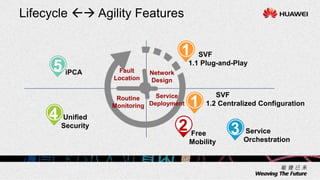
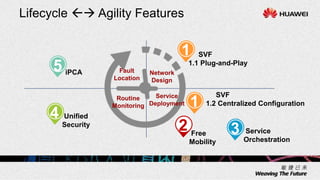
Lifecycle  Agility Features
Network
Design
Fault
Location
1 SVF
1.1 Plug-and-Play
1
SVF
1.2 Centralized Configuration
50
2 Free
Mobility
3 Service
Orchestration
4 Unified
Security
iPCA
5
Service
Deployment
Routine
Monitoring
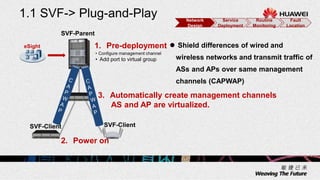
1.1 SVF-> Plug-and-Play
SVF-Parent
SVF-Client
3. Automatically create management channels
AS and AP are virtualized.
 Shield differences of wired and
wireless networks and transmit traffic of
ASs and APs over same management
channels (CAPWAP)
2. Power on
SVF-Client
1. Pre-deployment
• Configure management channel
• Add port to virtual group
eSight
Network
Design
Service
Deployment
Routine
Monitoring
Fault
Location
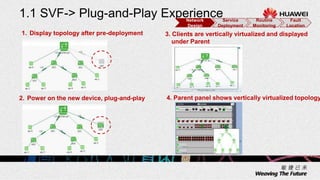
1.1 SVF-> Plug-and-Play Experience
1. Display topology after pre-deployment
2. Power on the new device, plug-and-play
3. Clients are vertically virtualized and displayed
under Parent
4. Parent panel shows vertically virtualized topology
Network
Design
Service
Deployment
Routine
Monitoring
Fault
Location
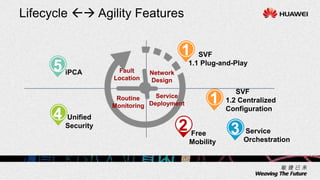
Lifecycle  Agility Features
Network
Design
Fault
Location
1 SVF
1.1 Plug-and-Play
1
SVF
1.2 Centralized
Configuration
50
2 Free
Mobility
3 Service
Orchestration
4 Unified
Security
iPCA
5
Service
Deployment
Routine
Monitoring
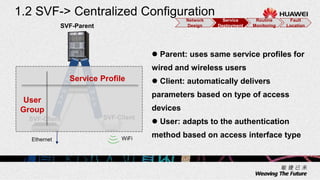
1.2 SVF-> Centralized Configuration
SVF-Parent
SVF-ClientSVF-Client
Ethernet WiFi
Service Profile
User
Group
 Parent: uses same service profiles for
wired and wireless users
 Client: automatically delivers
parameters based on type of access
devices
 User: adapts to the authentication
method based on access interface type
Network
Design
Service
Deployment
Routine
Monitoring
Fault
Location
Lifecycle  Agility Features
Network
Design
Fault
Location
1 SVF
1.1 Plug-and-Play
1
SVF
1.2 Centralized Configuration
50
2 Free
Mobility
3 Service
Orchestration
4 Unified
Security
iPCA
5
Service
Deployment
Routine
Monitoring
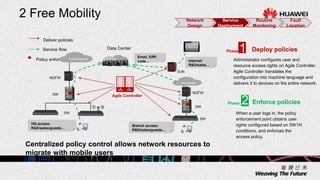
2 Free Mobility
Phase 1
2
Administrator configures user and
resource access rights on Agile Controller.
Agile Controller translates the
configuration into machine language and
delivers it to devices on the entire network.
When a user logs in, the policy
enforcement point obtains user
rights configured based on 5W1H
conditions, and enforces the
access policy.
Deploy policies
Enforce policies
Deliver policies
Service flow
Policy enforcement pointWAN/Internet
Agile Controller
WAN/Internet
Email, ERP,
code…
HQ access:
R&D/sales/guests…
Branch access:
R&D/sales/guests…
Internet:
R&D/sales…
NGFW
SW
SW
SW
SW
NGFW
SVN
Centralized policy control allows network resources to
migrate with mobile users
Network
Design
Service
Deployment
Routine
Monitoring
Fault
Location
Data Center
Phase
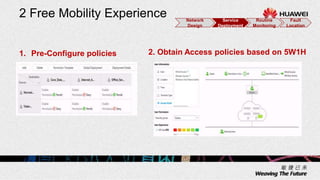
2 Free Mobility Experience
1. Pre-Configure policies 2. Obtain Access policies based on 5W1H
Network
Design
Service
Deployment
Routine
Monitoring
Fault
Location
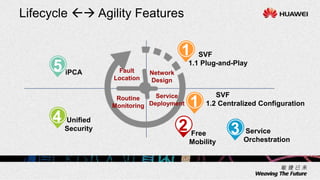
Lifecycle  Agility Features
Network
Design
Fault
Location
1 SVF
1.1 Plug-and-Play
1
SVF
1.2 Centralized Configuration
50
2 Free
Mobility
3 Service
Orchestration
4 Unified
Security
iPCA
5
Service
Deployment
Routine
Monitoring
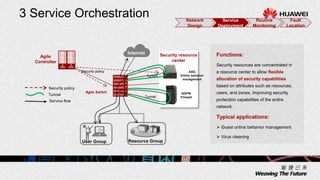
3 Service Orchestration
Functions:
Security resources are concentrated in
a resource center to allow flexible
allocation of security capabilities
based on attributes such as resources,
users, and zones, improving security
protection capabilities of the entire
network.
Typical applications:
 Guest online behavior management
 Virus cleaning
Security resource
center
User Group Resource Group
Internet
Tunnel
Tunnel
Agile Switch
Security policy ASG
Online behavior
management
NGFW
Firewall
Agile
Controller
Security policy
Tunnel
Service flow
Network
Design
Service
Deployment
Routine
Monitoring
Fault
Location
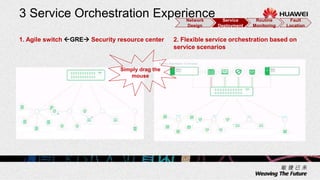
3 Service Orchestration Experience
1. Agile switch GRE Security resource center 2. Flexible service orchestration based on
service scenarios
Simply drag the
mouse
Network
Design
Service
Deployment
Routine
Monitoring
Fault
Location
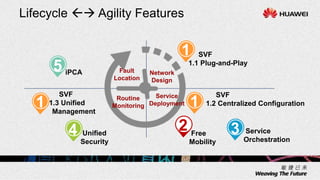
Lifecycle  Agility Features
Network
Design
Fault
Location
1 SVF
1.1 Plug-and-Play
1
SVF
1.2 Centralized Configuration1
SVF
1.3 Unified
Management
50
2 Free
Mobility
3 Service
Orchestration
4 Unified
Security
iPCA
5
Service
Deployment
Routine
Monitoring
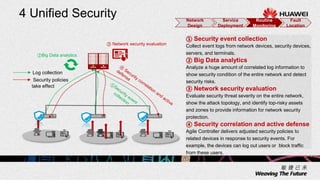
4 Unified Security
① Security event collection
Collect event logs from network devices, security devices,
servers, and terminals.
② Big Data analytics
Analyze a huge amount of correlated log information to
show security condition of the entire network and detect
security risks.
③ Network security evaluation
Evaluate security threat severity on the entire network,
show the attack topology, and identify top-risky assets
and zones to provide information for network security
protection.
④ Security correlation and active defense
Agile Controller delivers adjusted security policies to
related devices in response to security events. For
example, the devices can log out users or block traffic
from these users.
Log collection
Security policies
take effect
②Big Data analytics
③ Network security evaluation
Network
Design
Service
Deployment
Routine
Monitoring
Fault
Location
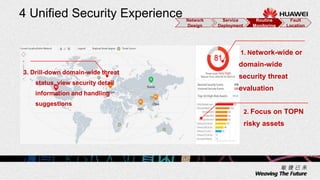
4 Unified Security Experience
1. Network-wide or
domain-wide
security threat
evaluation
2. Focus on TOPN
risky assets
3. Drill-down domain-wide threat
status, view security detail
information and handling
suggestions
Network
Design
Service
Deployment
Routine
Monitoring
Fault
Location
Lifecycle  Agility Features
Network
Design
Fault
Location
1 SVF
1.1 Plug-and-Play
1
SVF
1.2 Centralized Configuration
50
2 Free
Mobility
3 Service
Orchestration
4 Unified
Security
iPCA
5
Service
Deployment
Routine
Monitoring
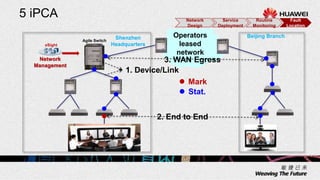
5 iPCA
Network
Management
eSight
Agile Switch
Operators
leased
network
Shenzhen
Headquarters
Beijing Branch
 Mark
1. Device/Link
3. WAN Egress
2. End to End
 Stat.
Network
Design
Service
Deployment
Routine
Monitoring
Fault
Location
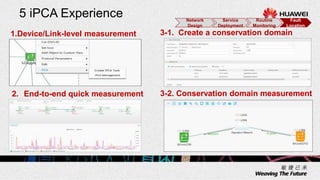
5 iPCA Experience
1.Device/Link-level measurement
2. End-to-end quick measurement
Network
Design
Service
Deployment
Routine
Monitoring
Fault
Location
3-1. Create a conservation domain
3-2. Conservation domain measurement
Agile Network Agile Management

Agile Network Agile Management

  • 1.
  • 2.
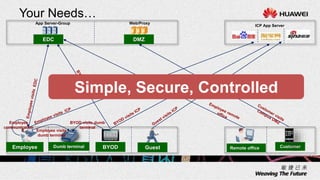
    Your Needs… Web/ProxyApp Server-Group RemoteofficeEmployee CustomerBYOD GuestDumb terminal ICP App Server EDC DMZ BYOD visits dumb terminal Employee visits dumb terminal Employee communication Simple, Secure, Controlled
  • 3.
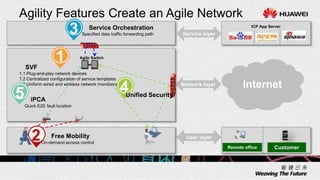
    Agility Features Createan Agile Network Web/ProxyApp Server-Group 员工 BYOD ICP App Server EDC DMZ Service layer Network layer User layer Intrane t eSightController Agile Switch InternetInternet Service Orchestration Specified data traffic forwarding path Free Mobility On-demand access control SVF 1.1 Plug-and-play network devices 1.2 Centralized configuration of service templates 1.3 Uniform wired and wireless network monitoring iPCA Quick E2E fault location 50 2 1 3 5 4Unified Security Remote office Customer
  • 4.
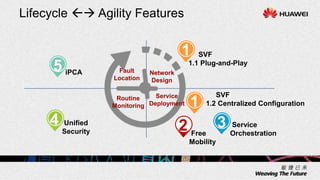
    Lifecycle  AgilityFeatures Network Design Fault Location 1 SVF 1.1 Plug-and-Play 1 SVF 1.2 Centralized Configuration 50 2 Free Mobility 3 Service Orchestration 4 Unified Security iPCA 5 Service Deployment Routine Monitoring
  • 5.
    1.1 SVF-> Plug-and-Play SVF-Parent SVF-Client 3.Automatically create management channels AS and AP are virtualized.  Shield differences of wired and wireless networks and transmit traffic of ASs and APs over same management channels (CAPWAP) 2. Power on SVF-Client 1. Pre-deployment • Configure management channel • Add port to virtual group eSight Network Design Service Deployment Routine Monitoring Fault Location
  • 6.
    1.1 SVF-> Plug-and-PlayExperience 1. Display topology after pre-deployment 2. Power on the new device, plug-and-play 3. Clients are vertically virtualized and displayed under Parent 4. Parent panel shows vertically virtualized topology Network Design Service Deployment Routine Monitoring Fault Location
  • 7.
    Lifecycle  AgilityFeatures Network Design Fault Location 1 SVF 1.1 Plug-and-Play 1 SVF 1.2 Centralized Configuration 50 2 Free Mobility 3 Service Orchestration 4 Unified Security iPCA 5 Service Deployment Routine Monitoring
  • 8.
    1.2 SVF-> CentralizedConfiguration SVF-Parent SVF-ClientSVF-Client Ethernet WiFi Service Profile User Group  Parent: uses same service profiles for wired and wireless users  Client: automatically delivers parameters based on type of access devices  User: adapts to the authentication method based on access interface type Network Design Service Deployment Routine Monitoring Fault Location
  • 9.
    Lifecycle  AgilityFeatures Network Design Fault Location 1 SVF 1.1 Plug-and-Play 1 SVF 1.2 Centralized Configuration 50 2 Free Mobility 3 Service Orchestration 4 Unified Security iPCA 5 Service Deployment Routine Monitoring
  • 10.
    2 Free Mobility Phase1 2 Administrator configures user and resource access rights on Agile Controller. Agile Controller translates the configuration into machine language and delivers it to devices on the entire network. When a user logs in, the policy enforcement point obtains user rights configured based on 5W1H conditions, and enforces the access policy. Deploy policies Enforce policies Deliver policies Service flow Policy enforcement pointWAN/Internet Agile Controller WAN/Internet Email, ERP, code… HQ access: R&D/sales/guests… Branch access: R&D/sales/guests… Internet: R&D/sales… NGFW SW SW SW SW NGFW SVN Centralized policy control allows network resources to migrate with mobile users Network Design Service Deployment Routine Monitoring Fault Location Data Center Phase
  • 11.
    2 Free MobilityExperience 1. Pre-Configure policies 2. Obtain Access policies based on 5W1H Network Design Service Deployment Routine Monitoring Fault Location
  • 12.
    Lifecycle  AgilityFeatures Network Design Fault Location 1 SVF 1.1 Plug-and-Play 1 SVF 1.2 Centralized Configuration 50 2 Free Mobility 3 Service Orchestration 4 Unified Security iPCA 5 Service Deployment Routine Monitoring
  • 13.
    3 Service Orchestration Functions: Securityresources are concentrated in a resource center to allow flexible allocation of security capabilities based on attributes such as resources, users, and zones, improving security protection capabilities of the entire network. Typical applications:  Guest online behavior management  Virus cleaning Security resource center User Group Resource Group Internet Tunnel Tunnel Agile Switch Security policy ASG Online behavior management NGFW Firewall Agile Controller Security policy Tunnel Service flow Network Design Service Deployment Routine Monitoring Fault Location
  • 14.
    3 Service OrchestrationExperience 1. Agile switch GRE Security resource center 2. Flexible service orchestration based on service scenarios Simply drag the mouse Network Design Service Deployment Routine Monitoring Fault Location
  • 15.
    Lifecycle  AgilityFeatures Network Design Fault Location 1 SVF 1.1 Plug-and-Play 1 SVF 1.2 Centralized Configuration1 SVF 1.3 Unified Management 50 2 Free Mobility 3 Service Orchestration 4 Unified Security iPCA 5 Service Deployment Routine Monitoring
  • 16.
    4 Unified Security ①Security event collection Collect event logs from network devices, security devices, servers, and terminals. ② Big Data analytics Analyze a huge amount of correlated log information to show security condition of the entire network and detect security risks. ③ Network security evaluation Evaluate security threat severity on the entire network, show the attack topology, and identify top-risky assets and zones to provide information for network security protection. ④ Security correlation and active defense Agile Controller delivers adjusted security policies to related devices in response to security events. For example, the devices can log out users or block traffic from these users. Log collection Security policies take effect ②Big Data analytics ③ Network security evaluation Network Design Service Deployment Routine Monitoring Fault Location
  • 17.
    4 Unified SecurityExperience 1. Network-wide or domain-wide security threat evaluation 2. Focus on TOPN risky assets 3. Drill-down domain-wide threat status, view security detail information and handling suggestions Network Design Service Deployment Routine Monitoring Fault Location
  • 18.
    Lifecycle  AgilityFeatures Network Design Fault Location 1 SVF 1.1 Plug-and-Play 1 SVF 1.2 Centralized Configuration 50 2 Free Mobility 3 Service Orchestration 4 Unified Security iPCA 5 Service Deployment Routine Monitoring
  • 19.
    5 iPCA Network Management eSight Agile Switch Operators leased network Shenzhen Headquarters BeijingBranch  Mark 1. Device/Link 3. WAN Egress 2. End to End  Stat. Network Design Service Deployment Routine Monitoring Fault Location
  • 20.
    5 iPCA Experience 1.Device/Link-levelmeasurement 2. End-to-end quick measurement Network Design Service Deployment Routine Monitoring Fault Location 3-1. Create a conservation domain 3-2. Conservation domain measurement

Editor's Notes

  • #2 Feel
  • #12 Obtain 5W1H access policies (rights, bandwidth)