A few words on Agile
     And how it might be useful for projects


     by Adam Knowles for Elvis Communications, London UK


Not saying we have to do things this way but I wanted to get some principles
out there to explain a bit about what I mean. We can take it or leave it, take
some bits and leave others. But my personal recommendation as you’ve
guessed is that these ideas will make our lives easier.


                                                                                 1
Agile
     it’s

                                                 not
                                       fragile
Method not madness.
Simple not easy.


The following four slides are from agilemanifesto.org
it’s
            people
                                                   over
                        process
Intro: not to say the thing underneath isn’t important, but the thing on top is
relatively more important.


So we invent the support tools and institutionalise things as we go, when we
decide we need them, not all up-front.
it’s
            working
            software
                                                over
                    dead documents

It’s ends over means. Outputs over inputs. Making it real. Researching only
when you have to. If it isn’t contributing to the end product, you shouldn’t be
doing it. That may mean a prototype.


A note on documentation: barely sufficient. Just in time and just enough.
http://www.allaboutagile.com/agile-principle-4-agile-requirements-are-
barely-sufficient/
it’s
 collaboration
                                                  over
                           contracts
That means breaking the agency/client divide. If you want boarded up stuff
carted over and presented, this may not be for you. It’s to arrive at the
answers together by sharing the problems. There’ll still be work we each
need to do and there’ll still BE a contract, but that is far less important than
actually having the right approach to doing the work.
it’s
             iterative
                                                 over
                      a one-time plan

“Planning is guessing” - Rework by 37signals. You need to be free to decide
what needs to be done today, not hamstrung by something you guessed
would be necessary before you’d started it. Otherwise you’re acting out a
plan that’s become out of sync with reality. It’s not failing to plan, it’s
planning that incorporates changing the plan. Working without a plan
sounds scary but blindly folowing a plan that’s become out of touch with
reality is much scarier.


You can still fix time & cost, but then you flex scope. You make a plan but
you ensure everyone is aware of the confidence-level in that plan, which will
increase as you approach it (cone of uncertainty). You reserve the right to
change the plan if it’s in the best interests of the project, but with an eye on
what you’ve promised at a high level.


“The timeframe of an agile development project is fixed, whereas the
features are variable.”
- http://www.allaboutagile.com/agile-principle-4-agile-requirements-are-
barely-sufficient/
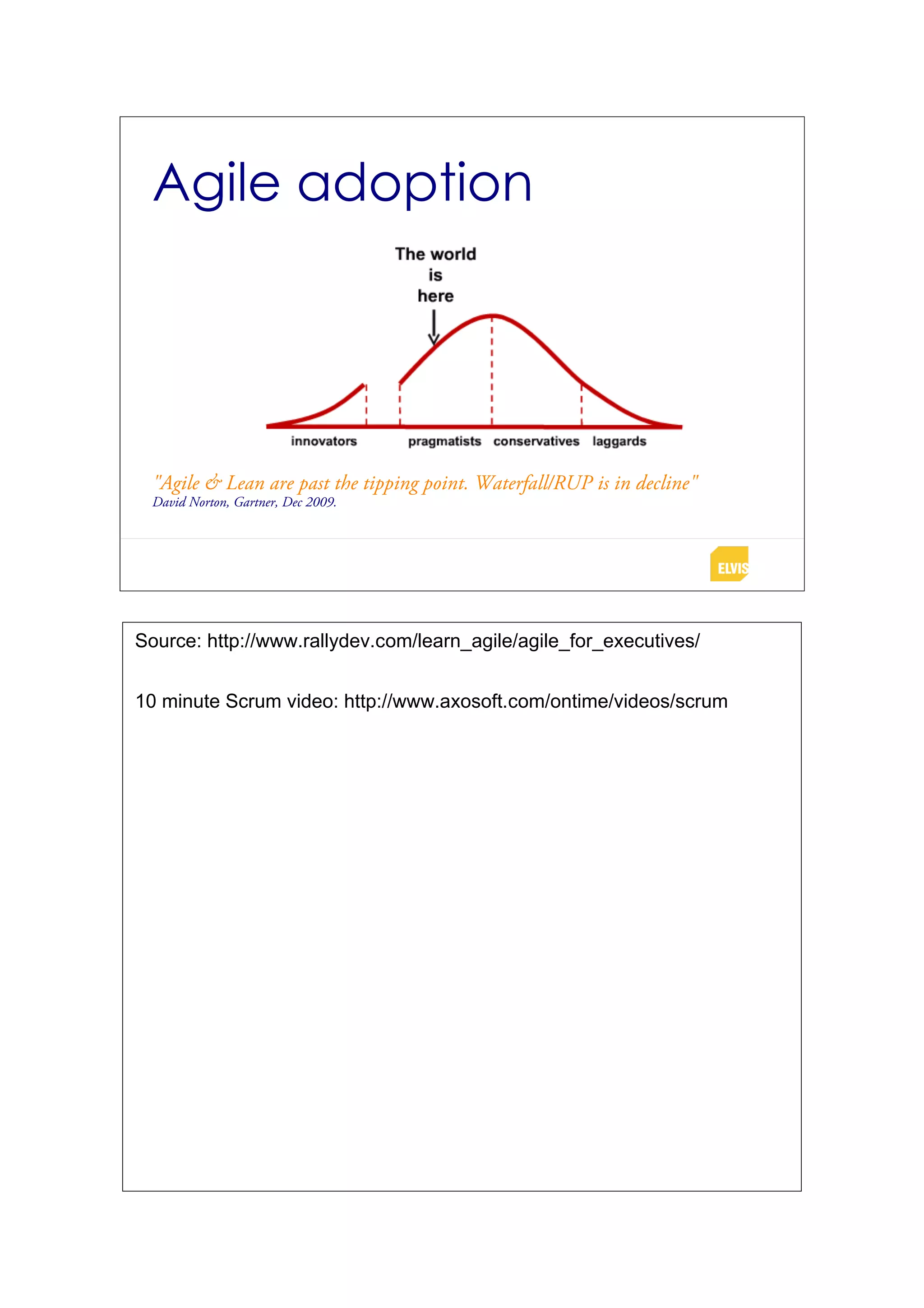
Agile adoption


                                                  over
 "Agile & Lean are past the tipping point. Waterfall/RUP is in decline"
 David Norton, Gartner, Dec 2009.


Source: http://www.rallydev.com/learn_agile/agile_for_executives/


10 minute Scrum video: http://www.axosoft.com/ontime/videos/scrum

Agile

  • 1.
    A few wordson Agile And how it might be useful for projects by Adam Knowles for Elvis Communications, London UK Not saying we have to do things this way but I wanted to get some principles out there to explain a bit about what I mean. We can take it or leave it, take some bits and leave others. But my personal recommendation as you’ve guessed is that these ideas will make our lives easier. 1
  • 2.
    Agile it’s not fragile Method not madness. Simple not easy. The following four slides are from agilemanifesto.org
  • 3.
    it’s people over process Intro: not to say the thing underneath isn’t important, but the thing on top is relatively more important. So we invent the support tools and institutionalise things as we go, when we decide we need them, not all up-front.
  • 4.
    it’s working software over dead documents It’s ends over means. Outputs over inputs. Making it real. Researching only when you have to. If it isn’t contributing to the end product, you shouldn’t be doing it. That may mean a prototype. A note on documentation: barely sufficient. Just in time and just enough. http://www.allaboutagile.com/agile-principle-4-agile-requirements-are- barely-sufficient/
  • 5.
    it’s collaboration over contracts That means breaking the agency/client divide. If you want boarded up stuff carted over and presented, this may not be for you. It’s to arrive at the answers together by sharing the problems. There’ll still be work we each need to do and there’ll still BE a contract, but that is far less important than actually having the right approach to doing the work.
  • 6.
    it’s iterative over a one-time plan “Planning is guessing” - Rework by 37signals. You need to be free to decide what needs to be done today, not hamstrung by something you guessed would be necessary before you’d started it. Otherwise you’re acting out a plan that’s become out of sync with reality. It’s not failing to plan, it’s planning that incorporates changing the plan. Working without a plan sounds scary but blindly folowing a plan that’s become out of touch with reality is much scarier. You can still fix time & cost, but then you flex scope. You make a plan but you ensure everyone is aware of the confidence-level in that plan, which will increase as you approach it (cone of uncertainty). You reserve the right to change the plan if it’s in the best interests of the project, but with an eye on what you’ve promised at a high level. “The timeframe of an agile development project is fixed, whereas the features are variable.” - http://www.allaboutagile.com/agile-principle-4-agile-requirements-are- barely-sufficient/
  • 7.
    Agile adoption over "Agile & Lean are past the tipping point. Waterfall/RUP is in decline" David Norton, Gartner, Dec 2009. Source: http://www.rallydev.com/learn_agile/agile_for_executives/ 10 minute Scrum video: http://www.axosoft.com/ontime/videos/scrum