 Advanced Manual : Technical
Presentations
 Project 1: The Technical Briefing
 Scrum : An Agile Methodology
 Lisette Zounon , CSM (certified Scrum Master)
 Thursday , August 1st , 2013
Outline
 History of Software Development
 Agile values
 What is a Scrum team
 Product backlog
 What is a sprint
 Sprint review
 Daily Standup
 Putting all together
Brief History on SW
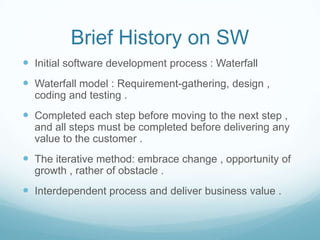
 Initial software development process : Waterfall
 Waterfall model : Requirement-gathering, design ,
coding and testing .
 Completed each step before moving to the next step ,
and all steps must be completed before delivering any
value to the customer .
 The iterative method: embrace change , opportunity of
growth , rather of obstacle .
 Interdependent process and deliver business value .
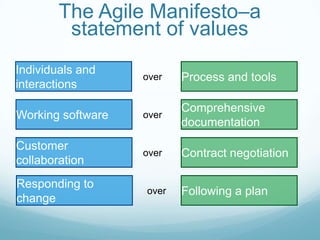
The Agile Manifesto–a
statement of values
Process and tools
Individuals and
interactions
over
Following a plan
Responding to
change
over
Comprehensive
documentation
Working software over
Contract negotiation
Customer
collaboration
over
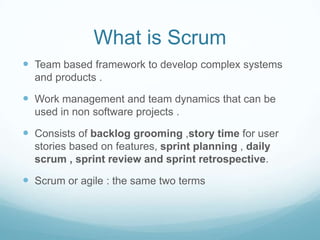
What is Scrum
 Team based framework to develop complex systems
and products .
 Work management and team dynamics that can be
used in non software projects .
 Consists of backlog grooming ,story time for user
stories based on features, sprint planning , daily
scrum , sprint review and sprint retrospective.
 Scrum or agile : the same two terms
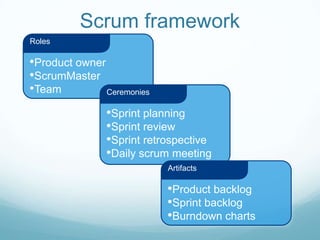
Scrum framework
•Product owner
•ScrumMaster
•Team
Roles
•Sprint planning
•Sprint review
•Sprint retrospective
•Daily scrum meeting
Ceremonies
•Product backlog
•Sprint backlog
•Burndown charts
Artifacts
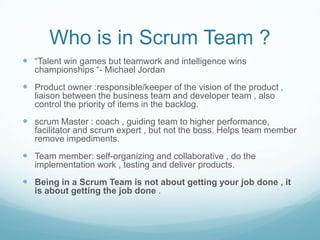
Who is in Scrum Team ?
 “Talent win games but teamwork and intelligence wins
championships “- Michael Jordan
 Product owner :responsible/keeper of the vision of the product ,
liaison between the business team and developer team , also
control the priority of items in the backlog.
 scrum Master : coach , guiding team to higher performance,
facilitator and scrum expert , but not the boss. Helps team member
remove impediments.
 Team member: self-organizing and collaborative , do the
implementation work , testing and deliver products.
 Being in a Scrum Team is not about getting your job done , it
is about getting the job done .
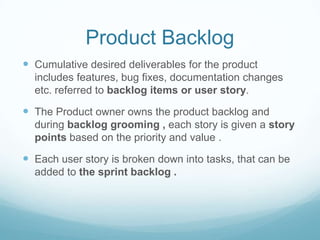
Product Backlog
 Cumulative desired deliverables for the product
includes features, bug fixes, documentation changes
etc. referred to backlog items or user story.
 The Product owner owns the product backlog and
during backlog grooming , each story is given a story
points based on the priority and value .
 Each user story is broken down into tasks, that can be
added to the sprint backlog .
What is Sprint
 Sprint cycle is the foundation of Scrum , the iterative
approach of getting thing done .
 At the end of the sprint , team should be able to
demonstrate a working software or product .
 One to four weeks is the maximum length for a sprint.
 Sprint planning meeting: beginning of the sprint . Team
commit to a set of deliverables then define tasks that must
be completed in order to deliver on the agreed upon user
stories .1 or 2 hours per week for time box.
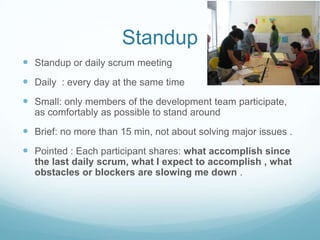
Standup
 Standup or daily scrum meeting
 Daily : every day at the same time
 Small: only members of the development team participate,
as comfortably as possible to stand around
 Brief: no more than 15 min, not about solving major issues .
 Pointed : Each participant shares: what accomplish since
the last daily scrum, what I expect to accomplish , what
obstacles or blockers are slowing me down .
Sprint Review
 At end of the sprint , team get a chance to showcase a
working software , in a demo to stakeholders.
 Time box : half to one hour for every week of sprint.
 Take note on stakeholders reaction and suggestion on
the product to improve up .
 Sprint retrospective: only for members of the team ,
team focus on what was learned and what to improve
on .
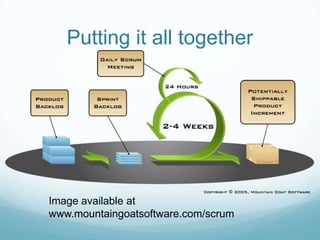
Putting it all together
Image available at
www.mountaingoatsoftware.com/scrum
References
 The Elements of Scrum by Chris Sum and Hillary Louis
Johnson from Scrum Alliance
 http://www.mountaingoatsoftware.com/scrum/product-
backlog
 http://scrummethodology.com/scrum-meetings/
 http://agilemanifesto.org/principles.html
END
 Any questions?

Agile Methodologies: Introduction to Scrum .

  • 1.
     Advanced Manual: Technical Presentations  Project 1: The Technical Briefing  Scrum : An Agile Methodology  Lisette Zounon , CSM (certified Scrum Master)  Thursday , August 1st , 2013
  • 2.
    Outline  History ofSoftware Development  Agile values  What is a Scrum team  Product backlog  What is a sprint  Sprint review  Daily Standup  Putting all together
  • 3.
    Brief History onSW  Initial software development process : Waterfall  Waterfall model : Requirement-gathering, design , coding and testing .  Completed each step before moving to the next step , and all steps must be completed before delivering any value to the customer .  The iterative method: embrace change , opportunity of growth , rather of obstacle .  Interdependent process and deliver business value .
  • 4.
    The Agile Manifesto–a statementof values Process and tools Individuals and interactions over Following a plan Responding to change over Comprehensive documentation Working software over Contract negotiation Customer collaboration over
  • 5.
    What is Scrum Team based framework to develop complex systems and products .  Work management and team dynamics that can be used in non software projects .  Consists of backlog grooming ,story time for user stories based on features, sprint planning , daily scrum , sprint review and sprint retrospective.  Scrum or agile : the same two terms
  • 6.
    Scrum framework •Product owner •ScrumMaster •Team Roles •Sprintplanning •Sprint review •Sprint retrospective •Daily scrum meeting Ceremonies •Product backlog •Sprint backlog •Burndown charts Artifacts
  • 7.
    Who is inScrum Team ?  “Talent win games but teamwork and intelligence wins championships “- Michael Jordan  Product owner :responsible/keeper of the vision of the product , liaison between the business team and developer team , also control the priority of items in the backlog.  scrum Master : coach , guiding team to higher performance, facilitator and scrum expert , but not the boss. Helps team member remove impediments.  Team member: self-organizing and collaborative , do the implementation work , testing and deliver products.  Being in a Scrum Team is not about getting your job done , it is about getting the job done .
  • 8.
    Product Backlog  Cumulativedesired deliverables for the product includes features, bug fixes, documentation changes etc. referred to backlog items or user story.  The Product owner owns the product backlog and during backlog grooming , each story is given a story points based on the priority and value .  Each user story is broken down into tasks, that can be added to the sprint backlog .
  • 9.
    What is Sprint Sprint cycle is the foundation of Scrum , the iterative approach of getting thing done .  At the end of the sprint , team should be able to demonstrate a working software or product .  One to four weeks is the maximum length for a sprint.  Sprint planning meeting: beginning of the sprint . Team commit to a set of deliverables then define tasks that must be completed in order to deliver on the agreed upon user stories .1 or 2 hours per week for time box.
  • 10.
    Standup  Standup ordaily scrum meeting  Daily : every day at the same time  Small: only members of the development team participate, as comfortably as possible to stand around  Brief: no more than 15 min, not about solving major issues .  Pointed : Each participant shares: what accomplish since the last daily scrum, what I expect to accomplish , what obstacles or blockers are slowing me down .
  • 11.
    Sprint Review  Atend of the sprint , team get a chance to showcase a working software , in a demo to stakeholders.  Time box : half to one hour for every week of sprint.  Take note on stakeholders reaction and suggestion on the product to improve up .  Sprint retrospective: only for members of the team , team focus on what was learned and what to improve on .
  • 12.
    Putting it alltogether Image available at www.mountaingoatsoftware.com/scrum
  • 13.
    References  The Elementsof Scrum by Chris Sum and Hillary Louis Johnson from Scrum Alliance  http://www.mountaingoatsoftware.com/scrum/product- backlog  http://scrummethodology.com/scrum-meetings/  http://agilemanifesto.org/principles.html
  • 14.