Introduction to Scrum Presented at Agile NCR Workshop By,  Mayank Gupta, GlobalLogic Deepak Mittal, IntelliGrape
Agenda Agile Manifesto Scrum Alliance Survey What is Scrum Scrum Framework Scrum Roles and Ceremonies Why we might fail using Scrum Summary
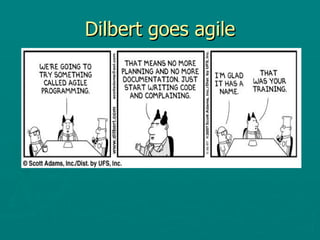
Dilbert goes agile
Agile Manifesto Individuals and Interactions  over processes and tools Working software  over comprehensive documentation Customer collaboration  over contract negotiation Responding to change  over following a plan. That is, while there is value in the items on the right, we value the items on the left more.
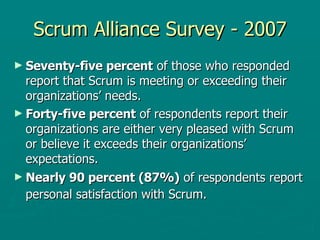
Scrum Alliance Survey - 2007 Seventy-five percent  of those who responded report that Scrum is meeting or exceeding their organizations’ needs. Forty-five percent  of respondents report their organizations are either very pleased with Scrum or believe it exceeds their organizations’ expectations.  Nearly 90 percent (87%)  of respondents report personal satisfaction with Scrum.
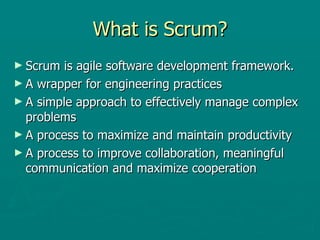
What is Scrum? Scrum is agile software development framework.  A wrapper for engineering practices A simple approach to effectively manage complex problems A process to maximize and maintain productivity A process to improve collaboration, meaningful communication and maximize cooperation
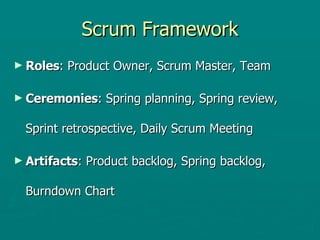
Scrum Framework Roles : Product Owner, Scrum Master, Team Ceremonies : Spring planning, Spring review, Sprint retrospective, Daily Scrum Meeting Artifacts : Product backlog, Spring backlog, Burndown Chart
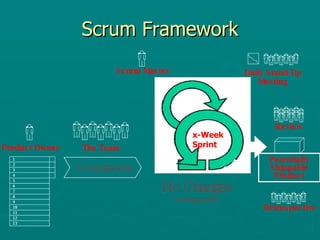
Scrum Framework No Changes (during sprint) Commitment Potentially Shippable Product Product Owner Review Scrum Master The Team 7 8 9 10 11 12 1 2 3 4 5 6 13 Daily Stand-Up Meeting Retrospective 7 8 9 10 11 12 1 2 3 4 5 6 13 x-Week  Sprint
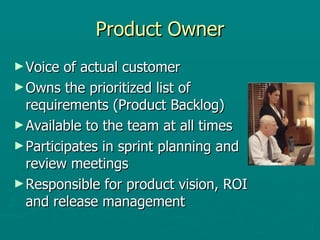
Product Owner Voice of actual customer Owns the prioritized list of requirements (Product Backlog) Available to the team at all times Participates in sprint planning and review meetings Responsible for product vision, ROI and release management
Scrum Team Teams of 7 +/- 2 participants (max -15)   Cross functional Best experts in the domain area Self-organizing Team decides who shall do what They  inspect and adapt  as the sprint goes along Have most of the powers during a sprint
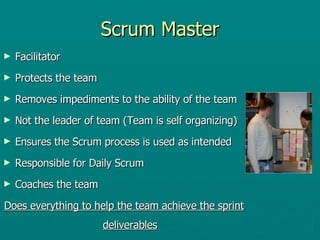
Scrum Master Facilitator Protects the team Removes impediments to the ability of the team Not the leader of team (Team is self organizing) Ensures the Scrum process is used as intended Responsible for Daily Scrum Coaches the team Does everything to help the team achieve the sprint deliverables
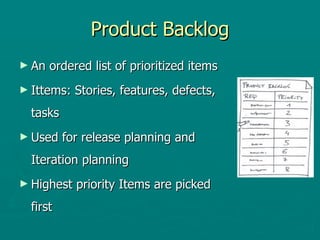
Product Backlog An ordered list of prioritized items Ittems: Stories, features, defects, tasks Used for release planning and Iteration planning Highest priority Items are picked first
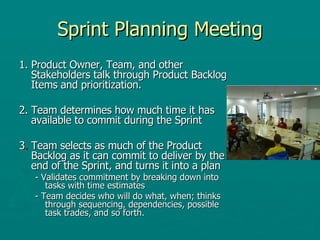
Sprint Planning Meeting 1. Product Owner, Team, and other Stakeholders talk through Product Backlog Items and prioritization. 2. Team determines how much time it has available to commit during the Sprint 3 .  Team selects as much of the Product Backlog as it can commit to deliver by the end of the Sprint, and turns it into a plan - Validates commitment by breaking down into tasks with time estimates - Team decides who will do what, when; thinks through sequencing, dependencies, possible task trades, and so forth.
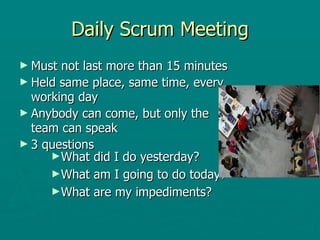
Daily Scrum Meeting Must not last more than 15 minutes Held same place, same time, every working day Anybody can come, but only the team can speak 3 questions What did I do yesterday? What am I going to do today? What are my impediments?
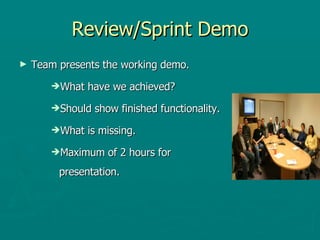
Review/Sprint Demo Team presents the working demo.  What have we achieved? Should show finished functionality. What is missing. Maximum of 2 hours for presentation.
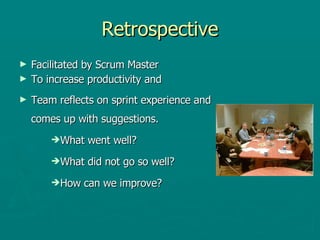
Retrospective Facilitated by Scrum Master To increase productivity and  Team reflects on sprint experience and comes up with suggestions. What went well? What did not go so well? How can we improve?
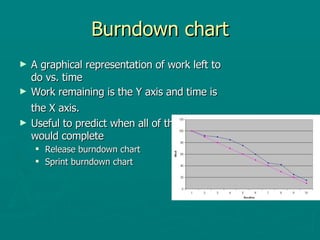
Burndown chart A graphical representation of work left to do vs. time  Work remaining is the Y axis and time is the X axis.   Useful to predict when all of the work would complete Release burndown chart Sprint burndown chart
Why we might fail using scrum? Hard! Scrum does not fix everything  Scrum makes problems visible - early Ready for a change? It makes Products to be delivered faster Customized/partial Scrum
Summary Everything is time-boxed. Inspect & Adapt. You can-not plan everything.  Fail early.  Shippable product at the end of every iteration/sprint. Iterative incremental development.  Cross-functional teams.  Self-organizing teams. Team owns the sprint backlog.
Where Scrum is used? US Federal Reserve  SAP H P Motorola TransUnion Google Microsoft GlobalLogic Yahoo Sun Siemens Nokia Philips BBC IBM Xebia
Thank You Questions?

Introduction To Scrum

  • 1.
    Introduction to ScrumPresented at Agile NCR Workshop By, Mayank Gupta, GlobalLogic Deepak Mittal, IntelliGrape
  • 2.
    Agenda Agile ManifestoScrum Alliance Survey What is Scrum Scrum Framework Scrum Roles and Ceremonies Why we might fail using Scrum Summary
  • 3.
  • 4.
    Agile Manifesto Individualsand Interactions over processes and tools Working software over comprehensive documentation Customer collaboration over contract negotiation Responding to change over following a plan. That is, while there is value in the items on the right, we value the items on the left more.
  • 5.
    Scrum Alliance Survey- 2007 Seventy-five percent of those who responded report that Scrum is meeting or exceeding their organizations’ needs. Forty-five percent of respondents report their organizations are either very pleased with Scrum or believe it exceeds their organizations’ expectations. Nearly 90 percent (87%) of respondents report personal satisfaction with Scrum.
  • 6.
    What is Scrum?Scrum is agile software development framework. A wrapper for engineering practices A simple approach to effectively manage complex problems A process to maximize and maintain productivity A process to improve collaboration, meaningful communication and maximize cooperation
  • 7.
    Scrum Framework Roles: Product Owner, Scrum Master, Team Ceremonies : Spring planning, Spring review, Sprint retrospective, Daily Scrum Meeting Artifacts : Product backlog, Spring backlog, Burndown Chart
  • 8.
    Scrum Framework NoChanges (during sprint) Commitment Potentially Shippable Product Product Owner Review Scrum Master The Team 7 8 9 10 11 12 1 2 3 4 5 6 13 Daily Stand-Up Meeting Retrospective 7 8 9 10 11 12 1 2 3 4 5 6 13 x-Week Sprint
  • 9.
    Product Owner Voiceof actual customer Owns the prioritized list of requirements (Product Backlog) Available to the team at all times Participates in sprint planning and review meetings Responsible for product vision, ROI and release management
  • 10.
    Scrum Team Teamsof 7 +/- 2 participants (max -15) Cross functional Best experts in the domain area Self-organizing Team decides who shall do what They inspect and adapt as the sprint goes along Have most of the powers during a sprint
  • 11.
    Scrum Master FacilitatorProtects the team Removes impediments to the ability of the team Not the leader of team (Team is self organizing) Ensures the Scrum process is used as intended Responsible for Daily Scrum Coaches the team Does everything to help the team achieve the sprint deliverables
  • 12.
    Product Backlog Anordered list of prioritized items Ittems: Stories, features, defects, tasks Used for release planning and Iteration planning Highest priority Items are picked first
  • 13.
    Sprint Planning Meeting1. Product Owner, Team, and other Stakeholders talk through Product Backlog Items and prioritization. 2. Team determines how much time it has available to commit during the Sprint 3 . Team selects as much of the Product Backlog as it can commit to deliver by the end of the Sprint, and turns it into a plan - Validates commitment by breaking down into tasks with time estimates - Team decides who will do what, when; thinks through sequencing, dependencies, possible task trades, and so forth.
  • 14.
    Daily Scrum MeetingMust not last more than 15 minutes Held same place, same time, every working day Anybody can come, but only the team can speak 3 questions What did I do yesterday? What am I going to do today? What are my impediments?
  • 15.
    Review/Sprint Demo Teampresents the working demo. What have we achieved? Should show finished functionality. What is missing. Maximum of 2 hours for presentation.
  • 16.
    Retrospective Facilitated byScrum Master To increase productivity and Team reflects on sprint experience and comes up with suggestions. What went well? What did not go so well? How can we improve?
  • 17.
    Burndown chart Agraphical representation of work left to do vs. time Work remaining is the Y axis and time is the X axis. Useful to predict when all of the work would complete Release burndown chart Sprint burndown chart
  • 18.
    Why we mightfail using scrum? Hard! Scrum does not fix everything Scrum makes problems visible - early Ready for a change? It makes Products to be delivered faster Customized/partial Scrum
  • 19.
    Summary Everything istime-boxed. Inspect & Adapt. You can-not plan everything. Fail early. Shippable product at the end of every iteration/sprint. Iterative incremental development. Cross-functional teams. Self-organizing teams. Team owns the sprint backlog.
  • 20.
    Where Scrum isused? US Federal Reserve SAP H P Motorola TransUnion Google Microsoft GlobalLogic Yahoo Sun Siemens Nokia Philips BBC IBM Xebia
  • 21.