Agile Scrum Product
Development Methodology
Presentation By : Aditya Adam
What is Agile Scrum ?
 The term scrum is formed from rugby game.
 Agile scrum process is most popular
framework and product management
methodology in software Development.
 Extreme programming and testing.
 Adaptive software Development.
 Agile Scrum model is incremental spiral model
to develop a software piece by piece by
enhancing.
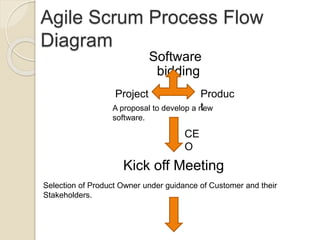
Agile Scrum Process Flow
Diagram
Software
bidding
Project Produc
tA proposal to develop a new
software.
CE
O
Selection of Product Owner under guidance of Customer and their
Stakeholders.
Kick off Meeting
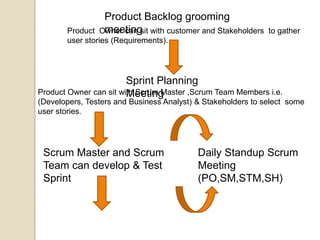
Product Backlog grooming
meetingProduct Owner can sit with customer and Stakeholders to gather
user stories (Requirements).
Sprint Planning
MeetingProduct Owner can sit with Scrum Master ,Scrum Team Members i.e.
(Developers, Testers and Business Analyst) & Stakeholders to select some
user stories.
Scrum Master and Scrum
Team can develop & Test
Sprint
Daily Standup Scrum
Meeting
(PO,SM,STM,SH)
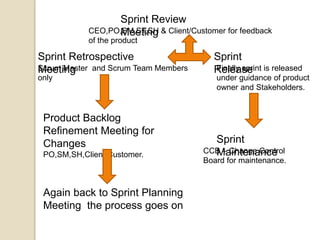
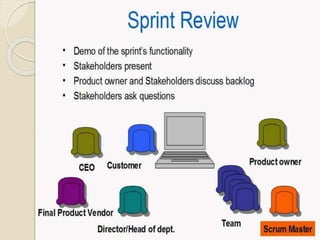
Sprint Review
MeetingCEO,PO,SM,ST,SH & Client/Customer for feedback
of the product
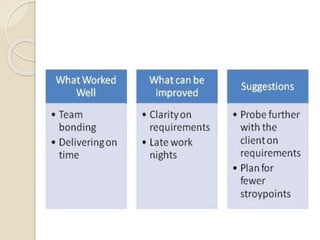
Sprint Retrospective
MeetingScrum Master and Scrum Team Members
only
Sprint
ReleaseFinally sprint is released
under guidance of product
owner and Stakeholders.
CCB – Change Control
Board for maintenance.
Sprint
Maintenance
Product Backlog
Refinement Meeting for
Changes
PO,SM,SH,Client,Customer.
Again back to Sprint Planning
Meeting the process goes on
Agile Scrum Process
Explanation
 Software bidding is of two types such as
 Customer proposal: If proposal is customer
proposal than customer is responsible to
appoint stakeholders.
 Self proposal: If proposal is self proposal than
company is responsible to appoint
stakeholders.
 Kick off meeting is a selection process of
product owner.
 Product owner is responsible to gather all user
stories(requirements)
 Product owner, scrum master, scrum team
members and stakeholders are responsible to
select some user stories from all user stories
for current sprint.
 Sprint is a piece of software and potentially
shippable(release) to customer/client.
 Scrum Team is a formation of developers and
testers 3:1 ratio from 7 – 10 members.
 Each sprint development and testing is
reasonable for 30 working days.
 Daily standup scrum meeting is mandatory
 Team level changes are not acceptable in the
middle of sprint duration.
 Review meeting is useful to collect
feedback from customers/clients on
sprint
 Retrospective meeting is useful to
know need for team level changes.
 Refinement meeting is useful to know
need for changes is user stories(client
requirements).
Roles and Responsibilities as per
Agile Scrum Process
1.CEO
 Responsible to study client provided
proposal or responsible to create own
proposal.
 Responsible to select right person as
product owner.
 Responsible to involve in every sprint
review meeting
2.Customers/Clients
 Responsible to explain business
requirements request to product owner.
 Request to appoint stakeholders as
technical advisors.
 Approve Selection of product owner
 Responsible to give feedback on every
sprint release.
 Responsible to involve in refinement
meeting for changes in requirements
3.Stakeholders
 Responsible to approve selection of
product owner.
 Responsible to explain customer
requirements to product owner.
 Responsible to select some user stories
from all user stories for every sprint.
 Responsible to involve in daily scrum
meeting.
 Responsible to involve in sprint review
meeting to take feedback from
customers/clients on every sprint.
 Responsible to involve in refinement
meeting for changes in customer
requirements.
4. Product Owner
 Responsible to define features of
software with the help of clients and
their stakeholders.(All user stories)
 Responsible to prioritize user stories
to develop a software sprint by sprint.
 Responsible to decide content and
release date of each sprint under
guidance of stakeholders
 Adjust features of sprint with respect
to priority and size
 Responsible to accept or reject the work
of scrum team members.
 Responsible for release when
customer/client feedback is good.
 Responsible to manage change control
board team for maintenance of released
sprints.
5.Scrum Master
 Behave like facilitator to scrum team.
 Responsible to identify the solution for
problems of scrum team members.
 Responsible to ensure correctness of
scrum team activities
 Responsible to maintain co-ordination in
between developers and testers in
scrum team.
 Protect scrum team members from
external interferences.
5. Scrum Team Developers
 Understand customer/client user stories
(requirements) selected for current
sprint.
 Design user stories development logics
in high level and low level
 Implement coding with respect to design
 Conduct testing on each program called
as unit testing
 Interconnect programs and conduct
integration testing
 Responsible to fix bugs reported by
6.Scrum Team Testers
 Understand user stories and clients
requirements of current sprint.
 Assist product owner and scrum master
to prepare test strategy and test plan.
 Prepare test scenarios, test cases and
test data.
 Receive sprint from developers and
execute cases through manual or
automation.
 Report defects to developers.
 Receive modified sprint from developers
 Need to ensure correctness of bugs
fixing.
 Need to involve in sprint review meeting
along with developers to collect
feedback from customers/clients.
 Participation in daily scrum meeting is
mandatory for developers and testers.
 Responsible to involve in sprint
retrospective meeting along with
developers and scrum master for team
level changes.
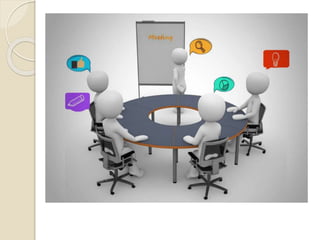
Kick off Meeting
 The kick off meeting is an important
tool for the product owner to get to
know all team members and motivate
them to achieve the product
objectives.
 Selection process of product
owner/project manager under
guidance of customers and
stakeholders.
Product Backlog Grooming
Meeting
 Product owner can sit with their
customer/clients and stakeholders
 If any user story is epic, product owner
can split that user story into sub user
stories.
 Sometimes product owner can take the
help of subject Matter Experts(SME) in
user stories preparation.
 List of all user stories is called as
product backlog document.
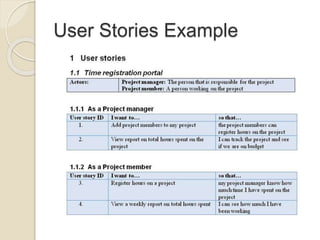
 Gather requirements as user stories like
User Stories Example
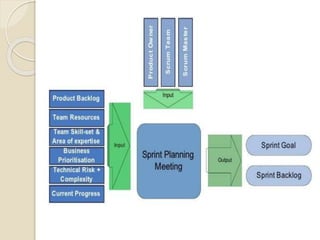
Sprint Planning Meeting
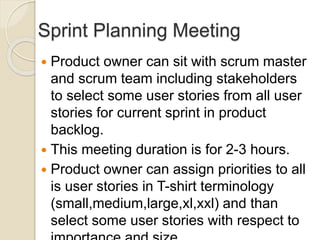
 Product owner can sit with scrum master
and scrum team including stakeholders
to select some user stories from all user
stories for current sprint in product
backlog.
 This meeting duration is for 2-3 hours.
 Product owner can assign priorities to all
is user stories in T-shirt terminology
(small,medium,large,xl,xxl) and than
select some user stories with respect to
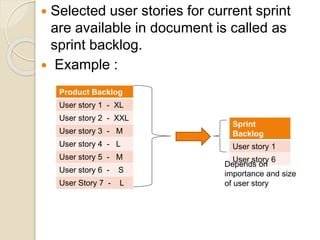
 Selected user stories for current sprint
are available in document is called as
sprint backlog.
 Example :
Product Backlog
User story 1 - XL
User story 2 - XXL
User story 3 - M
User story 4 - L
User story 5 - M
User story 6 - S
User Story 7 - L
Sprint
Backlog
User story 1
User story 6
Depends on
importance and size
of user story
 From the above diagram, user story
1and user story 4 are important user
stories as per customer/client to develop
as first sprint.
 But user story 1 size is XL and user story
4 size is L. In general scrum team is not
able to finish development and testing of
one XL and one L user stories in 30
days.
 Due to this reason, product owner can
convince stakeholders to select user
story 1 and user story 6 by balancing
importance and size of user stories.
 Release sprint backlog to scrum master
and scrum team email id’s.
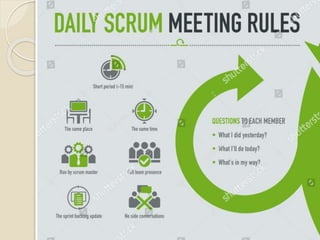
Daily Scrum/Daily Standup
meeting
 Involvement of product owner,
stakeholders, scrum master and scrum
team.
 Mandatory to conduct on everyday during
30 days of sprint.
 Meeting duration is 15 minutes
 Discuss questions like
1.What we did today?
2.What we are going to do tomorrow?
3.What problems are rising in the way?
Sprint Review Meeting
 Involvement of CEO, product owner,
scrum master, scrum team,
customer/clients and stakeholders
 Give sprint demo to customer/client for
feedback on the product.
 Time duration for this meeting is 2 hours
 If feedback is good than product owner
can plan for sprint release to
customer/client site
 If feedback is not good, then scrum team
can perform instant changes before the
release of sprint to customer/client.
Sprint Retrospective Meeting
 Involvement of scrum master and scrum
team members only.
 Scrum master can try to get feedback
from scrum team members on previous
30 days of sprint.
 Scrum master can try to motivate scrum
team members what improvement
should be applied for next 30 days of
sprint.
 This meeting is mandatory to conduct for
first 5 to 6 sprints.
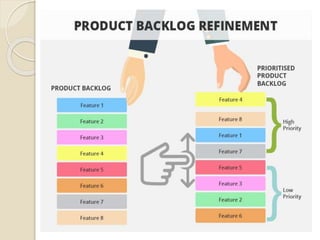
Product Backlog Refinement
meeting
 Involvement of product owner, scrum
master, stakeholders and customer/client.
 Identify changes in product backlog user
stories which is yet to develop.
 Approve changes and than concentrate
on next sprint planning meeting.
 This meeting duration is 2-3 hours
Scrum in Practice
Plan your roadmap
 Identify small yet distinctively measurable goal.
 Be clear.
 Create internal expertise – Scrum Masters.
Prepare your teams
 Get the terminology correct – Train.
 Ensure you have all members covered –
Seniors as well.
 Make them comfortable.
Scrum Process Benefits
Team
 The team gets focused towards one common
goal.
 Creates self discipline, accountability and
responsibility.
 Faster better communication without barriers.
 Team work, commitment time and risk
management.
Organization
 Business Value.
Agile scrum product development methodology

Agile scrum product development methodology

  • 1.
    Agile Scrum Product DevelopmentMethodology Presentation By : Aditya Adam
  • 2.
    What is AgileScrum ?  The term scrum is formed from rugby game.  Agile scrum process is most popular framework and product management methodology in software Development.  Extreme programming and testing.  Adaptive software Development.  Agile Scrum model is incremental spiral model to develop a software piece by piece by enhancing.
  • 3.
    Agile Scrum ProcessFlow Diagram Software bidding Project Produc tA proposal to develop a new software. CE O Selection of Product Owner under guidance of Customer and their Stakeholders. Kick off Meeting
  • 4.
    Product Backlog grooming meetingProductOwner can sit with customer and Stakeholders to gather user stories (Requirements). Sprint Planning MeetingProduct Owner can sit with Scrum Master ,Scrum Team Members i.e. (Developers, Testers and Business Analyst) & Stakeholders to select some user stories. Scrum Master and Scrum Team can develop & Test Sprint Daily Standup Scrum Meeting (PO,SM,STM,SH)
  • 5.
    Sprint Review MeetingCEO,PO,SM,ST,SH &Client/Customer for feedback of the product Sprint Retrospective MeetingScrum Master and Scrum Team Members only Sprint ReleaseFinally sprint is released under guidance of product owner and Stakeholders. CCB – Change Control Board for maintenance. Sprint Maintenance Product Backlog Refinement Meeting for Changes PO,SM,SH,Client,Customer. Again back to Sprint Planning Meeting the process goes on
  • 6.
    Agile Scrum Process Explanation Software bidding is of two types such as  Customer proposal: If proposal is customer proposal than customer is responsible to appoint stakeholders.  Self proposal: If proposal is self proposal than company is responsible to appoint stakeholders.  Kick off meeting is a selection process of product owner.  Product owner is responsible to gather all user stories(requirements)
  • 7.
     Product owner,scrum master, scrum team members and stakeholders are responsible to select some user stories from all user stories for current sprint.  Sprint is a piece of software and potentially shippable(release) to customer/client.  Scrum Team is a formation of developers and testers 3:1 ratio from 7 – 10 members.  Each sprint development and testing is reasonable for 30 working days.  Daily standup scrum meeting is mandatory  Team level changes are not acceptable in the middle of sprint duration.
  • 8.
     Review meetingis useful to collect feedback from customers/clients on sprint  Retrospective meeting is useful to know need for team level changes.  Refinement meeting is useful to know need for changes is user stories(client requirements).
  • 9.
    Roles and Responsibilitiesas per Agile Scrum Process 1.CEO  Responsible to study client provided proposal or responsible to create own proposal.  Responsible to select right person as product owner.  Responsible to involve in every sprint review meeting
  • 10.
    2.Customers/Clients  Responsible toexplain business requirements request to product owner.  Request to appoint stakeholders as technical advisors.  Approve Selection of product owner  Responsible to give feedback on every sprint release.  Responsible to involve in refinement meeting for changes in requirements
  • 11.
    3.Stakeholders  Responsible toapprove selection of product owner.  Responsible to explain customer requirements to product owner.  Responsible to select some user stories from all user stories for every sprint.  Responsible to involve in daily scrum meeting.  Responsible to involve in sprint review meeting to take feedback from customers/clients on every sprint.
  • 12.
     Responsible toinvolve in refinement meeting for changes in customer requirements.
  • 13.
    4. Product Owner Responsible to define features of software with the help of clients and their stakeholders.(All user stories)  Responsible to prioritize user stories to develop a software sprint by sprint.  Responsible to decide content and release date of each sprint under guidance of stakeholders  Adjust features of sprint with respect to priority and size
  • 14.
     Responsible toaccept or reject the work of scrum team members.  Responsible for release when customer/client feedback is good.  Responsible to manage change control board team for maintenance of released sprints.
  • 15.
    5.Scrum Master  Behavelike facilitator to scrum team.  Responsible to identify the solution for problems of scrum team members.  Responsible to ensure correctness of scrum team activities  Responsible to maintain co-ordination in between developers and testers in scrum team.  Protect scrum team members from external interferences.
  • 16.
    5. Scrum TeamDevelopers  Understand customer/client user stories (requirements) selected for current sprint.  Design user stories development logics in high level and low level  Implement coding with respect to design  Conduct testing on each program called as unit testing  Interconnect programs and conduct integration testing  Responsible to fix bugs reported by
  • 17.
    6.Scrum Team Testers Understand user stories and clients requirements of current sprint.  Assist product owner and scrum master to prepare test strategy and test plan.  Prepare test scenarios, test cases and test data.  Receive sprint from developers and execute cases through manual or automation.  Report defects to developers.  Receive modified sprint from developers
  • 18.
     Need toensure correctness of bugs fixing.  Need to involve in sprint review meeting along with developers to collect feedback from customers/clients.  Participation in daily scrum meeting is mandatory for developers and testers.  Responsible to involve in sprint retrospective meeting along with developers and scrum master for team level changes.
  • 19.
    Kick off Meeting The kick off meeting is an important tool for the product owner to get to know all team members and motivate them to achieve the product objectives.  Selection process of product owner/project manager under guidance of customers and stakeholders.
  • 21.
    Product Backlog Grooming Meeting Product owner can sit with their customer/clients and stakeholders  If any user story is epic, product owner can split that user story into sub user stories.  Sometimes product owner can take the help of subject Matter Experts(SME) in user stories preparation.  List of all user stories is called as product backlog document.  Gather requirements as user stories like
  • 22.
  • 23.
    Sprint Planning Meeting Product owner can sit with scrum master and scrum team including stakeholders to select some user stories from all user stories for current sprint in product backlog.  This meeting duration is for 2-3 hours.  Product owner can assign priorities to all is user stories in T-shirt terminology (small,medium,large,xl,xxl) and than select some user stories with respect to
  • 24.
     Selected userstories for current sprint are available in document is called as sprint backlog.  Example : Product Backlog User story 1 - XL User story 2 - XXL User story 3 - M User story 4 - L User story 5 - M User story 6 - S User Story 7 - L Sprint Backlog User story 1 User story 6 Depends on importance and size of user story
  • 25.
     From theabove diagram, user story 1and user story 4 are important user stories as per customer/client to develop as first sprint.  But user story 1 size is XL and user story 4 size is L. In general scrum team is not able to finish development and testing of one XL and one L user stories in 30 days.  Due to this reason, product owner can convince stakeholders to select user story 1 and user story 6 by balancing importance and size of user stories.  Release sprint backlog to scrum master and scrum team email id’s.
  • 27.
    Daily Scrum/Daily Standup meeting Involvement of product owner, stakeholders, scrum master and scrum team.  Mandatory to conduct on everyday during 30 days of sprint.  Meeting duration is 15 minutes  Discuss questions like 1.What we did today? 2.What we are going to do tomorrow? 3.What problems are rising in the way?
  • 29.
    Sprint Review Meeting Involvement of CEO, product owner, scrum master, scrum team, customer/clients and stakeholders  Give sprint demo to customer/client for feedback on the product.  Time duration for this meeting is 2 hours  If feedback is good than product owner can plan for sprint release to customer/client site  If feedback is not good, then scrum team can perform instant changes before the release of sprint to customer/client.
  • 31.
    Sprint Retrospective Meeting Involvement of scrum master and scrum team members only.  Scrum master can try to get feedback from scrum team members on previous 30 days of sprint.  Scrum master can try to motivate scrum team members what improvement should be applied for next 30 days of sprint.  This meeting is mandatory to conduct for first 5 to 6 sprints.
  • 33.
    Product Backlog Refinement meeting Involvement of product owner, scrum master, stakeholders and customer/client.  Identify changes in product backlog user stories which is yet to develop.  Approve changes and than concentrate on next sprint planning meeting.  This meeting duration is 2-3 hours
  • 35.
    Scrum in Practice Planyour roadmap  Identify small yet distinctively measurable goal.  Be clear.  Create internal expertise – Scrum Masters. Prepare your teams  Get the terminology correct – Train.  Ensure you have all members covered – Seniors as well.  Make them comfortable.
  • 36.
    Scrum Process Benefits Team The team gets focused towards one common goal.  Creates self discipline, accountability and responsibility.  Faster better communication without barriers.  Team work, commitment time and risk management. Organization  Business Value.