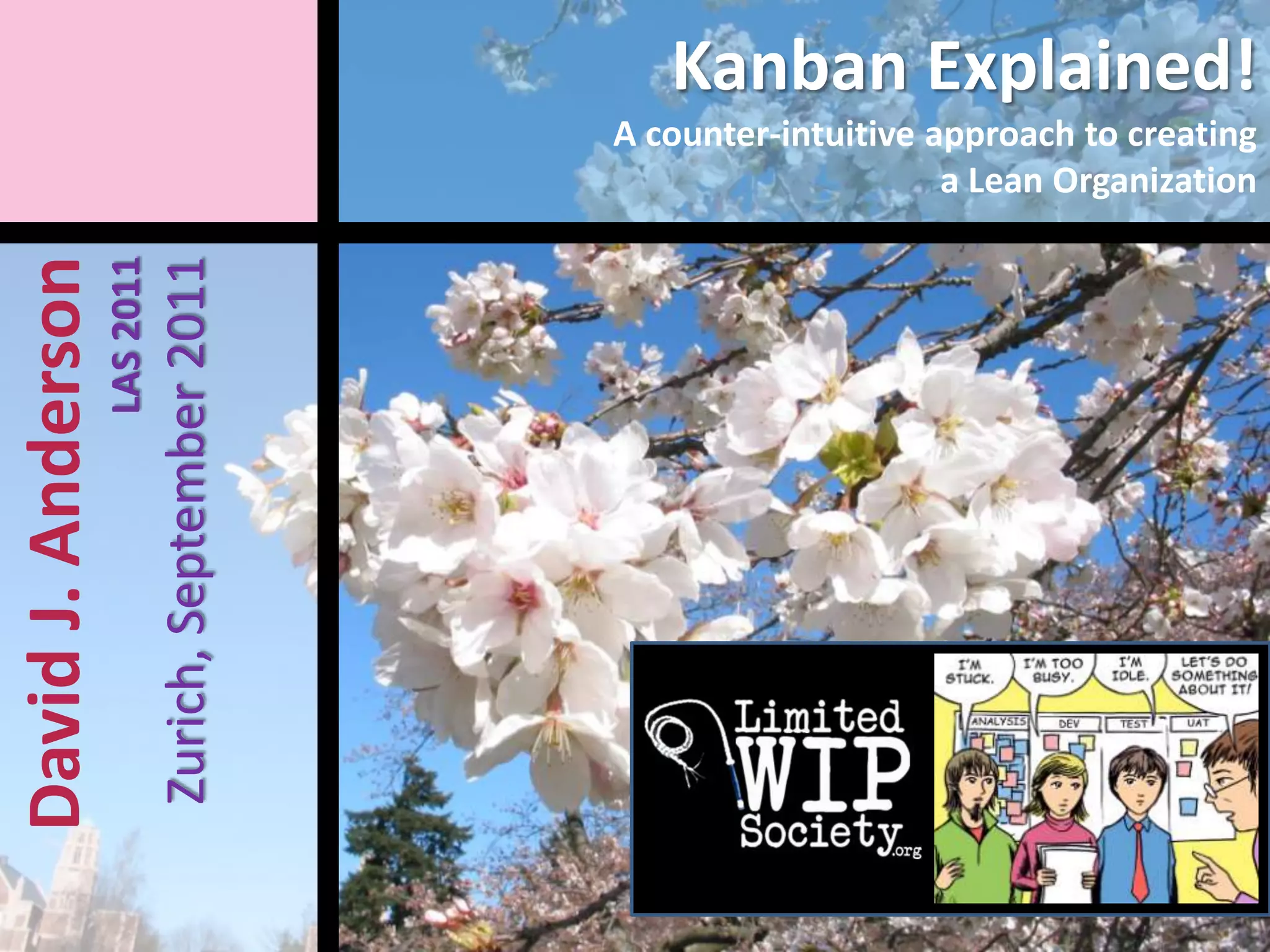
Kanban Explained!A counter-intuitive approach to creatinga Lean OrganizationDavid J. Anderson LAS 2011Zurich, September 2011
Published April 2010A 72,000 word introductionMore to come in a future book
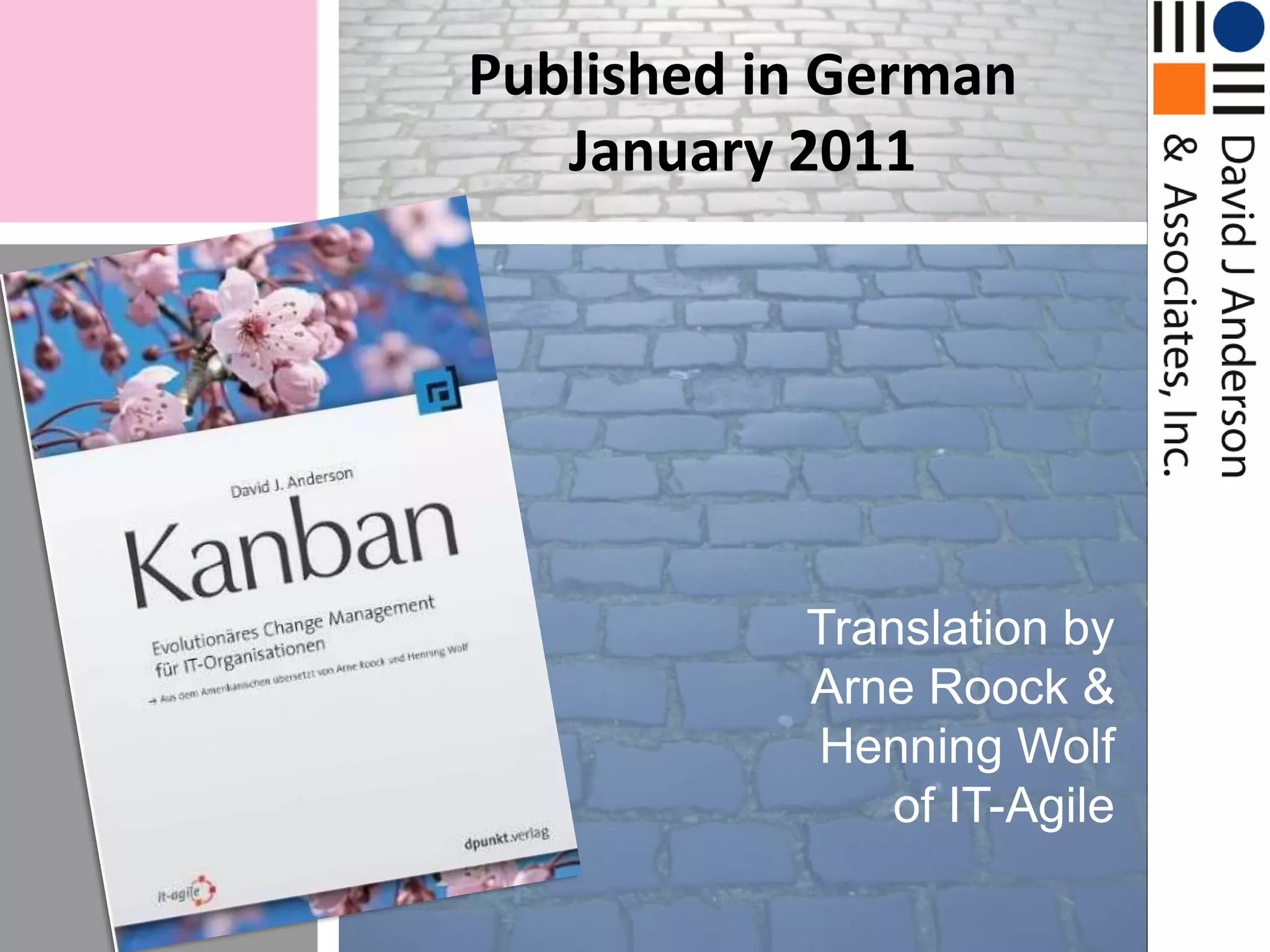
Published in GermanJanuary 2011Translation byArne Roock & Henning Wolfof IT-Agile
What is…Lean Software Development?
The foundational pillars of Lean are debated by different authors, however, most would agree on the following…
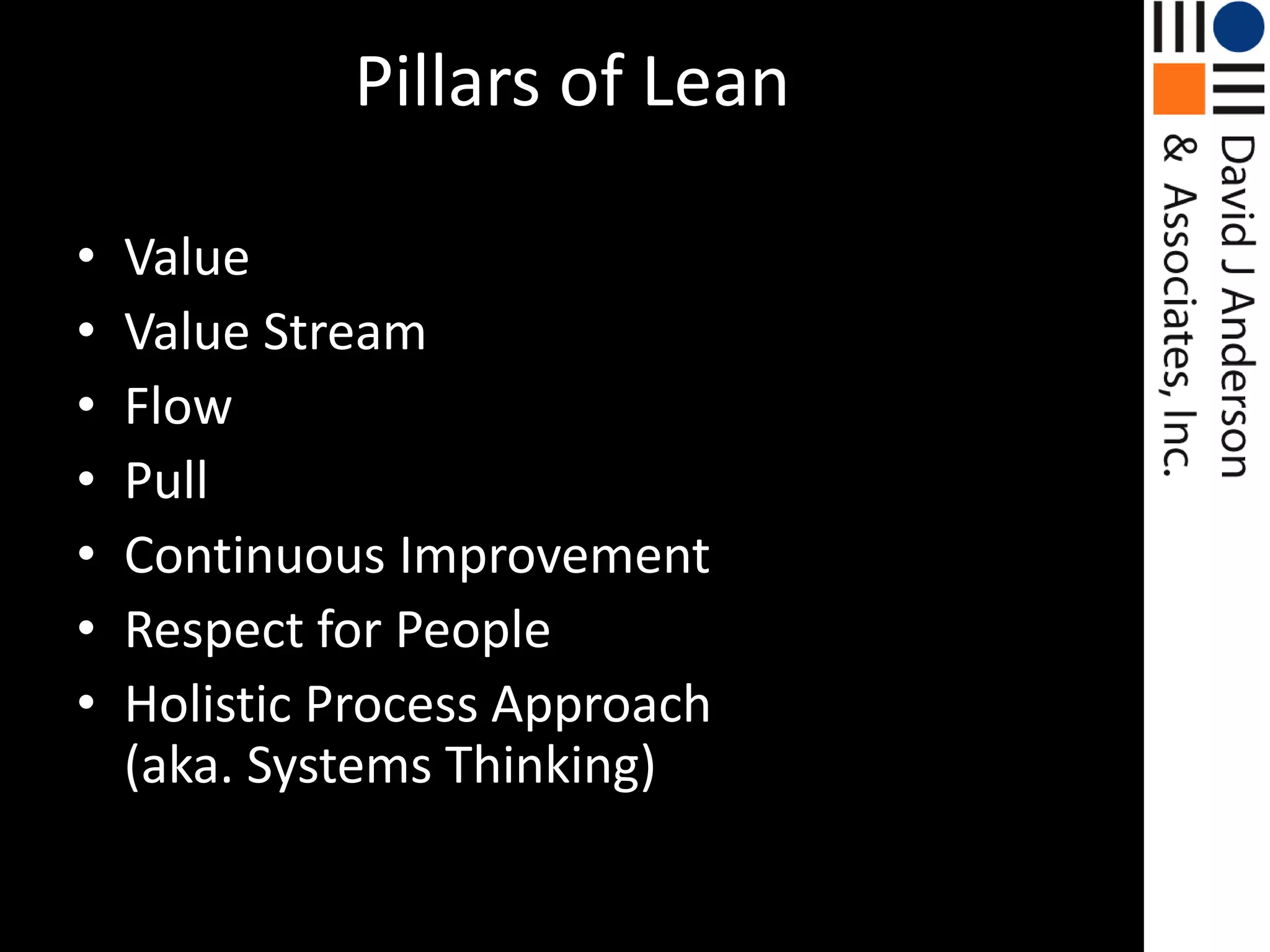
Pillars of LeanValueValue StreamFlowPullContinuous ImprovementRespect for PeopleHolistic Process Approach(aka. Systems Thinking)
Western Lean Thinking has focused on waste elimination in comparison with Japanese “Toyota Way” that has a broader definition of muda, muri and mura, and a cultural aspect Kaizen
Western Lean literature and consulting tended to focus on waste elimination. This was both easy to do and useful in manufacturing but has proven problematic in knowledge work areas.
The concept of Lean Software Development has been around since 1993, and yet by 2008 you didn't meet anyone doing it
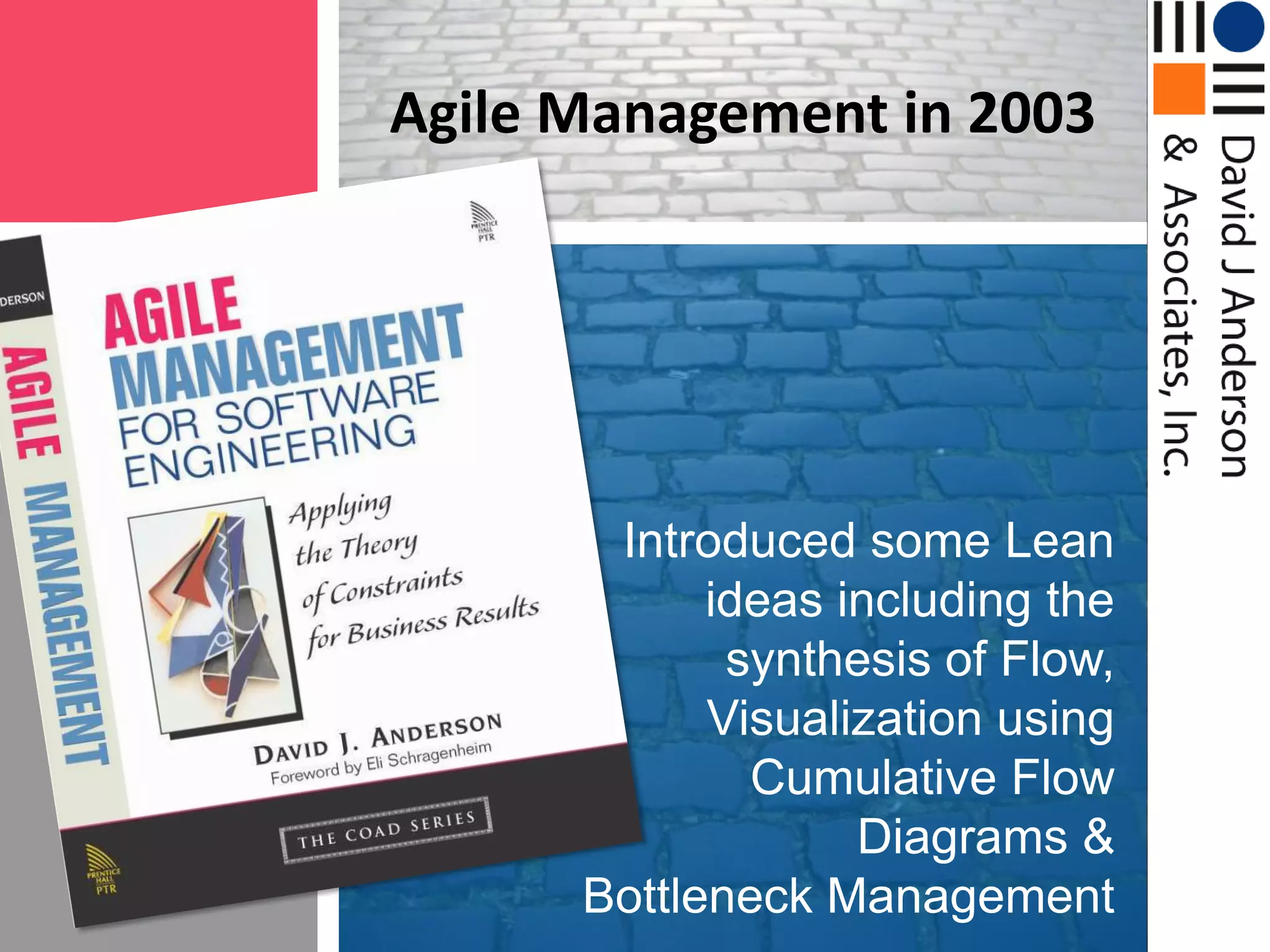
Agile Management in 2003Introduced some Lean ideas including the synthesis of Flow, Visualization using Cumulative Flow Diagrams &Bottleneck Management
I’d been talking about managing flowfor 6 years, but despite support for cumulative flow diagrams in many Agile tools, (almost) no one was doing it!
I concluded that after 15+ years we must assume that Growing Lean Adoption in the IT industry ishard!
Agile Methods are not creating Lean Organizations …
Extreme Programming is evidently a veryLeanmethod
XP has very little waste
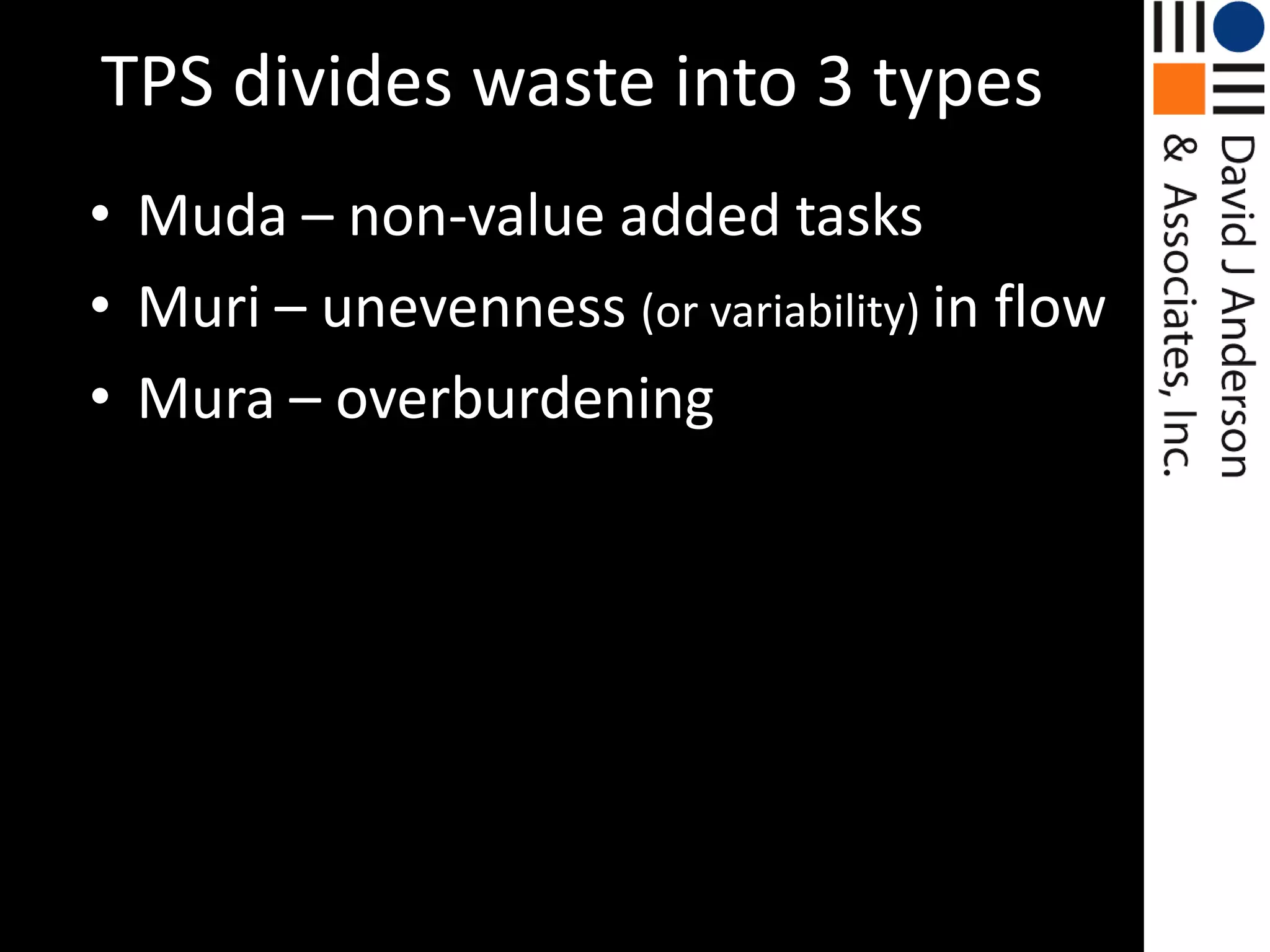
TPS divides waste into 3 typesMuda – non-value added tasksMuri – unevenness (or variability) in flowMura – overburdening
XP avoidsMurathrough use of tests and tight definition of "Done"
XP avoidsMuriwith skilled craftsmanship that can "flow" a story without handoffs and a strict WIP limit policy of1 story per pair
XP has littleMudaas planning, coordination and delivery are lightweight and partly automated
Some XP practitioners such asJoshua Kerievsky, ArloBelshee & Jim shorehave sought to reduce waste in XP with techniques such as Naked Planning, Agile Workcell, elimination of planning, estimation and time-boxed iterations, and Limited Red
Themotivationfor these changes, that involved introduction of "kanban" style techniques, was (further)elimination of waste
However, Extreme Programming hasn't been for everyone!
Some people & organizations have resistedadoption of Agile methods!
If not every organization is ready to adoptan Agile method, how can we encourage them to become more Lean?
So What is the Kanban Method?
Kanban is the enabler of a Kaizen Culture & emergence of a Lean organization
So how do we go about introducing Lean into organizations that have failedto adopt an Agile method such as TDD or failed to truly achieve a continuously improving culture?
The counter-intuitive answeris to use apull system that limitswork-in-progress as a catalyst for introduction of other Lean concepts
Kanban Systems are pull systems that limit work-in-progress and have been part of the Lean toolkit for 50+ years
Mymotivationfor adopting kanban systems was toprevent mura, control muriand encourage an evolutionary approach to change
In developing theKanban Method, a change management approach that uses kanban systems to provoke change, we are enabling the emergenceof Lean software development in organizations
How does theKanban Method work?
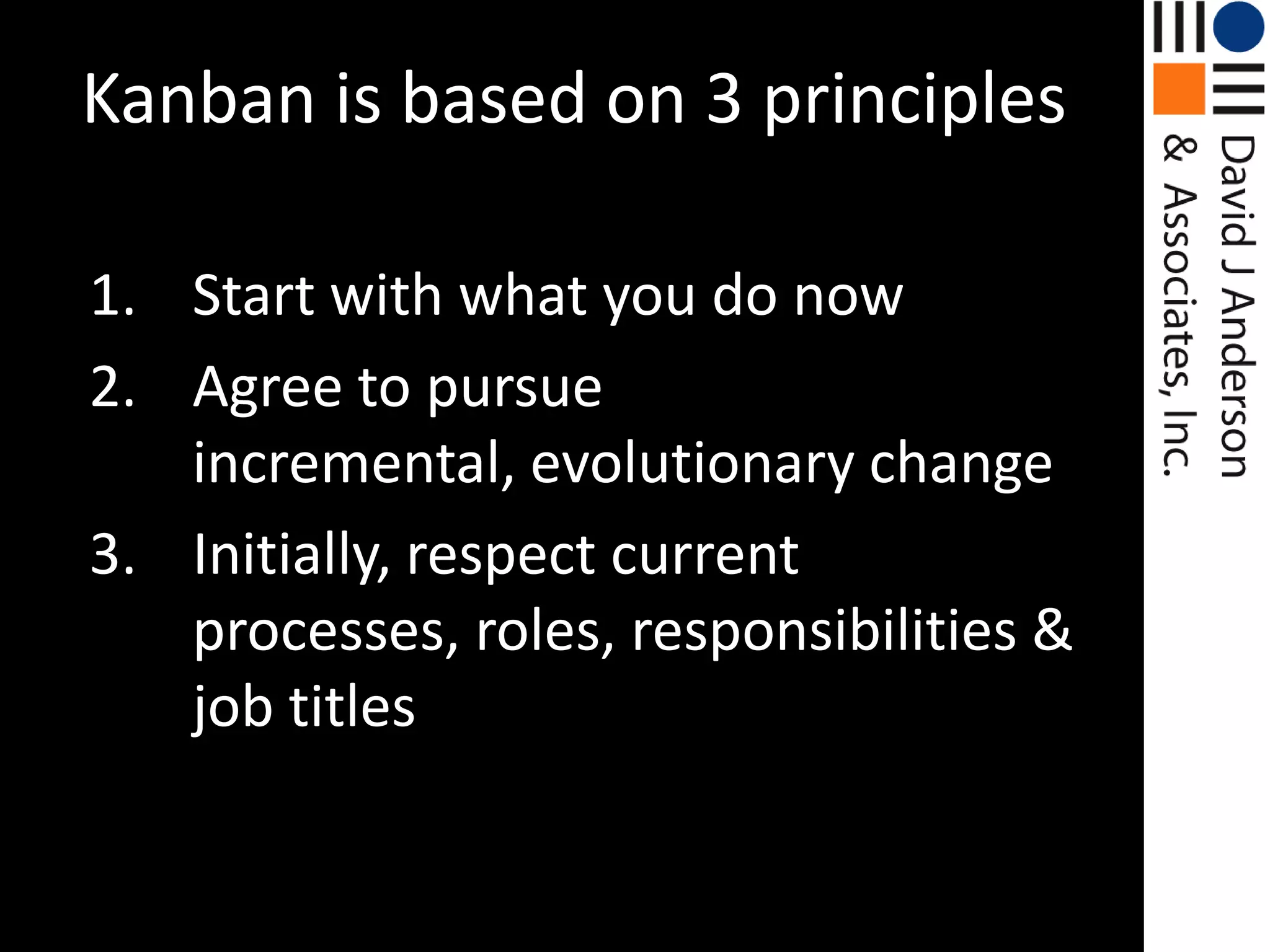
Kanban is based on 3 principlesStart with what you do nowAgree to pursue incremental, evolutionary changeInitially, respect current processes, roles, responsibilities & job titles
Then…adopt the 5 core practices that are observedto be present in successful Kanban implementations
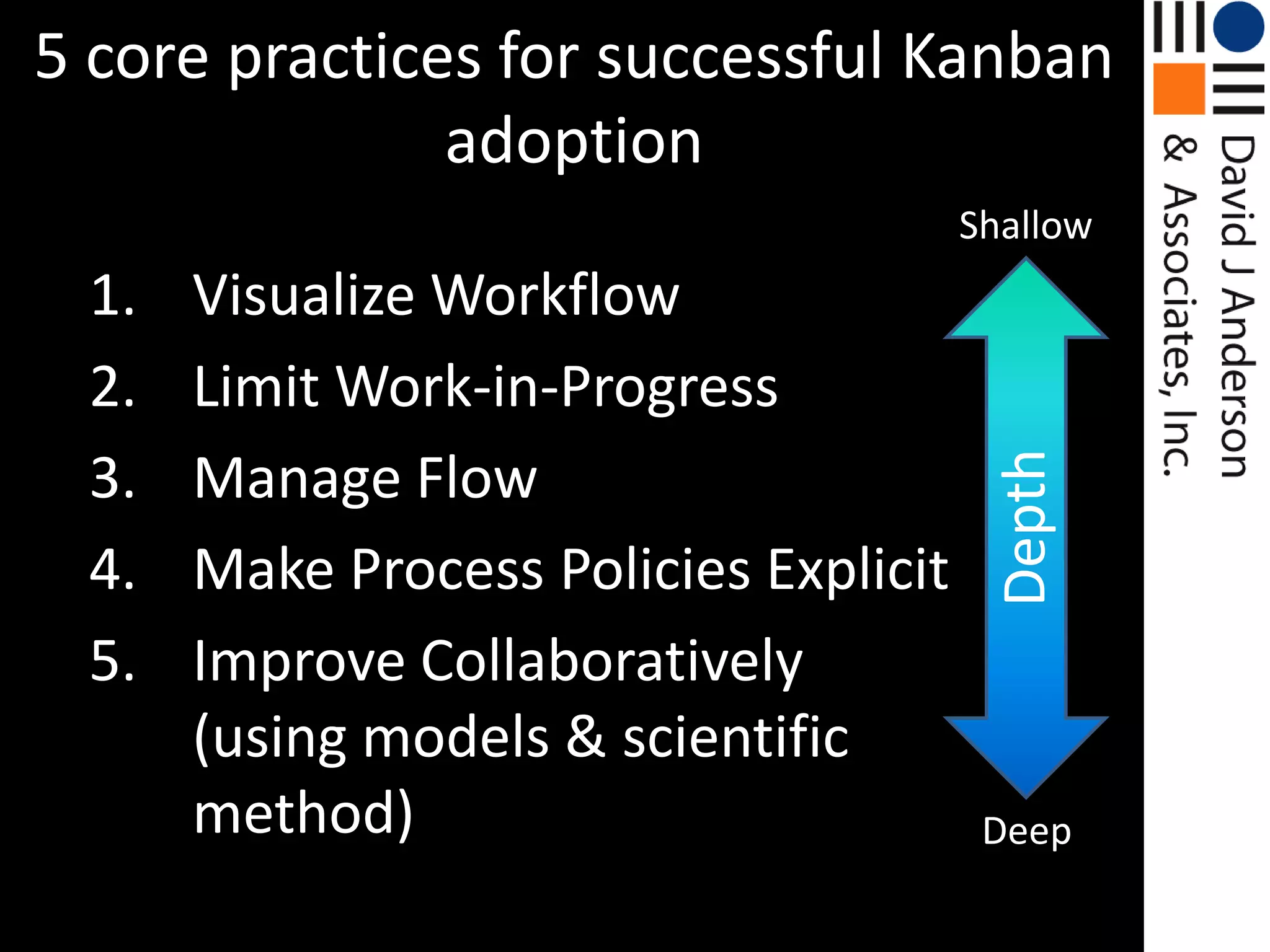
5 core practices for successful Kanban adoptionShallowVisualize WorkflowLimit Work-in-ProgressManage FlowMake Process Policies ExplicitImprove Collaboratively(using models & scientific method)DepthDeep
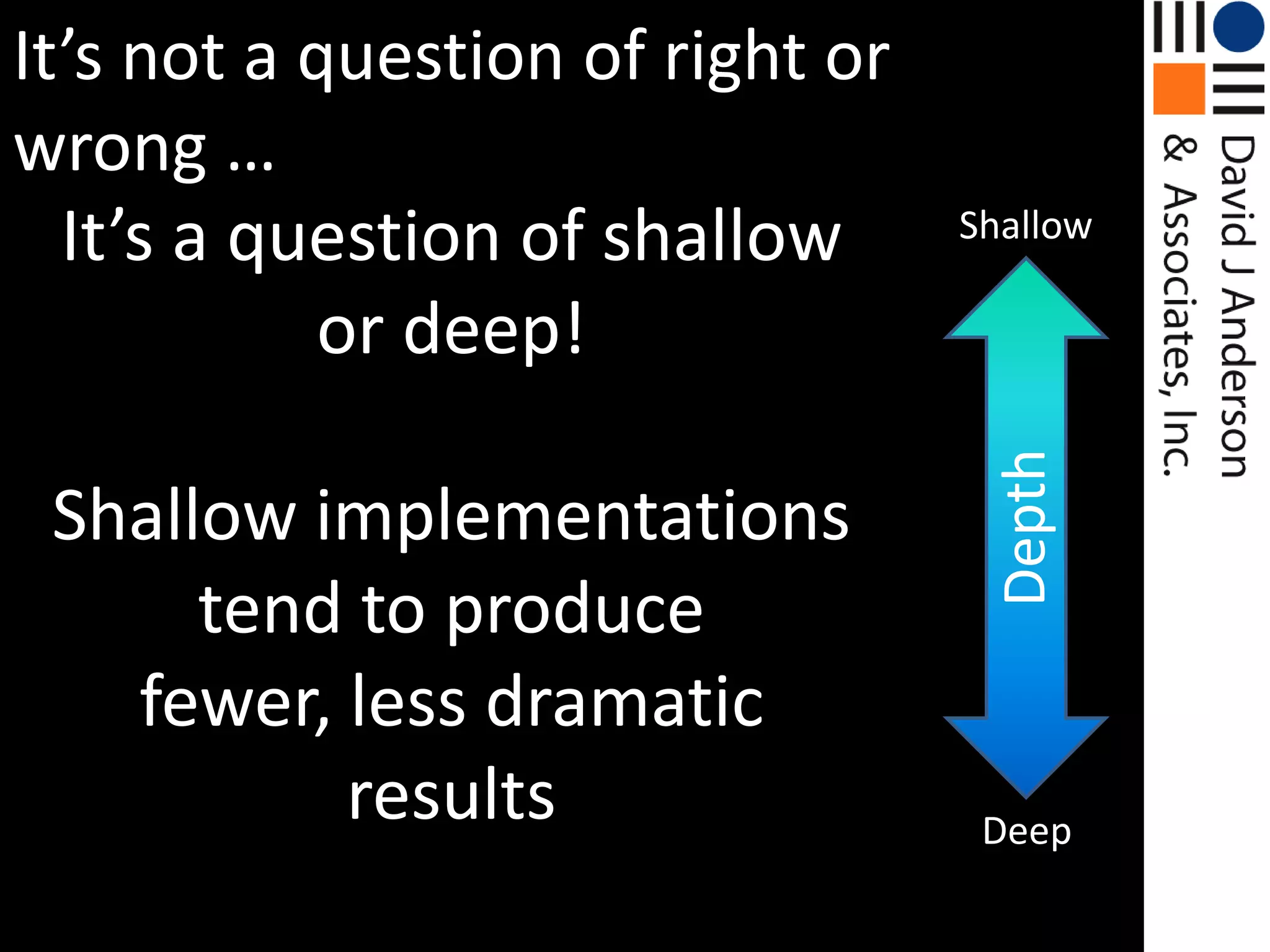
It’s not a question of right or wrong …ShallowIt’s a question of shallow or deep!Shallow implementations tend to produce fewer, less dramatic resultsDepthDeep
When…all5 core practices are adopted they form the seed conditions for Kanban as a complex adaptive systemthat enables a Lean(er) way of working to emerge
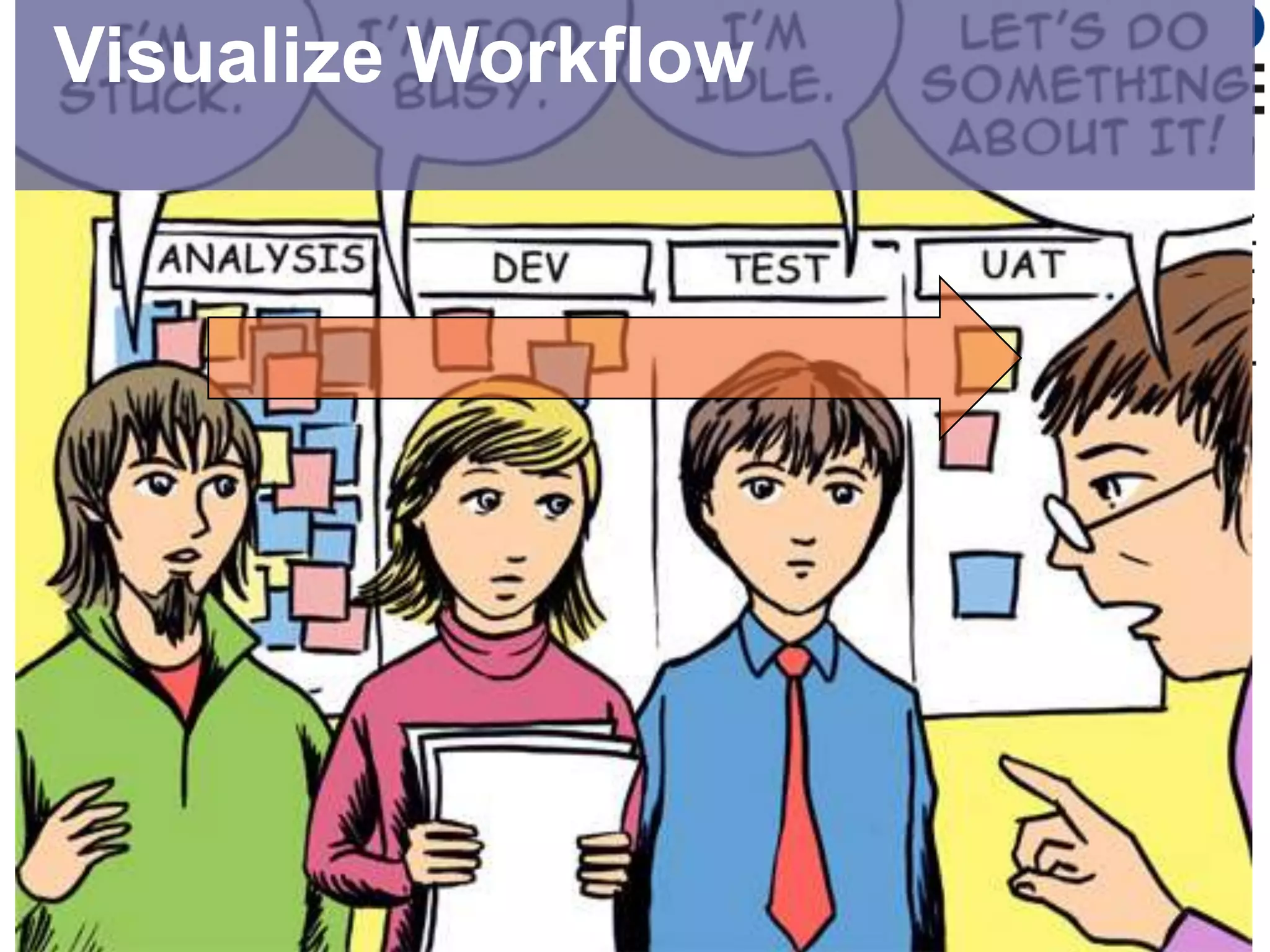
Visualize Workflow
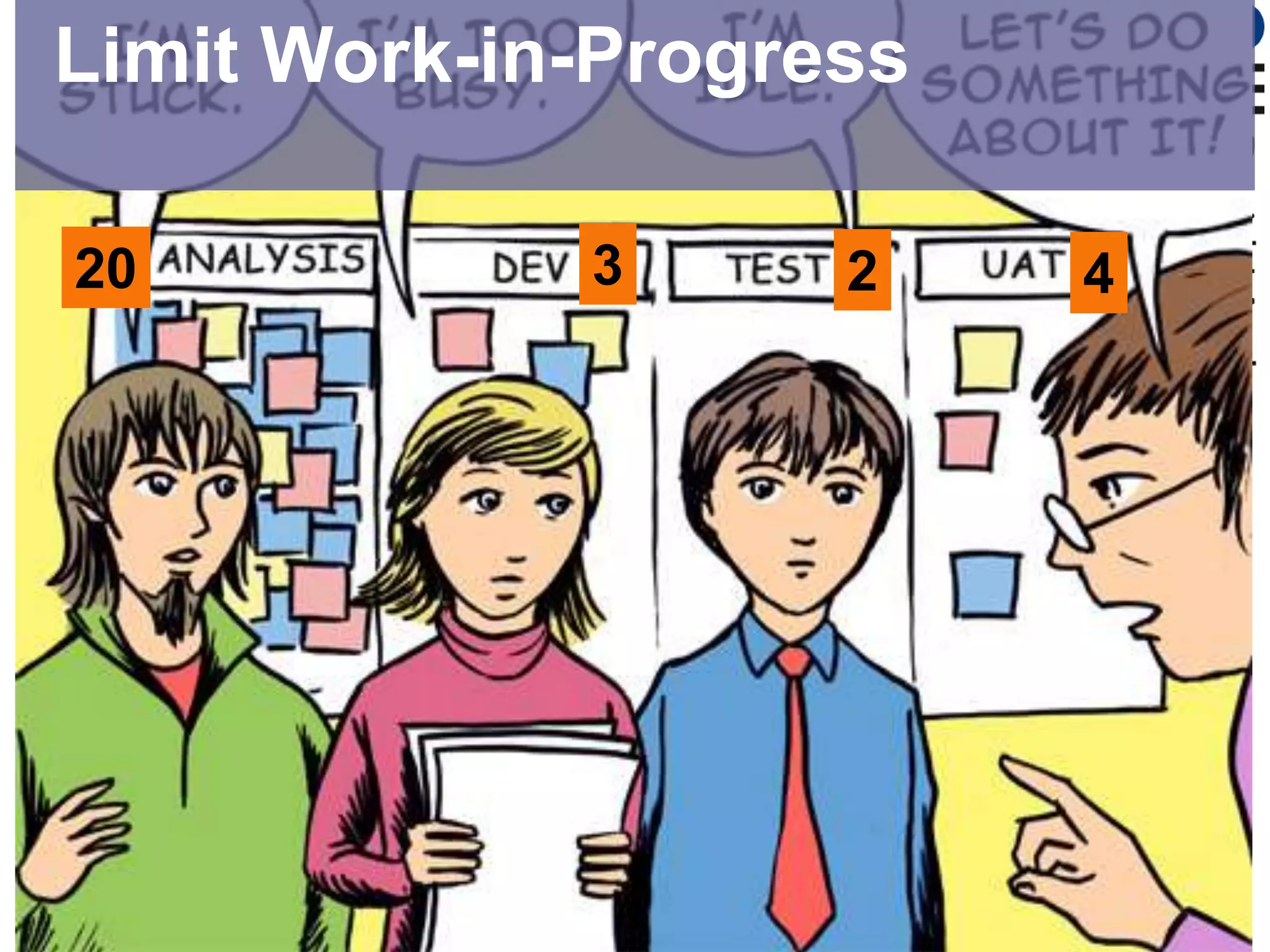
Limit Work-in-Progress32024
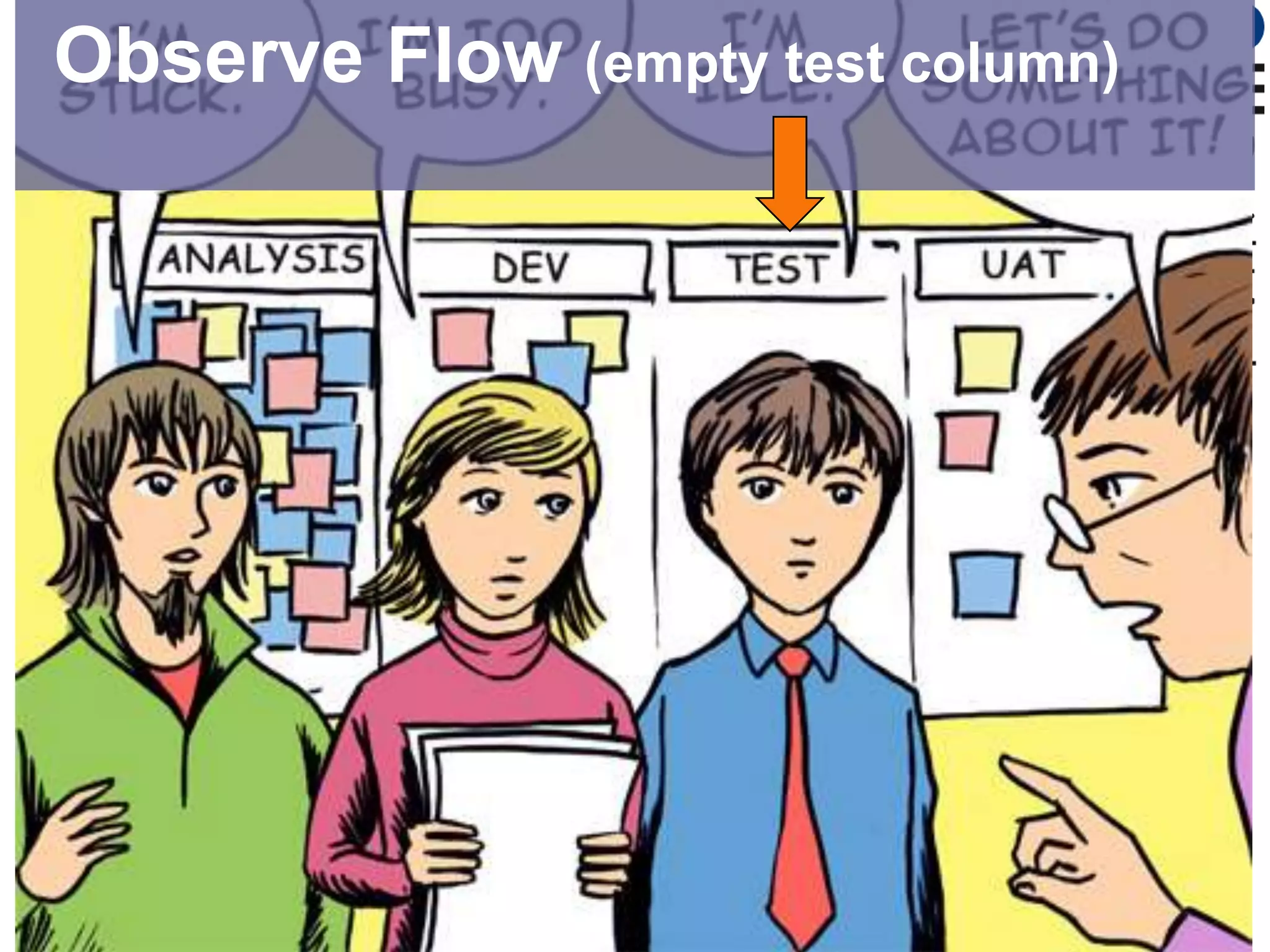
Observe Flow (empty test column)
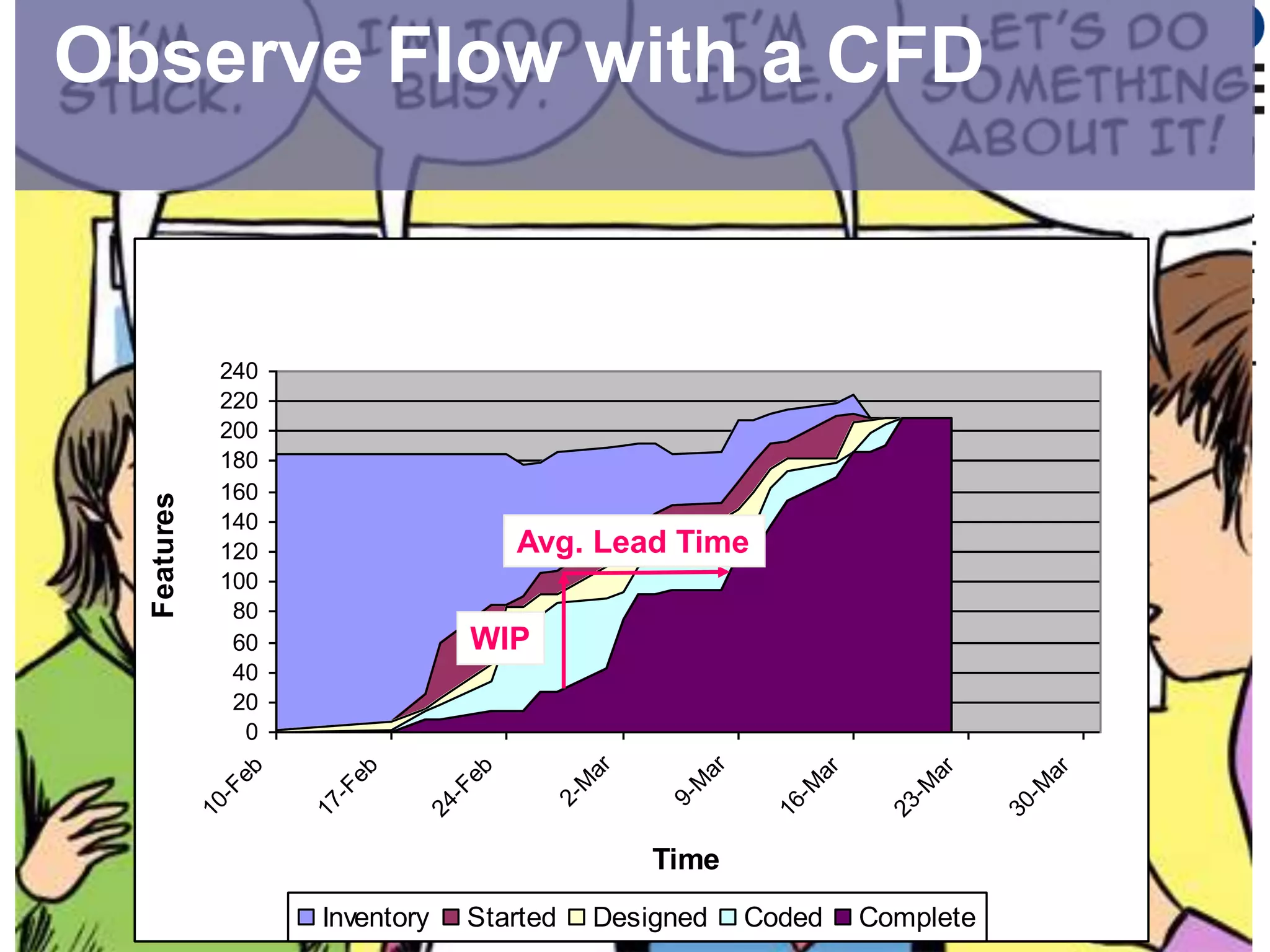
ObserveFlow with a CFDAvg. Lead TimeWIP
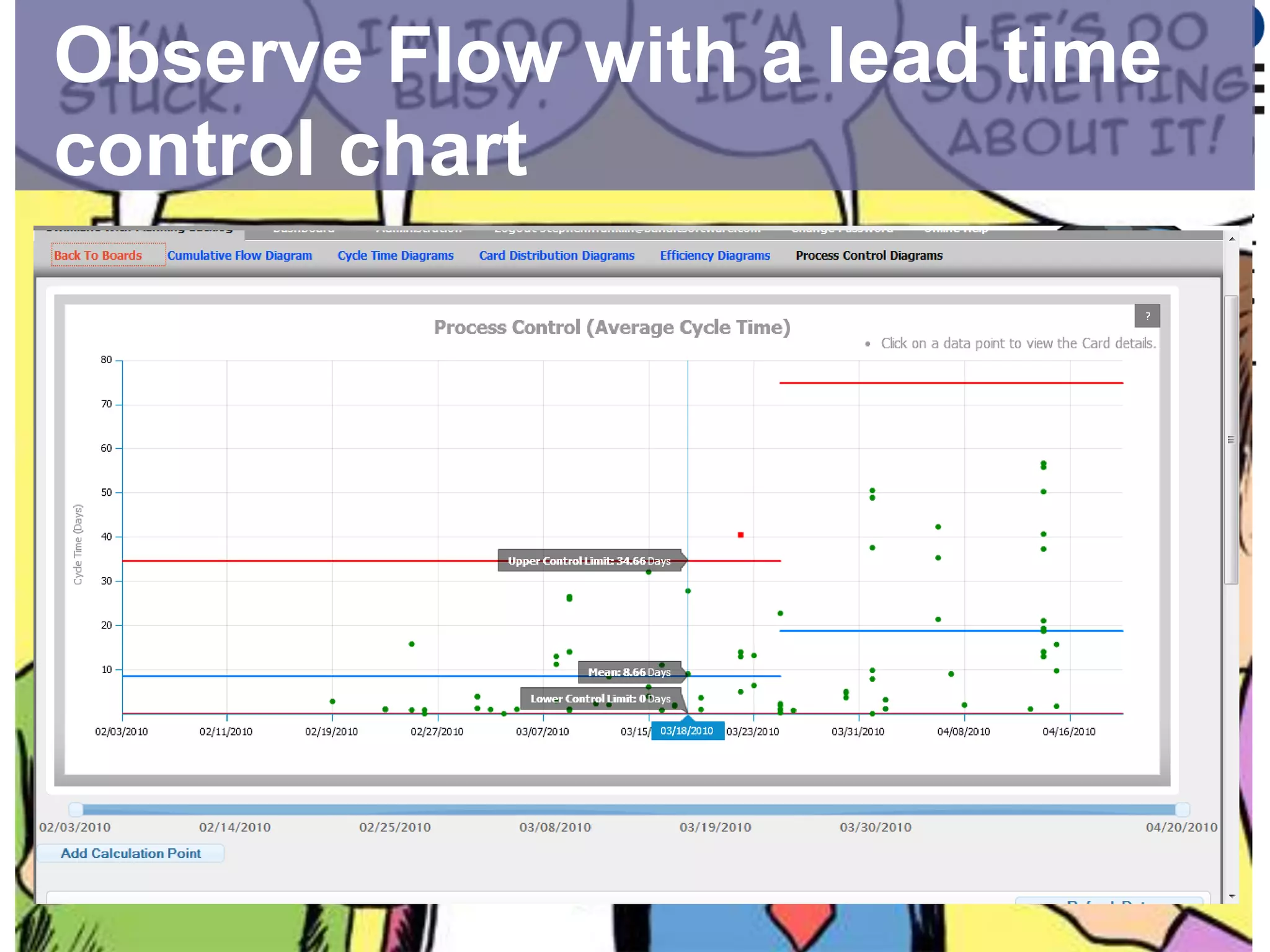
ObserveFlow with a lead time control chart
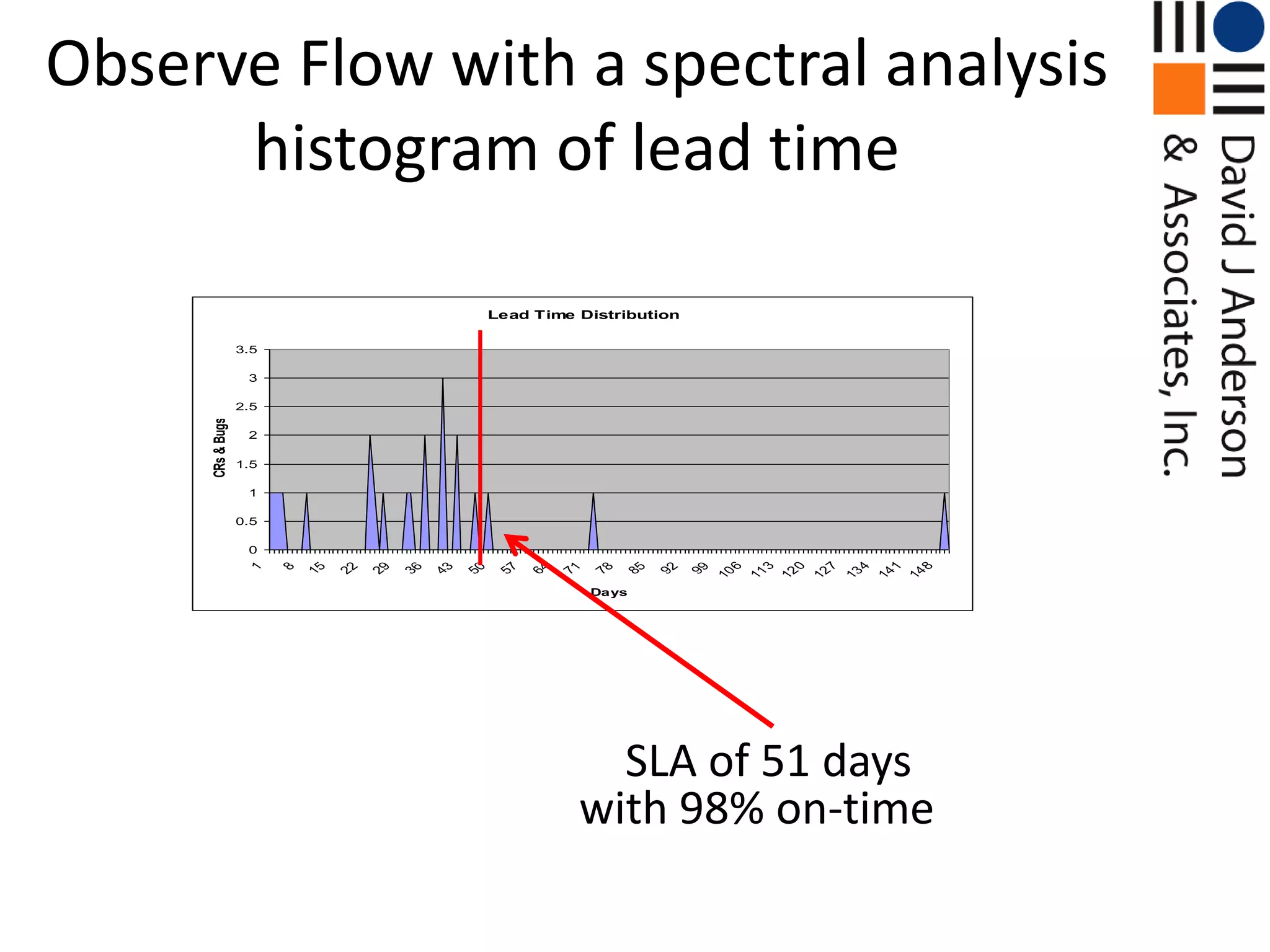
Observe Flow with a spectral analysis histogram of lead timeSLA of51 dayswith 98% on-timea from mean)
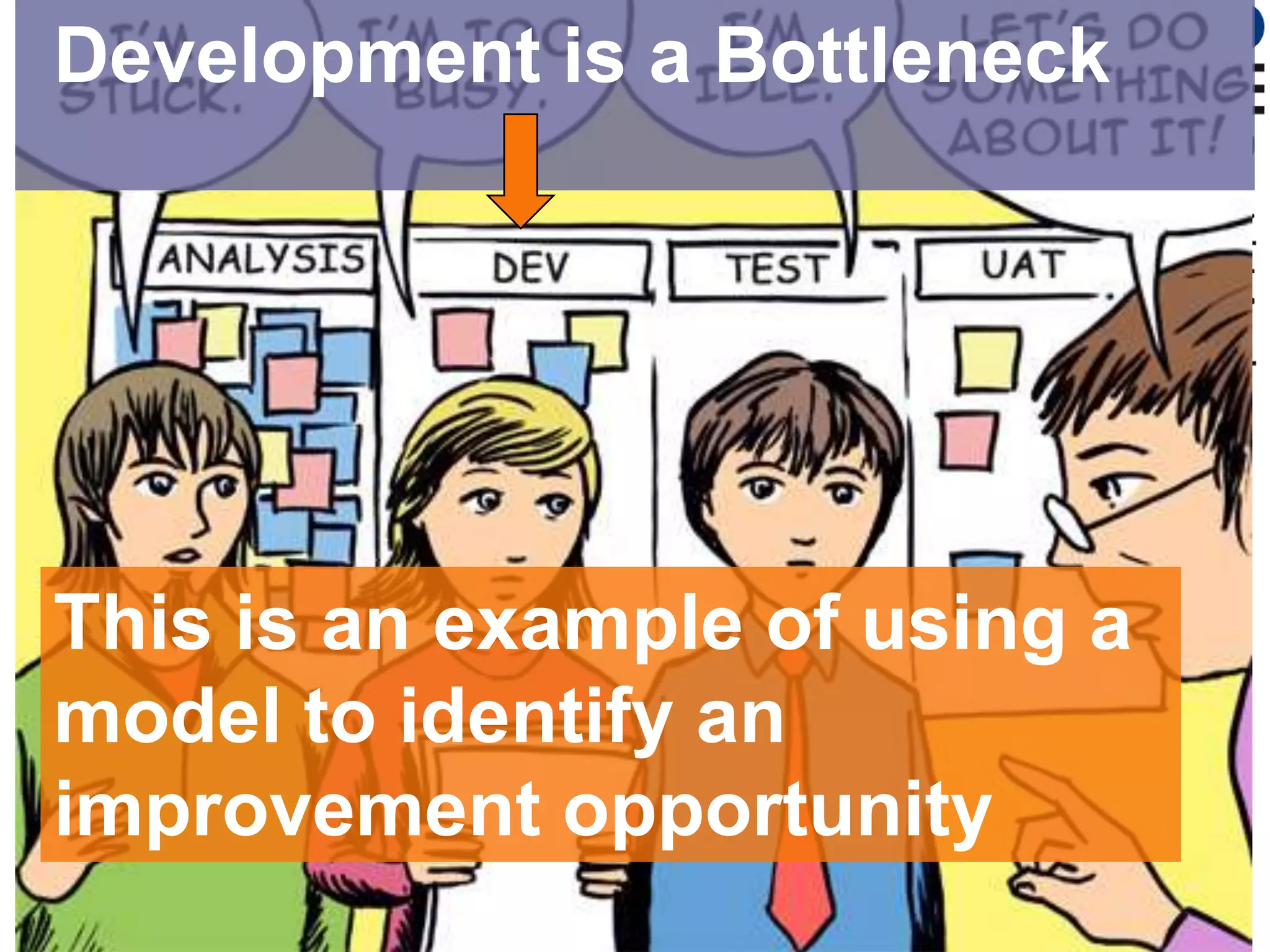
Development is a BottleneckThis is an example of using a model to identify an improvement opportunity
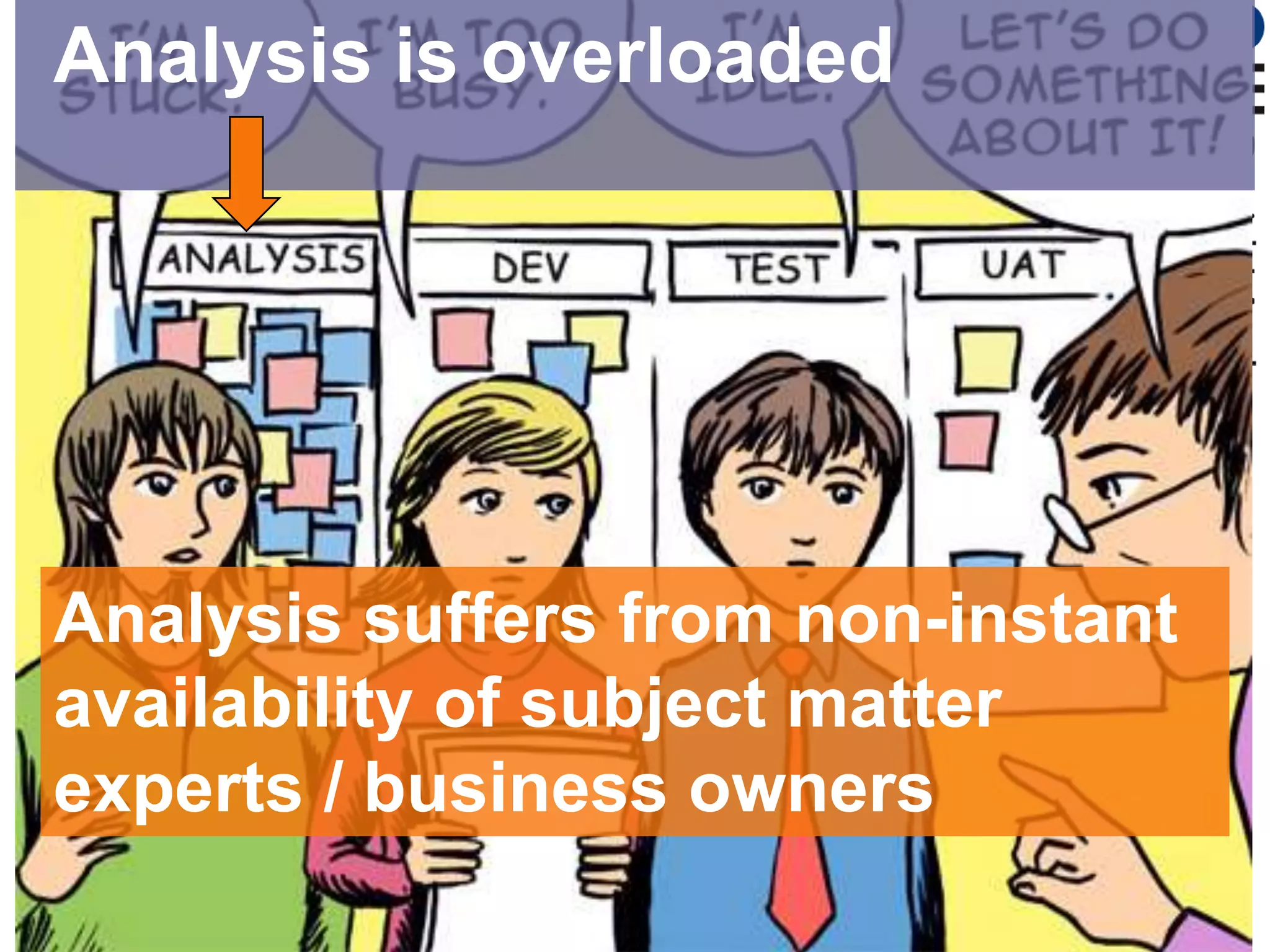
Analysis is overloadedAnalysis suffers from non-instant availability of subject matter experts / business owners
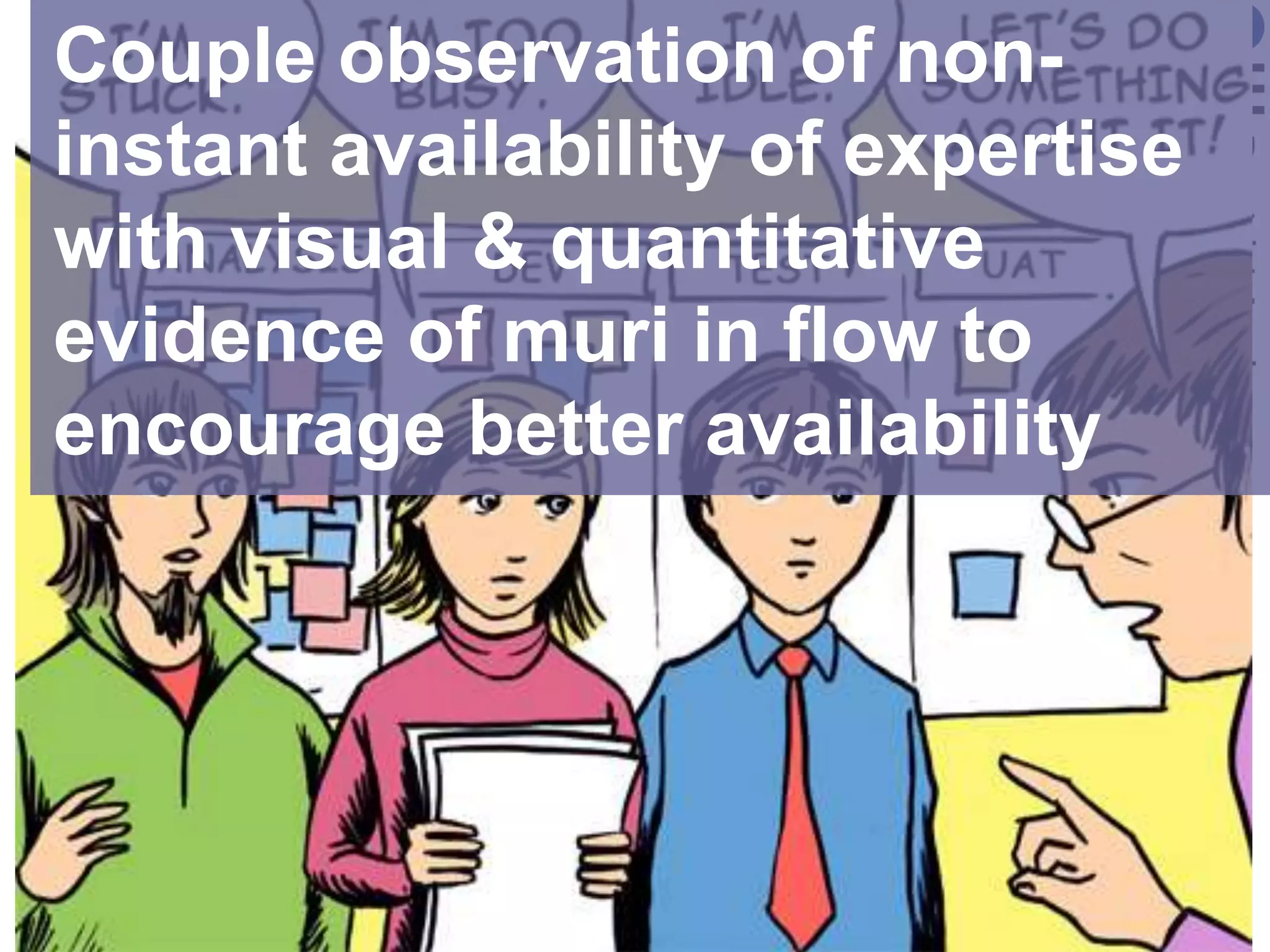
Couple observation of non-instant availability of expertise with visual & quantitative evidence of muri in flow to encourage better availability
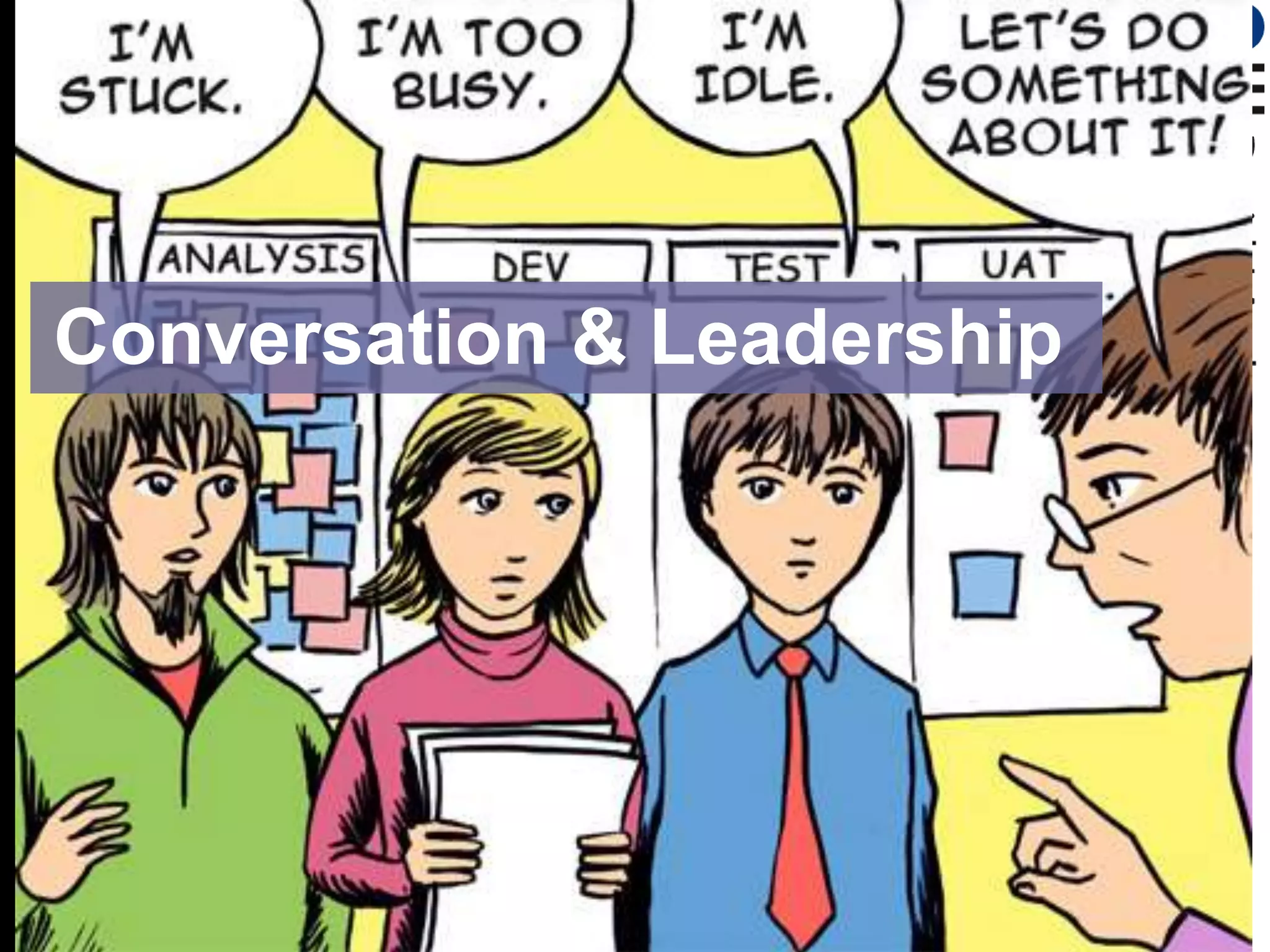
Conversation & Leadership
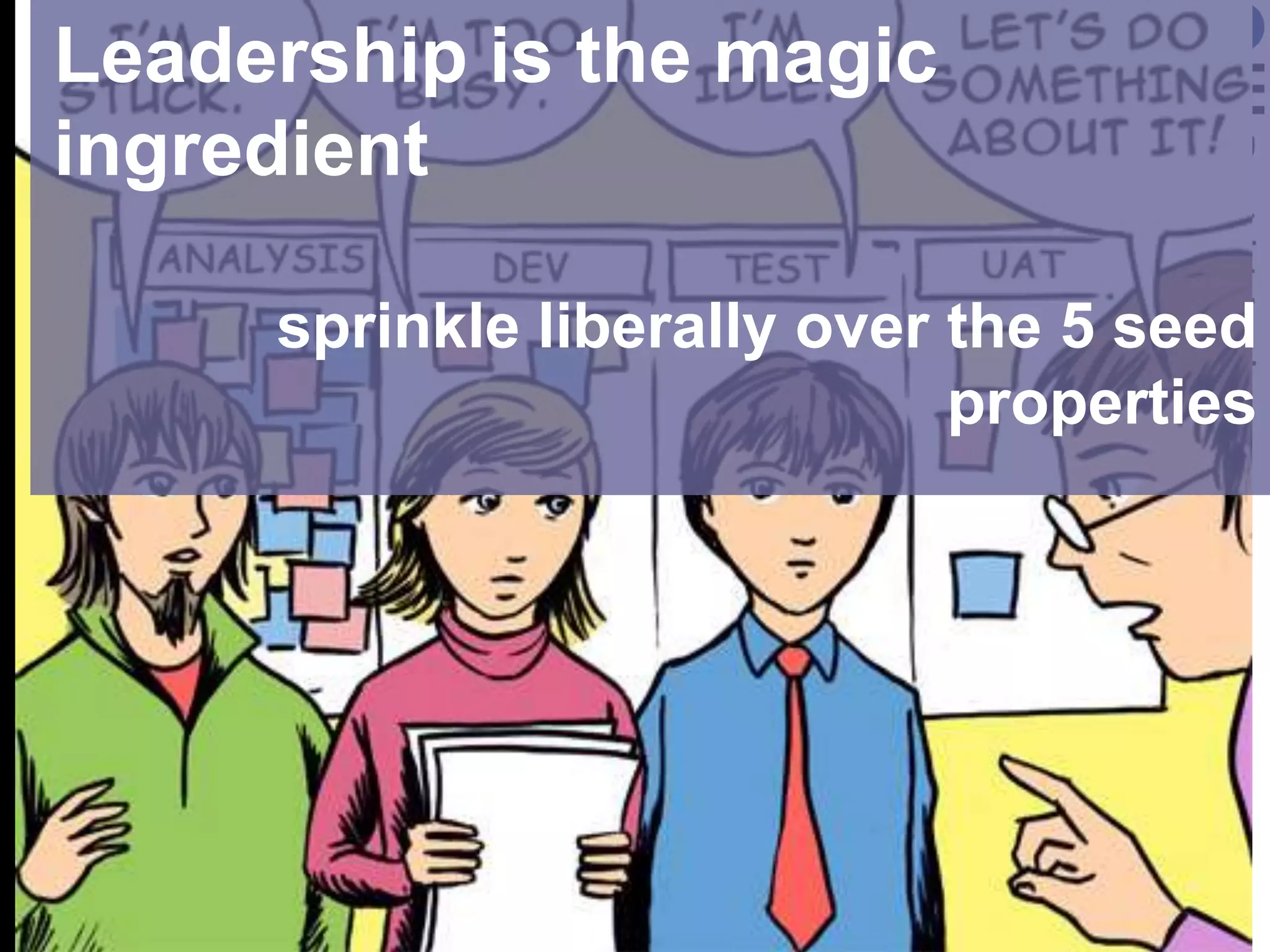
Leadership is the magic ingredientsprinkle liberally over the 5 seed properties
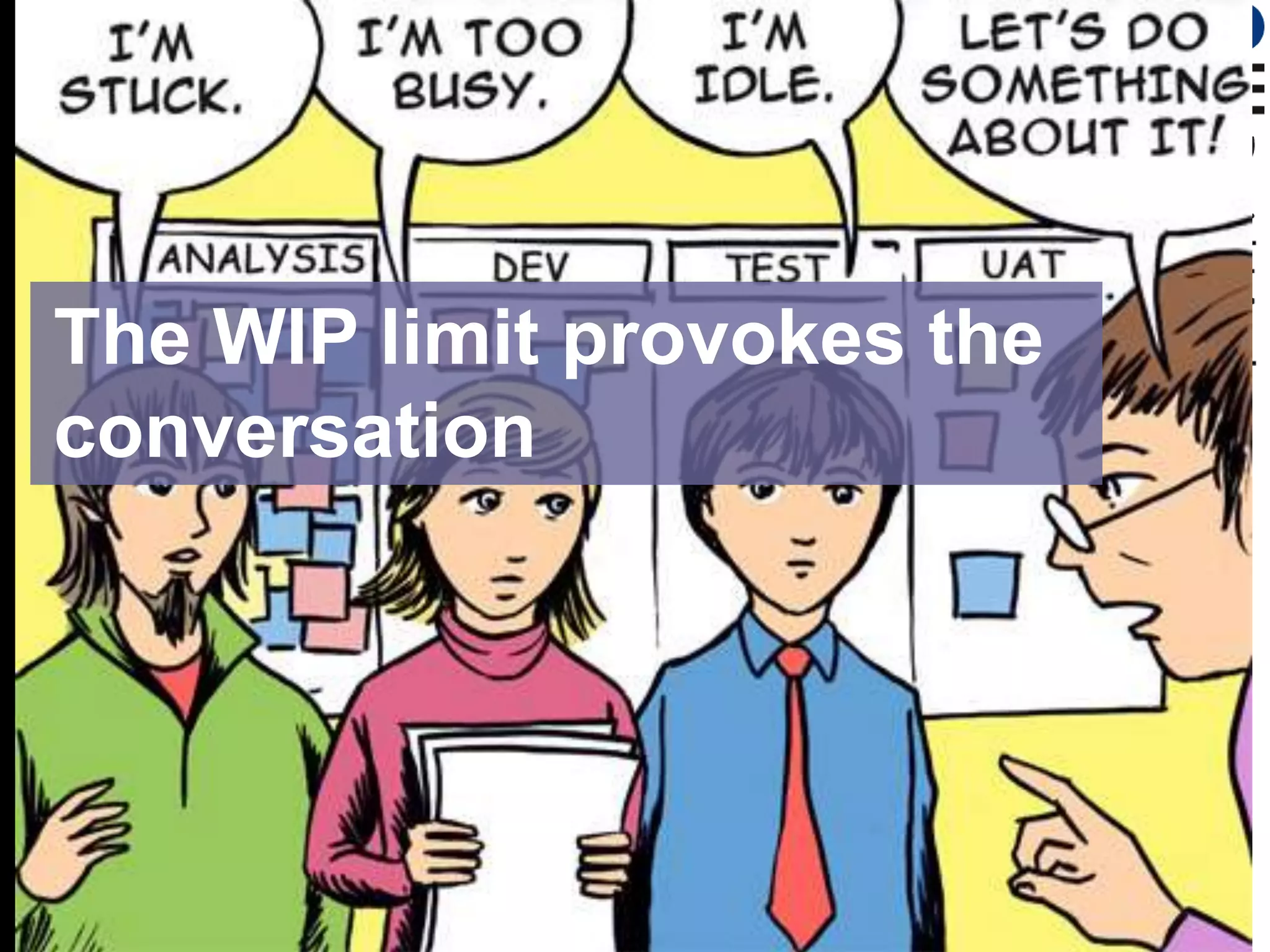
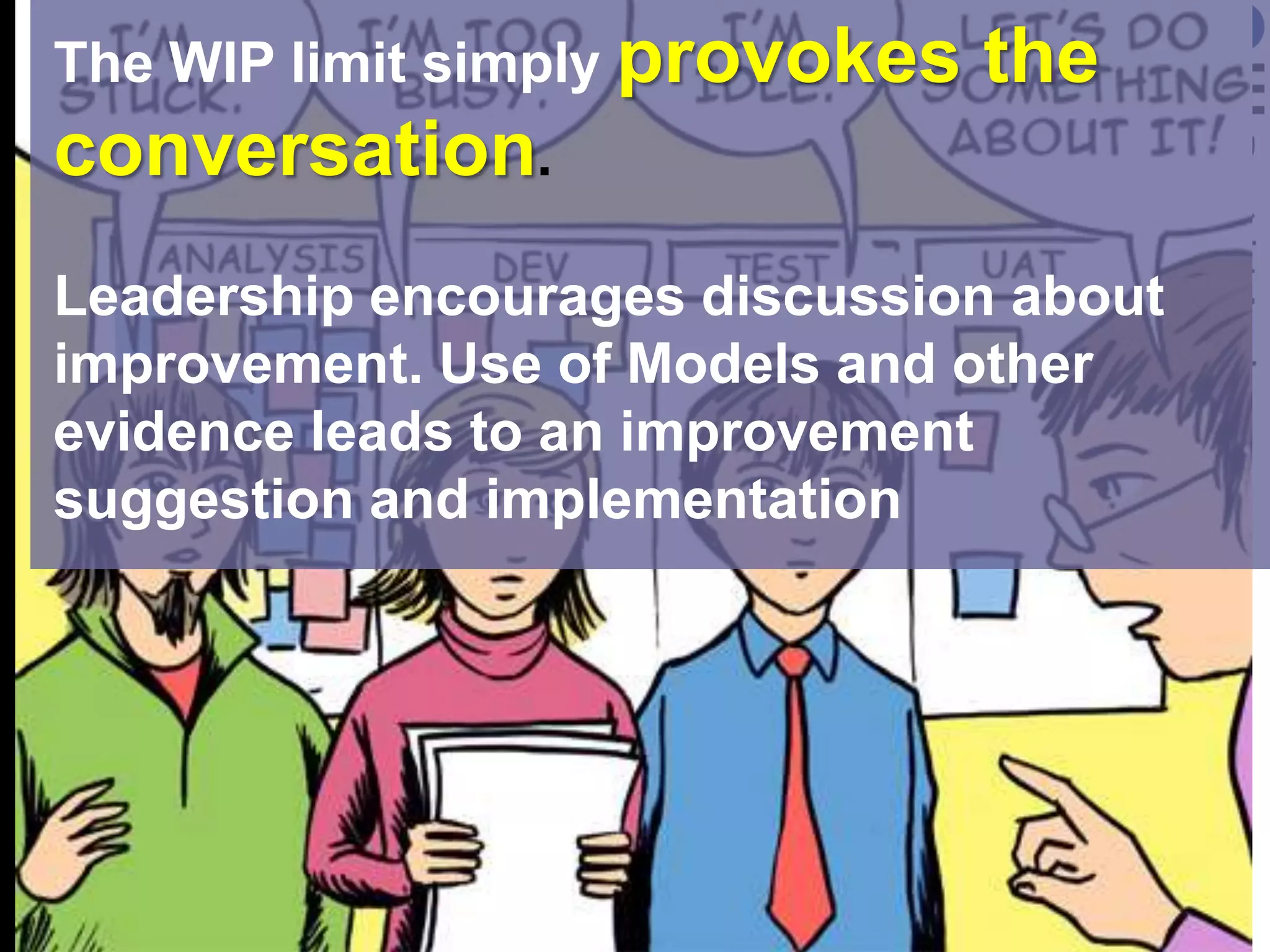
The WIP limit provokes the conversation
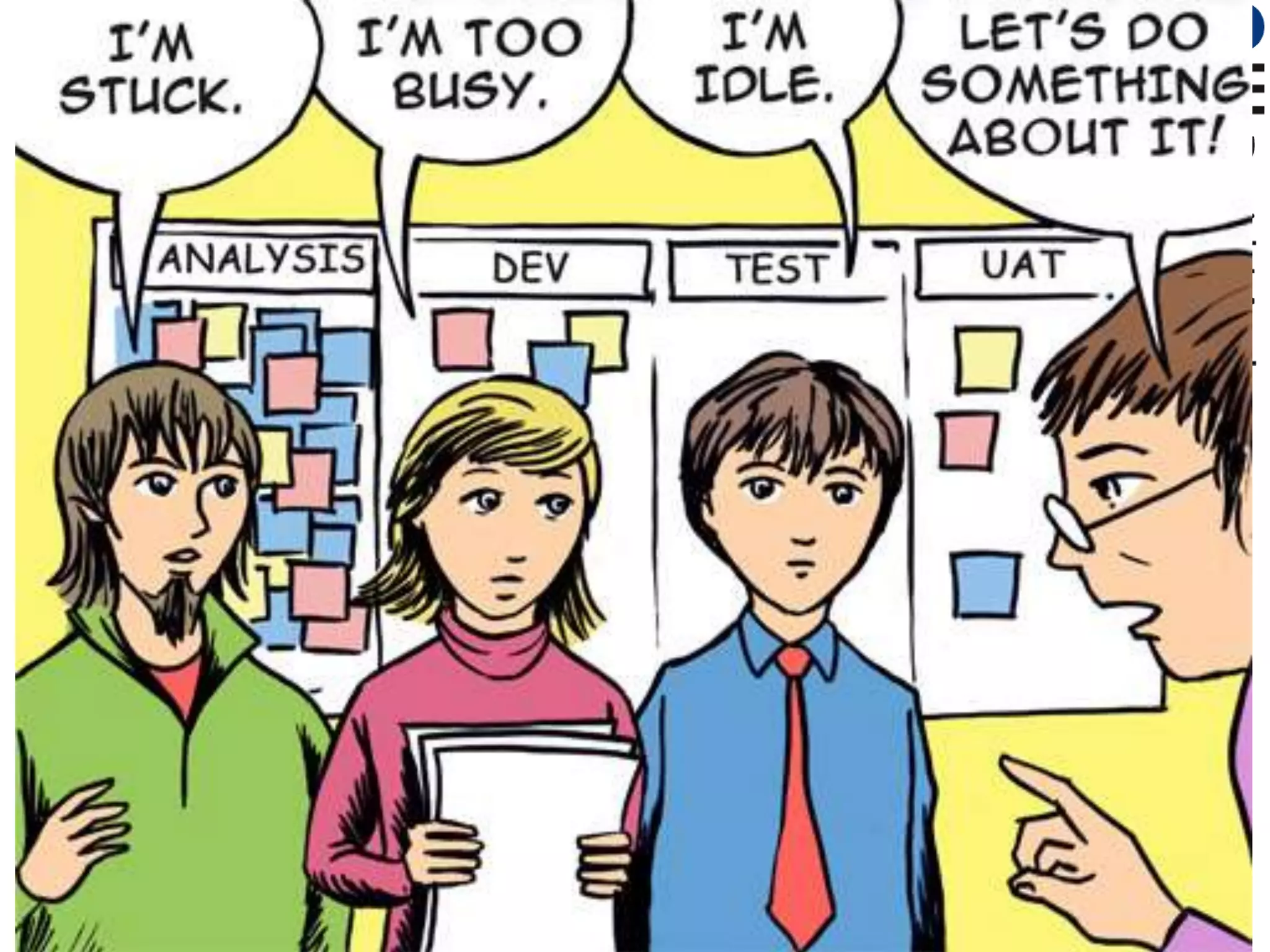
Without a WIP limit the Idle & Stuck comments may never emerge
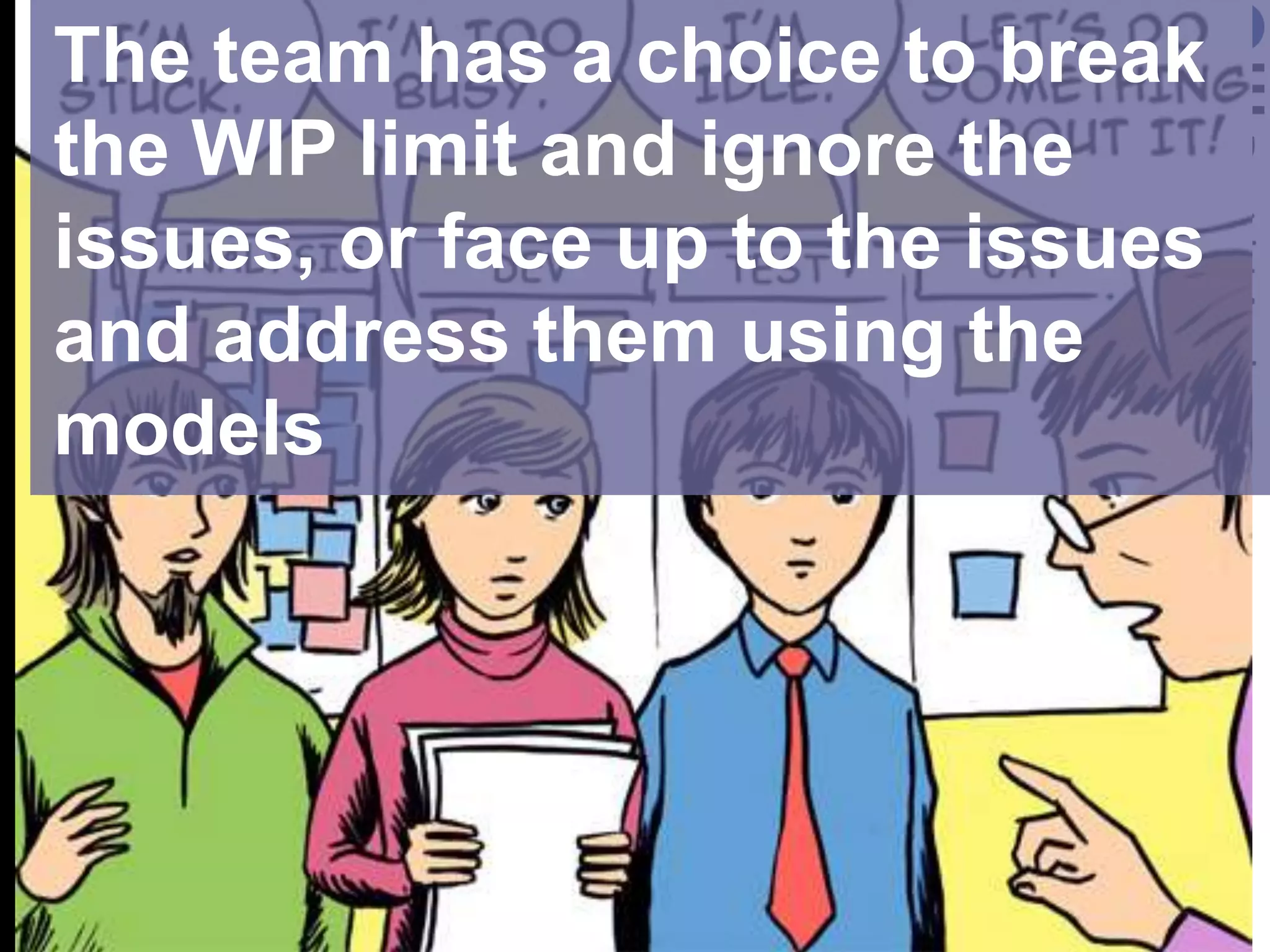
The team has a choice to break the WIP limit and ignore the issues, or face up to the issues and address them using the models
The WIP limit simply provokes the conversation. Leadership encourages discussion about improvement. Use of Models and other evidence leads to an improvement suggestion and implementation
Kanban & Emergence
Emergent behavior is seen in nature when systems adapt to unfolding events and changing circumstances in their surroundings
Often very complex behavior is derived out of system with simple rules. When these rules can change over time, the systems are referred to as Complex Adaptive Systems
Kanban has been observed to stimulateemergent behaviors in many organizations
The simple rules of Kanban such as WIP limits, Cadence, Pull Criteria & Classes of Service, are adaptable over time. Hence, Kanban creates a Complex Adaptive System within an organization
This explains why Kanban provides a good mechanism for dealing with complexity in knowledge work processes
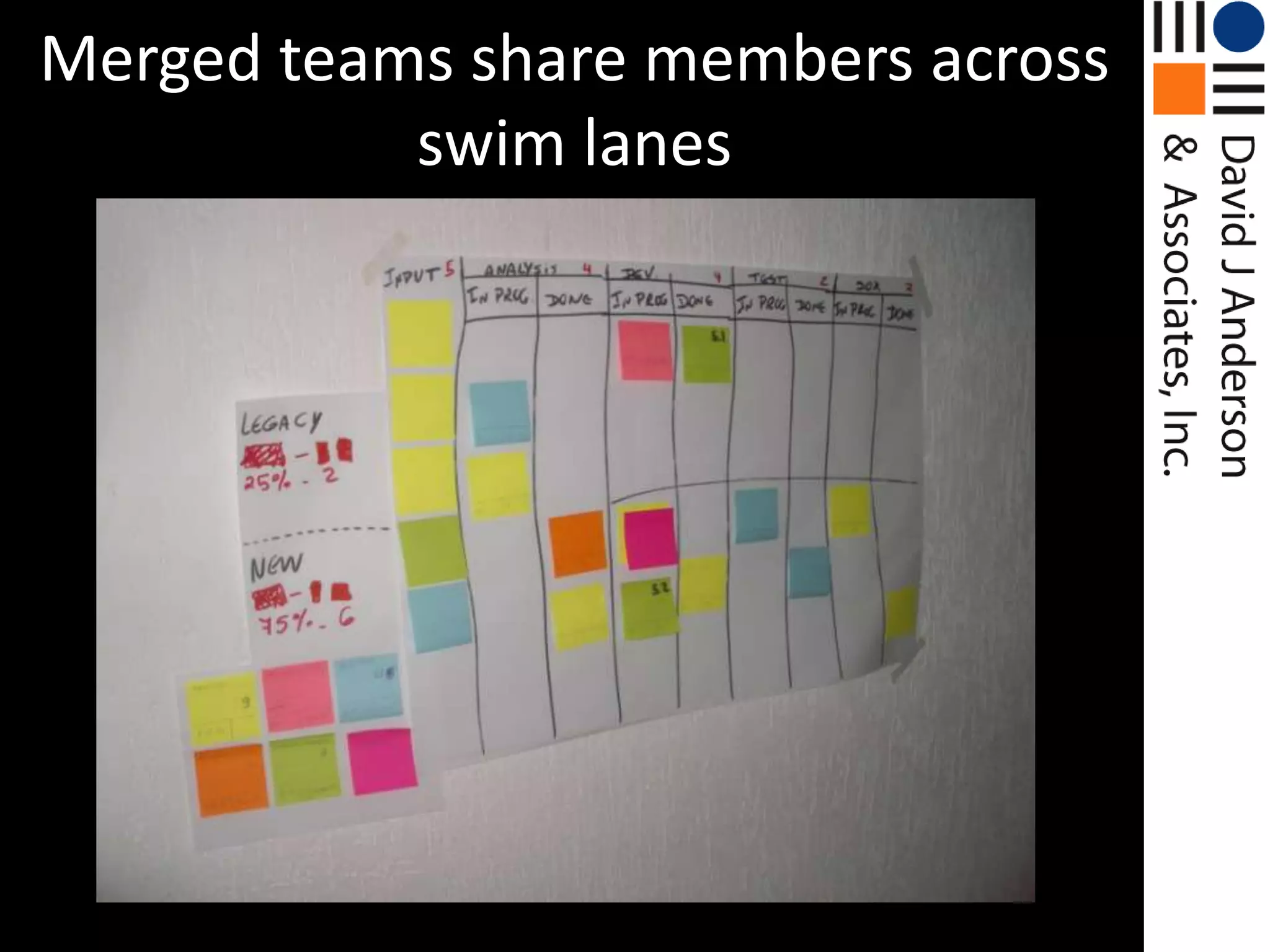
There is a growing list of emergent behaviors observed in practiceProcess uniquely tailored to each project/value stream Decoupled Cadences (aka Iterationless Development)Work Scheduled by (opportunity) Cost of Delay Value Optimized with Classes of ServiceRisk Managed With Capacity AllocationTolerance for Process ExperimentationQuantitative ManagementViral Spread (of Kanban)Small teams merged for more liquid labor pools
TypicallyNoEnterprise Process DefinitionNo "shrink to fit.“Nor is there "stretch to fit.“The existing process evolves over time and emerges as a new leaner process, based on simple rules and operational performance models.
Iterationless Flow is acommon motivation for adopting the use of a kanban systemHowever, it is not core to the Kanban Method for change managemente.g. you can add a kanban system to Scrum and provoke evolutionary change without abandoning Sprints
A WIP limit on the input queue focuses attention on what to start nextProvokes focus on value(market payoff function, aka cost of delay function)
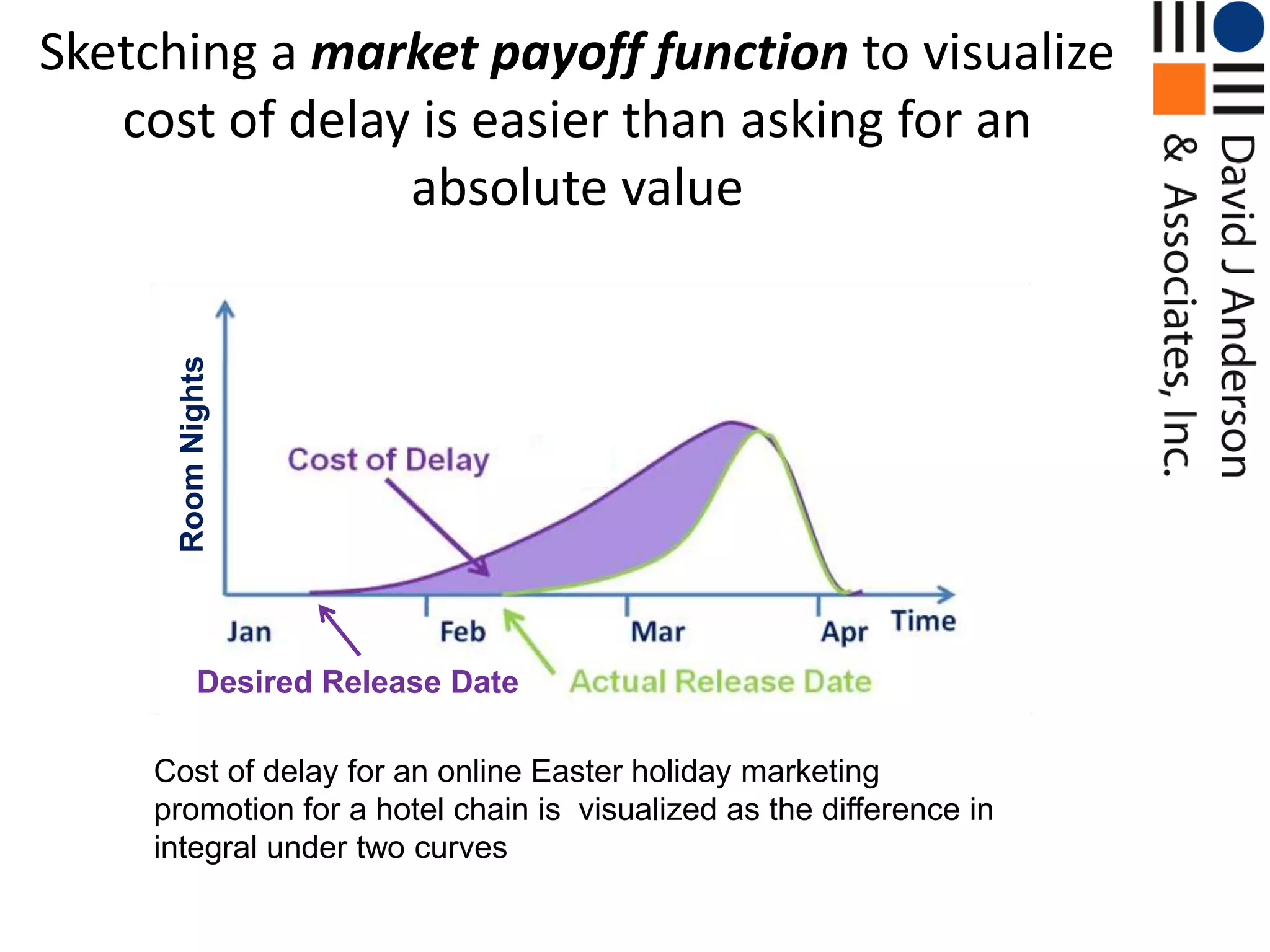
Sketching a market payoff function to visualize cost of delay is easier than asking for an absolute valueRoom Nights Desired Release DateCost of delay for an online Easter holiday marketing promotion for a hotel chain is  visualized as the difference in integral under two curves
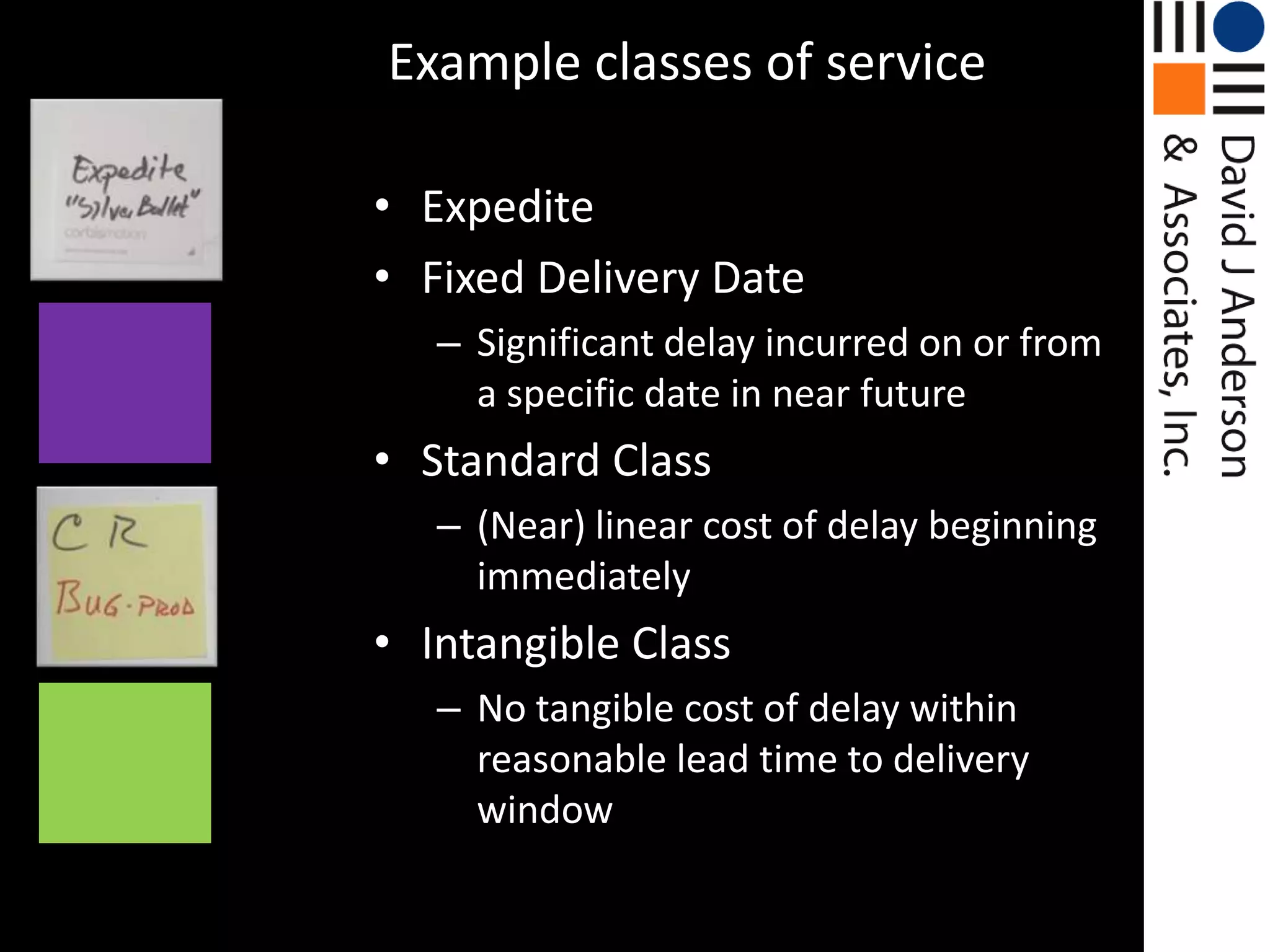
Example classes of serviceExpediteFixed Delivery DateSignificant delay incurred on or from a specific date in near futureStandard Class(Near) linear cost of delay beginning immediatelyIntangible ClassNo tangible cost of delay within reasonable lead time to delivery window
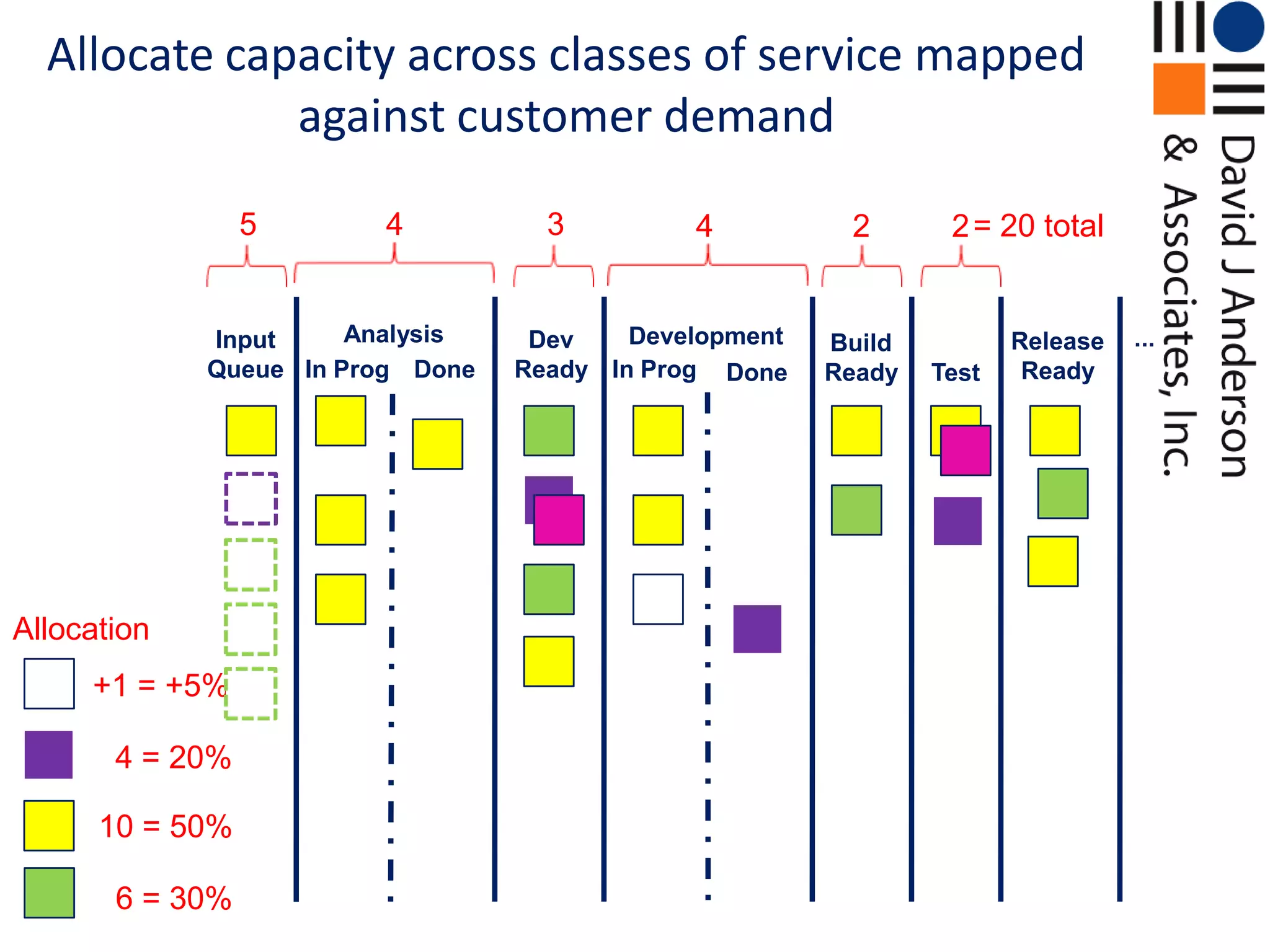
Allocate capacity across classes of service mapped against customer demand543= 20 total422AnalysisDevelopment...InputQueueDevReadyReleaseReadyBuildReadyIn ProgIn ProgDoneDoneTestAllocation+1 = +5%4 = 20%10 = 50%6 = 30%
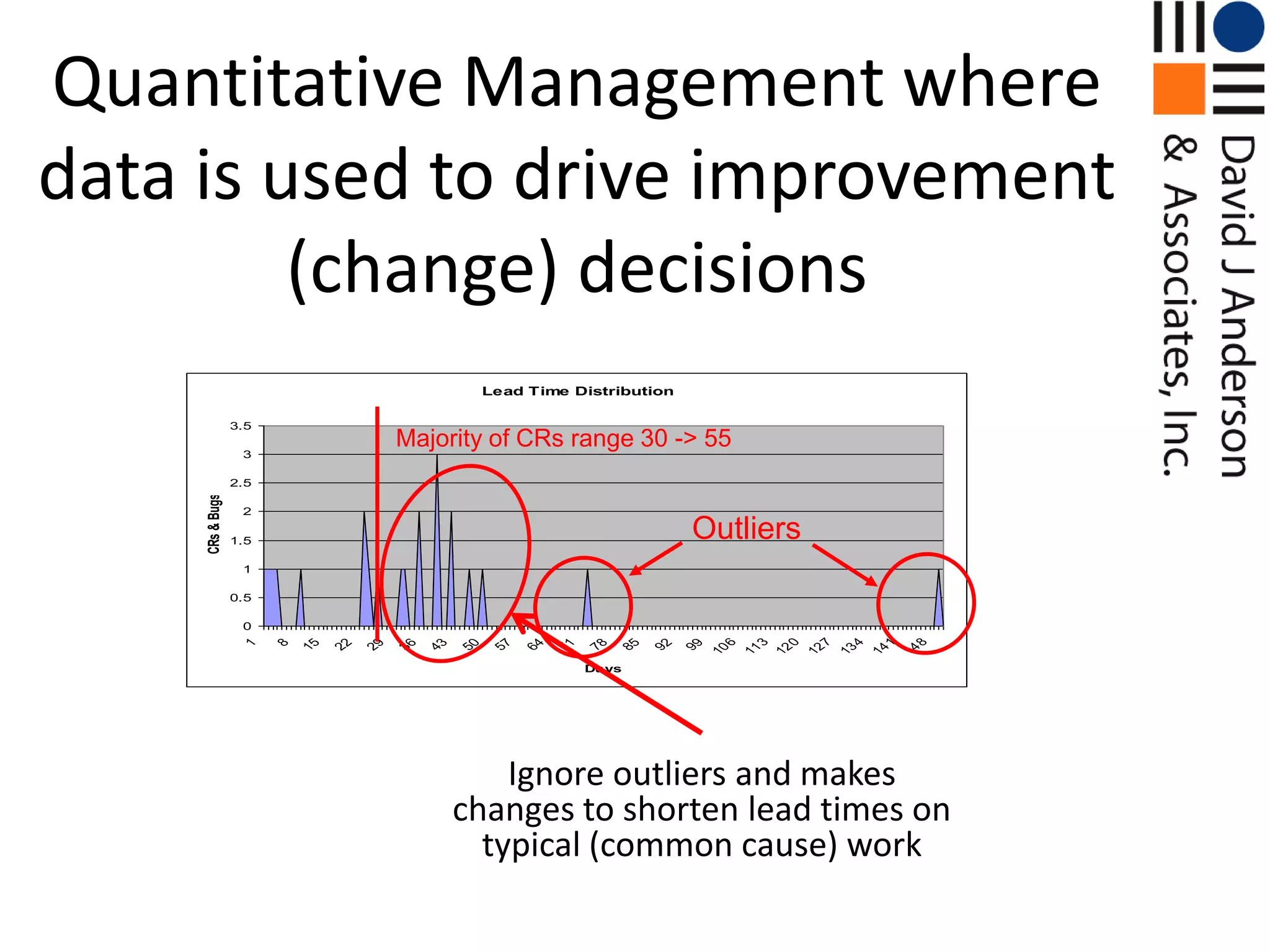
Quantitative Management where data is used to drive improvement (change) decisionsMajority of CRs range 30 -> 55OutliersIgnore outliers and makes changes to shorten lead times on typical (common cause) work
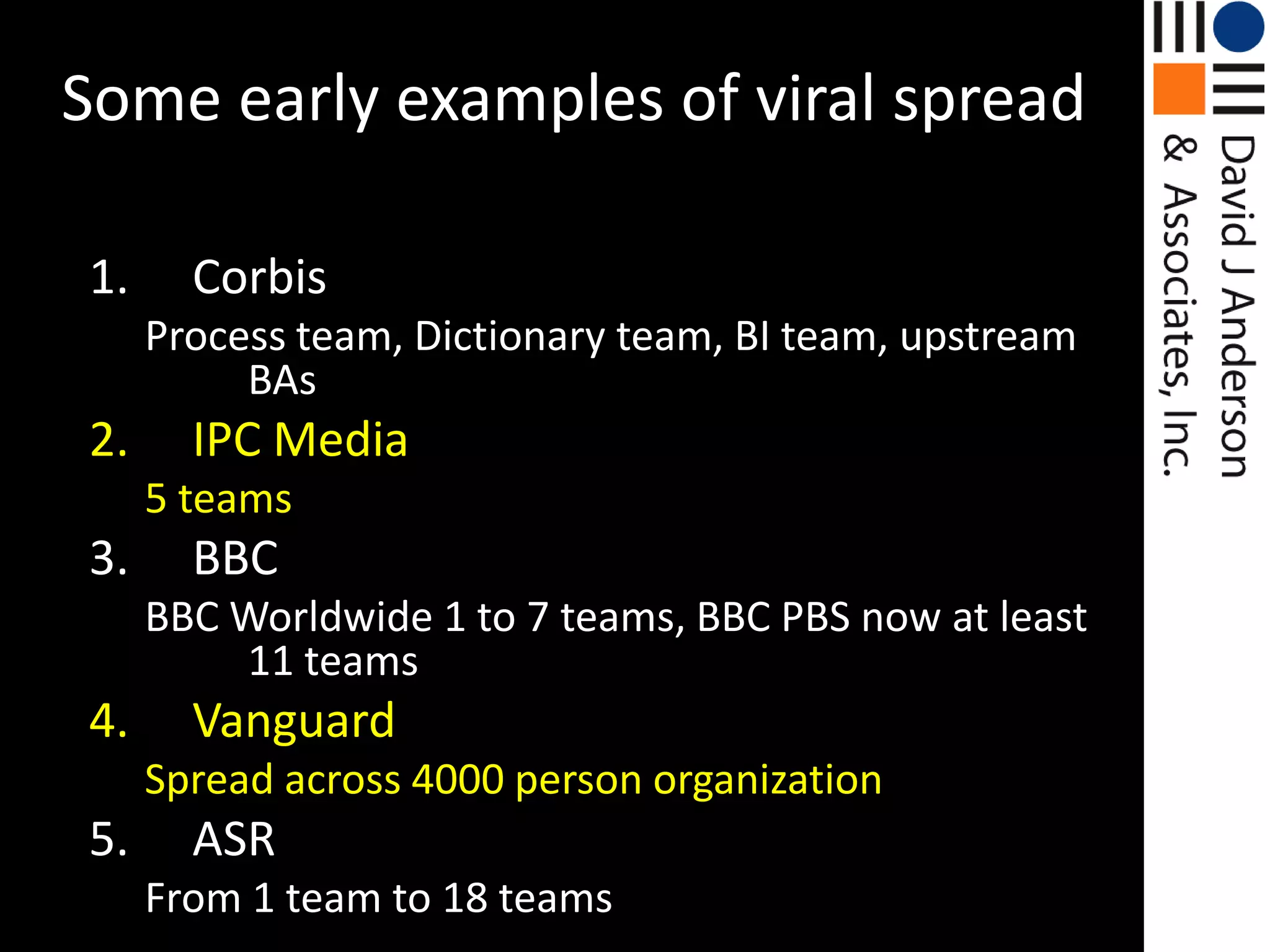
Some early examples of viral spreadCorbisProcess team, Dictionary team, BI team, upstream BAsIPC Media5 teamsBBCBBC Worldwide 1 to 7 teams, BBC PBS now at least 11 teamsVanguardSpread across 4000 person organizationASRFrom 1 team to 18 teams
Merged teams share members across swim lanesLKBE10
Conclusions
Limiting work-in-progress can catalyzeincremental changes
The team must respectthe WIP limit and value the conversationsit provokes about problems
Leadershipis the secret sauce! Encourage it from any team member regardless of position, experience or authority
Arm the team with transparency of process(visualization of workflow and explicitly stated policies.) Use models for understanding problems and improvementswill occur.
These improvements will provide bettereconomic and sociological outcomes
What emerges is an organization that lives all the pillars of Lean
Thank you!dja@djandersonassociates.comhttp://www.kanbaninaction.com/
http://leankanbanuniversity.comhttp://www.limitedwipsociety.orgLinkedIn Groups: Software KanbanYahoo! Groups: kanbandevYahoo! Groups: kanbanops
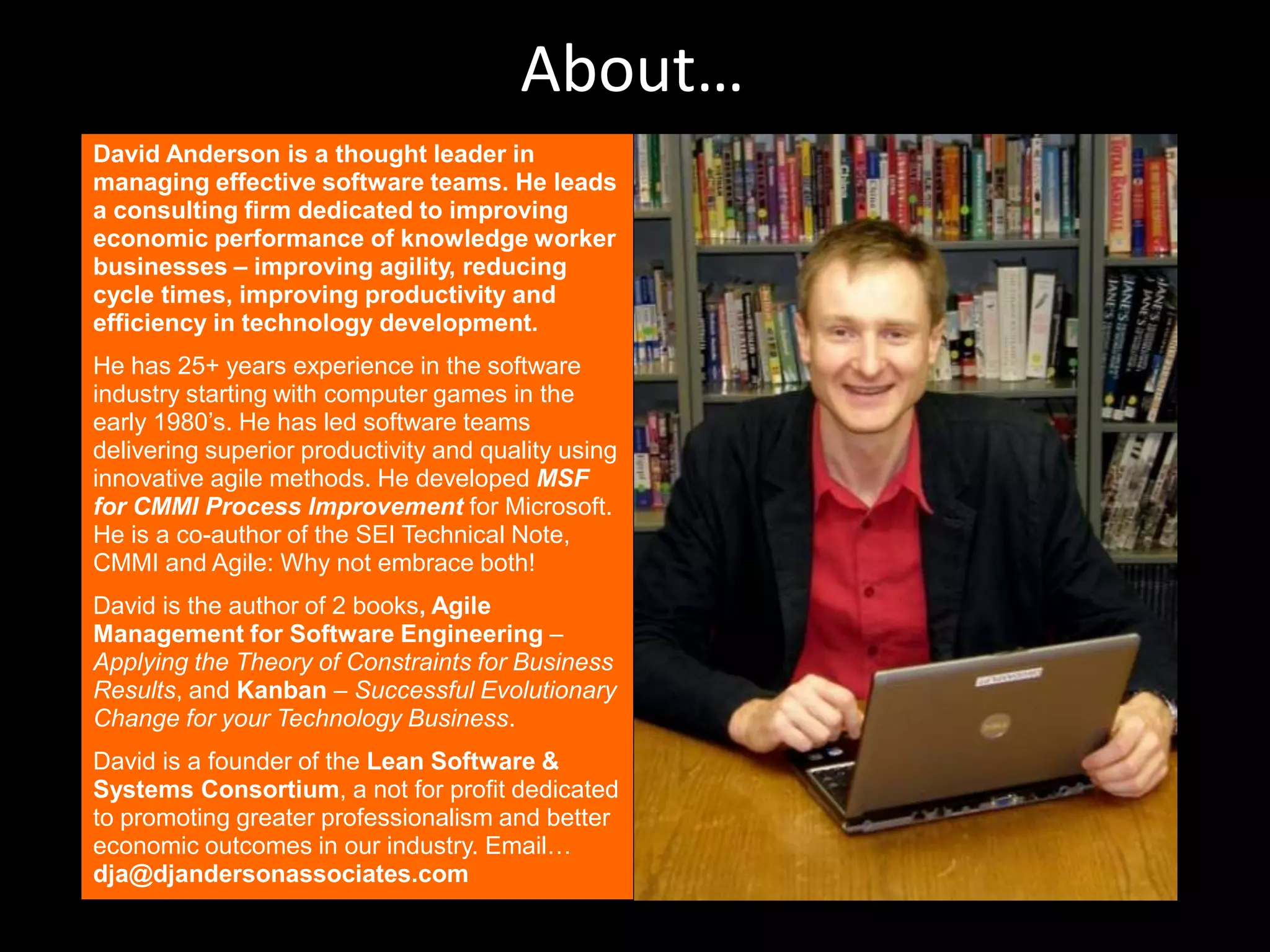
About…David Anderson is a thought leader in managing effective software teams. He leads a consulting firm dedicated to improving economic performance of knowledge worker businesses – improving agility, reducing cycle times, improving productivity and efficiency in technology development.He has 25+ years experience in the software industry starting with computer games in the early 1980’s. He has led software teams delivering superior productivity and quality using innovative agile methods. He developed MSF for CMMI Process Improvement for Microsoft. He is a co-author of the SEI Technical Note, CMMI and Agile: Why not embrace both!David is the author of 2 books, Agile Management for Software Engineering –  Applying the Theory of Constraints for Business Results, and Kanban – Successful Evolutionary Change for your Technology Business.David is a founder of the Lean Software & Systems Consortium, a not for profit dedicated to promoting greater professionalism and better economic outcomes in our industry. Email… dja@djandersonassociates.com

Kanban explained David Anderson LAS 2011-zurich

  • 1.
    Kanban Explained!A counter-intuitiveapproach to creatinga Lean OrganizationDavid J. Anderson LAS 2011Zurich, September 2011
  • 2.
    Published April 2010A72,000 word introductionMore to come in a future book
  • 3.
    Published in GermanJanuary2011Translation byArne Roock & Henning Wolfof IT-Agile
  • 4.
  • 5.
    The foundational pillarsof Lean are debated by different authors, however, most would agree on the following…
  • 6.
    Pillars of LeanValueValueStreamFlowPullContinuous ImprovementRespect for PeopleHolistic Process Approach(aka. Systems Thinking)
  • 7.
    Western Lean Thinkinghas focused on waste elimination in comparison with Japanese “Toyota Way” that has a broader definition of muda, muri and mura, and a cultural aspect Kaizen
  • 8.
    Western Lean literatureand consulting tended to focus on waste elimination. This was both easy to do and useful in manufacturing but has proven problematic in knowledge work areas.
  • 9.
    The concept ofLean Software Development has been around since 1993, and yet by 2008 you didn't meet anyone doing it
  • 10.
    Agile Management in2003Introduced some Lean ideas including the synthesis of Flow, Visualization using Cumulative Flow Diagrams &Bottleneck Management
  • 11.
    I’d been talkingabout managing flowfor 6 years, but despite support for cumulative flow diagrams in many Agile tools, (almost) no one was doing it!
  • 12.
    I concluded thatafter 15+ years we must assume that Growing Lean Adoption in the IT industry ishard!
  • 13.
    Agile Methods arenot creating Lean Organizations …
  • 14.
    Extreme Programming isevidently a veryLeanmethod
  • 15.
    XP has verylittle waste
  • 16.
    TPS divides wasteinto 3 typesMuda – non-value added tasksMuri – unevenness (or variability) in flowMura – overburdening
  • 17.
    XP avoidsMurathrough useof tests and tight definition of "Done"
  • 18.
    XP avoidsMuriwith skilledcraftsmanship that can "flow" a story without handoffs and a strict WIP limit policy of1 story per pair
  • 19.
    XP has littleMudaasplanning, coordination and delivery are lightweight and partly automated
  • 20.
    Some XP practitionerssuch asJoshua Kerievsky, ArloBelshee & Jim shorehave sought to reduce waste in XP with techniques such as Naked Planning, Agile Workcell, elimination of planning, estimation and time-boxed iterations, and Limited Red
  • 21.
    Themotivationfor these changes,that involved introduction of "kanban" style techniques, was (further)elimination of waste
  • 22.
    However, Extreme Programminghasn't been for everyone!
  • 23.
    Some people &organizations have resistedadoption of Agile methods!
  • 24.
    If not everyorganization is ready to adoptan Agile method, how can we encourage them to become more Lean?
  • 25.
    So What isthe Kanban Method?
  • 26.
    Kanban is theenabler of a Kaizen Culture & emergence of a Lean organization
  • 27.
    So how dowe go about introducing Lean into organizations that have failedto adopt an Agile method such as TDD or failed to truly achieve a continuously improving culture?
  • 28.
    The counter-intuitive answeristo use apull system that limitswork-in-progress as a catalyst for introduction of other Lean concepts
  • 29.
    Kanban Systems arepull systems that limit work-in-progress and have been part of the Lean toolkit for 50+ years
  • 30.
    Mymotivationfor adopting kanbansystems was toprevent mura, control muriand encourage an evolutionary approach to change
  • 31.
    In developing theKanbanMethod, a change management approach that uses kanban systems to provoke change, we are enabling the emergenceof Lean software development in organizations
  • 32.
    How does theKanbanMethod work?
  • 33.
    Kanban is basedon 3 principlesStart with what you do nowAgree to pursue incremental, evolutionary changeInitially, respect current processes, roles, responsibilities & job titles
  • 34.
    Then…adopt the 5core practices that are observedto be present in successful Kanban implementations
  • 35.
    5 core practicesfor successful Kanban adoptionShallowVisualize WorkflowLimit Work-in-ProgressManage FlowMake Process Policies ExplicitImprove Collaboratively(using models & scientific method)DepthDeep
  • 36.
    It’s not aquestion of right or wrong …ShallowIt’s a question of shallow or deep!Shallow implementations tend to produce fewer, less dramatic resultsDepthDeep
  • 37.
    When…all5 core practicesare adopted they form the seed conditions for Kanban as a complex adaptive systemthat enables a Lean(er) way of working to emerge
  • 39.
  • 40.
  • 41.
  • 42.
    ObserveFlow with aCFDAvg. Lead TimeWIP
  • 43.
    ObserveFlow with alead time control chart
  • 44.
    Observe Flow witha spectral analysis histogram of lead timeSLA of51 dayswith 98% on-timea from mean)
  • 45.
    Development is aBottleneckThis is an example of using a model to identify an improvement opportunity
  • 46.
    Analysis is overloadedAnalysissuffers from non-instant availability of subject matter experts / business owners
  • 47.
    Couple observation ofnon-instant availability of expertise with visual & quantitative evidence of muri in flow to encourage better availability
  • 48.
  • 49.
    Leadership is themagic ingredientsprinkle liberally over the 5 seed properties
  • 50.
    The WIP limitprovokes the conversation
  • 51.
    Without a WIPlimit the Idle & Stuck comments may never emerge
  • 52.
    The team hasa choice to break the WIP limit and ignore the issues, or face up to the issues and address them using the models
  • 53.
    The WIP limitsimply provokes the conversation. Leadership encourages discussion about improvement. Use of Models and other evidence leads to an improvement suggestion and implementation
  • 54.
  • 55.
    Emergent behavior isseen in nature when systems adapt to unfolding events and changing circumstances in their surroundings
  • 56.
    Often very complexbehavior is derived out of system with simple rules. When these rules can change over time, the systems are referred to as Complex Adaptive Systems
  • 57.
    Kanban has beenobserved to stimulateemergent behaviors in many organizations
  • 58.
    The simple rulesof Kanban such as WIP limits, Cadence, Pull Criteria & Classes of Service, are adaptable over time. Hence, Kanban creates a Complex Adaptive System within an organization
  • 59.
    This explains whyKanban provides a good mechanism for dealing with complexity in knowledge work processes
  • 60.
    There is agrowing list of emergent behaviors observed in practiceProcess uniquely tailored to each project/value stream Decoupled Cadences (aka Iterationless Development)Work Scheduled by (opportunity) Cost of Delay Value Optimized with Classes of ServiceRisk Managed With Capacity AllocationTolerance for Process ExperimentationQuantitative ManagementViral Spread (of Kanban)Small teams merged for more liquid labor pools
  • 61.
    TypicallyNoEnterprise Process DefinitionNo"shrink to fit.“Nor is there "stretch to fit.“The existing process evolves over time and emerges as a new leaner process, based on simple rules and operational performance models.
  • 62.
    Iterationless Flow isacommon motivation for adopting the use of a kanban systemHowever, it is not core to the Kanban Method for change managemente.g. you can add a kanban system to Scrum and provoke evolutionary change without abandoning Sprints
  • 63.
    A WIP limiton the input queue focuses attention on what to start nextProvokes focus on value(market payoff function, aka cost of delay function)
  • 64.
    Sketching a marketpayoff function to visualize cost of delay is easier than asking for an absolute valueRoom Nights Desired Release DateCost of delay for an online Easter holiday marketing promotion for a hotel chain is visualized as the difference in integral under two curves
  • 65.
    Example classes ofserviceExpediteFixed Delivery DateSignificant delay incurred on or from a specific date in near futureStandard Class(Near) linear cost of delay beginning immediatelyIntangible ClassNo tangible cost of delay within reasonable lead time to delivery window
  • 66.
    Allocate capacity acrossclasses of service mapped against customer demand543= 20 total422AnalysisDevelopment...InputQueueDevReadyReleaseReadyBuildReadyIn ProgIn ProgDoneDoneTestAllocation+1 = +5%4 = 20%10 = 50%6 = 30%
  • 67.
    Quantitative Management wheredata is used to drive improvement (change) decisionsMajority of CRs range 30 -> 55OutliersIgnore outliers and makes changes to shorten lead times on typical (common cause) work
  • 68.
    Some early examplesof viral spreadCorbisProcess team, Dictionary team, BI team, upstream BAsIPC Media5 teamsBBCBBC Worldwide 1 to 7 teams, BBC PBS now at least 11 teamsVanguardSpread across 4000 person organizationASRFrom 1 team to 18 teams
  • 69.
    Merged teams sharemembers across swim lanesLKBE10
  • 70.
  • 71.
    Limiting work-in-progress cancatalyzeincremental changes
  • 72.
    The team mustrespectthe WIP limit and value the conversationsit provokes about problems
  • 73.
    Leadershipis the secretsauce! Encourage it from any team member regardless of position, experience or authority
  • 74.
    Arm the teamwith transparency of process(visualization of workflow and explicitly stated policies.) Use models for understanding problems and improvementswill occur.
  • 75.
    These improvements willprovide bettereconomic and sociological outcomes
  • 76.
    What emerges isan organization that lives all the pillars of Lean
  • 78.
  • 79.
  • 80.
    About…David Anderson isa thought leader in managing effective software teams. He leads a consulting firm dedicated to improving economic performance of knowledge worker businesses – improving agility, reducing cycle times, improving productivity and efficiency in technology development.He has 25+ years experience in the software industry starting with computer games in the early 1980’s. He has led software teams delivering superior productivity and quality using innovative agile methods. He developed MSF for CMMI Process Improvement for Microsoft. He is a co-author of the SEI Technical Note, CMMI and Agile: Why not embrace both!David is the author of 2 books, Agile Management for Software Engineering – Applying the Theory of Constraints for Business Results, and Kanban – Successful Evolutionary Change for your Technology Business.David is a founder of the Lean Software & Systems Consortium, a not for profit dedicated to promoting greater professionalism and better economic outcomes in our industry. Email… dja@djandersonassociates.com