“Make the Change” ~ Agile Human Resource Management.

“Adaptability” & “Responsiveness” is a highly acclaimed characteristic in business world. Changing
customer needs and mounting competition can only be won by managers who can lead their workers
to respond the changers in an agile manner. But there are circumstances management and HR
processes are too slow, they don't reflect business changes fast enough and they don’t give people
fast-enough feedback and learning. There are some inherent problems when trying to manage a
dynamic world with static processes.

     Goals change continuously. How to prioritize with changing business conditions?
       Feedback takes place continuously. Meeting a milestone or making a mistake needs to
        be addressed with feedback immediately. As it gets older it becomes less useful, and
        eventually becomes irrelevant.
     Performance feedback comes from all directions. Today most workers are in highly
        distributed teams and likely to get 360 degree feedback. As workers get continuous feedback
        managers clear the room for continuous improvement
       We cannot predict the future. Need to set goals with proactive plans to address
        changes
     Long term Training needs could be obsolete. With the rapid evolution of technology it
        is quite hard to analyze long term training needs. Workers need to learn quickly and adapt.


Incorporating an element of agility into the HR function allows it to be nimbler and helps create an
organizational culture that’s more responsive to the needs of customers. An agile organization is one
that’s able to change direction quickly and easily, and HR needs to be responsive to the ever-
changing needs of such an organization.


Agile Methodology


The whole idea of agile HR likely originated as a result of the increasing popularity of agile software
development, a methodology being used to develop and enhance computer applications through a
continuing, iterative and collaborative process that seeks to make incremental changes on an ongoing
basis. The four values of agile development are adaptability, transparency, simplicity and unity.


How Agile fits in Management and HR:


     Traditional annual performance appraisals replace with continuous feedback and
        recognition is an "agile" approach.
     Traditional formal training and certification replaces with rapid e-learning and informal
        learning is an "agile" approach.


“Make the Change” by Janani Rasanjali MBA, B.Sc. IT                                                 Page 1
 Top down cascading goals are a replace with approach - rapidly updated "objectives and
         key results".
     Traditional annual rewards and bonuses are replaced with continuous recognition and
         social recognition systems are an "agile" model.
     The annual employee engagement survey is replaced with continuous online idea
         factories and open blogs are an "agile" model for employee engagement.
     The annual development planning process replaces with - an ongoing coaching
         relationship is an "agile" model for leadership.
     The traditional recruiting process is replace with a continuous process of social recruiting
         and referral-based recruiting which can be rolled out in a few hours.


Scrum Framework for Agile Methodology


Scrum is a very handy tool, an agile framework that allows self-organizing teams to focus on
delivering the highest business value in the shortest time. Using iterative development, it allows us to
rapidly develop and repeatedly inspect working software every two to four weeks (a sprint or
iteration). Scrum Teams are self-organizing, cross-functional team. They develop a deep form of
camaraderie and a feeling that "we're all in this together. This increases team spirit & sense of
responsibility.


Scrum in a Nutshell


Sprint
A sprint is short fixed length development cycle (between 1-4 weeks) whose purpose is to deliver
small chunk of useful output to the customer. At the end of every sprint the customer tests progress
made. This provides room for customer to make changes of his requirements and also for the
working team to address the changes in next sprint.


Product Backlog
A prioritized list of everything needed done to fulfill a specific endeavor


Product Owner
The product owner is the person understands the customer needs. Maintain and prioritize the product
backlog. They’re ultimately responsible fulfillment of the endeavor undertaken


“Make the Change” by Janani Rasanjali MBA, B.Sc. IT                                             Page 2
Scrum Master
The scrum master is the grease that allows everything on the team to run smoothly.
He exists to remove roadblocks from the way of team.


Scrum Work Flow Board
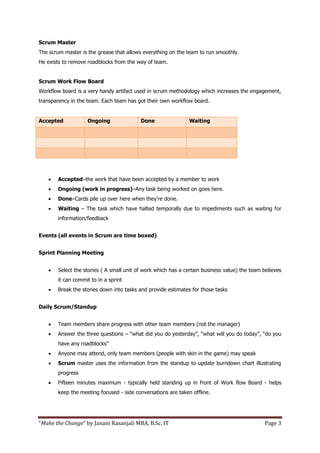
Workflow board is a very handy artifact used in scrum methodology which increases the engagement,
transparency in the team. Each team has got their own workflow board.


Accepted            Ongoing               Done                Waiting


      Accepted–the work that have been accepted by a member to work
      Ongoing (work in progress)–Any task being worked on goes here.
      Done–Cards pile up over here when they’re done.
      Waiting – The task which have halted temporally due to impediments such as waiting for
       information/feedback


Events (all events in Scrum are time boxed)


Sprint Planning Meeting


      Select the stories ( A small unit of work which has a certain business value) the team believes
       it can commit to in a sprint
      Break the stories down into tasks and provide estimates for those tasks


Daily Scrum/Standup


      Team members share progress with other team members (not the manager)
      Answer the three questions – “what did you do yesterday”, “what will you do today”, “do you
       have any roadblocks”
      Anyone may attend, only team members (people with skin in the game) may speak
      Scrum master uses the information from the standup to update burndown chart illustrating
       progress
      Fifteen minutes maximum - typically held standing up in front of Work flow Board - helps
       keep the meeting focused - side conversations are taken offline.


“Make the Change” by Janani Rasanjali MBA, B.Sc. IT                                           Page 3
Sprint Retrospective


       Team reviews what went well and what went poorly.
       Use retrospection techniques to find potential for improvement.
       Pick one or two areas to focus for improvement.


The Bottom-line


It is undeniable that the technology shapes the way we think and behave. From desktop to laptop to
tablet to iPod, technology is changing so rapidly. Organizations require to venturing plans to embrace
the changes proactively than making a stampede. Go Agile and make the change. Bring it on!


References


    •   http://www.hrreporter.com/blog/hr-policies-practices/archive/2012/04/24/what-is-agile-
        human-resources
    •   http://www.codeproject.com/Articles/17329/Scrum-in-a-Nutshell-or-5-Minutes-to-Learn-
        Scrum


“Make the Change” by Janani Rasanjali MBA, B.Sc. IT                                            Page 4

Agile HR management

  • 1.
    “Make the Change”~ Agile Human Resource Management. “Adaptability” & “Responsiveness” is a highly acclaimed characteristic in business world. Changing customer needs and mounting competition can only be won by managers who can lead their workers to respond the changers in an agile manner. But there are circumstances management and HR processes are too slow, they don't reflect business changes fast enough and they don’t give people fast-enough feedback and learning. There are some inherent problems when trying to manage a dynamic world with static processes.  Goals change continuously. How to prioritize with changing business conditions?  Feedback takes place continuously. Meeting a milestone or making a mistake needs to be addressed with feedback immediately. As it gets older it becomes less useful, and eventually becomes irrelevant.  Performance feedback comes from all directions. Today most workers are in highly distributed teams and likely to get 360 degree feedback. As workers get continuous feedback managers clear the room for continuous improvement  We cannot predict the future. Need to set goals with proactive plans to address changes  Long term Training needs could be obsolete. With the rapid evolution of technology it is quite hard to analyze long term training needs. Workers need to learn quickly and adapt. Incorporating an element of agility into the HR function allows it to be nimbler and helps create an organizational culture that’s more responsive to the needs of customers. An agile organization is one that’s able to change direction quickly and easily, and HR needs to be responsive to the ever- changing needs of such an organization. Agile Methodology The whole idea of agile HR likely originated as a result of the increasing popularity of agile software development, a methodology being used to develop and enhance computer applications through a continuing, iterative and collaborative process that seeks to make incremental changes on an ongoing basis. The four values of agile development are adaptability, transparency, simplicity and unity. How Agile fits in Management and HR:  Traditional annual performance appraisals replace with continuous feedback and recognition is an "agile" approach.  Traditional formal training and certification replaces with rapid e-learning and informal learning is an "agile" approach. “Make the Change” by Janani Rasanjali MBA, B.Sc. IT Page 1
  • 2.
     Top downcascading goals are a replace with approach - rapidly updated "objectives and key results".  Traditional annual rewards and bonuses are replaced with continuous recognition and social recognition systems are an "agile" model.  The annual employee engagement survey is replaced with continuous online idea factories and open blogs are an "agile" model for employee engagement.  The annual development planning process replaces with - an ongoing coaching relationship is an "agile" model for leadership.  The traditional recruiting process is replace with a continuous process of social recruiting and referral-based recruiting which can be rolled out in a few hours. Scrum Framework for Agile Methodology Scrum is a very handy tool, an agile framework that allows self-organizing teams to focus on delivering the highest business value in the shortest time. Using iterative development, it allows us to rapidly develop and repeatedly inspect working software every two to four weeks (a sprint or iteration). Scrum Teams are self-organizing, cross-functional team. They develop a deep form of camaraderie and a feeling that "we're all in this together. This increases team spirit & sense of responsibility. Scrum in a Nutshell Sprint A sprint is short fixed length development cycle (between 1-4 weeks) whose purpose is to deliver small chunk of useful output to the customer. At the end of every sprint the customer tests progress made. This provides room for customer to make changes of his requirements and also for the working team to address the changes in next sprint. Product Backlog A prioritized list of everything needed done to fulfill a specific endeavor Product Owner The product owner is the person understands the customer needs. Maintain and prioritize the product backlog. They’re ultimately responsible fulfillment of the endeavor undertaken “Make the Change” by Janani Rasanjali MBA, B.Sc. IT Page 2
  • 3.
    Scrum Master The scrummaster is the grease that allows everything on the team to run smoothly. He exists to remove roadblocks from the way of team. Scrum Work Flow Board Workflow board is a very handy artifact used in scrum methodology which increases the engagement, transparency in the team. Each team has got their own workflow board. Accepted Ongoing Done Waiting  Accepted–the work that have been accepted by a member to work  Ongoing (work in progress)–Any task being worked on goes here.  Done–Cards pile up over here when they’re done.  Waiting – The task which have halted temporally due to impediments such as waiting for information/feedback Events (all events in Scrum are time boxed) Sprint Planning Meeting  Select the stories ( A small unit of work which has a certain business value) the team believes it can commit to in a sprint  Break the stories down into tasks and provide estimates for those tasks Daily Scrum/Standup  Team members share progress with other team members (not the manager)  Answer the three questions – “what did you do yesterday”, “what will you do today”, “do you have any roadblocks”  Anyone may attend, only team members (people with skin in the game) may speak  Scrum master uses the information from the standup to update burndown chart illustrating progress  Fifteen minutes maximum - typically held standing up in front of Work flow Board - helps keep the meeting focused - side conversations are taken offline. “Make the Change” by Janani Rasanjali MBA, B.Sc. IT Page 3
  • 4.
    Sprint Retrospective  Team reviews what went well and what went poorly.  Use retrospection techniques to find potential for improvement.  Pick one or two areas to focus for improvement. The Bottom-line It is undeniable that the technology shapes the way we think and behave. From desktop to laptop to tablet to iPod, technology is changing so rapidly. Organizations require to venturing plans to embrace the changes proactively than making a stampede. Go Agile and make the change. Bring it on! References • http://www.hrreporter.com/blog/hr-policies-practices/archive/2012/04/24/what-is-agile- human-resources • http://www.codeproject.com/Articles/17329/Scrum-in-a-Nutshell-or-5-Minutes-to-Learn- Scrum “Make the Change” by Janani Rasanjali MBA, B.Sc. IT Page 4