ERA Shale Gas Joint Programme 
Technical seminar 
Modelling of fluid flow in shales 
Faculty of Drilling, Oil and Gas 
Department of Natural Gas Engineering 
Gdańsk, 8-9.10.2014 
wwwwww..aagghh..eedduu..ppll
shale gas = unconventional gas (why?) 
shale gas - natural gas that is trapped within fine-grained 
sedimentary rocks (called shale or mudstone), that can be source 
rocks for hydrocarbons 
„unconventional reservoirs” are those that cannot be produced 
at economic flow rates without massive stimulation treatments or 
special recovery processes and technologies 
the term „unconventional” reflects current level of techniques 
and technologies, the knowledge and experience applied to 
recover hydrocarbons from such type of reservoirs 
wwwwww..aagghh..eedduu..ppll
shale gas resources 
• important contribution to the U.S. „energy cocktail” 
• shale gas resources are of high interest; expected to be future 
source of hydrocarbons 
• economically efficient development achieved by 
intensive multi-stage hydraulic fracturing 
World shale gas in place ~690 Tcm 
Technically recoverable resources ~ 190 Tcm 
Conventional natural gas proved reserves ~210 Tcm 
According to Energy Information Agency (EIA, 2013) 
wwwwww..aagghh..eedduu..ppll
shale rock properties 
• variety of shale rock types => different types of shale gas 
reservoirs 
• four important characteristics : 
1. maturity of organic matter 
(vitrinite reflectance [%Ro]; > 1% Ro) 
2. type of gas generated and stored in the reservoir 
(thermogenic or biogenic) 
3. TOC content of the strata (min. 1.0 wt%) 
4. permeability of the reservoir 
(0.00001-0.001mD = 10-1000 nD) 
www.agh.edu.pl
modelling „problems” 
• complex porous system and 
interaction between its elements 
• multiple gas storage and 
transport mechanisms 
www.agh.edu.pl
4-porosity system 
• three different natural porous systems: 
1. gas-wet organic porosity 
2. water-wet (primarly) inorganic porosity 
3. system of natural fractures 
• one human-made pore system – hydraulicaly induced 
fractures 
www.agh.edu.pl
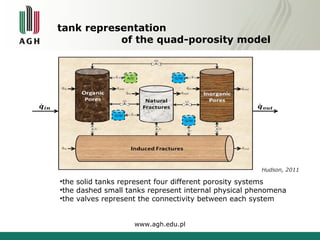
tank representation 
of the quad-porosity model 
www.agh.edu.pl 
Hudson, 2011 
•the solid tanks represent four different porosity systems 
•the dashed small tanks represent internal physical phenomena 
•the valves represent the connectivity between each system
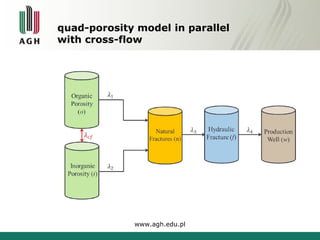
quad-porosity model in parallel 
with cross-flow 
www.agh.edu.pl
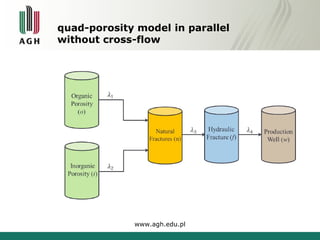
quad-porosity model in parallel 
without cross-flow 
www.agh.edu.pl
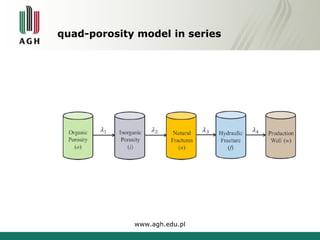
quad-porosity model in series 
www.agh.edu.pl
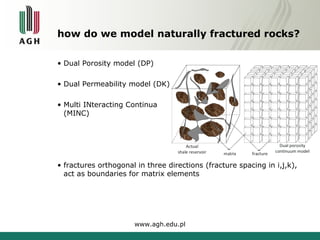
how do we model naturally fractured rocks? 
• Dual Porosity model (DP) 
• Dual Permeability model (DK) 
• Multi INteracting Continua 
(MINC) 
• fractures orthogonal in three directions (fracture spacing in i,j,k), 
act as boundaries for matrix elements 
www.agh.edu.pl
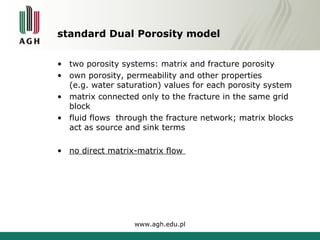
standard Dual Porosity model 
• two porosity systems: matrix and fracture porosity 
• own porosity, permeability and other properties 
(e.g. water saturation) values for each porosity system 
• matrix connected only to the fracture in the same grid 
block 
• fluid flows through the fracture network; matrix blocks 
act as source and sink terms 
• no direct matrix-matrix flow 
www.agh.edu.pl
Dual Permeability model 
• main difference – each matrix block is connected to both 
the fracture blocks and the surrounding matrix blocks 
• fluid flows both through the fracture network as well as 
through the matrix 
• where to use? 
– in cases where there is capillary continuity 
– when vertical (K direction) matrix-matrix mass 
transfer is important 
– matrix-matrix flow can be controlled (or even set to 
zero) by matrix transmissibility multipliers 
www.agh.edu.pl
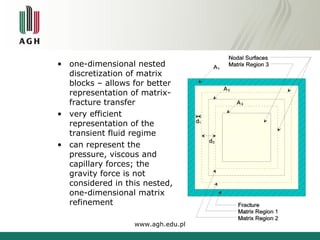
• one-dimensional nested 
discretization of matrix 
blocks – allows for better 
representation of matrix-fracture 
transfer 
• very efficient 
representation of the 
transient fluid regime 
• can represent the 
pressure, viscous and 
capillary forces; the 
gravity force is not 
considered in this nested, 
one-dimensional matrix 
refinement 
www.agh.edu.pl
DK vs MINC – what to choose? 
• DK – normally used when simulating naturally fractured 
reservoirs 
• MINC – accounts for transient flow from matrix to 
fracture; useful for low permeability systems where 
pressure drop between fracture and shale is very large 
www.agh.edu.pl
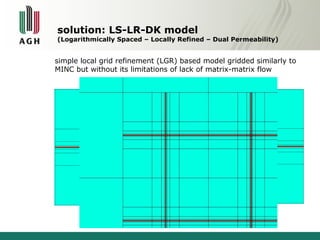
solution: LS-LR-DK model 
(Logarithmically Spaced – Locally Refined – Dual Permeability) 
simple local grid refinement (LGR) based model gridded similarly to 
MINC but without its limitations of lack of matrix-matrix flow 
MINC LS-LR-DK 
www.agh.edu.pl
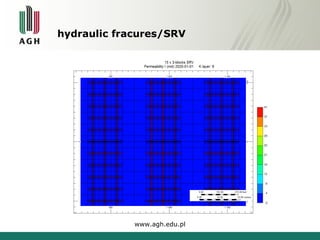
hydraulic fracures/SRV 
www.agh.edu.pl
shale rock modelling - coclusions 
• the standard Dual Perm model is unable to properly 
model very low permeable fractured shales 
• the MINC model is able to approximately reproduce the 
flow in very low permeability fractured shales, but 
cannot be used in higher permeability shale gas models 
• the LGR based logarithmically spaced dual permeability 
(LS-LR-DK) grid overcomes limitations of both DK and 
MINC grids 
• together with non-Darcy flow permeability based 
correction factor (Kcorr) non-Darcy flow effects can be 
accurately modelled in hydraulic fracture blocks as wide 
as 2 ft 
www.agh.edu.pl
gas storage mechanisms 
three types of gas storing mechanisms: 
1. free gas – gas stored in matrix pore volume (pores and 
natural fractures) 
2. adsorbed gas – gas adsorbed onto surface of the shale 
formation and solid organic material 
3. gas dissolved in organic material 
www.agh.edu.pl
adsorbed gas 
• amount of adsorbed gas varies between reservoirs - from 
15% up to 60% (even 85%), of gas initially in place 
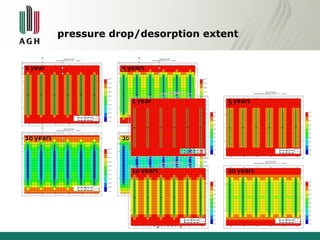
• sufficient pressure decrease necessary to liberate the 
adsorbed gas 
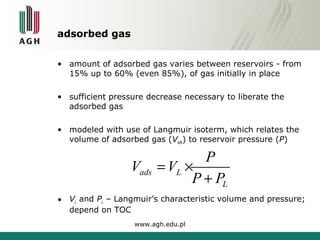
• modeled with use of Langmuir isoterm, which relates the 
volume of adsorbed gas (Vads) to reservoir pressure (P) 
= ´ 
ads L 
• VL and PL – Langmuir’s characteristic volume and pressure; 
depend on TOC 
www.agh.edu.pl 
L 
V V P 
P + 
P
pressure drop/desorption extent 
www.agh.edu.pl
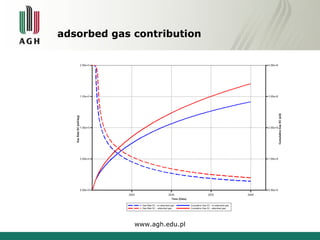
adsorbed gas contribution 
www.agh.edu.pl
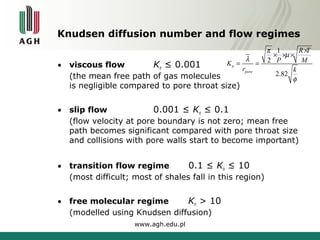
Knudsen diffusion number and flow regimes 
• viscous flow Kn ≤ 0.001 
(the mean free path of gas molecules 
is negligible compared to pore throat size) 
• slip flow 0.001 ≤ Kn ≤ 0.1 
p m l 
´ ´ ´ ´ 
(flow velocity at pore boundary is not zero; mean free 
path becomes significant compared with pore throat size 
and collisions with pore walls start to become important) 
• transition flow regime 0.1 ≤ Kn ≤ 10 
(most difficult; most of shales fall in this region) 
• free molecular regime Kn > 10 
(modelled using Knudsen diffusion) 
www.agh.edu.pl 
1 
2 
2.82 
n 
pore 
R T 
K P M 
r k 
f 
= =
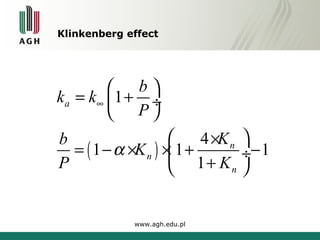
Klinkenberg effect 
= æ + ö çè ø¸ 
( ) 
www.agh.edu.pl 
1 
1 1 4 1 
1 
a 
n 
n 
n 
k k b 
P 
b a 
K K 
P K 
¥ 
æ ´ ö = - ´ ´ç + ¸- è + ø
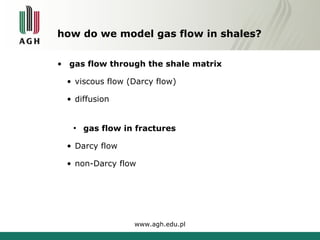
how do we model gas flow in shales? 
• gas flow through the shale matrix 
• viscous flow (Darcy flow) 
• diffusion 
▪ gas flow in fractures 
• Darcy flow 
• non-Darcy flow 
www.agh.edu.pl
Thank you! 
stanislaw.nagy@agh.edu.pl 
lukasz.klimkowski@agh.edu.pl 
www.agh.edu.pl
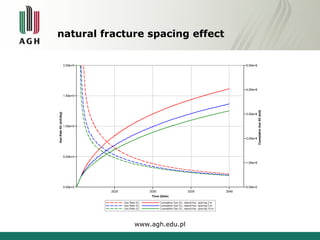
natural fracture spacing effect 
www.agh.edu.pl
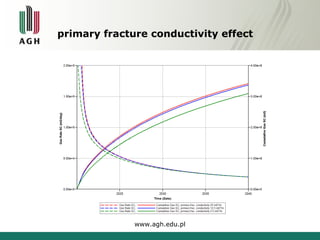
primary fracture conductivity effect 
www.agh.edu.pl
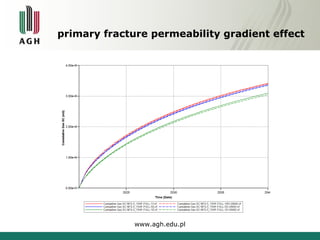
primary fracture permeability gradient effect 
www.agh.edu.pl
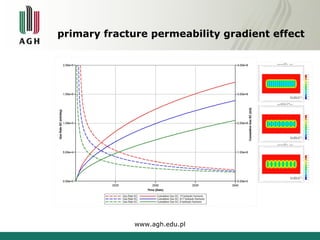
primary fracture permeability gradient effect 
www.agh.edu.pl
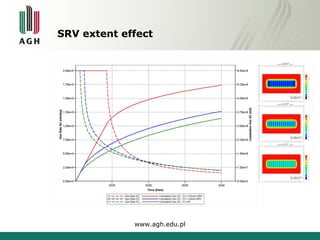
SRV extent effect 
www.agh.edu.pl

Agh eera 8-9.10.2014

  • 1.
    ERA Shale GasJoint Programme Technical seminar Modelling of fluid flow in shales Faculty of Drilling, Oil and Gas Department of Natural Gas Engineering Gdańsk, 8-9.10.2014 wwwwww..aagghh..eedduu..ppll
  • 2.
    shale gas =unconventional gas (why?) shale gas - natural gas that is trapped within fine-grained sedimentary rocks (called shale or mudstone), that can be source rocks for hydrocarbons „unconventional reservoirs” are those that cannot be produced at economic flow rates without massive stimulation treatments or special recovery processes and technologies the term „unconventional” reflects current level of techniques and technologies, the knowledge and experience applied to recover hydrocarbons from such type of reservoirs wwwwww..aagghh..eedduu..ppll
  • 3.
    shale gas resources • important contribution to the U.S. „energy cocktail” • shale gas resources are of high interest; expected to be future source of hydrocarbons • economically efficient development achieved by intensive multi-stage hydraulic fracturing World shale gas in place ~690 Tcm Technically recoverable resources ~ 190 Tcm Conventional natural gas proved reserves ~210 Tcm According to Energy Information Agency (EIA, 2013) wwwwww..aagghh..eedduu..ppll
  • 4.
    shale rock properties • variety of shale rock types => different types of shale gas reservoirs • four important characteristics : 1. maturity of organic matter (vitrinite reflectance [%Ro]; > 1% Ro) 2. type of gas generated and stored in the reservoir (thermogenic or biogenic) 3. TOC content of the strata (min. 1.0 wt%) 4. permeability of the reservoir (0.00001-0.001mD = 10-1000 nD) www.agh.edu.pl
  • 5.
    modelling „problems” •complex porous system and interaction between its elements • multiple gas storage and transport mechanisms www.agh.edu.pl
  • 6.
    4-porosity system •three different natural porous systems: 1. gas-wet organic porosity 2. water-wet (primarly) inorganic porosity 3. system of natural fractures • one human-made pore system – hydraulicaly induced fractures www.agh.edu.pl
  • 7.
    tank representation ofthe quad-porosity model www.agh.edu.pl Hudson, 2011 •the solid tanks represent four different porosity systems •the dashed small tanks represent internal physical phenomena •the valves represent the connectivity between each system
  • 8.
    quad-porosity model inparallel with cross-flow www.agh.edu.pl
  • 9.
    quad-porosity model inparallel without cross-flow www.agh.edu.pl
  • 10.
    quad-porosity model inseries www.agh.edu.pl
  • 11.
    how do wemodel naturally fractured rocks? • Dual Porosity model (DP) • Dual Permeability model (DK) • Multi INteracting Continua (MINC) • fractures orthogonal in three directions (fracture spacing in i,j,k), act as boundaries for matrix elements www.agh.edu.pl
  • 12.
    standard Dual Porositymodel • two porosity systems: matrix and fracture porosity • own porosity, permeability and other properties (e.g. water saturation) values for each porosity system • matrix connected only to the fracture in the same grid block • fluid flows through the fracture network; matrix blocks act as source and sink terms • no direct matrix-matrix flow www.agh.edu.pl
  • 13.
    Dual Permeability model • main difference – each matrix block is connected to both the fracture blocks and the surrounding matrix blocks • fluid flows both through the fracture network as well as through the matrix • where to use? – in cases where there is capillary continuity – when vertical (K direction) matrix-matrix mass transfer is important – matrix-matrix flow can be controlled (or even set to zero) by matrix transmissibility multipliers www.agh.edu.pl
  • 14.
    • one-dimensional nested discretization of matrix blocks – allows for better representation of matrix-fracture transfer • very efficient representation of the transient fluid regime • can represent the pressure, viscous and capillary forces; the gravity force is not considered in this nested, one-dimensional matrix refinement www.agh.edu.pl
  • 15.
    DK vs MINC– what to choose? • DK – normally used when simulating naturally fractured reservoirs • MINC – accounts for transient flow from matrix to fracture; useful for low permeability systems where pressure drop between fracture and shale is very large www.agh.edu.pl
  • 16.
    solution: LS-LR-DK model (Logarithmically Spaced – Locally Refined – Dual Permeability) simple local grid refinement (LGR) based model gridded similarly to MINC but without its limitations of lack of matrix-matrix flow MINC LS-LR-DK www.agh.edu.pl
  • 17.
  • 18.
    shale rock modelling- coclusions • the standard Dual Perm model is unable to properly model very low permeable fractured shales • the MINC model is able to approximately reproduce the flow in very low permeability fractured shales, but cannot be used in higher permeability shale gas models • the LGR based logarithmically spaced dual permeability (LS-LR-DK) grid overcomes limitations of both DK and MINC grids • together with non-Darcy flow permeability based correction factor (Kcorr) non-Darcy flow effects can be accurately modelled in hydraulic fracture blocks as wide as 2 ft www.agh.edu.pl
  • 19.
    gas storage mechanisms three types of gas storing mechanisms: 1. free gas – gas stored in matrix pore volume (pores and natural fractures) 2. adsorbed gas – gas adsorbed onto surface of the shale formation and solid organic material 3. gas dissolved in organic material www.agh.edu.pl
  • 20.
    adsorbed gas •amount of adsorbed gas varies between reservoirs - from 15% up to 60% (even 85%), of gas initially in place • sufficient pressure decrease necessary to liberate the adsorbed gas • modeled with use of Langmuir isoterm, which relates the volume of adsorbed gas (Vads) to reservoir pressure (P) = ´ ads L • VL and PL – Langmuir’s characteristic volume and pressure; depend on TOC www.agh.edu.pl L V V P P + P
  • 21.
  • 22.
  • 23.
    Knudsen diffusion numberand flow regimes • viscous flow Kn ≤ 0.001 (the mean free path of gas molecules is negligible compared to pore throat size) • slip flow 0.001 ≤ Kn ≤ 0.1 p m l ´ ´ ´ ´ (flow velocity at pore boundary is not zero; mean free path becomes significant compared with pore throat size and collisions with pore walls start to become important) • transition flow regime 0.1 ≤ Kn ≤ 10 (most difficult; most of shales fall in this region) • free molecular regime Kn > 10 (modelled using Knudsen diffusion) www.agh.edu.pl 1 2 2.82 n pore R T K P M r k f = =
  • 24.
    Klinkenberg effect =æ + ö çè ø¸ ( ) www.agh.edu.pl 1 1 1 4 1 1 a n n n k k b P b a K K P K ¥ æ ´ ö = - ´ ´ç + ¸- è + ø
  • 25.
    how do wemodel gas flow in shales? • gas flow through the shale matrix • viscous flow (Darcy flow) • diffusion ▪ gas flow in fractures • Darcy flow • non-Darcy flow www.agh.edu.pl
  • 26.
    Thank you! stanislaw.nagy@agh.edu.pl lukasz.klimkowski@agh.edu.pl www.agh.edu.pl
  • 27.
    natural fracture spacingeffect www.agh.edu.pl
  • 28.
    primary fracture conductivityeffect www.agh.edu.pl
  • 29.
    primary fracture permeabilitygradient effect www.agh.edu.pl
  • 30.
    primary fracture permeabilitygradient effect www.agh.edu.pl
  • 31.
    SRV extent effect www.agh.edu.pl