SOCIAL LANGUAGES
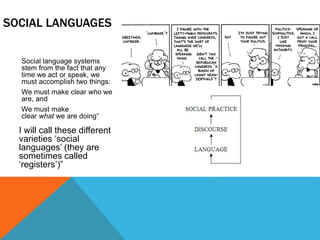
Social language systems
stem from the fact that any
time we act or speak, we
must accomplish two things:
We must make clear who we
are, and
We must make
clear what we are doing”
I will call these different
varieties ‘social
languages’ (they are
sometimes called
‘registers’)”
CONVERSATIONS
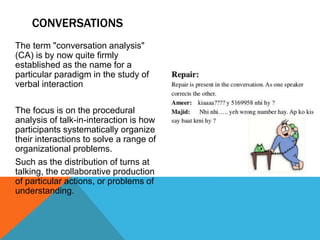
The term "conversation analysis"
(CA) is by now quite firmly
established as the name for a
particular paradigm in the study of
verbal interaction
The focus is on the procedural
analysis of talk-in-interaction is how
participants systematically organize
their interactions to solve a range of
organizational problems.
Such as the distribution of turns at
talking, the collaborative production
of particular actions, or problems of
understanding.
The notion of intertextuality offers a perspective of both
reading and writing texts as a way of looking at a text’s
interactions with prior texts, writers, readers, and
conventions.
“intertextuality is not just a matter of which other texts
you refer to, but how you use them, what you use them
for, and ultimately how you position yourself as a writer
to them to make your own statement” .
The study of intertextuality, for
Lemke, is “concerned with the
recurrent discourse and activity
patterns of the community and how
they are constituted by, instanced in,
and interconnected or disjoined
through, particular texts”

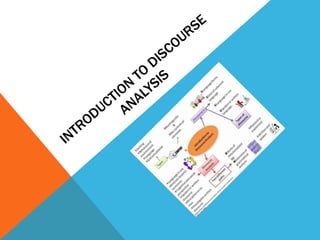
Introduction to discourse analysis

  • 2.
    SOCIAL LANGUAGES Social languagesystems stem from the fact that any time we act or speak, we must accomplish two things: We must make clear who we are, and We must make clear what we are doing” I will call these different varieties ‘social languages’ (they are sometimes called ‘registers’)”
  • 3.
    CONVERSATIONS The term "conversationanalysis" (CA) is by now quite firmly established as the name for a particular paradigm in the study of verbal interaction The focus is on the procedural analysis of talk-in-interaction is how participants systematically organize their interactions to solve a range of organizational problems. Such as the distribution of turns at talking, the collaborative production of particular actions, or problems of understanding.
  • 4.
    The notion ofintertextuality offers a perspective of both reading and writing texts as a way of looking at a text’s interactions with prior texts, writers, readers, and conventions. “intertextuality is not just a matter of which other texts you refer to, but how you use them, what you use them for, and ultimately how you position yourself as a writer to them to make your own statement” . The study of intertextuality, for Lemke, is “concerned with the recurrent discourse and activity patterns of the community and how they are constituted by, instanced in, and interconnected or disjoined through, particular texts”