Page 1
Dr Joanne Bennett
Community
composition
Community
composition
Land-use
change
Vegetation
loss and fragmentation
Vegetation
loss and fragmentation
Competitive
interactions
Competitive
interactions
Climate
change
Resource
Availability
Resource
Availability
Ecosystem services
(Pollination)
Ecosystem services
(Pollination)
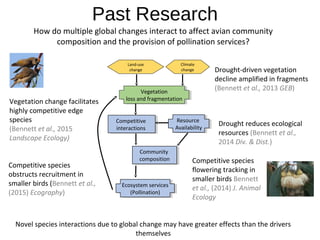
Past Research
How do multiple global changes interact to affect avian community
composition and the provision of pollination services?
Drought-driven vegetation
decline amplified in fragments
(Bennett et al., 2013 GEB)
Drought reduces ecological
resources (Bennett et al.,
2014 Div. & Dist.)
Vegetation change facilitates
highly competitive edge
species
(Bennett et al., 2015
Landscape Ecology)
Competitive species
flowering tracking in
smaller birds Bennett
et al., (2014) J. Animal
Ecology
Competitive species
obstructs recruitment in
smaller birds (Bennett et al.,
(2015) Ecography)
Novel species interactions due to global change may have greater effects than the drivers
themselves
Page 3
Synthesizing Worldwide
Ecology, Evolution and
Physiology
Joanne Bennett*, Adam Algar, Miguel Araújo, Piero Calosi, Susana Clusella-
Trullas, Bradford Hawkins, Sally Keith, Ingolf Kühn, Brezo Martínez, Carsten
Rahbek, Laura Rodríguez, Jennifer Sunday, Alexander Singer, Fabricio Villalobos,
Ignacio Morales-Castilla, Miguel Ángel Olalla-Tárraga
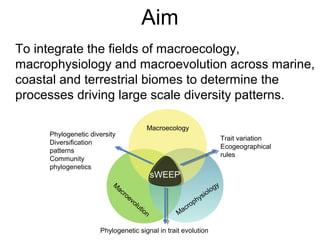
Aim
To integrate the fields of macroecology,
macrophysiology and macroevolution across marine,
coastal and terrestrial biomes to determine the
processes driving large scale diversity patterns.
sWEEP
M
acroevolution
Macroecology
Macrophysiology
Phylogenetic diversity
Diversification
patterns
Community
phylogenetics
Trait variation
Ecogeographical
rules
Phylogenetic signal in trait evolution
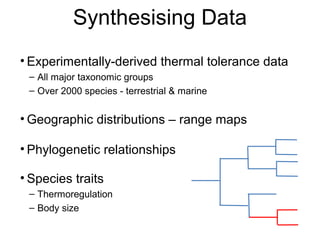
• Experimentally-derived thermal tolerance data
– All major taxonomic groups
– Over 2000 species - terrestrial & marine
• Geographic distributions – range maps
• Phylogenetic relationships
• Species traits
– Thermoregulation
– Body size
Synthesising Data
Objectives
1. What is the contribution of macrophysiology and
macroevolution to generating species diversity
gradients?
2. Are diversity patterns in coastal areas more influenced
by terrestrial or marine systems?
3. What is the level of mismatch between fundamental and
realized climatic niches?
4. Which taxa have realized niches that are closer to
their upper physiological tolerances?
5. Are fundamental climatic niches determined by the
prevailing climate when the clades originated?
• Species temperature tolerance is related to the
prevailing climate when their order originated
– Stronger for exothermic species
• Strong phylogenetic structure in species
temperature tolerance
Findings so fair
"Bali Barat mangroves" byRonfromNieuwegein/ SouthMoretonOxfordshire, Netherlands / UK - flickr: Taman Nasional Bali Barat (West Bali National Park). Licensedunder Creative Commons Attribution-ShareAlike2.0via WikimediaCommons -
http://commons.wikimedia.org/wiki/File:Bali_Barat_mangroves.jpg#mediaviewer/File:Bali_Barat_mangroves.jpg
Christian Fischer [CC-BY-SA-3.0 (http://creativecommons.org/licenses/by-sa/3.0)], via Wikimedia CommonsBy Stef Maruch (kelp-forest.jpg) [CC-BY-SA-2.0 (http://creativecommons.org/licenses/by-sa/2.0)], via Wikimedia Commons
Page 8
We kindly acknowledge the support
by the German Centre for Integrative
Biodiversity Research (iDiv)
Halle-Jena-Leipzig,
funded by the German Science Foundation
(FZT 118).

Postdoc bennett 2016

  • 1.
  • 2.
    Community composition Community composition Land-use change Vegetation loss and fragmentation Vegetation lossand fragmentation Competitive interactions Competitive interactions Climate change Resource Availability Resource Availability Ecosystem services (Pollination) Ecosystem services (Pollination) Past Research How do multiple global changes interact to affect avian community composition and the provision of pollination services? Drought-driven vegetation decline amplified in fragments (Bennett et al., 2013 GEB) Drought reduces ecological resources (Bennett et al., 2014 Div. & Dist.) Vegetation change facilitates highly competitive edge species (Bennett et al., 2015 Landscape Ecology) Competitive species flowering tracking in smaller birds Bennett et al., (2014) J. Animal Ecology Competitive species obstructs recruitment in smaller birds (Bennett et al., (2015) Ecography) Novel species interactions due to global change may have greater effects than the drivers themselves
  • 3.
    Page 3 Synthesizing Worldwide Ecology,Evolution and Physiology Joanne Bennett*, Adam Algar, Miguel Araújo, Piero Calosi, Susana Clusella- Trullas, Bradford Hawkins, Sally Keith, Ingolf Kühn, Brezo Martínez, Carsten Rahbek, Laura Rodríguez, Jennifer Sunday, Alexander Singer, Fabricio Villalobos, Ignacio Morales-Castilla, Miguel Ángel Olalla-Tárraga
  • 4.
    Aim To integrate thefields of macroecology, macrophysiology and macroevolution across marine, coastal and terrestrial biomes to determine the processes driving large scale diversity patterns. sWEEP M acroevolution Macroecology Macrophysiology Phylogenetic diversity Diversification patterns Community phylogenetics Trait variation Ecogeographical rules Phylogenetic signal in trait evolution
  • 5.
    • Experimentally-derived thermaltolerance data – All major taxonomic groups – Over 2000 species - terrestrial & marine • Geographic distributions – range maps • Phylogenetic relationships • Species traits – Thermoregulation – Body size Synthesising Data
  • 6.
    Objectives 1. What isthe contribution of macrophysiology and macroevolution to generating species diversity gradients? 2. Are diversity patterns in coastal areas more influenced by terrestrial or marine systems? 3. What is the level of mismatch between fundamental and realized climatic niches? 4. Which taxa have realized niches that are closer to their upper physiological tolerances? 5. Are fundamental climatic niches determined by the prevailing climate when the clades originated?
  • 7.
    • Species temperaturetolerance is related to the prevailing climate when their order originated – Stronger for exothermic species • Strong phylogenetic structure in species temperature tolerance Findings so fair "Bali Barat mangroves" byRonfromNieuwegein/ SouthMoretonOxfordshire, Netherlands / UK - flickr: Taman Nasional Bali Barat (West Bali National Park). Licensedunder Creative Commons Attribution-ShareAlike2.0via WikimediaCommons - http://commons.wikimedia.org/wiki/File:Bali_Barat_mangroves.jpg#mediaviewer/File:Bali_Barat_mangroves.jpg Christian Fischer [CC-BY-SA-3.0 (http://creativecommons.org/licenses/by-sa/3.0)], via Wikimedia CommonsBy Stef Maruch (kelp-forest.jpg) [CC-BY-SA-2.0 (http://creativecommons.org/licenses/by-sa/2.0)], via Wikimedia Commons
  • 8.
    Page 8 We kindlyacknowledge the support by the German Centre for Integrative Biodiversity Research (iDiv) Halle-Jena-Leipzig, funded by the German Science Foundation (FZT 118).

Editor's Notes

  • #2 After saying who you are…  What is your postdoc situation (past, present, finished, just starting) The project you are or were working on in the synthesis centre Whether you are working by yourself, or with a group Where you sit Explain the aims of sweep here
  • #4 After saying who you are…  What is your postdoc situation (past, present, finished, just starting) The project you are or were working on in the synthesis centre Whether you are working by yourself, or with a group Where you sit Explain the aims of sweep here
  • #6 Experimentally-derived thermal tolerance data for 1929 species in 39 classes, 190 orders and 496 families across terrestrial and marine realms (1623 and 306 species respectively) were obtained from the literature. Published experimental estimates of UTT and LTT limits included both lethal and critical (loss of a key ecological function i.e. photosynthesis, locomotion) thermal metrics. Realms classifications were taken from The IUCN Red List of Threatened Species version 3. To overcome many of the challenges associated with comparing among phylogenetic trees we took all estimates of clade age from Hedges et al. (2015) evolutionary time tree of life. Although there are errors in this tree, as with all trees by using only one source, errors should be consistent across the tree, so that meaningful comparisons can be made. Clades were grouped into four broadly defined paleoclimate categories following Romdal et al. (2013) (1) full glaciation, (2) partial glaciation, (3) warm, and (4) warmest to reduce errors associated with making clade ages to climate estimates in deep geological time. We assumed that the probability of a clade originating in a given historical climate niche will likely correlate with palaeoclimatic category (i.e. warm earth would probably indicate a tropical origin). This assumption will result in noise in the analysis which will likely be amplified in the mid temperature categories (i.e. species that originated on a warm earth will mostly have a tropical origin but not all), but given our large dataset, general patterns if present should still emerge.
  • #8 We have found strong phylogenetic structure in species temperature tolerance, however, whether this constitutes evidence for PNC is hotly debated. Some authors use the terms PNC and PS interchangeably (e.g. Swenson et al. 2007), which has led others to recommendations that the term PNC be abandoned (Pearman et al. 2008). Losos (2008) argued that phytogenic signal alone does not provide sufficient evidence for PNC, as the similarity between species must be ‘conserved’ so that a process is constraining divergence so that it is less than what would be expected under Brownian motion. Our results suggest that niche divergence is mainly constrained by phylogeny and comparatively weakly by time. This is intuitive as the genetic material a species has for selection to work on is determined by the parent taxa. Additional conserving mechanisms of species traits may in fact be other species traits, such as mobility, (i.e. more mobile species are more able to track climate and experience gene flow then less mobile taxa which will either have to adapt or go extinct) and generation time (i.e. species with short generation times are more adaptive), and these traits may themselves also have a phylogenetic signal. Wiens & Graham (2005) go further by referring to PNC as a driving process of diversity patterns including the LDG. We found that most lineages have retained affinities to their ancestral climate niche over evolutionary time. Which, lends support to the involvement of PNC in maintaining the LDG. Under this hypotheses current species distributions are determined by current climate conditions but the size of species pools in the earth’s latitudinal bioclimatic regions (i.e. tropical, temperate etc.) was determined by the historical climate regimes. However, our results are unable to disentangle PNC from other processes i.e. the diversification rate hypotheses, in part because many of the explanations for the LDG are not mutually exclusive. Furthermore, our findings do not support PNC is an active process, instead we can only confidently say that PNC is an evolutionary pattern visible on a phylogeny. We found strong ubiquitous PNC in species ancestral climate niches across realms in our global dataset. This result supports the validity of CNC as an assumption in SDMs, which, increases our confidence in their associated predictions of climate driven widespread species redistributions, extinctions, and associated ecosystem function loss. However, the extent to which behavioral adaptation, will allow species’ to tolerate greater temperature extremes than to which they are physiologically adapted is still unknown.