SONGHAI
Social Studies for 10th E.G.B.
Teacher: Mauricio Torres
AFTER MALI
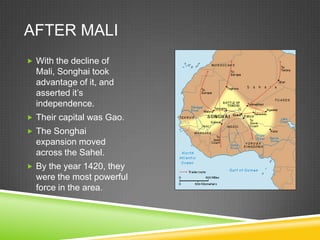
 With the decline of
  Mali, Songhai took
  advantage of it, and
  asserted it’s
  independence.
 Their capital was Gao.
 The Songhai
  expansion moved
  across the Sahel.
 By the year 1420, they
  were the most powerful
  force in the area.
SUNNI ALI
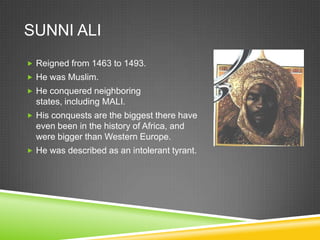
 Reigned from 1463 to 1493.
 He was Muslim.
 He conquered neighboring
  states, including MALI.
 His conquests are the biggest there have
  even been in the history of Africa, and
  were bigger than Western Europe.
 He was described as an intolerant tyrant.
ASKIA MUHAMMAD THE GREAT
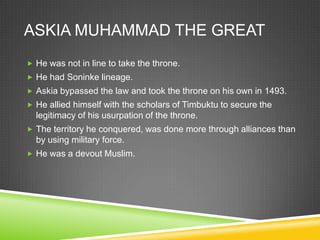
 He was not in line to take the throne.
 He had Soninke lineage.
 Askia bypassed the law and took the throne on his own in 1493.
 He allied himself with the scholars of Timbuktu to secure the
  legitimacy of his usurpation of the throne.
 The territory he conquered, was done more through alliances than
  by using military force.
 He was a devout Muslim.
ASKIA’S ACHIEVEMENTS
             Standardized measures and
              regulations.
             Policing of trade routes.
             Organized Tax System.
             Encouraged learning and literacy.
             The building of canals to improve
              agriculture.
TIMBUKTU
 Even though it was not
  the capital, it was a
  center for trade
    Arabs, Italians and Jews
      gathered here to trade.
 A revival of Islamic
  scholarship took place
  here.
ECONOMY
 Clans were the cell of the social structre.
    They decided what everyone’s function was. The most common were:
      metalworkers, fishermen and carpenters.
    The clans resembled modern day unions.
DECLINE: THE COWS TOPPLE AN
EMPIRE
              Succession disputes weakened the
               empire.
              Finally, the Sultan of Morocco invaded
               from the north, in a desperate
               measure to gain riches fast.
                 At a battle, the fire of guns and cannons,
                   provoked an stampede that routed the
                   whole Sonhgai army.
              The Arabs couldn’t hold the Empire
               together, and it began to fragment into
               smaller kingdoms.
ASK YOURSELF
 How are the kingdoms of the rulers of Songhai alike with Mansa
  Musa’s?


 What led to the decline of Songhai?


 Why was Timbuktu given such an importance?


 Is there a pattern in the rise and fall of West-African Empires?
ASSIGNMENT
 Make a table comparing the three empires from Western Africa
  that we have studied.
 Use the following fields:
    How it rose to power.
    Source of strength of each empire.
    Most important leader of each.
    Greatest achievements (at least 2).
    Important facts, of any kind (at least two).

 Make a first draft, and bring a clean and final version next class.
 In a paragraph, draw a conclusion, how alike or different where
  they?
BIBLIOGRAPHY
 Ellis, E. G., & Esler, A. (2009). World History. (P. Hall, Ed.) Upper
  Saddle River, New Jersey, US: Pearson Education INC.
 Wikipedia. (n.d.). Songhai Empire. Retrieved May 14, 2012, from
  Wikipedia: http://en.wikipedia.org/wiki/Songhai_Empire
 Wikipedia. (n.d.). Askia Mohammad I. Retrieved May 14, 2012,
  from Wikipedia: http://en.wikipedia.org/wiki/Askia_the_Great
 Images taken from Google.

Songhai

  • 1.
    SONGHAI Social Studies for10th E.G.B. Teacher: Mauricio Torres
  • 2.
    AFTER MALI  Withthe decline of Mali, Songhai took advantage of it, and asserted it’s independence.  Their capital was Gao.  The Songhai expansion moved across the Sahel.  By the year 1420, they were the most powerful force in the area.
  • 3.
    SUNNI ALI  Reignedfrom 1463 to 1493.  He was Muslim.  He conquered neighboring states, including MALI.  His conquests are the biggest there have even been in the history of Africa, and were bigger than Western Europe.  He was described as an intolerant tyrant.
  • 4.
    ASKIA MUHAMMAD THEGREAT  He was not in line to take the throne.  He had Soninke lineage.  Askia bypassed the law and took the throne on his own in 1493.  He allied himself with the scholars of Timbuktu to secure the legitimacy of his usurpation of the throne.  The territory he conquered, was done more through alliances than by using military force.  He was a devout Muslim.
  • 5.
    ASKIA’S ACHIEVEMENTS  Standardized measures and regulations.  Policing of trade routes.  Organized Tax System.  Encouraged learning and literacy.  The building of canals to improve agriculture.
  • 6.
    TIMBUKTU  Even thoughit was not the capital, it was a center for trade  Arabs, Italians and Jews gathered here to trade.  A revival of Islamic scholarship took place here.
  • 7.
    ECONOMY  Clans werethe cell of the social structre.  They decided what everyone’s function was. The most common were: metalworkers, fishermen and carpenters.  The clans resembled modern day unions.
  • 8.
    DECLINE: THE COWSTOPPLE AN EMPIRE  Succession disputes weakened the empire.  Finally, the Sultan of Morocco invaded from the north, in a desperate measure to gain riches fast.  At a battle, the fire of guns and cannons, provoked an stampede that routed the whole Sonhgai army.  The Arabs couldn’t hold the Empire together, and it began to fragment into smaller kingdoms.
  • 9.
    ASK YOURSELF  Howare the kingdoms of the rulers of Songhai alike with Mansa Musa’s?  What led to the decline of Songhai?  Why was Timbuktu given such an importance?  Is there a pattern in the rise and fall of West-African Empires?
  • 10.
    ASSIGNMENT  Make atable comparing the three empires from Western Africa that we have studied.  Use the following fields:  How it rose to power.  Source of strength of each empire.  Most important leader of each.  Greatest achievements (at least 2).  Important facts, of any kind (at least two).  Make a first draft, and bring a clean and final version next class.  In a paragraph, draw a conclusion, how alike or different where they?
  • 11.
    BIBLIOGRAPHY  Ellis, E.G., & Esler, A. (2009). World History. (P. Hall, Ed.) Upper Saddle River, New Jersey, US: Pearson Education INC.  Wikipedia. (n.d.). Songhai Empire. Retrieved May 14, 2012, from Wikipedia: http://en.wikipedia.org/wiki/Songhai_Empire  Wikipedia. (n.d.). Askia Mohammad I. Retrieved May 14, 2012, from Wikipedia: http://en.wikipedia.org/wiki/Askia_the_Great  Images taken from Google.