African Ethnic Groups

Arab, Ashanti, Bantu & Swahili
Arabs

• Mostly found in Southwest Asia
  and NORTHERN Africa
• Speak Arabic
• Usually practice Islam
Guns are a common sight on the streets of Cairo, both toy and real varieties.
          These kids look up from playing to smile at the camera.
                    (Gold Island, Egypt, October 2006)
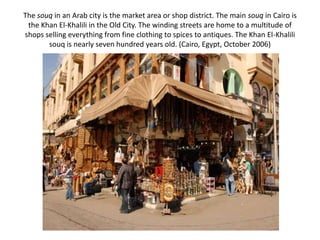
The souq in an Arab city is the market area or shop district. The main souq in Cairo is
 the Khan El-Khalili in the Old City. The winding streets are home to a multitude of
shops selling everything from fine clothing to spices to antiques. The Khan El-Khalili
       souq is nearly seven hundred years old. (Cairo, Egypt, October 2006)
Ashanti

• Large ethnic group found off the west coast of
  Africa in Ghana
• Speak mostly Twi as their main language
• Live with extended family members
• The Ashanti religion is a mixture of spiritual
  and supernatural powers. They believe that
  plants, animals, and trees have souls.
• They have many tribal ceremonies
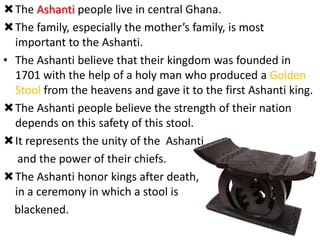
The Ashanti people live in central Ghana.
The family, especially the mother’s family, is most
  important to the Ashanti.
• The Ashanti believe that their kingdom was founded in
  1701 with the help of a holy man who produced a Golden
  Stool from the heavens and gave it to the first Ashanti king.
The Ashanti people believe the strength of their nation
  depends on this safety of this stool.
It represents the unity of the Ashanti
   and the power of their chiefs.
The Ashanti honor kings after death,
  in a ceremony in which a stool is
  blackened.
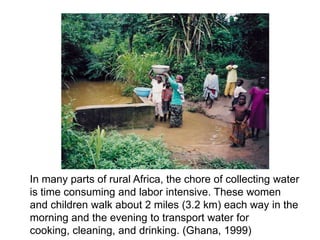
In many parts of rural Africa, the chore of collecting water
is time consuming and labor intensive. These women
and children walk about 2 miles (3.2 km) each way in the
morning and the evening to transport water for
cooking, cleaning, and drinking. (Ghana, 1999)
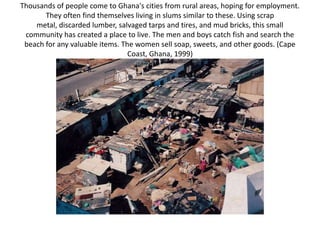
Thousands of people come to Ghana's cities from rural areas, hoping for employment.
       They often find themselves living in slums similar to these. Using scrap
    metal, discarded lumber, salvaged tarps and tires, and mud bricks, this small
 community has created a place to live. The men and boys catch fish and search the
 beach for any valuable items. The women sell soap, sweets, and other goods. (Cape
                                 Coast, Ghana, 1999)
Bantu
• Mostly found in Central & Southern Africa
• They speak Bantu as their main language
• Bantu is usually known more as a language
  than an ethnic group
• Bantu is a mixture of over 400 different ethnic
  groups combined
Today, close to 100 million people across the southern half of Africa speak related
languages, collectively known as Bantu languages. Linguistic evidence shows that the
root Bantu language emerged in what is now Nigeria and Cameroon by 2000 BC. By
1000 BC, in a series of migrations, Bantu speakers had spread south to the savanna
lands of Angola and east to the Lake Victoria region. Over the next 1500 years they
scattered throughout central and southern Africa, interacting with and absorbing
indigenous populations as they                                   spread.
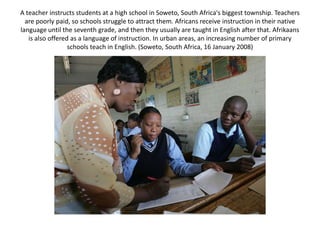
A teacher instructs students at a high school in Soweto, South Africa's biggest township. Teachers
  are poorly paid, so schools struggle to attract them. Africans receive instruction in their native
language until the seventh grade, and then they usually are taught in English after that. Afrikaans
   is also offered as a language of instruction. In urban areas, an increasing number of primary
                  schools teach in English. (Soweto, South Africa, 16 January 2008)
Swahili

• Mostly found in East Africa (especially in
  Kenya)
• The language they speak is Swahili
     -This is a mixture of Arabic &
       Traditional African Languages

• Most Swahili people are strict Muslims
• The Swahili community developed along the coast of East
   Africa when Arab and Persian traders looking for profitable
   markets began to settle there and intermarry with the local
   Bantu-speaking population.
• While the Swahili language is considered a Bantu language,
   there are many Arabic words and phrases included as well.
• The word Swahili comes from the
• Arabic word “Swahili,” which
means “one who lives on the coast.”
• Many are engaged in fishing and
  trade, as their ancestors were.
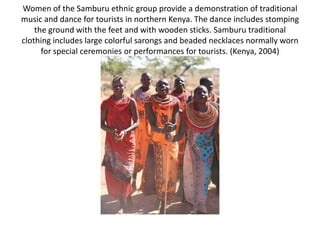
Women of the Samburu ethnic group provide a demonstration of traditional
music and dance for tourists in northern Kenya. The dance includes stomping
    the ground with the feet and with wooden sticks. Samburu traditional
clothing includes large colorful sarongs and beaded necklaces normally worn
      for special ceremonies or performances for tourists. (Kenya, 2004)
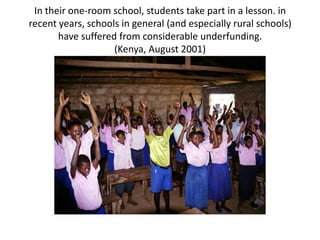
In their one-room school, students take part in a lesson. in
recent years, schools in general (and especially rural schools)
       have suffered from considerable underfunding.
                    (Kenya, August 2001)

African ethnic groups 2010ppt

  • 1.
    African Ethnic Groups Arab,Ashanti, Bantu & Swahili
  • 2.
    Arabs • Mostly foundin Southwest Asia and NORTHERN Africa • Speak Arabic • Usually practice Islam
  • 3.
    Guns are acommon sight on the streets of Cairo, both toy and real varieties. These kids look up from playing to smile at the camera. (Gold Island, Egypt, October 2006)
  • 4.
    The souq inan Arab city is the market area or shop district. The main souq in Cairo is the Khan El-Khalili in the Old City. The winding streets are home to a multitude of shops selling everything from fine clothing to spices to antiques. The Khan El-Khalili souq is nearly seven hundred years old. (Cairo, Egypt, October 2006)
  • 5.
    Ashanti • Large ethnicgroup found off the west coast of Africa in Ghana • Speak mostly Twi as their main language • Live with extended family members • The Ashanti religion is a mixture of spiritual and supernatural powers. They believe that plants, animals, and trees have souls. • They have many tribal ceremonies
  • 6.
    The Ashanti peoplelive in central Ghana. The family, especially the mother’s family, is most important to the Ashanti. • The Ashanti believe that their kingdom was founded in 1701 with the help of a holy man who produced a Golden Stool from the heavens and gave it to the first Ashanti king. The Ashanti people believe the strength of their nation depends on this safety of this stool. It represents the unity of the Ashanti and the power of their chiefs. The Ashanti honor kings after death, in a ceremony in which a stool is blackened.
  • 7.
    In many partsof rural Africa, the chore of collecting water is time consuming and labor intensive. These women and children walk about 2 miles (3.2 km) each way in the morning and the evening to transport water for cooking, cleaning, and drinking. (Ghana, 1999)
  • 8.
    Thousands of peoplecome to Ghana's cities from rural areas, hoping for employment. They often find themselves living in slums similar to these. Using scrap metal, discarded lumber, salvaged tarps and tires, and mud bricks, this small community has created a place to live. The men and boys catch fish and search the beach for any valuable items. The women sell soap, sweets, and other goods. (Cape Coast, Ghana, 1999)
  • 9.
    Bantu • Mostly foundin Central & Southern Africa • They speak Bantu as their main language • Bantu is usually known more as a language than an ethnic group • Bantu is a mixture of over 400 different ethnic groups combined
  • 10.
    Today, close to100 million people across the southern half of Africa speak related languages, collectively known as Bantu languages. Linguistic evidence shows that the root Bantu language emerged in what is now Nigeria and Cameroon by 2000 BC. By 1000 BC, in a series of migrations, Bantu speakers had spread south to the savanna lands of Angola and east to the Lake Victoria region. Over the next 1500 years they scattered throughout central and southern Africa, interacting with and absorbing indigenous populations as they spread.
  • 11.
    A teacher instructsstudents at a high school in Soweto, South Africa's biggest township. Teachers are poorly paid, so schools struggle to attract them. Africans receive instruction in their native language until the seventh grade, and then they usually are taught in English after that. Afrikaans is also offered as a language of instruction. In urban areas, an increasing number of primary schools teach in English. (Soweto, South Africa, 16 January 2008)
  • 12.
    Swahili • Mostly foundin East Africa (especially in Kenya) • The language they speak is Swahili -This is a mixture of Arabic & Traditional African Languages • Most Swahili people are strict Muslims
  • 13.
    • The Swahilicommunity developed along the coast of East Africa when Arab and Persian traders looking for profitable markets began to settle there and intermarry with the local Bantu-speaking population. • While the Swahili language is considered a Bantu language, there are many Arabic words and phrases included as well. • The word Swahili comes from the • Arabic word “Swahili,” which means “one who lives on the coast.” • Many are engaged in fishing and trade, as their ancestors were.
  • 14.
    Women of theSamburu ethnic group provide a demonstration of traditional music and dance for tourists in northern Kenya. The dance includes stomping the ground with the feet and with wooden sticks. Samburu traditional clothing includes large colorful sarongs and beaded necklaces normally worn for special ceremonies or performances for tourists. (Kenya, 2004)
  • 15.
    In their one-roomschool, students take part in a lesson. in recent years, schools in general (and especially rural schools) have suffered from considerable underfunding. (Kenya, August 2001)