INTRODUCTION
TO AFRICAN HISTORY,
CULTURES, TRADITIONS
AND BELIEFS
Endozo, Cloewie
Fernandez, Allyana Faye
Torralba, Alissa
IT4
AFRICA
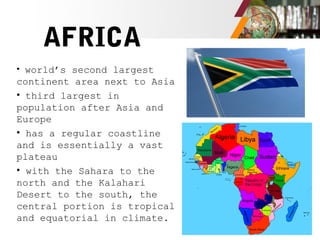
• world’s second largest
continent area next to Asia
• third largest in
population after Asia and
Europe
• has a regular coastline
and is essentially a vast
plateau
• with the Sahara to the
north and the Kalahari
Desert to the south, the
central portion is tropical
and equatorial in climate.
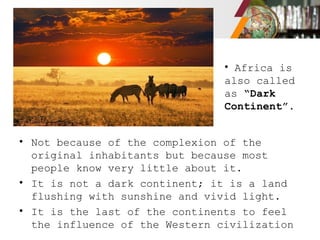
• Not because of the complexion of the
original inhabitants but because most
people know very little about it.
• It is not a dark continent; it is a land
flushing with sunshine and vivid light.
• It is the last of the continents to feel
the influence of the Western civilization
• Africa is
also called
as “Dark
Continent”.
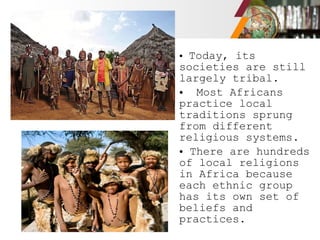
• Today, its
societies are still
largely tribal.
• Most Africans
practice local
traditions sprung
from different
religious systems.
• There are hundreds
of local religions
in Africa because
each ethnic group
has its own set of
beliefs and
practices.
• The geography of Africa is so varied
and extremely diverse.
• Most local arts is closely associated
with religion.
• primitive in nature and is associated
with superstition and spiritual
motifs
• decorative motifs are used to honors
the animal and plant life of religion
• It is the best place in the world
where wild animals can still be seen
migrating across the plains, rivers,
swamps and on the savanna.
FAMOUS PEOPLE
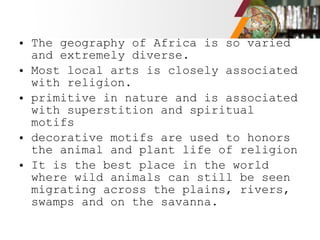
Nelson Mandela
• After released from jail for twenty-
seven years he became the first
democratically elected president of South
Africa.
• Founded the military wing of the
African National Congress which was
involved in sabotaging government
installations.
• He demonstrated courage, patience and
determination to free his nation from the
shackles of apartheid.
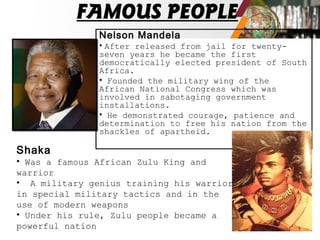
Shaka
• Was a famous African Zulu King and
warrior
• A military genius training his warriors
in special military tactics and in the
use of modern weapons
• Under his rule, Zulu people became a
powerful nation
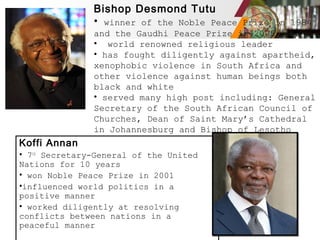
Bishop Desmond Tutu
• winner of the Noble Peace Prize in 1984
and the Gaudhi Peace Prize in 2005
• world renowned religious leader
• has fought diligently against apartheid,
xenophobic violence in South Africa and
other violence against human beings both
black and white
• served many high post including: General
Secretary of the South African Council of
Churches, Dean of Saint Mary’s Cathedral
in Johannesburg and Bishop of Lesotho
Koffi Annan
• 7th
Secretary-General of the United
Nations for 10 years
• won Noble Peace Prize in 2001
•influenced world politics in a
positive manner
• worked diligently at resolving
conflicts between nations in a
peaceful manner
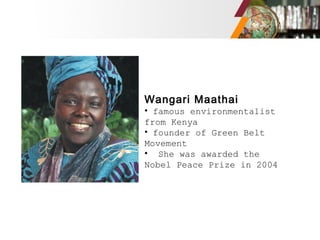
Wangari Maathai
• famous environmentalist
from Kenya
• founder of Green Belt
Movement
• She was awarded the
Nobel Peace Prize in 2004
HISTORICAL PLACES
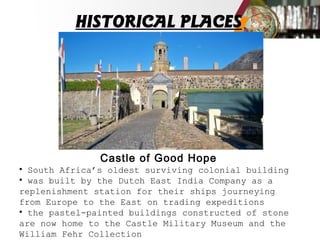
Castle of Good Hope
• South Africa’s oldest surviving colonial building
• was built by the Dutch East India Company as a
replenishment station for their ships journeying
from Europe to the East on trading expeditions
• the pastel-painted buildings constructed of stone
are now home to the Castle Military Museum and the
William Fehr Collection
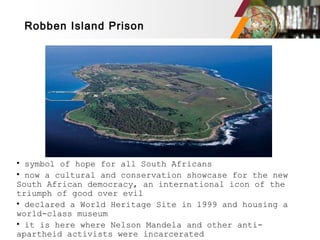
Robben Island Prison
• symbol of hope for all South Africans
• now a cultural and conservation showcase for the new
South African democracy, an international icon of the
triumph of good over evil
• declared a World Heritage Site in 1999 and housing a
world-class museum
• it is here where Nelson Mandela and other anti-
apartheid activists were incarcerated
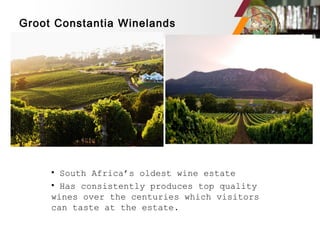
Groot Constantia Winelands
• South Africa’s oldest wine estate
• Has consistently produces top quality
wines over the centuries which visitors
can taste at the estate.
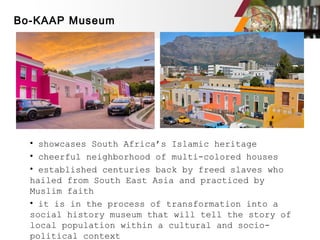
Bo-KAAP Museum
• showcases South Africa’s Islamic heritage
• cheerful neighborhood of multi-colored houses
• established centuries back by freed slaves who
hailed from South East Asia and practiced by
Muslim faith
• it is in the process of transformation into a
social history museum that will tell the story of
local population within a cultural and socio-
political context
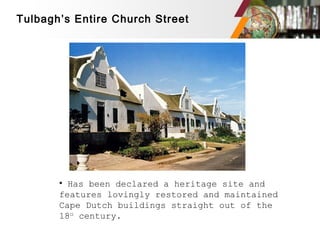
Tulbagh’s Entire Church Street
• Has been declared a heritage site and
features lovingly restored and maintained
Cape Dutch buildings straight out of the
18th
century.
SIGNIFICANT EVENTS
The Dutch Cape Colony
• First European
settlement in South
Africa established by the
Dutch in 1652 for the
purpose of resupplying
ships as they sailed
around the southern tip
of Africa
• It created a racially
segregated society
dependent on African
labor
• Dutch settlers regarded
the land as theirs and
Africans as foreigner
The British Cape Colony and
the Great Trek
• Great Britain captured the
Cape Colony from the Dutch
in 1806 and began to impose
English law on the
Afrikaners.
• In 1833, the British
government abolished slavery
altogether.
• Many Afrikaners attempted
to escape British colonial
control by travelling to the
interior of the country to
preserve their 17th
century
Dutch culture.
• The Afrikaner migration
became known as the Great
The African Wars
•The Great Trek brought Afrikaners into conflict with
African kingdoms
•The Battle of Blood River symbolized their position
•For the Zulus and other Africans, the battle was one of
many attempts to stop white intrusion onto African land
•Similar African wars continued, until the conquest of
almost all Africans were complete in the late 1800’s.
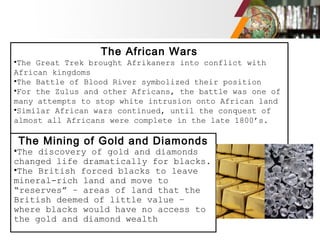
The Mining of Gold and Diamonds
•The discovery of gold and diamonds
changed life dramatically for blacks.
•The British forced blacks to leave
mineral-rich land and move to
“reserves” – areas of land that the
British deemed of little value –
where blacks would have no access to
the gold and diamond wealth
The Union of South Africa
• The British granted independence to South Africa
in 1910
• South African whites enacted laws to transform
black land reserves into pools for cheap,
unskilled labor for white farmers and
industrialists.
• In 1948, Daniel Malan’s National Party won the
South African election
• It immediately began the policy of apartheid
(apartness), a system that legalized Afrikaner’s
strict control over blacks
• The National Party planned to make Afrikaner the
legal culture of South Africa by phasing out
English language
CULTURE
• The culture of Africa encompasses and
includes all cultures within the
continent of Africa.
• There is a political or racial split
between North Africa, and Sub-Saharan
Africa, which in turn was divided into a
great number of ethnic cultures.
• African cultures are diverse and varied
and not static
• Historically, Africa is home to
innumerable tribes, ethnic and social
groups
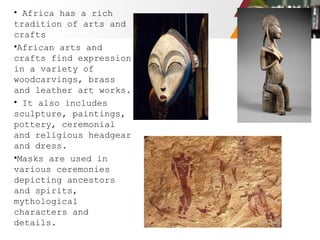
• Africa has a rich
tradition of arts and
crafts
•African arts and
crafts find expression
in a variety of
woodcarvings, brass
and leather art works.
• It also includes
sculpture, paintings,
pottery, ceremonial
and religious headgear
and dress.
•Masks are used in
various ceremonies
depicting ancestors
and spirits,
mythological
characters and
details.
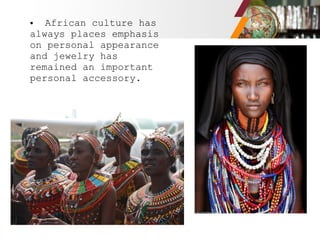
• African culture has
always places emphasis
on personal appearance
and jewelry has
remained an important
personal accessory.
LITERATURE
• African literature refers to oral and written
literary pieces produced on the African
continent
• Oral literature of Africa may be in prose or
poetry
• Storytellers often tell stories using the call-
and-response technique
• Poetry is often sung or recited in a sing-song
voice
• Africa’s written literature is in European
languages
• Traditional languages became vehicles of
cultural thoughts
• African literature is also the home of literary
masters
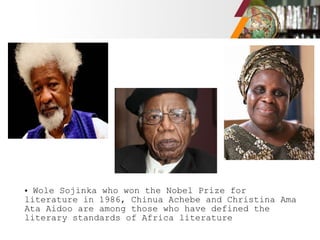
• Wole Sojinka who won the Nobel Prize for
literature in 1986, Chinua Achebe and Christina Ama
Ata Aidoo are among those who have defined the
literary standards of Africa literature
TRADITIONS
Clothes/Clothing
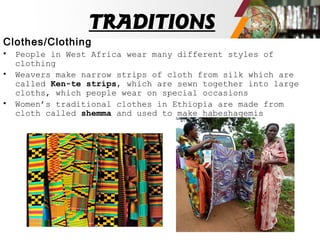
• People in West Africa wear many different styles of
clothing
• Weavers make narrow strips of cloth from silk which are
called Ken-te strips, which are sewn together into large
cloths, which people wear on special occasions
• Women’s traditional clothes in Ethiopia are made from
cloth called shemma and used to make habeshaqemis
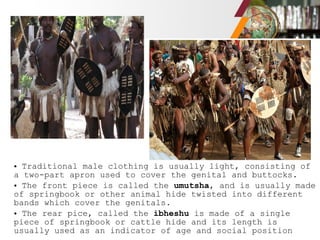
• Traditional male clothing is usually light, consisting of
a two-part apron used to cover the genital and buttocks.
• The front piece is called the umutsha, and is usually made
of springbook or other animal hide twisted into different
bands which cover the genitals.
• The rear pice, called the ibheshu is made of a single
piece of springbook or cattle hide and its length is
usually used as an indicator of age and social position
Music and Dance
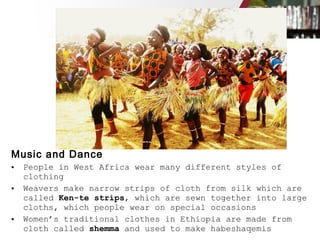
• People in West Africa wear many different styles of
clothing
• Weavers make narrow strips of cloth from silk which are
called Ken-te strips, which are sewn together into large
cloths, which people wear on special occasions
• Women’s traditional clothes in Ethiopia are made from
cloth called shemma and used to make habeshaqemis
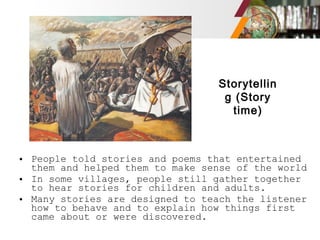
• People told stories and poems that entertained
them and helped them to make sense of the world
• In some villages, people still gather together
to hear stories for children and adults.
• Many stories are designed to teach the listener
how to behave and to explain how things first
came about or were discovered.
Storytellin
g (Story
time)
Cuisine/Food
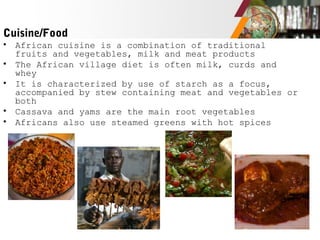
• African cuisine is a combination of traditional
fruits and vegetables, milk and meat products
• The African village diet is often milk, curds and
whey
• It is characterized by use of starch as a focus,
accompanied by stew containing meat and vegetables or
both
• Cassava and yams are the main root vegetables
• Africans also use steamed greens with hot spices
• Lobola
• This is one traditional custom in Africa where the groom pays the
father of the bride in order to compensate for the loss of the
man’s daughter
• Traditionally, lobola was paid in cattle, a valued commodity in
may African cultures but today modern couples pay it in cash
• Lobola is intended to bring together two families, fostering
mutual respect
• It indicates that the groom is financially capable of supporting
his wife
Wedding Rites
• Wedding is held at night when the moon is full
• It is considered bad luck if the wedding takes place when the moon
is not bright
• the wedding celebrations can last several days but the bride’s
parents do not attend because it is too sad or them and the event
is intended to be a joyous one
• a man can have many wishes as he can afford and the wives share
the responsibilities for the daily chores such as babysitting,
pounding corn, preparing the meals and washing clothes
• The practice of polygamy brings families together and deepens the
interest of the welfare in others
• The protection of the family is the core value in most African
tribes
Customs
The Rite Passage/Circumcision
• The rite passage is a controversial African custom
that varies from tribe to tribe
• Circumcision, which is usually performed on males, is
in some cultures, performed on females as well
• The ritual is usually spread over a period of several
months
• The one being circumcised is forbidden from screaming
or crying because doing so is considered a cowardly
behavior
• This kind of custom has often caused mutilation and
even death
LITERARY JOURNEY
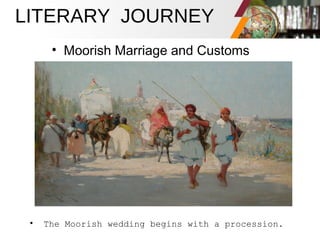
• Moorish Marriage and Customs
• The Moorish wedding begins with a procession.
• The bride and groom have never
seen each other.
• When the bride arrives at the
house, there is nobody except a
female Negro servant who lifts
her out of the box because her
feet must not touch the ground.
• The groom himself is not at
home; she waits until he
arrives.
• When he comes in, the two eat
together alone while the
members of the family wait
outside, shrieking out loud
music.
• This is the bride’s one and
only meal with her husband
because afterward she will eat
only with the women.
• The arrangement is mainly financial.
• The engagement must last for months.
• During this period, the girl is
deliberately fattened up because to
the Moroccans, plumpness is
fashionable.
• A Moslem can have only a maximum of
four legal wives and he must treat
them equally and their children
equally too.
• To the Moslem moors, there is
no courtship before marriage.
• All is arranged by the fathers.
• Usually the father of the groom
looks around to size up
available young ladies from 13
to 15 years old.

AFRICA

  • 1.
    INTRODUCTION TO AFRICAN HISTORY, CULTURES,TRADITIONS AND BELIEFS Endozo, Cloewie Fernandez, Allyana Faye Torralba, Alissa IT4
  • 2.
    AFRICA • world’s secondlargest continent area next to Asia • third largest in population after Asia and Europe • has a regular coastline and is essentially a vast plateau • with the Sahara to the north and the Kalahari Desert to the south, the central portion is tropical and equatorial in climate.
  • 3.
    • Not becauseof the complexion of the original inhabitants but because most people know very little about it. • It is not a dark continent; it is a land flushing with sunshine and vivid light. • It is the last of the continents to feel the influence of the Western civilization • Africa is also called as “Dark Continent”.
  • 4.
    • Today, its societiesare still largely tribal. • Most Africans practice local traditions sprung from different religious systems. • There are hundreds of local religions in Africa because each ethnic group has its own set of beliefs and practices.
  • 5.
    • The geographyof Africa is so varied and extremely diverse. • Most local arts is closely associated with religion. • primitive in nature and is associated with superstition and spiritual motifs • decorative motifs are used to honors the animal and plant life of religion • It is the best place in the world where wild animals can still be seen migrating across the plains, rivers, swamps and on the savanna.
  • 6.
    FAMOUS PEOPLE Nelson Mandela •After released from jail for twenty- seven years he became the first democratically elected president of South Africa. • Founded the military wing of the African National Congress which was involved in sabotaging government installations. • He demonstrated courage, patience and determination to free his nation from the shackles of apartheid. Shaka • Was a famous African Zulu King and warrior • A military genius training his warriors in special military tactics and in the use of modern weapons • Under his rule, Zulu people became a powerful nation
  • 7.
    Bishop Desmond Tutu •winner of the Noble Peace Prize in 1984 and the Gaudhi Peace Prize in 2005 • world renowned religious leader • has fought diligently against apartheid, xenophobic violence in South Africa and other violence against human beings both black and white • served many high post including: General Secretary of the South African Council of Churches, Dean of Saint Mary’s Cathedral in Johannesburg and Bishop of Lesotho Koffi Annan • 7th Secretary-General of the United Nations for 10 years • won Noble Peace Prize in 2001 •influenced world politics in a positive manner • worked diligently at resolving conflicts between nations in a peaceful manner
  • 8.
    Wangari Maathai • famousenvironmentalist from Kenya • founder of Green Belt Movement • She was awarded the Nobel Peace Prize in 2004
  • 9.
    HISTORICAL PLACES Castle ofGood Hope • South Africa’s oldest surviving colonial building • was built by the Dutch East India Company as a replenishment station for their ships journeying from Europe to the East on trading expeditions • the pastel-painted buildings constructed of stone are now home to the Castle Military Museum and the William Fehr Collection
  • 10.
    Robben Island Prison •symbol of hope for all South Africans • now a cultural and conservation showcase for the new South African democracy, an international icon of the triumph of good over evil • declared a World Heritage Site in 1999 and housing a world-class museum • it is here where Nelson Mandela and other anti- apartheid activists were incarcerated
  • 11.
    Groot Constantia Winelands •South Africa’s oldest wine estate • Has consistently produces top quality wines over the centuries which visitors can taste at the estate.
  • 12.
    Bo-KAAP Museum • showcasesSouth Africa’s Islamic heritage • cheerful neighborhood of multi-colored houses • established centuries back by freed slaves who hailed from South East Asia and practiced by Muslim faith • it is in the process of transformation into a social history museum that will tell the story of local population within a cultural and socio- political context
  • 13.
    Tulbagh’s Entire ChurchStreet • Has been declared a heritage site and features lovingly restored and maintained Cape Dutch buildings straight out of the 18th century.
  • 14.
    SIGNIFICANT EVENTS The DutchCape Colony • First European settlement in South Africa established by the Dutch in 1652 for the purpose of resupplying ships as they sailed around the southern tip of Africa • It created a racially segregated society dependent on African labor • Dutch settlers regarded the land as theirs and Africans as foreigner The British Cape Colony and the Great Trek • Great Britain captured the Cape Colony from the Dutch in 1806 and began to impose English law on the Afrikaners. • In 1833, the British government abolished slavery altogether. • Many Afrikaners attempted to escape British colonial control by travelling to the interior of the country to preserve their 17th century Dutch culture. • The Afrikaner migration became known as the Great
  • 15.
    The African Wars •TheGreat Trek brought Afrikaners into conflict with African kingdoms •The Battle of Blood River symbolized their position •For the Zulus and other Africans, the battle was one of many attempts to stop white intrusion onto African land •Similar African wars continued, until the conquest of almost all Africans were complete in the late 1800’s. The Mining of Gold and Diamonds •The discovery of gold and diamonds changed life dramatically for blacks. •The British forced blacks to leave mineral-rich land and move to “reserves” – areas of land that the British deemed of little value – where blacks would have no access to the gold and diamond wealth
  • 16.
    The Union ofSouth Africa • The British granted independence to South Africa in 1910 • South African whites enacted laws to transform black land reserves into pools for cheap, unskilled labor for white farmers and industrialists. • In 1948, Daniel Malan’s National Party won the South African election • It immediately began the policy of apartheid (apartness), a system that legalized Afrikaner’s strict control over blacks • The National Party planned to make Afrikaner the legal culture of South Africa by phasing out English language
  • 17.
    CULTURE • The cultureof Africa encompasses and includes all cultures within the continent of Africa. • There is a political or racial split between North Africa, and Sub-Saharan Africa, which in turn was divided into a great number of ethnic cultures. • African cultures are diverse and varied and not static • Historically, Africa is home to innumerable tribes, ethnic and social groups
  • 18.
    • Africa hasa rich tradition of arts and crafts •African arts and crafts find expression in a variety of woodcarvings, brass and leather art works. • It also includes sculpture, paintings, pottery, ceremonial and religious headgear and dress. •Masks are used in various ceremonies depicting ancestors and spirits, mythological characters and details.
  • 19.
    • African culturehas always places emphasis on personal appearance and jewelry has remained an important personal accessory.
  • 20.
    LITERATURE • African literaturerefers to oral and written literary pieces produced on the African continent • Oral literature of Africa may be in prose or poetry • Storytellers often tell stories using the call- and-response technique • Poetry is often sung or recited in a sing-song voice • Africa’s written literature is in European languages • Traditional languages became vehicles of cultural thoughts • African literature is also the home of literary masters
  • 21.
    • Wole Sojinkawho won the Nobel Prize for literature in 1986, Chinua Achebe and Christina Ama Ata Aidoo are among those who have defined the literary standards of Africa literature
  • 22.
    TRADITIONS Clothes/Clothing • People inWest Africa wear many different styles of clothing • Weavers make narrow strips of cloth from silk which are called Ken-te strips, which are sewn together into large cloths, which people wear on special occasions • Women’s traditional clothes in Ethiopia are made from cloth called shemma and used to make habeshaqemis
  • 23.
    • Traditional maleclothing is usually light, consisting of a two-part apron used to cover the genital and buttocks. • The front piece is called the umutsha, and is usually made of springbook or other animal hide twisted into different bands which cover the genitals. • The rear pice, called the ibheshu is made of a single piece of springbook or cattle hide and its length is usually used as an indicator of age and social position
  • 24.
    Music and Dance •People in West Africa wear many different styles of clothing • Weavers make narrow strips of cloth from silk which are called Ken-te strips, which are sewn together into large cloths, which people wear on special occasions • Women’s traditional clothes in Ethiopia are made from cloth called shemma and used to make habeshaqemis
  • 25.
    • People toldstories and poems that entertained them and helped them to make sense of the world • In some villages, people still gather together to hear stories for children and adults. • Many stories are designed to teach the listener how to behave and to explain how things first came about or were discovered. Storytellin g (Story time)
  • 26.
    Cuisine/Food • African cuisineis a combination of traditional fruits and vegetables, milk and meat products • The African village diet is often milk, curds and whey • It is characterized by use of starch as a focus, accompanied by stew containing meat and vegetables or both • Cassava and yams are the main root vegetables • Africans also use steamed greens with hot spices
  • 27.
    • Lobola • Thisis one traditional custom in Africa where the groom pays the father of the bride in order to compensate for the loss of the man’s daughter • Traditionally, lobola was paid in cattle, a valued commodity in may African cultures but today modern couples pay it in cash • Lobola is intended to bring together two families, fostering mutual respect • It indicates that the groom is financially capable of supporting his wife Wedding Rites • Wedding is held at night when the moon is full • It is considered bad luck if the wedding takes place when the moon is not bright • the wedding celebrations can last several days but the bride’s parents do not attend because it is too sad or them and the event is intended to be a joyous one • a man can have many wishes as he can afford and the wives share the responsibilities for the daily chores such as babysitting, pounding corn, preparing the meals and washing clothes • The practice of polygamy brings families together and deepens the interest of the welfare in others • The protection of the family is the core value in most African tribes Customs
  • 28.
    The Rite Passage/Circumcision •The rite passage is a controversial African custom that varies from tribe to tribe • Circumcision, which is usually performed on males, is in some cultures, performed on females as well • The ritual is usually spread over a period of several months • The one being circumcised is forbidden from screaming or crying because doing so is considered a cowardly behavior • This kind of custom has often caused mutilation and even death
  • 29.
    LITERARY JOURNEY • MoorishMarriage and Customs • The Moorish wedding begins with a procession.
  • 30.
    • The brideand groom have never seen each other. • When the bride arrives at the house, there is nobody except a female Negro servant who lifts her out of the box because her feet must not touch the ground. • The groom himself is not at home; she waits until he arrives.
  • 31.
    • When hecomes in, the two eat together alone while the members of the family wait outside, shrieking out loud music. • This is the bride’s one and only meal with her husband because afterward she will eat only with the women.
  • 32.
    • The arrangementis mainly financial. • The engagement must last for months. • During this period, the girl is deliberately fattened up because to the Moroccans, plumpness is fashionable. • A Moslem can have only a maximum of four legal wives and he must treat them equally and their children equally too.
  • 33.
    • To theMoslem moors, there is no courtship before marriage. • All is arranged by the fathers. • Usually the father of the groom looks around to size up available young ladies from 13 to 15 years old.