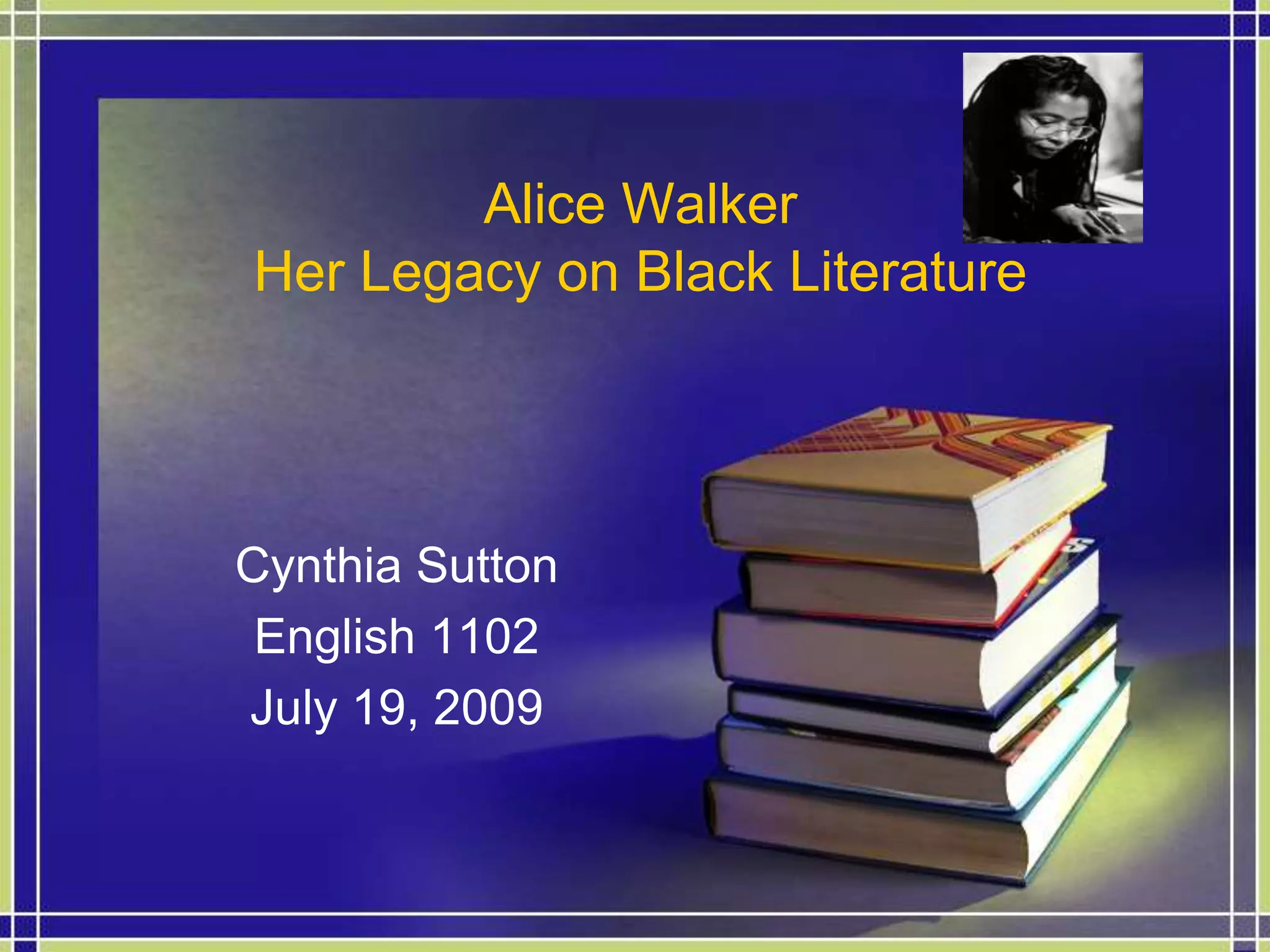
Alice WalkerHer Legacy on Black LiteratureCynthia SuttonEnglish 1102July 19, 2009
Alice Walker’s BackgroundBorn in Eatonton, Georgia 1944Parents were poor sharecroppersBB gun accident in 1952 left her blind in one eyeAccident left her to live a life of seclusionBegan writing poetry at the age of 8Coined the phrase “Womanist” for women of colorFirst black woman to win Pulitzer Prize for The Color Purple
Some of Walker’s Novels and Short Stories	The Third Life of Grange Copeland  Everyday UseIn Love and TroubleMeridianThe Color PurpleAm I Blue?The Temple of my FamiliarPossessing the Secret of Joy
Quotes about Walker“One of the things that most upsets Walker is the manner  in which black people skipped over their parents, grandparents, and great grandparents in the great rush to return to African values and traditions.” (Korenman)“There’s nothing quite like a Pulitzer Prize to draw attention to a little known writer.  Walker is one of the few black writers of the mid-60’s to remain steadily productive for the two ensuing decades, the enormous success of The Color Purple has generated critical interest in a literary career that has been, even if not widely noted, at the very least worthy of note.”  (Petry)
Quotes cont’d“The strength of Walker’s writing derives from the author’s inexorable recognition of her place in history; the sensitivity of her work, from her profound sense of community; its beauty, from her commitment to the future.”   (Willis)“Her technique was flawless—her plots inexorable, her images perfect, her control unwavering.  She writes with sadness and defiance of the price she had paid for loving a white man.”  (Bradley)“Walker defines her response to the South in a richly ambivalent way.  She emphasizes that Southern black writers have enormous richness and beauty to draw from.”  (Butler)
Her SuccessWalker took all of her experiences as a poor black child in a volatile discriminatory southern town and developed an outlet for her voice.She portrays many of her characters based on her own life.She stands for equality of not only races but gender.Her writing has helped bring the civil-rights movement into the forefront of society.Walker was encouraged by whites to remain uneducated.  She was valedictorian and later graduated from Sarah Lawrence College.
Summary		Alice Walker’s work has influenced the literary world by her ability to turn life experiences into celebrating the accomplishments of strong black women.  She focusing most of her works on the racist and sexist struggles of black women.  Walker characters are typically black women who eventually turn their rage on the men in the story.  I enjoy her writing and believe that she has uplifted many women who have encountered some of the same struggles in life.
Honors and RecognitionPulitzer Prize for The Color Purple“Humanist of the Year” American Humanist Assoc.California Hall of FameO. Henry Award for “Kindred Spirits”Rosenthal Award
Works CitedPetry, Alice Hall. "Alice Walker: The Achievement of the Short Fiction." Modern Language Studies. 19.1 	(Winter 1989): 12-27. Rpt. in Contemporary Literary Criticism. Ed. 	Deborah A. Schmitt. Vol. 103. Detroit: 	Gale Research, 1998. 12-27. Literature Resources from Gale. Gale. TROY UNIV. 25 June  2009 	<http://go.galegroup.com/ps/start.do?p=LitRG&u=troy25957>.Korenman, Joan S.  “African-American Women Writers, Black Nationalism, and the Matrilineal Heritage.” CLA Journal. 	38.2 (Dec. 1994): 143-161. Rpt. inShort Story Criticism. Ed.  Jelena O. Krstovic. Vol. 97. Detroit: 	Gale, 2007. 143-161. Literature Resources from Gale. Gale. TROY UNIV. 4 June 2009 	<http://go.galegroup.com/ps/start/do?p=LitRG&u=troy25957>.Willis, Susan. "Alice Walker's Women." Specifying: Black Women Writing the American Experience. The University 	of Wisconsin Press, 1987. 110-128. Rpt. inContemporary Literary Criticism. Ed. Deborah A. Schmitt. 	Vol. 103. Detroit: Gale Research, 1998. 110-128. Literature Resources from Gale. Gale. TROY 	UNIV. 16 July 2009   <http://go.galegroup.com/ps/start.do?p=LitRG&u=troy25957>.Bradley, David. "Novelist Alice Walker Telling the Black Woman's Story." The New York Times Magazine. 25-37. Rpt. inContemporary Literary Criticism. Ed. Deborah A. Schmitt. Vol. 103. Detroit: Gale 	Research,1998. 25-37. Literature Resources from Gale.   Gale. TROY UNIV. 16 July 2009 	<http://go.galegroup.com/ps/start.do?p=LitRG&u=troy25957>.Butler, Robert James. "Alice Walker's Vision of the South in The Third Life of Grange  Copeland," in African American Review, Vol. 27, No. 2, Summer, 1993, pp. 192-204. Reproduced by permission. Reproduced in Contemporary Literary Criticism-Select. 	TROY UNIV. 16 July 2009http://infotrac.galegroup.com.libproxy.troy.edu

Alice Walker

  • 1.
    Alice WalkerHer Legacyon Black LiteratureCynthia SuttonEnglish 1102July 19, 2009
  • 2.
    Alice Walker’s BackgroundBornin Eatonton, Georgia 1944Parents were poor sharecroppersBB gun accident in 1952 left her blind in one eyeAccident left her to live a life of seclusionBegan writing poetry at the age of 8Coined the phrase “Womanist” for women of colorFirst black woman to win Pulitzer Prize for The Color Purple
  • 3.
    Some of Walker’sNovels and Short Stories The Third Life of Grange Copeland Everyday UseIn Love and TroubleMeridianThe Color PurpleAm I Blue?The Temple of my FamiliarPossessing the Secret of Joy
  • 4.
    Quotes about Walker“Oneof the things that most upsets Walker is the manner in which black people skipped over their parents, grandparents, and great grandparents in the great rush to return to African values and traditions.” (Korenman)“There’s nothing quite like a Pulitzer Prize to draw attention to a little known writer. Walker is one of the few black writers of the mid-60’s to remain steadily productive for the two ensuing decades, the enormous success of The Color Purple has generated critical interest in a literary career that has been, even if not widely noted, at the very least worthy of note.” (Petry)
  • 5.
    Quotes cont’d“The strengthof Walker’s writing derives from the author’s inexorable recognition of her place in history; the sensitivity of her work, from her profound sense of community; its beauty, from her commitment to the future.” (Willis)“Her technique was flawless—her plots inexorable, her images perfect, her control unwavering. She writes with sadness and defiance of the price she had paid for loving a white man.” (Bradley)“Walker defines her response to the South in a richly ambivalent way. She emphasizes that Southern black writers have enormous richness and beauty to draw from.” (Butler)
  • 6.
    Her SuccessWalker tookall of her experiences as a poor black child in a volatile discriminatory southern town and developed an outlet for her voice.She portrays many of her characters based on her own life.She stands for equality of not only races but gender.Her writing has helped bring the civil-rights movement into the forefront of society.Walker was encouraged by whites to remain uneducated. She was valedictorian and later graduated from Sarah Lawrence College.
  • 7.
    Summary Alice Walker’s workhas influenced the literary world by her ability to turn life experiences into celebrating the accomplishments of strong black women. She focusing most of her works on the racist and sexist struggles of black women. Walker characters are typically black women who eventually turn their rage on the men in the story. I enjoy her writing and believe that she has uplifted many women who have encountered some of the same struggles in life.
  • 8.
    Honors and RecognitionPulitzerPrize for The Color Purple“Humanist of the Year” American Humanist Assoc.California Hall of FameO. Henry Award for “Kindred Spirits”Rosenthal Award
  • 9.
    Works CitedPetry, AliceHall. "Alice Walker: The Achievement of the Short Fiction." Modern Language Studies. 19.1 (Winter 1989): 12-27. Rpt. in Contemporary Literary Criticism. Ed. Deborah A. Schmitt. Vol. 103. Detroit: Gale Research, 1998. 12-27. Literature Resources from Gale. Gale. TROY UNIV. 25 June 2009 <http://go.galegroup.com/ps/start.do?p=LitRG&u=troy25957>.Korenman, Joan S. “African-American Women Writers, Black Nationalism, and the Matrilineal Heritage.” CLA Journal. 38.2 (Dec. 1994): 143-161. Rpt. inShort Story Criticism. Ed. Jelena O. Krstovic. Vol. 97. Detroit: Gale, 2007. 143-161. Literature Resources from Gale. Gale. TROY UNIV. 4 June 2009 <http://go.galegroup.com/ps/start/do?p=LitRG&u=troy25957>.Willis, Susan. "Alice Walker's Women." Specifying: Black Women Writing the American Experience. The University of Wisconsin Press, 1987. 110-128. Rpt. inContemporary Literary Criticism. Ed. Deborah A. Schmitt. Vol. 103. Detroit: Gale Research, 1998. 110-128. Literature Resources from Gale. Gale. TROY UNIV. 16 July 2009 <http://go.galegroup.com/ps/start.do?p=LitRG&u=troy25957>.Bradley, David. "Novelist Alice Walker Telling the Black Woman's Story." The New York Times Magazine. 25-37. Rpt. inContemporary Literary Criticism. Ed. Deborah A. Schmitt. Vol. 103. Detroit: Gale Research,1998. 25-37. Literature Resources from Gale. Gale. TROY UNIV. 16 July 2009 <http://go.galegroup.com/ps/start.do?p=LitRG&u=troy25957>.Butler, Robert James. "Alice Walker's Vision of the South in The Third Life of Grange Copeland," in African American Review, Vol. 27, No. 2, Summer, 1993, pp. 192-204. Reproduced by permission. Reproduced in Contemporary Literary Criticism-Select. TROY UNIV. 16 July 2009http://infotrac.galegroup.com.libproxy.troy.edu