AFL-CIO New Media Academy How To Get Started Integrating Social Media Into Your Online Communications Strategy May 13, 2010 Danielle Hatchett Social Media Manager, AFL-CIO [email_address] Facebook:  www.facebook.com/aflcio Twitter: www.twitter.com/aflcio
Social Media: Growing Fast 3 out of 4 Americans use social technology 1 in 3 online Americans post to social networks at least once a week Users spend at  least  5hrs and 30 min per month on average on social networking sites 99% of social media users believe organizations should have a presence in social media 37% of internet users aged 18-29 use blogs or social networking sites as a venue for political or civic involvement compared to: 17% of online 30-49 year olds  12% of 50-64 year olds 10% of internet users over 65
Social Media: Growing Fast Provides additional platforms to spread your message; reach a new audience Plug your cause, raise awareness about an issue, spread the word, and update your network Allows opportunity for instant feedback from your constituents; tap into word of mouth. Connect with influentials (i.e. bloggers, policymakers, press, advocacy organizers and people with large networks) Provides organizing opportunities (IBEW and Comcast Workers)
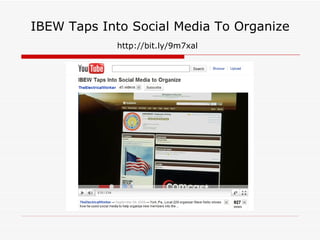
IBEW Taps Into Social Media To Organize http://bit.ly/9m7xal
Developing A Social Media Strategy Do some research and find out where your existing audience is Spend some time listening to the conversation Create a campaign around the launch of new social media platforms Produce engaging content
Questions We Asked (or wish we had asked!) Before Getting Started Who will manage the site? Who can post items to the site? What kinds of items are appropriate for the site? Are we prepared to let go of control of our brand just a little? How does engaging users via social media integrate with our overall communications/marketing strategy? How will we measure success or failure? (views, number of followers/subscribers, comments)
AFL-CIO Social Media Tools Blog :  http://www.blog.aflcio.org Facebook :  http://www.facebook.com/aflcio Twitter :  http://www.twitter.com/aflcio YouTube :  http://www.youtube.com/user/aflcionow Flickr :  http://www.flickr.com/photos/labor2008 Ustream/Livestream:  (live broadcasts)-  http://www.ustream.tv/user/aflcionow
Getting Started With Twitter
What is Twitter? Social networking and micro blogging service that allows you to answer the question, “What are you doing?” Combination of various forms of communication like e-mail, instant messenger, blogs, and RSS feeds. Difference is that posts, or tweets, are  restricted to 140 characters or less.
What Is Twitter? Evolved from simply answering the question, “What are you doing?” into  Shared links to interesting content on the web Conversations around hot topics Shared photos, videos, music  Real time accounts from people who are in midst of a newsworthy event (like a convention or conference), crisis or natural disaster
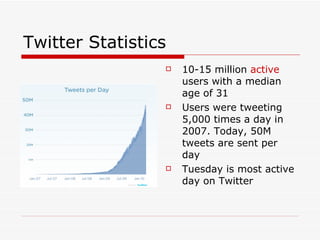
Twitter Statistics 10-15 million  active  users with a median age of 31 Users were tweeting 5,000 times a day in 2007. Today, 50M tweets are sent per day Tuesday is most active day on Twitter
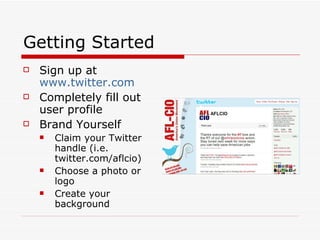
Getting Started Sign up at  www.twitter.com Completely fill out user profile Brand Yourself Claim your Twitter handle (i.e. twitter.com/aflcio) Choose a photo or logo Create your background
What do I tweet about? Share news or events from your union (rallies, conferences, meetings, trainings – anything you promote via traditional means. Difference is you only have 140 characters) Automatically share your blog posts ( www.twitterfeed.com ) Links to relevant news stories around the web (www.bitly.com)
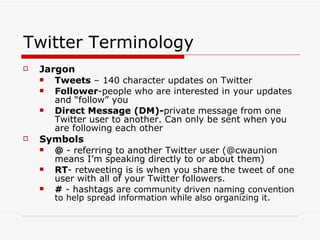
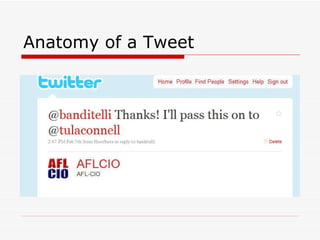
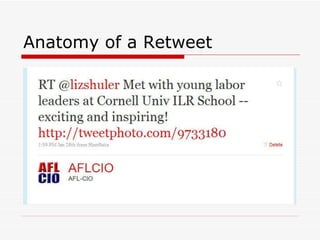
Twitter Terminology Jargon Tweets  – 140 character updates on Twitter Follower -people who are interested in your updates and “follow” you Direct Message (DM)- private message from one Twitter user to another. Can only be sent when you are following each other Symbols @  - referring to another Twitter user (@cwaunion means I’m speaking directly to or about them) RT - retweeting is is when you share the tweet of one user with all of your Twitter followers.  #  - hashtags are  community driven naming convention to help spread information while also organizing it.
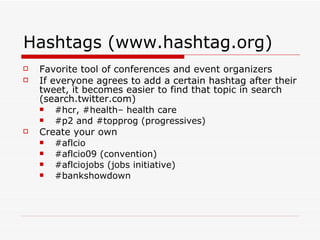
Hashtags (www.hashtag.org) Favorite tool of conferences and event organizers If everyone agrees to add a certain hashtag after their tweet, it becomes easier to find that topic in search (search.twitter.com) #hcr, #health– health care #p2 and #topprog (progressives) Create your own #aflcio #aflcio09 (convention) #aflciojobs (jobs initiative) #bankshowdown
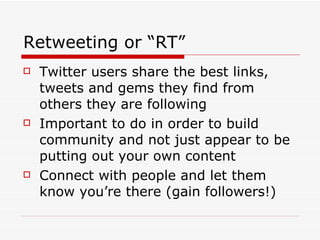
Retweeting or “RT” Twitter users share the best links, tweets and gems they find from others they are following Important to do in order to build community and not just appear to be putting out your own content Connect with people and let them know you’re there (gain followers!)
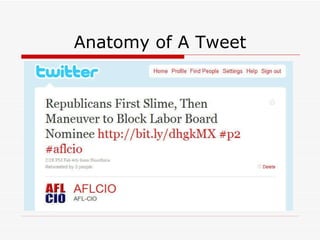
Anatomy of A Tweet
Anatomy of a Tweet
Anatomy of a Retweet
How do I build community? Listening/Retweeting Directories of progressives Tweet Progress ( www.tweetprogress.org )  Can also sign up for a Twitter mentor here Union Twibe ( www.twibes.com/group/union ) AFL-CIO Blog Post: Social Media: New Tools Aid In Organizing (list of unions on Twitter) http://blog.aflcio.org/2009/09/29/social-media-new-tools-aid-in-organizing/ People who use #p2 or #topprog hashtags in their tweets
 
Get your Twitter account started (claim your username) Brand your profile Listen to the conversation and retweet Connect with people (Find people to follow) Promote your new social media presence  (e-mail signature, website, blog entries, cross promotion)
Getting Started With Facebook
What Is Facebook? Free online social networking site  Connect -build your network; connect with supporters and other like-minded organizations Share - spread information about union news and events; share photos, video and other media; start a discussion and get instant feedback from supporters
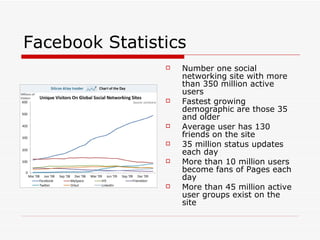
Facebook Statistics Number one social networking site with more than 350 million active users  Fastest growing demographic are those 35 and older Average user has 130 friends on the site  35 million status updates each day  More than 10 million users become fans of Pages each day More than 45 million active user groups exist on the site
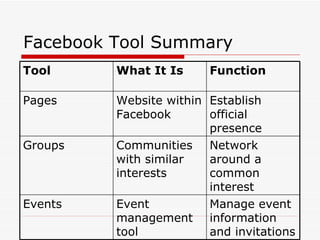
Facebook Tool Summary Manage event information and invitations Event management tool Events Network around a common interest Communities with similar interests Groups Establish official presence Website within Facebook Pages Function What It Is Tool
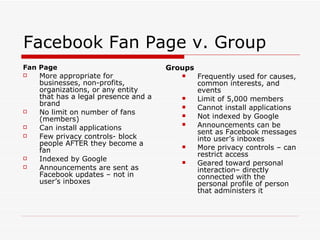
Facebook Fan Page v. Group Fan Page More appropriate for businesses, non-profits, organizations, or any entity that has a legal presence and a brand  No limit on number of fans (members)  Can install applications  Few privacy controls- block people AFTER they become a fan Indexed by Google  Announcements are sent as Facebook updates – not in user’s inboxes Groups Frequently used for causes, common interests, and events  Limit of 5,000 members  Cannot install applications  Not indexed by Google  Announcements can be sent as Facebook messages into user’s inboxes More privacy controls – can restrict access Geared toward personal interaction– directly connected with the personal profile of person that administers it
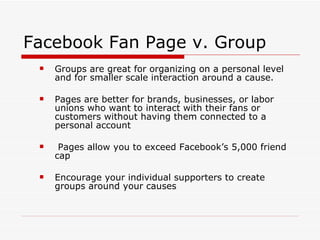
Facebook Fan Page v. Group Groups are great for organizing on a personal level and for smaller scale interaction around a cause.  Pages are better for brands, businesses, or labor unions who want to interact with their fans or customers without having them connected to a personal account Pages allow you to exceed Facebook’s 5,000 friend cap Encourage your individual supporters to create groups around your causes
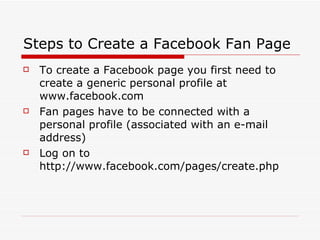
Steps to Create a Facebook Fan Page To create a Facebook page you first need to create a generic personal profile at www.facebook.com Fan pages have to be connected with a personal profile (associated with an e-mail address)  Log on to http://www.facebook.com/pages/create.php
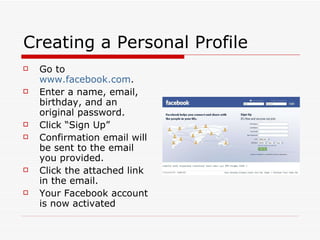
Creating a Personal Profile Go to  www.facebook.com . Enter a name, email, birthday, and an original password.  Click “Sign Up” Confirmation email will be sent to the email you provided.  Click the attached link in the email. Your Facebook account is now activated
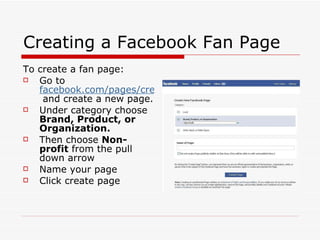
Creating a Facebook Fan Page To create a fan page: Go to  facebook.com/pages/create.php  and create a new page. Under category choose  Brand, Product, or Organization. Then choose  Non-profit  from the pull down arrow Name your page Click create page
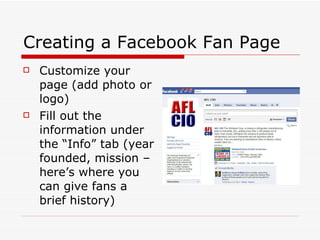
Creating a Facebook Fan Page Customize your page (add photo or logo) Fill out the information under the “Info” tab (year founded, mission – here’s where you can give fans a brief history)
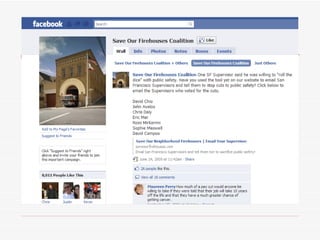
Add Content to Your Fan Page Empower your fans by giving them content to share – enable them to be viewed as a resource Ask questions that inspire discussion and even debate Links to blog posts (can set up to automatically post) Encourage fans to share their relevant content Links to news stories around the web Share content from other affiliates page Spread news about events, rallies, etc. Use event tool to invite people to an organized event or even to sign a petition or participate in some virtual event
 
AFL-CIO Social Media Group Communications staff from unions and affiliated organizations sharing resources, successful social media campaigns, strategies, and tools  Working on development of social media training tools that can be distributed to unions Trainings- New Media Academy
New Media Training Academy: Social Media Training Social Media June 3-  Intermediate Facebook/Social Media June 24  –Introduction to Social Media July 22-  Intermediate Facebook/Social Media
Join our Social Media Group Danielle Hatchett [email_address] www.facebook.com/aflcio www.twitter.com/aflcio
Resources How To Use Social Media For Your Union   http://www.aflcio.org/aboutus/upload/socialmedia.pdf SmartBriefs on Social Media Issues   http://www.smartbrief.com/news/socialmedia   Frog Loop: Nonprofit Online Marketing Blog http://www.frogloop.com/socialmedia   Case Foundation: Ask the Guru http://www.ustream.tv/CaseFoundation
Resources Mashable’s Twitter Guide Book (@mashable) http://mashable.com/guidebook/twitter/  Twitter Best Practices for Non Profit Organizations http://www.diosacommunications.com/twitterbestpractices.htm   Beth’s Kanter’s Blog http://beth.typepad.com   Facebook for Nonprofit Beginners: Learn the Basics of this Online Social Networking Tool http://blog.techsoup.org/node/27
Resources: Listservs Progressive Exchange http://www.progressiveexchange.org/welcome.htm   Labor Talk http://groups.google.com/group/laborcom?hl=en

AFL-CIO New Media Academy

  • 1.
    AFL-CIO New MediaAcademy How To Get Started Integrating Social Media Into Your Online Communications Strategy May 13, 2010 Danielle Hatchett Social Media Manager, AFL-CIO [email_address] Facebook: www.facebook.com/aflcio Twitter: www.twitter.com/aflcio
  • 2.
    Social Media: GrowingFast 3 out of 4 Americans use social technology 1 in 3 online Americans post to social networks at least once a week Users spend at least 5hrs and 30 min per month on average on social networking sites 99% of social media users believe organizations should have a presence in social media 37% of internet users aged 18-29 use blogs or social networking sites as a venue for political or civic involvement compared to: 17% of online 30-49 year olds 12% of 50-64 year olds 10% of internet users over 65
  • 3.
    Social Media: GrowingFast Provides additional platforms to spread your message; reach a new audience Plug your cause, raise awareness about an issue, spread the word, and update your network Allows opportunity for instant feedback from your constituents; tap into word of mouth. Connect with influentials (i.e. bloggers, policymakers, press, advocacy organizers and people with large networks) Provides organizing opportunities (IBEW and Comcast Workers)
  • 4.
    IBEW Taps IntoSocial Media To Organize http://bit.ly/9m7xal
  • 5.
    Developing A SocialMedia Strategy Do some research and find out where your existing audience is Spend some time listening to the conversation Create a campaign around the launch of new social media platforms Produce engaging content
  • 6.
    Questions We Asked(or wish we had asked!) Before Getting Started Who will manage the site? Who can post items to the site? What kinds of items are appropriate for the site? Are we prepared to let go of control of our brand just a little? How does engaging users via social media integrate with our overall communications/marketing strategy? How will we measure success or failure? (views, number of followers/subscribers, comments)
  • 7.
    AFL-CIO Social MediaTools Blog : http://www.blog.aflcio.org Facebook : http://www.facebook.com/aflcio Twitter : http://www.twitter.com/aflcio YouTube : http://www.youtube.com/user/aflcionow Flickr : http://www.flickr.com/photos/labor2008 Ustream/Livestream: (live broadcasts)- http://www.ustream.tv/user/aflcionow
  • 8.
  • 9.
    What is Twitter?Social networking and micro blogging service that allows you to answer the question, “What are you doing?” Combination of various forms of communication like e-mail, instant messenger, blogs, and RSS feeds. Difference is that posts, or tweets, are restricted to 140 characters or less.
  • 10.
    What Is Twitter?Evolved from simply answering the question, “What are you doing?” into Shared links to interesting content on the web Conversations around hot topics Shared photos, videos, music Real time accounts from people who are in midst of a newsworthy event (like a convention or conference), crisis or natural disaster
  • 11.
    Twitter Statistics 10-15million active users with a median age of 31 Users were tweeting 5,000 times a day in 2007. Today, 50M tweets are sent per day Tuesday is most active day on Twitter
  • 12.
    Getting Started Signup at www.twitter.com Completely fill out user profile Brand Yourself Claim your Twitter handle (i.e. twitter.com/aflcio) Choose a photo or logo Create your background
  • 13.
    What do Itweet about? Share news or events from your union (rallies, conferences, meetings, trainings – anything you promote via traditional means. Difference is you only have 140 characters) Automatically share your blog posts ( www.twitterfeed.com ) Links to relevant news stories around the web (www.bitly.com)
  • 14.
    Twitter Terminology JargonTweets – 140 character updates on Twitter Follower -people who are interested in your updates and “follow” you Direct Message (DM)- private message from one Twitter user to another. Can only be sent when you are following each other Symbols @ - referring to another Twitter user (@cwaunion means I’m speaking directly to or about them) RT - retweeting is is when you share the tweet of one user with all of your Twitter followers. # - hashtags are community driven naming convention to help spread information while also organizing it.
  • 15.
    Hashtags (www.hashtag.org) Favoritetool of conferences and event organizers If everyone agrees to add a certain hashtag after their tweet, it becomes easier to find that topic in search (search.twitter.com) #hcr, #health– health care #p2 and #topprog (progressives) Create your own #aflcio #aflcio09 (convention) #aflciojobs (jobs initiative) #bankshowdown
  • 16.
    Retweeting or “RT”Twitter users share the best links, tweets and gems they find from others they are following Important to do in order to build community and not just appear to be putting out your own content Connect with people and let them know you’re there (gain followers!)
  • 17.
  • 18.
  • 19.
    Anatomy of aRetweet
  • 20.
    How do Ibuild community? Listening/Retweeting Directories of progressives Tweet Progress ( www.tweetprogress.org ) Can also sign up for a Twitter mentor here Union Twibe ( www.twibes.com/group/union ) AFL-CIO Blog Post: Social Media: New Tools Aid In Organizing (list of unions on Twitter) http://blog.aflcio.org/2009/09/29/social-media-new-tools-aid-in-organizing/ People who use #p2 or #topprog hashtags in their tweets
  • 21.
  • 22.
    Get your Twitteraccount started (claim your username) Brand your profile Listen to the conversation and retweet Connect with people (Find people to follow) Promote your new social media presence (e-mail signature, website, blog entries, cross promotion)
  • 23.
  • 24.
    What Is Facebook?Free online social networking site Connect -build your network; connect with supporters and other like-minded organizations Share - spread information about union news and events; share photos, video and other media; start a discussion and get instant feedback from supporters
  • 25.
    Facebook Statistics Numberone social networking site with more than 350 million active users Fastest growing demographic are those 35 and older Average user has 130 friends on the site 35 million status updates each day More than 10 million users become fans of Pages each day More than 45 million active user groups exist on the site
  • 26.
    Facebook Tool SummaryManage event information and invitations Event management tool Events Network around a common interest Communities with similar interests Groups Establish official presence Website within Facebook Pages Function What It Is Tool
  • 27.
    Facebook Fan Pagev. Group Fan Page More appropriate for businesses, non-profits, organizations, or any entity that has a legal presence and a brand No limit on number of fans (members) Can install applications Few privacy controls- block people AFTER they become a fan Indexed by Google Announcements are sent as Facebook updates – not in user’s inboxes Groups Frequently used for causes, common interests, and events Limit of 5,000 members Cannot install applications Not indexed by Google Announcements can be sent as Facebook messages into user’s inboxes More privacy controls – can restrict access Geared toward personal interaction– directly connected with the personal profile of person that administers it
  • 28.
    Facebook Fan Pagev. Group Groups are great for organizing on a personal level and for smaller scale interaction around a cause. Pages are better for brands, businesses, or labor unions who want to interact with their fans or customers without having them connected to a personal account Pages allow you to exceed Facebook’s 5,000 friend cap Encourage your individual supporters to create groups around your causes
  • 29.
    Steps to Createa Facebook Fan Page To create a Facebook page you first need to create a generic personal profile at www.facebook.com Fan pages have to be connected with a personal profile (associated with an e-mail address) Log on to http://www.facebook.com/pages/create.php
  • 30.
    Creating a PersonalProfile Go to www.facebook.com . Enter a name, email, birthday, and an original password. Click “Sign Up” Confirmation email will be sent to the email you provided. Click the attached link in the email. Your Facebook account is now activated
  • 31.
    Creating a FacebookFan Page To create a fan page: Go to facebook.com/pages/create.php and create a new page. Under category choose Brand, Product, or Organization. Then choose Non-profit from the pull down arrow Name your page Click create page
  • 32.
    Creating a FacebookFan Page Customize your page (add photo or logo) Fill out the information under the “Info” tab (year founded, mission – here’s where you can give fans a brief history)
  • 33.
    Add Content toYour Fan Page Empower your fans by giving them content to share – enable them to be viewed as a resource Ask questions that inspire discussion and even debate Links to blog posts (can set up to automatically post) Encourage fans to share their relevant content Links to news stories around the web Share content from other affiliates page Spread news about events, rallies, etc. Use event tool to invite people to an organized event or even to sign a petition or participate in some virtual event
  • 34.
  • 35.
    AFL-CIO Social MediaGroup Communications staff from unions and affiliated organizations sharing resources, successful social media campaigns, strategies, and tools Working on development of social media training tools that can be distributed to unions Trainings- New Media Academy
  • 36.
    New Media TrainingAcademy: Social Media Training Social Media June 3- Intermediate Facebook/Social Media June 24 –Introduction to Social Media July 22- Intermediate Facebook/Social Media
  • 37.
    Join our SocialMedia Group Danielle Hatchett [email_address] www.facebook.com/aflcio www.twitter.com/aflcio
  • 38.
    Resources How ToUse Social Media For Your Union http://www.aflcio.org/aboutus/upload/socialmedia.pdf SmartBriefs on Social Media Issues http://www.smartbrief.com/news/socialmedia Frog Loop: Nonprofit Online Marketing Blog http://www.frogloop.com/socialmedia Case Foundation: Ask the Guru http://www.ustream.tv/CaseFoundation
  • 39.
    Resources Mashable’s TwitterGuide Book (@mashable) http://mashable.com/guidebook/twitter/ Twitter Best Practices for Non Profit Organizations http://www.diosacommunications.com/twitterbestpractices.htm Beth’s Kanter’s Blog http://beth.typepad.com Facebook for Nonprofit Beginners: Learn the Basics of this Online Social Networking Tool http://blog.techsoup.org/node/27
  • 40.
    Resources: Listservs ProgressiveExchange http://www.progressiveexchange.org/welcome.htm Labor Talk http://groups.google.com/group/laborcom?hl=en