THE ADVOCATE AUGUST 2001 39
Alberto J.P. Nunes, Ph.D.
Agribrands Purina do Brasil
São Paulo, Brazil
albertojpn@agribrands.com.br
Yont Musig, Ph.D.
Kasetsart University
Bangkok, Thailand
ffisyon@ku.ac.th
Mechanical aeration is an effec-
tive means of improving pro-
duction efficiency in shrimp farming.
Aerators create strong water move-
ment and turbulence, breaking up the
air-water interface. This causes oxy-
genation, mixing, and destratification
of the pond water column, which en-
hances dissolved-oxygen concentra-
tions and lowers the accumulation of
nitrogenous compounds.
As the shrimp industry modernizes
and culture technologies intensify,
supplemental aeration is turning from
an occasional to conventional practice
at many farms. This article presents
preliminary results of the aerated pond
management survey conducted with
Eastern and Western Hemisphere
shrimp farmers as part of the Global
Shrimp OP: 2001 program.
Operational Profile
The use of mechanical aeration is
rapidly spreading in semi-intensive
and intensive shrimp farms. Of 29 re-
spondents to the survey, 59% of the
operations were located in the West-
ern Hemisphere. Participant countries
included Brazil (8 respondents), India
(4), Australia (3), Indonesia, Thailand,
Belize, Ecuador, France, Honduras,
Japan, Mexico, Nicaragua, South Afri-
ca, and the United States.
Surveyed operations were classi-
fied as medium to large farms, mostly
older than 6 years (61%), with 11-50
ponds (62%). Farms less than five
years old with 51-200 ponds were less
common, representing 38% and 17%
of the respondents, respectively. The
primary species cultured was Litope-
naeus vannamei (48%), followed by
Penaeus monodon (41%), Marsupe-
naeus japonicus (7%), and Fennero-
penaeus indicus (3%).
Pond Characteristics
The bulk of the farms that em-
ployed aeration had ponds with the
traditional rectangular configuration
(66%), and area ranging from 0.5-1 ha
(34%) to 1.1-5 ha (38%). Although the
benefits of mechanical aeration ap-
pear to be better capitalized in smaller
culture areas using more sophisticat-
ed pond shapes, only a fraction of the
farms (3%) used ponds of less than
0.5 ha, and modern configurations such
as square (22%) or round (6%) shapes,
and raceways (6%). Under these con-
ditions, aerators can effectively create
circular currents to assist in the re-
moval of clay materials, detritus, and
other undesirable organic particles
from water.
Most surveyed farms used ponds
with depths of 1.1-1.25 m (24%) to
1.26-1.5 m (34%), but a number of
operations ponds exceeded 1.5 m in
depth (24%). Aeration is discouraged
in very large ponds over 20 ha and
shallow ponds (less than 0.75 m), as it
can result in inconsistent oxygenation
of the rearing area and scouring of the
pond bottom. This can produce dead
or anaerobic areas in the pond, and
disturb toxic materials present in the
top layer of the sediment.
Aeration Rates and Costs
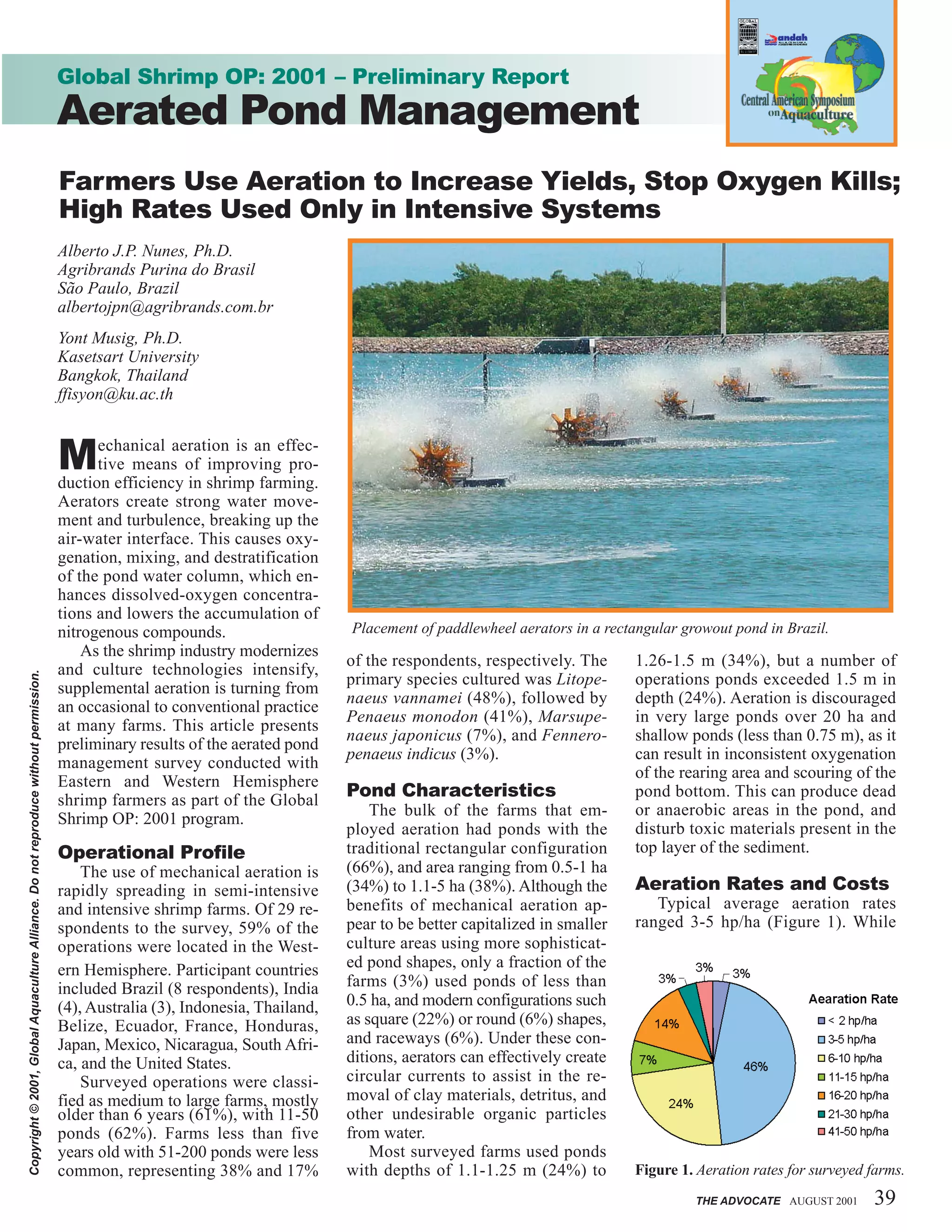
Typical average aeration rates
ranged 3-5 hp/ha (Figure 1). While
Global Shrimp OP: 2001 – Preliminary Report
Aerated Pond Management
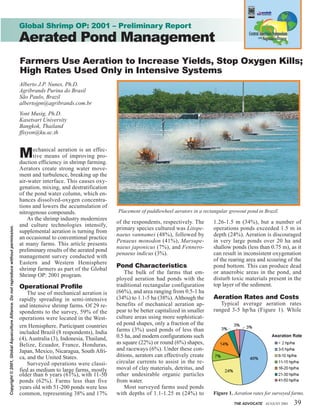
Placement of paddlewheel aerators in a rectangular growout pond in Brazil.
Farmers Use Aeration to Increase Yields, Stop Oxygen Kills;
High Rates Used Only in Intensive Systems
Figure 1. Aeration rates for surveyed farms.
Copyright©2001,GlobalAquacultureAlliance.Donotreproducewithoutpermission.
40 THE ADVOCATE AUGUST 2001
higher aeration rates are in use, they
seem to be limited to very intensive or
heterotrophic-based rearing systems.
Most farmers estimate their horse-
power rating on motor size (72%),
while very few use the actual draw
power of motor (28%).
Respondents indicated electricity
as their primary source of power for
aeration, originated either from on-
site power generation (48%) or utility
(48%). Only one respondent used di-
rect drive from gas or diesel motor.
Almost half the farms evaluated used
a backup power supply for emergen-
cies, followed by 29% with no back-
up and 25% with partial backup. This
agrees with the finding that 30% of
the respondents indicated power out-
age as one of leading causes of low-
oxygen shrimp mortality in their grow-
out ponds.
Operational Cost Restrictions
One of the greatest restrictions to a
more widespread use of aeration
seems to be related to its operational
costs, particularly power expenses. In-
terestingly, aeration is becoming quite
popular in countries like Brazil, where
electricity derived from hydroelectric
plants is common in rural areas and rel-
atively inexpensive compared to other
power sources. In Brazil, it is estimat-
ed that one kWh generated by diesel
fuel is at least three times more expen-
sive than electricity from utility sources.
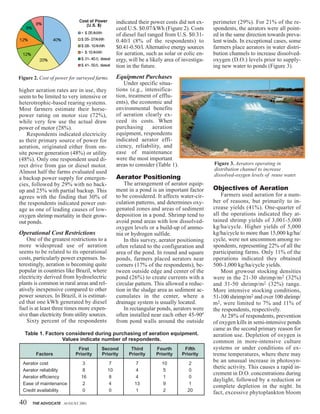
Sixty percent of the respondents
indicated their power costs did not ex-
ceed U.S. $0.07/kWh (Figure 2). Costs
of diesel fuel ranged from U.S. $0.31-
0.40/l (8% of the respondents) to
$0.41-0.50/l. Alternative energy sources
for aeration, such as solar or eolic en-
ergy, will be a likely area of investiga-
tion in the future.
Equipment Purchases
Under specific situa-
tions (e.g., intensifica-
tion, treatment of efflu-
ents), the economic and
environmental benefits
of aeration clearly ex-
ceed its costs. When
purchasing aeration
equipment, respondents
indicated aerator effi-
ciency, reliability, and
ease of maintenance
were the most important
areas to consider (Table 1).
Aerator Positioning
The arrangement of aerator equip-
ment in a pond is an important factor
to be considered. It affects water-cir-
culation patterns, and determines oxy-
genated zones and areas of sediment
deposition in a pond. Shrimp tend to
avoid pond areas with low dissolved-
oxygen levels or a build-up of ammo-
nia or hydrogen sulfide.
In this survey, aerator positioning
often related to the configuration and
area of the pond. In round and square
ponds, farmers placed aerators near
corners (17% of the respondents), be-
tween outside edge and center of the
pond (26%) to create currents with a
circular pattern. This allowed a reduc-
tion in the sludge area as sediment ac-
cumulates in the center, where a
drainage system is usually located.
In rectangular ponds, aerators were
often installed near each other 45-90º
from pond walls around the outside
perimeter (29%). For 21% of the re-
spondents, the aerators were all point-
ed in the same direction towards preva-
lent winds. In exceptional cases, some
farmers place aerators in water distri-
bution channels to increase dissolved-
oxygen (D.O.) levels prior to supply-
ing new water to ponds (Figure 3).
Objectives of Aeration
Farmers used aeration for a num-
ber of reasons, but primarily to in-
crease yields (41%). One-quarter of
all the operations indicated they at-
tained shrimp yields of 3,001-5,000
kg/ha/cycle. Higher yields of 5,000
kg/ha/cycle to more than 15,000 kg/ha/
cycle, were not uncommon among re-
spondents, representing 22% of all the
participating farms. Only 11% of the
operations indicated they obtained
500-1,000 kg/ha/cycle yields.
Most growout stocking densities
were in the 21-30 shrimp/m2 (32%)
and 31-50 shrimp/m2 (32%) range.
More intensive stocking conditions,
51-100 shrimp/m2 and over 100 shrimp/
m2, were limited to 7% and 11% of
the respondents, respectively.
At 28% of respondents, prevention
of oxygen kills in semi-intensive ponds
came as the second primary reason for
aeration use. Depletion of oxygen is
common in more-intensive culture
systems or under conditions of ex-
treme temperatures, where there may
be an unusual increase in photosyn-
thetic activity. This causes a rapid in-
crement in D.O. concentrations during
daylight, followed by a reduction or
complete depletion in the night. In
fact, excessive phytoplankton bloom
Figure 2. Cost of power for surveyed farms.
Figure 3. Aerators operating in
distribution channel to increase
dissolved-oxygen levels of reuse water.
Table 1. Factors considered during purchasing of aeration equipment.
Values indicate number of respondents.
First Second Third Fourth Fifth
Factors Priority Priority Priority Priority Priority
Aerator cost 3 7 7 10 2
Aerator reliability 8 10 4 5 0
Aerator efficiency 16 8 4 1 0
Ease of maintenance 2 4 13 9 1
Credit availability 0 0 1 2 20
42 THE ADVOCATE AUGUST 2001
was considered one of the biggest caus-
es for low-oxygen mortality in aerat-
ed ponds by 30% of the respondents.
In areas with an incidence of dis-
ease outbreaks, water exchange must
be avoided, and D.O. concentrations
can only be sustained with supple-
mental aeration. Intensive aeration is
more commonly used to continually
resuspend organic material and create
heterotrophic microbial communities
to purify water and recycle protein
(19%). Other purposes for aeration in-
cluded water circulation (6%), de-
stratification of zero-exchange ponds
(3%), and reduction in sludge area
(3% of responses).
Research
Aeration can be used in a number
of culture systems and situations, ei-
ther as a remedial measure or practical
method to enhance production output.
Still, there are several areas critical
for research.
Surveyed farmers indicated their
highest priorities for research were
improved gas exchange efficiency,
and study of the importance of aera-
tion versus water circulation. Re-
search on automatic aerator control by
D.O. sensors, and variable operating
speed (day versus night) followed as
priorities. Other areas included aera-
tor arrangement and performance tests.
As shrimp farmers become more
knowledgeable about the benefits of
pond aeration, management strategies
and less-expensive technologies should
evolve, making aeration a more acces-
sible and widespread tool in shrimp
aquaculture.
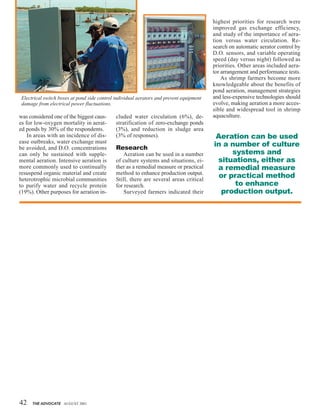
Electrical switch boxes at pond side control individual aerators and prevent equipment
damage from electrical power fluctuations.
Aeration can be used
in a number of culture
systems and
situations, either as
a remedial measure
or practical method
to enhance
production output.

Aeration management in shrimp farming

  • 1.
    THE ADVOCATE AUGUST2001 39 Alberto J.P. Nunes, Ph.D. Agribrands Purina do Brasil São Paulo, Brazil albertojpn@agribrands.com.br Yont Musig, Ph.D. Kasetsart University Bangkok, Thailand ffisyon@ku.ac.th Mechanical aeration is an effec- tive means of improving pro- duction efficiency in shrimp farming. Aerators create strong water move- ment and turbulence, breaking up the air-water interface. This causes oxy- genation, mixing, and destratification of the pond water column, which en- hances dissolved-oxygen concentra- tions and lowers the accumulation of nitrogenous compounds. As the shrimp industry modernizes and culture technologies intensify, supplemental aeration is turning from an occasional to conventional practice at many farms. This article presents preliminary results of the aerated pond management survey conducted with Eastern and Western Hemisphere shrimp farmers as part of the Global Shrimp OP: 2001 program. Operational Profile The use of mechanical aeration is rapidly spreading in semi-intensive and intensive shrimp farms. Of 29 re- spondents to the survey, 59% of the operations were located in the West- ern Hemisphere. Participant countries included Brazil (8 respondents), India (4), Australia (3), Indonesia, Thailand, Belize, Ecuador, France, Honduras, Japan, Mexico, Nicaragua, South Afri- ca, and the United States. Surveyed operations were classi- fied as medium to large farms, mostly older than 6 years (61%), with 11-50 ponds (62%). Farms less than five years old with 51-200 ponds were less common, representing 38% and 17% of the respondents, respectively. The primary species cultured was Litope- naeus vannamei (48%), followed by Penaeus monodon (41%), Marsupe- naeus japonicus (7%), and Fennero- penaeus indicus (3%). Pond Characteristics The bulk of the farms that em- ployed aeration had ponds with the traditional rectangular configuration (66%), and area ranging from 0.5-1 ha (34%) to 1.1-5 ha (38%). Although the benefits of mechanical aeration ap- pear to be better capitalized in smaller culture areas using more sophisticat- ed pond shapes, only a fraction of the farms (3%) used ponds of less than 0.5 ha, and modern configurations such as square (22%) or round (6%) shapes, and raceways (6%). Under these con- ditions, aerators can effectively create circular currents to assist in the re- moval of clay materials, detritus, and other undesirable organic particles from water. Most surveyed farms used ponds with depths of 1.1-1.25 m (24%) to 1.26-1.5 m (34%), but a number of operations ponds exceeded 1.5 m in depth (24%). Aeration is discouraged in very large ponds over 20 ha and shallow ponds (less than 0.75 m), as it can result in inconsistent oxygenation of the rearing area and scouring of the pond bottom. This can produce dead or anaerobic areas in the pond, and disturb toxic materials present in the top layer of the sediment. Aeration Rates and Costs Typical average aeration rates ranged 3-5 hp/ha (Figure 1). While Global Shrimp OP: 2001 – Preliminary Report Aerated Pond Management Placement of paddlewheel aerators in a rectangular growout pond in Brazil. Farmers Use Aeration to Increase Yields, Stop Oxygen Kills; High Rates Used Only in Intensive Systems Figure 1. Aeration rates for surveyed farms. Copyright©2001,GlobalAquacultureAlliance.Donotreproducewithoutpermission.
  • 2.
    40 THE ADVOCATEAUGUST 2001 higher aeration rates are in use, they seem to be limited to very intensive or heterotrophic-based rearing systems. Most farmers estimate their horse- power rating on motor size (72%), while very few use the actual draw power of motor (28%). Respondents indicated electricity as their primary source of power for aeration, originated either from on- site power generation (48%) or utility (48%). Only one respondent used di- rect drive from gas or diesel motor. Almost half the farms evaluated used a backup power supply for emergen- cies, followed by 29% with no back- up and 25% with partial backup. This agrees with the finding that 30% of the respondents indicated power out- age as one of leading causes of low- oxygen shrimp mortality in their grow- out ponds. Operational Cost Restrictions One of the greatest restrictions to a more widespread use of aeration seems to be related to its operational costs, particularly power expenses. In- terestingly, aeration is becoming quite popular in countries like Brazil, where electricity derived from hydroelectric plants is common in rural areas and rel- atively inexpensive compared to other power sources. In Brazil, it is estimat- ed that one kWh generated by diesel fuel is at least three times more expen- sive than electricity from utility sources. Sixty percent of the respondents indicated their power costs did not ex- ceed U.S. $0.07/kWh (Figure 2). Costs of diesel fuel ranged from U.S. $0.31- 0.40/l (8% of the respondents) to $0.41-0.50/l. Alternative energy sources for aeration, such as solar or eolic en- ergy, will be a likely area of investiga- tion in the future. Equipment Purchases Under specific situa- tions (e.g., intensifica- tion, treatment of efflu- ents), the economic and environmental benefits of aeration clearly ex- ceed its costs. When purchasing aeration equipment, respondents indicated aerator effi- ciency, reliability, and ease of maintenance were the most important areas to consider (Table 1). Aerator Positioning The arrangement of aerator equip- ment in a pond is an important factor to be considered. It affects water-cir- culation patterns, and determines oxy- genated zones and areas of sediment deposition in a pond. Shrimp tend to avoid pond areas with low dissolved- oxygen levels or a build-up of ammo- nia or hydrogen sulfide. In this survey, aerator positioning often related to the configuration and area of the pond. In round and square ponds, farmers placed aerators near corners (17% of the respondents), be- tween outside edge and center of the pond (26%) to create currents with a circular pattern. This allowed a reduc- tion in the sludge area as sediment ac- cumulates in the center, where a drainage system is usually located. In rectangular ponds, aerators were often installed near each other 45-90º from pond walls around the outside perimeter (29%). For 21% of the re- spondents, the aerators were all point- ed in the same direction towards preva- lent winds. In exceptional cases, some farmers place aerators in water distri- bution channels to increase dissolved- oxygen (D.O.) levels prior to supply- ing new water to ponds (Figure 3). Objectives of Aeration Farmers used aeration for a num- ber of reasons, but primarily to in- crease yields (41%). One-quarter of all the operations indicated they at- tained shrimp yields of 3,001-5,000 kg/ha/cycle. Higher yields of 5,000 kg/ha/cycle to more than 15,000 kg/ha/ cycle, were not uncommon among re- spondents, representing 22% of all the participating farms. Only 11% of the operations indicated they obtained 500-1,000 kg/ha/cycle yields. Most growout stocking densities were in the 21-30 shrimp/m2 (32%) and 31-50 shrimp/m2 (32%) range. More intensive stocking conditions, 51-100 shrimp/m2 and over 100 shrimp/ m2, were limited to 7% and 11% of the respondents, respectively. At 28% of respondents, prevention of oxygen kills in semi-intensive ponds came as the second primary reason for aeration use. Depletion of oxygen is common in more-intensive culture systems or under conditions of ex- treme temperatures, where there may be an unusual increase in photosyn- thetic activity. This causes a rapid in- crement in D.O. concentrations during daylight, followed by a reduction or complete depletion in the night. In fact, excessive phytoplankton bloom Figure 2. Cost of power for surveyed farms. Figure 3. Aerators operating in distribution channel to increase dissolved-oxygen levels of reuse water. Table 1. Factors considered during purchasing of aeration equipment. Values indicate number of respondents. First Second Third Fourth Fifth Factors Priority Priority Priority Priority Priority Aerator cost 3 7 7 10 2 Aerator reliability 8 10 4 5 0 Aerator efficiency 16 8 4 1 0 Ease of maintenance 2 4 13 9 1 Credit availability 0 0 1 2 20
  • 3.
    42 THE ADVOCATEAUGUST 2001 was considered one of the biggest caus- es for low-oxygen mortality in aerat- ed ponds by 30% of the respondents. In areas with an incidence of dis- ease outbreaks, water exchange must be avoided, and D.O. concentrations can only be sustained with supple- mental aeration. Intensive aeration is more commonly used to continually resuspend organic material and create heterotrophic microbial communities to purify water and recycle protein (19%). Other purposes for aeration in- cluded water circulation (6%), de- stratification of zero-exchange ponds (3%), and reduction in sludge area (3% of responses). Research Aeration can be used in a number of culture systems and situations, ei- ther as a remedial measure or practical method to enhance production output. Still, there are several areas critical for research. Surveyed farmers indicated their highest priorities for research were improved gas exchange efficiency, and study of the importance of aera- tion versus water circulation. Re- search on automatic aerator control by D.O. sensors, and variable operating speed (day versus night) followed as priorities. Other areas included aera- tor arrangement and performance tests. As shrimp farmers become more knowledgeable about the benefits of pond aeration, management strategies and less-expensive technologies should evolve, making aeration a more acces- sible and widespread tool in shrimp aquaculture. Electrical switch boxes at pond side control individual aerators and prevent equipment damage from electrical power fluctuations. Aeration can be used in a number of culture systems and situations, either as a remedial measure or practical method to enhance production output.