

FISHING
Fishing is the activity of catching fish.
It is an ancient practice dating back at
least 40,000 years. Since the 16th
century fishing vessels have been able
to cross oceans in pursuit of fish and
since the 19th century it has been
possible to use larger vessels and in
some cases process the fish on board.
Fish are normally caught in the wild.
Techniques for catching fish include
hand gathering, spearing, netting,
angling and trapping.
STONE AGE FISH HOOK MADE
FROM BONE
FAO STATISTICS
   According to FAO statistics, the total
    number of fishermen and fish farmers is
    estimated to be 38 million. Fisheries and
    aquaculture provide direct and indirect
    employment to over 500 million people. In
    2005,    the   worldwide     per    capita
    consumption of fish captured from wild
    fisheries was 14.4 kilograms, with an
    additional 7.4 kilograms harvested from
    fish farms.
TECHNOLOGICAL EVOLUTION OF
FISHING
   The ancient river Nile was full of fish; fresh and
    dried fish were a staple food for much of the
    population. The Egyptians invented various
    implements and methods for fishing and these are
    clearly illustrated in tomb scenes, drawings, and
    papyrus documents. Simple reed boats served for
    fishing. Woven nets, weir baskets made from
    willow branches, harpoons and hook and line (the
    hooks having a length of between eight
    millimetres and eighteen centimetres) were all
    being used. By the 12th dynasty, metal hooks with
    barbs were being used.
   Nile perch, catfish and eels were among the most
    important fish.
Fishing      scenes      are     rarely
represented in ancient Greek
culture, a reflection of the low social
status of fishing. They were used
fish-cage for keeping live fish or as
a fish-trap. The Greek historian
Polybius (ca 203 BC–120 BC), in his
Histories, describes hunting for
swordfish by using a harpoon with
a barbed and detachable head.
Roman fishing comes from
mosaics which show fishing
from boats with rod and line
as well as nets. Various
species such as conger,
lobster, sea urchin, octopus
and cuttlefish are illustrated.
In India, the Pandyas, a classical
Dravidian Tamil kingdom, were
known for the pearl fishery as
early as the 1st century BC. Their
seaport Tuticorin was known for
deep sea pearl fishing. The
paravas, a Tamil caste centred in
Tuticorin, developed a rich
community because of their pearl
trade, navigation knowledge and
fisheries.
From ancient representations and
literature it is clear that fishing boats
were typically small, lacking a mast
or sail, and were only used close to
the shore.
In Norse mythology the sea
giantess Rán uses a fishing net to
trap lost sailors.
The Moche people of ancient
Peru depicted fisherman in their
ceramics.
Crab fishing, 1891–1895.   commercial fishermen
                           in Alaska, early 20th
                           century
EVIDENCE OF CHANGES REGARDING
GILL NET
      Gillnetting was an early fishing technology in
       Colonial America.
      Immigrant fishermen from northern Europe and
       the Mediterranean brought adaptation of the
       technology during 1860s.
      The fishermen used boat around 25‟(8mt.) long and
       powered by oars.
      Many of these boats also had small sails and were
       called “row-sail” boat.
      At the beginning of the 20th century steam powered
       ships would haul these small boat to their fishing
       ground and retrieve then at the end of each day.
       Gas powered boat were beginning to make their
       appearance and by 1930s the row-sail boat had
       virtually disappeared.
 In 1931 the first powered drum was created and this
allowed the nets to be drawn in much faster and
fishermen were able to fish in areas they had previously
been unable to go into.
During World War II, navigation and communication
devices, as well as many other forms of maritime
equipment (ex. depth-sounding and radar) were
improved and made more compact. These devices
became much more accessible to the average fisherman.
the fisherman were forced to invest more into their
boats and equipment in order to stay up to date with
the current technology.
The introduction of fine synthetic fibres such as nylon
in the construction of fishing gear during the 1960s
marked an expansion in the commercial use of gillnets.
This type of net was heavily used by many Japanese,
South Korean, and Taiwanese fishing fleets on the high
seas in the 1980s to target tunas. Although highly selective
with respect to size class of animals captured, gill nets are
associated with high numbers of incidental captures of
cetaceans, (whales and dolphins). In the Sri Lankan gill net
fishery, one dolphin is caught for every 1.7-4.0 tonnes of
tuna landed. This compares poorly with the rate of one
dolphin per 70 tonnes of tuna landed in the eastern Pacific
purse seine tuna fishery. Gillnets were banned by the
United Nations in 1993 in international waters, although
their use is still permitted within 200 nautical miles
(400 km) of a coast.
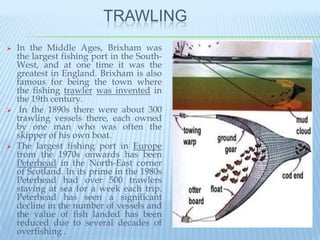
TRAWLING
   In the Middle Ages, Brixham was
    the largest fishing port in the South-
    West, and at one time it was the
    greatest in England. Brixham is also
    famous for being the town where
    the fishing trawler was invented in
    the 19th century.
    In the 1890s there were about 300
    trawling vessels there, each owned
    by one man who was often the
    skipper of his own boat.
   The largest fishing port in Europe
    from the 1970s onwards has been
    Peterhead in the North-East corner
    of Scotland. In its prime in the 1980s
    Peterhead had over 500 trawlers
    staying at sea for a week each trip.
    Peterhead has seen a significant
    decline in the number of vessels and
    the value of fish landed has been
    reduced due to several decades of
    overfishing .
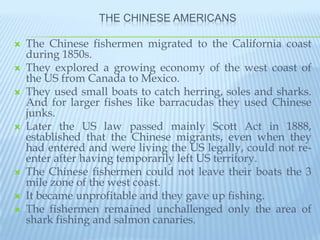
THE CHINESE AMERICANS

   The Chinese fishermen migrated to the California coast
    during 1850s.
   They explored a growing economy of the west coast of
    the US from Canada to Mexico.
   They used small boats to catch herring, soles and sharks.
    And for larger fishes like barracudas they used Chinese
    junks.
   Later the US law passed mainly Scott Act in 1888,
    established that the Chinese migrants, even when they
    had entered and were living the US legally, could not re-
    enter after having temporarily left US territory.
   The Chinese fishermen could not leave their boats the 3
    mile zone of the west coast.
   It became unprofitable and they gave up fishing.
   The fishermen remained unchallenged only the area of
    shark fishing and salmon canaries.
TECHNOLOGICAL CHANGES IN CRAFTS
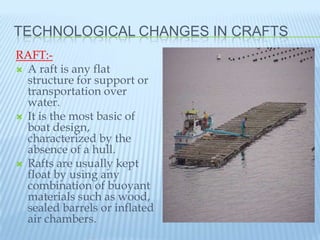
RAFT:-
 A raft is any flat
  structure for support or
  transportation over
  water.
 It is the most basic of
  boat design,
  characterized by the
  absence of a hull.
 Rafts are usually kept
  float by using any
  combination of buoyant
  materials such as wood,
  sealed barrels or inflated
  air chambers.
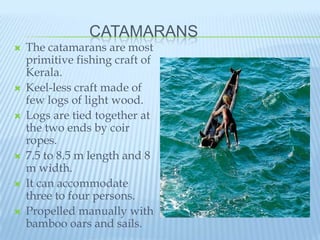
CATAMARANS
   The catamarans are most
    primitive fishing craft of
    Kerala.
   Keel-less craft made of
    few logs of light wood.
   Logs are tied together at
    the two ends by coir
    ropes.
   7.5 to 8.5 m length and 8
    m width.
   It can accommodate
    three to four persons.
   Propelled manually with
    bamboo oars and sails.
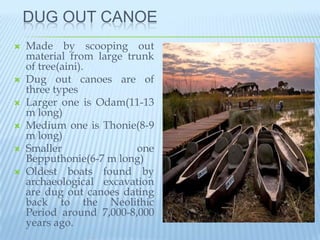
DUG OUT CANOE
   Made by scooping out
    material from large trunk
    of tree(aini).
   Dug out canoes are of
    three types
   Larger one is Odam(11-13
    m long)
   Medium one is Thonie(8-9
    m long)
   Smaller               one
    Bepputhonie(6-7 m long)
   Oldest boats found by
    archaeological excavation
    are dug out canoes dating
    back to the Neolithic
    Period around 7,000-8,000
    years ago.
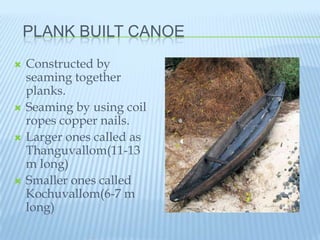
PLANK BUILT CANOE
   Constructed by
    seaming together
    planks.
   Seaming by using coil
    ropes copper nails.
   Larger ones called as
    Thanguvallom(11-13
    m long)
   Smaller ones called
    Kochuvallom(6-7 m
    long)
DOGGER

 During 17th century the British developed the
  dogger, an early type of sailing trawler or
  long liner which commonly operated on the
  North Sea
 The dogger takes its name from the Dutch
  word dogger, meaning a fishing vessels
  which tows a trawl.
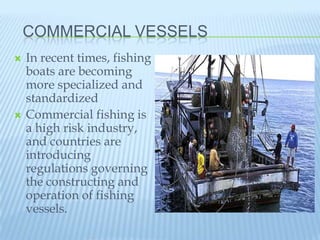
COMMERCIAL VESSELS
   In recent times, fishing
    boats are becoming
    more specialized and
    standardized
   Commercial fishing is
    a high risk industry,
    and countries are
    introducing
    regulations governing
    the constructing and
    operation of fishing
    vessels.
GLOBAL FISH PRODUCTION SCENARIO


   The production increased from 100.36 million
    tonnes in 1990 to 125.2 million tonnes in 1999.
   The production of fish in 2010 was 159 million
    tonnes.
   Fish catches accounted for 74% and aquaculture for
    26% of the total harvest.
   China was the first to contribute overall
    production. India got the 4th place to the overall
    production.
GLOBAL CONSUMPTION OF FISH
    In 1998 fish supply reached an exceptional low due to El
    Nino and demand as well due to the financial crisis in
    emerging markets.

   The total food fish supply has been growing at a rate of
    3.6% per annum since 1961.

   The world population increased 1.8% per annum.

   Per capita fish consumption increased from about 9 kg per
    annum to 16 kg in the recent decade.

   The consumption of fish in 2010 was 110 million tonnes.
HINDU DIETARY CUSTOMS
General Rules
   Tamas, Rajas and Sattva; - these Ayurvedic "vibrations" are
    characteristics of various foods and affect both the physical
    and astral bodies. This is the root theory behind various
    Hindu food customs.
   Tamasic (heavy) foods such as meat and fermented foods
    (including alcohol) promote dullness and inertia.
   Rajasic (expanding) foods including onions, garlic, hot spices,
    stimulants,FISHES, eggs and salt. are thought excite intellect and
    passion which interfere with meditation.
   Sattvic (ascending) foods including fruits, vegetables and grains
    are thought to promote transcendence, sublimity and orderliness.
   Higher caste people adhere to sattvic foods, middle
    casts indulge rajasic and lower castes are tamasic foods.
According to religious aspect fish is an
unique food item to meet the nutritional
demand for human population.


From the economical view point the
global demand of fish is increased rapidly.
So, to meet the global demand aquaculture
is necessary.
HISTORY OF FARMING
   The Neolithic culture and technology spread
    worldwide between 4,000 and 8,000 years ago.
   In China the „Sung Dynasty‟ started aquaculture.
    They were collected and store the fish only. It
    was around 500 BC.
   After this the „Ming Dynasty‟ started culture
    practice. They collected the fishes and also
    reared the fishes.
   Later „China Dynasty‟ came and they introduced
    the technologies of collection of fishes, rearing
    and fry production method.
TECHNOLOGICAL CHANGES ON
AQUACULTURE
EXTENSIVE AQUQCULTURE:-
 The growth rate of fish is limited.
 The available food is supplied from the nature.
 Additional    fertilizer use to increase the
  photosynthetic production.
 Here aquaculturist choose a fiter algae feeder
  such as tilapia, a benthic feeder such as carp or
  catfish, zooplankton feeder various carps and
  submerged weed feeder grass carp.
INTENSIVE AQUACULTURE
 The amount of fish per unit surface area can
  be increased by providing sufficient oxygen,
  optimum water quality and best feeding
  schedule.
 The cost of inputs per unit of fish weight is
  higher than in extensive farming, especially
  because of the high cost of fish feed.
 Some producers have adapted their intensive
  systems in an effort to provide consumers
  with fish that do not carry dormant forms of
  viruses and diseases
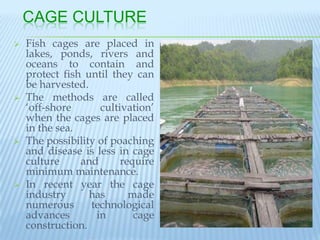
CAGE CULTURE
   Fish cages are placed in
    lakes, ponds, rivers and
    oceans to contain and
    protect fish until they can
    be harvested.
   The methods are called
    „off-shore      cultivation‟
    when the cages are placed
    in the sea.
   The possibility of poaching
    and disease is less in cage
    culture     and      require
    minimum maintenance.
   In recent year the cage
    industry      has      made
    numerous      technological
    advances       in       cage
    construction.
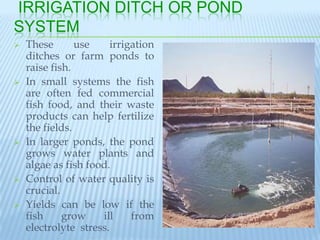
IRRIGATION DITCH OR POND
SYSTEM
   These       use     irrigation
    ditches or farm ponds to
    raise fish.
   In small systems the fish
    are often fed commercial
    fish food, and their waste
    products can help fertilize
    the fields.
   In larger ponds, the pond
    grows water plants and
    algae as fish food.
   Control of water quality is
    crucial.
   Yields can be low if the
    fish     grow    ill     from
    electrolyte stress.
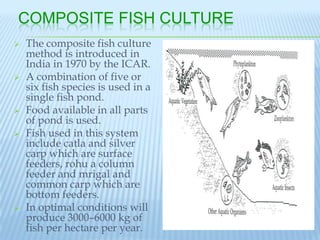
COMPOSITE FISH CULTURE
   The composite fish culture
    method is introduced in
    India in 1970 by the ICAR.
   A combination of five or
    six fish species is used in a
    single fish pond.
   Food available in all parts
    of pond is used.
   Fish used in this system
    include catla and silver
    carp which are surface
    feeders, rohu a column
    feeder and mrigal and
    common carp which are
    bottom feeders.
   In optimal conditions will
    produce 3000–6000 kg of
    fish per hectare per year.
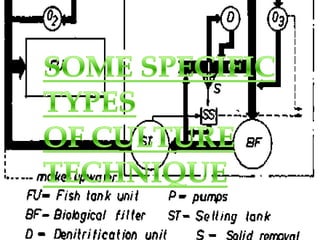
INTEGRATED RECYCLING SYSTEM
 The largest-scale pure fish farms use a
  system derived from the New Alchemy
  Institute in the 1970s.
 Basically, large plastic fish tanks are placed
  in a greenhouse. A hydroponic bed is placed
  near, above or between them.
 Tilapia is used as they eat the algae when the
  tank is properly fertilized.
 To maintain fishes in this method is very
  complicated so this method is not so
  common.
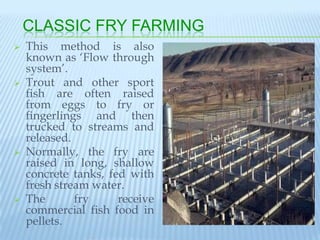
CLASSIC FRY FARMING
   This method is also
    known as „Flow through
    system‟.
   Trout and other sport
    fish are often raised
    from eggs to fry or
    fingerlings and then
    trucked to streams and
    released.
   Normally, the fry are
    raised in long, shallow
    concrete tanks, fed with
    fresh stream water.
   The       fry     receive
    commercial fish food in
    pellets.
Technological evolution in fish catching

Technological evolution in fish catching

  • 2.
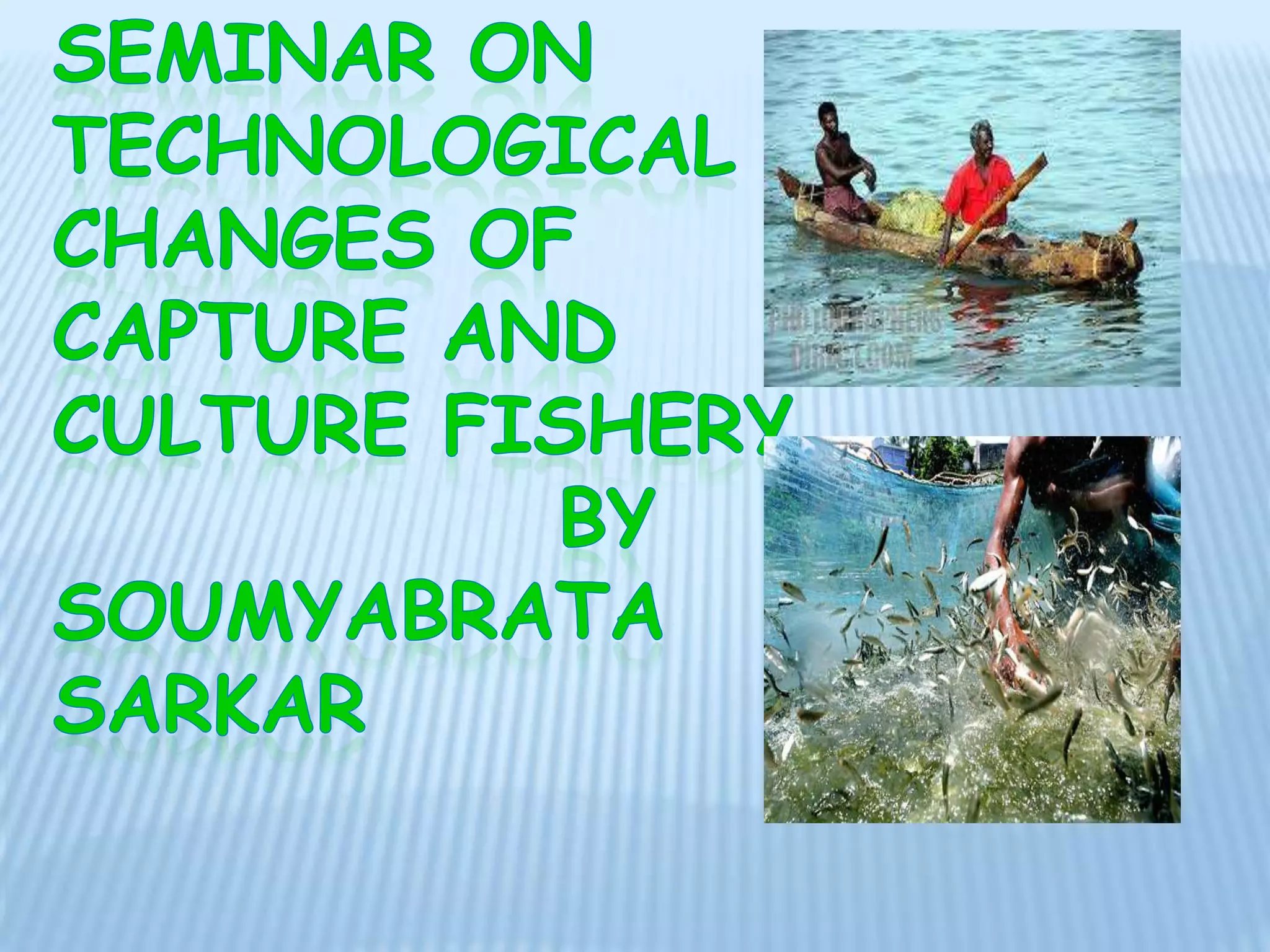
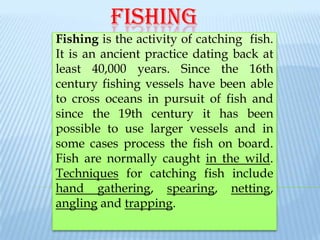
    FISHING Fishing is theactivity of catching fish. It is an ancient practice dating back at least 40,000 years. Since the 16th century fishing vessels have been able to cross oceans in pursuit of fish and since the 19th century it has been possible to use larger vessels and in some cases process the fish on board. Fish are normally caught in the wild. Techniques for catching fish include hand gathering, spearing, netting, angling and trapping.
  • 3.
    STONE AGE FISHHOOK MADE FROM BONE
  • 4.
    FAO STATISTICS  According to FAO statistics, the total number of fishermen and fish farmers is estimated to be 38 million. Fisheries and aquaculture provide direct and indirect employment to over 500 million people. In 2005, the worldwide per capita consumption of fish captured from wild fisheries was 14.4 kilograms, with an additional 7.4 kilograms harvested from fish farms.
  • 5.
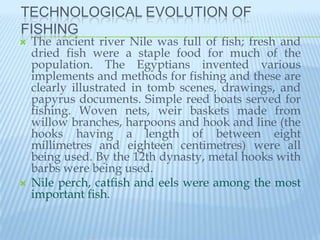
    TECHNOLOGICAL EVOLUTION OF FISHING  The ancient river Nile was full of fish; fresh and dried fish were a staple food for much of the population. The Egyptians invented various implements and methods for fishing and these are clearly illustrated in tomb scenes, drawings, and papyrus documents. Simple reed boats served for fishing. Woven nets, weir baskets made from willow branches, harpoons and hook and line (the hooks having a length of between eight millimetres and eighteen centimetres) were all being used. By the 12th dynasty, metal hooks with barbs were being used.  Nile perch, catfish and eels were among the most important fish.
  • 6.
    Fishing scenes are rarely represented in ancient Greek culture, a reflection of the low social status of fishing. They were used fish-cage for keeping live fish or as a fish-trap. The Greek historian Polybius (ca 203 BC–120 BC), in his Histories, describes hunting for swordfish by using a harpoon with a barbed and detachable head.
  • 7.
    Roman fishing comesfrom mosaics which show fishing from boats with rod and line as well as nets. Various species such as conger, lobster, sea urchin, octopus and cuttlefish are illustrated.
  • 8.
    In India, thePandyas, a classical Dravidian Tamil kingdom, were known for the pearl fishery as early as the 1st century BC. Their seaport Tuticorin was known for deep sea pearl fishing. The paravas, a Tamil caste centred in Tuticorin, developed a rich community because of their pearl trade, navigation knowledge and fisheries.
  • 9.
    From ancient representationsand literature it is clear that fishing boats were typically small, lacking a mast or sail, and were only used close to the shore. In Norse mythology the sea giantess Rán uses a fishing net to trap lost sailors. The Moche people of ancient Peru depicted fisherman in their ceramics.
  • 10.
    Crab fishing, 1891–1895. commercial fishermen in Alaska, early 20th century
  • 11.
    EVIDENCE OF CHANGESREGARDING GILL NET  Gillnetting was an early fishing technology in Colonial America.  Immigrant fishermen from northern Europe and the Mediterranean brought adaptation of the technology during 1860s.  The fishermen used boat around 25‟(8mt.) long and powered by oars.  Many of these boats also had small sails and were called “row-sail” boat.  At the beginning of the 20th century steam powered ships would haul these small boat to their fishing ground and retrieve then at the end of each day.  Gas powered boat were beginning to make their appearance and by 1930s the row-sail boat had virtually disappeared.
  • 12.
     In 1931the first powered drum was created and this allowed the nets to be drawn in much faster and fishermen were able to fish in areas they had previously been unable to go into. During World War II, navigation and communication devices, as well as many other forms of maritime equipment (ex. depth-sounding and radar) were improved and made more compact. These devices became much more accessible to the average fisherman. the fisherman were forced to invest more into their boats and equipment in order to stay up to date with the current technology. The introduction of fine synthetic fibres such as nylon in the construction of fishing gear during the 1960s marked an expansion in the commercial use of gillnets.
  • 13.
    This type ofnet was heavily used by many Japanese, South Korean, and Taiwanese fishing fleets on the high seas in the 1980s to target tunas. Although highly selective with respect to size class of animals captured, gill nets are associated with high numbers of incidental captures of cetaceans, (whales and dolphins). In the Sri Lankan gill net fishery, one dolphin is caught for every 1.7-4.0 tonnes of tuna landed. This compares poorly with the rate of one dolphin per 70 tonnes of tuna landed in the eastern Pacific purse seine tuna fishery. Gillnets were banned by the United Nations in 1993 in international waters, although their use is still permitted within 200 nautical miles (400 km) of a coast.
  • 14.
    TRAWLING  In the Middle Ages, Brixham was the largest fishing port in the South- West, and at one time it was the greatest in England. Brixham is also famous for being the town where the fishing trawler was invented in the 19th century.  In the 1890s there were about 300 trawling vessels there, each owned by one man who was often the skipper of his own boat.  The largest fishing port in Europe from the 1970s onwards has been Peterhead in the North-East corner of Scotland. In its prime in the 1980s Peterhead had over 500 trawlers staying at sea for a week each trip. Peterhead has seen a significant decline in the number of vessels and the value of fish landed has been reduced due to several decades of overfishing .
  • 15.
    THE CHINESE AMERICANS  The Chinese fishermen migrated to the California coast during 1850s.  They explored a growing economy of the west coast of the US from Canada to Mexico.  They used small boats to catch herring, soles and sharks. And for larger fishes like barracudas they used Chinese junks.  Later the US law passed mainly Scott Act in 1888, established that the Chinese migrants, even when they had entered and were living the US legally, could not re- enter after having temporarily left US territory.  The Chinese fishermen could not leave their boats the 3 mile zone of the west coast.  It became unprofitable and they gave up fishing.  The fishermen remained unchallenged only the area of shark fishing and salmon canaries.
  • 16.
    TECHNOLOGICAL CHANGES INCRAFTS RAFT:-  A raft is any flat structure for support or transportation over water.  It is the most basic of boat design, characterized by the absence of a hull.  Rafts are usually kept float by using any combination of buoyant materials such as wood, sealed barrels or inflated air chambers.
  • 17.
    CATAMARANS  The catamarans are most primitive fishing craft of Kerala.  Keel-less craft made of few logs of light wood.  Logs are tied together at the two ends by coir ropes.  7.5 to 8.5 m length and 8 m width.  It can accommodate three to four persons.  Propelled manually with bamboo oars and sails.
  • 18.
    DUG OUT CANOE  Made by scooping out material from large trunk of tree(aini).  Dug out canoes are of three types  Larger one is Odam(11-13 m long)  Medium one is Thonie(8-9 m long)  Smaller one Bepputhonie(6-7 m long)  Oldest boats found by archaeological excavation are dug out canoes dating back to the Neolithic Period around 7,000-8,000 years ago.
  • 19.
    PLANK BUILT CANOE  Constructed by seaming together planks.  Seaming by using coil ropes copper nails.  Larger ones called as Thanguvallom(11-13 m long)  Smaller ones called Kochuvallom(6-7 m long)
  • 20.
    DOGGER  During 17thcentury the British developed the dogger, an early type of sailing trawler or long liner which commonly operated on the North Sea  The dogger takes its name from the Dutch word dogger, meaning a fishing vessels which tows a trawl.
  • 21.
    COMMERCIAL VESSELS  In recent times, fishing boats are becoming more specialized and standardized  Commercial fishing is a high risk industry, and countries are introducing regulations governing the constructing and operation of fishing vessels.
  • 22.
    GLOBAL FISH PRODUCTIONSCENARIO  The production increased from 100.36 million tonnes in 1990 to 125.2 million tonnes in 1999.  The production of fish in 2010 was 159 million tonnes.  Fish catches accounted for 74% and aquaculture for 26% of the total harvest.  China was the first to contribute overall production. India got the 4th place to the overall production.
  • 23.
    GLOBAL CONSUMPTION OFFISH  In 1998 fish supply reached an exceptional low due to El Nino and demand as well due to the financial crisis in emerging markets.  The total food fish supply has been growing at a rate of 3.6% per annum since 1961.  The world population increased 1.8% per annum.  Per capita fish consumption increased from about 9 kg per annum to 16 kg in the recent decade.  The consumption of fish in 2010 was 110 million tonnes.
  • 24.
    HINDU DIETARY CUSTOMS GeneralRules  Tamas, Rajas and Sattva; - these Ayurvedic "vibrations" are characteristics of various foods and affect both the physical and astral bodies. This is the root theory behind various Hindu food customs.  Tamasic (heavy) foods such as meat and fermented foods (including alcohol) promote dullness and inertia.  Rajasic (expanding) foods including onions, garlic, hot spices, stimulants,FISHES, eggs and salt. are thought excite intellect and passion which interfere with meditation.  Sattvic (ascending) foods including fruits, vegetables and grains are thought to promote transcendence, sublimity and orderliness.  Higher caste people adhere to sattvic foods, middle casts indulge rajasic and lower castes are tamasic foods.
  • 25.
    According to religiousaspect fish is an unique food item to meet the nutritional demand for human population. From the economical view point the global demand of fish is increased rapidly. So, to meet the global demand aquaculture is necessary.
  • 26.
    HISTORY OF FARMING  The Neolithic culture and technology spread worldwide between 4,000 and 8,000 years ago.  In China the „Sung Dynasty‟ started aquaculture. They were collected and store the fish only. It was around 500 BC.  After this the „Ming Dynasty‟ started culture practice. They collected the fishes and also reared the fishes.  Later „China Dynasty‟ came and they introduced the technologies of collection of fishes, rearing and fry production method.
  • 27.
    TECHNOLOGICAL CHANGES ON AQUACULTURE EXTENSIVEAQUQCULTURE:-  The growth rate of fish is limited.  The available food is supplied from the nature.  Additional fertilizer use to increase the photosynthetic production.  Here aquaculturist choose a fiter algae feeder such as tilapia, a benthic feeder such as carp or catfish, zooplankton feeder various carps and submerged weed feeder grass carp.
  • 28.
    INTENSIVE AQUACULTURE  Theamount of fish per unit surface area can be increased by providing sufficient oxygen, optimum water quality and best feeding schedule.  The cost of inputs per unit of fish weight is higher than in extensive farming, especially because of the high cost of fish feed.  Some producers have adapted their intensive systems in an effort to provide consumers with fish that do not carry dormant forms of viruses and diseases
  • 30.
    CAGE CULTURE  Fish cages are placed in lakes, ponds, rivers and oceans to contain and protect fish until they can be harvested.  The methods are called „off-shore cultivation‟ when the cages are placed in the sea.  The possibility of poaching and disease is less in cage culture and require minimum maintenance.  In recent year the cage industry has made numerous technological advances in cage construction.
  • 31.
    IRRIGATION DITCH ORPOND SYSTEM  These use irrigation ditches or farm ponds to raise fish.  In small systems the fish are often fed commercial fish food, and their waste products can help fertilize the fields.  In larger ponds, the pond grows water plants and algae as fish food.  Control of water quality is crucial.  Yields can be low if the fish grow ill from electrolyte stress.
  • 32.
    COMPOSITE FISH CULTURE  The composite fish culture method is introduced in India in 1970 by the ICAR.  A combination of five or six fish species is used in a single fish pond.  Food available in all parts of pond is used.  Fish used in this system include catla and silver carp which are surface feeders, rohu a column feeder and mrigal and common carp which are bottom feeders.  In optimal conditions will produce 3000–6000 kg of fish per hectare per year.
  • 33.
    INTEGRATED RECYCLING SYSTEM The largest-scale pure fish farms use a system derived from the New Alchemy Institute in the 1970s.  Basically, large plastic fish tanks are placed in a greenhouse. A hydroponic bed is placed near, above or between them.  Tilapia is used as they eat the algae when the tank is properly fertilized.  To maintain fishes in this method is very complicated so this method is not so common.
  • 34.
    CLASSIC FRY FARMING  This method is also known as „Flow through system‟.  Trout and other sport fish are often raised from eggs to fry or fingerlings and then trucked to streams and released.  Normally, the fry are raised in long, shallow concrete tanks, fed with fresh stream water.  The fry receive commercial fish food in pellets.