28 September/October 2010 global aquaculture advocate
Traditionally, feeds for marine shrimp have been dependent
on the use of fishmeal and fish oil to supply essential nutrients
such as protein, amino acids and omega-3 fatty acids for growth
and survival. Although other protein and lipid sources derived
from plant and land animals are available and widely used in
shrimp feeds, none has been able to fully replace the individual
value of fishmeal or fish oil. The problem is that increasing levels
of these marine ingredients are needed to meet the rapid growth
of the aquaculture industry.
A global survey conducted in 2008 by aquaculture nutritionists
Albert G. J. Tacon and Marc Metian on the use of fishmeal and
fish oil in aquafeed revealed that marine shrimp were the top con-
sumer of fishmeal within the aquaculture sector. However, Tacon
and Metian anticipated that commercial shrimp feeds were gradu-
ally moving away from the use of fishmeal and fish oil. They pre-
dicted the maximum inclusion levels of fishmeal and fish oil in
complete diets for penaeid shrimp as follows: 12 and 2% in 2010,
8 and 1.5% in 2015 and 5 and 1% in 2020, respectively.
Experimental Design
Challenged by their predictions, the authors carried out a
10-week case study to measure the effects of replacement of
anchovy fishmeal and fish oil with soy protein concentrate (SPC)
and soybean oil (SBO) on the performance of white shrimp, Litope-
naeus vannamei, at LABOMAR’s aquaculture facilities in Brazil.
SPC is a refined product made from standard soybean meal
in which most of the carbohydrate content is removed. As a
result, the protein level of SPC is around 65% (comparable to
fishmeal), lipid levels are lower than 1%, and ash content is
about 6%. Moreover, most of the antinutritional factors found in
soybean meal are destroyed during the SPC manufacturing pro-
cess. Despite its good essential amino acid profile, SPC is still
deficient in methionine and can have palatability problems.
In the lab, eight practical isonitrogenous (38% crude protein)
and isoenergetic (15.9 MJ/kg, dry matter basis) diets were man-
ufactured with two levels of fish oil, 2% in the control and 1% in
test diets. For each group of three diets with the same inclusion
level of fish oil, fishmeal was increasingly substituted by SPC at
0% (control), 30% and 60%.
In practical terms, replacement levels meant the use of fishmeal
at 12.0, 8.5 and 5.0%, respectively, following Tacon and Metian’s
forecasts. In two additional diets, 100% of fishmeal was replaced by
SPC. The year “2025” was assigned for these two non-fishmeal
diets. As SPC inclusion increased in the formulas, the dietary level
of SBO increased in order to balance the lipid and energy content of
the diets. Whenever necessary, experimental diets were supple-
mented with synthetic sources of methionine and lysine (Table 1).
The study was conducted in 50 circular tanks of 500 L each
that operated under a continuous water recirculation regime. L.
vannamei of 2.02 ± 0.51 g were stocked at 70 animals/m2
(40
shrimp/tank) and fed twice a day according to their appetites.
Results
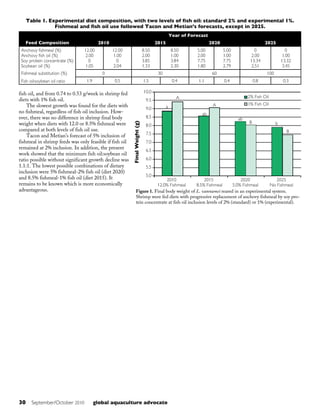
At harvest, there was no significant difference in shrimp sur-
vival among the different feed treatments (P > 0.05). Final
shrimp survival ranged from 89.6 to 94.6%. On the other hand,
there were differences in weekly growth rates and final shrimp
body weight among shrimp fed the experimental diets (P < 0.05;
Figure 1). Shrimp growth decreased as fishmeal was replaced by
SPC from 0.69 to 0.58 g/week in shrimp fed diets with 2.0%
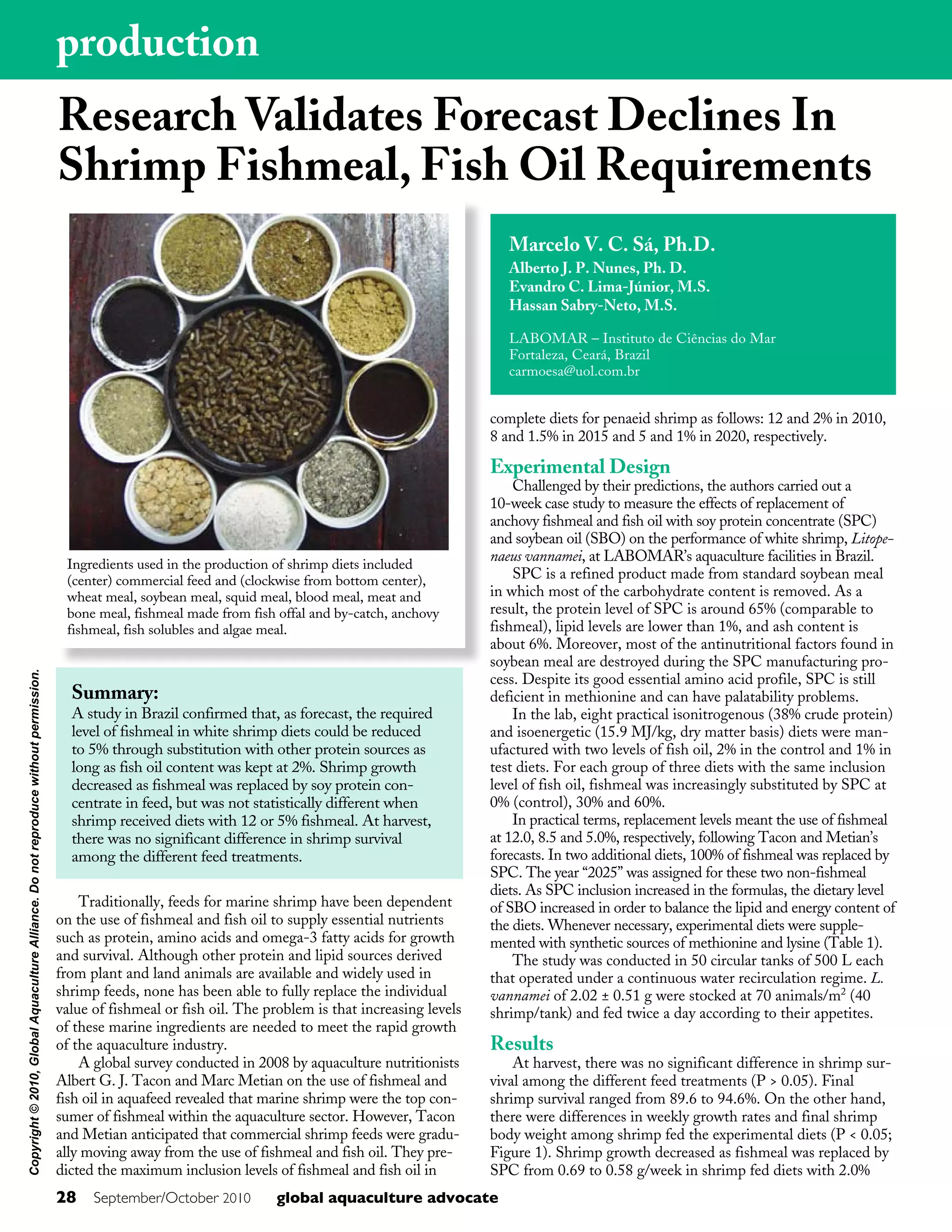
Ingredients used in the production of shrimp diets included
(center) commercial feed and (clockwise from bottom center),
wheat meal, soybean meal, squid meal, blood meal, meat and
bone meal, fishmeal made from fish offal and by-catch, anchovy
fishmeal, fish solubles and algae meal.
Research Validates Forecast Declines In
Shrimp Fishmeal, Fish Oil Requirements
Summary:
A study in Brazil confirmed that, as forecast, the required
level of fishmeal in white shrimp diets could be reduced
to 5% through substitution with other protein sources as
long as fish oil content was kept at 2%. Shrimp growth
decreased as fishmeal was replaced by soy protein con-
centrate in feed, but was not statistically different when
shrimp received diets with 12 or 5% fishmeal. At harvest,
there was no significant difference in shrimp survival
among the different feed treatments.
Marcelo V. C. Sá, Ph.D.
Alberto J. P. Nunes, Ph. D.
Evandro C. Lima-Júnior, M.S.
Hassan Sabry-Neto, M.S.
LABOMAR – Instituto de Ciências do Mar
Fortaleza, Ceará, Brazil
carmoesa@uol.com.br
productionCopyright©2010,GlobalAquacultureAlliance.Donotreproducewithoutpermission.
30 September/October 2010 global aquaculture advocate
fish oil, and from 0.74 to 0.53 g/week in shrimp fed
diets with 1% fish oil.
The slowest growth was found for the diets with
no fishmeal, regardless of fish oil inclusion. How-
ever, there was no difference in shrimp final body
weight when diets with 12.0 or 8.5% fishmeal were
compared at both levels of fish oil use.
Tacon and Metian’s forecast of 5% inclusion of
fishmeal in shrimp feeds was only feasible if fish oil
remained at 2% inclusion. In addition, the present
work showed that the minimum fish oil:soybean oil
ratio possible without significant growth decline was
1.1:1. The lowest possible combinations of dietary
inclusion were 5% fishmeal-2% fish oil (diet 2020)
and 8.5% fishmeal-1% fish oil (diet 2015). It
remains to be known which is more economically
advantageous.
Feed Composition
Year of Forecast
2010 2015 2020 2025
Anchovy fishmeal (%)
Anchovy fish oil (%)
Soy protein concentrate (%)
Soybean oil (%)
Fishmeal substitution (%)
Fish oil:soybean oil ratio
12.00
2.00
0
1.05
12.00
1.00
0
2.04
8.50
2.00
3.85
1.33
8.50
1.00
3.84
2.30
5.00
2.00
7.75
1.80
5.00
1.00
7.75
2.79
0
2.00
13.34
2.51
0
1.00
13.32
3.45
0 30 60 100
1.9 0.5 1.5 0.4 1.1 0.4 0.8 0.3
Table 1. Experimental diet composition, with two levels of fish oil: standard 2% and experimental 1%.
Fishmeal and fish oil use followed Tacon and Metian’s forecasts, except in 2025.
FinalWeight(g)
2% Fish Oil
1% Fish Oil
	 2010	 2015	 2020	 2025
	 12.0% Fishmeal	 8.5% Fishmeal	 5.0% Fishmeal	 No Fishmeal
Figure 1. Final body weight of L. vannamei reared in an experimental system.
Shrimp were fed diets with progressive replacement of anchovy fishmeal by soy pro-
tein concentrate at fish oil inclusion levels of 2% (standard) or 1% (experimental).
10.0
9.5
9.0
8.5
8.0
7.5
7.0
6.5
6.0
5.5
5.0
a
A
ab
A
ab
B
B
b

Research Validates Forecast Declines In Shrimp Fishmeal, Fish Oil Requirements

  • 1.
    28 September/October 2010global aquaculture advocate Traditionally, feeds for marine shrimp have been dependent on the use of fishmeal and fish oil to supply essential nutrients such as protein, amino acids and omega-3 fatty acids for growth and survival. Although other protein and lipid sources derived from plant and land animals are available and widely used in shrimp feeds, none has been able to fully replace the individual value of fishmeal or fish oil. The problem is that increasing levels of these marine ingredients are needed to meet the rapid growth of the aquaculture industry. A global survey conducted in 2008 by aquaculture nutritionists Albert G. J. Tacon and Marc Metian on the use of fishmeal and fish oil in aquafeed revealed that marine shrimp were the top con- sumer of fishmeal within the aquaculture sector. However, Tacon and Metian anticipated that commercial shrimp feeds were gradu- ally moving away from the use of fishmeal and fish oil. They pre- dicted the maximum inclusion levels of fishmeal and fish oil in complete diets for penaeid shrimp as follows: 12 and 2% in 2010, 8 and 1.5% in 2015 and 5 and 1% in 2020, respectively. Experimental Design Challenged by their predictions, the authors carried out a 10-week case study to measure the effects of replacement of anchovy fishmeal and fish oil with soy protein concentrate (SPC) and soybean oil (SBO) on the performance of white shrimp, Litope- naeus vannamei, at LABOMAR’s aquaculture facilities in Brazil. SPC is a refined product made from standard soybean meal in which most of the carbohydrate content is removed. As a result, the protein level of SPC is around 65% (comparable to fishmeal), lipid levels are lower than 1%, and ash content is about 6%. Moreover, most of the antinutritional factors found in soybean meal are destroyed during the SPC manufacturing pro- cess. Despite its good essential amino acid profile, SPC is still deficient in methionine and can have palatability problems. In the lab, eight practical isonitrogenous (38% crude protein) and isoenergetic (15.9 MJ/kg, dry matter basis) diets were man- ufactured with two levels of fish oil, 2% in the control and 1% in test diets. For each group of three diets with the same inclusion level of fish oil, fishmeal was increasingly substituted by SPC at 0% (control), 30% and 60%. In practical terms, replacement levels meant the use of fishmeal at 12.0, 8.5 and 5.0%, respectively, following Tacon and Metian’s forecasts. In two additional diets, 100% of fishmeal was replaced by SPC. The year “2025” was assigned for these two non-fishmeal diets. As SPC inclusion increased in the formulas, the dietary level of SBO increased in order to balance the lipid and energy content of the diets. Whenever necessary, experimental diets were supple- mented with synthetic sources of methionine and lysine (Table 1). The study was conducted in 50 circular tanks of 500 L each that operated under a continuous water recirculation regime. L. vannamei of 2.02 ± 0.51 g were stocked at 70 animals/m2 (40 shrimp/tank) and fed twice a day according to their appetites. Results At harvest, there was no significant difference in shrimp sur- vival among the different feed treatments (P > 0.05). Final shrimp survival ranged from 89.6 to 94.6%. On the other hand, there were differences in weekly growth rates and final shrimp body weight among shrimp fed the experimental diets (P < 0.05; Figure 1). Shrimp growth decreased as fishmeal was replaced by SPC from 0.69 to 0.58 g/week in shrimp fed diets with 2.0% Ingredients used in the production of shrimp diets included (center) commercial feed and (clockwise from bottom center), wheat meal, soybean meal, squid meal, blood meal, meat and bone meal, fishmeal made from fish offal and by-catch, anchovy fishmeal, fish solubles and algae meal. Research Validates Forecast Declines In Shrimp Fishmeal, Fish Oil Requirements Summary: A study in Brazil confirmed that, as forecast, the required level of fishmeal in white shrimp diets could be reduced to 5% through substitution with other protein sources as long as fish oil content was kept at 2%. Shrimp growth decreased as fishmeal was replaced by soy protein con- centrate in feed, but was not statistically different when shrimp received diets with 12 or 5% fishmeal. At harvest, there was no significant difference in shrimp survival among the different feed treatments. Marcelo V. C. Sá, Ph.D. Alberto J. P. Nunes, Ph. D. Evandro C. Lima-Júnior, M.S. Hassan Sabry-Neto, M.S. LABOMAR – Instituto de Ciências do Mar Fortaleza, Ceará, Brazil carmoesa@uol.com.br productionCopyright©2010,GlobalAquacultureAlliance.Donotreproducewithoutpermission.
  • 2.
    30 September/October 2010global aquaculture advocate fish oil, and from 0.74 to 0.53 g/week in shrimp fed diets with 1% fish oil. The slowest growth was found for the diets with no fishmeal, regardless of fish oil inclusion. How- ever, there was no difference in shrimp final body weight when diets with 12.0 or 8.5% fishmeal were compared at both levels of fish oil use. Tacon and Metian’s forecast of 5% inclusion of fishmeal in shrimp feeds was only feasible if fish oil remained at 2% inclusion. In addition, the present work showed that the minimum fish oil:soybean oil ratio possible without significant growth decline was 1.1:1. The lowest possible combinations of dietary inclusion were 5% fishmeal-2% fish oil (diet 2020) and 8.5% fishmeal-1% fish oil (diet 2015). It remains to be known which is more economically advantageous. Feed Composition Year of Forecast 2010 2015 2020 2025 Anchovy fishmeal (%) Anchovy fish oil (%) Soy protein concentrate (%) Soybean oil (%) Fishmeal substitution (%) Fish oil:soybean oil ratio 12.00 2.00 0 1.05 12.00 1.00 0 2.04 8.50 2.00 3.85 1.33 8.50 1.00 3.84 2.30 5.00 2.00 7.75 1.80 5.00 1.00 7.75 2.79 0 2.00 13.34 2.51 0 1.00 13.32 3.45 0 30 60 100 1.9 0.5 1.5 0.4 1.1 0.4 0.8 0.3 Table 1. Experimental diet composition, with two levels of fish oil: standard 2% and experimental 1%. Fishmeal and fish oil use followed Tacon and Metian’s forecasts, except in 2025. FinalWeight(g) 2% Fish Oil 1% Fish Oil 2010 2015 2020 2025 12.0% Fishmeal 8.5% Fishmeal 5.0% Fishmeal No Fishmeal Figure 1. Final body weight of L. vannamei reared in an experimental system. Shrimp were fed diets with progressive replacement of anchovy fishmeal by soy pro- tein concentrate at fish oil inclusion levels of 2% (standard) or 1% (experimental). 10.0 9.5 9.0 8.5 8.0 7.5 7.0 6.5 6.0 5.5 5.0 a A ab A ab B B b