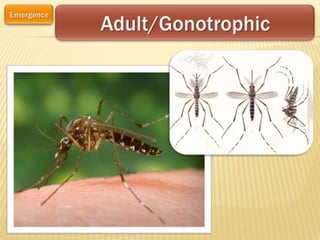
The adult emerges from the pupal case after about two days.
The adult ingest air to expand their abdomen. This splits the pupal
case allowing the adult to emerge head first.
The adults move from the surface of the water to cool, moist areas
where they mate and begin the life cycle again.
Males and females mate shortly after emerging from their pupal
cases. Male mosquitoes live only a few days after mating, feeding on
plant nectar until they die.
The fertilized female must have one to three blood meals to allow
her eggs to mature for laying.
Each blood meal takes two to seven days to digest.
The female can produce up to 200 eggs per clutch after three blood
meals.
The number of eggs produced depends on the amount of blood
consumed.
Each female is capable of producing up to five clutches in her
lifetime.
Pupa to Adult transition takes approximately 2 days to complete.
Aedes aegypti females usually lay their eggs singly, though they
can be laid in a raft.
Eggs are laid near water where flooding and raised water levels
generally occur.
Initially white eggs turn a shiny black color a few minutes after
being laid.
Eggs can survive several months if desiccated. When wet, the
eggs hatch into larvae in two to seven days based upon the
climate and temperature.
Egg to Larvae transition is approximately 2-7 days.
Mosquito larvae are commonly called "wrigglers" because of
their behavior of wiggling when disturbed.
Larvae hang head down from the surface of the water with their
posterior breathing tube (siphon) extended above the surface for
air.
The larvae feed on algae and microorganisms filtered from the
water by their mouthparts.
The larva quickly moves through the first three stages (instars)
as they grow rapidly and require molting.
The larva stays in the fourth instar stage longer than the
previous stages, usually three days under ideal conditions.
Ae. aegypti larva can survive up to a month under cold
conditions.
Egg to Larvae transition is approximately 2 days.
After reaching maturity, the fourth instar enters the pupal
stage.
The pupa is located on the surface of the water where it
breathes through a pair of air tubes or trumpets.
This stage of the mosquito is commonly referred to as a
"tumbler." The pupae of mosquitoes are mobile and respond to
stimuli.
The pupae do not feed.
They take about two days to mature.
Inside the pupal case metamorphosis occurs changing the
larval form into an adult with legs, wings, compound eyes, and
sucking mouthparts.
Larva to Pupa transition is approximately 2 days.
Aedes Aegypti

Aedes Aegypti

  • 3.
    The adult emergesfrom the pupal case after about two days. The adult ingest air to expand their abdomen. This splits the pupal case allowing the adult to emerge head first. The adults move from the surface of the water to cool, moist areas where they mate and begin the life cycle again. Males and females mate shortly after emerging from their pupal cases. Male mosquitoes live only a few days after mating, feeding on plant nectar until they die. The fertilized female must have one to three blood meals to allow her eggs to mature for laying. Each blood meal takes two to seven days to digest. The female can produce up to 200 eggs per clutch after three blood meals. The number of eggs produced depends on the amount of blood consumed. Each female is capable of producing up to five clutches in her lifetime. Pupa to Adult transition takes approximately 2 days to complete.
  • 5.
    Aedes aegypti femalesusually lay their eggs singly, though they can be laid in a raft. Eggs are laid near water where flooding and raised water levels generally occur. Initially white eggs turn a shiny black color a few minutes after being laid. Eggs can survive several months if desiccated. When wet, the eggs hatch into larvae in two to seven days based upon the climate and temperature. Egg to Larvae transition is approximately 2-7 days.
  • 7.
    Mosquito larvae arecommonly called "wrigglers" because of their behavior of wiggling when disturbed. Larvae hang head down from the surface of the water with their posterior breathing tube (siphon) extended above the surface for air. The larvae feed on algae and microorganisms filtered from the water by their mouthparts. The larva quickly moves through the first three stages (instars) as they grow rapidly and require molting. The larva stays in the fourth instar stage longer than the previous stages, usually three days under ideal conditions. Ae. aegypti larva can survive up to a month under cold conditions. Egg to Larvae transition is approximately 2 days.
  • 9.
    After reaching maturity,the fourth instar enters the pupal stage. The pupa is located on the surface of the water where it breathes through a pair of air tubes or trumpets. This stage of the mosquito is commonly referred to as a "tumbler." The pupae of mosquitoes are mobile and respond to stimuli. The pupae do not feed. They take about two days to mature. Inside the pupal case metamorphosis occurs changing the larval form into an adult with legs, wings, compound eyes, and sucking mouthparts. Larva to Pupa transition is approximately 2 days.