ADVICE for the WISE


    Newsletter – JUNE 2012
Contents


Index                        Page No.
Economic Update                   4

Equity Outlook                    8

Debt Outlook                     11
Forex                             13

Commodities                       14

Real Estate                      15


                                        2
From the Desk of the CIO…

Dear Investor,
The domestic investors in Indian equities markets can use the approach                                 positive news alike can be exploited rather systematically by having the
used by several companies in the developed markets when their stock                                    gumption to buy into falling markets. The flipside is of course that
prices are unusually depressed for reasons beyond their control. Such                                  attractive markets get even more attractive before they get fairly valued
companies routinely buy back their stock with spare cash. They believe                                 again. One who has the patience to ignore the noise on the way will tend
that the stock prices do not reflect the fundamental value of their                                    to make the most of the turbulence.
company and use the opportunity to buy back the cheaply available stock.
                                                                                                       In the short term the events in Europe will dominate the investor
As global investors shun India with several doubts regarding the India
                                                                                                       sentiment globally. We have seen mood swings of epic proportion in
growth story coupled with their own domestic fears of a financial
                                                                                                       recent weeks. Eurobonds, political union, fiscal compact, Spanish banks on
meltdown, Indian investors would do well to use this opportunity to
                                                                                                       the eastern side of Atlantic and a renewed talk of QE-III on the western
increase their holding of Indian equities. Just as the beaten down mid-cap
                                                                                                       side of it have kept investors guessing regarding the present times are
stock recovers once normalcy returns, the equities valuations in a country
                                                                                                       “risk-on” or “risk-off”. We continue to believe that Euro will continue to
such as India will tend to recover quite sharply once the sentiment
                                                                                                       survive even if and when Greece exits it. The talk of Lehman-like meltdown
stabilizes globally.
                                                                                                       underestimates the degree of preparedness around the world on another
This is not to trivialize the challenges facing the India growth story since                           Greek default (after the “voluntary” write-down last year). The battle of
there are quite a few. However we believe that in falling markets investors                            wits between the stronger Euro-area countries including Germany and the
often look for confirmatory negative evidence to their beliefs. Hence even                             weaker section (increasingly led by France) is more of a poker game than a
data of relatively limited relevance becomes suddenly the centre of                                    shoot-out. The stronger countries will foot a large part of the bill for
attention if it happens to confirm the existing pessimistic beliefs. The price                         further fiscal integration (through Eurobonds, debt mutualization etc) and
volatility hence tends to be significantly higher than volatility of earnings,                         they want to extract a good price for it – potentially through a higher say
as everyone tries to makes sure that she is not without the chair when the                             in the future United States of Europe. As we maintained earlier, in absence
proverbial music stops. The mirror image of this behavior occurs in the                                of an unforeseen financial accident, Euro is unlikely to break up. The path
bullish markets when most analysts spend better part of their energy on                                to the crisis resolution is very bumpy however.
justifying already high valuations by projecting good recent past into an
                                                                                                       Ignore all news (noise!) till it settles down or actively buy when others sell
infinite future.
                                                                                                       are the only two sensible strategies through such turbulence.
We believe that this tendency of majority to over-react to negative and

“Advisory services are provided through Karvy Stock Broking Ltd. (PMS) having SEBI Registration No: INP000001512. Investments are subject to market risks. Please read the disclaimer on slide no.18”
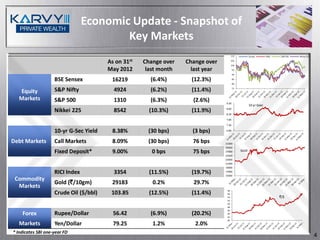
Economic Update - Snapshot of
                                         Key Markets
                                                                                       110          Sensex       Nifty    S&P 500   Nikkei 225

                                        As on 31st   Change over   Change over         105

                                                                                       100

                                        May 2012      last month     last year          95

                                                                                        90

                    BSE Sensex           16219         (6.4%)        (12.3%)            85

                                                                                        80


   Equity           S&P Nifty             4924         (6.2%)        (11.4%)            75


   Markets          S&P 500               1310         (6.3%)        (2.6%)      9.30
                                                                                                    10 yr Gsec
                    Nikkei 225            8542         (10.3%)       (11.9%)     8.80

                                                                                 8.30

                                                                                 7.80

                                                                                 7.30

                    10-yr G-Sec Yield    8.38%        (30 bps)       (3 bps)     6.80


Debt Markets        Call Markets         8.09%        (30 bps)       76 bps      31000
                                                                                 29000
                    Fixed Deposit*       9.00%          0 bps        75 bps      27000       Gold
                                                                                 25000
                                                                                 23000
                                                                                 21000
                                                                                 19000

                    RICI Index            3354         (11.5%)       (19.7%)     17000
                                                                                 15000
 Commodity
                    Gold (`/10gm)        29183          0.2%         29.7%
  Markets
                                                                                  58
                    Crude Oil ($/bbl)    103.85        (12.5%)       (11.4%)      56
                                                                                  54                                     `/$
                                                                                  52
                                                                                  50
                                                                                  48
                                                                                  46
    Forex           Rupee/Dollar          56.42        (6.9%)        (20.2%)      44
                                                                                  42
                                                                                  40
   Markets          Yen/Dollar            79.25         1.2%          2.0%
* Indicates SBI one-year FD
                                                                                                                                                 4
Economy Update - Global

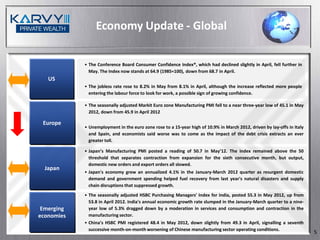
            • The Conference Board Consumer Confidence Index®, which had declined slightly in April, fell further in
              May. The Index now stands at 64.9 (1985=100), down from 68.7 in April.
   US
            • The jobless rate rose to 8.2% in May from 8.1% in April, although the increase reflected more people
              entering the labour force to look for work, a possible sign of growing confidence.

            • The seasonally adjusted Markit Euro zone Manufacturing PMI fell to a near three-year low of 45.1 in May
              2012, down from 45.9 in April 2012

 Europe
            • Unemployment in the euro zone rose to a 15-year high of 10.9% in March 2012, driven by lay-offs in Italy
              and Spain, and economists said worse was to come as the impact of the debt crisis extracts an ever
              greater toll.

            • Japan’s Manufacturing PMI posted a reading of 50.7 in May’12. The index remained above the 50
              threshold that separates contraction from expansion for the sixth consecutive month, but output,
              domestic new orders and export orders all slowed.
  Japan
            • Japan's economy grew an annualized 4.1% in the January-March 2012 quarter as resurgent domestic
              demand and government spending helped fuel recovery from last year's natural disasters and supply
              chain disruptions that suppressed growth.
            • The seasonally adjusted HSBC Purchasing Managers' Index for India, posted 55.3 in May 2012, up from
              53.8 in April 2012. India's annual economic growth rate slumped in the January-March quarter to a nine-
 Emerging     year low of 5.3% dragged down by a moderation in services and consumption and contraction in the
economies     manufacturing sector.
            • China’s HSBC PMI registered 48.4 in May 2012, down slightly from 49.3 in April, signalling a seventh
              successive month-on-month worsening of Chinese manufacturing sector operating conditions.
                                                                                                                         5
Economy Outlook - Domestic

10.0%
 8.0%
                                       IIP
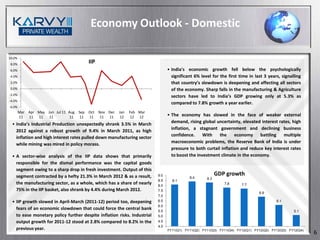
 6.0%                                                                           • India's economic growth fell below the psychologically
 4.0%                                                                             significant 6% level for the first time in last 3 years, signalling
 2.0%                                                                             that country’s slowdown is deepening and affecting all sectors
 0.0%                                                                             of the economy. Sharp falls in the manufacturing & Agriculture
-2.0%
                                                                                  sectors have led to India’s GDP growing only at 5.3% as
-4.0%
                                                                                  compared to 7.8% growth a year earlier.
-6.0%
        Mar Apr May Jun Jul 11 Aug Sep Oct Nov Dec    Jan   Feb Mar
        11  11 11    11        11   11 11  11 11      12     12 12              • The economy has slowed in the face of weaker external
                                                                                  demand, rising global uncertainty, elevated interest rates, high
  • India’s Industrial Production unexpectedly shrank 3.5% in March
                                                                                  inflation, a stagnant government and declining business
    2012 against a robust growth of 9.4% in March 2011, as high
                                                                                  confidence.     With    the     economy     battling   multiple
    inflation and high interest rates pulled down manufacturing sector
                                                                                  macroeconomic problems, the Reserve Bank of India is under
    while mining was mired in policy morass.
                                                                                  pressure to both curtail inflation and reduce key interest rates
  • A sector-wise analysis of the IIP data shows that primarily                   to boost the investment climate in the economy.
    responsible for the dismal performance was the capital goods
    segment owing to a sharp drop in fresh investment. Output of this
    segment contracted by a hefty 21.3% in March 2012 & as a result,      9.0                             GDP growth
                                                                                           8.4      8.3
                                                                          8.5     8.1
    the manufacturing sector, as a whole, which has a share of nearly     8.0
                                                                                                             7.8      7.7
    75% in the IIP basket, also shrank by 4.4% during March 2012.         7.5
                                                                                                                               6.9
                                                                          7.0
  • IIP growth slowed in April-March (2011-12) period too, deepening      6.5                                                           6.1
                                                                          6.0
    fears of an economic slowdown that could force the central bank       5.5                                                                    5.1
    to ease monetary policy further despite inflation risks. Industrial   5.0
    output growth for 2011-12 stood at 2.8% compared to 8.2% in the       4.5
                                                                          4.0
    previous year.                                                              FY11(Q1) FY11(Q2) FY11(Q3) FY11(Q4) FY12(Q1) FY12(Q2) FY12(Q3) FY12(Q4)
                                                                                                                                                          6
Economic Outlook - Domestic

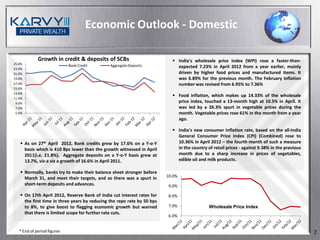
             Growth in credit & deposits of SCBs                            India's wholesale price index (WPI) rose a faster-than-
25.0%                        Bank Credit       Aggregate Deposits
23.0%
                                                                             expected 7.23% in April 2012 from a year earlier, mainly
21.0%                                                                        driven by higher food prices and manufactured items. It
19.0%                                                                        was 6.89% for the previous month. The February Inflation
17.0%                                                                        number was revised from 6.95% to 7.36%
15.0%
13.0%
                                                                            Food inflation, which makes up 14.33% of the wholesale
11.0%
 9.0%                                                                        price index, touched a 13-month high at 10.5% in April. It
 7.0%                                                                        was led by a 26.3% spurt in vegetable prices during the
 5.0%                                                                        month. Vegetable prices rose 61% in the month from a year
                                                                             ago.

                                                                            India's new consumer inflation rate, based on the all-India
                                                                             General Consumer Price Index (CPI) (Combined) rose to
    As on 27th April 2012, Bank credits grew by 17.6% on a Y-o-Y            10.36% in April 2012 – the fourth month of such a measure
     basis which is 410 Bps lower than the growth witnessed in April         in the country of retail prices - against 9.38% in the previous
     2011(i.e. 21.8%). Aggregate deposits on a Y-o-Y basis grew at           month due to a sharp increase in prices of vegetables,
     13.7%, viz-a viz a growth of 16.6% in April 2011.                       edible oil and milk products.

    Normally, banks try to make their balance sheet stronger before
     March 31, and meet their targets, and so there was a spurt in       10.0%
     short-term deposits and advances.                                   9.0%

    On 17th April 2012, Reserve Bank of India cut interest rates for    8.0%
     the first time in three years by reducing the repo rate by 50 bps
     to 8%, to give boost to flagging economic growth but warned         7.0%                Wholesale Price Index
     that there is limited scope for further rate cuts.
                                                                         6.0%


   * End of period figures                                                                                                                     7
Equity Outlook

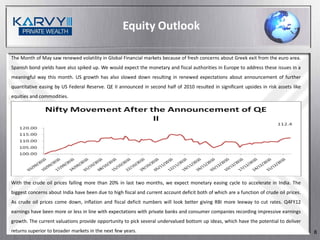
The Month of May saw renewed volatility in Global Financial markets because of fresh concerns about Greek exit from the euro area.
Spanish bond yields have also spiked up. We would expect the monetary and fiscal authorities in Europe to address these issues in a
meaningful way this month. US growth has also slowed down resulting in renewed expectations about announcement of further
quantitative easing by US Federal Reserve. QE II announced in second half of 2010 resulted in significant upsides in risk assets like
equities and commodities.


With the crude oil prices falling more than 20% in last two months, we expect monetary easing cycle to accelerate in India. The
biggest concerns about India have been due to high fiscal and current account deficit both of which are a function of crude oil prices.
As crude oil prices come down, inflation and fiscal deficit numbers will look better giving RBI more leeway to cut rates. Q4FY12
earnings have been more or less in line with expectations with private banks and consumer companies recording impressive earnings
growth. The current valuations provide opportunity to pick several undervalued bottom up ideas, which have the potential to deliver
returns superior to broader markets in the next few years.                                                                                8
Sector View

    Sector          Stance                                                     Remarks

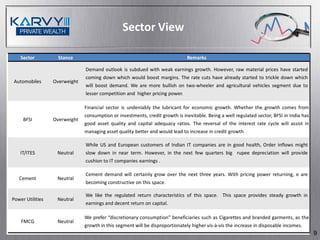
                               Demand outlook is subdued with weak earnings growth. However, raw material prices have started
                               coming down which would boost margins. The rate cuts have already started to trickle down which
Automobiles       Overweight
                               will boost demand. We are more bullish on two-wheeler and agricultural vehicles segment due to
                               lesser competition and higher pricing power.

                               Financial sector is undeniably the lubricant for economic growth. Whether the growth comes from
                               consumption or investments, credit growth is inevitable. Being a well regulated sector, BFSI in India has
     BFSI         Overweight
                               good asset quality and capital adequacy ratios. The reversal of the interest rate cycle will assist in
                               managing asset quality better and would lead to increase in credit growth

                               While US and European customers of Indian IT companies are in good health, Order inflows might
    IT/ITES        Neutral     slow down in near term. However, in the next few quarters big rupee depreciation will provide
                               cushion to IT companies earnings .

                               Cement demand will certainly grow over the next three years. With pricing power returning, e are
   Cement          Neutral
                               becoming constructive on this space.

                               We like the regulated return characteristics of this space. This space provides steady growth in
Power Utilities    Neutral
                               earnings and decent return on capital.

                               We prefer “discretionary consumption” beneficiaries such as Cigarettes and branded garments, as the
    FMCG           Neutral
                               growth in this segment will be disproportionately higher vis-à-vis the increase in disposable incomes.
                                                                                                                                           9
Sector View

  Sector       Stance                                                    Remarks
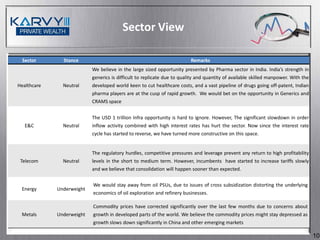
                           We believe in the large sized opportunity presented by Pharma sector in India. India’s strength in
                           generics is difficult to replicate due to quality and quantity of available skilled manpower. With the
Healthcare     Neutral     developed world keen to cut healthcare costs, and a vast pipeline of drugs going off-patent, Indian
                           pharma players are at the cusp of rapid growth. We would bet on the opportunity in Generics and
                           CRAMS space


                           The USD 1 trillion Infra opportunity is hard to ignore. However, The significant slowdown in order
   E&C         Neutral     inflow activity combined with high interest rates has hurt the sector. Now since the interest rate
                           cycle has started to reverse, we have turned more constructive on this space.


                           The regulatory hurdles, competitive pressures and leverage prevent any return to high profitability
 Telecom       Neutral     levels in the short to medium term. However, incumbents have started to increase tariffs slowly
                           and we believe that consolidation will happen sooner than expected.

                           We would stay away from oil PSUs, due to issues of cross subsidization distorting the underlying
 Energy      Underweight
                           economics of oil exploration and refinery businesses.

                           Commodity prices have corrected significantly over the last few months due to concerns about
 Metals      Underweight   growth in developed parts of the world. We believe the commodity prices might stay depressed as
                           growth slows down significantly in China and other emerging markets

                                                                                                                                    10
Debt Outlook

      9.0                                                                      9.30
                              Yield curve                                                    10-yr G-sec yield
      8.8
                                                                               8.80
      8.6
                                                                               8.30
(%)


                                                                         (%)
      8.4

      8.2                                                                      7.80
      8.0
                                                                               7.30
      7.8

      7.6                                                                      6.80
             7.9
             0.0
             0.8
             1.6
             2.4
             3.2
             4.0
             4.7
             5.5
             6.3
             7.1

             8.7
             9.5
            10.2
            11.0
            11.8
            12.6
            13.4
            14.2
            15.0
            15.7
            16.5
            17.3
            18.1
            18.9
            19.7
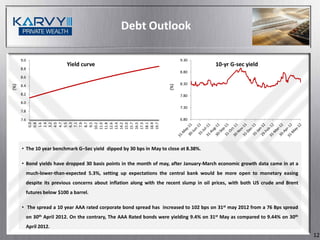
      • The 10 year benchmark G–Sec yield dipped by 30 bps in May to close at 8.38%.

      • Bond yields have dropped 30 basis points in the month of may, after January-March economic growth data came in at a
            much-lower-than-expected 5.3%, setting up expectations the central bank would be more open to monetary easing
            despite its previous concerns about inflation along with the recent slump in oil prices, with both US crude and Brent
            futures below $100 a barrel.

      • The spread a 10 year AAA rated corporate bond spread has increased to 102 bps on 31st may 2012 from a 76 Bps spread
            on 30th April 2012. On the contrary, The AAA Rated bonds were yielding 9.4% on 31st May as compared to 9.44% on 30th
            April 2012.
                                                                                                                                    12
Debt Strategy

  Category     Outlook                                         Details
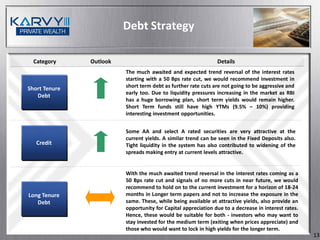
                         The much awaited and expected trend reversal of the interest rates
                         starting with a 50 Bps rate cut, we would recommend investment in
Short Tenure             short term debt as further rate cuts are not going to be aggressive and
                         early too. Due to liquidity pressures increasing in the market as RBI
   Debt
                         has a huge borrowing plan, short term yields would remain higher.
                         Short Term funds still have high YTMs (9.5% – 10%) providing
                         interesting investment opportunities.


                         Some AA and select A rated securities are very attractive at the
                         current yields. A similar trend can be seen in the Fixed Deposits also.
   Credit                Tight liquidity in the system has also contributed to widening of the
                         spreads making entry at current levels attractive.


                         With the much awaited trend reversal in the interest rates coming as a
                         50 Bps rate cut and signals of no more cuts in near future, we would
                         recommend to hold on to the current investment for a horizon of 18-24
Long Tenure              months in Longer term papers and not to increase the exposure in the
   Debt                  same. These, while being available at attractive yields, also provide an
                         opportunity for Capital appreciation due to a decrease in interest rates.
                         Hence, these would be suitable for both - investors who may want to
                         stay invested for the medium term (exiting when prices appreciate) and
                         those who would want to lock in high yields for the longer term.
                                                                                                     13
Forex

Rupee movement vis-à-vis other currencies (M-o-M)                        100
                                                                                   Trade balance and export-import data                                                        0
             USD             GBP           EURO            YEN                                 Export             Import              Trade Balance (mn $)
                                                                          80                                                                                                   -5000
0.00%                                                                     60
                                                                                                                                                                               -10000
-1.00%                                                                    40
                                                                                                                                                                               -15000
                                                                          20
-2.00%                                    (0.48%)                                                                                                                              -20000
                                                                           -
-3.00%                                                                   (20)                                                                                                  -25000
                           (2.15%)
-4.00%
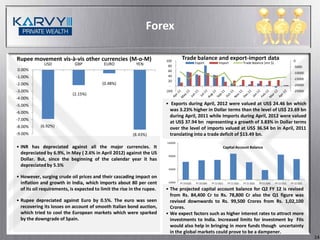
-5.00%                                                                   • Exports during April, 2012 were valued at US$ 24.46 bn which
                                                                           was 3.23% higher in Dollar terms than the level of US$ 23.69 bn
-6.00%
                                                                           during April, 2011 while Imports during April, 2012 were valued
-7.00%
                                                                           at US$ 37.94 bn representing a growth of 3.83% in Dollar terms
-8.00%      (6.92%)                                                        over the level of imports valued at US$ 36.54 bn in April, 2011
-9.00%                                                    (8.43%)          translating into a trade deficit of $13.49 bn.
                                                                         140000
• INR has depreciated against all the major currencies. It                                                           Capital Account Balance
  depreciated by 6.9%, in May ( 2.6% in April 2012) against the US
                                                                          90000
  Dollar. But, since the beginning of the calendar year it has
  depreciated by 5.5%
                                                                          40000


• However, surging crude oil prices and their cascading impact on
  inflation and growth in India, which imports about 80 per cent         -10000   FY 10 (Q3)   FY 10 (Q4)   FY 11 (Q1)   FY 11 (Q2)   FY 11 (Q3)   FY 11 (Q4)   FY 12 (Q1)   FY 12 (Q2)

  of its oil requirements, is expected to limit the rise in the rupee.   • The projected capital account balance for Q2 FY 12 is revised
                                                                           from Rs. 84,400 Cr to Rs. 78,800 Cr also the Q1 figure was
• Rupee depreciated against Euro by 0.5%. The euro was seen                revised downwards to Rs. 99,500 Crores from Rs. 1,02,100
  recovering its losses on account of smooth Italian bond auction,         Crores.
  which tried to cool the European markets which were sparked            • We expect factors such as higher interest rates to attract more
  by the downgrade of Spain.                                               investments to India. Increased limits for investment by FIIs
                                                                           would also help in bringing in more funds though uncertainty
                                                                           in the global markets could prove to be a dampener.
                                                                                                                                                                                          14
Commodities

                                                                                         30000
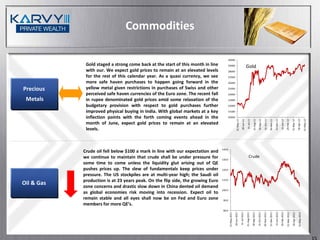
             Gold staged a strong come back at the start of this month in line           29000
                                                                                                                                       Gold
             with our. We expect gold prices to remain at an elevated levels             28000
             for the rest of this calendar year. As a quasi currency, we see             27000

             more safe haven purchases to happen going forward in the                    26000

Precious     yellow metal given restrictions in purchases of Swiss and other             25000

             perceived safe haven currencies of the Euro zone. The recent fall           24000

 Metals      in rupee denominated gold prices amid some relaxation of the                23000

             budgetary provision with respect to gold purchases further                  22000

             improved physical buying in India. With global markets at a key             21000

             inflection points with the forth coming events ahead in the                 20000


                                                                                                                                         31-Jul-11


                                                                                                                                                                                                                            31-Jan-12
                                                                                                                                                        31-Aug-11


                                                                                                                                                                                   31-Oct-11


                                                                                                                                                                                                                                                         31-Mar-12
                                                                                                                           30-Jun-11


                                                                                                                                                                                                                                                                        30-Apr-12
                                                                                                                                                                                                              31-Dec-11
                                                                                                            31-May-11


                                                                                                                                                                                                30-Nov-11


                                                                                                                                                                                                                                                                                        31-May-12
                                                                                                                                                                     30-Sep-11


                                                                                                                                                                                                                                          29-Feb-12
             month of June, expect gold prices to remain at an elevated
             levels.


                                                                                 140.0
            Crude oil fell below $100 a mark in line with our expectation and
            we continue to maintain that crude shall be under pressure for                                                                   Crude
                                                                                 130.0
            some time to come unless the liquidity glut arising out of QE
            pushes prices up. The slew of fundamentals keep prices under         120.0

            pressure. The US stockpiles are at multi-year high; the Saudi oil
            production is at 23 years peak. On the flip side, the growing Euro   110.0
Oil & Gas   zone concerns and drastic slow down in China dented oil demand
                                                                                 100.0
            as global economies risk moving into recession. Expect oil to
            remain stable and all eyes shall now be on Fed and Euro zone          90.0
            members for more QE’s.
                                                                                  80.0


                                                                                                                                                                    31-Oct-2011


                                                                                                                                                                                                                                           31-Mar-2012
                                                                                                        30-Jun-2011


                                                                                                                                                                                                                                                          30-Apr-2012
                                                                                                                                                                                                31-Dec-2011
                                                                                          31-May-2011


                                                                                                                                                                                  30-Nov-2011


                                                                                                                                                                                                                                                                          31-May-2012
                                                                                                                        31-Jul-2011


                                                                                                                                                     30-Sep-2011


                                                                                                                                                                                                              31-Jan-2012

                                                                                                                                                                                                                            29-Feb-2012
                                                                                                                                       31-Aug-2011
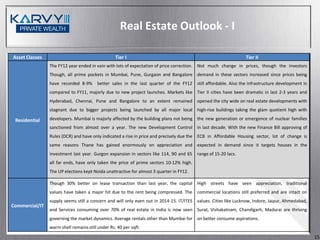
Real Estate Outlook - I

Asset Classes                                     Tier I                                                        Tier II
                The FY12 year ended in vain with lots of expectation of price correction. Not much change in prices, though the investors
                Though, all prime pockets in Mumbai, Pune, Gurgaon and Bangalore demand in these sectors increased since prices being
                have recorded 8-9%      better sales in the last quarter of the FY12 still affordable. Also the infrastructure development in
                compared to FY11, majorly due to new project launches. Markets like Tier II cities have been dramatic in last 2-3 years and
                Hyderabad, Chennai, Pune and Bangalore to an extent remained opened the city wide on real estate developments with
                stagnant due to bigger projects being launched by all major local high-rise buildings taking the glam quotient high with

 Residential    developers. Mumbai is majorly affected by the building plans not being the new generation or emergence of nuclear families
                sanctioned from almost over a year. The new Development Control in last decade. With the new Finance Bill approving of
                Rules (DCR) and have only indicated a rise in price and precisely due the ECB in Affordable Housing sector, lot of change is
                same reasons Thane has gained enormously on appreciation and expected in demand since it targets houses in the
                investment last year. Gurgon expansion in sectors like 114, 90 and 65    range of 15-20 lacs.
                all far ends, have only taken the price of prime sectors 10-12% high.
                The UP elections kept Noida unattractive for almost 3 quarter in FY12.

                Though 30% better on lease transaction than last year, the capital High streets have seen appreciation, traditional
                values have taken a major hit due to the rent being compressed. The commercial locations still preferred and are intact on
                supply seems still a concern and will only even out in 2014-15. IT/ITES values. Cities like Lucknow, Indore, Jaipur, Ahmedabad,
Commercial/IT
                and Services consuming over 70% of real estate in India is now seen Surat, Vishakatnam, Chandigarh, Madurai are thriving
                governing the market dynamics. Average rentals other than Mumbai for on better consume aspirations.
                warm shell remains still under Rs. 40 per sqft.

                                                                                                                                                  15
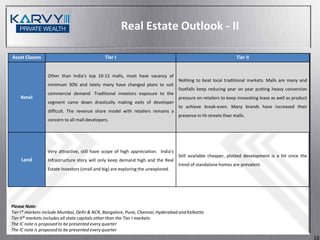
Real Estate Outlook - II

Asset Classes                                 Tier I                                                            Tier II


                 Other than India’s top 10-15 malls, most have vacancy of
                                                                                   Nothing to beat local traditional markets. Malls are many and
                 minimum 30% and lately many have changed plans to suit
                                                                                   footfalls keep reducing year on year putting heavy conversion
                 commercial demand. Traditional investors exposure to the
    Retail                                                                         pressure on retailers to keep innovating lease as well as product
                 segment came down drastically making exits of developer
                                                                                   to achieve break-even. Many brands have increased their
                 difficult. The revenue share model with retailers remains a
                                                                                   presence in Hi-streets than malls.
                 concern to all mall developers.


                 Very attractive, still have scope of high appreciation. India’s
                                                                                   Still available cheaper, plotted development is a hit since the
    Land         Infrastructure story will only keep demand high and the Real
                                                                                   trend of standalone homes are prevalent.
                 Estate Investors (small and big) are exploring the unexplored.


Please Note:
Tier I* markets include Mumbai, Delhi & NCR, Bangalore, Pune, Chennai, Hyderabad and Kolkatta
Tier II* markets includes all state capitals other than the Tier I markets
The IC note is proposed to be presented every quarter
                                                                                                                                                       16
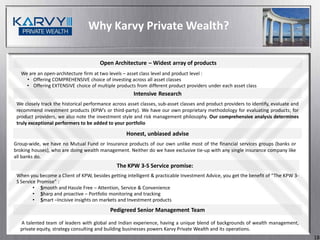
Why Karvy Private Wealth?

                                       Open Architecture – Widest array of products
   We are an open-architecture firm at two levels – asset class level and product level :
     • Offering COMPREHENSIVE choice of investing across all asset classes
     • Offering EXTENSIVE choice of multiple products from different product providers under each asset class
                                                       Intensive Research
 We closely track the historical performance across asset classes, sub-asset classes and product providers to identify, evaluate and
 recommend investment products (KPW’s or third-party). We have our own proprietary methodology for evaluating products; for
 product providers, we also note the investment style and risk management philosophy. Our comprehensive analysis determines
 truly exceptional performers to be added to your portfolio

                                                   Honest, unbiased advise
Group-wide, we have no Mutual Fund or Insurance products of our own unlike most of the financial services groups (banks or
broking houses), who are doing wealth management. Neither do we have exclusive tie-up with any single insurance company like
all banks do.
                                               The KPW 3-S Service promise:
 When you become a Client of KPW, besides getting intelligent & practicable Investment Advice, you get the benefit of “The KPW 3-
 S Service Promise” :
         • Smooth and Hassle Free – Attention, Service & Convenience
         • Sharp and proactive – Portfolio monitoring and tracking
         • Smart –Incisive insights on markets and Investment products
                                            Pedigreed Senior Management Team

  A talented team of leaders with global and Indian experience, having a unique blend of backgrounds of wealth management,
  private equity, strategy consulting and building businesses powers Karvy Private Wealth and its operations.
                                                                                                                                       18
Disclaimer

The information and views presented here are prepared by Karvy Private Wealth(a division of Karvy Stock Broking Limited) or other Karvy Group
companies. The information contained herein is based on our analysis and upon sources that we consider reliable. We, however, do not vouch for the
accuracy or the completeness thereof. This material is for personal information and we are not responsible for any loss incurred based upon it.

The investments discussed or recommended here may not be suitable for all investors. Investors must make their own investment decisions based on
their specific investment objectives and financial position and using such independent advice, as they believe necessary. While acting upon any
information or analysis mentioned here, investors may please note that neither Karvy nor any person connected with any associated companies of
Karvy accepts any liability arising from the use of this information and views mentioned here.

The author, directors and other employees of Karvy and its affiliates may hold long or short positions in the above-mentioned companies from time to
time. Every employee of Karvy and its associated companies are required to disclose their individual stock holdings and details of trades, if any, that
they undertake. The team rendering corporate analysis and investment recommendations are restricted in purchasing/selling of shares or other
securities till such a time this recommendation has either been displayed or has been forwarded to clients of Karvy. All employees are further
restricted to place orders only through Karvy Stock Broking Ltd.

The information given in this document on tax are for guidance only, and should not be construed as tax advice. Investors are advised to consult their
respective tax advisers to understand the specific tax incidence applicable to them. We also expect significant changes in the tax laws once the new
Direct Tax Code is in force – this could change the applicability and incidence of tax on investments

Karvy Private Wealth (A division of Karvy Stock Broking Limited) operates from within India and is subject to Indian regulations.
Karvy Stock Broking Ltd. is a SEBI registered stock broker, depository participant having its offices at:
702, Hallmark Business plaza, Sant Dnyaneshwar Marg, Bandra (East), off Bandra Kurla Complex, Mumbai 400 051 .
(Registered office Address: Karvy Stock Broking Limited, “KARVY HOUSE”, 46, Avenue 4, Street No.1, Banjara Hills, Hyderabad 500 034)

SEBI registration No’s:”NSE(CM):INB230770138, NSE(F&O): INF230770138, BSE: INB010770130, BSE(F&O): INF010770131,NCDEX(00236,
NSE(CDS):INE230770138, NSDL – SEBI Registration No: IN-DP-NSDL-247-2005, CSDL-SEBI Registration No:IN-DP-CSDL-305-2005, PMS Registration No.:
INP000001512”                                                                                                                                             19
Contact Us


                                  Bangalore               080-26606126
                                  Chennai                 044-45925923
                                  Coimbatore              0422-4291018
                                  Delhi                   011-43533941
                                  Gurgaon                 0124-4780228
                                  Hyderabad               040-44507282
                                  Kochi                   0484-2322152

                                  Kolkata                 033-40515100
                                  Mumbai                  022-33055000
                                  Pune                    020-30116238

     Email: wealth@karvy.com            SMS: ‘HNI’ to 56767         Website: www.karvywealth.com


Corporate Office : 702, Hallmark Business Plaza, Off Bandra Kurla Complex, Bandra (East), Mumbai – 400 051
                                                                                                             20

Advice for the wise June 2012

  • 1.
    ADVICE for theWISE Newsletter – JUNE 2012
  • 2.
    Contents Index Page No. Economic Update 4 Equity Outlook 8 Debt Outlook 11 Forex 13 Commodities 14 Real Estate 15 2
  • 3.
    From the Deskof the CIO… Dear Investor, The domestic investors in Indian equities markets can use the approach positive news alike can be exploited rather systematically by having the used by several companies in the developed markets when their stock gumption to buy into falling markets. The flipside is of course that prices are unusually depressed for reasons beyond their control. Such attractive markets get even more attractive before they get fairly valued companies routinely buy back their stock with spare cash. They believe again. One who has the patience to ignore the noise on the way will tend that the stock prices do not reflect the fundamental value of their to make the most of the turbulence. company and use the opportunity to buy back the cheaply available stock. In the short term the events in Europe will dominate the investor As global investors shun India with several doubts regarding the India sentiment globally. We have seen mood swings of epic proportion in growth story coupled with their own domestic fears of a financial recent weeks. Eurobonds, political union, fiscal compact, Spanish banks on meltdown, Indian investors would do well to use this opportunity to the eastern side of Atlantic and a renewed talk of QE-III on the western increase their holding of Indian equities. Just as the beaten down mid-cap side of it have kept investors guessing regarding the present times are stock recovers once normalcy returns, the equities valuations in a country “risk-on” or “risk-off”. We continue to believe that Euro will continue to such as India will tend to recover quite sharply once the sentiment survive even if and when Greece exits it. The talk of Lehman-like meltdown stabilizes globally. underestimates the degree of preparedness around the world on another This is not to trivialize the challenges facing the India growth story since Greek default (after the “voluntary” write-down last year). The battle of there are quite a few. However we believe that in falling markets investors wits between the stronger Euro-area countries including Germany and the often look for confirmatory negative evidence to their beliefs. Hence even weaker section (increasingly led by France) is more of a poker game than a data of relatively limited relevance becomes suddenly the centre of shoot-out. The stronger countries will foot a large part of the bill for attention if it happens to confirm the existing pessimistic beliefs. The price further fiscal integration (through Eurobonds, debt mutualization etc) and volatility hence tends to be significantly higher than volatility of earnings, they want to extract a good price for it – potentially through a higher say as everyone tries to makes sure that she is not without the chair when the in the future United States of Europe. As we maintained earlier, in absence proverbial music stops. The mirror image of this behavior occurs in the of an unforeseen financial accident, Euro is unlikely to break up. The path bullish markets when most analysts spend better part of their energy on to the crisis resolution is very bumpy however. justifying already high valuations by projecting good recent past into an Ignore all news (noise!) till it settles down or actively buy when others sell infinite future. are the only two sensible strategies through such turbulence. We believe that this tendency of majority to over-react to negative and “Advisory services are provided through Karvy Stock Broking Ltd. (PMS) having SEBI Registration No: INP000001512. Investments are subject to market risks. Please read the disclaimer on slide no.18”
  • 4.
    Economic Update -Snapshot of Key Markets 110 Sensex Nifty S&P 500 Nikkei 225 As on 31st Change over Change over 105 100 May 2012 last month last year 95 90 BSE Sensex 16219 (6.4%) (12.3%) 85 80 Equity S&P Nifty 4924 (6.2%) (11.4%) 75 Markets S&P 500 1310 (6.3%) (2.6%) 9.30 10 yr Gsec Nikkei 225 8542 (10.3%) (11.9%) 8.80 8.30 7.80 7.30 10-yr G-Sec Yield 8.38% (30 bps) (3 bps) 6.80 Debt Markets Call Markets 8.09% (30 bps) 76 bps 31000 29000 Fixed Deposit* 9.00% 0 bps 75 bps 27000 Gold 25000 23000 21000 19000 RICI Index 3354 (11.5%) (19.7%) 17000 15000 Commodity Gold (`/10gm) 29183 0.2% 29.7% Markets 58 Crude Oil ($/bbl) 103.85 (12.5%) (11.4%) 56 54 `/$ 52 50 48 46 Forex Rupee/Dollar 56.42 (6.9%) (20.2%) 44 42 40 Markets Yen/Dollar 79.25 1.2% 2.0% * Indicates SBI one-year FD 4
  • 5.
    Economy Update -Global • The Conference Board Consumer Confidence Index®, which had declined slightly in April, fell further in May. The Index now stands at 64.9 (1985=100), down from 68.7 in April. US • The jobless rate rose to 8.2% in May from 8.1% in April, although the increase reflected more people entering the labour force to look for work, a possible sign of growing confidence. • The seasonally adjusted Markit Euro zone Manufacturing PMI fell to a near three-year low of 45.1 in May 2012, down from 45.9 in April 2012 Europe • Unemployment in the euro zone rose to a 15-year high of 10.9% in March 2012, driven by lay-offs in Italy and Spain, and economists said worse was to come as the impact of the debt crisis extracts an ever greater toll. • Japan’s Manufacturing PMI posted a reading of 50.7 in May’12. The index remained above the 50 threshold that separates contraction from expansion for the sixth consecutive month, but output, domestic new orders and export orders all slowed. Japan • Japan's economy grew an annualized 4.1% in the January-March 2012 quarter as resurgent domestic demand and government spending helped fuel recovery from last year's natural disasters and supply chain disruptions that suppressed growth. • The seasonally adjusted HSBC Purchasing Managers' Index for India, posted 55.3 in May 2012, up from 53.8 in April 2012. India's annual economic growth rate slumped in the January-March quarter to a nine- Emerging year low of 5.3% dragged down by a moderation in services and consumption and contraction in the economies manufacturing sector. • China’s HSBC PMI registered 48.4 in May 2012, down slightly from 49.3 in April, signalling a seventh successive month-on-month worsening of Chinese manufacturing sector operating conditions. 5
  • 6.
    Economy Outlook -Domestic 10.0% 8.0% IIP 6.0% • India's economic growth fell below the psychologically 4.0% significant 6% level for the first time in last 3 years, signalling 2.0% that country’s slowdown is deepening and affecting all sectors 0.0% of the economy. Sharp falls in the manufacturing & Agriculture -2.0% sectors have led to India’s GDP growing only at 5.3% as -4.0% compared to 7.8% growth a year earlier. -6.0% Mar Apr May Jun Jul 11 Aug Sep Oct Nov Dec Jan Feb Mar 11 11 11 11 11 11 11 11 11 12 12 12 • The economy has slowed in the face of weaker external demand, rising global uncertainty, elevated interest rates, high • India’s Industrial Production unexpectedly shrank 3.5% in March inflation, a stagnant government and declining business 2012 against a robust growth of 9.4% in March 2011, as high confidence. With the economy battling multiple inflation and high interest rates pulled down manufacturing sector macroeconomic problems, the Reserve Bank of India is under while mining was mired in policy morass. pressure to both curtail inflation and reduce key interest rates • A sector-wise analysis of the IIP data shows that primarily to boost the investment climate in the economy. responsible for the dismal performance was the capital goods segment owing to a sharp drop in fresh investment. Output of this segment contracted by a hefty 21.3% in March 2012 & as a result, 9.0 GDP growth 8.4 8.3 8.5 8.1 the manufacturing sector, as a whole, which has a share of nearly 8.0 7.8 7.7 75% in the IIP basket, also shrank by 4.4% during March 2012. 7.5 6.9 7.0 • IIP growth slowed in April-March (2011-12) period too, deepening 6.5 6.1 6.0 fears of an economic slowdown that could force the central bank 5.5 5.1 to ease monetary policy further despite inflation risks. Industrial 5.0 output growth for 2011-12 stood at 2.8% compared to 8.2% in the 4.5 4.0 previous year. FY11(Q1) FY11(Q2) FY11(Q3) FY11(Q4) FY12(Q1) FY12(Q2) FY12(Q3) FY12(Q4) 6
  • 7.
    Economic Outlook -Domestic Growth in credit & deposits of SCBs  India's wholesale price index (WPI) rose a faster-than- 25.0% Bank Credit Aggregate Deposits 23.0% expected 7.23% in April 2012 from a year earlier, mainly 21.0% driven by higher food prices and manufactured items. It 19.0% was 6.89% for the previous month. The February Inflation 17.0% number was revised from 6.95% to 7.36% 15.0% 13.0%  Food inflation, which makes up 14.33% of the wholesale 11.0% 9.0% price index, touched a 13-month high at 10.5% in April. It 7.0% was led by a 26.3% spurt in vegetable prices during the 5.0% month. Vegetable prices rose 61% in the month from a year ago.  India's new consumer inflation rate, based on the all-India General Consumer Price Index (CPI) (Combined) rose to  As on 27th April 2012, Bank credits grew by 17.6% on a Y-o-Y 10.36% in April 2012 – the fourth month of such a measure basis which is 410 Bps lower than the growth witnessed in April in the country of retail prices - against 9.38% in the previous 2011(i.e. 21.8%). Aggregate deposits on a Y-o-Y basis grew at month due to a sharp increase in prices of vegetables, 13.7%, viz-a viz a growth of 16.6% in April 2011. edible oil and milk products.  Normally, banks try to make their balance sheet stronger before March 31, and meet their targets, and so there was a spurt in 10.0% short-term deposits and advances. 9.0%  On 17th April 2012, Reserve Bank of India cut interest rates for 8.0% the first time in three years by reducing the repo rate by 50 bps to 8%, to give boost to flagging economic growth but warned 7.0% Wholesale Price Index that there is limited scope for further rate cuts. 6.0% * End of period figures 7
  • 8.
    Equity Outlook The Monthof May saw renewed volatility in Global Financial markets because of fresh concerns about Greek exit from the euro area. Spanish bond yields have also spiked up. We would expect the monetary and fiscal authorities in Europe to address these issues in a meaningful way this month. US growth has also slowed down resulting in renewed expectations about announcement of further quantitative easing by US Federal Reserve. QE II announced in second half of 2010 resulted in significant upsides in risk assets like equities and commodities. With the crude oil prices falling more than 20% in last two months, we expect monetary easing cycle to accelerate in India. The biggest concerns about India have been due to high fiscal and current account deficit both of which are a function of crude oil prices. As crude oil prices come down, inflation and fiscal deficit numbers will look better giving RBI more leeway to cut rates. Q4FY12 earnings have been more or less in line with expectations with private banks and consumer companies recording impressive earnings growth. The current valuations provide opportunity to pick several undervalued bottom up ideas, which have the potential to deliver returns superior to broader markets in the next few years. 8
  • 9.
    Sector View Sector Stance Remarks Demand outlook is subdued with weak earnings growth. However, raw material prices have started coming down which would boost margins. The rate cuts have already started to trickle down which Automobiles Overweight will boost demand. We are more bullish on two-wheeler and agricultural vehicles segment due to lesser competition and higher pricing power. Financial sector is undeniably the lubricant for economic growth. Whether the growth comes from consumption or investments, credit growth is inevitable. Being a well regulated sector, BFSI in India has BFSI Overweight good asset quality and capital adequacy ratios. The reversal of the interest rate cycle will assist in managing asset quality better and would lead to increase in credit growth While US and European customers of Indian IT companies are in good health, Order inflows might IT/ITES Neutral slow down in near term. However, in the next few quarters big rupee depreciation will provide cushion to IT companies earnings . Cement demand will certainly grow over the next three years. With pricing power returning, e are Cement Neutral becoming constructive on this space. We like the regulated return characteristics of this space. This space provides steady growth in Power Utilities Neutral earnings and decent return on capital. We prefer “discretionary consumption” beneficiaries such as Cigarettes and branded garments, as the FMCG Neutral growth in this segment will be disproportionately higher vis-à-vis the increase in disposable incomes. 9
  • 10.
    Sector View Sector Stance Remarks We believe in the large sized opportunity presented by Pharma sector in India. India’s strength in generics is difficult to replicate due to quality and quantity of available skilled manpower. With the Healthcare Neutral developed world keen to cut healthcare costs, and a vast pipeline of drugs going off-patent, Indian pharma players are at the cusp of rapid growth. We would bet on the opportunity in Generics and CRAMS space The USD 1 trillion Infra opportunity is hard to ignore. However, The significant slowdown in order E&C Neutral inflow activity combined with high interest rates has hurt the sector. Now since the interest rate cycle has started to reverse, we have turned more constructive on this space. The regulatory hurdles, competitive pressures and leverage prevent any return to high profitability Telecom Neutral levels in the short to medium term. However, incumbents have started to increase tariffs slowly and we believe that consolidation will happen sooner than expected. We would stay away from oil PSUs, due to issues of cross subsidization distorting the underlying Energy Underweight economics of oil exploration and refinery businesses. Commodity prices have corrected significantly over the last few months due to concerns about Metals Underweight growth in developed parts of the world. We believe the commodity prices might stay depressed as growth slows down significantly in China and other emerging markets 10
  • 11.
    Debt Outlook 9.0 9.30 Yield curve 10-yr G-sec yield 8.8 8.80 8.6 8.30 (%) (%) 8.4 8.2 7.80 8.0 7.30 7.8 7.6 6.80 7.9 0.0 0.8 1.6 2.4 3.2 4.0 4.7 5.5 6.3 7.1 8.7 9.5 10.2 11.0 11.8 12.6 13.4 14.2 15.0 15.7 16.5 17.3 18.1 18.9 19.7 • The 10 year benchmark G–Sec yield dipped by 30 bps in May to close at 8.38%. • Bond yields have dropped 30 basis points in the month of may, after January-March economic growth data came in at a much-lower-than-expected 5.3%, setting up expectations the central bank would be more open to monetary easing despite its previous concerns about inflation along with the recent slump in oil prices, with both US crude and Brent futures below $100 a barrel. • The spread a 10 year AAA rated corporate bond spread has increased to 102 bps on 31st may 2012 from a 76 Bps spread on 30th April 2012. On the contrary, The AAA Rated bonds were yielding 9.4% on 31st May as compared to 9.44% on 30th April 2012. 12
  • 12.
    Debt Strategy Category Outlook Details The much awaited and expected trend reversal of the interest rates starting with a 50 Bps rate cut, we would recommend investment in Short Tenure short term debt as further rate cuts are not going to be aggressive and early too. Due to liquidity pressures increasing in the market as RBI Debt has a huge borrowing plan, short term yields would remain higher. Short Term funds still have high YTMs (9.5% – 10%) providing interesting investment opportunities. Some AA and select A rated securities are very attractive at the current yields. A similar trend can be seen in the Fixed Deposits also. Credit Tight liquidity in the system has also contributed to widening of the spreads making entry at current levels attractive. With the much awaited trend reversal in the interest rates coming as a 50 Bps rate cut and signals of no more cuts in near future, we would recommend to hold on to the current investment for a horizon of 18-24 Long Tenure months in Longer term papers and not to increase the exposure in the Debt same. These, while being available at attractive yields, also provide an opportunity for Capital appreciation due to a decrease in interest rates. Hence, these would be suitable for both - investors who may want to stay invested for the medium term (exiting when prices appreciate) and those who would want to lock in high yields for the longer term. 13
  • 13.
    Forex Rupee movement vis-à-visother currencies (M-o-M) 100 Trade balance and export-import data 0 USD GBP EURO YEN Export Import Trade Balance (mn $) 80 -5000 0.00% 60 -10000 -1.00% 40 -15000 20 -2.00% (0.48%) -20000 - -3.00% (20) -25000 (2.15%) -4.00% -5.00% • Exports during April, 2012 were valued at US$ 24.46 bn which was 3.23% higher in Dollar terms than the level of US$ 23.69 bn -6.00% during April, 2011 while Imports during April, 2012 were valued -7.00% at US$ 37.94 bn representing a growth of 3.83% in Dollar terms -8.00% (6.92%) over the level of imports valued at US$ 36.54 bn in April, 2011 -9.00% (8.43%) translating into a trade deficit of $13.49 bn. 140000 • INR has depreciated against all the major currencies. It Capital Account Balance depreciated by 6.9%, in May ( 2.6% in April 2012) against the US 90000 Dollar. But, since the beginning of the calendar year it has depreciated by 5.5% 40000 • However, surging crude oil prices and their cascading impact on inflation and growth in India, which imports about 80 per cent -10000 FY 10 (Q3) FY 10 (Q4) FY 11 (Q1) FY 11 (Q2) FY 11 (Q3) FY 11 (Q4) FY 12 (Q1) FY 12 (Q2) of its oil requirements, is expected to limit the rise in the rupee. • The projected capital account balance for Q2 FY 12 is revised from Rs. 84,400 Cr to Rs. 78,800 Cr also the Q1 figure was • Rupee depreciated against Euro by 0.5%. The euro was seen revised downwards to Rs. 99,500 Crores from Rs. 1,02,100 recovering its losses on account of smooth Italian bond auction, Crores. which tried to cool the European markets which were sparked • We expect factors such as higher interest rates to attract more by the downgrade of Spain. investments to India. Increased limits for investment by FIIs would also help in bringing in more funds though uncertainty in the global markets could prove to be a dampener. 14
  • 14.
    Commodities 30000 Gold staged a strong come back at the start of this month in line 29000 Gold with our. We expect gold prices to remain at an elevated levels 28000 for the rest of this calendar year. As a quasi currency, we see 27000 more safe haven purchases to happen going forward in the 26000 Precious yellow metal given restrictions in purchases of Swiss and other 25000 perceived safe haven currencies of the Euro zone. The recent fall 24000 Metals in rupee denominated gold prices amid some relaxation of the 23000 budgetary provision with respect to gold purchases further 22000 improved physical buying in India. With global markets at a key 21000 inflection points with the forth coming events ahead in the 20000 31-Jul-11 31-Jan-12 31-Aug-11 31-Oct-11 31-Mar-12 30-Jun-11 30-Apr-12 31-Dec-11 31-May-11 30-Nov-11 31-May-12 30-Sep-11 29-Feb-12 month of June, expect gold prices to remain at an elevated levels. 140.0 Crude oil fell below $100 a mark in line with our expectation and we continue to maintain that crude shall be under pressure for Crude 130.0 some time to come unless the liquidity glut arising out of QE pushes prices up. The slew of fundamentals keep prices under 120.0 pressure. The US stockpiles are at multi-year high; the Saudi oil production is at 23 years peak. On the flip side, the growing Euro 110.0 Oil & Gas zone concerns and drastic slow down in China dented oil demand 100.0 as global economies risk moving into recession. Expect oil to remain stable and all eyes shall now be on Fed and Euro zone 90.0 members for more QE’s. 80.0 31-Oct-2011 31-Mar-2012 30-Jun-2011 30-Apr-2012 31-Dec-2011 31-May-2011 30-Nov-2011 31-May-2012 31-Jul-2011 30-Sep-2011 31-Jan-2012 29-Feb-2012 31-Aug-2011
  • 15.
    Real Estate Outlook- I Asset Classes Tier I Tier II The FY12 year ended in vain with lots of expectation of price correction. Not much change in prices, though the investors Though, all prime pockets in Mumbai, Pune, Gurgaon and Bangalore demand in these sectors increased since prices being have recorded 8-9% better sales in the last quarter of the FY12 still affordable. Also the infrastructure development in compared to FY11, majorly due to new project launches. Markets like Tier II cities have been dramatic in last 2-3 years and Hyderabad, Chennai, Pune and Bangalore to an extent remained opened the city wide on real estate developments with stagnant due to bigger projects being launched by all major local high-rise buildings taking the glam quotient high with Residential developers. Mumbai is majorly affected by the building plans not being the new generation or emergence of nuclear families sanctioned from almost over a year. The new Development Control in last decade. With the new Finance Bill approving of Rules (DCR) and have only indicated a rise in price and precisely due the ECB in Affordable Housing sector, lot of change is same reasons Thane has gained enormously on appreciation and expected in demand since it targets houses in the investment last year. Gurgon expansion in sectors like 114, 90 and 65 range of 15-20 lacs. all far ends, have only taken the price of prime sectors 10-12% high. The UP elections kept Noida unattractive for almost 3 quarter in FY12. Though 30% better on lease transaction than last year, the capital High streets have seen appreciation, traditional values have taken a major hit due to the rent being compressed. The commercial locations still preferred and are intact on supply seems still a concern and will only even out in 2014-15. IT/ITES values. Cities like Lucknow, Indore, Jaipur, Ahmedabad, Commercial/IT and Services consuming over 70% of real estate in India is now seen Surat, Vishakatnam, Chandigarh, Madurai are thriving governing the market dynamics. Average rentals other than Mumbai for on better consume aspirations. warm shell remains still under Rs. 40 per sqft. 15
  • 16.
    Real Estate Outlook- II Asset Classes Tier I Tier II Other than India’s top 10-15 malls, most have vacancy of Nothing to beat local traditional markets. Malls are many and minimum 30% and lately many have changed plans to suit footfalls keep reducing year on year putting heavy conversion commercial demand. Traditional investors exposure to the Retail pressure on retailers to keep innovating lease as well as product segment came down drastically making exits of developer to achieve break-even. Many brands have increased their difficult. The revenue share model with retailers remains a presence in Hi-streets than malls. concern to all mall developers. Very attractive, still have scope of high appreciation. India’s Still available cheaper, plotted development is a hit since the Land Infrastructure story will only keep demand high and the Real trend of standalone homes are prevalent. Estate Investors (small and big) are exploring the unexplored. Please Note: Tier I* markets include Mumbai, Delhi & NCR, Bangalore, Pune, Chennai, Hyderabad and Kolkatta Tier II* markets includes all state capitals other than the Tier I markets The IC note is proposed to be presented every quarter The IC note is proposed to be presented every quarter 16
  • 17.
    Why Karvy PrivateWealth? Open Architecture – Widest array of products We are an open-architecture firm at two levels – asset class level and product level : • Offering COMPREHENSIVE choice of investing across all asset classes • Offering EXTENSIVE choice of multiple products from different product providers under each asset class Intensive Research We closely track the historical performance across asset classes, sub-asset classes and product providers to identify, evaluate and recommend investment products (KPW’s or third-party). We have our own proprietary methodology for evaluating products; for product providers, we also note the investment style and risk management philosophy. Our comprehensive analysis determines truly exceptional performers to be added to your portfolio Honest, unbiased advise Group-wide, we have no Mutual Fund or Insurance products of our own unlike most of the financial services groups (banks or broking houses), who are doing wealth management. Neither do we have exclusive tie-up with any single insurance company like all banks do. The KPW 3-S Service promise: When you become a Client of KPW, besides getting intelligent & practicable Investment Advice, you get the benefit of “The KPW 3- S Service Promise” : • Smooth and Hassle Free – Attention, Service & Convenience • Sharp and proactive – Portfolio monitoring and tracking • Smart –Incisive insights on markets and Investment products Pedigreed Senior Management Team A talented team of leaders with global and Indian experience, having a unique blend of backgrounds of wealth management, private equity, strategy consulting and building businesses powers Karvy Private Wealth and its operations. 18
  • 18.
    Disclaimer The information andviews presented here are prepared by Karvy Private Wealth(a division of Karvy Stock Broking Limited) or other Karvy Group companies. The information contained herein is based on our analysis and upon sources that we consider reliable. We, however, do not vouch for the accuracy or the completeness thereof. This material is for personal information and we are not responsible for any loss incurred based upon it. The investments discussed or recommended here may not be suitable for all investors. Investors must make their own investment decisions based on their specific investment objectives and financial position and using such independent advice, as they believe necessary. While acting upon any information or analysis mentioned here, investors may please note that neither Karvy nor any person connected with any associated companies of Karvy accepts any liability arising from the use of this information and views mentioned here. The author, directors and other employees of Karvy and its affiliates may hold long or short positions in the above-mentioned companies from time to time. Every employee of Karvy and its associated companies are required to disclose their individual stock holdings and details of trades, if any, that they undertake. The team rendering corporate analysis and investment recommendations are restricted in purchasing/selling of shares or other securities till such a time this recommendation has either been displayed or has been forwarded to clients of Karvy. All employees are further restricted to place orders only through Karvy Stock Broking Ltd. The information given in this document on tax are for guidance only, and should not be construed as tax advice. Investors are advised to consult their respective tax advisers to understand the specific tax incidence applicable to them. We also expect significant changes in the tax laws once the new Direct Tax Code is in force – this could change the applicability and incidence of tax on investments Karvy Private Wealth (A division of Karvy Stock Broking Limited) operates from within India and is subject to Indian regulations. Karvy Stock Broking Ltd. is a SEBI registered stock broker, depository participant having its offices at: 702, Hallmark Business plaza, Sant Dnyaneshwar Marg, Bandra (East), off Bandra Kurla Complex, Mumbai 400 051 . (Registered office Address: Karvy Stock Broking Limited, “KARVY HOUSE”, 46, Avenue 4, Street No.1, Banjara Hills, Hyderabad 500 034) SEBI registration No’s:”NSE(CM):INB230770138, NSE(F&O): INF230770138, BSE: INB010770130, BSE(F&O): INF010770131,NCDEX(00236, NSE(CDS):INE230770138, NSDL – SEBI Registration No: IN-DP-NSDL-247-2005, CSDL-SEBI Registration No:IN-DP-CSDL-305-2005, PMS Registration No.: INP000001512” 19
  • 19.
    Contact Us Bangalore 080-26606126 Chennai 044-45925923 Coimbatore 0422-4291018 Delhi 011-43533941 Gurgaon 0124-4780228 Hyderabad 040-44507282 Kochi 0484-2322152 Kolkata 033-40515100 Mumbai 022-33055000 Pune 020-30116238 Email: wealth@karvy.com SMS: ‘HNI’ to 56767 Website: www.karvywealth.com Corporate Office : 702, Hallmark Business Plaza, Off Bandra Kurla Complex, Bandra (East), Mumbai – 400 051 20