DESIGN FOR PRODUCTION 
SANGEETA JAIN
WHAT IS ADVERTISING? 
Advertising is the means of providing the most 
persuasive possible selling message to the right 
prospects at the lowest possible cost. 
The most successful advertising is that which most 
effectively communicates with the customers.
CLIENT PERSPECTIVE 
Advertising is an investment made by the client that is 
intended to improve and expand their business. The 
return of this investment depends on the planning and 
thought that precede the actual expenditure. 
By first developing an effective advertising plan, we 
can increase the prospect of a positive return on the 
investment regardless of the amount of money spend.
CONSUMER PERSPECTIVE 
We all take in huge amounts of information every day. 
Before we leave home, we may talk with our families, 
receive emails, read newspaper, watch television, listen to 
the radio, go online or get a text or a WhatsApp message. 
Advertising is just one element of this mass of information, 
so it has to work very hard to compete for our attention. 
The key (for advertisers) is to ensure that the 
audience takes notice of your advertisement.
DESIGNER PERSPECTIVE 
Communication through advertising is by no 
means easy. To advertise a product or service 
effectively is a very serious matter and requires 
careful planning and preparation.
LECTURE 2 – PLANNING AN ADVERTISING CAMPAIGN
WHAT IS PLANNING? 
§ Research and Analysis = defining the problem 
§ Planning = seeking insight 
§ Creation = choosing the best solution 
§ Prototyping = communicating the solution 
§ Production = selling the solution
WHAT IS PLANNED? 
§ Research and Analysis 
§ Planning 
§ Creative Strategy 
§ Media Strategy 
§ Budget 
§ Timeline 
§ Creation 
§ Prototyping 
§ Production
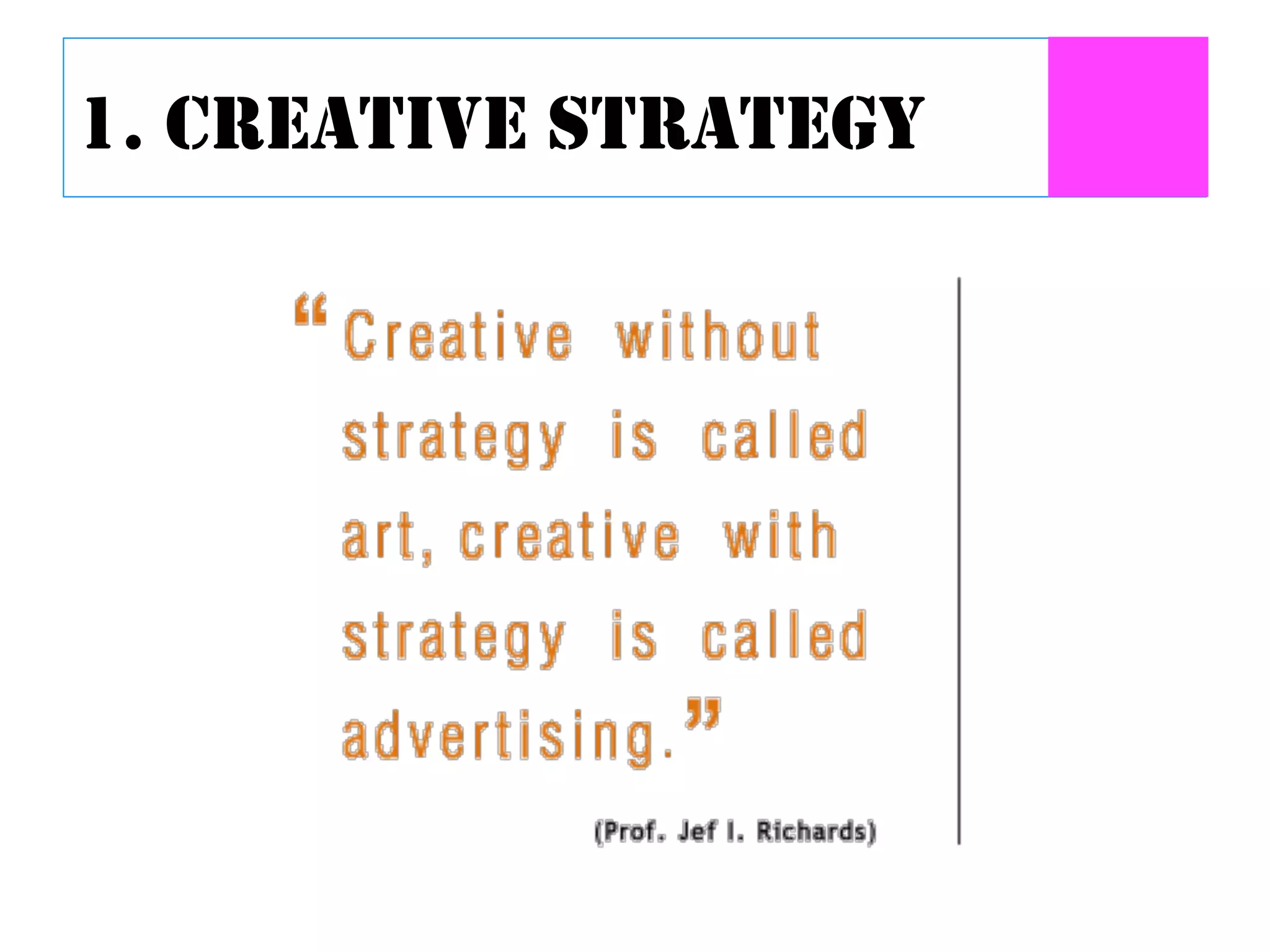
1. CREATIVE STRATEGY
1. CREATIVE STRATEGY 
• Creative strategy is an outline and the tone of 
the message to be communicated by an 
advertising campaign. It is the first step in 
developing the advertising plan which helps 
specify the advertising goals. 
• It must be very precise in terms of why the 
product or the service needs advertising 
(Problem Statement) and what the advertising 
campaign should achieve. (Design Solution)
1. CREATIVE STRATEGY 
Some possible goals of a creative strategy are: 
• To increase awareness of your product/service. 
• To attract new customers. 
• To increase the loyalty of existing customers. 
• To offer a deal or discount. 
• To generate immediate sales or sales leads.
1. CREATIVE STRATEGY 
While 
deciding 
the 
crea.ve 
strategy 
keep 
"AIDA" 
in 
mind: 
– a7ract 
A7en.on 
– hold 
Interest 
– arouse 
Desire 
– mo.vate 
Ac.on
1. CREATIVE STRATEGY 
Points to be included in the assessment task: 
– Repeat the problem statement in brief 
– Repeat the USP in brief 
– The creative approach 
– The goal of this approach/expected outcomes 
– Describe the AIDA
2. MEDIA STRATEGY
2. MEDIA STRATEGY 
• Media strategy is a plan for bringing advertising 
messages to the attention of consumers through the 
use of an appropriate media. There is a wide range 
of media technologies or mediums that are 
intended to reach a large audience. 
• There are definite inherent strengths and 
weaknesses associated with each medium. One 
must choose the type of media that best suits their 
audience and message.
2. MEDIA STRATEGY 
Some of the media technologies or mediums include: 
– Advertising in magazines 
– Advertising in national newspapers 
– Advertising on television 
– Poster advertising 
– Direct mail 
– Exhibitions 
– Merchandising and point of sale 
– Advertising through the Internet (website, banner, app) 
– Mobile Communications
ADVERTISING IN MAGAZINES
DIRECT MAIL
POINT OF SALE
POSTERS/HOARDINGS
EXHIBITIONS
AMBIENT MEDIA
INTERACTIVE MEDIA
TRANSPORTATION MEDIA
MOBILE COMMUNICATIONS
2. MEDIA STRATEGY 
Points to be included in the assessment task: 
– Media Objectives – goal 
– Media Selection – technology 
– Description of the technology selected (ex: name of magazine 
for magazine advertisement) 
– Explain how this media is appropriate for the target audience 
– Media Budget – indicative cost 
– Media Frequency – repetitions of media 
– Media Continuity – timing of media (ex: if you select magazine 
ad and exhibition then which will come first)
3. BUDGET
3. BUDGET 
• A budget is the money a company sets aside to pay for 
designing and advertising. It reflects the amount a client is 
willing to commit to achieve its advertising objectives. In order 
to utilize the budget to its fullest potential consider innovative 
ways to produce cost effective advertising. 
• Allotting the budget: 
– Name of the media option(s) 
– Description/specifications of the media option 
– Size, location etc. of the advertisement 
– Repetition of the advertisement and/or media option 
– Cost of each insertion and total amount
3. BUDGET 
Points to be included in the assessment task: 
– Name of the media option(s) 
– Description/specifications of the media option 
– Size, location etc. of the advertisement 
– Cost of each insertion and total amount 
– Cost of material – ex: paper for printing (if applicable) 
– Exhibition booth charges (if applicable) 
– Cost of photography (if required) 
– Designing charges 
– Miscellaneous expenses (such as transportation expense)
4. TIMELINE
4. TIMELINE 
• Timeline is the proposed schedule of the entire 
advertising campaign. It is useful to draft an initial time 
plan and provide it to everyone involved in the campaign. 
• The Gantt Chart is a graphic representation of a this plan 
that shows the sequence of tasks. For this assessment 
task you will prepare a timeline that indicates when and 
how you will proceed in the 11 weeks of this semester 
with this advertising campaign.
4. TIMELINE 
Points to be included in the assessment task: 
– What are your key targets and deadlines? 
– Who is going to be doing what? (if working in a group) 
– When do you need to launch the advertising campaign? 
(submission date – week 11) 
– When do you need to have it ready for review? 
(for critiques/comments/feedback/corrections – week 9) 
– What and when will you need any kind of extra resources? 
(such as images, info about magazines, tradeshows etc.) 
– When and where will you go to the printer to get estimate for printing? 
– When and how will you find out about online advertising charges? 
– When and how will you find out about events, tradeshows, exhibitions? 
– When and how will you identify legal and ethical constraints? 
– When and how will you monitor your progress?
4. TIMELINE 
This process will help to identify the following: 
– Lead times and key deadlines 
– Potential clashes between activities 
– Your likely resource needs 
– Roles and responsibilities for your team 
– Periods of peak activity when you might be trying to do too much 
with too little time 
– Will you have enough people/time to do everything in time? 
– Are you over-committing yourself/your team? 
– Can you physically do everything you want in the timescales 
– What extra resources might you need and when? 
– Where will they come from?
ASSESSMENT TASK 2 – PLANNING
ASSESSMENT TASK 2 
• In Assessment Task 2, you should determine the length, pace 
and format for the advertisement in accordance with the 
creative brief and the budget, size and position each element 
of the advertisement. A detailed plan of campaign and 
locations of their proposed advertisements should be 
included. You must specify media assets as required and 
identify legal and ethical constraints. 
• In this class, you may choose to design for print or the digital 
media or a combination of both for the advertising campaign. 
You are required to select a total of 3 advertising medias.
ASSESSMENT TASK 2 
• The assessment task will be submitted in the form of a 
presentation. 
• A checklist of the assessment task is also uploaded on the 
forum. Please use it to make sure that you are not missing 
any important points. Use it as a guideline not rule. Feel free 
to modify it to suit your product and purpose. 
§ Weight: 25% 
§ Due Date: At the end of Week 6
NEXT… 
§ Research and Analysis = Lecture 1 Task 1 
§ Planning = Lecture 2 Task 2 
§ Creation = Lecture 3 Part 1 Task 3A 
§ Prototyping = Lecture 3 Part 2 Task 3B 
§ Production = Lecture 3 Part 3 Task 3C

Planning an Advertising Campaign

  • 1.
    DESIGN FOR PRODUCTION SANGEETA JAIN
  • 2.
    WHAT IS ADVERTISING? Advertising is the means of providing the most persuasive possible selling message to the right prospects at the lowest possible cost. The most successful advertising is that which most effectively communicates with the customers.
  • 3.
    CLIENT PERSPECTIVE Advertisingis an investment made by the client that is intended to improve and expand their business. The return of this investment depends on the planning and thought that precede the actual expenditure. By first developing an effective advertising plan, we can increase the prospect of a positive return on the investment regardless of the amount of money spend.
  • 4.
    CONSUMER PERSPECTIVE Weall take in huge amounts of information every day. Before we leave home, we may talk with our families, receive emails, read newspaper, watch television, listen to the radio, go online or get a text or a WhatsApp message. Advertising is just one element of this mass of information, so it has to work very hard to compete for our attention. The key (for advertisers) is to ensure that the audience takes notice of your advertisement.
  • 5.
    DESIGNER PERSPECTIVE Communicationthrough advertising is by no means easy. To advertise a product or service effectively is a very serious matter and requires careful planning and preparation.
  • 6.
    LECTURE 2 –PLANNING AN ADVERTISING CAMPAIGN
  • 7.
    WHAT IS PLANNING? § Research and Analysis = defining the problem § Planning = seeking insight § Creation = choosing the best solution § Prototyping = communicating the solution § Production = selling the solution
  • 8.
    WHAT IS PLANNED? § Research and Analysis § Planning § Creative Strategy § Media Strategy § Budget § Timeline § Creation § Prototyping § Production
  • 9.
  • 10.
    1. CREATIVE STRATEGY • Creative strategy is an outline and the tone of the message to be communicated by an advertising campaign. It is the first step in developing the advertising plan which helps specify the advertising goals. • It must be very precise in terms of why the product or the service needs advertising (Problem Statement) and what the advertising campaign should achieve. (Design Solution)
  • 11.
    1. CREATIVE STRATEGY Some possible goals of a creative strategy are: • To increase awareness of your product/service. • To attract new customers. • To increase the loyalty of existing customers. • To offer a deal or discount. • To generate immediate sales or sales leads.
  • 12.
    1. CREATIVE STRATEGY While deciding the crea.ve strategy keep "AIDA" in mind: – a7ract A7en.on – hold Interest – arouse Desire – mo.vate Ac.on
  • 13.
    1. CREATIVE STRATEGY Points to be included in the assessment task: – Repeat the problem statement in brief – Repeat the USP in brief – The creative approach – The goal of this approach/expected outcomes – Describe the AIDA
  • 14.
  • 15.
    2. MEDIA STRATEGY • Media strategy is a plan for bringing advertising messages to the attention of consumers through the use of an appropriate media. There is a wide range of media technologies or mediums that are intended to reach a large audience. • There are definite inherent strengths and weaknesses associated with each medium. One must choose the type of media that best suits their audience and message.
  • 16.
    2. MEDIA STRATEGY Some of the media technologies or mediums include: – Advertising in magazines – Advertising in national newspapers – Advertising on television – Poster advertising – Direct mail – Exhibitions – Merchandising and point of sale – Advertising through the Internet (website, banner, app) – Mobile Communications
  • 17.
  • 18.
  • 19.
  • 20.
  • 21.
  • 22.
  • 23.
  • 24.
  • 25.
  • 26.
    2. MEDIA STRATEGY Points to be included in the assessment task: – Media Objectives – goal – Media Selection – technology – Description of the technology selected (ex: name of magazine for magazine advertisement) – Explain how this media is appropriate for the target audience – Media Budget – indicative cost – Media Frequency – repetitions of media – Media Continuity – timing of media (ex: if you select magazine ad and exhibition then which will come first)
  • 27.
  • 28.
    3. BUDGET •A budget is the money a company sets aside to pay for designing and advertising. It reflects the amount a client is willing to commit to achieve its advertising objectives. In order to utilize the budget to its fullest potential consider innovative ways to produce cost effective advertising. • Allotting the budget: – Name of the media option(s) – Description/specifications of the media option – Size, location etc. of the advertisement – Repetition of the advertisement and/or media option – Cost of each insertion and total amount
  • 29.
    3. BUDGET Pointsto be included in the assessment task: – Name of the media option(s) – Description/specifications of the media option – Size, location etc. of the advertisement – Cost of each insertion and total amount – Cost of material – ex: paper for printing (if applicable) – Exhibition booth charges (if applicable) – Cost of photography (if required) – Designing charges – Miscellaneous expenses (such as transportation expense)
  • 30.
  • 31.
    4. TIMELINE •Timeline is the proposed schedule of the entire advertising campaign. It is useful to draft an initial time plan and provide it to everyone involved in the campaign. • The Gantt Chart is a graphic representation of a this plan that shows the sequence of tasks. For this assessment task you will prepare a timeline that indicates when and how you will proceed in the 11 weeks of this semester with this advertising campaign.
  • 33.
    4. TIMELINE Pointsto be included in the assessment task: – What are your key targets and deadlines? – Who is going to be doing what? (if working in a group) – When do you need to launch the advertising campaign? (submission date – week 11) – When do you need to have it ready for review? (for critiques/comments/feedback/corrections – week 9) – What and when will you need any kind of extra resources? (such as images, info about magazines, tradeshows etc.) – When and where will you go to the printer to get estimate for printing? – When and how will you find out about online advertising charges? – When and how will you find out about events, tradeshows, exhibitions? – When and how will you identify legal and ethical constraints? – When and how will you monitor your progress?
  • 34.
    4. TIMELINE Thisprocess will help to identify the following: – Lead times and key deadlines – Potential clashes between activities – Your likely resource needs – Roles and responsibilities for your team – Periods of peak activity when you might be trying to do too much with too little time – Will you have enough people/time to do everything in time? – Are you over-committing yourself/your team? – Can you physically do everything you want in the timescales – What extra resources might you need and when? – Where will they come from?
  • 35.
    ASSESSMENT TASK 2– PLANNING
  • 36.
    ASSESSMENT TASK 2 • In Assessment Task 2, you should determine the length, pace and format for the advertisement in accordance with the creative brief and the budget, size and position each element of the advertisement. A detailed plan of campaign and locations of their proposed advertisements should be included. You must specify media assets as required and identify legal and ethical constraints. • In this class, you may choose to design for print or the digital media or a combination of both for the advertising campaign. You are required to select a total of 3 advertising medias.
  • 37.
    ASSESSMENT TASK 2 • The assessment task will be submitted in the form of a presentation. • A checklist of the assessment task is also uploaded on the forum. Please use it to make sure that you are not missing any important points. Use it as a guideline not rule. Feel free to modify it to suit your product and purpose. § Weight: 25% § Due Date: At the end of Week 6
  • 38.
    NEXT… § Researchand Analysis = Lecture 1 Task 1 § Planning = Lecture 2 Task 2 § Creation = Lecture 3 Part 1 Task 3A § Prototyping = Lecture 3 Part 2 Task 3B § Production = Lecture 3 Part 3 Task 3C