
AI3391
ARTIFICAL INTELLIGENE
B.TECH
II YEAR – III SEM (R18)
(2023-2024)
Prepared
By
Asst.Prof.M.Gokilavani
Department of Artificial Intelligence and Data Science
DEPARTMENT OF ARTIFICIAL INTLLIGENCE AND DATA SCIENCE
UNIT III GAME PLAYING AND CSP
Game theory-optimal decision in games-alpha beta Search-Monte Carlo tree search-stochastic games-
partially observed games. Constraint satisfaction problem-Constraint propagation-backtracking search for
CSP-Local search for CSP-structure of CSP.
INTRODUCTION TO GAME PLAYING AND CSP
Multiple Agent Environments:
• Search strategies - single agent that aims to find the solution which often expressed in
the form of a sequence of actions.
• More than one agent leads to game theory. (Multiple agent)
• The environment with more than one agent is termed as multi-agent environment, in which
each agent is an opponent of other agent and playing against each other.
• Each agent needs to consider the action of other agent and effect of that action on their
performance.
• Definition for Game: Searches in which two or more players with conflicting goals
are trying to explore the same search space for the solution are called adversarial
searches, often known as Games.
1. ADVERSARIAL SEARCH:
• Adversarial search is a game-playing technique where the agents are surrounded by a
competitive environment.
• A conflicting goal is given to the agents (multiagent).
• These agents compete with one another and try to defeat one another in order to win the
game.
• Such conflicting goals give rise to the adversarial search.
• Here, game-playing means discussing those games where human intelligence and logic
factor is used, excluding other factors such as luck factor.
• Tic-tac-toe, chess, checkers, etc., are such type of games where no luck factor works, only
mind works.
• Mathematically, this search is based on the concept of ‘Game Theory.’ According to game
theory, a game is played between two players. To complete the game, one has to win the
game and the other looses automatically.’
Factors in Game Theory:
Factors associated with the game theory are:
• Pruning: A technique which allows ignoring the unwanted portions of a search tree which
make no difference in its final result.
• Heuristic Evaluation Function: It allows approximating the cost value at each level of
the search tree, before reaching the goal node.
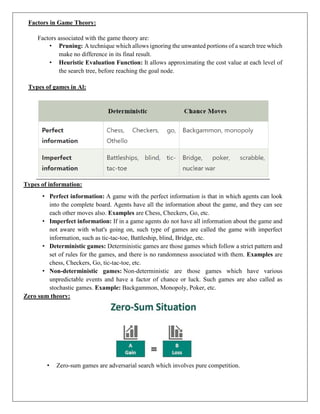
Types of games in Al:
Types of information:
• Perfect information: A game with the perfect information is that in which agents can look
into the complete board. Agents have all the information about the game, and they can see
each other moves also. Examples are Chess, Checkers, Go, etc.
• Imperfect information: If in a game agents do not have all information about the game and
not aware with what's going on, such type of games are called the game with imperfect
information, such as tic-tac-toe, Battleship, blind, Bridge, etc.
• Deterministic games: Deterministic games are those games which follow a strict pattern and
set of rules for the games, and there is no randomness associated with them. Examples are
chess, Checkers, Go, tic-tac-toe, etc.
• Non-deterministic games: Non-deterministic are those games which have various
unpredictable events and have a factor of chance or luck. Such games are also called as
stochastic games. Example: Backgammon, Monopoly, Poker, etc.
Zero sum theory:
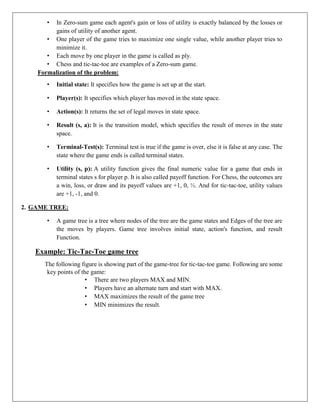
• Zero-sum games are adversarial search which involves pure competition.
• In Zero-sum game each agent's gain or loss of utility is exactly balanced by the losses or
gains of utility of another agent.
• One player of the game tries to maximize one single value, while another player tries to
minimize it.
• Each move by one player in the game is called as ply.
• Chess and tic-tac-toe are examples of a Zero-sum game.
Formalization of the problem:
• Initial state: It specifies how the game is set up at the start.
• Player(s): It specifies which player has moved in the state space.
• Action(s): It returns the set of legal moves in state space.
• Result (s, a): It is the transition model, which specifies the result of moves in the state
space.
• Terminal-Test(s): Terminal test is true if the game is over, else it is false at any case. The
state where the game ends is called terminal states.
• Utility (s, p): A utility function gives the final numeric value for a game that ends in
terminal states s for player p. It is also called payoff function. For Chess, the outcomes are
a win, loss, or draw and its payoff values are +1, 0, ½. And for tic-tac-toe, utility values
are +1, -1, and 0.
2. GAME TREE:
• A game tree is a tree where nodes of the tree are the game states and Edges of the tree are
the moves by players. Game tree involves initial state, action's function, and result
Function.
Example: Tic-Tac-Toe game tree
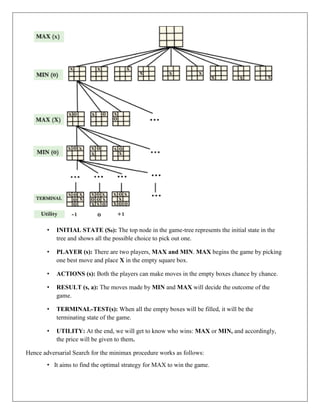
The following figure is showing part of the game-tree for tic-tac-toe game. Following are some
key points of the game:
• There are two players MAX and MIN.
• Players have an alternate turn and start with MAX.
• MAX maximizes the result of the game tree
• MIN minimizes the result.
• INITIAL STATE (S0): The top node in the game-tree represents the initial state in the
tree and shows all the possible choice to pick out one.
• PLAYER (s): There are two players, MAX and MIN. MAX begins the game by picking
one best move and place X in the empty square box.
• ACTIONS (s): Both the players can make moves in the empty boxes chance by chance.
• RESULT (s, a): The moves made by MIN and MAX will decide the outcome of the
game.
• TERMINAL-TEST(s): When all the empty boxes will be filled, it will be the
terminating state of the game.
• UTILITY: At the end, we will get to know who wins: MAX or MIN, and accordingly,
the price will be given to them.
Hence adversarial Search for the minimax procedure works as follows:
• It aims to find the optimal strategy for MAX to win the game.
• It follows the approach of Depth-first search.
• In the game tree, optimal leaf node could appear at any depth of the tree.
• Propagate the minimax values up to the tree until the terminal node discovered.
3. TYPES OF ALGORITHMS IN ADVERSARIAL SEARCH:
• Adversarial search is a game-playing technique where the agents are surrounded by a
competitive environment.
• It is also obvious that the solution for the goal state will be an optimal solution because the
player will try to win the game with the shortest path and under limited time.
• There are following types of adversarial search:
i. Min-max Algorithm
ii. Alpha-beta Pruning.
i. MIN-MAX ALGORITHM:
 In artificial intelligence, minimax is a decision-making strategy under game
theory, which is used to minimize the losing chances in a game and to maximize the
winning chances.
 This strategy is also known as ‘Min-max,’ ’MM,’ or ‘Saddle point.’
 Mini-max algorithm is a recursive or backtracking algorithm which is used in decision-
making and game theory. It provides an optimal move for the player assuming that
opponent is also playing optimally.
 Mini-Max algorithm uses recursion to search through the game-tree.
Example: Chess, Checkers, tic-tac-toe
 In this algorithm two players play the game; one is called MAX and other is called MIN.
 Both the players fight it as the opponent player gets the minimum benefit while they get
the maximum benefit.
o MIN: Decrease the chances of MAX to win the game.
o MAX: Increases his chances of winning the game.
 The minimax algorithm performs a depth-first search algorithm
for the exploration of the complete game tree.
 The minimax algorithm proceeds all the way down to the terminal
node of the tree, then backtrack the tree as the recursion.
Working of MIN-MAX Algorithm:
• MINIMAX algorithm is a backtracking algorithm where it backtracks to pick the best move
out of several choices.
• MINIMAX strategy follows the DFS (Depth-first search) concept.
• Here, we have two players MIN and MAX, and the game is played alternatively between
them, i.e., when MAX made a move, then the next turn is of MIN.
• It means the move made by MAX is fixed and, he cannot change it.
• The same concept is followed in DFS strategy, i.e., we follow the same path and cannot
change in the middle.
• That’s why in MINIMAX algorithm, instead of BFS, we follow DFS.
• Keep on generating the game tree/ search tree till a limit d.
• Compute the move using a heuristic function.
• Propagate the values from the leaf node till the current position following the minimax
strategy.
• Make the best move from the choices.
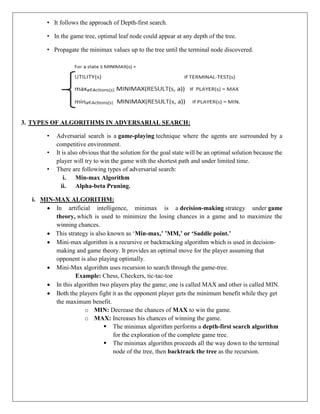
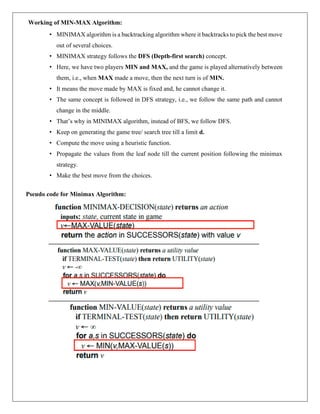
Pseudo code for Minimax Algorithm:
Step1:
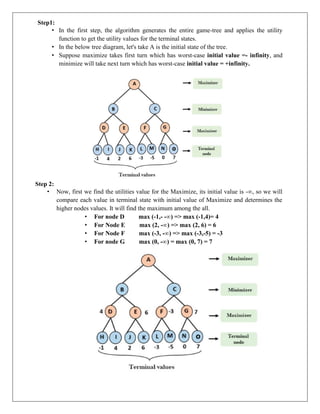
• In the first step, the algorithm generates the entire game-tree and applies the utility
function to get the utility values for the terminal states.
• In the below tree diagram, let's take A is the initial state of the tree.
• Suppose maximize takes first turn which has worst-case initial value =- infinity, and
minimize will take next turn which has worst-case initial value = +infinity.
Step 2:
• Now, first we find the utilities value for the Maximize, its initial value is -∞, so we will
compare each value in terminal state with initial value of Maximize and determines the
higher nodes values. It will find the maximum among the all.
• For node D max (-1,- -∞) => max (-1,4)= 4
• For Node E max (2, -∞) => max (2, 6) = 6
• For Node F max (-3, -∞) => max (-3,-5) = -3
• For node G max (0, -∞) = max (0, 7) = 7
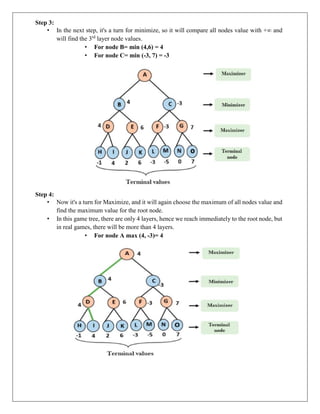
Step 3:
• In the next step, it's a turn for minimize, so it will compare all nodes value with +∞ and
will find the 3rd
layer node values.
• For node B= min (4,6) = 4
• For node C= min (-3, 7) = -3
Step 4:
• Now it's a turn for Maximize, and it will again choose the maximum of all nodes value and
find the maximum value for the root node.
• In this game tree, there are only 4 layers, hence we reach immediately to the root node, but
in real games, there will be more than 4 layers.
• For node A max (4, -3)= 4
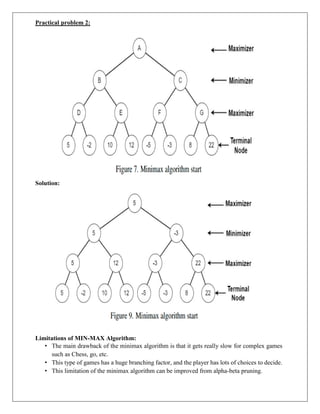
Practical problem 2:
Solution:
Limitations of MIN-MAX Algorithm:
• The main drawback of the minimax algorithm is that it gets really slow for complex games
such as Chess, go, etc.
• This type of games has a huge branching factor, and the player has lots of choices to decide.
• This limitation of the minimax algorithm can be improved from alpha-beta pruning.
ii. ALPHA –BETA PURNING:
 A modified variant of the minimax method is alpha-beta pruning. It's a way for improving the
minimax algorithm.
 As a result, there is a technique known as Pruning that allows us to compute the correct
minimax choice without having to inspect each node of the game tree.
 It's named alpha-beta pruning because it involves two threshold parameters, Alpha and beta,
for future expansion.
 Alpha-beta pruning can be done at any depth in a tree, and it can sometimes prune the entire
sub-tree as well as the tree leaves.
Conditions of Alpha-Beta Pruning:
The main condition which required for alpha-beta pruning is:
α>=β
Key points about Alpha-Beta Pruning:
 The Max player will only update the value of alpha.
 The Min player will only update the value of beta.
 While backtracking the tree, the node values will be passed to upper nodes instead of values
of alpha and beta.
 We will only pass the alpha, beta values to the child nodes.
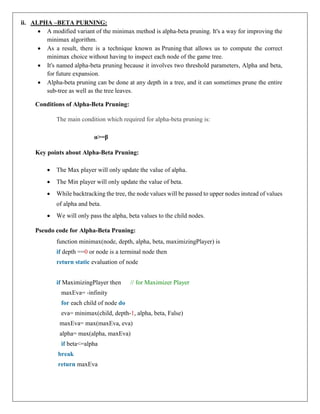
Pseudo code for Alpha-Beta Pruning:
function minimax(node, depth, alpha, beta, maximizingPlayer) is
if depth ==0 or node is a terminal node then
return static evaluation of node
if MaximizingPlayer then // for Maximizer Player
maxEva= -infinity
for each child of node do
eva= minimax(child, depth-1, alpha, beta, False)
maxEva= max(maxEva, eva)
alpha= max(alpha, maxEva)
if beta<=alpha
break
return maxEva
else // for Minimizer player
minEva= +infinity
for each child of node do
eva= minimax(child, depth-1, alpha, beta, true)
minEva= min(minEva, eva)
beta= min(beta, eva)
if beta<=alpha
break
return minEva
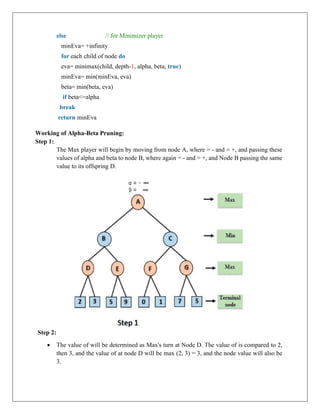
Working of Alpha-Beta Pruning:
Step 1:
The Max player will begin by moving from node A, where = - and = +, and passing these
values of alpha and beta to node B, where again = - and = +, and Node B passing the same
value to its offspring D.
Step 2:
 The value of will be determined as Max's turn at Node D. The value of is compared to 2,
then 3, and the value of at node D will be max (2, 3) = 3, and the node value will also be
3.
Step 3:
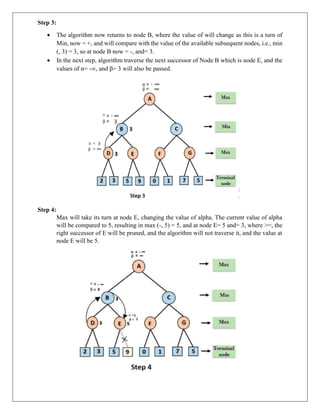
 The algorithm now returns to node B, where the value of will change as this is a turn of
Min, now = +, and will compare with the value of the available subsequent nodes, i.e., min
(, 3) = 3, so at node B now = -, and= 3.
 In the next step, algorithm traverse the next successor of Node B which is node E, and the
values of α= -∞, and β= 3 will also be passed.
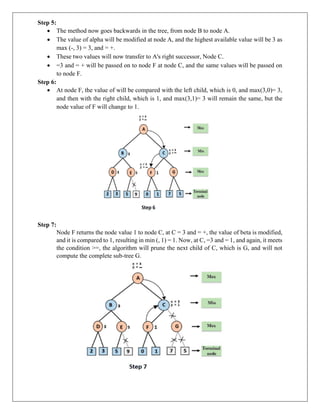
Step 4:
Max will take its turn at node E, changing the value of alpha. The current value of alpha
will be compared to 5, resulting in max (-, 5) = 5, and at node E= 5 and= 3, where >=, the
right successor of E will be pruned, and the algorithm will not traverse it, and the value at
node E will be 5.
Step 5:
 The method now goes backwards in the tree, from node B to node A.
 The value of alpha will be modified at node A, and the highest available value will be 3 as
max (-, 3) = 3, and = +.
 These two values will now transfer to A's right successor, Node C.
 =3 and = + will be passed on to node F at node C, and the same values will be passed on
to node F.
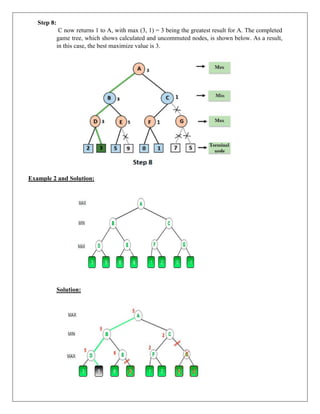
Step 6:
 At node F, the value of will be compared with the left child, which is 0, and max(3,0)= 3,
and then with the right child, which is 1, and max(3,1)= 3 will remain the same, but the
node value of F will change to 1.
Step 7:
Node F returns the node value 1 to node C, at C = 3 and = +, the value of beta is modified,
and it is compared to 1, resulting in min (, 1) = 1. Now, at C, =3 and = 1, and again, it meets
the condition >=, the algorithm will prune the next child of C, which is G, and will not
compute the complete sub-tree G.
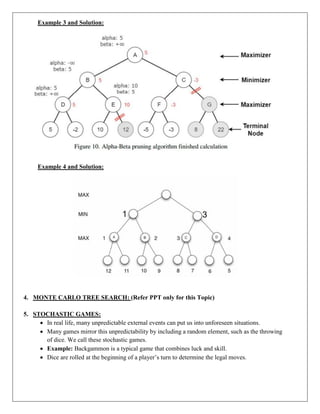
Step 8:
C now returns 1 to A, with max (3, 1) = 3 being the greatest result for A. The completed
game tree, which shows calculated and uncommuted nodes, is shown below. As a result,
in this case, the best maximize value is 3.
Example 2 and Solution:
Solution:
Example 3 and Solution:
Example 4 and Solution:
4. MONTE CARLO TREE SEARCH: (Refer PPT only for this Topic)
5. STOCHASTIC GAMES:
 In real life, many unpredictable external events can put us into unforeseen situations.
 Many games mirror this unpredictability by including a random element, such as the throwing
of dice. We call these stochastic games.
 Example: Backgammon is a typical game that combines luck and skill.
 Dice are rolled at the beginning of a player’s turn to determine the legal moves.
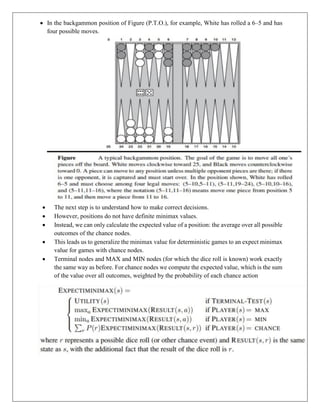
 In the backgammon position of Figure (P.T.O.), for example, White has rolled a 6–5 and has
four possible moves.
 The next step is to understand how to make correct decisions.
 However, positions do not have definite minimax values.
 Instead, we can only calculate the expected value of a position: the average over all possible
outcomes of the chance nodes.
 This leads us to generalize the minimax value for deterministic games to an expect minimax
value for games with chance nodes.
 Terminal nodes and MAX and MIN nodes (for which the dice roll is known) work exactly
the same way as before. For chance nodes we compute the expected value, which is the sum
of the value over all outcomes, weighted by the probability of each chance action
Monte Carlo simulation vs. Alpha Beta Pruning:
 An alternative is to find solution Monte Carlo simulation to evaluate a position.
 Start with MONTE CARLO SIMULATION an alpha–beta (or other) search algorithm.
 From a start position, have the algorithm play thousands of games against itself, using random
dice rolls.
 In the case of backgammon, the resulting win percentage has been shown to be a good
approximation of the value of the position, even if the algorithm has an imperfect heuristic and
is searching only a few plies ROLLOUT (Tesauro, 1995).
 For games with dice, this type of simulation is called a rollout.
6. PARTIALLY OBSERVED GAMES
 Partial observability means that an agent does not know the state of the world or that the agents
act simultaneously.
 Partial observability for the multiagent case is more complicated than the fully observable
multiagent case or the partially observable single-agent case.
 The following simple examples show some important issues that arise even in the case of two
agents, each with a few choices.
 A partially observable system is one in which the entire state of the system is not fully visible
to an external sensor.
 In a partially observable system the observer may utilize a memory system in order to add
information to the observer's understanding of the system.
 An example of a partially observable system would be a card game in which some of the cards
are discarded into a pile face down.
 In this case the observer is only able to view their own cards and potentially those of the dealer.
 They are not able to view the face-down (used) cards, nor the cards which will be dealt at some
stage in the future.
 A memory system can be used to remember the previously dealt cards that are now on the used
pile (large collection arranged one over other).
 This adds to the total sum of knowledge that the observer can use to make decisions.
 In contrast, a fully observable system would be that of chess. In chess (apart from the 'who is
moving next' state) the full state of the system is observable at any point in time.
 Partially observable is a term used in a variety of mathematical settings, including that of
Artificial Intelligence and Partially observable Markov decision processes.
 Chess has often been described as war in miniature, but it lacks at least one major characteristic
of real wars, namely, partial observability.
 In the “fog of war,” the existence and disposition of enemy units is often unknown until revealed
by direct contact.
 As a result, warfare includes the use of scouts and spies together information and the use of
concealment and bluff to confuse the enemy.
 Partially observable games share these characteristics and are thus qualitatively different from
other observable games.
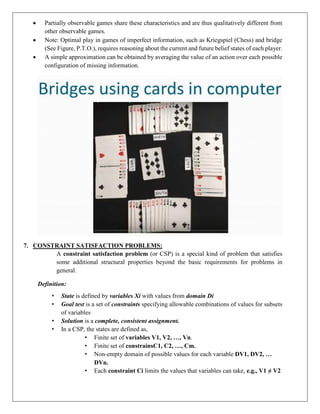
 Note: Optimal play in games of imperfect information, such as Kriegspiel (Chess) and bridge
(See Figure, P.T.O.), requires reasoning about the current and future belief states of each player.
 A simple approximation can be obtained by averaging the value of an action over each possible
configuration of missing information.
7. CONSTRAINT SATISFACTION PROBLEMS:
A constraint satisfaction problem (or CSP) is a special kind of problem that satisfies
some additional structural properties beyond the basic requirements for problems in
general.
Definition:
• State is defined by variables Xi with values from domain Di
• Goal test is a set of constraints specifying allowable combinations of values for subsets
of variables
• Solution is a complete, consistent assignment.
• In a CSP, the states are defined as,
• Finite set of variables V1, V2, …, Vn.
• Finite set of constrainsC1, C2, …, Cm.
• Non-empty domain of possible values for each variable DV1, DV2, …
DVn.
• Each constraint Ci limits the values that variables can take, e.g., V1 ≠ V2
CSP EXAMPLE:
GRAPH COLORING:
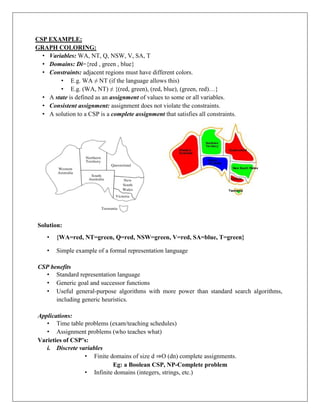
• Variables: WA, NT, Q, NSW, V, SA, T
• Domains: Di={red , green , blue}
• Constraints: adjacent regions must have different colors.
• E.g. WA ≠ NT (if the language allows this)
• E.g. (WA, NT) ≠ {(red, green), (red, blue), (green, red)…}
• A state is defined as an assignment of values to some or all variables.
• Consistent assignment: assignment does not violate the constraints.
• A solution to a CSP is a complete assignment that satisfies all constraints.
Solution:
• {WA=red, NT=green, Q=red, NSW=green, V=red, SA=blue, T=green}
• Simple example of a formal representation language
CSP benefits
• Standard representation language
• Generic goal and successor functions
• Useful general-purpose algorithms with more power than standard search algorithms,
including generic heuristics.
Applications:
• Time table problems (exam/teaching schedules)
• Assignment problems (who teaches what)
Varieties of CSP’s:
i. Discrete variables
• Finite domains of size d ⇒O (dn) complete assignments.
Eg: a Boolean CSP, NP-Complete problem
• Infinite domains (integers, strings, etc.)
Eg: job scheduling, variables are start/end days for each job
• Need a constraint language
Eg: StartJob1 +5 ≤ StartJob3.
• Linear constraints solvable, nonlinear undecidable.
ii. Continuous variables
• Linear constraints solvable in poly time by linear programming methods
(deal with in the field of operations research).
iii. Our focus: discrete variables and finite domains
iv. Unary constraints involve a single variable.
E.g. SA ≠ green
v. Binary constraints involve pairs of variables.
E.g. SA ≠ WA
vi. Global constraints involve an arbitrary number of variables.
Eg: Crypth-arithmetic column constraints.
• Preference (soft constraints) e.g. red is better than green often represent able
by a cost for each variable assignment; not considered here.
REAL WORLD CSP’s:
• Assignment problems
• E.g., who teaches what class
• Timetable problems
• E.g., which class is offered when and where?
• Transportation scheduling
• Factory scheduling
CSP as a standard search problem:
Incremental formulation:
• States: Variables and values assigned so far
• Initial state: The empty assignment
• Action: Choose any unassigned variable and assign to it a value that does not
violate any constraints
• Fail if no legal assignments
• Goal test: The current assignment is complete and satisfies all constraints.
• Same formulation for all CSPs!!!
• Solution is found at depth n (n variables).
• What search method would you choose?
• How can we reduce the branching factor?
Commutative:
• CSPs are commutative.
• The order of any given set of actions has no effect on the outcome.
• Example: choose colors for Australian territories one at a time
• [WA=red then NT=green] same as [NT=green then WA=red]
• All CSP search algorithms consider a single variable assignment at a time
⇒ there are dn leaves.
CRYPTARITHMETIC PROBLEM
• Cryptarithmetic Problem is a type of constraint satisfaction problem where the game is
about digits and its unique replacement either with alphabets or other symbols.
• In cryptarithmetic problem, the digits (0-9) get substituted by some possible alphabets or
symbols.
• The task in cryptarithmetic problem is to substitute each digit with an alphabet to get the
result arithmetically correct.
• We can perform all the arithmetic operations on a given cryptarithmetic problem.
Constraints for cryptarithmetic problem:
• Unique digit to be replaced with a unique alphabet (no repeated digits).
• The result should satisfy the predefined arithmetic rules, i.e., 2+2 =4
• Digits should be from 0-9 only.
• In addition operation only one carry forward.
• The problem can be solved from both sides, i.e., lefthand side (L.H.S), or right-hand side
(R.H.S)
Example 1: Given a cryptarithmetic problem, i.e., S E N D + M O R E = M O N E Y.
Step 1: Starting from the left hand side (L.H.S) , the terms are S and M. Assign a digit which
could give a satisfactory result. Let’s assign S->9 and M->1.
Hence, we get a satisfactory result by adding up the terms and got an assignment for O as O-
>0 as well.
Step 2: Now, move ahead to the next terms E and O to get N as its output.
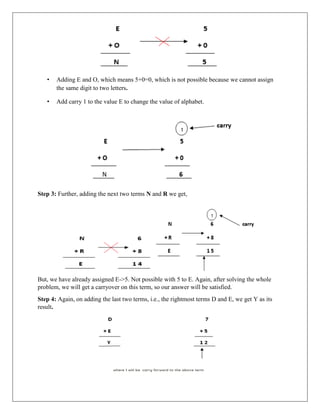
• Adding E and O, which means 5+0=0, which is not possible because we cannot assign
the same digit to two letters.
• Add carry 1 to the value E to change the value of alphabet.
Step 3: Further, adding the next two terms N and R we get,
But, we have already assigned E->5. Not possible with 5 to E. Again, after solving the whole
problem, we will get a carryover on this term, so our answer will be satisfied.
Step 4: Again, on adding the last two terms, i.e., the rightmost terms D and E, we get Y as its
result.
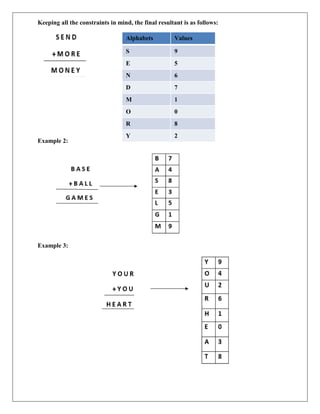
Keeping all the constraints in mind, the final resultant is as follows:
Example 2:
Example 3:
Alphabets Values
S 9
E 5
N 6
D 7
M 1
O 0
R 8
Y 2
8. CONSTRATIN PROPAGATION:
 In local state-spaces, the choice is only one, i.e., to search for a solution. But in CSP, we have
two choices either:
 We can search for a solution or
 We can perform a special type of inference called constraint propagation.
 Constraint propagation is a special type of inference which helps in reducing the legal
number of values for the variables.
 The idea behind constraint propagation is local consistency.
 In local consistency, variables are treated as nodes, and each binary constraint is treated as
an arc in the given problem.
There are following local consistencies which are discussed below:
1. Node Consistency: A single variable is said to be node consistent if all the values in the
variable’s domain satisfy the unary constraints on the variables.
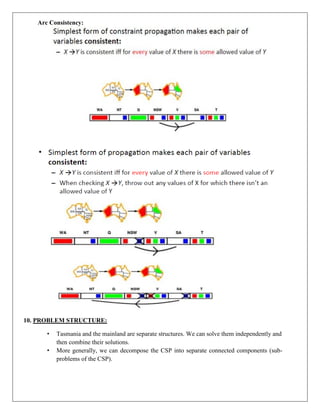
2. Arc Consistency: A variable is arc consistent if every value in its domain satisfies the binary
constraints of the variables.
3. Path Consistency: When the evaluation of a set of two variables with respect to a third
variable can be extended over another variable, satisfying all the binary constraints. It is similar
to arc consistency.
4. k-consistency: This type of consistency is used to define the notion of stronger forms of
propagation. Here, we examine the k-consistency of the variables.
9. BACKTRACKING CSP’s:
• In CSP’s, variable assignments are commutative
For example:
[WA = red then NT = green]
Is the same as?
[NT =green then WA = red]
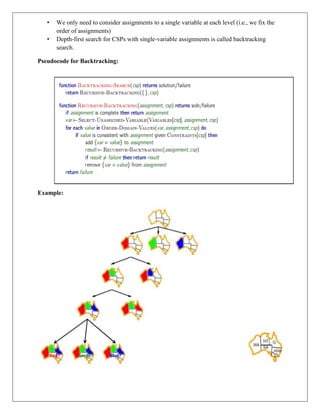
• We only need to consider assignments to a single variable at each level (i.e., we fix the
order of assignments)
• Depth-first search for CSPs with single-variable assignments is called backtracking
search.
Pseudocode for Backtracking:
Example:
Problem in ordering:
• Ordering
– How should we order variables for assignment?
– How should we order values from the domains?
Need Improving Backtracking Efficiency Ordering
Improving Backtracking Efficiency Ordering:
• Ordering
– How should we order variables for assignment? –
– How should we order values from the domains?
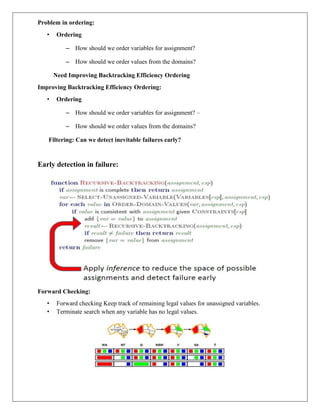
Filtering: Can we detect inevitable failures early?
Early detection in failure:
Forward Checking:
• Forward checking Keep track of remaining legal values for unassigned variables.
• Terminate search when any variable has no legal values.
Arc Consistency:
10. PROBLEM STRUCTURE:
• Tasmania and the mainland are separate structures. We can solve them independently and
then combine their solutions.
• More generally, we can decompose the CSP into separate connected components (sub-
problems of the CSP).
• Then the solution is the union of the sub- problem solutions. This can be much more
efficient than solving the entire CSP as one problem.
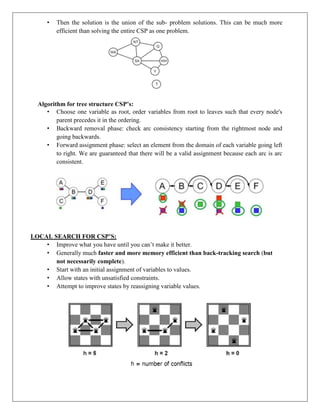
Algorithm for tree structure CSP’s:
• Choose one variable as root, order variables from root to leaves such that every node's
parent precedes it in the ordering.
• Backward removal phase: check arc consistency starting from the rightmost node and
going backwards.
• Forward assignment phase: select an element from the domain of each variable going left
to right. We are guaranteed that there will be a valid assignment because each arc is arc
consistent.
LOCAL SEARCH FOR CSP’S:
• Improve what you have until you can’t make it better.
• Generally much faster and more memory efficient than back-tracking search (but
not necessarily complete).
• Start with an initial assignment of variables to values.
• Allow states with unsatisfied constraints.
• Attempt to improve states by reassigning variable values.
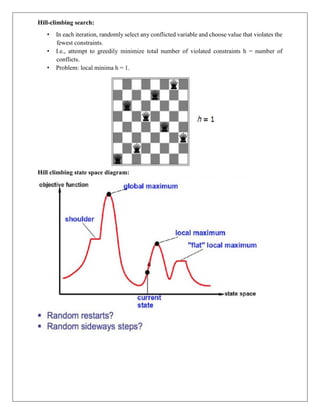
Hill-climbing search:
• In each iteration, randomly select any conflicted variable and choose value that violates the
fewest constraints.
• I.e., attempt to greedily minimize total number of violated constraints h = number of
conflicts.
• Problem: local minima h = 1.
Hill climbing state space diagram:

AI3391 Artificial Intelligence UNIT III Notes_merged.pdf

  • 1.
    AI3391 ARTIFICAL INTELLIGENE B.TECH II YEAR– III SEM (R18) (2023-2024) Prepared By Asst.Prof.M.Gokilavani Department of Artificial Intelligence and Data Science
  • 2.
    DEPARTMENT OF ARTIFICIALINTLLIGENCE AND DATA SCIENCE
  • 4.
    UNIT III GAMEPLAYING AND CSP Game theory-optimal decision in games-alpha beta Search-Monte Carlo tree search-stochastic games- partially observed games. Constraint satisfaction problem-Constraint propagation-backtracking search for CSP-Local search for CSP-structure of CSP. INTRODUCTION TO GAME PLAYING AND CSP Multiple Agent Environments: • Search strategies - single agent that aims to find the solution which often expressed in the form of a sequence of actions. • More than one agent leads to game theory. (Multiple agent) • The environment with more than one agent is termed as multi-agent environment, in which each agent is an opponent of other agent and playing against each other. • Each agent needs to consider the action of other agent and effect of that action on their performance. • Definition for Game: Searches in which two or more players with conflicting goals are trying to explore the same search space for the solution are called adversarial searches, often known as Games. 1. ADVERSARIAL SEARCH: • Adversarial search is a game-playing technique where the agents are surrounded by a competitive environment. • A conflicting goal is given to the agents (multiagent). • These agents compete with one another and try to defeat one another in order to win the game. • Such conflicting goals give rise to the adversarial search. • Here, game-playing means discussing those games where human intelligence and logic factor is used, excluding other factors such as luck factor. • Tic-tac-toe, chess, checkers, etc., are such type of games where no luck factor works, only mind works. • Mathematically, this search is based on the concept of ‘Game Theory.’ According to game theory, a game is played between two players. To complete the game, one has to win the game and the other looses automatically.’
  • 5.
    Factors in GameTheory: Factors associated with the game theory are: • Pruning: A technique which allows ignoring the unwanted portions of a search tree which make no difference in its final result. • Heuristic Evaluation Function: It allows approximating the cost value at each level of the search tree, before reaching the goal node. Types of games in Al: Types of information: • Perfect information: A game with the perfect information is that in which agents can look into the complete board. Agents have all the information about the game, and they can see each other moves also. Examples are Chess, Checkers, Go, etc. • Imperfect information: If in a game agents do not have all information about the game and not aware with what's going on, such type of games are called the game with imperfect information, such as tic-tac-toe, Battleship, blind, Bridge, etc. • Deterministic games: Deterministic games are those games which follow a strict pattern and set of rules for the games, and there is no randomness associated with them. Examples are chess, Checkers, Go, tic-tac-toe, etc. • Non-deterministic games: Non-deterministic are those games which have various unpredictable events and have a factor of chance or luck. Such games are also called as stochastic games. Example: Backgammon, Monopoly, Poker, etc. Zero sum theory: • Zero-sum games are adversarial search which involves pure competition.
  • 6.
    • In Zero-sumgame each agent's gain or loss of utility is exactly balanced by the losses or gains of utility of another agent. • One player of the game tries to maximize one single value, while another player tries to minimize it. • Each move by one player in the game is called as ply. • Chess and tic-tac-toe are examples of a Zero-sum game. Formalization of the problem: • Initial state: It specifies how the game is set up at the start. • Player(s): It specifies which player has moved in the state space. • Action(s): It returns the set of legal moves in state space. • Result (s, a): It is the transition model, which specifies the result of moves in the state space. • Terminal-Test(s): Terminal test is true if the game is over, else it is false at any case. The state where the game ends is called terminal states. • Utility (s, p): A utility function gives the final numeric value for a game that ends in terminal states s for player p. It is also called payoff function. For Chess, the outcomes are a win, loss, or draw and its payoff values are +1, 0, ½. And for tic-tac-toe, utility values are +1, -1, and 0. 2. GAME TREE: • A game tree is a tree where nodes of the tree are the game states and Edges of the tree are the moves by players. Game tree involves initial state, action's function, and result Function. Example: Tic-Tac-Toe game tree The following figure is showing part of the game-tree for tic-tac-toe game. Following are some key points of the game: • There are two players MAX and MIN. • Players have an alternate turn and start with MAX. • MAX maximizes the result of the game tree • MIN minimizes the result.
  • 7.
    • INITIAL STATE(S0): The top node in the game-tree represents the initial state in the tree and shows all the possible choice to pick out one. • PLAYER (s): There are two players, MAX and MIN. MAX begins the game by picking one best move and place X in the empty square box. • ACTIONS (s): Both the players can make moves in the empty boxes chance by chance. • RESULT (s, a): The moves made by MIN and MAX will decide the outcome of the game. • TERMINAL-TEST(s): When all the empty boxes will be filled, it will be the terminating state of the game. • UTILITY: At the end, we will get to know who wins: MAX or MIN, and accordingly, the price will be given to them. Hence adversarial Search for the minimax procedure works as follows: • It aims to find the optimal strategy for MAX to win the game.
  • 8.
    • It followsthe approach of Depth-first search. • In the game tree, optimal leaf node could appear at any depth of the tree. • Propagate the minimax values up to the tree until the terminal node discovered. 3. TYPES OF ALGORITHMS IN ADVERSARIAL SEARCH: • Adversarial search is a game-playing technique where the agents are surrounded by a competitive environment. • It is also obvious that the solution for the goal state will be an optimal solution because the player will try to win the game with the shortest path and under limited time. • There are following types of adversarial search: i. Min-max Algorithm ii. Alpha-beta Pruning. i. MIN-MAX ALGORITHM:  In artificial intelligence, minimax is a decision-making strategy under game theory, which is used to minimize the losing chances in a game and to maximize the winning chances.  This strategy is also known as ‘Min-max,’ ’MM,’ or ‘Saddle point.’  Mini-max algorithm is a recursive or backtracking algorithm which is used in decision- making and game theory. It provides an optimal move for the player assuming that opponent is also playing optimally.  Mini-Max algorithm uses recursion to search through the game-tree. Example: Chess, Checkers, tic-tac-toe  In this algorithm two players play the game; one is called MAX and other is called MIN.  Both the players fight it as the opponent player gets the minimum benefit while they get the maximum benefit. o MIN: Decrease the chances of MAX to win the game. o MAX: Increases his chances of winning the game.  The minimax algorithm performs a depth-first search algorithm for the exploration of the complete game tree.  The minimax algorithm proceeds all the way down to the terminal node of the tree, then backtrack the tree as the recursion.
  • 9.
    Working of MIN-MAXAlgorithm: • MINIMAX algorithm is a backtracking algorithm where it backtracks to pick the best move out of several choices. • MINIMAX strategy follows the DFS (Depth-first search) concept. • Here, we have two players MIN and MAX, and the game is played alternatively between them, i.e., when MAX made a move, then the next turn is of MIN. • It means the move made by MAX is fixed and, he cannot change it. • The same concept is followed in DFS strategy, i.e., we follow the same path and cannot change in the middle. • That’s why in MINIMAX algorithm, instead of BFS, we follow DFS. • Keep on generating the game tree/ search tree till a limit d. • Compute the move using a heuristic function. • Propagate the values from the leaf node till the current position following the minimax strategy. • Make the best move from the choices. Pseudo code for Minimax Algorithm:
  • 10.
    Step1: • In thefirst step, the algorithm generates the entire game-tree and applies the utility function to get the utility values for the terminal states. • In the below tree diagram, let's take A is the initial state of the tree. • Suppose maximize takes first turn which has worst-case initial value =- infinity, and minimize will take next turn which has worst-case initial value = +infinity. Step 2: • Now, first we find the utilities value for the Maximize, its initial value is -∞, so we will compare each value in terminal state with initial value of Maximize and determines the higher nodes values. It will find the maximum among the all. • For node D max (-1,- -∞) => max (-1,4)= 4 • For Node E max (2, -∞) => max (2, 6) = 6 • For Node F max (-3, -∞) => max (-3,-5) = -3 • For node G max (0, -∞) = max (0, 7) = 7
  • 11.
    Step 3: • Inthe next step, it's a turn for minimize, so it will compare all nodes value with +∞ and will find the 3rd layer node values. • For node B= min (4,6) = 4 • For node C= min (-3, 7) = -3 Step 4: • Now it's a turn for Maximize, and it will again choose the maximum of all nodes value and find the maximum value for the root node. • In this game tree, there are only 4 layers, hence we reach immediately to the root node, but in real games, there will be more than 4 layers. • For node A max (4, -3)= 4
  • 12.
    Practical problem 2: Solution: Limitationsof MIN-MAX Algorithm: • The main drawback of the minimax algorithm is that it gets really slow for complex games such as Chess, go, etc. • This type of games has a huge branching factor, and the player has lots of choices to decide. • This limitation of the minimax algorithm can be improved from alpha-beta pruning.
  • 13.
    ii. ALPHA –BETAPURNING:  A modified variant of the minimax method is alpha-beta pruning. It's a way for improving the minimax algorithm.  As a result, there is a technique known as Pruning that allows us to compute the correct minimax choice without having to inspect each node of the game tree.  It's named alpha-beta pruning because it involves two threshold parameters, Alpha and beta, for future expansion.  Alpha-beta pruning can be done at any depth in a tree, and it can sometimes prune the entire sub-tree as well as the tree leaves. Conditions of Alpha-Beta Pruning: The main condition which required for alpha-beta pruning is: α>=β Key points about Alpha-Beta Pruning:  The Max player will only update the value of alpha.  The Min player will only update the value of beta.  While backtracking the tree, the node values will be passed to upper nodes instead of values of alpha and beta.  We will only pass the alpha, beta values to the child nodes. Pseudo code for Alpha-Beta Pruning: function minimax(node, depth, alpha, beta, maximizingPlayer) is if depth ==0 or node is a terminal node then return static evaluation of node if MaximizingPlayer then // for Maximizer Player maxEva= -infinity for each child of node do eva= minimax(child, depth-1, alpha, beta, False) maxEva= max(maxEva, eva) alpha= max(alpha, maxEva) if beta<=alpha break return maxEva
  • 14.
    else // forMinimizer player minEva= +infinity for each child of node do eva= minimax(child, depth-1, alpha, beta, true) minEva= min(minEva, eva) beta= min(beta, eva) if beta<=alpha break return minEva Working of Alpha-Beta Pruning: Step 1: The Max player will begin by moving from node A, where = - and = +, and passing these values of alpha and beta to node B, where again = - and = +, and Node B passing the same value to its offspring D. Step 2:  The value of will be determined as Max's turn at Node D. The value of is compared to 2, then 3, and the value of at node D will be max (2, 3) = 3, and the node value will also be 3.
  • 15.
    Step 3:  Thealgorithm now returns to node B, where the value of will change as this is a turn of Min, now = +, and will compare with the value of the available subsequent nodes, i.e., min (, 3) = 3, so at node B now = -, and= 3.  In the next step, algorithm traverse the next successor of Node B which is node E, and the values of α= -∞, and β= 3 will also be passed. Step 4: Max will take its turn at node E, changing the value of alpha. The current value of alpha will be compared to 5, resulting in max (-, 5) = 5, and at node E= 5 and= 3, where >=, the right successor of E will be pruned, and the algorithm will not traverse it, and the value at node E will be 5.
  • 16.
    Step 5:  Themethod now goes backwards in the tree, from node B to node A.  The value of alpha will be modified at node A, and the highest available value will be 3 as max (-, 3) = 3, and = +.  These two values will now transfer to A's right successor, Node C.  =3 and = + will be passed on to node F at node C, and the same values will be passed on to node F. Step 6:  At node F, the value of will be compared with the left child, which is 0, and max(3,0)= 3, and then with the right child, which is 1, and max(3,1)= 3 will remain the same, but the node value of F will change to 1. Step 7: Node F returns the node value 1 to node C, at C = 3 and = +, the value of beta is modified, and it is compared to 1, resulting in min (, 1) = 1. Now, at C, =3 and = 1, and again, it meets the condition >=, the algorithm will prune the next child of C, which is G, and will not compute the complete sub-tree G.
  • 17.
    Step 8: C nowreturns 1 to A, with max (3, 1) = 3 being the greatest result for A. The completed game tree, which shows calculated and uncommuted nodes, is shown below. As a result, in this case, the best maximize value is 3. Example 2 and Solution: Solution:
  • 18.
    Example 3 andSolution: Example 4 and Solution: 4. MONTE CARLO TREE SEARCH: (Refer PPT only for this Topic) 5. STOCHASTIC GAMES:  In real life, many unpredictable external events can put us into unforeseen situations.  Many games mirror this unpredictability by including a random element, such as the throwing of dice. We call these stochastic games.  Example: Backgammon is a typical game that combines luck and skill.  Dice are rolled at the beginning of a player’s turn to determine the legal moves.
  • 19.
     In thebackgammon position of Figure (P.T.O.), for example, White has rolled a 6–5 and has four possible moves.  The next step is to understand how to make correct decisions.  However, positions do not have definite minimax values.  Instead, we can only calculate the expected value of a position: the average over all possible outcomes of the chance nodes.  This leads us to generalize the minimax value for deterministic games to an expect minimax value for games with chance nodes.  Terminal nodes and MAX and MIN nodes (for which the dice roll is known) work exactly the same way as before. For chance nodes we compute the expected value, which is the sum of the value over all outcomes, weighted by the probability of each chance action
  • 20.
    Monte Carlo simulationvs. Alpha Beta Pruning:  An alternative is to find solution Monte Carlo simulation to evaluate a position.  Start with MONTE CARLO SIMULATION an alpha–beta (or other) search algorithm.  From a start position, have the algorithm play thousands of games against itself, using random dice rolls.  In the case of backgammon, the resulting win percentage has been shown to be a good approximation of the value of the position, even if the algorithm has an imperfect heuristic and is searching only a few plies ROLLOUT (Tesauro, 1995).  For games with dice, this type of simulation is called a rollout. 6. PARTIALLY OBSERVED GAMES  Partial observability means that an agent does not know the state of the world or that the agents act simultaneously.  Partial observability for the multiagent case is more complicated than the fully observable multiagent case or the partially observable single-agent case.  The following simple examples show some important issues that arise even in the case of two agents, each with a few choices.  A partially observable system is one in which the entire state of the system is not fully visible to an external sensor.  In a partially observable system the observer may utilize a memory system in order to add information to the observer's understanding of the system.  An example of a partially observable system would be a card game in which some of the cards are discarded into a pile face down.  In this case the observer is only able to view their own cards and potentially those of the dealer.  They are not able to view the face-down (used) cards, nor the cards which will be dealt at some stage in the future.  A memory system can be used to remember the previously dealt cards that are now on the used pile (large collection arranged one over other).  This adds to the total sum of knowledge that the observer can use to make decisions.  In contrast, a fully observable system would be that of chess. In chess (apart from the 'who is moving next' state) the full state of the system is observable at any point in time.  Partially observable is a term used in a variety of mathematical settings, including that of Artificial Intelligence and Partially observable Markov decision processes.  Chess has often been described as war in miniature, but it lacks at least one major characteristic of real wars, namely, partial observability.  In the “fog of war,” the existence and disposition of enemy units is often unknown until revealed by direct contact.  As a result, warfare includes the use of scouts and spies together information and the use of concealment and bluff to confuse the enemy.
  • 21.
     Partially observablegames share these characteristics and are thus qualitatively different from other observable games.  Note: Optimal play in games of imperfect information, such as Kriegspiel (Chess) and bridge (See Figure, P.T.O.), requires reasoning about the current and future belief states of each player.  A simple approximation can be obtained by averaging the value of an action over each possible configuration of missing information. 7. CONSTRAINT SATISFACTION PROBLEMS: A constraint satisfaction problem (or CSP) is a special kind of problem that satisfies some additional structural properties beyond the basic requirements for problems in general. Definition: • State is defined by variables Xi with values from domain Di • Goal test is a set of constraints specifying allowable combinations of values for subsets of variables • Solution is a complete, consistent assignment. • In a CSP, the states are defined as, • Finite set of variables V1, V2, …, Vn. • Finite set of constrainsC1, C2, …, Cm. • Non-empty domain of possible values for each variable DV1, DV2, … DVn. • Each constraint Ci limits the values that variables can take, e.g., V1 ≠ V2
  • 22.
    CSP EXAMPLE: GRAPH COLORING: •Variables: WA, NT, Q, NSW, V, SA, T • Domains: Di={red , green , blue} • Constraints: adjacent regions must have different colors. • E.g. WA ≠ NT (if the language allows this) • E.g. (WA, NT) ≠ {(red, green), (red, blue), (green, red)…} • A state is defined as an assignment of values to some or all variables. • Consistent assignment: assignment does not violate the constraints. • A solution to a CSP is a complete assignment that satisfies all constraints. Solution: • {WA=red, NT=green, Q=red, NSW=green, V=red, SA=blue, T=green} • Simple example of a formal representation language CSP benefits • Standard representation language • Generic goal and successor functions • Useful general-purpose algorithms with more power than standard search algorithms, including generic heuristics. Applications: • Time table problems (exam/teaching schedules) • Assignment problems (who teaches what) Varieties of CSP’s: i. Discrete variables • Finite domains of size d ⇒O (dn) complete assignments. Eg: a Boolean CSP, NP-Complete problem • Infinite domains (integers, strings, etc.)
  • 23.
    Eg: job scheduling,variables are start/end days for each job • Need a constraint language Eg: StartJob1 +5 ≤ StartJob3. • Linear constraints solvable, nonlinear undecidable. ii. Continuous variables • Linear constraints solvable in poly time by linear programming methods (deal with in the field of operations research). iii. Our focus: discrete variables and finite domains iv. Unary constraints involve a single variable. E.g. SA ≠ green v. Binary constraints involve pairs of variables. E.g. SA ≠ WA vi. Global constraints involve an arbitrary number of variables. Eg: Crypth-arithmetic column constraints. • Preference (soft constraints) e.g. red is better than green often represent able by a cost for each variable assignment; not considered here. REAL WORLD CSP’s: • Assignment problems • E.g., who teaches what class • Timetable problems • E.g., which class is offered when and where? • Transportation scheduling • Factory scheduling CSP as a standard search problem: Incremental formulation: • States: Variables and values assigned so far • Initial state: The empty assignment • Action: Choose any unassigned variable and assign to it a value that does not violate any constraints • Fail if no legal assignments • Goal test: The current assignment is complete and satisfies all constraints. • Same formulation for all CSPs!!! • Solution is found at depth n (n variables). • What search method would you choose? • How can we reduce the branching factor? Commutative: • CSPs are commutative. • The order of any given set of actions has no effect on the outcome. • Example: choose colors for Australian territories one at a time • [WA=red then NT=green] same as [NT=green then WA=red] • All CSP search algorithms consider a single variable assignment at a time ⇒ there are dn leaves.
  • 24.
    CRYPTARITHMETIC PROBLEM • CryptarithmeticProblem is a type of constraint satisfaction problem where the game is about digits and its unique replacement either with alphabets or other symbols. • In cryptarithmetic problem, the digits (0-9) get substituted by some possible alphabets or symbols. • The task in cryptarithmetic problem is to substitute each digit with an alphabet to get the result arithmetically correct. • We can perform all the arithmetic operations on a given cryptarithmetic problem. Constraints for cryptarithmetic problem: • Unique digit to be replaced with a unique alphabet (no repeated digits). • The result should satisfy the predefined arithmetic rules, i.e., 2+2 =4 • Digits should be from 0-9 only. • In addition operation only one carry forward. • The problem can be solved from both sides, i.e., lefthand side (L.H.S), or right-hand side (R.H.S) Example 1: Given a cryptarithmetic problem, i.e., S E N D + M O R E = M O N E Y. Step 1: Starting from the left hand side (L.H.S) , the terms are S and M. Assign a digit which could give a satisfactory result. Let’s assign S->9 and M->1. Hence, we get a satisfactory result by adding up the terms and got an assignment for O as O- >0 as well. Step 2: Now, move ahead to the next terms E and O to get N as its output.
  • 25.
    • Adding Eand O, which means 5+0=0, which is not possible because we cannot assign the same digit to two letters. • Add carry 1 to the value E to change the value of alphabet. Step 3: Further, adding the next two terms N and R we get, But, we have already assigned E->5. Not possible with 5 to E. Again, after solving the whole problem, we will get a carryover on this term, so our answer will be satisfied. Step 4: Again, on adding the last two terms, i.e., the rightmost terms D and E, we get Y as its result.
  • 26.
    Keeping all theconstraints in mind, the final resultant is as follows: Example 2: Example 3: Alphabets Values S 9 E 5 N 6 D 7 M 1 O 0 R 8 Y 2
  • 27.
    8. CONSTRATIN PROPAGATION: In local state-spaces, the choice is only one, i.e., to search for a solution. But in CSP, we have two choices either:  We can search for a solution or  We can perform a special type of inference called constraint propagation.  Constraint propagation is a special type of inference which helps in reducing the legal number of values for the variables.  The idea behind constraint propagation is local consistency.  In local consistency, variables are treated as nodes, and each binary constraint is treated as an arc in the given problem. There are following local consistencies which are discussed below: 1. Node Consistency: A single variable is said to be node consistent if all the values in the variable’s domain satisfy the unary constraints on the variables. 2. Arc Consistency: A variable is arc consistent if every value in its domain satisfies the binary constraints of the variables. 3. Path Consistency: When the evaluation of a set of two variables with respect to a third variable can be extended over another variable, satisfying all the binary constraints. It is similar to arc consistency. 4. k-consistency: This type of consistency is used to define the notion of stronger forms of propagation. Here, we examine the k-consistency of the variables. 9. BACKTRACKING CSP’s: • In CSP’s, variable assignments are commutative For example: [WA = red then NT = green] Is the same as? [NT =green then WA = red]
  • 28.
    • We onlyneed to consider assignments to a single variable at each level (i.e., we fix the order of assignments) • Depth-first search for CSPs with single-variable assignments is called backtracking search. Pseudocode for Backtracking: Example:
  • 29.
    Problem in ordering: •Ordering – How should we order variables for assignment? – How should we order values from the domains? Need Improving Backtracking Efficiency Ordering Improving Backtracking Efficiency Ordering: • Ordering – How should we order variables for assignment? – – How should we order values from the domains? Filtering: Can we detect inevitable failures early? Early detection in failure: Forward Checking: • Forward checking Keep track of remaining legal values for unassigned variables. • Terminate search when any variable has no legal values.
  • 30.
    Arc Consistency: 10. PROBLEMSTRUCTURE: • Tasmania and the mainland are separate structures. We can solve them independently and then combine their solutions. • More generally, we can decompose the CSP into separate connected components (sub- problems of the CSP).
  • 31.
    • Then thesolution is the union of the sub- problem solutions. This can be much more efficient than solving the entire CSP as one problem. Algorithm for tree structure CSP’s: • Choose one variable as root, order variables from root to leaves such that every node's parent precedes it in the ordering. • Backward removal phase: check arc consistency starting from the rightmost node and going backwards. • Forward assignment phase: select an element from the domain of each variable going left to right. We are guaranteed that there will be a valid assignment because each arc is arc consistent. LOCAL SEARCH FOR CSP’S: • Improve what you have until you can’t make it better. • Generally much faster and more memory efficient than back-tracking search (but not necessarily complete). • Start with an initial assignment of variables to values. • Allow states with unsatisfied constraints. • Attempt to improve states by reassigning variable values.
  • 32.
    Hill-climbing search: • Ineach iteration, randomly select any conflicted variable and choose value that violates the fewest constraints. • I.e., attempt to greedily minimize total number of violated constraints h = number of conflicts. • Problem: local minima h = 1. Hill climbing state space diagram: