Introduction to
Grammar, continued…
ADVERBS
• Adverbs describe and modify or change other
words, just as adjectives do.
• HOWEVER, instead of describing things, they
describe actions & qualities.
• Adverbs qualify the meanings of verbs,
adjectives, and other adverbs.
• For example:
– How did the runner run?
– How deep was the snow?
– How well did the singer sing?
• Adverbs have the answers to all these questions!
Example
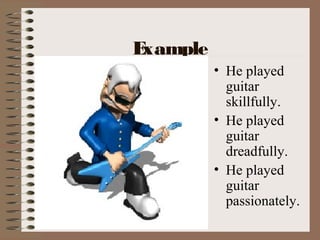
• He played
guitar
skillfully.
• He played
guitar
dreadfully.
• He played
guitar
passionately.
Features of Adverbs
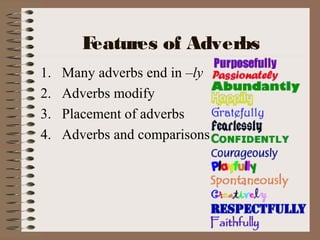
1. Many adverbs end in –ly
2. Adverbs modify
3. Placement of adverbs
4. Adverbs and comparisons
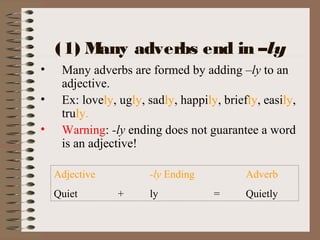
(1) Many adverbs end in –ly
• Many adverbs are formed by adding –ly to an
adjective.
• Ex: lovely, ugly, sadly, happily, briefly, easily,
truly.
• Warning: -ly ending does not guarantee a word
is an adjective!
Adjective -ly Ending Adverb
Quiet + ly = Quietly
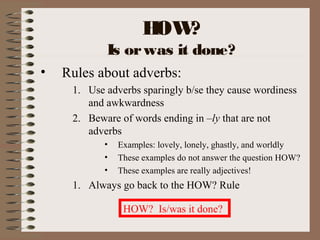
HOW?
Is orwas it done?
• Rules about adverbs:
1. Use adverbs sparingly b/se they cause wordiness
and awkwardness
2. Beware of words ending in –ly that are not
adverbs
• Examples: lovely, lonely, ghastly, and worldly
• These examples do not answer the question HOW?
• These examples are really adjectives!
1. Always go back to the HOW? Rule
HOW? Is/was it done?
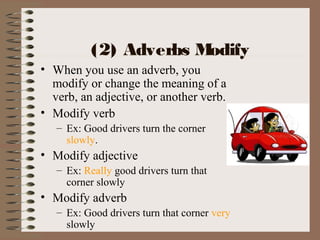
(2) Adverbs Modify
• When you use an adverb, you
modify or change the meaning of a
verb, an adjective, or another verb.
• Modify verb
– Ex: Good drivers turn the corner
slowly.
• Modify adjective
– Ex: Really good drivers turn that
corner slowly
• Modify adverb
– Ex: Good drivers turn that corner very
slowly
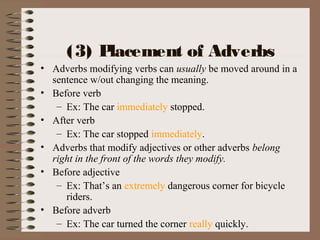
(3) Placement of Adverbs
• Adverbs modifying verbs can usually be moved around in a
sentence w/out changing the meaning.
• Before verb
– Ex: The car immediately stopped.
• After verb
– Ex: The car stopped immediately.
• Adverbs that modify adjectives or other adverbs belong
right in the front of the words they modify.
• Before adjective
– Ex: That’s an extremely dangerous corner for bicycle
riders.
• Before adverb
– Ex: The car turned the corner really quickly.
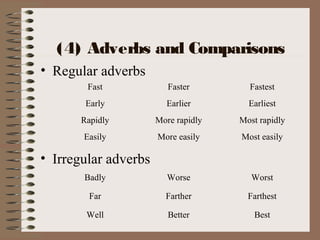
(4) Adverbs and Comparisons
• Regular adverbs
Fast Faster Fastest
Early Earlier Earliest
Rapidly More rapidly Most rapidly
Easily More easily Most easily
• Irregular adverbs
Badly Worse Worst
Far Farther Farthest
Well Better Best
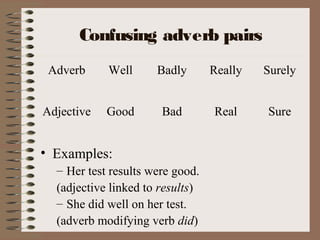
Confusing adverb pairs
• Examples:
– Her test results were good.
(adjective linked to results)
– She did well on her test.
(adverb modifying verb did)
Adverb Well Badly Really Surely
Adjective Good Bad Real Sure

Adverbs

  • 1.
  • 2.
    ADVERBS • Adverbs describeand modify or change other words, just as adjectives do. • HOWEVER, instead of describing things, they describe actions & qualities. • Adverbs qualify the meanings of verbs, adjectives, and other adverbs. • For example: – How did the runner run? – How deep was the snow? – How well did the singer sing? • Adverbs have the answers to all these questions!
  • 3.
    Example • He played guitar skillfully. •He played guitar dreadfully. • He played guitar passionately.
  • 4.
    Features of Adverbs 1.Many adverbs end in –ly 2. Adverbs modify 3. Placement of adverbs 4. Adverbs and comparisons
  • 5.
    (1) Many adverbsend in –ly • Many adverbs are formed by adding –ly to an adjective. • Ex: lovely, ugly, sadly, happily, briefly, easily, truly. • Warning: -ly ending does not guarantee a word is an adjective! Adjective -ly Ending Adverb Quiet + ly = Quietly
  • 6.
    HOW? Is orwas itdone? • Rules about adverbs: 1. Use adverbs sparingly b/se they cause wordiness and awkwardness 2. Beware of words ending in –ly that are not adverbs • Examples: lovely, lonely, ghastly, and worldly • These examples do not answer the question HOW? • These examples are really adjectives! 1. Always go back to the HOW? Rule HOW? Is/was it done?
  • 7.
    (2) Adverbs Modify •When you use an adverb, you modify or change the meaning of a verb, an adjective, or another verb. • Modify verb – Ex: Good drivers turn the corner slowly. • Modify adjective – Ex: Really good drivers turn that corner slowly • Modify adverb – Ex: Good drivers turn that corner very slowly
  • 8.
    (3) Placement ofAdverbs • Adverbs modifying verbs can usually be moved around in a sentence w/out changing the meaning. • Before verb – Ex: The car immediately stopped. • After verb – Ex: The car stopped immediately. • Adverbs that modify adjectives or other adverbs belong right in the front of the words they modify. • Before adjective – Ex: That’s an extremely dangerous corner for bicycle riders. • Before adverb – Ex: The car turned the corner really quickly.
  • 9.
    (4) Adverbs andComparisons • Regular adverbs Fast Faster Fastest Early Earlier Earliest Rapidly More rapidly Most rapidly Easily More easily Most easily • Irregular adverbs Badly Worse Worst Far Farther Farthest Well Better Best
  • 10.
    Confusing adverb pairs •Examples: – Her test results were good. (adjective linked to results) – She did well on her test. (adverb modifying verb did) Adverb Well Badly Really Surely Adjective Good Bad Real Sure