Adverb
• Adverbs are an important part of speech.
They usually answer questions such a show?
where? when? how often? and how much?
What is an Adverb?
• adverb (noun): a word that modifies a verb, an
adjective or another adverb, expressing manner, place,
time or degree; a word that can modify a phrase,
clause or sentence
• An adverb is a word that tells us more about a verb. It
"qualifies" or "modifies" averb (The man ran quickly).
In the following examples, the adverb is in bold and
the verb that it modifies is in italics.
• John speaks loudly. (How does John speak?)
• Afterwards she smoked a cigarette. (When did she
smoke?)
• Mary lives locally. (Where does Mary live?)
• But adverbs can also modify adjectives (Tara
is really beautiful), or even otheradverbs (It
works very well). Look at these examples:
• Modify an adjective:
- He is really handsome. (How handsome is he?)
- That was extremely kind of you.
• Modify another adverb:
- She drives incredibly slowly. (How slowly does she drive?)
- He drives extremely fast.
• Note that adverbs have other functions, too. They can:
• Modify a whole sentence: Obviously, I can't know
everything.
• Modify a prepositional phrase: It's immediately inside the
door.
Adverb Form
• There are some basic rules about spelling for -ly
adverbs. See the table below:
adjective
ending do this adjective adverb
most
adjectives
add -ly quick
nice
sole
careful
quickly
nicely
solely
carefully
-able or -
ible
change -e to -y regrettable
horrible
regrettably
horribly
-y change -y to -ily happy happily
-ic change -ic to -ically economic economically
• We make many adverbs by adding -ly to an
adjective, for example:
• quick (adjective) > quickly (adverb)
• careful (adjective) > carefully (adverb)
• beautiful (adjective) > beautifully (adverb)
• But not all words that end in -ly are adverbs. The
following -ly words, for example, are all
adjectives:
• friendly, lovely, lonely, neighbourly
• And some adverbs have no particular form. Look
at these examples:
• well, fast, very, never, always, often, still
Kinds of Adverbs
• Adverbs of Manner
• Adverbs of Place
• Adverbs of Time
• Adverbs of Degree
Adverbs of Manner
• Adverbs of Manner tell us the manner or way in which
something happens. They answer the question "how?".
Adverbs of Manner mainly modify verbs.
• He speaks slowly. (How does he speak?)
• They helped us cheerfully. (How did they help us?)
• James Bond drives his cars fast. (How does James Bond
drive his cars?)
• We normally use Adverbs of Manner with dynamic
(action) verbs, not with stative or state verbs.
• He ran fast. She came quickly. They worked happily.
• She looked beautifully. It seems strangely. They are happily.
Adverbs of Place
• Adverbs of Place tell us the place where
something happens. They answer the
question "where?". Adverbs of Place mainly
modify verbs.
• Please sit here. (Where should I sit?)
• They looked everywhere. (Where did they
look?)
• Two cars were parked outside. (Where were
two cars parked?)
Adverbs of Time
• Adverbs of Time tell us something about the time that
something happens. Adverbs of Time mainly modify verbs.
• They can answer the question "when?":
• He came yesterday. (When did he come?)
• I want it now. (When do I want it?)
• Or they can answer the question "how often?" (frequency):
• They deliver the newspaper daily. (How often do they
deliver the newspaper?)
• We sometimes watch a movie. (How often do we watch a
movie?)
Adverbs of Degree
• Adverbs of Degree tell us the degree or extent to which
something happens. They answer the question "how
much?" or "to what degree?". Adverbs of Degree can
modify verbs, adjectives and other adverbs.
• She entirely agrees with him. (How much does she
agree with him?)
• Mary is very beautiful. (To what degree is Mary
beautiful? How beautiful is Mary?)
• He drove quite dangerously. (To what degree did he
drive dangerously? How dangerously did he drive?)
Adverb Position
• When an adverb modifies a verb, there are usually 3 possible positions
within the sentence or clause:
1. FRONT - before
subject
Now I will read a
book.
2. MID - between
subject + verb
I often read books.
3. END - after
verb/object
I read books carefully.
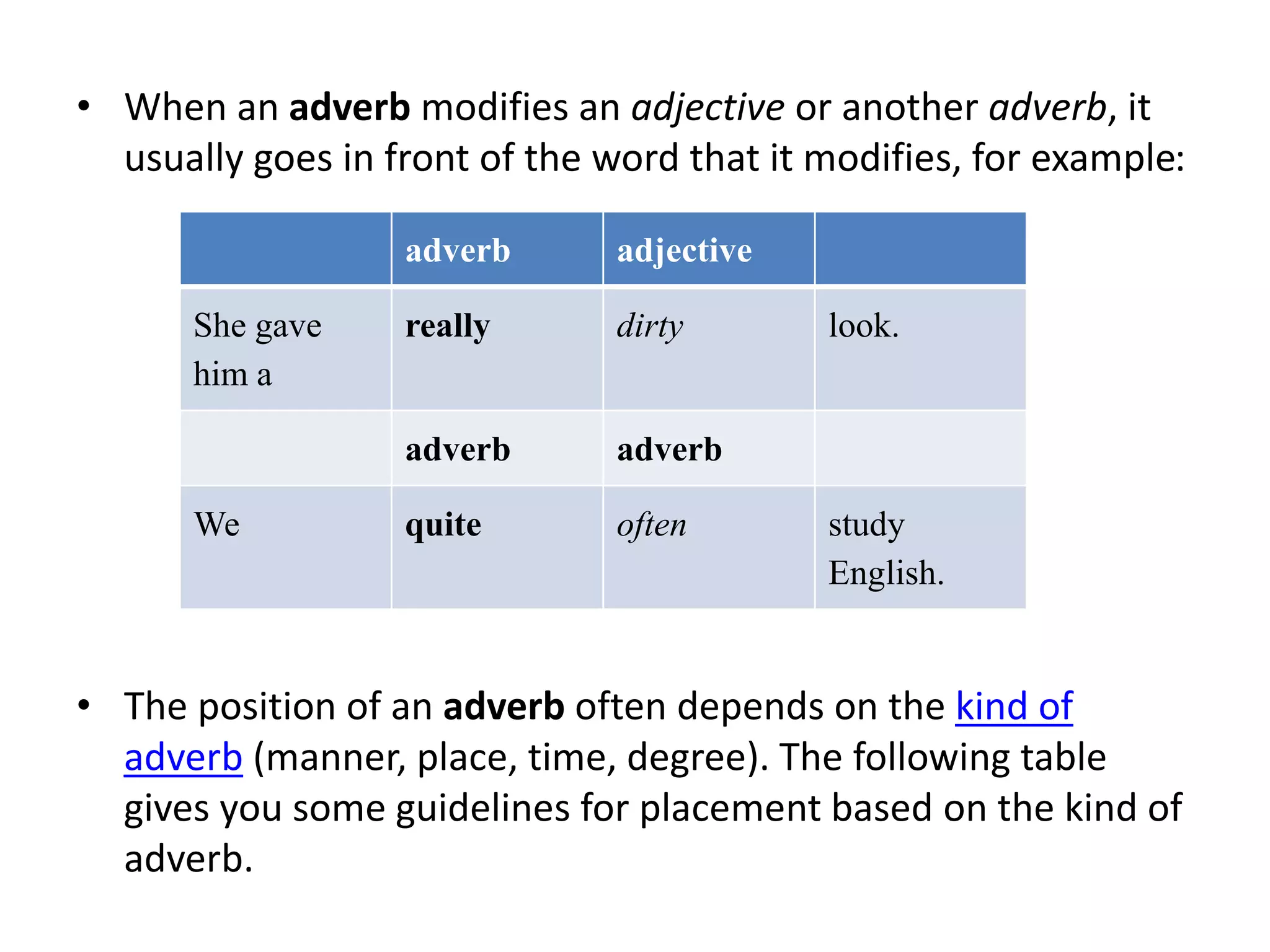
• When an adverb modifies an adjective or another adverb, it
usually goes in front of the word that it modifies, for example:
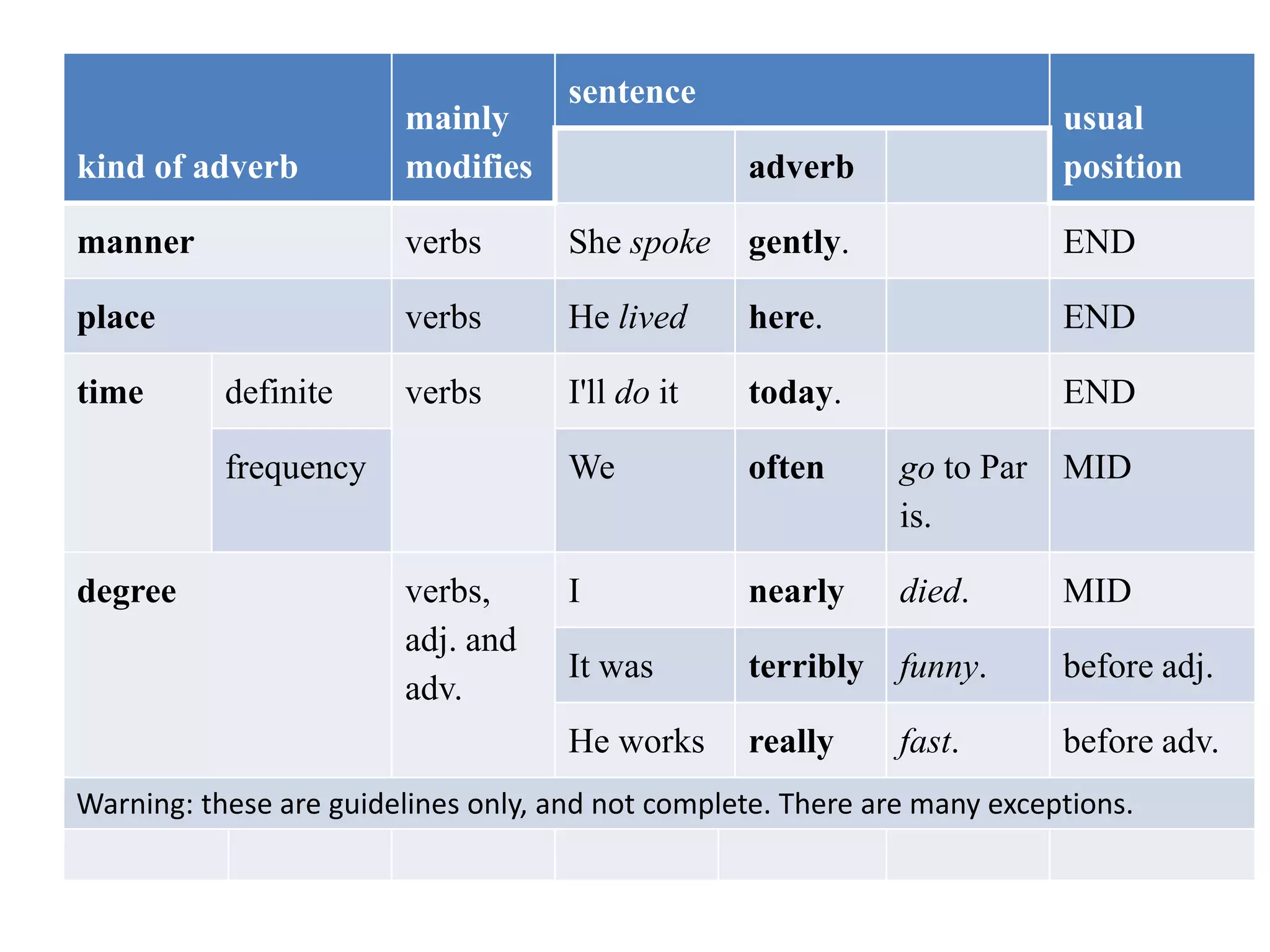
• The position of an adverb often depends on the kind of
adverb (manner, place, time, degree). The following table
gives you some guidelines for placement based on the kind of
adverb.
adverb adjective
She gave
him a
really dirty look.
adverb adverb
We quite often study
English.
kind of adverb
mainly
modifies
sentence
usual
positionadverb
manner verbs She spoke gently. END
place verbs He lived here. END
time definite verbs I'll do it today. END
frequency We often go to Par
is.
MID
degree verbs,
adj. and
adv.
I nearly died. MID
It was terribly funny. before adj.
He works really fast. before adv.
Warning: these are guidelines only, and not complete. There are many exceptions.

Adverb from Parts of Speech

  • 1.
    Adverb • Adverbs arean important part of speech. They usually answer questions such a show? where? when? how often? and how much?
  • 2.
    What is anAdverb? • adverb (noun): a word that modifies a verb, an adjective or another adverb, expressing manner, place, time or degree; a word that can modify a phrase, clause or sentence • An adverb is a word that tells us more about a verb. It "qualifies" or "modifies" averb (The man ran quickly). In the following examples, the adverb is in bold and the verb that it modifies is in italics. • John speaks loudly. (How does John speak?) • Afterwards she smoked a cigarette. (When did she smoke?) • Mary lives locally. (Where does Mary live?)
  • 3.
    • But adverbscan also modify adjectives (Tara is really beautiful), or even otheradverbs (It works very well). Look at these examples: • Modify an adjective: - He is really handsome. (How handsome is he?) - That was extremely kind of you. • Modify another adverb: - She drives incredibly slowly. (How slowly does she drive?) - He drives extremely fast. • Note that adverbs have other functions, too. They can: • Modify a whole sentence: Obviously, I can't know everything. • Modify a prepositional phrase: It's immediately inside the door.
  • 4.
    Adverb Form • Thereare some basic rules about spelling for -ly adverbs. See the table below: adjective ending do this adjective adverb most adjectives add -ly quick nice sole careful quickly nicely solely carefully -able or - ible change -e to -y regrettable horrible regrettably horribly -y change -y to -ily happy happily -ic change -ic to -ically economic economically
  • 5.
    • We makemany adverbs by adding -ly to an adjective, for example: • quick (adjective) > quickly (adverb) • careful (adjective) > carefully (adverb) • beautiful (adjective) > beautifully (adverb) • But not all words that end in -ly are adverbs. The following -ly words, for example, are all adjectives: • friendly, lovely, lonely, neighbourly • And some adverbs have no particular form. Look at these examples: • well, fast, very, never, always, often, still
  • 6.
    Kinds of Adverbs •Adverbs of Manner • Adverbs of Place • Adverbs of Time • Adverbs of Degree
  • 7.
    Adverbs of Manner •Adverbs of Manner tell us the manner or way in which something happens. They answer the question "how?". Adverbs of Manner mainly modify verbs. • He speaks slowly. (How does he speak?) • They helped us cheerfully. (How did they help us?) • James Bond drives his cars fast. (How does James Bond drive his cars?) • We normally use Adverbs of Manner with dynamic (action) verbs, not with stative or state verbs. • He ran fast. She came quickly. They worked happily. • She looked beautifully. It seems strangely. They are happily.
  • 8.
    Adverbs of Place •Adverbs of Place tell us the place where something happens. They answer the question "where?". Adverbs of Place mainly modify verbs. • Please sit here. (Where should I sit?) • They looked everywhere. (Where did they look?) • Two cars were parked outside. (Where were two cars parked?)
  • 9.
    Adverbs of Time •Adverbs of Time tell us something about the time that something happens. Adverbs of Time mainly modify verbs. • They can answer the question "when?": • He came yesterday. (When did he come?) • I want it now. (When do I want it?) • Or they can answer the question "how often?" (frequency): • They deliver the newspaper daily. (How often do they deliver the newspaper?) • We sometimes watch a movie. (How often do we watch a movie?)
  • 10.
    Adverbs of Degree •Adverbs of Degree tell us the degree or extent to which something happens. They answer the question "how much?" or "to what degree?". Adverbs of Degree can modify verbs, adjectives and other adverbs. • She entirely agrees with him. (How much does she agree with him?) • Mary is very beautiful. (To what degree is Mary beautiful? How beautiful is Mary?) • He drove quite dangerously. (To what degree did he drive dangerously? How dangerously did he drive?)
  • 11.
    Adverb Position • Whenan adverb modifies a verb, there are usually 3 possible positions within the sentence or clause: 1. FRONT - before subject Now I will read a book. 2. MID - between subject + verb I often read books. 3. END - after verb/object I read books carefully.
  • 12.
    • When anadverb modifies an adjective or another adverb, it usually goes in front of the word that it modifies, for example: • The position of an adverb often depends on the kind of adverb (manner, place, time, degree). The following table gives you some guidelines for placement based on the kind of adverb. adverb adjective She gave him a really dirty look. adverb adverb We quite often study English.
  • 13.
    kind of adverb mainly modifies sentence usual positionadverb mannerverbs She spoke gently. END place verbs He lived here. END time definite verbs I'll do it today. END frequency We often go to Par is. MID degree verbs, adj. and adv. I nearly died. MID It was terribly funny. before adj. He works really fast. before adv. Warning: these are guidelines only, and not complete. There are many exceptions.